Showing posts with label Vietnam War. Show all posts

07 January 2014

Alan Wieder : Bill Ayers' 'Public Enemy: Confessions of an American Dissident'

This page has moved.

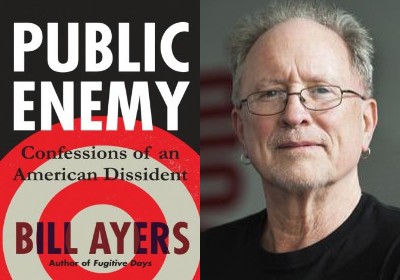
In his ongoing journey, and with his new memoir, 'Public Enemy,' Bill Ayers continues to bring the radical 'spark' forward.
public_enemy and ayers
Image from Uprising Radio.

By Alan Wieder | The Rag Blog | January 7, 2014
Bill Ayers and Bernardine Dohrn will speak at "Underground Goes Overboard," a launch party for TheRagBlog.com, at 7 p.m., Friday, January 17, at the 5604 Manor Community Center in Austin. They will also be Thorne Dreyer's guests on Rag Radio earlier that same day, from 2-3 p.m. on KOOP 91.7-FM in Austin and streamed live. Go here for other stations and times, and for podcast information.
[Public Enemy: Confessions of an American Dissident by Bill Ayers (2013: Beacon Press); Hardcover; 240 pp; $24.95.]

“They just don’t get it.” Yes, the phrase is overused, yet, all too appropriate when addressing the continuing critiques, from both the left and the right, of Bill Ayers.

The recent publication of the second phase of his memoir, Public Enemy: Confessions of An American Dissident (Beacon, 2013), was followed on the “SDS and ‘60s Leftists” page of Facebook by an unthoughtful conversation on Ayers, his comrade and wife Bernardine Dohrn, and the Weather Underground (WO).

Facilitated by George Fish and responding to a negative book review by Jon Wiener, 43 comments followed Fish’s post. Mostly sour, bitter, and ahistorical in tone, the comments provide the antithesis of Ayers’ book and life, that of learning from the past and continuing, in a human and life-affirming way, the ongoing struggle that began for Ayers in the civil rights movement, antiwar movement, Students for a Democratic Society, and then the Weather Underground.

When confronted by a radio interviewer who referred to the subtitle as snide, Ayers softly replied that the entire title was chosen for its irony. Missing both the breadth and depth of Public Enemy, the interviewer, as well as Wiener and other critics, fail to acknowledge the thoughtfulness and energy that Ayers brings to struggle, both past and present.

In this particular book, we alternate between the author’s recollections of first, his experience in the 2008 attempt to demonize Barack Obama because he “palled around with terrorists,” and, second, the years after he surfaced from underground beginning in 1980 from where Ayers left off in his previous book, Fugitive Days.

There are both multiple and complex events, issues, and ideas presented in Public Enemy. A sampling will be discussed in this review.

Recently, South African anti-apartheid struggle leader and Constitutional Court Justice (comparable to the U.S. Supreme Court) Albie Sachs spoke at Pacific University in Forest Grove, Oregon. Talking about his country’s Truth and Reconciliation Commission (TRC), Sachs emphasized the importance of acknowledgement for both personal and political healing.

Acknowledgement causes me to return to the radio interviewer’s portrayal of Confessions of An American Dissident as snide. In fact, irony aside, Ayers responded by talking about acknowledging one particular flaw during his time in WO. He asserted that neither he nor his comrades ever doubted their positions and that by not being skeptical they were arrogant and without reflection.
Doubt is discussed in Public Enemy and Ayers also talks about apologetics within a conceptual framework of an American Truth Commission.
Doubt is discussed in Public Enemy and Ayers also talks about apologetics within a conceptual framework of an American Truth Commission. In both the book and current media interviews, Ayers has continually repeated that neither he nor the WO ever killed anyone in the bombings of buildings.
Not only did I never kill or injure anyone, but in the six years of its existence, the Weather Underground never killed or injured anyone either. We crossed lines of legality to be sure, of propriety, and perhaps even of common sense, but it was restrained, and those are the simple, straightforward facts.
The correct term for Weather Underground bombings, in correspondence to the armed struggle in South Africa, is “armed propaganda.” And like Umkhonto We Sizwe underground soldiers in South Africa, Ayers would welcome the opportunity to answer queries about his WO activities at an American TRC.

In Public Enemy Ayers writes:
America, it seemed to me, was in urgent need of some kind of truth and reconciliation process… We needed a process to understand the truth of the past in order to create the possibility of a more balanced future… Everyone together would have the opportunity to tell their stories of suffering, and the victimizers would be asked why and how they created that misery. Society would have the opportunity to witness all of it in order to understand the extent and depth of the disaster as a step toward putting it behind us and moving forward. In that setting and standing with Kissinger and McCain, McNamara and Kerry, Bush and Cheney, I’d be happy to say exactly what I did, take full responsibility, and bow deeply. But without any chain of culpability whatsoever, I’ll stand on the record, or just stand aside.
While five chapters in Public Enemy present the threats and blacklisting Bill Ayers experienced during and after the 2008 presidential campaign, I will address the topic with brevity as it has already been explored in other reviews. An in-depth description and analysis is portrayed in Maya Schwenwar’s Truthout review, “Bill Ayers Weighs in on Democracy, Selfhood, and His ‘Unrepentant Terrorist’ Alter-Ego.”

Besides endless email threats and having someone actually come to his office at the University of Illinois-Chicago, Ayers was banned from talking on college campuses throughout the country. At the time my colleague at the University of South Carolina, Craig Kridel, the Curator of the Museum of Education, posted a page titled “The Bill Ayers Problem” on the Museum webpage. The page title, like Public Enemy, is ironic and at the time I wrote:
The inequality, unfairness, violence, and global greed are what Bill Ayers has fought against for many years. The fight is every bit as important today as it was during the Civil Rights Movement and the Viet Nam War. And while some people might call me insensitive because I refuse to enter a debate on Bill Ayers as a terrorist, I choose not to speak back to the cries of O’Reilly, Hannity, and Colmes and their nameless comrades because the work Bill Ayers is doing does not need defenders but, rather, supporters and allies that fight for a more just world. Finally, as an academic who works with teachers who fought against apartheid in South Africa, I can’t help but think that the same people who define Bill Ayers as a terrorist would have given that label to Nelson Mandela and his less known comrades during the struggle against the apartheid regime. We know now what history says about that – we can only hope that Bill Ayers and many other people continue their work as progressive educators and activists.
But Bill Ayers does not rail against his detractors in his writing. Rather, while he is critical in a political/personal way of their harassment and silencing and analyzes their actions, his emphasis is a celebration of people who continue the struggle. While the story of the cancellation of his talk at the University of Wyoming is politically important, from Ayers we learn more about the woman who fought for his right to speak. More accurately, she fought for her own free speech.
"I’m going to sue the university in federal court," she told me during our first conversation. "And I’m claiming that it’s my free speech that’s been violated – I have the right to speak to anyone I want to, and right now I want to speak to you." She was young and unafraid, smart and sassy, her dreams being rapidly made and used – no fear, no regret. I liked her immediately. Meg’s approach struck me as quite brilliant – students (and not I) were indeed the injured party.
The University of Wyoming student won the case and Bill Ayers spoke on democracy and education with over 1,000 people at the University. In discussing the event, he also honors his sister’s father-in-law, a retired United Church of Christ minister who drove a couple of hours to Laramie for the talk and told Bill: “‘The Lord moves in mysterious ways,’ he said with a wink and a smile gesturing with his Bible. ‘If any of the crazy Christians get out of hand, he wants me to set them straight.’”

Ayers writes of other cancellations at places throughout the country. The University of Nebraska stands out but only because he was in Tapai at the time and was woken with the news from a dean at three in the morning.

In contrast to Nebraska, there are brave academics at Millersville University and Georgia Southern University where Ayers was welcomed. At Millersville administrators explained that it was their “duty and honor” to have him speak. “It’s not about you personally, it’s about the mission and the meaning of the university.”
Honoring people throughout Bill Ayers’ journey is the stuff of Public Enemy.
Honoring people throughout Bill Ayers’ journey is the stuff of Public Enemy. One of the funniest yet potent tales is the reaction of Ayers’ comrade and friend, Michael Klonsky, when he was invited to give an education conference keynote address. The organization told Klonsky that they had intended to invite Bill Ayers but that he was “too controversial and too radical.” Klonsky scolded the inviter saying: “How dare you ask me to scab on Bill Ayers?” When Ayers thanked him, he replied: “Defending you? I wasn’t defending you, I was defending myself – I was deeply and personally offended when they said that your were too radical, and by implication that I wasn’t too radical. I’m as radical as you are, motherfucker.”

Bill Ayers’ book is about issues, ideas, actions, and people – it is not solely about Bill Ayers. Epsie Reyes was a colleague at the University of Illinois-Chicago. She supported Hillary, not Barack, in the 2008 democratic primaries, and she was one of many people who consoled Bill Ayers after Hillary Clinton first demonized him in a primary presidential debate.

Reyes sent strong emails to both Clinton and the Democratic National Committee “detailing how much money she’d donated and how many weekends she’d devoted to organizing on her behalf, explaining who I really was in her ‘humble opinion,’ and encouraging, then demanding that the campaign apologize to me personally and denounce the smears – or else she would have to rethink her commitments.”

Close friends and colleagues, of course, also came through in both 2001 and 2008. Mona and Rashid Khalidi were both supportive and insightful as were dozens of others. In 2008 there was a surprise call from Edward Said: “Of course it’s painful for you personally, but cringing and going quiet is the worst thing you could do at this moment. Your kids are watching you and your students too and a lot of others. Don’t let them down.”

Said’s message corresponds to the entirety of Public Enemy. Ayers celebrates political struggle and the people who try to sustain the fight. Two quotes come to mind, the first from a speech by Paul Potter referred to in the book. “Don’t let your life make a mockery of your values.” Margaret Meade’s words correspond to Potter’s connecting the personal to the collective. “Never doubt that a small group of thoughtful, committed citizens can change the world. Indeed, it’s the only thing that ever has.”

In addition to the 2001, 2008, and more recent stories, Public Enemy includes portraits from the time Bernardine and Bill came up from underground in 1980. Ayers writes admiringly about his childrens’ pre-school teacher at the time, BJ, whom he refers to as “an inspired early childhood educator.” “She was one of a kind, and everyone knew it.” Ayers’ portrait of BJ brought a response in Ron Jacobs’ Dissident Voice article, “Get Bill Ayers”: “Indeed, the truest hero in the book is the family’s New York child care provider, BJ.”

On Bill’s journey we meet Bernardine’s lawyers Eleanora Kennedy and Michael Kennedy and various other people including Ellie and Robby Meeropol who were Bill’s friends at the University of Michigan. Robby was the son of Ethel and Julius Rosenberg and he was three years old when his parents were executed.

Bernardine and Bill had just adopted Chesa Boudin whose parents, Kathy Boudin and David Gilbert, had been sentenced for murder in the Brinks Robbery in Nyack, New York. Robby explained that there was no road map and that times would be rough for Chesa – honest responses are very much a part of the many vignettes that Ayers presents throughout Public Enemy.
The real heart of the book, however, within the context of continuing struggle, is the authentic portrayal of the Dohrn/Ayers family...
The real heart of the book, however, within the context of continuing struggle, is the authentic portrayal of the Dohrn/Ayers family – Bernardine Dohrn and their sons Chesa, Malik, and Zayd. The book depicts seriousness and humor and mostly respect and admiration. There is a story from the early above ground days that I must include in this review.
Leaving swim class one day, we were swept up into a raucous women-led march heading from Broadway and Fifty-ninth Street toward Times Square. "No more porn! No more porn! No more porn!" we chanted ecstatically, fists pumping and voices rising as we entered the pornography district. It was a feisty and colorful crowd, our attendance just a happy accident, but with Zayd cheerfully perched on my shoulders we were in high spirits and quite pleased to be in cahoots. Soon we spotted a pizza stand along the route, and Zayd was famished from swimming and ready for a slice, so we settled into a booth. Zayd reflected on the parade we’d just left: "That was fun," he said. "Why don’t we want more corn?"
Ayers tells the story of all three sons advising him during 2008 and the respect appears to go both ways. Pages 129 to 131 serve as an illustration as Malik, Zayd, and Chesa join Bernardine in coaxing Bill not to speak with the media – a disposition alien to his being. Malik warns him of ambush and it recalls Mailer’s self-admonitions of never talk to the press – they control the story.
The consensus from them, in line with Bernardine’s steady and consistent basic instinct, was that whatever happened on the web or in the press, we should simply turn away. No comment, no elaboration, no clarification, no response. "Be completely quiet," they said, "and stay calm." "It’s harder then it sounds," Zayd added, looking right at me, "especially for you." True, too true: I tend to have a lot on my mind – who doesn’t? – and I’m genetically wired to speak up and speak out, and not always with considered judgment. My default position, no matter what, is to say something… "You’ll get flattened," they now said in unison.
Bill Ayers remained silent through 2008, but of course, “palling around with terrorists” quietly lives on. There is an ethos throughout Public Enemy, consistently present in the ideas, issues, actions, and people portrayed in the book, amidst everything else – this book is homage to Bernardine Dohrn.

Her strength, thoughtfulness, commitment, and humanity is the spirit of Public Enemy: Confessions of An American Dissident. Whether it is gently chiding Bill with their children or being warmly welcomed back by the judge in Chicago when she surfaced from underground – her humanity is ever present. Political commitment is obvious in Dohrn’s first above ground statement: “This is no surrender. The fight against racism and war continues, and I will spend my energy organizing to defeat the American empire.”

Ayers writes of her actions and dispositions when she was imprisoned at the Metropolitan Correctional Center in New York for refusing to give Grand Jury testimony on the Brinks Robbery. The emotion of being away from her kids but at the same time focused political commitment. There is also a great story of her mother passing on contraband when she visited the prison – a chocolate chip cookie!

There is much more to Public Enemy than the samples that I present. Bill Ayers critiques the Weather Underground and provides much more breadth to the ideas, issues, actions, people, and events he portrays. He also pushes his story to the present and therein lies the further message. Ayers, Dohrn, and many of their WO (and beyond) comrades continue to work for the same issues they have pursued beginning in the sixties.

For Ayers it is education and more and the latter includes working with young activists who continue the fight for the end of racism, class disparity, and imperialism. First in the civil rights movement, then SDS and WO, Ayers was part of the “spark” for a just world. His book is a partial story of continuing to keep that “spark” alive today.

This article was first published at Dissident Voice and was cross-posted to The Rag Blog by the author.

[Alan Wieder is an oral historian who lives in Portland, Oregon. His latest book, Ruth First and Joe Slovo in the War Against Apartheid was published in the United States by Monthly Review Press and in South Africa by Jacana Media. Read more articles by Alan Wieder on The Rag Blog.]

The Rag Blog

[+/-] Read More...

16 December 2013

Allen Young : Ralph Dungan, the 'Good Liberal'

Ralph Dungan in Chile, 1966. Photo from The Washington Post.
Discretion, valor, 
and the 'good liberal'
In the most patronizing tone, Mr. Dungan said if we opposed U.S. policy, we should 'return to the U.S. and run for Congress.'
By Allen Young / The Rag Blog / December 16, 2013

The October obituary of Ralph Dungan, one of President John F. Kennedy’s top aides who later served as ambassador to Chile, reminded me of my one-time experience with this man referred to by a historian as a “good liberal.”

In the mid-1960s, when I was living in Santiago, Chile, on a scholarship from the Inter-American Press Association, I was called in to Ambassador Dungan's office along with another American graduate student and given a tongue-lashing that I have never forgotten.

My friend and I both had strong objections to the growing military involvement of the United States in Vietnam and awareness of the growing anti-war movement back home, and we had been expressing our views to our Chilean friends. Fluent in Spanish, I spoke to a gathering of students at the University of Chile.

In the most patronizing tone, Mr. Dungan said if we opposed U.S. policy, we should “return to the U.S. and run for Congress.” He made veiled threats that if we continued this behavior, our lives could become complicated.

I became quite angry about this lecture and considered informing Chile's very popular left-wing press. This could have led to headlines, but the truth is that I was quite intimidated by the whole thing. I was only 25 years old, and I was afraid I could lose my scholarship and my related draft deferment. I didn't stop expressing my views, but I became more cautious.

Thus a classic liberal showed his true colors on the issue of the Vietnam War and freedom of expression. And I was not as courageous as I might have been. Looking back on my entire life, this moment in Chile is the best example I have of truly understanding the famous line from Shakespeare's Henry IV: "Discretion is the better part of valor."

[Allen Young left The Washington Post to work with Liberation News Service in the late Sixties and later became an important voice in the gay liberation movement. Allen now lives in rural Massachusetts where he is involved with environmental issues and writes a column for the Athol Daily News.]

The Rag Blog

[+/-] Read More...

15 November 2013

INTERVIEW / Jonah Raskin : Novelist Beverly Gologorsky Was Shaped by Sixties, Feminism, and The Bronx

Novelist Beverly Gologorsky. Photo by Marion Ettlinger.
An Interview with Beverly Gologorsky:
Novelist and long-time activist's
new book shouts its presence
“Working people are as ubiquitous as Blue Jays. When they fly they’re beautiful."
By Jonah Raskin / The Rag Blog / November 16, 2013

No one wants to be saddled with labels from the past, certainly not that ubiquitous species known as the creative writer. But even writers -- or perhaps especially writers -- have emotional attachments to moments and to spaces from the past. That’s true for Beverly Gologorsky, the author of the 1999 novel, The Things We Do to Make it Home -- and a new novel, Stop Here (Seven Stories; $16.95), the title of which practically shouts its presence.

A long-time activist, Gologorsky edited two anti-war publications -- Viet-Report and Leviathan -- that made a difference by informing and inspiring. She also played a part in the women’s liberation movement in New York in the 1960s and 1970s.

But before the long decade of defiance and resistance to the war and to the patriarchy, she was shaped by her blue collar and pink collar neighborhood in The Bronx where she grew up like everyone else in her generation, in the shadow of war: World War II, the Korean War, and the Cold War. Moreover, like the women characters she writes about in Stop Here, she worked as a waitress.

I’ve known Gologorsky since about 1970 when, if I remember correctly, we rallied in the streets and sat through interminable meetings. I interviewed her in 1999 when her first novel came out. “Writing is the only thing that really makes me happy,” she told me then. When asked the same question recently, she said, “I should have said -- and I feel now -- that I don't always understand myself. Writing is my connection to the universe.”

In many ways, she’s a perfect perfectionist. She writes and rewrites and rewrites some more. Sometimes she’ll rewrite a chapter 12 and 13 times. She’ll put a book away for years, then come back to it and start anew. In her new novel, Stop Here, she writes with the ears of a poet and the eyes of an historian, with compassion and love and with a sense of solidarity, too.

“There’s no way to ignore the warmongering on Fox News, though Ava is trying,” her new book begins. From the start, you know where you’re at, though you don’t know where the book will take you or how it will end. There’s no stopping the momentum of the story once in starts and the characters are unstoppable, too.

Labels are rather limited -- and yet they’re also essential. You could call Gologorsky a daughter of the working class, a feminist and a novelist shaped by the New Left. That’s all true. Still, I’d suggest that you read her novels and forget about the labels. In Stop Here, you’ll want to linger at Murray’s Diner, meet the customers and the employees, and watch as the drama of their lives unfolds against the backdrop of war and resistance.

If you want to read a novel by a radical from the past who’s still a radical, read Stop Here. And if you weren’t a radical then and aren’t one now but you’re curious about the lives of Americans who watch Fox news, this novel has your name written all over it.


Jonah Raskin: Here it is September 11 again. What do you remember about that day in 2001? Where were you?

Beverly Gologorsky: I had just turned on the news in my Upper West Side apartment and after the first sentence the station (NPR) went dead. That was the first plane. Never before have I experienced New York City as quiet of traffic and airplanes as it was in the next three days. Never before had I seen actual shock on ordinary people's faces as I did that day.

Was it a pivotal point in your own life? If so how?

No, though I must admit it remains unforgettable. Particularly, the few days after the event, the sense of burning bodies, the smell, and the sadness of it did permeate all else. No one I knew could work or think about anything except the death and destruction. My doctor friend ran to a hospital to help out, but hardly any bodies needed attending. Horrid. After two days, I went with friends and came as close to the devastation as permitted. The feeling of loss was palpable.

What if anything have Americans learned from 9/11?

Mostly, I fear, the wrong lessons. What should have been seen as a criminal act became a war on state terrorism. So many unnecessary deaths occurred and still do on a lesser basis. Fear was ratcheted up among the populace here, which allowed so much to be done to others in our name that wasn't necessary and was in fact evil. I speak here in particular of Iraq.

It seems to me that American history for the past 80 years or so is a record of war, bombings, invasions, and mass death? How would you describe this last phase of history?

Unfortunately, what you say is true, however, I maintain that people, lots of them, can change policy. It takes a village and it takes patience.

You have written about the impact of war in two novels, The Things We Do to Make it Home from 1999 and your new novel, Stop Here. Why have you focused on war?

I don't see myself focusing on war, per se. Rather, the characters that speak to me happen to be for the most part working class men and women and it has always been their lives that have been affected by war. Also, in my novels, I speak of their relationships to one another not only to the results of war.

The War in Vietnam really was different wasn’t it, as wars go? The opposition was immense, the friendship between the Vietnamese and the American ran really deep, and the solidarity of the global community was awesome. Was that time an aberration in history?

I hope not, and I don't believe so. There are too many reasons for me to go into here, but let me say that many factors keep movements from forming or from not forming.

When I hear writers say that their characters are made up I don’t believe them because we usually find out that their characters -- I’m thinking of Hemingway, for example, or Willa Cather -- are based on actual people. What can you tell us about your main characters?

They are figures from my imagination and composites of various people I've met. But as Gustave Flaubert, the French novelist, said, "Every character, C'est moi."

Much of your new book takes place in a diner -- that all-American institution. It’s what the cafĂ© is to France and the pub to England. How did the idea of the diner come to you?

It was always the cheapest place to eat, the one where you could sit and rap with your friends or family for hours. I love diners.

One of my favorite authors, B. Traven, said that working people were far more interesting from a novelist’s point of view than rich and famous people? What do you think of that comment?

Working people are as ubiquitous as Blue Jays and when they fly they are beautiful.

You wrote for and edited Leviathan and for other anti-war publications. What did you learn about writing from that experience?

A great deal about challenge and about patience. Many of the encounters with other writers were learning experiences. It was the period in which I was gathering my own worldview.

Women writers talk about the gender imbalance in publishing, reviewing, and publicity. While women read more books than men, buy more books, belong to more book groups, male writers are reviewed more often and get more space. It looks like the patriarchy controls a lot of the book industry. Does that affect you?

Yes. Newspaper and magazine review space has dwindled. It’s barely there, and what little space there is isn't shared evenly, so we need to keep up the pressure so the inequitable coverage will change. We can do that. We have in the past, around other male-dominated venues. So I'm hopeful.

What is it that women today most need to know and appreciate about the women’s liberation movement from the 1960s and 1970s?

Women need to continue to educate other woman about the progress, as well as the failures: to say what needs to be done and perhaps even how to do it.

[Jonah Raskin, a regular contributor to The Rag Blog, is a professor emeritus at Sonoma State University and the author of For the Hell of It: The Life and Times of Abbie Hoffman and American Scream: Allen Ginsberg’s “Howl” and the Making of the Beat Generation. Read more articles by Jonah Raskin on The Rag Blog.]

The Rag Blog

[+/-] Read More...

10 November 2013

Michael James : Going Off Campus, 1965

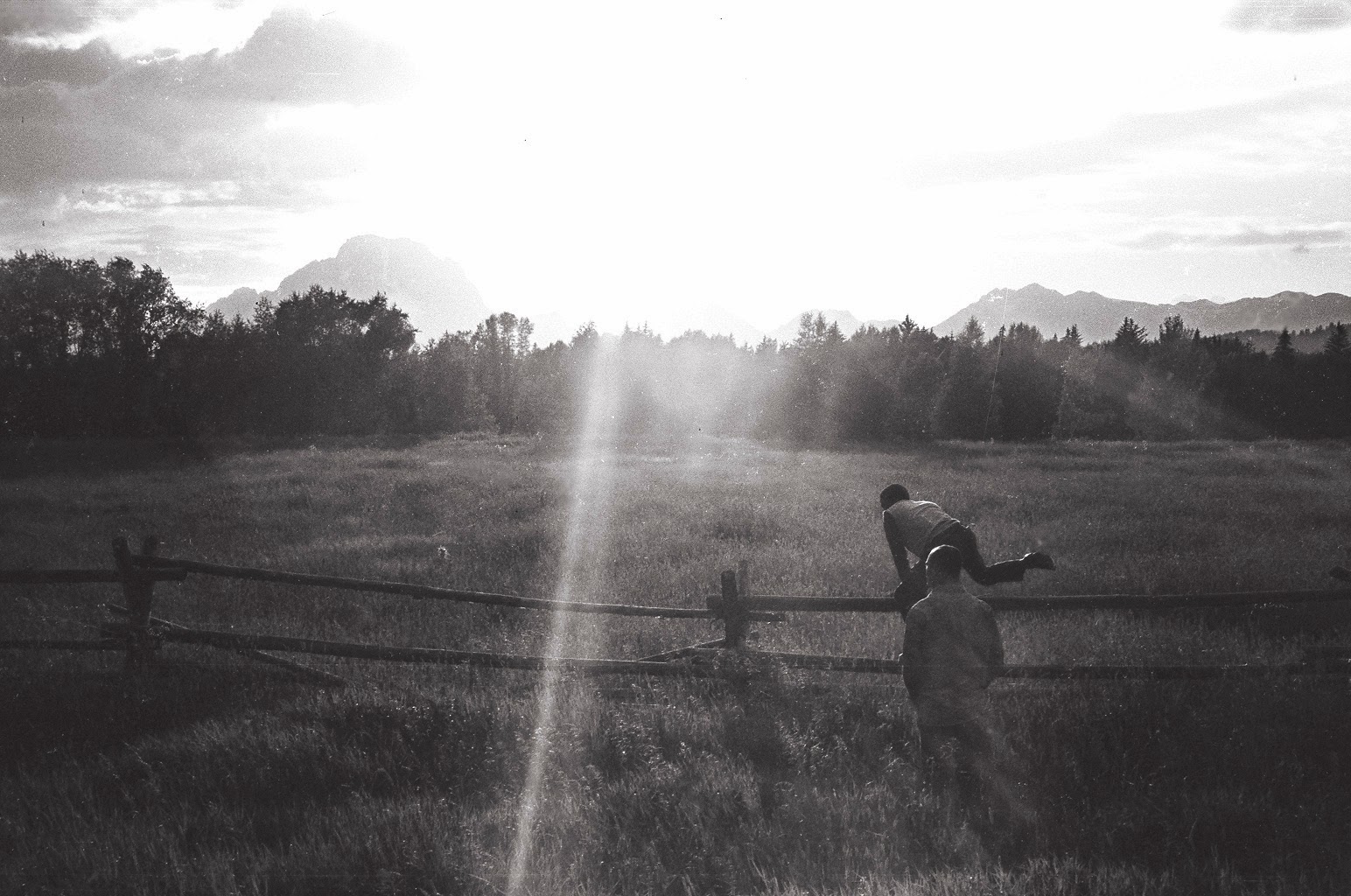
Sam and Theophilius at sunset in Jackson Hole, Wyoming. Photos by Michael James from his forthcoming book, Michael Gaylord James' Pictures from the Long Haul.
Pictures from the Long Haul:
Going off campus:
Idaho, Wyoming, and Connecticut, 1965
I proceeded to quote Tom Paine: “Let them call me rebel and welcome, I feel no concern from it; but I should suffer the misery of devils were I to make a whore of my soul.”
By Michael James / The Rag Blog / November 11, 2013

[In this series, Michael James is sharing images from his rich past, accompanied by reflections about -- and inspired by -- those images. This photo will be included in his forthcoming book, Michael Gaylord James' Pictures from the Long Haul.]

At UC Berkeley in the winter and spring of 1965 the Free Speech Movement battles continued. The court proceedings for the Sproul Hall arrests continued, as did rallies and negotiations. My sentence gave me a choice: 25 days in jail, a year’s probation, or a $250 fine. Believing that a year’s probation would limit my political activities, I took the fine, and said to the judge; “A lot of people across the land are coming to feel as I do,” and proceeded to quote Tom Paine: “Let them call me rebel and welcome, I feel no concern from it; but I should suffer the misery of devils were I to make a whore of my soul.”

Eventually the University agreed to permit tables and discussion in Sproul Hall Plaza, and reversed their edict on no political activity. And political activity there was. The U.S. war on the people of Vietnam was in the forefront. I got involved with the Vietnam Day Committee initiated by Jerry Rubin, Stew Alpert, and others. In May we held a two-day teach-in, which thousands attended. Senator Ernest Gruening of Alaska was a featured speaker. He and Oregon’s Wayne Morse were the first Senators to stand in opposition to U.S. involvement in the war in Vietnam.

Ken Kesey and his Merry Pranksters showed up in a wildly painted school bus; Allan Ginsberg, Wavy Gravy, and others were on the scene. Protest singer Phil Ochs came to perform. Before he took to the stage I was fortunate to hang out with him at the home of Neil Blumenthal, a Berkeley psychologist and the Free Speech Movement’s resident shrink.

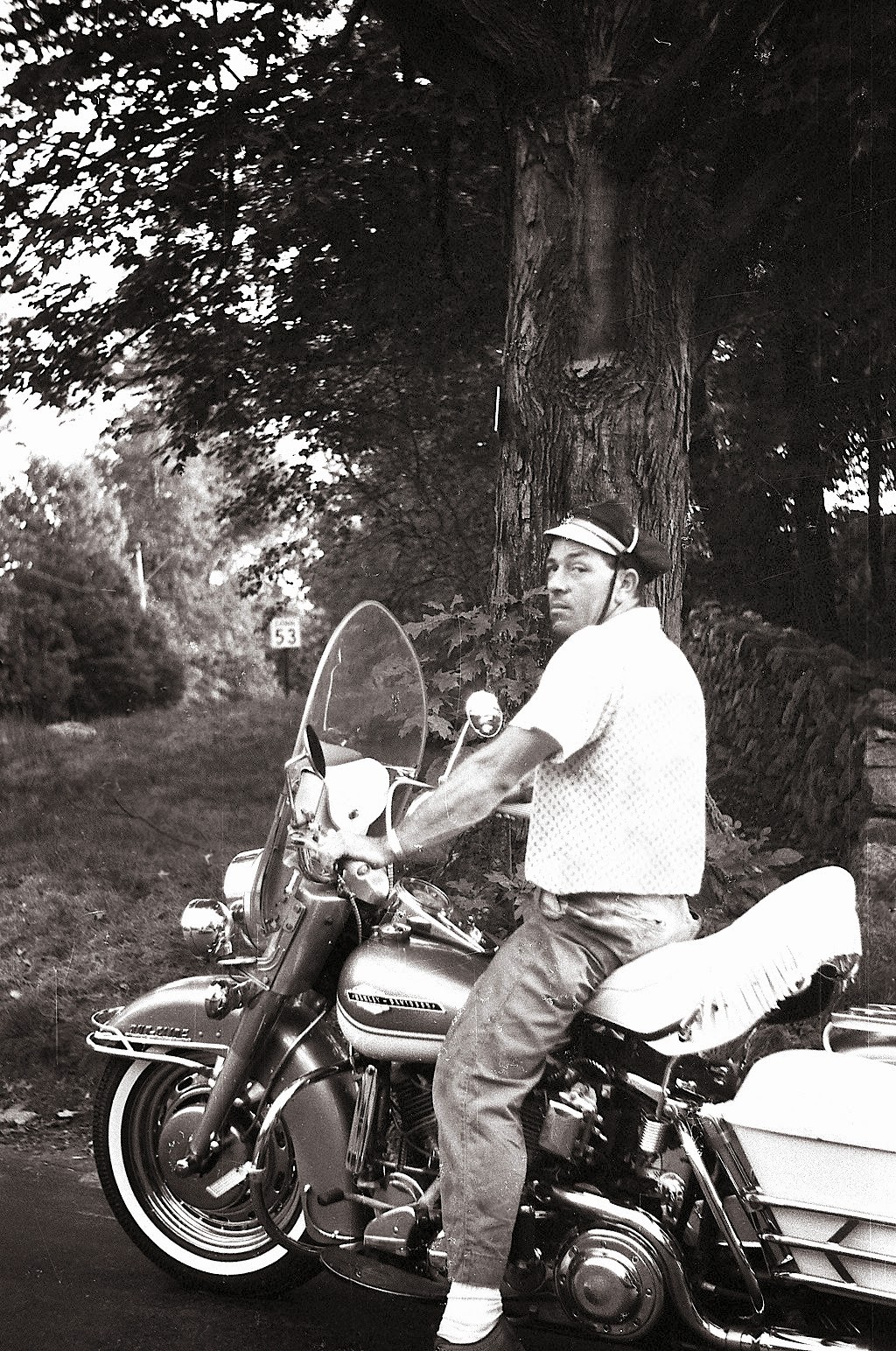
Man on Harley, Route 53, Connecticut.
For the teach-in I helped compile a pamphlet with articles on Vietnam and the war. While laying it out at the Berkeley Free Press, I leaned on the light table and fell through the glass (no injuries, luckily, and the shop owner took it in stride). When the pamphlet made it to press, I remember the brass bell on the Multilith offset that gave a constant ding-ding at the tempo of the press’s speed. The pressman was David Goines, who became a well-known poster artist.

Students for a Democratic Society was the organization that caught my attention, and then my love and devotion. Back when we surrounded the police car with Jack Weinberg in it -- the event that really set the Free Speech Movement in motion -- I had found a leaflet put out by SDS calling to “build the interracial movement of the poor.” SDS “traveler” (field organizer) Mike Davis, now a noted author, came through town and signed me up into the ranks of SDS. At an SDS party I talked and drank wine with Michael Harrington, who I had heard speak in 1962 at the University of Chicago, along with the old socialist Norman Thomas. Harrington’s ’62 book The Other America exposed the dramatic extent of poverty in the U.S.

The summer of ’65, while the anti-war movement was building at Berkeley and across the land, some of us were making plans to move into West Oakland. We would be among SDS members involved in the Economic Research and Action Project (ERAP), which had begun organizing in 13 cities, trying to build an interracial movement of the poor. Paul Booth, an SDS leader, came to California to help with what would be called the West Oakland Community Project (WOCP). We were idealistic. We said, “Let the people decide.” An SDS button proclaimed Sam Cook’s lyric “A change is gonna come.”

Twelve of us --11 white, one black -- were involved in the WOCP that summer. We had a house at 320 Henry Street near the Southern Pacific Railroad yards. People in the community wondered who we were and what was going on. A ragtag group of men who lived at the Catholic Worker’s Peter Maurin House came by to check us out. [Peter Maurin was a Catholic activist who along with Dorothy Day founded the Catholic Worker Movement]. They’d been drinking wine and their spokesman was challenging, but mellowed out when we shared our hopes and intentions.

Lots of people were working for change in Oakland. There were freedom schools, summer work projects, and labor projects. The issue that got traction in our efforts was beautification. It may not seem radical, but responding to the way the city was tearing down fences and ruining people’s gardens at Peralta Villa Public Housing without notice or community input, was about letting the people decide, a major SDS principle. The Peralta Villa folks were pissed off, and they let the city know about it. The fence removal was halted, a small but significant victory.

A mostly white group of Berkeley students organizing in a poor black community did not bring us far on the road to a revolution. Perhaps the biggest deterrent to sustained work by WOCP was the exploding growth of opposition to the Vietnam War. There was considerable anti-war activity on campus and energies were pulled in that direction.

To top it off, there were the troop trains, and the efforts by hundreds to stop them. During August there was a demonstration at the railroad tracks in Berkeley. My clearest memory of that day is a soldier’s face, probably a conscript, who was on the Union Pacific train from Fort Riley in Kansas, heading to the Oakland Army Terminal to be shipped off to Nam. He was at the window with a shaved head. His face was laughing yet somehow also fearful as he watched me take the picket sign I held and slap it against the window. “U.S. Out of Viet Nam!” I hope he made it back.

Sam and Theophilus in Wyoming or Nebraska.


At the end of the summer I headed back east. My Staples High School pal, football lineman Sam Whiteside, was on the West Coast. He and I, along with two women from the Oakland Project and a young black SNCC activist named Theopholis Smith, headed east in Sam’s Chevy wagon. Theo had been on a break from his work in the South and was heading back to the voter registration battlefield in Alabama.

I was back on the road, heading east from Berkeley by car for the first time. Sam, like me, was up for a circuitous route, and I had a camera with me. We drove through Nevada, then Idaho, and on to Jackson Hole, Wyoming, where at sunset I caught a picture of Sam and Theo climbing a over a fence. Later that night we spotted Indians swaying and staggering along the road. We were riding through a Crow reservation as we neared Dubois, Wyoming. In Dubois we ate at a bar while a piano player tickled the keys. We joined him in song before driving off into the night.

By morning we were in my ancestral homeland of Nebraska. Near Valentine we decided to stop and take a jump into the Niabrara River. Sam cut his foot, and got stitches from a doctor in Valentine. I talked to the doc about the war, which he supported. As my family will attest, this was the beginning of a lifetime of bringing up politics with folks anywhere I am -- in an elevator, at a gas station, attending a wedding, on the phone with an operator at a credit card company in wherever. “And what state are you taking this call in? Hope you guys are going to vote out so-and-so!”

In Chicago we went to the Uptown neighborhood, where the JOIN (Jobs or Income Now) Community Union office was located on Argyle. There I met Sandra Cason, aka Casey Hayden, who had just left her work with SNCC in Mississippi after Stokley Carmichael (Kwame Ture) had booted the white members out. Sam and the others left me there.

Cross, cowboy, Conoco, and Wonder Bread truck in Idaho.
Casey and I visited Old Town, a pioneer hip neighborhood and happening place. The night heat was close to unbearable, and the sidewalks were packed with people. A guy on a motorcycle, his squeeze on the back, was jumpy and jittery as he revved his bike, moving through the crowds crossing the street. I suggested to Casey, “Let’s get out of here!” We took the Chicago Northwestern RR to Lake Forest, 30 miles north. It was cooler there, where we stayed at the home of my anthropology Prof Gerry Gerasimo.

The next morning we said goodbye to Gerry and his wife Dottie, who had been a classmate of mine. Casey and I grabbed our stuff and hitchhiked east, stopping for a night at an SDS ERAP project in Cleveland, located in a mostly poor white neighborhood near the Great Lake Erie. The next day, thumbs out, we hitched rides and made it to Connecticut.

We linked up with fellow Berkeley sociology student Nigel Young and his wife Antonia, serious peace activists from England. Nigel told me about writing “U.S. out of Guatemala” on a wall in London in 1956, when he got arrested while trying to figure out how to spell Guatemala. They were quite a couple, he in mod all black: turtleneck, black pants, short black jacket, and pointy-toe black shoes. Antonia wore a big long fur coat. (This was before there was much talk of animal rights.)

All four of us headed west in a gray 1957 Plymouth station wagon “drive-away” that needed to be delivered to California. We stopped at the Custer Battlefield and Museum in Montana, where the park ranger-guide kept referring to “the hostiles” coming over this hill, and doing this or that. With Crazy Horse and Sitting Bull already heroes in my consciousness, I found his rap to be offensive. In Billings we stopped to eat at a place with an adjacent bar that had a dirt floor and a sign “Check guns at door.” That made sense.

We cruised through Yellowstone National Park, took in the geysers, and had our progress momentarily halted while a bull buffalo decided to mosey along the middle of the road. In Idaho we crossed over a mountain and stopped to eat early in the morning. On the jukebox I noticed Johnny Cash covers of Dylan tunes, and thought: “Wow, something is happening here, the times indeed are a-changing.”

A ranch in Idaho.
On a back road we stopped at an abandoned ranch where I found a branding iron. Down the road we had to stop for a herd of sheep. The shepherd was Basque, didn’t speak English, and wore a jean jacket and pants and engineer boots. Later Nigel enlightened us about the struggles of the Basque people in Spain.

Back at school in Berkeley, I was a graduate teaching assistant. Casey was bereft, missing her comrades in Mississippi, and returned to her family’s home in Victoria, Texas. I tried to restart the Oakland Project along with Vivian Rothstein. From 12 of us, we were down to two. We moved into a different house where neighborhood kids ripped us off. Honest talk led to the goods being returned.

Barry and Betty, both of whom had worked in the Newark Community Union Project (NCUP), soon joined Vivien and me in our efforts. We took a trip to a commune near Big Sur. As we approached we heard beating drums, apparently a sunset ritual to help the sun to go down over the Pacific. A number of longhairs came running at us with clubs, but backed off when Barry yelled he was there to see his sister.

It quickly became clear that the Oakland Project had run out of steam. Though my heart was still with the interracial movement of the poor, I needed to figure out the best place for me to help work toward that vision. Knowing now that I wanted to leave Berkeley, to go off campus and organize, I began contemplating my next moves.

[Michael James is a former SDS national officer, the founder of Rising Up Angry, co-founder of Chicago's Heartland Café (1976 and still going), and co-host of the Saturday morning (9-10 a.m. CDT) Live from the Heartland radio show, here and on YouTube. He is reachable by one and all at michael@heartlandcafe.com. Find more articles by Michael James on The Rag Blog.]

The Rag Blog

[+/-] Read More...

14 August 2013

Ron Jacobs : Remembering the Resignation of 'Nixon the Crook'

Front page of The Baltimore Sun, August 9, 1974.
Let there be no question:
Richard Nixon was a crook!
He surrounded himself with men who did not believe in democracy but understood what compromise might be required to maintain and consolidate power.
By Ron Jacobs / The Rag Blog / August 14, 2013

August 9, 1974, is one of my favorite days in history. On that day, Richard Nixon resigned from the presidency of the United States. He only did so because he knew he was facing certain impeachment and a probable conviction on at least some of the charges he was facing.

The look of despair obvious on his face during his last speech from the White House was enough to make anyone who had opposed his rule almost believe that there was such a thing as earthly justice. Of course, Nixon never had to answer for his crimes. Indeed, when he died in April 1994, anyone listening to the speeches at his funeral would have thought he was an honorable man, a great world leader, and a statesman.

Richard Nixon was a crook. He was also a war criminal and mass murderer. He surrounded himself with other men who shared a similar worldview as to his. In other words, he surrounded himself with men who did not believe in democracy but understood what compromise might be required to maintain and consolidate power.

His circle of cronies were, like Nixon himself, paranoid, often petty and infinitely capable of surprising the somewhat naĂŻve population of the United States with the callousness of their words and the Machiavellian nature of their deeds.

Among those deeds was the manipulation of white America’s racial fears to get elected not once but twice. Another highlight on this list would have to be the creation of the secret police-like Plumbers unit whose work it was to bring down Nixon’s political enemies by any means necessary (legal and otherwise).

Yet another was the invasion of Cambodia in spring 1970; an action that was followed by a nationwide rebellion that resulted in the murders of six college students by the forces of law and order and remarks by Nixon that essentially blamed the students for their own deaths. A couple more highlights on this list are the Christmas bombing of 1972 and the 1973 CIA-ITT-Anaconda Copper military coup in Chile.

I could go on, but the point, I believe, is made.

There is an opinion that occasionally pops up among today’s liberals, progressives, and even leftists that Richard Nixon was more progressive than Barack Obama. As proof, this argument cites Nixon’s creation of the Environmental Protection Agency, support of Clean Water legislation, his establishment of OSHA, his support of federal affirmative action and his endorsement of the Equal Rights Amendment as a constitutional amendment.

These things happened in spite of Nixon and his crew of megalomaniacs, not because of them.

On top of that, argue those with a truly warped grip on history, he ended the U.S. war on Vietnam. This opinion is nonsense and historically ignorant. The way Nixon ended the war was by killing hundreds of thousands of Vietnamese, at least 20,000 more U.S. troops, and having his henchman Henry Kissinger ultimately sign a peace agreement with conditions almost exactly the same as those that could have been reached with the North Vietnamese and National Liberation Front of Vietnam in 1969 when he was inaugurated.

In other words, close to a million more people died before Nixon realized that the U.S. would not win the war.

As far as the environmental, affirmative action, and women’s policies are concerned, Nixon was just reacting to the groundswell of almost universal support for this legislation. Indeed, the underlying reason Nixon did anything progressive was because there was a popular and militant leftist movement in the United States at the time that constantly pushed the political conversation leftward.

Nixon, being a shrewd politician and determined to save capital for his masters in the war industry and on Wall Street, used his immense power to push through certain aspects of the liberal/progressive agenda as a means to placate the more moderate populace and to insure capital’s continued hegemony.

This is not to defend Barack Obama. He has been anything but progressive, despite the fact that he campaigned as if he would be. I believe this is why he provokes the angry response that he does from so many of those who voted for him. These voters actually believed that Obama would change the system that he rules over.

I had thought Richard Nixon and his successors would have removed such naivetĂ© from the U.S. voting booth forever. After all, Richard Nixon certainly made a good part of my generation very cynical about politics, politicians, and government in general. Perhaps that will be Obama’s legacy for this generation.

Richard Nixon expanded the police state. Despite the investigations by the United States Senate Select Committee to Study Governmental Operations with Respect to Intelligence Activities, a U.S. Senate committee chaired by Senator Frank Church in 1975 (The Church Committee) and others in and out of Congress, that police state never really went away. In fact, it has continued to expand to the point it is today.

The National Security Agency was spying on U.S. citizens in the 1970s and it’s spying on them now. The FBI and numerous other police agencies were waging counterinsurgency operations against leftist, third world, and anarchist organizations then and they are now.

It was under Nixon that these and numerous other authoritarian tactics intensified and became common practice. Obama is just continuing the tradition. It was also Richard Nixon who established the Drug Enforcement Agency, the most draconian, paramilitary, and covert of all police agencies funded by U.S. taxpayers.

He started the destruction of our civil liberties and civil rights known as the War on Drugs and made the use of racial code words to hide what were blatantly racist policies when put into practice in this and other government programs.

One of my favorite moments in television history remains the few minutes that were shown live the morning after Nixon resigned. Unfortunately, when he waved goodbye, it wasn’t forever. Even worse, the mess he left behind is now business as usual. We are not better off because of that.

[Rag Blog contributor Ron Jacobs is the author of The Way The Wind Blew: A History of the Weather Underground. He recently released a collection of essays and musings titled Tripping Through the American Night. His novels, The Co-Conspirator's Tale, and Short Order Frame Up will be republished by Fomite in April 2013 along with the third novel in the series All the Sinners Saints. Ron Jacobs can be reached at ronj1955@gmail.com. Find more articles by Ron Jacobs on The Rag Blog.]

The Rag Blog

[+/-] Read More...

17 April 2013

Bob Feldman : Civil Rights, SDS, and Student Activism in Austin, Texas, 1954-1973

Massive march against the War in Vietnam, Austin, Texas, May 8, 1970. Image from The Rag Blog.
The hidden history of Texas
Part 13: 1954-1973/2 -- Student Activism and the Anti-War Movement at the University of Texas
By Bob Feldman / The Rag Blog / April 17, 2013

[This is the second section of Part 13 of Bob Feldman's Rag Blog series on the hidden history of Texas.]

Inspired by the early 1960s Civil Rights Movement protests of groups like the Congress of Racial Equality [CORE], the Southern Christian Leadership Council [SCLC], and the Student Nonviolent Coordinating Committee [SNCC], and in response to the 1965 escalation of the Pentagon’s War in Viet Nam, an increasing number of students and non-students in Austin, Texas, became involved in New Left and countercultural groups like SDS and in underground press journalism during the 1960s.

There was substantial New Left activity in other Texas cities, including Houston where underground newspaper Space City! helped pull together an active movement community, but Austin -- which had always been a center for cultural and political iconoclasm -- would become one of the nation's New Left hot spots.

As Beverly Burr observed in her thesis, "History of Student Activism at the University of Texas at Austin (1960-88)":

The Students for a Democratic Society [SDS] formed a chapter in the early spring of 1964. From 1964-7, the UT chapter of SDS began to build the local white, radical student movement. Alice Embree, one of the early participants in SDS at UT, said that when she went through registration at the beginning of the Spring 1964 semester, there was an SDS information table. She conjectured that 4 or 5 people started the group.

The early focus of the group was participating with black student activists in the sit-ins at downtown Austin restaurants... In mid-October 1965, SDS held a death march protesting U.S. policy toward Vietnam. This protest was apparently the first antiwar demonstration on the campus during the 1960s. About 70 students participated in the march and rally... SDS had attempted to get a parade permit to march on the streets during the rally but the permit had been refused by the City Council...

SDS held its first fall 1966 meeting in late October [1966]... At the same time, students organized an underground newspaper called The Rag... Most of the staffers were SDSers who created the paper not only to publicize issues of importance to the movement but also in reaction to the corporate controlled mainstream media... During the fall [of 1966] 10 SDS and Rag women... held a sit-in protesting the draft at the Selective Service in Austin. In January of 1967 several demonstrations were held against Secretary of State Dean Rusk while he was in town... Over 200 came to the second protest which succeeded in canceling Rusk’s dinner at the UT Alumni Center...

The first conflict between SDS and the University occurred later in the spring of 1967 during Flipped-Out Week... SDS had planned a week of activities including a speech by... Stokely Carmichael..., an anti-war march to the Capitol, and Gentle Thursday... The activities attracted several thousands... The week after Flipped-Out Week, SDS distributed flyers... to plan a Monday protest against Vice President Hubert Humphrey who would be speaking at the Capitol... On Monday, about 150 students protested at the Capitol against the war in Vietnam. Later that day, UT withdrew recognition of SDS as a campus organization...

UT initiated disciplinary proceedings against 6 students involved in the anti-war protest... against Hubert Humphrey... Simultaneously the UT administration... called for the arrest of George Vizard, a non-student. Vizard was arrested by Austin police... The police brutally arrested him in the Chuckwagon, a café and radical hangout in the Student Union... Over 250 outraged students and faculty members... founded the University Freedom Movement [UFM].
University Freedom Movement rally,
UT campus, 1967. Photo from
The Rag.
But despite subsequently well-attended free speech rallies and extralegal campus protests by UFM supporters during the rest of April 1967, the six anti-war students who were being disciplined by the UT administration were all placed on probation for their political activity on May 1, 1967. Yet the anti-war countercultural movement in Austin continued to gain more local popular support, and in October 1969, around 10,000 people protested in Austin against the Republican Nixon Administration's failure to end the Pentagon’s War in Vietnam .

African-American student and non-student Movement activists also continued to organize anti-racist protests during the late 1960s in Austin. As the “History of Student Activism at the University of Texas at Austin ” thesis also noted:
In 1966, the Negro Association for Progress [NAP] was formed... During the spring of 1967, NAP... members converged on the office of... athletic director and... football coach Darrell Royal to find out why UT was not accepting or recruiting black athletes... In October [1967]... NAP held an illegal demonstration for black student rights... In the spring of 1968 NAP was replaced by the Afro-Americans for Black Liberation [AABL]...

In May [1968]... the owner of a Conoco station... attacked a black musician... Larry Jackson of Austin SNCC and Grace Cleaver, chair of AABL, called on all persons opposed to racism to picket [and to boycott the station]... Jackson requested that SDS participate in the action and the group agreed. The students held several sit-ins at the gas station. City police arrested about 50 in the demonstrations... That fall AABL won 2 academic programs in Afro-American Studies...
And in a Feb. 1, 2003, speech before the W.H. Passion Historical Society at the Southgate-Lewis House in Austin, former Austin SNCC activist Larry Jackson also recalled how a SNCC chapter came to be formed in Austin during the late 1960s:
I was born in central East Texas, a little town called Hearn... And that’s the place I first began my activities in civil rights... I first got involved in a lot of civil rights activities when I was in high school in Hearne, Texas. And I was trying to integrate the pool... I left Hearne, Texas because I was involved with so much strife there...

And in Houston I became very active in school activities at Texas Southern... And what really got me here in Austin was I had previously worked on the Martin Luther King speech day in Houston... And at the music hall, outside of the TSU people and a few whites to hear Martin Luther King speak, there was not 200 people there. And this happened in 1967... And I ended up coming here on a speaking deal with Stokely Carmichael and Rap Brown. That’s how I got to Austin , Texas... And so he was speaking out there at the University of Texas. So I stayed on here because I was gonna form a SNCC chapter here in Austin...”
Austin was also a center for the fast-growing women's liberation movement and, according to Jo Freeman in Women: A Feminist Perspective, the landmark Supreme Court decision on abortion, Roe v. Wade, "was the project of a small feminist group in Austin, Texas and the lawyer [Sarah Weddington] who argued Roe before the Supreme Court was one of its participants."

[Bob Feldman is an East Coast-based writer-activist and a former member of the Columbia SDS Steering Committee of the late 1960s. Read more articles by Bob Feldman on The Rag Blog.]

The Rag Blog

[+/-] Read More...

08 April 2013

Lamar W. Hankins : Lyndon Baines Johnson As Tragic Hero

Former President Lyndon Baines Johnson, August 1972. Image from the
LBJ Library / PBS Newshour.
Lyndon Baines Johnson: 
My tragic hero
LBJ was doomed from the start, trapped by earlier mistakes that he could not avoid without being vilified by the political opponents and war hawks in his own party as well as by Republicans.
By Lamar W. Hankins / The Rag Blog /April 8, 2013

The recent unveiling of a monument to honor Vietnam veterans at the Texas state Capitol in Austin rekindled my memories about President Lyndon Baines Johnson -- known widely as LBJ. Both of his daughters participated in the ceremony marking the groundbreaking, which included reading the names of all 3,417 Texans who died in that war -- some of whom I knew. I loved LBJ for his championing of civil rights and the War on Poverty.

But the War in Vietnam was his downfall and led to my partial disaffection with him.

It may seem overblown to call LBJ my tragic hero, but in a real since he was -- at least in the Aristotelian sense.

For those who didn’t live through the 1960s, it may be difficult to imagine what it was like for someone who went from teenager to young adult in that span of years. I was an active participant in the civil rights movement while in high school in Port Arthur, a town whose inhabitants were as racist as any in the South, but with a Cajun twist that sometimes took the edge off because of the intermixing that occurred in parts of neighboring Louisiana, where many of our residents came from.

But make no mistake -- racism was rampant among whites, even if some of the vitriol was absent.

LBJ became a friend of the civil rights movement because he felt the movement’s pressure, he understood history, and he knew that racism was wrong. Without him, it is doubtful that the civil rights acts of the mid-60s would have passed as soon as they did.

The two oldest Kennedy brothers were reluctant to act decisively about civil rights except under extreme pressure. John F. Kennedy did not have the legislative abilities that LBJ possessed. It is unlikely that the public accommodations and voting rights acts would have passed in 1964 and 1965 if JFK had been president.

I am regularly reminded that the role of our military is to preserve our freedoms. But that wasn’t what the military was doing in the Vietnam War. That war had nothing whatever to do with our freedoms, but it did concern our misunderstanding of the rest of the world and the widespread belief that the United States has been called by God to control and fix the rest of the world through our overwhelming military and economic power.

A recent Gallup poll reports that Americans have greater confidence in the military than in any other of our institutions. This does not surprise me for several reasons. The military taps into the emotion called patriotism more than any other institution of government. The media give the military enormous publicity and rarely push back against military decisions.

The World War II generation has been hailed as “The Greatest Generation” because of its defeat of Hitler and Japan and the successful expansion of the economy and the middle class for several decades after the war.

But I have never shared that level of confidence in the military. The incestuous relationship between high military brass, politicians, and the corporations that feed off our taxes that support the military seems to fulfill the very definition of corruption.

Decades ago, the Pentagon developed a strategy to put some sort of military installation or award contracts for military hardware and supplies in every congressional district in the country. Consequently, most politicians provide unquestioning support for keeping military expenditures higher than the combined military expenditures of the next highest-spending 14 countries. And those expenditures make wealthy the corporations who build the military hardware and look after the military’s needs.

During the Vietnam War, I knew young men who were drafted into the military, but I also knew several who fled to Canada to avoid the draft, others who became conscientious objectors, and one who went to prison for refusing to cooperate with the draft.

I was a conscientious objector and performed alternate service for my country for two years, serving in LBJ’s War on Poverty, and I spent almost 10 more years in that same effort, living for one year on poverty wages and working for three and a half years as a Legal Services attorney.

During the Vietnam War, with help from the American Friends Service Committee, I provided volunteer counseling to young men who thought that they might qualify as conscientious objectors. My motivation during those years was to try to reduce the number of young men who were sent off to be what I regarded as cannon fodder for the war against the Vietnamese, a country that had done us no harm, and had already driven the colonialist French out of that part of the world.

To be a conscientious objector, however, is not to be a pacifist. I was delighted by some verses in a 1966 Pete Seeger song -- “Bring Them Home” -- that made this clear:
If you love your Uncle Sam,
Bring them home, bring them home.
Support our boys in Vietnam,
Bring them home, bring them home.

...There’s one thing I must confess,
Bring them home, bring them home.
I’m not really a pacifist,
Bring them home, bring them home.

If an army invades this land of mine,
Bring them home, bring them home.
You’ll find me out on the firing line,
Bring them home, bring them home.
At the time, nothing expressed so simply and elegantly how I felt and how I feel still. But I have never been associated with any organization that advocated violence, except for my 30-year dalliance with the Democratic Party, which ended in 1992.

I have read some of Tim O’Brien’s Vietnam War-themed books and heard him lecture a couple of times. One point that O’Brien makes in his lectures and discusses in one of his books -- The Things They Carried -- is that deciding to go into the military after being drafted was one of the most morally difficult decisions a young man could make. O’Brien believes that the more difficult and the more courageous decision was to oppose the draft, whether by fleeing to Canada, refusing to cooperate, or by becoming a conscientious objector. I always felt the opposite was true.

When I told my family that I had become a conscientious objector and that my application had been granted and I was ordered to do alternate service for two years, one uncle asked me if I did that because I was afraid to go fight. I had to explain to him that it was not fear that drove my decision, though one would have to be non-human not to have some fear, but it was a moral objection I had to war that I had thought about for several years. I don’t know if my uncle accepted my explanation, but he dropped the subject.

That was the same year that LBJ announced that he would not accept the nomination of his party to be a candidate for president. I have listened to some of LBJ’s archived conversations with friends and associates about the Vietnam War. I know that he agonized over what he had done in persuading the Congress to escalate the conflict, but he felt trapped by circumstance.

LBJ inherited American military involvement in Vietnam that began when Harry Truman promised the South Vietnamese that he would not let the South be taken over by the communist North. Kennedy increased our troops in Vietnam to 16,000 by 1963. LBJ could not find a way to keep Truman’s promise or get U.S. troops out of Vietnam, while preserving his and the country’s honor as he understood that term. This misguided code of honor, I believe, was his fatal flaw.

For Aristotle, the tragic hero was someone of noble stature, outstanding ability, with a greatness about him  a “great and good man.” Clearly, LBJ was such a man. His skills as a legislator have been unsurpassed during my lifetime. When he was suddenly thrust into the presidency after the assassination of President Kennedy, he was prepared. He needed no on-the-job training. In the first few weeks after taking office, he gave the country confidence that he would keep the country together and accomplish important work.

In Vietnam, LBJ’s purpose (however misguided) was the same as Truman’s, Eisenhower’s, and Kennedy’s: to defeat the spread of Chinese communism. As we have seen, even after our defeat in Vietnam, Chinese communism did not spread there. The so-called Domino Theory had no substance, though it sounded logical to many.

But Americans tend to look at the rest of the world through their own lens, which may have no relationship to reality. Our presidents and foreign policy experts have made similar mistakes over and over. And these people supposedly are our best and brightest. Their own hubris feeds that of our presidents, and of our citizens.

LBJ was doomed from the start, trapped by earlier mistakes that he could not avoid without being vilified by the political opponents and war hawks in his own party as well as by Republicans. The military-industrial complex that Eisenhower had warned about as he left office had already become an inescapable force that even our most skillful politician could not overcome.

As the Iraq War and the Afghan War’s frequent transformation and escalation over 11 years have demonstrated, wars are not as easy to get out of as they are to get into. Perhaps President Obama has found a narrative about Afghanistan that will allow him to escape the trap that LBJ could not escape in Vietnam.

But President Obama is not prepared to completely leave Afghanistan. He plans to leave a contingent of troops there and elsewhere in the Middle East to continue fighting terrorism using a special forces strategy aided by drones, even though that fight no longer has anything to do with the perpetrators of 9/11, which was the basis for the authority Congress gave President Bush to attack Afghanistan.

Since I was in kindergarten nearly 65 years ago, I have watched people in positions of authority wield power in varying ways. Sometimes, their exercise of power has been wise and the results beneficial; often times not. Every president who has served during my lifetime has made some extraordinarily bad decisions. Most of them have been based on the idea that America is exceptional and has some birthright to control the world. Without question, this idea was behind the Vietnam debacle. But it was pride (and politics) that made it so difficult for LBJ (and later Richard Nixon) to extricate us from Indochina.

While I often say I don’t have heroes, LBJ was a tragic hero for me. Unless American politics undergoes a radical change, it won’t be long before another American president will play the same role that can lead only to tragedy both here and abroad.

[Lamar W. Hankins, a former San Marcos, Texas, city attorney, is also a columnist for the San Marcos Mercury. This article © Freethought San Marcos, Lamar W. Hankins. Read more articles by Lamar W. Hankins on The Rag Blog.]

The Rag Blog

[+/-] Read More...

20 March 2013

Harry Targ : Expanding the 'Iraq Syndrome'

Image from Democratic Underground.
Cooperation over conflict:
We need to expand the 'Iraq Syndrome'
As we reflect on the 10-year anniversary of the launching of the Iraq War, the madmen inside the beltway are talking about increasing U.S. military involvement abroad.
By Harry Targ / The Rag Blog / March 20, 2013
In a November/December 2005 Foreign Affairs article, "The Iraq Syndrome," I argued that there would likely be growing skepticism about the notions that "the United States should take unilateral military action to correct situations or overthrow regimes it considers reprehensible but that present no immediate threat to it, that it can and should forcibly bring democracy to other nations not now so blessed, that it has the duty to rid the world of evil, that having by far the largest defense budget in the world is necessary and broadly beneficial, that international cooperation is of only very limited value, and that Europeans and other well-meaning foreigners are naive and decadent wimps."

Most radically, I went on to suggest that the United States might “become more inclined to seek international cooperation, sometimes even showing signs of humility.”

-- John Mueller, “The Iraq Syndrome Revisited,” Foreign Affairs, March 28, 2011
David Halberstam reported in his important book,The Best and the Brightest, that President Roosevelt directed his State Department to develop a position on what United States foreign policy toward Indochina should be after the World War in Asia was ended. Two choices were possible in 1945: support the Vietnamese national liberation movement that bore the brunt of struggle against Japanese occupation of Indochina or support the French plan to reoccupy the Indochinese states of Vietnam, Cambodia, and Laos.

As the Cold War escalated the United States rejected Ho Chi Minh’s plea for support for independence and began funding the French in their effort to reestablish colonialism in Indochina. When the French were defeated by the Viet Minh forces in 1954, the United States stepped in and fought a murderous war until the collapse of the U.S. South Vietnamese puppet regime in 1975.

Paralleling the struggle for power in Indochina, competing political forces emerged on the Korean Peninsula after the World War. With the Soviet Union and China supporting the North Koreans and the United States supporting a regime created by it in the South, a shooting war, a civil war, between Koreans ensued in 1950 and continued until an armistice was established in 1953. That armistice, not peace, continues to this day as a war of words and periodic provocations.

Political scientist John Mueller analyzed polling data concerning the support for U.S. military action in Korea and Vietnam, discovering that in both wars there was a steady and parallel decline in support for them. Working class Americans were the most opposed to both wars at every data point. Why? Because working class men and women were most likely to be drafted to fight and their loved ones the most likely to suffer the pain of soldiers coming home dead, scarred, or disabled.

Polling data from the period since the onset of the Iraq war followed the pattern Mueller found in reference to Korea and Vietnam. In all three cases levels of support for U.S. war-making declined as the length of the wars increased and casualties rose. The American people typically gave the presidents some flexibility when the wars started and the rally-round-the-flag phenomenon prevailed. But then resistance grew.

Throughout the period from the end of the Vietnam War until the 1990s, each presidential administration was faced with what foreign policy elites called “the Vietnam Syndrome.” This was a pejorative term these elites used to scornfully describe what they correctly believed would be the resistance to foreign military interventions that they periodically wished to initiate.

President Reagan wanted to invade El Salvador to save its dictatorship and to overthrow the Sandinista regime in Nicaragua. He would have preferred to send troops to Angola to defend the anti-communist forces of Jonas Savimbi of UNITA.

To overcome the resistance to launching what could become another Vietnam quagmire, policymakers had to engage in “low intensity conflict,” covert operations that would minimize what the American people could learn about what their government was doing and who it was supporting. Reagan did expand globally and sent troops to tiny Granada, but even Reagan’s globalism, militarism, and interventionism were somewhat constrained by the fear of public outrage.

President George Herbert Walker Bush launched a six-month campaign to convince the American people that military action was needed to force Iraqi troops out of Kuwait. Despite a weak endorsement of such action by the Congress, the American people supported Gulf War I because casualties were small and the war lasted only a month. During a press conference announcing the Gulf War’s end in February 1991, Bush proclaimed that “at last we licked the Vietnam Syndrome.”

Clinton knew better. He limited direct U.S. military action to supporting NATO bombing in the former Yugoslavia in 1995, bombed targets in Iraq in so-called “no-fly zones in 1998,” bombed Serbia in a defense of Kosovo in 1999, and used economic embargoes to weaken so-called “rogue states” throughout his eight years in office.

It was President George Walker Bush who launched long and devastating wars in Afghanistan in 2001 and Iraq in 2003. The Bush administration used the sorrow and anger of the American people after the 9/11 terrorist acts to lie, deceive, aggress, and qualitatively increase the development of a warfare state.

As Mueller has suggested, an “Iraq Syndrome” had surfaced by 2005 as the lies about that war became public, the war costs were headed toward trillions of dollars in expenditures, and troop deaths and disabilities escalated. And of course an historically repressive society, Iraq, was so destroyed that U.S. troops left it in shambles with hundreds of thousands dead, disabled, and in abject poverty.

As we reflect on the 10-year anniversary of the launching of the Iraq War in March 2003, the madmen inside the beltway are talking about increasing U.S. military involvement in Syria, not “taking any options off the table” in Iran, and threatening North Korea.

Meanwhile the United States is beefing up its military presence in the Pacific to “challenge” rising Chinese power, establishing AFRICOM to respond to “terrorism” on the African continent, and speaking with scorn about the leadership in Latin America of recently deceased Hugo Chavez.

The American people must escalate commitment to its “syndromes,” demanding in no uncertain terms an end to United States militarism. Mueller’s call for a U.S. foreign policy that emphasizes cooperation over conflict motivated by humility over arrogance is the least the country can do to begin the process of repairing the damage it has done to global society.

[Harry Targ is a professor of political science at Purdue University and is a member of the National Executive Committee of the Committees of Correspondence for Democracy and Socialism. He lives in West Lafayette, Indiana, and blogs at Diary of a Heartland Radical. Read more of Harry Targ's articles on The Rag Blog.]

The Rag Blog

[+/-] Read More...

28 February 2013

PHOTO ESSAY / Judy Gumbo Albert : Visiting Viet Nam, 1970-2013

From left: Genie Plamondon, Nancy Kurshan, and Judy Gumbo Albert in Viet Nam, 1970.
A photo essay:
Visiting Viet Nam, 1970-2013
Everywhere we traveled we were warmly welcomed. The Vietnamese still feel grateful to the U.S. peace movement. I came to understand that while my trip in 1970 was life changing, this trip was life affirming.
By Judy Gumbo Albert / The Rag Blog / February 28, 2013
Rag Blog contributor Judy Gumbo Albert was an original member of the Youth International Party (YIPPIES), founded in 1967. See Jonah Raskin's April 17, 2012, interview with Judy Gumbo Albert in The Rag Blog -- and see Raskin's current Rag Blog interview with Nancy Kurshan, a prison activist and fellow Yippie founder who recently traveled with Judy to Viet Nam. Judy Gumbo Albert and Nancy Kurshan will be Thorne Dreyer's guests on Rag Radio, Friday, April 12, 2013, from 2-3 p.m., on KOOP 91.7-FM in Austin, and streamed live on the Internet -- so mark your calendars!
In 1970, during the American War, I visited what was then North Viet Nam. It was a Yippie trip. I’m the one on the right above. Next to me is Nancy Kurshan, next to her is Genie Plamondon of the White Panther Party. This year I returned to Viet Nam. What follows are some of my impressions.

In Ha Noi and the surrounding countryside, I photographed the devastation wrought by the war:

CLICK ON IMAGES TO ENLARGE.

And felt inspired by Viet Nam’s resistance fighters:


Forty years later, in January 2013, Nancy and I were invited back as part of a delegation of activists who had visited Viet Nam during the war. We were there to help celebrate the 40th Anniversary of the Paris Peace Accords:


I met former Attorney General Ramsey Clark and filmmaker Jay Craven:


And my favorite hero of all time, Mme. Nguyen Thi Binh, a member of the Provisional Revolutionary Government of South Viet Nam, a leader of the Viet Nam Women’s movement, and a negotiator and signer of the Paris Peace Accords. I told her, "Thank you for what you have done." She replied, “We will continue to do it," and squeezed my hand:


Everywhere we traveled we were warmly welcomed. The Vietnamese still feel grateful to the U.S. peace movement. I came to understand that while my trip in 1970 was life changing, this trip was life affirming.

At the same time, it was apparent that the outcomes of the American war continue to devastate the country.

With unexploded ordnance


that to this day kills and maims:


Agent Orange/dioxin, has remained in the soil and water of Viet Nam for 40 years, poisoning a third and fourth generation of children:


I was heartbroken when I met these kids. All I could think was, “We are responsible.”

Nor could I ignore the remnants of Diem and Thieu’s tiger cages:


Survivors of the tiger cages have managed to make a new life for themselves. “In order to close the past, we must be open to the future,” is what I heard them say. (The older woman in the center was imprisoned in a tiger cage for 15 years.)


Today Viet Nam integrates the new with the old. They are on the road to prosperity by means of what they call a “socialist-oriented market economy.”


I came home from Viet Nam understanding that every one of us can -- and should -- feel proud of what we did and continue to do to end all wars.


© Judy Gumbo Albert. See more of Judy's photos here.

Thanks to The Rag Blog's James Retherford for assistance with graphics on this article.

[Judy Gumbo Albert is an original Yippie, along with Abbie and Anita Hoffman, Jerry Rubin and Nancy Kurshan, Paul Krassner, and Judy’s late husband Stew Albert. Judy has remarried, lives in Berkeley, California, and is currently writing her memoir, Yippie Girl. She can be found at www.yippiegirl.com. You can contact her at judygumboalbert@gmail.com or on Facebook at Judy Gumbo Albert or Yippie Girl. Read more articles by Judy Gumbo Albert on The Rag Blog.]

The Rag Blog

[+/-] Read More...

Only a few posts now show on a page, due to Blogger pagination changes beyond our control.

Please click on 'Older Posts' to continue reading The Rag Blog.