Showing posts with label Jim Rigby. Show all posts

19 September 2012

Jim Rigby : Religion is No Longer Adequate

The Dalai Lama. Image from Nulla dies sine linea.

Dalai Lama:
Religion is no longer adequate
There is a growing realization that something is being born in between what we call “religion” and what we call “atheism.”
By Jim Rigby / The Rag Blog / September 19, 2012

Last Monday the Dalai Lama posted on his Facebook blog:
All the world’s major religions, with their emphasis on love, compassion, patience, tolerance, and forgiveness can and do promote inner values. But the reality of the world today is that grounding ethics in religion is no longer adequate. This is why I am increasingly convinced that the time has come to find a way of thinking about spirituality and ethics beyond religion altogether.
Religion has always been the lamp, it has never been the flame. Religion is whatever skillful means we use to remember we are all interconnected. It is whatever practice we use to stay grateful and alert. Unfortunately those who do not fall asleep into religion are rare.

I doubt the Dalai Lama was actually calling for the end to those disiplines that brought him to this clarity, but I do think he was realizing that religion that does not die into compassion, becomes a hindrance. He is calling for a new way of speaking about ethics.

I began this blog in part because I believe we are living at the death of an old worldview and the birth of a new. After Galileo, Darwin, and Einstein, much of what we once called ”religion” lies in ashes. But it is the nature of human understanding to die and then rise from the ashes.

There is a growing realization that something is being born in between what we call “religion” and what we call “atheism.” It is a Colossus with the clarity of a scientist and the reverence of a mystic. We do not yet have words for it, but I personally find it a thrilling time to be alive.

[Rev. Jim Rigby, a human rights activist, is pastor of St. Andrew’s Presbyterian Church in Austin, Texas. Jim Rigby blogs at jimrigby.org. He can be reached at jrigby0000@aol.com, and videos of his sermons are available online here. Read more articles by Jim Rigby on The Rag Blog.]

The Rag Blog

[+/-] Read More...

07 March 2012

Jim Rigby : The Flag by the Pulpit

Image from encountering love.

The flag by the pulpit
What does it mean when we tell preachers not to be political, but place a flag by the pulpit as though the flag were not itself a political statement?
By Jim Rigby / The Rag Blog / March 7, 2012

When I first graduated from seminary and began to preach, I barely noticed the flag that stands by most pulpits in the U.S. If we see a flag on a ship at sea, or on the car of a diplomat, we understand those vehicles are set aside to represent the United States. It did not occur to me that the flag by the pulpit bore the same meaning.

If a Roman emperor required a statue of himself to be placed in an early church, everyone would understand what that statue really meant. The statue would be a reminder that people could worship however they wished, so long as their first loyalty was to the empire.

The flag can also stand as a boundary that American preachers are not to cross. We may pray for our troops, but not for our enemy’s. We may pray for healing, but not for health care. We may pray for the poor, but we must never question the capitalist system that makes them poor.

What does it mean when we tell preachers not to be political, but place a flag by the pulpit as though the flag were not itself a political statement? Is the flag not a warning? Does the flag not bear a command? “You shall not speak of any other politics than that of the American Empire. You are not to worship a God who is bigger than your nation. You shall not hold the actions of your nation to a universal standard.”

The flag by the pulpit reminds us that the American Empire and the capitalism for which it now stands, lies in the background of everything the church can do, or even think, so long as nationalism is the context from within which we try to be ethical.

Knowing this, who would not take the flag down? We should take down the very cross itself, if it ever prevented us from showing the love of Christ to those who are not Christian. There is one universal love to which every other lesser loyalty must submit. We do not love America less, for loving humankind more.

[Rev. Jim Rigby, a human rights activist, is pastor of St. Andrew’s Presbyterian Church in Austin, Texas. Jim Rigby blogs at jimrigby.org. He can be reached at jrigby0000@aol.com., and videos of his sermons are available online here. Read more articles by Jim Rigby on The Rag Blog.]

The Rag Blog

[+/-] Read More...

22 December 2011

Jim Rigby : Christmas Cancelled as Security Measure!

Three wise men arrested for illegal possession of “frankincense” and “myrrh.” Art from Dare to Create.

Christmas is no time to
talk about war and peace
When the angels sang, 'peace on earth good will to all,' they were expressing the song written in every heart. But, that song calls us out of empire and into our entire human family.
By Jim Rigby / The Rag Blog / December 22, 2011

When I heard the President speak to returning troops last week, my mind flashed back to an article I once wrote for our local newspaper. Each week a different member of the local clergy would write a column, and I had been asked to write the piece for Christmas.

That year all I could hear was the drumbeat leading toward a war with Iraq. I racked my brain trying to think of a way to put faces on the people we were about to bomb. Looking at a nativity scene I thought, “the people we are about to kill look like that.” Maybe a reframed Christmas story could help Americans stop hating Saddam long enough to care about the people who will pay the real cost of this invasion.

I submitted the following article, covering the Christmas story the way the U.S. press was covering the build-up to the Iraq war. Looking back, I should have known what was about to happen.
Christmas Cancelled as a Security Measure

ELLIS ISLAND -- The three wise men were arrested today attempting to enter the country. The Iraqi nationals were carrying massive amounts of flammable substances known as “frankincense” and “myrrh.” While not explosives themselves, experts revealed that these two substances could be used as a fuse to detonate a larger bomb. The three alleged terrorists were also carrying gold, presumably to finance the rest of their mission.

Also implicated in the plot were two Palestinians named Joseph and Mary. An anonymous source close to the family overheard Mary bragging that her son would “bring down the mighty from their thrones and lift up the lowly.” In what appears to be a call to anarchy, the couple claims their son will someday “help prisoners escape captivity.” “These people match our terrorist profile perfectly,” an official source reported.

All of the suspects claimed they heard angels singing of a new era of hope for the afflicted and poor. As one Wall Street official put it, “These one world wackos are talking about overturning the entire economic and political hierarchy that holds the civilized world together. I don’t care what some angel sang; God wants the status quo -- by definition.”

A somber White House press secretary announced that it might be prudent to cancel Christmas until others in the plot are rounded up. “I assure you that this measure is temporary. The President loves Christmas as much as anyone. People can still shop and give expensive gifts, but we’re asking them not to think about world peace until after we have rid the world of evil people. For Americans to sing, ‘peace on earth, good will to all’, is just the wrong message to send to our enemies at this time.”

The strongest opponents of the Christmas ban were the representatives of retail stores, movie chains and makers of porcelain Christmas figurines. “This is a tempest in a teapot,” fumed one unnamed business owner. “No one thinks of the political meaning of Christmas any more. Christmas isn’t about a savior who will bring hope to the outcasts of the world; it’s about nativity scenes and beautiful lights. History has shown that mature people are perfectly capable of singing hymns about world peace while still supporting whatever war our leaders deem necessary. People long ago stopped tying religion to the real events in the world.”

There has been no word on where the suspects are being kept, or when their trial might be held. Authorities are asking citizens who see other foreigners resembling nativity scene figures to contact the Office of Homeland Security.
A few days after submitting that piece, I received a nervous call from an editor. “We love your story. It’s very funny.”

“Thank you,” I said waiting for the other shoe to fall.

“The thing is, we want to take out the part about Iraq and Palestine.”

After a horrified pause, I explained that had been the whole point of writing the story -- to humanize the people who were about to be killed. When I refused to gut the story, he told me they would have to drop it all together.

I shouldn’t have been surprised. Clergy who want to talk about real events in the world are seen as too political for the religious section, and too religious for the political section. Of course, if a minister gets in the pulpit and waves the flag and prays for the troops, that’s not called “political," but if a minister questions any war, then it is considered mixing religion and politics. The resulting pablum in most clergy columns validates their strategic placement somewhere between the obituaries and the comics.

What have we learned as a result of the war? That was answered by Obama’s words to the returning troops:
Because of you -- because you sacrificed so much for a people that you had never met -- Iraqis have a chance to forge their own destiny. That’s part of what makes us special as Americans. Unlike the old empires, we don’t make these sacrifices for territory or for resources. We do it because it’s right. There can be no fuller expression of America’s support for self-determination than our leaving Iraq to its people. That says something about who we are.
Looking back at my earlier Christmas article, I feel pain not pride at what the President said. His speech to returning troops could have been taken from any leader, of any nation, from any period of history, simply by changing the names and places. It is the kind of speech every leader has given since the emperors: brave and noble words, written in someone else’s blood.

This President who ran, in part, against this war, has come to repeat the party line. This President, who once spoke of respect for all people of the world, has now deported more immigrants than Bush.

Hearing another speech expressing our nation’s narcissistic delusion made me physically ill. I could not help but think of the bloody wake such rhetoric leaves behind when put into action. The fact that we are leaving Iraq at this point says nothing about the purity of our initial motives. Even bank robbers don’t stay around after the crime has been committed.

I appreciate trying to make our young soldiers not feel like they were pawns in someone else’s parlor game, but for the sake of future generations we must painfully remember and affirm, that is exactly what happened.

We, from the United States, are not like the people in our nativity scenes. We are like the Romans looming ominously in the background of the story. Christmas is about the little people of the world who find joy and meaning while living under someone else’s boot. We from the United States can only celebrate Christmas by ending our cultural narcissism, renouncing empire, and making room for the poor and the weak of the world like Joseph and Mary.

Christmas is not a fact of history, but Christianity’s particular symbol of every human being’s hope for world peace and universal happiness. When the angels sang, “peace on earth good will to all,” they were expressing the song written in every heart. But, that song calls us out of empire and into our entire human family.

Maybe stopping the frenzy of Christmas long enough to really hear the song the angels sang to the wretched of the earth, would give us the humanity to stop hanging our Christmas lights until we no longer kill our brothers and sisters for the fuel to illumine them.
O ye beneath life's crushing load, whose forms are bending low,
Who toil along the climbing way with painful steps and slow;
Look now, for glad and golden hours come swiftly on the wing;
Oh rest beside the weary road and hear the angels sing.
[Rev. Jim Rigby, a human rights activist, is pastor of St. Andrew’s Presbyterian Church in Austin, Texas. He can be reached at jrigby0000@aol.com., and videos of his sermons are available online here. Read more articles by Jim Rigby on The Rag Blog.]

The Rag Blog

[+/-] Read More...

04 August 2011

Jim Rigby : Scriptures You Won't Hear at Perry's Prayer Event

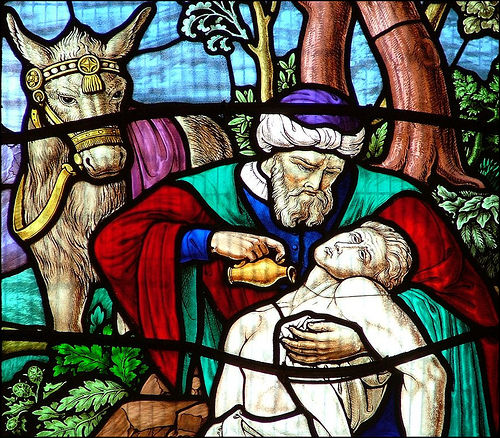
The parable of the Good Samaritan was a lesson in humility. Image from Sarcastic Lutheran.

Five scriptures you won’t hear
at Rick Perry’s prayer event
If the governor wants to call us to repentance it should begin with our real sins against the poor...
By Jim Rigby / The Rag Blog / August 4, 2011

As a native Texan, I’m used to crazy religion and crazy politics. So, the announcement of Gov. Rick Perry’s plans for “The Response,” a prayer event scheduled for August 6 at Houston’s Reliant Stadium, was not a surprise.

But as a Presbyterian minister and community organizer, it’s part of my job to stand up for my neighbors. The use of the governor’s office to promote one religion in a country with such rich religious diversity is obviously unhealthy politics, but -- if one takes the Christian and Jewish scriptures seriously -- it is also unhealthy religion. Here are five rather important verses of scripture you aren’t likely to hear at “The Response”:


Don’t make a show of prayer
"And when you pray, do not be like the hypocrites, for they love to pray in public places to be seen by others... But when you pray, go into your room, close the door and pray to your heavenly parent, who is unseen.” (Matt. 6:5-6)
While Jesus never addressed the issues most important to some of this event’s co-sponsors, such as homosexuality and abortion, he did speak out against public displays of religion. Whatever Jesus meant by the word “prayer,” it seems to have been about the quiet and personal. The disciples had to ask Jesus how to pray, which is a pretty good indication that he wasn’t praying a lot publicly. What he did say about prayer carried a warning label: “Don’t rub it in other people’s faces.”


God doesn’t withhold rain because we’ve done something wrong
“God causes the sun to rise on the evil and the good, and sends rain on the righteous and the unrighteous.” (Matt. 5:45)
Perry recently called Texans to pray for rain, which implies that God steers clouds toward the worthy. According to Right Wing Watch, one of the events co-sponsors has said the earthquake in Japan happened because the emperor had sex with the Sun Goddess. It may be a part of our lower nature to blame disasters on people we don’t like or understand, but Jesus taught that God sends rain on the just and unjust. Furthermore, he said our love should be equally nonselective.

I have chosen Christianity as my life’s religion, but when nonjudgmental love is taken out of its center, it becomes poisonous and predatory. The word “God” can be a helpful symbol for all the transcendentals of life, but the symbol becomes instantly pathological when used as a scientific explanation or political justification.


God doesn’t have favorites

Then Peter began to speak:
“I now realize how true it is that God does not show favoritism.” (Acts 10:34)
When the Bible says that God is not a “respecter of persons” it means that God doesn’t have a favorite country or religion. The idea that God wants Christians to be in charge of other people violates Jesus’ teaching that we are to take the lowest place. We are to change the world by humble persuasion and good example, not by messianic coercion. The assumption that Christianity and America are God’s two favorite things will be particularly ironic, as the prayer event falls on the anniversary of the bombing of Hiroshima.


Worship by those who neglect the poor is offensive to God
“I hate, I despise your religious festivals; your assemblies are a stench to me... Away with the noise of your songs! I will not listen to the music of your harps. But let justice roll on like a river, righteousness like a never-failing stream!” (Amos 5:21-24)
The prophet Amos chastised the religion of his day for praying to God while mistreating people. Texas leads the nation in citizens who are uninsured, who work for minimum wage, and who die from unsafe working conditions on construction sites. Our state has the widest gap between rich and poor of any in the union. If the governor wants to call us to repentance it should begin with our real sins against the poor, not the imaginary sins dreamed up by his friends.


The heart of Christian ethics is being a good neighbor

When Jesus told the story of the Good Samaritan (Luke 10:30-37) it was to teach humility to a rich young zealot who thought he was approaching moral perfection. The Samaritans were the scapegoats of the day. The rich young ruler would consider Samaritans heretics and immoral people. Jesus used a merciful Samaritan as the example of ethical perfection. It is a lesson many Christians have yet to learn.

One sponsor of the event, the American Family Association, is listed by the Southern Poverty Law Center as a hate group. The group’s director of analysis for government and policy is quoted by the SPLC as saying that Hitler was “an active homosexual” who sought out gays “because he could not get straight soldiers to be savage and brutal and vicious enough.” He also said Muslims should not be allowed in the military or be allowed to build mosques in the United States.

None of this analysis springs from malice. In fact, I must confess that I have a soft spot for Rick Perry. When the James Byrd, Jr. Hate Crimes Prevention Act in Texas was passed, I had the honor of pushing the wheelchair of Byrd’s mother into the governor’s office for the signing. I privately thanked Perry for his courage in standing up to all the groups who had fought against the bill; I knew he might pay a political price for signing the bill. Tears came to his eyes, and he said, “It’s the right thing to do.”

I can’t know what is in Perry’s heart, of course, but I do know the problem isn’t one politician but rather a nation that has embraced an unhealthy political arrogance undergirded by even unhealthier religious hubris. The “prayer” that is most needed at this time is for each of us, believer or not, to go into our own heart and find the humility and empathy that is at the core of righteousness, political and spiritual.

[Rev. Jim Rigby, a human rights activist, is pastor of St. Andrew’s Presbyterian Church in Austin, Texas. He can be reached at jrigby0000@aol.com., and videos of his sermons are available online here. Read more articles by Jim Rigby on The Rag Blog.]

The Rag Blog

[+/-] Read More...

04 July 2011

Jim Rigby : Nero's Fire

Great Fire of Rome. Image from HubPages.

Nero’s fire

By Jim Rigby / The Rag Blog / July 4, 2011

At a gathering on World Refugee Day, we remembered the 1,900 people deported or detained last year from Austin. Friends and family gathered to weep for their missing loved ones. We spoke about the private prisons springing like toadstools to profit from the misery. What follows is a reconstruction of the speech I gave.

A United States senator claimed recently that the wildfires in Arizona were possibly started by immigrants. When asked to produce his evidence, he backed off a bit, but the damage was done.

Another layer of mythological sediment had settled over the unexamined lives of the American people. Some had come to believe the fires destroying much of Arizona are not the result of climate change, nor poor water management, but, instead, are a curse brought about by strangers in our midst.

The technique has a classic lineage. A leader redirects the attention of the people away from the powerful guilty and upon the weakest and most vulnerable innocents in the population.

For Nero it was the Christians, but it could have been any marginal group of outsiders. Immigrants have always made perfect scapegoats. The problem is that blaming our problems on scapegoats also means not confronting the actual roots of our suffering.

To be sure, some fires are probably started by immigrants trying to make do in dried out areas, but there is a larger fire smoldering that threatens to take down our entire nation. Our nation’s infrastructure shimmers and crackles with heat. The rich are getting richer and poor are getting poorer.

The poor did not start that fire, but, like Nero, our rich elite assure us that America’s problems come from the weakest among us.

A moment of thought would be sufficient to realize that whoever robbed America, would still have the booty. The poor are innocent by definition. The rich are suspects by definition. The real fire was not and could not be set by the powerless. It could only be set by the mindlessly rich and the heartlessly powerful.

America’s immigration problem does not begin when someone crosses U.S. borders in search of a better life. America’s immigration problem begins when our corporations cross over into other parts of the hemisphere and destabilize the economies of other nations.

Our immigration problem begins when our military is used to destabilize entire nations in the name of “American” interests. America’s immigration problem begins when we in the United States forget that the word “America” refers to an entire hemisphere and not to ourselves alone.

Centuries of exploitation have produced masses of rootless sojourners who wander our hemisphere without a real home. The walls we are building to keep them out are becoming our own prison.

Privately run prisons intended to exploit immigrants will easily and unavoidably come to house dissident citizens as well. As the saying goes, “None of us is free while one of us is in chains.”

We U.S. citizens who are not rich have two options as I see it. We can wait until we also become pawns in some rich person’s game, or we can declare our solidarity with humanity now while we still have the power to do something. Perhaps if we stopped selling out the weak, we could find critical mass to stand up to the strong.

Liberation movements have a chant, “The people united cannot be defeated." Alone we are helpless, together we can take back our world. It comes down to a choice of whether we will speak up for the universal human rights of all people, or will go on following Nero until Rome completely burns.

[Rev. Jim Rigby, a human rights activist, is pastor of St. Andrew’s Presbyterian Church in Austin, Texas. He can be reached at jrigby0000@aol.com., and videos of his sermons are available online here. Read more articles by Jim Rigby on The Rag Blog.]

The Rag Blog

[+/-] Read More...

23 February 2011

Jim Rigby : Our Nation of Weeping Executioners

Rev. Jane Adams Spahr. Image from One More Lesbian.

Our nation of weeping executioners:
The religious tribunal of Rev. Jane Adams Spahr

By Jim Rigby / The Rag Blog / February 23, 2011
Rev. Jim Rigby, human rights activist and pastor at St. Andrew's Presbyterian Church in Austin, will be Thorne Dreyer's guest on Rag Radio, Friday, Feb. 25, 2011, 2-3 p.m. (CST), on KOOP 91.7 FM in Austin. To stream Rag Radio live on the internet, go here. To listen to this interview after it is broadcast -- and to other shows on the Rag Radio archives -- go here.
A recent Los Angeles Times profile of Rev. Jane Adams Spahr wonderfully captured the loving spirit of one of my few heroes in the Presbyterian Church. This courageous lesbian minister has fought prejudice and fear within our denomination, refusing to surrender to voices of intolerance within the church.

The article also captured the sense of helplessness which threatens to unravel not only the Presbyterian system of democratic government, but, possibly, our nation’s as well.

The Times reporter noted that at Rev. Spahr’s third trial, a religious tribunal found her guilty of violating the Presbyterian constitution because she conducted same-sex marriage ceremonies. The story explains:
But then several of [the tribunal] members apologized to Spahr, and their decision admonished not the faithful minister but the faith itself. “We call upon the church to reexamine our own fear and ignorance that continues to reject the inclusiveness of the Gospel of Jesus Christ,” panel members wrote while finding Spahr guilty in Napa last August. “We as a church need to be able to respond to... reality as Dr. Jane Spahr has done with faithfulness and compassion."
In other words, the liberal members of the church court agreed with Rev. Spahr’s theology and practice but found her guilty anyway, apparently unable to step out of a system they themselves described as unjust.

Some of the committee wept as they read their verdict which reminded me of a term coined by Walt Herbert, emeritus professor of English at Southwestern University. Dr. Herbert used the term, “weeping executioners” to describe those who express concern for the oppressed, but will not leave their place in the hierarchy of that oppression.

Democracy demands a rare courage and sense of personal responsibility. The Presbyterian denomination originally began as an attempt at a democratic form of church government. Some in England called the American Revolution “that Presbyterian rebellion” because that denomination inspired much of the democratic structure of American government and some of its revolutionary spirit.

The Presbyterian idea of democracy was not mob rule. It emphasized personal responsibility over and against any human group. The Westminster Confession of Faith went so far as to forbid surrendering one’s conscience to any human council. The refusal to surrender responsibility applied to national as well as church governments. Needless to say, that revolutionary spark now lies buried under centuries of accumulated ash.

For many years, Janie Spahr has been a much needed thorn in the side of the Presbyterian Church, charging us to give every person their full human rights. Rev. Spahr was already married and ordained when she finally faced the reality that she was attracted to other women. Her husband Jimmy was fully supportive and they divorced amicably. At that point, she was an out lesbian Presbyterian pastor.

Because the issue of homosexuality had not been dealt with yet, there wasn’t a provision to strip her of ordination. She was denied a position as a pastor of a church but became the “lesbian evangelist” of the Presbyterian Church, ministering to all those rejected by the church. She became gay and lesbian Presbyterians’ best hope, and homophobic Presbyterians’ worst nightmare.

In August 2010, a judicial committee of the Presbyterian Church convicted Rev. Spahr of marrying 11 same sex couples. I went to the trial to observe and to express my support for Rev. Spahr. The day before the verdict was announced members of the judicial committee spoke about the need for inclusivity and for justice. The moderator read a verse from James Russell Lowell’s prophetic poem, “Once to Every Soul and Nation.” He promised that the verdict would be in the spirit of the poem. As soon as I got back to a computer I printed out the whole poem and read these stanzas (modified a bit to remove sexist language):
Once to every soul and nation, comes the moment to decide.
In the strife of truth with falsehood, for the good or evil side.
Some great cause, some great decision, offering each the bloom or blight.
And that choice goes by forever twixt that darkness and that light.

Then it is the brave soul chooses while the coward stands aside.
Till the multitude make virtue of the faith they had denied.
New occasions teach new duties. Time makes ancient good uncouth.
They must upward still and onward who would keep abreast of truth.
Looking at those noble words, I was certain the committee would find the courage to oppose rules they themselves said were discriminatory. I showed the lines to my gay and lesbian friends at the trial and said assuredly, “they are going to do something prophetic.”

When their guilty verdict was read, some of the judicial committee wept. They agreed that the church’s discrimination against gay and lesbian persons was wrong, but because of earlier rulings by church courts, they felt they had no choice but to convict her.

One woman from the judicial committee stood crying and said to the 11 same-sex couples, “We want you to know how hard this was for us.” Another member of the committee said, choking back sobs, “We want you to know... that we love you.”

When those words were spoken, a muted but profound groan crept through the room. The dagger of condemnation wrapped in bandages of deedless compassion cut deeper than any words of hate. Once again, the gospel of kindness had been betrayed with a kiss.

I looked around at all the beautiful people from the gay and lesbian community who had accepted me into their families. One of my lesbian friends collapsed in her chair. A gay couple embraced, staring vacuously forward, both of their shirts wet with tears.

The committee seemed genuinely surprised by the response. One of the committee members confided afterward that they had given Rev. Spahr grounds for appeal “served on a platter.” That “gift” was, of course, based on the premise that someone else down the line would be braver than they.

The Rev. Jane Adams Spahr talks with supporters after a Presbyterian Church court handed down its ruling. Photo by Christopher Chung / AP.

Most democracies are born out of revolution and begin to die on the day they choose tradition over their own revolutionary principles. Nothing is more perilous than the human tendency to grow conservative in times of great transition. Because life is change, sanity is not an unchanging state, but a commitment to change by certain standards.

The revolutionary “soul” of democracy is not submission to the will of the majority, but the conviction that every human being has certain inalienable rights that cannot be put up for a vote. When a majority deprives the minority of inalienable rights, every decent citizen must be willing to leave the majority and stand with the minority.

When citizens in a democracy feel their only power is to vote for candidates who then tell them what to do, they have forgotten what liberty means. They become beasts of burden who think they are free if they can vote on who rides them.

Democracy demands an active courage. Unless citizens are brave enough to follow its principles in times of crisis, democracy loses its sinew and dies. Issues like immigration and gay marriage test whether our nation will follow living principles into new understandings, or perish repeating the comfortable wisdoms of the dead.

Martin Luther King wrote a letter from the Birmingham Jail to his own weeping executioners to say “justice delayed is justice denied.” Later, he also wrote the following call to courage:
I say to you, this morning, that if you have never found something so dear and precious to you that you will die for it, then you aren’t fit to live. You may be 38 years old, as I happen to be, and one day, some great opportunity stands before you and calls upon you to stand for some great principle, some great issue, some great cause. And you refuse to do it because you are afraid.

You refuse to do it because you want to live longer. You’re afraid that you will lose your job, or you are afraid that you will be criticized or that you will lose your popularity, or you’re afraid that somebody will stab or shoot or bomb your house. So you refuse to take a stand.

Well, you may go on and live until you are 90, but you are just as dead at 38 as you would be at 90. And the cessation of breathing in your life is but the belated announcement of an earlier death of the spirit. You died when you refused to stand up for right. You died when you refused to stand up for truth. You died when you refused to stand up for justice.
James Russell Lowell is still right: “Once to every soul and nation comes the moment to decide.” Issues like immigration and gay marriage force us to choose between our principles and our traditions. We will not get these moments back. If we choose tradition over our revolutionary principles, democracy will surely die. Our ship of state will be a vessel that is all anchor and no sail.

Furthermore, if we do not stop surrendering our human agency to hierarchical systems of power, we are doomed to either being the sacrificial victims of that system, or of being its “weeping executioners.” Such is my denomination. Such is our beloved nation.

What would it look like to step out of the system? I saw that as well. One night, during the week of the trial, the 11 couples met for an evening service. Each couple came forward to light a candle to honor the love that held their family together. Janie Spahr’s partner got up to light a candle and looked out for Janie to come join her.

My eyes filled with tears as Janie’s ex-husband Jimmy got up to stand beside them to honor their love. Then his wife got up to stand beside them as well. Finally, the children of Jane and Jimmy got up to stand beside them.. When I saw that beautiful family I knew I was seeing the world that Isaiah was talking about when he said the human beings rejected by religion and by nations have become the foundation of a new humanity. Humanity’s new cathedral will be built with the shattered stones of unjust nations and unkind religions.

Leaving our role in the hierarchy of oppression is really as simple as giving others every right we claim for ourselves, and ceasing to work for justice within the parameters of unjust systems. We have become like ants who built bridges out of our own bodies and now consider those bridges more real than ourselves.

And it is as simple as Einstein’s charge that we should remember our humanity and forget the rest. At some point, if you will not disobey an unjust law, you are not working within the system to dismantle oppression, you are the oppression.

[Jim Rigby is a human rights activist and the pastor of St. Andrew's Presbyterian Church in Austin. He is a member of the board of the Third Coast Activist Resource Center. He can be reached at jrigby0000@aol.com. This article was originally posted to Faith and Reason and to CommonDreams.]

The Rag Blog

[+/-] Read More...

15 May 2010

Jim Rigby : Towards a Radical Christianity

Jesus drives the money changers from the Temple. Image from ETC / University of South Florida.

A Radical Christianity?
I would say any Christian who leaves the fate of the poor to market forces has renounced Christ in every meaningful sense.
By Jim Rigby / The Rag Blog / May 15, 2010

Dr. Jim Rigby, an activist for peace and justice and for gay rights and women's reproductive rights, is pastor of St. Andrew’s Presbyterian Church in Austin, Texas. He was interviewed by Alex Doherty of the New Left Project about a radical interpretation of Christianity.

Your journey seems to have been one of increasing politicization but without moving away from religion -- can you describe that journey for us?

To me, religion is a fancy word for how we build our frame of meaning, and politics is just a fancy word for how we treat each other. As a child I learned an apolitical version of Christianity and was duly offended if a preacher ever brought up social issues in a sermon. Religion, I was taught, was a personal relationship with Jesus. So I could sing “Jesus loves the little children," but did not feel any need to confront the possibility that my nation might be dropping napalm on them.

Nor did I consider myself political in college or seminary. Of course, I was political, I just didn’t know it because the religious worldview I had been taught was so in line with the dominant culture that my own politics were invisible to me. In my mind, I was just a white Christian male who happened to worship a white male version of Christ.

I wasn’t selling out consciously, but it was in my interest not to notice the power systems that left me in a place of privilege. By viewing religion as politically neutral, I could disguise the unfair advantages that came from being a white Christian heterosexual male, My complicity with various oppressions was unconscious, but I knew enough not to explore other ways of thinking, so, on some level, I knew what I was doing.

When I began to work with survivors of rape I could feel the role my male privilege played in their trauma. Later, that insight grew to include what my heterosexual privilege meant to gay and lesbian persons. Finally, I came to understand that justice has to include the whole human family. I realize that most leftists have a well deserved contempt for religion, but I personally came to hear the gospel as a call to justice for all people, which is how many oppressed people have heard it from the beginning.

In your sermons, you take biblical stories to have metaphorical but not literal truth. What is a metaphorical approach to reading the bible?

If the Bible were literally true we would not need it. We do not need symbols for things on the surface of our experience, but the more deeply we wish to speak of life, the more we need poetry and ritual. Reason does very well at apprehending special affairs like matter, it is not so good at apprehending time. Symbols describe aspects of life that are invisible at any one moment but play out over time.

As I studied the stories of the Bible I realized that they were often Jewish versions of much older stories. They weren’t about actual people. They were poems about life as a human experiences it. The figures in the stories weren’t historical but allegorical representations of experiential lessons.

Science and history are attempts to describe our experiences from the outside in. Art is the attempt to express those same experiences from the inside out. Religion is that intuitive act that balances those two vital concerns. As the word implies, religion is reconnecting the pieces of our experience into a meaningful whole. We never have enough information, so that effort requires faith. We never can get complete control of events, so it requires hope. We are never completely what we strive to be, so it requires forgiveness and love.

You view the gospels as having a radical message -- how is it then that the Church has so often sided with forces of oppression?

The church was radical for several centuries but was co-opted by the Roman Empire about the time of Constantine. The reason for this hostile takeover is pretty obvious. It is the same reason corporations buy protest songs and turn them into commercials.

Religion deserves much of the blame it receives for historical monstrosities such as the crusades and inquisitions, but more often, religion falls captive to political bullies who use it for very secular purposes. The war in the Middle East isn’t really about religion at all. It is a fight over land hiding behind the cloak of religion. I doubt very seriously that the primary motive for the Crusades was rescuing the holy lands from Islam. I suspect the booty captured by “pious” European kings was much more to the point.

The role of religion in violence may be closer to the role alcohol plays in domestic abuse as a “dis-inhibitor." If you blame abuse on the alcohol, you may be missing the real dynamics of bullying. I think Voltaire was right to say those who believe absurdities are much more likely to commit atrocities, but the real question for me, is can there be a religion that honors reason, science, and universal human rights? If we use “religion” as a synonym for supernaturalism, the answer, obviously, is no. But I think it is a conversation worth having.

What does the word “God” mean to you?

There are many religious forms that do not personify experience using a concept of God at all. Non-theist religion has a rich heritage when it isn’t being burned by theists. So a personal God is not necessary, but it can be a helpful symbol for doing elementary metaphysics -- which is addressing questions like “what’s it all about?” We cannot really answer the question, but our minds will construct some such frame.

Einstein would often use the word “God” as a shorthand metaphysical device, probably to save time and give a charm to his imagery. He did not believe in a personal God, but he found the symbol useful for talking about everything at once. Our minds need a frame to begin the task of understanding our experience. The universe is a boundless verb, but our minds need the closure of nouns. Hegel said religion is putting philosophy in pictures. That’s an over simplification, of course, but it states a truth I think.

“God” is a human symbol that allows us to speak of everything that is too big, too deep, and too strange for our ordinary understanding. In Hebrew, the divine name of God is YHWH which is a verb form of the word “being.” The other names for God are like facets on that one diamond. The point is not to believe in a being, but to illumine various aspects of being itself.

Your Church took the unusual step of accepting a confirmed atheist -- the writer and activist Robert Jensen -- as a member of your congregation. Why did you accept him as a part of your Church? How was his acceptance viewed within and outside St. Andrews?

Robert Jensen was an example of someone who had rejected religion for all the right reasons. When I heard his speeches I felt prophetic principles beneath his disdain for religion. He hated religion for the same reason that the prophets hated the religion of their day.

When Dr. Jensen joined our church, people inside our church were delighted, but many outside the church were quite upset. It was a bit strange. I received hate mail from theists and he received hate mail from atheists. We were ordered to take him off the roles by the next higher level of the church but we refused. Bob has been a tremendous addition to our church and has allowed people to feel much freer in rejecting supernaturalism and challenging the dominant religion of our nation which is, of course, capitalism.

What is your opinion of the so-called "New Atheists" -- in particular Christopher Hitchens, Sam Harris, and Richard Dawkins?

I have great affinity for atheists like Robert Ingersoll, but some of the people writing bestselling books are like the televangelists of atheism. They completely misunderstand what intelligent religious people are saying. If you assume that the worst of religion represents the rest, then laughing at us is easy. It is easy to refute Pat Robertson, but I’ve yet to hear a convincing argument that the world was poorer because Martin Luther King and Gandhi were religious. Who can’t refute flat earth religion? I’m sure they are good people, but reading their books feels like getting lynched by people who don’t know how to tie a knot.

When I read an atheist like Bertrand Russell I get a very different feeling. His indignation against religion came straight out of his concern for humankind so he knew where to put the scalpel. I also love Monty Python’s attacks on bad religion. The New Atheists feel more like high school bullies making fun of the slow and weak. I agree with most of what they say, but their cruelty toward their frightened and superstitious brothers and sisters is counterproductive. When confronted with ignorance a fool ridicules and a sage teaches.

What is wrong with capitalism from a Christian standpoint?

Theoretically, a Christian could support many types of government, but the core insights of the religion are basically socialist and even, I think, anarchist. Jesus began his ministry by saying “I’ve come to preach good news to the poor, and to announce the acceptable year of God.”

That statement would have been understood as announcing the year of Jubilee, which meant a release of prisoners and a redistribution of the wealth. To pretend Jesus wasn’t political doesn’t make any sense. The Romans wouldn’t have killed him for being a religious leader. Crucifixion was primarily reserved for insurrectionists. The fact that the Romans put “King of the Jews” on his cross was not a religious taunt. It was a threat to any movement of liberation among the people.

Of course, the ancient world didn’t have the word “capitalism” in the modern sense, but they had a word for making money off of interest owed you by your neighbor. It was called “usury” and it was considered a sin. It is a mistake to reduce any religion down to a political position. And it is also wrong to force any religious sectarian viewpoint into the public sphere. But, I would say any Christian who leaves the fate of the poor to market forces has renounced Christ in every meaningful sense.

Much of the religious life consists of ritual. What is the point of religious rituals? What is meant to be achieved by them?

I used to hate rituals. I felt manipulated by them. What I have come to realize is, when they are done voluntarily, rituals can be a way our body comes to understand the symbols in our heads. When birds want to mate they don’t say it with words, they dance. It is written in their bodies. When bees want to tell of far away honey they, too, dance. Our bodies respond to certain movements in a powerful way that rational language cannot touch.

People often think of religious rituals as acts of socialization, but their more important function is to integrate individuals and communities to the circle of life and to help us move through life passages like puberty, marriage, and death. One of the things that makes Americans so easy to frighten is that we do not have rituals that help our bodies understand that death is a part of life and is not to be avoided. Instead of asking people to live without rituals, I believe we should teach the kind of rituals that would help people to recognize the earth as our home, and every human as a part of our family.

Can you recommend some writers on Christianity and religion in general whom you particularly admire.

I was a musician for a while and discovered that those who can talk about music usually can’t make it. Sadly, the same is true for religion. Most theology induces my gagging reflex because religion isn’t supposed to be a special topic of its own. To hear someone talk about religion is like watching someone chew with their mouth open. I would much rather see them absorb the teachings and then demonstrate them in acts of courage and compassion.

Adult religion shouldn’t in the foreground of our lives. It is more the wonder behind our science, the passion behind our art, and the compassion behind our ethics. I love the writings of MLK, Gandhi, and Tolstoy. But I also love an atheist like Carl Sagan who turns science into a hymn. Richard Dawkins has some nice celebrations of nature. Anyone who tunes their instrument to the chord of nature, and becomes a friend of humankind is singing the one hymn written in every human heart.

[This interview was first published May 10, 2010, by the New Left Project.]

Thanks to Robert Jensen / The Rag Blog

[+/-] Read More...

Only a few posts now show on a page, due to Blogger pagination changes beyond our control.

Please click on 'Older Posts' to continue reading The Rag Blog.