Showing posts with label WikiLeaks. Show all posts

03 September 2013

Lamar W. Hankins : The Tyranny of the Manning Trial

Pfc. Bradley Manning. Graphic by DonkeyHotey / Flickr.
A failure of the justice system:
The tyranny of the Manning trial
Pfc. Manning has been sentenced to 35 years in a military prison for embarrassing the government in a trial that grossly violated the constitutional guarantee of due process.
By Lamar W. Hankins / The Rag Blog / September 3, 2013

The right to due process is the bedrock of the right to trial in this country. The recently concluded trial of Pfc. Bradley Manning [who has since expressed her intention to live as a woman and be known as Chelsea Manning] demonstrates that Manning did not receive due process, that is, procedural fairness and government actions that follow the law in all relevant aspects. Both the military courts and the civilian courts are controlled by the same Constitution, though Manning’s trial calls this proposition into question.

Certainly, Manning received the outward appearances of due process: he received notice of the charges against him; he had a jury trial presided over by an apparently unbiased judge; he was represented by able counsel; he had adequate time to prepare for trial; to a limited extent, he was given notice of the evidence against him, allowed to present evidence in his own defense, and permitted some cross-examination of the witnesses who testified against him; a written record was made of the proceeding; and the basis of the decision against him was made known.

If that’s all that were required, we could put this case behind us and move on, but the full story of the persecution (it was not just a prosecution) of Manning requires a more complete look at what the government did to him.

Manning was sentenced to 35 years in a military prison for leaking to WikiLeaks more than 700,000 classified files from the U.S. State Department, diplomatic cables, powerpoint presentations, lists of military addresses, military databases, videos of military actions, documents related to the wars in Iraq and Afghanistan, and other similar materials.

No one disputes that Manning leaked these materials. What is disputed is how he should be dealt with for what he believed was his duty to expose wrongdoing.

Manning was charged with violations of Army regulations: failure to obey a lawful order or regulation, aiding the enemy, knowingly giving intelligence to the enemy through indirect means, wrongfully storing classified information, and related infractions.

From the beginning of Manning’s case, however, the government engaged in misconduct. After he was arrested he endured 11 months of solitary confinement in conditions that the United Nations special rapporteur on torture considers, based on article 16 of the convention against torture, as cruel, inhuman, and degrading -- very near to torture:
The special rapporteur concludes that imposing seriously punitive conditions of detention on someone who has not been found guilty of any crime is a violation of his right to physical and psychological integrity as well as of his presumption of innocence.
Had the special rapporteur been allowed private access to Manning as a part of his investigation, he would have been able to gauge whether Manning’s treatment amounted to torture. Officials at the Pentagon denied the special rapporteur private communications with Manning, thus thwarting a complete investigation into the conditions of his imprisonment, a violation of human rights procedures according to the UN.

Manning was forced to sleep naked facing a lamp, confined to a 6-by-8 foot cell for over 23-and-a-half hours a day, and denied contact with other inmates. When they found him asleep, guards woke him up. When he danced to overcome the boredom, guards considered that he was mentally unstable. Besides, dancing was not a form of exercise approved by his jailers.

Manning’s harsh treatment was justified by his guards as punishment for the most serious charge -- aiding the enemy -- though he had not been convicted of any crime at the time (and subsequently was found not guilty of aiding the enemy). His pretrial confinement conditions will be one issue taken up on appeal.

Another issue on appeal will be that Manning was denied his right to a speedy trial through a procedure in which an Army commander complied with a prosecution request several times to remove from consideration a period of time that would otherwise have counted toward the speedy trial clock. Such a procedure makes a complete mockery of the right to a speedy trial.

One of the most egregious violations of due process that I have ever heard in my over 35 years of practicing law was the changing of the charges against Manning after the government had rested its case. That is, after all evidence in the case had been presented and closed, the presiding military judge allowed the prosecution to change the charges of larceny to a different offense.

Notice of the charges against a defendant before the trial begins is essential to due process. Changing those charges after all evidence has closed clearly violates the notice requirement.

Some actions relating to witnesses and evidence prevented Manning’s attorney, David Coombs, from pursuing the defense that he had chosen. For example, before the defense was allowed to call a witness, the witness had to be approved by the prosecution. Important evidence that Manning’s attorney wanted to present was not allowed, on the specious ground that it would compromise national security, though the evidence for this is minimal at best.

Further, although Manning could have used the defense that he had a duty under the U.S. military code and international law to which the U.S. subscribes to expose war crimes, he was denied the right to present evidence of this duty by both the court and the prosecution.

Some evidence that could have aided Manning was kept from the defense because it was declared classified. Coombs believes that classification was used to inhibit Manning’s defense. It was the government’s prosecutor alone who decided what classified evidence was beneficial and what was not. Coombs has a security clearance, so he could have looked at the evidence and decided its usefulness to Manning’s defense. That is a decision for trial counsel, not the prosecution.

 In civilian courts, where the prosecution has evidence that could be useful to the defense, but the prosecution is not sure of its usefulness, it is presented to judges privately and they decide what should be given to the defense. Not so in Manning’s trial. On the charge of “aiding the enemy,” of which Manning was found not guilty, Coombs had this to say after the trial:
Well, I think that, for starters, you go with an offense of aiding the enemy, and that offense really is unprecedented. When you look at how that was used in the past and how the government tried to use it in this case, they had to go back to an 1800s case to even make an argument, a colorable argument, as to why you would go after somebody who gave information to a journalist and say that they aided the enemy. That is an unprecedented aspect of this case.

Not only there, but in every other charging decision that they made, they pushed the envelope of, and even strained, any realistic reading of what the law is. And yet, they seemed to not have a problem with that. It was almost a win-at-all-costs mentality. And I think that ultimately will be something on appeal that will get reviewed, and perhaps at that point Brad will get some relief, even on appeal.
The claim of harm caused by Manning’s public disclosures seemed the most important reason for prosecuting him, but whether the disclosures had done actual harm was impossible for the government to prove. Coombs characterized the government’s evidence of harm, presented during the sentencing phase of the trial, as “pure speculation.”

Normally, witnesses are not allowed to speculate, but the government could find no actual evidence of harm to national security, so it was left to present witnesses who could only speculate about possible harm in the future, not even likely harm, but maybe some potential for harm.

It should not be surprising that no harm could be found. According to The Arizona Republic, 5 million government employees and contractors are eligible to see all of the information Manning leaked. U.S. Rep. Duncan Hunter believes that the government has far too many records classified -- that we are in a period of “classification inflation.”

As a result, average Americans cannot know what their government is doing in matters that, if publicized, would not harm national security, but would severely embarrass the government.

Such secretiveness prevents journalists from informing the public about matters that we should know if we are to be citizens capable of making informed and intelligent decisions about government policy and practice. Considering the government actions that we do know about, what is surprising to me is that there are not more leaks.

Preventing such leaks is, in part, what the Manning trial was all about -- an attempt to discourage whistleblowing by essentially ending the lives of those who dare to let the public know about the actions of its government and its abuse of its authority. The government wanted Manning sentenced to nearly double the 35 years in prison he received -- a sentence that could have kept him in prison for the rest of his life.

Another troubling aspect of Manning’s trial, directly related to secrecy, was that some of it was closed to the public (and none of it was allowed to be broadcast so the public could see first-hand what the government was doing). Coombs believes that the government used closed sessions to convince the public that some information released by Manning was harmful. Otherwise, there would be no reason for closed sessions.

Coombs and many other observers believe that the government was embarrassed by the content of some of the leaks, as well as by the massive amount of leaks. Especially with regard to the diplomatic cables that became public, Coombs believes that having the truth come out was extremely embarrassing:
I think the damage there was an embarrassment of having other people see that we don’t always do the right thing for the right reasons as the United States, which might come as a surprise to some people. You would think that when we deal with other countries, when we deal with people who are less fortunate than our country, that we’re doing so in a way that helps everybody, that’s in everyone’s best interest.

But that’s not always the case. And, in fact, frequently we do things that are in our own national interests, and sometimes that is to the detriment of people who are struggling to have what we have here in America -- a democracy, a free and open press. And that’s a little disheartening when you see that. And I think that’s probably the biggest damage, because if people actually look to these documents, they will see that we don’t always do what we should do, and we are not always the country that we should strive to be.
Perhaps the most embarrassing leak (released by WikiLeaks), and certainly one of the most damaging to America’s image in the world, was the 2007 video of airstrikes in Baghdad by two Apache helicopter crews that killed a Reuters cameraman and his assistant, along with nine Iraqis, two of whom may have had weapons.

The attack was approved by the crews’ commander via radio communication at the crews’ urging. Not content with the killing and maiming they had just done, at least one of the Apache helicopter crews opened fire just minutes later on a van  that was trying to rescue the wounded. The van was occupied by a family that included two children who were both wounded.

No evidence has surfaced that any of the dead were insurgents. Their behavior did not indicate any activity that would have been considered threatening to nearby U.S. troops. It is not clear whether WikiLeaks obtained the footage from Manning first, or had obtained it before Manning released the material.

Regardless of where the Baghdad airstrike footage originated, what seems clear today is that Manning is, as Coombs described him, “a good young man who did what he thought was morally right, and for the right reasons, and he was sentenced the way we would sentence somebody who committed murder, the way we would sentence somebody who molested a child.”

It is a failure of the justice system, both military and civilian, that the callous, unjustified killing of innocent Iraqis, including children and journalists, has not been redressed, but Pfc. Manning has been sentenced to 35 years in a military prison for embarrassing the government in a trial that grossly violated the constitutional guarantee of due process and was nothing short of tyrannical.

This is a time when all patriotic Americans should be questioning the ability of their government to follow the values that are the foundation of our country. Manning should be at least as free as those who carried out the 2007 massacre in Baghdad.

NOTE: Quotes from David Coombs are from an interview he gave to independent journalist Alexa O’Brien just after the Manning trial ended. To join an effort to free Manning, go here.

[Lamar W. Hankins, a former San Marcos, Texas, city attorney, is also a columnist for the San Marcos Mercury. This article © Freethought San Marcos, Lamar W. Hankins. Read more articles by Lamar W. Hankins on The Rag Blog.]

The Rag Blog

[+/-] Read More...

20 June 2012

James McEnteer : Julian Assange, Come on Over

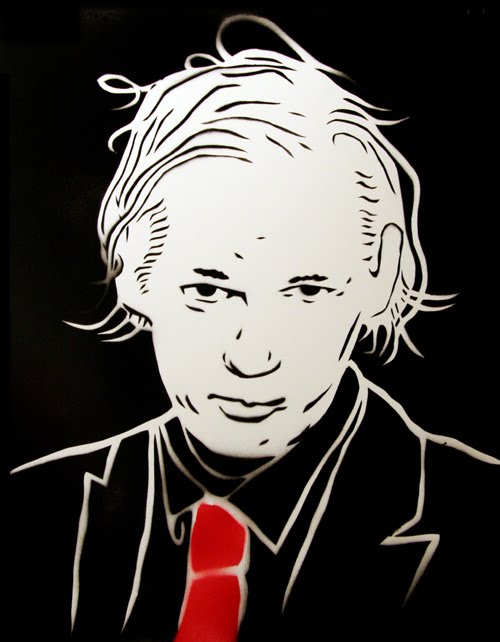
Stencil of Julian Assange from Bold Legume.

Insane Asylum?
From Center Stage to Middle Earth
Is Julian Assange crazy to want to go to Ecuador, of all the obscure places on this globe?
By James McEnteer / The Rag Blog / June 20, 2012

QUITO, Ecuador -- After the UK waived the right of Julian Assange to resist extradition to Sweden, Assange took refuge in the Ecuadorean Embassy in London. He is seeking political asylum in Ecuador to avoid prosecution in Sweden and possible deportation to the United States for exposing state secrets via Wikileaks.

Western media are second-guessing Assange’s choice. Is he crazy to want to go to Ecuador, of all the obscure places on this globe? UK and U.S. officials are already putting pressure on the government of Ecuador to hand Assange over for prosecution for violating the terms of his bail. That pressure will no doubt intensify.

Assange interviewed Ecuadorean President Rafael Correa last month on his syndicated talk program with world leaders. The two men appeared cordial. After Wikileaks exposed U.S. accusations of Ecuadorean police corruption and presidential malfeasance, Ecuador expelled U.S. Ambassador Heather Hodges from the country in 2011.

The United States and Ecuador have been on touchy terms since Correa’s presidency began in 2007. Correa refused to renew the U.S. air base in Manta, on Ecuador’s Pacific coast, choosing instead to open an oil refinery there in partnership with Venezuela’s Hugo Chavez. Correa said at the time that he would be glad to let the U.S. maintain its base in Ecuador if Ecuador were allowed to open a military base in Florida. Rafael Correa is not likely to be easily intimidated.

Critics of Assange’s decision to seek asylum in Ecuador cite Rafael Correa’s crackdown on oppositional media. From the start of Correa’s term in office, media have attacked him politically and personally. He has responded with law suits, prosecutions of individuals and confiscations of media outlets, accusing his critics of colluding with the largest banks against the interests of the majority.

Correa’s censure of local media has brought him international criticism from organizations such as the Committee to Protect Journalists and the Inter American Press Association. Under intense international pressure he pardoned several high-profile journalists who had been fined and sentenced to prison. To oppose a free press would seem a vile act. But opposing a Murdoch-like press, itself a vile species, is much less so. Quoth A.J. Liebling: “Freedom of the press belongs to those who own one,” aka the 1 percent.

Critics who believe Correa’s press crackdown should give Assange pause fail to realize that both men abhor media corruption, especially the complicity of mass media with governmental and financial interests and pressures.

Changes in the new Ecuadorean constitution, written since Correa took office, have empowered the environmental movement on several fronts, on land and at sea. Assange will find Ecuador one of the greenest governments on earth. And with his popularity at a continued unprecedented high, Correa is highly likely to maintain the country’s presidency in the upcoming 2013 elections. So there would be no likely radical change of policy in the foreseeable future.

Though it’s a small country, Ecuador is ethnically and environmentally diverse, with lovely tropical coast, high volcanic Andes, and Amazon rainforest. Indigenous peoples and Afro-Ecuadorians enrich the culture. Increasing numbers of U.S. retirees are choosing to move here. So while Ecuador may seem like a “last resort” for Julian Assange, he will actually have a number of resorts -- and climates -- from which to choose.

Mr. Assange will also find more than adequate high-speed Internet connections available, at least in the urban areas. It’s not exactly a hardship post. And at least some of us who have chosen to live in Ecuador would be proud to have Julian Assange as a neighbor. There’s a perfectly comfortable two-bedroom apartment downstairs from us that’s currently available.

Julian, come on over!

[James McEnteer is the author of Shooting the Truth: the Rise of American Political Documentaries (Praeger 2006). He lives in Quito, Ecuador. Read more of James McEnteer's articles on The Rag Blog.]

The Rag Blog

[+/-] Read More...

09 May 2012

BOOKS / Ron Jacobs : Rules are Rules: 'The Passion of Bradley Manning'


Rules are rules as any fool can see: 
'The Passion of Bradley Manning'

By Ron Jacobs / The Rag Blog / May 9, 2012

[The Passion of Bradley Manning: The Story of the Suspect Behind the Largest Security Breach in U.S. History by Chase Madar (2012: OR Books); Paperback; 190 pp.; $15.]

I remember the very first time I saw the Wikileaks-released video filmed from a U.S. gunship showing the murder of a dozen unarmed civilians including two journalists. The video proved the true brutality of the U.S. occupation of Iraq and the distressing disregard for human life common among U.S. soldiers.

Sadly, I wasn’t shocked or surprised at what I saw. Even after having heard about such incidents in conversations with returning veterans, the visual evidence was still quite disturbing to watch.

That video was the first time most Americans had heard about Wikileaks. Not long after, the name of Bradley Manning also entered the U.S. consciousness. He would be accused of releasing that video and thousands of other documents relating to the U.S. wars on Iraq and Afghanistan, along with thousands of diplomatic cables describing in oftentimes explicit detail the crimes and morally questionable actions and words of Washington officials.

Soon, Mr. Manning would be charged with treason and aiding the enemy (among other charges) for his actions. He is currently on trial in a U.S. military court located at Fort Meade, MD. and faces life imprisonment. It is my belief that only an immense and broad popular movement could possibly change that fate.

Bradley Manning’s decision and the subsequent reaction is the subject of a newly published book by civil rights attorney and commentator Chase Madar. This book, titled The Passion of Bradley Manning: The Story of the Suspect Behind the Largest Security Breach in U.S. History, presents Manning’s decision in the context it was meant to be understood: as a political act by a man who saw his duty to humanity to be greater than his orders to protect the Pentagon and politicians that sent him and thousands of other GIs to war.

Madar attacks the very system of secrecy Manning is charged with violating. He details the overzealous use of secret and top secret classifications by government officials, calling it a “tragic, bloated farce.” He questions the use of the Espionage Act to charge Manning and other men whose actions are not about aiding the enemy, but about exposing the misdeeds of the U.S. government.

In discussing the frequent use of strategic leaks by government officials to get a piece of legislation approved, Madar surmises that Manning’s biggest mistake is that, unlike those government officials, he didn’t break the law properly.

What did the documents Manning sent to Wikileaks contain? While it is impossible to even begin to summarize the millions of words in those documents in the brief space of Madar’s text, he does list the basics of some of the content.

The documents showed a brutal pacification campaign in Afghanistan where civilian deaths were all too common and sometimes intentional. They acknowledged massive civilian casualties from U.S. fire in Iraq and detailed Washington’s retail diplomacy with the Vatican hoping to convince the Holy See to call the U.S. wars just.

 In other areas, the diplomatic cables exposed the role of the U.S. Embassy in Haiti in fighting attempts to raise the minimum wage there to 61 cents an hour and U.S. complicity in covering up Israeli atrocities in Gaza.

Yet, despite the revelations they contained, the U.S. government has been unable to prove that the leaks harmed any individual. Unfortunately, neither have they changed the essence of U.S. policy.

After acknowledging this, Madar writes about two leaks that probably did matter. One was a 1968 leak by Daniel Ellsberg to presidential candidate Robert F. Kennedy that detailed the Johnson administration’s plans to expand the U.S. war to Laos and Cambodia. The leak and Kennedy’s revealing it probably prevented that expansion under LBJ. Of course, Nixon wasted little time in doing exactly what Johnson didn’t do.

Another more recent example occurred in 2003 when the national intelligence assessment of Iran’s nuclear weapons capability was leaked. This document stated clearly that Iran had no nuclear weapons and was not building any at the time. That leak probably prevented the U.S. from attacking Iran.

Like it or not, since his arrest Manning's treatment has been shameful. His imprisonment, which includes solitary confinement and forced nakedness, is nothing short of torture. Indeed it has been condemned as such by the German Bundestag and several other individuals in European governments and even some high ranking U.S. officials.

Madar’s discussion of Manning's treatment is revealing and likely to garner a number of denials by liberals and neocons in the halls of power. This is especially true when he argues against the view promulgated by U.S. liberals that the treatment is an aberration.

The fact is, writes Madar, the abuses experienced by Manning and by prisoners in U.S.-run prisons in Guantanamo Bay, Iraq, and Afghanistan are also commonplace in U.S. prisons. Furthermore, torture is a common occurrence in U.S. jails at all levels of the penal system.

In the early 1970s Kris Kristofferson recorded a song whose chorus includes the lines, “The law is for protection of the people/ Rules are rules as any fool can see...” The song proceeds to show the use of this maxim by the powers that be to lock up those that disrupt their rule. The sarcasm of the lyrics continues, pointing out how laws are not only applied unequally, but are often written only to protect the wealthy and powerful. If Kris Kristofferson were to add a verse to his tune in 2012, it could be about Bradley Manning.

When pressed to explain the charges arrayed against Manning, the reason given most often is that he broke the rules regarding classified information and that is reason enough. As Madar points out over and over in his book, these rules are broken quite often by government officials in the pursuit of certain policies and those violations are rarely challenged.

Furthermore, and considerably more appalling, is the reality that the atrocities and diplomatic maneuverings revealed in the documents Manning released are not illegal. Why? Simply put, because the laws are written by the warmakers and profiteers. So, those who reveal the machinations of the powerful are more likely to go to prison than those who kill, torture, bribe, and steal in the name of empire.

Simultaneously an indictment of a government obsessed with secrecy and a nation addicted to war, The Passion of Bradley Manning is also a concise and clear explanation of who Bradley Manning is. It explains why he risked his life and future by committing the overtly political act of exposing his government’s crimes and lies.

Perhaps most importantly, it is a call to us to act not only in defense of Manning, but in defense of our futures.

[Rag Blog contributor Ron Jacobs is the author of The Way The Wind Blew: A History of the Weather Underground. He recently released a collection of essays and musings titled Tripping Through the American Night. His latest novel, The Co-Conspirator's Tale, is published by Fomite. His first novel, Short Order Frame Up, is published by Mainstay Press. Ron Jacobs can be reached at ronj1955@gmail.com. Find more articles by Ron Jacobs on The Rag Blog.]

The Rag Blog

[+/-] Read More...

06 July 2011

Richard Raznikov : Bradley Manning and the Obama Grand Jury

Bradley Manning. Art from Rossi Projects.

Uses of the grand jury system:

Feds move on Bradley Manning
Anyone who might expose inconvenient 'secrets' -- truths -- is an enemy of the state, and what is being done to Bradley Manning, right in front of us, is meant to discourage and to intimidate.
By Richard Raznikov / The Rag Blog / July 6, 2011

Once upon a time, the grand jury was a safety device, a mechanism through which members of a community, behind closed doors, could review the evidence being gathered by a prosecutor and ensure that the rights of the individual were protected.

Predictably, humans being what we are, this intention was long ago subverted when prosecutors discovered that grand juries could be brought to do pretty much anything since the evidence they see is controlled by the state and the targets of the state have no lawyers present to help them.

The Obama government has empaneled a grand jury in Alexandria, Virginia. Since it might have chosen any venue, Alexandria is especially fortuitous for the prosecutors because its population has the highest concentration of government employees in the nation.

Obama is going after Bradley Manning, the Pfc. accused of leaking documents, including the infamous video of U.S. soldiers aboard an Apache attack helicopter joyously committing murder, to Wikileaks, and his Justice Department is using this grand jury to do it.

The U.S. government doesn’t want the American people to know what it’s doing. That is perfectly understandable since much of what it is doing won’t stand the light of day.

Bradley Manning has been in custody, without official charges and without being given any of the ordinary rights of an accused, for more than a year. Much of that time was spent at Quantico, Virginia. He was recently moved to Leavenworth, Kansas. The conditions of his imprisonment have been condemned as torture and as a violation of international law by Amnesty International and other such organizations. It is quite plain that the Obama government’s policy has been to destroy him psychologically since it cannot break him lawfully.

I have no idea whether Manning was the main source of the treasure trove of "secret" documents Wikileaks has been releasing. Whoever did this is a hero to the human race. In the U.S., however, rattle-brained pols such as Mike Huckabee are calling him a traitor and demanding that he be executed.

The Alexandria grand jury has been taking testimony from people who themselves are being deprived of their rights. Witnesses are issued “immunity certificates” which nullify their 5th Amendment right against self-incrimination, which coerces compliance with the government’s operation.

The U.S. government doesn’t want the American people to know what it’s doing because if that were to happen there might be serious consequences.

During the Vietnam War, shortly after the Tet Offensive in early 1968, a CBS camera captured video of the Saigon Police Chief summarily executing a bound suspect, shooting him in the head. Although the American people had seen much of the war on television and certainly knew of its brutality, something about this particular film registered with surprising power. Perhaps it was because it is one thing to hear or read of something, to "know" it intellectually, and another to witness it.

The stunning Wikileaks video which recorded the cold blooded murder of more than a dozen innocent people, including several who had stopped their van to try to aid the wounded, and which included the voices of the crew -- U.S. soldiers asking for permission to shoot and exulting in their kills -- was an ugly contradiction to the bland, phony “Support Our Troops” propaganda with which we are daily assaulted in the mass media.

The Obama government did not investigate the killings or punish the perpetrators; it sought to find and punish those who made it public.

Even now, even with the publication of much of the Wikileaks revelations in some areas of the U.S. and on the internet, it is not at all widely known that the U.S. government and the Pentagon have been systematically covering-up the enormity of the civilian deaths in Iraq. Internal Pentagon documents show that more than 100,000 such deaths have simply gone unrecorded in the figures released to the public, although the actual numbers are internally collected.

During the Vietnam era, the military cooked the books to show far more "enemy" dead than was true in order to make it look like the war was being won. Today, the books are being cooked to make civilian deaths disappear as though they did not happen.

Control of the news is vital to any government which is undemocratic and wishes to disguise what it is doing. When the information escapes into the public space, the lies which support tyranny begin to fail. This is what has happened in much of the Middle East, and although the western media never mentions it, some of the Wikileaks exposure has helped fuel the pro-democracy movements in Egypt, Syria, and elsewhere.

In America there has been a concerted effort to control the news, both through the privatization of the public space -- ownership of CNN, NBC, and all the rest in few, corporate hands -- and by suppression by the government and its agents of dissent.

Anyone who might expose inconvenient "secrets" -- truths -- is an enemy of the state, and what is being done to Bradley Manning, right in front of us, is meant to discourage and to intimidate.

By the way, a second federal grand jury has been set up by the Obama regime, this one investigating “antiwar” activists.

Two days ago, the nation’s birthday celebration. Hope you enjoyed the fireworks.

[Richard Raznikov is an attorney practicing in San Rafael, California. He blogs at News from a Parallel World.]

The Rag Blog

[+/-] Read More...

17 January 2011

Marc Estrin : The Ethics of Infiltration

Cartoon from Brainstuck.com.

THE ETHICS OF INFILTRATION

By Marc Estrin / The Rag Blog / January 17, 2011

We began two weeks ago with Hallelujah in the mall, and last week contrasted that with theatrical infiltrations less in service to consumer capitalism.

When I began publishing these in various theater journals, I was met with a storm of protesting letters concerning my unethical “manipulation” of the poor bystanders. I wrote a piece in response describing what I thought to be a continuum of manipulations, from those which decreased understanding and degrees of freedom to those which increased them.

It might be good to look at such a continuum in the light of what is going on today. Let's start with the bad news:

A recent article by George Monbiot reports a training session organized by the right wing libertarian group, American Majority on "How to Manipulate the Medium":
Here’s what I do. I get on Amazon; I type in “Liberal Books." I go through and I say "one star, one star, one star." The flipside is you go to a conservative/libertarian whatever, go to their products and give them five stars... This is where your kids get information: Rotten Tomatoes, Flixster. These are places where you can rate movies. So when you type in “Movies on Healthcare," I don’t want Michael Moore’s to come up, so I always give it bad ratings. I spend about 30 minutes a day, just click, click, click, click... If there’s a place to comment, a place to rate, a place to share information, you have to do it. That’s how you control the online dialogue and give our ideas a fighting chance.
On a wider scale, we have the current Israeli government support for a special undercover team of workers paid to surf the internet and spread positive news about Israel. The deputy director of the Foreign Ministry's hasbara ("public diplomacy," aka propaganda) department has admitted the team will be working undercover:
Our people will not say: "Hello, I am from the hasbara department of the Israeli Foreign Ministry and I want to tell you the following." Nor will they necessarily identify themselves as Israelis, he said. They will speak as net-surfers and as citizens, and will write responses that will look personal but will be based on a prepared list of messages that the foreign ministry developed.
The new team is expected to increase the ministry’s close coordination with a private advocacy group, giyus.org (Give Israel Your United Support). About 50,000 activists are reported to have downloaded a program called Megaphone that sends an alert to their computers when an article critical of Israel is published. They are then supposed to bombard the site with comments supporting Israel.

A justification for much of this -- a story we broke on The Rag Blog -- was shamefully enunciated by our own government's Cass Sunstein -- Obama's Harvard Law School bud, and recently appointed Administrator of the White House Office of Information and Regulatory Affairs.

Writing in a scholarly journal, (J. Political Philosophy, 7 (2009), 202-227), Sunstein proposes the following:
[W]e suggest a distinctive tactic for breaking up the hard core of extremists who supply conspiracy theories: cognitive infiltration of extremist groups, whereby government agents or their allies (acting either virtually or in real space, and either openly or anonymously) will undermine the crippled epistemology of believers by planting doubts about the theories and stylized facts that circulate within such groups, thereby introducing beneficial cognitive diversity.
From cognitive infiltration of websites, groups and meetings, it is a short enough step to the entrapments by agents provocateur we read about so commonly today. The missteps of suckered individuals have enormous life consequences -- for them, and for all of us -- in the age of Patriot Act paranoia and power.

If these kind of infiltrations populate one end of the continuum, what is the other end – the “good” end?

The most obvious current example lies in the operation of Wikileaks and the brave individuals that feed it sequestered material. A person working in a dishonest, destructive organization has every right to transform him or herself into an infiltrator, making available to Wikileaks or other publicity groups secret material the organization would otherwise have hidden.

As Julian Assange wrote on the Wikileaks homepage, “The goal is justice; the method is transparency.” It is paradoxical that it takes invisible infiltration to create public transparency, but there it is, and the effectiveness of this tactic can no longer be in question. Nor can the public good resulting.

While the theatrical infiltrations I described last week may be trivial compared to these larger examples, both good and bad, they do raise the question of whether all arts -- Art itself -- does not function as an infiltration.

One innocently goes to a bookstore to buy a book. But the contents of that book, if it be a good one, will infiltrate and infect one's heartmind. The infiltrating virus will lie within, creating biopsychical response, spiritual molecules unlabeled, unacknowledged, perhaps unknown, but potentially agents provocateur for new thinking and action.

It is with this infiltrating image in mind that my wife, Donna, and I have recently begun a new publication project called Fomite. A fomite is a medium capable of transmitting infectious organisms from one individual to another.
"The activity of art is based on the capacity of people to be infected by the feelings of others.” -- Tolstoy, What is Art?
Art, writing, music are the kinds of infiltrations which -- if ethically and mindfully done -- have the capacity to increase, not decrease, degrees of freedom.

[Marc Estrin is a writer, activist, and cellist, living in Burlington, Vermont. His novels, Insect Dreams, The Half Life of Gregor Samsa, The Education of Arnold Hitler, Golem Song, and The Lamentations of Julius Marantz have won critical acclaim. His memoir, Rehearsing With Gods: Photographs and Essays on the Bread & Puppet Theater (with Ron Simon, photographer) won a 2004 theater book of the year award. He is currently working on a novel about the dead Tchaikovsky.]

Also see: And see:
The Rag Blog

[+/-] Read More...

21 December 2010

Danny Schechter : WikiLeaks and the Fetish of Secrecy

Graphic from APS.

Wikileaks and the secrets that deceive us
It's the age-old battle between our right to know and their right to keep us from knowing.
By Danny Schechter / The Rag Blog / December 21, 2010

In the days of Stalin’s Russia, not only would dissidents “disappear” but also, even in the pre-digital era, photographs of officials at May Day reviewing stands would be erased from photographs when their political stars fell. Our own “Kremlinologists” would know who was in, and who was out by comparing last year’s pictures with this years.

That’s one way of concealing information.

Just last week Republicans on the Financial Crisis Inquiry Commission pushed to have certain words removed from the report they were writing because they posed a conflict to their view that only the government was to blame for the financial collapse

Explained economist Paul Krugman,
Last week, reports Shahien Nasiripour of The Huffington Post, all four Republicans on the commission voted to exclude the following terms from the report: "deregulation," "shadow banking," "interconnection," and, yes, "Wall Street."

When Democratic members refused to go along with this insistence that the story of Hamlet be told without the prince, the Republicans went ahead and issued their own report, which did, indeed, avoid using any of the banned terms.
In our media today, omission of images and ideas is as key to sanitizing the news as is commission, What is not reported or perhaps even known is often more important than stories that are twisted by bias.

Enter WikiLeaks and an age-old battle between our right to know and their right to keep us from knowing. Its critics make a fetish about keeping secrets as if it is a holy duty and not a system of keeping the public uninformed about what their government is doing in its name.

The public has a right to know if officials are saying one thing in private and another in public, if they are concealing information or just plain lying.

The Pentagon Papers showed us that wars could be waged deceptively, based on deliberate falsehoods. WikiLeaks revelations about the Iraq and Afghanistan wars tell a similar story. We have learned how torture and civilian deaths were pervasive -- and covered up.

Veteran investigative reporter Bob Parry argues that in the national security area, journalists -- and the people -- need leaks from officials of conscience.

He writes:
Whatever the unusual aspects of the case, the Obama administration’s reported plan to indict WikiLeaks founder Julian Assange for conspiring with Army Pvt. Bradley Manning to obtain U.S. secrets strikes at the heart of investigative journalism on national security scandals.

That’s because the process for reporters obtaining classified information about crimes of state most often involves a journalist persuading some government official to break the law either by turning over classified documents or at least by talking about the secret information. There is almost always some level of “conspiracy” between reporter and source.

Contrary to what some outsiders might believe, it’s actually quite uncommon for sensitive material to simply arrive “over the transom” unsolicited. Indeed, during three decades of reporting on these kinds of stories, I can only recall a few secret documents arriving that way to me.
It’s not just the government that hides behind secrecy rules it puts in place. The private sector does too -- with the complicity of much of the media, which did not warn us about the financial crisis that was building. We didn’t learn about the pervasive fraud in the banking and real estate industries and still don’t know the full extent of the crimes of Wall Street.

Do we have to wait for historians to tell us that the stories we are being told are a crock?

Anyone remember reading about the Spanish American war? That’s the one which also marked the beginnings of “yellow journalism” when screaming headlines and falsified photos were used to mobilize the public for war.

Back then, at the turn of the last century, an American battleship, the USS Maine, sank in Havana Harbor. The incident sparked a battle cry, “REMEMBER THE MAINE.” We were told that “THEY” sank it. The incident led to war which later spread to the Philippines at a cost of six million lives.

Eighty years later, a submersible submarine went down to the remains of the Maine on the harbor floor. What they found was that no one -- no terrorists, no Spaniards, no Cubans, nobody sank the Maine. There had been an accident in the engine room. The whole war was based on a well publicized event that never happened.

If we had known that at the time, many lives would have been saved and U.S. foreign policy might not have gone in an imperial direction.

So, back to today:

What do we gain from persecuting and prosecuting Bradley Manning who was among three million people with access to the diplomatic cables we are now reading about? What will we gain by jailing or killing (as some right wingers advocate) Julian Assange, who is already being called “the Che Guevara of the Information Age”?

The CIA’s murder of the original Guevara created a global martyr whose image is still among the most popular icons in the world. Guevara had his own problems with hostile women. One, Molly Gonzales, tried to break through barricades upon his arrival in New York with a seven-inch hunting knife. He later became famous for saying, “the true revolutionary is guided by a great feeling of love."

Assange is being accused of sexual crimes in Sweden, a country, ironically, recently condemned by Amnesty International for not enforcing its own laws against rape. Now, the WikiLeaker-in-chief, is being targeted by the leak of a Swedish police document detailing charges against him. (They are charges, not facts, and may be serious under Swedish law.)

The ongoing and well-orchestrated war on WikiLeaks is also outraging millions worldwide who see the United States as a secretive and manipulative colossus that lives on lies and deception.

For many, this issue has reached a level of hysteria which, like the “Red Hunts” of the 1920s and the commie “crimes” of the cold war era, will only bring more shame to a Washington desperate to change the story away from the content of the leaked cables to allegations of wrongdoing by Assange. The Administration is also virtually torturing the man who dumped the documents, Bradley Manning, in Gitmo-like conditions, in an effort to turn hum against Assange. He has yet to be tried.

We can’t put the leaks genie back in the bottle. We might do better reflecting on the meaning of these disclosures for our democracy and media. The big secret is the one we don’t want to see: that we are building support and respect for WikiLeaks even as officials fulminate against it.

["News Dissector" Danny Schechter is a journalist, author,
Emmy award winning television producer, and independent filmmaker. Schechter directed Plunder: The Crime of Our Time, and a companion book, The Crime of Our Time: Why Wall Street Is Not Too Big to Jail. Contact him at dissector@mediachannel.org.]

The Rag Blog

[+/-] Read More...

20 December 2010

Marc Estrin : Kicking the Dog

Image from Photobucket.

Passing of the lantern:
Kicking the dog


By Marc Estrin / The Rag Blog / December 20, 2010

So Julian Assange is now without his passport, braceleted under house arrest, waiting for the Wheels of Injustice to slowly grind. At this point, his story is not so much that of killing the messenger (though that is what many in the U.S. are calling for), as that of kicking the dog.

The dog in question was Julian’s close ancestor, Diogenes, a contentious fanatic foolish enough to spend his life with a lantern, looking unsuccessfully for "an honest man." Some say he sought “a human being.” His writings did not survive, but there are legends.

Notorious for his provocative behavior, people called him a dog, a nickname he embraced. “Other dogs,” he said, “bite their enemies. I bite my friends to save them.”

He wasn’t kind to his enemies either. At a sumptuous dinner given by a wealthy man, a guest became so outraged by Diogenes' behavior that he began to throw bones to “the dog." The philosopher got up, lifted his leg and toga, and took a leak on him.

Like Assange’s, Diogenes' life was a relentless campaign to promote reason and virtue, and to debunk the values and institutions of a corrupt society. In doing so he disregarded laws, customs, conventions, public opinion, reputation, honor and personal dishonor.

Political authority was a main target for both -- its folly, pretense, selfishness, vanity, self-deception, corruption, and artificiality of conduct. Diogenes said: “Those who have virtue always in their mouth, and neglect it in practice, are like a harp which emits a sound pleasing to others, while being itself deaf to the music.”

So together the dogs -- Diogenes and Assange -- challenge the false coin of human morality, sharing Socrates' belief that one can be a doctor to men’s souls, and morally improve humanity, while being contemptuous of its behavior.

Sitting alone in a Dickensian prison, or now with wi-fi in a mansion, Assange has not yet been assassinated, as many have called for. He may or may not end like Socrates, taken out by the State. But Diogenes lived a long while, and one hopes the same may be true for Julian Assange.

One legend of Diogenes' death is that, at 90, he committed suicide by holding his breath. If or when Assange does die, it will likely be because he, too, is no longer allowed to breathe, speak, or leak out his documents.

[Marc Estrin is a writer, activist, and cellist, living in Burlington, Vermont. His novels, Insect Dreams, The Half Life of Gregor Samsa, The Education of Arnold Hitler, Golem Song, and The Lamentations of Julius Marantz have won critical acclaim. His memoir, Rehearsing With Gods: Photographs and Essays on the Bread & Puppet Theater (with Ron Simon, photographer) won a 2004 theater book of the year award. He is currently working on a novel about the dead Tchaikovsky.]

The Rag Blog

[+/-] Read More...

15 December 2010

Tom Hayden : Julian Assange and the Lynch-Mob Moment

The lynch mob in Frankenstein. Is Julian Assange next?

The lynch-mob moment:
The frenzy over Julian Assange and WikiLeaks


By Tom Hayden / The Rag Blog / December 15, 2010

We know that conservatives are extremists for order, but why have so many liberals lost their minds and joined the frenzy over Julian Assange and WikiLeaks? As the secrets of power are unmasked, there is a growing bipartisan demand that Julian Assange must die.

Once-liberal Democrat Bob Beckel said on FOX that someone should "illegally shoot the son-of-a-bitch." A few days ago center-liberal legal analyst Jeffrey Toobin said on CNN that Assange is "absurd, ridiculous, delusional, and well beyond our sympathy." The Washington Times called for treating him as an "enemy combatant"; Rep. Peter King of the Homeland Security Committee wants him prosecuted as a terrorist; and of course, Sarah Palin wants him hunted down like Osama Bin Ladin or a wolf in Alaska.

This is a lynch mob moment, when the bloodlust runs over. We have this mad overreaction many times since the witch burnings and Jim Crow, including the Palmer Raids of the 1920s, the McCarthy purges of the 1950s, the Nixon-era conspiracy trials, the Watergate break- ins, and the invasions of Afghanistan and Iraq after 9/11.

Most Americans know now that those periods of frenzy and scapegoating did nothing for our security but damaged our democracy and left in their wake a secretive National Security State.

There's wisdom in expecting calmer heads to prevail in the WikiLeaks matter, but what can be done when the calmer heads are going nuts or hiding in silence?

Do the frothing pundits remember that we have a legal system in which the accused is entitled to due process, legal representation, and the right to a defense? The first obligation of our threatened elected officials, bureaucrats and pundits is to calm down.

No one has died as a result of the WikiLeaks disclosures. But the escalation by the prosecutors in this case could lead to an escalation, with more sensitive documents being released in a retaliatory spiral of this first cyber-war. Imprisoning the messenger will amplify his message and further threats of execution.

I can understand the reasonable questions that reasonable people have about this case. It is clearly illegal to release and distribute the 15,652 documents stamped as "secret." Why should underground whistleblowers have the unlimited right to release those documents? There is a risk that some individuals might be harmed by the release? There is a concern that ordinary diplomatic business might be interrupted.

All fair questions. These concerns have to be weighed against two considerations, it seems to me. First, how important is the content of the documents? And how serious is the secrecy system in preventing our right to know more about the policies -- especially wars -- being carried out in our name? And finally, is there a reasonable alternative to letting the secrets mount, such as pursuing the "transparency" agenda, which the White House purports to support?

Let me weigh these questions with regard to the wars in Iraq, Afghanistan, Pakistan, Yemen, and the "Long War" scenario that has occupied my full attention these past nine years.

It will be remembered that the Iraq War was based on fabricated evidence by U.S. and British intelligence services, the Bush-Cheney White House, and even The New York Times through the deceptive reporting of Judith Miller. The leading television media invited top military officials to provide the nightly narrative of the war lest their be any doubts in the mesmerized audience.

Secrecy and false narratives were crucial to the invasions, special operations, renditions, tortures, and mass detentions that plunged us into the quagmires where we now are stranded. The secret-keepers were incompetent to protect our national security, even when cables warned of an immanent attack by hijacked airliners.

The secrecy grew like a cancer on democracy. Earlier this year, the Washington Post reported in "Top-Secret America" that there were 854,000 people with top- security clearances. [William Arkin, Dana Priest, "Top Secret America," Washington Post, July 19, 2010] That was the tip of the iceberg. The number of new secrets rose 75% between 1996 and 2009, to 183, 224; the number of documents using those secrets has exploded from 5.6 million in 1996 to 54.6 million last year. [Time, December 13, 2010] The secrecy cult appears uncontrollable: the Clinton executive order 12958 [1995] gave only 20 officials the power to stamp documents top-secret, but those 20 could delegate the power to 1,336 others, while a "derivative" procedure extended the power to 3 million more officials and contractors. [Time, December 13, 2010]

The 1917 U.S. espionage statute requires that Assange received secret documents and willfully, with bad faith, intended to harm the United States by releasing "national defense information." That's a tough standard. Perhaps in order to close what U.S. Attorney General Eric Holder describes as "gaps in our laws," the State Department sent a letter demanding that Assange cease the releases, return all classified documents and destroy any records on WikiLeaks databases. [Washington Post, November 30, 2010]

These are difficult legal hurdles for the Justice Department under the First Amendment, but, according to a source close to the defense with experience in such cases, it seems clear that the U.S. government will prosecute Assange with every tool at their disposal, perhaps even rendition.

"What President Obama needs is a photo of Assange in chains brought into a federal court," the source said.

[U.K. prosecutors seeking to overturn a ruling granting bail to Assange will have their appeal heard by a London judge tomorrow, December 16.]

Should there be an attempt to extradite Assange, he has the right to appeal to the European Court of Human Rights.

Assange has a very strong base of support in London where public anger over the fabrications that led to war still runs high. An extradition fight in London could carry on for weeks, providing an important platform for the defense. Or the UK government could take the risk of an accelerated emergency deportation process to send him to Stockholm, or even the U.S. in the most extreme scenario.

If Assange winds up in Stockholm, it could take several weeks to fight his way through a bizarre and complicated sexual harassment trial. Anything is possible there, from all charges being dropped, to the finding of a technical infraction, to jail time. Or Sweden could make an emergency finding to extradite him straight to the U.S., risking an adverse public reaction for serving as to a handmaiden of the Pentagon.

In the atmosphere of hysteria ahead, it is important for peace and justice advocates to remember and share what Americans owe to Julian Assange and WikiLeaks.
  1. WikiLeaks has disclosed 390,136 classified documents about the Iraq War and 76,607 about Afghanistan so far. No one died as a result of these disclosures, one of which revealed another 15,000 civilian casualties in Iraq which had not been acknowledged or reported before;
  2. Fragmentary orders [FRAGO] 242 and 039 instructed American troops not to investigate torture in Iraq conducted by America's allies;
  3. The CIA operates a secret army of 3,000 in Afghanistan;
  4. A secret U.S. Task Force 373 is assigned to nighttime hunter-killer raids in Afghanistan;
  5. The U.S. ambassador in Kabul says it is impossible to fix corruption when our ally is the corrupt entity;
  6. One Afghan minister alone carried $52 million out of the country;
  7. U.S. Special Forces operate in Pakistan without public acknowledgment, apparently in violation of that country's sovereignty;
  8. America's ally, Pakistan, is the chief protector of the Taliban in Afghanistan.
  9. Following secret U.S. air strikes against suspected al-Qaeda militants, Yeme's President Ali Abdullah Saleh told General David Petraeus, "We'll continue saying the bombs are ours, not yours."
The secretive wars exposed by WikiLeaks will cost $159.3 billion in the coming fiscal year, and several trillion dollars since 2001. The American death toll in Afghanistan will reach 500 this year, or 50 per month, for a total of 1,423, and 9,583 wounded overall -- over half of the wounded during this year alone. The Iraq War has left 4,430 U.S. soldiers dead and 32,000 wounded as of today. The civilian casualties are ignored, but range in the hundreds of thousands of Iraqis, Afghans, and Pakistanis.

Is it possible that Julian Assange is the scapegoat for arrogant American officials who would rather point the fingers of blame than see the blood on their own hands? What else can explain their frenzy to see Assange dead?

It may be too late to prevent an escalation. The lynch mob is rabid, terrorized by what they cannot control, completely out of balance, at their most dangerous. If they realize their darkest desires, they will make Assange a martyr -- a "warrior for openness" -- in the new age now beginning. A legion of hackers are fingering their Send buttons in response, and who can say what flood they may release?

The trial of Julian Assange is becoming a trial of secrecy itself. Wherever the line is drawn, secrecy has become the mask of power, and without new rules, the revolt of the hackers will continue.

[Tom Hayden is a former California state senator and leader of Sixties peace, justice, and environmental movements. He currently teaches at Pitzer College in Los Angeles. His latest book is The Long Sixties. This article was also published at The Nation and Progressive America Rising.]

The Rag Blog

[+/-] Read More...

14 December 2010

Leah Wilson : Imperialist Uses of WikiLeaks

WikiLeaks cables were used by corporate media to defame the government of Salvadoran President Mauricio Funes. Photo from ESAhora.

Wikileaks, El Salvador, and imperialist interests
How corporate media turned a diplomatic crisis into a political advantage for the U.S.
By Leah Wilson / The Rag Blog / December 14, 2010

SAN SALVADOR -- Since the “Cablegate” leaks were first announced, I have been championing Wikileaks and Julian Assange as at the forefront of the struggle for government transparency. I considered the release of these cables a major blow to the Empire, exposing the unsavory practices of U.S. foreign policy and its arrogant, hegemonic worldview.

The cables I was reading were mostly just providing proof that the U.S. was consciously doing what we already knew it was doing: legitimizing the Honduran coup despite being fully aware it was an illegal coup d’état, trying to isolate Venezuela and Cuba, pressuring foreign governments to not investigate war crimes in Iraq and Afghanistan, spying on heads of state and foreign functionaries, etc.

And then the first cables that mention El Salvador were published by the Spanish online news source ElPais.com. I was in a San Salvador pizzeria Tuesday night when the TV that had only been background noise up until that point grabbed my attention: “Breaking News: Wikileaks cables call President Funes’ government schizophrenic.”

At the end of November Salvadoran newspapers began reporting that 1,119 of the more than 250,000 cables leaked as part of Cablegate mentioned El Salvador. My friends and I were waiting for the first ones to be published so we could see plain and simple what dirty deeds the U.S. Embassy had been up to in El Salvador.

On Tuesday night, we got our wish, but we should have known to be careful what we wish for. What I saw on the TV news and read in the newspapers was not about the dirty deeds of the U.S. Embassy, but rather outright defamation of the government of President Mauricio Funes and the leftist party that brought him to power, the Farabundo Martí National Liberation Front (FMLN).

The first five cables that were released by ElPais.com, which apparently also has in its hands the other 1,114 cables mentioning El Salvador, are basically political updates sent to the U.S. by Robert Blau, who was the Charge d’Affaires at the U.S. Embassy in San Salvador at the time. In September 2010 President Obama named the new U.S. Ambassador Mari Carmen Aponte and Blau became the Deputy Chief of Mission, continuing as one of the Ambassador’s close advisors.

His memos contain a barrage of false accusations and distortions about the FMLN and its leaders as well as exaggerated declarations about conflict and tensions between President Funes and the FMLN members that are part of his cabinet. To read more analysis about the actual content of the San Salvador cables and their impact, I suggest you read the communiqué put together by the Committee in Solidarity with the People of El Salvador (CISPES).

Overall, the release of the documents has done nothing more than give more ammunition to the Salvadoran right wing in its ongoing attempt to discredit and undermine the Funes administration and the FMLN. As I said to a friend after reading the initial coverage, “Imperialism sure is astute. It managed to transform a major diplomatic crisis into a political advantage.”

Argentine Marxist Néstor Kohan explains in his book Approaches to Marxism that capitalism is incredibly adaptable. It is constantly entering into crises but these crises in themselves never mark the death of capitalism, it simply adapts and bounces back even more voraciously. The same can be said for U.S. imperialism, currently capitalism’s main tool for global expansion.

[While this falls outside the scope of this article, I would like to point out that Kohan isn’t a fatalist but goes on to explain that organized, mass resistance with an alternative proposal (socialism) is the only thing capable of taking capitalism down.]

Imperialism proved adaptable and the major corporate media sources of the world found a way to avert focus from all the information in the cables that incriminates the U.S. -- both the Obama administration and past administrations -- and channel public attention towards the information that makes the U.S.’s declared and undeclared “enemies” look bad.

To understand how they did this, I will point you to five words that I learned on my first day as a Communications major: “The medium is the message.” What Marshall McLuhan meant when he wrote this phrase that would begin advertising, public relations, and journalism textbooks for decades to come, is that the form in which one presents an idea has more impact than the idea itself. This brings us to how Wikileaks decided to present the more than 250,000 diplomatic leaked cables from around the world.

Wikileaks selected four major international corporate news agencies as the filter for the leaked cables: France’s Le Monde, Spain’s El País, Germany’s Der Spiegel, and Britain’s The Guardian. The Guardian then shared cables with The New York Times, bringing the total number of news agencies to five.

Wikileaks chose not to publish everything on their website so that all the information is transparently available and journalists of all types -- independent, establishment, right leaning, left leaning, etc. -- could then drudge through it, analyze it, and determine what should be reported on.

Instead, five major newspapers are deciding which cables they want us to see and also formulating the first analysis the public receives about what the content of the chosen cables means, perpetuating corporate media’s domination of information.

Let’s return to the San Salvador cables as an example. El País journalist Maite Rico, who wrote the article about the first five released cables, is well known for using her journalistic platform to undermine the Latin American Left. When she’s not omitting information to make Venezuelan President Hugo Chavez look bad, she’s busy fabricating information about the death of Raúl Reyes, a leader of Colombia’s Revolutionary Armed Forces (FARC).

Her false reporting on the Colombian military attack on a FARC encampment in which Reyes was killed was later used to sully the names of leftist leaders throughout Latin America as guilty by association with the FARC. She also published a book called Marcos: the great imposter that does nothing more than defame the leader of the Mexican Zapatista movement.

The examples of her hostility towards Latin America’s leftist leaders go on and on. And this is the person apparently deciding which leaked U.S. Embassy cables about El Salvador we get to see. No wonder the first five released cables contain opinions of the U.S. Embassy that could potentially damage President Funes and the FMLN’s credibility.

I would like to see the cables sent by the U.S. Embassy during the 2004 Salvadoran presidential campaign, when overt intervention by the Ambassador and the U.S. State Department helped turn a close race between the FMLN’s Shafick Handal and the far-right Nationalist Republican Alliance (ARENA) candidate Tony Saca into a decisive victory for the latter. But I have to wait until El País decides they are worthy of reporting.

I would also like to see the cables sent in 2007, when Salvadoran police trained at the U.S.-run International Law Enforcement Academy (ILEA) violently attacked a peaceful protest against water privatization.

And, of course, it would be informative to read the cables sent during the Salvadoran armed conflict, when the U.S. was “advising” and equipping the repressive Salvadoran military as it carried out civilian massacres. I guess I’ll have to wait for those too. I’m not holding my breath.

As long as Wikileaks is letting mainstream corporate media sources decide which cables we get to see and what we should glean from them, those sources are going to publish information in the interest of maintaining the thing that has served their pocketbooks so well up until now -- the status quo.

As David de Ugarte wrote in his editorial for Sociedad de Las indias Electrónicas, "From a state of panic to Wikileaks and why Assange doesn’t make us freer," “At this moment Assange and WikiLeaks occupy a central role in representing the confluence of interests of media corporations and States. It is true that both groups of power briefly enter in friction... but it is precisely because they converge, not because they diverge.”

It is no surprise that five corporate news agencies would serve imperialist interests. So, why would Assange entrust only them with information that has the potential to undermine those interests? I don’t know. We can all speculate on the answer to that question. I just know that it’s the duty of those of us who support alternative media as a method to emancipate ourselves from corporate control of information to speak up and also examine the cables and analysis coming out with a critical eye.

[Austin native Leah Wilson is a solidarity activist and collaborator with the Committee in Solidarity with the People of El Salvador (CISPES). She lives in El Salvador.]

The Rag Blog

[+/-] Read More...

Dave Lindorff : The Strange Case of Interpol's Red Alert

A supporter of Wikileaks founder Julian Assange holds up a placard outside the City of Westminster Magistrates Court in London. Photo from The Hindu / AP.
UPDATE: A British judge granted bail to WikiLeaks founder Julian Assange on Tuesday, saying he must abide by strict bail conditions as he fights extradition to Sweden in a sex-crimes investigation...

Supporters outside City of Westminster Magistrates' Court erupted in cheers when they heard news of the judge's ruling. -- AP / NPR / December 14, 2010
Something is rotten:
The strange case of Interpol's Red Alert
on Julian Assange


By Dave Lindorff / December 13, 2010
The other Interpol Red Alert sought by Swedish prosecutors this year was for Jan Christer Wallenkurtz, a 58-year-old Swedish national wanted on multiple charges of alleged sex crimes and sex crimes against children.
Far be it from me to minimize the issue of rape, but to borrow from the Bard, in the case of the “rape” case being alleged against WikiLeaks founder Julian Assange (technically, Swedish prosecutors say it's not rape, it's "sex by surprise"), currently being held in a British jail without bail pending an extradition request from Stockholm: “Something is rotten in Sweden.”

As I wrote earlier, the alleged sexual crimes that Assange is currently being sought for by a Swedish prosecutor are:

1. Allegedly failing to halt an act of consensual sexual intercourse when his sex partner and host, Anna Ardin, claims she somehow became aware that the condom he was using had “split” and,

2. Having consensual sex with a second woman a few days later without informing her that he had just been with Ardin, and then, a day later, allegedly refusing to return a phone call on his cell phone, when she tried to call him to ask him to take an STD test.

(Assange says he had turned off and was not using his phone for fear he was being traced through it, not that refusing to take a call from a woman one recently slept with should be considered criminal. Cold or even cruel, maybe, but not justification for a rape charge!)

In most countries, including the U.S. and UK, these would not pass the test to be considered a crime, much less qualify as a category of “rape," but Swedish authorities, who in all of this year have only submitted one other request to Interpol for assistance in capturing a sex crimes suspect, asked the international police agency to issue a so-called Red Alert for Assange, who was subsquently asked by police in the UK, where he was staying, to turn himself in or face arrest.

(The other Interpol Red Alert sought by Swedish prosecutors this year was for Jan Christer Wallenkurtz, a 58-year-old Swedish national wanted on multiple charges of alleged sex crimes and sex crimes against children.)

You have to ask, given that Sweden has the highest per-capital number of reported rape cases in Europe, how it can be that only these two suspects -- Wallenkurtz and Assange -- are brought to Interpol.

You also have to wonder how it is that Assange -- charged only with consensual sex “offenses” -- is denied bail by a British court magistrate, despite having several people at his arraignment hearing, including a well-known British filmmaker, ready to post whatever bail might be required to assure his return to court for an extradition hearing, while even people charged with aggressive rape are apparently routinely released on bail in both the UK and Sweden.

Here’s an interesting letter that ran in The Guardian in England, authored by Katrin Axelsson, of the British organization Women Against Rape:
Many women in both Sweden and Britain will wonder at the unusual zeal with which Julian Assange is being pursued for rape allegations. Women in Sweden don't fare better than we do in Britain when it comes to rape. Though Sweden has the highest per capita number of reported rapes in Europe and these have quadrupled in the last 20 years, conviction rates have decreased.

On 23 April 2010 Carina Hägg and Nalin Pekgul (respectively MP and chairwoman of Social Democratic Women in Sweden) wrote in the Göteborgs-Posten that "up to 90% of all reported rapes never get to court. In 2006 six people were convicted of rape though almost 4,000 people were reported." They endorsed Amnesty International's call for an independent inquiry to examine the rape cases that had been closed and the quality of the original investigations.


Assange, who it seems has no criminal convictions, was refused bail in England despite sureties of more than £120,000. Yet bail following rape allegations is routine. For two years we have been supporting a woman who suffered rape and domestic violence from a man previously convicted after attempting to murder an ex-partner and her children -- he was granted bail while police investigated.


There is a long tradition of the use of rape and sexual assault for political agendas that have nothing to do with women's safety. In the south of the U.S., the lynching of black men was often justified on grounds that they had raped or even looked at a white woman. Women don't take kindly to our demand for safety being misused, while rape continues to be neglected at best or protected at worst.
The long arm of the U.S. in this case is hard to miss here.

Especially in view of one of the latest WikiLeaks State Department cables to be disclosed in The New York Times, which in an article on Thursday laid out how the U.S. had strong-armed even the powerful German government into blocking German prosecutors from indicting and requesting the extradition to Germany of 13 CIA agents involved in the illegal kidnapping and renditioning to Bagram prison in Afghanistan of Khaled el-Masri, a German citizen wrongly thought by the CIA to be a terrorist.

El-Masri was kidnapped by these agents in 2003, stripped, bound, placed in an adult diaper with a plug in his rectum, and flown by the CIA to Bagram, where he was repeatedly tortured, sodomized, injected with mind-altering drugs, and held for months, before being simply dropped off by the CIA on an Albanian roadside, after it was determined by the U.S. that a “mistake” had been made.

The U.S. did not want its rendition program and its policy of officially-sanctioned torture disclosed and so it pressed German authorities to drop all prosecution of the agency kidnappers, threatening “the implications for relations with the U.S.” (El-Masri has been barred from suing the U.S. government for damages.)

It strains credulity to believe that the same U.S. government that put such pressure on Germany, a NATO ally, is not behind Swedish prosecutors’ sudden intense interest in this preposterous case of consensual sex and a broken condom -- particularly as the initial prosecutor in the case dropped it after learning that the two women, far from being upset following their nights with Assange, had in one case thrown a party for him following the alleged incident, and in the other, left him in her bed while she went out to buy him breakfast.

(Both women reportedly sent twitters to friends bragging about their conquests, messages they later tried to have expunged from the Twitter system).

It also strains credulity to believe that the denial of bail to this particular suspect by a British court -- particularly given that he is not charged with any violent act, and has no criminal record -- is not the result of behind-the-scenes U.S. pressure.

Indeed, it appears that the U.S. is busy trumping up more serious charges against Assange, with his lawyers saying they are anticipating that the U.S. Justice Department (already reportedly in discussions with Swedish authorities about getting their hands on Assange), is planning soon to charge him under the 1917 Espionage statute, the same law that the Nixon Justice Department tried to use unsuccessfully against Daniel Ellsberg in the Pentagon Papers case. That could explain why efforts are being made to try to keep Assange held in a cell.

It could also explain why Assange is challenging the Swedish extradition request.

Opposition to the Afghan and Irag Wars is intense in the UK and is supported by the overwhelming majority of British citizens, which makes Assange something of a hero in Britain for his WikiLeaks exposes of the ongoing crimes by U.S. and UK forces in those conflicts. British government acquiescence to an extradition order from the U.S. on espionage charges would likely lead to massive opposition by British citizens.

Sweden, on the other hand, which is not a member of NATO, but which has some 500 troops participating in the "NATO" war in Afghanistan, does not face the same kind of popular opposition to its role, and Assange may fear that Sweden, a very small country, could be pressured much more easily to hand Assange over to U.S. authorities, with little resulting fuss from the Swedish public.

Back in the U.S., there has been no move by news organizations to come to Assange’s defense. In fact, the corporate media reaction to this whole issue has been the opposite. For the most part, the Swedish charges, and his arrest in Britain on the basis of the Interpol Red Alert, are reported as being about “rape,” without any explanation of the actual “violations,” which would not even rise to the level of a crime in the U.S.

Meanwhile, most editorial pages are condemning the violation of diplomatic secrecy, not the government’s efforts to shut down a source of important news about government ineptness, malfeasance, and deceit.

Yet if it turns out, as I’m confident it will, that the U.S. government has been the driving force behind both the arrest and imprisonment of Assange, and his extradition to Sweden, and if it turns out, as appears increasingly likely, that the U.S. government has also been behind simultaneous decisions by Visa, MasterCard, Paypal, and several Swiss banks to refuse to handle donations to WikiLeaks, as well as by Amazon, which withdrew Wikileak's access to its cloud data storage system, and a DNS registry which de-registered WikiLeak's URL, publishers and broadcasters, and journalists themselves, should be up in arms defending him.

As I wrote earlier, this kind of attack on a news source for purely political reasons is a threat to the First Amendment as profound as the Nixonian attack on Daniel Ellsberg, and the attempt to block The New York Times from publishing his purloined documents about the origins of the Vietnam War.

Andreas Fink, CEO of DataCell ehf, the Swiss company that has been accepting donations on behalf of Wikileaks via Visa, had this to say about the Dec. 8 decision by Visa to cease processing Wikileaks donations:
The suspension of payments towards Wikileaks is a violation of the agreements with their customers. Visa users have explicitly expressed their will to send their donations to Wikileaks and Visa is not fulfilling this wish. It will probably hurt their brand much much more to block payments towards Wikileaks than to have them occur.

Visa customers are contacting us in masses to confirm that they really donate and they are not happy about Visa rejecting them. It is obvious that Visa is under political pressure to close us down. We strongly believe a world class company such as Visa should not get involved by politics and just simply do their business where they are good at. Transferring money.

They have no problem transferring money for other businesses such as gambling sites, pornography services and the like so why a donation to a Website which is holding up for human rights should be morally any worse than that is outside of my understanding.
Contributions can still be made to Wikileaks and to Assange’s defense by wire transfer and by check and ordinary mail. To find out how to contribute, go here.

By the way, if there is anyone out there working for Visa, MasterCard, Paypal, or any banking organization, or in a government office, who can provide me with evidence that the U.S. has been behind the decision of any of those organizations to freeze out WikiLeaks and destroy it financially, I will guarantee your anonymity at all costs. Please contact me or send me documentation.

[Dave Lindorff is a regular columnist for Counterpunch and has also written for such diverse and seemingly mutually exclusive publications as BusinessWeek, The Nation, Extra!, Treasury & Risk, and Rolling Stone. This article first appeared in This Can't Be Happening and was distributed by Truthout.]

Also see: The Rag Blog

[+/-] Read More...

10 December 2010

Clay Bennett : 'I Feel So Violated'

Political cartoon by Clay Bennett / Chatanooga Times Free Press / Truthout.
CLICK ON IMAGE TO ENLARGE
The Rag Blog

[+/-] Read More...

06 December 2010

John Naughton : The WikiLeaks Backlash and the Culture of the Internet

Political cartoon from The Young Diplomat.

Killing the messenger:
The attack on WikiLeaks
It represents the first really sustained confrontation between the established order and the culture of the internet...
By John Naughton / December 6, 2010

"Never waste a good crisis" used to be the catchphrase of the Obama team in the run-up to the presidential election. In that spirit, let us see what we can learn from official reactions to the WikiLeaks revelations.

The most obvious lesson is that it represents the first really sustained confrontation between the established order and the culture of the internet. There have been skirmishes before, but this is the real thing.

And as the backlash unfolds -- first with deniable attacks on internet service providers hosting WikiLeaks, later with companies like Amazon and eBay and PayPal suddenly "discovering" that their terms and conditions preclude them from offering services to WikiLeaks, and then with the U.S. government attempting to intimidate Columbia students posting updates about WikiLeaks on Facebook -- the intolerance of the old order is emerging from the rosy mist in which it has hitherto been obscured.

The response has been vicious, coordinated and potentially comprehensive, and it contains hard lessons for everyone who cares about democracy and about the future of the net.

There is a delicious irony in the fact that it is now the so-called liberal democracies that are clamouring to shut WikiLeaks down.

Consider, for instance, how the views of the U.S. administration have changed in just a year. On 21 January, secretary of state Hillary Clinton made a landmark speech about internet freedom, in Washington, DC, which many people welcomed and most interpreted as a rebuke to China for its alleged cyberattack on Google. "Information has never been so free," declared Clinton. "Even in authoritarian countries, information networks are helping people discover new facts and making governments more accountable."

She went on to relate how, during his visit to China in November 2009, Barack Obama had "defended the right of people to freely access information, and said that the more freely information flows the stronger societies become. He spoke about how access to information helps citizens to hold their governments accountable, generates new ideas, and encourages creativity." Given what we now know, that Clinton speech reads like a satirical masterpiece.

One thing that might explain the official hysteria about the revelations is the way they expose how political elites in western democracies have been deceiving their electorates.

The leaks make it abundantly clear not just that the U.S.-Anglo-European adventure in Afghanistan is doomed but, more important, that the American, British, and other Nato governments privately admit that too.

The problem is that they cannot face their electorates -- who also happen to be the taxpayers funding this folly -- and tell them this. The leaked dispatches from the U.S. ambassador to Afghanistan provide vivid confirmation that the Karzai regime is as corrupt and incompetent as the South Vietnamese regime in Saigon was when the U.S. was propping it up in the 1970s. And they also make it clear that the U.S. is as much a captive of that regime as it was in Vietnam.

The WikiLeaks revelations expose the extent to which the U.S. and its allies see no real prospect of turning Afghanistan into a viable state, let alone a functioning democracy. They show that there is no light at the end of this tunnel. But the political establishments in Washington, London, and Brussels cannot bring themselves to admit this.

Afghanistan is, in that sense, a quagmire in the same way that Vietnam was. The only differences are that the war is now being fought by non-conscripted troops and we are not carpet-bombing civilians.

The attack of WikiLeaks also ought to be a wake up call for anyone who has rosy fantasies about whose side cloud computing providers are on. These are firms like Google, Flickr, Facebook, Myspace, and Amazon which host your blog or store your data on their servers somewhere on the internet, or which enable you to rent "virtual" computers -- again located somewhere on the net.

The terms and conditions under which they provide both "free" and paid-for services will always give them grounds for dropping your content if they deem it in their interests to do so. The moral is that you should not put your faith in cloud computing -- one day it will rain on your parade.

Look at the case of Amazon, which dropped WikiLeaks from its Elastic Compute Cloud the moment the going got rough. It seems that Joe Lieberman, a U.S. senator who suffers from a terminal case of hubris, harassed the company over the matter. Later Lieberman declared grandly that he would be "asking Amazon about the extent of its relationship with WikiLeaks and what it and other web service providers will do in the future to ensure that their services are not used to distribute stolen, classified information."

This led the New Yorker's Amy Davidson to ask whether "Lieberman feels that he, or any senator, can call in the company running the New Yorker's printing presses when we are preparing a story that includes leaked classified material, and tell it to stop us."

What WikiLeaks is really exposing is the extent to which the western democratic system has been hollowed out. In the last decade its political elites have been shown to be incompetent (Ireland, the U.S., and UK in not regulating banks); corrupt (all governments in relation to the arms trade); or recklessly militaristic (the U.S. and UK in Iraq). And yet nowhere have they been called to account in any effective way. Instead they have obfuscated, lied, or blustered their way through. And when, finally, the veil of secrecy is lifted, their reflex reaction is to kill the messenger.

As Simon Jenkins put it recently in the Guardian, "Disclosure is messy and tests moral and legal boundaries. It is often irresponsible and usually embarrassing. But it is all that is left when regulation does nothing, politicians are cowed, lawyers fall silent and audit is polluted. Accountability can only default to disclosure." What we are hearing from the enraged officialdom of our democracies is mostly the petulant screaming of emperors whose clothes have been shredded by the net.

Which brings us back to the larger significance of this controversy. The political elites of western democracies have discovered that the internet can be a thorn not just in the side of authoritarian regimes, but in their sides too. It has been comical watching them and their agencies stomp about the net like maddened, half-blind giants trying to whack a mole. It has been deeply worrying to watch terrified internet companies -- with the exception of Twitter, so far -- bending to their will.

But politicians now face an agonizing dilemma. The old, mole-whacking approach won't work. WikiLeaks does not depend only on web technology. Thousands of copies of those secret cables -- and probably of much else besides -- are out there, distributed by peer-to-peer technologies like BitTorrent.

Our rulers have a choice to make: either they learn to live in a WikiLeakable world, with all that implies in terms of their future behavior; or they shut down the internet. Over to them.

© Guardian News and Media Limited 2010

[John Naughton is professor of the public understanding of technology at the Open University. This article was originally published in The Guardian, UK, and was distributed by CommonDreams.]

The Rag Blog

[+/-] Read More...

Only a few posts now show on a page, due to Blogger pagination changes beyond our control.

Please click on 'Older Posts' to continue reading The Rag Blog.