Showing posts with label Books. Show all posts

07 January 2014

Alan Wieder : Bill Ayers' 'Public Enemy: Confessions of an American Dissident'

This page has moved.

In his ongoing journey, and with his new memoir, 'Public Enemy,' Bill Ayers continues to bring the radical 'spark' forward.
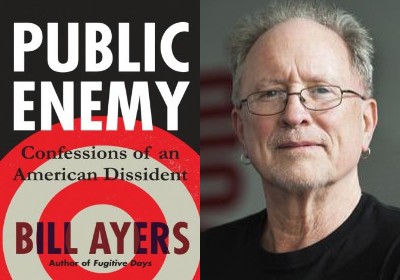
public_enemy and ayers
Image from Uprising Radio.

By Alan Wieder | The Rag Blog | January 7, 2014
Bill Ayers and Bernardine Dohrn will speak at "Underground Goes Overboard," a launch party for TheRagBlog.com, at 7 p.m., Friday, January 17, at the 5604 Manor Community Center in Austin. They will also be Thorne Dreyer's guests on Rag Radio earlier that same day, from 2-3 p.m. on KOOP 91.7-FM in Austin and streamed live. Go here for other stations and times, and for podcast information.
[Public Enemy: Confessions of an American Dissident by Bill Ayers (2013: Beacon Press); Hardcover; 240 pp; $24.95.]

“They just don’t get it.” Yes, the phrase is overused, yet, all too appropriate when addressing the continuing critiques, from both the left and the right, of Bill Ayers.

The recent publication of the second phase of his memoir, Public Enemy: Confessions of An American Dissident (Beacon, 2013), was followed on the “SDS and ‘60s Leftists” page of Facebook by an unthoughtful conversation on Ayers, his comrade and wife Bernardine Dohrn, and the Weather Underground (WO).

Facilitated by George Fish and responding to a negative book review by Jon Wiener, 43 comments followed Fish’s post. Mostly sour, bitter, and ahistorical in tone, the comments provide the antithesis of Ayers’ book and life, that of learning from the past and continuing, in a human and life-affirming way, the ongoing struggle that began for Ayers in the civil rights movement, antiwar movement, Students for a Democratic Society, and then the Weather Underground.

When confronted by a radio interviewer who referred to the subtitle as snide, Ayers softly replied that the entire title was chosen for its irony. Missing both the breadth and depth of Public Enemy, the interviewer, as well as Wiener and other critics, fail to acknowledge the thoughtfulness and energy that Ayers brings to struggle, both past and present.

In this particular book, we alternate between the author’s recollections of first, his experience in the 2008 attempt to demonize Barack Obama because he “palled around with terrorists,” and, second, the years after he surfaced from underground beginning in 1980 from where Ayers left off in his previous book, Fugitive Days.

There are both multiple and complex events, issues, and ideas presented in Public Enemy. A sampling will be discussed in this review.

Recently, South African anti-apartheid struggle leader and Constitutional Court Justice (comparable to the U.S. Supreme Court) Albie Sachs spoke at Pacific University in Forest Grove, Oregon. Talking about his country’s Truth and Reconciliation Commission (TRC), Sachs emphasized the importance of acknowledgement for both personal and political healing.

Acknowledgement causes me to return to the radio interviewer’s portrayal of Confessions of An American Dissident as snide. In fact, irony aside, Ayers responded by talking about acknowledging one particular flaw during his time in WO. He asserted that neither he nor his comrades ever doubted their positions and that by not being skeptical they were arrogant and without reflection.
Doubt is discussed in Public Enemy and Ayers also talks about apologetics within a conceptual framework of an American Truth Commission.
Doubt is discussed in Public Enemy and Ayers also talks about apologetics within a conceptual framework of an American Truth Commission. In both the book and current media interviews, Ayers has continually repeated that neither he nor the WO ever killed anyone in the bombings of buildings.
Not only did I never kill or injure anyone, but in the six years of its existence, the Weather Underground never killed or injured anyone either. We crossed lines of legality to be sure, of propriety, and perhaps even of common sense, but it was restrained, and those are the simple, straightforward facts.
The correct term for Weather Underground bombings, in correspondence to the armed struggle in South Africa, is “armed propaganda.” And like Umkhonto We Sizwe underground soldiers in South Africa, Ayers would welcome the opportunity to answer queries about his WO activities at an American TRC.

In Public Enemy Ayers writes:
America, it seemed to me, was in urgent need of some kind of truth and reconciliation process… We needed a process to understand the truth of the past in order to create the possibility of a more balanced future… Everyone together would have the opportunity to tell their stories of suffering, and the victimizers would be asked why and how they created that misery. Society would have the opportunity to witness all of it in order to understand the extent and depth of the disaster as a step toward putting it behind us and moving forward. In that setting and standing with Kissinger and McCain, McNamara and Kerry, Bush and Cheney, I’d be happy to say exactly what I did, take full responsibility, and bow deeply. But without any chain of culpability whatsoever, I’ll stand on the record, or just stand aside.
While five chapters in Public Enemy present the threats and blacklisting Bill Ayers experienced during and after the 2008 presidential campaign, I will address the topic with brevity as it has already been explored in other reviews. An in-depth description and analysis is portrayed in Maya Schwenwar’s Truthout review, “Bill Ayers Weighs in on Democracy, Selfhood, and His ‘Unrepentant Terrorist’ Alter-Ego.”

Besides endless email threats and having someone actually come to his office at the University of Illinois-Chicago, Ayers was banned from talking on college campuses throughout the country. At the time my colleague at the University of South Carolina, Craig Kridel, the Curator of the Museum of Education, posted a page titled “The Bill Ayers Problem” on the Museum webpage. The page title, like Public Enemy, is ironic and at the time I wrote:
The inequality, unfairness, violence, and global greed are what Bill Ayers has fought against for many years. The fight is every bit as important today as it was during the Civil Rights Movement and the Viet Nam War. And while some people might call me insensitive because I refuse to enter a debate on Bill Ayers as a terrorist, I choose not to speak back to the cries of O’Reilly, Hannity, and Colmes and their nameless comrades because the work Bill Ayers is doing does not need defenders but, rather, supporters and allies that fight for a more just world. Finally, as an academic who works with teachers who fought against apartheid in South Africa, I can’t help but think that the same people who define Bill Ayers as a terrorist would have given that label to Nelson Mandela and his less known comrades during the struggle against the apartheid regime. We know now what history says about that – we can only hope that Bill Ayers and many other people continue their work as progressive educators and activists.
But Bill Ayers does not rail against his detractors in his writing. Rather, while he is critical in a political/personal way of their harassment and silencing and analyzes their actions, his emphasis is a celebration of people who continue the struggle. While the story of the cancellation of his talk at the University of Wyoming is politically important, from Ayers we learn more about the woman who fought for his right to speak. More accurately, she fought for her own free speech.
"I’m going to sue the university in federal court," she told me during our first conversation. "And I’m claiming that it’s my free speech that’s been violated – I have the right to speak to anyone I want to, and right now I want to speak to you." She was young and unafraid, smart and sassy, her dreams being rapidly made and used – no fear, no regret. I liked her immediately. Meg’s approach struck me as quite brilliant – students (and not I) were indeed the injured party.
The University of Wyoming student won the case and Bill Ayers spoke on democracy and education with over 1,000 people at the University. In discussing the event, he also honors his sister’s father-in-law, a retired United Church of Christ minister who drove a couple of hours to Laramie for the talk and told Bill: “‘The Lord moves in mysterious ways,’ he said with a wink and a smile gesturing with his Bible. ‘If any of the crazy Christians get out of hand, he wants me to set them straight.’”

Ayers writes of other cancellations at places throughout the country. The University of Nebraska stands out but only because he was in Tapai at the time and was woken with the news from a dean at three in the morning.

In contrast to Nebraska, there are brave academics at Millersville University and Georgia Southern University where Ayers was welcomed. At Millersville administrators explained that it was their “duty and honor” to have him speak. “It’s not about you personally, it’s about the mission and the meaning of the university.”
Honoring people throughout Bill Ayers’ journey is the stuff of Public Enemy.
Honoring people throughout Bill Ayers’ journey is the stuff of Public Enemy. One of the funniest yet potent tales is the reaction of Ayers’ comrade and friend, Michael Klonsky, when he was invited to give an education conference keynote address. The organization told Klonsky that they had intended to invite Bill Ayers but that he was “too controversial and too radical.” Klonsky scolded the inviter saying: “How dare you ask me to scab on Bill Ayers?” When Ayers thanked him, he replied: “Defending you? I wasn’t defending you, I was defending myself – I was deeply and personally offended when they said that your were too radical, and by implication that I wasn’t too radical. I’m as radical as you are, motherfucker.”

Bill Ayers’ book is about issues, ideas, actions, and people – it is not solely about Bill Ayers. Epsie Reyes was a colleague at the University of Illinois-Chicago. She supported Hillary, not Barack, in the 2008 democratic primaries, and she was one of many people who consoled Bill Ayers after Hillary Clinton first demonized him in a primary presidential debate.

Reyes sent strong emails to both Clinton and the Democratic National Committee “detailing how much money she’d donated and how many weekends she’d devoted to organizing on her behalf, explaining who I really was in her ‘humble opinion,’ and encouraging, then demanding that the campaign apologize to me personally and denounce the smears – or else she would have to rethink her commitments.”

Close friends and colleagues, of course, also came through in both 2001 and 2008. Mona and Rashid Khalidi were both supportive and insightful as were dozens of others. In 2008 there was a surprise call from Edward Said: “Of course it’s painful for you personally, but cringing and going quiet is the worst thing you could do at this moment. Your kids are watching you and your students too and a lot of others. Don’t let them down.”

Said’s message corresponds to the entirety of Public Enemy. Ayers celebrates political struggle and the people who try to sustain the fight. Two quotes come to mind, the first from a speech by Paul Potter referred to in the book. “Don’t let your life make a mockery of your values.” Margaret Meade’s words correspond to Potter’s connecting the personal to the collective. “Never doubt that a small group of thoughtful, committed citizens can change the world. Indeed, it’s the only thing that ever has.”

In addition to the 2001, 2008, and more recent stories, Public Enemy includes portraits from the time Bernardine and Bill came up from underground in 1980. Ayers writes admiringly about his childrens’ pre-school teacher at the time, BJ, whom he refers to as “an inspired early childhood educator.” “She was one of a kind, and everyone knew it.” Ayers’ portrait of BJ brought a response in Ron Jacobs’ Dissident Voice article, “Get Bill Ayers”: “Indeed, the truest hero in the book is the family’s New York child care provider, BJ.”

On Bill’s journey we meet Bernardine’s lawyers Eleanora Kennedy and Michael Kennedy and various other people including Ellie and Robby Meeropol who were Bill’s friends at the University of Michigan. Robby was the son of Ethel and Julius Rosenberg and he was three years old when his parents were executed.

Bernardine and Bill had just adopted Chesa Boudin whose parents, Kathy Boudin and David Gilbert, had been sentenced for murder in the Brinks Robbery in Nyack, New York. Robby explained that there was no road map and that times would be rough for Chesa – honest responses are very much a part of the many vignettes that Ayers presents throughout Public Enemy.
The real heart of the book, however, within the context of continuing struggle, is the authentic portrayal of the Dohrn/Ayers family...
The real heart of the book, however, within the context of continuing struggle, is the authentic portrayal of the Dohrn/Ayers family – Bernardine Dohrn and their sons Chesa, Malik, and Zayd. The book depicts seriousness and humor and mostly respect and admiration. There is a story from the early above ground days that I must include in this review.
Leaving swim class one day, we were swept up into a raucous women-led march heading from Broadway and Fifty-ninth Street toward Times Square. "No more porn! No more porn! No more porn!" we chanted ecstatically, fists pumping and voices rising as we entered the pornography district. It was a feisty and colorful crowd, our attendance just a happy accident, but with Zayd cheerfully perched on my shoulders we were in high spirits and quite pleased to be in cahoots. Soon we spotted a pizza stand along the route, and Zayd was famished from swimming and ready for a slice, so we settled into a booth. Zayd reflected on the parade we’d just left: "That was fun," he said. "Why don’t we want more corn?"
Ayers tells the story of all three sons advising him during 2008 and the respect appears to go both ways. Pages 129 to 131 serve as an illustration as Malik, Zayd, and Chesa join Bernardine in coaxing Bill not to speak with the media – a disposition alien to his being. Malik warns him of ambush and it recalls Mailer’s self-admonitions of never talk to the press – they control the story.
The consensus from them, in line with Bernardine’s steady and consistent basic instinct, was that whatever happened on the web or in the press, we should simply turn away. No comment, no elaboration, no clarification, no response. "Be completely quiet," they said, "and stay calm." "It’s harder then it sounds," Zayd added, looking right at me, "especially for you." True, too true: I tend to have a lot on my mind – who doesn’t? – and I’m genetically wired to speak up and speak out, and not always with considered judgment. My default position, no matter what, is to say something… "You’ll get flattened," they now said in unison.
Bill Ayers remained silent through 2008, but of course, “palling around with terrorists” quietly lives on. There is an ethos throughout Public Enemy, consistently present in the ideas, issues, actions, and people portrayed in the book, amidst everything else – this book is homage to Bernardine Dohrn.

Her strength, thoughtfulness, commitment, and humanity is the spirit of Public Enemy: Confessions of An American Dissident. Whether it is gently chiding Bill with their children or being warmly welcomed back by the judge in Chicago when she surfaced from underground – her humanity is ever present. Political commitment is obvious in Dohrn’s first above ground statement: “This is no surrender. The fight against racism and war continues, and I will spend my energy organizing to defeat the American empire.”

Ayers writes of her actions and dispositions when she was imprisoned at the Metropolitan Correctional Center in New York for refusing to give Grand Jury testimony on the Brinks Robbery. The emotion of being away from her kids but at the same time focused political commitment. There is also a great story of her mother passing on contraband when she visited the prison – a chocolate chip cookie!

There is much more to Public Enemy than the samples that I present. Bill Ayers critiques the Weather Underground and provides much more breadth to the ideas, issues, actions, people, and events he portrays. He also pushes his story to the present and therein lies the further message. Ayers, Dohrn, and many of their WO (and beyond) comrades continue to work for the same issues they have pursued beginning in the sixties.

For Ayers it is education and more and the latter includes working with young activists who continue the fight for the end of racism, class disparity, and imperialism. First in the civil rights movement, then SDS and WO, Ayers was part of the “spark” for a just world. His book is a partial story of continuing to keep that “spark” alive today.

This article was first published at Dissident Voice and was cross-posted to The Rag Blog by the author.

[Alan Wieder is an oral historian who lives in Portland, Oregon. His latest book, Ruth First and Joe Slovo in the War Against Apartheid was published in the United States by Monthly Review Press and in South Africa by Jacana Media. Read more articles by Alan Wieder on The Rag Blog.]

The Rag Blog

[+/-] Read More...

18 December 2013

BOOKS / Alan Wieder : Paul Buhle's 'Radical Jesus: A Graphic History of Faith'

Paul Buhle's 'Radical Jesus':
Comic artists explore the history
and social message of Jesus Christ

By Alan Wieder / The Rag Blog / December 19, 2013
Paul Buhle, the noted historian, author, graphic novel publisher, and editor of Radical Jesus, is Thorne Dreyer's guest on the 200th edition of Rag Radio, Friday, December 20, from 2-3 p.m. (CST). Rag Radio airs and streams live on cooperatively-run KOOP 91.7-FM in Austin, Texas, and is rebroadcast and streamed on WFTE-FM in Mt. Cobb and Scranton, PA, Sunday at 10 a.m. (EST) and on KPFT's HD-3 Channel in Houston, Wednesday at 3 p.m. (CST). The podcast of this show can be found at the Internet Archive.
[Radical Jesus: A Graphic History of Faith. Paul Buhle, Editor; Sabrina Jones, Gary Dumm, Nick Thorkelson, Artists (2013: Herald Press); Paperback; 128 pp; $24.99.]

Paul Buhle is one of the most prolific and insightful critics from the American left. While his topics at first glance appear incredibly eclectic, closer reading uncovers a sharp focus that thoughtfully challenges class disparity, racism, and imperialism in the United States and throughout the world.

The breadth of his work, even if you consider only his collaborative graphic titles, is mind-boggling as the topics include Che, Yiddishkeit, SDS, the Wobblies, Emma Goldman, FDR, the Beats, and Isadora Duncan. And now, in collaboration with artists Sabrina Jones, Gary Dumm, and Nick Thorkelson, comes Radical Jesus: A Graphic History of Faith.

Like Buhle’s prior books, Radical Jesus investigates the inequalities that exist in the world, historically and presently, but this time through a theological lens. After an introduction, the sections of the book are “Radical Gospel,” “Radical History,” and “Radical Resistance.”

As a focus for reading the book we can assume that liberation theology began with Jesus and carries on at the present time. Each section is illustrated by a different artist but is pulled together by both content and style. As Buhle explains in the Introduction: “The book has been designed with a purposeful color progression from black and white in the first section, to a color choice reminiscent of the illuminated texts of the Middle Ages, to the full color of modern times.”

Combining substance and style, the drawings and text constantly switch between social issues of the past and the present. Interviewed by a reporter for the Brown University newspaper, Buhle said that he wrote the book for the young people involved in the Occupy Movement.
Oh, let’s say I was speaking to those young people. I’m not a person who goes to church. But I was speaking to those young people and to others who were looking for some alternative, there’s one page in the comic that says no to either passivity or violence. For some other way to respond to the crises, and you know, Americans by and large, still, have this religious thing, this mystique. It’s good to think of a way to speak to them in this fashion.
There are numerous poignant frames in Radical Jesus; below are some samples. With stark black and white graphics page 23 in the “Radical Gospel” section, by Sabrina Jones, begins with a priest looking at a dead man lying in the street, “unclean -- better keep away!” Another priest does the same but then comes the Good Samaritan who helps the man who isn’t dead -- who is the Christian.

Stories of Jesus and class disparity continue in this section with a distressing sequence on preaching and religious leaders on page 35, “They preach – But they don’t practice.” Reminiscent of of Bishop Tutu’s story of Europeans coming to Africa: “We had the land and they had the bible. Then they said, ‘Let us pray.’ And we dutifully shut our eyes, and when we said amen at the end and opened our eyes, why, they had the land and we had the bible.”

But of course Bishop Tutu said much more. Corresponding to Radical Jesus:
This God did not just talk... He showed himself to be a doing God. Perhaps we might add another point about God -- he takes sides. He is not a neutral God. He took the side of the slaves, the oppressed, the victims. He is still the same even today; he sides with the poor, the hungry, the oppressed, and the victims of injustice.
Gary Dumm did the “Radical History” section of the book with Laura Dumm and others. This section tells the story of dissent beginning in the 14th Century and concluding with the abolitionists. John Wycliffe, the Anabaptists, Quakers, and the Grimke sisters are introduced with many other people who challenged church hierarchy in the name of social justice. On page 63, Buhle collaborates with Dumm on a story called “Escape from Galley Slavery.”
Some martyrs were burned at the stake, others were drowned, decapitated, had their tongues ripped out, or their mouths filled with gunpowder. To go to a violent death with cold determination or even good cheer was to prove to all present that the believer placed ultimate trust in God’s judgment.
However, these executions were ultimately cynical and class disparately vicious.
French and Belgian royal courts sometimes offered ‘banquets’ for the intended victim the day before the execution. In the city hall, the accused would be compelled to take the seat of honor between the mayor and a local religious leader while being mocked and offered expensive food and wine.
Many a martyr refused to eat or drink!

Drawing by Sabrina Jones
from
Radical Jesus.
The last pages of “Radical History” speak to the Quakers in Pennsylvania losing the fight for Indian rights. Two frames appear on page 85 with the first showing Quaker representatives in the Pennsylvania Assembly resigning and walking out of the chambers in protest of oppressive actions to attack Indians.

The second frame, titled “What was Lost,” depicts people in a living room watching a baseball game between the Philadelphia Quakers and New York Iroquois -- shades of Howard Zinn history.

The 39 pages of the book’s last section, “Radical Resistance,” is thick as the art of Nick Thorkelson and the text speak to the many more modern quests for social justice through questions/statements of a grand diversity of people on-the-ground testifying at a faith-based meeting.

The courage of abolitionist Sojourner Truth is portrayed in a story called “Steal Away: Abolitionism and Black Freedom.” We meet those who fought for civil rights in the United States like Rosa Parks, Ella Baker, Martin Luther King, Ralph Abernathy, Fred Shuttleworth, Bob Moses, and many people whose names we don’t know.

The New Jim Crow is portrayed on page 104 with Reverend Jeremiah Wright connecting the incarceration of blacks in the United States with the plight of Jesus. On Reverend Wright: “A prophetic voice much maligned in the mainstream media but cherished by the thousands of black churches allied against mass incarceration.”

“Radical Resistance” also tell us of Dorothy Day and Peter Maurin’s Catholic Worker movement as a lead into the anti-war actions of the Berrigan brothers -- liberation theology and the work and political assassination in El Salvador of Archbishop Oscsar Romero. All of these accounts of activism conclude with stories of people that we have never heard of who fight for social justice in both their communities and throughout the world -- and there lies the "mission" of Paul Buhle and his collaborators in Radical Jesus.

Buhle writes:
The radicalism of Jesus has nothing to do with men hoarding guns against the imagined threat of black helicopters, or bearded fanatics burning down schools for women. Instead, Jesus goes to the roots of assorted hatreds -- not only our destructive exploitation of humanity but also our plundering of creation. All of life is endangered and we cannot afford these hatreds running rampant much longer.
Radical Jesus provides the stories of models, teachers, for the young people for whom Buhle says the book was written. The book’s portraits, graphics, and text are thoughtful and powerful, and are important not only for young activists, but also for all of us who thoughtfully work for social justice.

[Alan Wieder is an oral historian who lives in Portland, Oregon. His latest book, Ruth First and Joe Slovo in the War Against Apartheid was published in the United States by Monthly Review Press and in South Africa by Jacana Media. Read more articles by Alan Wieder on The Rag Blog.]

The Rag Blog

[+/-] Read More...

11 December 2013

BOOKS / Ron Jacobs : Matt Hern Writes With Bravado That Sports Do Matter

Wait a minute people:
Sports do have meaning
Engagingly written, One Game at a Time is motivated by the belief that sports do matter as much as sports fans think they do.
By Ron Jacobs / The Rag Blog / December 12, 2013

[One Game at a Time: Why Sports Matter by Matt Hern (2013: AK Press); Paperback; 176 pp; $10.63.]

Earlier this fall the Boston Red Sox baseball team blew most preseason projections of their season all to hell when they bested the St. Louis Cardinals four games to two and won Major League Baseball's World Series.

Even though the team has already won two such championships this century after an 86-year drought, Boston fans (including myself) were quite ecstatic. As I write, the sports media are announcing the draws for football (that’s soccer to you folks in the U.S.) for the 32 national teams competing in the World Cup. Soon, even the non-sports media will be covering this event. Elsewhere in the sports world, basketball seasons are heating up and U.S. football seasons are cooling down, while ice hockey skates along.

I'm guessing about now some readers are already moving to the next article. After all, goes their thinking, sports are just another distraction. Why does anyone care?

I don't know the exact answer to that question. Nor, can I explain why I spend so many hours every summer watching, listening to, and umpiring baseball. However, there are a few writers currently around who continue to investigate that question. Writing in the tradition of The Daily Worker’s Lester Rodney and the Trinidadian CLR James, these writers attempt to place sports at all levels -- youth to college to professional level -- within the context of capitalist economics and the culture that grows from such economies.

I have reviewed a couple of leftist sportswriter Dave Zirin’s works, as well as Gabriel Kuhn’s top notch look at soccer titled Soccer vs. the State. These two writers take a serious and engaging look at the role sports play in making money for the neoliberal robber barons.

Zirin also champions individual athletes who use their notoriety to encourage gender and racial tolerance and even challenge imperial war. Kuhn has done similar work regarding various football players and teams. Between the two of them, the role played by professional sports in maintaining neoliberal economics and nationalist tropes is breached and examined.

Matt Hern is a sportswriter living in Vancouver, BC. His recently published title One Game at a Time walks into the terrain where sports and politics mesh, taking a look at some of the same issues his compatriots examine and exploring new ones. Hern’s view contains a bit more bravado than either Zirin’s or Kuhn’s, as if sports radio grew a brain while retaining its brashness.

Engagingly written, One Game at a Time is motivated by the belief that sports do matter as much as sports fans think they do. It’s just that they matter in ways not explored by the mainstream media and the advertising machine behind them.

Hern compares sports to other pursuits like music and theater. By doing this, he validates the multiple experiences associated with sports -- from participation at any level to viewing them and fandom -- while simultaneously critiquing capitalism’s manipulation of all the aforementioned pursuits in the name of maximum profit.

In other words, Hern extols the virtues of sports, yet takes capitalism to task for twisting their cultural value in a manner similar to capitalism’s manipulation of music, theater, and film. Instead of quality hip hop and rock, the masses get fed sexist nonsense and pop pablum promoting greed. When it comes to sports, we get corporatism, nationalism, overpriced cable television coverage, and tickets only the wealthy can truly afford; not to mention athletes afraid to speak out against wrongs for fear of losing their jobs and corporate sponsors.

Zirin has championed boxer Muhammad Ali as an example of a sports hero who rose above his game. Indeed, it can be reasonably argued that Ali is more famous for his presence and actions outside the boxing ring than for his feats within the ropes.

Hern adds to Zirin’s portrayal of Ali, detailing how his image has been watered-down and depoliticized, then writing “We have to be willing to read Ali as he was: defiant, radical, complex, devout, confusing, dangerous, and all the rest....” If we do this, then perhaps modern athletes will find the strength to replicate Ali’s militancy and courage. Then, sports can matter even more and for greater reasons than the reasons most fans currently care about them.

Matt Hern is a welcome addition to the growing team of sportswriters willing to move sports out of their current position that masquerades as being apolitical while actually being outrageously political in support of the status quo.

The excessive importance of sports in modern society is not going to go away. Therefore, it is crucial that those sportswriters whose writing challenges the conventional narrative accompanying the sports spectacle be read by as many people as possible. The crack they have created in the nationalist, pro-capitalist, homophobic, and even racist sports coverage too many fans have grown used to is finally shedding a little light on the cloistered world that is modern athletics.

[Rag Blog contributor Ron Jacobs is the author of The Way The Wind Blew: A History of the Weather Underground. He recently released a collection of essays and musings titled Tripping Through the American Night. His novel, The Co-Conspirator's Tale, was published in 2013, along with the third novel in the series All the Sinners Saints. Ron Jacobs can be reached at ronj1955@gmail.com. Find more articles by Ron Jacobs on The Rag Blog.]

The Rag Blog

[+/-] Read More...

18 November 2013

BOOKS / Ron Jacobs : Marc Myers Tells Us 'Why Jazz Happened'


'Jazz, man, that’s where I’m at':
Chronicling the history of America's music
Myers provides the reader with a deep, rich, and broad perspective on the confluence of jazz and U.S. history in the decades following World War Two.
By Ron Jacobs / The Rag Blog / November 18, 2013

[Why Jazz Happened by Marc Myers (2012: University of California Press); Hardcover; 266 pp; $30.51.]

After a very brief introduction, Walt Myers begins his history of jazz music with the bebop era. Charlie Parker’s saxophone floats in the background as he sets the background for a unique look at the economic, cultural, and even political circumstances of the last 70 or so years of jazz in the United States.

Truman Capote once called the writing of Jack Kerouac “typing, not writing.” A similar mindset met the advent of bebop in the 1940s. This snobbery came from a misunderstanding of the improvisation Beat writing and bebop insisted on. Within a decade, however, bebop had replaced the Big Band swing sound as the dominant force in the music.

Why Jazz Happened details this transformation. There are a multitude of details between the covers of this book. These details require a quality writer to arrange them and make a readable story. Myers performs that task nobly. In doing so, he provides the reader with a deep, rich, and broad perspective on the confluence of jazz and U.S. history in the decades following World War Two.

It may be difficult for anyone who first began listening to music on the radio in the 1960s to believe that jazz was at one time a popular and bestselling musical form. Indeed, concerts by swing band masters like Benny Goodman and shows by masters of the solo instrument like Charlie Parker were the mid-twentieth century equivalent to today’s hip-hop and rock artists. When the phonograph became affordable and the vinyl record common, the popularity of the form grew even greater.

Myers relates the intriguing story of the relationships between jazz artists, producers, electronics corporations, and the recording trade. He tosses into that mix the struggles of composers and performers in gaining compensation for their works and the growth of the musicians’ union. In his telling, the reader gains an understanding of the nature of art in an economy rapidly becoming corporatized, with the accompanying contradiction of simultaneous compartmentalization and centralization monopoly capitalism demands.

Advances in technology did more than enhance accessibility to the music and increase sales. It also changed the music itself. Instead of short solos made for a three minute song -- a virtual necessity on the shellac 78 RPM discs in existence at the beginning of reproducible music -- the advent of the 33⅓ RPM LP enabled producers to lay down extended solos.

Given the nature of bebop, which is defined by long solos by individual band members, the LP provided thousands more jazz listeners with an opportunity to hear their favorite ensembles and soloists. This popularized the music yet also removed its avant-garde allure. Now, anyone with a record player had the potential to be hip.

The downside to the development of vinyl records for jazz music and musicians, especially the shorter playing 45 RPM variety, was that record companies began to record other genres of music that were less established in the industry. This was done in part because many of these artists were less aware of the economic possibilities of the format and therefore easier to exploit.

Indeed, one could reasonably argue that it was the 45 RPM record that popularized both rhythm and blues and rock and roll. Both genres depended on a catchy hook and the songs usually ran less than three minutes each. As anyone who grew up listening to 45s knows, this format was perfect for those little round pieces of plastic with big holes in the middle.

In today’s world of Mp3s, downloading, ITunes, and Bittorrent, the pages Myers devotes to discussing artists’ attempts to gain control over the rights to their work takes on added interest. The story of musicians fighting to make money from other artists performing their works is a long one. It is also one that seems to contain more victories for the corporations that control music publishing and recording than victories for the artists.

The creation of the American Society of Composers, Authors and Publishers (ASCAP) in 1914 was the beginning of an organized attempt to distribute the royalties from such performances. Its enhancement in the 1930s and 1940s created a stalemate between the industry and the Musicians Union that was resolved when one record company acceded to the union’s demands, thereby forcing the other corporations involved to do the same or rsik losing their stable of artists to another company.

The incorporation of the Recording Industry Association of America (RIAA) in 1952 added another layer of accountability to the process, albeit one that took a slightly more industry-favorable position than either ASCAP or the union.

Never lost in the story’s telling by Myers are the changes in the music. He chronicles the history of postwar jazz from its bebop and swing roots to the smooth sounds of West Coast jazz to hard bop and into the fusion sounds of the late 1960s and 1970s. In between, he tells the story of avant-garde jazz and its modern music influences from returning GI musicians studying atonal composition and modern classical in university music departments on the GI Bill.

He also discusses the changes wrought by rock music’s British invasion and Berry Gordy’s softer R&B that became known as soul music. The cultural revolution of the 1960s, whether it was the fury and fight for justice boiling up in Black America or the psychedelic brew being mixed in the counterculture of America’s youth, influenced the direction jazz would take, as well.

Myers touches on them all to create a detailed, well-researched and readable history of the essential musical form of the United States.

Why Jazz Happened is a book for anyone interested in jazz music. This history penned by Marc Myers places jazz within the cultural, technological, and economic currents of the period covered. The writing is fluid and accessible. Myers provides a complex story of a cultural phenomenon where the context is more than incidental.

Not only will readers understand jazz music on a deeper level after reading this book, they will also better understand the history of the United States after World War Two.

[Rag Blog contributor Ron Jacobs is the author of The Way The Wind Blew: A History of the Weather Underground. He recently released a collection of essays and musings titled Tripping Through the American Night. His novel, The Co-Conspirator's Tale, was published in 2013, along with the third novel in the series All the Sinners Saints. Ron Jacobs can be reached at ronj1955@gmail.com. Find more articles by Ron Jacobs on The Rag Blog.]

The Rag Blog

[+/-] Read More...

15 November 2013

INTERVIEW / Jonah Raskin : Novelist Beverly Gologorsky Was Shaped by Sixties, Feminism, and The Bronx

Novelist Beverly Gologorsky. Photo by Marion Ettlinger.
An Interview with Beverly Gologorsky:
Novelist and long-time activist's
new book shouts its presence
“Working people are as ubiquitous as Blue Jays. When they fly they’re beautiful."
By Jonah Raskin / The Rag Blog / November 16, 2013

No one wants to be saddled with labels from the past, certainly not that ubiquitous species known as the creative writer. But even writers -- or perhaps especially writers -- have emotional attachments to moments and to spaces from the past. That’s true for Beverly Gologorsky, the author of the 1999 novel, The Things We Do to Make it Home -- and a new novel, Stop Here (Seven Stories; $16.95), the title of which practically shouts its presence.

A long-time activist, Gologorsky edited two anti-war publications -- Viet-Report and Leviathan -- that made a difference by informing and inspiring. She also played a part in the women’s liberation movement in New York in the 1960s and 1970s.

But before the long decade of defiance and resistance to the war and to the patriarchy, she was shaped by her blue collar and pink collar neighborhood in The Bronx where she grew up like everyone else in her generation, in the shadow of war: World War II, the Korean War, and the Cold War. Moreover, like the women characters she writes about in Stop Here, she worked as a waitress.

I’ve known Gologorsky since about 1970 when, if I remember correctly, we rallied in the streets and sat through interminable meetings. I interviewed her in 1999 when her first novel came out. “Writing is the only thing that really makes me happy,” she told me then. When asked the same question recently, she said, “I should have said -- and I feel now -- that I don't always understand myself. Writing is my connection to the universe.”

In many ways, she’s a perfect perfectionist. She writes and rewrites and rewrites some more. Sometimes she’ll rewrite a chapter 12 and 13 times. She’ll put a book away for years, then come back to it and start anew. In her new novel, Stop Here, she writes with the ears of a poet and the eyes of an historian, with compassion and love and with a sense of solidarity, too.

“There’s no way to ignore the warmongering on Fox News, though Ava is trying,” her new book begins. From the start, you know where you’re at, though you don’t know where the book will take you or how it will end. There’s no stopping the momentum of the story once in starts and the characters are unstoppable, too.

Labels are rather limited -- and yet they’re also essential. You could call Gologorsky a daughter of the working class, a feminist and a novelist shaped by the New Left. That’s all true. Still, I’d suggest that you read her novels and forget about the labels. In Stop Here, you’ll want to linger at Murray’s Diner, meet the customers and the employees, and watch as the drama of their lives unfolds against the backdrop of war and resistance.

If you want to read a novel by a radical from the past who’s still a radical, read Stop Here. And if you weren’t a radical then and aren’t one now but you’re curious about the lives of Americans who watch Fox news, this novel has your name written all over it.


Jonah Raskin: Here it is September 11 again. What do you remember about that day in 2001? Where were you?

Beverly Gologorsky: I had just turned on the news in my Upper West Side apartment and after the first sentence the station (NPR) went dead. That was the first plane. Never before have I experienced New York City as quiet of traffic and airplanes as it was in the next three days. Never before had I seen actual shock on ordinary people's faces as I did that day.

Was it a pivotal point in your own life? If so how?

No, though I must admit it remains unforgettable. Particularly, the few days after the event, the sense of burning bodies, the smell, and the sadness of it did permeate all else. No one I knew could work or think about anything except the death and destruction. My doctor friend ran to a hospital to help out, but hardly any bodies needed attending. Horrid. After two days, I went with friends and came as close to the devastation as permitted. The feeling of loss was palpable.

What if anything have Americans learned from 9/11?

Mostly, I fear, the wrong lessons. What should have been seen as a criminal act became a war on state terrorism. So many unnecessary deaths occurred and still do on a lesser basis. Fear was ratcheted up among the populace here, which allowed so much to be done to others in our name that wasn't necessary and was in fact evil. I speak here in particular of Iraq.

It seems to me that American history for the past 80 years or so is a record of war, bombings, invasions, and mass death? How would you describe this last phase of history?

Unfortunately, what you say is true, however, I maintain that people, lots of them, can change policy. It takes a village and it takes patience.

You have written about the impact of war in two novels, The Things We Do to Make it Home from 1999 and your new novel, Stop Here. Why have you focused on war?

I don't see myself focusing on war, per se. Rather, the characters that speak to me happen to be for the most part working class men and women and it has always been their lives that have been affected by war. Also, in my novels, I speak of their relationships to one another not only to the results of war.

The War in Vietnam really was different wasn’t it, as wars go? The opposition was immense, the friendship between the Vietnamese and the American ran really deep, and the solidarity of the global community was awesome. Was that time an aberration in history?

I hope not, and I don't believe so. There are too many reasons for me to go into here, but let me say that many factors keep movements from forming or from not forming.

When I hear writers say that their characters are made up I don’t believe them because we usually find out that their characters -- I’m thinking of Hemingway, for example, or Willa Cather -- are based on actual people. What can you tell us about your main characters?

They are figures from my imagination and composites of various people I've met. But as Gustave Flaubert, the French novelist, said, "Every character, C'est moi."

Much of your new book takes place in a diner -- that all-American institution. It’s what the café is to France and the pub to England. How did the idea of the diner come to you?

It was always the cheapest place to eat, the one where you could sit and rap with your friends or family for hours. I love diners.

One of my favorite authors, B. Traven, said that working people were far more interesting from a novelist’s point of view than rich and famous people? What do you think of that comment?

Working people are as ubiquitous as Blue Jays and when they fly they are beautiful.

You wrote for and edited Leviathan and for other anti-war publications. What did you learn about writing from that experience?

A great deal about challenge and about patience. Many of the encounters with other writers were learning experiences. It was the period in which I was gathering my own worldview.

Women writers talk about the gender imbalance in publishing, reviewing, and publicity. While women read more books than men, buy more books, belong to more book groups, male writers are reviewed more often and get more space. It looks like the patriarchy controls a lot of the book industry. Does that affect you?

Yes. Newspaper and magazine review space has dwindled. It’s barely there, and what little space there is isn't shared evenly, so we need to keep up the pressure so the inequitable coverage will change. We can do that. We have in the past, around other male-dominated venues. So I'm hopeful.

What is it that women today most need to know and appreciate about the women’s liberation movement from the 1960s and 1970s?

Women need to continue to educate other woman about the progress, as well as the failures: to say what needs to be done and perhaps even how to do it.

[Jonah Raskin, a regular contributor to The Rag Blog, is a professor emeritus at Sonoma State University and the author of For the Hell of It: The Life and Times of Abbie Hoffman and American Scream: Allen Ginsberg’s “Howl” and the Making of the Beat Generation. Read more articles by Jonah Raskin on The Rag Blog.]

The Rag Blog

[+/-] Read More...

06 November 2013

BOOKS / Nina Herencia : Are We Hearing You Well, Mariann?


Are we hearing you well, Mariann?
New poetry and drawings from the Wizard

By Nina Herencia / The Rag Blog / November 6, 2013
Mariann Wizard has published two books this month; the second one, Hempseed Food: The REAL Secret Ingredient for Health & Happiness, will be reviewed soon in The Rag Blog. Mariann will launch Hempseed officially on Saturday, November 9, 7-9 p.m., at Austin's Brave New Books, 1904 Guadalupe, and promises to read a bit from Didn't You Hear Me the First Time? as well at that event.

Wizard will also be on Rag Radio, Friday, November 15, from 2-3 p.m., on KOOP 91.7-FM in Austin and streamed live. She will be joined on that show by fellow former staffer from the original Rag, Doyle Nieman, now a member of the Maryland State Assembly.
[Didn't You Hear Me the First Time? and End Games. Poetry and drawings by Mariann Garner-Wizard. (2013: Dharma Wizard Books. Paperback; 42 pp; $10. Available at. www.Lulu.com, Amazon.com, and local bookstores.]

AREQUIPA, Peru -- From outside the U.S., more in times of premonition than confirmed crude realities (I'm writing this just after September 11, a date which for North and South America has only sobering connotations!), it is unlikely to expect a woman’s poetic voice arising from the center of global power.

Surely, this is due more to the muffling of real people’s voices than their absence, or to the lack of channels to share them all the way here. Or perhaps it is our own outsider expectations, accustomed as we are to simulated voices, or those supplanted by artificial mechanical devices, or trained with ulterior motives. Hardly ever do we hear common people’s spontaneous expressions that resonate with ordinary folks.

Poetry seems no match for a system glowing pompously (from the outside) like an efficient machine, reputedly based on science (not necessarily constructive), unforgiving of imperfection, lack of success, frailty... Not being able to measure up, most of the world can only retreat to a safe distance, and perhaps wonder.

And in the face of insecurities, limitations, shortcomings of the common human condition, poetry comes in handy, as much as family, to shield and nourish. That is why voices from the U.S., walking on foot, unveiling their own suffering, longings, and concerns, reaching out to tune in with feelings, to extend the sense of family all over the world, surprise us!

Because poetry’s natural existence is roaming loose in streets and plazas, in abandoned and forgotten corners, perhaps humming pained lullabies, its harvesters, poets, in heroic persistence, bring forth a product that resonates universally with common people. Mariann Garner-Wizard’s poetry represents creation in times of war and peace, bonanza and crisis, excess accumulation and hovering cataclysm. Her life has surfed the waters of her times, keeping a compass of the heart balanced by a good political sense. (Of course I have my own biases, but she has asked me to read her poems, and react to them. What an honor!)

Her poetry first surprised me in my Austin walk while I was there doing graduate work; a poem about education, I remember. Its magical dimension rose to a level recognizable in any language, in any culture. Anyone from Asia, Europe, or Africa, or we in Latin America, would have gotten her meaning immediately!

Fortunate to have met her personally, and through her quite a few of her peer generation and family, I felt in their company in an oasis of solidarity, sensitivity, and world concern. Wizard’s poetry conveys thoughts and feelings about our times, about people and nature that are recognizable and reconcilable with/by most people in the world.

A short roaming through Mariann’s poetry garden, to view and smell the aroma of her flower creations: poems that go from the personal private (welcome that!) to non-private but personal bonds with neighbors and family. Her inspecting gaze fans from past virtues, now fading away, as in a poem to her beloved former mother-in-law, Zula Vizard, to visions of a future already here, as in "Grand Central Station," where all of the human family knows each other and even speaks each other’s languages.

Introspective personal poems touch the passing of time in one’s own life, a feeling of "Deep Water" running, in realization of the end of life's proximity...; and the existential need to start paddling, left or right! (Don’t we all empathize!)

One of my favorite poems visits the past and makes it forever present. "García Lorca’s Grave" makes Mariann, for me, a natural member of the International Brigade of Poets! I could not hold myself back from sharing it with friends during the recent 70th momentous commemoration of García Lorca’s death. In it, she combines rhymes and associations that we all have -- rain in Spain, for whom the bells toll -- and turns the flowery-innocent and literary into committed political speech.

“As long as there are mass graves, you will find the poets in them.” But their voice, she says, “the people’s voice...will not be silenced in the common grave.”

In "Egypt-Land 1 (18 February 2011)" she conveys her sensitivity to international struggles with allusions to her own social history, the breaking of political bondage and desire for liberation now! Recognizing the eternal true voice of the Sphinx, it is all about people, it closes with a subtle haiku image of the movement of history itself: "Ripples spread in sand as in water; dunes shift slowly, then all at once."

From world and historical awareness, she turns to view the internal crisis in the U.S. with a critical yet good-humored tone. In "Like Wheel of Fortune’s Before & After: Fiscal Cliff Dwellers -- a Meditation on Mesa Verde and the Ongoing Crisis," Mariann reflects on the dilemma of the life style of the U..S as symbolized by Wall Street:
Life on the cliff face keeps men on their toes;
there is nothing certain, that's just how it goes.
You know it's called "Wall Street," so what did you think?
There's a top, and a bottom, and always, the brink!
In another poem she offers recommendations on living in times of fear and how to "Be Safe." In another, perceptive of entanglements that tie people to serve and be served in the system, she still reacts with a woman’s pain: “It’s in these times I still miss you!” Here are intimate reflections about the world, complex and often ambiguous, declared at the kitchen table, with or without company.

Her political awareness, never divorced from the intimate and personal, comes out expressly in "Didn't You Hear Us the First Time?," signed meaningfully on U.S. Independence Day, July 4, 2013. In it, she reiterates her generation’s pronouncements, a still-relevant and vibrant 70s call echoed in the book's title:
We're getting tired of fighting the same battles
over and over again,
winning, and having victory
snatched from our grasp;
tired, but nobody's quitting;
it's too important and besides
what else would we be doing?
Taking some fantasy cruise
on a Carnival death ship?

(Believe It Or Not: it's cheaper to live on cruise ships than in retirement homes!)

Who the hell listens to all those conversations they're recording,
and who reads all our so-called private mail?
Is that the career of the future?
... they didn't hear us the first time.
It is hard to choose a favorite and hard to not copy them fully for readers to savor, relish, and ruminate upon. "In His Eye Is On the White Tail Deer," she returns again to the seemingly ordinary: homelessness, hunger, and a deer hunt ban. In prosperous Austin, often a youth-glorifying city that in rapid development has lost some of its depth, as in her poem, man and nature are prey of the same captors.

Through her we look into hidden corners, under highway bridges, along city-bounded creeks and in nature’s hideaways, to view the lives of the poor and of animals, each prisoners of irrational cruelty.

The city’s trajectory, combining the natural with the metaphoric, is also seen in other poems. Having lived there, I understand Mariann's agony over Texas' near-record drought and unusually abrasive heat. She transforms that into a parable of climate change harshness, with the connotation that it is literally "man"-caused, opposed to the resistant feminine.

The extreme drought, the exacting heat and lack of surface water, cannot bend the stubbornly fertile (an intellectual fertility, in Mariann's case!) woman who remains underground. Obviously, she does not just talk about nature’s trials but woman’s resonance with nature, and the feminine fortitude residing within the earth’s bosom. Her message: no matter how much longing, yearning, suffering, grieving, languishing, and moping take place in the drought, life will be salvaged.

Another poem also talks about extreme heat in Texas, drought plus huge wildfires in areas bigger than some cooler, non-wild states (i.e., Massachusetts). It likens the fires to deer ticks jumping out of control, or "a coyote looking for lunch in Prairiedog Town," resolving when the state’s contending rigid ideological-religious bands agree, in mea culpa unison with a phrase of local culinary fame (meat), that they must have done something "real bad" for Texas to be this "well done." ("Bien cocido.")

The personal religious, with its conservative dissonances, also emerges coupled with Mariann's political side in "I’m Not Down with Jesus Anymore," as a lapsed Methodist-Jew-Buddhist looks at Jesus and his Father as portrayed by the conservative establishment. In response to this established Jesus Christ who seems to no longer love his brother, she movingly posits the feminine in a simple question: "Can you imagine how that hurts His Mother?"

In "People are Praying," the constructive advocacy of a stubborn activist, a woman at that, insists:
We can only change the future.
We change it by changing ourselves.
We are the change we seek, all of us, all together,
none unvalued, none forgotten, none unseen.
As a teacher of introductory sociology in a community college, I cherish another poem particularly, "Hiatus." This one embraces the new generation rising, rolling massively in the face of no political alternatives (tellingly, this does not just happen in the U.S., but across the world), with love from the generation that cried before: Didn’t you hear us the first time?

Clearly Mariann’s poem speaks for those who welcome this promising new movement, featuring within it values of solidarity and communion with nature. The stage is ready for them, lit by the clear yearning, seemingly most specifically of mothers, blessing the new actors. Swept and clean, the stage awaits their gifts!
Lightly as snowflakes, deeper than earthquakes,
firmly they step to the fore;
unafraid of each other, knowing Earth as their mother,
occupying tomorrow's far shore.
Another poem I shared with a friend whose backyard faces a greenbelt reserve in Austin, amazed that the poet could decipher so well our enthralled witnessing of co-travelers in life some late afternoons. "The Deer Sleep Here":
What ancient instinct leads them here,
relict, remnant, ruminant mass?
Water whispering underground,
"This too shall pass. This too shall pass."
Her closing poem, "After Armageddon," signals for me a hopeful new beginning. It is an impatient but not unkind push of the fundamentalist Christians populating the Texas cultural landscape to complete their transition upwards, after the prophesied destruction that they seem to so anticipate. Prediction or prophecy of another monumental cycle presided over by Mother Earth, the cataclysm signals getting back to basics, once more:
Tribes will meet again by the rivers,
at solstice or equinox,
to trade, to laugh, to court, to mourn,
to dance the Long Dance.
Herds and flocks and packs of beasts, birds, and butterflies
will move freely again on the land, tracing ancient migrations,
patterning the earth with a web of wonder and
finding no fences…

...another cycle monumental in our eyes,
yet barely touching Mother-Goddess' crust.
After Armageddon,
things can get back to normal around here.
Even if I missed a few of Mariann's subtle meanings, in part due to specific cultural contents that escape me and in part because I would need to live through her experiences myself, I cried in my first reading, amazed and delighted at her play of words, of images, her humor, intelligence, and compassion. She is a voice of her generation in Austin and more; a woman’s voice expressing in poetry the passion for life that is indeed political.

Engaged always in the extraordinary and the transcendental -- her friendships with and support of writers and political activists for years attests it -- she remains faithful to principle in the very center of a system overextending its dominion. That her tribe remains loving, seeing, and speaking is something that we all, in the wider world, want to sense in the United States!

[Cristina Herencia is a Peruvian social psychologist and activist who works in interdisciplinary social sciences, specializing in issues of gender and identity among Andean indigenous peoples and the effect of globalization on native peoples and cultures.]

The Rag Blog

[+/-] Read More...

02 October 2013

INTERVIEW / Jonah Raskin : Oral Historian Margaret Randall on Che and the Cuban Revolution

Margaret Randall, Berkeley, California, March 23, 2011. Photo © Scott Braley.
Interview with Margaret Randall:
Feminist, poet, and oral historian of Che,
Fidel, and the Cuban revolution
"Che, even on his early motorcycle adventure through Latin America, was deeply affected by human misery and beginning to figure out what he felt could be done to alleviate it."
By Jonah Raskin / The Rag Blog / October 3, 2013

Margaret Randall, 77, lives today in Albuquerque, New Mexico, where her roots run as deep as they do in Mexico, Cuba, and Nicaragua where she has also lived for extended periods of time.

In the 1980s she was a woman without a country -- or at least a woman without a legal passport. Born in New York in 1936, she dropped out of college, moved to Spain and then to Mexico where she married the poet, Sergio Mondragon, with whom she founded and edited the literary magazine, El Corno Emplumado (The Plumed Horn).

In 1968, after a year of involvement with the Mexican student movement, she went underground and escaped to Cuba where she lived until 1980, interviewing Cuban women and serving as a judge for the Casas de las Americas poetry contest and raising a family. Then, after four years in Sandanista Nicaragua, she returned to the U.S. where she was greeted by family members and friends -- and declared persona non grata by the Immigration and Naturalization Service.

In 1969, when she had acquired Mexican citizenship she also simultaneously lost her American citizenship. Immigration officials stated that, in her writings, she had expressed views "against the good order and happiness of the United States." After a five-year legal battle, the Center for Constitutional Rights won Randall’s case and succeeded in having her U.S. citizenship reinstated.

The author of more than 120 books, she lives with painter and teacher Barbara Byers. In 1990, Randall was awarded the Lillian Hellman and Dashiell Hammett grant for writers persecuted by political repression. In 2004, she was the first recipient of PEN New Mexico’s Dorothy Doyle Lifetime Achievement Award for Writing and Human Rights Activism.

She has four children and10 grandchildren. Duke University Press has just published Che On My Mind, which Noam Chomsky calls “a compelling personal meditation.”

Randall with her husband, the Mexican poet Sergio Mondragon.

Jonah Raskin: We’re close to the anniversary of Che’s death. He was murdered 46 years ago, on October 8, 1967. In some ways he might not recognize the world of 2013.

Margaret Randall: Would Che recognize the world of 2013? I'm inclined to think he would. One of the fascinating things about him is that he had a far-ranging analytical mind. He was curious about everything and knew a lot of political theory, revolutionary practice, medicine, anthropology, art, language, and more.

So, extrapolating from this I believe our world would not have surprised him. It would be more interesting to know how he might gotten from "there" to "here." We'll never know. With his murder those who feared him put an end to his astonishing capacity to see history and to process it. What we’re left with is a story made static by its unnatural end.

Your own life was intense in this period. Can you say something about it?

I was part of the Mexican student movement of 1968 that was brutally repressed; hundreds were shot and killed by the army. A year later, in 1969, we were preparing to honor those who had died. Two paramilitary guys forced there way into my house at gunpoint and stole my passport. I reported it stolen but the Mexican government refused to give me another. That’s when I went underground. I acquired fake papers, traveled to the U.S., then to Toronto and to Prague and from there then to Havana. My kids had gone on ahead of me and met me at the airport.

Was there an epiphany during the writing of the book?

The whole book was a kind of epiphany. Che had long fascinated me. I knew one of his sisters and a brother, too. I felt close to the family. I kept reading and rereading and than one day I just found myself writing. At first I thought it was going to be a short essay, then it turned into a book.

In Che On My Mind, you’re both critical of Che and at the same time empathetic. Did it take time for you to reach that vantage point where you saw his strengths and his flaws?

I’ve been ruminating on the man and his era -- which was also mine -- for almost half a century.

I imagine that if you had written a book about Che in, say, 1968, or even in 1975, it would have been a very different book. This book reflects who you are now in 2013 doesn’t it?

Absolutely. It’s a culmination of years of my own experience, losses, thinking and rethinking -- observing how Che’s persona has been reflected in and used by generations for whom he’s been a model in one way or another.

The photos of Che that you include say a lot about him and his personality. The photo with his mother seems to reveal their deep connection, while the photo of him from 1963 in Havana smoking a big cigar suggests a kind of arrogance -- at least to me. Do you have one favorite image of Che?

My favorite photograph of Che, or the image that haunts me most insistently, is the one taken on October 9, 1967, by Bolivian press photographer, Freddy Alborta, of the man lying dead in a schoolhouse in Bolivia. I reproduce it twice in my book, one full frame and again as a close-up of Che’s face. Although “lifeless” his features retain a mysterious quality -- something between terrible foreboding and infinite calm. The CIA and Bolivian Army staged this photo shoot in order to prove that the guerrilla leader was dead. This image proved just the opposite.

Your book reflects your own personal journey from North America to Latin America -- Mexico and  Cuba and Nicaragua -- and back to North America. At one time you might have said that living here was living “in the Belly of the Beast.” Is there an image or a metaphor you would use today to describe the USA?

Che with Fidel, left, circa 1958 in the mountains during the guerrilla war against the Bautista dictatorship. Photos of Che Guevara from Che on My Mind by Margaret Randall, Duke University Press, 2013.
Living in the U.S. today is like living on the far side of Alice’s Looking Glass or, as Eduardo Galeano has said, in a world that is upside down. Official wisdom is really smug deception. Criminality passes itself off as benevolence, and the 1% continues to ignore all the warming signs in a world it’s destroying.

It’s definitely difficult for guerrillas from the mountains to morph into government officials in the capital. Che did that for a while when he was president of the Bank of Cuba. Che as banker doesn’t fit the popular mythology does it, but its part of the picture.

Che was one among many who pointed out that winning a military campaign and restructuring society are very different endeavors, and that the latter is far more complex and difficult than the former. I believe that Che had immense courage, some valuable ideas, and also made some painful mistakes in both contexts. There is no doubt in my mind, though, that had his ideas about a new society continued to be implemented after he left Cuba, more of the revolution would exist in that country today.

I like the selections from Che’s letters that you have included. In several of them he seems to romanticize violence as when he writes about “the staccato singing of the machine guns.” Machine guns probably don’t really sing do they?

No, they don’t sing; they kill.

Why did you return to the United States after years of living in what might be called “exile”? Did you feel that you took that part of your journey as far as you could take it?

I missed my language, my culture, the space and colors of my New Mexico desert, my aging parents: all the components that together define home. And I was tired after so many years away, often on the front lines of battles that were and were not my own. I was close to 50. It was time to come home.

What do you miss most about the Latin American world that you knew?

I miss its rich cultures, extraordinary creativity, and unfailing hope in the face of forces that continue to exploit and usurp. I miss good Mexican mole, Cuban yuca al mojo de ajo, Nicaraguan tamales. I miss César Vallejo’s voice and all the voices of young poets who exist because he did. I miss my children, three of whom opted to remain in Latin America; and of course I miss my grandchildren whose lives are unfolding in Mexico and Uruguay.

You’re also critical of Fidel and Cuba in your book -- including what you call “the stagnation.” Given the blockade and U.S. foreign policy on the one hand and the reliance on the Soviet Union for so long on the other hand, what choices did the Cubans really have?

I am critical of decisions I feel were paternalistic, didn’t display enough faith in the Cuban people themselves, discouraged healthy criticism, and further isolated a nation that is, after all, an island. Given the balance of power during the Cold War years, Cuba may not have had more viable options. Hindsight is always 20/20, as they say. When the Cuban revolution has been most open and embracing I believe it has achieved its greatest successes. This said, every time I revisit the country I come away with a palpable sense of justice and possibility I don’t experience anywhere else.

Edward Boorstein, the American economist who wrote about Cuba, told me a story about how Che became head of the national bank. In his version, it was Fidel who asked if there was anyone in a room of guerrillas who was an economist. Che raised his hand. Later, when he wasn’t very effective at the bank, Fidel went to him and said, “I thought you told me you knew economics.” Che replied, “I thought you asked if anyone was a communist.” You point out that the story may be apocryphal. What does the story say to you? How do you interpret it?

Popular culture tends to pick up and focus in on moments that illustrate deep truths, and then incorporate them into legend. I’m sure there is at least a kernel of truth in this story. The Cubans have a marvelous capacity to laugh at their own idiosyncrasies. If this story didn’t happen exactly as it is told, what remains significant is that changing society requires superhuman effort, often by people who have no particular training for the job and must invent as they go along. Making the effort is always better than saying, “We can’t do this because we don’t know how.”

For me the most sobering moment in your book isn’t the death of Che in Bolivia but the suicide of Haydee Santamaria, perhaps the most prominent of the revolutionary leaders, in 1980 in Cuba. What can you tell us about her suicide? How did she take her life? Did she leave a suicide note? Was her death covered up?

Her death wasn’t covered up. But, as with many such major events, in Cuba and elsewhere, we know what those who control the information want us to know. As far as I’m aware, she didn’t leave a note. But she left a life. Like Che, Haydée Santamaría was an exceptional human being. To me, she represented the very best humanity has to offer. She definitely envisioned and worked to create a better world. It must have been unbearably painful for her to have to live in the one that exists.

The chapter about Che and Haydée is the one in my book that means the most to me, the one on which I worked the hardest, and the one I believe embodies most completely what I want to say about the Cuban revolution, its central figures, that whole extraordinary swatch of history.

Che in 1963 in his office in the Hotel Rivera in Havana. Photo by the French photographer Rene Burri, on assignment for Look magazine.
You seem to be positive about the Weather Underground. You say that the organization remained “the voice of a certain radical faction” when the New Left declined. Do you admire the organization more than any other in the USA from that time?

I admired it at the time. I admired all those who dared speak out, rise up, and fight the power of U.S. hegemony and imperialist abuse of other nations and our own. And I continue to feel that admiration. I was also living somewhere else, though, and therefore in no position to observe or judge the excesses, the lack of connection many radical groups had with the lives of ordinary working people, certain sectarian or authoritarian ideas that created dangerous divisions and doomed brilliantly creative projects.

The young Che Guevara seems like a young Jack Kerouac in some ways; he was in search of “adventures” and “fun” to use his own words. Che went on his motorcycle journey about the same time that Kerouac was traveling across the U.S.A. And he was extraordinarily poetic, too, as when he wrote that, “words turn to prisons inhibiting my feelings.” Do you think he and the Beats would have been comrades on the road if they had met in say, 1955?

I can see them as comrades on the road if they had met in 1955, though probably not in 1965. The Beats were motivated by a rejection of the social hypocrisy pervasive in the U.S. throughout the 1950s. But their solutions involved lighting up and dropping out. Che, even on his early motorcycle adventure through Latin America, was deeply affected by human misery and beginning to figure out what he felt could be done to alleviate it. Kerouac’s and Che’s roads diverged. But I definitely sense an underlying “brotherhood.”

Che was in New York in 1964 and 1965. He talked about sleeping in a hammock in Central Park -- the closest he could get to a jungle. What thoughts do you have about him in New York?

I wasn’t there. But I imagine he was lonely, enraged much of the time, deeply curious as he always was about places with which he was unfamiliar, perceptive, and perhaps a little bit in love.

If you had met him what might you have wanted to ask him?

At this point in my life all I can be sure of is that I would not, back then, have been able to ask the right questions -- of him or anyone else. It’s taken me a while to be able to formulate the questions I do ask in my book.

Though he used the Spanish word for “faggot” to describe homosexuals you don’t think he was homophobic?

I struggled with this in my book, and I am honest about the process of that struggle. Of course, there was a great deal of the macho in Guevara, and his use of the word “faggot” was disgusting, unforgivable. It was also an almost unthinking part of the popular culture at the time. I came to the conclusion, after looking closely at the role he played or did not play in the actual repression of homosexuals in Cuba, that he was not one of those for whom that egregious repression was personally important.

And looking at other ways in which he departed from the norm, I came to feel that -- like Fidel -- had he lived long enough to experience the call for gay rights, he would have endorsed them. Che was a man of his time, but deeply principled.

Your book might be described as a feminist reading of Che’s life and work. Do you see it that way?

Absolutely. Insofar as feminism is a framework for looking at power relations, I read everything from a feminist point of view. I also see this as a poet’s book, a poetic reading of a life.

[Jonah Raskin, a professor emeritus at Sonoma State University and a regular contributor to The Rag Blog, is the author of American Scream: Allen Ginsberg’s “Howl” and the Making of the Beat Generation, and the editor of The Radical Jack London: Writings on War and Revolution. Read more articles by Jonah Raskin on The Rag Blog.]

The Rag Blog

[+/-] Read More...

15 August 2013

BOOKS / Ivan Koop Kuper : Vicki Ayo's 'Boys From Houston' Documents a Thriving '60s Music Scene


Vicki Welch Ayo's 'Boys From Houston'
describes a thriving '60s music scene
The book is a real eye-opener for those who would have never believed that the city once known as 'Baghdad on the Bayou,' referring to its oppressive climate and its brackish waterway, was anything but a cultural wasteland.
By Ivan Koop Kuper / The Rag Blog / August 15, 2013

[Boys From Houston: The Spirit and Image of Our Music by Vicki Welch Ayo (2013: Create Space); Paperback; 450 pp; $89.95.]

Author Vicki Welch Ayo and I have never actually met, but we share a similar adolescent experience. The very first rock concert we both attended as teenagers was a performance by a local group called The Sound Investment, a garage band from South Houston fronted by a charismatic vocalist named Ray Salazar.

The year was 1967, and in the high school semester before the "Summer of Love,” Houston, Texas, was experiencing a cultural renaissance. This was a period of creativity and progressive thinking that was reflected in alternative lifestyles, hippie fashion, visual art, and most important, the music.

Vicky Welch Ayo at 17.
Three years had passed since the “Fab Four” first appeared that eventful Sunday night on the Ed Sullivan Show, and from that point on, in the living rooms, basements, and garages of America, boys and sometimes girls were hard at work, on a grassroots level, honing their craft in an attempt to emulate their mop-top heroes.

This was also an era in Houston, Texas, when music was everywhere, and on any given weekend, local bands were performing for their peers in high school gymnasiums, fraternity houses, and neighborhood shopping malls.

These bands were comprised of mostly “waspy” teenagers with a smattering of Italian, Jewish, and Hispanic kids in the mix, who, in the laboratories of their parents' suburban homes, borrowed from the British Invasion, California surf music, and their own Texas blues roots to create what would be referred to as the “Gulf Coast Sound.”

The soundtrack to this special era was provided by Texas bands with the names of A-440, The Coachmen, The Coastliners, The Clique, The Crabs, The Sixpentz, The Fun & Games Commission, The Children, Thursdays Children, Lost and Found, Red Krayola (with Mayo Thompson), The 13th Floor Elevators (with Roky Erickson), Fever Tree, Bubble Puppy, The Moving Sidewalks (with Billy Gibbons), and Zakary Thaks, to name just a few.

Roky Erickson and the 13th Floor Elevators at the New Orleans Club, 1966. Photo © Robert Simmons. Image from Boys From Houston.
Although not all of these bands originated in Houston, they all performed in Houston clubs, recorded in Houston studios, and their records were played on Houston radio. Their music was embraced by Houston teenagers, and some of these bands and band members even went on to make a name for themselves in the national music arena.

First-time author Ayo speaks to those baby boomers who, like herself, share a collective memory of coming of age during the 1960s in Houston, in teen clubs like The Living Eye, Love Street Light Circus, La Maison, and The Catacombs, and in “head shops” of the era like The Electric Paisley, Dirty Jim’s Dry Goods, and Houston Blacklight & Poster Company.

Boys From Houston is a real eye-opener for those who would have never believed that the city once known as “Baghdad on the Bayou,” referring to its oppressive climate and its brackish waterway, was anything but a cultural wasteland.

The Moving Sidewalks: From left, Dan Mitchell, Tommy Moore, Don Summers, and Billy Gibbons. Photo courtesy Rick Campbell. Image from Boys From Houston.
Ayo chronicles the time period from 1965 to 1970 with near-encyclopedic accuracy, and explains what key ingredients contributed to this creative and historic time in a town not necessarily known for tolerance or for having an enlightened outlook toward social change.

Houston musician and songwriter, Neal Ford (of The Fanatics), puts this phenomenon into perspective ever so poignantly in the prologue of this publication:
Up and down the streets of the neighborhoods of Houston the sound of bands practicing in their garages and living rooms could be heard day and night. New sounds, fun sounds, and exciting sounds of guitars, basses, drums and keyboards that claimed we are here and we have something to say.
Ayo does have a tendency to overly romanticize this time period and eschews writing about those musicians we lost due to their fascination with the dark side who were added to the roster of Houston’s rock & roll casualties. These were individuals whose promising careers were cut short, and who left us wondering where their talent would ultimately have taken them had they lived.

Bubble Puppy. Photo courtesy of Dave Fore. Image from Boys From Houston.
Tragically, three prominent guitarist/songwriters of this era with ties to Houston -- Steve Perron of The Children, Stacy Sutherland of The 13th Floor Elevators, and Michael Knust of Fever Tree -- all died prematurely, and their all-too-early deaths were unfortunately linked to reckless behavior, an excessive lifestyle, addictive personalities, and substance abuse.

Still equally sad is how some of the key players of this era grew into adulthood and abandoned their musical ambitions only to buy into the trappings of the generation they strived to become an alternative to. Some were lured by Houston’s petrochemical industry, some by the promise of riches in real estate development; and still some have been seen over the years pandering to conservative Texas politicians and other special interest groups.

Ayo reveals how this special point in time could not have occurred without the help of rival AM radio stations, KILT and KNUZ, who made a commitment to the community to provide radio airplay to records produced by local talent, as did Houston’s first progressive free-form FM station, KFMK. This was a time before corporate greed and radio programming consultants redefined the concept of broadcasting into one of “narrowcasting” by creating new radio formats that restricted the quantity and genre of music introduced into the marketplace.

Ayo also gives accolades to local music columnist Scott Holtman, whose weekly column, “Now Sounds,” in The Houston Post, gave invaluable print exposure to the city’s burgeoning music scene and youth culture. Holtzman, with his wife, Vivian, would go on to produce and manage Houston’s psych/pop export, Fever Tree.

Another Houston Post music columnist who is referenced by Ayo is Larry Sepulvado. Sepulvado is recognized as one of the first to write about the Texas music scene in a national publication. In December, 1968, Rolling Stone magazine issue #23 published Sepulvado’s comprehensive expose, “Tribute to the Lone Star State.”

B.J. Thomas and the Triumphs. Photo courtesy Don Drachenberg. Image from Boys From Houston.
This was the issue with the iconic photo on the front cover of the late Doug Sahm and his toddler son, Shawn, who is seen wearing an oversized cowboy hat. It is also the issue, thanks to Sepulvado, that first exposed the nation to Beaumont native and guitar virtuoso, Johnny Winter.

Ayo also acknowledges the contribution made by disc jockey-turned-TV-host, the late Harry Lieberman aka Larry Kane, who hosted a teen dance show Saturday afternoons on KTRK-TV for more than 11 years. The Larry Kane Show broadcast both local Houston and Texas bands lip-synching to their new 45 rpm singles on the air while adoring fans in the studio audience danced to the infectious backbeat of the music.

Vicky Welch Ayo, who now resides in Southern California, spent eight years researching this self-funded labor of love, and after shopping her unfinished manuscript to both UT Press and Texas A&M Press for their “Texas Music Series,” she opted to self-publish, under the company name, CreateSpace Independent Publishing Platform, in favor of editorial control.

Boys from Houston is a fun read and is recommended to all those who ever wondered about Houston’s once-glorious musical past. It was a special time in the most unlikely of cities whose once-thriving music scene vanished as mysteriously as it appeared.

My only burning question is, “What happened?” Perhaps Ayo could address this issue in Boys From Houston, Volume II, which I understand she is in the process of researching.

[Ivan Koop Kuper is a a drummer and a real estate broker, and is still a graduate student at the University of St. Thomas in Houston. He can be reached for comment at kuperi@stthom.edu. Find more articles by Ivan Koop Kuper on The Rag Blog.] The Rag Blog

[+/-] Read More...

Only a few posts now show on a page, due to Blogger pagination changes beyond our control.

Please click on 'Older Posts' to continue reading The Rag Blog.