Showing posts with label William Michael Hanks. Show all posts

14 July 2012

FILM / William Michael Hanks : 'Anne Braden: Southern Patriot'


Anne Braden: Southern Patriot:
A film by Anne Lewis and Mimi Pickering

By William Michael Hanks / The Rag Blog / July 14, 2012
"The meaning of life is in that struggle which human beings have always been able to do -- to envision something better... that's what makes human beings divine." -- Anne Braden
If you find yourself in Austin Wednesday, July 18, be sure to see the screening of Anne Braden: Southern Patriot. This significant new documentary -- directed by Anne Lewis and Mimi Pickering and released by Appalshop Films -- is being  presented by the Austin Film Society and The Texas Observer at the Alamo Drafthouse South, 1120 South Lamar in Austin, at 7 p.m.

Anne Lewis, who is a senior lecturer at the University of Texas at Austin and a contributor to The Rag Blog, will be at the screening to discuss the film. There have also been recent screenings of Anne Braden: Southern Patriot in San Jose and San Francisco, California.


Who is a “patriot”? The Minute Men, the Continental Army in Valley Forge, Jefferson and Adams debating on the floor of Congress, or maybe the volunteer who serves her country in time of war?

Perhaps, but the one thing that all patriots share is a love of their country and the courage to fight for what they believe in -- to fight for their personal vision of a better America. That is, and will always be, the definition of true American patriotism.

At the close of World War II, America needed patriots. The poor and people of color were on the bottom rung of the ladder with no hope of advancement -- America was an apartheid state. True American patriots who would see a better way and risk their blood and treasure to move us towards a better world were needed more than ever.

America's pastime, baseball, was integrated in 1946 when Branch Rickey signed Jackie Robinson to play for the Brooklyn Dodgers. But racism in America was far from over. Two years later, Anne McCarty married Carl Braden and they began a lifetime of activism together. Through the lens of Anne Braden's life we see the challenges and victories of the civil rights movement.

(Along with her husband Carl, Anne Braden, who died in 2006, edited the iconic Southern Patriot newspaper, published by the Southern Conference Educational Fund.)

In 1954 Anne and Carl bought a house for a black family in a white neighborhood. That set in motion an unimaginable sequence of events that swept Anne into the spotlight, accused of being a communist, and sent her husband, Carl, to prison for sedition against the state. In time it was held that sedition was a federal crime, not prosecutable by the state, and Carl was set free. But, by then, Anne Braden had a glimpse of a better America and worked tirelessly throughout her life to see it became a reality.

There are several remarkable things about this documentary. The technique of the first person narrative is used throughout the film and it flows seamlessly from one person to another as the story of the civil rights struggle throughout the South unfolds. Iconic footage of civil rights demonstrations is intercut with reflections by Anne Braden and other civil rights workers, former co-workers, and scholars -- including Cornel West and Angela Davis -- descriptions of how they were vilified and branded “communists” for trying to realize a better vision of America.

The first-person technique requires rigorous discipline in editing to keep the narrative flowing through the voices of different persons. Anne Braden: Southern Patriot is an outstanding example of that challenging form. Anne Lewis and Mimi Pickering are both award-winning filmmakers and this film is a landmark work in both content and style.

Who was Anne Braden? In the 1950's she was a young woman with a determination to follow her conscience. She was born in Louisville, Kentucky, and moved with her family to Alabama where she enjoyed the privileged life of a child of the middle class. As a young girl, she began to notice the disparities in race relations and she began to develop an active social conscience. A conscience that would not let her stand by and look the other way. Her life is an example of right action -- pursuing the vision of a better world.

Anne Braden:
The meaning of life is in that struggle which human beings have always been able to do -- to envision something better... that's what makes human beings divine.
Anne Braden's life touched others and inspired them to action. Bob Zellner describes his first experience as an organizer in the South:
My first job at SNCC was to head a campus traveling program. The first staff meeting I went to was in McComb, Mississippi, where a freedom march was being planned. I joined the march and was beaten, arrested, and almost lynched that first meeting. They kept calling me a god-damned, nigger-lovin', son of a bitch Jew from New York. And I said well, nine out of 10 is not bad but I'm not from New York!

Anne had taught us you could be for an open political discussion... you can be for integration... and you could still be a good person... a normal person. If it was Rosa Parks and Martin Luther King who convinced me to join the struggle, it was Anne Braden who showed me how to do it.
Anne Braden:
The real danger comes from people in high places, from the halls of Congress to the boardrooms of our big corporations, who tell white people that if their paychecks are eaten up by taxes it’s not because of our bloated military budget but because of government programs that benefit black people. If young whites are unemployed, it’s because blacks are getting all the jobs. Our problem is the people in power who are creating a scapegoat mentality. That’s what is creating the danger of a fascist movement in America.
Anne Braden sensed that what she faced in Alabama was the same fascism that the Allies had just announced a victory over in WWII. In an eerie echo of the recent past, the words of Herman Goering, Hitler's Third Reich Marshall at the Nuremberg trials offer a key to understanding the dynamics in Alabama. He speaks of “war” but substitute any government policy and the formula still works:
Naturally, the common people don't want war, but after all it is the leaders of a country who determine the policy. And, it is always a simple matter to drag people along, whether it is a democracy or a fascist dictatorship, or a parliament, or a communist dictatorship, voice or no voice, the people can always be brought to the bidding of the leaders. This is easy. All you have to do is tell them they are being attacked and denounce the pacifists for lack of patriotism and exposing the country to danger. It works the same in every country.
This simple, age-old, and effective strategy has been used by our leaders, particularly since WWII and the “Communist threat," to suppress dissent and silence voices of righteous anger. But, it did not silence Anne Braden.

Faced with an intractable segregationist power structure in Alabama, Anne and Carl Braden set about doing what they could for social justice in spite of it. Nothing seemed to stop her. She was inspired by a glimpse of something better -- a better life for blacks and whites -- and she saw no reason why it should not be.

When she heard Martin Luther King portrayed as a “dreamer," Anne insisted that "Martin Luther King was not a dreamer, he was a revolutionary.” and she would quote MLK's Riverside Church speech: “True compassion is more than flinging coins to a beggar... true compassion realizes that a society that produces beggars needs to be entirely restructured."

Anne Braden: Southern Patriot is a wellspring of intellectual reason, a blueprint for action, and it includes some of the most iconic footage from the civil-rights movement ever seen. Here Anne Braden describes her discovery of a simple but effective strategy:
If you use every attack as a platform, they can't win and you can't lose. If they leave you alone you keep on organizing, if they attack you, you have a platform to reach a lot more people, so you really can't lose.
In 1965 President Lyndon Johnson signed the most sweeping civil rights legislation in U.S. history and Dr. Martin Luther King won the Nobel Peace Prize. But civil rights workers were murdered in Mississippi, and beaten in Birmingham and Selma. The struggle goes on. Each generation must shoulder the responsibility of providing oversight to their government. And if we don't, the inexorable concentration and abuse of power will continue.

Anne Braden and Cornel West.

Jackie Robinson retired after the 1956 season, before the Dodgers left Brooklyn for Los Angeles. Twenty five years after his historic debut, Jackie Robinson, the grandson of a slave, agreed to throw out the first ball of the 1972 World Series. He was dissatisfied with the progress of race relations. “As I write this 20 years later, and sing the anthem, I cannot salute the flag. I know that I am a black man in a white world. In 1972, in 1947, at my birth in 1917, I knew that I never had it made.”

So, what do we do if our founders do not rise from the grave to set our country right? We do what they intended us to do -- rise from our slumber and act -- if we have the conscience and the fortitude -- if we have the guts.

The ills that are imbedded in the darker angels of human nature, are in turn reflected in society. We may trace the disease of social oppression through history. And, as certainly as a physical disease diminishes the body, so do societal ills diminish the body politic.

It's not surprising that most of our so-called leaders are afflicted with pride, avarice, and self interest; that is to be expected -- power corrupts. But it is for that very reason that the conscience of the people must call on the brighter angels of our nature.

We are at a crossroads in America -- a crises of conscience. Fortunately, there is a simple, effective cure. Really, all we have to do is follow the example of Anne Braden.


Anne Braden: Southern Patriot, a documentary by Anne Lewis and Mimi Pickering, will screen at the Alamo Drafthouse South, 1120 S. Lamar, Austin, Texas at 7 p.m., Wednesday, July 18. Don't miss it.

For ticket information: The Austin Film Society.

[William Michael Hanks has written, produced, and directed film and television productions for the National Aeronautics and Space Administration (NASA), the U. S. Information Agency, and for Public Broadcasting. His documentary film, The Apollo File, won a Gold Medal at the Festival of the Americas. Mike, who worked with the original Rag in Sixties Austin, lives in Nacagdoches, Texas. Read more articles by Mike Hanks on The Rag Blog.]

The Rag Blog

[+/-] Read More...

19 April 2012

William Michael Hanks : Darkness and Light

Photo by Diego Huerta, from the 31K Portraits for Peace exhibit at the Mexic-Arte Museum in Austin.

Darkness and Light:
31K Portraits for Peace
(31K Retratos por la Paz)

By William Michael Hanks / The Rag Blog / April 19, 2012
See Gallery of Images from 31K Portraits for Peace, Below.
"I saw on that ivory face the expression of somber pride, of ruthless power, of craven terror -- of an intense and hopeless despair ... He cried in a whisper at some image, at some vision, -- he cried out twice, a cry that was no more than a breath -- The horror! The horror!”
These were the last words of Kurtz, in Joseph Conrad's Heart of Darkness. He may well be speaking of our world today instead of the Belgian Congo of Conrad's time.

Kurtz was a promising young man with just connections enough to get a job as a station chief for a colonial Africa trading company. He became legendary for his profitable management of the most remote station on the Congo. But as his greed for ivory grew he devolved deeper into the primitive, the savage -- deeper into the darkness. In his quest for wealth, he lost his humanity.

It seems much the same has happened today. Our leaders have become consumed with wealth and power. And the world they have made is filled with horror and images of horror.


Every day in Mexico is another day drenched in blood. The cartels have expanded from turf battles to extortion and kidnapping. Daily the warring cartels leave the bodies of their tortured victims in the public streets and squares as a warning to their enemies.

But Mexico's grief did not begin with the cartels. Going as far back as the 70s, before there were any drug cartels in Mexico, U.S. policy was wreaking havoc with the poor of Mexico. As part of U.S.-financed “Operation Condor," the Mexican government sent 10,000 soldiers and police to a poverty-stricken region in northern Mexico plagued by drug production and leftist insurgency. Hundreds of peasants were arrested, tortured, and jailed, but not a single big drug trafficker was captured.

The direct ancestor to “Operation Condor” was the “Night and Fog” decree signed by Adolf Hitler on November 7, 1941. It provided for political prisoners to be arrested, held incommunicado, and removed to undisclosed locations for forced labor or to be tortured and killed.

In his Nuremberg trial, General Keital said of all the atrocities he was ordered to commit, this was the hardest to carry out. Hitler and his upper level staff made a critical decision not to have to conform to what they considered unnecessary rules. This same disregard for human rights was the expressed attitude of George W. Bush's Attorney General, Alberto Gonzales. He felt the Geneva Convention rules were “quaint."

In recent years, some agencies of the U.S. government have gone dangerously rogue and persist in developing destructive plans, like “Fast and Furious," without regard for consequences to the Mexican people. The thousands that are dying are paying the price for these ill-conceived and poorly executed operations.
PHOENIX (AP) -- Two people accused of participating in a gun smuggling ring are expected to change their pleas in the federal government’s botched investigation known as “Operation Fast and Furious." Jose Angel Polanco and Dejan Hercegovac are scheduled to change their pleas Monday in Phoenix. Authorities say the two were members of a ring that smuggled guns into Mexico for use by a drug cartel. Two rifles bought by another ring member were found in the aftermath of a 2010 shootout that mortally wounded a Border Patrol agent in southern Arizona.
Operation “Fast and Furious," a scheme conceived by the ATF, was a debacle from the start. First, a plan to allow illegal arms into Mexico with no ability to track them, then a botched attempt to cover it up, has called into question the honesty of both the Homeland Security director, Janet Napolitano, and Attorney General Eric Holder.

Monterrey, one of the most prosperous cities in Mexico, has turned into Mexico's most notoriously violent over the past two years. In 2010, the number of murders leapt to 828 across Nuevo Leon, up from 267 the previous year. The figure jumped once more in 2011, to a total of 2,003. The most infamous incident was the murder of 52 casino patrons in August 2010, the result of a fire set by the Zetas as punishment for an unpaid extortion fee. It was the most deadly single attack in recent Mexican history.

Mass graves have been found where the passengers of bus operators who did not pay the extortion to pass through their territory were murdered and buried. Children are being recruited from school campuses to serve as couriers, lookouts, and enforcers.

Politicians and journalists have long been targets of the cartels but they are moving into the transportation industries now as well. Taxi drivers are being assassinated for not paying extortion or, in the case of drivers recruited by a cartel, by rival gangs. And, the cartels are establishing bases in every major U.S. city along the border and further inland.

In the midst of this bloodbath, the Sixth Summit of the Americas was convened in Cartegena, Columbia. just last weekend.
Reuters, April 16-- President Barack Obama patiently sat through diatribes, interruptions and even the occasional eye-ball roll at the weekend Summit of the Americas in an effort to win over Latin American leaders fed up with U.S. Policies. He failed.
The Sixth Summit of the Americas was to be a means of strengthening ties among the people of North, Central, and South America. There was much to celebrate. Brazil is emerging as an economic powerhouse. Relative peace is seen in Columbia after so many years of conflict. But the Summit was overshadowed by a fundamental disagreement over drug policy. The same drug policy that is responsible for so many deaths and ruined lives throughout the Americas.

CNN reported that Colombian President Juan Manuel Santos compared continuing the existing policies to address this issue to being on “a stationary bike” -- making little progress, despite ample effort.
According to former Presidents Fernando Henrique Cardoso of Brazil, Ernesto Zedillo of Mexico and César Gaviria of Colombia, the United States-led drug war is pushing Latin America into a downward spiral; Mr. Cardoso said in a conference that "the available evidence indicates that the war on drugs is a failed war." The panel of the Latin American Commission on Drugs and Democracy, headed by Cardoso, stated that the countries involved in this war should remove the "taboos" and re-examine the anti-drug programs.

Latin American governments have followed the advice of the U.S. to combat the drug war, but the policies had little effect. The commission made some recommendations to President Barack Obama to consider new policies, such as decriminalization of cannabis (marijuana) and to treat drug use as a public health problem and not as a security problem. The Council on Hemispheric Affairs states it is time to seriously consider drug decriminalization and legalization, a policy initiative that would be in direct opposition to the interests of criminal gangs. -- Mexican Drug War, Wikipedia.
In the face of demands from the entire hemisphere for decriminalization to reduce the cartel violence, the U.S. stubbornly refuses to admit that the “War on Drugs” was misconceived, mismanaged, and lost years ago. Mexico is paying the biggest price today for this failed policy. The success of Columbia's offensives against the cartels has moved these operations north to Mexico. Now the people of Mexico are living in a daily horror of violence, cruelty, and death.


Spark of light

But, no darkness is entirely without a spark of light. Diego Huerta, a professional photographer in Mexico, committed himself to do something about it. To counteract the thousands of images of the tortured and murdered he had a vision of thousands of images of ordinary Mexican citizens who took the time to stand for peace. To tie the portraits together visually he made an origami dove called “La Huesteca” and each of the people in the portraits is holding the dove of peace.

“Daily we read bad news and more deaths, another dramatic and horrific number on the paper and it seems that nothing else happens in Mexico. Yet, Mexico is such a lovely country with so many good qualities to talk about. We are convinced that the only way to defeat the bad effect that this has caused on Mexico is by taking action and stimulating positive acts on people. So, this is why we have considered art to do so.” -- Diego Huerta, 31k Project
Diego's portraits of the people of Mexico -- done in collaboration with project partner Daniela Gutiérrez -- are works of art and deserve to be seen for that reason alone. But they should also be seen for what they signify -- people doing what they can do to stand up for peace.

Diego's 31k Project was the 2012 Revolucionario Award Winner at SXSW Interactive. It is a recognition given to Hispanic artists and activists for the creative use of social media. Diego used hashtags, Facebook, Twitter, and a dedicated website to connect with people throughout Mexico and many U.S.and European cities.

In Conrad's Heart of Darkness Kurtz was overwhelmed by the visions of horror -- the light came too late for him. But it's not too late for you to make a statement, to do something, to add your own spark of light to the thousands of others -- together we can brighten the darkness.

Diego Huerta's “31k Portraits for Peace” exhibit will be at the Mexic-Arte Museum, 418 Congress Ave., in Austin, through Sunday, April 22, 2012.

The Mexic-Arte Museum, designated as the "official Mexican and Mexican American Fine Art Museum of Texas" by the Texas state legislature, "is dedicated to enriching the community through education programs and exhibitions focusing on traditional and contemporary Mexican, Latino, and Latin American art and culture..."

There is an area at the museum to make your own origami dove and an Austin background for your portrait. Stop by, make a dove, take your photograph, and become a part of “31k Portraits for Peace."

[William Michael Hanks has written, produced, and directed film and television productions for the National Aeronautics and Space Administration, the U. S. Information Agency, and for Public Broadcasting. His documentary film, The Apollo File, won a Gold Medal at the Festival of the Americas. Mike, who worked with the original Rag in Sixties Austin, lives in Nacagdoches, Texas. Read more articles by Mike Hanks on The Rag Blog.]

Links:
Fold it!: Spread the message of peace.
Click on image to enlarge.

Images from Diego Huerta's 31K Portraits for Peace:


The Rag Blog

[+/-] Read More...

01 June 2011

FILM / William Michael Hanks : Turk Pipkin's 'Building Hope'


Turk Pipkin's Building Hope:
A story of how little it takes
to make a big difference


By William Michael Hanks
/ The Rag Blog / June 1, 2011

Building Hope is the third of a trilogy of films by Austin-based filmmaker Turk Pipkin exploring the challenges facing the youth of the world today.

The first film, Nobelity, gathered together the ideas of a number of Nobel Laureates. The second, One Peace at a Time -- subtitled "a film about a messed up world... and how we could fix it" -- visited projects around the world that were making a difference for children's rights, and featured Muhammad Yunus, Steve Chu, Desmond Tutu, and Willie Nelson.

Pipkin's latest, Building Hope, is the most compelling of all. By following one single project through from concept to completion, the film illuminates the lives of the participants around the light of the event itself.

Beauty is the first emotion that the film evokes. Set in the mountains of Kenya, among some of the most dramatic scenery on Earth, the film reveals the land, the wildlife, and the people as the spectacular photography unfolds. Through good composition and editing, the viewer enters a place of wonder and brighter vision. The photography by Turk, his wife Christy, and his daughters, Katie and Lilly, reveals the love both given to and returned by this rural community.

The project began when Turk met Wangari Maathai while working on One Peace at a Time. She started the Green Belt movement in Africa and Turk went there to plant trees. But what he really wanted to do was plant trees at a school. That's how he met Joseph Mutongu and visited the Mahiga Primary School. It had mud floors and slat walls. Nevertheless the school's motto was -- and is -- "Hard Work Pays."

After planting his tree at the school, Turk returned home and, through the Nobelity Project -- Turk and Christy's Austin-based nonprofit -- raised some money to build a water system for the primary school. The kids and parents did the work.

Two years later Turk returned to Kenya and the Mahiga Primary School to see the finished water system. The electricity needed for the water purification also made it possible to have a computer lab. So he helped put that in place as well. He saw that there was no place for the students to go after they finished primary school so, with a call back home to Christy, they decided to help build a high school for the kids at Mahiga.

The financial requirements were daunting. Turk decided to combine the release of One Peace at a Time, a film about securing children's rights, with building the high school. He wanted it to be known as "the movie that built a high school." So he did fundraising for the school at showings of One Peace at a Time. He knew that a bigger school would require more clean water so he decided to build a basketball court to catch rainwater and purify it using solar power.

He recruited his friend, Willie Nelson, to help. Willie's response was: "That's a choir I want to sing in." The court would cost $100,000 so he called on the Nike Gamechangers Award who, together with Cameron Sinclair of Architecture for Humanity, began to design and build the school and basketball court, The whole Mahiga community enthusiastically participated with ideas and labor.

Greg Elsner, was selected to be the on-site architect. He would live in the community and see the project through. As Greg said, when he first came to Mahiga he didn't know anyone and the future location of the school was an open field. When he left he was part of the community and a two-story stone school house and full rainwater basketball court stood where the field had been.

The project was not without it's setbacks. Cost overruns, poor roads, and an AWOL contractor all had to be overcome. With the project a month behind schedule, Turk took the only sensible course -- a road trip. He wanted to see some of the partnership programs in other parts of Kenya.

One was Comfort the Children which works with special needs kids -- some of them going out in the community for the first time. In the Mukuru slum, Nairobi, Kenya, the SIDAREC Community Center will be a model for kids achieving freedom from poverty. And, while he was there, Turk visited with President Obama's sister, Youth Counselor Auma Obama. She works with the "Sport for Social Change and Youth Empowerment Initiative," concentrating on building community infrastructure.

On returning, Turk, who is six-foot-seven himself, undertook to teach the kids basketball -- a sport they had never played before. Fortunately, the first adult mentor at the school was Ester Diaga, who had toured Africa playing for the Kenyan women's basketball team. She had the moves, and with the kid's enthusiasm, Mahiga was well on it's way to being a serious contender.

One of the students, George Abrahams, was given a journalism scholarship. While Turk was away, Abrahams shot the sequences of raising the rainwater basketball court with a pocket-sized Flip video camera. They built a giant 30-foot-high scaffold from eucalyptus poles to winch the steel trusses in place for the rainwater court. After dropping a truss, a storm came through and shut the operation down. It was a good time to have a safety meeting. George's scenes cut well with the rest of the film and really show what can be done with very low-cost equipment and a hopeful attitude.

The climax of the film comes with the ribbon-cutting for the school and the first game is played on the new rainwater court. It hadn't rained in two months and as the game neared the finish it began to pour and the water tanks began to fill. It was like a cosmic alignment of community, time, and place.

Mahiga Hope High School, with capacity for 320 students, is now part of the Kieni West Education District. It will provide a healthy learning environment and pure water for the children of Mahiga for generations to come. Leave the world a little better place? I'll say. The music and photography alone make the film worth seeing. But seeing the miracle of positive change and feeling in some way a part of it is even better.

Building Hope opens Friday, June 3, 7 p.m., at the Violet Crown Cinema, located at 434 W. 2nd Street in Austin, and is scheduled to run through June 9. The Violet Crown is a lovely new downtown art house theater that features independent films. There are several showings a night, but it would be wise to get tickets early. This is one to see. It will restore your faith in people and in cinema, all for the price of a ticket -- not a bad deal all the way around.

Also on The Rag Blog:

Links:[William Michael Hanks has written, produced and directed film and television productions for the National Aeronautics and Space Administration, The U. S. Information Agency, and for Public Broadcasting. His documentary film,The Apollo File, won a Gold Medal at the Festival of the Americas. Mike, who worked with the original Rag in Sixties Austin, lives in Nacagdoches, Texas. Read more articles by Mike Hanks on The Rag Blog.]

The Rag Blog

[+/-] Read More...

28 April 2011

FILM / William Michael Hanks : Jamie Johnson's 'The One Percent'


Documentary film:
Jamie Johnson's The One Percent is a
revealing statement about wealth in America


By William Michael Hanks / The Rag Blog / April 28, 2011

Jamie Johnson has a conscience if he can keep it. He is heir to one of the largest fortunes in America: Johnson & Johnson. In The One Percent, his second documentary after Born Rich, he combines his interest in economic inequality in America with a skill and talent for filmmaking.

The film is worth seeing. It is a fresh and honest statement about the disparity of wealth in America. The exclusive access the filmmaker's family name gives him to the very wealthy made some of the surprisingly revealing interviews possible.

Jamie points out that:

Today in America the disparity between the haves and have-nots is greater than it's ever been. Now the top one percent of Americans like my family and me own 40 percent of all the country’s wealth and we share an aggregate net worth that is greater than the bottom 90 percent of individuals combined.
His family, as do most very wealthy families, has a wealth counselor who meets with the whole family regularly. You have to see this guy. He comes off like a mean-spirited hired gun -- like the Jack Palance character in Shane. The deference which Jamie's father shows this bully is pathetic. But then, every year the story is always the same -- the wealth of the family continues to grow and who can argue with success?

Jamie uses his family name to enroll in one of the most exclusive wealth conferences in America -- The Lido. Jamie remarks to the conference director: "There are people that are looking for funding for their projects who would absolutely kill to get into this meeting." The Director, Gregg Kushner, responds "That's right, absolutely, and we make sure they don't get to get in."

It is this "circle the wagons" -- the "us and them" mentality -- that pervades the attitudes of the very rich. There is a universal refusal to even broach the subject of disparity of wealth. The candid sequences with the very rich in the film reveal this in ways that media coverage and mere commentary cannot.

The mantra of the rich as given by Gregg Kushner, the Lido Conference director, is as follows
There is much greater good done by the people with the wealth in creating jobs, creating business opportunities, and in philanthropy than otherwise, and I would say it makes more sense to me to encourage business ownership, to encourage the wealthy to generate that wealth so that wealth can then be shared rather than take it from individuals to then redistribute it through social policy and transfer policies of medicare and social security or whatever. I hope that didn't come out sounding crass.
Well, Gregg, it did.

Of course the fallacies -- some would say lies -- are that the facts belie the myth that wealth is shared. How much sharing is being done if one percent owns 40 percent of the wealth? And how is having a person over the barrel, so he has to accept slave wages, not taking it from individuals? How does charging 600 percent interest on a pay day loan not taking it from individuals?

Apparently taking from some individuals is OK -- just not from the wealthy. As Dickens said, "The poor have no right to their good fortune." The other lie is that rather than being "redistribution" or "transfer" policies, social security and medicare are self-funded programs that are supported by those who participate.

But it is this hedge of false mythology that is the personal cover of most of those who are represented at the conference. The justifications are so weak that most of those who are among the privileged few react very nearly with violence when these questions are even raised.

Jamie runs into these attitudes repeatedly in his interviews. The interview with Milton Friedman is something to see. The duplicity and bullying are astounding. I would like to know who paid for this man's Nobel Prize. It could not have come from an original contribution to economics; the previous author Attila the Hun should have gotten the prize. He reveals himself to be merely a thug who works as economic muscle for the wealthy and their minions.

These reactions are typical in most of Jamie's interviews with the very wealthy, but there are some who seem not to be able to silence their conscience so easily. His interviews with Warren Buffet's granddaughter led Buffet to disown her and his interview with the the Oscar Mayer heir revealed his struggle with economic equity which culminated with giving away his money.

It's not even that huge profits are a result of hard work and innovation anymore, or real service to the market; more and more, huge profits are the result of favorable laws, regulations, and subsidies. Laws bought and paid for with campaign contributions.

In one interview, Kevin Philips, a former Nixon aide and author, said "It's been the case for the last 25 years in the United States that the amount of money flowing into the system for political contributions has been a major shaper of who gets what within the economy." The film shows specific examples of how corporate and individual contributions lead directly to multi-million dollar subsidies for donors.

The most revealing moments of the film are the times when the very wealthy are being interviewed and show a complete lack of self reflection -- their mythology, tired and aging as it may be, seems the touchstone of justification for their control of such vast assets. It was always the same song: vast wealth generated all good in society and any form of taxation is socialism.

Most of those interviewed just shut up and refused to comment when the subject of the film was revealed. The fear of addressing the obvious was palpable.

The saddest thing about the film is the portrait of Jamie's father. When he was Jamie's age, he had made a film about poverty and apartheid in South Africa. He was so criticized by his family that it appears he never quite got over it. He, one of the wealthiest men in America, was reduced to being a fearful, ineffectual, and indecisive man with faith no more in anything but the bloodless approval of his financial adviser, his croquet games with rich friends at the country club, and an ice cold martini, or two.

But the unseen tragedy that the film holds like a secret box within a box is that Jamie himself will end up like his father. The wolves encircling him -- biting, punishing, threatening to alienate him from all he has known in his life. Reminding him of the ultimate price -- exclusion, poverty, and isolation. Surely he will come to his senses, surely he will come back into the fold, a chastened member of the club.

But then again, Jamie has a conscience, if he can keep it.

[William Michael Hanks lived at the infamous Austin Ghetto and worked with the original Rag gang in the Sixties. He has written, produced, and directed film and television productions for the National Aeronautics and Space Administration, The U. S. Information Agency, and for Public Broadcasting. His documentary film The Apollo File won a Gold Medal at the Festival of the Americas. Mike lives in Nacagdoches, Texas. Read more articles by Mike Hanks on The Rag Blog.]The Rag Blog

[+/-] Read More...

15 October 2010

William Michael Hanks : Net Neutrality / Stop Thief!

Stop thief!
How the internet happened
and why it's in danger now

By William Michael Hanks / The Rag Blog / October 15, 2010

  • Also see Mike Hanks' companion article: Net Neutrality / Open Internet Under Fire
  • And see 'Save the Internet' video and Net Neutrality resources, Below
  • Somebody is trying to steal your shiny new bicycle and I know who it is. What you can do about it depends on being able to dissuade their accomplices from participating in the crime.

    Your bicycle is the Internet. It takes you to far away places, on adventures, to see friends and family, and it informs your opinions. Right now you can hop on it and go anywhere you want. But if five monopolistic corporations have their way you'll have to ask their permission first.

    A few short years ago there were thousands of local Internet Service Providers (ISP's). They sold, for a monthly fee, telephone modem access to the Internet. Beep beep, whistle, buzz, long wait. Then cable service providers began to offer the service over much faster cable lines. Cable companies merged and consolidated so that now four or five corporations operate in protected monopolies across the entire country.

    The biggest are Comcast, AT&T, Verizon, Time Warner, and Cox. It's not enough that they have a monopoly in your community, or that you pay them for the use of your Internet highway. They want to control where and how fast you can go and who you can do business with as well.

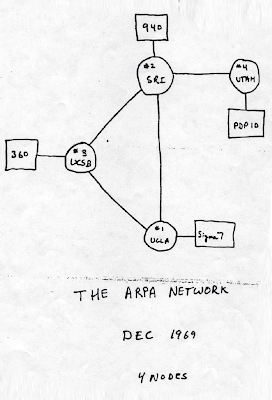
    Why is this a theft? After all it's their cables. Because, if you have ever paid taxes, the Internet belongs to you. It was conceived with tax dollars spent on your behalf by the Defense Advanced Research Projects Agency (DARPA). Like most bureaucratic projects, it began with a memo:
    Dated April 23, 1963, the memo was dictated as its author, Joseph Carl Robnett Licklider, was rushing to catch an airplane. Licklider’s task might have been easier if he had been pursuing a more conventional line of computing research -- improvements in database management, say, or fast-turnaround batch-processing systems. He could have just commissioned work from mainstream companies like IBM, who would have been more than happy to participate. But in fact, with his bosses’ approval, Licklider was pushing a radically different vision of computing.

    His inspiration had come from Project Lincoln, which had begun back in 1951 when the Air Force commissioned MIT to design a state-of-the art, early-warning network to guard against a Soviet nuclear bomber attack. The idea -- radical at the time -- was to create a system in which all the radar surveillance, target tracking, and other operations would be coordinated by computers, which in turn would be based on a highly experimental MIT machine known as Whirlwind: the first "real-time" computer capable of responding to events as fast as they occurred.

    Licklider, who was then a professor of experimental psychology at MIT, had led a team of young psychologists working on the human factors aspects of the SAGE radar operator’s console. And something about it had obviously stirred his imagination.

    By 1957, he was giving talks about a "Truly SAGE System" that would be focused not on national security, but enhancing the power of the mind.... he imagined a nationwide network of "thinking centers," with responsive, real-time computers that contained vast libraries covering every subject imaginable. And in place of the radar consoles, he imagined a multitude of interactive terminals, each capable of displaying text, equations, pictures, diagrams, or any other form of information.

    By 1958, Licklider had begun to talk about this vision as a "symbiosis" of men and machines, each preeminent in its own sphere -- rote algorithms for computers, creative heuristics for humans -- but together far more powerful than either could be separately.

    By 1960, in his classic article "Man-Computer Symbiosis," he had written down these ideas in detail -- in effect, laying out a research agenda for how to make his vision a reality. And now, at ARPA, he was using the Pentagon’s money to implement that agenda.

    Licklider’s research program was so successful, in fact, that it’s now hard for us to remember just how visionary it was. IBM and the other major computer manufacturers were going in a completely different direction at the time, emphasizing punch cards and batch-processing machines suited to the needs of the business world. Mainstream computer engineers tended to see the ARPA approach as totally wrong-headed. Use precious computer cycles just to help people think? What a waste of resources!

    Thus his memo on April 23, 1963, which he addressed to "the members and affiliates of the Intergalactic Computer Network" -- they would have to take all their time-sharing computers, once the machines became operational, and link them into a national system. "If such a network as I envisage nebulously could be brought into operation," Licklider wrote, "we would have at least four large computers, perhaps six or eight small computers, and a great assortment of disc files and magnetic tape units -- not to mention the remote consoles and Teletype stations -- all churning away."

    Leave aside the primitive technology and the laughably small number of machines: The vision that lay behind that sentence is still a pretty good description of the Internet we have today. Indeed, Licklider’s Intergalactic Network memo would soon become the inspiration for the Internet’s direct precursor, the ARPANET."

    -- "DARPA and the Internet Revolution," by Mitch Waldrop

    Project Sage's Whirlwind computer, developed at MIT, was the first computer to operate in real time. Image from History of Computers.

    One big problem remained and that was how to get all these computers physically linked to one another. The job of laying wires to each computer even in the U.S., much more so to computers all over the world, was monumental. However, a simple solution was found in using existing AT&T telephone wires.

    Essentially the network leased long distance lines and kept them perpetually open as in a never ending long distance call. But static in the system posed another problem. When data was being transmitted, if the stream broke, the data was useless -- mere bips and beeps without meaning.

    To solve that, a method of correcting errors was developed along the lines of the U.S. Postal Service. The data stream was broken up into packets, each with the address of the sender and recipient. That way if a packet were unreadable it would be resent and added to the coherent data stream. After some hardware and software design accommodations, the inter-network system -- the Internet -- was a reality. It was a pretty small reality then but it had profound implications. With simple scalability it could be extended anywhere in the world, or, as in Linklider's original, perhaps tongue in cheek memo, to the Galaxy.


    The content was primitive by today's standards -- ones and zeros -- computer code. But that soon changed. Standards were developed to translate the bits and bytes into letters and numbers. The first email programs were written. And the whole system met it's design criteria -- no single node was necessary to exchange information. It could just be rerouted. So if those darn commies blew up a computer somewhere in the system -- no problems mate. The world went merrily on as if nothing happened.

    But the thing that really made the Internet what it is today -- the thing we all love and the main reason we use it -- was the Graphic User Interface (GUI). That's why we can send Aunt Martha pictures of the kids, why we can see animation of the space station construction, and why we can read and write blogs like this. The ability to see pictures and hear sounds, to tell a story, to research a term paper, to do all the things and go to all the places our shiny new bicycle will take us -- it all depends on the GUI.

    The GUI was a gift. We didn't pay for it like we did the design, architecture, hardware and software that put the Internet in place. It was a gift of a few good geniuses who wanted to do a few good things. Tim Berners-Lee, while at CERN, the European Particle Physics Laboratory, invented a way to transmit images over the Internet -- and the World Wide Web was born. He could have patented his invention, protected it with copyrights, and made a bizzillion dollars. But he didn't. He gave it to us, free of charge -- a gift to the people.

    So not only is the foundation of the World Wide Web -- the Internet -- yours because you paid to develop it, but the World Wide Web itself -- the Graphic Interface -- is yours because it was a gift.

    So what's the problem? The problem is a bunch of fat cats who can barely tie their shoes and could never in a million years create it themselves want to steal it and sell it back to you. Who would have the presumption, the hubris, the unmitigated gall to try such a thing? I'll give you a clue. It's who you make your check out to each month for your Internet connection.

    It's the huge corporate vultures who are not content to simply have a monopoly on your Internet business -- they want more. They want to leverage their monopoly to sell you services that you would otherwise freely choose on the open market where their limited abilities and lack of innovation make them uncompetitive.

    Here's how it works. Lets say you use Vonage or Skype for phone service. You pay the modest fees, they give you good service, you save money. But the company that you use -- that you pay to use -- to connect to Vonage -- your Internet Service Provider (ISP) -- sees that's a good business and wants to offer it too. So mysteriously your calls with Vonage buzz with static, get dropped, aren't as clear as they used to be.

    Then, here comes your Internet Service Provider to the rescue. They have a service. It costs a little more but it's more reliable so you switch. But because they have their foot on the hose -- your Internet connection -- they have just turned down or turned off your connection to Vonage without your knowledge. They think people are stupid enough not to notice.

    Well, people do notice. So now they have a problem. They have just hijacked your freedom to choose but how do they get away with it? Enter the accomplices -- your representatives. You see, if the law doesn't forbid this practice -- or worse, if it encodes it into law -- then there's nothing you or anybody else can do about it.

    They have just stolen your shiny new bicycle and are offering to sell it back to you and it's all perfectly legal. Well, after all, Representatives and Senators have to fly in jet planes and live high on the hog too. What's a little graft in the free market. So what if they are selling you out to line their pockets. What are you going to do about it -- complain? Take a number.

    There's only one currency that is slightly more valuable to elected officials than dollars and that is votes. And that's what you have. You may spend every dime every month just to live or send your kids to school but you still have what your representatives want just a little more than money -- a vote. Or more exactly lots of votes. So if you exercise your oversight over your representatives and you convince enough other people to do the same, you win. If not, you lose. It's just that simple.

    The theft of Net Neutrality is only one crime that moneyed corporations have tried to legitimize by recruiting your representatives as accomplices. But it's one of the most important because if they can control your access to services that you choose to purchase on the Web they can also control your access to any kind of information about the world that you live in. They can tell you where you can and cannot ride your shiny new bicycle because now they own it.

    Net Neutrality is non-negotiable if you want to go where you want to go, see what you want to see, and continue to create and have access to ideas of your own choosing. Act now. Sign the petitions. Call your Senators and Representatives. Write them, email them. Get your friends together, make signs and march in the streets. Because once your freedom to ride your bike wherever you want to go is gone you may never get it back. Don't let 'em steal the Internet -- it belongs to you and to the generations to come.

    [William Michael Hanks lived at the infamous Austin Ghetto and worked with the original Rag gang in the Sixties. He has written, produced, and directed film and television productions for the National Aeronautics and Space Administration, The U. S. Information Agency, and for Public Broadcasting. His documentary film The Apollo File won a Gold Medal at the Festival of the Americas. Mike lives in Nacagdoches, Texas.]

    Also see:


    Net Neutrality Resources:
    • Electronic Frontier Foundation (EFF): Anyone who watched John Hodgman's famous Daily Show rant knows what Net Neutrality means as an abstract idea. But what will it mean when it makes the transformation from idealistic principle into real-world regulations? 2010 will be the year we start to find out, as the Federal Communications Commission begins a Net Neutrality rulemaking process.

      But how far can the FCC be trusted? Historically, the FCC has sometimes shown more concern for the demands of corporate lobbyists and "public decency" advocates than it has for individual civil liberties. Consider the FCC's efforts to protect Americans from "dirty words" in FCC v. Pacifica Foundation, or its much-criticized deregulation of the media industry, or its narrowly-thwarted attempt to cripple video innovation with the Broadcast Flag.

      With the FCC already promising exceptions from net neutrality for copyright-enforcement, we fear that the FCC's idea of an "Open Internet" could prove quite different from what many have been hoping for.

    • Democracy Now: The internet and telecom giants Verizon and Google have reportedly reached an agreement to impose a tiered system for accessing the internet. The deal would enable Verizon to charge for quicker access to online content over wireless devices, a violation of the concept of net neutrality that calls for equal access to all services. The deal comes amidst closed-door meetings between the Federal Communications Commission and major telecom giants on crafting new regulations.
    Net Neutrality Petitions:Some You Tube Videos:The Rag Blog

    [+/-] Read More...

    William Michael Hanks : Net Neutrality / Open Internet Under Fire

    Cartoon from Schrier Blog.

    Is FCC dropping the ball?
    The fight for a free internet


    By William Michael Hanks / The Rag Blog / October 15, 2010
  • Also see Mike Hanks' companion article: Net Neutrality / Stop Thief!
  • And see Net Neutrality Timeline, Below
  • A strong right punch from the DC Appeals Court in April stunned the FCC, leaving it dazed and staggering. The champion of the people's Internet entered the ring with a good fight plan and a righteous score to settle with the opponent.

    But, in a strong defense by a heavy-muscled corporation, the court delivered a near knockout punch to the open Internet defender. Blocking the FCC's regulatory blow to Comcast, the court held the FCC had no authority to regulate Comcast's Internet bandwidth management policies.

    The fight started brewing in 2007 when the Associated Press (AP) discovered that Comcast was blocking transmission of BitTorrent Peer-to-Peer file exchanges without notifying customers. A complaint was filed with the FCC by Internet and legal advocates and the FCC held public hearings on the issue. But at the first bell Comcast was caught wearing brass knuckles under the gloves.

    Then FCC Chair Kevin Martin called for public comments. The first hearing was at Harvard and was packed with shills, hired by Comcast, who filled the available seats. Advocates of an open Internet could not be seated and the campus police blocked their entry. Public outcry and overwhelming evidence moved the FCC to sanction the media giant anyway. That's when the battle got bloody.

    Comcast punched back with a suit in federal court that demanded a stay of the FCC sanction. The court held in early April that a change during the Bush administration shifting the authority in such matters from Title II to Title I of the Communications Act resulting in the commission being powerless in the matter.

    That left the current FCC Chair Julius Genachowski with only one backup punch -- to switch the authority back to Title II of the Communications Act and reassert control over Internet services. But so far the Commission seems dazed and unable to react.

    In August, while the Commission was still seeing stars, Google and Verizon proposed a "compromise" that called for unhindered Internet access for wired customers while leaving the door wide open for wireless providers to decide whatever they like, regardless of customer demands. They insist that their ambitious plans to enter the wireless business had nothing to do with their suggestion.

    Another blow to Net Neutrality came in September when Sen. Henry Waxman, Chairman of the House Energy and Commerce Committee, announced he was dropping the push for a Net Neutrality bill in Congress. This came after the Open Internet Coalition pulled it's support and it seemed unlikely the bill would receive Republican support.

    Calls for Chairman Genachowski to act on the promises made by President Obama to vigorously fight for a free and open Internet have gone unheeded. It's looking more like a free-for-all -- a fight where the referees seem to be bought and the champ's taking a fall.

    Unless the FCC gets off the mat, the next round will be when Congress reconvenes after the elections. By then the ringside tickets will be sold out, the fix will be in, and the citizens -- the real owners -- will get the cheap seats where they can't be heard. But, hey, maybe it'll all be on television, if you paid your cable bill.

    [William Michael Hanks lived at the infamous Austin Ghetto and worked with the original Rag gang in the Sixties. He has written, produced, and directed film and television productions for the National Aeronautics and Space Administration, The U. S. Information Agency, and for Public Broadcasting. His documentary film The Apollo File won a Gold Medal at the Festival of the Americas. Mike lives in Nacagdoches, Texas.]

    Also see:
    Super highway: Traffic jam ahead? Photo by Sean Nel. Image from Robin Good.

    Timeline of recent events (from SaveTheInternet.com).

  • 2007. Comcast gave us a glimpse of a world without Net Neutrality when an Associated Press investigation found that the company was blocking the file-sharing application BitTorrent. Despite mounting evidence of Internet blocking, the company refused to come clean and disclose its “network management” practices. A coalition of Net Neutrality supporters and legal scholars filed a complaint with the FCC urging the agency to stop the cable giant from meddling with our ability to share information online.

  • 2008. The FCC took complaints about Comcast’s blocking seriously and convened a series of hearings across the country so that interested citizens could weigh in. Fearful that the public would lay into Comcast for violating Net Neutrality, the company hired people off the street to pack the first hearing at Harvard. The seat fillers took up so many chairs that Comcast critics and other members of the public were denied entry by campus police.

  • In response to the public outcry and a mountain of evidence, FCC Chair Kevin Martin sanctioned Comcast for violating Net Neutrality. The complaint was brought to the agency after a coalition of Net users and activists caught the cable giant red-handed, jamming use of popular file-sharing applications. Martin ruled that Comcast had "arbitrarily" blocked Internet access and failed to disclose to consumers what it was doing. But the ink was barely dry on the FCC order before Comcast filed an appeal in federal court, challenging not only the FCC’s ruling but the agency’s entire authority to protect Web users.

  • 2009. Buried deep in President Barack Obama's American Reinvestment and Recovery Act is a line that brought a smile to the faces of Net Neutrality supporters -- and a scowl to phone and cable industry lobbyists. It requires that billions of dollars directed to connect more Americans to broadband be spent on services that meet "nondiscrimination and network interconnection obligations." The stimulus package stipulated that federal money earmarked for high-speed Internet services be spent the right way: building networks that abide by Net Neutrality.

  • The fight for Net Neutrality gained ground when Julius Genachowski, the newly appointed FCC chair, announced plans to expand existing agency rules to protect the free and open Internet. Genachowski said the FCC must be a "smart cop on the beat,” preserving Net Neutrality against increased efforts by providers to block services and applications over both wired and wireless connections. The chairman cited a number of examples where network providers had acted as gatekeepers and concluded, “If we wait too long to preserve a free and open Internet, it will be too late.

  • 2010. As the FCC began its Net Neutrality inquiry, the phone and cable industry that controls Internet access for 97 percent of Americans went into a spending overdrive. They funneled tens of millions of dollars to nearly 500 Washington lobbyists. Their mission: further consolidate industry control over Internet access and kill Net Neutrality, before the public gets a say. Untold sums have also been spent on Astroturf groups, fake grassroots operations that are funded by corporations to manufacture the impression of public support and that generate misinformation designed to sway policymakers and the media.

  • In early April, the U.S. Court of Appeals for the D.C. Circuit ruled that the FCC lacks the authority (under the jurisdiction it claimed) to protect Internet users against network operators. The case was brought by cable giant Comcast after it was sanctioned by the FCC for blocking Net users’ access to file-sharing applications. The ruling effectively gave corporate gatekeepers control over Internet users’ online experience, and it called into question the FCC’s ability to act as a public interest watchdog over our country’s communications media.

    We now wait to see whether the FCC will reclassify the Internet Service Providers from Title I to Title II and thereby reassert jurisdiction or whether Congress will act with legislation to preserve Internet Neutrality. Nothing is likely to happen before the mid-term elections. The outcome of those elections will undoubtedly affect the vitality of efforts to save the Internet from corporate piracy.

    The Rag Blog

    [+/-] Read More...

    20 June 2010

    William Michael Hanks : Good Government and the Mountain Within Us

    Mount Fuji. It's all in how you look at it.

    Climbing the mountain:
    The foundations of good government


    By William Michael Hanks / The Rag Blog / June 20, 2010

    It is interesting how we each, in the progressive community, have different takes on the same issues -- social justice, civil liberties and others.

    How much more difficult may it be to come to agreement with others of more widely divergent views? Yet, that is what will be required to achieve substantial remedies to the very serious difficulties that stand in the way of realizing our hopes for a free society.

    Are we, and our political opposites, really seeing and pursuing different goals or are we seeing and pursuing the same goals in different ways? The answer will determine our ability to achieve the power in numbers to effect change.

    It’s like a group of companions who are hiking in the wilderness and suddenly see a mountain in the distance. It’s an awesome sight and everyone has something to say about it. The geologist comments on the clearly defined folded strata, the forester is taken with the different varieties of trees ascending from the base to the tree line, and the skier instinctively looks for that perfect line of descent on the slopes.

    I believe there is an internal landscape, like that mountain, which exists within each of us and indeed within all human beings going back to our humble beginnings. At first the imperatives of survival took precedence over all other concerns. But, as civilization formed cooperative communities, mankind began to express and codify this internal landscape into the domains of culture and law.

    We see traces of these attempts to describe our common internal sense of truth in the laws of Moses, Hammurabi, and Salon in Greece, Roman law, the Magna Carta, and the U.S. Constitution, among many others. The most successful examples are those that resonate with the greatest fidelity to each individual’s view of their own internal landscape.

    That is why the ideas of Gandhi and Martin Luther King have such currency. They are not inventions or discoveries but expressions of truths that exists independently and within all individuals -- truths that each of us can recognize within ourselves.

    So then, with all this truth in us, how is it, as a people, we find it so hard to describe it, agree on it, and act together? The answer, I believe, is twofold. Our experiences influence how we view the truth, like the geologist who sees the rocks, and the forester who sees the trees. And, our self-interests influence our interpretation of it -- it’s meaning in our lives.

    During the period of the civil war, the traditional churches condemned slavery and, in contrast, the fundamentalist churches justified it. Why? It wasn’t so much because one was better than the other. Surely principles influenced these positions, but a far more powerful influence was that the constituencies, and therefore the financial support of the churches in the South, were overwhelmingly fundamentalist.

    It was in the self-interest of the economic powers to favor slavery. Those who had no “dog in the fight” were free to act on principle.

    Likewise the corruption and the infidelity to our sense of internal truth in our present day can be seen in the economic influences acting upon our legislative, administrative and judicial systems. Examples abound. BP’s sacrifices of human life and of the environment for self-interested financial gain are being exposed in the Congressional hearings today.

    It seems that our greatest challenge is not so much in defining what is right or wrong -- we all carry a more or less clear idea of that within us -- but in designing social and political systems that remove as far as possible the influence of individual self-interest from the process of deciding public policy.

    If we continue to merely react in outrage to pork barrel deals, corrupt influence, and cavalier military excursions we have accomplished nothing. The perpetrators are duly corrected and admonished and, rubbing their hands together, chuckle gleefully to the bank. Instead, let’s design a system that works for citizens, not just politicians and financial interests. We have a good start but it is the responsibility of each generation to move closer to that goal.

    For the solution to the problem of adverse influence on public policy I believe we must proceed from the following premise: that the people are the foundation and the guardians of democracy (not a new idea). And, that for the people to effectively exercise that responsibility, certain things are conditional. There are four major obstacles to good government today. When we overcome these, I’m sure there will be others.

    The first is that people must have the time to focus on the issues. Therefore a revisiting of labor laws is in order. If people are being worked to death and entertained silly there won’t be much left for the more important task of guarding democracy. Corporations have found ways around the 40-hour week by promoting workers to “executive” or “supervisory” positions that are exempt from labor laws that limit the required workweek.

    In their few hours of spare time people naturally fall prey to the seduction of mass media and constant sales messages. Corporations must be prevented from working people to the point of not being able to discharge their civic duties. A real and effective limitation on required working hours would go a long way towards reducing unemployment as well.

    Second, we must insist upon making available quality education through the baccalaureate level for any who desire it and are willing to do the work. It does little good to have a vote if one hasn’t a clue as to how to exercise it -- or is not well informed.

    In fact an ignorant and uninformed electorate insures the fact that people will not and cannot have a positive influence on their government. If this is done, military adventurism will take care of itself -- we simply can’t afford to both educate our people and support foreign military adventures at the same time.

    Third, we must have universal health care. If people are too sick to be concerned with good government we will suffer from a weakening of one of the pillars of good government -- a healthy electorate. If people are financially ruined or mentally and physically destroyed by health problems they won’t have the ability to exert a positive influence on our democracy. The people’s numbers -- our greatest strength -- are diminished.

    Then we must remove the immunity of power and return to a true representation of the idea, which exists within each of us, that no one is above the law. Politicians, powerful government appointees, and corporate executives get away with “taking responsibility” without taking consequences. We need to insure true accountability. We send people to jail who do far less damage to our society than corrupt politicians, inept appointees, and greedy executives.

    A healthy, well-educated public with the time and ability to exercise their civic responsibilities and hold their representatives accountable is fundamentally necessary to advance “the great experiment." We’re a long way from that today.

    These are strategic measures that will go far towards realizing the ideals that, for the most part, we all carry within us. The tactical ways to achieve these goals will require compromises.

    To secure real change we must have a substantial majority of the people focused on these four strategic goals. No single political party can secure these alone. We must find practical ways of working together -- even with those with whom we may profoundly disagree -- or find distasteful. We don’t have to find a way to achieve the lofty destiny of loving one another, just how to work together towards achieving the goal of good government.

    To do that we must begin to identify common cause with all those who are stakeholders in our democracy -- or at least as many as possible. Then, having identified common ground, create understanding with others who see things through the lens of different culture, experiences, and self-interests.

    The point is that the left wing-right wing, Democrat-Republican battles are playing in to the hands of those who benefit from the status quo. The ongoing battles are fun for some and profitable for others but as long as we are pitted against one another we cannot move forward towards curing the ills of our times. I know this is counterintuitive, but when the enemy of good government is not our political opponents but the status quo, it is nevertheless true.

    Does that mean we shouldn’t debate with others -- just agree? Absolutely not! The constructive exchange of ideas is the soil from which good decisions emerge. Well-informed and good-natured debate sheds light on the issues of our times. We would be derelict in our duties and in our intellectual integrity not to pursue these issues vigorously.

    I guess what I’m saying, regarding the tactical measures to achieve the strategic goal of removing the current major obstacles to good government -- time, education, health care, and accountability -- is to extend the kind of discourse we have among progressives to others of even more divergent viewpoints and create a force that cannot be ignored. Take a Tea Party follower to dinner tonight. We can’t win this alone.

    [William Michael Hanks is a writer and documentary filmmaker who lives in Nacogdoches, Texas.]

    The Rag Blog

    [+/-] Read More...

    02 June 2009

    FILM / Turk Pipkin's Remarkable 'One Peace at a Time'

    Another day at the office. Turk Pipkin (who refers to himself in the movie as a "human q-tip" ) shoots at the Muharam Shia Festival in Calcutta, India.

    One Peace at a Time: A film about a messed up world and how we can fix it.

    By William Michael Hanks / The Rag Blog / June 2, 2009
    See Willie Nelson Video, and a sneak preview Video of One Peace at a Time, Below.
    Also see Turk Pipkin, and a Brief History of the Documentary Form, by William Michael Hanks / The Rag Blog.
    ['One Peace at a Time: A film about a messed up world and how we can fix it.' A feature documentary film by Turk Pipkin. Produced by the Nobelity Project. One Peace at a Time is a sequel to Pipkin’s highly acclaimed Nobelity.]

    One Peace at a Time documents Turk Pipkin’s global odyssey to find working solutions for humanity’s most urgent problems.

    In the 1960s the issues that most concerned the activist community were civil rights and the Vietnam War. Many believed that we could make a difference by getting involved and making our voices heard. At that time the horizon of concerns did not go far beyond the landscape of domestic issues.

    Now, confirming Marshall McLuhan’s insights, the media of television and the Internet have changed our worldview and our conversation. With a global perspective, the problems of our time threaten to overwhelm our sensibilities and defy attempts to gain traction against them. In an odyssey of faith, Turk Pipkin invested years of searching the world for antidotes to the threats against our survival.

    Through interviews with nine Nobel laureates, ten non-governmental organization (NGO) innovators, one U. S. Congressman, and one musician-philosopher, One Peace at a Time provides a first-hand look at the projects that are working to make a better world. But Turk Pipkin, a Texas writer, actor and director, living in Austin, has done even more –- he has produced a work that represents the evolution of documentary production.

    In his previous documentary Nobelity Turk Pipkin begins with Nobel Laureate Steve Weinberg speaking about the problems facing the world today. This began a journey that led to conversations with eight more Nobel Laureates around the world. As a father, Turk Pipkin was eager to engage the challenges that his children would face in coming years. In Nobelity he defines for us the significant problems of our time. But that led to something more -- the participation of his wife, Christy, and his daughters, in a new project to find effective solutions to those problems.

    In his sequel One Peace at a Time we see the solutions developed by those working on the front lines to leave a better world for future generations. The film opens with Turk in a train station in India. At about six feet six inches tall he is unmistakably a visitor on a road trip. And that is the form of the film. It is the most enduring of documentary forms -- a road movie, a travelogue, but unlike any you’ve ever seen.

    Carrying his camera he says: “There are so many layers that separate me from reality -- but that morning I looked up from my camera and suddenly the problems were looking back at me -- I wasn’t behind the camera anymore –- I was part of the picture.”

    Ironically, it is the layers in the film that bring so much to its power. The foundation is its theme: the power of individual choices. Upon that is layered the pictures of the people and places which provide a sense of reality that is sometimes tragic and surprisingly, comic. On that is layered an artful music score providing context and mood. Over a multi-panel montage of children living in poverty among industrial waste and pollution Bob Dylan sings:
    “Broken idols, broken heads,
    People sleeping in broken beds.
    Streets are filled with broken hearts.
    Broken words never meant to be spoken,
    Everything is broken.”
    The music together with the content works to evoke worlds of meaning as we hear “Peace Train," “The Weight," and “Better Way” -- songs of an earlier generation seen with the children of a new generation dramatize the continuing struggle for justice, peace, and the dignity of life.

    Overlaying that is the first-person descriptions of the success of those who are leading the way to provide solutions. And, upon that is the voice of guide and narrator, Turk Pipkin, who provides perspective for the film. The final layer is the reflexivity, the self awareness, that engages us more fully in the theme -- we, as the audience, are aware of our role.

    As we travel with Turk through the slums of India, Africa, and Bangladesh we see first-hand the conditions that imprison children in seemingly unalterable poverty but as Turk leads us on a journey of hope we begin to see that, if we choose, we can make a difference -- each of us can make the world better.

    Back in Texas, in a chess game with Willie Nelson, the importance of our choices is seen through the moves they make on the chessboard. Willie says: “You know what to do, right and wrong is not that hard, its just what you choose to do.” The Nobel Laureates and NGO leaders tell us more about the world’s problems and show us that we can change the course of history when we choose to act.
    “What you do, where you are, is of significance.”
    Desmond Tutu, Nobel Peace Prize

    “There is nothing magical about change. It’s getting up off your ass and caring enough to take the first steps to contribute to change on an issue you care about.”
    Jody Williams, Nobel Peace Prize

    “Even the poorest of the poor person has enormous potential. If you decide where you want to be, and I decide where I want to be … we’ll be there.”
    Muhammad Yunus, Nobel Peace Prize

    “We’re doing harm. Our decisions are clearly not made with our descendants in mind.”
    Steve Weinberg, Nobel Prize in Physics

    “There are twenty five million children living in orphanages … a million more each year. In 2006 there were only 3,332 adoptions in India.”
    Caroline Boudreaux, Founder, The Miracle Foundation
    Turk tells us that he didn’t know what to expect when he visited the orphanages in India but smiling, he says that what he found was love and joy. That hopeful tone resonates throughout the film. There is precious little to smile about in media these days but the sight of those children singing, laughing, and learning, undeterred by conditions of poverty and difficulty, brought a big smile to my face too.

    Drug and AIDS counselor at CARE's HIV/needle-exchange program in Dhaka, Bangladesh.

    However, it is not a film marred by a Pollyanna vision. The reality of how the world is failing to provide for even the basic needs stated in the United Nations “Rights of the Child”: clean water, adequate nutrition, health care, education, a stable loving environment, and conditions of freedom and dignity, is the organizing structure for the film.

    Six million children die of hunger each year. Sixteen thousand die of hunger each day. Twelve children die of hunger each minute. In the time it takes you to read this paragraph, six children died of hunger. While you process that –- one more died. How could that be possible? One more.

    That is one example of how One Peace at a Time brings home the big numbers to a personal level. Turk Pipkin leads us further into an almost apocalyptic landscape as he attends the convention to ban cluster munitions in Oslo, Norway.
    “A cluster munition is essentially a large container that opens up in mid-air and spews out hundreds of individual bomblets. So if you use these anywhere near civilian areas you’re almost guaranteed to kill and injure large numbers of civilians. To make matters worse, many of these individual bomblets -- hundreds at a time -- don’t explode on contact. Instead they function like anti-personnel land mines -- they keep killing weeks, months, and decades later.
    Steve Goose, Human Rights Watch
    The United States is the most prolific user and exporter of these munitions -- we also refuse to sign the treaty to ban them. This led Turk to his Congressman, Lloyd Doggett, to ask how citizens can influence legislation on this and other important issues.
    “In terms of the money that we appropriate every year, fifty-five cents of every dollar went to military expenditures. We spend enough in one week in Iraq to fund the college education of over a million students -- we could be putting people on the dean’s list instead of the casualty list. Just electing someone is not enough. You have to have an informed public movement that really cares about how our budget is allocated.”
    Lloyd Doggett, U. S. House of Representatives
    Not satisfied to merely show what we can do, Turk Pipkin put his own blood and treasure on the line as well. He broke his leg in the Grand Canyon while filming a sequence on global warming. He sponsored a child in India through The Miracle Foundation, provided micro-financing to a small businesswoman in Africa through Kiva.org, raised money for a well to deliver clean water to an Ethiopian village, and through The Nobelity Project, sponsored a computer classroom in Kenya

    One Peace at a Time is not only a compelling look at what is being done to solve the problems of our time but shows the power of our choices to make a difference. It is also an outstanding example of the evolution of the documentary form. The most unexpected thing about the film is the humor, joy, and hope that it delivers. This isn’t a doomsday prophecy -- it is an inspiring roadmap to a better world.

    One Peace at a Time home: The Nobelity Project

    Turk Pipkin Website: TurkPipkin.com

    Choose to Act

    This is a road movie about choices. One Peace at a Time calls on us to choose a project and get engaged in the solution. All of the following organizations are making a difference in the lives of people around the world. At a time when many investments are showing negative returns, these are some of the best investments you can make.[William Michael Hanks has written, produced and directed film and television productions for the National Aeronautics and Space Administration, The U. S. Information Agency, and for Public Broadcasting. His documentary film The Apollo File won a Gold Medal at the Festival of the Americas. Having experienced the challenges and the evolution of the form in his own work, his view from that lens brings into focus both the content and technique of One Peace at a Time. William Michael Hanks lives in Nacagdoches, Texas.]

    Nobelity Project Computer Lab at Mahiga Primary School in rural Kenya.
    Turk Pipkin: "I'm headed to Kenya in a week to purchase land for the high school for 400 students that we're going to build near this primary school. Education in the area currently ends after 8th grade, and we've made a big commitment to help change chat. The Nobeliy Project has raised about 20k of the 100k we need for the school. We're accepting donations at nobelity.org."
    Willie Nelson for One Peace at a Time

    About One Peace at a Time.

    One Peace at a Time is an inspiring feature documentary highlighting solutions to some of the world’s most pressing problems. The film includes the insights of Nobel Peace laureate Muhammad Yunus, Nobel Physicist Steven Chu, (Barack Obama’s Secretary of Energy), Dr. Helene Gayle (CEO of CARE, International), American legend Willie Nelson and many others.

    The film follows director Turk Pipkin’s five-continent, two-year search for a better way ahead. Pipkin sought the answer to one basic question: Can we provide basic rights -- water, nutrition, education, healthcare and a sustainable and peaceful environment -- to every child on earth?

    The solutions Pipkin chronicles include the model Indian orphanages of The Miracle Foundation, family planning initiatives with Thailand’s Mechai Viravaidya, Ethiopian water projects with A Glimmer of Hope, and Architecture for Humanity’s global design challenge for communities in need in the Himalayas, the Amazon and the slums of Nairobi.

    In Banngladesh, Pipkin met Muhammad Yunus, the “Banker to the Poor” whose pioneering work in microfinance has led tens of millions of people out of extreme poverty. “We must be pilots,” Yunus told Pipkin. We must know where we are going and lead the world where we want to go.”

    One Peace at a Time is Pipkin’s sequel to his highly acclaimed documentary Nobelity, which Esquire Magazine called, “Nine ways to save the World.” While Nobelity looked at problems through the eyes of nine Nobel laureates, the new movie focuses on solutions that every person can be a part of.

    “People are hungry to play a part in creating a better world,” says Pipkin. “I hope this film will inspire large numbers of people to accomplish great things in the world and in their own lives.”

    The film is produced by the Nobelity Project, a 501c3 nonprofit working for a more peaceful and sustainable world. Proceeds from the film support the Nobelity in Schools education program and the nonprofit’s development work in Kenya, Ethiopia and elsewhere.

    In its own words, “The Nobelity Project collaborates with Nobel laureates and other inspiring leaders to provide reliable information and innovative thinking on pressing global problems and solutions that work. Combining professional filmmaking with a nonpartisan, nonprofit education program, our work reaches a broad cross section of people interested in making a difference.”

    One Piece at a Time will have a national release in September and October this year. It is being distributed by Monterey Media and will play in theaters around the country and there will also be hundreds of screenings in community centers, churches, on campuses and in private homes. Anyone who wants to sponsor a screening can contact nobelity.org.

    Actor, writer and filmmaker Turk Pipkin has had a long career in books, television and film. He is the writer and director of the award-winning documentary Nobelity. As an actor, he appeared in the feature films Friday Night Lights, The Alamo and Scanner Darkly. On HBO’s The Sopranos, Turk played the recurring role of Janice’s narcoleptic boyfriend, Aaron Arkaway. He is the author of ten books including the New York Times best-seller, The Tao of Willie, co-authored with Willie Nelson.
    One Peace at a Time - Sneak Preview


    The Rag Blog

    [+/-] Read More...

    Only a few posts now show on a page, due to Blogger pagination changes beyond our control.

    Please click on 'Older Posts' to continue reading The Rag Blog.