Showing posts with label Oil Spill. Show all posts

23 April 2012

Jordan Flaherty : Gulf Residents Fear for the Future

Image from GRIID
.
Two years after the BP drilling disaster,
Gulf residents fear for the future

By Jordan Flaherty / The Rag Blog / April 23, 2012
“The Gulf is a robust ecosystem and it's been dying the death of a thousand cuts...” -- Aaron Viles, Gulf Restoration Network.
On April 20, 2010, a reckless attitude towards the safety of the Gulf Coast by British Petroleum, as well as Transocean and Halliburton, caused a well to blow out 5,000 feet below the surface of the Gulf of Mexico.

As the world watched in horror, underwater cameras showed a seemingly endless flow of oil -- hundreds of millions of gallons -- and a series of failed efforts to stop it, over a period of nearly three months. Two years later, that horror has not ended for many on the Gulf.

“People should be aware that the oil is still there,” says Wilma Subra, a chemist who travels widely across the Gulf meeting with fishers and testing seafood and sediment samples for contamination.

Subra says that the reality she is seeing on the ground contrasts sharply with the image painted by BP. “I’m extremely concerned on the impact it’s having on all these sick individuals,” she says. Subra believes we may be just at the beginning of this disaster. In every community she visits, fishers show her shrimp born without eyes, fish with lesions, and crabs with holes in their shells. She says tarballs are still washing up on beaches across the region.

While it's too early to assess the long-term environmental impact, a host of recent studies published by the National Academy of Sciences and other respected institutions have shown troubling results. They describe mass deaths of deepwater coral, dolphins, and killifish, a small animal at the base of the Gulf food chain.

"If you add them all up, it’s clear the oil is still in the ecosystem, it’s still having an effect,” says Aaron Viles, deputy director of Gulf Restoration Network, an environmental organization active in the region.

The major class action lawsuit on behalf of communities affected by the spill has reached a proposed $7.8 billion settlement, subject to approval by a judge. While this seems to have brought a certain amount of closure to the saga, environmentalists worry that any settlement is premature, saying they fear that the worst is yet to come.

Pointing to the 1989 Exxon spill off the coast of Alaska, previously the largest oil spill in U.S. waters, Viles said that it was several years before the full affect of that disaster was felt. “Four seasons after Exxon Valdez is when the herring fisheries collapsed,” says Viles. “The Gulf has been a neglected ecosystem for decades -- we need to be monitoring it closely.”

In the aftermath of the spill, BP flooded the Gulf with nearly 2 million gallons of chemical dispersants. While BP says these chemicals broke up the oil, some scientists have said this just made it less visible, and sent the poisons deeper into the food chain.

It is widely agreed that environmental problems on the coast date back to long before the well blew open. The massive catastrophe brought into focus problems that have existed for a generation. Land loss caused by oil company drilling has already displaced many who lived by the coast, and the pollution from treatment plants has poisoned communities across the state -- especially in "cancer alley," the corridor of industrial facilities along the Mississippi River south of Baton Rouge.

“The Gulf is a robust ecosystem and it's been dying the death of a thousand cuts for a long time,” says Viles. “BP is legally obligated to fix what they screwed up. But if you’re only obligated to put the ecosystem back to where it was April 19, 2010, why would we?”

Fishing is a huge part of the economy for the Gulf Coast. Around 40% of the seafood caught in the continental U.S. comes from here. Many area fishermen were still recovering from Hurricane Katrina when the spill closed a third of Gulf waters to fishing for months.

George Barisich, president of the United Commercial Fisherman’s Association, a group that supports Gulf Coast fishers, says many fishers still had not recovered from Hurricane Katrina when the oil started flowing from the BP spill. Now, he says, many are facing losing their homes. “Production is down at least 70 percent,” compared to the year before the spill, he says. “And prices are still depressed 30, 40, 60 percent.”

In a video statement on BP’s website, Geir Robinson, Vice President of Economic Restoration for BP’s Gulf Coast Restoration Organization, says that the company believes the legal settlement will resolve most legitimate economic claims. “We do have critics,” adds Robinson. “And we’re working hard every day to show them that we will meet our responsibilities.”

Environmentalists and scientists also complain that the Obama administration has let down the Gulf Coast. Viles is critical of the role the U.S. government has played, saying that by inaction they seemed to protect BP more than coastal communities or the environment. “The coast guard seems to empower the worst instincts of BP,” Viles says. “I don’t know if it’s Stockholm Syndrome or what.”

International environmental groups have also joined in the criticism. Oceana, a conservation group with offices in Europe and the Americas, released a report criticizing the U.S. government’s reforms as being either ineffective or nonexistent, saying “offshore drilling remains as risky and dangerous as it was two years ago, and that the risk of a major spill has not been effectively reduced.”

Theresa Dardar lives in Bayou Pointe-au-Chien , a Native American fishing community on Louisiana's Gulf Coast. Dardar and her neighbors have seen their land vanish from under their feet within their lifetimes due to canals built by the oil companies to access wells.

The canals brought salt water into freshwater marshes, helping cause the coastal erosion that sees Louisiana lose a football field of land every 45 minutes. The main street that runs through the community now disappears into the swamps, with telephone poles sticking out of the water.

Now, in addition to worries about disappearing land and increasing risk of hurricanes, she fears that her family’s livelihood is gone for good. “It’s not going to be over for years,” she says, expressing a widely held concern among fishers here. “We’re just a small Native American fishing community."

That’s all they’ve done their whole lives. Some of them are over 60. What are they going to do? If BP gives them money for the rest of their lives, that’s one thing. But if not, then what can they do?

[Jordan Flaherty is a journalist based in New Orleans and author of the book Floodlines: Community and Resistance from Katrina to the Jena Six. He can be reached at neworleans@leftturn.org. This article was also published at CounterPunch. Find more articles by Jordan Flaherty on The Rag Blog

The Rag Blog

[+/-] Read More...

15 September 2010

Dahr Jamail : Strong Evidence BP Is Spraying Toxic Dispersants

Dispersant remnant, June 26, 2010. Photo by Shirley Tillman / Truthout.

Evidence mounts:
BP spraying toxic dispersants
The Tillmans and thousands of other fishermen and residents along the Gulf of Mexico are deeply concerned about local, state, and federal government complicity in what they see as a massive cover-up of the oil disaster by using toxic dispersants to sink any and all oil that is located.
By Dahr Jamail / September 15, 2010
See gallery of photos, Below.
[The following dispatch from journalist Dahr Jamail, whose work has frequently appeared on The Rag Blog, was distributed by Truthout.]

Shirley and Don Tillman, residents of Pass Christian, Mississippi, have owned shrimp boats, an oyster boat and many pleasure boats. They spent much time on the Gulf of Mexico before working in BP's Vessels Of Opportunity (VOO) program looking for and trying to clean up oil.

Don decided to work in the VOO program in order to assist his brother, who was unable to do so due to health problems. Thus, Don worked on the boat and Shirley decided to join him as a deckhand most of the days.

"We love the Gulf, our life is here and so when this oil disaster happened, we wanted to do what we could to help clean it up," Shirley explained to Truthout.

However, not long after they began working in BP's response effort in June, what they saw disturbed them. "It didn't take long for us to understand that something was very, very wrong about this whole thing," Shirley told Truthout. "So that's when I started keeping a diary of what we experienced and began taking a lot of pictures. We had to speak up about what we know is being done to our Gulf."

Shirley logged what they saw and took hundreds of photos. The Tillmans confirm, both with what they logged in writing as well as in photos, what Truthout has reported before: BP has hired out-of-state contractors to use unregistered boats, usually of the Carolina Skiff variety, to spray toxic Corexit dispersants on oil located by VOO workers.

Shirley provided Truthout with key excerpts from the diary she kept of her experiences out on the water with her husband while they worked in the VOO program before they, like most of the other VOO workers in Mississippi, were laid off because the state of Mississippi, along with the U.S. Coast Guard, has declared there is no more "recoverable oil" in their area.

"The first day I went, I noticed a lot of foam on the water," reads her entry from June 26. "My husband said he had been seeing a lot of it. At that time, we were just looking for 'Oil.' We would go out in groups of normally, five boats. The Coast Guard was over the VOO operation. There was always a Coast Guard on at least one of the boats. They would tell us when to leave the harbor, where to go and how fast to go. They had flags on each of the VOO boats and also a transponder. Sometimes we would have one or more National Guardsmen in our group too, as well as an occasional safety man to monitor the air quality and procedures on the boat. If we found anything, the Coast Guard in our group would call it in to 'Seahorse' and they would determine what action would be taken."

Along with giving a clear description of how the Coast Guard was thus always aware of the findings of the VOO workers, her diary provides, at times, heart-wrenching descriptions of what is happening to the marine life and wildlife of the Gulf of Mexico.

"Before we went to work, I went down by the beach," reads her entry from July 4. "There were dead jellyfish everywhere. Some of them were surrounded by foam. A seagull was by the waters edge, as the foamy stuff continued to wash up. There was also a crane that appeared to be sick. It didn't look like it had any oil on it, but it just stood there, no matter how close I got."

On the morning of August 5, Shirley describes spotting a dead young dolphin floating in the water. "As we waited for the VOO Wildlife boat to come pick it up, we noticed a pod of dolphins close by," she writes. "Even with all the boats around, they did not leave until the dead one was removed from the water. It was very emotional, for all of us."

The next day, August 6, found her logging more death. "Last night on the news, they reported a fish kill. Before we went to work, I went to the beach by the harbor. The seagulls were everywhere. As for the dead fish, the only ones on the beach, were ones that the tide had left when it went back out. The rest of the 'Fish Kill,' was laying underwater, on the bottom. It was mainly flounder and crab. We only spotted two dead flounder floating that day. I can only imagine how many were on the bottom... I went back to the beach after work. The tide had gone out and the seagulls were eating all the dead fish that had been exposed. You could still see dead fish underwater, still on the bottom. Dead fish don't float anymore?"

The Tillmans' primary concern is the rampant use of toxic dispersants by what they described as private contractors working in unregistered boats, that regularly were going out into the Gulf as they and other VOO teams were coming in from their days' work. There was, oftentimes, so much dispersant on top of the water, their boat left a trail.

"The first thing I noticed, was the 'trail' the boat was leaving in the water," her log from July 10 reads. "You could see exactly where we had been, as far back as you could see. Around 11:00, we were in oil sheen and brownish clumps. We were North of Cat and Ship Island when the Coast Guard told us to drop the boom over. When you pick the boom up, you have to wear 'protective gear.'"

Her log from August 1 describes, in detail, an incident of the Coast Guard not allowing them to collect oil and his proceeding to deny what they found was even oil:
Around 2:00 p.m., we started noticing a lot of oil sheen. We were North of the East end of Cat Island, but South of the Inter Coastal channel. There was, as usual, a Coast Guard on one of the boats in our team. He called in to report it, but we were told not to drop the boom, it was just "Fish Oil." In the beginning of the clean-up operation, if something was floating on the water and it looked like oil, it was oil or oil sheen. Later they would sometimes say it was just "Fish Oil." Also, if it was heavy foam with a brown or rust color, originally it was "Oil Mousse." Later it was called "Algae." We were then told to head Northwest. The further we went, the worse the "Fish Oil" got. Then, the foam was mixed in with the oil. It was at least the size of a football field, around our boat alone. My husband got on the radio and asked if they could put the boom over.
The Coast Guard, again, told them no.
We were then headed West, back towards Pass Christian. A pleasure boat flagged one of the boats in our group down and told him that there was oil all over. The Coast Guard said to tell him that they were aware of the situation... On the way back to the Pass Harbor, I asked my husband, "Just exactly what are we even doing out here?" He told me that he was beginning to think that it was all just for show. I can only imagine what the people on the pleasure boat had to say when they got back home that day. Probably, that they had seen a lot of oil on the water and the VOO boats were out there just riding around in it and not doing anything to clean it up. That is exactly what happened. We decided then to start documenting as much as we could. I believe it was the very next day, Thad Allen was on TV saying that they were scaling operations back due to the fact that, "No oil has been seen in the Gulf in almost two weeks." Now, if we had pulled boom on Sunday and unloaded a bunch of dirty boom in the Pass harbor, it might have been a problem for him later.
On August 5, she describes a rare instance of their being allowed to drop boom in order to collect oil. "We had a Coast Guard and two Safety Men on our boat. We went to the West of the Pass Harbor. The water looked black in places. Lots of bubbles, not foam, just bubbles. Around 8:30, we were in oil sheen and mousse and were told to drop the boom. The more we pulled the boom, it appeared the more was coming up. The Pass [Christian] Harbor was closed because the oil was coming in so bad. We pulled boom back and forth the rest of the afternoon."

By early August, the total number of VOO boats operating out of Pass Christian Harbor, where Shirley and Don worked, was down to 26.

On August 8, Shirley wrote,
Talk at the harbor was that airplanes were spraying dispersants on the water at night, out by the islands. There was also talk of skiffs, from Louisiana, with white tanks on them, that were spraying [dispersants] too. We had seen the skiffs before. They would pass us up in the mornings and head towards the Bay St. Louis Bridge. We were told that they were working out of an area at Henderson Point. Henderson Point has a county-owned area with a boat launch & piers. It was closed to the public after the oil spill and a BP sub-contractor staging area was set up. It always appeared that these boats were finishing up their work day, just as we were going to start ours. Most of these skiffs were Carolina Skiffs.
Later that same morning, Shirley and her husband headed out of the harbor with a member of the National Guard on their boat, heading west, while a member of the Coast Guard and another member of the National Guard were on another boat in their VOO team. After boating for an hour, they turned back to the east, at which point Don spotted five of the Carolina Skiffs.

"I got my camera and started taking pictures of them," Shirley writes.
As I was zooming in as close as I could, I saw one of them spraying something onto the water. I did not get a picture of it, I was too busy telling my husband to tell the Coast Guard on the other boat. The skiffs had turned North and were scattered out, zigzagging South of the train bridge. The Coast Guard called the incident in and sent one of our boats to follow the skiffs. The skiffs immediately left. When I saw the boat spraying, it was upwind from our boat. Within a few minutes, my nose started drying out. Later my throat and eyes did the same thing. A Coast Guard helicopter was dispatched along with a Coast Guard boat. We saw the helicopter about twenty minutes later, but I never saw the Coast Guard boat.
Back at Pass Christian Harbor, her team reported the Carolina Skiffs actively spraying dispersants. She was told by the contracting company, Parson's, that managed their VOO team, to bring in her photographs.

Her entry from the next day, August 9, reads:
I took the pictures, 8x10's to Parson's. A short time later, my husband called and said the Coast Guard wanted me to make a disc of the pictures. I took the disc and turned it over to the Coast Guard. I was told, in the presence of others, that the incident had been investigated and the boats in question had been located at the Henderson Point site. He said that these boats were in the VOO program as skimmer boats, but it had not yet been verified. He said that he had questioned them about spraying something on the water. They told him that if I had seen them spraying anything, they were probably just rinsing out their tanks. He also asked me, "Don't you think if they were spraying dispersants, they would be wearing respirators?" I told him, "You would think so, but nothing surprises me around here anymore." We basically left after that. I knew all they had really wanted was to see exactly what I had gotten pictures of. There is of course the question, "Why would a skimmer boat need to rinse out his tanks?" If he had been skimming oil, why dump it back over? If he hadn't been skimming oil, what was he rinsing out? I know what I saw and I know how I felt afterwards. I also know that in one of the pictures I took, you can see a helicopter over those boats. BP has spotters looking for oil. Could it be he was telling them where to "Touch Up" before they called it a day? One thing I did learn from Coast Guard guy that day, evidently these so-called skimmer boats, also have the ability to spray!
The Tillman's curiosity drove them to investigate further, given the inconsistencies they were seeing in the Coast Guard's actions regarding the dispersant being sprayed from contractors in the Carolina Skiffs.

"My husband came home and said that they had seen the 'Skiffs' again today," reads Shirley's entry from August 10.
He took pictures of them and a jack-up-rig. The rig moves around in the sound and is suppose to be a de-contamination station. However, some Captains have said when they went there, they were told it wasn't in operation at the time. After thinking about the tank skiffs and the Coast Guard for two days, I could not make any sense of this whole situation. The Coast Guard is supposedly over the VOO Program, but it knows nothing about the skiffs at the site, so close to the Pass Harbor. They not only tell us every move to make, but they are always with us when we make the moves. Our boats are flagged and have transponders on them. Those boats have no flags, we have not seen a transponder, nor a Coast Guard member on one of them telling them what to do.
That afternoon, the Tillmans visited the Henderson Point staging area. Though it was guarded, what they found shocked them: "There were probably more boats there than in the entire Pass [Christian] VOO program at the time," reads her entry.
There were only a couple of regular skimmer boats. All appeared to have Louisiana registrations. Almost all of the skiffs had the white tanks on them. A few of the tanks looked like they could have had something in them at one time, but nothing like the oily, sticky mess we had been dealing with. If we got something on our boat, it was almost impossible to get it off. I don't see how they could have gotten it out of the tanks and still looked like they did. Also, there was a Harrison County Sheriffs Department car, right by the boats and some large, plastic, white containers with yellow bases.
On August 13, the VOO boat that Shirley and Don were running was deactivated. Still very concerned, the next day they visited the BP staging area in Hancock County.

"They had evacuated this site," she writes. "Same setup though, a guard and a Sheriff's car. We then went to a site in Gulfport. Evidently, this is a main BP storage site. There were all kinds of boats, including the tank skiffs. The Sheriffs Department was there also and so was those large, plastic tanks with the yellow bases."

Other reports, of a very similar nature, have been reported about other BP staging areas along the Gulf of Mexico. The tanks are clearly used to store and transport Corexit dispersant. The Carolina Skiffs are clearly used to spray it atop oil.

Her August 16 entry details her discovery:
Over the next few days, I continued to go by the Henderson Point site and the Gulfport site. The Henderson Point site brought back a few boats, but none of the tank skiffs or the large plastic tanks. The Gulfport site stayed the same, full of everything. On August 25, I received an email with a link to an article about dispersants. It had a picture of the tanks that dispersants come in, with the label "Nalco Corexit EC9005A." They were 330 gallon, large, plastic, white tanks with a yellow base. These were the same tanks that I had been seeing at the Henderson Point site and the Gulfport site. I was able to get the name of the manufacturer of the tanks, off a picture I took and compared it to the picture in the article. It was the same manufacturer. I researched this company on the internet and found the 330 gal tanks. They are marketed as: "The only manufacturer in the industry to offer portable tanks certified for hazardous goods transport by the United Nations and the U.S. Department of Transportation."
Shirley and Don are, like tens of thousands of other VOO workers and Gulf residents, left with more questions than answers.

"While working on the boats, if you pull boom back onto the boat, you not only had to wear Tyvek suits, protective glasses and gloves, you also had to put tape around the gloves and suit sleeves, as well as around your boots and the suit." Shirley asks, "Why would it be safe for people to get into the same water that all of this hazardous stuff was coming out of?"

For the Coast Guard, she asks:
How can you not know there are boats in the VOO program if you are in charge of the VOO program? The Coast Guard was supposedly over the VOO program, but they acted like they don't know anything about the Carolina Skiffs. The boats were in either a task force or strike force. Every VOO boat has a flag. We all had transponders. This was VOO and Coast Guard regulations. But these skiffs didn't have flags and we never saw transponders on them, nor did they have Coast Guard with them and supposedly every group had at least one Coast Guard in each group. Sometimes we would have two. But the Skiffs didn't have any.
Local media in Pass Christian and Gulfport, Mississippi, are now reporting that BP hopes to have the VOO program in that area completed by September 19.

Shirley is incredulous. "Why would anyone bring their children here and put them in water that has had millions of gallons of toxic chemicals dumped into it, not counting the oil itself?" she asks. "Why would you want to eat seafood that has been living and dying in the water, with all those contaminates?"

Truthout has earlier reported on other fisherman in the area, James "Catfish" Miller and Mark Stewart, who have reported being eyewitnesses to the contractors in the Carolina Skiffs spraying dispersant as well.

Meanwhile, local, state and federal authorities continue to claim that dispersant was only used south of Mississippi's barrier islands and that the Carolina Skiffs and the large tanks they carry are only used to "skim" oil.

"If dispersants were only being sprayed South of the islands, why would these 330 gallon hazardous goods tanks be located at two different work sites, right by the tank skiffs?" Shirley asks. "Why would the skiffs tanks be so clean if they were really skimming oil?"

The Tillmans and thousands of other fishermen and residents along the Gulf of Mexico are deeply concerned about local, state, and federal government complicity in what they see as a massive cover-up of the oil disaster by using toxic dispersants to sink any and all oil that is located.

Dr. Riki Ott, a toxicologist and marine biologist, is a survivor of the 1989 Exxon Valdez oil disaster in Alaska. She recently submitted an open letter to the U.S. Environmental Protection Agency expressing many of these same concerns.

Ongoing government denials of this problem neither fool nor dissuade Shirley. "I know what I have seen," she told Truthout. "I know what I have been told. I know what I have experienced. I know what I have documented. I also know that I have taken hundreds of pictures to verify what I am saying."

[Houston native Dahr Jamail, an independent journalist, is the author of The Will to Resist: Soldiers Who Refuse to Fight in Iraq and Afghanistan, (Haymarket Books, 2009), and Beyond the Green Zone: Dispatches From an Unembedded Journalist in Occupied Iraq, (Haymarket Books, 2007). Jamail reported from occupied Iraq for nine months as well as from Lebanon, Syria, Jordan, and Turkey over the last five years.]

Source / Truthout

Oiled boom, August 5, 2010.

Oil sheen and dispersant remnant, August 1, 2010.

Corner of Canal Road and I-10, in Gulfport, Mississippi, at the Gulfport site used as a BP staging area, August 14, 2010.

Corner of Canal Road and I-10, in Gulfport, at the Gulfport site used as a BP staging area.

Corexit tanks, September 1, 2010.

Dead flounder among fish kill, August 6, 2010. Photos by Shirley Tillman / Truthout.

The Rag Blog

[+/-] Read More...

26 July 2010

Jonah Raskin : BP's Silent Siren and our Nation of Sleepwalkers

Sleep Walkers by Thomas Fedro, c. 2009 / Art for Art's Sake.

Silent siren:
Symbol for our somnambulant age


By Jonah Raskin / The Rag Blog / July 27, 2010

Americans have been distracting themselves to death for decades. They’ve been in denial for ages about the state of the planet, about themselves, and the political mess they’re in. Okay -- that we’re in. I count myself in, not out, of this somnambulant, or sleeping-walking, nation.

Tuning out not tuning in, we’ve turned all-too-often into blind, deaf, and dumb citizens in an ersatz nation that doesn’t want to see, hear, or smell. Indeed, we have lost touch with our own senses; we know what cardboard pizza tastes like, but the real thing, perhaps not. And common sense, which was once valued highly by Americans, has gotten lost in the culture of the experts, like those at BP, who are more often than not to blame for the mess we’re in.

Now, comes the disquieting news that the emergency alarm on the oil rig in the Gulf of Mexico was turned off the night that 11 workers were killed, and that the biggest oil spill in U.S. history began to wreak havoc. This news comes not from a CEO at BP, but, as is so often the case, from a worker -- from Mike Williams, who was the chief electronics engineer on the rig. Williams recently told investigators that the alarm was turned off deliberately so that workers would sleep through the night and not be woken by “false” alarms. Hey, who wants to lose sleep, especially when the world might be blown to kingdom come?

The dead alarm on the rig seems to me to emblematic of the age in which we are living -- an age in which people would like to sleep through disaster, crisis, war, and sorrow. Americans have been on continual overload ever since the 21st-century began and increasingly we’re shutting off the alarm systems in our own bodies with all sorts of drugs for anxiety, depression, and more.

We are masking our feelings, and burying our heads in the seductive sands of computer screens, TV screens, and movie screens with summer blockbuster movies like Inception, in which the hero, played by Leonardo DiCaprio, penetrates the unconscious minds of his sleeping victims and plants there the seeds of destruction. Inception’s director Christopher Nolan seems to be on to something akin to that dead alarm on the Gulf of Mexico oil rig -- namely sleeping victims, and impending disaster.

The nightmare, from which Americans are in constant flight and which we only allow ourselves brief glimpses in surreal movies and in our equally surreal novels, does not grow larger with the passing years. It was nightmarish from the beginning, and all through the centuries as the continent itself was destroyed and the Indians exterminated.

The oil rig is only the latest in a long unbroken string of disasters in which citizens have died and pristine waters have been polluted. The nightmare is now more deeply entrenched in the collective unconscious of the nation than ever before. It is passed down from generation to generation, and, one might say, has almost become a part of the American DNA.

I know I’m supposed to be hopeful. I’ve read Rebecca Solnit’s A Paradise Built in Hell: Extraordinary Communities that Arise in Disaster (2009), and I know that Americans are an amazingly resilient people, and that they do often thrive in amazing ways in the midst of crisis. But the opposite of Solnit’s thesis is also true. Extraordinary communities are destroyed by disaster, and hell is often built in paradise.

Perhaps it’s too late to stop the inevitable slide into global annihilation. Perhaps if someone were to sound the alarm -- an alarm large and loud enough to wake the entire country -- the country would turn off the alarm, roll over, and go back to sleep. Better perhaps to sleepwalk through Iraq, Afghanistan, and our own border with Mexico than to be fully awake and to have to take responsibility for our own waking acts.

[Jonah Raskin is the former Minister of Education of the Youth International Party and a professor at Sonoma State University.]

The Rag Blog

[+/-] Read More...

21 July 2010

Larry Ray : Hitting the Pause Button


From the land of the 'oil geezer':
America's round-the-clock 'churnalism'


By Larry Ray / The Rag Blog / July 21, 2010

GULFPORT, Mississippi -- This column has been on pause for almost a month.

The disgust and distraction from smelly, greasy petroleum pollution rolling onto beaches and marshes just a mile or so from my home has been mostly responsible for the hiatus. But the general roar of background noise from today’s “news media” is more disgusting, distracting, and off-putting than the BP oil well blowout itself.

Immediately dubbed “the oil spill,” it is not a spill at all. It is a runaway blown-out oil well almost a mile beneath the surface of the Gulf of Mexico that has been pumping an estimated 40-60,000 barrels of oil a day into the Gulf for almost three months. It is a very complex story that requires at least a basic understanding of high school physics and knowledge of basic geology to discuss it in any sort of meaningful way.

It also helps to know something about hydrocarbons and the advanced technology used in oil and gas drilling and producing deep ocean oil wells. But those basic requirements don't stop pretty news faces from blathering on, basically clueless, reading teleprompter tripe or swapping fuzzy speculation amongst themselves.

The plight of gulf coast residents is heralded by local politicians and a few, including a morbidly obese New Orleans area parish president, have become regulars on national newscasts as they growl and repeat their attacks on BP and the U.S. government. Not that there isn't plenty to growl about, if you like to listen to it over and over.

In May, immediately after the Deepwater Horizon drilling rig exploded and plunged to the bottom, the short, hyper, bald headed afternoon CNN ringmaster exclaimed breathlessly that they had just discovered a “geezer of oil” coming from the sea floor. And that was before the reporting got really bad.

Nightly stories with video of oil soaked birds and massive pollution of sensitive marine marsh lands requires only a video camera and a talking head reciting the lines of the generic “Gee isn’t this a shame” news story template. Works equally well for earthquakes, floods and raging forest fires.

Mix in the soap opera of BP CEO, Tony Hayward, with his passive Lemur-like gaze and terminal case of foot-in-mouth disease (it has just been announced he is leaving BP in a matter of weeks), then add grimy pre-November election political dirt, tea party racism, and General McChrystal’s inglorious cashiering for trash talking his Commander in Chief, and Arizona's Nazi immigration law and viola... non-stop, 24-7 all American “churnalism.”

That churnalism, mixed with endless side-effect warnings of 4-hour erections, rashes, and diarrhea from the drug commercials that dominate the evening news and the off switch is the best bet. The New York Times and a cuppa coffee in the mornings along with a visit to the BBC and a couple of Italian major newspapers seems to provide an adequate news balance.

With the dog days of summer spreading record breaking heat and humidity across much of the nation and the threat of an above average hurricane season here where Katrina tore us up almost five years ago, I will probably just keep the pause button pressed and plan to be back, intact, by Thanksgiving or maybe before, hopefully.

[Retired journalist Larry Ray is a Texas native and former Austin television news anchor. He also posts at The iHandbill.]

The Rag Blog

[+/-] Read More...

10 July 2010

Harry Targ on Capitalism : How Profits Trump Safety

Image from Skeptic Cat.

Collateral Damage, Dept:
Of capitalism, profits, and destruction


By Harry Targ / The Rag Blog / July 10, 2010

I have been thinking a whole lot about the virtual destruction of the Gulf of Mexico, the rich animal life that once lived there, and the lost jobs of perhaps millions of those who fish, work in the tourist sector, or somehow depend on the resources of the Gulf Coast for their livelihood.

Almost everybody, with the possible exception of libertarians and some Republicans, is condemning British Petroleum for the disaster that they and their corporate sisters such as Haliburton, Deep Water Horizon, and Transocean have wrought. Virtually everybody who comments on the disaster sanctimoniously attacks BP, granted an easy target. Somehow this seems to me to be mistaking the trees for the forest.

I reflected on this general impression when I was listening to a radio report on National Public Radio on Sunday, July 4, about table saw accidents. It seems that some 3,000 people per year cut off fingers with table saws and 10 times that number have accidents that require emergency room visits. Carpenters work with these saws. Backyard hobbyists work with them. And lots of students still take high school shop courses in which they learn to fashion wood products using these dangerous devices.

About a decade ago Steve Gass invented the “SawStop.” The SawStop does everything an old table saw does with one difference. The sharp rotating saw senses when the blade is making contact with a finger. The SawStop sensor shuts down the saw before it can endanger the finger of the wood worker. “When the safety brake is triggered, the blade slams down into the table and away from the person’s hand.”

A logical idea concerning human safety would suggest that all table saws produced subsequent to the invention of this new safety feature would include the new SawStop technology. However, the story indicated, the machine tool industry has resisted adding the safety feature to its product.

A spokesperson for the trade association of tool makers, the Power Tool Institute, indicated why the new safety feature has not been adopted. First, tool makers have always been studying new ways to make their products safer and they think they have found additions to the product that can protect consumers more cheaply. Second, adding the SawStop feature would add cost to the product, cost that they said would have to be transferred to the consumer. Third, adding the SawStop feature to the product, instead of some other, albeit less productive devices, “...could increase the consumer’s cost of table saws and reduce the ability of consumers to choose from among safe alternative designs,” said Susan Young, Power Tool Institute spokesperson.

Finally, the new chairperson of the Consumer Product Safety Commission, Inez Tenenbaum, warned that if the industry does not embrace voluntary standards for product safety, then the government just might have to set product safety standards, presumably at some time in the distant future.

After listening to this NPR report, I reflected on the Gulf Coast disaster. I went back to read a long and technical article about why the Gulf Coast disaster happened, by a research team including David Barstow, Laura Dodd, James Glanz, Stephanie Saul, and Ian Urbina, called “Regulators Failed to Address Risks in Oil Rig Fail-Save Device (The New York Times, June 20, 2010). The article examined why appropriate deep water drilling technology was not installed to prevent oil “spills” such as the BP disaster.

Their article lists a multiplicity of problems including lack of adequate government regulation and oversight; the failure of the Obama administration to deal with “the well-known weaknesses of blowout preventers or the sufficiency of the nation’s drilling regulations”; and the false sense of security of all “stakeholders” including corporations, the Congress, and the regulators.

Most prominently mentioned in the story was the decision of the relevant corporations, Deepwater Horizon, acquired by Transocean, and contracted by British Petroleum, not to install appropriate technology to stifle accidental failures of drilling equipment. “...neither Transocean nor BP took steps to outfit the Deepwater Horizon’s blowout preventer with two blind shear rams.” Why?

The reporters noted that all participating corporations realized the necessity from a safety point of view to have “blind shear rams” on all oil wells. But they suggest that the technology was not made available because of cost constraints. Oil industry studies estimated that pulling up blowout preventers for repairs would cost $700 per minute. “Those costs could be enough to draw the attention of Wall Street.” Industry sources also indicated that drilling corporations “cut corners on federally mandated tests of blowout preventers.”

The authors added that “BP and other oil companies helped finance a study early this year arguing that blowout preventer pressure tests conducted every 14 days should be stretched out to every 35 days. The industry estimated the change could save $193 million a year in lost productivity.”

Reflecting on the table saw industry and the 80-day reporting of the tragedy of the Gulf Coast, I began to think of some parallels between severed fingers and environmental spoilation.

First, corporations engaged in very different productive activities are, by definition, driven by the pursuit of profit and the accumulation of more and more capital. Second, whatever the product, the producing corporations must maximize their profits, meaning minimizing their costs. Third, the ways to minimize costs include cutting wages, increasing worker productivity, minimizing costly health and safety provisions at the work place, and more generally circumventing expensive rules and regulations that are designed to protect workers, consumers, and the environment.

Therefore, while we are appropriately outraged at British Petroleum or Black and Decker and should demand that they meet federally determined and enforced health and safety standards, we need to be aware of the fact that the economic system of capitalism shapes and conditions the behavior of all corporations and banks. Some behave better than others and they should be applauded. But, in the end, only a system of humane, democratic socialism can create the conditions for the protection of fingers, hands, wildlife, rivers, streams, and oceans.

[Harry Tarq is a professor in American Studies who lives in West Lafayette, Indiana. He blogs at Diary of a Heartland Radical.]

The Rag Blog

[+/-] Read More...

07 July 2010

Gulf Oil Spill : Toxic Popsicle or Extinction Event?

This page has moved. You will be redirected in 5 seconds.

A speckled crab -- and an American flag -- are encased in a thick layer of oil just offshore from the Bon Secour National Wildlife Refuge. Photo from BP Slick.

Methane in the Gulf:
Is the oil spill a toxic popsicle
Or an extinction event?

By Bruce Melton / The Rag Blog / July 6, 2010

Tar balls have hit Galveston now, observations from Monday show patches of oil south of Vermillion Bay, Lousiana, half way between New Orleans and Texas, but poor observation conditions due to rough seas may be hampering the identification of oil.

The oil spread models for the Gulf south of Western Louisiana and Eastern Texas show that strong southeast winds have set up a strong westward current that could result in impacts to Texas.

NOAA says there is a 60% chance that Miami Beach will be hit, and although the models show the oil ejecting far out into the North Atlantic on the Gulf Stream, NOAA is saying that it is increasingly unlikely that anything north of North Carolina will be affected.

It is also interesting to understand how these models work. The current NOAA model says that the "coastlines with the highest probability for impact (81 to 100 percent) extend from the Mississippi River Delta to the western panhandle of Florida...”

Science is science. There are industry standards in the world of science that dictate how scientists behave. To say that there is only an 81% probability of oil hitting the coast from Louisiana to Florida, may be perfectly valid to a computer modeler. But tell that to the wildlife, the fishermen, the business owners and the generation (generations?) of people who will have to live with the results of this modeling.

The model uses 90 days of spill at 33,000 barrels per day, or just about 3 million barrels (120 million gallons). The official Deepwater Horizon Spill Response numbers for what is actually coming out of the blowout are between 35,000 and 60,000 barrels per day or up to 2.5 million gallons per day.

As of July 6, the 77 days of spill could have released 4.6 million barrels or 193 million gallons of oil. This would be equal to 17 Exxon Valdez spills. This volume of oil is now approaching the level of the largest spill ever -- the Gulf War spill in Kuwait.

British Petroleum (BP) says they have captured about 10 million gallons of oil and 28 million gallons of oily water.

Eighty one thousand square miles of the Gulf are closed to fishing, an area larger than the six New England States and New Jersey combined. Enough boom has been placed to almost stretch from Pheonix, Arizona to Pensacola, Florida. More than 45,000 personnel are working the spill with the on and offshore response. More than 1.7 million gallons of dispersant have been deployed.

Five hundred miles of shoreline are oiled, but the area of marsh impacted is not readily available. I was able to dig up this quote from Plaquemines Parish (on the Mississippi delta in Louisiana) president Billy Nungesser: “Well, they can go to Pensacola and find tar balls. If they want to find 4,000 acres of thick oil, destroying wildlife, eating up the marsh, where everything is dead, come to Plaquemines Parish.”

What Nungesser is saying is something that is feared in the environmental community. When oil soaks a marsh, it not only kills the vegetation, but it can form a seal on the marsh muck where the marsh plants have their roots. Once this happens, oxygen is cut off and the roots of the plants die, along with all of the life that lives in the muck (a lot more than just crabs and crawdads).

Without this life, the countless number of air channels and decomposition gas pockets (think of rotten eggs) and root paths that gave the marsh muck that good old mucky feel -- well, all of that collapses. Once it collapses, it can take years, or even decades to regenerate.

So now we have a situation similar to that in the Rockies, where the forests are dying because their changed climate is just too warm. The foresters say that the trees will grow back in 100 years but in 100 years the temperature will be 13 degrees warmer than it is now. (The Rockies will warm like the polar regions -- at a much greater rate than the rest of the planet.)

If the forests are dying now because of a few degrees of temperature change, how will they grow back with five times that much change?

In Lousiana, the marshes are already struggling with sea level rise, subsidence, and lack of sediment nourishment. But that will not complete the death sentence of the marshes. Sea level rise is rapidly accelerating.

For most of the 20th century sea level rise was about 1.5 mm per year. Since the turn of the Century it has jumped to 3.4 mm per year and is rapidly accelerating.

I know 3.4 mm per year doesn’t sound like much, but it is cumulative. And the Army Corp of Engineers has recently published a report stating that, in healthy ecosystems, when sea level rise reaches 7 mm per year, the dynamical processes will begin to disintegrate -- meaning that even healthy marshes will disappear. How will these marshes devastated by oil be able to cope?

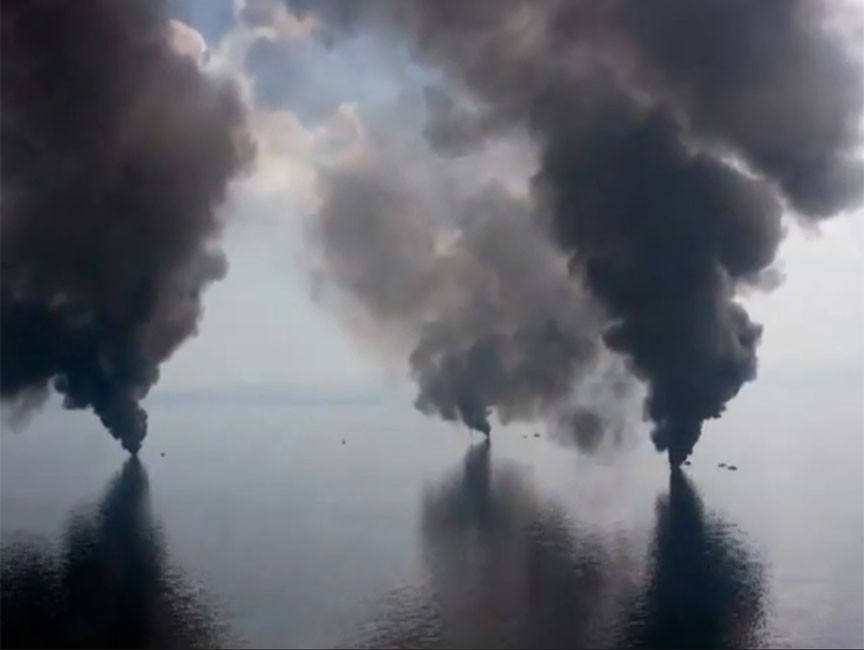
To keep some of the spill from hitting shore, 275 fires have been set in the Gulf to burn oil corralled by containment booms. These fires are the fires that have reportedly burned sea turtles alive, confirmed by testimony from NOAA scientists in a Huffington Post article on July 2.

The wildlife report below is of course the official statistics for the subject. None of the turtles burned in the 275 offshore fires were included in this report. These are just the numbers of reported impacts by the official collectors and rehabilitates. The actual number of impacted individual animals is also unknown, but it's likely to be far in excess of the official statistics.

CLICK ON CHART TO ENLARGE.
The Ixtoc blowout in the Bay of Campeche in the far southwestern Gulf of Mexico in 1979, the second largest oil spill ever, dumped 140 million gallons in nine months. The Deepwater Horizon spill surpassed this milestone in late June, after about three months. The difference in scale too is dramatic. The Ixtoc was in 160 feet of water and the well was 10,000 feet deep. The Deepwater Horizon is in 4,100 feet of water and the well is 18,000 or maybe even 25,000 feet below the ocean bed (there seems to still be some uncertainty involving the permitted and actual numbers).

There is a big difference between the Deepwater Horizon oil and that from most other oil wells because of the amount of natural gas in this particular oil field. As a result, this spill contains enormous amounts of natural gas, or methane.

This methane has caused a lot of trouble beginning with the actual blowout itself. Natural gas in an oil well is common, but not in large amounts and it is usually not a good thing. A lot of natural gas makes things even worse.

This well pushes the limits in many ways -- with the combination of the deep water, the deep well, and the high natural gas concentration -- and then we add in the technical mistakes, which we won't be able to fully determine until sometime in the future.

Gulf on fire. Image by John L. Walthen / BP Slick.

The methane continued to cause problems, as the oil recovery devices started to became clogged with methane ice, or what is really called methane clathrates -- a combination of methane and water ice that can freeze when the temperature is above 32 degrees and the pressure is high enough (like at the bottom of the ocean).

But this is not the worst that methane can do. Texas A&M Oceanographer John Kessler says that deep-ocean methane levels from the Deepwater Horizon blowout are hundreds of thousands of times higher than background levels and even approached one million times higher than normal in some of the samples that his team made while researching the “oil plumes” around the blowout.

One million times greater than background is indeed astonishing, but when put into context it becomes all the more sobering.

Methane is the same as the natural gas that we burn in our stoves. It is a greenhouse gas with one carbon and four hydrogen atoms. It has a global warming potential many times that of carbon dioxide, but when burned as a fuel only emits 71% as much CO2 as oil and 56% as much as coal. (Some say it could be a good transition fuel to get us off of coal.)

This well has a tremendous amount of natural gas, estimated to be 40% by weight of the total spill by Kessler and 50% by Samantha Joye at the University of Georgia. This is compared to about 5% from normal oil deposits.

By day 160 of the blowout we will hopefully have the pipe plugged. It should be well into August when the relief wells are finished. But we should note that it took the Mexican oil firm Pemex nine months to get their relief well to work on the Ixtoc blowout -- a well that was only 10,000 feet deep in 160 feet of water. And by the time 160 days have elapsed, the Deep Horizon will have spilled 236 million barrels of natural gas.

To put this much methane into perspective, we have to understand its global warming potential. Normally, we know that methane, as a greenhouse gas, is capable of capturing about 25 times more heat than carbon dioxide. But recent studies have shown this to be low. Because our planet is warming and the natural CO2 sinks are slowing, methane really has about 34 times the heat trapping capacity of CO2.

But wait, that’s not all.

The figure of 34 times the heat trapping capacity is for time spans of 100 years. In the not too distant past, this was an appropriate time span to consider for climate change. But that was 20th century climate change. A decade -- a half generation -- has passed since those times. The climate change times scale of relevance today is 20 or 30 years, not a century.

So when we realize that the heat trapping capacity of methane should now be based on a short 20 or 30 year times scale, the number increases to something more like 62 times more potent, not 34, or even 25.

So methane has a warming capacity that is 62 times more than carbon dioxide. And when we calculate the global warming potential of those 236 million barrels of methane, it is equal to about 5 percent of the total U.S. transportation fleet emissions of carbon dioxide. This is one incredibly huge well.

But are the emissions really important? Doctors Kessler and Joye are finding that little of the methane is making it to the surface. It is becoming dissolved in the great ocean depths and suspended with the oil in those massive plumes.

Microbiologoic activity then begins to consume the methane (and the oil). It is this bioactivity that consumes the oxygen in the water and creates hard times for the organisms that live there. Kessler and Joye said that oxygen depletion had not reached a critical level yet, only falling about 30 to 40 percent below normal. But this was about three weeks ago and at the time they said that, levels were falling 1 to 2 percent per day.

This oxygen depletion would put the waters in question down in the 4 ppm (parts per million) range. Levels of 2 ppm stress most fish. Levels below 1.4 ppm are deadly. The plumes are still 30 to 40 miles long, miles wide and thousands of feet thick. The closer to the well you get, the lower the oxygen content is, and the higher the methane concentrations.

From all over the oil-impacted coastal areas, we are hearing anecdotal reports of strange fish behavior, of sharks and turtles congregating near shore, dolphins disappearing, and that sort of thing. There are also reports about other oxygen deprived waters in the Gulf that are not associated with the great Mississippi Delta dead zone for which there are no ready explanations.

Dead zones are increasing significantly in our world’s oceans because the oceans are getting warmer (warmer water holds less oxygen) and because of increased nutrient runoff from agricultural industrialization. But further study is needed concerning these new Gulf of Mexico dead zones.

Methane occurs naturally in sea water; it is released as a byproduct of the decomposition of organic material. The organic material gets there because of the constant cycling of life; fish live and die and organic debris is washed into the oceans from rivers, but mostly it comes form what is called primary productivity. This is the planetary sized mass of life that creates half of the oxygen on Earth -- the algae and plankton of the oceans.

These single and few celled organisms are like grass and trees on land. They are the fundamental building blocks of life in the oceans. There are approximately 50 gigatons of primary productivity in our oceans (one gigaton is a billion tons). To put this to scale, there are about 2 gigatons of crops on earth.

Over tens and hundreds of thousands of years, this natural production of methane collects in sediments. Below a couple of thousand feet in depth, pressures are so high and water temperature is generally cool enough that the methane decomposition products can freeze, just like the natural gas coming out of the busted blowout preventer froze and clogged up the top hat spill collector that BP had deployed.

The frozen methane, or methane clathrates, collect in the ocean sediments and over tens and hundreds of millions of years form oil deposits deep below the ocean floor.

This is where the methane that clogged the top hat oil collector that BP deployed came from -- four to five miles beneath the bottom of the Gulf of Mexico.

But the formation of the shallow methane clathrates continue to this day. The Gulf of Mexico contains some of the greatest shallow methane clathrates deposits in the world and the oil giants are itching to get their hands on them.

There is only one problem. Methane clathrates are very unstable. They form on the edge of the envelope of pressure and temperature. Just a little warming and they become unstable. The recent Congressional inquiry into the Deep Horizon incident brought up this point:

Offshore drilling operations that disturb methane hydrate-bearing sediments could fracture or disrupt the bottom sediments and compromise the wellbore, pipelines, rig supports, and other equipment involved in oil and gas production from the seafloor.

Destabilization of methane clathrates has also been identified as a likely culprit in some of Earth’s more punctuating moments. These moments usually took tens to hundreds of thousands of years, as the earth’s climate naturally changed from warm to cold because of solar influences and natural feedbacks.

But at some point, an additional forcing, like an asteroid striking the Yucatan Peninsula, caused a perturbation in the natural cycle. The additional warming triggered the instability of the methane clathrates, great amounts of methane were released causing great warming, and abrupt climate changes occurred that caused great extinction events.

This is a very critical path that our planet occasionally follows . Right now mankind is increasing the CO2 concentration on this planet faster than at any time in the last 20 million years and likely as fast as when the giant asteroid hit the Yucatan Peninsula and the dinosaurs went extinct 65 million years ago.

Methane concentrations on earth have started to rise again after a decade of stability. It is thought that contemporary agricultural techniques and their expansion across the world had halted the increase in our planet’s methane emission, and this is probably what happened.

Baby Kemp's Ridley Sea Turtle, covered in oil. Image courtesy the National Oceanic and Atmospheric Administration (NOAA).

The new increase is likely coming from methane clahtrates in the Laptev Sea on the edge of Siberia and the Arctic Ocean. This area of the planet has warmed 7 to 9 degrees Fahrenheit in the last 20 years and the methane clahtrates on the bottom of the Laptev sea have started to vent.

The venting is so great that it rivals all the rest of the methane emissions from all of the rest of the world’s oceans combined.

The methane gas also melts beneath the clahtrates. The heat of the earth can cause free methane gas to collect beneath the solid sheet of methane ice in the sediments at the bottom of the sea. This sheet of ice has become perforated in the Laptev Sea. But what happens when the clathrates are on a slope like in the Gulf of Mexico and Mississippi Canyon where the Deepwater Horizon is?

In the past, phonemena called methane outburst occurred when their overlying methane ice laden sediment became destabilized. Scars from dozens of massive tsunami causing landslides along the continental shelf of the east coast are evident from prehistoric times.

These things happen when our climate is rapidly changing. Eight thousand years ago when Earth had just warmed out of the depths of the last ice age, a great undersea landslide took place off of the shores of Norway.

It is called the Storrega slide. It was 200 miles across and the slide traveled for 800 miles under the Atlantic Ocean, most of the way to Greenland. The tsunami it produced was 65 to 82 feet tall. The 2004 Indian Ocean Tsunami, that killed 200,000, was 50 feet tall.

I am not saying that anything of the sort is imminent. I am saying that there are important things to understand about our Earth and the way it operates. So the important things to understand now are that clathrates are unstable on slopes, the Deepwater Horizon is on a big slope, and the product coming out of the blowout is 180 degrees Fahrenheit.

[When Bruce Melton, P.E., isn't practicing civil engineering, he's studying climate change and writing about it. Melton was one of eight Austinites named in the "Heroes of Climate Change" article published in The Good Life magazine in July 2007. To read more of his work on climate change, visit his website, Melton Engineering Services Austin.]

References:

EIA Transportation Sector Emissions in 2008 –
Total CO2 emissions from transportation sector in the U.S. = 1.93 billion tons
http://www.eia.doe.gov/oiaf/1605/ggrpt/carbon.html

Primary Produtivity 50 Gtons in the oceans, 2 gtons in world crops
http://en.academic.ru/dic.nsf/enwiki/30382

Methane GWP 20 year timeframe – 62 times more potent than CO2
Nisbet, Have sudden large releases of methane from geologic reservoirs occurred since the last Glacial Maximum, Philosophical Transactions of the Royal Society, 2002.

Dr, John Kessler, Texas A&M University, Department of Oceanography
http://tamunews.tamu.edu/2010/05/26/prof-heads-out-to-study-gulf-oil-spill-with-first-nsf-grant/

Samantha Joye, University of Georgia
http://solveclimate.com/blog/20100701/methane-dead-zones-gulf-waters-confirmed-gas-levels-100-000-times-normal

Methane clathrates:
Laherrere, Oceanic Hydrates - more questions than answers, Energy Exploration and Exploitation, May 2000.

The national Methane Hydrates R&D lab
http://www.netl.doe.gov/technologies/oil-gas/FutureSupply/MethaneHydrates/projects/DOEProjects/MH_5668EMCharGOM.html

NOAA Modeling Threat
http://www.noaanews.noaa.gov/stories2010/20100702_longterm.html

Wildlife Report – July 5, 2010
http://www.deepwaterhorizonresponse.com/posted/2931/WildLifeConsolidated5july.739707.pdf

Gulf Oil Spill – The Plight of the Sea Turtles, Huffington Post, July 2, 2010
http://www.huffingtonpost.com/2010/07/02/gulf-oil-spill-the-plight_n_634083.html

Stats July 5, 2010, Government Monitor
http://www.thegovmonitor.com/world_news/united_states/florida-releases-july-6-2010-gulf-oil-spill-situation-update-34982.html

Tsunamis India 2004: Australian Bureau of Meteorology

The North Atlantic tsunami caused by a methane clathrate slide:
Record Breaking Height for Tsunami in the North Atlantic 8000 yrs BP, EOS, 2003

Stability of methane clathrates on slopes:
Deepwater Horizon Oil Spill: Selected Issues for Congress
http://www.fas.org/sgp/crs/misc/R41262.pdf

The oil coming out of the seafloor in Mississippi canyon is about 180 degrees F.
A July 1 interview on the American Geophysical Union blog of marine goechemist John Farrington, one of a group of scientists of the Consortium of Ocean Leadership at Louisiana State University.
http://blog.agu.org/geohazards/2010/07/01/oil-spill-science/

The Rag Blog

[+/-] Read More...

26 June 2010

Payoff Time in the Gulf : Hitting the Petro Jackpot


Everyone loses:
Hitting the Petro-Jackpot

The gulf is carpeted with long wide dark and slimy rainbow slivers and miles of weathered henna colored crude oil mousse...
By Larry Ray / The Rag Blog / June 26, 2010

GULFPORT, Mississippi -- Winds, tides and ocean currents, changing like spinning wheels on a slot machine, have finally lined up to announce a Petro-Jackpot! Floating and submerged oily, syrupy petroleum filth is the unwelcome payoff as it finally glides into the Mississippi Sound.

BP's uncontrolled gusher of oil has assaulted our protective pristine offshore barrier islands and now is flowing into the shallow marine nursery grounds off the Mississippi coastal shoreline. The gulf is carpeted with long wide dark and slimy rainbow slivers and miles of weathered henna colored crude oil mousse that bob and drift toward the horizon. This menace is now within sight of our miles of white beachfront along coastal Highway 90.

The futility of pleading "Somebody do something!" becomes evident. Trying to skim and contain the millions of gallons of floating oil before it comes ashore is like trying to scoop up and dispose of billions of flu germs from ten thousand sneezes. Oil, assisted by a rolling sea, splashes over and eases under so-called oil containment booms. Also consider that we have had a daily heat index here averaging 100º to 108º for the past month. Suffocating heat adds to the futility of trying to sop up oil and tar before it arrives to coat the blazing beach sand.

All the political rhetoric, naive denial, and assurances that "our beaches" are pristine and somehow exempt from the nautical nuance of Ma Nature, has stopped. The hastily produced TV commercials showing happy kids splashing along our water's edge, and couples strolling on the beach with a setting sun turning the water golden have been pulled off the air.

Now multi-faceted environmental damage begins right here on the beaches and in the seafood-rich waters fronting Gulfport and Biloxi. Recovering from this long term damage will not be like recovering from Hurricanes Camille and Katrina. The area around Valdez, Alaska has yet to truly recover from a much smaller amount of oil carelessly loosed on its shores 21 years ago when a fully loaded Exxon oil tanker ran aground splitting open its tanks just offshore.

Looking at today's NOAA oil trajectory map, above, one can visualize a double lobed, fat tube of 30-weight toothpaste being squeezed, with the cap having been unscrewed right at the flat line just off Gulfport. Governor Haley Barbour has urged churches to have special prayer services. I wonder if entreaties to a higher power to cause the deluge to somehow miss "our area" suggest that the glop would be prayed away to "some other area?" This has puzzled me since I was a little kid.

During an active hurricane season here a few years ago a large evangelical church's sign on a main Gulfport street proclaimed, "Glory... God turned the storm!"

A category three hurricane, indeed, veered away from our coast right into Florida causing several deaths and terrible destruction in the tens of millions of dollars.

How about we call off the location-specific prayer tug-of-war and instead all go take a nice walk down the beach in a couple of weeks?

There's lots of power in reality checks too.

[Retired journalist Larry Ray is a Texas native and former Austin television news anchor. He also posts at The iHandbill.]

The Rag Blog

[+/-] Read More...

18 June 2010

Jim Hightower : British Petroleum as Global Corporate Criminal

British Petroleum: the many faces of corporate crime. Photo from BP 50 years in Pictures / TLAXCALA.

British Petroleum:
Recidivist corporate criminal


By Jim Hightower / June 18, 2010

Gosh, how quickly things turn. One day, you're a strutting peacock -- the next day, you're just another gasping, oil-covered bird.

In early April, BP was strutting about in full corporate splendor, showing off the $9 billion in profits that it had soaked up in just the first three months of this year. It was also basking in a corporate re-imaging campaign, depicting itself as a clean-energy pioneer and declaring that BP now stood for "Beyond Petroleum."

Since its Gulf of Mexico well blew out on April 20, however, BP has proven to be beyond belief. The wider and deeper that this catastrophe spreads, the more we discover just how oily this giant is.

From the time it was known as the Anglo-Persian Oil Company [later renamed the Anglo-Iranian Oil Company] and set out to grab and control the rich petroleum reserves owned by what is now Iran, BP has been a recidivist global criminal. In the past three decades, it grew huge by swallowing such competitors as Standard Oil of Ohio, Amoco, and Arco. Along the way, it has been implicated in bribery, overthrowing governments, plunder and money laundering, plus having established one of the worst safety and environmental records in an industry that is notoriously reckless on both counts.

And now, its rap sheet grows almost daily. In fact, the Center for Public Integrity has revealed that the oil giant's current catastrophic mess should come as no surprise, for it has a long and sorry record of causing calamities.

In the last three years, the center says, an astonishing "97 percent of all flagrant violations found in the refining industry by government safety inspectors" came at BP facilities. These included 760 violations rated as "egregious" and "willful." In contrast, the oil company with the second-worst record had only eight such citations.

While its CEO, Tony Hayward, claims that its gulf blowout was simply a tragic accident that no one could've foreseen, internal corporate documents reveal that BP itself had been struggling for nearly a year with its inability to get this well under control. Also, it had been willfully violating its own safety policies and had flat out lied to regulators about its ability to cope with what's delicately called a major "petroleum release" in the Gulf of Mexico.

"What the hell did we do to deserve this?" Hayward asked shortly after his faulty well exploded. Excuse us, Tony, but you're not the victim here -- and this disaster is not the work of fate. Rather, the deadly gusher in the gulf is a direct product of BP's reckless pursuit of profits. You waltzed around environmental protections, deliberately avoided installing relatively cheap safety equipment, and cavalierly lied about the likelihood of disaster and your ability to cope with it.

"It wasn't our accident," the CEO later declared, as oil was spreading. Wow, Tony, in one four-word sentence, you told two lies. First, BP owns the well, and it is your mess. Second, the mess was not an "accident," but the inevitable result of hubris and greed flowing straight from BP's executive suite.

"The Gulf of Mexico is a very big ocean," Hayward told the media, trying to sidestep the fact that BP's mess was fast becoming America's worst oil calamity. Indeed, Tony coolly explained that the amount of oil spewing from the well "is tiny in relation to the total water volume." This flabbergasting comment came only two weeks before it was revealed that the amount of gushing oil was 19 times more than BP had been claiming.

Eleven oil workers are dead, thousands of Gulf Coast people have had their livelihoods devastated and unfathomable damage is being done to the gulf ecology. Imagine how the authorities would be treating the offender if BP were a person. It would've been put behind bars long ago -- if not on death row.

[National radio commentator, writer, public speaker, former Texas Agriculture Commissioner, and author of the book, Swim Against The Current: Even A Dead Fish Can Go With The Flow, Jim Hightower has spent three decades battling the Powers That Be on behalf of the Powers That Ought To Be -- consumers, working families, environmentalists, small businesses, and just-plain-folks.]

Copyright 2010 Creators.com


Source / Truthout

The Rag Blog

[+/-] Read More...

Tom Tomorrow : Free-Market-Man

Cartoon by Tom Tomorrow / This Modern World.
CLICK ON IMAGE TO ENLARGE
Source / Truthout

The Rag Blog

[+/-] Read More...

16 June 2010

View From Texas Coast : Stop the Drilling Now

In better days: Brown Pelican off the Texas Coast. Photo from Amber Coakley / Birders Lounge.

BP oil disaster demonstrates
Need to end offshore drilling
...our love for the abundant life [on the Gulf Coast] is so woven into our lives that we can’t imagine what we will experience if it is diminished permanently.
By Lamar W. Hankins / The Rag Blog / June 16, 2010

Growing up on the Gulf Coast at the Louisiana-Texas border makes it difficult to consider the BP oil disaster unemotionally. Nevertheless, I will try to sort the facts from my emotional response, and acknowledge my personal and financial interest in the damage this oil gush is causing on the Gulf coast. But if you’re not sickened by the sight of oil sludge-saturated sea life, then this column will not be worth your time to read.

I lived in Port Arthur beginning in 1948 and left to attend college in central Texas in 1962. I returned to the coast many times in the intervening years and began doing serious and regular salt-water fishing there in the mid-80s.

I (along with my wife) own a beach house with six other friends near where the Colorado River joins the Gulf of Mexico. Now when I fish, it is in the estuaries, bayous, and bays in that area, and in the surf of the Gulf of Mexico about 60 miles southwest of Galveston Island.

We share the same marshland wildlife that people on the Louisiana coast enjoy. Brown Pelicans, Sea Gulls, migrating ducks, Whooping Cranes, Bald Eagles, owls, countless other sea birds, Red Fish, Black Drum, Spotted Sea Trout, Flounder, Dolphin, Pompano, Whiting, assorted shark species, crabs, shrimp, bivalves and mollusks, turtles and many other birds, fish, and mammals that thrive along the Gulf Coast.

While our livelihoods don’t depend on the coastal ecosystem, our love for the abundant life there is so woven into our lives that we can’t imagine what we will experience if it is diminished permanently.

Oil-blackened marshes and sea birds and other sea life gasping for oxygen make clear that we are witnessing a vast destruction of life. While BP will pay for the dead workers killed by the explosion on its Deepwater Horizon drilling rig, it will not pay for the suffering of the sea birds and sea life, nor does this cold, calculating, greed-driven corporation care. Its view is that the earth and water are there for its exploitation and views to the contrary can be damned.

An exhausted oil-covered brown pelican sits in a pool of oil along Queen Bess Island Pelican Rookery, near Grand Isle, Louisiana on Jun. 5, 2010. Photo by Sean Gardner / National Post.

The people along the Louisiana coast are learning firsthand what we hoped never to experience. The loss of a significant amount of wildlife can cause grief as profound as the loss of a family member. As a child, I remember when two whales beached themselves on the coast between Galveston and Sabine Pass. Some wildlife researchers put tents around them and performed necropsies to determine why they died.

They let people into the tents to examine the whales up close. It was the first and last time I touched a whale. From my young perspective, they were several times bigger than an elephant, though I’m sure that they were closer to an even match with a full-grown pachyderm. I was in awe of the large creatures. We walked around their carcasses with reverence.

Before seining by hand with 200-foot nets was prohibited, such activity was great fun for family and friends on holiday weekends. An uncle of mine would always take hold of the lead pole and walk into the Gulf until it was so deep he had to bob up and down using the pole to keep his head mostly above water. He would then lead the procession of helpers spread out along the seine in an arc and start heading back into the shore.

It took everyone -- maybe 20-25 people -- to pull the net ashore to learn what we had caught. There was always much sea life in the net, including some that no one in the group could identify, though some guessed at the name of this creature and that one. The fish we cleaned and cooked for supper and we helped the crabs and other creatures we weren’t afraid to touch go back into the water.

That life is no more because of overfishing, which led to outlawing seining in the 70s. But that government rule and other conservation measures aimed at saving numerous species have saved the Spotted Sea Trout, Red Fish, Black Drum, Flounder, Brown Pelican, sea turtles and other sea life from extinction. At least that was the situation before the BP oil disaster.

We don’t yet know what effects it will have, but we are beginning to get an idea. The one lesson I have already taken from the disaster is that BP is incapable of restoring the sea and shore life that have been killed and will continue to be killed for decades as a result of BP’s negligence and greed.

In 1989, the Exxon Valdez leaked about 22.2 million gallons of crude oil into Prince William Sound in Alaska, despoiling some 1,230 miles of coastline and killing as many as 250,000 birds and sea mammals immediately, along with billions of fish eggs for many years and contributing to reproductive failures in other species for several generations.

In comparison, it is believed that the BP gusher has yielded about 20,000 barrels a day by conservative government estimates. This is the equivalent of 840,000 gallons a day times 56 days (as of June 14), which totals to a conservative estimate of over 47 million gallons, more than twice what the Exxon Valdez spilled, and there is no end in sight.

It is too early to know how many miles of coastline could be affected, but the State of Florida (which appears vulnerable) has just over 1230 miles of coastline, and about 120 miles of Louisiana coast already has been affected.

Scientists estimate that it will take mussel beds fouled by the oil leak in Alaska at least 30 years to substantially, but not fully, recover from the Exxon Valdez disaster, which was caused by the failure of Exxon to repair an expensive, but highly effective, sonar system that would have allowed the third mate (who was at the helm at the time of the disaster) to guide the ship safely through Prince William Sound. No one knows how long it will take the oyster beds along the Gulf coast to recover.

As reported by David Biello in the Scientific American:
More than 20 years after the Exxon Valdez foundered off the coast of Alaska, puddles of oil can still be found in Prince William Sound. Nearly 25 years after a storage tank ruptured, spilling oil into the mangrove swamps and coral reefs of Bahia Las Minas in Panama, oil slicks can still be found on the water. And more than 40 years after the barge Florida grounded off Cape Cod, dumping fuel oil, the muck beneath the marsh grasses still smells like a gas station.
Biello reports also that Texas A & M University marine biologist Thomas Shirley has found that there are nearly 16,000 species of plants and animals in the Gulf of Mexico, not counting microbes. U.S. National Oceanic and Atmospheric Administration (NOAA) marine biologist Jane Lubchenko pointed to another aspect of the release of oil: "There are a diversity of types of habitats in the Gulf, many very important in support of a variety of wildlife and fisheries... Many are at risk of being affected..." With these facts in mind, the situation in the Gulf of Mexico looks absolutely dismal.

Already, conservative and Libertarian voices are advancing the notion that BP has no responsibility for this environmental debacle. Rand Paul said, “I think it's part of this sort of blame-game society in the sense that it's always got to be somebody's fault instead of the fact that maybe sometimes accidents happen." David Brooks, the Barack Obama of conservative confabulation, has attributed the cause of the Gulf gusher to the complexity of the technology that exceeds the ability of humans to cope

Boom deployed by Plaquemines Parish, Louisiana, on June 12, 2010 in attempt to protect nearby islands. Photo by Kurt Fromherz / WDSU.com.

To these political voices, no one can be held responsible for such events. They prefer to ignore BP’s long history of recklessness toward its employees and the environment, and its disdain for and venality toward those employees who report safety concerns. Would that we all could get off so easily for our transgressions.

The people and institutions at the top of the economic food chain generally have limits on their accountability, such as the $75 million plus cleanup costs limitation on damages for oil companies who spill oil into coastal waters, which was enacted by a unanimous Congress in 1990 (the Oil Pollution Act of 1990). But those at the bottom of the economic food chain are often dealt with harshly, out of all proportion to their wrongdoing. Just walk into any criminal courtroom in the country to confirm this.

Recently, Dr. Rafe Sagarin, a marine ecologist and policy researcher at the University of Arizona's Institute of the Environment, and Mary Turnipseed, a graduate student in Duke University's Nicholas School of the Environment, wrote about a legal doctrine known as the Public Trust Doctrine:
...the Public Trust Doctrine (PTD), established in the earliest days of this country and since expanded through courts and state and federal legislative bodies, provides the power -- and the legal responsibility -- to manage public trust assets in a comprehensive fashion that balances competing short and long-term needs of all American citizens. It's a mandate that if it had been implemented properly would likely have prevented the current catastrophe, and if applied to the full extent of its powers could prevent similar disasters in the future.
Sagarin and Turnipseed, writing for McClatchy News, concluded:
... the Deepwater Horizon spill is a catastrophic failure to protect the public trust. Millions of animals; a $2.5 billion fishing industry and a $3 billion tourism sector imperiled; the toxic legacy of dispersants; and up to 17,000 barrels of oil spilling into the Gulf every day, all are a shocking blow to the value of the coastal and marine resources that are a vital part of our nation's public trust.
BP understands nothing about the public trust.

The world’s recoverable oil reserves are about 1,200 billion barrels. North America accounts for about 6% to 9% of those reserves, and the Gulf of Mexico only a portion of that. Even if we produced all the oil that is currently producible in the United States, it would last from three years to nine years, depending on which expert you believe.

Destroying our coastal environment is not worth a few years of oil production, whether it is three years or nine, or 19 if the experts are way off in their estimates. The facts are that we don’t have to drill in the Gulf of Mexico to get the oil we need until green alternatives become both feasible and abundant.

Among Americans who depend on the Gulf Coast and its waters for recreation, living, and work, few believe that BP should not have to pay for the damage it has done and will continue to do, for generations, to the Gulf of Mexico and its environs from this one incident. Ruining the natural world for oil is not a good trade-off for Americans.

The lesson we should take from BP’s negligence is that green energy should become the “race to the moon” of the second decade of the 21st century. If the government could be the stimulus for winning that race in the 1960s, it can be the stimulus for winning this new race to produce feasible and affordable alternative energy before the end of the next decade. The government, along with entrepreneurs and creative scientists and technologists, can assure that we can continue to lead good lives while we protect the natural world from man-made disasters.

It is time to accept that offshore drilling is as much a certain killer of the creatures in the sea as is overfishing. I agree with the conservative and Libertarian BP apologists on one point -- it is inevitable that such disasters will occur again as long as we allow offshore drilling. We need the same no-nonsense rules that protect specific species to protect all of the sea life in the Gulf of Mexico.

Undoubtedly, the oil companies have escaped effective regulation because of their political power, while fishermen and shrimpers have been forced to accept regulations needed to conserve sea life. Now, we must force our politicians to accept the indisputable reality that oil production in the Gulf is inevitably destructive of the environment.

An end to offshore drilling is the most effective action we can take to protect our coastal waters and environs to ensure that we are taking care of a resource that provides food, recreation, and a way of life for many Americans. And it is equally important to protect all life, whether human or other species, because we are all related, and it is the responsible thing to do.

© Freethought San Marcos, Lamar W. Hankins

[This article was also published in the San Marcos Mercury.]

The Rag Blog

[+/-] Read More...

Only a few posts now show on a page, due to Blogger pagination changes beyond our control.

Please click on 'Older Posts' to continue reading The Rag Blog.