Showing posts with label Christianity. Show all posts

08 January 2013

Lamar W. Hankins : The Failure of Religion-Based Public Grief

On Sunday night, December 16, President Obama spoke at a vigil for those who died at Sandy Hook elementary school in Newtown, Conn. Image from The Washington Post.

The failure of religion-based public grief
My dissonance came from the very words Obama spoke and quoted because for me they are empty and inconsequential in the face of such tragedy.
By Lamar W. Hankins / The Rag Blog / January 8, 2013

When President Obama spoke at the memorial service for the children, teachers, and administrators murdered in Newtown, Connecticut, I was overwhelmed by dissonance. His remarks assumed that a Christian perspective was applicable to everyone who mourned as he spoke about “eternal glory” and quoted bible verses: “For we know that if the earthly tent we live in is destroyed, we have a building from God, an eternal house in heaven not built by human hands.”

I empathize with Obama’s reliance on scripture and belief in a supernatural world with a heaven above and prayers heard by a god who presumably cares. With such tragedy, it is difficult to know what to say without relying on that which is familiar and may comfort the speaker and at least some of the listeners.

What to say confounds Christians and non-Christians alike. But my dissonance came from the very words Obama spoke and quoted because for me they are empty and inconsequential in the face of such tragedy.

If there were a god who cared, who answered prayers, the deaths of these 26 people and the killer’s mother would not have happened. We might disagree about the lives of the adults who were killed, but it is hard to ignore the essential innocence of the 20 children whose lives were snuffed out.

Unless a person believes in the Old Testament practice of child sacrifice, there can be no justification for a culture that makes it easy to end so many young lives so quickly.

I have no reason to doubt, as Obama said, that Newtown is a community “full of good and decent people.” And the survivors of December 16 were not alone in their grief, though it is hard to imagine that any of us felt grief in the same way those families did.

In spite of Obama’s best intentions, there is no way that any of us can fully comprehend the burdens felt and experienced by the families of those dead children and their public school caretakers. And Obama was right to point out the selflessness of those caretakers.

Obama’s acknowledgement of the importance of our care and support for one another was a fitting reminder that we are all in this together:
As a community, you’ve inspired us, Newtown. In the face of indescribable violence, in the face of unconscionable evil, you’ve looked out for each other. You’ve cared for one another. And you’ve loved one another. This is how Newtown will be remembered, and with time and God’s grace, that love will see you through.
But Obama’s reliance on his personal theology added nothing but dissonance to his valuable reminder of our togetherness and the need to find solutions to gun violence as communities and as a nation:
...[W]e come to realize that we bear responsibility for every child, because we’re counting on everybody else to help look after ours, that we’re all parents, that they are all our children... Can we honestly say that we’re doing enough to keep our children, all of them, safe from harm?... I’ve been reflecting on this the last few days, and if we’re honest with ourselves, the answer’s no. We’re not doing enough. And we will have to change.
Obama then recounted the four mass shootings that have occurred since he became president, as well as other recent mass killings and deadly shooting incidents: Tucson, Aurora, Oak Creek, Newtown, Columbine, Blacksburg. He continued:
We can’t tolerate this anymore. These tragedies must end. And to end them, we must change. We will be told that the causes of such violence are complex, and that is true. No single law, no set of laws can eliminate evil from the world or prevent every senseless act of violence in our society, but that can’t be an excuse for inaction. Surely we can do better than this... We can’t accept events like this as routine.
This appeal to political action to stop such senseless violence should have resonated with everyone. Especially so now that we know, thanks to Slate.com, that 18 people are killed each day in the U.S. by gun violence. Stated another way, every 36 hours, we experience the number of gun deaths that occurred in Newtown on December 16.

After making his appeal to find answers to the useless violence caused by people with powerful killing machines, and discussing the human condition briefly, Obama returned to his Christian message, quoting scripture which suggests that the deaths of these 27 people were a part of his God’s “heavenly plan,” as well as the plan of Jesus, which we will not be able to understand.

Even as Obama said that “God has called them all home,” he failed to explain why they had to suffer murder by Bushwacker in the process.

But Obama failed to note the contradiction in his call for political action for gun control. If the deaths of these 27 people in Connecticut were God’s plan, who are we to interfere in that plan? How can we interfere with an act of the Almighty? And making his “God’s will” argument is a strange comfort to those who lost their young children to the actions of a mentally unstable individual who had access to an assault rifle. It is a cold and callous god who would will the deaths of 20 young children, as well as the adults who tried to protect them.

And, of course, Obama felt the need to end his eulogy by once again invoking his religious views: “May God bless and keep those we’ve lost in His heavenly place. May He grace those we still have with His holy comfort, and may He bless and watch over this community and the United States of America.” By implication, God has not kept up His responsibility to watch over us all.

Newtown includes not just Christians of many stripes (mainly Catholic, but also Mormons, mainline Protestant Christians, Pentecostals, and others), along with Jews, Muslims, followers of Eastern religions, nonbelievers, and the religiously unaffiliated. Faced with speaking to such a diverse group, it is not appropriate to assume that they will all find comfort and blessings in any particular version of Christian theology and belief.

But those from the political class regularly mouth the platitudes and beliefs of Christianity because it is the dominant religion in the U.S. References to Christian doctrine are the politically safe route to curry favor with that majority, many of whom also believe in astrology, reincarnation, ghosts, witches, and other superstitions not consonant with Christian doctrine.

Even as a Christian, I did not believe in heaven, hell, miracles, the virgin birth, transubstantiation, and other mythologies that are clearly impossible or beyond reason.

As a humanist, I derive no comfort, holy or otherwise, in being told that the killing of these 27 people was all a part of God’s plan, that all the innocent children are with Jesus in Heaven, and that God has called them home. Their actual homes are bereft of their presence, missing their laughter, joy, and sorrow, and filled with people whose grief seems almost unbearable.

No Bible verses or supernatural ideas or superstitions can change that for most people. For those who are comforted by such beliefs, Obama’s words may have been appropriate, but for the rest, they likely seemed insensitive, unreasoning, and obsequious.

Obama’s task was daunting. Much of it he did well, but pushing his theology on others was unnecessary, unhelpful, and potentially offensive to those from other lifestances, as well as many Christians who don’t hold to such doctrine.

Christians in public life need to end their self-centeredness and realize that they represent only about one-third of the world’s people, though they are a majority in the U.S. And none of them know, any more than I do, what happens after we die. About death, as we have been reminded by the great 19th century orator Robert Ingersoll, ignorance is equal among all people.

No matter who is in the majority when it comes to religion or non-religion, we should all learn how to speak a common language of comfort, care, compassion, and grief without resorting to the shibboleths of personal religious belief.

[Lamar W. Hankins, a former San Marcos, Texas, city attorney, is also a columnist for the San Marcos Mercury. This article © Freethought San Marcos, Lamar W. Hankins. Read more articles by Lamar W. Hankins on The Rag Blog.]

The Rag Blog

[+/-] Read More...

10 June 2012

Lamar W. Hankins : The Gospel Truth

West Virginia Pentecostal preacher Mark Randall “Mack” Wolford died from a snake bite he received handling snakes in church. Image from Eternal Life Blog.

The Gospel truth:
Fatal misunderstanding of the Bible
'And these signs will follow those who believe: in My name they will cast out demons; they will speak with new tongues; they will take up serpents...'
By Lamar W. Hankins / The Rag Blog / June 10, 2012

Among the Abrahamic religions -- Judaism, Islam, and Christianity -- the tiny group of Christians known as Pentecostal serpent handlers are among the most unusual of Christian sub-groups. They have focused their religious belief and practice on a few verses at the end of the book of Mark -- verses that do not appear in the two oldest versions of writings that became the Gospel of Mark.

Few ministers or pastors tell their congregations this truth about Mark and about much of the Bible. What they mainly do is read it and interpret it, and many teach that every word in the Bible was created by a supernatural God and given to some human being to write down.

Such teachings were my experience growing up. No minister ever told me that over 5,000 (now, nearly 6,000) known manuscripts make up the text of what we call the Bible. Maybe if congregants knew such facts, they would not take so seriously everything found in the Bible. I suspect, though I do not know, that many ministers may not themselves know about these textual variations.

Even when I took New Testament Greek in college, I was not told that the Greek version of the New Testament that we studied lacked clear authenticity.

The case in point this week is the death of the West Virginia Pentecostal preacher, Mark Randall “Mack” Wolford, age 44, who died from a snake bite he received handling snakes in church. Wolford was a devout believer in the passage in Mark 16:17-18:
And these signs will follow those who believe: in My name they will cast out demons; they will speak with new tongues; they will take up serpents; and if they drink anything deadly, it will by no means hurt them; they will lay their hands on the sick, and they will recover.
Mack Wolford’s father had died from a snake bite in a similar fashion when Mack was 15. His family’s faith in this passage of Mark prevented them from seeking medical attention. Such believers often attribute deaths from snake bites to two causes: either the victims lacked sufficient faith or it was God’s will that they die.

None of them consider that they may have been reading and believing in an inauthentic version of the Gospel of Mark. As Bible scholar and textual critic Bart Ehrman explains,
As we learned at Moody [Bible Institute] in one of the first courses in the curriculum, we don't actually have the original writings of the New Testament. What we have are copies of these writings, made years later -- in most cases, many years later. Moreover, none of these copies is completely accurate, since the scribes who produced them inadvertently and/or intentionally changed them in places.
The main reason for the changes, or variants, is that these scriptures were written by hand in days before the printing press was invented. Transcription errors, as a particular scripture is copied from an older one, are inevitable. Words are misread, letters are transposed (often changing the meaning of words), spelling and grammar errors abound, words are incorrectly separated or joined together, sentences are left out or repeated, and new material may be added for purposes known only to the transcriber.

Most of these variants don’t make much difference. But sometimes variants make a great difference.

Such is the case of Mark, chapter 16. Scholars know about four transcripts of the Gospel of Mark. Generally, they consider the earliest versions of scripture the most authentic. According to Ehrman in his book “Misquoting Jesus,” the last 12 verses of Mark were added to the later manuscripts nearly 300 years after it was first copied and are not found in the two oldest and best manuscripts. Mark is also the earliest of the Gospel texts, so it is not surprising that Luke has a similar passage concerning serpents at Luke 10:19 -- Mark was its source.

Even Ehrman’s critics, such as Daniel B. Wallace of the Dallas Theological Seminary, acknowledge him as “one of North America’s leading textual critics.” Textual critics study the work of the people who tediously copied religious manuscripts, study the process by which certain manuscripts were accepted as a part of what we know as the Bible (its canonization), study these texts of the Greek New Testament, and determine through evidence and reasoning which parts of the text have authentic origins and which parts were added by a different author at some later time, and why, to the extent that can be determined.

In the case of the last 12 verses of Mark, chapter 16, Ehrman explains that not only are they not found in the two oldest manuscripts attributed to Mark, but the writing style of these 12 verses differs from the rest of the text; the transition between these verses and the earlier text makes little sense in the context of the story (Mary Magdalene is referred to as though she had not been mentioned earlier, but she had been); and many of the words and phrases in the 12 verses are not found elsewhere in Mark.

Ehrman states that “nearly all textual scholars” believe these verses were added to Mark by a later scribe, possibly to smooth out what would have been an abrupt ending to the writing with no mention to the disciples of Jesus’s resurrection or his appearance to the women who went to the tomb.

For Ehrman, “the task of the textual critic is to try to recover the oldest forms of these texts.” This task is important because Christianity “is a textually oriented religion whose texts have been changed.” The meaning of the New Testament can’t be grasped if the words that were intended are not known. This is true whether one believes the words are divinely inspired or one believes merely that the New Testament is a significant book.

 For Ehrman, the New Testament “is an enormous cultural artifact, a book that is revered by millions and that lies at the foundation of the largest religion in the world today.”

I find that many Christians don’t know that it wasn’t until around the year 250 of the Common Era that a generous benefactor of the Roman church, Marcion, put together the first collection of scriptures that he considered the sacred texts of the faith, often referred to as the canon.

But Marcion chose what scriptures should be included in the canon based on his belief that the God of the Old Testament was not the same God of Jesus and Paul. He believed they were two different Gods -- the God of the Jews, who created the world and had very harsh laws that had to be followed, and “the God of Jesus, who sent Christ into the world to save people from the wrathful vengeance of the Jewish creator God,” as Ehrman explains.

Marcion’s canon included a Gospel (a version of Luke) and 10 epistles, with no Old Testament. Because he also believed that others who disagreed with him had altered some of the texts, Marcion amended the texts to leave out references to the Old Testament God.

About 30 years later, another Christian writer, Irenaeus (known as the bishop of Lyons in Gaul -- what is now modern France) criticized Marcion’s version of the canon and produced one of his own, which included the more familiar four Gospels.

Debates raged about the canon for several centuries. In the latter part of the fourth century, the bishop of Alexandria, Athanasius, approved 27 books that make up what we know generally as the New Testament today. It took many decades, perhaps centuries, for this version of the New Testament to be widely accepted among Christians, and there are differences among some of the versions in use today.

Further, the manuscripts from which the New Testament was taken do not have punctuation, verses, and chapters. These were added later to create some order within the texts.

If only the Pentecostal serpent handlers understood what Ehrman and other scholars of the Bible teach about the origins and development of the text of the New Testament, their lives might be quite different. Perhaps the two verses in Mark on which they base some of their religious practices and beliefs would not have seemed so important, and both Mack Wolford and his father before him would not have died from handling snakes as part of their religious worship.

[Lamar W. Hankins, a former San Marcos, Texas, city attorney, is also a columnist for the San Marcos Mercury. This article © Freethought San Marcos, Lamar W. Hankins. Read more articles by Lamar W. Hankins on The Rag Blog.]

The Rag Blog

[+/-] Read More...

07 March 2012

Jim Rigby : The Flag by the Pulpit

Image from encountering love.

The flag by the pulpit
What does it mean when we tell preachers not to be political, but place a flag by the pulpit as though the flag were not itself a political statement?
By Jim Rigby / The Rag Blog / March 7, 2012

When I first graduated from seminary and began to preach, I barely noticed the flag that stands by most pulpits in the U.S. If we see a flag on a ship at sea, or on the car of a diplomat, we understand those vehicles are set aside to represent the United States. It did not occur to me that the flag by the pulpit bore the same meaning.

If a Roman emperor required a statue of himself to be placed in an early church, everyone would understand what that statue really meant. The statue would be a reminder that people could worship however they wished, so long as their first loyalty was to the empire.

The flag can also stand as a boundary that American preachers are not to cross. We may pray for our troops, but not for our enemy’s. We may pray for healing, but not for health care. We may pray for the poor, but we must never question the capitalist system that makes them poor.

What does it mean when we tell preachers not to be political, but place a flag by the pulpit as though the flag were not itself a political statement? Is the flag not a warning? Does the flag not bear a command? “You shall not speak of any other politics than that of the American Empire. You are not to worship a God who is bigger than your nation. You shall not hold the actions of your nation to a universal standard.”

The flag by the pulpit reminds us that the American Empire and the capitalism for which it now stands, lies in the background of everything the church can do, or even think, so long as nationalism is the context from within which we try to be ethical.

Knowing this, who would not take the flag down? We should take down the very cross itself, if it ever prevented us from showing the love of Christ to those who are not Christian. There is one universal love to which every other lesser loyalty must submit. We do not love America less, for loving humankind more.

[Rev. Jim Rigby, a human rights activist, is pastor of St. Andrew’s Presbyterian Church in Austin, Texas. Jim Rigby blogs at jimrigby.org. He can be reached at jrigby0000@aol.com., and videos of his sermons are available online here. Read more articles by Jim Rigby on The Rag Blog.]

The Rag Blog

[+/-] Read More...

22 December 2011

Jim Rigby : Christmas Cancelled as Security Measure!

Three wise men arrested for illegal possession of “frankincense” and “myrrh.” Art from Dare to Create.

Christmas is no time to
talk about war and peace
When the angels sang, 'peace on earth good will to all,' they were expressing the song written in every heart. But, that song calls us out of empire and into our entire human family.
By Jim Rigby / The Rag Blog / December 22, 2011

When I heard the President speak to returning troops last week, my mind flashed back to an article I once wrote for our local newspaper. Each week a different member of the local clergy would write a column, and I had been asked to write the piece for Christmas.

That year all I could hear was the drumbeat leading toward a war with Iraq. I racked my brain trying to think of a way to put faces on the people we were about to bomb. Looking at a nativity scene I thought, “the people we are about to kill look like that.” Maybe a reframed Christmas story could help Americans stop hating Saddam long enough to care about the people who will pay the real cost of this invasion.

I submitted the following article, covering the Christmas story the way the U.S. press was covering the build-up to the Iraq war. Looking back, I should have known what was about to happen.
Christmas Cancelled as a Security Measure

ELLIS ISLAND -- The three wise men were arrested today attempting to enter the country. The Iraqi nationals were carrying massive amounts of flammable substances known as “frankincense” and “myrrh.” While not explosives themselves, experts revealed that these two substances could be used as a fuse to detonate a larger bomb. The three alleged terrorists were also carrying gold, presumably to finance the rest of their mission.

Also implicated in the plot were two Palestinians named Joseph and Mary. An anonymous source close to the family overheard Mary bragging that her son would “bring down the mighty from their thrones and lift up the lowly.” In what appears to be a call to anarchy, the couple claims their son will someday “help prisoners escape captivity.” “These people match our terrorist profile perfectly,” an official source reported.

All of the suspects claimed they heard angels singing of a new era of hope for the afflicted and poor. As one Wall Street official put it, “These one world wackos are talking about overturning the entire economic and political hierarchy that holds the civilized world together. I don’t care what some angel sang; God wants the status quo -- by definition.”

A somber White House press secretary announced that it might be prudent to cancel Christmas until others in the plot are rounded up. “I assure you that this measure is temporary. The President loves Christmas as much as anyone. People can still shop and give expensive gifts, but we’re asking them not to think about world peace until after we have rid the world of evil people. For Americans to sing, ‘peace on earth, good will to all’, is just the wrong message to send to our enemies at this time.”

The strongest opponents of the Christmas ban were the representatives of retail stores, movie chains and makers of porcelain Christmas figurines. “This is a tempest in a teapot,” fumed one unnamed business owner. “No one thinks of the political meaning of Christmas any more. Christmas isn’t about a savior who will bring hope to the outcasts of the world; it’s about nativity scenes and beautiful lights. History has shown that mature people are perfectly capable of singing hymns about world peace while still supporting whatever war our leaders deem necessary. People long ago stopped tying religion to the real events in the world.”

There has been no word on where the suspects are being kept, or when their trial might be held. Authorities are asking citizens who see other foreigners resembling nativity scene figures to contact the Office of Homeland Security.
A few days after submitting that piece, I received a nervous call from an editor. “We love your story. It’s very funny.”

“Thank you,” I said waiting for the other shoe to fall.

“The thing is, we want to take out the part about Iraq and Palestine.”

After a horrified pause, I explained that had been the whole point of writing the story -- to humanize the people who were about to be killed. When I refused to gut the story, he told me they would have to drop it all together.

I shouldn’t have been surprised. Clergy who want to talk about real events in the world are seen as too political for the religious section, and too religious for the political section. Of course, if a minister gets in the pulpit and waves the flag and prays for the troops, that’s not called “political," but if a minister questions any war, then it is considered mixing religion and politics. The resulting pablum in most clergy columns validates their strategic placement somewhere between the obituaries and the comics.

What have we learned as a result of the war? That was answered by Obama’s words to the returning troops:
Because of you -- because you sacrificed so much for a people that you had never met -- Iraqis have a chance to forge their own destiny. That’s part of what makes us special as Americans. Unlike the old empires, we don’t make these sacrifices for territory or for resources. We do it because it’s right. There can be no fuller expression of America’s support for self-determination than our leaving Iraq to its people. That says something about who we are.
Looking back at my earlier Christmas article, I feel pain not pride at what the President said. His speech to returning troops could have been taken from any leader, of any nation, from any period of history, simply by changing the names and places. It is the kind of speech every leader has given since the emperors: brave and noble words, written in someone else’s blood.

This President who ran, in part, against this war, has come to repeat the party line. This President, who once spoke of respect for all people of the world, has now deported more immigrants than Bush.

Hearing another speech expressing our nation’s narcissistic delusion made me physically ill. I could not help but think of the bloody wake such rhetoric leaves behind when put into action. The fact that we are leaving Iraq at this point says nothing about the purity of our initial motives. Even bank robbers don’t stay around after the crime has been committed.

I appreciate trying to make our young soldiers not feel like they were pawns in someone else’s parlor game, but for the sake of future generations we must painfully remember and affirm, that is exactly what happened.

We, from the United States, are not like the people in our nativity scenes. We are like the Romans looming ominously in the background of the story. Christmas is about the little people of the world who find joy and meaning while living under someone else’s boot. We from the United States can only celebrate Christmas by ending our cultural narcissism, renouncing empire, and making room for the poor and the weak of the world like Joseph and Mary.

Christmas is not a fact of history, but Christianity’s particular symbol of every human being’s hope for world peace and universal happiness. When the angels sang, “peace on earth good will to all,” they were expressing the song written in every heart. But, that song calls us out of empire and into our entire human family.

Maybe stopping the frenzy of Christmas long enough to really hear the song the angels sang to the wretched of the earth, would give us the humanity to stop hanging our Christmas lights until we no longer kill our brothers and sisters for the fuel to illumine them.
O ye beneath life's crushing load, whose forms are bending low,
Who toil along the climbing way with painful steps and slow;
Look now, for glad and golden hours come swiftly on the wing;
Oh rest beside the weary road and hear the angels sing.
[Rev. Jim Rigby, a human rights activist, is pastor of St. Andrew’s Presbyterian Church in Austin, Texas. He can be reached at jrigby0000@aol.com., and videos of his sermons are available online here. Read more articles by Jim Rigby on The Rag Blog.]

The Rag Blog

[+/-] Read More...

18 December 2011

Lamar W. Hankins : The Gospel According to Tebow

Denver Broncos quarterback Tim Tebow shown "Tebowing."

Whose side is God on?
The Gospel according to Tebow


By Lamar W. Hankins / The Rag Blog / December 18, 2011

I don’t normally write about an individual’s religious beliefs unless that person is a politician using religion to further his or her political career. But the religion of Tim Tebow, the current quarterback for the Denver Broncos, fits into that genre, although Tebow uses his religion to boost the performance and popularity of a pro football team and his ambition to be a winner, rather than to boost political ambitions.

For those who don’t know, whenever Tebow scores a touchdown, he drops to one knee and assumes a prayerful stance, presumably thanking his God for making his success possible. Tebow is not alone in such public demonstrations of piety. Many football players who score for their teams engage in similar acts of religious fealty.

Some touch an area near their heart and point upward to the sky, the usually accepted location for God’s residence, as though giving God credit for their athletic accomplishment. Others kneel and make the sign of the cross, or some combination of religious demonstrations. Often, field goal kickers, just before the ball is snapped, cross their chests in the manner of priests invoking the blessing of the Father, Son, and Holy Ghost.

I’ve never understood why linemen don’t do the same for an excellent block they have made which allowed a halfback to break through the line and score, or gave time for the quarterback to throw a touchdown pass. Maybe players think God deserves credit only for the points on the scoreboard, not the grunt work it takes to make those scores. When Tebow gets around to writing his gospel for all to read, perhaps he will explain this aspect of the game.

There are other things I don’t understand about Tebow’s Gospel. Why doesn’t God help him throw better passes? He is a weak passer, with a lousy passing percentage. One would think that making Tebow a better passer would take some of the work out of making the Broncos a winning team. But maybe God likes to keep Broncos fans on edge. It makes the games more exciting than would a five touchdown lead.

But Tebow doesn’t stop with such public displays of righteousness. He talks up his religion constantly to fans, reporters, and teammates. Apparently, the entire Bronco team has embraced Tebow’s religion; maybe they figure it wins games for them.

I always thought that Jimmy Johnson, the former winning coach at the University of Miami and the Dallas Cowboys, was smart to study psychology as an undergraduate, even if he never intended to use that knowledge to produce winning football teams. He parlayed what he learned about motivation and human nature into an exceptional career in football that any coach would be pleased with.

Tebow may not have knowledge of psychology to help him, but he has learned the basics about group solidarity, optimism, and Norman Vincent Peale’s “Power of Positive Thinking.” He uses his religion to motivate, inspire, and achieve cohesiveness among his teammates. As long as he continues to give them confidence and help them win, few people in Denver are likely to object to his public displays of religious fervor. But if the winning stops, belief in Tebow’s leadership may wane, as may the Broncos’ reliance on religion to augment a mediocre team.

What Tebow has learned, whether intentionally or as a by-product of his piety, is nothing new to those who have played team sports, especially football. My high school football coaches encouraged (though, as a practical matter, we had no choice) the team to gather on bended knee before games (and sometimes afterwards) to recite The Lord’s Prayer in unison. The coaches knew that this praying together created group cohesion, especially in a demographically select group of Christians. I don’t know what might have happened if one of the few Jewish boys in our high school had been a football player.

The practice also resulted in an aura of supernatural power hovering over the team. If the players thought that God was on their side, it might give them more confidence to stomp the hell out of the other team. This was not a time to think about the Beatitudes.

In trying to understand the Gospel of Tebow, I have wondered why he doesn’t thank God for his mistakes as well as his accomplishments. After all, if God is helping him score touchdowns, the opposite must be true as well. When the team runs three lackluster plays and has to punt, why doesn’t Tebow thank God for helping him be more humble?

The huddle is a perfect place for all the players to take a knee for three seconds, praise Jesus, and call the next play, which might just be a doozy after paying homage to a God so awesome that he takes sides in a football game.

But such God-directed football inevitably leads to the problem of what God might do if two opposing football teams had a similar, if not equal, adherence to the Gospel of Tebow. How would God split the football baby?

We know that Solomon was wise enough when confronted with claims by two women that they were both the mother of a baby to offer a solution that demonstrated the superior compassion of one of the women, who was then awarded the baby. But how does this story relate to who wins a football game?

After all, in pro football we have “sudden death” to decide the winner in games that are tied after four quarters of regulation play. Of course, God could just not allow a score for 15 minutes of sudden death overtime play and the game would end a tie. Somehow, this doesn’t seem particularly Solomonic, however.

Lest someone think I am begrudging Tebow his heart-felt religion, be assured that I believe Tebow is entitled to practice his religion in any stadium anywhere. His practice does me no harm. What it does do is cause me to question the depth and wisdom of his belief in a God that cares about the score of a football game. What sort of God is so trivial that he/she/it would be concerned with football while there is so much suffering of innocents in this world?

Biblical scholar and historian Bart Ehrman wrote recently,
I simply couldn’t understand how there could be a good and powerful God who’s in control of this world given all the pain and misery in it. We live in a world in which a child starves to death every five seconds, a world where almost 300 people die every hour of malaria. We live in a world ravaged by earthquakes and tsunamis and hurricanes and drought and famine and epidemics...
And I wonder why Tebow’s “good and powerful God” gives a damn about the Denver Broncos or any other football team, but not about the millions who suffer through no fault of their own. When Tebow can explain that to me, his public piety may make some sense. Until then, it appears to be nothing more than the same crass use of religion for private gain practiced by so many of our politicians.

“Go Broncos! Amen.”

[Lamar W. Hankins, a former San Marcos, Texas, city attorney, is also a columnist for the San Marcos Mercury. This article © Freethought San Marcos, Lamar W. Hankins. Read more articles by Lamar W. Hankins on The Rag Blog.]The Rag Blog

[+/-] Read More...

04 August 2011

Jim Rigby : Scriptures You Won't Hear at Perry's Prayer Event

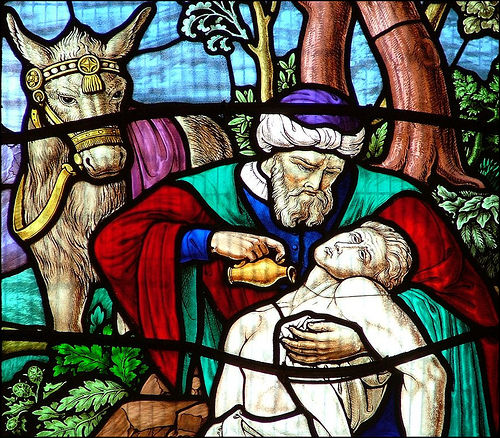
The parable of the Good Samaritan was a lesson in humility. Image from Sarcastic Lutheran.

Five scriptures you won’t hear
at Rick Perry’s prayer event
If the governor wants to call us to repentance it should begin with our real sins against the poor...
By Jim Rigby / The Rag Blog / August 4, 2011

As a native Texan, I’m used to crazy religion and crazy politics. So, the announcement of Gov. Rick Perry’s plans for “The Response,” a prayer event scheduled for August 6 at Houston’s Reliant Stadium, was not a surprise.

But as a Presbyterian minister and community organizer, it’s part of my job to stand up for my neighbors. The use of the governor’s office to promote one religion in a country with such rich religious diversity is obviously unhealthy politics, but -- if one takes the Christian and Jewish scriptures seriously -- it is also unhealthy religion. Here are five rather important verses of scripture you aren’t likely to hear at “The Response”:


Don’t make a show of prayer
"And when you pray, do not be like the hypocrites, for they love to pray in public places to be seen by others... But when you pray, go into your room, close the door and pray to your heavenly parent, who is unseen.” (Matt. 6:5-6)
While Jesus never addressed the issues most important to some of this event’s co-sponsors, such as homosexuality and abortion, he did speak out against public displays of religion. Whatever Jesus meant by the word “prayer,” it seems to have been about the quiet and personal. The disciples had to ask Jesus how to pray, which is a pretty good indication that he wasn’t praying a lot publicly. What he did say about prayer carried a warning label: “Don’t rub it in other people’s faces.”


God doesn’t withhold rain because we’ve done something wrong
“God causes the sun to rise on the evil and the good, and sends rain on the righteous and the unrighteous.” (Matt. 5:45)
Perry recently called Texans to pray for rain, which implies that God steers clouds toward the worthy. According to Right Wing Watch, one of the events co-sponsors has said the earthquake in Japan happened because the emperor had sex with the Sun Goddess. It may be a part of our lower nature to blame disasters on people we don’t like or understand, but Jesus taught that God sends rain on the just and unjust. Furthermore, he said our love should be equally nonselective.

I have chosen Christianity as my life’s religion, but when nonjudgmental love is taken out of its center, it becomes poisonous and predatory. The word “God” can be a helpful symbol for all the transcendentals of life, but the symbol becomes instantly pathological when used as a scientific explanation or political justification.


God doesn’t have favorites

Then Peter began to speak:
“I now realize how true it is that God does not show favoritism.” (Acts 10:34)
When the Bible says that God is not a “respecter of persons” it means that God doesn’t have a favorite country or religion. The idea that God wants Christians to be in charge of other people violates Jesus’ teaching that we are to take the lowest place. We are to change the world by humble persuasion and good example, not by messianic coercion. The assumption that Christianity and America are God’s two favorite things will be particularly ironic, as the prayer event falls on the anniversary of the bombing of Hiroshima.


Worship by those who neglect the poor is offensive to God
“I hate, I despise your religious festivals; your assemblies are a stench to me... Away with the noise of your songs! I will not listen to the music of your harps. But let justice roll on like a river, righteousness like a never-failing stream!” (Amos 5:21-24)
The prophet Amos chastised the religion of his day for praying to God while mistreating people. Texas leads the nation in citizens who are uninsured, who work for minimum wage, and who die from unsafe working conditions on construction sites. Our state has the widest gap between rich and poor of any in the union. If the governor wants to call us to repentance it should begin with our real sins against the poor, not the imaginary sins dreamed up by his friends.


The heart of Christian ethics is being a good neighbor

When Jesus told the story of the Good Samaritan (Luke 10:30-37) it was to teach humility to a rich young zealot who thought he was approaching moral perfection. The Samaritans were the scapegoats of the day. The rich young ruler would consider Samaritans heretics and immoral people. Jesus used a merciful Samaritan as the example of ethical perfection. It is a lesson many Christians have yet to learn.

One sponsor of the event, the American Family Association, is listed by the Southern Poverty Law Center as a hate group. The group’s director of analysis for government and policy is quoted by the SPLC as saying that Hitler was “an active homosexual” who sought out gays “because he could not get straight soldiers to be savage and brutal and vicious enough.” He also said Muslims should not be allowed in the military or be allowed to build mosques in the United States.

None of this analysis springs from malice. In fact, I must confess that I have a soft spot for Rick Perry. When the James Byrd, Jr. Hate Crimes Prevention Act in Texas was passed, I had the honor of pushing the wheelchair of Byrd’s mother into the governor’s office for the signing. I privately thanked Perry for his courage in standing up to all the groups who had fought against the bill; I knew he might pay a political price for signing the bill. Tears came to his eyes, and he said, “It’s the right thing to do.”

I can’t know what is in Perry’s heart, of course, but I do know the problem isn’t one politician but rather a nation that has embraced an unhealthy political arrogance undergirded by even unhealthier religious hubris. The “prayer” that is most needed at this time is for each of us, believer or not, to go into our own heart and find the humility and empathy that is at the core of righteousness, political and spiritual.

[Rev. Jim Rigby, a human rights activist, is pastor of St. Andrew’s Presbyterian Church in Austin, Texas. He can be reached at jrigby0000@aol.com., and videos of his sermons are available online here. Read more articles by Jim Rigby on The Rag Blog.]

The Rag Blog

[+/-] Read More...

03 September 2010

Glenn Beck : Testing the Waters?

Glenn Beck and friend. Photo by Alex Brandon / AP.

Testing the waters?
Glenn Beck could happen here
Beck...ignores the reality that our essential legal structures are Greco-Roman and Hodenosaunee (Iroquois) in origin, NOT Judaeo-Christian. Five of the first six presidents of the United States were Unitarians and/or Deists, NOT Christians...
By Harvey Wasserman / The Rag Blog / September 3, 2010

Now that the dust has settled from Glenn Beck’s weekend revival at the Lincoln Memorial, two messages need to be delivered loud and clear.

First: the United States of America has NEVER been a Christian nation, but there are those who would make it so, past and future.

And second: do not discount Glenn Beck becoming president of the United States.

I say these things after having sat through nearly all of the 17-part video rendering of Beck’s rally this past weekend, and having read as many critiques of it -- left and right -- as I could find.

This rally was not about intellectual content, and it’s a mistake to analyze it that way.

Its organizers kept the verbal content extremely simple: honor the military, “restore America,” have faith in your churches, follow their lead, and donate generously.

Much of the real meaning was in who was missing.

The only major media stars were Glenn Beck and Sarah Palin. Limbaugh, O’Reilly, Hannity, Levin, Dr. Laura, Ann Coulter -- no one else from the firmament of the Right got the mike or -- unless I missed them -- appeared on camera.

While his rhetoric was duly humble, the sum of Beck’s parts was about his personal Divine Inspiration. The rally was a “miracle,” he said. God told him to do it, and its stunning, unlikely, impossible, amazing, fantastic, Godly, lucrative success was all due to Him, operating through His only visible Messenger, Glenn Beck.

As of this rally, there is no other putative favorite for the Republican nomination for president. Beck is the only one with a very large, dedicated grassroots constituency.

His modus this weekend was keeping it simple. But there were some twists. He is a Mormon. He repeatedly referred to the Jewish exodus from slavery in Egypt (he timed it wrongly by about two millennia) and had a rabbi conspicuously center stage. He honored Native Americans, the other “lost tribe.” Until the very end, when he did mention “mosques” as a place of worship, there was virtually no mention of Muslims, and none prominently on display.

The vast bulk of the show had to do with honoring the military, the Christian faith, and with endless sermons by Beck himself. Except for Palin, no one else spoke anywhere near as long, and even her appearance was fleeting by comparison.

There was also a strenuous avoidance of explicit partisan politics. Obama’s name was barely mentioned. The most prominent reference to abortion came from Dr. Martin Luther King’s niece. The natural environment was a total no-show. Ditto partisan bickering over deficits, social security, etc. (Unspoken, too, was Beck’s endorsement of the legalization of marijuana).

One might assume Glenn figured we all know where he stands due to his radio and TV shows. But if that was meant to be the message, it was implied, not stated.

Dr. King’s fierce opposition to the war in Vietnam was never mentioned. But he was repeatedly placed in the pantheon of American greatness alongside Washington, Jefferson and Lincoln. The documentary clips -- which Beck narrated -- gave the impression of uncompromised support for the civil rights movement.

As usual, the proportion of people of color on stage vastly outstripped the diversity of the actual audience. Except for a Beatles t-shirt that somehow appeared on a participant in the crowd, the 1960s seemed to have never happened, except in the agonies of our troops in Vietnam.

No... on a bright, sunny day in front of the Lincoln memorial, surrounded by monuments to our great presidents and wars, this had all the trappings of well-scrubbed audition for a presidential candidacy.

As expected, the show did feature the usual array of patented historical fabrications. Topping the list was a “Black Robed” battalion of armed priests who allegedly terrified the British during the American Revolution. To end the rally Beck dragged up more than 200 preachers to replicate the symbol.

This is pure -- and dangerous -- invention. If you can find solid reference to this alleged priestly horde anywhere in our history, please send the citations.

Like most of the right, Beck avoids our nation’s deeply secular roots. He repeatedly cites the Constitution and Declaration, but NEVER the Bill of Rights.

Beck also ignores the reality that our essential legal structures are Greco-Roman and Hodenosaunee (Iroquois) in origin, NOT Judaeo-Christian.

Five of the first six presidents of the United States were Unitarians and/or Deists, NOT Christians. So were three of the five men charged with writing the Declaration of Independence. Tom Paine, who wrote the book -- Common Sense -- that inspired the Revolution, was deeply critical of the Christian faith, to which he most decidedly did not ascribe.

Nor did Ben Franklin, the new nation’s truest intellectual godfather, who is almost always absent from the neo-con iconography. It was the free-living Franklin who drew the inspiration for the federal union from the Iroquois Confederacy, still history’s longest-lived democracy.

Thanks in large part to Franklin, the word “Christian” (like the word “corporation”) was omitted from the Constitution by intelligent design.

None of which mattered at this excruciatingly sanitized gathering. We will see, in the coming months, what kind of legs it gave Mr. Beck, and where he wants to go with them.

He’s never run for or held public office. To many he seems a marginal fool, a bore and a rube, a Crusader Babbitt for a traumatized Main Street... just like, say, Ronald Reagan or George W. Bush.

Now he’s stepped out of the studio and into the real world of grassroots constituency-building. He has inspired a large and dedicated core and transcended his merely electronic base. His people have a fire in the belly, with a serious flow of cash nobody else on the right or left can currently match.

Maybe, for the true inner Beck, it’s just about the money and the glory. Until he hears those voices again.

For in a broke new world, where anything can happen, Glenn and his God just might smite us all.

[Harvey Wasserman has been involved in the struggle for peace, justice, and a green earth since the late 1960's. Harvey Wasserman's History of the United States is at www.harveywasserman.com, along with "Thomas Paine's" Passions of the Potsmoking Patriots.]

The Rag Blog

[+/-] Read More...

15 May 2010

Jim Rigby : Towards a Radical Christianity

Jesus drives the money changers from the Temple. Image from ETC / University of South Florida.

A Radical Christianity?
I would say any Christian who leaves the fate of the poor to market forces has renounced Christ in every meaningful sense.
By Jim Rigby / The Rag Blog / May 15, 2010

Dr. Jim Rigby, an activist for peace and justice and for gay rights and women's reproductive rights, is pastor of St. Andrew’s Presbyterian Church in Austin, Texas. He was interviewed by Alex Doherty of the New Left Project about a radical interpretation of Christianity.

Your journey seems to have been one of increasing politicization but without moving away from religion -- can you describe that journey for us?

To me, religion is a fancy word for how we build our frame of meaning, and politics is just a fancy word for how we treat each other. As a child I learned an apolitical version of Christianity and was duly offended if a preacher ever brought up social issues in a sermon. Religion, I was taught, was a personal relationship with Jesus. So I could sing “Jesus loves the little children," but did not feel any need to confront the possibility that my nation might be dropping napalm on them.

Nor did I consider myself political in college or seminary. Of course, I was political, I just didn’t know it because the religious worldview I had been taught was so in line with the dominant culture that my own politics were invisible to me. In my mind, I was just a white Christian male who happened to worship a white male version of Christ.

I wasn’t selling out consciously, but it was in my interest not to notice the power systems that left me in a place of privilege. By viewing religion as politically neutral, I could disguise the unfair advantages that came from being a white Christian heterosexual male, My complicity with various oppressions was unconscious, but I knew enough not to explore other ways of thinking, so, on some level, I knew what I was doing.

When I began to work with survivors of rape I could feel the role my male privilege played in their trauma. Later, that insight grew to include what my heterosexual privilege meant to gay and lesbian persons. Finally, I came to understand that justice has to include the whole human family. I realize that most leftists have a well deserved contempt for religion, but I personally came to hear the gospel as a call to justice for all people, which is how many oppressed people have heard it from the beginning.

In your sermons, you take biblical stories to have metaphorical but not literal truth. What is a metaphorical approach to reading the bible?

If the Bible were literally true we would not need it. We do not need symbols for things on the surface of our experience, but the more deeply we wish to speak of life, the more we need poetry and ritual. Reason does very well at apprehending special affairs like matter, it is not so good at apprehending time. Symbols describe aspects of life that are invisible at any one moment but play out over time.

As I studied the stories of the Bible I realized that they were often Jewish versions of much older stories. They weren’t about actual people. They were poems about life as a human experiences it. The figures in the stories weren’t historical but allegorical representations of experiential lessons.

Science and history are attempts to describe our experiences from the outside in. Art is the attempt to express those same experiences from the inside out. Religion is that intuitive act that balances those two vital concerns. As the word implies, religion is reconnecting the pieces of our experience into a meaningful whole. We never have enough information, so that effort requires faith. We never can get complete control of events, so it requires hope. We are never completely what we strive to be, so it requires forgiveness and love.

You view the gospels as having a radical message -- how is it then that the Church has so often sided with forces of oppression?

The church was radical for several centuries but was co-opted by the Roman Empire about the time of Constantine. The reason for this hostile takeover is pretty obvious. It is the same reason corporations buy protest songs and turn them into commercials.

Religion deserves much of the blame it receives for historical monstrosities such as the crusades and inquisitions, but more often, religion falls captive to political bullies who use it for very secular purposes. The war in the Middle East isn’t really about religion at all. It is a fight over land hiding behind the cloak of religion. I doubt very seriously that the primary motive for the Crusades was rescuing the holy lands from Islam. I suspect the booty captured by “pious” European kings was much more to the point.

The role of religion in violence may be closer to the role alcohol plays in domestic abuse as a “dis-inhibitor." If you blame abuse on the alcohol, you may be missing the real dynamics of bullying. I think Voltaire was right to say those who believe absurdities are much more likely to commit atrocities, but the real question for me, is can there be a religion that honors reason, science, and universal human rights? If we use “religion” as a synonym for supernaturalism, the answer, obviously, is no. But I think it is a conversation worth having.

What does the word “God” mean to you?

There are many religious forms that do not personify experience using a concept of God at all. Non-theist religion has a rich heritage when it isn’t being burned by theists. So a personal God is not necessary, but it can be a helpful symbol for doing elementary metaphysics -- which is addressing questions like “what’s it all about?” We cannot really answer the question, but our minds will construct some such frame.

Einstein would often use the word “God” as a shorthand metaphysical device, probably to save time and give a charm to his imagery. He did not believe in a personal God, but he found the symbol useful for talking about everything at once. Our minds need a frame to begin the task of understanding our experience. The universe is a boundless verb, but our minds need the closure of nouns. Hegel said religion is putting philosophy in pictures. That’s an over simplification, of course, but it states a truth I think.

“God” is a human symbol that allows us to speak of everything that is too big, too deep, and too strange for our ordinary understanding. In Hebrew, the divine name of God is YHWH which is a verb form of the word “being.” The other names for God are like facets on that one diamond. The point is not to believe in a being, but to illumine various aspects of being itself.

Your Church took the unusual step of accepting a confirmed atheist -- the writer and activist Robert Jensen -- as a member of your congregation. Why did you accept him as a part of your Church? How was his acceptance viewed within and outside St. Andrews?

Robert Jensen was an example of someone who had rejected religion for all the right reasons. When I heard his speeches I felt prophetic principles beneath his disdain for religion. He hated religion for the same reason that the prophets hated the religion of their day.

When Dr. Jensen joined our church, people inside our church were delighted, but many outside the church were quite upset. It was a bit strange. I received hate mail from theists and he received hate mail from atheists. We were ordered to take him off the roles by the next higher level of the church but we refused. Bob has been a tremendous addition to our church and has allowed people to feel much freer in rejecting supernaturalism and challenging the dominant religion of our nation which is, of course, capitalism.

What is your opinion of the so-called "New Atheists" -- in particular Christopher Hitchens, Sam Harris, and Richard Dawkins?

I have great affinity for atheists like Robert Ingersoll, but some of the people writing bestselling books are like the televangelists of atheism. They completely misunderstand what intelligent religious people are saying. If you assume that the worst of religion represents the rest, then laughing at us is easy. It is easy to refute Pat Robertson, but I’ve yet to hear a convincing argument that the world was poorer because Martin Luther King and Gandhi were religious. Who can’t refute flat earth religion? I’m sure they are good people, but reading their books feels like getting lynched by people who don’t know how to tie a knot.

When I read an atheist like Bertrand Russell I get a very different feeling. His indignation against religion came straight out of his concern for humankind so he knew where to put the scalpel. I also love Monty Python’s attacks on bad religion. The New Atheists feel more like high school bullies making fun of the slow and weak. I agree with most of what they say, but their cruelty toward their frightened and superstitious brothers and sisters is counterproductive. When confronted with ignorance a fool ridicules and a sage teaches.

What is wrong with capitalism from a Christian standpoint?

Theoretically, a Christian could support many types of government, but the core insights of the religion are basically socialist and even, I think, anarchist. Jesus began his ministry by saying “I’ve come to preach good news to the poor, and to announce the acceptable year of God.”

That statement would have been understood as announcing the year of Jubilee, which meant a release of prisoners and a redistribution of the wealth. To pretend Jesus wasn’t political doesn’t make any sense. The Romans wouldn’t have killed him for being a religious leader. Crucifixion was primarily reserved for insurrectionists. The fact that the Romans put “King of the Jews” on his cross was not a religious taunt. It was a threat to any movement of liberation among the people.

Of course, the ancient world didn’t have the word “capitalism” in the modern sense, but they had a word for making money off of interest owed you by your neighbor. It was called “usury” and it was considered a sin. It is a mistake to reduce any religion down to a political position. And it is also wrong to force any religious sectarian viewpoint into the public sphere. But, I would say any Christian who leaves the fate of the poor to market forces has renounced Christ in every meaningful sense.

Much of the religious life consists of ritual. What is the point of religious rituals? What is meant to be achieved by them?

I used to hate rituals. I felt manipulated by them. What I have come to realize is, when they are done voluntarily, rituals can be a way our body comes to understand the symbols in our heads. When birds want to mate they don’t say it with words, they dance. It is written in their bodies. When bees want to tell of far away honey they, too, dance. Our bodies respond to certain movements in a powerful way that rational language cannot touch.

People often think of religious rituals as acts of socialization, but their more important function is to integrate individuals and communities to the circle of life and to help us move through life passages like puberty, marriage, and death. One of the things that makes Americans so easy to frighten is that we do not have rituals that help our bodies understand that death is a part of life and is not to be avoided. Instead of asking people to live without rituals, I believe we should teach the kind of rituals that would help people to recognize the earth as our home, and every human as a part of our family.

Can you recommend some writers on Christianity and religion in general whom you particularly admire.

I was a musician for a while and discovered that those who can talk about music usually can’t make it. Sadly, the same is true for religion. Most theology induces my gagging reflex because religion isn’t supposed to be a special topic of its own. To hear someone talk about religion is like watching someone chew with their mouth open. I would much rather see them absorb the teachings and then demonstrate them in acts of courage and compassion.

Adult religion shouldn’t in the foreground of our lives. It is more the wonder behind our science, the passion behind our art, and the compassion behind our ethics. I love the writings of MLK, Gandhi, and Tolstoy. But I also love an atheist like Carl Sagan who turns science into a hymn. Richard Dawkins has some nice celebrations of nature. Anyone who tunes their instrument to the chord of nature, and becomes a friend of humankind is singing the one hymn written in every human heart.

[This interview was first published May 10, 2010, by the New Left Project.]

Thanks to Robert Jensen / The Rag Blog

[+/-] Read More...

03 April 2010

Leonardo Boff : Easter for the Crucified Earth

“The Crucified Land,” 1939, oil on canvas by Alexandre Hogue.

Our devastated common dwelling:
Easter for the crucified Earth


By Leonardo Boff / The Rag Blog / April 3, 2010

Easter is a celebration shared by Jews and Christians, and is a metaphor for the present situation of the Earth, our devastated common dwelling.

Etymologically, Easter means passage from slavery to freedom and from death to life. The Planet, as a whole, is passing though a severe Easter. We are within an accelerated process of loss: of air, of soil, of water, of forests, of ice, of oceans, of biodiversity, and of sustainability of the very Earth-system. Terrified, we witnessed the Earthquakes of Haiti and Chile, followed by tsunamis.

How does all of this relate to the Earth? When will the losses end, or where will they lead us? Dare we hope, as in Easter, that after Good Friday of the passion and death, new life and resurrection will always burst forth?

We need a retrospective look at the history of the Earth to shed some light on the present crisis. In the first place, we must recognize that earthquakes and disasters are recurrent in the geologic history of the Planet. There is a basic rate of extinction that is part of the normal process of evolution. Species exist for millions and millions of years, and, then they disappear. Like an individual who is born, lives for a certain time, and dies. Extinction is the destiny of individuals and species, including ours.

But beyond this natural process, mass extinctions exist. The Earth, according to geologists, may have experienced 15 such great extinctions. Two were particularly grave. The first, 245 million years ago, with the rupture of Pangea, that single land mass that broke apart, giving birth to the present continents.

That event was so devastating that it decimated between 75% and 95% of all the living species then in existence. Beneath the continents, the tectonic plates continue to be active, colliding with each other, overriding or drifting apart, in a movement called continental drift, which causes the earthquakes.

The second occurred 65 million years ago, caused by climatic disturbances, rising of the sea levels, and warming -- events generated by a 9.6 km asteroid that fell in Central America, causing huge firestorms, tidal waves, poisonous gasses, and a long darkening of the sun. Dinosaurs that had dominated, sovereign, upon the Earth, for 133 million years, totally disappeared, and 50% of other living species as well.

The Earth needed ten million years to completely remake herself. But it allowed for a wide range of biodiversity such as never before in history. Our ancestors who used to live in the treetops, feeding on flowers, shivering with fear of the dinosaurs, could come down to the ground and make their way, culminating in what we are now.

Scientists, like Ward, Ehrlich, Lovelock, Myers, and others, believe that another great extinction is occurring, one that began some 2.5 million years ago when vast glaciers began to cover part of the Planet, altering the climates and the sea levels. That process was greatly accelerated by the appearance of a truly devastating meteor, namely, the human being, through his systematic intervention in the Earth system, particularly in recent centuries. Peter Ward (O fim da evolução, 1977, p. 268), says that this mass extinction is clearly visible in Brazil, where over the last 35 years, four species were definitively extinguished each day. And he ends by warning: "a gigantic ecologic disaster awaits us."

It is the existence of earthquakes that destroy everything and kill thousands and thousands of people, such as in Haiti and Chile, that creates in us a crisis of meaning. Here we must humbly accept the Earth such as she is, generous mother or cruel stepmother.

She follows the blind mechanisms of her geologic forces and ignores us, which is why the tsunamis and cataclysms are so terrifying. But she passes information to us. Our mission as intelligent beings is to decode that information to avoid damage, or to use it for our own benefit. Animals capture that information, and before a tsunami hits, they fly to the highest places.

Perhaps at one time, long ago, we also knew how to capture that information, and defend ourselves. We have lost that capacity now, but to supplement our deficiency, there is science. Science can decode the information that previously the Earth passed to us, and suggest strategies of self defense and of salvation.

We are the Earth herself, with her consciousness and intelligence, but we are still in the youthful phase with very meager learning. We are entering the adult phase, learning how to better handle the energies of the Earth and of the cosmos. Then, the mechanisms of the Earth, through our knowledge, will stop being destructive. We all must grow, learn and mature.

The Earth hangs from the cross. We must take her from there and resurrect her. Then we will celebrate a true Easter, and we will be able to wish: Happy Easter!

Original in Portuguese; translated into Spanish by Servicios Koinonia; translated into English by Refugio del Rio Grande, Texas.

[A Brazilian theologian, philosopher, educator, and author of more than 60 books, Leonardo Bofff lives in Jardim Araras, an ecological wilderness area in the municipality of Petrópolis, Rio de Janeiro. Boff is Professor Emeritus of Ethics, Philosophy of Religion, and Ecology at the State University of Rio de Janeiro. A former Franciscan priest with a doctorate from the University of Munich, Boff was an early advocate of liberation theology. In 1991, after a series of clashes with the Vatican, Boff renounced his activities as a priest and "promoted himself to the state of laity."]

The Rag Blog

[+/-] Read More...

A King's Easter : Reflecting on Jesus and Eggs


A King's Easter:
Pausing to reflect on Jesus and eggs


By Greg Moses / The Rag Blog / April 3, 2010

This year -- for the second time -- the sad anniversary of the assassination of Martin Luther King, Jr. falls on Easter, a day that according to Google Trends brings annual peaks of interest in the search terms Jesus and eggs.

Easter is a perfect context for thinking about King's death in a Kingian way because as a preacher of Easter sermons he would insist that after we pay death its due we should not neglect the fact of life which after all makes death possible in the first place.

Likewise with movement. For King life was movement. And half the hope for life was bound up in hope for the next movement which in his case would have been the Poor People's Campaign of summer 1968. I say half the hope because as a Sunday preacher King warned against placing your whole hope in human effort.

Paradoxical as it sounds, the great maestro of social movement insisted that human effort could never completely do for itself. That would be like saying Jesus resurrected himself or the egg laid itself. There's something besides all the things you can do -- which you should do -- for yourself. Something the movement needs which is not the movement itself.

David Rovics sent out an email yesterday reflecting upon the growing anticipations that people are having. Something is badly needed which is not being provided. Or as the Secretary of the Treasury says, unemployment will remain at unacceptable levels for many more years to come.

A movement of some kind is in the making. What's not so clear is how people are preparing their half of the responsibility for it. King died while doing too much. Paradoxically the preacher of Easter sermons who said human effort was only half the ingredient of movement was exhausting himself in that half trying heroically to make up for the rest of us who exhaust ourselves doing too little.

In a book of spiritual teachings I recently ran across the term "personal work" and I think King would have liked that term. In the process of nonviolence as practiced by King, "personal work" was required. During the Easter campaign of 1963, protesters were required to meditate on the life of Jesus. They had to sign cards saying they had thought deeply about the example of Jesus. Jesus was required reading.

With our common life scooped out and replaced by mass media velocities -- and considering the pattern of our recent debates about health care -- there is reason to think that movements have been replaced in the internet age by virtual flame wars. And the thing about flame wars is that they lack all evidence of "personal work."

Capitalism, once again, has imploded out from underneath millions of people whom it pretended to serve. And socialism even under these conditions finds underwhelming support. Between the cracks of two deflated ideals, a necessary movement grows roots. With so much death around us, King's Easter reminds us that if we don't neglect "personal work" there is always hope for birth and rebirth through righteous, organized, and disciplined social movements.

[Greg Moses is editor of the Texas Civil Rights Review and author of Revolution of Conscience: Martin Luther King, Jr. and the Philosophy of Nonviolence. He can be reached at gmosesx@gmail.com.]

The Rag Blog

[+/-] Read More...

Marc Estrin : George's Messiah


Happy Easter,
But crucify him first


By Marc Estrin / The Rag Blog / April 3, 2010

This morning, the cheery NPR voice announced that today was Good Friday -- but not for the Catholic Church, which was reeling from you know what. Good Friday -- good.

I suppose it can be seen as good if you like nailing people onto crosses and the institutional power secreted from those wounds, but for most followers of Jesus Who Is Called The Christ, it's a pretty sad end of the week.

Here in Happy-face Land, we love Easter, pink, white, and blooming. And now even Good Friday has been gobbled by Goodness. But George Fredrick Händel was not so easily scammed.

Most American performances of Messiah offer only the Christmas portion with tacked-on Hallelujah and Amen celebrating a babe not yet messiahed. But Messiah was written as an Easter piece, full of pain, suffering and transcendence. The familiar Christmas portion was a prologue only -- to contrast with the anxious and metaphysical burden of the work. But Hallmark will have its way.

I am the president and only member of the National Bring Back Messiah As An Easter Piece Society. I have little influence on American cultural practice. But I do get to write novels with their interior rants.

Tweaking When the Gods Come Home to Roost for possible publication, I came across this short chapter I thought you of classical music persuasion might enjoy:

George's Messiah


George loved Messiah. It was nothing a Jewish boy in Levittown had been expected to love, but it happened. Until he was fifteen, he had steered clear of this goyish mania. But one day, a lovely young girl with long, dark hair handed him a leaflet for an afternoon performance a busride away in Queens. Maybe she sang in the chorus. It must be all right for a Jew to go into a church, he thought, if it’s for a concert, and not to eat the body and blood. He wouldn't tell his parents. They’d never know.

The young man was ravished by the experience. He used the word in every possible meaning: he was seized and violently done to; he was overcome by horror, joy and delight; he was pre-sexually bewitched, for the long-haired one was in fact singing soprano in the front row, and never had such an angelic voice issued from such sensuous purity. This concert was of the Easter portion of the work, and from “Behold the Lamb of God” to the last “Amen”; he was transfixed with wonder.

From the three bar mitzvahs he'd attended he knew Jews didn’t make this kind of sound. Synagogues were filled with the discordant rumble of davvenning, each worshipper finding his individual prayer voice and rhythm, chanting, whispering, singing, crying, repeating phrases over and over, lost in the brumming of the crowd. Sometimes a cantor sang. But this -- this! It is music, music that hath ravished me! He got home at an unsuspicious five o'clock, and never mentioned his encounter.

He had tried to hear Messiah every year since then, but with all the changes that had occurred along the way, he had managed to bat only about .300. So what a boon -- right here, in his own community, that he could conduct an annual Messiah! The sad part was that he could never share this joy with his family, old anti-clerical mom and pop ever more rigid in their disdain for religion. The idea of their very own son promoting Christ the Jew-killer might, he thought, send them each into heart failure. So this was his one activity he never called home about.

Choosing to do the Easter portion of Messiah for Christmas was George's little revenge on America. Though written as an Easter piece, and traditionally performed in Europe during Easter time, in coming to America Messiah had shifted seasons, and along with them, content. Though the Puritans had banned the celebration of Christmas, post-Puritan America has embraced it with a vengeance, currently exhorting all to worship at the mall of one’s choice.

Perhaps in the land of the Easter Bunny and the lethal injection, crucifixion is seen as barbaric. Christmas, not Easter, is where most American celebration is concentrated, and with it, most concertizing. Messiah has become a Christmas piece, and most American performances restrict themselves to its first section concerning Advent and the birth of Christ. The meat of the oratorio is left out, and the introductory portion is capped with the Hallelujah chorus -- a masterwork written to praise Christ’s ascent to his heavenly throne, unreported in these Hallmark card performances.

“A premature ejaculation at best,” George thought when feeling generous. But if Americans were determined to hear part of Messiah at Christmas, he was going to be damn sure it was the Easter portion that attacked them.

At 6:30 on the evening of the concert, Betty cell-phoned in to say that she had had a flat on I-680, that the AAA said they'd be there within fifteen minutes, and that being the case, she'd be at the church by ten after, and could they hold the performance? As if there were a choice.

So George came out at 7:05, and announced that the concert would begin at 7:20 because, as the contemporary world amply demonstrates, the Messiah always comes late. Then he did a remarkable thing, unexpected, certainly, because of his refusal of the first part of Messiah, but unexpected, ever, in any form, under the eye of God. He sat down at the Steinway, and played the slow opening of the opening "Symphony" of the work. Twenty-four stately, double-dotted measures marked grave -- this the limit of his keyboard technique.

When the moment came for the Allegro moderato to begin, George stood up, walked to the curve of the piano as if for a vocal recital, placed his right hand on the rim of the case, and performed that three-part fugue all by himself. He whistled the soprano voice out of the right side of his mouth, the alto out of the left, and vocalized the bass part with accurate, wordless humming. You don’t believe this. It is true. Upwards of a hundred people heard it with their own ears. He must have been practicing this in the shower for the last twenty years in preparation for that night.

Now Messiah is one of the grandest works of western culture. It is simply not appropriate for a serious conductor to whistle the overture in public performance. But the effect, rather than being ridiculous, was to create a churchfull of gaping at the wonder that is man. No problem was too great for one who set his mind to it, no achievement too difficult. The room was riddled with people who had dedicated themselves to Bay Area excellence: none could gainsay George Helmstetter's accomplishment.

Betty arrived, pumped and wired. The chorus filed on to the risers. In spite of George Bernard Shaw’s opinion alleging “the impossibility of obtaining justice for that work in a Christian country,” mid-Messiah instantly summoned the audience to pain and passion including even them, the guilt-free of the world. "Behold the Lamb of God," the sacrifice upon whom all sins would be heaped and slaughtered into renewal, the Lamb whose blood would be smeared on door jambs to frighten Death away, the Lamb that would conquer the wolves, the conquering Lamb.

What about this Lamb? Handel took great pains to describe its scorn-filled whipping. “He gave his back to the smiters, and his cheeks to them that pluckèd off the hair.” Blood and hair clotting together on the prison floor. Here is perhaps the only major artwork which celebrates saliva as such: “He hid not his face from shame and spitting,” spit in the face, a cadence, ach-ptoo!

The listeners were assured, in no uncertain terms, that the Lamb was burdened with their very own doings: Surely he hath born our griefs, and carried our sorrows. The fierce F-minor cries, the painful, discordant suspensions: He was wounded for our transgressions; he was bruised for our iniquities, a catharsis of pity and terror.

Even the Jewish mothers of many in the audience would not have been able to evoke such a sense of guilt. The thoughtful were carried emotionally along, while at the same time wondering about the phenomenon of the Messiah. Is this suffering lamb the Saviour of the world? How odd.

The Messiah’s function is to be victorious. Christians thought of Christ. Jews thought through their own lens of the “true” reference, the continued oppression and persecution of Israel throughout the Christian and pre-Christian centuries -- the Nazi destruction, the pogroms of the nineteenth century which had brought their parents to the New World, the persecutions of the eighteenth century, the seventeenth, and on back to the Exile, where the image of the Lamb converges with that of scattered Israel.

“And with His stripes we are healed.” What is that about? Why should one’s agony be inversely proportional to another’s? Conservation of Wound? Conservation of Tears? Conservation of Pain? Beckett has told us: “The tears of the world are a constant quantity. For each one who begins to weep somewhere else another stops. The same is true of the laugh.”

Handel lingers over the word “healed” as if to lay soothing balm upon Christ’s -- and our -- wounds. Yet even this very moment, was beyond a definitive scan. The perverse listener -- and who is not perverse? -- could easily hear the melismatic syllables of “healed” as “hee-hee-hee-hee-heeled," in effect a subtle but demonic, underlying cackling, as if to say that no matter what the unction, the wound is too great to be cured -- you’ll see. Hee-hee-hee. George was haunted by this dopplegängbanging effect, but was unable to phrase his way around it. The Lamb of God, and the sheep who have gone astray.

“All they that see him, laugh him to scorn. They shoot out their lips and shake their heads, saying”: Enter the scornful, the brutal choral metamorphosis from a confessing people of God to an unruly crowd in obscene play at a public execution. So does Jekyll turn unexpectedly to Hyde.

He trusted in God that He would deliver him: let Him deliver him, if he delight in him. Such assertive contemptuousness! The trivializing, de-legitimizing of God, putting his capitalized pronoun on a syncopated weak beat, now ironically, self-flatteringly strong. What pristine nastiness, abundantly clear. Thy rebuke hath broken His heart. He is full of heaviness. He lookèd for some to have pity on him. But there was no man, neither found he any, to comfort him.

Not only was this George’s favorite moment of Messiah, with the single most touching note in music slipping into place in the piano’s middle voice, a pensive entwinement of suffering and beauty. In the pause after pity on him, a luminous E rises half step to a questioning, consoling F, as if at least one human heart might go out to Jesus from the frigid emptiness answering his gaze.

But it was also the theological key to the work: Here was the heart of it. As every culture has known and proclaimed, something is wrong with the human race. Things are not as they should be. There have been many intellectual explanations -- mythological, religious, philosophical. But here is the psalmist’s prophetic assessment: the primal fault is that we disdain God. We have turnèd everyone in his own way. The biblical word for this is “sin.”

Since by man came death... The listeners had to interpolate the moment of death. But George found this not egregious. The whole textual strategy of the Messiah is one of brilliant, evocative avoidance. Charles Jennens, an otherwise unremarkable British gentleman, had provided his friend George Fredrick with a libretto of theological genius, portraying every shade of devotion from piety, resignation and repentance to hope, faith and exultation.

And all this without resorting to narrative, as in the Passions of Bach: Christ did this, and then he did that, the misery composed directly into the music. The Messiah commands attention because of what it does not show, for the most part indicating, rather than depicting events. And therefore the death of Jesus, that epoch-making moment, really could exist as a lacuna between his unrewarded search for comfort and the triumphant Lift up your heads which followed. Praise be to Handel for demonstrating this.

Lift up your heads; The Lord gave the word; Their sound is gone out. And so, for the Jews, the Ark takes its place in the Temple, for the Christians, the Son takes his place in Heaven, and the preachers tell the world -- but some do not hear. Why do the nations so furiously rage together? Tim Eckleburg stepped out to sing, less than accurately but with conviction, to sing of the kings of the earth, of the rulers that counsel together against the Lord.

Again, the demonic chorus: Let us break any bonds with the Anointed, and cast away their yokes from us. And what will happen? This time Willy Higinbotham, a “real” tenor from the Cal music department, stepped forward to describe the smashing and breaking that will ensue, an image which always reminded George of the piled up debris confronting Walter Benjamin’s Angel of History.

And then, the great moment, the moment incoherently misplaced in American versions, the phenomenal Hallelujah Chorus. The piling up of debris? Hallelujah! For the Lord God Omnipotent reigneth -- which at first blush is not a very encouraging vision of the future. But what if it were to become the case -- that the kingdom of this world is become the kingdom of our Lord, and that over such a peaceable kingdom He shall reign forever and ever ? It did give one pause, in the midst of the war on drugs and the war on terror.

Almost three hundred years earlier, King George had stood in his excitement, dragging the court to its surprised feet around him, and now the audience at the Mt. Diablo Unitarian-Universalist Church took this traditional ninth inning stretch incapable, however, of diverting the impregnable momentum of the music.

For all the radiance of the performance, there was one moment that stood out above all others. Dr. T.J. Eckleburg, with his strong baritone, came in too soon after George's breathtaking pause before the final cadence, shattering the loudest silence in creation. After the concert, BB commented to another alto: “I’ve sung Messiah many times in my life,” she said, “and I’ve always waited for someone to come in too soon. It was very satisfying to me.”

[Marc Estrin is a writer and activist, living in Burlington, Vermont. His novels, Insect Dreams, The Half Life of Gregor Samsa, The Education of Arnold Hitler, Golem Song, and The Lamentations of Julius Marantz have won critical acclaim. His memoir, Rehearsing With Gods: Photographs and Essays on the Bread & Puppet Theater (with Ron Simon, photographer) won a 2004 theater book of the year award. He is currently working on a novel about the dead Tchaikovsky.]

The Rag Blog

[+/-] Read More...

Only a few posts now show on a page, due to Blogger pagination changes beyond our control.

Please click on 'Older Posts' to continue reading The Rag Blog.