Showing posts with label Berkeley. Show all posts

10 November 2013

Michael James : Going Off Campus, 1965
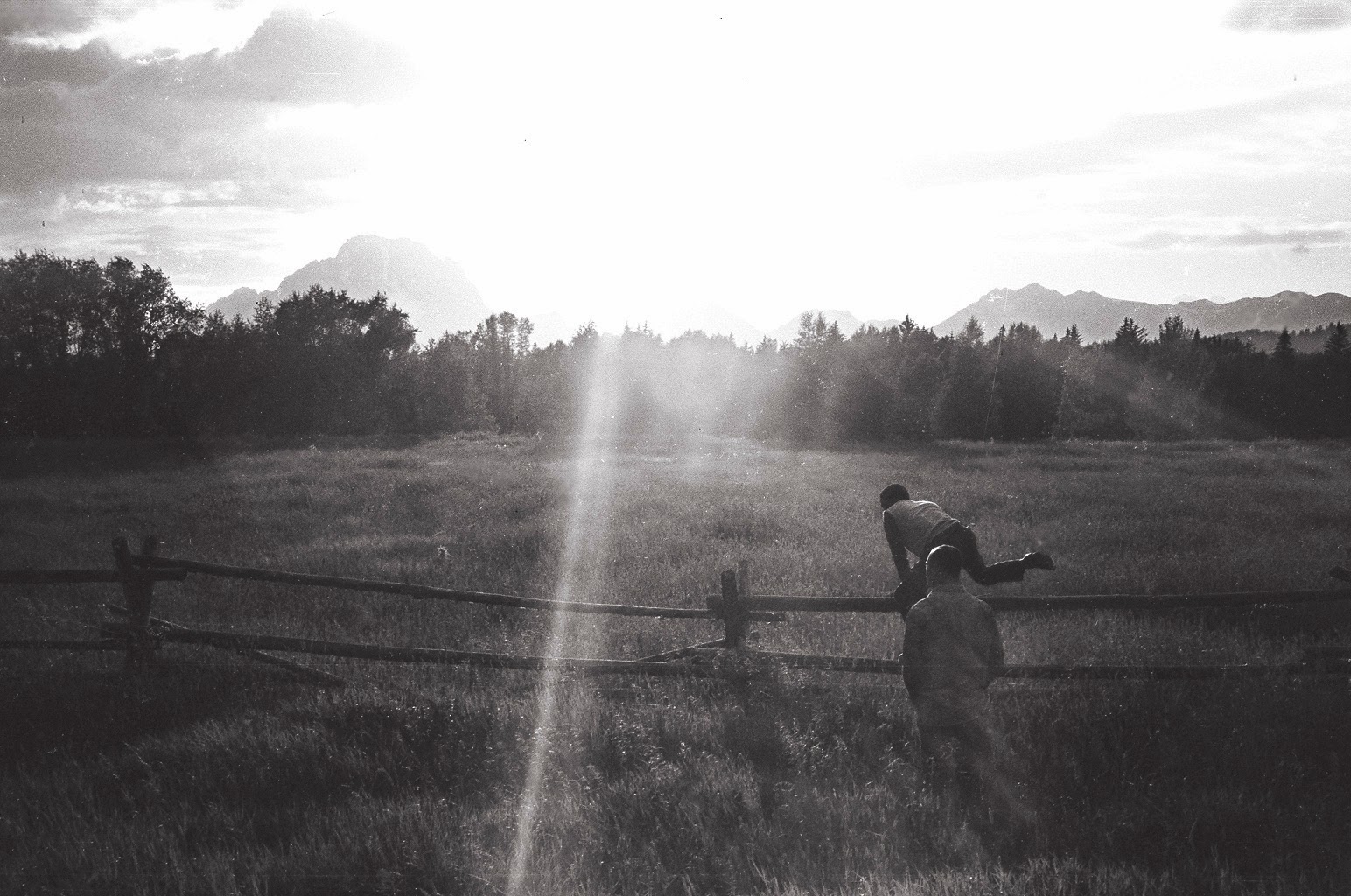
Sam and Theophilius at sunset in Jackson Hole, Wyoming. Photos by Michael James from his forthcoming book, Michael Gaylord James' Pictures from the Long Haul.
Pictures from the Long Haul:
Going off campus:
Idaho, Wyoming, and Connecticut, 1965
I proceeded to quote Tom Paine: “Let them call me rebel and welcome, I feel no concern from it; but I should suffer the misery of devils were I to make a whore of my soul.”
By Michael James / The Rag Blog / November 11, 2013

[In this series, Michael James is sharing images from his rich past, accompanied by reflections about -- and inspired by -- those images. This photo will be included in his forthcoming book, Michael Gaylord James' Pictures from the Long Haul.]

At UC Berkeley in the winter and spring of 1965 the Free Speech Movement battles continued. The court proceedings for the Sproul Hall arrests continued, as did rallies and negotiations. My sentence gave me a choice: 25 days in jail, a year’s probation, or a $250 fine. Believing that a year’s probation would limit my political activities, I took the fine, and said to the judge; “A lot of people across the land are coming to feel as I do,” and proceeded to quote Tom Paine: “Let them call me rebel and welcome, I feel no concern from it; but I should suffer the misery of devils were I to make a whore of my soul.”

Eventually the University agreed to permit tables and discussion in Sproul Hall Plaza, and reversed their edict on no political activity. And political activity there was. The U.S. war on the people of Vietnam was in the forefront. I got involved with the Vietnam Day Committee initiated by Jerry Rubin, Stew Alpert, and others. In May we held a two-day teach-in, which thousands attended. Senator Ernest Gruening of Alaska was a featured speaker. He and Oregon’s Wayne Morse were the first Senators to stand in opposition to U.S. involvement in the war in Vietnam.

Ken Kesey and his Merry Pranksters showed up in a wildly painted school bus; Allan Ginsberg, Wavy Gravy, and others were on the scene. Protest singer Phil Ochs came to perform. Before he took to the stage I was fortunate to hang out with him at the home of Neil Blumenthal, a Berkeley psychologist and the Free Speech Movement’s resident shrink.
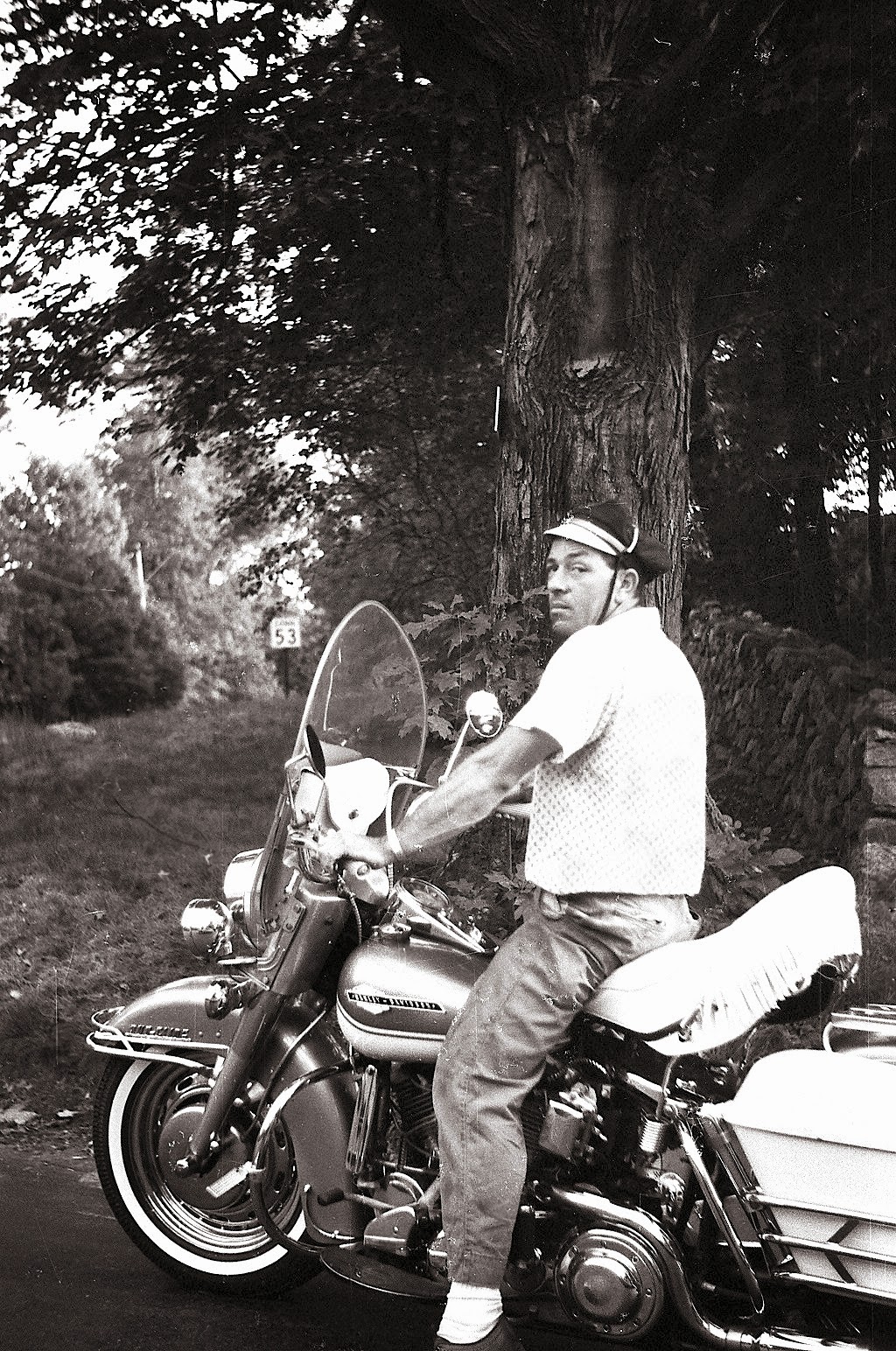
Man on Harley, Route 53, Connecticut.
For the teach-in I helped compile a pamphlet with articles on Vietnam and the war. While laying it out at the Berkeley Free Press, I leaned on the light table and fell through the glass (no injuries, luckily, and the shop owner took it in stride). When the pamphlet made it to press, I remember the brass bell on the Multilith offset that gave a constant ding-ding at the tempo of the press’s speed. The pressman was David Goines, who became a well-known poster artist.

Students for a Democratic Society was the organization that caught my attention, and then my love and devotion. Back when we surrounded the police car with Jack Weinberg in it -- the event that really set the Free Speech Movement in motion -- I had found a leaflet put out by SDS calling to “build the interracial movement of the poor.” SDS “traveler” (field organizer) Mike Davis, now a noted author, came through town and signed me up into the ranks of SDS. At an SDS party I talked and drank wine with Michael Harrington, who I had heard speak in 1962 at the University of Chicago, along with the old socialist Norman Thomas. Harrington’s ’62 book The Other America exposed the dramatic extent of poverty in the U.S.

The summer of ’65, while the anti-war movement was building at Berkeley and across the land, some of us were making plans to move into West Oakland. We would be among SDS members involved in the Economic Research and Action Project (ERAP), which had begun organizing in 13 cities, trying to build an interracial movement of the poor. Paul Booth, an SDS leader, came to California to help with what would be called the West Oakland Community Project (WOCP). We were idealistic. We said, “Let the people decide.” An SDS button proclaimed Sam Cook’s lyric “A change is gonna come.”

Twelve of us --11 white, one black -- were involved in the WOCP that summer. We had a house at 320 Henry Street near the Southern Pacific Railroad yards. People in the community wondered who we were and what was going on. A ragtag group of men who lived at the Catholic Worker’s Peter Maurin House came by to check us out. [Peter Maurin was a Catholic activist who along with Dorothy Day founded the Catholic Worker Movement]. They’d been drinking wine and their spokesman was challenging, but mellowed out when we shared our hopes and intentions.

Lots of people were working for change in Oakland. There were freedom schools, summer work projects, and labor projects. The issue that got traction in our efforts was beautification. It may not seem radical, but responding to the way the city was tearing down fences and ruining people’s gardens at Peralta Villa Public Housing without notice or community input, was about letting the people decide, a major SDS principle. The Peralta Villa folks were pissed off, and they let the city know about it. The fence removal was halted, a small but significant victory.

A mostly white group of Berkeley students organizing in a poor black community did not bring us far on the road to a revolution. Perhaps the biggest deterrent to sustained work by WOCP was the exploding growth of opposition to the Vietnam War. There was considerable anti-war activity on campus and energies were pulled in that direction.

To top it off, there were the troop trains, and the efforts by hundreds to stop them. During August there was a demonstration at the railroad tracks in Berkeley. My clearest memory of that day is a soldier’s face, probably a conscript, who was on the Union Pacific train from Fort Riley in Kansas, heading to the Oakland Army Terminal to be shipped off to Nam. He was at the window with a shaved head. His face was laughing yet somehow also fearful as he watched me take the picket sign I held and slap it against the window. “U.S. Out of Viet Nam!” I hope he made it back.

Sam and Theophilus in Wyoming or Nebraska.


At the end of the summer I headed back east. My Staples High School pal, football lineman Sam Whiteside, was on the West Coast. He and I, along with two women from the Oakland Project and a young black SNCC activist named Theopholis Smith, headed east in Sam’s Chevy wagon. Theo had been on a break from his work in the South and was heading back to the voter registration battlefield in Alabama.

I was back on the road, heading east from Berkeley by car for the first time. Sam, like me, was up for a circuitous route, and I had a camera with me. We drove through Nevada, then Idaho, and on to Jackson Hole, Wyoming, where at sunset I caught a picture of Sam and Theo climbing a over a fence. Later that night we spotted Indians swaying and staggering along the road. We were riding through a Crow reservation as we neared Dubois, Wyoming. In Dubois we ate at a bar while a piano player tickled the keys. We joined him in song before driving off into the night.

By morning we were in my ancestral homeland of Nebraska. Near Valentine we decided to stop and take a jump into the Niabrara River. Sam cut his foot, and got stitches from a doctor in Valentine. I talked to the doc about the war, which he supported. As my family will attest, this was the beginning of a lifetime of bringing up politics with folks anywhere I am -- in an elevator, at a gas station, attending a wedding, on the phone with an operator at a credit card company in wherever. “And what state are you taking this call in? Hope you guys are going to vote out so-and-so!”

In Chicago we went to the Uptown neighborhood, where the JOIN (Jobs or Income Now) Community Union office was located on Argyle. There I met Sandra Cason, aka Casey Hayden, who had just left her work with SNCC in Mississippi after Stokley Carmichael (Kwame Ture) had booted the white members out. Sam and the others left me there.

Cross, cowboy, Conoco, and Wonder Bread truck in Idaho.
Casey and I visited Old Town, a pioneer hip neighborhood and happening place. The night heat was close to unbearable, and the sidewalks were packed with people. A guy on a motorcycle, his squeeze on the back, was jumpy and jittery as he revved his bike, moving through the crowds crossing the street. I suggested to Casey, “Let’s get out of here!” We took the Chicago Northwestern RR to Lake Forest, 30 miles north. It was cooler there, where we stayed at the home of my anthropology Prof Gerry Gerasimo.

The next morning we said goodbye to Gerry and his wife Dottie, who had been a classmate of mine. Casey and I grabbed our stuff and hitchhiked east, stopping for a night at an SDS ERAP project in Cleveland, located in a mostly poor white neighborhood near the Great Lake Erie. The next day, thumbs out, we hitched rides and made it to Connecticut.

We linked up with fellow Berkeley sociology student Nigel Young and his wife Antonia, serious peace activists from England. Nigel told me about writing “U.S. out of Guatemala” on a wall in London in 1956, when he got arrested while trying to figure out how to spell Guatemala. They were quite a couple, he in mod all black: turtleneck, black pants, short black jacket, and pointy-toe black shoes. Antonia wore a big long fur coat. (This was before there was much talk of animal rights.)

All four of us headed west in a gray 1957 Plymouth station wagon “drive-away” that needed to be delivered to California. We stopped at the Custer Battlefield and Museum in Montana, where the park ranger-guide kept referring to “the hostiles” coming over this hill, and doing this or that. With Crazy Horse and Sitting Bull already heroes in my consciousness, I found his rap to be offensive. In Billings we stopped to eat at a place with an adjacent bar that had a dirt floor and a sign “Check guns at door.” That made sense.

We cruised through Yellowstone National Park, took in the geysers, and had our progress momentarily halted while a bull buffalo decided to mosey along the middle of the road. In Idaho we crossed over a mountain and stopped to eat early in the morning. On the jukebox I noticed Johnny Cash covers of Dylan tunes, and thought: “Wow, something is happening here, the times indeed are a-changing.”

A ranch in Idaho.
On a back road we stopped at an abandoned ranch where I found a branding iron. Down the road we had to stop for a herd of sheep. The shepherd was Basque, didn’t speak English, and wore a jean jacket and pants and engineer boots. Later Nigel enlightened us about the struggles of the Basque people in Spain.

Back at school in Berkeley, I was a graduate teaching assistant. Casey was bereft, missing her comrades in Mississippi, and returned to her family’s home in Victoria, Texas. I tried to restart the Oakland Project along with Vivian Rothstein. From 12 of us, we were down to two. We moved into a different house where neighborhood kids ripped us off. Honest talk led to the goods being returned.

Barry and Betty, both of whom had worked in the Newark Community Union Project (NCUP), soon joined Vivien and me in our efforts. We took a trip to a commune near Big Sur. As we approached we heard beating drums, apparently a sunset ritual to help the sun to go down over the Pacific. A number of longhairs came running at us with clubs, but backed off when Barry yelled he was there to see his sister.

It quickly became clear that the Oakland Project had run out of steam. Though my heart was still with the interracial movement of the poor, I needed to figure out the best place for me to help work toward that vision. Knowing now that I wanted to leave Berkeley, to go off campus and organize, I began contemplating my next moves.

[Michael James is a former SDS national officer, the founder of Rising Up Angry, co-founder of Chicago's Heartland Café (1976 and still going), and co-host of the Saturday morning (9-10 a.m. CDT) Live from the Heartland radio show, here and on YouTube. He is reachable by one and all at michael@heartlandcafe.com. Find more articles by Michael James on The Rag Blog.]

The Rag Blog

[+/-] Read More...

01 October 2013

Michael James : Free Speech at Sproul Plaza, Berkeley, Fall of 1964

Gathering during Free Speech Movement at UC Berkeley, December 1964. At left, with mustache, is Jack Weinberg; center, in tie, is Michael Lerner; second from right, in glasses, is Marvin Garson. Photos by Michael James from his forthcoming book, Michael Gaylord James' Pictures from the Long Haul.
Pictures from the Long Haul:
Free speech, Sproul Plaza with Jesus,
and the Roseville Auction, Fall of '64
I am one of 773 arrested at Sproul Hall and hauled off to Santa Rita County Jail. One of many who goes limp, I am arrested with the added charge of resisting arrest, and dragged down the stairs. It will not be the only time I’ll get that charge.
By Michael James / The Rag Blog / October 1, 2013

[In this series, Michael James is sharing images from his rich past, accompanied by reflections about -- and inspired by -- those images. This photo will be included in his forthcoming book, Michael Gaylord James' Pictures from the Long Haul.]

I’m heading west to grad school at Berkeley in my “ragtop” (convertible) 1957 Ford. Mine has a ripped as well as ragged top. I’m on US Route 40 -- Victory Highway, the first federally funded highway. In1964 it was the main cross-continental route and I take it from St. Louis west.

It takes me through Salina, Kansas, smack dab in the middle of the country -- a fact I know from having read Hot Rod Magazine’s 1955 report, “Showdown in the Middle of the Nation.”

Temperatures on the prairie and the plains are hot -- real hot. Around twilight I stop for gas and a good meal at a gas station diner in western Kansas and shoot the shit with the young attendant. He has long blond hair and is wearing blue jeans, a white t-shirt, and engineer boots, a la James Dean in Rebel Without A Cause.

Moving through the Great Plains I sense a moving on up, a gradual incline taking me higher and higher. The terrain changes, sagebrush rolls and tumbles, and I see dozens of black and white birds with long tail feathers on and along the road -- learned later they were Magpies.

I make it to California. It’s afternoon and I stop in Delano to visit the headquarters of the National Farm Workers Association (later the United Farm Workers), founded in 1962 by Dolores Huerta and César Chávez. Heat, dust. I find myself in a single story building, where I enter a room and meet and speak with Mr. Chavez. I donate my Lake Forest College football letter jacket to their clothing drive.

In the mid-70’s, progressive organizations -- including Rising Up Angry -- will welcome a large contingent of UFW workers to Chicago during the grape boycott and ongoing picketing of Jewel supermarkets. And in the fall of 1986 Caesar will be eating at the Heartland Café, sharing his jazz love. In my studio office I will show him my record collection and he will ask me to make tapes from my vinyl, selecting a stack nearly two feet tall. Sadly, he passed away before I could honor his request.

After leaving Delano, I roll into Canyon, a hip little town on the eastern slope of the Berkeley Hills. Skip Richheimer and his wife Susan are living in a cool crib at the bottom of a canyon, surrounded by tall redwoods and oaks. It is dusk. The home scene is warm and comforting.

I met Skip through a mutual friend, Gloria Peterson, a Lake Forest College classmate of mine. He was a fellow Triumph motorcycle guy, part of the Blessed Virgin Mother Mary Motorcycle Club at the University of Chicago. Once I was following him near the Museum of Science and Industry when he crashed, injuring both himself and his bike. We loaded it into my trunk, and then dropped him at the University of Chicago Hospital. An hour later I ditched the bike at his dad’s coffee roasting plant -- Richheimer Coffee, on Halsted near the Chicago River.

Calls to action: 'With Jesus' at Sproul Plaza, UC Berkeley..
In ’64 Skip is a Berkeley grad student in history and the only person I’m aware that I know at my new school. Soon I’ll run into some fellow Staples High students from Connecticut: Joy Kimball, Robert Roll, and Ginger Akin. I go on a date with Joy; Robert and Ginger are already conservatives and will soon work for the Rand Corporation think tank.

I enter the campus for the first time from Telegraph and Bancroft. Berkeley feels good -- exciting from the very get-go. I walk into events from which will grow the Free Speech Movement, soon to capture worldwide attention. There are people at many tables representing a smorgasbord of beliefs, organizations, movements, and causes. There is plenty of information and calls to action: left, right, Jesus, atheist, Zen, civil rights, socialist, peace -- you name it.

At Berkeley there is no shortage of people to talk with, to learn from. One is Al Plumber, a likeable old guy who had been involved with the Industrial Workers of the World (IWW). He talks about earlier struggles -- government harassment and repression of organizations and activists. In the 50’s Al hid from the FBI, living up in Idaho with other Wobblies.

People are riled up about the University’s new rules that curtail advocating action and forbid fundraising for off-campus political activities. That strikes many of us -- including supporters of SNCC’s Mississippi Freedom Sumer voter registration drive and California farm workers -- as terrible.

The UC Berkeley policy is clearly out of sync with the student body -- and apparently with the times. The Bay Area -- with its long history of labor and civil rights activism -- had been the site of considerable protest and militant action. This included effective demonstrations against HUAC, the notorious House Un-American Activities Committee (HUAC). This Federal committee blackened the nation’s eyes with its witch hunts, interrogations, and imprisonment of Communists and non-Communists alike, accusing them all of being “un-American.”

At a nighttime rally in front of Sproul Hall a large group of fraternity guys show up chanting in support of the University’s edict, but are rebuffed by the rest of the crowd. Two sociology professors I thought to be “radicals” in the field -- Seymour Martin Lipset and Nathan Glazer -- try to defend the new policy. People boo them. I am taken aback, thinking these are supposed to be the good guys, part of the reason I selected Berkeley for grad school. I will learn to look beyond reputation and begin to understand revisionism.

At a meeting of graduate sociology students I meet Dave Wellman, who is the president of the Graduate Sociology Club. We become roommates and move into 5006 Telegraph Avenue in Oakland across from Vern’s Supermarket. There is a bar next-door where I meet singer Bill Withers ("Ain’t no Sunshine" and "Lean on Me") who is hanging out at the bar. And some blocks behind Vern’s I discover a blues club and spend two nights listening to one of my favorites, Little Junior Parker.

Davy is a red diaper baby. His dad and mom, Saul and Peggy Wellman, were members of the Michigan Communist Party. She was a labor organizer who had once been deported to Canada, when the U.S. government falsely claimed she had been born there. Saul was a commissar in the Lincoln Brigade, the American volunteer force that fought fascism in Spain in the 1930’s. President Roosevelt and Congress had turned a blind eye to the slaughter being carried out by dictator Franco, who was backed in the Spanish Civil War by Hitler and the Nazis.

Davy tells me about being a kid growing up in Detroit and being followed, questioned, and bullied by the FBI. I will learn a lot from him and be introduced to many interesting people and ideas. Our saddest day together is Sunday, February 21, 1965, when we are both home studying and learn of the assassination of Malcolm X.

On a weekend I take a ride north to Loomis, an agricultural town where Jack and Donna Traylor live. I know them from my 1962 motorcycle-trip-summer-of-study to Mexico City. They are schoolteachers and Jack makes music -- playing and performing. They have a daughter, Xochimilco (“garden of flowers”), who has just learned to walk and they live in a cabin in an Oak grove. I meet his mom -- an attractive blonde Oklahoma woman with her hair up in curlers. Walking back to Jack’s on a dusty road I meet his dad, who works for the state’s Department of Agriculture.

A visit to the Roseville Auction and Market in Roseville, California .
A highlight of my visit -- in addition to hearing Jack sing Woody Guthrie’s "Deportees" -- is a trip to the Roseville Auction. It’s a bit like Chicago’s Maxwell Street market -- all sorts of people, anything and everything for sale. I buy a second-hand cast iron frying pan I continue to use to this day.

At the Roseville Auction and Market livestock are for sale. I observe goats in a truck, where rams gang up on the ewe, forcing her into a corner. This catches my attention; anthropomorphizing, I find it somewhat disturbing and unfair.

On a weekend evening I end up at the San Francisco Mime Troup space. Later my sister Melody will be a member of that groundbreaking theater. On this particular night I meet SFMT founder R.G. Davis, and also Joe McDonald, the future Country Joe, mainstay of Country Joe and the Fish. And I meet the late filmmaker, writer, and Cuban documentarian Saul Landau, whom I knew by reading his articles in Studies on the Left.

On campus the protests over freedom of speech are heating up and on October 1, Jack Weinberg, working a Congress of Racial Equality (CORE) table, refuses to give campus police his name. He is arrested and the local constabulary attempts to take him away. The police car is quickly surrounded and the FSM (Free Speech Movement) is born.

While sitting around the police car I find a leaflet on the ground. It has a picture of a black man selling apples and the slogan “Build the Interracial Movement of the Poor.” Put out by SDS’s ERAP (Economic Research and Action Project), it reverberates in my heart and mind.

I write SDS headquarters in Chicago: “I would like to be a part of building the interracial movement of the poor.” A return letter will tell me it is up to me to help build it. Soon that is exactly what I will try to do.

That fall the FSM is the main event. The rebellion grows and there are near-daily rallies and plenty of speakers and performers. State Senator (later San Francisco Mayor) Willie Brown fires up a crowd; so does Congressman Bill Burton. On November 20, Joan Baez performs for thousands while the California Board of Regents meets and takes a position to the right of the UC Berkeley Administration.

On December 2, the graduate students go on strike. The noon rally is huge. Our leader and FSM spokesman Mario Savio, who spent the summer doing voter registration in Mississippi, gives his great speech, a speech for the ages. He talks about universities' compliance with corporations and the educational and corporate machine’s dehumanizing process, which turns people into a compliant profit-serving workforce.

Rally at Lower Sproul Plaza, Berkeley.
Mario says:
There's a time when the operations of the machine becomes so odious, makes you so sick at heart, that you can't take part; you can't even passively take part. And you've got to put your bodies upon the gears and upon the wheels, upon the levers, upon all the apparatus, and you've got to indicate to the people who own it that unless you're free, the machines will be prevented from working at all.
And with that, over 1,500 of us march into Sproul Hall.

In the wee hours of the morning on December 4, 1964, the Sproul Hall bust is on. (Five years later -- to the day -- Chicago Police will assassinate Black Panther Party leader Fred Hampton in his bed.)

Some protesters leave before the arrests begin. I stay and am one of 773 arrested and hauled off to Santa Rita County Jail. One of many who goes limp, I am arrested with the added charge of resisting arrest, and dragged down the stairs. It will not be the only time I’ll get that charge.

We’re out of the slammer before sunrise December 5. Some of us reassemble on campus and attempt to block trucks from making their campus deliveries. We encourage Teamster drivers to honor our movement. They express their support, but we do not shut down the campus.

No, we don’t shut down the campus, but people around the world take note of these events. Nothing will ever be the same -- not for UC Berkeley and the university community, not for the members of the FSM, and not for me.

[Michael James is a former SDS national officer, the founder of Rising Up Angry, co-founder of Chicago's Heartland Café (1976 and still going), and co-host of the Saturday morning (9-10 a.m. CDT) Live from the Heartland radio show, here and on YouTube. He is reachable by one and all at michael@heartlandcafe.com. Find more articles by Michael James on The Rag Blog.]


Type rest of the post here

The Rag Blog

[+/-] Read More...

26 May 2011

Chellis Glendinning : The Way We Were

On Memorial Day, May 30, 1969, 30,000 students and Berkeley citizens marched past barricaded People's Park to protest events of recent days, including the death of James Rector, the blinding of Alan Blanchard, and the many injuries inflicted by police. Photo by Suellen Bulow / Peoples Park.

People's Park and beyond:
The way we were


By Chellis Glendinning / The Rag Blog / May 26, 2011

I plopped down onto the sidewalk in the first row of cross-legged protestors, eye-level with the shin-guards of the first row of National Guardsmen. My hair dropped down my back in a braid, and I was wearing a shirt made of an Indian-print bedspread. The blonde next to me leaned over and disclosed that she was on acid, in fact that she took acid every day.

I know all the details because a photograph of us showed up in Newsweek a few days later: me, the acid head, the dudes with their gas masks and rifles. It was snapped by photojournalist Peter Barnes, who later broke from the “objectivity” of press work, wrote a book on the oppression of soldiers, founded the progressive credit-card company Working Assets, wrote some more books -- and even later than that, by 20 years and wild providence, became lovers with the subject of his camera aim whose Indian-print shirt had long since shredded into compost.

Another photo appeared in that article about the rabble-rousers in Berkeley: a helicopter soaring between the Campanile and Sproul Hall dropping toxic CS gas into the plaza like it was Vietnam. Down at ground level people were screaming, fainting, falling down, blinded, retching, and the National Guard was advancing into the crowds cracking skulls with their batons.

My husband Bill and I somehow ratcheted our bodies away from the toxic clouds, into the cafeteria, down the spiral staircase of the kitchen, and out into the lower plaza. It was the first (and last) time I ever hurled a rock through a window, I was so appalled by the military exercise, and I wonder to this day whatever happened to the woman on acid.

On Bloody Thursday, May 29, 1969, a crowd at Dwight Way and Telegraph is despersed with teargas, a few minutes before the Alameda County deputies came down the street with their shotguns. Photo by Kathryn Bigelow / Peoples Park.


The Third World Liberation Strike demanded that we students skip classes, so I regrouped in the Victorian house that Bill and I rented on Walnut Street, turned my attention to cooking Adele Davis-style, shook my fist during protests against racism, played volleyball with my professor-pal Troy Duster and his social-science comrades... and quietly kept up with my homework.

I was taking The Sociology of the Family. At the end of the quarter, when I decided I’d hand in my paper on women in the Soviet Union and take the final so I could still graduate, the template was laid for a nightmare that plagued my dreams for decades after.

I nervously approached the lecture hall that I hadn’t stepped Swedish clog into for three months. To my terror it was empty. Abandoned, reassigned, unavailable, gone. No students. No prof. No sign redirecting the Returning Striker.

Panic emanated from The Sociology of the Family again when I sheepishly edged toward the departmental office to retrieve the paper and final exam I had somehow managed to hand in. I rifled through the pile to no avail: neither was there -- and I felt as adrift as a hippie waif on Telegraph Avenue. I finally mustered the courage to ask the secretary, and she offered that I must be “the one” who was instructed to see the prof.

He had a beard and glasses (as if I even remembered what he looked like). With a stern voice he told me to sit down, and I felt the axe about to fall. He then smiled and explained that there had been only two A’s in the whole quarter... and they were my paper and my exam. It was hardly the moment to speak of irony, as he blubbered on encouraging me to pursue graduate sociology. I had a flare for it, apparently. Somehow the news was more stultifying than if he’d announced I’d been kicked out for fraud.

The strike was a raging success, laying the ground for what then became a norm in higher education: Black, Chicano, Asian, and Native American studies. I went on to write books that sprang from such experiences as our Third World Liberation Strike -- and at least hinted that I might have kind-of taken some sociology classes.

National Guardsmen confront students at Sproul Hall on the Berkeley campus, May 20, 1969. Photo Dick Corten / Peoples Park.

I really can’t figure out how I have wrangled my way through this life, somehow doing the most out-there-outrageous things -- and at the same time being so timid.

The Café Mediterraneum was clearly the place to hang out. Michael Delacour was always there in his pea coat, earnestly talking revolution. There was Moe, with his waning hairline and cigar. Marty Schiffenbauer with his shorts, combat boots, and curly red locks flying every which-way. Old Carroll, the ghetto astrologer. Street poet Julia Vinograd in her yellow cap.

It was all I could do to go in there, I was so nervous: the place was that cool.

It was where the hot-and-heavy political strategizing took place. Where the Red Family grabbed a break from haggling about who did the dishes in the commune. Where the seekers from Shambhala Bookstore talked Krishnamurti, astrology, and Tibetan Buddhism. Where Simone de Beauvoir mixed it up with Martin Heidegger. Where the espresso machine swooshed, Vivaldi’s “Primavera” echoed, and folks sported Mao caps. Where, for Chrissake, everyone smoked... Galoise.

I went, at first ordering cappuccino dusted with chocolate and toting the de rigueur blue pack of cancer sticks, later (after I launched a brief stint with a two-hour-a-day yoga-meditation practice), the far thinner rose-hips tea.

But I always felt a tad “thin” in the cool department.

I cottoned right up to the fashion side of things, though. I mean, how many cases of scabies can be traced to the ultra-wide bell-bottoms scrounged from piles of threads on the concrete floor of the San Pablo army-navy store?

As my signature, I donned the Pirate Coat I paid $15 for at the Paris flea market. Some days I boasted a green leather jacket hinting of London Mod, purchased at the hippest of boutiques, Red Square, and my closet burst with slinky 1930s dresses.

But maybe the finest of couture happened when we dressed up in garb appropriate to the film we were seeing: tux and gowns for Fred Astaire-Ginger Rogers; trench coats for noir; boxy 1940s suits and spectators for Preston Sturges; kimonos for Rashomon.

Cool threads and the National Guard, May 30, 1969. Photo by Suellen Bulow / Peoples Park.


Being in jail had its perks.
Quiet time, good food, ample bedding, exercise, books for illumination, freedom to roam -- they were not among them.

But it was a pre-feminist moment for us women to be together. I know now that we could have done things differently. There simply did not have to be that pre-midnight crescendo of panicked voices in a solitaire cell that some 100 women from the Mass Bust were now crammed into; we could have gathered into small groups to quietly discuss terror and claustrophobia. We could have been more supportive of our disparate needs. We could have meditated. Or done a ritual.

But what did we know?

We did know that the big bust was coming. Our own private rendition of Deep Throat within the police department had tipped us off, and a few had met in a living room just off campus to weigh our options. Tom Hayden was there. Wendy Schlesinger. Delacour. Bill Miller.

But somehow any planning we mustered had zero effect when the shit hit the fan and the cops cordoned off Shattuck Avenue, hemming in not just us anti-war protestors, but also innocent mailmen and shopping mothers. I was one of the Health Food 15. Guilty as all get-out, we had rushed into Goodson’s, grabbed wire shopping baskets, and pretended to be buying organic oatmeal -- but sure enough, a policeman emerged tall and angry through the back door and rounded us up for the bus ride to Santa Rita Detention Center.

Knowing it was coming, I had made my own plan for bail. It’s not a plan that -- what with post-9-11 paranoia -- would fly today, but it did back then. I had hand-penned a letter to Wells Fargo bank authorizing my commune-mate to take out $300 from my savings account, and when he showed up at the jail with papers for my release, I was never happier to see a parking lot.

The stories that came out of the men’s section were grim. While we women had had the freedom to fashion the plastic bags filled with Wonder-bread-bologna sandwiches into “volleyballs” for our nervous amusement, the men had been jammed face down in the yard and made to lie there without flinching through the night. One had his head tied to an iron pipe, and an officer had banged the pipe till blood gushed from his eyes, nose, and mouth.

In the end, the Health Food 15 got off through the efforts of our pro bono lawyer Bob Treuhaft. And in the end, the perk was seeing the system from the inside out.

Members of the Black Panther Party in their "humongous leather jackets." Image from Ancestry in Progress.


In their humongous leather jackets
, the Black Panthers came on as fierce as the police they were bucking. One day a militaristic line-up of them made the trek from downtown Oakland to hold forth at the noon rally in Sproul Plaza.

Their message was kind of confusing to those of us who had grown up on “We Shall Overcome” and sharpened our political teeth in the South during Mississippi Summer. Bristling with the radicalism of the international liberation/decolonization movements, the Black Panthers announced that the new revolutionary tack was to stand alone, Whitey not invited. At the same time, they demanded our support.

After that, a lot of interracial marriages broke apart in a frenzy of political realignment. Along with everyone else, I was reading Eldridge Cleaver’s Soul on Ice, and Frantz Fanon’s notion of violence against whites as a cleansing act was flying through the halls of academia, so I wasn’t completely in the dark about rage, separatism, and self-empowerment.

Just then something began to appear in the dark, hung on a peg in the hallway of the apartment we shared with a university secretary, who was white. It was the fiercest black-leather jacket of all. Every time it was there, a heavy silence emanated from behind her closed door, and soon she began to show up in a black beret behind the card table, taking the money and handing out leaflets, at Panther events.

I could only think that she, among very few, had mastered the delicacies of white support.

Mario Savio, standing atop a police car in Sproul Plaza, Oct. 1, 1964, speaks to thousands during the Free Speech Movement. Photo courtesy Bancroft Library / Berkeley Daily Planet.


I had no idea that we activists
-- sometimes amassed in crowds of 3,000, sometimes 100,000 -- had, through the years of rampaging around campus and in the streets, developed an unspoken method: a way of forming, spreading, taking over the city, then dispersing, and finally re-congealing like a dance that was in our genes.

That is, until the neophytes arrived -- which happened the summer after People’s Park when every Tom, Dick, and Hari Krishna east of Sproul Plaza decided that Berkeley was the place to hone one’s revolutionary skills. Suddenly, up against the Alameda County Sheriff’s Department “Blue Meanies,” the streets became a place of edginess, chaos, and utter lack of method.

I said, “To Hell With It,” and retired to my commune on Vine Street. It was a good time to pull back for a spell. The obvious next step was something akin to what we’d seen in the film Battle of Algiers, and indeed many in the New Left were joining gun clubs, just as some Students for a Democratic Society radicals back East were morphing into the Weather Underground.

Bill and I hightailed it to Europe, bought a second-hand Deux Chevaux in Amsterdam, and tooled at 40 m.p.h. through Holland, Denmark, Sweden, France, Andorra, Spain, and Morocco. When we got back and retreated to a maple-sugar farm in Vermont, sure enough, the FBI tracked us down and paid a visit to see what we were up to.

Things being as they were, Bill refused to ID any of the folks in the photos and told the FBI dude to shove it.

[Chellis Glendinning is the author of five books, including My Name Is Chellis and I’m in Recovery from Western Civilization. Her Off the Map: An Expedition Deep into Empire and the Global Economy and Chiva: A Village Takes on the Global Heroin Trade, both won the National Federation of Press Women book award in nonfiction, in 2000 and 2006 respectively. She lives in Marquina, Bolivia, and can be reached via www.chellisglendinning.org.]

Photo by Gil Madrid / PeoplesPark.

The Rag Blog

[+/-] Read More...

Only a few posts now show on a page, due to Blogger pagination changes beyond our control.

Please click on 'Older Posts' to continue reading The Rag Blog.