Showing posts with label Texas. Show all posts

04 July 2012

Jim Hightower : Best Little Chicken Sanctuary in Texas

"Me and my Gal." Painting of Farm Street chickens in Bastrop by Jo Knoblach Castillo. Inset photo below: Free-ranging Bastrop chickens. Photo by Terry Hagerty / Bastrop Advertiser.

The Best Little Chicken Sanctuary in Texas
A flock of feral chickens has lived for years on (the appropriately named) Farm Street in the town of Bastrop.
By Jim Hightower / OtherWords / July 4, 2012

BASTROP, Texas -- Some people complain that their town has gone to the dogs. Bastrop, Texas has gone to the chickens -- and Bastropians are proud of it.

Well, most Bastropians.

While other cities might boast of their historic sites or cultural offerings, the good folks of this easy going, free-spirited community near Austin have chosen to highlight a flock of feral chickens that has lived for years on (the appropriately named) Farm Street. No one owns these roosters, hens, and chicks. They take care of themselves, eating bugs and clucking contentedly from yard to yard. Yes, they cross the road for no apparent reason.

It's a quirky phenomenon that fits right in with this town of delightfully quirky folks. Three years ago, some of them got the city council to enshrine the quirkiness by designating their area "The Farm Street Historical Chicken Sanctuary." This proclamation provides protected status for the flock. Everyone smiled, the chickens clucked, and all was well.

Until this spring, when Beverly Hoskins raised a ruckus in the henhouse, figuratively speaking. As the owner of several rental houses along Farm Street, she wants the council to consider repealing the proclamation, complaining that "a lot of chicken waste" was being spread by the daily promenade.

The denizens of Farm Street, however, flocked to defend the fowls, asserting that wild chickens are an integral part of "Bastrop culture." One lady who rents one of Hoskins' houses said of the chickens that roost in a tree in her yard: "I welcome them." Another neighbor pointed out that "Hey, the chickens were here first... And it is 'Farm Street'!"

The flock's fate is still up in the air, but the council recently hinted at its sentiments by authorizing some banners on Farm Street telling motorists to slow down. After all, they're driving through a chicken sanctuary.

[Jim Hightower is a radio commentator, writer, and public speaker. He's also editor of the populist newsletter, The Hightower Lowdown. This article was first published by OtherWords and was distributed byTruthout. Read more articles by and about Jim Hightower on The Rag Blog.]
  • Go here to read "Jim Hightower and the 'Populist Moment'" by Thorne Dreyer on The Rag Blog and to listen to the podcast of our April 6, 2012, hour-long Rag Radio interview with Jim Hightower.
The Rag Blog

[+/-] Read More...

23 April 2012

Lamar W. Hankins : Freedom of Conscience in Hays County, Texas

Kyle, Texas-area Constable James Kohler: "If they can't pledge allegiance to that flag, they need to get the hell out of the United States. Image from Hays Free Press.
 
Respect for freedom of conscience 
missing in Hays County

By Lamar W. Hankins / The Rag Blog / April 23, 2012
“If there is any fixed star in our constitutional constellation, it is that no official, high or petty, can prescribe what shall be orthodox in politics, nationalism, religion, or other matters of opinion or force citizens to confess by word or act their faith therein.” –– West Virginia Board of Education v. Barnette, 319 U.S. 624 (1943)
SAN MARCOS, Texas -- The San Marcos Mercury recently reported that  Hays County Commissioner candidate Sam Brannon refused to stand and participate in the Pledge of Allegiance at the beginning of a Commissioners Court meeting about a year ago.  

His inaction was challenged by Kyle-area Constable James Kohler, who called out Brannon publicly for standing silently without his hand over his heart during the ceremonial recitation of the pledge at the beginning of the court session.

Kohler is reported to have said, “I’ve never seen anybody not salute, not put their hand over their heart, when we pledge allegiance to the flag of the United States of America. If they can’t pledge allegiance to that flag, they need to get the hell out of the United States.” Kohler also noted that Brannon did not bow his head for the court’s invocation.

However Kohler’s official position is described -- high or petty, or perhaps somewhere in between -- he has no grounds for impugning the integrity of a citizen for exercising his or her conscience, as the Supreme Court opinion quoted above holds.

I know nothing about Brannon except what I have read in the local media. He may be a scoundrel or an upstanding person, or somewhere in between. Some have called into question Brannon’s lifestyle, past political activities, financial dealings as a former candidate, and whether he is a legitimate resident of County Commissioner Precinct 3, in which he is a candidate this year. But those matters are beside the point raised by Kohler. Perhaps a bit of background on the pledge can put this whole matter in context.

The Pledge of Allegiance was written in 1892 by the author, editor, Christian socialist, and Baptist minister Francis Bellamy as part of an advertising campaign to sell flags to schools and promote the magazine The Youth's Companion, for which Bellamy was an employee hired to participate in this promotion. The magazine even worked into its advertising campaign the celebration of the 400th anniversary of Columbus’s discovery of the New World, with the flag as the centerpiece -- it sold flags to 26,000 schools during the campaign. As written originally, Bellamy’s pledge read:
I pledge allegiance to my Flag and the Republic for which it stands, one nation, indivisible, with liberty and justice for all.
In 1923, the words were modified slightly from “my Flag” to "the Flag of the United States of America." That version lasted until the McCarthy era, when President Eisenhower, in 1954, was persuaded to join with the Knights of Columbus religious group to support having Congress adopt the pledge with the added words “under God” to distinguish the United States from the Soviet Union’s "Godless Communism," giving us the pledge as it exists today:
I pledge allegiance to the flag of the United States of America, and to the republic for which it stands, one nation, under God, indivisible, with liberty and justice for all.
Originally, Bellamy had prescribed a salute to the flag when the pledge was recited that resembled the Nazi salute. During World War II, this practice was largely abandoned in favor of a hand held over the heart, or in the case of a service man or woman, a military salute.

Of course, no law requires any particular behavior during the recitation of the pledge, but custom and social pressure have usually assured that standing at attention and gesturing as described during the pledge’s recitation are followed by most people.

In the 1930s, the expulsion from public school of the children of Jehovah’s Witnesses for their unwillingness to salute the flag and recite the pledge led to a Supreme Court decision that venerated patriotism over freedom of conscience.

The parents argued that as Jehovah’s Witnesses, the children’s allegiance was only to God; thus, to salute the flag and recite the pledge would violate their religious beliefs. But the Supreme Court held that the school district’s interest in creating national unity through a patriotic practice allowed school officials to require students to salute the flag in spite of their religious beliefs.

The 1940 decision was grounded in the shibboleth that “National unity is the basis of national security.”

Almost immediately after the decision was rendered, Jehovah’s Witnesses were set upon by mobs and beaten, and their children were expelled from public schools. According to the book Judging Jehovah's Witnesses: Religious Persecution and the Dawn of the Rights Revolution, by Shawn Francis Peters, by the end of 1940 “more than 1,500 Witnesses in the United States had been victimized in 335 separate attacks." Such attacks included beatings, tarring and feathering, hangings, shootings, maimings, kidnappings, castration, threats, and other acts of violence.

Attacks were reported in Ash Fork, near Prescott, Arizona; Crocker, Missouri; Jasper, Refugio, and Port Arthur, Texas; Hinton and Union City, Oklahoma; Jackson, Mississippi; Litchfield, Carlyle, and Greenville, Illinois; Kennebunk and North Windham, Maine; Connersville, Indiana; Harlan, Kentucky; and elsewhere. Expulsions were reported in Kentucky, Michigan, New Hampshire, Texas, and other states.

Details of the violence appeared in a 1941 report published by the American Civil Liberties Union and signed by well-known national figures, such as Dr. Reinhold Niebuhr, Dr. Harry Emerson Fosdick, Rev. Ernest F. Tittle, Rabbi Edward L. Israel, and several others.

The widespread barbarity engendered by the court’s opinion, in combination with the fear caused by the rise of totalitarianism in Europe, so shocked the court that it looked for a way to reverse its decision. In 1943, it found a way to do so. In West Virginia Board of Education v. Barnette, the Supreme Court held that mandating recitation “invades the sphere of intellect and spirit which it is the purpose of the First Amendment to our Constitution to reserve from all official control.”

The behavior of Constable Kohler toward Sam Brannon is one kind of action that the Supreme Court may have had in mind when it wrote that “no official, high or petty, can prescribe what shall be orthodox in politics, nationalism, religion, or other matters of opinion or force citizens to confess by word or act their faith therein.”

 It is shameful that no public official who witnessed Kohler’s outburst toward Brannon challenged it. Reports indicate that Hays County Judge Bert Cobb seemed beguiled by Kohler’s behavior. Perhaps all of our public officials are as petty as was Kohler. Certainly, they could all stand to learn something about our constitutional history.

But these are the same public officials who routinely use their public offices to force their preferred religious practices -- Christian prayers -- on all our citizens at public meetings. I can’t imagine that any of them will ever be able to appreciate the importance of the right of conscience that we are guaranteed by the Constitution. They have no problem forcing their theocratic views on us all, and they treat obeisance to the state no differently.

They would be wiser leaders if they heeded the words of Thomas Jefferson written to Benjamin Rush in 1803:
It behoves every man who values liberty of conscience for himself, to resist invasions of it in the case of others; or their case may, by change of circumstances, become his own.
[Lamar W. Hankins, a former San Marcos, Texas, city attorney, is also a columnist for the San Marcos Mercury. This article © Freethought San Marcos, Lamar W. Hankins. Read more articles by Lamar W. Hankins on The Rag Blog.]

The Rag Blog

[+/-] Read More...

18 May 2011

Peter Montgomery : Newt Gingrich Wants to Make America More Like Texas!

Newt Gingrich: Texas Number One!

Worse campaign promise ever?
Newt Gingrich wants to
make America 'like Texas'


By Peter Montgomery / AlterNet / May 18, 2011

In his presidential campaign announcement on Sean Hannity’s Fox News Channel show last week, former House Speaker Newt Gingrich praised job creation in Texas and said he’d been talking to Texas Gov. Rick Perry. "I know how to get the whole country to resemble Texas,” Gingrich told Hannity.

That could go down as the worst campaign promise ever.

“I dearly love the state of Texas,” the late Texan and progressive icon Molly Ivins wrote, “but I consider that a harmless perversion on my part, and discuss it only with consenting adults.” Noting that Texas was a state that provided relatively few services to its residents, she once wrote, “The only depressing part is that, unlike Mississippi, we can afford to do better. We just don’t.”

Maybe that should be the motto for Newt Gingrich and his fellow anti-government demagogues.

The impact of that governing philosophy is spreading a lot of pain in Texas right now. Nobel Prize-winning economist and New York Times columnist Paul Krugman wrote earlier this year:
Texas is where the modern conservative theory of budgeting -- the belief that you should never raise taxes under any circumstances, that you can always balance the budget by cutting wasteful spending -- has been implemented most completely. If the theory can’t make it there, it can’t make it anywhere.
In fact, Texas lawmakers have been struggling all year to figure out how to deal with a massive budget deficit. An AP story from March, headlined “Texas’ economic miracle beginning to tarnish,” noted that the state’s budget shortfall was “among the worst in the nation.” A temporary budget deal in March involving more than $1 billion in spending cuts still left the state $23 billion short over the next two years by one estimate.

Proposed cuts could result in layoffs for 100,000 school employees and 60,000 nursing home workers and eliminate 9,600 state jobs this year. Just this week lawmakers struggled to reach agreement on a deal to close a $4 billion deficit in the current year, which ends in August.

It is possible that entire crisis may have been manufactured by Perry and other anti-government Republicans to give lawmakers a justification for further slashing government and basic human services.

Does Newt think we really want the whole country to look like Texas, which ranks:
  • 50th in percentage of population without health insurance (2010)
  • 50th in percentage of children insured (2009)
  • 50th in percentage of women receiving early prenatal care (2010)
  • 45th in rate of infectious diseases (2010)
  • 44th in percentage of children in poverty (2010)
  • 42nd in per capita health care funding (2010)
  • 40th in overall health (2010)
  • 36th in high school graduation rate (2010)
  • 35th in crime (2010)
  • 35th in percentage of children immunized (2010)
  • 34th in rate of occupational fatalities (2010)
  • 30th in percentage of people with college degree (2008)
Texas also ranks:
  • 1st in amount of recognized carcinogens released into the air (2002)
  • 4th highest in release of toxic chemicals into the environment (2002)
  • 8th highest in percentage of people below poverty level (2008)
  • 13th highest in obesity (2010)
“I know how to get the whole country to resemble Texas.” Uh, thanks, Newt, but no thanks.

[Peter Montgomery is a senior fellow at People For the American Way Foundation. This piece originally appeared at Right Wing Watch, a blog published by People For the American Way, and was distributed by AlterNet.]

The Rag Blog

[+/-] Read More...

21 February 2011

Lauren Kelley : Packing Heat on Texas Campuses

Texas Governor Rick Perry fires a six shooter at an event in Fort Worth. Photo by Rodger Mallison / AP.

Pretty scary:
Texas about to make it legal

to carry guns on college campuses


By Lauren Kelley / AlterNet / February 21, 2011

From the annals of bad ideas: the Texas legislature is poised to pass a bill that will make it legal for both students and professors to carry concealed handguns on college campuses, in the name of self-defense.

From AP:
More than half the members of the Texas House have signed on as co-authors of a measure directing universities to allow concealed handguns. The Senate passed a similar bill in 2009 and is expected to do so again. Republican Gov. Rick Perry, who sometimes packs a pistol when he jogs, has said he's in favor of the idea.

Texas has become a prime battleground for the issue because of its gun culture and its size, with 38 public universities and more than 500,000 students. It would become the second state, following Utah, to pass such a broad-based law. Colorado gives colleges the option and several have allowed handguns.
This move isn't a huge surprise, since Texas is clearly one of the more gun-friendly states in the country (the governor "sometimes packs a pistol when he jogs," for goodness sake). But the measure has drawn its fair share of criticism, most notably from the victims of the Virginia Tech shooting -- a group that knows a thing or two about the consequences of carrying guns on campuses. Some of the Virginia Tech victims traveled to the Texas state Capitol on Thursday:
Colin Goddard, who was shot four times during the Virginia Tech rampage and survived by playing dead, urged Texas lawmakers on Thursday not to allow concealed handguns in college classrooms. He and John Woods, another former Virginia Tech student whose girlfriend was among the more than 30 people killed in the April 2007 carnage, were at the Capitol to fight against guns on campus bills pending in the House and Senate....

I was there that day. It was the craziest day of my life with one person walking around with two guns," Goddard said. "I can't even imagine what it would have been like with multiple students and multiple guns."
Another group against the bill? Leaders of Texas' own community colleges.

Collin College chief of police Ed Leathers says he is a supporter of Texas' concealed handgun laws, and even has a concealed handgun license himself. But he adds that “Our officers are trained to go immediately to the location of where shots are reported to be fired, and they’re trained not to ask any questions but stop the person who they identify with a weapon” -- possibly causing confusion about who the criminal is, which could have tragic consequences.

San Jacinto College spokesperson Teri Fowlé adds, "If you have students who are constantly wary of who is carrying a gun and who is not, how does that facilitate education?”

[Lauren Kelley is an associate editor at AlterNet and a freelance journalist based in New York City. This article was distributed by AlterNet.]

The Rag Blog

[+/-] Read More...

15 December 2010

Carlos Calbillo : On the Passing of Carlos Guerra

“America’s friendliest angry looking retired columnist... and feared by fish.” -- Carlos Guerra, on Twitter.

Columnist and Sixties Chicano
activist Carlos Guerra dies
See "Memories from 'the day': On the passing of Carlos Guerra," by Carlos Calbillo / The Rag Blog, Below.
Carlos Guerra, 63, an icon of the Sixties Chicano movement, a former columnist for the San Antonio Express-News, and a leader in social justice issues throughout his life, died December 6, in Port Aransas, Texas.

Arnold Garcia, Jr., wrote in the Austin American-Statesman that Carlos Guerra "was a student activist, grant writer, political organizer, fundraiser, legislative aide, jeweler, opinion writer and a pretty darned good cook." And, Garcia said, Guerra "was a man whose intellect -- like his humor -- refused to recognize boundaries."

Guerra was, according to the Texas Observer’s Melissa Del Bosque, “one of the first prominent Latino columnists in American newspapers,” and was “one of Texas' most recognizable voices and a role model for countless younger journalists.” In an obituary, the San Antonio Express-News said that Guerra “was an outspoken advocate for increased access to higher education, environmental issues and Latino participation in government and politics.”

Guerra, who grew up in Robstown, Texas, became an early leader in the Sixties Chicano movement. He was national chairman of the Mexican American Youth Organization (MAYO) and worked with La Raza Unida Party, serving as chairman of Ramsey Muniz’s second race for Texas governor.

At a memorial service for Carlos Guerra December 11 at Palo Alto College in San Antonio, former Raza Unida leader Mario Campeon said, “He stood for the well-being of others, particularly the poor. He fought…the fierce discrimination that existed at that time.” “All of us of that generation had the passion,” said Campeon, “but Carlos was also a gifted speaker in articulating the agenda of the Chicano movement.”

-- Thorne Dreyer / The Rag Blog / December 15, 2010

Carlos Guerra on the cover of Caracol, a Texas-based Chicano literary/news magazine from the 1970s. Image from National Association of Hispanic Journalists.

Memories from 'the day':
On the passing of Carlos Guerra


By Carlos Calbillo / The Rag Blog / December 15, 2010

The 60's of course were a different time, and we as thinking young people were being influenced and bombarded by the dominant American culture: the music, the militancy -- revolution was in the air -- and of course the fashion. We wore bell bottoms, paisley shirts, and desert boots with our serapes and brown berets. We were young and crazy -- some of us actually idealistic -- trying to find a new way in the reality that was Texas of the times.

This society we perceived as intolerably oppressive and it definitely seemed to us “enlightened” youth to be designed to keep brown and black people down. So we took up "arms" against it, much to the horror of our parents and other "gente decente," such as LULAC and their ilk.

I met Carlos Guerra at some of these early confabs of the Mexican American Youth Organization (MAYO), and since the Houston MAYO cadres were urban and "hippie-ish," many of us either didn't speak Spanish or did so haltingly. When I began to attend MAYO actions in the small communities across South Texas (small compared to Houston) and discovered that some of the MAYO hermanos/hermanas spoke mostly Spanish, perhaps out of nationalistic zeal, I -- and many of the Houston MAYOs -- would become uncomfortable.

One time we traveled to Robstown, Texas, to support a rally protesting the racist school system, which of course was designed not to educate our people, but to serve as an institutional bludgeon to keep us Mexicans down and ignorant. Robstown was a perfect example of a small Texas town where the population was overwhelmingly Mexican-American yet the economics and politics were tightly controlled by the gringo establishment.

The rally was being held in front of the MAYO headquarters in a down and out barrio and about 100 community people, parents, and students were there, very pissed, carrying protest signs in English and in Spanish. Robstown MAYO chieftain Mateo Vega was delivering a fiery bilingual speech and rant.

The Robstown police, represented by several big white guys in coats, ties, and sunglasses -- and wearing very large pistols prominently on their belts -- were walking around taking our pictures and generally acting like racist thugs out of central casting.

Carlos Guerra was there of course and afterwards we all met to debrief. I will never forget that, unlike the linguistic ideologues who considered those of us from Houston to be culturally pendejos, he was a firme vato who looked upon us, his urban hermanitos, not with scorn or disgust, but with a loving bemusement -- and with an open attitude of inclusion.

Carlos of course was completely tri-lingual and spoke not only English perfectly but also a beautiful Texas Spanish and a stunning pachuco cálo.

From the beginning, Carlos understood the need to unite and not to fight, something that we in the current political arena and climate sometimes appear to forget.

Texas DPS surveillance photo of MAYO/Raza Unida leaders meeting on the campgrounds at Garner State Park, 1970. Carlos Guerra is in the rear, leaning to the right.
CLICK ON IMAGE TO ENLARGE
Another incident I remember with my friend "Charlie War" -- as some of us jokingly called him -- was when MAYO and La Raza Unida Party had finally succeeded in taking over Crystal City and surrounding towns, and even entire counties, and Jose Angel Gutierrez called for all chapters to meet and to discuss future strategy at Garner State Park.

It was a beautiful setting with picnic tables under the great oak trees and we munched on barbacoa and tripitas as Jose Angel led us in discussion. We had all noticed several unmarked police vehicles on the periphery and we could see and even hear their cameras -- with telephoto lenses -- clicking away.

Eventually, Carlos Guerra and several others, including myself, made our way over to the parking lot at Garner where most of us had parked our junky cars. The lot filled suddenly with uniformed DPS troupers who began to berate, intimidate, and bait us in the way that only they knew how to do.

They went around writing down the license plate numbers of all of our cars, which they seemed to know well. Being new to this kind of political intimidation, I freaked out and began to back off. Carlos Guerra fearlessly went up to these PENsadores and began an attempt to educate them on the rights of American citizens to peacefully assemble, our right to meet without fear of governmental interference or intimidation.

Several of these sons of Texas seemed shocked and taken aback that their "right" to harass us was being challenged by this long-haired hippie who seemed not to fear them or anything else for that matter. They became very upset but apparently couldn't come up with an excuse to arrest Carlos in front of witnesses; they muttered something and left.

Every time we visited Robstown, Carlos was there ready to assist us, his urban MAYO brothers and sisters, with a meal or with a place to crash. There have been many -- and will be many more -- remembrances of Carlos Guerra, incredible tales, profound and funny adventures, many of them even true. For those of us who were touched by his life, it goes without saying that we, and I for one, will never forget his wit, his love, and his example.

To paraphrase the bard (some vato from Inglatierra): "He was a man, take him for all in all, I shall not look upon his like again."

Amen y con safos. Descanse en paz, hermanito en una raza que pronto llegará a ser verdaderamente unida, porque si se puede...

[Carlos Calbillo is a filmmaking instructor and filmmaker living and working in his hometown of Houston, Texas. He is currently working on a documentary film on emerging Latino political power in Houston and Texas. He can be reached at laszlomurdock@hotmail.com]

The Rag Blog

[+/-] Read More...

14 October 2010

Diana Claitor : Why We Need To Protect Texas Inmates

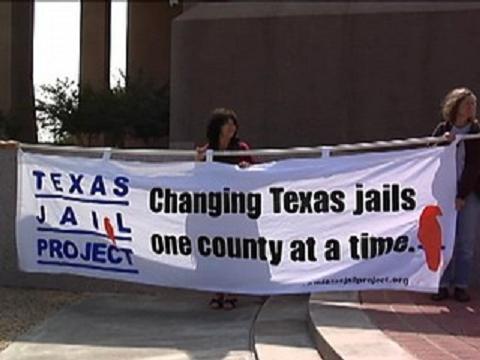
Texas Jail Project protests at Taylor County Jail in 2008. Image from Abilene Reporter-News.
Texas Jail Project director Diana Claitor will be Thorne Dreyer's guest on Rag Radio on KOOP 91.7 FM in Austin, Tuesday, October 19, 2-3 p.m. (CST). To stream Rag Radio live, go here. To listen to this show after the broadcast, or to listen to earlier shows on Rag Radio, go here.
Protecting Texas inmates:
Why do we need another law?


By Diana Claitor / The Rag Blog / October 14, 2010

I often hear about how stupid it is that Texas and other states have to pass bills and create laws to ensure care for pregnant inmates or to stop the shackling of nonviolent women during childbirth. Folks say, "Why don't people in charge just do the right thing?"


Of course, you can say that about everything. Why do we have to pass laws against pollution or bribery? Why do we have to enact standards or requirements for elected officials to follow?

Probably because those in charge are human beings and make mistakes -- and because they don't always do the right thing. Like when sheriffs and jail administrators release inmates in dangerous locations after dark.

Texas Jail Project recently found out about a man with a mental disorder who was shoved out of the Val Verde County facility, onto the county road outside Del Rio. Traumatized and lacking any information about where the town was, he walked up and down the road for hours in the dark until a deputy felt sorry for him and drove him into town.

A typical response to stories like that: "Well, that's an isolated case. You're going to have that happen with some 245 jails all over this huge state."

But it's turning out not
to be so isolated. We have received detailed accounts of similar releases at night in Houston, and in Seguin over in Guadalupe County. Even worse cases are coming to light, including two releases outside Brownsville that resulted in women being hit by cars. Both woman died, one of them this past summer. Priscilla Falduto was 27.

Patricia Falduta, who was arrested for swimming nude in a Brownsville park fountain, was killed when struck by a car after being released from custody on a highway close to the jail.

Brownsville citizens wrote to their newspapers in outrage and contacted their elected representatives. Texas Jail Project brought these examples up to the Texas Commission on Jail Standards in the past month, but director Adan Muñoz says it is outside their purview -- that when and where people are released is under local control.

“The sheriff can’t be told when and where inmates are to be released,” says Muñoz.

Why not, Mr. Muñoz?

It seems to me that the legislature could pass a state law requiring that county jail inmates be released during daylight hours (like at Texas state prisons) at safe locations where transportation and a phone are available -- thus ensuring that inmates are not treated like so much garbage, to be put out at night.

The general idea of incarceration is that jails should hold people safely until it is determined whether they have broken the law or not. In the latter case, or after bail is made, they are released -- and we want that to be a safe release.

So it looks like we actually do need a new law, to require sheriffs and counties to be as careful in how they restore freedom as they are (or should be) when holding a person in custody.

If, however, any of you readers should discover that human nature has changed and that people in charge have started making sure that each inmate gets released safely, let me know -- it will be a huge relief.

Please help us at the Texas Jail Project to research and publicize this problem.

[Diana Claitor is director of the Texas Jail Project, an organization dedicated to improving conditions for the approximately 70,000 people incarcerated in Texas jails on any given day. Visit www.texasjailproject.org to learn more or to help support their efforts.]
Activist-author Diane Wilson.

Diane Wilson headlines Texas Jail Project bash.

The Texas Jail Project is having a fundraising event Saturday, November 6, from 7-10 p.m., at 3209 Hemlock Ave. in Austin. Special guest will be TJP co-founder and award-winning author and activist Diane Wilson. Wilson will speak about the history of the Texas Jail Project and her experiences in the Harris and Victoria County Jails, and she will also tell about being arrested in Washington D.C. after disrupting two Senate hearings on the Gulf oil disaster.

Wilson will also preview her new book, Diary of an Eco-Outlaw: An Unreasonable Woman Breaks the Law for Mother Earth, to be published in the spring of 2011. For more information on this event, please contact Diana Claitor at diana@texasjailproject.org or call (512) 597-8746.
The Rag Blog

[+/-] Read More...

09 August 2010

Greg Moses : Deporting Texas Student Was Big Mistake

Saad Nabeel. Photo by Shehab Uddin / Der Spiegel.

What the Times forgot to mention:
Story of deported Texas student
Awaits President in Dallas


By Greg Moses / The Rag Blog / August 9, 2010

While the New York Times Monday morning proclaims that the Obama administration is not deporting college students whose parents brought them to America at a young age, the President is headed toward a fundraiser in Dallas Monday night where one such case is well known.

Dallas real estate developer and immigrant rights advocate Ralph Isenberg bought tickets to the fundraiser with President Barack Obama so that he can plead for the speedy return of a young deportee from Texas. Isenberg has been working for several months to secure the return of 19-year-old who was deported to Bangladesh with his parents in early 2010.

If the New York Times is correct about what the Obama administration is trying to do, then the deportation of Saad Nabeel was a big mistake. He had lived in the USA since age three, completing grades six through twelve in Texas. When he was deported at age 18, Nabeel was studying electrical engineering on full scholarship at the University of Texas at Arlington

"I plan to tell the President that if he is looking for a poster child for someone who has been unfairly treated and who we need to do right by, then Saad Nabeel is perfect," said Isenberg Saturday in a telephone interview with the Texas Civil Rights Review.

"There are multiple legal issues that we can pursue to try to get Saad back in the country," said Isenberg. "But the quickest solution by far would be to pass a DREAM Act that includes an amendment for young persons who have been recently deported. Other legal issues would require lengthy legal actions -- and the wait would do no good to Saad."

If adopted by Congress and signed by the President, the DREAM Act would offer citizenship options to youth who were brought to the USA by migrant parents. When Isenberg approaches the President in Nabeel's behalf, he will also be representing the opinions of Saad's young friends who are this week preparing their returns to college life.

"I feel like everything that has happened in the past year was unnecessary," explains Chris Anderson, one of Nabeel's high school friends contacted by the Texas Civil Rights Review.
Saad was brought to America by his family when he was a young child. He lived like every other American by going to school, getting a job, and spending time with his friends and family. Everything that he knew and loved was in the United States, and one day he was just uprooted from college, thrown in jail for over a month, and shipped to a foreign third world country that he has no memory of.
Nabeel's case has attracted media attention in Dallas and the German magazine Der Spiegel. Other international media have shown interest in the case. Isenberg agrees with Der Spiegel that Nabeel's campaign to return to the USA has been helped by the young man's fluency with computer skills.

Keeping tabs on news via computer in Bangladesh, Nabeel saw Monday’s New York Times report as soon as it hit his inbox as the morning’s top story. When asked via email what he would like to say to the President during Monday’s visit to Texas, Nabeel replied within two minutes:
I love America and would die for my country in a heartbeat. It is the only home that I know.
“Saad's case is really rather compelling," said Isenberg over the weekend. "Given the discretion that is available to immigration authorities, this thing could have so easily gone the other way. My hope is that the most powerful man in the world will at least take a brief interest."

[Rag Blog contributor Greg Moses is editor of the Texas Civil Rights Review and author of Revolution of Conscience: Martin Luther King, Jr. and the Philosophy of Nonviolence. He can be reached at gmosesx@gmail.com .]

The Rag Blog

[+/-] Read More...

05 July 2010

Green Party Scandal : Dime's Worth of Difference

A difference between Democrats and Republicans? Ask FDR.

And furthermore:
There IS a dime's worth of difference


By Thomas McKelvey Cleaver / The Rag Blog / July 5, 2010

[On June 30 The Rag Blog posted an article by Tom Cleaver titled "The Texas Greens: Making a Deal With the Dark Side" about the recent controversy concerning the allegedly Republican-directed and corporate-funded petition drive to get Green Party candidates on the Texas ballot for the upcoming fall election. Tom here elaborates on his contention, disputed by some of the Greens and their supporters, that, even from a progressive perspective, there is much more than a "dimes-worth" of difference between the Democrats and Republicans.]

In answer to those who might have disagreed with my previous post about the political immorality of the Green Party, ask yourselves if this is the America we’d like to see after the November elections:

According to the Republican leadership, their first priority would be repeal of the health care reform act. Yes, it’s not anywhere close to perfect, and on more than a few points, it’s not even good. I would remind all of you, however, that when Social Security first passed in 1935, the only jobs covered were those “traditionally” held by white males, and not even all of them. However, by the time I got my Social Security Card in 1958, pretty much everyone was covered.

The Medicare Act that passed in 1966 was a shadow of the program that exists today. In both cases, what happened was progressives got their foot in the door, and then proceeded in the following years to work to amend the law and expand coverage. Right now the GOP plan is to repeal and if they cannot do that, to refuse to fund the Affordable Care Act, something they can do if they gain control of the House.

Their second priority would be to reduce regulation of business and industry beyond where it is already. To the Republicans, the problem in the Gulf of Mexico is not that BP has wrecked the environment for the coming century, but that the government regulated the oil industry at all. They want MORE of what caused the problem, and they’ll be happy to apologize to the oil companies for anything done against their interests.

The same is the case with Wall Street reform, which they characterize as “using a nuclear weapon on an ant.” Their plan is to keep everything as it was before, all the programs and policies that led to the greatest financial meltdown since the Great Depression.

Their third priority would be to kill any environmental legislation that attempts to deal with climate change, which they say is a “liberal plot” to destroy capitalism. They would also take away the authority of the Environmental Protection Agency to regulate greenhouse emissions.

They would gut the Endangered Species Act, some would destroy the EPA, and “drill baby drill” and “dig baby dig” would be the policies of the day. The result 50 years from now, when the "tipping point" has been passed and profound change is irreversible, would be a "revolution" for sure, but not one I think anyone would want.

Their fourth priorities would be to start legislating choice out of existence, and to not only maintain current restrictions against gay people, but to further criminalize the state of being gay. (Think I am kidding? The GOP-dominated Montana legislature right now is debating a bill to make homosexuality a felony.)

I think we can see what they would do to education in the current follies of the Texas School Board.

So, for those who think there isn’t a dime’s worth of difference between the Republicans and the Democrats, welcome to Republican World.

I am sure there are those (my wife included) who will say I am being an alarmist, that the necessary majorities won't happen this November, but all it will take is 39 seats changing over in the House (and they only have to win by one vote in each) and the Reaction begins.

Whatever happens, this election is going to be close, and the decisive races -- whichever way they go -- will be by razor-thin margins. Remember the last six years of the Clinton presidency, with the Republicans in control of the House? That will be a Sunday school picnic, compared to what will happen this time. I'll be happy to be proven wrong on November 10.

The Rag Blog

[+/-] Read More...

24 June 2010

Texas Republicans : A Platform for Atilla the Hun

Texas Gov. Rick Perry welcomes the flock at the first general session of the Republican Party of Texas convention on June 11, 2010, in Dallas. Photo from AP.

A document for the (middle) ages:
Platform of the Texas Republican Party


By Ted McLaughlin / The Rag Blog / June 24, 2010

The Texas Republican Party held its convention a couple of weeks ago in Dallas. To say the Texas branch of the Republican Party is right wing is a vast understatement. They make Attila the Hun seem like a bleeding-heart liberal. It'll probably give you some idea of where they stand to know that one of the main speakers at their kick off dinner was Rep. Michele Bachmann, the extremist right-winger from Minnesota.

But to really get the feel of how extreme the Texas Republicans are, one needs to read the Texas Republican Platform. Here are just a few of the things in that platform that these Republicans would like to see (and the comments in parentheses are mine):
  • Want deep-water drilling to continue in the Gulf of Mexico and other places. (A crazy notion in the midst of the current oil disaster, and one that is at odds with the majority of Americans.)
  • Want to abolish the Energy Department. (Makes no sense in light of global climate change and our need to find and develop alternate energy sources.)
  • Want to abolish the Education Department. (This would give fundamentalist-controlled local school boards even more power -- creationism anyone?)
  • Want to abolish the Internal Revenue Service and institute a national sales tax. (To protect the rich and put a greater percentage of the tax burden on the poor, working and middle classes.)
  • Want to withdraw this country from the United Nations. (With a military budget like the U.S. has, who needs diplomacy?)
  • Oppose the establishment of time frames for withdrawal from Iraq or Afghanistan. (Because eternal war is good for business and the dead soldiers are mainly poor, working class or minority.)
  • Support the "democratically-elected" governments in Afghanistan and Iraq. (They may be corrupt puppets, but they are our corrupt puppets.)
  • Want to abolish Affirmative Action. (Because the white power structure must be maintained.)
  • Want to eliminate the Endangered Species Act. (Our grandkids wouldn't want to have those animals around taking up space that can be used by Big Business.)
  • Want to outlaw driver's licenses for undocumented immigrants. (Will we be safer if all these drivers are unlicensed and uninsured?)
  • Want to let religious organizations engage in politics without fear of losing their tax-exempt status and want to eliminate the separation of church and state. (Because a theocracy is much better than a democracy.)
  • Want to eliminate the Employment Non-Discrimination Act. (Because businesses should be able to discriminate against anyone they want.)
  • Want to abolish Supreme Court jurisdiction in abortion, religious issues, and the Bill of Rights. (Because rights are only for white Christian males.)
  • Want to require a presidential candidate to submit a birth certificate before they can be placed on the state's ballot. (The "birthers" are alive and well -- and Republican.)
  • Want English adopted as the official language. (Even though Spanish was spoken for hundreds of years in Texas before English was.)
  • Want to abolish "no-fault divorce" laws. (Because it should be difficult for a person to get out of an abusive marriage.)
  • Want to ensure marriage can only be between a "natural man and a natural woman." (Because equal rights shouldn't apply to all citizens.)
  • Want to re-institute sodomy laws and deny the Supreme Court the right to review the law. (In spite of the fact that both of these would be unconstitutional.)
  • Want to make it a felony crime to issue a marriage license to a same-sex couple. (If they have to force discrimination they are willing to do it.)
  • Want all human life respected from fertilization to natural death. (A fancy way of saying a woman should not have the right to control over her own body.)
  • Support the death penalty and want to extend it to rape cases. (What happened to respect for human life until natural death?)
  • Want to outlaw the sale and use of RU-486 and any other "morning-after pills." (But you can bet they'll oppose the government taking care of the unwanted babies this would cause.)
  • Want to eliminate social security and the social security tax and transition to "private pensions." (Because retirement should only be for those who can afford it -- not poor or working class folks.)
  • Want to "defund, repeal and reject" the health care act passed by U.S. Congress and signed by President Obama. (Because health care is a privilege for the rich -- not a right for everyone.)
  • Oppose government mandating the vaccination of children. (Because a plague every now and then is a good thing.)
  • Oppose pre-school, kindergarten and any government programs dealing with early childhood development. (Wouldn't want kids to actually be ready for school or they might learn to think for themselves.)
  • Support "open carry" laws and oppose "Gun Free Zones." (Because everyone should always be armed, especially in schools, bars, churches, and courthouses.)
  • Support the formation of an armed state militia. (Because you just can't have too many nuts carrying guns.)
  • Want the Minimum Wage Law to be repealed. (Because workers and families don't really need to have a decent standard of living.)
  • Oppose the Fourteenth Amendment which gives citizenship to anyone born in the U.S. (Especially brown people who may soon make whites a minority.)
  • Oppose a Palestinian state being carved out of "historical Israel." (Because that would lead to a two-state solution and peace in the Middle East).
These are just a few of the nutty ideas proposed in the Texas Republican platform. Does this sound like the kind of America you want to live in and leave for your children? I urge you to go read this very scary document in its entirety. The America these people want to create would be a terrible place for anyone not white, male, and rich.

The Republicans don't just want a return to the 1950s -- they want to go all the way back to the 1850s. Is there any remaining doubt that the Republican Party in Texas has been taken over by right-wing extremist fringe elements?

[Rag Blog contributor Ted McLaughlin also posts at jobsanger.]

The Rag Blog

[+/-] Read More...

23 June 2010

Michael Dell : Did He Violate Texas Antitrust Laws?

The artist as a young nerd: Michael Dell at Dell Computers production facility in Austin, 1989. At age 24 he was already a multi-millionaire. Photo by Rebecca McEntee / AP / Academy of Achievement.
Monopolies in Texas

A new era of antitrust regulation in Texas began with the enactment of the Texas Free Enterprise and Antitrust Act of 1983 (Texas Business & Commerce Code, ch. 15), which is based on federal antitrust law. Unlawful practices, defined as in the federal statutes, include: "every contract, combination, or conspiracy in restraint of trade or commerce;" to monopolize, or to attempt or conspire to monopolize, "any part of trade or commerce;" and tying arrangements and acquisition of stock or assets that lessen competition substantially...

The legislature... made it clear that the act would apply to Texas activities and conduct even if they also affect interstate commerce... The attorney general may sue for civil fines of up to $1,000,000 against a corporation... District attorneys may bring felony prosecutions against persons who enter into a contract, combination, or conspiracy in restraint of trade or commerce, or who monopolize, or attempt or conspire to monopolize, any part of trade or commerce. ...The attorney general also was authorized to bring civil suits under federal antitrust laws.

-- The Handbook of Texas
Did Dell and Intel's years of collusion
Violate U.S. and Texas antitrust laws?


By Bob Feldman / The Rag Blog / June 23, 2010

In recent years, Dell Inc. Chairman of the Board Michael Dell has been among the richest of the Texas Rich. Personally worth around $13.5 billion, Dell was ranked by Forbes magazine in 2010 as the 37th-wealthiest billionaire on earth.

Coincidentally, in his November 3, 2009, legal complaint against Intel, which alleges that U.S. antitrust laws were violated by Intel, New York Attorney General Andrew Cuomo also makes some interesting observations about how executives at Texas billionaire Dell’s firm have allegedly been doing business in recent years. According to the New York Attorney General’s complaint:
...Intel for years paid Dell lump-sum rebates…

...As Dell’s lead negotiator with Intel put it in a Dec. 7, 2004 email to his Intel counterpart, explaining that Michael Dell wanted an additional $400 million rebate payment from Intel. "This is really easy... MSD [Michael Dell] wants $400 M [million] more. I’ve been trying to figure out the structure."

Dell’s profitability... came to depend on Intel rebate payments. This was dramatically illustrated by internal Intel emails in April 2004, arriving from Dell’s need to finalize its earnings forecast for the coming quarter. Essentially Dell asked Intel for an additional $100 million...

Absent Intel’s anticompetitive acts, prices to consumers would have been lower...

As AMD [Advanced Micro Devices] was beginning to threaten Intel’s dominance, Dell and Intel formed a partnership in which, in exchange for exclusivity, Intel paid Dell billions of dollars, assured it of a preferred supply of chips over its competitors, and collaborated with Dell to submit below-cost bids in strategic contests against AMD’s products...

This arrangement lasted for at least five years, from 2001 to 2006… As Intel’s payments increased, Dell became more and more dependent on Intel for its reported profits...

In pure dollar terms, Dell was far and away the leader in receiving Intel’s largess. For example, over the four year period from February 2002 to January 2007, it received approximately $6 billion in "rebates." Most of this money was furnished to Dell under programs initially titled "MOAP" and then "MCP." "MOAP" was an acronym standing for "Mother of all Programs." The term MOAP was later replaced in the lexicon by another acronym "MCP" which purportedly (and misleadingly) stood for "Meet Competition Payments." Both generally referred both to Dell’s global percentage based rebates and to lump-sum payments made by Intel to Dell during the relevant period...

Intel also assured Dell of "preferred" supply... Internal Intel emails show that satisfying 100% of Dell’s demand was a top priority for Intel...

In return for exclusivity, Dell sought terms from Intel that were more favorable than those Intel extended to its other largest and most favored customers...

Intel did in fact grant Dell significant financial advantages...

...Intel encouraged Dell to make below-cost bids, with Intel subsidies, when competing against AMD-based server products...

Over the coming years, Intel and Dell fell into a pattern of negotiating the amount of Intel’s subsidies to Dell on a nearly continuous basis... In each successive round of negotiations, the groundwork was usually laid by mid-level executives at both companies tasked with conveying messages and "positioning" to and from the other so that top executives at both firms would know what to expect when they met...

After the meeting on July 9, 2002, [former Dell Inc. Chief Operating Officer] Kevin Rollins reported to Michael Dell that the result of the meeting was that Intel was willing to increase payments to Dell and seemed willing to do “whatever it takes” to keep Dell from purchasing from AMD. Rollins wrote "They got the message that we were very serious... and seem to want to do whatever it takes to persuade us... Initial word is that our MOAP should increase from $70 M this qtr to $100 mm."...

In September 2003, Intel’s then Chairman and CEO Craig Barrett met with Michael Dell to address the basic relationship between the companies. He reported back to his Intel colleagues that he and Michael Dell "shook hands on the deal. MD [Michael Dell] agreed to quarterly mtgs... to make sure we are aligned in our strategic issues and coordinated in spending the monies. He had no issue with the win/win nature of the agreement. I clearly committed our long range support regardless of competition... Nice work you guys!"...

An internal Dell email reported that under the new arrangement, Intel was making a $40 million lump sum payment in order to maintain Dell’s status as an Intel-only CPU [Central Processing Unit] buyer...

...A Dell executive wrote on January 19, 2004: "This is very scary... HP (and IBM) can bracket our server business by using AMD to beat us on price..." Another Dell executive agreed, writing that Intel had "better be down here sucking up with a bag-o-money."...

Top Dell and Intel executives met and Intel again agreed on substantial increases in rebate levels; Dell would now receive a "base" rebate of 11% of its processor purchases from Intel, up from 7%, for not switching to AMD. In addition, they also agreed on another 3% in "incremental" or "variable" rebates, for a total of up to 14%. Dell’s lead negotiator estimated that the "new MCP" would be worth $400 million to Dell over the twelve month period from April 1, 2004 to March 31, 2005. Indeed, around that time, Intel’s payments to Dell started to reach figures of $100 million per quarter or more.

...Dell’s quarterly profit margins had become dependent on Intel’s payments. A comparison of Dell’s reported net income with the rebates it received from Intel for some quarterly periods show that, by 2004, the rebate payments amounted to more than a third of Dell’s earnings. For the 3 month period between August and October of 2004, Dell received approximately $304 million in rebates from Intel and reported income of $846 million, so that the rebates amounted to 36% of net income. Thereafter, the proportion of rebates to net income rose steeply. In 2006, Dell received approximately $1.9 billion in rebates from Intel, and in two quarterly periods of that year, rebate payments exceeded reported net income. From February to April of 2006, rebates ($805 million) amounted to 104% of net income. The following 3 months, between May and July of 2006, the proportion was even higher, 116% ($554 million of rebates and $480 million in net income).

In one instance, Dell asked Intel to retroactively increase the size of its payment to stabilize Dell’s forecasted earnings. In several early Sunday morning emails in April 2004, Intel’s Austin-based Dell lead negotiator alerted top Intel executives to an urgent Dell request regarding "our meet comp response for Dell considering new data from msd [Michael Dell] on Friday." Dell needed to finalize its margin forecast for the coming quarter, but needed "direction" from Intel: "dell is finalizing their call the qtr today. They need direction from us. They are asking for $100 upside to old MC deal..."...

Later the same day, another Intel executive clarified Dell’s request in an email directed to [current Intel Chairman of the Board] Paul Otellini who was Intel’s chief operating officer at the time. He informed Otellini that Dell had assumed that its new agreement with Intel for increased subsidies would be retroactive to the beginning of the current fiscal year in February.

In an April 8 email to Michael Dell and Kevin Rollins, Dell’s lead negotiator with Intel described the outcome of Dell’s request to Intel as follows: "...We got what we needed to meet expectations ($60M) in the form of increased MCP and programs… I think we got all we could in one 30 day period."

As this episode shows, Intel’s payments to Dell did not benefit consumers through better products... or lower prices...

By September 2004, Dell’s tone was becoming strident...

On December 6, 2006, Intel’s Otellini emailed Intel’s Dell account representative about his concern that Dell would defect to AMD... The next day, the Intel executive promptly forwarded this email on to Dell’s lead negotiator with a plea for help in securing "incremental support" for Dell...

...Dell’s lead negotiator emailed back: "This is really easy. MSD [Michael Dell] wants $400 M more. I’ve been trying to figure out the structure..."

...What the payment bought was Dell’s commitment to "maintain" exclusivity...

In fact, Intel’s payments to Dell shot upward, roughly doubling in less than one year...

...Intel subsidized below-cost bids by Dell when it was bidding against competitors selling AMD-based computers and servers to large businesses or other "enterprise" customers...

...Over a period of approximately two years, from approximately mid-2004 to mid-2006, the reports show tens of thousands of bids...

In the summer of 2005, Intel and Dell held another round or rebate negotiations...

...Intel increased its payments to Dell to an unprecedented level. According to figures provided by Dell, Intel’s payments ($471 million) amounted to 78% of Dell’s reported net income ($606 million) for the period August to October of 2005.

...In May [2006], Intel sought a deal with Dell… Under that deal, Intel was to make further payments to Dell in return for continued exclusivity outside the multi-processor server segment. Dell’s Rollins wrote in a June 1, 2006 email that he was trying to get $250 million still from Intel...

Despite this agreement, by September of 2006, Dell... announced further AMD products...

...For February, March and April 2006, Intel had paid Dell approximately $800 million in rebates...
Besides allegedly accepting around $6 billion in secret rebates from Intel between 2002 and 2007 (in apparent violation of U.S. and Texas antitrust and anti-monopolization laws), Texas Billionaire Dell’s firm also was the target of a lawsuit by the New York Attorney General a few years ago, on charges of having violated New York State’s consumer protection laws. As a September 15, 2009 press release of the Office of New York’s Attorney General noted:
Attorney General Andrew M. Cuomo today announced that Dell and its subsidiary, Dell Financial Services (DFS), have agreed to pay the Attorney General’s Office $4 million in restitution, penalties and costs to resolve charges of fraudulent and deceptive business practices that scammed consumers across New York State.

The settlement follows a decision of the New York Supreme Court, Albany County, which sustained Attorney General Cuomo’s claims that Dell had engaged in fraud, false advertising, deceptive business practices, and abusive debt collection practices. The court’s decision came as a result of the original lawsuit filed by Cuomo’s Office, which charged that Dell engaged in bait and switch advertising with respect to its "no interest" financing promotions, misled consumers to believe they had qualified for promotional financing, failed to adequately disclose the terms of its "next day" service contracts and failed to provide consumers with warranty service and promised rebates...

According to the Court’s decision upholding the Attorney General’s lawsuit, Dell deprived consumers of the technical support to which they were entitled under their warranty or service contract by: (1) repeatedly failing to provide timely on site repair to consumers who purchased service contracts promising “on site” and expedited service; (2) pressuring consumers, including those who purchased service contracts promising “on site” repair, to remove the external cover of their computer and remove, reinstall, and manipulate hardware components; and (3) discouraging consumers from seeking technical support: those who called Dell’s toll free number were subjected to long wait times, repeated transfers, and frequent disconnections.

The court concluded that Dell lured consumers to purchase its products with advertisements that offered attractive "no interest" and/or "no payment" financing promotions. In practice, however, the vast majority of consumers, even those with very good credit scores, were denied these deals. In a classic "bait and switch" scheme, DFS instead offered consumers financing at high interest rates, which often exceeded 20 percent. Dell and DFS frequently failed to clearly inform these consumers that they had not qualified for the promotional terms, leaving many to unwittingly finance their purchase at high interest rates.

The decision also held that DFS incorrectly billed consumers on cancelled orders, returned merchandise, or accounts they did not authorize Dell to open, and then continually harassed these consumers with illegal billing and collection activity. Although many consumers repeatedly contacted Dell and/or DFS to advise them of the errors, DFS did not suspend its collection activity and Dell failed to expeditiously credit consumers’ accounts, even after assuring consumers it would do so. As a result, many consumers have been subjected to harassing collection calls for months on end and have had their credit ratings harmed.
In addition to allegedly accepting $6 billion in secret rebates from Intel (whose board of directors currently includes Harvard Business School Professor David Yoffie, University of California-Berkeley Vice-Chancellor Frank Yeary, Stanford University Professor James Plummer, Dartmouth College Trustee John Donahoe, former Yahoo President Susan Decker, former FCC Chairman Reed Hundt, former U.S. Trade Representative Charlene Barshefsky, and members of the Berkshire Hathaway, Estee Lauder, American Express, McKesson corporate boards), Dell also accepted $853 million worth of U.S. War Machine contracts in 2009, making it the 51th-largest recipient of juicy Pentagon contracts these days.

One reason NBC News, MSNBC, CNN, and Time Magazine might not be that eager to broadcast or print many exposes about either Dell’s alleged acceptance of secret rebates from Intel or its violations of U.S. consumer protection laws is that former U.S. Senator and current Dell Inc. board member Sam Nunn also sits on the board of GE -- the parent company of NBC News and MSNBC (in addition to also sitting on Chevron/Unocal’s corporate board); and a recent Dell Inc. board member named Michael Miles sits on the board of Time-Warner -- the parent company of CNN and Time Magazine.

Yet in recent months the U.S. Securities and Exchange Commission (S.E.C.) has also apparently begun to look into the legality of the relationship between Texas billionaire Dell’s firm and Intel. As the New York Times (6/10/10) recently observed, “the disclosure that the S.E.C. has been investigating aspects of the relationship between the two companies is new, as is its focus on Mr. Dell” and “a person briefed on the case, who agreed to speak on the condition of anonymity because the investigation is confidential, said that the S.E.C.’s allegations related to how Dell accounted for payments and rebates that it had received from Intel.”

As long ago as 1998, Current Biography noted that Michael Dell owned “about 16 percent of his company’s stock” and was “thus a multi-billionaire and the richest man in Texas.” So it’s not surprising that despite Dell Inc.’s alleged acceptance of rebates from Intel in apparent violation of U.S. anti-trust laws, many U.S. politicians have apparently been accepting a lot of money in campaign contributions from Texas billionaire Dell during the last 16 years.

Since 1994, for example, U.S. politicians have accepted nearly $900,000 in campaign contributions from Michael Dell (and $330,000 in campaign contributions from his wife, Susan), according to the Center for Responsive Politics website.

So it’s not likely that many U.S. politicians are going to ask the Texas Attorney General to look into whether or not Dell Inc.’s alleged acceptance of about $6 billion in secret rebates from Intel between 2002 and 2007 violated state law.

[Bob Feldman is an East Coast-based writer-activist and a former member of the Columbia SDS Steering Committee of the late 1960s.]

The Rag Blog

[+/-] Read More...

16 June 2010

View From Texas Coast : Stop the Drilling Now

In better days: Brown Pelican off the Texas Coast. Photo from Amber Coakley / Birders Lounge.

BP oil disaster demonstrates
Need to end offshore drilling
...our love for the abundant life [on the Gulf Coast] is so woven into our lives that we can’t imagine what we will experience if it is diminished permanently.
By Lamar W. Hankins / The Rag Blog / June 16, 2010

Growing up on the Gulf Coast at the Louisiana-Texas border makes it difficult to consider the BP oil disaster unemotionally. Nevertheless, I will try to sort the facts from my emotional response, and acknowledge my personal and financial interest in the damage this oil gush is causing on the Gulf coast. But if you’re not sickened by the sight of oil sludge-saturated sea life, then this column will not be worth your time to read.

I lived in Port Arthur beginning in 1948 and left to attend college in central Texas in 1962. I returned to the coast many times in the intervening years and began doing serious and regular salt-water fishing there in the mid-80s.

I (along with my wife) own a beach house with six other friends near where the Colorado River joins the Gulf of Mexico. Now when I fish, it is in the estuaries, bayous, and bays in that area, and in the surf of the Gulf of Mexico about 60 miles southwest of Galveston Island.

We share the same marshland wildlife that people on the Louisiana coast enjoy. Brown Pelicans, Sea Gulls, migrating ducks, Whooping Cranes, Bald Eagles, owls, countless other sea birds, Red Fish, Black Drum, Spotted Sea Trout, Flounder, Dolphin, Pompano, Whiting, assorted shark species, crabs, shrimp, bivalves and mollusks, turtles and many other birds, fish, and mammals that thrive along the Gulf Coast.

While our livelihoods don’t depend on the coastal ecosystem, our love for the abundant life there is so woven into our lives that we can’t imagine what we will experience if it is diminished permanently.

Oil-blackened marshes and sea birds and other sea life gasping for oxygen make clear that we are witnessing a vast destruction of life. While BP will pay for the dead workers killed by the explosion on its Deepwater Horizon drilling rig, it will not pay for the suffering of the sea birds and sea life, nor does this cold, calculating, greed-driven corporation care. Its view is that the earth and water are there for its exploitation and views to the contrary can be damned.

An exhausted oil-covered brown pelican sits in a pool of oil along Queen Bess Island Pelican Rookery, near Grand Isle, Louisiana on Jun. 5, 2010. Photo by Sean Gardner / National Post.

The people along the Louisiana coast are learning firsthand what we hoped never to experience. The loss of a significant amount of wildlife can cause grief as profound as the loss of a family member. As a child, I remember when two whales beached themselves on the coast between Galveston and Sabine Pass. Some wildlife researchers put tents around them and performed necropsies to determine why they died.

They let people into the tents to examine the whales up close. It was the first and last time I touched a whale. From my young perspective, they were several times bigger than an elephant, though I’m sure that they were closer to an even match with a full-grown pachyderm. I was in awe of the large creatures. We walked around their carcasses with reverence.

Before seining by hand with 200-foot nets was prohibited, such activity was great fun for family and friends on holiday weekends. An uncle of mine would always take hold of the lead pole and walk into the Gulf until it was so deep he had to bob up and down using the pole to keep his head mostly above water. He would then lead the procession of helpers spread out along the seine in an arc and start heading back into the shore.

It took everyone -- maybe 20-25 people -- to pull the net ashore to learn what we had caught. There was always much sea life in the net, including some that no one in the group could identify, though some guessed at the name of this creature and that one. The fish we cleaned and cooked for supper and we helped the crabs and other creatures we weren’t afraid to touch go back into the water.

That life is no more because of overfishing, which led to outlawing seining in the 70s. But that government rule and other conservation measures aimed at saving numerous species have saved the Spotted Sea Trout, Red Fish, Black Drum, Flounder, Brown Pelican, sea turtles and other sea life from extinction. At least that was the situation before the BP oil disaster.

We don’t yet know what effects it will have, but we are beginning to get an idea. The one lesson I have already taken from the disaster is that BP is incapable of restoring the sea and shore life that have been killed and will continue to be killed for decades as a result of BP’s negligence and greed.

In 1989, the Exxon Valdez leaked about 22.2 million gallons of crude oil into Prince William Sound in Alaska, despoiling some 1,230 miles of coastline and killing as many as 250,000 birds and sea mammals immediately, along with billions of fish eggs for many years and contributing to reproductive failures in other species for several generations.

In comparison, it is believed that the BP gusher has yielded about 20,000 barrels a day by conservative government estimates. This is the equivalent of 840,000 gallons a day times 56 days (as of June 14), which totals to a conservative estimate of over 47 million gallons, more than twice what the Exxon Valdez spilled, and there is no end in sight.

It is too early to know how many miles of coastline could be affected, but the State of Florida (which appears vulnerable) has just over 1230 miles of coastline, and about 120 miles of Louisiana coast already has been affected.

Scientists estimate that it will take mussel beds fouled by the oil leak in Alaska at least 30 years to substantially, but not fully, recover from the Exxon Valdez disaster, which was caused by the failure of Exxon to repair an expensive, but highly effective, sonar system that would have allowed the third mate (who was at the helm at the time of the disaster) to guide the ship safely through Prince William Sound. No one knows how long it will take the oyster beds along the Gulf coast to recover.

As reported by David Biello in the Scientific American:
More than 20 years after the Exxon Valdez foundered off the coast of Alaska, puddles of oil can still be found in Prince William Sound. Nearly 25 years after a storage tank ruptured, spilling oil into the mangrove swamps and coral reefs of Bahia Las Minas in Panama, oil slicks can still be found on the water. And more than 40 years after the barge Florida grounded off Cape Cod, dumping fuel oil, the muck beneath the marsh grasses still smells like a gas station.
Biello reports also that Texas A & M University marine biologist Thomas Shirley has found that there are nearly 16,000 species of plants and animals in the Gulf of Mexico, not counting microbes. U.S. National Oceanic and Atmospheric Administration (NOAA) marine biologist Jane Lubchenko pointed to another aspect of the release of oil: "There are a diversity of types of habitats in the Gulf, many very important in support of a variety of wildlife and fisheries... Many are at risk of being affected..." With these facts in mind, the situation in the Gulf of Mexico looks absolutely dismal.

Already, conservative and Libertarian voices are advancing the notion that BP has no responsibility for this environmental debacle. Rand Paul said, “I think it's part of this sort of blame-game society in the sense that it's always got to be somebody's fault instead of the fact that maybe sometimes accidents happen." David Brooks, the Barack Obama of conservative confabulation, has attributed the cause of the Gulf gusher to the complexity of the technology that exceeds the ability of humans to cope

Boom deployed by Plaquemines Parish, Louisiana, on June 12, 2010 in attempt to protect nearby islands. Photo by Kurt Fromherz / WDSU.com.

To these political voices, no one can be held responsible for such events. They prefer to ignore BP’s long history of recklessness toward its employees and the environment, and its disdain for and venality toward those employees who report safety concerns. Would that we all could get off so easily for our transgressions.

The people and institutions at the top of the economic food chain generally have limits on their accountability, such as the $75 million plus cleanup costs limitation on damages for oil companies who spill oil into coastal waters, which was enacted by a unanimous Congress in 1990 (the Oil Pollution Act of 1990). But those at the bottom of the economic food chain are often dealt with harshly, out of all proportion to their wrongdoing. Just walk into any criminal courtroom in the country to confirm this.

Recently, Dr. Rafe Sagarin, a marine ecologist and policy researcher at the University of Arizona's Institute of the Environment, and Mary Turnipseed, a graduate student in Duke University's Nicholas School of the Environment, wrote about a legal doctrine known as the Public Trust Doctrine:
...the Public Trust Doctrine (PTD), established in the earliest days of this country and since expanded through courts and state and federal legislative bodies, provides the power -- and the legal responsibility -- to manage public trust assets in a comprehensive fashion that balances competing short and long-term needs of all American citizens. It's a mandate that if it had been implemented properly would likely have prevented the current catastrophe, and if applied to the full extent of its powers could prevent similar disasters in the future.
Sagarin and Turnipseed, writing for McClatchy News, concluded:
... the Deepwater Horizon spill is a catastrophic failure to protect the public trust. Millions of animals; a $2.5 billion fishing industry and a $3 billion tourism sector imperiled; the toxic legacy of dispersants; and up to 17,000 barrels of oil spilling into the Gulf every day, all are a shocking blow to the value of the coastal and marine resources that are a vital part of our nation's public trust.
BP understands nothing about the public trust.

The world’s recoverable oil reserves are about 1,200 billion barrels. North America accounts for about 6% to 9% of those reserves, and the Gulf of Mexico only a portion of that. Even if we produced all the oil that is currently producible in the United States, it would last from three years to nine years, depending on which expert you believe.

Destroying our coastal environment is not worth a few years of oil production, whether it is three years or nine, or 19 if the experts are way off in their estimates. The facts are that we don’t have to drill in the Gulf of Mexico to get the oil we need until green alternatives become both feasible and abundant.

Among Americans who depend on the Gulf Coast and its waters for recreation, living, and work, few believe that BP should not have to pay for the damage it has done and will continue to do, for generations, to the Gulf of Mexico and its environs from this one incident. Ruining the natural world for oil is not a good trade-off for Americans.

The lesson we should take from BP’s negligence is that green energy should become the “race to the moon” of the second decade of the 21st century. If the government could be the stimulus for winning that race in the 1960s, it can be the stimulus for winning this new race to produce feasible and affordable alternative energy before the end of the next decade. The government, along with entrepreneurs and creative scientists and technologists, can assure that we can continue to lead good lives while we protect the natural world from man-made disasters.

It is time to accept that offshore drilling is as much a certain killer of the creatures in the sea as is overfishing. I agree with the conservative and Libertarian BP apologists on one point -- it is inevitable that such disasters will occur again as long as we allow offshore drilling. We need the same no-nonsense rules that protect specific species to protect all of the sea life in the Gulf of Mexico.

Undoubtedly, the oil companies have escaped effective regulation because of their political power, while fishermen and shrimpers have been forced to accept regulations needed to conserve sea life. Now, we must force our politicians to accept the indisputable reality that oil production in the Gulf is inevitably destructive of the environment.

An end to offshore drilling is the most effective action we can take to protect our coastal waters and environs to ensure that we are taking care of a resource that provides food, recreation, and a way of life for many Americans. And it is equally important to protect all life, whether human or other species, because we are all related, and it is the responsible thing to do.

© Freethought San Marcos, Lamar W. Hankins

[This article was also published in the San Marcos Mercury.]

The Rag Blog

[+/-] Read More...

Only a few posts now show on a page, due to Blogger pagination changes beyond our control.

Please click on 'Older Posts' to continue reading The Rag Blog.