Showing posts with label Alan Wieder. Show all posts

07 January 2014

Alan Wieder : Bill Ayers' 'Public Enemy: Confessions of an American Dissident'

This page has moved.

In his ongoing journey, and with his new memoir, 'Public Enemy,' Bill Ayers continues to bring the radical 'spark' forward.
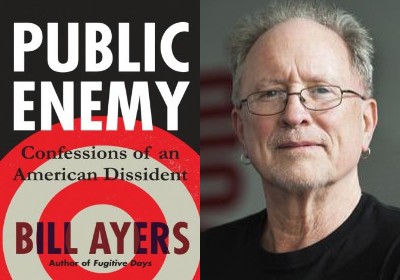
public_enemy and ayers
Image from Uprising Radio.

By Alan Wieder | The Rag Blog | January 7, 2014
Bill Ayers and Bernardine Dohrn will speak at "Underground Goes Overboard," a launch party for TheRagBlog.com, at 7 p.m., Friday, January 17, at the 5604 Manor Community Center in Austin. They will also be Thorne Dreyer's guests on Rag Radio earlier that same day, from 2-3 p.m. on KOOP 91.7-FM in Austin and streamed live. Go here for other stations and times, and for podcast information.
[Public Enemy: Confessions of an American Dissident by Bill Ayers (2013: Beacon Press); Hardcover; 240 pp; $24.95.]

“They just don’t get it.” Yes, the phrase is overused, yet, all too appropriate when addressing the continuing critiques, from both the left and the right, of Bill Ayers.

The recent publication of the second phase of his memoir, Public Enemy: Confessions of An American Dissident (Beacon, 2013), was followed on the “SDS and ‘60s Leftists” page of Facebook by an unthoughtful conversation on Ayers, his comrade and wife Bernardine Dohrn, and the Weather Underground (WO).

Facilitated by George Fish and responding to a negative book review by Jon Wiener, 43 comments followed Fish’s post. Mostly sour, bitter, and ahistorical in tone, the comments provide the antithesis of Ayers’ book and life, that of learning from the past and continuing, in a human and life-affirming way, the ongoing struggle that began for Ayers in the civil rights movement, antiwar movement, Students for a Democratic Society, and then the Weather Underground.

When confronted by a radio interviewer who referred to the subtitle as snide, Ayers softly replied that the entire title was chosen for its irony. Missing both the breadth and depth of Public Enemy, the interviewer, as well as Wiener and other critics, fail to acknowledge the thoughtfulness and energy that Ayers brings to struggle, both past and present.

In this particular book, we alternate between the author’s recollections of first, his experience in the 2008 attempt to demonize Barack Obama because he “palled around with terrorists,” and, second, the years after he surfaced from underground beginning in 1980 from where Ayers left off in his previous book, Fugitive Days.

There are both multiple and complex events, issues, and ideas presented in Public Enemy. A sampling will be discussed in this review.

Recently, South African anti-apartheid struggle leader and Constitutional Court Justice (comparable to the U.S. Supreme Court) Albie Sachs spoke at Pacific University in Forest Grove, Oregon. Talking about his country’s Truth and Reconciliation Commission (TRC), Sachs emphasized the importance of acknowledgement for both personal and political healing.

Acknowledgement causes me to return to the radio interviewer’s portrayal of Confessions of An American Dissident as snide. In fact, irony aside, Ayers responded by talking about acknowledging one particular flaw during his time in WO. He asserted that neither he nor his comrades ever doubted their positions and that by not being skeptical they were arrogant and without reflection.
Doubt is discussed in Public Enemy and Ayers also talks about apologetics within a conceptual framework of an American Truth Commission.
Doubt is discussed in Public Enemy and Ayers also talks about apologetics within a conceptual framework of an American Truth Commission. In both the book and current media interviews, Ayers has continually repeated that neither he nor the WO ever killed anyone in the bombings of buildings.
Not only did I never kill or injure anyone, but in the six years of its existence, the Weather Underground never killed or injured anyone either. We crossed lines of legality to be sure, of propriety, and perhaps even of common sense, but it was restrained, and those are the simple, straightforward facts.
The correct term for Weather Underground bombings, in correspondence to the armed struggle in South Africa, is “armed propaganda.” And like Umkhonto We Sizwe underground soldiers in South Africa, Ayers would welcome the opportunity to answer queries about his WO activities at an American TRC.

In Public Enemy Ayers writes:
America, it seemed to me, was in urgent need of some kind of truth and reconciliation process… We needed a process to understand the truth of the past in order to create the possibility of a more balanced future… Everyone together would have the opportunity to tell their stories of suffering, and the victimizers would be asked why and how they created that misery. Society would have the opportunity to witness all of it in order to understand the extent and depth of the disaster as a step toward putting it behind us and moving forward. In that setting and standing with Kissinger and McCain, McNamara and Kerry, Bush and Cheney, I’d be happy to say exactly what I did, take full responsibility, and bow deeply. But without any chain of culpability whatsoever, I’ll stand on the record, or just stand aside.
While five chapters in Public Enemy present the threats and blacklisting Bill Ayers experienced during and after the 2008 presidential campaign, I will address the topic with brevity as it has already been explored in other reviews. An in-depth description and analysis is portrayed in Maya Schwenwar’s Truthout review, “Bill Ayers Weighs in on Democracy, Selfhood, and His ‘Unrepentant Terrorist’ Alter-Ego.”

Besides endless email threats and having someone actually come to his office at the University of Illinois-Chicago, Ayers was banned from talking on college campuses throughout the country. At the time my colleague at the University of South Carolina, Craig Kridel, the Curator of the Museum of Education, posted a page titled “The Bill Ayers Problem” on the Museum webpage. The page title, like Public Enemy, is ironic and at the time I wrote:
The inequality, unfairness, violence, and global greed are what Bill Ayers has fought against for many years. The fight is every bit as important today as it was during the Civil Rights Movement and the Viet Nam War. And while some people might call me insensitive because I refuse to enter a debate on Bill Ayers as a terrorist, I choose not to speak back to the cries of O’Reilly, Hannity, and Colmes and their nameless comrades because the work Bill Ayers is doing does not need defenders but, rather, supporters and allies that fight for a more just world. Finally, as an academic who works with teachers who fought against apartheid in South Africa, I can’t help but think that the same people who define Bill Ayers as a terrorist would have given that label to Nelson Mandela and his less known comrades during the struggle against the apartheid regime. We know now what history says about that – we can only hope that Bill Ayers and many other people continue their work as progressive educators and activists.
But Bill Ayers does not rail against his detractors in his writing. Rather, while he is critical in a political/personal way of their harassment and silencing and analyzes their actions, his emphasis is a celebration of people who continue the struggle. While the story of the cancellation of his talk at the University of Wyoming is politically important, from Ayers we learn more about the woman who fought for his right to speak. More accurately, she fought for her own free speech.
"I’m going to sue the university in federal court," she told me during our first conversation. "And I’m claiming that it’s my free speech that’s been violated – I have the right to speak to anyone I want to, and right now I want to speak to you." She was young and unafraid, smart and sassy, her dreams being rapidly made and used – no fear, no regret. I liked her immediately. Meg’s approach struck me as quite brilliant – students (and not I) were indeed the injured party.
The University of Wyoming student won the case and Bill Ayers spoke on democracy and education with over 1,000 people at the University. In discussing the event, he also honors his sister’s father-in-law, a retired United Church of Christ minister who drove a couple of hours to Laramie for the talk and told Bill: “‘The Lord moves in mysterious ways,’ he said with a wink and a smile gesturing with his Bible. ‘If any of the crazy Christians get out of hand, he wants me to set them straight.’”

Ayers writes of other cancellations at places throughout the country. The University of Nebraska stands out but only because he was in Tapai at the time and was woken with the news from a dean at three in the morning.

In contrast to Nebraska, there are brave academics at Millersville University and Georgia Southern University where Ayers was welcomed. At Millersville administrators explained that it was their “duty and honor” to have him speak. “It’s not about you personally, it’s about the mission and the meaning of the university.”
Honoring people throughout Bill Ayers’ journey is the stuff of Public Enemy.
Honoring people throughout Bill Ayers’ journey is the stuff of Public Enemy. One of the funniest yet potent tales is the reaction of Ayers’ comrade and friend, Michael Klonsky, when he was invited to give an education conference keynote address. The organization told Klonsky that they had intended to invite Bill Ayers but that he was “too controversial and too radical.” Klonsky scolded the inviter saying: “How dare you ask me to scab on Bill Ayers?” When Ayers thanked him, he replied: “Defending you? I wasn’t defending you, I was defending myself – I was deeply and personally offended when they said that your were too radical, and by implication that I wasn’t too radical. I’m as radical as you are, motherfucker.”

Bill Ayers’ book is about issues, ideas, actions, and people – it is not solely about Bill Ayers. Epsie Reyes was a colleague at the University of Illinois-Chicago. She supported Hillary, not Barack, in the 2008 democratic primaries, and she was one of many people who consoled Bill Ayers after Hillary Clinton first demonized him in a primary presidential debate.

Reyes sent strong emails to both Clinton and the Democratic National Committee “detailing how much money she’d donated and how many weekends she’d devoted to organizing on her behalf, explaining who I really was in her ‘humble opinion,’ and encouraging, then demanding that the campaign apologize to me personally and denounce the smears – or else she would have to rethink her commitments.”

Close friends and colleagues, of course, also came through in both 2001 and 2008. Mona and Rashid Khalidi were both supportive and insightful as were dozens of others. In 2008 there was a surprise call from Edward Said: “Of course it’s painful for you personally, but cringing and going quiet is the worst thing you could do at this moment. Your kids are watching you and your students too and a lot of others. Don’t let them down.”

Said’s message corresponds to the entirety of Public Enemy. Ayers celebrates political struggle and the people who try to sustain the fight. Two quotes come to mind, the first from a speech by Paul Potter referred to in the book. “Don’t let your life make a mockery of your values.” Margaret Meade’s words correspond to Potter’s connecting the personal to the collective. “Never doubt that a small group of thoughtful, committed citizens can change the world. Indeed, it’s the only thing that ever has.”

In addition to the 2001, 2008, and more recent stories, Public Enemy includes portraits from the time Bernardine and Bill came up from underground in 1980. Ayers writes admiringly about his childrens’ pre-school teacher at the time, BJ, whom he refers to as “an inspired early childhood educator.” “She was one of a kind, and everyone knew it.” Ayers’ portrait of BJ brought a response in Ron Jacobs’ Dissident Voice article, “Get Bill Ayers”: “Indeed, the truest hero in the book is the family’s New York child care provider, BJ.”

On Bill’s journey we meet Bernardine’s lawyers Eleanora Kennedy and Michael Kennedy and various other people including Ellie and Robby Meeropol who were Bill’s friends at the University of Michigan. Robby was the son of Ethel and Julius Rosenberg and he was three years old when his parents were executed.

Bernardine and Bill had just adopted Chesa Boudin whose parents, Kathy Boudin and David Gilbert, had been sentenced for murder in the Brinks Robbery in Nyack, New York. Robby explained that there was no road map and that times would be rough for Chesa – honest responses are very much a part of the many vignettes that Ayers presents throughout Public Enemy.
The real heart of the book, however, within the context of continuing struggle, is the authentic portrayal of the Dohrn/Ayers family...
The real heart of the book, however, within the context of continuing struggle, is the authentic portrayal of the Dohrn/Ayers family – Bernardine Dohrn and their sons Chesa, Malik, and Zayd. The book depicts seriousness and humor and mostly respect and admiration. There is a story from the early above ground days that I must include in this review.
Leaving swim class one day, we were swept up into a raucous women-led march heading from Broadway and Fifty-ninth Street toward Times Square. "No more porn! No more porn! No more porn!" we chanted ecstatically, fists pumping and voices rising as we entered the pornography district. It was a feisty and colorful crowd, our attendance just a happy accident, but with Zayd cheerfully perched on my shoulders we were in high spirits and quite pleased to be in cahoots. Soon we spotted a pizza stand along the route, and Zayd was famished from swimming and ready for a slice, so we settled into a booth. Zayd reflected on the parade we’d just left: "That was fun," he said. "Why don’t we want more corn?"
Ayers tells the story of all three sons advising him during 2008 and the respect appears to go both ways. Pages 129 to 131 serve as an illustration as Malik, Zayd, and Chesa join Bernardine in coaxing Bill not to speak with the media – a disposition alien to his being. Malik warns him of ambush and it recalls Mailer’s self-admonitions of never talk to the press – they control the story.
The consensus from them, in line with Bernardine’s steady and consistent basic instinct, was that whatever happened on the web or in the press, we should simply turn away. No comment, no elaboration, no clarification, no response. "Be completely quiet," they said, "and stay calm." "It’s harder then it sounds," Zayd added, looking right at me, "especially for you." True, too true: I tend to have a lot on my mind – who doesn’t? – and I’m genetically wired to speak up and speak out, and not always with considered judgment. My default position, no matter what, is to say something… "You’ll get flattened," they now said in unison.
Bill Ayers remained silent through 2008, but of course, “palling around with terrorists” quietly lives on. There is an ethos throughout Public Enemy, consistently present in the ideas, issues, actions, and people portrayed in the book, amidst everything else – this book is homage to Bernardine Dohrn.

Her strength, thoughtfulness, commitment, and humanity is the spirit of Public Enemy: Confessions of An American Dissident. Whether it is gently chiding Bill with their children or being warmly welcomed back by the judge in Chicago when she surfaced from underground – her humanity is ever present. Political commitment is obvious in Dohrn’s first above ground statement: “This is no surrender. The fight against racism and war continues, and I will spend my energy organizing to defeat the American empire.”

Ayers writes of her actions and dispositions when she was imprisoned at the Metropolitan Correctional Center in New York for refusing to give Grand Jury testimony on the Brinks Robbery. The emotion of being away from her kids but at the same time focused political commitment. There is also a great story of her mother passing on contraband when she visited the prison – a chocolate chip cookie!

There is much more to Public Enemy than the samples that I present. Bill Ayers critiques the Weather Underground and provides much more breadth to the ideas, issues, actions, people, and events he portrays. He also pushes his story to the present and therein lies the further message. Ayers, Dohrn, and many of their WO (and beyond) comrades continue to work for the same issues they have pursued beginning in the sixties.

For Ayers it is education and more and the latter includes working with young activists who continue the fight for the end of racism, class disparity, and imperialism. First in the civil rights movement, then SDS and WO, Ayers was part of the “spark” for a just world. His book is a partial story of continuing to keep that “spark” alive today.

This article was first published at Dissident Voice and was cross-posted to The Rag Blog by the author.

[Alan Wieder is an oral historian who lives in Portland, Oregon. His latest book, Ruth First and Joe Slovo in the War Against Apartheid was published in the United States by Monthly Review Press and in South Africa by Jacana Media. Read more articles by Alan Wieder on The Rag Blog.]

The Rag Blog

[+/-] Read More...

18 December 2013

BOOKS / Alan Wieder : Paul Buhle's 'Radical Jesus: A Graphic History of Faith'

Paul Buhle's 'Radical Jesus':
Comic artists explore the history
and social message of Jesus Christ

By Alan Wieder / The Rag Blog / December 19, 2013
Paul Buhle, the noted historian, author, graphic novel publisher, and editor of Radical Jesus, is Thorne Dreyer's guest on the 200th edition of Rag Radio, Friday, December 20, from 2-3 p.m. (CST). Rag Radio airs and streams live on cooperatively-run KOOP 91.7-FM in Austin, Texas, and is rebroadcast and streamed on WFTE-FM in Mt. Cobb and Scranton, PA, Sunday at 10 a.m. (EST) and on KPFT's HD-3 Channel in Houston, Wednesday at 3 p.m. (CST). The podcast of this show can be found at the Internet Archive.
[Radical Jesus: A Graphic History of Faith. Paul Buhle, Editor; Sabrina Jones, Gary Dumm, Nick Thorkelson, Artists (2013: Herald Press); Paperback; 128 pp; $24.99.]

Paul Buhle is one of the most prolific and insightful critics from the American left. While his topics at first glance appear incredibly eclectic, closer reading uncovers a sharp focus that thoughtfully challenges class disparity, racism, and imperialism in the United States and throughout the world.

The breadth of his work, even if you consider only his collaborative graphic titles, is mind-boggling as the topics include Che, Yiddishkeit, SDS, the Wobblies, Emma Goldman, FDR, the Beats, and Isadora Duncan. And now, in collaboration with artists Sabrina Jones, Gary Dumm, and Nick Thorkelson, comes Radical Jesus: A Graphic History of Faith.

Like Buhle’s prior books, Radical Jesus investigates the inequalities that exist in the world, historically and presently, but this time through a theological lens. After an introduction, the sections of the book are “Radical Gospel,” “Radical History,” and “Radical Resistance.”

As a focus for reading the book we can assume that liberation theology began with Jesus and carries on at the present time. Each section is illustrated by a different artist but is pulled together by both content and style. As Buhle explains in the Introduction: “The book has been designed with a purposeful color progression from black and white in the first section, to a color choice reminiscent of the illuminated texts of the Middle Ages, to the full color of modern times.”

Combining substance and style, the drawings and text constantly switch between social issues of the past and the present. Interviewed by a reporter for the Brown University newspaper, Buhle said that he wrote the book for the young people involved in the Occupy Movement.
Oh, let’s say I was speaking to those young people. I’m not a person who goes to church. But I was speaking to those young people and to others who were looking for some alternative, there’s one page in the comic that says no to either passivity or violence. For some other way to respond to the crises, and you know, Americans by and large, still, have this religious thing, this mystique. It’s good to think of a way to speak to them in this fashion.
There are numerous poignant frames in Radical Jesus; below are some samples. With stark black and white graphics page 23 in the “Radical Gospel” section, by Sabrina Jones, begins with a priest looking at a dead man lying in the street, “unclean -- better keep away!” Another priest does the same but then comes the Good Samaritan who helps the man who isn’t dead -- who is the Christian.

Stories of Jesus and class disparity continue in this section with a distressing sequence on preaching and religious leaders on page 35, “They preach – But they don’t practice.” Reminiscent of of Bishop Tutu’s story of Europeans coming to Africa: “We had the land and they had the bible. Then they said, ‘Let us pray.’ And we dutifully shut our eyes, and when we said amen at the end and opened our eyes, why, they had the land and we had the bible.”

But of course Bishop Tutu said much more. Corresponding to Radical Jesus:
This God did not just talk... He showed himself to be a doing God. Perhaps we might add another point about God -- he takes sides. He is not a neutral God. He took the side of the slaves, the oppressed, the victims. He is still the same even today; he sides with the poor, the hungry, the oppressed, and the victims of injustice.
Gary Dumm did the “Radical History” section of the book with Laura Dumm and others. This section tells the story of dissent beginning in the 14th Century and concluding with the abolitionists. John Wycliffe, the Anabaptists, Quakers, and the Grimke sisters are introduced with many other people who challenged church hierarchy in the name of social justice. On page 63, Buhle collaborates with Dumm on a story called “Escape from Galley Slavery.”
Some martyrs were burned at the stake, others were drowned, decapitated, had their tongues ripped out, or their mouths filled with gunpowder. To go to a violent death with cold determination or even good cheer was to prove to all present that the believer placed ultimate trust in God’s judgment.
However, these executions were ultimately cynical and class disparately vicious.
French and Belgian royal courts sometimes offered ‘banquets’ for the intended victim the day before the execution. In the city hall, the accused would be compelled to take the seat of honor between the mayor and a local religious leader while being mocked and offered expensive food and wine.
Many a martyr refused to eat or drink!

Drawing by Sabrina Jones
from
Radical Jesus.
The last pages of “Radical History” speak to the Quakers in Pennsylvania losing the fight for Indian rights. Two frames appear on page 85 with the first showing Quaker representatives in the Pennsylvania Assembly resigning and walking out of the chambers in protest of oppressive actions to attack Indians.

The second frame, titled “What was Lost,” depicts people in a living room watching a baseball game between the Philadelphia Quakers and New York Iroquois -- shades of Howard Zinn history.

The 39 pages of the book’s last section, “Radical Resistance,” is thick as the art of Nick Thorkelson and the text speak to the many more modern quests for social justice through questions/statements of a grand diversity of people on-the-ground testifying at a faith-based meeting.

The courage of abolitionist Sojourner Truth is portrayed in a story called “Steal Away: Abolitionism and Black Freedom.” We meet those who fought for civil rights in the United States like Rosa Parks, Ella Baker, Martin Luther King, Ralph Abernathy, Fred Shuttleworth, Bob Moses, and many people whose names we don’t know.

The New Jim Crow is portrayed on page 104 with Reverend Jeremiah Wright connecting the incarceration of blacks in the United States with the plight of Jesus. On Reverend Wright: “A prophetic voice much maligned in the mainstream media but cherished by the thousands of black churches allied against mass incarceration.”

“Radical Resistance” also tell us of Dorothy Day and Peter Maurin’s Catholic Worker movement as a lead into the anti-war actions of the Berrigan brothers -- liberation theology and the work and political assassination in El Salvador of Archbishop Oscsar Romero. All of these accounts of activism conclude with stories of people that we have never heard of who fight for social justice in both their communities and throughout the world -- and there lies the "mission" of Paul Buhle and his collaborators in Radical Jesus.

Buhle writes:
The radicalism of Jesus has nothing to do with men hoarding guns against the imagined threat of black helicopters, or bearded fanatics burning down schools for women. Instead, Jesus goes to the roots of assorted hatreds -- not only our destructive exploitation of humanity but also our plundering of creation. All of life is endangered and we cannot afford these hatreds running rampant much longer.
Radical Jesus provides the stories of models, teachers, for the young people for whom Buhle says the book was written. The book’s portraits, graphics, and text are thoughtful and powerful, and are important not only for young activists, but also for all of us who thoughtfully work for social justice.

[Alan Wieder is an oral historian who lives in Portland, Oregon. His latest book, Ruth First and Joe Slovo in the War Against Apartheid was published in the United States by Monthly Review Press and in South Africa by Jacana Media. Read more articles by Alan Wieder on The Rag Blog.]

The Rag Blog

[+/-] Read More...

24 June 2013

BOOKS / Alan Wieder : Thai Jones Draws 'A Radical Line'


Generations in the struggle:
A 'retro-review' of 
Thai Jones' A Radical Line
Throughout A Radical Line the progressive fights of Thai Jones’ extended families, Weather Underground and earlier, are connected to the collective struggle against class disparity, racism, and the Viet Nam War.
By Alan Wieder / The Rag Blog / June 24, 2013

[A Radical Line: From the Labor Movement to the Weather Underground, One Family's Century of Conscience by Thai Jones (2004: Free Press); Hardcover; 336 pp; $26.]

Reading Neil Gordon’s novel and then viewing Robert Redford’s film, The Company You Keep, a fictitious portrayal of the Weather Underground Organization (WUO), led me to re-read Thai Jones’ book on his family -- his mom and dad, WUO people Eleanor Stein and Jeff Jones, as well as their parents, Albert Jones a Quaker and WWII conscientious objector and Annie and Arthur Stein, labor movement people and both members of the Communist Party.

While I actually liked Redford’s film, and the book even more, A Radical Line is much more encompassing as it portrays generations and real lives in the continuing struggle for a democratic, socialist America -- yes, Eleanor and Jeff and I think Thai, as well as many of their WUO comrades and their children, continue the fight today.

I had no intention of writing a review as I began to re-read A Radical Line. The story, though, is so engrossing, and Thai Jones’ combination of detail, thoughtfulness, and drama pull you in as words bring depth to his extended family as well as the collective, progressive struggle in the United States.

Jones’ craft as a writer shows in the book's poignant beginning, as Jones describes his parents being arrested -- reflecting on his own memories of the event as a four year old child.
There had to be something I could do to help my parents. I made a fast survey of my possessions: a cowboy outfit, a coloring book, a stuffed Tyrannosaurus. I opened the drawer of my little desk and picked up my child’s scissors. The ends were rounded, and the blades were covered by blue plastic guards. Bouncing them in my hand and snipping at the air, I considered putting on the cowboy hat and charging into the hallway with scissors blazing to defeat these men who had come to hurt our family. Even then, I knew it was a battle against long odds. But I didn’t realize it was a question that many in my family had already faced. They had chosen to fight.
Throughout A Radical Line the progressive fights of Thai Jones’ extended families, Weather Underground and earlier, are connected to the collective struggle against class disparity, racism, and the Viet Nam War. Jeff Jones was raised in Southern California and his father worked for Walt Disney Corporation. But as already noted, Albert Jones was a pacifist, and his experience working as a conscientious objector at Civilian Public Service Camp #37 in Coleville, California, during WWII is itself a story.

 His path was not easy as his father disapproved and church people at the Methodist congregation that nurtured his views abandoned him -- Camp #37 became home:
He was surrounded by pacifists. Each Sunday they held a silent Quaker meeting, and that was the only time in the week that the men were not in heated discussions about their faith. Coming here, Albert finally felt welcome.
Jeff Jones’ early lessons were pacifism and peace and not a long leap to the civil rights movement and opposing the Viet Nam War.

Eleanor Stein’s parents were much more political. Annie was introduced to socialism in high school and was politicized even further as a student at Hunter College. Thai Jones describes her early participation in the National Student League and the Communist Party.

It was Annie who politicized Arthur. Initially she was disheartened because her husband was apolitical, but she began leaving copies of The Daily Worker around their apartment and soon Arthur was attending meetings and demonstrations.

Like Albert Jones’s lifelong commitment to nonviolence, Annie and Arthur Stein never stopped fighting class disparity and racism. In the book, Thai remembers Albert’s assertion to Jeff before the Days of Rage: “Son, I believe very strongly in your goals. But if you set out to hurt somebody, I would hope and pray that you are hurt first.”

Concurrently, Eleanor was clearly nurtured by Annie’s work with civil rights stalwart Mary Church Terrell and her political work on education in New York City. She was also nurtured by her father’s labor activism, his founding of the Fair Play for Cuba Committee chapter in Brooklyn, and his appearance before HUAC, where he was represented by Victor Rabinowitz, the attorney who also represented Paul Robeson and Pete Seeger.

Annie and Arthur sent Eleanor to Camp Lakeside, a "red diaper" summer camp. Eleanor recalled her mother’s expulsion from the CP over China and mother continued to lecture daughter throughout Eleanor’s WUO years:
“Look,” Annie would tell Eleanor, “I lived through the 1930s when the capitalist system was on the ropes. Labor unions were strong and men were out of work, on breadlines.” Pausing for effect, she would light a cigarette, sip her scotch and soda, and go to the bookshelf for her copy of Lenin’s What Is to Be Done? "It was obvious in 1917,” she would say, waving the book in her daughter’s face. “The workers were in the streets. Who is going to run the means of production in your revolution? The hippies? You’ve got to be kidding.”
The heart of A Radical Line, however, is Jeff and Eleanor’s lives in SDS and the Weather Underground and their coming together as a couple. There are rich photographs in the center of the book -- especially one of Eleanor wearing her lambswool jacket with a raised fist salute in front of Columbia University Law School. Most endearing is a page with portraits of both Thai, as a very young child, and Jeff in running gear.

We learn about Eleanor quitting law school after participating in the Columbia University student takeover in 1968 and of Jeff joining SDS while a student at Antioch. There are other events that have been written about by Mark Rudd, Cathy Wilkerson, Bill Ayers, and others; but Thai Jones presents a different take, new insights, and of course issues that still leave us with questions about the Weather Underground and the struggle in general.

We learn a great deal about WUO life underground but for the purpose of this review I would like to address one particular issue.

It begins in early July 1969, when Eleanor was part of a delegation that went to Cuba to meet with representatives of the National Liberation Front and of the North Vietnamese government. Others on the trip included Bernardine Dohrn and Diana Oughton.

The North Vietnamese had invited Eleanor and her comrades so that they could interact and learn how the anti-war movement in the United States might help to end the War in Vietnam. One of the first lessons was on the lack of focus of American activism. The teacher pointed out that day that anti-war slogans and chants, like

"No More Vietnams" vs. "Two, Three, Many Vietnams"
"No More Wars" vs "Bring the War Home"
"Long Live the Victory of the People’s War" vs. "Make Love not War"

were contradictory. What was the goal?

The Americans traveled Cuba with their Vietnamese mentors and one man, Nguyen Thai, stood out -- the man from whom Thai Jones inherited his name. There were hours and hours of discussions and Eleanor and the other Americans became focused on taking one message to the masses back home: “End the War Now.”

When they returned to the U.S., however, they were informed that their leadership had decided to form small collectives; their job was not to organize the masses. Thai Jones writes, “Before Eleanor had even clanked down the gangway to the shore, Nguyen Thai’s plan for an all-encompassing mass movement was sunk.”

And I would argue, that it was at this point, before the forming of the Weather Underground, before the Townhouse bombing, before the manifestos and armed propaganda, before freeing and then being betrayed by Timothy Leary, and before the breakup of WUO, the youth movement for social justice and equality in the United States was doomed. That is, doomed as a movement.

While the Vietnamese spoke of -- and represented -- a people’s movement, people on the ground weren’t included in the United States. The people of WUO and the anti-war movement in general were young -- we didn’t take the lessons that others taught us. We didn’t pay attention to how different Fidel and Che’s revolution in Cuba was from Che’s adventurist foray into Bolivia. We didn’t know how to organize a people’s war.

My analysis, of course, is only about a small part of Thai Jones’s book. And the people that he writes about, particularly his parents Eleanor Stein and Jeff Jones, as well as their WUO comrades, have continued, maybe not as a movement, but nevertheless continued, the fight to end class disparity and racism in the United States and throughout the World.

Their mistakes as well as their continuing commitment and passion offer important lessons. As does Thai Jones’ book, A Radical Line.

[Alan Wieder is an oral historian who lives in Portland, Oregon. His new book, from Monthly Review Books is titled Ruth First and Joe Slovo in the War Against Apartheid.]

The Rag Blog

[+/-] Read More...

20 February 2013

Alan Wieder : Race to the Bottom

Image from Diary of a Public School Teacher.
Race to the bottom:
Educating Obama
Inspiration and curiosity and breadth and depth in learning are often usurped by crowded and underfunded schools, high stakes testing, zero tolerance and incarceration, and the demonization of teachers.
By Alan Wieder / The Rag Blog / February 21, 2013

At about the same time that President Obama was reelected, The Oregonian in Portland ran an article in which a suburban Beaverton teacher told a reporter that she had 64 students in her high school biology class.

There are endless issues that need to be pressed as President Obama enters his second term. Some progressives are hopeful because there is no third term -- and supposedly no further political ambitions. Considering both history and the associations that the President chooses, hopefulness from the left doesn’t represent reality.

However, there is both the need and the responsibility to put pressure on the President for social, political, and economic justice. One area where the Obama administration has been especially deficient is public education. Initially taking their cue from Bush’s No Child Left Behind, they have magnified the push for non-egalitarian, class, race, and gender biased education via their own program, Race to the Top.

Obama, through his appointment of Arne Duncan as Secretary of Education, has endorsed the post-neocon educational reform movement, or what some critics refer to as the “educational deformers.” Administration policy is akin to privatization because the deformers view education as a commodity.

Bill Ayers elegantly stated the present educational reality in his recent open letter to the President:
The landscape of “educational reform” is currently littered with rubble and ruin and wreckage on all sides. Sadly, your administration has contributed significantly to the mounting catastrophe. You’re not alone: The toxic materials have been assembled as a bipartisan endeavor over many years, and the efforts of the last several administrations are now organized into a coherent push mobilized and led by a merry band of billionaires including Bill Gates, Michael Bloomberg, Sam Walton, and Eli Broad.
Unfortunately, Obama administration educational policy corresponds directly with the President’s choice of Wall Street over Main Street, in spite of his contradictory assertions during his battle with Romney and his recent State of the Union address. For school children and teachers, it means that inspiration and curiosity and breadth and depth in learning are often usurped by crowded and underfunded schools, high stakes testing, zero tolerance and incarceration, and the demonization of teachers.

In These Times published an article by Leonie Haimson that is wonderfully titled, “Educate All Kids Like Sasha and Malia.” Haimson argues that the current administration is “pauperizing, standardizing, digitizing and privatizing education” even though the President would never do the same to his own daughters.

She warns that although Obama has criticized “teaching to the test,” his administration has done just that by demanding teacher evaluation through student test scores. In addition, Haimson argues that punitive policies like school closings and mass teacher firings condemn poor children to unequal education.

Barack and Michelle Obama’s children attend the Friends School and they went to the University of Chicago Lab School before he became President. Both of these institutions honor teachers and provide a teaching and learning environment that includes small classes, abundant resources, and opportunities for exploration and experimentation by teachers and students. Standardized testing is not a religion and teachers are respected rather than demonized.

But the schools that President Obama's children attend are not the model for his Department of Education or the deformers that they have embraced. The irony is so great because the President and everyone else understand that good teaching and student learning have nothing to do with privatizing schools or high stakes testing or any of the other false measures that the federal government has foisted upon state legislatures. Government educational policy is economic and ideological -- not evidential -- in spite of government and deformer assertions to the contrary.

Another article that speaks to this issue is "How to Destroy Education While Making a Trillion Dollars" by Robert Freeman. The author stresses three assertions.
First, lower the costs so you can jack up the profits. Since the overwhelming cost in education is the salaries of the teachers, this means firing the experienced teachers, for they are the most expensive. Replace them with “teachers” who are young, inexperienced, and inexpensive. Better yet, waive requirements that they have to have any training, that is to say, that they be credentialed. That way, you can get the absolute cheapest workers available. Roll them over frequently so they don’t develop any expectation that they’ll ever make a career out of it.

Second, make the curriculum as narrow, rote, and regimented as you can. This makes it possible for low-skilled “teachers” to “teach.” All they need do is maintain order while drilling students in mindless memorization and robotic repetition. By all means avoid messy things like context, nuance, values, complexity, reflection, depth, ambiguity -- all the things that actually make for true intelligence.

Third, Proliferate franchised, chartered McSchools with each classroom in each McSchool teaching the same thing on the same day in exactly the same way. Develop the lesson literally once, but distribute and reuse it thousands of times with low-cost proctors doing the supervision.
Thankfully, teachers and their allies are fighting for smaller class sizes, limited standardized tests, enhanced arts programs, equitable financing, and strong teacher contracts that protect intellectual freedom, collegiality, and collaboration, as well as bread and butter issues.

And one had to have been in exile the past month not to be aware of the brave stand of teachers in Seattle who have refused to administer the statewide standard examination. Less known is the recent boycott of standardized testing by students, with the support of their parents, in Portland. The latter is lead by a student at Lincoln High School.

Everyone cites teaching and learning in Finland because it is a country where teachers are empowered. But there are great teachers throughout the United States who are ready to lead based on very different values and outcomes than those the Obama administration supports. They are the people who teach America’s children while simultaneously and selflessly fighting for progressive teaching and learning. Education is not a commodity.

Maybe our protests and our actions should remain naïve. Maybe we should be pounding Barack and Michelle Obama, as well as the current administration with Leonie Haimson’s words:

“Educate All Kids Like Sasha and Malia.”

[Alan Wieder taught at the University of South Carolina for over 20 years and wrote academically on racism and education. His forthcoming book, Ruth First and Joe Slovo in the War Against Apartheid will be available in June through Monthly Review Press in the United States and Jacana Media in South Africa.]

The Rag Blog

[+/-] Read More...

Only a few posts now show on a page, due to Blogger pagination changes beyond our control.

Please click on 'Older Posts' to continue reading The Rag Blog.