Showing posts with label Freedom of Expression. Show all posts

16 December 2013

Allen Young : Ralph Dungan, the 'Good Liberal'

Ralph Dungan in Chile, 1966. Photo from The Washington Post.
Discretion, valor, 
and the 'good liberal'
In the most patronizing tone, Mr. Dungan said if we opposed U.S. policy, we should 'return to the U.S. and run for Congress.'
By Allen Young / The Rag Blog / December 16, 2013

The October obituary of Ralph Dungan, one of President John F. Kennedy’s top aides who later served as ambassador to Chile, reminded me of my one-time experience with this man referred to by a historian as a “good liberal.”

In the mid-1960s, when I was living in Santiago, Chile, on a scholarship from the Inter-American Press Association, I was called in to Ambassador Dungan's office along with another American graduate student and given a tongue-lashing that I have never forgotten.

My friend and I both had strong objections to the growing military involvement of the United States in Vietnam and awareness of the growing anti-war movement back home, and we had been expressing our views to our Chilean friends. Fluent in Spanish, I spoke to a gathering of students at the University of Chile.

In the most patronizing tone, Mr. Dungan said if we opposed U.S. policy, we should “return to the U.S. and run for Congress.” He made veiled threats that if we continued this behavior, our lives could become complicated.

I became quite angry about this lecture and considered informing Chile's very popular left-wing press. This could have led to headlines, but the truth is that I was quite intimidated by the whole thing. I was only 25 years old, and I was afraid I could lose my scholarship and my related draft deferment. I didn't stop expressing my views, but I became more cautious.

Thus a classic liberal showed his true colors on the issue of the Vietnam War and freedom of expression. And I was not as courageous as I might have been. Looking back on my entire life, this moment in Chile is the best example I have of truly understanding the famous line from Shakespeare's Henry IV: "Discretion is the better part of valor."

[Allen Young left The Washington Post to work with Liberation News Service in the late Sixties and later became an important voice in the gay liberation movement. Allen now lives in rural Massachusetts where he is involved with environmental issues and writes a column for the Athol Daily News.]

The Rag Blog

[+/-] Read More...

18 February 2013

BOOKS / Jonah Raskin : Marjorie Heins' 'Priests of Our Democracy'


Priests of Our Democracy:
Marjorie Heins on Academic Freedom
and the Red Scare of the '50s
“There were only a few exceptions to university collaboration in the Cold War heresy hunt.” -- Marjorie Heins
By Jonah Raskin / The Rag Blog / February 18, 2013

[Priests of Our Democracy: The Supreme Court, Academic Freedom, and the Anti-Communist Purge by Marjorie Heins (February 2013: New York University Press); Hardcover; 384 pages; $35.]
Noted civil Liberties lawyer, teacher, and author Marjorie Heins discussed Priests of Our Democracy and the larger issue of academic freedom in our society with Rag Blog editor Thorne Dreyer on Rag Radio, Friday, February 8, 2013. Listen to or download Dreyer's interview with Marjorie Heins, here.

In 1952, U.S. Supreme Court Justice Felix Frankfurter called teachers “the priests of our democracy” and noted that it was their special task “to foster those habits of open-mindedness and critical inquiry which alone make for responsible citizens.”

Frankfurter was an odd character, indeed, as Marjorie Heins shows in her fact-filled, balanced, and yet thought-provoking book about the battles for academic freedom that have been waged for decades in and out of classrooms, courtrooms, and in front of local and national investigating committees.

The battles go on; almost every week a book is banned by a school board somewhere in the U.S., though book bannings often don’t make it onto network news.

In an early chapter in which she profiles the members of the Supreme Court in the period after World War II, Heins chronicles Frankfurter’s epic journey from Austria, where he was born in 1894, to Ellis Island, the gateway to America, and from there to Harvard Law School and then to Washington, D.C. where he sat on the bench along with Hugo Black, once a Ku Klux Klan member, and William Douglas who came down on the side of the First Amendment and Freedom of Speech throughout his long judicial career.

It was an exceptional court by all accounts.

In 1952, when Frankfurter called teachers “priests,” priests were held in much higher esteem than they are today by the American public, and so were teachers. For the past 60 years, the church and academia have both lost much of the prestige and status that they once enjoyed in part because of scandals that have often involved sex and money. Remember Jerry Sandusky? Now, both academia and the church routinely go about cleaning their respective houses; they have to if they want to remain in business.

Once upon a time, teachers -- including many that Heins writes about -- believed that they were on a holy mission to foster “open-mindedness and critical inquiry.” Some of them were communists, others were pacifists, Quakers, Trotskyites, and plain old subversives.

They were often the best of teachers, so Heins suggests, and they were often the teachers most beloved by their students. But parents, politicians, and priests, too, viewed them with suspicion, accused them of heresy, disloyalty, and treason, along with minor crimes and misdemeanors.

Perhaps parents, priests in the Catholic Church, and virulently anti-communist politicians were jealous of the genuine bonds that existed between teachers and pupils and felt that they had to destroy them. Far more than ideology was at work here; pettiness, pride, and ego rose to the surface.

In the first nuclear age, The United States went berserk, though not everyone did, of course. Justice Douglas remained relatively sane and so did Justice Frankfurter. Their sanity is part of the picture that Heins paints. In the White House, Harry Truman lost his grip even as he tightened the screws; in 1945 he approved the dropping of atomic bombs on Japan, and in 1947 he made loyalty oaths obligatory for federal employees. The U.S. seemed to want to do what the Soviet Union had done under Stalin -- “purge” anyone and everyone suspected of failing to worship the leader.

Justice Felix Frankfurter.
As Marjorie Heins -- a long time civil liberties lawyer -- shows Americans obsessed about loyalty and disloyalty in the era of President Harry Truman, Senator Joseph R. McCarthy, and a young California Congressman named Richard R. Nixon who made loyalty the name of the political game that catapulted him into the national spotlight.

Nixon, Truman, McCarthy, and dozens of local Nixon’s, Truman’s and McCarthy’s, demanded that the priests of the democracy prove their undying, unswerving fealty, and name the names of those whom they suspected of disloyalty -- or whom they just didn’t like.

Heins writes about the activities of the House Un-American Activities Committee (HUAC) and those of the Rapp-Coudert Committee that operated in New York State and brought about the dismissal of outstanding teachers at City College of New York such as Philip Foner and his twin brother, Jack, both brilliant historians and both Old Lefties, though they were young lefties in the 1940s. Heins has a fondness for Old Lefties like the Foners and for the tireless lawyers of the Old Left such as Victor Rabinowitz and Leonard Boudin.

The historical period reeks with flamboyant characters and colorful cases. It has fascinated writers and scholars for decades, and no doubt will go on fascinating writers and scholars such as Heins who see it as a time that was put aside explicitly to hunt for heretics and then to purge them as unhealthy, unsavory, and un-American.

In Priests of Our Democracy, a suspenseful drama unfolds in which diabolical men persecute mostly good men and women, and in which the nine justices on the Supreme Court make momentous rulings that affect the lives of hundreds if not thousands of school teachers. Unfortunately, the justices were often too slow to act; they too were caught up in the hysteria of the period, and were cowed by politicians who were determined to root out so-called subversives. Political climate is a powerful thing, and Heins does an excellent job of mapping it.

To read this book is to live, or relive, the era of the Cold War, when American society as a whole reverted to the kind of Medieval thinking and acting that was prevalent during the fifteenth-century Spanish Inquisition. Indeed, historians such as Cedric Belfrage have called the phenomenon just that -- “an Inquisition.” Hollywood screenwriter Dalton Trumbo labeled it “the time of the toad” and Columbia Professor Eric Bentley, a scholar of Berthold Brecht, borrowed from the language of the investigators themselves and counted it up as a disastrous “thirty years of treason.”

Others, such as playwright Arthur Miller -- once Marilyn Monroe’s husband -- likened it to a “witch-hunt” in his 1953 play The Crucible that lost him his career as a budding playwright for many years. Defending those accused of witchcraft and subversion was dangerous and guilt by association ruined many a career.

The virtue of Heins’s book is that it focuses on largely unknown, unsung teachers and librarians such as Harry Adler, Oscar Shaftel, Vera Shlakman, George Starbuck -- who complained about “them damn loyalty oaths” — and Leon Josephson, an ex-communist and the lawyer for Harlem’s biracial nightclub, Café Society, where the likes of Billie Holiday and Lena Horne performed.

The Priests of Our Democracy mostly describes the anti-communist “crusade” (there’s another metaphor for you) that took place in and around New York in the 1950’s, and in and among the city’s Jewish population. Jews, many of them the sons and daughters of immigrants, tended to be union members and to believe in union solidarity.

Priests of Our Democracy also offers sections about earlier purges in American history -- during the Civil War and the Red Scare of the 1920s -- when politicians demanded absolutely loyalty from citizens. Then, too, crusades and inquisitions took place in other parts of the country, including New Hampshire and the State of Washington.

Heins is passionate about her subject, but levelheaded, too. She doesn’t romanticize communism, communists, the Old or the New Left of which she once was a part. Her research is compelling, the richness of the details absorbing, and the photos endearing. The index is excellent and the bibliography -- which includes the pioneering work of Ellen Schrecker, author of No Ivory Tower: McCarthyism and the Universities -- is helpful. Heins credits the work of pioneering authors in her field.

Sen. Joseph McCarthy.
She points out the lingering affects of McCarthyism, the witch-hunts, and the purges -- whatever you want to call them -- on American culture as a whole. History, she understands, doesn’t move in a straight line and rarely follows the path of progress. “There were only a few exceptions to university collaboration in the Cold War heresy hunt,” she writes in a chapter she calls “The Laughing Stock of Europe.”

In her conclusion, she describes what she calls “the continuing vacuum in American political discourse” which she attributes to the purges, investigating committees, betrayals, and punishments. American teachers, Heins shows, paid a heavy price if and when they refused to play the game of conformity. Booted out of academia, they scrambled to survive at all kinds of jobs.

They were also, she points out, a resilient and a resourceful group of people who were proud that they refused to knuckle under to the demagogic anti-communists who posed as idealists but who aimed to promote themselves and their careers. Some fired and discharged teachers were exonerated, and even honored -- decades later.

I lived through the period of the 1950s and remember it well. My aunts worked for the pubic school system in New York and were investigated as Communists. My father, who was a lawyer, defended them and succeeded in preventing the board of education from firing them.

My college roommate, Eric Foner, now an illustrious historian, is the son of Jack Foner, and the nephew of Philip Foner. I spent my college days in the company of the Foners who continued to conduct research, write, and teach. It would be fair to say that they were my mentors and role models.

Many of my own teachers at Columbia had been radicals in the 1930s; by the 1950s they were no longer on the Left and no longer Marxists. In fact, they wanted to convert us to Freud and to Freudian concepts and to have us understanding that the U.S. was the best of all possible worlds.

I recommend this book to students, scholars, and citizens who care about academic freedom and about the fate of public discourse in America. I also recommend Priests of Our Democracy to those who worry that the war against terror has become in part a war against civil rights and civil liberties at home. Several states, including Ohio brought back loyalty oaths in the wake of 9/11.

When I first went to work for the State of California as a college teacher I had to sign a loyalty oath. I did so without protest. I wanted the job. The muckraking reporter, Jessica Mitford -- whom I knew in Oakland --- didn’t sign the oath when she was asked. She took on the oath itself and the administrators who enforced it as a matter of moral principle. She had far more resources than I and her husband, Bob Treuhaft, was an outstanding civil liberties lawyer. I might have asked my own father to take my case -- and he would have been happy to do so -- but he died long before I was hired.

The Priests of Our Democracy is also meant for those who work for colleges and corporations and at hospitals, radio stations, and elsewhere and who feel that in order to keep their jobs they have to censor themselves. Heins offers a telling quotation from Edwin Harold Eby, a lefty professor, who spoke for many Americans when he said, “If I was going to make a living in the U.S. I had to shut up -- that was part of the job.”

Self-censorship is, as Marjorie Heins knows, perhaps the most effective and noxious kind of censorship on the face of the earth, and, unfortunately, it’s alive and well today from New York to Moscow and from Cairo and Los Angeles to Shanghai and Caracas.

[Jonah Raskin is a professor emeritus at Sonoma State University, where he taught First Amendment law. He is a regular contributor to The Rag Blog and the author of For the Hell of It: The Life and Times of Abbie Hoffman, and American Scream: Allen Ginsberg’s Howl and the making of the Beat Generation. Read more articles by Jonah Raskin on The Rag Blog.]

The Rag Blog

[+/-] Read More...

18 January 2012

Jorge Rivas and Jamilah King : SOPA and the Internet Blackout


What is SOPA?
Here are five things you need to know

Wikipedia was among several websites to shut down Wednesday in protest of anti-piracy bills now in Congress that critics say could amount to censorship.

Instead of the usual encyclopedia articles, visitors to Wikipedia's English-language site were greeted by a message about the decision to black out its Web page for an entire day.

"Imagine a World Without Free Knowledge," said the stark message in white letters on a black and gray background.

"For over a decade, we have spent millions of hours building the largest encyclopedia in human history. Right now, the U.S. Congress is considering legislation that could fatally damage the free and open Internet. For 24 hours, to raise awareness, we are blacking out Wikipedia." -- CNN
By Jorge Rivas and Jamilah King / AlterNet / January 18, 2012

The Stop Online Piracy Act (SOPA) has the entire Internet up in arms today. Media justice advocates say the bill is anathema to basic functioning of the Internet; for a system that’s based on relative freedom and connectivity, SOPA would work as the online world’s stingy gatekeeper, giving government the power to shutdown websites altogether.

Today, hundreds of websites are joining in a day of action to SOPA’s threat to freedom of expression on the Internet. Several civil rights and racial justice organizations are joining in what’s been called an “Internet strike,” by closing their websites from 8 a.m. to 8 p.m. eastern time. Colorlines.com’s Jamilah King, who covers media policy, explains why:
The Internet’s been an important space for communities of color to tell their own stories and advocate for issues they don’t often see in film or on television. SOPA puts that independence in jeopardy. It’ll add yet another barrier to how and what we can communicate.
So, here are the basics on what you need to know.

Who’s behind SOPA? Rep. Lamar Smith, a Texas politician who’s been known mostly for his anti-immigrant stances in recent years. Smith’s got big industry backers, namely: the Recording Industry Association of America, the Motion Picture Association of America (now led by former U.S. Senator Chris Dodd), and the U.S. Chamber of Commerce.

What’s the justification for SOPA? Supporters of the bill claim that it’ll help copyright holders (think big record labels) protect their content. Rep. Smith has criticized the bill’s opponents and explained that SOPA would only target foreign websites that put American businesses at risk.

But opponents argue that the definition of “foreign infringing sites” is too vague. As it’s written now, they argue, the bill will fundamentally alter the relative freedom with which the Internet currently operates. What’s certain is that it’ll add a level of supervision to the Internet that’s never existed before.

Who’s opposed to SOPA? Basically, every website that you visit regularly. Most notably, Wikipedia, Craigslist, and Reddit, along with at least 200 other websites, have chosen to go dark in opposition to the bill and to help educate users about its potential impact. But the list doesn’t stop there: Google [they're putting a black bar across their logo today], Yahoo, YouTube, and Twitter have also publicly opposed the bill. The White House has also announced that, should the bill reach President Obama’s desk, he will veto it.

How would SOPA work? It allows the U.S. attorney general to seek a court order against the targeted offshore website that would, in turn, be served on Internet providers in an effort to make the target virtually disappear. It’s kind of an Internet death penalty.

More specifically, section 102 of SOPA says that, after being served with a removal order:
A service provider shall take technically feasible and reasonable measures designed to prevent access by its subscribers located within the United States to the foreign infringing site (or portion thereof) that is subject to the order… Such actions shall be taken as expeditiously as possible, but in any case within five days after being served with a copy of the order, or within such time as the court may order.
How would it impact me? If you create or consume content on the Internet, under SOPA the government would have the power to pull the plug on your website. If you’re a casual consumer, your favorite websites could be penalized and shut down if they seem to be illegally supporting copyrighted material.

This is especially important for human rights groups and advocates in communities of color, who could faced increased censorship if the bill is passed. The language of the bill makes it easy for the US Attorney General to go after websites it simply sees as a threat.

[Jorge Rivas is multimedia editor and pop culture blogger and Jamilah King is the news editor at Colorlines.com. This article was sourced from Colorlines and distributed by AlterNet.]

The Rag Blog

[+/-] Read More...

14 December 2010

Dave Lindorff : The Strange Case of Interpol's Red Alert

A supporter of Wikileaks founder Julian Assange holds up a placard outside the City of Westminster Magistrates Court in London. Photo from The Hindu / AP.
UPDATE: A British judge granted bail to WikiLeaks founder Julian Assange on Tuesday, saying he must abide by strict bail conditions as he fights extradition to Sweden in a sex-crimes investigation...

Supporters outside City of Westminster Magistrates' Court erupted in cheers when they heard news of the judge's ruling. -- AP / NPR / December 14, 2010
Something is rotten:
The strange case of Interpol's Red Alert
on Julian Assange


By Dave Lindorff / December 13, 2010
The other Interpol Red Alert sought by Swedish prosecutors this year was for Jan Christer Wallenkurtz, a 58-year-old Swedish national wanted on multiple charges of alleged sex crimes and sex crimes against children.
Far be it from me to minimize the issue of rape, but to borrow from the Bard, in the case of the “rape” case being alleged against WikiLeaks founder Julian Assange (technically, Swedish prosecutors say it's not rape, it's "sex by surprise"), currently being held in a British jail without bail pending an extradition request from Stockholm: “Something is rotten in Sweden.”

As I wrote earlier, the alleged sexual crimes that Assange is currently being sought for by a Swedish prosecutor are:

1. Allegedly failing to halt an act of consensual sexual intercourse when his sex partner and host, Anna Ardin, claims she somehow became aware that the condom he was using had “split” and,

2. Having consensual sex with a second woman a few days later without informing her that he had just been with Ardin, and then, a day later, allegedly refusing to return a phone call on his cell phone, when she tried to call him to ask him to take an STD test.

(Assange says he had turned off and was not using his phone for fear he was being traced through it, not that refusing to take a call from a woman one recently slept with should be considered criminal. Cold or even cruel, maybe, but not justification for a rape charge!)

In most countries, including the U.S. and UK, these would not pass the test to be considered a crime, much less qualify as a category of “rape," but Swedish authorities, who in all of this year have only submitted one other request to Interpol for assistance in capturing a sex crimes suspect, asked the international police agency to issue a so-called Red Alert for Assange, who was subsquently asked by police in the UK, where he was staying, to turn himself in or face arrest.

(The other Interpol Red Alert sought by Swedish prosecutors this year was for Jan Christer Wallenkurtz, a 58-year-old Swedish national wanted on multiple charges of alleged sex crimes and sex crimes against children.)

You have to ask, given that Sweden has the highest per-capital number of reported rape cases in Europe, how it can be that only these two suspects -- Wallenkurtz and Assange -- are brought to Interpol.

You also have to wonder how it is that Assange -- charged only with consensual sex “offenses” -- is denied bail by a British court magistrate, despite having several people at his arraignment hearing, including a well-known British filmmaker, ready to post whatever bail might be required to assure his return to court for an extradition hearing, while even people charged with aggressive rape are apparently routinely released on bail in both the UK and Sweden.

Here’s an interesting letter that ran in The Guardian in England, authored by Katrin Axelsson, of the British organization Women Against Rape:
Many women in both Sweden and Britain will wonder at the unusual zeal with which Julian Assange is being pursued for rape allegations. Women in Sweden don't fare better than we do in Britain when it comes to rape. Though Sweden has the highest per capita number of reported rapes in Europe and these have quadrupled in the last 20 years, conviction rates have decreased.

On 23 April 2010 Carina Hägg and Nalin Pekgul (respectively MP and chairwoman of Social Democratic Women in Sweden) wrote in the Göteborgs-Posten that "up to 90% of all reported rapes never get to court. In 2006 six people were convicted of rape though almost 4,000 people were reported." They endorsed Amnesty International's call for an independent inquiry to examine the rape cases that had been closed and the quality of the original investigations.


Assange, who it seems has no criminal convictions, was refused bail in England despite sureties of more than £120,000. Yet bail following rape allegations is routine. For two years we have been supporting a woman who suffered rape and domestic violence from a man previously convicted after attempting to murder an ex-partner and her children -- he was granted bail while police investigated.


There is a long tradition of the use of rape and sexual assault for political agendas that have nothing to do with women's safety. In the south of the U.S., the lynching of black men was often justified on grounds that they had raped or even looked at a white woman. Women don't take kindly to our demand for safety being misused, while rape continues to be neglected at best or protected at worst.
The long arm of the U.S. in this case is hard to miss here.

Especially in view of one of the latest WikiLeaks State Department cables to be disclosed in The New York Times, which in an article on Thursday laid out how the U.S. had strong-armed even the powerful German government into blocking German prosecutors from indicting and requesting the extradition to Germany of 13 CIA agents involved in the illegal kidnapping and renditioning to Bagram prison in Afghanistan of Khaled el-Masri, a German citizen wrongly thought by the CIA to be a terrorist.

El-Masri was kidnapped by these agents in 2003, stripped, bound, placed in an adult diaper with a plug in his rectum, and flown by the CIA to Bagram, where he was repeatedly tortured, sodomized, injected with mind-altering drugs, and held for months, before being simply dropped off by the CIA on an Albanian roadside, after it was determined by the U.S. that a “mistake” had been made.

The U.S. did not want its rendition program and its policy of officially-sanctioned torture disclosed and so it pressed German authorities to drop all prosecution of the agency kidnappers, threatening “the implications for relations with the U.S.” (El-Masri has been barred from suing the U.S. government for damages.)

It strains credulity to believe that the same U.S. government that put such pressure on Germany, a NATO ally, is not behind Swedish prosecutors’ sudden intense interest in this preposterous case of consensual sex and a broken condom -- particularly as the initial prosecutor in the case dropped it after learning that the two women, far from being upset following their nights with Assange, had in one case thrown a party for him following the alleged incident, and in the other, left him in her bed while she went out to buy him breakfast.

(Both women reportedly sent twitters to friends bragging about their conquests, messages they later tried to have expunged from the Twitter system).

It also strains credulity to believe that the denial of bail to this particular suspect by a British court -- particularly given that he is not charged with any violent act, and has no criminal record -- is not the result of behind-the-scenes U.S. pressure.

Indeed, it appears that the U.S. is busy trumping up more serious charges against Assange, with his lawyers saying they are anticipating that the U.S. Justice Department (already reportedly in discussions with Swedish authorities about getting their hands on Assange), is planning soon to charge him under the 1917 Espionage statute, the same law that the Nixon Justice Department tried to use unsuccessfully against Daniel Ellsberg in the Pentagon Papers case. That could explain why efforts are being made to try to keep Assange held in a cell.

It could also explain why Assange is challenging the Swedish extradition request.

Opposition to the Afghan and Irag Wars is intense in the UK and is supported by the overwhelming majority of British citizens, which makes Assange something of a hero in Britain for his WikiLeaks exposes of the ongoing crimes by U.S. and UK forces in those conflicts. British government acquiescence to an extradition order from the U.S. on espionage charges would likely lead to massive opposition by British citizens.

Sweden, on the other hand, which is not a member of NATO, but which has some 500 troops participating in the "NATO" war in Afghanistan, does not face the same kind of popular opposition to its role, and Assange may fear that Sweden, a very small country, could be pressured much more easily to hand Assange over to U.S. authorities, with little resulting fuss from the Swedish public.

Back in the U.S., there has been no move by news organizations to come to Assange’s defense. In fact, the corporate media reaction to this whole issue has been the opposite. For the most part, the Swedish charges, and his arrest in Britain on the basis of the Interpol Red Alert, are reported as being about “rape,” without any explanation of the actual “violations,” which would not even rise to the level of a crime in the U.S.

Meanwhile, most editorial pages are condemning the violation of diplomatic secrecy, not the government’s efforts to shut down a source of important news about government ineptness, malfeasance, and deceit.

Yet if it turns out, as I’m confident it will, that the U.S. government has been the driving force behind both the arrest and imprisonment of Assange, and his extradition to Sweden, and if it turns out, as appears increasingly likely, that the U.S. government has also been behind simultaneous decisions by Visa, MasterCard, Paypal, and several Swiss banks to refuse to handle donations to WikiLeaks, as well as by Amazon, which withdrew Wikileak's access to its cloud data storage system, and a DNS registry which de-registered WikiLeak's URL, publishers and broadcasters, and journalists themselves, should be up in arms defending him.

As I wrote earlier, this kind of attack on a news source for purely political reasons is a threat to the First Amendment as profound as the Nixonian attack on Daniel Ellsberg, and the attempt to block The New York Times from publishing his purloined documents about the origins of the Vietnam War.

Andreas Fink, CEO of DataCell ehf, the Swiss company that has been accepting donations on behalf of Wikileaks via Visa, had this to say about the Dec. 8 decision by Visa to cease processing Wikileaks donations:
The suspension of payments towards Wikileaks is a violation of the agreements with their customers. Visa users have explicitly expressed their will to send their donations to Wikileaks and Visa is not fulfilling this wish. It will probably hurt their brand much much more to block payments towards Wikileaks than to have them occur.

Visa customers are contacting us in masses to confirm that they really donate and they are not happy about Visa rejecting them. It is obvious that Visa is under political pressure to close us down. We strongly believe a world class company such as Visa should not get involved by politics and just simply do their business where they are good at. Transferring money.

They have no problem transferring money for other businesses such as gambling sites, pornography services and the like so why a donation to a Website which is holding up for human rights should be morally any worse than that is outside of my understanding.
Contributions can still be made to Wikileaks and to Assange’s defense by wire transfer and by check and ordinary mail. To find out how to contribute, go here.

By the way, if there is anyone out there working for Visa, MasterCard, Paypal, or any banking organization, or in a government office, who can provide me with evidence that the U.S. has been behind the decision of any of those organizations to freeze out WikiLeaks and destroy it financially, I will guarantee your anonymity at all costs. Please contact me or send me documentation.

[Dave Lindorff is a regular columnist for Counterpunch and has also written for such diverse and seemingly mutually exclusive publications as BusinessWeek, The Nation, Extra!, Treasury & Risk, and Rolling Stone. This article first appeared in This Can't Be Happening and was distributed by Truthout.]

Also see: The Rag Blog

[+/-] Read More...

15 October 2010

William Michael Hanks : Net Neutrality / Stop Thief!

Stop thief!
How the internet happened
and why it's in danger now

By William Michael Hanks / The Rag Blog / October 15, 2010

  • Also see Mike Hanks' companion article: Net Neutrality / Open Internet Under Fire
  • And see 'Save the Internet' video and Net Neutrality resources, Below
  • Somebody is trying to steal your shiny new bicycle and I know who it is. What you can do about it depends on being able to dissuade their accomplices from participating in the crime.

    Your bicycle is the Internet. It takes you to far away places, on adventures, to see friends and family, and it informs your opinions. Right now you can hop on it and go anywhere you want. But if five monopolistic corporations have their way you'll have to ask their permission first.

    A few short years ago there were thousands of local Internet Service Providers (ISP's). They sold, for a monthly fee, telephone modem access to the Internet. Beep beep, whistle, buzz, long wait. Then cable service providers began to offer the service over much faster cable lines. Cable companies merged and consolidated so that now four or five corporations operate in protected monopolies across the entire country.

    The biggest are Comcast, AT&T, Verizon, Time Warner, and Cox. It's not enough that they have a monopoly in your community, or that you pay them for the use of your Internet highway. They want to control where and how fast you can go and who you can do business with as well.

    Why is this a theft? After all it's their cables. Because, if you have ever paid taxes, the Internet belongs to you. It was conceived with tax dollars spent on your behalf by the Defense Advanced Research Projects Agency (DARPA). Like most bureaucratic projects, it began with a memo:
    Dated April 23, 1963, the memo was dictated as its author, Joseph Carl Robnett Licklider, was rushing to catch an airplane. Licklider’s task might have been easier if he had been pursuing a more conventional line of computing research -- improvements in database management, say, or fast-turnaround batch-processing systems. He could have just commissioned work from mainstream companies like IBM, who would have been more than happy to participate. But in fact, with his bosses’ approval, Licklider was pushing a radically different vision of computing.

    His inspiration had come from Project Lincoln, which had begun back in 1951 when the Air Force commissioned MIT to design a state-of-the art, early-warning network to guard against a Soviet nuclear bomber attack. The idea -- radical at the time -- was to create a system in which all the radar surveillance, target tracking, and other operations would be coordinated by computers, which in turn would be based on a highly experimental MIT machine known as Whirlwind: the first "real-time" computer capable of responding to events as fast as they occurred.

    Licklider, who was then a professor of experimental psychology at MIT, had led a team of young psychologists working on the human factors aspects of the SAGE radar operator’s console. And something about it had obviously stirred his imagination.

    By 1957, he was giving talks about a "Truly SAGE System" that would be focused not on national security, but enhancing the power of the mind.... he imagined a nationwide network of "thinking centers," with responsive, real-time computers that contained vast libraries covering every subject imaginable. And in place of the radar consoles, he imagined a multitude of interactive terminals, each capable of displaying text, equations, pictures, diagrams, or any other form of information.

    By 1958, Licklider had begun to talk about this vision as a "symbiosis" of men and machines, each preeminent in its own sphere -- rote algorithms for computers, creative heuristics for humans -- but together far more powerful than either could be separately.

    By 1960, in his classic article "Man-Computer Symbiosis," he had written down these ideas in detail -- in effect, laying out a research agenda for how to make his vision a reality. And now, at ARPA, he was using the Pentagon’s money to implement that agenda.

    Licklider’s research program was so successful, in fact, that it’s now hard for us to remember just how visionary it was. IBM and the other major computer manufacturers were going in a completely different direction at the time, emphasizing punch cards and batch-processing machines suited to the needs of the business world. Mainstream computer engineers tended to see the ARPA approach as totally wrong-headed. Use precious computer cycles just to help people think? What a waste of resources!

    Thus his memo on April 23, 1963, which he addressed to "the members and affiliates of the Intergalactic Computer Network" -- they would have to take all their time-sharing computers, once the machines became operational, and link them into a national system. "If such a network as I envisage nebulously could be brought into operation," Licklider wrote, "we would have at least four large computers, perhaps six or eight small computers, and a great assortment of disc files and magnetic tape units -- not to mention the remote consoles and Teletype stations -- all churning away."

    Leave aside the primitive technology and the laughably small number of machines: The vision that lay behind that sentence is still a pretty good description of the Internet we have today. Indeed, Licklider’s Intergalactic Network memo would soon become the inspiration for the Internet’s direct precursor, the ARPANET."

    -- "DARPA and the Internet Revolution," by Mitch Waldrop

    Project Sage's Whirlwind computer, developed at MIT, was the first computer to operate in real time. Image from History of Computers.

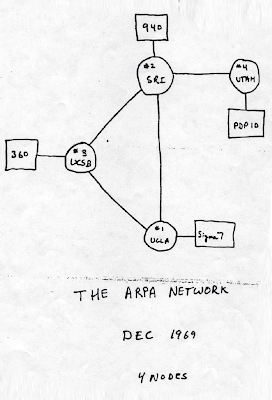
    One big problem remained and that was how to get all these computers physically linked to one another. The job of laying wires to each computer even in the U.S., much more so to computers all over the world, was monumental. However, a simple solution was found in using existing AT&T telephone wires.

    Essentially the network leased long distance lines and kept them perpetually open as in a never ending long distance call. But static in the system posed another problem. When data was being transmitted, if the stream broke, the data was useless -- mere bips and beeps without meaning.

    To solve that, a method of correcting errors was developed along the lines of the U.S. Postal Service. The data stream was broken up into packets, each with the address of the sender and recipient. That way if a packet were unreadable it would be resent and added to the coherent data stream. After some hardware and software design accommodations, the inter-network system -- the Internet -- was a reality. It was a pretty small reality then but it had profound implications. With simple scalability it could be extended anywhere in the world, or, as in Linklider's original, perhaps tongue in cheek memo, to the Galaxy.


    The content was primitive by today's standards -- ones and zeros -- computer code. But that soon changed. Standards were developed to translate the bits and bytes into letters and numbers. The first email programs were written. And the whole system met it's design criteria -- no single node was necessary to exchange information. It could just be rerouted. So if those darn commies blew up a computer somewhere in the system -- no problems mate. The world went merrily on as if nothing happened.

    But the thing that really made the Internet what it is today -- the thing we all love and the main reason we use it -- was the Graphic User Interface (GUI). That's why we can send Aunt Martha pictures of the kids, why we can see animation of the space station construction, and why we can read and write blogs like this. The ability to see pictures and hear sounds, to tell a story, to research a term paper, to do all the things and go to all the places our shiny new bicycle will take us -- it all depends on the GUI.

    The GUI was a gift. We didn't pay for it like we did the design, architecture, hardware and software that put the Internet in place. It was a gift of a few good geniuses who wanted to do a few good things. Tim Berners-Lee, while at CERN, the European Particle Physics Laboratory, invented a way to transmit images over the Internet -- and the World Wide Web was born. He could have patented his invention, protected it with copyrights, and made a bizzillion dollars. But he didn't. He gave it to us, free of charge -- a gift to the people.

    So not only is the foundation of the World Wide Web -- the Internet -- yours because you paid to develop it, but the World Wide Web itself -- the Graphic Interface -- is yours because it was a gift.

    So what's the problem? The problem is a bunch of fat cats who can barely tie their shoes and could never in a million years create it themselves want to steal it and sell it back to you. Who would have the presumption, the hubris, the unmitigated gall to try such a thing? I'll give you a clue. It's who you make your check out to each month for your Internet connection.

    It's the huge corporate vultures who are not content to simply have a monopoly on your Internet business -- they want more. They want to leverage their monopoly to sell you services that you would otherwise freely choose on the open market where their limited abilities and lack of innovation make them uncompetitive.

    Here's how it works. Lets say you use Vonage or Skype for phone service. You pay the modest fees, they give you good service, you save money. But the company that you use -- that you pay to use -- to connect to Vonage -- your Internet Service Provider (ISP) -- sees that's a good business and wants to offer it too. So mysteriously your calls with Vonage buzz with static, get dropped, aren't as clear as they used to be.

    Then, here comes your Internet Service Provider to the rescue. They have a service. It costs a little more but it's more reliable so you switch. But because they have their foot on the hose -- your Internet connection -- they have just turned down or turned off your connection to Vonage without your knowledge. They think people are stupid enough not to notice.

    Well, people do notice. So now they have a problem. They have just hijacked your freedom to choose but how do they get away with it? Enter the accomplices -- your representatives. You see, if the law doesn't forbid this practice -- or worse, if it encodes it into law -- then there's nothing you or anybody else can do about it.

    They have just stolen your shiny new bicycle and are offering to sell it back to you and it's all perfectly legal. Well, after all, Representatives and Senators have to fly in jet planes and live high on the hog too. What's a little graft in the free market. So what if they are selling you out to line their pockets. What are you going to do about it -- complain? Take a number.

    There's only one currency that is slightly more valuable to elected officials than dollars and that is votes. And that's what you have. You may spend every dime every month just to live or send your kids to school but you still have what your representatives want just a little more than money -- a vote. Or more exactly lots of votes. So if you exercise your oversight over your representatives and you convince enough other people to do the same, you win. If not, you lose. It's just that simple.

    The theft of Net Neutrality is only one crime that moneyed corporations have tried to legitimize by recruiting your representatives as accomplices. But it's one of the most important because if they can control your access to services that you choose to purchase on the Web they can also control your access to any kind of information about the world that you live in. They can tell you where you can and cannot ride your shiny new bicycle because now they own it.

    Net Neutrality is non-negotiable if you want to go where you want to go, see what you want to see, and continue to create and have access to ideas of your own choosing. Act now. Sign the petitions. Call your Senators and Representatives. Write them, email them. Get your friends together, make signs and march in the streets. Because once your freedom to ride your bike wherever you want to go is gone you may never get it back. Don't let 'em steal the Internet -- it belongs to you and to the generations to come.

    [William Michael Hanks lived at the infamous Austin Ghetto and worked with the original Rag gang in the Sixties. He has written, produced, and directed film and television productions for the National Aeronautics and Space Administration, The U. S. Information Agency, and for Public Broadcasting. His documentary film The Apollo File won a Gold Medal at the Festival of the Americas. Mike lives in Nacagdoches, Texas.]

    Also see:


    Net Neutrality Resources:
    • Electronic Frontier Foundation (EFF): Anyone who watched John Hodgman's famous Daily Show rant knows what Net Neutrality means as an abstract idea. But what will it mean when it makes the transformation from idealistic principle into real-world regulations? 2010 will be the year we start to find out, as the Federal Communications Commission begins a Net Neutrality rulemaking process.

      But how far can the FCC be trusted? Historically, the FCC has sometimes shown more concern for the demands of corporate lobbyists and "public decency" advocates than it has for individual civil liberties. Consider the FCC's efforts to protect Americans from "dirty words" in FCC v. Pacifica Foundation, or its much-criticized deregulation of the media industry, or its narrowly-thwarted attempt to cripple video innovation with the Broadcast Flag.

      With the FCC already promising exceptions from net neutrality for copyright-enforcement, we fear that the FCC's idea of an "Open Internet" could prove quite different from what many have been hoping for.

    • Democracy Now: The internet and telecom giants Verizon and Google have reportedly reached an agreement to impose a tiered system for accessing the internet. The deal would enable Verizon to charge for quicker access to online content over wireless devices, a violation of the concept of net neutrality that calls for equal access to all services. The deal comes amidst closed-door meetings between the Federal Communications Commission and major telecom giants on crafting new regulations.
    Net Neutrality Petitions:Some You Tube Videos:The Rag Blog

    [+/-] Read More...

    William Michael Hanks : Net Neutrality / Open Internet Under Fire

    Cartoon from Schrier Blog.

    Is FCC dropping the ball?
    The fight for a free internet


    By William Michael Hanks / The Rag Blog / October 15, 2010
  • Also see Mike Hanks' companion article: Net Neutrality / Stop Thief!
  • And see Net Neutrality Timeline, Below
  • A strong right punch from the DC Appeals Court in April stunned the FCC, leaving it dazed and staggering. The champion of the people's Internet entered the ring with a good fight plan and a righteous score to settle with the opponent.

    But, in a strong defense by a heavy-muscled corporation, the court delivered a near knockout punch to the open Internet defender. Blocking the FCC's regulatory blow to Comcast, the court held the FCC had no authority to regulate Comcast's Internet bandwidth management policies.

    The fight started brewing in 2007 when the Associated Press (AP) discovered that Comcast was blocking transmission of BitTorrent Peer-to-Peer file exchanges without notifying customers. A complaint was filed with the FCC by Internet and legal advocates and the FCC held public hearings on the issue. But at the first bell Comcast was caught wearing brass knuckles under the gloves.

    Then FCC Chair Kevin Martin called for public comments. The first hearing was at Harvard and was packed with shills, hired by Comcast, who filled the available seats. Advocates of an open Internet could not be seated and the campus police blocked their entry. Public outcry and overwhelming evidence moved the FCC to sanction the media giant anyway. That's when the battle got bloody.

    Comcast punched back with a suit in federal court that demanded a stay of the FCC sanction. The court held in early April that a change during the Bush administration shifting the authority in such matters from Title II to Title I of the Communications Act resulting in the commission being powerless in the matter.

    That left the current FCC Chair Julius Genachowski with only one backup punch -- to switch the authority back to Title II of the Communications Act and reassert control over Internet services. But so far the Commission seems dazed and unable to react.

    In August, while the Commission was still seeing stars, Google and Verizon proposed a "compromise" that called for unhindered Internet access for wired customers while leaving the door wide open for wireless providers to decide whatever they like, regardless of customer demands. They insist that their ambitious plans to enter the wireless business had nothing to do with their suggestion.

    Another blow to Net Neutrality came in September when Sen. Henry Waxman, Chairman of the House Energy and Commerce Committee, announced he was dropping the push for a Net Neutrality bill in Congress. This came after the Open Internet Coalition pulled it's support and it seemed unlikely the bill would receive Republican support.

    Calls for Chairman Genachowski to act on the promises made by President Obama to vigorously fight for a free and open Internet have gone unheeded. It's looking more like a free-for-all -- a fight where the referees seem to be bought and the champ's taking a fall.

    Unless the FCC gets off the mat, the next round will be when Congress reconvenes after the elections. By then the ringside tickets will be sold out, the fix will be in, and the citizens -- the real owners -- will get the cheap seats where they can't be heard. But, hey, maybe it'll all be on television, if you paid your cable bill.

    [William Michael Hanks lived at the infamous Austin Ghetto and worked with the original Rag gang in the Sixties. He has written, produced, and directed film and television productions for the National Aeronautics and Space Administration, The U. S. Information Agency, and for Public Broadcasting. His documentary film The Apollo File won a Gold Medal at the Festival of the Americas. Mike lives in Nacagdoches, Texas.]

    Also see:
    Super highway: Traffic jam ahead? Photo by Sean Nel. Image from Robin Good.

    Timeline of recent events (from SaveTheInternet.com).

  • 2007. Comcast gave us a glimpse of a world without Net Neutrality when an Associated Press investigation found that the company was blocking the file-sharing application BitTorrent. Despite mounting evidence of Internet blocking, the company refused to come clean and disclose its “network management” practices. A coalition of Net Neutrality supporters and legal scholars filed a complaint with the FCC urging the agency to stop the cable giant from meddling with our ability to share information online.

  • 2008. The FCC took complaints about Comcast’s blocking seriously and convened a series of hearings across the country so that interested citizens could weigh in. Fearful that the public would lay into Comcast for violating Net Neutrality, the company hired people off the street to pack the first hearing at Harvard. The seat fillers took up so many chairs that Comcast critics and other members of the public were denied entry by campus police.

  • In response to the public outcry and a mountain of evidence, FCC Chair Kevin Martin sanctioned Comcast for violating Net Neutrality. The complaint was brought to the agency after a coalition of Net users and activists caught the cable giant red-handed, jamming use of popular file-sharing applications. Martin ruled that Comcast had "arbitrarily" blocked Internet access and failed to disclose to consumers what it was doing. But the ink was barely dry on the FCC order before Comcast filed an appeal in federal court, challenging not only the FCC’s ruling but the agency’s entire authority to protect Web users.

  • 2009. Buried deep in President Barack Obama's American Reinvestment and Recovery Act is a line that brought a smile to the faces of Net Neutrality supporters -- and a scowl to phone and cable industry lobbyists. It requires that billions of dollars directed to connect more Americans to broadband be spent on services that meet "nondiscrimination and network interconnection obligations." The stimulus package stipulated that federal money earmarked for high-speed Internet services be spent the right way: building networks that abide by Net Neutrality.

  • The fight for Net Neutrality gained ground when Julius Genachowski, the newly appointed FCC chair, announced plans to expand existing agency rules to protect the free and open Internet. Genachowski said the FCC must be a "smart cop on the beat,” preserving Net Neutrality against increased efforts by providers to block services and applications over both wired and wireless connections. The chairman cited a number of examples where network providers had acted as gatekeepers and concluded, “If we wait too long to preserve a free and open Internet, it will be too late.

  • 2010. As the FCC began its Net Neutrality inquiry, the phone and cable industry that controls Internet access for 97 percent of Americans went into a spending overdrive. They funneled tens of millions of dollars to nearly 500 Washington lobbyists. Their mission: further consolidate industry control over Internet access and kill Net Neutrality, before the public gets a say. Untold sums have also been spent on Astroturf groups, fake grassroots operations that are funded by corporations to manufacture the impression of public support and that generate misinformation designed to sway policymakers and the media.

  • In early April, the U.S. Court of Appeals for the D.C. Circuit ruled that the FCC lacks the authority (under the jurisdiction it claimed) to protect Internet users against network operators. The case was brought by cable giant Comcast after it was sanctioned by the FCC for blocking Net users’ access to file-sharing applications. The ruling effectively gave corporate gatekeepers control over Internet users’ online experience, and it called into question the FCC’s ability to act as a public interest watchdog over our country’s communications media.

    We now wait to see whether the FCC will reclassify the Internet Service Providers from Title I to Title II and thereby reassert jurisdiction or whether Congress will act with legislation to preserve Internet Neutrality. Nothing is likely to happen before the mid-term elections. The outcome of those elections will undoubtedly affect the vitality of efforts to save the Internet from corporate piracy.

    The Rag Blog

    [+/-] Read More...

    12 April 2010

    Internet Freedom : It's On the Line


    The battle for Net Neutrality:
    Corporate takeover or opportunity?


    By Megan Tady / April 12, 2010

    On Tuesday, April 6, a federal court decision put the Internet, and your ability to use it, in jeopardy. It’s a major setback for free speech online and for the prospects of connecting the entire country to broadband.

    The Washington, DC, Circuit Court of Appeals ruled that the Federal Communications Commission (FCC) lacks the current authority to enforce rules that keep Internet service providers from blocking and controlling Internet traffic -- a principle called Net Neutrality.

    The court ruled in favor of the Internet service provider Comcast, which was caught blocking the file sharing service BitTorrent in 2007 and contested the FCC’s attempts to stop the company. The decision makes it nearly impossible for the FCC to follow through with plans to create strong Net Neutrality protections that keep the Internet out of the hands of corporations. Additionally, without authority over broadband, the FCC could be unable to implement portions of its just released National Broadband Plan designed to bridge the digital divide.

    Millions of Internet users don’t realize that a battle over the future of the Internet is being played out right now in Washington D.C.. On one side are public interest and consumer groups, small businesses, Internet entrepreneurs, librarians, civil libertarians, and civil rights groups. They want to preserve the Internet as it is -- the last remaining open communications platform where anyone with access and a computer can create and consume online content. The principle of “Network Neutrality” is what makes this open communications possible. Net Neutrality is what allows us to go wherever we want online.

    In a message to members of the organization ColorofChange.org, Director James Rucker stressed the importance of Net Neutrality for voices, perspectives, and communities traditionally marginalized and ignored. “For Black folks, [Net Neutrality] is crucial,” he writes. “For the first time in history we can communicate with a global audience -- for entertainment, education, or political organizing -- without prohibitive costs, or mediation by gatekeepers in government or industry.”

    On the other side of this battle are the Internet service providers who want to dismantle Net Neutrality. Not only do they want to provide Internet service, but they want to be able to charge users to prioritize their content, effectively giving the Internet service providers the ability to choose which content on the Web loads fast, slow, or not at all.

    The foundation for the Net Neutrality battle began in 2002 with the Bush FCC reclassifying broadband as an “information service” rather than a “telecommunications service.” This was a huge blow to Internet protections like Net Neutrality because the FCC doesn’t have the same regulatory oversight over information services that it has over telecommunications services.

    It is this classification loophole, coupled with the D.C. Circuit’s decision, that let Comcast wiggle out from under the FCC’s thumb and convince the courts that the FCC has no business clamping down on their Net Neutrality violations. And it is this loophole that will make the FCC powerless when it comes to achieving many of the objectives set out in the Obama administration’s national broadband plan to provide high speed Internet access to rural America.

    The FCC can resurrect its power by changing broadband back to a “telecommunications service.” Reclassifying broadband will make these questions about FCC authority obsolete, allowing the agency to get back to the important work of protecting free speech online and bridging the digital divide.

    While this fix may seem simple, it will take political courage from the FCC and Chairman Julius Genachowski to do the right thing. The telecom industry will be hammering the FCC with pressure to keep broadband a lawless land in order to deepen their control and enormous profits. At the same time, concerned Americans are encouraging the FCC to protect Net Neutrality and the national broadband plan.

    Free Press Director Josh Silver reminded the public what’s at stake during an interview Wednesday on Democracy Now! “People have to remember, all media -- television, radio, phone service -- every type of media other than the printed page, will soon be delivered by a broadband or Internet connection.”

    Like me, you love the Internet. It takes you where you want to go. Frustrated with mainstream media you have found alternative news and information online, like this very site. You turn on your computer and you’re connected to the world. Our relationship with the phone and cable companies should stop when we pay for our Internet service. These companies should not be able to block, control, or interfere with what we search for or create online. Nor should they be able to prioritize some content over others.

    Let’s hope the court just handed the FCC the best opportunity to make a systemic change to how they oversee our nation’s primary communications platform, and their ability to stop the corporate takeover of the Internet once and for all.

    [Megan Tady is a blogger and campaign coordinator for the national, non-profit media reform organization Free Press. Megan has traveled across the country interviewing people who struggle to live and work without high-speed Internet access. This article was published in Women's International Perspective and distributed by Media Channel.]

    The Rag Blog

    [+/-] Read More...

    11 April 2010

    Net Neutrality : The Fight Ahead

    Image from Francesco Lapenta.

    Net Neutrality: All is not lost

    By Tim Karr / April 11, 2010

    "The Day the Internet Lost" read a full-banner headline on Huffington Post. The New York Times held a wake for the Internet reporting that Internet service providers can now "block or slow specific sites" and demand that content producers now "pay a fee to ensure delivery of material."

    On Tuesday, the DC Circuit court took away the Federal Communications Commission's to protect our rights on the Internet. The decision has been widely reported as the end of an era for America's Internet. But what does the future hold? And what can we do to keep the Internet open and democratic?

    The ruling echoes the Supreme Court's Citizens United v. FEC decision, which amounted to a judicial giveaway of our democracy to powerful corporations. Yesterday's court decision effectively hands the future of communications over to corporations like AT&T, Comcast, Verizon and Time Warner Cable.

    This is bad news on several fronts:

    Broadband ambitions sidelined: High-speed Internet access is a central component to our economic recovery. Putting high-speed Internet into the hands of the third of the country that now does not connect is Priority #1 of the FCC's National Broadband Plan. The court decision pulls the carpet from beneath the agency's plan, effectively leaving this essential job to companies that have failed -- by almost every international measure -- to deliver a fast and affordable services to Americans stuck on the wrong side of the digital divide.

    The end of openness: The decision could mark the beginning of America's Broadband Dark Age. The court ruled that the FCC has no right to stop carriers from developing a two-tier Internet and blocking Web content that they don't like. They've already indicated their interest in prioritizing certain content over others. As The Economist reported that an ISP could simply "decide to hijack all search queries... and redirect them to its own search site so it could harvest the extra hits, even when users were attempting to use Google or other search engines." Nice!

    It's Now Their Internet, Not Yours: The decision could bring us a world where Internet users no longer have control over their Internet experience -- where we have no protections against ISPs that abuse our Internet rights at will and without repercussions. Increasingly AT&T, Comcast and Verizon have sought to encroach upon user choice online. Net Neutrality is essential to keeping the future of communications in the hands of all Americans -- and preventing ISPs from picking winners and losers on the Web. We've just lost that guarantee and it's only a matter of time before the Great Encroachment begins.

    But don't give up hope. There's a way out of this legal mess. The easiest route to restore an open Internet is for the FCC to simply vote to reclassify broadband under Title 2 of the Communications Act. This move would return to the agency the powers to protect consumers that it had before Bush-era deregulation struck it down.

    Other remedies include a Supreme Court appeal or congressional legislation but, as Prof. Jack Balkin notes, such actions run the risk of a conservative Supreme Court that appears to favor corporations over the public interest. And a move in Congress would require 60 votes from a Senate where passing anything is nearly impossible - much less on an issue over which broadband providers like AT&T and Comcast wield a corrupting level of influence in both parties.

    The FCC, however, could reclassify by a simple majority vote of commissioners. Chairman Genachowski has made protecting the open Internet a signature effort of his tenure. He has the support of the majority of FCC commissioners on that. He should now move to reclassify with a simple vote at the agency.

    Moreover, the Supreme Court case has specifically said the decision to reclassify is up to the FCC, and as long as the Commission gives good reasons for its choice to do so, that action should be upheld in the courts.

    Makes sense, right? That's why Free Press is pushing full throttle to embolden the FCC to reclassify in a way that allows it to protect Net Neutrality and fulfill the universal access goals envisioned in its National Broadband Plan. (You can join the action here.)

    In the world of wonky telecommunications policy, reclassification -- or returning the Internet to its legal status prior to Bush-era deregulation -- is tantamount to declaring World War III with the phone and cable lobby.

    That's a fight that we're ready to have right now. The future of open communications depends upon it.

    Source / Save the Internet / Free Press

    Free Press Responds to Comcast Net Neutrality Decision


    From Brian Lehrer Live on Vimeo.
    Dead? Hardly.
    Ruling all but ensures net neutrality


    By Johna Till Johnson / March 9, 2010

    As I predicted last month, a federal appeals court recently overturned the fines imposed by the Federal Communications Commission on Comcast in 2007. The ruling was overturned on the grounds that the FCC lacks jurisdiction over telco Internet access offerings.

    This decision has a number of ramifications, which I'll go into shortly. But first: Some people are saying this ruling sounds the death knell to net neutrality.

    How can I put this delicately? Horsepucky.

    The end game is precisely the opposite: This decision has essentially ensured the passage of net neutrality.

    Here's how things are likely to play out. The FCC very likely will move to reclassify Internet services as a Title II common carrier services (which transport people or goods under regulatory supervision). Why? Because the FCC wants to move forward on the broadband stimulus bill, which relies on the ability of the FCC to regulate Internet access providers.

    Reclassifying Internet services as a Title II service would provoke a royal catfight with the carriers, which have preemptively warned the FCC not to go there. Back in February, carriers -- including Verizon, Time Warner, AT&T, Qwest, the National Cable andTelecommunications Association, and the wireless and phone company trade associations -- warned FCC Chairman Julius Genachowski that trying to classify Internet access as a Title II service would provoke "years of litigation and regulatory chaos."

    More pointedly, they indicated such a decision would make them unwilling to invest the billions of dollars required to achieve the government's goal of 100MBps broadband speeds to 100 million households by 2020.

    This is a potent threat, because it shines a spotlight on the real elephant in the corner: Everybody wants broadband Internet access, but nobody knows how to pay for it. Internet connectivity simply doesn't generate enough profit to justify the investment -- whether from carriers, Google, or anyone else. If the carriers decide to pull their investment dollars -- or spend them on litigation instead -- good luck having a functioning Internet in 2015. (But that's the subject of another column).

    It remains to be seen whether the FCC will cave. I'm betting not -- Genachowski doesn't strike me as the kind of guy who gives in to threats. Regardless, there's a belt-and-suspenders strategy that the FCC will likely pursue in parallel: petitioning Congress to modify the FCC's charter to explicitly cover Internet services.

    How this will play out depends, of course, on the exact makeup of Congress -- and the willingness of lawmakers to cross party lines. My guess, though, is that such a move will ultimately succeed, if for no other reason than common sense. The FCC is set up to regulate "communications," and it's ridiculous to argue that the Internet is not a communications service.

    And once that happens, the passage of net neutrality is a foregone conclusion. The wild card is how it will be defined. As noted previously, a U.K.-based Web Site recently filed a motion with the FCC requesting enforcement of "open search" rules to complement net neutrality -- which could open up a whole new angle.

    Pass the popcorn, it's shaping up to be an interesting couple of years.

    Source / Computerworld
    Also see: The Rag Blog

    [+/-] Read More...

    03 March 2010

    Jonah Raskin : Google Is Not God

    Illustration © 2007 by Stuart Brown / Modern Life.

    Google is not God:
    Whatever happened to privacy in America?


    By Jonah Raskin / The Rag Blog / March 3, 2010

    Google often seems to be all-powerful, and as omniscient as God himself -- or the Goddess herself, as the case may be. But recently a court in Italy sentenced three Google executives to six months in prison for a video on Google that depicted students taunting and harassing an autistic kid. The Italian Judge, Oscar Magi, ruled that the video was an invasion of the privacy of the kid who did not want his image transmitted around the globe.

    Google officials have been irate -- even though the sentences were suspended; not surprisingly they see the ruling as a threat to Google’s aim to operate freely, globally, without adhering to particular customs, cultures, and laws. In short, like the British Empire of old, Google doesn’t want the sun ever to set on its dominions, or for colonial territories to rebel against its world-wide hegemony. Not surprisingly, Google lawyers, and some American law professors in the United States, have viewed the decision by the Italian court as a victory of European ideas of privacy against American ideas of privacy and freedom of speech.

    But wait a minute! What American ideas about privacy? And what about the actual respect for the right of privacy in the USA and not simply the ideals? Yes, two Harvard Law Professors wrote in 1890 a famous article entitled “The Right to Privacy” in which they complained that photographers were taking pictures of rich and famous people, and that the servants of the ruling classes were going to the media with tales of their debauched bosses. They demanded the “right to privacy” -- and incidentally it was the privacy of prosperous Bostonians they had in mind, not the poor Irish immigrants arriving in the harbor.

    Now, 110 years later, there’s probably less actual privacy in the United States than when Samuel Warren and Louis D. Brandeis wrote “The Right to Privacy.” There is also probably less privacy now in the United States than in 1791 when the Bill of Rights was written, and, while the word privacy is not in the Bill of Rights, it is inherent in the First, the Fourth, and the Fifth Amendments.

    Freedom of religion, freedom of speech and freedom of expression are connected inherently to the right to privacy -- to have and to enjoy one’s own free thoughts. During the investigations into communism and communists in the 1950s, subpoenaed witnesses often invoked the First Amendment when they declined to answer questions about their political beliefs and affiliations.Tthe First Amendment and the Right to Privacy might be thought of as two sides of the same coin -- both aimed at protecting the citizens against arbitrary power whatever its source.

    So, one might ask, why is there less privacy today than in 1890 or 1790. First, because of expanded government power, recently augmented in the Patriot Act that gives the government the right to monitor phone calls, and emails, and maintain surveillance of citizens –- all in the name of the war on terrorists and terrorism. There are more “unreasonable searches and seizures” today than there were in 1890. Police power to search and seize is almost though not entirely unlimited.

    Second, there is less privacy now because of the power of corporations –- linked to computers and the Internet –- that monitor what consumers buy and sell, where they shop, and how much they spend –- with the aim of branding them and persuading them to spend more money. Marketplace privacy is largely a thing of the past.

    Third, there is less privacy today than 100 or so years ago, because Americans are tattling on their friends, their neighbors, their lovers, and their spouses. They’re tattling on Facebook and they’re twittering, too, and for the moment there does not seem any way to curtain those invasions of privacy. As a culture we are outing ourselves. We are outing our own brothers, as in the case of Mark McGuire’s brother who recently wrote a book about steroid use by the home run king.

    Even in what might be called the heyday of privacy in the 1960s and 1970s, when citizens and consumers rose up to protest and to protect themselves against big government and big corporations, privacy was rarely if ever absolute. In court, when a newspaper could persuade a judge that the information it published was “newsworthy,” the newspaper was almost always ruled not guilty of invasion of privacy.

    Judges – especially male judges –- had an odd way of thinking about and defining privacy. So, naked women’s bodies made their way into newspapers and magazines –- as “newsworthy” -- even when women cried “invasion of privacy.” Some mothers, like Brooke Shields’s mother, sold nude photos of their own daughters when the price was right.

    The right to privacy has been superseded by the power of the mass media, including Google, to spotlight and publicize the fortunes and misfortunes of ordinary as well as extraordinary citizens –- the poorest of the poor, as well as the richest of the rich. There is, of course, also a long history of this kind of journalism in the United States. The penny press of the mid 19th-century –- so-called because the newspapers sold for one cent –- capitalized on the tragedies of the urban poor: poverty, suicide, domestic violence, and alcoholism.

    It was all entertainment –- all part of the spectacle of American culture. Reporters and photographers zoomed into private spaces, caught people in marital affairs, or stuffing their faces with food, and snorting cocaine.

    We no longer have the “stocks” in which colonial Americans were locked down in public and for the purpose of humiliation. But we have the mass media to ridicule citizens, mock them, and dehumanize them. The judgments made by the mass media can be as harsh as the rulings of judges, or the acts of executioners. Invasions of privacy are sometimes as effective in enforcing conformity as hell-and-brimstone sermons from the pulpit, or arrests for indecency and profanity.

    Google, it seems to me, has no right to invade the privacy of citizens anywhere in the world. Google has an obligation to be responsible. As a giant corporation, it is not the little man or the little woman battling against tyrannical power. It has all the potential to be tyrannical itself, and it is refreshing to know that a judge in Italy kept an eye on Google and stood up to Google’s imperial power and its imperious executives.

    [Jonah Raskin is the author of The Mythology of Imperialism and Field Days. He teaches media law at Sonoma State University.]

    The Rag Blog

    [+/-] Read More...

    Only a few posts now show on a page, due to Blogger pagination changes beyond our control.

    Please click on 'Older Posts' to continue reading The Rag Blog.