Showing posts with label nostalgia. Show all posts

06 January 2014

Michael James : Like a Bruegel Painting, 1966

The JOIN Community Union was our effort in Uptown, Chicago, to build solidarity and create an organized force for change, especially among poor people of Southern origin.
james JOIN 5
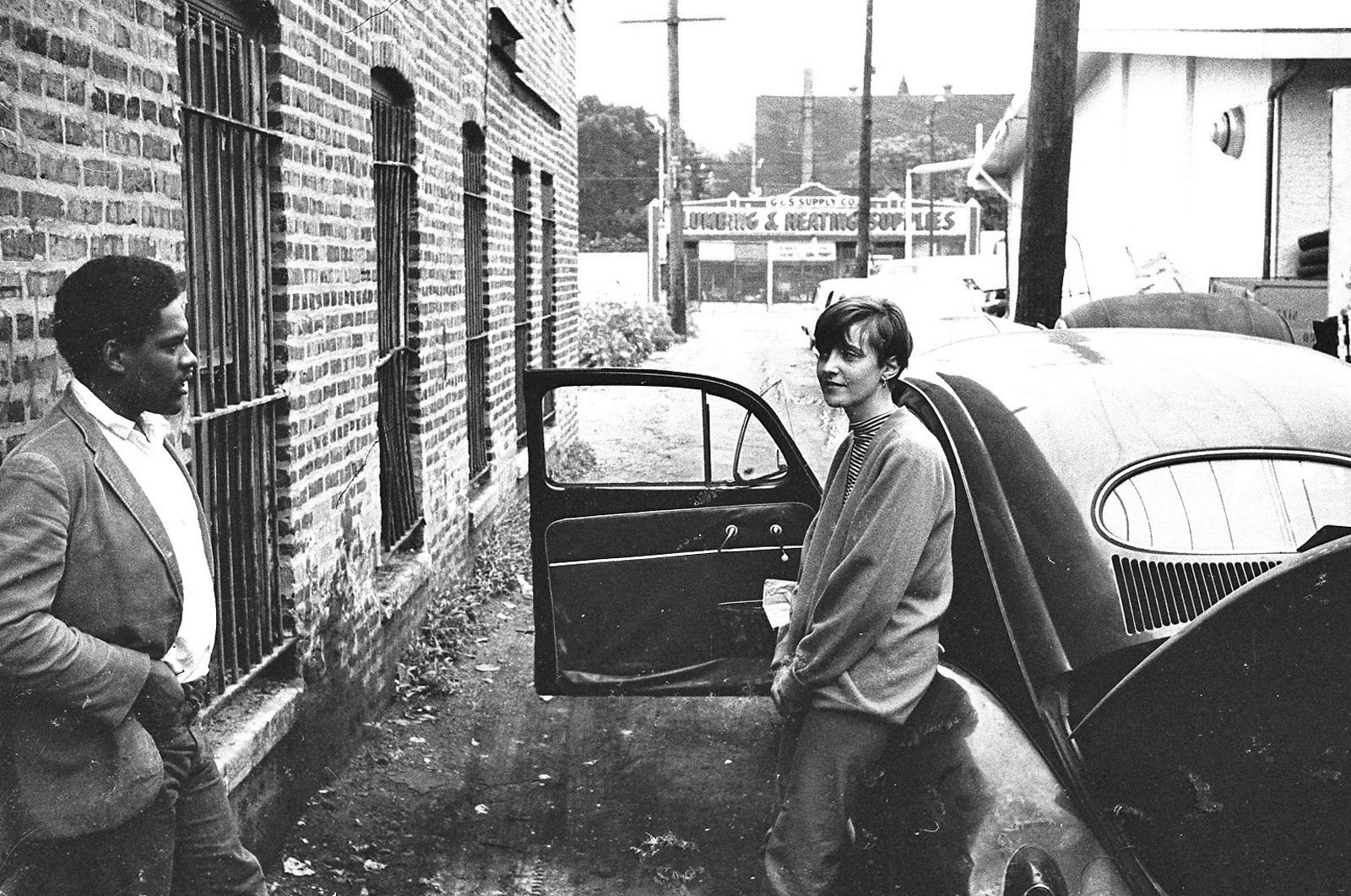
SNCC’s Curtis Hayes (Muhammad) and SDS’s Susan Lum in Uptown, Chicago, 1966. Photos by Michael James from his forthcoming book, Michael Gaylord James' Pictures from the Long Haul.

By Michael James | The Rag Blog | January 6, 2014

[In this series, Michael James is sharing images from his rich past, accompanied by reflections about -- and inspired by -- those images. This photo will be included in his forthcoming book, Michael Gaylord James' Pictures from the Long Haul.]

UPTOWN, Chicago in 1966. I called it “Hillbilly Harlem.” Uptown was the regional capital of poor Southern white migrants moving to the North. The migration of Southern whites began when they came north in the 1940’s for war industry work, and accelerated after WWII when factories flourished in and around Chicago.People arrived from rural and urban areas throughout the South, with the majority coming from Appalachia.

I had lived in Uptown in the summer of 1964 when I worked as a participant observer for a Notre Dame study of Southern white migrants. Daytime had found me hanging out with older guys, often drinking, rolling cigarettes, and playing the guitar under the El tracks next to Graceland Cemetery. Now I was working with others in JOIN Community Union, a community organizing project initiated by SDS (Students for a Democratic Society) and its Economic Research and Action Project (ERAP).

When it first started, as a project to organize the unemployed, JOIN stood for Jobs or Income Now. But when organizing the unemployed didn’t pan out, JOIN evolved into a “community union,” uniting folks to fight around issues that affected their lives, like housing, welfare, and police brutality.

Young radicals like myself went into cities around the country trying to organize “to build an interracial movement of the poor.” JOIN was our effort to build solidarity and create an organized force for change among poor people of Southern origin and others who lived in this community on Chicago’s North Side. We intended to help our nation live up to its stated vision of equal opportunity for all.
james JOIN 2
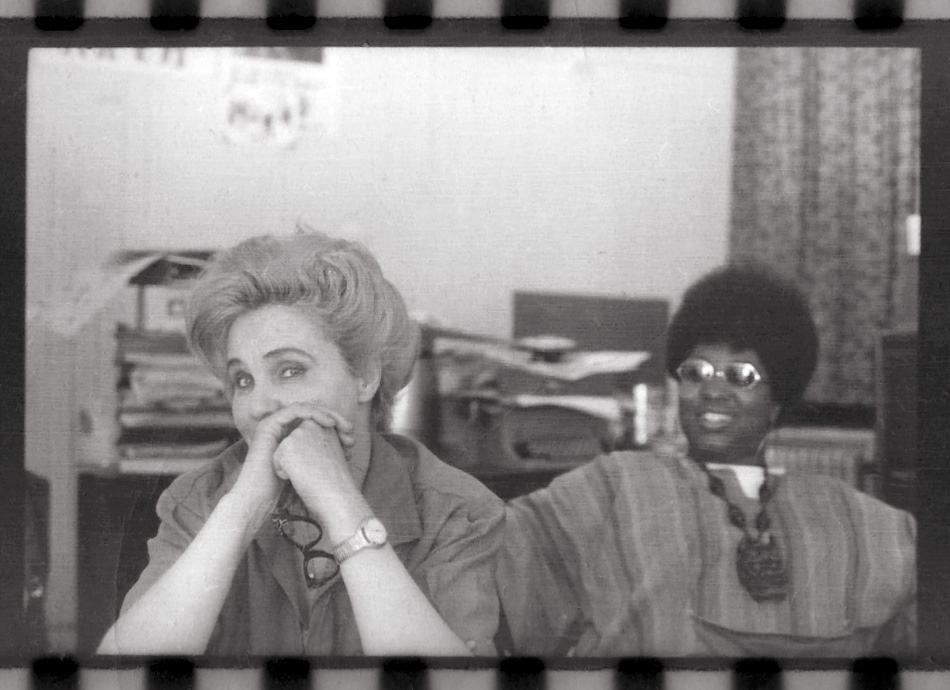
Virginia Bowers and Little Dovie.
In Uptown, we met a lot of folks while leafleting in front of the Unemployment Compensation Office on Lawrence Avenue. The backbone of JOIN was welfare women. The leadership included Dovie Coleman and Dovie Thurman, aka Big Dovie and Little Dovie -- confident and forceful black women.

Southern white women on welfare were aware of the goings-on in the civil rights movement and looked to these black women for leadership. One was Virginia Bowers from Arkansas, who became the JOIN office manager. Key organizers included Harriet Stulman, Alice Keller, and Vivien and Richie Rothstein.

Vivien and I had worked together what had been the West Oakland Community Union Project. In future years she became an organizer in Los Angeles of Vietnamese immigrants. Richie forged links to unions and set up a JOIN School to help community people learn about the power structure, welfare, police, and housing matters.

Post-JOIN he wrote about education for The New York Times and worked on education policy at the Economic Policy Institute at the University of California, Berkeley. In his Uptown work he was serious, smart, dedicated and, as I now realize, inspirational. He didn’t always appreciate my rebellious youthful behavior.

The government’s new War on Poverty was active in Uptown, headquartered on Montrose (now a gym in the increasingly gentrified neighborhood). We believed the War on Poverty didn’t encourage community people to take action or make decisions on the big issues of jobs, housing, education, and welfare. It too often focused on superficial, harmless programs like where to plant trees.

JOIN held weekly meetings that featured speakers, theatrical skits, and singing. The group-sing was enthusiastic, if sometimes off key, and included mountain tunes, spirituals, and traditional union songs. Sometimes we altered the lyrics to reflect current conditions.

We showed films we got from UE’s (United Electrical Workers') treasure-trove of labor documentary and training films. We rented films from a distribution house, including the previously banned Salt of the Earth about striking mine workers in Silver City, New Mexico — though The Hank Williams Story turned out a larger crowd.
Regular attendees were a unique, interesting, somewhat motley crew of Uptown residents.
Regular attendees were a unique, interesting, somewhat motley crew of Uptown residents. We had our share of wino attendees, including a Greek fellow named John. Once I carried a drunk John into Cook County Hospital, when his frostbitten feet prevented him from walking.

Each week there was an increasing number of young guys from the neighborhood, hanging in the back of the room. One Southern kid named James Osborne had a job with the War on Poverty and also hung around JOIN. At a meeting in Washington, D.C., he spoke up and asked Sargent Shriver, the War on Poverty’s head man, a question that was apparently too challenging. James lost his job -- and distanced himself from JOIN.

A short time later he married a nun who worked in the neighborhood and they opened the Book Box on Lawrence (now Shake Rattle and Read) by the Green Mill. Later, in 1968, we held training sessions in its basement for a short-lived outfit called the National Organizing Committee (NOC), which recruited college students to be community organizers.
james JOIN 4
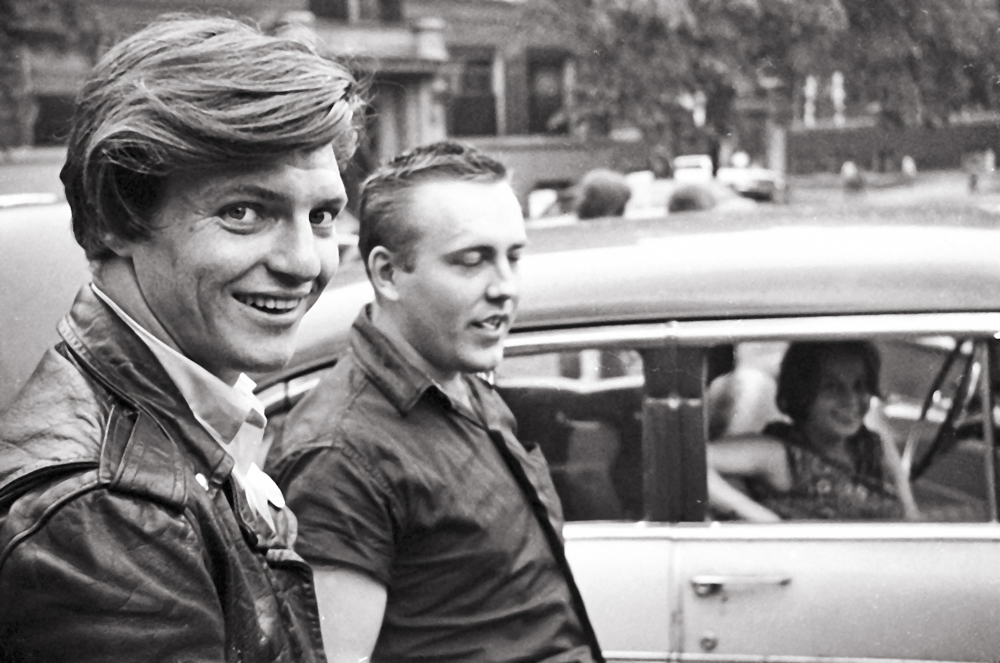
Goodfellows and girl in a car.
While I liked to joke that the meetings reminded me of a Bruegel painting, a mass of tortured and rough-edged peasants, there were of course plenty of sharp and effective people among the ranks, including Sarah, a Russian who had participated in the Russian Revolution and by 1966 was selling papers on Argyle.

Carl, a physically challenged welfare activist, came, as did Eugene Feldman, a retired teacher and former Communist. Feldman had organized sharecroppers in the South during the 1930s and shared pamphlets from those times. We knew we were part of an ongoing, long tradition of organizing and fighting for peoples’ rights.

A highlight of many meetings was a JOIN Theater agitprop skit that focused on the likes of Mayor Daley, urban renewal (poor people removal), landlords, and welfare and police brutality. My younger sister Melody James founded this project. Melody studied drama at Carnegie Institute and San Francisco State, so I asked her to come to Uptown to organize a peoples’ theater. After her JOIN work she returned to San Francisco and became a member of the legendary San Francisco Mime Troupe.

For JOIN Melody put together a lively mix of community people and student organizer types. JOIN Theater performed on various stages around town and in an empty lot on Clifton Street. Following the City’s massive urban removal of people in that part of the neighborhood, they performed before a large crowd, calling on the city to build a Hank Williams Memorial Playground in the space where Truman College stands today.

Over the spring and summer of ‘66 young guys began coming around JOIN. Near the old Wilson Avenue pool hall where Al Capone was said to have played, Reverend Maury ran a program for young guys. As we were less concerned with life after death than a better life in this lifetime, the Reverend’s hall became fertile ground for recruiting and we quickly made inroads.

We got to know these young guys, many of whom readily shared their accounts of police harassment and brutality. By the fall of 1966 Rev. Maury closed his operation. In its stead Bob Lawson, a JOIN organizer who had played football at Berkeley, gathered a group of young Southern guys that included Ralph Thurman, Hi Thurman, Bobby Joe McGinnis, and Jack (Junebug) Boykin.

They started a new group, which was friendly to but officially independent of JOIN. They called themselves The Uptown Goodfellows and opened a hangout-clubhouse space on Wilson at Kenmore.
When the police killed a young man named Ronnie Williams, who had moved to Uptown from Kentucky, it set off activity protesting police harassment and brutality.
When the police killed a young man named Ronnie Williams, who had moved to Uptown from Kentucky, it set off activity protesting police harassment and brutality. The Goodfellows and JOIN together organized a march on the infamous Summerdale 20th District Police Station. Over 300 people marched, mostly but not only, white Southerners.

Summerdale had been implicated earlier in a stolen-goods ring. The “Summerdale Scandal” led to the hiring (and brief tenure) of a forward-thinking criminology professor from Berkeley named O. W. Wilson as Police Superintendent. Our march called for an end to all police brutality but singled out a particularly hard-ass cop named Sam Joseph.

My own interaction with Joseph was limited to a short exchange of wise-ass remarks after he shined a flashlight into my car. I was parked down at Montrose Beach with Susan Ring, who was from a progressive home in the Swedish neighborhood of Andersonville. Her mom worked for the AFSC (American Friends Service Committee) and her dad was a butcher I jokingly referred to as the “Marxist butcher.”

Susan and I were making out when Joseph and his sidekick shined the light into the car and knocked on the window. Later Susan ended up marrying Junebug Boykin, who was my main street mentor.

The Summerdale march gave people a sense of unity, direction, and power. What followed from JOIN and the community was the founding of a program called Citizens’ Alert. This was an earlier version of the Oakland Black Panther Party’s practice of following the police and observing their activities. Citizens’ Alert is still active in Chicago, calling attention to police misbehavior. Activist Mary Powers has long been its leader.

The police response to the march was more hard-hitting on young guys in the neighborhood and an attack on JOIN. My college roommate Patrix Sturgis and my sister Melody were at the JOIN office when the 20th District Chicago Police burst in, ransacked the office and arrested them, claiming to have found a small amount of pot. Though it received less media coverage, they were later acquitted, after the police were found to have lied and planted the marijuana.

Housing was another major concern of folks in the hood. Buildings had mice, rats, and roaches, repairs weren’t made, and people were locked out when rent was late. We held rent strikes and demonstrations around housing issues. A group of lawyers who helped JOIN included Irv Birnbaum and Ted Stein. They worked with organizers and tenants, often going to housing court with them.

We tried to stop evictions. I made my way into a number of basements, turning on gas or electricity after landlords or their managers had turned the utilities off, and was once arrested when I informed an officer of the tenant’s rights and the law. Tenants at a large building on Broadway near Irving Park went up against a slumlord named Gutman. On a Sunday morning Rennie Davis and I went to his apartment building on the northwest side and hung a leaflet inside his vestibule: “Your Neighbor is a Slumlord!” We also put one on every car on the street.

In short order Gutman settled with the tenants, and that particular building became part of an improved housing initative by the Kate Maremont Foundation. A prolonged rent strike with marches at the “Sampson Building” on the 4100 N. Kenmore block led to an agreement and the formation of a tenant’s council.
JOIN did welfare advocacy, demonstrated at the welfare office, and called for fair treatment by the Illinois Department of Welfare.
JOIN did welfare advocacy, demonstrated at the welfare office, and called for fair treatment by the Illinois Department of Welfare. We worked closely with the Kenwood Oakland Community Organization (KOCO) and the Latin American Defense Organization. These demonstrations and marches exemplified the potential for building an interracial movement of the poor. Actions involving primarily black, brown, and white organizations helped lay the early groundwork for rainbow coalitions to come.
james JOIN 3
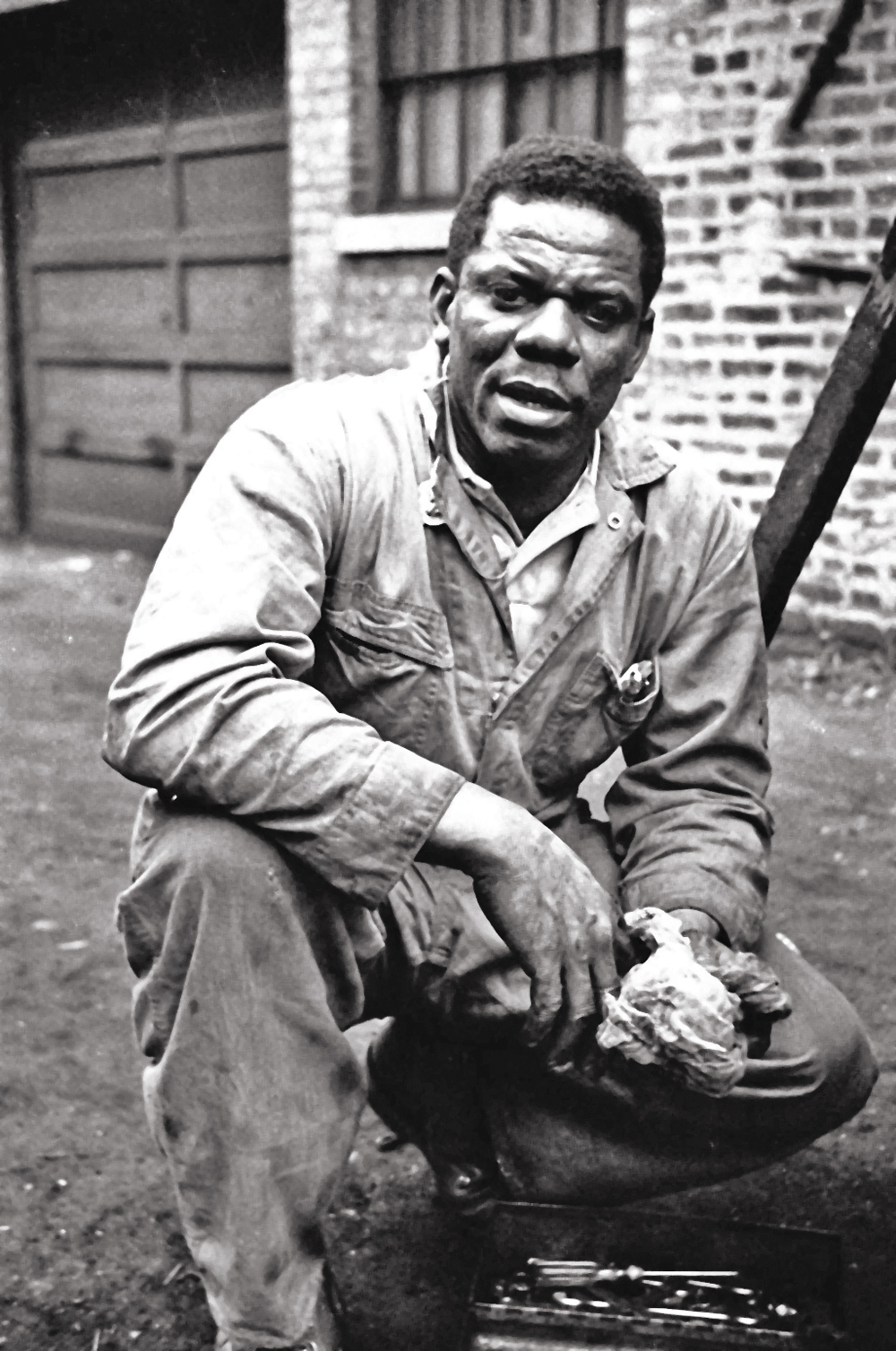
Mechanic and Steelworker Eric Gil.
 One spring afternoon the photographer Danny Lyon gave me a ride on his Triumph motorcycle to Molly Hagen’s apartment on Hyde Park Blvd. on the South Side. Molly’s crib became a regular destination. I would head there to hang out, smoke weed, and eat. I met Curtis Hayes (now Muhammad), who had worked with Molly in the Student Nonviolent Coordinating Committee (SNCC), and Eric Gill, from Belize, who worked on cars and had a job in the steel mill, and an assortment other characters, including a salesman for Duncan Yo Yo.

That summer I bought a 1963 Triumph 650 TR6 motorcycle from Clay Highland, who I knew from Lake Forest College. On the bike, sometimes with Molly on board, I explored Chicago and its far-flung neighborhoods, communities, and off-the-beaten-path treasures. I loved late night cruising up and down Lake Shore Drive, the green tunnel of Lower Wacker Drive, the smell of chocolate production on Kinzie, and the blast furnace at Finkl & Sons Steel on Armitage.

In addition to country music joints in Uptown, I went to hear Paul Butterfield, first in Old Town at Big John’s (where I had first seen Steve Miller), and then at the Blue Flame on Drexel Blvd at 39th Street, where he played with Howlin’ Wolf’s old band. At a meeting of activists from various projects around town I met a law student named Bernardine Dohrn.

Days later Bob Lawson and I took an exhilarating ride on my Triumph to the SDS Convention held in Clear Lake, Iowa, the place where Buddy Holly, Richie Valens, and the Big Bopper had gone down in an airplane. While there we got word that both the JOIN office and the new Movement for A Democratic Society office in Rogers Park had been busted. People were out of sorts.

Wearing a cowboy hat, I stood up and quoted Joe Hill: “Don’t mourn, organize.” This moment was my introduction to the assembled SDSers, and I left Clear Lake as part of SDS’s leadership, a member of the National Interim Committee. Before heading back to Chicago I reintroduced myself to Bernardine by sending her a post card: “Nice meeting you; how about we take a ride together on my motorcycle?”

[Michael James is a former SDS national officer, the founder of Rising Up Angry, co-founder of Chicago's Heartland Café (1976 and still going), and co-host of the Saturday morning (9-10 a.m. CDT) Live from the Heartland radio show, here and on YouTube. He is reachable by one and all at michael@heartlandcafe.com. Find more articles by Michael James on The Rag Blog.]

The Rag Blog

[+/-] Read More...

08 December 2013

Michael James : Back to Uptown, 1965-1966

Two men, Uptown Chicago, 1966. Photos by Michael James from his forthcoming book, Michael Gaylord James' Pictures from the Long Haul.
Pictures from the Long Haul:
Back to Uptown: Bye-bye California, 
Chicago here I come, 1965-1966
I was glad to be back in Uptown, progressing along my path with another left turn and a big step into America.
By Michael James / The Rag Blog / December 9, 2013

[In this series, Michael James is sharing images from his rich past, accompanied by reflections about -- and inspired by -- those images. This photo will be included in his forthcoming book, Michael Gaylord James' Pictures from the Long Haul.]

The West Oakland organizing project over, I planned to leave Berkeley. But in the late fall of 1965 I was still there. I had classes. I was thinking about conflict, and how you could bring conflicting groups together. I met others who were already doing community organizing, including Mike Miller who is still at it in 2013, and Mike Sharon with whom I’ve lost contact. I was going to be a community organizer, either in Newark or Chicago.

That fall I lived with friends, for a time with John Williams, who taught me a lot about cooking and politics, and then at Julie Miller’s. Julie was a politically active student friend from Los Angeles. I studied and took in doses of politics and culture. In addition to sociology classes with Nathan Glazer and Hebert Blumer (a renowned academic who had played football at the University of Chicago and then professionally with the old Chicago Cardinals), I went to talks, rallies, demonstrations, films, and musical events.

The playwright and poet LeRoi Jones had become Amiri Baraka. He came to campus and his anti-white rap shook me up. My more knowledgeable pals Davy Wellman and Joe Blum helped me to understand Black Nationalism. A few years later Black Panther leader Bobby Seale would distinguish between revolutionary and reactionary nationalism. “You don’t fight fire with fire, you fight fire with water, and you don’t fight racism with more racism, you fight racism with solidarity.”

Simply put: dig yourself and others.

There were large marches into Oakland, against the Vietnam War and against the racist Oakland Tribune and its rightwing Republican owner, former Senator Bill Knowland. I saw the great guitarist John Fahey along with Country Joe and the Fish at the Finnish Hall. On Telegraph Avenue I bought and listened (over and over) to Joe’s EP Section 43. And I began going to concerts at the Fillmore Auditorium in San Francisco.

Also in San Francisco I took in a movie I’d read about, Jean Genet’s Un Chant d’Amour, a flick about gay men in prison and their fantasies. The article in Studies on the Left reported on the SF Police Department’s harassment of a theater showing the film. This was all new to me; I didn’t have much consciousness about gays at the time.

I liked the film; it featured a black prisoner and a white one, breathing and whispering through a straw between their neighboring cells. I found it pleasant and sensual; it sure bumped up my learning curve on such matters.

I visited what I now considered my second home, the Williams compound in the Carmel Highlands. From there I explored down the coast. I climbed foothills of the Santa Cruz Mountains and went to a rodeo in the old mission town San Juan Bautista. The rodeo was different than my early rodeo experience in Madison Square Garden -- this one was small, outdoors, and heavily influenced by Mexican culture.

Charlie Mingus, Monterrey, California, 1965.
And I went to the Monterey Jazz Festival. A jazz fan since my mid-teens, I’d been to shows and concerts in Greenwich Village and NYC’s Town Hall. I was at the Newport Jazz Festival in 1961, and went to many sets in Chicago. The Monterey Jazz Festival was my first jazz event on the West Coast. I took some pictures of Charlie Mingus hanging out in the concession area before his short set.

At Christmas time I went home to Connecticut. My brother and I, in a tradition started accidentally by our Dad years earlier, went to get a tree late on Christmas Eve; as usual the tree seller had long gone. My Dad returned to the lot to pay the next day, but no one was there. In subsequent years Beau and I didn’t even make that much effort, so later in my life when I sold trees at the Heartland Café, I never got too upset if some went missing and unaccounted for. Karma.

I’ll always remember that particular Christmas, especially for the warm vibes I felt while listening to the Beatles’ Rubber Soul, over and over. I suddenly appreciated them, and saw both them and the Remains at the Chicago Amphitheater the following year.

After Christmas I went to Newark, New Jersey, to visit Tom Hayden and others who worked in the Newark Community Union Project, in a black community. Then I went to Chicago and visited the National Office of Students for a Democratic Society, which was located at 63rd and Cottage Grove.

While in Chicago I visited a snow-covered, gray, and very cold Uptown, where I met with two JOIN Community Union organizers, Peter and Stevie Friedman, working in what was then a predominantly Southern white community. Next I headed down to the University of Illinois in Champaign Urbana, where SDS was holding one of its conventions. My only recollection of that meeting is of when I leapt off a table to break up an altercation between a black community person from the Newark Project and Bob Speck, a Navy vet from the Austin SDS chapter.

At the end of winter break I rode with fellow SDS members from Chicago to Los Angeles, and made my way back to Berkeley. Early in the New Year of ‘66 I was at a SNCC (Student Non-Violent Coordinating Committee) benefit at the Fillmore, featuring Grateful Dead, Quick Silver Messenger Service, Moby Grape, and comedian Richard Pryor.

In the back of the hall I met and talked with Stokeley Carmichael (Kwame Ture) who was then head of SNCC. I shared with him my intention to leave Cal and go into a community, either Newark or Chicago. He told me in no uncertain terms to “Work with whites, we’ve got plenty going on in the Black community. We need more support from within the white community."

California girls. Carmel, California, 1965.
That was it. Bye-bye California. Chicago here I come.

But it took a while longer.

I had a graduate paper to write on organizing the poor. I was comparing three efforts: the Saul Alinsky model from his Industrial Areas Foundation, the conflicting and self-constricting efforts of the Government’s War on Poverty, and the “be one with the people” and “let the people decide” projects of SDS and ERAP. My research findings of course declared the SDS efforts best, and I spent the winter of 1966 in the Highlands writing about poverty and organizing.

While there I battled a raccoon that raided the bird feeder every night. Laying in wait, I was inside writing with a baseball bat nearby. I attached bells to the feeder and when they jingled I leapt into action. I went for the animal with a mighty swing, missing as the raccoon jumped free ahead of the bat.

Back up in the Bay Area I ran into someone at a Paul Butterfield concert who said, “I thought you left for Chicago.” I replied: “Soon -- I’m finishing a paper.” I was. I was also having a real fine time in my final weeks as a California resident.

But bye-bye California and hello Chicago did come to be. One Sunday in early April, JOIN organizer Burt Steck and I began heading east in my 1957 Ford convertible, to the heart of the nation.

On Monday night we stopped on the Navajo Reservation in northeastern Arizona and slept on the ground beside the Ford ragtop. In the morning we found that we had actually slept very close to the edge of Canyon de Chelly. Driving on a dirt road we stopped to pick up a hitchhiking Navajo kid. His mom came running out from the bushes and they both got into the car.

The small woman had a blanket she was bringing to a trading post. I just happened to have with me a box of broken abalone shells I had literally thought about “trading to the Indians.” They made great buttons. When we reached the trading post I gave them to the mom. She smiled. Inside I arranged for the trader to send me a buckskin, which I later traded to Austin SDS friend Bob Pardun for a very nice cowboy shirt.

Over a thousand miles and 20 hours later, Wednesday morning found us parked and asleep in front of the U.S. Farmers Association (USFA) office in Des Moines, Iowa. Two policemen tapped on the window and woke us up. We engaged in friendly and humorous conversation about Berkeley, the FSM, and heading to Chicago to organize the poor. They did ask about marijuana; I shared that I had tried it, but assured them we didn’t have any.

We were in Des Moines because a new SDS friend from the University of Nebraska, Carl Davidson, had told me about a radical farmer named Fred Stover. Stover had been a Department of Agriculture official in the Roosevelt and Truman administrations, had supported the progressive, Henry Wallace, in the 1948 presidential campaign, and opposed the Korean War. He had been accused of being a member of the Communist Party in his youth and had been forced out of the leadership of the National Farmers Union (NFU). That led to his founding of the USFA, a progressive offshoot of the NFU.

When Fred arrived he took us out to eat, treating us ravenous boys to a big Iowa breakfast. We had a good talk. I really liked Stover. I myself had been a member of the 4H Club (“Head, Heart, Hands, and Health”), and have always liked agriculture and farmers, particularly those on the progressive side of the political equation.

By mid-afternoon Burt and I were in Chicago in Uptown. I immediately became involved in a small demonstration at the Price-Rite TV Repair Shop on Argyle. Mrs. Hinton, an East Indian on welfare and a JOIN member, had tried to return a broken used TV set she had purchased from Price’s. They refused. JOIN organizers and community folks were picketing out front. One of the Price brothers and I got into some macho posturing and arguing. Eventually Mrs. Hinton got her just due. The Price brothers were from Appalachia; eventually they would become JOIN supporters themselves.

It was a good day. I was glad to be back in Uptown, progressing along my path with another left turn and a big step into America.

[Michael James is a former SDS national officer, the founder of Rising Up Angry, co-founder of Chicago's Heartland Café (1976 and still going), and co-host of the Saturday morning (9-10 a.m. CDT) Live from the Heartland radio show, here and on YouTube. He is reachable by one and all at michael@heartlandcafe.com. Find more articles by Michael James on The Rag Blog.]

The Rag Blog

[+/-] Read More...

10 November 2013

Michael James : Going Off Campus, 1965

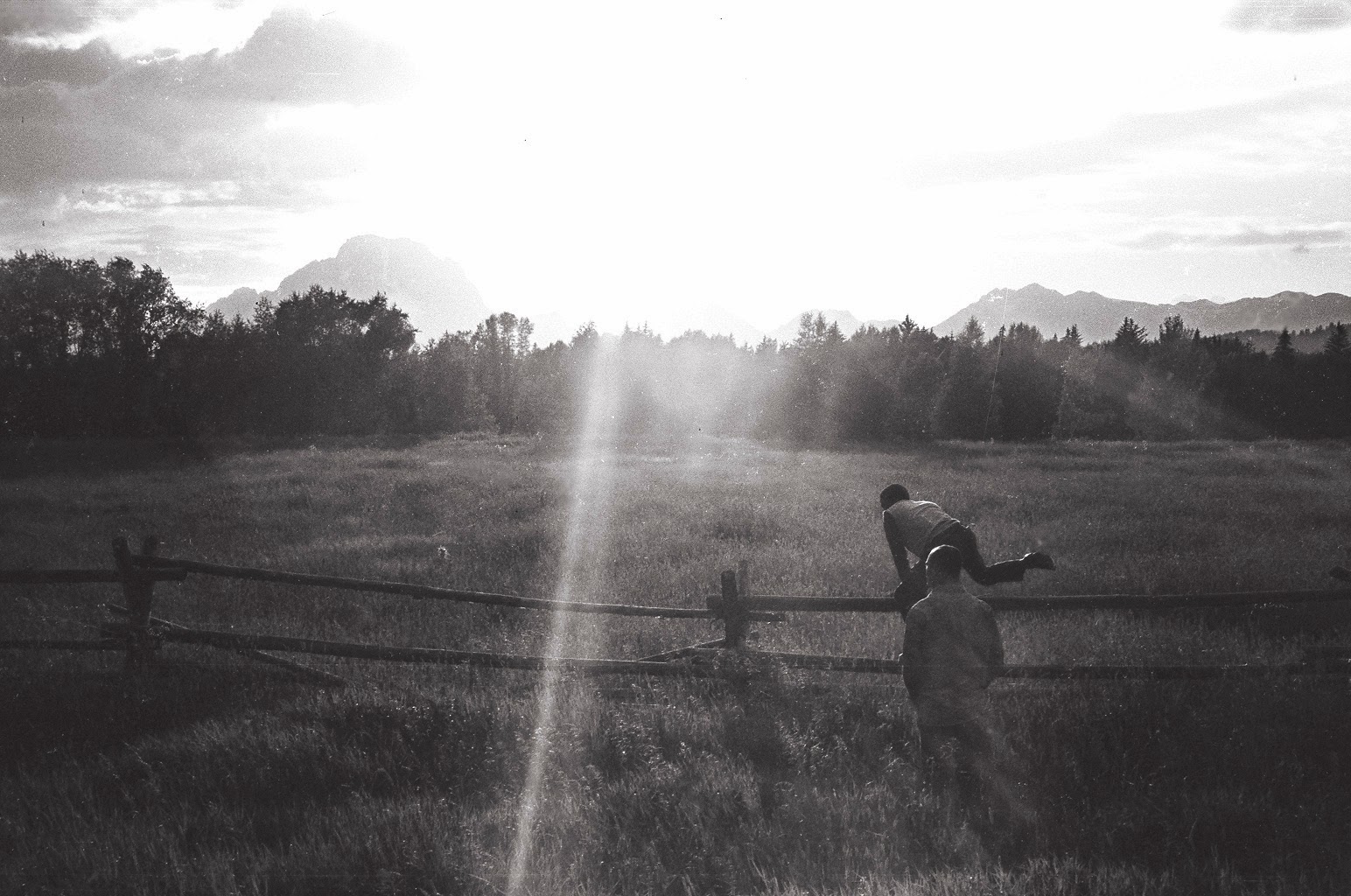
Sam and Theophilius at sunset in Jackson Hole, Wyoming. Photos by Michael James from his forthcoming book, Michael Gaylord James' Pictures from the Long Haul.
Pictures from the Long Haul:
Going off campus:
Idaho, Wyoming, and Connecticut, 1965
I proceeded to quote Tom Paine: “Let them call me rebel and welcome, I feel no concern from it; but I should suffer the misery of devils were I to make a whore of my soul.”
By Michael James / The Rag Blog / November 11, 2013

[In this series, Michael James is sharing images from his rich past, accompanied by reflections about -- and inspired by -- those images. This photo will be included in his forthcoming book, Michael Gaylord James' Pictures from the Long Haul.]

At UC Berkeley in the winter and spring of 1965 the Free Speech Movement battles continued. The court proceedings for the Sproul Hall arrests continued, as did rallies and negotiations. My sentence gave me a choice: 25 days in jail, a year’s probation, or a $250 fine. Believing that a year’s probation would limit my political activities, I took the fine, and said to the judge; “A lot of people across the land are coming to feel as I do,” and proceeded to quote Tom Paine: “Let them call me rebel and welcome, I feel no concern from it; but I should suffer the misery of devils were I to make a whore of my soul.”

Eventually the University agreed to permit tables and discussion in Sproul Hall Plaza, and reversed their edict on no political activity. And political activity there was. The U.S. war on the people of Vietnam was in the forefront. I got involved with the Vietnam Day Committee initiated by Jerry Rubin, Stew Alpert, and others. In May we held a two-day teach-in, which thousands attended. Senator Ernest Gruening of Alaska was a featured speaker. He and Oregon’s Wayne Morse were the first Senators to stand in opposition to U.S. involvement in the war in Vietnam.

Ken Kesey and his Merry Pranksters showed up in a wildly painted school bus; Allan Ginsberg, Wavy Gravy, and others were on the scene. Protest singer Phil Ochs came to perform. Before he took to the stage I was fortunate to hang out with him at the home of Neil Blumenthal, a Berkeley psychologist and the Free Speech Movement’s resident shrink.

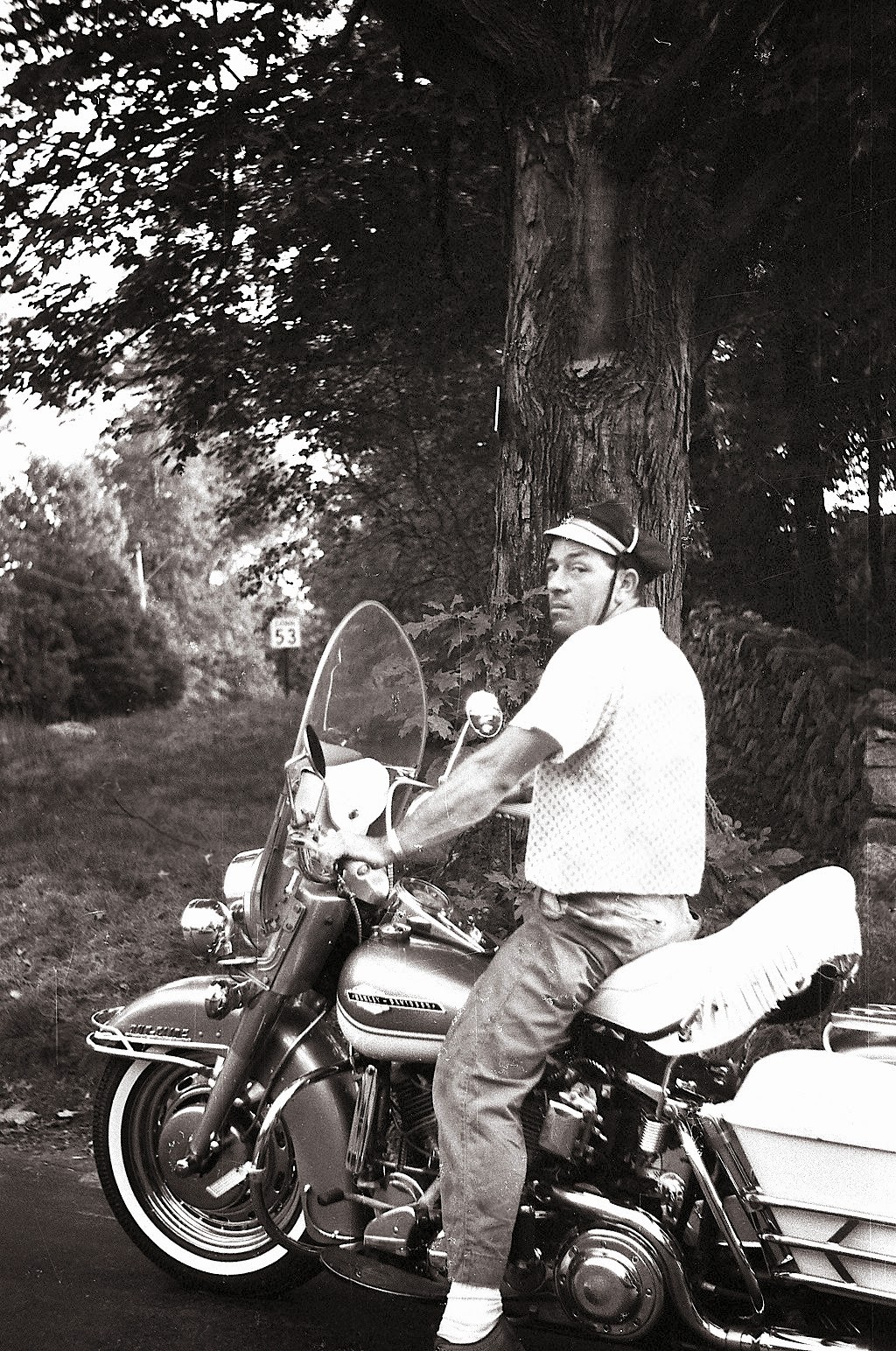
Man on Harley, Route 53, Connecticut.
For the teach-in I helped compile a pamphlet with articles on Vietnam and the war. While laying it out at the Berkeley Free Press, I leaned on the light table and fell through the glass (no injuries, luckily, and the shop owner took it in stride). When the pamphlet made it to press, I remember the brass bell on the Multilith offset that gave a constant ding-ding at the tempo of the press’s speed. The pressman was David Goines, who became a well-known poster artist.

Students for a Democratic Society was the organization that caught my attention, and then my love and devotion. Back when we surrounded the police car with Jack Weinberg in it -- the event that really set the Free Speech Movement in motion -- I had found a leaflet put out by SDS calling to “build the interracial movement of the poor.” SDS “traveler” (field organizer) Mike Davis, now a noted author, came through town and signed me up into the ranks of SDS. At an SDS party I talked and drank wine with Michael Harrington, who I had heard speak in 1962 at the University of Chicago, along with the old socialist Norman Thomas. Harrington’s ’62 book The Other America exposed the dramatic extent of poverty in the U.S.

The summer of ’65, while the anti-war movement was building at Berkeley and across the land, some of us were making plans to move into West Oakland. We would be among SDS members involved in the Economic Research and Action Project (ERAP), which had begun organizing in 13 cities, trying to build an interracial movement of the poor. Paul Booth, an SDS leader, came to California to help with what would be called the West Oakland Community Project (WOCP). We were idealistic. We said, “Let the people decide.” An SDS button proclaimed Sam Cook’s lyric “A change is gonna come.”

Twelve of us --11 white, one black -- were involved in the WOCP that summer. We had a house at 320 Henry Street near the Southern Pacific Railroad yards. People in the community wondered who we were and what was going on. A ragtag group of men who lived at the Catholic Worker’s Peter Maurin House came by to check us out. [Peter Maurin was a Catholic activist who along with Dorothy Day founded the Catholic Worker Movement]. They’d been drinking wine and their spokesman was challenging, but mellowed out when we shared our hopes and intentions.

Lots of people were working for change in Oakland. There were freedom schools, summer work projects, and labor projects. The issue that got traction in our efforts was beautification. It may not seem radical, but responding to the way the city was tearing down fences and ruining people’s gardens at Peralta Villa Public Housing without notice or community input, was about letting the people decide, a major SDS principle. The Peralta Villa folks were pissed off, and they let the city know about it. The fence removal was halted, a small but significant victory.

A mostly white group of Berkeley students organizing in a poor black community did not bring us far on the road to a revolution. Perhaps the biggest deterrent to sustained work by WOCP was the exploding growth of opposition to the Vietnam War. There was considerable anti-war activity on campus and energies were pulled in that direction.

To top it off, there were the troop trains, and the efforts by hundreds to stop them. During August there was a demonstration at the railroad tracks in Berkeley. My clearest memory of that day is a soldier’s face, probably a conscript, who was on the Union Pacific train from Fort Riley in Kansas, heading to the Oakland Army Terminal to be shipped off to Nam. He was at the window with a shaved head. His face was laughing yet somehow also fearful as he watched me take the picket sign I held and slap it against the window. “U.S. Out of Viet Nam!” I hope he made it back.

Sam and Theophilus in Wyoming or Nebraska.


At the end of the summer I headed back east. My Staples High School pal, football lineman Sam Whiteside, was on the West Coast. He and I, along with two women from the Oakland Project and a young black SNCC activist named Theopholis Smith, headed east in Sam’s Chevy wagon. Theo had been on a break from his work in the South and was heading back to the voter registration battlefield in Alabama.

I was back on the road, heading east from Berkeley by car for the first time. Sam, like me, was up for a circuitous route, and I had a camera with me. We drove through Nevada, then Idaho, and on to Jackson Hole, Wyoming, where at sunset I caught a picture of Sam and Theo climbing a over a fence. Later that night we spotted Indians swaying and staggering along the road. We were riding through a Crow reservation as we neared Dubois, Wyoming. In Dubois we ate at a bar while a piano player tickled the keys. We joined him in song before driving off into the night.

By morning we were in my ancestral homeland of Nebraska. Near Valentine we decided to stop and take a jump into the Niabrara River. Sam cut his foot, and got stitches from a doctor in Valentine. I talked to the doc about the war, which he supported. As my family will attest, this was the beginning of a lifetime of bringing up politics with folks anywhere I am -- in an elevator, at a gas station, attending a wedding, on the phone with an operator at a credit card company in wherever. “And what state are you taking this call in? Hope you guys are going to vote out so-and-so!”

In Chicago we went to the Uptown neighborhood, where the JOIN (Jobs or Income Now) Community Union office was located on Argyle. There I met Sandra Cason, aka Casey Hayden, who had just left her work with SNCC in Mississippi after Stokley Carmichael (Kwame Ture) had booted the white members out. Sam and the others left me there.

Cross, cowboy, Conoco, and Wonder Bread truck in Idaho.
Casey and I visited Old Town, a pioneer hip neighborhood and happening place. The night heat was close to unbearable, and the sidewalks were packed with people. A guy on a motorcycle, his squeeze on the back, was jumpy and jittery as he revved his bike, moving through the crowds crossing the street. I suggested to Casey, “Let’s get out of here!” We took the Chicago Northwestern RR to Lake Forest, 30 miles north. It was cooler there, where we stayed at the home of my anthropology Prof Gerry Gerasimo.

The next morning we said goodbye to Gerry and his wife Dottie, who had been a classmate of mine. Casey and I grabbed our stuff and hitchhiked east, stopping for a night at an SDS ERAP project in Cleveland, located in a mostly poor white neighborhood near the Great Lake Erie. The next day, thumbs out, we hitched rides and made it to Connecticut.

We linked up with fellow Berkeley sociology student Nigel Young and his wife Antonia, serious peace activists from England. Nigel told me about writing “U.S. out of Guatemala” on a wall in London in 1956, when he got arrested while trying to figure out how to spell Guatemala. They were quite a couple, he in mod all black: turtleneck, black pants, short black jacket, and pointy-toe black shoes. Antonia wore a big long fur coat. (This was before there was much talk of animal rights.)

All four of us headed west in a gray 1957 Plymouth station wagon “drive-away” that needed to be delivered to California. We stopped at the Custer Battlefield and Museum in Montana, where the park ranger-guide kept referring to “the hostiles” coming over this hill, and doing this or that. With Crazy Horse and Sitting Bull already heroes in my consciousness, I found his rap to be offensive. In Billings we stopped to eat at a place with an adjacent bar that had a dirt floor and a sign “Check guns at door.” That made sense.

We cruised through Yellowstone National Park, took in the geysers, and had our progress momentarily halted while a bull buffalo decided to mosey along the middle of the road. In Idaho we crossed over a mountain and stopped to eat early in the morning. On the jukebox I noticed Johnny Cash covers of Dylan tunes, and thought: “Wow, something is happening here, the times indeed are a-changing.”

A ranch in Idaho.
On a back road we stopped at an abandoned ranch where I found a branding iron. Down the road we had to stop for a herd of sheep. The shepherd was Basque, didn’t speak English, and wore a jean jacket and pants and engineer boots. Later Nigel enlightened us about the struggles of the Basque people in Spain.

Back at school in Berkeley, I was a graduate teaching assistant. Casey was bereft, missing her comrades in Mississippi, and returned to her family’s home in Victoria, Texas. I tried to restart the Oakland Project along with Vivian Rothstein. From 12 of us, we were down to two. We moved into a different house where neighborhood kids ripped us off. Honest talk led to the goods being returned.

Barry and Betty, both of whom had worked in the Newark Community Union Project (NCUP), soon joined Vivien and me in our efforts. We took a trip to a commune near Big Sur. As we approached we heard beating drums, apparently a sunset ritual to help the sun to go down over the Pacific. A number of longhairs came running at us with clubs, but backed off when Barry yelled he was there to see his sister.

It quickly became clear that the Oakland Project had run out of steam. Though my heart was still with the interracial movement of the poor, I needed to figure out the best place for me to help work toward that vision. Knowing now that I wanted to leave Berkeley, to go off campus and organize, I began contemplating my next moves.

[Michael James is a former SDS national officer, the founder of Rising Up Angry, co-founder of Chicago's Heartland Café (1976 and still going), and co-host of the Saturday morning (9-10 a.m. CDT) Live from the Heartland radio show, here and on YouTube. He is reachable by one and all at michael@heartlandcafe.com. Find more articles by Michael James on The Rag Blog.]

The Rag Blog

[+/-] Read More...

17 October 2013

Michael James : Kidnapped to the Highlands, 1964

Fishing boat on Monterey Bay. Photos by Michael James from his forthcoming book, Michael Gaylord James' Pictures from the Long Haul.
Pictures from the Long Haul:
Kidnapped to the Highlands: 
Gibson Beach and Monterey Bay, 1964
This morning on Monterey Bay is blessedly calm. Joe, smoking a Camel, steers the boat west as the morning sun emerges over the Santa Cruz Mountains.
By Michael James / The Rag Blog / October 17, 2013

[In this series, Michael James is sharing images from his rich past, accompanied by reflections about -- and inspired by -- those images. This photo will be included in his forthcoming book, Michael Gaylord James' Pictures from the Long Haul.]

A few weeks before getting busted -- along with 732 others -- for sitting in at Sproul Hall during the Free Speech Movement at Berkeley, I was smoothly kidnapped. It was November 1964. I was taken away and introduced to life in the Carmel Highlands. Nick Aliotti, a football player pal from Lake Forest College, was back in his hometown of Monterey. He invited me to come down for Thanksgiving.

At Berkeley I am meeting people, many of them grad students like myself. One of them is John Williams; he lives south of Monterey and offers to give me a ride to Nick’s.

We leave Berkeley on Wednesday afternoon, November 25, heading south. We’re in his green VW bug. (VW bugs: an identical one took me from Connecticut to DC for the March on Washington in 1963; in the not too distant future I’ll drive my own black VW bug through Indian Territory in the Dakotas; and in the 1970’s in yet another green VW bug, David Meggyesy and I will ride from Berkeley to Durango.)

Rolling down Highway 101 south of San Jose, I take in the foothills of the Santa Cruz Mountains to the east. This is the same highway I’d wrecked on en route to a cannery job in the summer of 1960; my very lucky self was pulled unconscious from my burning 1940 Ford hot rod by a passing truck driver.

But this is a fun ride. Windows open and California soaking in: the land, the California smells of garlic and eucalyptus, new views, and new towns. At Gilroy, the nation’s garlic capital, we cut over toward the coast on Highway 156, through Watsonville, and then hit Castroville, the nation’s artichoke capital. At sunset, continuing south on California Highway 1, we pass the sand dunes and coastal rifle range of Fort Ord.

It’s dark when I turn to John and say: “Hey, didn’t we just pass Monterey? That’s where Nick lives.” John mumbles, “I’ll take you over there tomorrow.” To which I reply, “Ok, I’m kidnapped.”

John on Gibson Beach.
We drive past exits to Seventeen Mile Drive and Carmel Valley, and then by Point Lobos State Reserve, where years later I’ll take an early morning run among the bountiful deer. Near the little Highland’s gas station, we turn right off the highway and onto a dirt driveway lined with trees.

Even in the darkness I sense this place to be special, somewhat magical. There are small buildings that over time will reveal themselves to be an art studio and library, a guesthouse with a great outdoor shower, a yurt, a workshop, and a chicken coup. Barking dogs run to the VW as we park in an open space surrounded by Eucalyptus trees with their wonderful smell. To the east are trees, Highway 1, and hills. There are more trees to the north and south. And to the west is the open night sky and stars above the vast Pacific Ocean.

The homestead itself looks south and west, and is made of stone, wood, and glass, a single story with a patio. We enter a room that is living room, dining area, and kitchen. Warmth exudes from the fire, the room and the people -- John’s sister Honey, Gregson Davis, and the family matriarch Cynthia. Cynthia, who over decades will gently influence me with her many stories and thoughts, is the daughter of a painter; her grandfather owned the Lexington Hotel in Chicago.

Pillows cover the elevated hearth and a bench that surrounds a round table covered with magazines, newspapers, and books. Both the hearth and kitchen have beautiful painted tiles, the work of one Ephraim Doner. “Doner” lives across Route 1 and up the hill.

Gibson Beach, looking north.
On this visit I meet him and his wife Rosa, founder of the Highland’s Little Red School House cooperative nursery school. And I meet their daughter Natasha, who’s mentioned in the opening pages of Henry Miller’s Big Sur and the Oranges of Hieronymus Bosch (1957). She goes to Cal and we become friends. She tells me that a young Bob Dylan spent time at the family’s home pouring over books on the shelves. Natasha will work with the United Farm Workers for many years.

Across the road and up the hill I’ll also meet a former radical merchant seaman named Harold Price, his Eurasian earth-mother-wife Lana, and their children. By the time I meet him he’s a commercial artist and more cynical.

In their home I will attend a smorgasbord with many food offerings, including a raw egg yolk sitting in the center of raw ground beef. That particular meal will be prepared and presented by a Scandinavian girlfriend of Cal grad student Gregson Davis. Davis, the 1960 Harvard valedictorian, is from Antigua and has a great laugh.

And also across the road and up the hill, a few years later at Christmas time, I will meet and talk with another neighbor, the legendary community organizer Saul Alinsky, who wrote Reveille for Radicals, the early bible on organizing skills and tactics.

On this first night of my first visit, I sit by the fire. There is brief introductory sharing of information. We consume wine and food. That hearth becomes a dear spot. John takes me down the hall to an unheated and chilly room with a bed heaped with covers and walls lined with books. I lie under the heavy covers and look out the big glass window. It is very dark save for a slice of starry sky above a silhouette of trees. I like this place.

In the pre-dawn morning I’m in a sleep-awake state. I notice a little girl, maybe ten, looking through books on a shelf. I say “Good morning” and “How are you?” in my best talking-to-little-kids-talk. She responds with an adult “Fine. And you are…?” Her name is Molly. She is the youngest of the Williams kids, and plans to be a veterinarian.

Now up, I venture into this landed, arty bohemian enclave. I join Cynthia, drinking tea, reading, and talking. Then John and I take a walk on a path of botanical wonders. We pass another home -- a cousin’s -- nestled into the land, and then start down a stretch of steep steps.

At the bottom is Gibson Beach, between the mountains and the ocean. For years to come I will descend these steps, often taking a very brief plunge into the huge, cold, turbulent Pacific waves that leave seaweed and long kelp tubes on the coarse sand. Cormorants take off and land on a rock island to the northwest, before and after beak-bomb dives into the surf.

By afternoon I leave the Williams compound and join Nick’s family in Monterey for Thanksgiving dinner. His people are fisherman and movie projectionists. Italians. Dinner includes artichokes, a big salad, rice stuffing with ground beef, rigatoni, cheeses, lots of garlic, prawns, veal, yams with maple syrup, turkey, and more pasta and seafood. Then coffee, and cannoli for dessert. Oh, and plenty of California red wine.

Monterey Bay: Sun rising over the Santa Cruz Mountains to the east.
I spend the night at Nick’s, falling out with my annual overfilled holiday tummy.

We are up early. We head down to the harbor and onto a fishing boat, out into Monterey Bay. Our captain is Nick’s uncle Joe Aliotti, the fisherman. Joe grew up in Italy, became a fisherman, and immigrated to California after serving in the Italian submarine corps during WWII.

I have memory flashes of earlier fishing expeditions with my dad. Me, age 10 in Boca Grande, Florida, watching the men fish for Tarpon, then hanging out in the boat’s galley with the Captain while he cooks beans. My dad and his pals, who called themselves the Society of Mizzable Bastards, were inside drinking at the Pink Elephant, a dockside bar. Another time I am very seasick in the turbulent tide-changing seas off Block Island.

This morning on Monterey Bay is blessedly calm. Joe, smoking a Camel, steers the boat west as the morning sun emerges over the Santa Cruz Mountains. We’re after a large shrimp, the Monterey Bay Spot Prawn. Joe is a pioneer in the commercial fishing of this species. We find Joe’s buoy and the long chain that drops 600 fathoms into an underwater canyon where the prawns hang out. They pull up the chain and the handmade wicker and rope traps called pots that are connected to the chain by rope. Joe cuts chum for the pots, an older fisherman baits them, and both lower them back into the canyon.

Emptying the traps.
After a few hours we have caught many prawns, plus a few junk fish. And we catch the enemy of the prawn fisherman, a small octopus. There are no prawns in the trap with the octopus. Uncle Joe picks up the octopus and bites its head in just the right place, sending it straight to octopus heaven. By late morning we’re dockside and leave containers with the catch at a dockside commercial fish-house. Joe tosses the octopus up on the dock; it’s part of the catch.

Over the years I make many runs, in many vehicles, with many people between Berkeley and the Highlands. I’m the cameraman on a wild pig hunt in the Carmel Valley with John and a guy named Reaford Shay. We find no wild pigs but do return with a young buck that Reaford dresses and we eat.

I talk with Cynthia’s brother Dick Criley, a longtime progressive activist who ran the Chicago Committee to Defend the Bill of Rights. I meet Florence, Dick’s wife, the feisty union organizer with the United Electrical Workers. Honey Williams introduces me to Joan Baez on a Christmas Eve on the streets of Carmel, and I dance with her sister Pauline and others during parties at the Williams house.

For a few years I derive great pleasure driving a red 1947 International pickup truck on rough dirt roads off Hwy 1 to a place called Rocky Creek. We shoot a home movie scene: the International pulls up by a small herd of cattle and stops abruptly, me in the pickup bed leaning on the cab, brandishing a rifle. Later that and other home movies are stolen -- I believe by the notorious “Red Squad” -- from my storefront crib at Armitage and Kedzie in Chicago, where we lay out the first issues of Rising Up Angry in 1969.

Visiting the Highlands in the winter of 1965, I hang out with “Muffy” Rebecca Katia North, the daughter of author Joseph North, a Communist Party activist and journalist. I get a nighttime call from my Oakland roommate Davy Wellman, also a red diaper baby. He is freaked out. History grad student and Free Speech Movement comrade Bob Novick has been busted for pot. Back in those days this was cause for panic: Is this a crackdown on activists or what? Davy is refusing to go into our apartment at 5006 Telegraph until I get rid of my small bag of weed within its walls.

Uncle Joe Aliotti.
In the morning Muffy and I drive north to Oakland. We arrive and approach the house with considerable trepidation, at least on my part. We climb the now spooky-stairs and enter my home, once warm and comforting. Thinking the cops are about to jump me, I quickly grab the bag of weed, dump it into the toilet, and flush. Immediately I feel stupid, take a deep breath and say to myself: “You asshole...”

Being kidnapped and taken to John’s home ended up being a gift. I will always be grateful to Cynthia Williams for the generous spirit with which she welcomed me and so many others into the nurturing, stimulating, life-altering world of the Highlands.

[Michael James is a former SDS national officer, the founder of Rising Up Angry, co-founder of Chicago's Heartland Café (1976 and still going), and co-host of the Saturday morning (9-10 a.m. CDT) Live from the Heartland radio show, here and on YouTube. He is reachable by one and all at michael@heartlandcafe.com. Find more articles by Michael James on The Rag Blog.]

[+/-] Read More...

26 August 2013

Ron Jacobs : Autumn in America, 1973

Lines at New York City gas station, 1973. AP photo. Image from SeattlePI.
Fall 1973:
Autumn in America
Tempers were heating up. The nightly news on WABC usually featured at least one story per broadcast of a fight or sometimes a shooting at a gas station.
By Ron Jacobs / The Rag Blog / August 26, 2013

Autumn 1973 was quite the autumn. Personally, I had just moved to New York City to attend college at the Bronx campus of Fordham University. I vaguely recall my first full weekend in New York, checking out the Village and attending a showing of National Lampoon’s production Lemmings at the Village Gate.

Some of the cast members would be household names by 1980: John Belushi, Christopher Guest, and Chevy Chase. I smoked a joint during the show and afterwards took the D Train back to the Grand Concourse. The next weekend I met an older woman who invited a fellow dorm resident and me back to her apartment. We drank whiskey and danced.

Perhaps a week after we danced, the Chilean military overthrew the elected government of Salvador Allende and his Popular Unity party. This is exactly what the international Left had feared. Articles regarding the subversion of the socialist Allende government by U.S. corporations IT&T and Anaconda Copper had been running in the Left and underground press for a while. Of course, these corporations were generously assisted by the CIA and the Nixon White House.

I followed the news with an expectant horror. After the generals attacked the palace, I knew it was over. There was a protest outside the UN building in Manhattan where Angela Davis spoke. The numbers attending were pitifully small. Elsewhere in the world tens of thousands protested. Meanwhile, the junta in Chile continued to round up leftists, journalists and others opposed to the coup.

Copper futures rose sharply. On September 25, the great poet Pablo Neruda was buried by his friends after the authorities refused a state funeral and made it illegal for mourners to attend. Thousands did anyhow. His last poem had been smuggled out of the country to Argentina where it was published. The poem lashed out at the authors of the coup in Washington and Santiago, calling the latter “prostitute merchants/of bread and American air,/deadly seneschals,/ a herd of whorish bosses/with no other law but torture/and the lashing hunger of the people.”

Meanwhile, in the football stadium in Santiago, soldiers and other authorities tortured thousands and killed hundreds, including the popular folksinger Victor Jara. Other detainees were held on an island off the Chilean coast. On September 28, the Weather Underground bombed the ITT offices in Manhattan in protest of the coup. Six days earlier, coup architect Henry Kissinger was appointed Secretary of State.

It seemed like only days later that Egypt, Syria, and a couple other Arab armies attacked Israeli military positions. Within days the television was saying that the Soviet Union was threatening to join the fray while Washington was sending an emergency shipment of arms to Israel. Like most wars, this wasn’t exactly a surprise, but the fact that Israel had not pre-empted the attack was at least unusual.

To add to the sense of crisis, the oil-producing nations instituted an oil embargo against the United States and other nations providing arms to Israel (European nations quickly ended their shipments). Even in Manhattan, there were long lines of cars with their drivers waiting to buy their ration of gasoline at every service station.

Like always, the energy industry would profit no matter what happened. So would Henry Kissinger, who was awarded the Nobel Peace Prize along with northern Vietnamese negotiator Le Duc Tho. Mr. Tho refused the prize because there was no peace in Vietnam.

In the United States, the situation known as Watergate continued to expand in the way it affected the White House, Congress, and the relationship of the U.S. citizenry to the government. To stave off his critics, Nixon had appointed a special prosecutor, Archibald Cox, whose job was to investigate the possibility that crimes had been committed (even though most of the U.S. already knew the answer) and what those crimes might be.

On September 11, 1973, a brutal military coup led by General Augusto Pinochet swept Chile's socialist President Salvador Allende from power. Photo by AFP. Image from BBC.
On October 10, Nixon ordered his Attorney General to fire the special prosecutor. Elliott Richardson, the Attorney General, resigned instead, as did his assistant. However, the man who was third in line at the Justice Department, Robert Bork, carried out Nixon’s order and fired Cox. The shit had barely begun to hit the fan as far as Watergate was concerned.

Thanks to my perusal of several leftist and underground newspapers, I was somewhat aware that students opposed to the military dictatorship of General Papodopoulos in Greece had taken over Athens Polytechnic University. This had followed a series of protests and the conviction of 17 protesters for resistance to authority. The convictions provoked more, larger protests.

After a couple weeks, the army sent tanks through the gates of the university and police chased students off the campus. Around 400 young people died that night and the next day, killed by the authorities. Students continued the protest, while the dictators outlawed numerous student organizations and arrested dozens. Papadopoulos made some efforts to appeal to the students and others opposed to the dictatorship. In response, he was overthrown by another set of military officers opposed to what they saw as a liberalization of Greek society and the protests continued.

A friend from Teaneck, New Jersey, skipped class for a week while he hired himself out to commuters needing gas but not having the time to sit in the growing lines. The price at the pump was slowly creeping up to 59 cents a gallon and rumors of rationing were growing.

Tempers were heating up, too. The nightly news on WABC usually featured at least one story per broadcast of a fight or sometimes a shooting at a gas station. Usually, the incident was provoked because someone jumped in line. Back then, Geraldo Rivera was a local reporter and still had somewhat liberal political leanings. So did a lot of people who would eventually swallow the poison pill offered by Ronald Reagan less than a decade later.

There was an Attica Brigade chapter on my campus. This was a leftist anti-imperialist youth organization connected to the Revolutionary Union, which was one of many organizations arising from the 1969-1970 dissolution of the Students for a Democratic Society (SDS). They were primary sponsors of the first Impeach Nixon rally in New York that fall and inspired a fair number of protesters to attempt a takeover of the Justice Department at another impeachment protest in DC the following April.

Their battle cry was “Throw the Bum Out!” We all know that the bum was eventually thrown out, only to be succeeded by a procession of more bums, some worse but none much better. This is what so-called democracy looks like, although objectively it doesn’t seem much different from the aforementioned colonels’ junta in Greece or the revolving dictatorship in Egypt. We fool ourselves when we pretend that it is.

[Rag Blog contributor Ron Jacobs is the author of The Way The Wind Blew: A History of the Weather Underground. He recently released a collection of essays and musings titled Tripping Through the American Night. His novels, The Co-Conspirator's Tale, and Short Order Frame Up will be republished by Fomite in April 2013 along with the third novel in the series All the Sinners Saints. Ron Jacobs can be reached at ronj1955@gmail.com. Find more articles by Ron Jacobs on The Rag Blog.]

The Rag Blog

[+/-] Read More...

21 August 2013

Michael James : 'El Lechero' in San Miguel de Allende, 1962

'El lechero' in San Miguel de Allende, Mexico, August 1962. Photo by Michael James from his forthcoming book, Michael Gaylord James' Pictures from the Long Haul.
Pictures from the Long Haul:
'El lechero' in San Miguel, 1962
We arrive early and watch people setting up and selling their produce and wares. There are a few vaqueros stumbling up a cobblestone street... I shoot an image of a lechero making his delivery rounds, a container of milk on his back.
By Michael James / The Rag Blog / August 21, 2013

[In this series, Michael James is sharing images from his rich past, accompanied by reflections about -- and inspired by -- those images. This photo will be included in his forthcoming book, Michael Gaylord James' Pictures from the Long Haul.]

I’m riding in the back seat of a 1957 Plymouth, heading to Acapulco on a weekend adventure. Cliffs on the mountainside act as pages in the "People’s Book," catching my attention. Giant messages say: “¡Capitalismo No! ¡Comunismo Si! ¡Viva Castro!” I heard in one of my anthropology classes about leftist guerillas controlling portions of Guerrero, the state we’re riding in.

The car belongs to the Delamarter twins out of Michigan, Larry and Lou. Also on the ride are Bob Marks and a guy named Zeke from Long Island. I credit these four with introducing me to the wilder side of new things I experienced in Mexico.

In Acapulco there’s drinking at a back-street cantina where a little pimp, speaking a few words in five languages, introduces a parade of women. There is a party on a docked sailboat, where the Jamaican captain is very rude to the women he’s invited.

On a more wholesome adventure, we head south of Acapulco to a non-tourist beach, for a great swim in the Pacific. Older women sit on an old boat. A campesino couple is walking the beach. An old man is asleep in a hammacca.

I see Afro-Mexican kids, reflecting the slave economy of earlier times. Years later I will learn the extent to which African slaves were brought to Mexico and Central and South America. And later I will also learn that Mexico abolished slavery in 1829, long before it was abolished in the USA.

Early Sunday morning in Acapulco, at dawn, I’m awakened from a short night’s sleep by the barking of dogs, followed by the earth rumbling and the building shaking. Whoa! It’s short and then it’s over: my first earthquake.

On yet another occasion with the same four fellows, plus another gringo and three Mexican theater types, I take a Saturday trip to San Miguel de Allende. An artists’ colony with a long-running expatriate presence, San Miguel is about 175 northwest of Mexico City. Once a battleground between the Dominican and Franciscan religious orders, there are churches everywhere.

We arrive early and watch people setting up and selling their produce and wares. There are a few vaqueros stumbling up a cobblestone street after an apparent night out. Lots of burros, little beasts of burden, are loaded with bundles on their backs. An old man pulls a small cart, watched by a group of laughing Mexican teenagers modernos. What a contrast. I shoot an image of a lechero making his delivery rounds, a container of milk on his back.

Other new friends I meet at the Mex-Ci-Co apartamentos include Jack and Donna Traylor, and Jim Darby, who years later would become a Chicago public school teacher. Jim, an ex-sailor, had ridden the smallest model Honda motorcycle all the way from Chicago. Part of the trip his brother was riding on back, getting out of town after being shot in the leg.

I would see Jim just once back in Chicago, but after then was never able to find him -- that is, until I saw him in 2013 while watching public TV. Jim and his boyfriend were the focus of a story about how they are suing my pal David Orr, the Cook County Clerk, over the right to marry in Illinois. Wow. I ended up contacting him and having him on our Live from the Heartland radio show.

Jack Traylor was an Okie, his family part of the Grapes of Wrath migration that moved from Oklahoma to California in the late 1930’s. He and Donna were schoolteachers and graduate students. And Jack sang beautiful versions of Woody Guthrie songs. He has my favorite voice ever.

In the early 1960’s in San Jose, California, Jack taught Paul Kantner guitar riffs. Later in the 60’s he played with the Gateway Singers and toured the nation’s folk clubs. In the 70’s, his own group, Steele Wind, put out an album on Grunt. The Jefferson Airplane “stole” guitarist Craig Chaquico from Steel Wind. Jack wrote some tunes for Jefferson Airplane, and was the link that brought the Airplane to the Heartland Café 40-odd years later.

Jack and Donna have a VW camper. I ride around with them, and they are the closest thing to parental figures I have in Mexico. They look out for me. Once Jack throws me into the van and speeds off. We’d been drinking at the Tipico Mexico in Garibaldi Square, a place full of bars, mariachi bands, and putas.

A well-dressed young Mexican with a smile asks me -- an inebriated, not-very-bilingual gringo¿Como se gusta tipico Mexico? How do I like typical Mexico? Thinking he means the bar we’ve been in, where solicitation for sex is constant, I say No me gusta, demasiado putas, “I don’t like, too many whores” -- whereupon Jack immediately shoves me into the van; an embarrassing episode to this day.

Mexico City. Wow! What a place. Years later I would become friends with the late, great leftist writer John Ross, who was a regular contributor to The Rag Blog and whose El Monstruo: Dread and Redemption in Mexico City covers the city’s dynamic history from early on.

My activities in La Ciudad that summer of ’62 include eating out, drinking, lifting weights at a Mexican version of a Vic Tanny gym, going to museums, taking classes, reading, writing letters, shopping, and getting the Triumph repaired. And I discover Sanborns.

Sanborns was a lunch counter/soda fountain operation similar to Howard Johnsons in the States. I meet a waitress there, a pretty counter girl in a tan uniform, little hat, and white apron. Getting my courage up, I make a return visit and ask if she would like to go on a date, go see a movie. And she accepts.

So, wearing a sport jacket and driving the Delamarter boys' 1957 Plymouth wagon, I venture into a maze of unpaved back streets, getting lost in el barrio. Eventually I find her family’s small adobe home, indistinct from hundreds of others. I go to the door and she greets me -- with the information that her father won’t permit her to go on the date. She says she is sorry. So am I.

At a party one night at the apartment complex, I am sharing a joint: la mota, la marijauna. I remember seeing this far-out, amazing golden waterfall as I take a piss. In the morning I wake up sick. Really sick. Very sick.

Yellow jaundus, hepititis. I’ve got it. It’s got me. Over the course of the next few days, through one of my dad’s connections (who he had repeatedly asked me to contact) --  I end up in the American British Cowdray Hospital. I stay there for 19 days. A benefit is eating big, part of the comeback.

While I am recovering I read a book filled with oddities about Mexico, called A Mexican Medley for the Curious. I read Kerouac’s On the Road. In posession of a portable Olivetti typewriter and probably influenced by Jack’s adventures, I write of my little Mexican adventures. I reference politics, drinking, women, and drugs.

A Panamanian nurse who speaks English and has been very friendly asks if she can read it; I say sure. When she returns a few days later, she hands back my would-be manuscript and leaves without a word, never to return. What? First glimmer of lessons I continue to learn.

For the short remainder of the summer I live with the Delamarter brothers who have moved to a modern apartment off the Carretera Mexico Toluca north of Mexico City College. A general lives next door. We never see him, but we do see his wife -- glamorous and modern, a bourgiois woman. Her two small boys come to play; other kids from the neighborhood come around too, checking out the gringos. The sexy neighbor wife has some Afghan hounds and, grinning, looks at us young fellows and asks, “You like my dogs?” Ay-yi-yi.

And then it’s time. Trecking north and back to school, I’m on the Triumph, following the gang of four in the Plymouth. We ride through San Luis Potosi, then the desert and Sautillo, and stop for the night in Monterrey. The next day we ride into dusk, heading to Nuevo Laredo during the night. Suddenly around a curve there are lights: a carnival, people enjoying a festive event. I shoot the picture. We move on, cross the border, and sleep in Laredo on the state side of the Rio Bravo, the Rio Grande.

In the morning we find a bike shop and I arrange to leave the Triumph to be shipped. Post-hepititis, I had been told not to ride the bike. But because Mexican law does not permit me to sell it; if I want to keep it I have to drive it out of the country, doctor's advice or not.

Then we cross back into Mexico, into Neuevo Laredo for a last-time look around. We walk through the red-light disctrict at noon, observing an abundance of women on the stoops of small shacks, their hair up in curlers.

The gang of four leaves me off at my college girlfriend Lucia’s new family home in Morton, outside Chicago. Her dad and I compete to see who can eat the most jalapeño peppers. A day later I’m hitchiking to Connecticut, somehow via the New York Thruway. A band of Gypsies picks me up in a beater Cadillac convertible. They ask if I have money. “No... I wouldn’t be hitchiking if I had money.”

Late that night I am pretty miserable, sleep-deprived, sort of hallucinating while waiting for a ride near Batavia, New York. I make it home to Connecticut sometime the next day and sleep till the day after that.

It’s good to be home. I talk with my dad. He tells me of his job in a fish cannery in Alaska back in the 1920’s, and lets me know that he had smoked marijauna then. He does encourage me not to smoke it every day.

Against my wishes, Dad had been editing and compiling my letters into what he called "The Mexican Oddyessy of Senior Miguel Gaylord James," then sending mimeographed copies to family and friends. Years later I am grateful to have that tamed-down version of my summer in Mexico.

[Michael James is a former SDS national officer, the founder of Rising Up Angry, co-founder of Chicago's Heartland Café (1976 and still going), and co-host of the Saturday morning (9-10 a.m. CDT) Live from the Heartland radio show, here and on YouTube. He is reachable by one and all at michael@heartlandcafe.com. Find more articles by Michael James on The Rag Blog.]

The Rag Blog

[+/-] Read More...

14 August 2013

Michael James : Fading Away: JFK in Mexico City, July 1962

JFK with Mexican President Lopez Mateos in Mexico City, July 29, 1962. Photo by Michael James from his forthcoming book, Michael Gaylord James' Pictures from the Long Haul.
Pictures from the Long Haul:
Fading away: 
JFK in Mexico City, July 1962
At the time I was a Kennedy fan... I was also, however, becoming aware that many in the world didn’t see the USA as the land of the free and the home of the brave.
By Michael James / The Rag Blog / August 14, 2013

[In this series, Michael James is sharing images from his rich past, accompanied by reflections about -- and inspired by -- those images. This photo will be included in his forthcoming book, Michael Gaylord James' Pictures from the Long Haul.]

The run from Victoria, Texas, to Ciudad Victoria, the Tamaulipas state capitol, on my Triumph Thunderbird motorcycle, was about 450 miles, 700 kilometros. That’s where I ended up, and where I checked into an old hotel. My room off the second floor balcony had a big bed and a big overhead fan, a good hot shower, and plenty of bugs on the ceiling in the night.

Out on the streets I watched a crowd gather around a gray-haired woman, a man in a straw cowboy hat, and a policeman. I didn’t know what it was about. After I shot a few pictures I was approached by an older fellow; he spoke English and we talked for a time. He had lived and worked in Chicago years earlier... said he once had a 1947 Harley.

I walked and looked around. People were friendly. I was offered the affectionate services of women for $2 -- offers I graciously declined, declaring I was too tired.

My first meal in Mexico was chosen by indicating to the waiter, el mesero, that I would have the same fare that someone at another table was eating. It turned out to be cabrito, baby goat. It was delicious. I washed it down with a Carta Blanca that cost 16 cents.

Awakening in the night, I went to the window and used my best español to ask someone in the gas station below what time it was. I heard doce -- midnight -- but I took it for dos, two. Figuring to get a jump on my ride to Mexico City, “dos” seemed good. I loaded up, gased up, and was ready to roll before I realized the correct time. With an extra two-hour jump, my ride now spanned the end of a night and the dawning of a new day.

A misty dawn and I was in a mountain town, smelling unique jungle scents, and the diesel fumes of buses and trucks. There I heard for the first time the early morning pat-pat-pat of women making tortillas. I shot a picture of my trusty steed parked in the middle of the road, in the middle of the town, with no one around. It was still. It was quiet. I soaked it in.

During the night out on the highway I had barely missed the rump of a caballo that was on the road seeking warmth. I had seen some campesinos muy borrachos staggering on the roadside, and, after following a bus for better lighting, had ended up in a dirt wash while navigating a turn near Ciudad Valles.

I had also pulled up to a rural cantina and dancehall, gotten off the bike, stretched out, and walked into the club. My entrance had eyes looking at me -- blond, 210, 6’ 2” -- wearing a gray leather welding jacket, black jeans, and jet boots. I ordered a refresco from the bar, drank it slowly, and nodded at numerous folks before saddling up and rumbling off into the night.

The Sunday ride south was “far out,” amazing and magical for this 20-year-old gringo del Norte. I rode above, below, and in the clouds. Along the side of the road there was an ongoing parade of Indians carrying sticks, pigs, turkeys, bundled-this and bundled-that, goods I did not yet know about.

I passed a scraggly group of peasants standing at attention, led in drill by a man in a scruffy uniform who waved as I rode by. And when I stopped, camera in hand, on the mountain’s edge, I decided not to “capture the spirit” of two Indians sitting on a wall with their machetes when they turned away from me.

Closer to Mexico City there were more mountains, more horses, burros and carts, more cars, buses and trucks, small towns, and all manner of roadside activity. And there were hundreds and hundreds of fellows riding European bikes. Bicycles. They were all wearing colorful tight-fitting riding outfits, grouped in packs, creating a rainbow effect. This bike scene was way new to me. I was the product of the fat-wheeled American bicycle era, a la J.C. Higgins and Schwinn, in the late 1940’s and early 1950’s.

By mid-afternoon I reached kilometro 16 up on the Carretera Mexico Toluca highway, 7,000 feet above sea level, 76 hours after leaving Lucia and central Illinois. I was there, at Mexico City College, planning to study, to see, to learn new things; and I intend to have a good time.

I took notice of the beatnik types, the early hippies, as well as straighter preppie types. Huaraches and woolen Indian sweaters were popular with all. I fell in with an interesting collection of gringo types living at the Mex-Ci-Co Apartments, and with people I met at school. All of them were older than me. I was, in fact, the young kid, being introduced to new and different things. That was my good fortune.

In my new world, Mexico summer 1962, these adventures included trips to the Museo Nacional de Arte, the central market, getting too drunk at a bar called Tipico Mexico in Garibaldi Square, climbing the pyramid at San Juan Teotihuacán, hitting the Toluca Thursday market, more climbing at las ruinas outside Toluca, and other trips out of town.

It also included discovering mangos, visiting eating establishments, hitting the Saturday night into Sunday morning after-hours dance halls, and going to the bullfights. And it also included drinking in the grand lobby of a palatial whorehouse, where I chatted with a very big and very black Cuban pro wrestler. Oh, and there was the discovery of la marijuana, the sacred weed. Hallelujah!

Twelve days after I showed up in Mexico City, so did President John F. Kennedy. He was attempting to bolster the U.S.’s role in Latin America via the Alliance for Progress. At the time I was a Kennedy fan, especially of his inspirational exhortation to “Ask not what your country can do for you, but what you can do for your country.” I was also, however, becoming aware that many in the world didn’t see the USA as the land of the free and the home of the brave.

I saw walls covered with anti-USA and anti-Kennedy graffiti. I photographed a man on a corner, and was able to discern the scrubbed-out words “Kennedy Largate” -- “Kennedy get out” -- on the wall behind him. My political awakening was continuing.

On July 29, 1962, an excited crowd lined the Paseo de la Reforma to catch a view of Kennedy in a confetti parade. I was there and shot two photos of Kennedy riding in an open air Mercedes with Mexican President Lopez Mateos. In the first one, which I call “Commotion in the Motorcade,” the secret service guys, riding behind Kennedy in a Cadillac convertible, are turned right and looking back. The motorcycle in front of the Mercedes had just hit someone who came too far out into the road.

That happened perhaps 20 yards to my right. I cocked my camera, immediately shooting again, catching a slightly blurred JFK who was directly in front of me. The vehicles had been moving fast, and after hours of buildup, the moment had come and gone. I took it easy, moving through the crowd, back to the Triumph and up the mountain to my Mex-Ci-Co abode, to eat, read Sons of the Shaking Earth, and reflect on some fading ways of looking at the world.

[Michael James is a former SDS national officer, the founder of Rising Up Angry, co-founder of Chicago's Heartland Café (1976 and still going), and co-host of the Saturday morning (9-10 a.m. CDT) Live from the Heartland radio show, here and on YouTube. He is reachable by one and all at michael@heartlandcafe.com. Find more articles by Michael James on The Rag Blog.]

The Rag Blog

[+/-] Read More...

Only a few posts now show on a page, due to Blogger pagination changes beyond our control.

Please click on 'Older Posts' to continue reading The Rag Blog.