Showing posts with label University of Texas. Show all posts

05 September 2013

Robert Jensen : Truce at the UT Factory

East Mall fountain, University of Texas at Austin. Photo by Frank Jaquier / Flickr.
With truce at the UT factory,
time to face tough choices
More than ever we need a university that refuses to serve power and instead focuses its resources on the compelling questions of social justice and ecological sustainability.
By Robert Jensen / The Rag Blog / September 5, 2013

AUSTIN -- A truce seems to have been negotiated in the long-running skirmish between the University of Texas and its conservative critics. The Board of Regents’ new chairman has toned down the rhetoric and signaled he wants to reduce tensions that have built over the past two years, which suggests that UT president Bill Powers may keep his job, at least for now.

The start of a new school year, along with this lull in the public squabbling (though Lord only knows what is going on behind the scenes), is a good time to step back and evaluate both sides of the debate.

On one side are Gov. Rick Perry and the regents he has appointed. Their basic complaint is that UT isn’t efficient enough in pursuing what they seem to believe is the primary purpose of the modern university: Churning out technologically competent and politically compliant graduates who will take their slots in the corporate capitalist hierarchy without complaining or questioning.

From that perspective, too many resources are being wasted on irrelevant research by a self-indulgent faculty, and the campus needs a president who can crack some professorial skulls.

On the other side are UT officials and supporters in the state Legislature who defend the quality of the instruction and research at the university, invoking the tradition of academic freedom and an intellectually diverse university, and/or Longhorn loyalty.

As a longtime UT faculty member (with tenure, and hence wide latitude to say what I really think), I don’t hesitate to condemn the anti-intellectual attacks coming from right-wing forces that want to undermine genuine critical thinking. But I also recognize that some of the conservative critique is on target -- there is a lot of irrelevant research being done by a lot of self-indulgent professors, though conservatives misunderstand the problem that creates.


Not enough oxygen for critical thinking

Because of both forces -- attacks pushing the university to the right, and faculty complacency -- there’s not enough genuine critical thinking going on at UT, at a time in the world when multiple cascading crises -- economic and ecological -- demand a critical thinking that is tougher than ever.

Stated bluntly: In 21 years of teaching at UT, I have seen how the reactionary politics of the conservatives and self-serving reactions of the faculty have not served students or society very well. The solution isn’t to force the university to become more factory-like or to defend the existing system of evaluating professors. Instead, we should ask: What is real critical thinking, and on what should it be focused?

Let’s start with the roots of the public squabble: Right-wing forces run the United States, and most of the world, but are never satisfied. Corporate profits are healthy and democracy is ailing; the increasing concentration of wealth undermines the radicalizing potential of democratic processes.

But that level of domination is never enough for the masters, and the right-wing has long wanted to shut down spaces where even token resistance is still possible, especially in journalism and education.

Challenges to corporate values are possible in the university, but that doesn’t mean they are widespread. Take one look at the UT catalog -- pay special attention to the economics and business courses -- and you will see the university isn’t exactly on the front lines of the revolution. The University of Texas is a corporately-run institution largely supportive of corporate values.

Where do faculty members fit in all this? The vast majority coexist with that corporate structure and value system, either because they agree with it or because they have decided not to fight. For the past three decades -- after the threat to an “orderly” society that broke out on college campuses in the 1960s was largely contained -- most faculty have been willing to keep their heads down and let individual career interests be their guide.

In science and technology fields, the result has been increased capitulation of research agendas to corporate demands. University research increasingly is valued when it can be turned into profit, the sooner the better, regardless of the effects on society or ecosystems. Basic science that has no immediate profit-potential is allowed, in part because it provides a necessary foundation for more applied work.

In the humanities and social sciences, the result has been a trend not only toward research that serves the master, but toward research that just doesn’t much matter. The most glaring example is the faddishness of so-called “postmodern” approaches to society, in which marginally coherent “theorizing” that is detached from the real world is not only accepted but celebrated.

When I ask students how they react to this allegedly sophisticated material, they usually roll their eyes. To them, it’s just one more part of college that must be endured to get a degree, like standing in line to get forms signed.

In the social sciences, researchers can easily advance careers not by asking important questions about how systems of power work, but by constructing complex models and methodologies that are, again, so allegedly sophisticated that they have to be important. Students also find most of this kind of work annoying, especially when faculty members have a hard time explaining why the articles being assigned are worth plodding through.


Finding our focus

I’m painting with a broad brush, of course. The University of Texas has many outstanding faculty members who care -- both about students and about the state of the world. I have colleagues I respect and from whom I learn. But the mediocrity and mendacity that I am describing is routine, and the system not only allows but rewards it.

If an individual professor breaks out of the system and spends too much time writing in plain language about subjects that potentially threaten the powerful, the career path gets rocky. As a result, most faculty members take the path of least resistance, accepting the conventional politics of the university and their academic disciplines.

I’ve been lucky in my own career, entering academic life more than two decades ago when it was easier to chart an alternative path; being white and male with the accompanying privileges; and getting some lucky breaks from sympathetic colleagues. As a result, I’ve been able to spend my career writing and teaching from a sharply critical perspective, and keep my job.

My focus has been on the human and ecological crises that existing systems of power -- both corporate and governmental -- have created and the problems those systems cannot honestly face, let alone solve.

That’s what I mean by critical thinking: Focusing first on power, and how concentrations of power undermine decent human communities. That focus is more important than ever, as the human species faces new and unique threats to a sustainable future. Climate change, soil erosion, fresh water shortages, chemical contamination, species extinction -- pick a topic in ecology, and the news is bad and getting worse, and our economic system is compounding the problems.

More than ever we need a university that refuses to serve power and instead focuses its resources on the compelling questions of social justice and ecological sustainability. Instead, the University of Texas has been caught up in a struggle with right-wing forces that want to eliminate what little space for critical thinking still exists. Given the siege mentality that this attack produces, critical self-reflection by faculty members is more difficult than ever.

I believe in the power of people to collectively face these problems and turn away from the death cult of contemporary consumer capitalism shaped by corporate values, and I believe that education is an important part of that struggle. I do not believe the University of Texas, as it exists today, is likely to contribute much to that struggle unless it not only fights the right-wing forces but recognizes that it is failing students and society.

To my faculty colleagues who scoff at this analysis, I would say: You are smart people, probably smarter than I, but being smart isn’t everything. Instead of investing time in your building status in academic cliques -- where you spend a lot of energy reminding each other how smart you are -- wade out into the world and let your work be guided by a simple question: How are we humans going to save ourselves and save the planet from ruin? We live in an unsustainable system that was created by systems that concentrate wealth and power. Do we care?

America is burning, and professors have a choice to fiddle or fight.

This article was also published at the Austin Post.

[Robert Jensen is a professor in the School of Journalism at the University of Texas at Austin and board member of the Third Coast Activist Resource Center in Austin. His latest books are Arguing for Our Lives: A User’s Guide to Constructive Dialogue and We Are All Apocalyptic Now: On the Responsibilities of Teaching, Preaching, Reporting, Writing, and Speaking Out. His writing is published extensively in mainstream and alternative media. Robert Jensen can be reached at rjensen@austin.utexas.edu. Read more articles by Robert Jensen on The Rag Blog.]

The Rag Blog

[+/-] Read More...

17 July 2013

RAG RADIO / Thorne Dreyer : Texas Law Prof Gerald Torres on Voting Rights, Affirmative Action & More

University of Texas law professor Gerald Torres in the studios of KOOP-FM in Austin, Texas, Friday, July 12, 2013. Photos by Roger Baker / The Rag Blog.
Rag Radio podcast:
UT-Austin law prof Gerald Torres
joins us on Rag Radio

We discuss the recent U.S. Supreme Court decisions on voting rights and affirmative action, plus immigration reform, Atmospheric Trust litigation, Native American sovereignty, and much more.
By Rag Radio / The Rag Blog / July 17, 2013

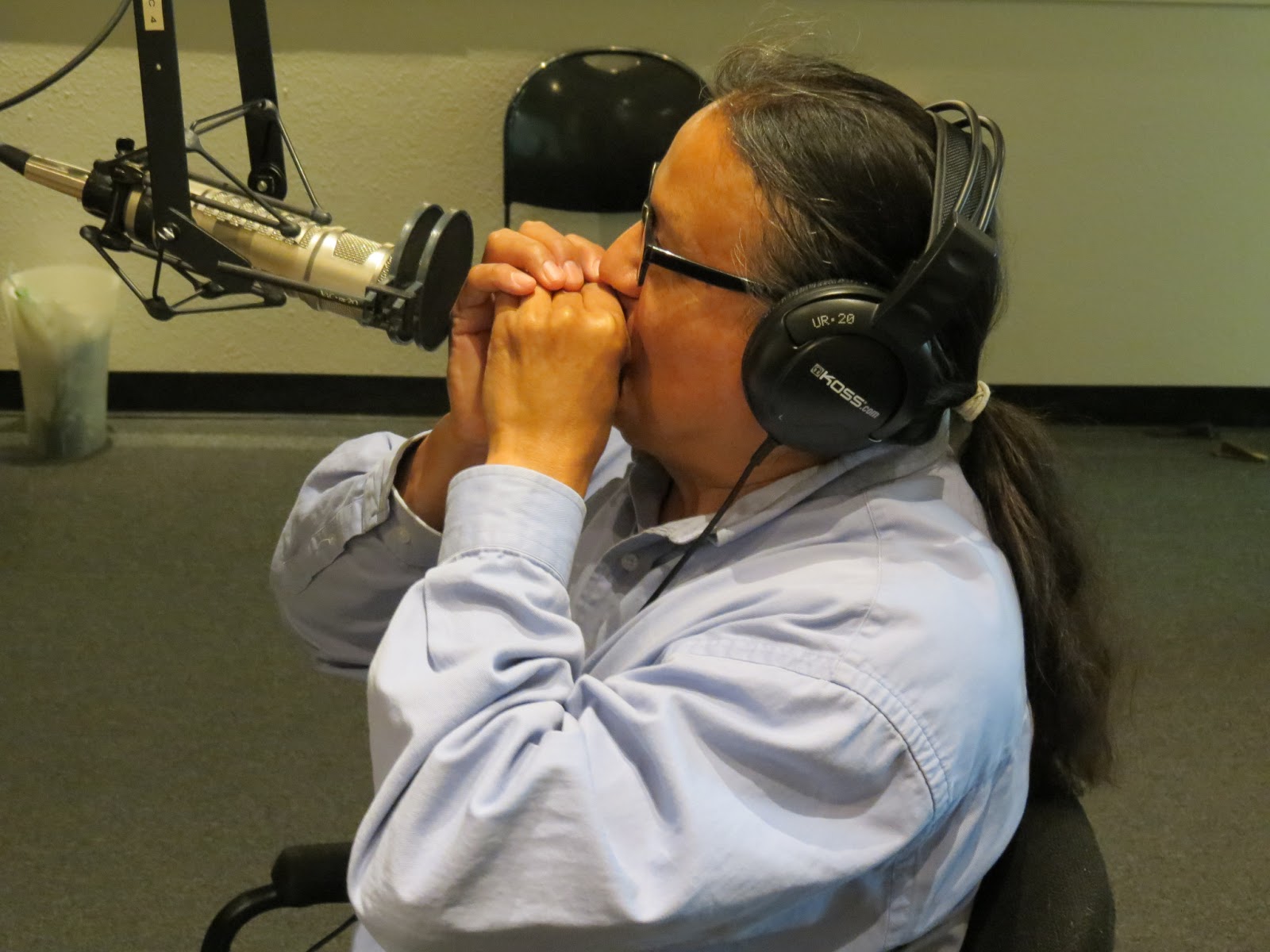
University of Texas law professor Gerald Torres was Thorne Dreyer's guest on Rag Radio, Friday, July 12, 2013. Torres, who holds the Bryant Smith Chair in Law at the University of Texas, is an expert on environmental and agricultural law, critical race theory, and federal Indian law.

And he plays a mean harmonica!

Rag Radio is a syndicated radio program produced at the studios of KOOP 91.7-FM, a cooperatively-run all-volunteer community radio station in Austin, Texas.

Listen to or download this episode of Rag Radio here:


Among issues that Professor Torres discusses with us on the show are the recent U.S. Supreme Court decisions on voting rights and affirmative action, plus immigration reform, Atmospheric Trust litigation, and Native American sovereignty.

Gerald Torres, who was associate dean of the University of Minnesota Law School before coming to UT-Austin, has served as deputy assistant attorney general for the Environment and Natural Resources Division of the U.S. Department of Justice in Washington, D.C., and as counsel to then U.S. Attorney General Janet Reno.

His book, The Miner’s Canary: Enlisting Race, Resisting Power, Transforming Democracy (Harvard University Press), written with Harvard Law Professor Lani Guinier, was described by Publisher’s Weekly as “one of the most provocative and challenging books on race produced in years.”

Gerald Torres in performance!
Professor Torres is a past president of the Association of American Law Schools. He has served on the board of the Environmental Law Institute, the National Petroleum Council, and on EPA’s National Environmental Justice Advisory Council. He is a member of the Council on Foreign Relations and the American Law Institute.

Torres was honored with the 2004 Legal Service Award from the Mexican American Legal Defense and Educational Fund (MALDEF) for his work to advance the legal rights of Latinos. He currently is Board Chair of the Advancement Project, the nation’s leading social and racial justice organization. He is also on the board of the Natural Resources Defense Council and is Vice-Chairman of the Board of Earth Day Network.

He has been a visiting professor at Harvard, Stanford, and Yale law schools.


Rag Radio is hosted and produced by Rag Blog editor and long-time alternative journalist Thorne Dreyer, a pioneer of the Sixties underground press movement.

The show has aired since September 2009 on KOOP 91.7-FM, an all-volunteer cooperatively-run community radio station in Austin, Texas. Rag Radio is broadcast live every Friday from 2-3 p.m. (CDT) on KOOP and is rebroadcast on Sundays at 10 a.m. (EDT) on WFTE, 90.3-FM in Mt. Cobb, PA, and 105.7-FM in Scranton, PA.

The show is streamed live on the web by both stations and, after broadcast, all Rag Radio shows are posted as podcasts at the Internet Archive.

Rag Radio is produced in association with The Rag Blog, a progressive Internet newsmagazine, and the New Journalism Project, a Texas 501(c)(3) nonprofit corporation. Tracey Schulz is the show's engineer and co-producer.

Rag Radio can be contacted at ragradio@koop.org.

Coming up on Rag Radio:
THIS FRIDAY,
July 19, 2013: Sociologist, media critic, and author Todd Gitlin.
Friday, July 26, 2013: Sanford, FL-based political science prof Jay D. Jurie, on the consequences of the Trayvon Martin verdict.

The Rag Blog

[+/-] Read More...

18 February 2013

Bob Feldman : Population Growth and Civil Rights Victories in Texas, 1940-1953

Herman Sweatt was the first African American to attend the University of Texas after a 1950 Supreme Court decision. Photo courtesy of UT Press / Daily Texan.
The hidden history of Texas
Part 12: 1940-1953/2 -- Population growth and some significant civil rights victories.
By Bob Feldman / The Rag Blog / February 18, 2013

[This is the second section of Part 12 of Bob Feldman's Rag Blog series on the hidden history of Texas.]

As Texas’s manufacturing industry expanded to produce more weapons and supplies for U.S. government needs during World War II, the need for factory workers in Texas increased; and more people in Texas moved from rural areas into cities and towns between 1940 and 1953.

By 1950, over 7.7 million people now lived in Texas and around 60 percent of all people in Texas now lived in urban areas. By 1950, for example, 596,163 people lived in Houston, 434,462 in Dallas, 408,407 in San Antonio, and 278,728 in Fort Worth; however, Austin's population was still only 132,459 in 1950.

According to Alwyn Barr’s Black Texans, “World War II almost doubled the number of black industrial workers” in Texas -- from 159,000 to a peak of 295,000 in 1943. But during World War II “the Consolidated Vultee plant” still “segregated its assembly line; and Baytown oil refineries paid blacks less than whites for the same work,” according to Randolph Campbell’s Going To Texas.

Many Texas-born African-Americans continued to leave white supremacist Texas society between 1940 and 1953 for states in the Northeast, Midwest, or West in which racial segregation was not legalized and where they had often been able to find factory jobs during World War II. But in Houston -- where the total population had grown from 384,514 to 596,163 between 1940 and 1950 -- the “black population increased from 86,302 to 125,400” during the 1940s, according to Merline Pitre’s In Struggle Against Jim Crow.

And -- despite an anti-black riot by white racist Texans that occurred on June 15, 1943, in Houston -- African-American civil rights activists in Houston and elsewhere in Texas between 1940 and 1953 began to win a few victories in their campaigns for an end to legalized racial discrimination, white supremacy, institutional racism, and interpersonal racism in Texas society and daily life.

In 1943, for example, a Houston NAACP “boycott against Winegarten Store [Sic: Correct spelling is "Weingarten's"] led to the dismissal of one of the store’s security guards, who had struck a black customer” and “an NAACP-led demonstration made it possible for blacks to attend a production of Porgy and Bess at the Houston Music Hall and be seated on the same floor levels as whites,” according to In Struggle Against Jim Crow.

In addition, “on Apr. 6, 1943... representatives of the Negro Committee of the Houston Teachers Association presented the school board with a petition for pay equalization” and “on Apr. 13, 1943, rather than take a chance on a... lawsuit, the Houston school board agreed to make the salaries of black teachers and principals equal to those of their white counterparts who possessed the same credentials and performed the same duties,” according to the same book.

Then in 1944, the U.S. Supreme Court declared Texas’s white Democratic primary law to be illegal in its Smith v. Allwright decision in a legal case that African-American civil rights groups in Texas had initiated. And in 1946 -- when 5,000 new members were recruited into the Houston chapter of the NAACP -- African-American civil rights activists in Texas began to challenge the racist admissions policy of the University of Texas in Austin.

As In Struggle Against Jim Crow recalled:
Lulu B. White... executive secretary of the NAACP’s Houston branch, and the NAACP’s state director... led fight...to integrate the University of Texas... Urged on by the NAACP and accompanied by Lulu White and other supporters, Herman Sweatt attempted to register at UT in Austin on Feb. 26, 1946. After a discussion with [then-University of Texas] President Theophilus Painter and other university officials, Sweatt left his application at the campus and returned to Houston... Sweatt sued university officials on May 16, 1946 for denying him admission...

In April 1949, Joseph J. Rhoades, president of Bishop College, organized a mass registration attempt sending 35 black college seniors from across the state to apply to various professional programs at UT... When they arrived at the registrar’s office seeking admission, they were told that they could apply at TSUN [Texas State University for Negroes; later renamed Texas Southern University]. These students then decided to stage a demonstration, marching from the university to the State Capitol. They carried placards... One sign read, "Texas Can’t Afford a Dual System of Graduate and Professional Education" Another proclaimed, "Separate and Equal Education Is a Mockery."...

The Supreme Court announced its findings in Sweatt v. Painter on June 5, 1950. In a unanimous decision the Court ordered Sweatt admitted to UT.
Also, “during the summer of 1946... the death of a black man gave rise to the largest mass protest demonstration that the city of Houston had ever witnessed” and “the NAACP... converted the funeral for Berry Branch, killed by a white bus driver, into a rally” in which “all labor unions in the city were represented,” according to the same book.

Yet despite the legal victories, there was still a poll tax in Texas that was utilized to block many African-Americans from being able to vote and the “only civil service positions” African-American residents were allowed to hold in Houston before 1945 “were in the post office,” according to In Struggle Against Jim Crow.

In addition, in 1948 only 15 of Houston’s 503 police officers were African-Americans and the “custom” of “the most blatant among the Houston companies” in its discriminatory policies between 1940 and 1953 -- Hughes Tool -- was still “to hire whites at 60 cents an hour and blacks at 50 cents an hour, although they were performing the same tasks,” according to the same book.

And,  “Austin in 1951 changed its city council representatives from geographical districts to an at-large basis which guaranteed control of all seats by the white majority,” according to Black Texans.

The number of African-Americans who lived in Texas only increased from 924,391 to 977,458 between 1940 and 1950, as many African-Americans left Texas for the West Coast, Midwest, or Northeast; and as late as 1945 there were still only about 45,000 people of Jewish religious background who lived in Texas.

But by 1950, the number of Latinos of Mexican descent living in Texas -- 1 million -- now exceeded the number of African-Americans who lived in the state.

[Bob Feldman is an East Coast-based writer-activist and a former member of the Columbia SDS Steering Committee of the late 1960s. Read more articles by Bob Feldman on The Rag Blog.]

The Rag Blog

[+/-] Read More...

07 February 2013

Anne Lewis : UT-Austin Ponders Privatizing Staff

Members of the Make UT Sweatshop-Free Coalition gather at the UT-Austin Tower Wednesday, February 6, to protest the University's consideration of job privatization for staff members. Photo by David Maly / The Horn.

'Culture war' at UT-Austin: 
President Powers considers privatization
The most deeply-rooted problem with Powers’ plan for cost cutting through privatization, consolidation, and commercialization is that it does not respect the rights of workers.
By Anne Lewis / The Rag Blog / February 8, 2013

AUSTIN, Texas -- On January 29, 2013, University of Texas at Austin President Bill Powers convened the UT-Austin community to make recommendations about increasing our efficiency that would include job privatization for university staff.

President Powers’ speech led to despair, anger, and confusion across our campus. Despair and anger came from threatened loss of health care, state pensions, jobs, and community; confusion from the contradiction posed by the projected image of Powers as our defender against the likes of Governor Rick Perry and the University of Texas Board of Regents.

Powers is presented as an administrator who wants both affordability and high quality in a February 2, 2013, Associated Press article, “Texas Fight Highlights Higher Ed Culture Clash.” The article -- which says that, "If colleges were automobiles, the University of Texas at Austin would be a Cadillac: a famous brand, a powerful engine of research and teaching" -- defines Texas as ground zero in a culture war to preserve educational quality and research, but degenerates towards the end when it quotes Peter Flawn, our emeritus president:
"Universities are by their very nature elite," he said. "Their job is to separate the sheep from the goats and the goat-sheep from the sheep-goats, and try to produce people who are knowledgeable and can reason, think and solve problems.”
And that, it seems, is the intellectual quality of this particular thread of discussion. I would not characterize my students as sheep, goats, sheep-goats, goat-sheep, nor would I consider the role of a university to be a sorter of the forenamed critters. It is not true that the enemy of our enemy is our friend. I think it’s critical that we look hard at what President Powers said.

The United Nations Declaration of Human Rights, which lays the groundwork for “an existence worthy of human dignity,” states in Article 23:
Everyone has the right to work, to free choice of employment, to just and favorable conditions of work and to protection against unemployment. Everyone has the right to form and to join trade unions for the protection of his interests.
The most deeply-rooted problem with Powers’ plan for cost cutting through privatization, consolidation, and commercialization is that it does not respect the rights of workers.

The plan is based on a report from the Committee on Business Productivity which convened for the first time in April 2012. Committee Chair Steve Rohleder is part of the executive leadership of Accenture, a global outsourcing company that cost the state of Texas more than $800 million in a failed effort to privatize food stamp and TANF eligibility. Other members of the committee are tied to equity firms TPG, Capital Royalty, HM Capital, Falconhead Capital, and Bull Ventures; and to Boeing, StarTex, Dell, and Susser.

President Powers says that the only way that UT-Austin can become “the very best public university in America” is to operate like a business through outsourcing and privatization of services; market costs to students for meal plans, housing, and parking; job reductions through consolidation of human resources, technology, and financial processing; and commercialization of intellectual property. He calls this a moral imperative.

President Powers states, “We’ve been outsourcing all along: we don’t have a fleet of airplanes used by faculty to get to meetings; we use Southwest Airlines.”

UT probably should not own a fleet of airplanes and pay the pilots with public funds. But the relationship of pilots to our university is quite different from that of workers who serve food, clean buildings, support our offices and technical facilities, and generally keep the university running.

These workers (who include many students) will lose and lose big -- guaranteed pay levels and advancement possibilities, state pensions and benefits, safety and environmental standards, rules against discrimination in employment, and the right to join a union.

I also question the assumption that cost-saving experiments endorsed by finance capital are best for the citizens of Texas. Accenture’s failed contract needlessly increased the suffering of thousands of poor and working class Texans and their children. The attempt to take over management of the Kerrville State Hospital last year by Geo Group, the private prison corporation, was resolved when State Health Commissioner David Lakey stated that reductions in staffing would put both the patients and the State of Texas at risk.

The notion that a business model is the only way for human endeavors to succeed seems strange at best. Cost cutting business practices have contributed to economic inequality, disregard of safety and environmental standards, and discrimination in employment. It’s why we need laws, government regulation, and labor unions where workers can have a collective voice.

It’s often more -- not less -- expensive when neoliberals turn not-for-profit into profit-making ventures. The savings that come from lower pay, lower health care costs, and erosion of pensions for workers will most likely benefit the company more than our university. That’s part of the margin of profit. The other part is increased cost for services.

We already see Powers’ suggestion that students should pay the market value -- 50% more for their privatized meal plans; 113% more for privatized parking for staff and students; more for privatized student housing -- all going towards the profits of contracted corporations and none benefiting our community.

President Powers boasts that “over the past five years, some 4,000 people left the payroll voluntarily. That’s 20 percent of UT’s core staff workforce.” Those jobs and positions have not been replaced. The thought of an additional 20 percent cutback is feared not only by workers who may not leave voluntarily but also by their co-workers who have added workloads and sometimes have impossible jobs.

Go to any office in our university at 7 p.m. and you will find workers who have been there since 8 a.m.. The work of support staff is necessary for the university to function properly. It’s wrong to balance a budget on job loss and inadequate staffing.

Finally, in an unfortunate example, President Powers compares the effort, which will be led by Chief Financial Officer Kevin Hegarty, to the Pope moving an obelisk in 1586. As a union woman who respects the dignity of work both intellectual and manual, I ask who exactly carried that 344-ton obelisk and under whose organizational authority.

We're sure that Mr. Hegarty would agree that he has none of the moral authority of a pope. Our university is not a 344-ton obelisk. We who devote our intellect, energy, and care to UT should have a voice in these decisions that so deeply impact our lives, our families, and our community.

I would suggest another approach. President Powers should go to the Texas legislature and demand that Texas pay its share with the same force he used to promote Austin taxpayer funding of a new medical school.

The Texas Constitution (1876) states:
The Legislature shall establish, organize and provide for the maintenance, support and direction of a university of the first class, styled "The University of Texas."
Thirty years ago, Texas funded more than half of the budget of UT-Austin. It’s now down to 13%. President Powers should join us at the Capitol on April 10 for a march and rally in defense of the public good and public workers.

Will Rogers once said, “When you’re in a hole, stop digging.”

[Anne Lewis, a senior lecturer at the University of Texas and a member of TSEU-CWA Local 6186 and NABET-CWA, is an independent filmmaker associated with Appalshop. She is co-director of Anne Braden: Southern Patriot, associate director of Harlan County, U.S.A, and the producer/director of Fast Food Women, To Save the Land and People, Morristown: in the air and sun, and a number of other social issue and cultural documentaries. Her website is annelewis.org.]

The Rag Blog

[+/-] Read More...

16 January 2013

Robert Jensen : Jim Koplin: Living Your Life Honestly

James Henry Koplin, 1933-2012. Image from JimKoplin.com.

Jim Koplin:
Living your life honestly

By Robert Jensen / The Rag Blog / January 16, 2013
“Good teaching is living your life honestly in front of students.”
I don’t recall exactly when Jim Koplin first told me that, but I know that he had to say it several times before I began to understand what he meant. Koplin was that kind of teacher -- always honing in on simple, but profound, truths; fond of nudging through aphorisms that required time to understand their full depth; always aware of the connection between epistemology and ethics; and patient with slow learners.

But, I’m getting ahead of myself. Some background: Jim Koplin was, by way of a formal introduction, Dr. James H. Koplin, granted a Ph.D. in psychology from the University of Minnesota in 1962 with a specialization in language acquisition, tenured at Vanderbilt University and later a founding faculty member of Hampshire College, retired early in 1980 to a rich life of community building and political organizing.

I never took a class from him, though in some sense the 24 years I knew him constituted one long independent study. That finally ended on December 15, 2012, not upon satisfactory completion of the course but when Jim died at the age of 79. He left behind a rich and diverse collection of friends, all of whom have a special connection with him. But I hang onto the conceit that I am his intellectual heir, the one who most directly continued his work in the classroom.

So, with that conceit firmly in place and his death fresh in my mind, it seems proper and fitting that I offer lessons learned from Koplin to the world outside his circle of students and friends.

I’ve spent a considerable amount of time in my 20 years of teaching at the University of Texas at Austin reflecting on Jim’s core insight, that good teaching is living your life honestly in front of students.

The first, and most obvious, implication is a rejection of the illusory neutrality that some professors claim. From the framing of a course, to the choice of topics for inclusion on the syllabus, to the selection of readings, to the particular way we talk about ideas -- teaching in the social sciences and humanities is political, through and through.

Political, in this sense, does not mean partisan advocacy of a particular politician, party, or program, but rather recognizing the need to assess where real power lies, analyze how that power operates in any given society, and acknowledge the effect of that power on what counts as knowledge.

Every professor’s “politics” in this sense has considerable influence on his/her teaching, and I believe it is my obligation to make clear to students the political judgments behind my decisions. The objective is not to strong-arm students into agreement, but to explain those choices and defend them when challenged by students. At the end of a successful semester, students should be able to identify my assumptions, critique them, and be clearer about their own.

I would recommend this approach for all faculty members, but it has been particularly important for me because I am politically active in fairly public ways, which students often learn about through mass media and the internet. To make clear the difference between the goals of Jensen-in-the-classroom (encouraging critical thinking) and Jensen-in-public (advocating political positions), I have taken extra care to be transparent in front of students.

This also was a product of my time with Jim, who insisted that if intellectual inquiry led one to conclusions about what is needed to advance social justice and ecological sustainability, then one should contribute to those projects. Jim’s life offered me a model for how intellectual work need not be separated from community and political work.

In one of my early conversations with Jim about this balance, he referred me to one of his elders, Scott Nearing, who said that three simple principles guided his life: the quest “to learn the truth, to teach the truth, and to help build the truth into the life of the community.” Each of those endeavors feeds the other two; scholarship, teaching, and community engagement are a package deal for me. But Jim always reminded me that what one does in front of students is not the same as what one does in front of a crowd at a rally, or in an organizing meeting.

Perhaps Jim’s most important contribution to my development as a teacher came in his advocacy of interdisciplinary undergraduate education. In the contemporary academy, the reward system and culture tend to push professors toward intellectual specialization over the big picture, and toward working with graduate students over undergraduate teaching. In my connection with Jim, I saw the importance of -- and joy in -- a truly interdisciplinary approach to knowledge that took as its primary task teaching at the most basic levels.

The first course I taught in the university-wide program called First-Year Seminars, “The Ethics and Politics of Everyday Life,” was straight out of Koplin: I had students read five books that touched on the political, economic, and ecological implications of our choices in our daily lives. Every time I worried that I would be pushing students too far, Jim would tell me that the students were hungry for honest, jargon-free radical talk, and he was right.

I devised my current interdisciplinary course, “Freedom: Philosophy, History, Law,” in conversation with Jim. As it came into focus, I told Jim that I wanted the course to not only challenge the culture’s simplistic definition of freedom but to undermine the confidence of anyone who thinks the term can be easily defined.

On the first day of class, I tell students that the minute they think they have nailed down a definitive definition of freedom, some new experience will force them to modify that. It is the struggle to understand the concept that matters, and I am just another person struggling with them, albeit with the advantage of more extensive reading and experience.

That reflects another of Jim’s other lessons, the understanding that a good teacher learns alongside students. That doesn’t mean pretending that students have as much to teach me as I have to teach them (if that were the case, why am I the one getting paid?); the excitement comes from genuinely being open to that discovery with students.

As a teacher, I shape -- but cannot control -- the experience. There’s always a certain kind of thrill in that process, especially in front of a class of 300. There are days when I feel a bit like I am doing an intellectual high-wire act. Those tend to be my favorite classes.

That thrill is rooted in another Koplin lesson: Good teaching is based in recognizing our intellectual limits, our ignorance. By that, he did not just mean that any single teacher can’t know everything. Instead, Jim meant that we humans are always more ignorant than knowledgeable, that even in fields in which we have dramatically deepened our understanding of the world, there is -- and always will be -- far more that we do not know than we do know.

I have come to realize that the longer I teach, the more I know and the less certain I am about what I know. The more aware I am of the limits of my knowledge, the better teacher I become.

Jim also believed that all teaching required an appreciation of the arts, and he taught me to look for wisdom in poetry. To the best of my knowledge, Jim never wrote a line of poetry in his life, but that made him only more appreciative of the form.

I cannot remember if I shared this poem with him or vice versa; at some point, as it is with a good teacher, the flow of information and insight was two-way and impossible to track. Whomever it came from first, Jim and I came across the poem “Dropping Keys” by Hafiz, the 14th century Sufi poet from Persia.
The small person
Builds cages for everyone
She
Sees.

Instead, the sage,
Who needs to duck her head,
When the moon is low,
Can be found dropping keys, all night long
For the beautiful,
Rowdy,
Prisoners.
For too many students, education too often feels like a cage. If we aren’t careful, we teachers can find ourselves building cages, guarding cages, and then locking ourselves inside those cages.

Jim Koplin never stopped dropping keys for me. To honor his memory, I will try to do the same for my students.

This article was also published at New Left Project.

[Robert Jensen is a professor in the School of Journalism at the University of Texas at Austin and board member of the Third Coast Activist Resource Center in Austin. He is the author of
Arguing for Our Lives: Critical Thinking in Crisis Times (City Lights, coming in 2013). His writing is published extensively in mainstream and alternative media. Robert Jensen can be reached at rjensen@uts.cc.utexas.edu. Read more articles by Robert Jensen on The Rag Blog.]

The Rag Blog

[+/-] Read More...

29 November 2012

Mercedes Lynn de Uriarte : Supreme Court Case Raises Larger Diversity Issues at UT-Austin

Though the UT-Austin student body is among the most diverse in the country, other related issues plague the school and its history. Photo by Eric Gay / AP / Christian Science Monitor.

Supreme Court focus on UT
student DNA masks pressing issues
The matter being debated by the Supreme Court is not apt to really address the long uneven evolution of the University of Texas toward integration.
By Mercedes Lynn de Uriarte / The Rag Blog / November 29, 2012

AUSTIN -- Several weeks ago the U.S. Supreme Court once again heard a lawsuit (Fisher v. the University of Texas) challenging the admission policies of the University of Texas that take race and ethnicity into account as one of the various factors considered. At the heart of the recurring conflict over admission policy is the struggle over whether UT must become integrated -- an achievement long resisted.

In fact, like many southern universities, the institution has layers of diversity, the most evident of which are the maintenance and service staff. The transient student population is now integrated by population based on DNA count. Over half -- 26,090, 51% --of the campus student body is white. This fall there are 8,973 Latinos, 2,140 African Americans, 7,939 Asian Americans and 151 American Indians. Of these, 80% are Texas residents. UT clearly meets its mandate as a land grant institution to educate future decision-makers largely the result of admission policies.

The battle to retain a bit of intellectual diversity rages on. This month Asian-American faculty and junior administrators met to discuss the implications of what the current suit might mean to their studies center. Just last year Mexican-American students demonstrated against curriculum cutbacks in their studies center made necessary by budget shortfalls. African and African-American Studies also felt the sting of cuts.

But even more visible are a series of racist actions, the most recent and most nasty three occurring since the start of the fall semester three months ago. A UT sorority threw a “Mexican theme” party where invited guests came as gardeners, maids, or criminals -- or wore T-shirts identifying themselves as “ILLEGAL.” Others dressed as border guards mingled.

In another stunt, fraternity members threw balloons of bleach at minority students. One fraternity party, also planned around race themes, was cancelled. The press covered all of these incidents. The October 22 issue of the student Daily Texan, reported that someone carved swastikas in an off-campus dormitory door where three Jewish students live. These sorts of hate messages have a long history at UT where the statue of Martin Luther King has often been vandalized.

July 16, 2004, cover of UT student newspaper, The Daily Texan, featuring story about campus dormitory named after former law prof who was also a Ku Klux Klan leader. Creative Commons image from fretna.org.

Even the buildings reflect a racist past. In 2010, after publication of a history book by Tom Russell, a former UT Law School professor, the University, after some deliberation, changed the name of a dorm memorializing William Stuart Simkins, a Klan leader and Law School professor in the early 1900s. UT administrators named the residence hall just after the 1954 Supreme Court decision outlawed segregated schools.

The least integrated of the UT human component is the faculty.

Demographics of teaching faculty (which excludes those who are deans, directors, or administrative officials) testifiy to slow integration across rank, gender, and diversity. At first glance, this does not seem to be the case: Of 3,018 of this faculty 1874 are male, 1144 are female. Within this group 80% are white.

But the ratio of full professors indicates significant skewed reality -- in 2010 (the latest posted data) just short of 800 were male, only 210 were female. Because race and ethnicity narrows the general professorial group, the ratio of minority professors to full professor whites is minute.

Some departments, including my own, have never promoted a woman or a minority to full -- although one minority woman (no longer at UT) was appointed to full,  a move that avoids the usual review and promotion committee approval -- and recently hired a woman who had earned the rank of full at another university.

Some of UT’s DNA profile records earlier years of blatant discrimination, but more recent evidence indicates a fairly tenacious hold on troubling patterns of the past. For example, three years ago UT authorized a study of the treatment of its faculty women drawing on its own statistics, pay records, and promotion experiences. That produced 170 pages that charted inequity.

The experience of minority females was not made specific because, as one equity researcher explained: “The small number of minority women faculty is not statistically significant.”

So the matter being debated by the Supreme Court is not apt to really address the long uneven evolution of the University of Texas toward integration. The suit, of course, does not consider intellectual diversity -- a component critical to the success of social integration. A legal mandate would raise both first amendment protections and academic freedom guarantees.

But the push in some quarters to do away with studies that focus on minority literature, history, sociology, and other content is short-sighted as well as anti-intellectual. And narrowing access to education contributes to these problems.

[Mercedes Lynn de Uriarte, a PhD, is an Associate Professor Emeritus at the University of Texas. She currently directs a funded study -- Austin Displaced -- which explores the impact of gentrification on affected residents. Mercedes is also president of the board of the New Journalism Project, the nonprofit that publishes The Rag Blog.]

The Rag Blog

[+/-] Read More...

20 November 2012

Robert Jensen : What Starts at UT... Accelerates Destruction?

Image from Latinitas.

UT motto modification:
What starts here...
accelerates destruction?
While UT administrators may be heartfelt in their belief that 'we are driven to solve society’s issues,' most of the so-called solutions that are generated ignore or intensify the fundamental problems of the systems.
By Robert Jensen / The Rag Blog / November 21, 2012

AUSTIN -- I want to suggest a slight modification of the University of Texas’ motto, “What starts here changes the world.”

A more accurate slogan -- while not quite as pithy and probably less effective for public-relations purposes -- would be, “What starts here accelerates the destruction of the world.”

I am not suggesting that the administrators or faculty of UT, where I have been a professor for two decades, want to destroy the world. Rather, I’m arguing that like almost every other institution of higher education in the United States, UT is complicit in the ongoing destruction of the world by offering a curriculum that celebrates the existing economic/political/social systems, which undermine the life-sustaining capacity of the world.

While that claim may sound crazy, I think my reasoning is calm and careful. The destructive features of contemporary America’s systems -- an extractive economy that demands endless growth, with a mystical faith in high-energy/high-technology systems and gadgets, dependent on continued mass consumption of goods of questionable value -- are all woven into the fabric of UT’s teaching and research.

Entire departments on campus are staffed with faculty who seem incapable of imagining a challenge to those features and appear dedicated to maintaining the systems. The goal of most courses is to train students to play by the existing rules, not question the systems that produce the rules.

The obvious problem: We face multiple, cascading ecological crises that should spur us to rethink our economy, politics, and society, but the existing rules rule out such thinking. If we can’t transcend these intellectual limits, it is not clear that an ongoing large-scale human presence on the earth will be possible.

What is clear is that affluent societies such as the United States cannot continue to live indefinitely in the style to which so many have become accustomed. In the short term such affluence can be maintained only by intensifying already unconscionable levels of inequality, and in the long term even that soulless strategy can’t stop the inevitable decline and eventual collapse.

First, the difficult realities. Look at any crucial measure of the health of the ecosphere in which we live -- groundwater depletion, topsoil loss, desertification, chemical contamination, increased toxicity in our own bodies, the number and size of “dead zones” in the oceans, extinction of species and reduction of bio-diversity -- and ask a simple question: Are we heading in the right direction?

Don’t forget that we also live in an oil-based world and are rapidly depleting the cheap and easily accessible oil, which means we face a huge reconfiguration of the infrastructure that undergirds our lives. The desperation to avoid that reconfiguration has brought us into the era of “extreme energy,” marked by the use of more dangerous and destructive technologies (hydrofracturing, deep-water drilling, mountain-top removal, tar sands extraction).

And, of course, there is the undeniable trajectory of global warming and climate disruption.

Where does that leave us? Instead of thinking in terms of manageable “environmental problems,” scientists these days are talking about tipping points and the breach of planetary boundaries, about how human activity is pushing the planet beyond its limits.

Second, the deficient response. Universities, which have the resources to chart the new paths that are necessary, too often push students onto the same old dead-end roads. On occasion, cautionary notes from the academy are sounded. For example, one group of scientists recently warned that humans are forcing a planetary-scale critical transition “with the potential to transform Earth rapidly and irreversibly into a state unknown in human experience,” which means that “the biological resources we take for granted at present may be subject to rapid and unpredictable transformations within a few human generations.”

Unfortunately, most of the modern university pays no heed. The most obvious place where realities are avoided and illusions maintained is the business school, ground zero on campus for the indoctrination into capitalist ideology.

What’s the problem with that? After all, hasn’t capitalism unleashed incredible productivity and created unparalleled wealth? Yes, but putting aside the important questions about what the unequal distribution of that wealth says about our alleged commitment to moral principles (in case it’s not clear, it says we don’t take our moral principles very seriously), we now face the grim reality that capitalism is ecocidal. Industrial capitalism treats the world as a mine from which to extract resources and a dump for wastes.

Largely unregulated markets obscure that destruction, as financial “instruments” are traded with no regard for what is necessary for a real economy to continue -- the capacity of nature to sustain life.

But in business school, future corporate leaders are taught to maximize profit, marketing experts develop evermore ways to sell us things we don’t need, and financial wizards slice and dice the numbers to make it all work -- at least on paper.

How much critique of the destructive capacity of contemporary corporate capitalism will students encounter in the UT business school? I regularly ask my students about their experience in business classes, and they report that there is virtually no such discussion beyond occasional mentions of “corporate social responsibility,” a concept designed to assuage consciences rather than deal with core problems. Real critique in business classes is so rare that when I ask that question, students either look confused or chuckle at the absurdity.

Move over to the economics department, which at UT (and most other universities) is dominated by the conventional wisdom of neoclassical and/or mildly reformist Keynesian economic thought. These models acknowledge “market failures” and “negative externalities,” and then proceed to downplay the dramatic consequences. Failures and externalities such as climate disruption and other human-generated forms of ecological destruction aren’t mere footnotes to otherwise well-functioning models.

Yet while these looming disasters reveal the models to be irrational, market fundamentalism demands we ignore the obvious.

These difficult realities do not seem to slow down the economics department or the business school, as they offer instruction in the theory and practice of a system that is killing the planet at a quickening pace.

In other parts of the university, the story is slightly more complicated. In the government department and law school, for example, a wider range of views are acceptable, but the overall thrust of each is toward the conventional. The study of law and politics typically takes corporate capitalism as non-negotiable, and so other aspects of our lives must adapt to the rules of that economic game. A few critics are allowed in these departments but are largely treated as cranky misfits who need not be taken seriously.

In the sciences and engineering, there is less attention paid to economic/political/social systems. There, administrators and faculty see their disciplines as focused on answering different kinds of questions. Here it is not market fundamentalism but technological fundamentalism that is most troubling.

Technological fundamentalists assume that the increasing use of evermore sophisticated high-energy advanced technology is always a good thing and that any problems caused by the unintended consequences of such technology eventually can be remedied by more technology. This kind of magical thinking offers a reassuring way out of the problems that the extractive/industrial economy has created -- if we ignore the history of those unintended consequences.

The story of air-conditioning is a great example. The chlorofluorocarbons (CFCs) widely used in cooling systems were depleting the ozone layer, and so they were replaced with “safer” hydrochlorofluorocarbons (HCFCs), which we now know are contributing significantly to global warming. Rather than rethink our demand for constant cooling, we stumble forward looking for the next technological fix.

But if we look only for “solutions” that don’t disturb existing systems, and those existing systems are unsustainable, then our solutions are at best irrelevant and at worst will exacerbate the fundamental problems and make it harder for people to imagine new systems. That’s not an argument to abandon all attempts to improve technology, but rather a reminder of technology’s limits and dangers.

The university departments where one is most likely to find the culture of sustained critical inquiry we need are in the humanities and the social sciences. These departments -- philosophy, history, literature, sociology, anthropology, as well as ethnic and women’s studies -- will vary ideologically depending on time and place, but they offer space from which one can think about challenges to existing systems of power and privilege.

While much excellent and exciting thinking goes on in such settings, too often the way in which that knowledge is framed and communicated guarantees that any insights will not go beyond a narrow scholarly community. The university’s system of rewards and punishments encourages professors to stay stuck in the academic trenches, which have become increasingly self-indulgent spaces.

As long as critically minded academics stay safely within academic life and speak an unnecessarily jargon-laden specialized language, they are free to pursue whatever topics they like, but at the cost of social irrelevance.

Let me be clear about what I am NOT arguing: I am not suggesting there is no good intellectual work done at UT; I am not suggesting that the system has cowed every administrator or professor; and I most certainly am not saying that anyone who disagrees with me is corrupt or incompetent.

Reasonable people can disagree, and I do not think I have an exclusive claim on wisdom. I consider myself a hard-working second-tier intellectual and make no claim to being a terribly deep or original thinker. This essay reflects the analyses and arguments made by an increasingly large group of critics urging us to step back and think more deeply about the world we have built.

And let me be clear about one more thing: I love my job and am grateful for the resources that UT provides for my work. But when I try to understand the system in which I work, I observe patterns that keep certain points of view dominant and other approaches marginal.

I see younger faculty who want to challenge that system but get beaten down, or who toe the line out of fear, or who are quickly seduced by the promise of privilege. I see students who want to push their professors to consider more critical views but often give up when they meet resistance.

Most important to understanding all this, I see a system of higher education that is structured hierarchically like a corporation and largely dependent on corporations for support. The primary reason that UT rarely challenges the conventional wisdom is that it is dependent on other institutions and people who build, maintain, and profit from the conventional wisdom.

The University of Texas should be a place where teaching and research challenge the culture to face what it prefers to ignore. Such confrontation isn’t going to come from corporations in a capitalist economy, which are dedicated to the status quo. Such confrontation isn’t going to come from conventional political parties and politicians, who are largely captured by the wealth concentrated in the corporate sector.

Such confrontation usually emerges on the margins of society, from relatively small grassroots groups that generate new ideas but lack the resources to put the relevant issues on the public agenda.

Universities could serve an important role in helping amplify those challenges to power. They have not only the resources, but the responsibility of pursuing knowledge even when the consequences are uncomfortable. UT claims that “we are a catalyst for change,” but the institution implicitly defines that as “change within existing systems.”

While UT administrators may be heartfelt in their belief that “we are driven to solve society’s issues,” most of the so-called solutions that are generated ignore or intensify the fundamental problems of the systems.

In a culture that is short on long-term vision, universities are vital spaces for critical thought. Instead of remaining trapped within the logic of existing systems, that critical thinking has to be more creative. If there is to be a decent future, we have to give up on the imperial fantasy of endless power, the capitalist fantasy of endless growth, the technological fantasy of endless comfort.

There’s a lot of intellectual work to do if we are to create such a future. What starts at UT and other universities can change the world, but only if we give up on those seductive fantasies and start facing the difficult realities.

[Robert Jensen is a professor in the School of Journalism at the University of Texas at Austin and board member of the Third Coast Activist Resource Center in Austin. He is the author of Arguing for Our Lives: Critical Thinking in Crisis Times (City Lights, coming in 2013) His writing is published extensively in mainstream and alternative media. Robert Jensen can be reached at rjensen@uts.cc.utexas.edu. Read more articles by Robert Jensen on The Rag Blog.]

The Rag Blog

[+/-] Read More...

09 May 2011

Robert Jensen : The Job Formerly Known as Teaching


Delivering educational products:
The job formerly known as teaching


By Robert Jensen / The Rag Blog / May 9, 2011

Hi, I’m Robert Jensen, a provider of educational products to consumers at the University of Texas at Austin.

I used to introduce myself as a UT professor, but that was before I attended a Texas Public Policy Foundation session last week, offering more exciting “breakthrough solutions” to the problems of higher education.

At that session in a downtown Austin hotel, I learned that these very real problems -- escalating costs and questionable quality of undergraduate instruction -- can be solved in the “free market.” You know, the free market, that magical mechanism that gave us the housing bubble/credit derivative scam/financial meltdown. The free market that has produced growing inequality in the United States and around the world. That good old free market.

The solutions offered by representatives of the Cato Institute’s Center for Educational Freedom, and the Center for College Affordability and Productivity in the morning’s first session focused on ending public subsidies for higher education and treating it like any other business.

These insights come on the heels of the much-hyped “seven breakthrough solutions” that TPPF has been pushing. (Read about them here, and for a satirical treatment go here.)

Not surprisingly, both panelists spoke in the language of the market, turning education into a commodity. Panel moderator William Murchison, a conservative syndicated columnist, chimed in during the discussion, referring to “consumers of the educational product.”

I think that means students.

That pithy phrase led me to the microphone in the Q&A period, where I asked whether in this mad quest to turn higher education into a business the panelists might not be promoting efficiency so much as guaranteeing the final destruction of what’s left of real education.

I said that I found it difficult to understand my teaching -- which focuses on how citizens should understand concentrations of power in government and corporations, and on how journalists should respond -- as “an economic exchange,” in the words of Cato’s Neal McCluskey.

Both McCluskey and Matthew Denhart from CCAP responded with more of the market mantra and didn’t seem to recognize, or care, that commodifying education might have implications not just for how we organize institutions and evaluate professors, but for learning itself.

Denhart responded that the “product” doesn’t have to be solely job training, but would include instruction in “esoteric concepts.” Those apparently are the two alternatives in college classrooms: purely practical or interesting irrelevance.

That got me thinking about my favorite class, “Critical Issues in Journalism,” the large introductory course I teach in the School of Journalism. The course tries to examine -- rigorously, but in plain language using clear concepts -- the nature of democracy and the role of the news media.

My goal is to model the critical thinking that is crucial for citizens and journalists in a world facing multiple crises (political and economic, cultural and ecological) with dwindling hopes for a smooth transition to a just and sustainable future. Rather than accept the shallow platitudes of American democracy or the self-serving claims of American mainstream journalism, I encourage students to challenge the conventional wisdom (and me).

My students can speak to how well I do that, but my interest here is in how I understand the nature of what I do. When I think of when the class seems to work best -- the moments that students seem to be most engaged with these crucial questions -- it’s difficult to think of myself as delivering an educational product or of my students as consumers.

Instead, I’m happy with being a professor. I profess.

“Profess” can be used in different ways -- to make a disingenuous statement (“He professed to like his boss”) or to announce religious commitments (“She professed her faith in God”). But I use it in the sense of making a public claim to knowledge, with an openness to respond to critiques of that claim.

When it really works, students not only listen to professors but learn to profess themselves. When it works, I’m just an older -- and, one hopes, at least slightly wiser -- version of my students.

That experience can happen in vocational training as well as in courses more philosophically focused. Good journalism writing teachers, for example, know the joy of professing the love of the craft and helping students discover that joy. The presumed division between training and intellectual work occurs only when teachers accept that false divide and abandon efforts to bring the two together.

I don’t want to appear naïve; I realize that much of what happens in American college classrooms (including mine, of course) falls short of these ideals on any given day. The question is not whether we sometimes fail, as we all do, but why failure sometimes becomes routine. On this count, ironically, I agree with some of the critiques coming from the TPPF.

After 19 years of full-time teaching at the University of Texas, I’ve heard a lot of legitimate student complaints about professors who don’t care about teaching. I’ve complained myself about the irrelevance and inanity of so much of the “research” produced in the disciplines I know in the social sciences and humanities.

I played that research game for my first six years to pass inspection and get tenure, but after that I dropped out of the scholarly publishing arena to concentrate on writing for a general audience. Shortly after that I stopped teaching graduate courses out of frustration with the self-indulgence of so much of the research/theory crowd in the study of media and mass communication. These days, I enjoy the challenge of connecting with undergraduates, writing about political and social matters, and speaking in public.

Let me be clear: This is not an anti-intellectual screed or an attack on systematic thinking and inquiry. I have learned a lot from the work of other scholars, which is reflected in the courses I teach, and such thinking and inquiry is more needed than ever to face these deepening crises. My writing for general audiences is rooted in research, defined more broadly.

But the critics of the university have a point. Increasingly, the academic game that most professors play is so self-indulgent that ordinary people -- not just reactionary ideologues with libertarian fantasies -- will not, and should not, support it indefinitely. Education is not a commodity, but economics are relevant in the sense that we don’t live in a world of endless resources.

But here’s where I part company with the critics: Instead of pretending to be able to measure faculty output and draining the life from teaching, we need to embrace the ideals of the university rather than capitulate to the false promises of failed market ideology. The obsessions with measurement and testing have nearly destroyed K-12 public education, and if applied to higher education it will have similar effects.

That model may be particularly attractive to those on the right precisely because it is so effective at undermining the kind of critical thinking some of us are trying to encourage in our classes. As U.S. society has moved steadily to the right over the past three decades, conservatives have been eager to eliminate the few remaining spaces in the culture where critiques of power -- especially concentrated economic power in a society marked by obscene wealth and indecent inequality -- can flourish.

Some parts of the modern university -- especially those teaching business, advertising, and economics -- are devoted to propping up that power, and much of the rest of the campus is not far behind. The corporatization of the modern university -- both in internal organization and reliance on funding from corporations and corporate-based foundations -- has done much to eliminate critical thinking that is connected to struggles for political and economic justice.

The victory of the market model would be the end of real education, if by education we mean independent inquiry into the power that structures our lives.

I’m encouraged that UT President Bill Powers -- who appeared on the second panel of the day, and had to endure the self-aggrandizing ramblings of fellow panelist and TPPF Senior Fellow Ronald Trowbridge -- supports faculty in this debate and recognizes the threats to academic freedom embedded in this market madness.

I have disagreements with the university administration about many things, but we faculty would make it easier for administrators in that debate if we not only press the institution to support us but engage in critical self-reflection.

In hallway conversations, faculty members will express frustration about bad teachers (though there is not always agreement on which colleagues are the bad teachers) who are allowed to continue to muddle along. Many worry that the demands for scholarly production have become so focused on quantity rather than quality that much of what is published in academic journals is of little value, even for specialists in a disciple.

Acknowledging these systemic failures doesn’t detract from all the good teaching done in universities, nor does it lessen the value of the important research of many faculty members. Instead, it should simply remind us that we owe it to the state, our students, and ourselves to confront these issues. If we don’t, the reactionary forces that increasingly dominate the culture will take care of it for us, and instead of breakthroughs in higher education we will witness an accelerating breakdown.

[Robert Jensen is a journalism professor at the University of Texas at Austin and board member of the Third Coast Activist Resource Center in Austin. He is the author of All My Bones Shake: Seeking a Progressive Path to the Prophetic Voice, (Soft Skull Press, 2009) and Getting Off: Pornography and the End of Masculinity (South End Press, 2007); Jensen is also co-producer of the documentary film Abe Osheroff: One Foot in the Grave, the Other Still Dancing, which chronicles the life and philosophy of the longtime radical activist. Robert Jensen can be reached at rjensen@uts.cc.utexas.edu. This article was also posted at the Texas Observer website. Read more articles by Robert Jensen on The Rag Blog.]

The Rag Blog

[+/-] Read More...

15 November 2010

BOOKS / Gary Chason : Glenn Jones' Novel is Paranoiac Psychedelic Memoir


A dark psychedelic flashback:
'Why Are We in Texas?'


By Gary Chason / The Rag Blog / November 15, 2010

[Why Are We in Texas? A novella by Glenn Jones (Lulu.com, 2010); Softcover; 93 pp.; $14. Also available as an electronic download for $3.99.]

Glenn Jones’ epic yarn, Why Are We in Texas?, is not so much a nostalgic stroll down memory lane as it is an LSD flashback. Drawing on over 60 years of Austin counterculture, it starts on that fateful day in 1966, when Charles Whitman rained hot lead down upon the campus, and ends a (disturbingly) few years in the future at that same, uber-symbolic building: the University of Texas Tower.

In a flash-forward prologue, Texas actually secedes from the United States, setting off a war that pits well-armed Tea Party types, bikers, the National Guard, Aggies, cowboys, gay revelers, liberals, soldiers from Fort Hood, and assorted others in a wild free-for-all of blood and guts. The “big-haired Governor,” the secessionist leader, avoids harm by cross-dressing and escaping on a motorcycle. Jones’ vision of the future is beyond dystopian; it reads like a bad acid trip. (You probably had at least one of those. I know I did.)

Between the beginning and end, the story revolves around Lon, a familiar enough denizen of the Austin underground, who, at the outset, is an underachieving UT student who spends more time discussing esoterica -- and paranoid fantasies -- in the Chuck Wagon at the Texas Union than he does on his classwork. The naturalism of the social scene, and indeed most of the novel, is in jarring contrast to the opening and closing sequences, which sometimes don’t seem to be part of the same story.

I was reminded of Billy Lee Brammer’s The Gay Place and Hunter Thompson’s Fear and Loathing in Las Vegas in equal measures. It is clear that Jones, a former contributor to The Rag, The Rag Blog’s print media predecessor, didn’t get any of his story ideas from books at the library; he obviously lived it from the inside, ate it up and swallowed it whole.

We are immersed in hippie culture, with all the drugs, booze, free sex, and radical politics that we could ever want. It feels authentic because it is authentic, as anyone who lived in Austin during those decades can attest. The iconic locations are all there: The Plantation, Les Amis, Vulcan Gas Company, Armadillo World Headquarters. And Lon’s residence is a spot-on depiction of the Ghetto, that legendary bastion of counterculture at its most awesome.

The main characters are recognizable, resembling people we all knew, or maybe still know. If you look closely enough, you may see yourself in there somewhere. We encounter rock stars Janis Joplin and Roky Erickson, filmmaker Eagle Pennell, writers Bud Shrake and Billy Lee Brammer, in a mix that somehow summarizes the whole shebang, that attempts (with considerable success) to put the entire Austin experience down on paper. If you can remember the Sixties and Seventies, it has been suggested that you didn’t really live them. This book will help you fill in the gaps in your memory.

It is so Austin-centric, however, that I wonder if readers who live elsewhere will get it. There’s a lot to be said, I suppose, for being time/place specific. It’s a staple of good storytelling. And for those potential readers who have never lived in Austin, I offer my sincere condolences. This book will serve as a primer.

Our hero and his many friends grow up, get married and divorced, screw around on each other, drink too much, smoke too much, party too much, get real jobs, and do all the things that make life happy and miserable simultaneously. Time passes; shit happens. Lon wants to write but never seems to get it together, and he is sometimes hard to like, especially when he’s slamming his wife through the sheetrock in a drunken rage.

In the epilogue, which matches the prologue in tone and paranoia, Lon’s dark side seems to win out. Regarding a stolen nuclear bomb brought up the Colorado River by boat from the Gulf of Mexico and buried on a farm, suspension of disbelief is a big stretch, but let’s give Jones the benefit of the doubt. After all, this is a paranoid fantasy, like many spun out over endless cups of coffee at the Chuck Wagon.

Which makes me wonder: Is that really what it’s been about?

In all, Why Are We In Texas? is a fast, fun read, especially for those of us fortunate enough to have been a part of the culture Jones so accurately depicts. I’m just hoping for a happier ending in real life.

[Gary Chason is an Austin-based independent filmmaker, actor, screenwriter, playwright, and stage director. His article, "Sexual Freedom League: The Naked Truth" was the cover story in the second issue of The Rag, August 17, 1966.]

The Rag Blog

[+/-] Read More...

14 July 2009

Robert Jensen : The Color of the Race Problem is White (Video)


The Color of the Race Problem is White
By Robert Jensen / The Rag Blog

“The Color of the Race Problem Is White” was a lecture by Professor Robert Jensen, recorded at the University of Texas at Austin on March 30, 2009. The lecture itself is 28 minutes and also includes 24 minutes of discussion. Jensen is the author of The Heart of Whiteness: Confronting Race, Racism, and White Privilege.

In The Souls of Black Folk, W.E.B. DuBois suggested that the question white people so often want to ask black people is, “How does it feel to be a problem?” This program turns the tables and recognizes some simple facts: Race problems have their roots in a system of white supremacy. White people invented white supremacy. Therefore, the color of the race problem is white. White people are the problem. White people have to ask ourselves: How does it feel to be a problem?

Following the ideas in his book The Heart of Whiteness, Jensen argues that -- even decades after the significant achievements of the civil rights movement and with an African-American president -- it is still appropriate to describe the United States as a white-supremacist society, in terms of how we think and how we live.

Through an analysis of contemporary racial ideology, Jensen presents a framework for critiquing the naturalizing of power and privilege in other arenas of our lives (gender, class, nationality, and ecology). How have we come to accept so easily systems of domination and subordination? How did we become resigned to hierarchy? How can we challenge the unjust and unsustainable nature of the systems in which we live?

[Robert Jensen is a journalism professor at the University of Texas at Austin and board member of the Third Coast Activist Resource Center. Among his books is The Heart of Whiteness: Confronting Race, Racism and White Privilege (City Lights, 2005) Jensen is also co-producer of the documentary filmAbe Osheroff: One Foot in the Grave, the Other Still Dancing, which chronicles the life and philosophy of the longtime radical activist. Jensen can be reached at rjensen@uts.cc.utexas.edu and his articles can be found online here.]

The Rag Blog
/ Posted July 14, 2009

[+/-] Read More...

18 June 2009

Austin : Spirited Demonstration Denounces Iranian Elections

Iranians and their supporters demonstrated at the Texas State Capitol Wednesday, June 17, 2009. Photos by James Retherford / The Rag Blog.

Dude. Where’s my Vote?

By Thorne Dreyer / The Rag Blog / June 18, 2009
See more photos below.
A rally and march condemning alleged election fraud in Iran took place in downtown Austin yesterday, Wednesday, June 17, 2009, starting at 5 p.m. Some 350 people, a majority of them Iranians and many either students or faculty at the University of Texas at Austin, gathered in front of the Texas State Capitol.

Backed by live music fueled by two energetic drummers, they chanted, listened to speakers and poetry, and waved signs directed at passing rush hour traffic. Many in cars honked their support and flashed peace signs. The demonstrators’ placards called for “Democracy for Iran” and asked “Where is my Vote?” Non-Iranian supporters showed signs expressing their “Solidarity with Iran.”

Then the two-block long group marched down Congress Ave. to Sixth Street and back, chanting “What do we want? Democracy!” and “Ahmadinejad. Shame on You,” One distinguished grey-haired gentleman in tie, jacket slung over his arm, stepped proudly while holding up a sign that asked, “Dude. Where’s my Vote?”

The demonstration was organized by UT student group Iranians for Peace and Justice, and by the Persian Student Society of UT and
Austin Permanent Peace Protest.

Also see Were Elections a Fraud? Uprising in Iran; Protest in Austin by Banafsheh Madaninejad / The Rag Blog / June 16, 2009


Demonstrators in Austin protest alleged voter fraud in Iran. Photos by James Retherford / The Rag Blog.

The Rag Blog

[+/-] Read More...

Only a few posts now show on a page, due to Blogger pagination changes beyond our control.

Please click on 'Older Posts' to continue reading The Rag Blog.