Showing posts with label Cocaine. Show all posts

22 May 2013

REPORT / Mariann G. Wizard : 'La Vida Coca' in Bolivia and Peru / 3

Coroico is the administrative capital of Bolivia's Nor Yungas province. The town hall façade features the coca leaf and coffee bean of local agriculture in addition to the exotic bird of tourism, the area's main economic activities. All photos by Mariann G. Wizard / The Rag Blog, unless otherwise credited.
La Vida Coca /3: 
Currents in traditional coca 
use in Bolivia and Peru
Regular tours of the area include coca 'plantations.' Almost all of the other travelers we met in Coroico and Copacabana were interested in trying and discussing coca.
By Mariann G. Wizard / The Rag Blog / May 22, 2013

Part three of three.

(Rag Blog Contributing Editor Wizard recently visited Peru and Bolivia with former fellow Ragstaffer Richard Lee. Wizard says the whole thing was Lee's idea, although she did the heavy lifting of writing this report of their experiences, while lifting copiously from conversations they shared and short reports Richard wrote on the spot.)

After being in Coroico about a week, we asked a woman we'd met on our first day there if she knew any cocaleros who might be willing to talk with us about the crop. A hard-working, intelligent person who was extremely patient with our often halting Spanish, she laughed, ducked her head, and said, "Soy una cocalera." ("I am a coca grower.")[1]

She isn't a commercial grower. She and her family tend a few plants, along with abundant fruit trees and vegetables. Over coffee and cake, she described carefully sprouting the small red seeds, transplanting them into pots, then into the field. She showed us the growth pattern of the plants and told us that the growth tips are never touched. We heard about cutting plants off near the base, then regrowing them; regeneration can occur several times, giving plants a life span of 20 years or more.

Most of what we learned I've since confirmed online, but there's nothing like hearing it from a passionate gardener! Her cupped hands as she demonstrated transplanting seedlings, her expertise in how to tell by touch when the hojas are dry enough for storage, reminded me of every other master gardener I know: pride, respect, and love make things grow. Richard, green thumb tingling, was also in his element!

Still, we wanted to see large coca fields. A couple we'd met recommended a local taxista who knew the area well, and we took an agricultural tour of greater Coroico. Tramping up and down steep, muddy jungle slopes before breakfast, swarmed by aroused mosquitoes, we weren't so much in our element as over cake and coffee! But we kept on chewing hojas and drinking water, and keeping on, until we saw what we came to see: well-tended, mature cocal, up close and personal.

Like many Bolivian towns, Coroico is surrounded by a network of rural villages (villas). I liked this "bewitching" signpost.
Here, several distinct cocal fields are seen on the hillside. We were told that each plot is owned by an individual or family; adjoining plots may be owned by close relatives or grown children. Photo by Richard Lee / The Rag Blog.
This small, well-tended cocal field near the road was easy for us to access.
Here you can see that the plant in front center has been cut off just above the ground and regenerated to its present height.
Small red seeds (see inset for enlargement) from tiny white flowers. Seeds are planted soon after falling off the parent plant. PVC pipes bring water for irrigation and for workers to drink. At high altitudes under a strong sun, hydration is vital.

Coca isn't the only traditional herbal medicine in common use in Peru and Bolivia. Chamomile (manzanillo; Matricaria recutita syn. Chamomilla recutita) or anise teas, mint (yerba buena; Mentha viridis), lemon verbena (yerba luisa, cedrón; Aloysia citriodora), and West Indian lemongrass (Cymbopogon citratus) were recommended and served to us by gardeners, restaurateurs, and/or friends.

Specific comments regarding manzanillo as a sleep aid, yerba buena to "balance" heavy foods, and yerba luisa as an overall tonic were noted. As in other indigenous cultures, many foods' and condiments' health effects are common knowledge, especially in traditional Quechua- and Áymara-speaking households.

After I had an allergic reaction to Coroico's notorious mosquitoes, bringing up lovely big red welts on my arms, everyone we met told me about one or another traditional repellent. Rubbing whole limes (Citrus limonum) on the skin in the evening was the one most mentioned. To be fair, DEET also worked quite well; if only I'd thought to use it that first rainy day!

Dried spices, hojas de coca, peppers (Capsicum spp.), and other condiments at Coroico's weekly market. Peppers, garlic (Allium sativum), and other spices are used in unique sauces, ajillos, by restaurants and at home; everyone seems to have a recipe for ají.
Both countries boast a wealth of fruits and vegetables -- Bolivia has over 30 varieties of potatoes (papas; Solanum spp.)! -- many not seen in the U.S., or seen infrequently, or in a processed state. While restaurants do not avail themselves much of this produce bounty (many serve French fries and rice at every meal!), a trip to the mercado brings delicious rewards. We recruited friends to cook papas lisas for us and enjoyed a fabulous traditional stew of the tiny potatoes, onion (Allium cepa), and alpaca rib meat – ¡que sabrosa!

Besides cattle, pigs, poultry, and sheep, two domestic camelid species, llamas and alpacas, are raised for meat, fiber, and as beasts of burden. (Wild vicuñas are protected.) Alpaca meat isn't much different from grass-fed beef in flavor. Guinea pigs (cuy) are also a traditional Andean food. Richard ate cuy years ago in Ecuador; I'll pass! However, some dishes I did have were equally odd, like this "chicken foot soup":


Peru, with its extensive coastline -- Bolivia is landlocked -- offers a wide array of fresh seafood. Lake Titicaca, between the two nations, is home to delicious lake trout.

By the way, again from Wikipedia, "Raw coca leaves, chewed or consumed as tea or mate de coca, are rich in nutrition... Specifically, the coca plant contains essential minerals (calcium, potassium, phosphorus), vitamins (B1, B2, C, and E) [, and]... protein and fiber."[2]

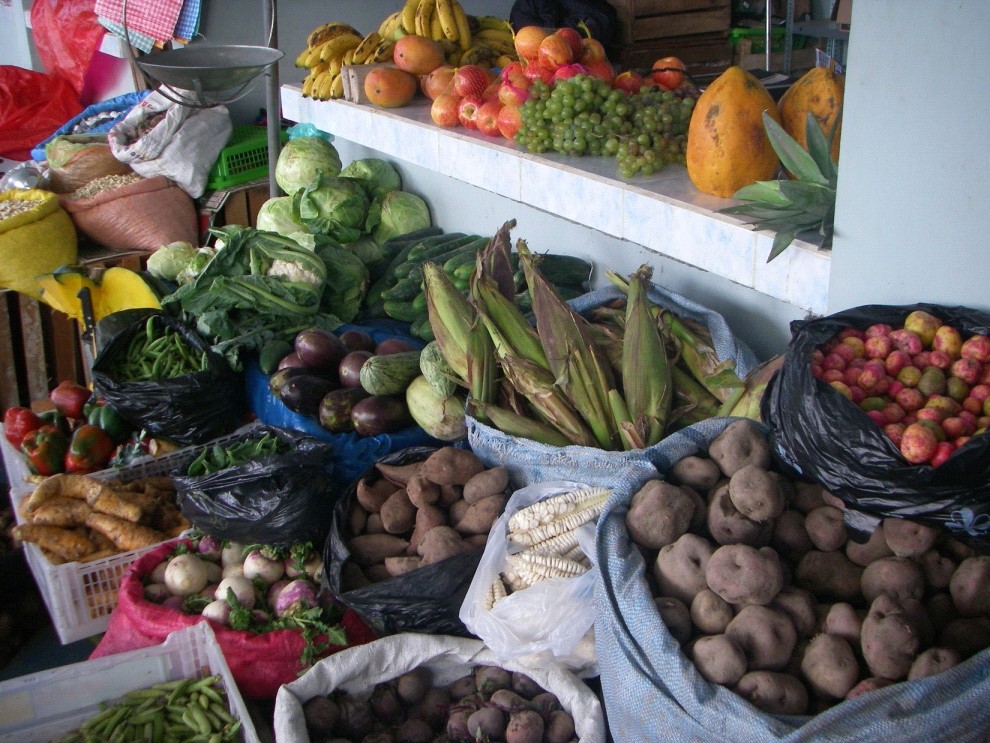
Abundant fruits and veggies in Coroico's weekly market. Papas lisas are the small red and yellow potatoes at right center. I also ate papas negras, the purple ones at bottom right and center, cooked whole in oil -- ¡muy rico!

Not all traditional medicine in the region is herbal or food-based. Good luck rituals and tokens abound, like the brightly-colored fetishes below, in La Paz' Mercado de Hechicería (Witches' Market). Arriving during Carnavál, we also saw cars, taxis, and buses decorated and prayed over as a blessing; and good luck icons by the score, such as miniatures of items the buyer hopes to obtain: money, cars, televisions, etc.[3] All of the shops in the Hechicería had coca. Some Andean shamans use hojas to divine the future.

In the Mercado de Hechicería, dried llama fetuses (hanging) of various sizes are sold. These are buried for good luck in new enterprises, especially those involving construction. Well-to-do traditional people are expected to sacrifice a live animal.

While our inquiries had been fruitful, we had questions our local informants couldn't readily answer. For example, other than for rapid drainage, and where the terrain consists of steep slopes, is it necessary to plant at such challenging angles? Also, can cocal be grown at lower altitudes than Coroico's 5000 feet above sea level, and if so, would this affect its strength or efficacy?

Lest you think we must have stood out for our unusual interest in coca, rest assured, we did not. Regular tours of the area include coca "plantations." Almost all of the other travelers we met in Coroico and Copacabana -- people of all ages from Switzerland, Belgium, New Zealand, Chile, Brazil, Germany, France, Australia, and Japan -- were interested in trying and discussing coca. Bolivians from other parts of the country were interested in comparing the local product with coca from their area.

Our "where's Waldo?" moment: a day after our field trip, strolling across Coroico's plaza for perhaps the 50th time that week, we finally recognized the healthy if somewhat untended stand of cocal growing there among the palms and hibiscus (Hibiscus sabdariffa). Since this is about the only flat spot in Nor Yungas, it seemed to settle whether cocal must be grown on a slope! (The question of altitude remains open.)

The public cocal patch in Coroico's main plaza.. Photo by Richard Lee / The Rag Blog.
Andean music on the plaza draws a crowd. Traditional women from the Afro-Bolivian community (seated, right front) are said to be prolific coca users.
The Sanjuanitos wowed us with John Lennon's "Imagine." Richard later wrote, "Lennon could have imagined this..."

It is in the plaza that matters of interest are discussed before and after cocalero meetings at the roofed "polyfunctional" sports court down the hill. Bolivia's future is being shaped by astute agriculturalists who value tradition but want the benefits of modernity. Change, like the new cell phone technology that has reportedly made rural life safer, is weighed and measured before adoption.

In this small plaza and others all over Bolivia and Peru, citizens talk and relax at the end of the day or the week, after school or at lunch time. Taxis come and go; buses disgorge weary travelers. Children and dogs run free and everyone sees that the soccer ball doesn't bowl over any old folks. Young couples promenade hand in hand in the evening, while the ice cream man, and the chicken sandwich lady, and the elders sitting on stone or wooden benches smile in approval. Here, coca is at home.

[Rag Blog Contributing Editor Mariann G. Wizard, a Sixties radical activist and contributor to The Rag, Austin's underground newspaper from the 60s and 70s, is a poet, a professional science writer specializing in natural health therapies, and a regular contributor to The Rag Blog. Read more poetry and articles by Mariann G. Wizard on The Rag Blog.]


Footnotes:
[1]I'm not naming any Bolivian acquaintances, in order to protect their privacy. None of them live electronically.
[2]http://en.wikipedia.org/wiki/Coca
[3]The fake lucky dinero, by the way, is from "El Banco de Buena Fortuna," and Richard got taken for 50 Bolivianos (about $7.50 US) by making change in the dark. It's a wonder what a photocopier can do, isn't it?

The Rag Blog

[+/-] Read More...

15 May 2013

REPORT / Mariann G. Wizard : 'La Vida Coca' in Bolivia and Peru / 2

Coca leaves, a standard small bag sold for personal use in Bolivia. From 10-40 hojas are used at once while working, walking, or otherwise exerting oneself at high altitudes. Habitual users enjoy coca three or four times a day. All photos by Mariann G. Wizard / The Rag Blog, unless otherwise credited.

La Vida Coca /2: 
Currents in traditional coca 
use in Bolivia and Peru
The overall effect of chewing leaves, drinking coca tea, or eating coca-containing foods can be described as both energizing and calming. Stress and anxiety are decreased, gastric disturbances eased, and the next hill isn't quite so daunting.
By Mariann G. Wizard / The Rag Blog / May 15, 2013

Part two of three.

[Rag Blog Contributing Editor Mariann Wizard recently visited Peru and Bolivia with former fellow Ragstaffer Richard Lee. Wizard says the whole thing was Lee's idea, although she did the heavy lifting of writing this report of their experiences, while lifting copiously from conversations they shared and short reports Richard wrote on the spot.]

It is estimated that 50% of Bolivia's gross national product is related directly or indirectly to coca. The illegality of much of this crop, and its ineligibility for international trade, has significantly handicapped Bolivia's economy and given it, along with Colombia, something of an "outlaw" reputation.

Rather than succumb as Colombia has at least temporarily done to U.S. demands for crop eradication, Bolivia now charts an independent path to international legitimacy and respect. Commodities production has given Bolivia a positive trade balance since 2004. Natural gas, silver, zinc, and soybeans account for 72% of total exports.

Main imports are machinery and transport equipment, chemicals and related products, and mineral fuels and lubricants. Main trading partners are Brazil (33% of total exports, 18% of imports), Argentina (12% of exports, 13% of imports), and United States (10% of exports and 11% of imports).[1]

A new Bolivian Vice Ministry of Coca and Internal Development was established in February 2009, in a reorganization of the executive branch. It is charged with developing employment opportunities, diversifying the economy, respecting traditional cultural values, and in general furthering Bolivian President Evo Morales' overarching vision of "Living Well."

It is expected to rationalize the processing of coca, maintain a climate of social peace, and mitigate and prevent conflicts under the new national policy of peacefully combating drug trafficking.[2]

One of the possible side effects of this policy is a striking lack of domestic militarization in Bolivia compared with most other Latin American nations we've visited in recent years. It's like the dog that didn't bark in the night, not obvious at first but increasingly pleasant over time.

It's worth noting that women spearhead Morales' administration. Strides in women's liberation are seen everywhere. Ending domestic violence and the rule of "machismo" are serious concerns in Bolivia's social revolution. Billboards and televised public service announcements proclaim, "Don't Kill The One You Love." Civilian gun ownership is banned.

While we were still in Bolivia, the campaign to have traditional coca use removed from the list of narcotics finally succeeded,[3] following a powerful appeal by Morales to UN delegates in Vienna.[4] Among the folks we talked with or saw responding in newscasts, this was met with firm approval. If Evo is leading a revolution, his constituents, at least in the altiplano, are keeping pace every step of the way.

Today, there is an emphasis on developing new products to "soak up" the excess coca that feeds illicit drug production, rumored to be concentrated in Brazil. Across the Amazon River, in one of the most difficult environments on the planet, one can envision secret jungle drug labs. But in the highlands, coca is part of a healthy, active lifestyle: "Living Well."

Coca candies, cookies, "teas" (actually infusions; true tea is Camellia sinensis), energy bars, and more are available or in the works. Coca Colla™, an energy drink made with coca extract, was reportedly launched in April 2010, but we didn't see it anywhere; we would surely have tried it. At least 35 coca product brands are operating.[5] A new publication, Il Jornada Nacional del Acullico, launched in 2012 to "reclaim" traditional coca mastication.[6]

Stevia (Stevia rebaudiana), an herb that produces the sweetest natural substances known to date, calorie-free steviosides, grows in Bolivia and is included in many products, in line with the government's overall health-promotion and economic development programs. It's commonly available in restaurants as an herb.

While coca "tea" is often made with whole leaves, there are also many chopped, bagged products from large and small manufacturers. When made of pure hojas, such teas may still be chewed as well as brewed for a stronger effect.
Coca teas, Larco Museum gift shop, Lima. Note the different flavors, including a coca-green tea combination. Some sources state that the term "maté" was adopted for coca teas to capitalize on the popularity of yerba maté (Ilex paraguariensis), but it is used in northwestern Bolivia for any mixed infusion. Matés commonly include tea, anise (Pimpinella anisum), cloves (Syzygium aromaticum), cinnamon (Cinnamonum verum), or other herbs or spices.
Energizing coca- and maca (Lepidum meyenii)-based candies, left, from airport gift shop, Lima. Coca-and-quinoa (Chenopodium quinoa) cookies, right, from Arcoiris Pasteleria on the plaza in Coroico, Nor Yungas, Bolivia.

Many medicinal and personal care products are made with coca, like these at Coroico's Blue Pine Tienda, as entrepreneurs combine traditional lore and modern marketing to legitimize coca in world markets.

Ingacoca's™ banner lists coca syrups for coughs, asthma, prostate support, rheumatism, acidic urine, liver support, stomach ulcers, gastritis, anemia, weight loss, mental acuity, poor appetite, diabetes, nerves, insomnia, kidneys, intestinal parasites, and high blood pressure; salves for rheumatism, varicose veins, bone support (coca is high in calcium), arthritis, gout, fungi, and hemorrhoids; and shampoo and skin creams.

What scientific support is there for the claimed benefits of coca leaf? Herbal medicine expert Andrew Weil says,
Coca appears to be a useful treatment for various gastrointestinal ailments, motion sickness, and laryngeal fatigue. It can be an adjunct in programs of weight reduction and physical fitness and may be a fast-acting antidepressant. It is of value in treating dependence on stronger stimulants.

Coca regulates carbohydrate metabolism in a unique way and may provide a new therapeutic approach to hypoglycemia and diabetes mellitus. With low-dose, chronic administration it appears to normalize body functions. In leaf form coca does not produce toxicity or dependence. Coca can be administered as a chewing gum or lozenge containing a whole extract of the leaf, including alkaloids, natural flavors, and nutrients.[7]
However, as with cannabis, coca's illegality makes it difficult for research on these benefits, all with at least some evidence, to proceed. A search of the PubMed database for Erythroxylon brought up just 109 reports, many on plant pharmacology. Interestingly, several studies used little-known species, not those most cultivated, but having local traditional uses. Most found a chemical basis for the tradition. Some reports are historical; others are policy, cultural, or environmental studies.

There are epidemiological and clinical studies of coca's effects in altitude sickness. (Results: it works and people use it without ill effects.) A study of effects of hojas on biochemical and physiological parameters found metabolic benefits with prolonged physical activity; that is, more fat is burned by users during exercise.[8]

We started seeing coca tea and/or hojas at the hotel breakfast (desayuno) buffet in Nazca, Peru, and at most hotels and hostels after that. Coca tea was on almost every restaurant menu. We learned later that coca is also readily available in Lima, where we had spent a week in ignorance. After all, at sea level, why would anyone have altitude sickness?

But the energizing qualities of coca can benefit tourists at any altitude: see more, do more, enjoy your trip more. While I was sick in Arequipa (everyone there blamed Nazca's water!), hotel staff, doctor, and "Ricardo" all recommended coca. Poco a poco, it helped.

Desayuno buffet at Hotel Berlina, La Paz, with hojas de coca and coca tea. This hotel also had leaves and tea, and hot water, in the lobby at all times.

So, everybody asks, "What is it like to chew coca?" What many really want to know is, "What is it like compared to cocaine?"

It's different. It's not nearly as strong as blow, no matter how much lejia (see below) you use or how many leaves you cram into your cheeks. Yes, there is an astringent flavor; yes, you can get a numbing effect in mouth and throat; yes, there are alkaloids in the leaves and you can test positive for cocaine if that's a concern.

The overall effect of chewing leaves, drinking coca tea, or eating coca-containing foods can be described as both energizing and calming. Stress and anxiety are decreased, gastric disturbances eased, and the next hill (everything in Bolivia is uphill or downhill from where you are!) isn't quite so daunting.

But, unlike the single alkaloid cocaine, use of whole leaf products doesn't end in a sudden emotional or energy crash or turn nice people into a--holes. After a time, the effect gently fades away. Neither of us ever experienced sleeplessness, anxiety, or remorse while using hojas.

And of course there is no issue of addiction or compulsion. You can take it or leave it (unless, of course, you're one of those people who can't take or leave anything; in that case, well, hojas are a lot cheaper than refined "salt").

The mild, balanced effects parallel those of other whole herbs versus single compounds. A classic example is cannabis flowers versus tetrahydrocannabinol (THC), their main psychoactive ingredient. Pharmaceutical medicines of THC alone can cause anxiety. Using whole cannabis for pain control, appetite stimulation, and other medical purposes causes fewer problems and gives patients more control.

And as it turns out, many "minor" ingredients of cannabis -- cannabinoids and other compounds -- also have benefits. The latest pharmaceutical versions of what Mother Nature provides are standardized cannabinoid blends.

A small piece of lejia ("lye") made from stevia (above) or quinoa ash, burned limestone, or baking soda ("bico"), is often chewed with coca to free more alkaloids. This produces a stronger effect, including numbing the inside of the mouth, than hojas alone.
Our serious quest for knowledge began in La Paz, the capital of Bolivia, 13,323 feet above sea level. We visited the coca market, ADEPCOCA, just four blocks from the Villa Fatima terminal, where minibuses from coca-growing Nor Yungas province leave and arrive hourly.

Four stories (each about 100 x 80 m) of coca fill La Paz' bustling ADEPCOCA market. This photo, made early on a Sunday, shows little of the traffic that normally congests this intersection, so that more of the building can be seen. The structure covers a full block. The sign on the front says "COCA ES VIDA"; coca is life.
Bags of prime hojas with the ADEPCOCA logo ready for delivery to hotels, markets, and other outlets. Taxis often carry several bags at a time along with passengers, piling bags in cargo compartments and atop vehicles.
While most traditional women and older men in the market didn't wish to be photographed, this young man with iPod had no qualms and happily posed. Many hundreds of bags like his are bought and sold daily at ADEPCOCA.

Between La Paz and Coroico, along what was once "the most dangerous road in the world," cocal, as coca is called in the field, begins to be seen. The closer we came to one of Bolivia's prime coca centers[9] (like our driver and some fellow passengers, chewing hojas all the way!), the more we saw the well-tended crop on steep hills framed by snowy peaks, rushing waterfalls, and infinite shades of green.

A cocal field near the road. Maintaining agricultural terraces or gradas under frequently torrential rains is an ongoing task of Andean coca growers. Photo by Richard Lee / The Rag Blog.

NEXT: Cocal up close and personal; everything else; our "Where's Waldo?" moment.

[Rag Blog Contributing Editor Mariann G. Wizard, a Sixties radical activist and contributor to The Rag, Austin's underground newspaper from the 60s and 70s, is a poet, a professional science writer specializing in natural health therapies, and a regular contributor to The Rag Blog. Read more poetry and articles by Mariann G. Wizard on The Rag Blog.]


Footnotes:
[1]Trading Economics.com. ]http://www.tradingeconomics.com/bolivia/balance-of-trade
[2]http://www.vcdi.gob.bo/index.php/institucion/institucional 
[3]Neuman W. Bolivia: Morales wins victory as U.N. agrees to define some coca use as legal. New York Times. Jan. 11, 2013. http://www.nytimes.com/2013/01/12/world/americas/bolivia-morales-wins-victory-as-un-agrees-to-define-some-coca-use-as-legal.html?_r=1& 
[4]Cusicanqui JJ. Morales buscar a retirar la coca de la lista de estupefacientes. La Razón. Mar. 12, 2013, p. A4. 
[5]Medrano E. Temen desvío de la industria de la hoja. La Razón. Mar. 12, 2013, p. A4. 
[6]Cusicanqui JJ. Morales buscar a retirar la coca de la lista de estupefacientes. Sidebar: Il Jornada del Acullico. La Razón. Mar. 12, 2013, p. A4. 
[7]Weil AT. The therapeutic value of coca in contemporary medicine. J Ethnopharmacol. 1981 Mar-May;3(2-3):367-76. http://www.ncbi.nlm.nih.gov/pubmed/6113306 
[8]Casikar V, Mujica E, Mongelli M, et. al. Does chewing coca leaves influence physiology at high altitude? Indian J Clin Biochem. July, 2010;25(3):311-4. doi: 10.1007/s12291-010-0059-1. http://www.ncbi.nlm.nih.gov/pubmed/21731204 
[9]The other is Chaparé.

The Rag Blog

[+/-] Read More...

09 May 2013

REPORT / Mariann G. Wizard : 'La Vida Coca' in Bolivia and Peru

Pre-Incan metal vessels in the Larco Museum, Lima, for storing coca leaves. Human-faced pots from some early Andean cultures (not shown) have distended cheek pouches, where coca leaves are held during use. The central figure above is using coca in the Amazonian/Caribbean way. There the Kogi, Arhuaco, and Wiwa people use a hollow gourd (poporo) associated with virility to consume coca. Women of these tribes are prohibited from coca use. All photos by Mariann G. Wizard / The Rag Blog, unless otherwise credited.
La Vida Coca /1: 
Currents in traditional coca 
use in Bolivia and Peru
Although its use continued, coca production had been 'stripped of its original cultural and social meaning' by the subjugation of indigenous practice to the whims of European and North American commodity culture.
By Mariann G. Wizard / The Rag Blog / May 9, 2013

Part one of three.

I recently visited Peru and Bolivia for the first time, in the company of intrepid adventurer and fellow former Ragstaffer Richard Lee. It was all his idea, a journey we talked about for a couple of years. Both South American nations are huge, with enormous wild and rugged areas; are rich in geographical, botanical, and cultural wonders; and are repositories of a wealth of ancient and modern histories unfamiliar to many outsiders.

We both like straying off the beaten path. A guide book or "canned" tour is merely a point of reference. While ruins and relics may be spectacular, inspiring, and mysterious, we prefer checking out current life and culture, moving slow, meeting people, and making new friends. Although my trip lasted two months, and Richard's even longer, it would take years to see all of the "must see" places the tour books extol.

Gradually, with experience, a sharper focus and questions may emerge. While Bolivia and Peru are each unique in hundreds of ways, they have something in common that is quite exotic to North Americans: traditional cultivation and use of coca (Erythroxylon spp). Coca, native to South America, has been used for thousands of years medicinally, ritually, and socially, and grown on several continents. Today Colombia, Peru, and Bolivia produce more than 98% of the world's coca.

Inca and pre-Incan cultures such as the Moche thought coca was a divine plant and sometimes reserved it for royalty. When the Inca fell to the Conquistadores, the Spanish at first tried to stamp out coca as a pagan practice. But they quickly learned to exploit its energizing qualities. Workers with a ready supply of coca didn't have to stop for lunch. So coca, monopolized by the conquerors, was "tolerated" for increased productivity, although Catholic missionaries continued to try to stop or limit its spiritual use.

Coca plants were grown by pre-Incan cultures 5000 years ago. These are at Huaca Pucllana, an active archaeological site in the heart of modern Miraflores, Lima, Peru.

According to Wikipedia, coca was traditionally used
as a stimulant to overcome fatigue, hunger, and thirst... particularly effective against altitude sickness. It also is used as an anesthetic and analgesic [for] pain of headache, rheumatism, wounds and sores, etc. Before stronger anesthetics were available, it also was used for broken bones, childbirth, and during trephining [sic] operations on the skull.

The high calcium content in coca explains why people used it for bone fractures. Because coca constricts blood vessels, it also serves to oppose bleeding, and coca seeds were used for nosebleeds. Indigenous use of coca has also been reported... for malaria, ulcers, asthma, to improve digestion, to guard against bowel laxity, as an aphrodisiac, and [was] credited with improving longevity.[1]
In some coca-using cultures, the herb was specifically linked to sexuality, procreation, and virility.

Richard, an avid horticulturalist, wanted to learn about coca growing. I write professionally about herbal medicines and welcome opportunities to encounter them "in the field." As we traveled south, and up, to the dizzying Andean altiplano, we started to feed our interests with knowledge.

Coca leaves (hojas) and seeds contain alkaloids and other compounds that exert physical and mental effects when consumed. Coca is intensively cultivated and harvested by hand, usually on well-drained, sunny mountainsides. It prefers somewhat alkaline soil. There are said to be over 250 Erythroxylon species; four are widely grown. Many, if not all, contain cocaine, an alkaloid that is coca's best-known ingredient.[2] The reported usual cocaine alkaloid content of coca leaf is between 0.1 and 0.8%.

Wikipedia says,
[P]lants thrive best in hot, damp and humid locations, such as the clearings of forests; but the leaves most preferred are obtained in drier areas, on the hillsides. The leaves are gathered from plants varying in age from one and a half to upwards of forty years, but only the new fresh growth is harvested. [Leaves] are... ready for plucking when they break on being bent. The first and most abundant harvest is in March after the rainy season, the second is at the end of June, and the third in October or November."[3]
Coca is a low-growing deciduous shrub. These plants are thriving in a traditional steeply terraced field.

Despite its South American origin, coca and its alkaloids have profoundly affected North American and European culture. Again from Wikipedia:
Coca was first introduced to Europe in the 16th century, but did not become popular until the mid-19th century, with the publication of an influential paper... praising its stimulating effects on cognition. This led to [the] invention of coca wine and the first production of pure cocaine."[4]
In the U.S., cocaine was associated with the Jazz Age and known as a "rich man's drug."

But another item originally derived from coca became the one symbol of North America, and specifically the U.S., known around the world: the Coca-Cola® soft drink, brand, and logos. Coke® and other kola (aka cola; Cola vera) drinks originally used coca as a flavoring and energizing ingredient; today's Coke still uses denatured coca leaves. The Stepan Company (Maywood, NJ), the top legal buyer of Bolivian coca, imports and denatures it. Coke owns Inka Cola®, formerly its main competitor in Peru, and Coke products are ubiquitous in both countries.

Coca Colla energy drink. Photo from Prensa Libre.com.

"Denaturing" means removing the cocaine. That is sold to Mallinckrodt (St. Louis, MO), the only pharmaceutical manufacturer in the U.S. licensed to purify "coke" for medical use. The only naturally occurring local anesthetic in use today, it was first isolated and purified in 1859. Approved uses include as anesthesia in eye surgery and as a precursor to synthetic prescription and over-the-counter painkillers: novocaine, lidocaine; essentially anything ending with "caine."

In addition to its medical value, cocaine is an attractive drug of abuse, providing an all-too-fleeting feeling of focused energy and power. Cheap South American coke and its derivative, even cheaper smokeable free-base or "crack" cocaine, flooded U.S. and European markets in the late 1960s, a ruinous flood that, with disco music, peaked in the 80s.

Coke and crack are still used, but methamphetamine is so much cheaper now (as well as heroin, other opiates, and prescription painkillers) that "Bolivian marching powder" has lost market share. The epidemic and resulting intensification of the so-called "war on drugs" left deep scars in many urban communities, put an end to the idyllic dreams of 60s social reformers and much of the U.S. Bill of Rights, bent law enforcement priorities, fed corruption both public and private, and helped fund repressive warfare in more than one foreign nation.

Efforts to control and eradicate coca had begun much earlier. The Convention for Limiting the Manufacture and Regulating the Distribution of Narcotic Drugs, an international drug control treaty, took effect in July 1933. It established two groups of forbidden drugs.

Group I included morphine and its salts, including morphine diacetate (heroin) and preparations made directly from raw or medicinal opium poppy (Papaver somniferum) containing more than 20% morphine; cocaine and its salts, including preparations made from coca leaf containing more than 0.1% cocaine[5], all esters of ecgonine and their salts; dihydrohydrooxycodeinone, dihydrocodeinone, dihydromorphinone, acetyldihydrocodeinone or acetyldemethylodihydrothebaine, dihydromorphine, their esters, and the salts of any of these substances and their esters; morphine-N-oxide, also morphine-N-oxide derivatives and other pentavalent nitrogen morphine derivatives; ecgonine[6] and thebaine and their salts; benzylmorphine and other ethers and salts of morphine, except methylmorphine (codeine); and ethylmorphine and its salts [Italics added].

Group II, more loosely regulated, included methylmorphine (codeine) and ethylmorphine, and their salts.[7]

These rudimentary groups foreshadowed the drug scheduling system still used today. The 1931 Convention was broadened considerably by later treaties and eventually superseded by the 1961 Single Convention on Narcotic Drugs, adding cannabis (Cannabis sativa) to the prohibited "narcotics." International law has been further expanded and amended since. Of course the U.S. has enacted its own drug legislation and has pushed prohibition hard in other nations, especially those it "aids."

Coca and coca products, used in the Andes for thousands of years and today by farmers, market women, hard-driving taxistas, tourists suffering from altitude sickness, and those with gastric distress, anxiety, high blood pressure, and other medical conditions, was thus prohibited by international law. Although its use continued, coca production had been "stripped of its original cultural and social meaning"[8] by the subjugation of indigenous practice to the whims of European and North American commodity culture.

The history of the U.S. drug war, specifically against coca cultivation in Colombia and Bolivia, is far beyond the reach of this report. It is well summed-up, however, in this assessment:
Attempts to reduce the supply of coca/cocaine oscillate between efforts to eradicate crops on the one hand, and crop substitution on the other... Experts have been unanimous in their condemnation of crop eradication as a viable strategy in isolation for the simple fact that the aggregated coca acreage has not been decreasing because crops have been displaced rather than eradicated.

And not only have such policies failed, but they have been accompanied by substantial ecological damage; virgin areas have been deforested and the environment has been polluted with long-lasting herbicides. But, above all, attempts at eradication have deprived poor peasants and their families of their main source of income.[9]
Crop substitution has had some limited successes. In mountainous Bolivia, coffee (Coffea robusta) was chosen for improvement and propagation. Long scorned as an inferior product, new cultivars, techniques, and training have made Bolivian coffee a star among aficionados.[10] However, unstable prices prevent it from persuading most coca growers to make the switch. Neither eradication nor substitution have ever had the full support of indigenous farmers where they have been tried.

Nor Yungas is home to wild, shade-grown, hand-harvested coffee, among the best in the world. These beans have another month or two to go before they're ready -- harvest generally coincides with la Semana Santa, Holy Week.

Peru and Bolivia did not accept coca's narcotic designation, repeatedly protesting in international forums. In 1994, the International Narcotics Control Board (INCB), the independent, quasi-judicial organ that implements UN drug conventions, said in its Annual Report, "mate de coca... considered harmless and legal in several countries in South America, is an illegal activity under the provisions of both the 1961 Convention and the 1988 Convention, though that was not the intention of the plenipotentiary conferences that adopted those conventions (Italics added)."[11]

But nothing changed legally.

Bolivian coca growers, or cocaleros, began in the mid-1980s to be a political and cultural force. Not coincidentally, in 1985 an energetic young man named Evo Morales was elected general secretary of a local cocalero union; by 1988 he was executive secretary of the Six Federations of the Tropics of Cochabamba.

Around then the Bolivian government, aided by the U.S., began an aerial spraying program to wipe out coca. Morales quickly became a leader among opponents of the program. As a result, he was frequently jailed and, in 1989, beaten nearly to death, dumped unconscious in some bushes and luckily found by colleagues. By 1996, he was president of the Tropics Federation (he retains this office today).[12]

Morales later led a 600 km march from Cochabamba to La Paz. Supporters gave the marchers drink, food, clothes, and shoes. They were greeted with cheers in the capital and the government agreed to negotiate with them. After they went home, the government sent forces to harass them.

According to Morales, in 1997 a U.S. Drug Enforcement Administration (DEA) helicopter strafed farmers with automatic rifle fire, killing five of his supporters. He also recounted being grazed by assassins' bullets in 2000. But Morales found a growing international audience for his positions, traveling abroad to gain support and to educate people on the differences between coca leaves and cocaine.

He says, "I am not a drug trafficker. I am a coca grower. I cultivate coca leaf, a natural product. I do not refine cocaine, and neither cocaine nor drugs have ever been part of Andean culture."[13]

After going through several political formations and fighting official suppression, Morales and his compatriots made a deal with a defunct yet still registered party, the Movement for Socialism (MAS). They could take over the party if they would keep its acronym, name, and colors. The former right wing MAS became the left coca activist party, the Movement for Socialism -- Political Instrument for the Sovereignty of the Peoples. The new MAS is "an indigenous-based political party that calls for nationalization of industry, legalization of the coca leaf... and fairer distribution of... resources."[14]

At a gathering of farmers in 2005 celebrating MAS' 10th anniversary, Morales declared the party ready to take power.[15] He was proven correct, winning over 53% of the vote in that year's Presidential election. Fending off attempts to remove him from office, he was re-elected in a 2009 landslide. Everywhere we went in northwestern Bolivia, graffiti on walls proclaimed, "¡VIVA MAS! ¡VIVA EVO!"[16]

Bolivian President Juan Evo Morales Ayma discussing coca use. Photo from www.parahoreca.com.

In his first term, in 2008, Morales evicted the DEA from Bolivia. When the U.S. ambassador protested, Evo accused him of conspiring against democracy and encouraging civil unrest, and ordered him out, too. The Bolivian ambassador to the U.S. was expelled in retaliation. Diplomatic relations between the two nations were restored in November, 2011, but have not warmed.

Morales still refuses to allow agents of the DEA into the country.[17] On May 1, 2013, he announced the long-threatened expulsion of the U.S. Agency for International Development (USAID), accusing it of funding his opposition. He also took exception to newly-confirmed U.S. Secretary of State John Kerry's recent characterization of the Western Hemisphere as the "backyard" of the U.S., a characterization most Central and South Americans and Canadians, and many U.S. citizens, must find paternalistic, arrogant, ignorant, and typical of the "Ugly Yanqui" we have come to know and despise.[18]

NEXT: Coca's changing future; the facts as we found them; our quest begins.

[Rag Blog Contributing Editor Mariann G. Wizard, a Sixties radical activist and contributor to The Rag, Austin's underground newspaper from the 60s and 70s, is a poet, a professional science writer specializing in natural health therapies, and a regular contributor to The Rag Blog. Read more poetry and articles by Mariann G. Wizard on The Rag Blog.]


Footnotes:
[1] http://en.wikipedia.org/wiki/Coca
[2] Bieri S, Brachet A, Veuthey JL, Christen P. Cocaine distribution in wild Erythroxylum species. J Ethnopharmacol. Feb. 20, 2006;103(3):439-47.
[3] Wikipedia/Coca, op. cit. Harvest times refer to commercial crops. Fresh hojas are picked and used as needed. Leaves are carefully sun dried for storage and shipment. Coca drops its leaves, like other deciduous plants, but every two-three years; new leaves soon emerge.
[4] Ibid.
[5] Remember, coca leaf material generally has a cocaine level of 0.1-0.8%; so, all products made from coca leaves were covered.
[6] Coca's alkaloids are all derivatives of ecgonine.
[7] http://en.wikipedia.org/wikiConvention_for_Limiting_the_Manufacture_and_Regulating_the_Distribution_of_Narcotic_Drugs
[8] Bastos FI, Caiaffa W, Rossi D, Vila M, Malta M. The children of Mama Coca: coca, cocaine and the fate of harm reduction in South America. Int J Drug Policy. Mar. 2007;18(2):99-106. doi:10.1016/j/drugpo.2006.11.017 – local_links.php
[9] Ibid.
[10] Friedman-Rudovsky J. Bolivian buzz: coca farmers switch to coffee beans. Time. Feb. 29, 2012. http://www.time.com/time/world/article/0,8599,2107750,00.html
[11] Wikipedia/Coca, op. cit.
[12] http://en.wikipedia.org/wiki/Evo_Morales#Early_cocalero_activism:_1978.E2.80.931983
[13] Ibid.
[14] Ibid.
[15] Ibid.
[16] It must be noted that this area is Morales' political stronghold. Opposition is centered in the eastern lowland province, Santa Cruz, and its capital of the same name, Bolivia's most populous city. 
[17] Wikipedia/Evo_Morales, op. cit.
[18] Valdez C, Bajak F. Bolivia's Morales expels USAID for allegedly seeking to undermine government. Associated Press. May 1, 2013. Accessed at http://www.huffingtonpost.com/2013/05/01/bolivia-morales-expels-usaid_n_3193115.html.

The Rag Blog

[+/-] Read More...

02 April 2010

Bolivia's Evo Morales : Putting the Coca Back in Cola

Bolivian President Evo Morales and Coca Colla. Above, photo from 1buenaidea.com. Below, photo by Red Erbol / Abiding in Bolivia.

Supports new coca-based drink:
Evo Morales tells Coke to take a hike


By Nikolas Kozloff / April 2, 2010

Move over Coca-Cola: here comes Bolivia.

The Andean nation’s indigenous people have long resented the U.S. beverage company for usurping the name of their sacred coca leaf. Now, they are aiming to take back their heritage. Recently, the government of Evo Morales announced that it would support a plan to produce a coca-based soft drink which would rival its fizzy American counterpart.

It’s still unclear whether the new drink will be promoted by a private company, a state enterprise, or some type of joint venture between the two. The new beverage will be called Coca Colla, in reference to age old history: in Bolivia, Quechua, Aymara, and other indigenous peoples descended from the Incas are known as collas.

In a move that will undoubtedly exasperate Coke, Bolivian officials say Coca Colla will feature a black swoosh and red label similar to the classic Coca-Cola insignia. Coca Colla reportedly has a black color, just like normal Coke, and could be sold on the market as early as April.

“Coca Cola robbed from us the name of our coca leaf and moreover has cornered the market all over the world,” says Julio Salazar, Secretary General of the Bolivian Coca Growers’ Federation and Senator from Evo Morales’ Movement Towards Socialism Party (known by its Spanish acronym MAS). “It is high time that the true owners of this natural resource benefit by industrializing our coca,” he added.

Bolivians would like to overturn the negative stigma attached to the coca leaf. Morales, an Aymara Indian, says that coca in its natural state does not harm human health, and that scientific research has demonstrated the plant to be "healthy." When drug smugglers change coca into cocaine, Morales adds, they change the plant's chemical composition.

While the Bolivian president condemns such practices, he also touts the commercial uses of coca leaf. Bolivia's new constitution, drafted by the ruling MAS party, recognizes coca as Bolivia’s "cultural heritage, a natural and renewable resource of biodiversity in Bolivia and a factor of social cohesion" and adds that coca leaf is not a narcotic in its natural state.

Coca leaf, which was domesticated over 4,000 years ago, is usually chewed with a bitter wood-ash paste to bring out the stimulant properties which are mild and similar to caffeine or nicotine. In its pure form, coca serves to ward off hunger and counteracts the effects of high altitude. Many poor peasants earn their livelihoods from cultivation of the leaf, and coca has been used for millennia in cooking, folk remedies, and religious ceremonies.

Indeed, for Andean Indians coca leaf is closely tied to the spiritual world. Offerings to Pachamama, the Mother Earth, begin in August to scare away malevolent spirits of the dry season and to encourage a good harvest. Offerings consist of llama foetuses, sweets of various colors, coca leaf, and other herbs. The yatiri, or indigenous priest, burns the offerings in a bonfire while muttering prayers to the achachilas, Gods that inhabit the mountains.

Vintage print ad for Vin Mariani. Image from cocaine.org.


The restorative powers of coca wine

Though Coca Colla’s launch may have taken Coke’s CEO’s by surprise, it’s certainly not the first time that coca leaf has been incorporated in commercial drinks. When I was in La Paz researching my recent book Revolution! South America and the Rise of the New Left (Palgrave-Macmillan), I stopped by the city’s coca museum where I learned about Mariani, a coca wine. Launched in Europe in 1863, the wine was launched by Corsican chemist and entrepreneur Angelo Mariani. The businessman spawned imitators such as John Styth Pemberton, an Atlanta entrepreneur who launched his own coca wine. Later, the American created a syrup which served as the prototype for Coke.

After gathering information about the Inca and its love of coca, Mariani took up horticulture and began to grow the sacred Andean leaf in his backyard. Ingeniously, he sent samples of his new wine to famous people world wide in search of endorsements.

Mariani’s outreach paid off: the businessman received glowing testimonials from the likes of Emile Zola, Thomas Edison, Buffalo Bill Cody, and even U.S. President William McKinley, Queen Victoria and three Popes. In 1885, when Ulysses Grant was in his final death throes and suffering from throat cancer, he drank coca wine. Reportedly, the treatment helped soothe his pain.

“Vin Mariani is the restorer par excellence,” crowed Le Figaro newspaper in 1877. “It is the king of remedies against anemia... It is a tonic which increases the secretion of gastric juices, produces appetite... Vin Mariani has the rare advantage of stimulating both the muscular and cerebral activities.”

“Just how much of a kick did Mariani deliver?” asks Mark Prendergast, author of For God, Country, and Coca-Cola: The Definitive History of the Great American Soft Drink and the Company That Makes It. “Fortunately,” he says “we can hazard a good guess, since a chemist studying various wine cocas reported in 1886 that Vin Mariani contained 0.12 grain cocaine per fluid ounce. The dosage on the wine’s label called for a ‘claret-glass full’ before or after every meal (half a glass for children). Assuming the wineglass to hold six fluid ounces, three daily glasses would amount to a full bottle of 18 ounces, or 2.16 grains of cocaine per day, enough to make someone feel very good indeed.”

From coca liquors to pasta

Taking up Mariani’s lead, Andean nations have apparently carried out their market research and are now doing their utmost to commercialize other types of alcoholic coca beverages. Take for example the Peruvian brewery Cervecería Peruana, which plans to export a coca beer to countries such as China and South Africa. The beer is called Apu, a magic word signifying God, power and richness in the Quechua indigenous language.

Another Bolivian beverage company recently launched a coca whisky. The drink is called Ajayu, which translates as soul or spirit in the indigenous Aymara language. The whisky packs a punch, with 32% alcoholic content. According to Ajayu’s producer, the whisky conserves all the essential qualities of coca, “including more calcium than milk, more iron than spinach and as much phosphorus as fish.”

Boosters hope that Ajayu winds up being the emblematic brand of Bolivia, much as tequila became identified with Mexico. Each separate bottle of Ajayu contains 25 grams of coca, and the brand’s producers hope to export the drink to Cuba or Venezuela.

Historically, Mariani pioneered the use of coca leaf not only in beverages but also in other products such as cordials and tea. Lozenges meanwhile were marketed toward singers, teachers, and others who sought to ease the throat. Today, Bolivian companies have taken up Mariani’s lead and are using coca to make teas, syrups, toothpaste, liqueurs, candy, and pastry. In one Italian restaurant in La Paz, diners can even order coca spaghetti made from a mixture of wheat flour and coca leaf.

Coca Colla and ethnic pride

Though Bolivia’s promotion of Coca Colla may cause some to chuckle, the move could contribute to a further deterioration in U.S.-Bolivian relations. For years, Bolivia’s indigenous peoples have bristled under the U.S.-fueled drug war which demonized coca leaf. In a snub back at Washington, coca growers from the Chapare region proposed Coca Colla and it is now Evo Morales, himself a former coca farmer from Chapare, who has taken up coca nationalism as a cultural and political rallying cry [for those interested in pursuing this matter further, see my chapter on coca nationalism in my book].

When speaking before adoring crowds, Morales drapes a garland of coca leaves around his neck and wears a straw hat layered with more coca. What’s more, Morales claims that the United States seeks to intervene in Latin American countries by playing up the drug war. Washington's policy, Morales has charged, is merely "a great imperialist instrument for geopolitical control." The Bolivian President argues that the only way to do away with drug trafficking is to cut off demand.

Raising eyebrows in Washington, Morales recently requested the removal of coca leaf from a list of banned substances under the 1961 U.N. anti-narcotics convention. Specifically, Bolivia wants to modify two subsections of Article 49 of the 1961 U.N. convention on drugs that prohibit chewing of coca leaf. In a theatrical move, Morales held up coca leaf and actually chewed it in front of a U.N. panel in Vienna to demonstrate that it had no ill effects. Hardly amused, the Obama administration announced its opposition to Morales’ proposal the very next day.

Bolivian President Morales chews coca leaves in the United Nations. Photo from MercoPress / treehugger.


Coca tit-for-tat

The Bolivian president’s U.N. diplomacy is not too surprising given that Morales originally came to power in January, 2006 promising to end forced eradication of coca. In fact, the recent scuffle at the U.N. caps a number of other diplomatic fall outs: in September 2008 Bolivia expelled U.S. ambassador Phil Goldberg, accusing the diplomat of “conspiracy.” Shortly thereafter, Morales suspended official collaboration with the DEA.

Striking back, the Bush administration suspended Bolivia’s participation in a tariff-exemption program for Andean nations, asserting that Morales was not cooperating sufficiently in the war on drugs. Categorically rejecting that assertion, the Bolivian leader cited U.N. statistics demonstrating that his government had done better than Washington allies Colombia and Peru in seizing shipments of cocaine. Indeed, local authorities claim they have confiscated tons of cocaine and destroyed many drug laboratories.

It’s difficult to see a way out of the morass, given that the Obama White House does not seem very interested in reversing the foreign policy course of the earlier Bush years. In fact, Washington says Morales is not doing enough to clamp down on drug smuggling and has continued to exclude Bolivia from the U.S. tariff exemption program.

“An excluded black man can exclude an Indian man,” Morales declared. “The so-called Indians and blacks have historically been the most excluded, the most marginalized,” Morales added. “If he wants to exclude us let him continue to exclude us; that doesn’t matter to us.” In another round of the endless tit-for-tat, Morales recently expelled U.S. diplomat Francisco Martínez, also on charges of conspiracy.

Increased cultivation for Coca-Colla?

Joking aside, the Coca-Colla imbroglio may add yet another twist on the recent diplomatic fall out. Like neighboring Peru, Bolivia permits certain limited cultivation of coca for use in cooking, folk medicine and religious rites. If plans for Coca Colla move forward, however, Bolivia will have to grow more coca, thus putting a further strain on U.S. relations.

Under Bolivia law, up to 30,000 acres of land may be cultivated with coca, but Morales wants to increase that to nearly 50,000 hectares in an effort to further commercialize the leaf. With the new excess cultivation, Bolivia will be well placed to launch its new Coca Colla. While promoting the beverage is sure to irritate Washington, the move is politically smart for Morales as he may drum up support against an unpopular corporation while helping to bring welcome resources to coca growers.

“Whether or not the initiative is a success,” notes a recent column on the environmental website treehugger, “Bolivia may find international support for standing up to a company that many see as an unfeeling capitalist juggernaut with a product that better serves the environment and livelihoods of the people producing it. No word on how Coca-Colla will taste, but there's already something refreshing about it.”

[Nikolas Kozloff is the author of Revolution! South America and the Rise of the New Left (Palgrave-Macmillan), and No Rain in the Amazon: How South America’s Climate Affects the Entire Planet, to be released by Palgrave-Macmillan in a matter of weeks. Visit his blog here.]

Source / BuzzFlash

The Rag Blog

[+/-] Read More...

16 December 2009

Colombia : Official Corruption and Mr. Big

Colombian President Álvaro Uribe.

A history of official corruption:

Colombia and the Uribe family

By Marion Delgado / The Rag Blog / December 16, 2009
See 'A Stroll down Paramilitary Lane,' below.
...the sheer number of cases, their geographic spread, and the diversity of military units implicated, indicate that these killings were carried out in a more or less systematic fashion by significant elements within the [Colombian] military... [Whose] cold-blooded, premeditated murder of innocent civilians for profit, stand out as one of the most serious abusive practices by state agents we have documented in Latin America in recent years." -- UN Special Rapporteur.
Cocaine smugglers have infiltrated senior levels of the Colombian army… While other cases of infiltration have been discovered in the past, officials suggested that those cases often were not investigated properly." -- Juan Santos, Minister of Defense
CARTAGENA DE INDIES, Colombia -- Cocaine, corruption, mass murder, right-wing gangs operating with impunity, chainsaw massacres, not just once in a while, but wholesale violations of the Colombian people by well-armed and funded criminals have occurred by the hundreds and thousands for years and years, right up to this very moment.

On March 1, 2008, Colombian armed forces crossed into Ecuador to kill 24 leftist Colombian guerrillas, including a senior commander, Raul Reyes, aka “Sure Shot.” The attack touched off a confrontation pitting Colombia against Ecuador and Venezuela, the latter condemning the violation of Ecuador's sovereignty and noting that Reyes was a key figure in negotiations over prisoner releases and a possible reduction in political tensions.

Under George W. Bush, the U.S. defended Colombia's right to attack "terrorists" even if it required crossing a border, a position echoed by last year's presidential candidates, and this year’s Secretary of State Hillary Clinton and U.S. President Barack Obama.

Despite the corruption disclosures -- and Colombian President Álvaro Uribe’s failure to stem Colombian cocaine smuggling to the United States -- the Bush administration showered Uribe’s government with trade incentives and billions of dollars in military and development aid.

Obama continues this trend, with more billions of your dollars, first with a military pact to create seven new U.S. military bases, and very soon a new free trade agreement that will send more American jobs to South America, if there are any jobs left to send.

Ironically, the latest evidence against Uribe’s government emerged from a U.S.-backed peace process that offered leniency to right-wing paramilitary death squads and their financial backers in exchange for giving up their guns and disclosing past crimes.

The right-wing paramilitaries and their cocaine-trafficking benefactors testified that elements of the Colombian government collaborated in a decade-long scorched-earth campaign, killing almost 10,000 civilians under the guise of dislodging the Fuerzas Armadas Revolucionarias de Colombia – Ejército del Pueblo, (FARC or FARC-EP; Revolutionary Armed Forces of Colombia – Peoples Army), a leftist guerrilla army.

How deeply is the government involved? Let’s look at who the government is and how he got there. It was all prearranged in 2001, according to paramilitary and drug lord accounts. If Uribe won the presidency, paramilitary leaders would be offered generous sentence reductions and could serve their time outside prison walls if they demobilized and confessed. Go and sin no more; chu hoi; Allie, Allie infree.

The Uribe family

Recent disclosures of official corruption have brought back to public attention the Uribe family’s long history of ties to drug lords and paramilitaries. Colombia’s Supreme Court said in July it was investigating Senator Mario Uribe, the president’s cousin and his point man in the Congress, for alleged links to the Autodefensas Unidas de Colombia, (AUC; United Self-Defense Groups of Colombia). Several paramilitary leaders have said Mario Uribe was their ally and an intermediary with the government. He has denied any wrongdoing.

The purported family link to drug lords dates back several decades. As a young man and an aspiring politician, Álvaro Uribe lost his position as mayor of Medellín -- after only five months on the job -- because the country’s then-president, Belisario Betancur, ousted him over his family’s suspected connections to traffickers, according to media reports at the time. Betancur’s daughter was running for President when she was kidnapped by the FARC; she was rescued in 2008 after several years in captivity.

The president's father, Alberto Uribe, a wealthy landowner, reportedly was a close associate of the Medellín cartel and its kingpins Pablo Escobar and the Ochoa brothers were his personal friends. Besides the three Ochoas and Pablito, another elite member of the Medellin cartel, Carlos Lederer, was sentenced to hundreds of years in a U.S. federal prison and admitted to dozens of murders. He was released after testilying against Manuel Noriega and now resides in England where he is the owner of... wait for it... wait... an insurance company.

In 1983 El Presidente's father, reportedly wanted by the U.S. government for drug trafficking, was killed in a kidnapping attempt by FARC. According to media accounts, his body was airlifted back to his family by one of Pablo Escobar’s helicopters.

In the early 1990s, Álvaro Uribe’s brother, Santiago, was investigated for allegedly organizing and leading a paramilitary outfit headquartered at the Uribe family hacienda. He was never charged, due to a lack of evidence. Santiago was photographed alongside Fabio Ochoa Vasco at a party even after the government declared Ochoa one of the most notorious traffickers of the Medellín cartel. This happened during Álvaro Uribe’s eight years in the Senate, where he opposed extradition of drug suspects. His critics accused him of working for the Medellín drug lords; can you imagine?

The relationship between right-wing narco-financed paramilitaries and the Colombian government has been long and complex, with alliances shifting by the self-interest of the moment.

Alienation from Washington widened in 1994, and the flood of U.S. dollars slowed temporarily, when President Ernesto Samper came to power amid disclosures that his campaign had received generous donations from cartels. The Colombian Army (COLAR) lost ground against the FARC and coca growers. In turn, the Samper government pushed what was known as the Convivir project. It armed, trained and organized local defense cooperatives to provide “special private security and vigilance services” alongside the military, another cover for right-wing paramilitary forces.

The rise of Uribe

Álvaro Uribe’s political rise was tied to the success of Convivir. In 1995, Uribe became the governor of Antioquia, a northwestern Departmento with Medellín as the capital.

He became the country’s most vocal supporter of the defense cooperatives, authorizing almost 20 run by paramilitary leaders including AUC’s then-top commander, Salvatore Mancuso.

Carlos Castaño, originator of AUC's predecessor, the United Self-Defense Forces of Córdoba and Urabá (ACCU), has been quoted as saying Uribe was the presidential candidate of AUC’s social support base. “Deep down, he’s the closest man to our philosophy,” Castaño said, adding that Uribe’s support for Convivir was based on the same principle that gave rise to paramilitarism in Colombia, the right to self-defense against “guerrillas."

Confronted with accusations of complicity between Convivir and drug-connected paramilitaries, Uribe said that at the time, nobody knew who the right-wing leaders and coke traffickers were.

After an international outcry, however, the government phased out Convivir. When it was outlawed in 1998, over 200 defense cooperatives, consisting of thousands of men, defied the order to demobilize and joined Castaño’s revived paramilitary alliance, now AUC.

While running for the presidency in 2002, Uribe cited the perceived success of the Convivir program in damaging FARC’s infrastructure in Antioquia as a key reason why Colombians should vote for him. Despite the drug suspicions -- and the links to paramilitary death squads -- Uribe benefited from public disenchantment with a sputtering peace process that had failed to end the civil war and emerged as the winner with 53% of the vote.

After his election, several drug barons claimed they had financed his campaign. Indicted drug trafficker Fabio Ochoa Vasco said he contributed $150,000 of his own money at AUC’s request.

Ochoa also said he witnessed a conversation between AUC’s leaders and supposed representatives of Uribe’s campaign before the election. “They talked about the peace process,” Fabio Ochoa stated. “They said anyone with problems with the U.S. could get involved. In another meeting, there were businessmen, landowners, and drug traffickers who [the AUC] thought could also be included, so they told them to get ready for the peace process.”

All the paramilitary leaders who negotiated peace agreements “know the truth. They know that to be there, they invested more than 10 million dollars [in the political process, including Uribe's campaign],” he added.

Government negotiations with the AUC began four months after Uribe took office. Castaño repositioned himself as an opponent of the drug corruption that, by then, clearly pervaded the organization. He resigned as AUC's military leader. In April, 2004, Castaño was ambushed by 20 elite paramilitaries on orders from AUC’s top leaders. He was shot almost two dozen times in the face, chopped into pieces, and burned.

Presidents Uribe and Bush: Partners in crime?

Uribe-Bush alliance

Among opinion makers of Washington, there has been almost no criticism of Colombian President Álvaro Uribe, although his inner circle has long been linked to both right-wing terrorism and cocaine trafficking.

Uribe lined up solidly behind George W. Bush, the only South American leader to endorse the U.S. invasion of Iraq. Uribe in turn sought more U.S. military aid, defining civil war against the leftist FARC as part of the “global war on terror.”

The backbone of U.S. policy in Colombia during the Bush years was Plan Colombia, a mostly military aid program to fight both drug production and irregular armies, most notably the FARC and AUC. Since 2001, Washington has sent over $5 billion to Bogotá.

Nonetheless, Plan Colombia put little dent in cocaine production. The coca acreage in 2006 was slightly up from 2001, after some reductions in 2003 and 2004.

But Uribe’s success in curbing political violence boosted his popularity at home. He vigorously pressed the war against the FARC, forcing the guerrillas into tactical retreat. Overall, Uribe reduced murders, kidnappings and massacres by about one-third.

The Uribe-controlled Congress also passed the Justice and Peace Law, launching a peace process with the right-wing paramilitaries that demobilized 30,000 men and women. The law was written by Sen. Mario Uribe, the cousin now being investigated for his AUC ties. Even the Bush administration criticized its terms for amnesty as overly lenient.

Popularity soaring, Uribe got congressional allies to change the Constitution to permit a second presidential term. He was swept to reelection in 2006, with 62% of the vote.

He is trying to change the Constitution again, to allow himself an unprecedented third term in 2010. Not a peep is heard from the Washington administration or the U.S Congress that went berserk with shouts of "Dictator!" when the same thing was done by President Hugo Chavez in Venezuela.

Still, accusations of corruption and unpunished human rights violations, dog Uribe. Several investigations, especially those led by Colombia’s Supreme Court, have amassed evidence against former and current government officials and prominent members of the country’s elite. Those allegedly working for drug cartels include dozens of current and former members of Congress; high-ranking military officers, including the current chief of staff; entire army battalions; prominent businessmen; and some of Uribe’s closest allies, including the father and brother of Colombia’s former Foreign Minister, Maria Consuelo Araújo.

In December 2006, embarrassed by ongoing criminality in the AUC’s Santa Fe Ralito safe haven, the government put some paramilitary leaders in prison. There, they continued to live the high life and to keep on top of their criminal operations. The local press published last May transcripts of police wiretaps revealing AUC leaders ordering killings and directing drug trafficking from prison, while enjoying dance parties, sex orgies, and alcohol. They hosted “Mexican friends” and had unrestricted access to cell phones and the Internet.

Infuriated by the wiretap disclosures, Uribe fired the top 12 police generals, but said little about evidence of AUC criminality beyond promising yet another investigation.

AUC leaders then threatened to break off the peace process, accusing the government of changing the terms. They felt betrayed, they said, and threatened to incriminate all their elite allies, including politicians, businessmen, and multinationals. Talks finally did break off in July, 2009, leaving some of AUC's regional blocs (see sidebar below) intact and others free to reorganize.

Regional trouble

The Organization of American States, which has overseen the peace process with the AUC, has been critical of the results. The OAS warns that paramilitaries are rearming and reorganizing under different names, with stronger ties to drug traffickers, led by some of the same leaders who supposedly have surrendered.

Despite Colombia’s corruption, its shaky internal peace process, and ineffective anti-drug program, Bush unstintingly supported Uribe. Calling Uribe a true democrat and strong leader, Dubya visited Colombia twice -- once in 2008 -- and met with Uribe several times in Washington. “I’m proud to call [Uribe] a friend and strategic ally,” Bush said, during one of Uribe’s visits. In Bogotá, he said: “I appreciate the [Colombian] president’s determination to bring human rights violators to justice... I believe that, given a fair chance, President Uribe can make the case.”

While not as publicly vocal as Bush about Uribe, Obama has continued U.S. financial and military support of the Colombian President.

Bush asked the U.S. Congress to increase financial support for Plan Colombia, but Democrats cut military aid from 80% to 65% of the total allocation, while increasing economic and humanitarian aid. Moreover, the Democrats attached strict conditions on the total $530 million increase. Democrats also more recently conditioned ratification of a free-trade agreement with Colombia on Uribe improving his human rights record and prosecuting paramilitary leaders.

In South America, Uribe has slowly backed himself into a corner by siding with the U.S. While most South American countries have grown more critical of U.S. foreign policy and the "Free Trade Agreement of the Americas," Colombia staunchly supports the yanquis.

Brazil and Ecuador have closer relations with Venezuela, as do most countries in the region, in stark contrast to the situation a decade ago. Colombia has been left out of South America’s MERCOSUR regional trade union, including a meeting held just this last week. Venezuela was admitted in 2008.

Uribe also has lost some regional backing in his fight against FARC. Ecuador has resisted labeling the FARC a terrorist organization, but criticized Plan Colombia, and sought reparations for collateral damage inflicted by Colombian forces on Ecuador’s border population.

Meanwhile, the drug and corruption scandal keeps growing. Though Uribe has denied most of the accusations, drug lord Fabio Ochoa Vasco said he is willing to negotiate his surrender to the DEA along with proof to support his charges. Fabio did surrender, and it’s widely believed he gave information, because he received a mere five year jail sentence.

Fabio also said some previously defiant AUC leaders and drug traffickers are now willing to surrender to U.S. law-enforcement agencies to avoid being murdered in Colombia, as powerful forces seek desperately to silence them and end the “Para-scandal.”

Whatever is ultimately proven the outpouring of evidence linking Uribe to Colombia’s vast cocaine industry and long history of political murders is bad news for President Obama, if he counts on Uribe to be a model for South America’s future and a bulwark against Chavez and his crazy social programs for the poor.

Right now, Uribe is Colombia's "Mr. Big," the man in whom all the monied interests find their best bet. But behind Mr. Big is his northern ally, the much-heralded "change" of U.S. presidents has not changed a damn thing about who is pulling the puppet strings.

This, then, is the Colombian government, and the Colombian military that our servicemen are meeting right now, these are the people they will be working with and fighting for, and this is what the Colombia you are sending your tax dollars to by the billions looks like.

For more about why, look for the next installment of "Build-up in Colombia" in the Rag Blog!

Así es en Colombia.

United Self-Defense Groups of Colombia (AUC), detail from the Afro-Colombian mural on U Street, NW, in Washington, DC. Image from Ronnie R / Flickr.
A Stroll down Paramilitary Lane

This week, instead of a visit to one of our new U.S. military bases, let's saunter through the AUC (United Self-Defense Groups of Colombia), bloc by bloc. Amid peace talks with Álvaro Uribe's government, which began in December 2002, the AUC agreed to a process of bloc-by-bloc demobilization, to culminate in August 2006. While many of the "paracos" claim to have demobilized, along with non-AUC units, each formerly included thousands of foot soldiers and commanded huge sums from narcotraffickers and landowners seeking protection.

Not all Colombian paramilitary blocs demobilized or even participated in the peace talks. In the Meta Department, for example, groups reorganized under mid-level commanders continue to battle over drug trafficking lanes, under the influence of leaders like Vicente Castaño and Hernán Hernandez.

There is certainly no shortage of paramilitaries today. In some areas, new groups step into the void. In urban barrios, paramilitaries made up of "former gangsters," such as the "Guapo Rincon," say they are keeping out mal elementos. The AUC name is unlikely to be used again.

The Northern Bloc

Run by AUC military leader Salvatore Mancuso, the Northern Bloc incorporated Fidel and Carlos Castaño's original ACCU, controlling municipalities from the Panamanian border to the Venezuelan. Authorities believe Mancuso's deputy on the Caribbean coast, Rodrigo Továr "Jorge 40" Pupo, controlled Colombia's Caribbean drug routes. Vicente Castaño, Carlos' and Fidel's brother, is a third powerful player, widely thought to have played a role in Carlos' death. The Northern Bloc demobilized in March of 2006. Vicente Castaño is a fugitive from justice.

The "Élmer Cárdenas Bloc"

Led by José Alfredo "El Aleman" Berrío, the Elmer Cárdenas Bloc was originally part of the ACCU that, through brutality and massacres, controlled the strategic Urabá region near the Colombian-Panamanian border in the 1990s. Substantial evidence suggests that Berrío and the Élmer Cárdenas Bloc are very big in coke. This bloc barely participated in peace talks and was one of the last to claim to demobilize.

The Catatumbo Bloc

This unit, an offshoot of the Northern Bloc, operated in the conflicted, drug-producing region of Catatumbo, in Norte de Santander department, near the Venezuelan border. It was commanded by Salvatore Mancuso (at one point AUC's military commander, see article above), who dominated paramilitary activity in Departmento Córdoba and elsewhere in northwestern Colombia. It demobilized in late 2004.

The Magdalena Medio Bloc

Led by Ramón "El Viejo" Isaza on the west side of the Magdalena River, one of the most veteran paramilitaries, and Victor Triana "Botalón" Arias on the east side, the Magdalena Medio Bloc demobilized in Feb., 2006.

The Central Bolivar Bloc

Deeply involved in the drug trade the BCB rivaled (and perhaps exceeded) the Northern Bloc in size and wealth. Led by Ivan Roberto "Ernesto Baez" Duque and Carlos Mario “Macaco” Jimenez, the BCB controlled much of the greater Magdalena Medio region and significant southern Colombia's coca-growing regions. The BCB, along with the Northern Bloc, was one of the first to enter negotiations with the government. It officially demobilized in Jan., 2006.

The Mineros Bloc

Though it controlled only a small area in northeast Antioquia, the Mineros Bloc was quite wealthy, largely from narcotrafficking. Led by Ramiro "Cuco" Vanoy, wanted by the U.S. for his participation in the North Valle drug cartel, the Mineros Bloc demobilized in Jan., 2006.

The Calima Bloc

Working in and around Cali and down the Pacific coast to northern Cauca, and led by Hernán Hernandez, this bloc formed in 1999 after the Ejercito de Liberacion Nacional, (ELN; the National Liberation Army, another guerrilla force) pulled a kidnapping at a church in a wealthy Cali neighborhood. Heavily dependent on drug traffickers' support, they demobilized in Dec., 2004.

The Avengers of Arauca Bloc

Commanded, at least on paper, by Pablo "El Mellizo" Mejia, a Northern Valle cartel figure wanted by the U.S., the Avengers operated in an oil-producing region that has been a principal destination of your military assistance. It demobilized in Dec., 2005.

The Libertadores del Sur Bloc

This outfit operated in the coca-growing zones of Nariño and Putumayo, led by Guillermo Perez "Pablo Sevillano" Alzate, a noted narcotrafficker wanted by U.S. authorities. They demobilized in July, 2005.

The Centauros Bloc

In oil-rich Casanare, Meta, Cundinamarca, and in Bogotá's slums, this bloc really started disintegrating when its leader, Miguel Arroyave, died at the hands of his own men in Sept., 2004. The Centauros fought a bloody campaign against the Llanos Bloc in Casanare. They demobilized in Sept., 2005.

The Llanos Bloc

Headed by "Martin Llanos" in Casanare, this bloc has been decimated by repeated attacks from the rest of the AUC (especially the Centauros) and COLAR. However, it never participated in peace talks, and remnants still operate.

-- Marion Delgado
  • For previous reports from Colombia by Marion Delgado, go here.
.The Rag Blog

[+/-] Read More...

Only a few posts now show on a page, due to Blogger pagination changes beyond our control.

Please click on 'Older Posts' to continue reading The Rag Blog.