Showing posts with label Bolivia. Show all posts

22 May 2013

REPORT / Mariann G. Wizard : 'La Vida Coca' in Bolivia and Peru / 3

Coroico is the administrative capital of Bolivia's Nor Yungas province. The town hall façade features the coca leaf and coffee bean of local agriculture in addition to the exotic bird of tourism, the area's main economic activities. All photos by Mariann G. Wizard / The Rag Blog, unless otherwise credited.
La Vida Coca /3: 
Currents in traditional coca 
use in Bolivia and Peru
Regular tours of the area include coca 'plantations.' Almost all of the other travelers we met in Coroico and Copacabana were interested in trying and discussing coca.
By Mariann G. Wizard / The Rag Blog / May 22, 2013

Part three of three.

(Rag Blog Contributing Editor Wizard recently visited Peru and Bolivia with former fellow Ragstaffer Richard Lee. Wizard says the whole thing was Lee's idea, although she did the heavy lifting of writing this report of their experiences, while lifting copiously from conversations they shared and short reports Richard wrote on the spot.)

After being in Coroico about a week, we asked a woman we'd met on our first day there if she knew any cocaleros who might be willing to talk with us about the crop. A hard-working, intelligent person who was extremely patient with our often halting Spanish, she laughed, ducked her head, and said, "Soy una cocalera." ("I am a coca grower.")[1]

She isn't a commercial grower. She and her family tend a few plants, along with abundant fruit trees and vegetables. Over coffee and cake, she described carefully sprouting the small red seeds, transplanting them into pots, then into the field. She showed us the growth pattern of the plants and told us that the growth tips are never touched. We heard about cutting plants off near the base, then regrowing them; regeneration can occur several times, giving plants a life span of 20 years or more.

Most of what we learned I've since confirmed online, but there's nothing like hearing it from a passionate gardener! Her cupped hands as she demonstrated transplanting seedlings, her expertise in how to tell by touch when the hojas are dry enough for storage, reminded me of every other master gardener I know: pride, respect, and love make things grow. Richard, green thumb tingling, was also in his element!

Still, we wanted to see large coca fields. A couple we'd met recommended a local taxista who knew the area well, and we took an agricultural tour of greater Coroico. Tramping up and down steep, muddy jungle slopes before breakfast, swarmed by aroused mosquitoes, we weren't so much in our element as over cake and coffee! But we kept on chewing hojas and drinking water, and keeping on, until we saw what we came to see: well-tended, mature cocal, up close and personal.

Like many Bolivian towns, Coroico is surrounded by a network of rural villages (villas). I liked this "bewitching" signpost.
Here, several distinct cocal fields are seen on the hillside. We were told that each plot is owned by an individual or family; adjoining plots may be owned by close relatives or grown children. Photo by Richard Lee / The Rag Blog.
This small, well-tended cocal field near the road was easy for us to access.
Here you can see that the plant in front center has been cut off just above the ground and regenerated to its present height.
Small red seeds (see inset for enlargement) from tiny white flowers. Seeds are planted soon after falling off the parent plant. PVC pipes bring water for irrigation and for workers to drink. At high altitudes under a strong sun, hydration is vital.

Coca isn't the only traditional herbal medicine in common use in Peru and Bolivia. Chamomile (manzanillo; Matricaria recutita syn. Chamomilla recutita) or anise teas, mint (yerba buena; Mentha viridis), lemon verbena (yerba luisa, cedrón; Aloysia citriodora), and West Indian lemongrass (Cymbopogon citratus) were recommended and served to us by gardeners, restaurateurs, and/or friends.

Specific comments regarding manzanillo as a sleep aid, yerba buena to "balance" heavy foods, and yerba luisa as an overall tonic were noted. As in other indigenous cultures, many foods' and condiments' health effects are common knowledge, especially in traditional Quechua- and Áymara-speaking households.

After I had an allergic reaction to Coroico's notorious mosquitoes, bringing up lovely big red welts on my arms, everyone we met told me about one or another traditional repellent. Rubbing whole limes (Citrus limonum) on the skin in the evening was the one most mentioned. To be fair, DEET also worked quite well; if only I'd thought to use it that first rainy day!

Dried spices, hojas de coca, peppers (Capsicum spp.), and other condiments at Coroico's weekly market. Peppers, garlic (Allium sativum), and other spices are used in unique sauces, ajillos, by restaurants and at home; everyone seems to have a recipe for ají.
Both countries boast a wealth of fruits and vegetables -- Bolivia has over 30 varieties of potatoes (papas; Solanum spp.)! -- many not seen in the U.S., or seen infrequently, or in a processed state. While restaurants do not avail themselves much of this produce bounty (many serve French fries and rice at every meal!), a trip to the mercado brings delicious rewards. We recruited friends to cook papas lisas for us and enjoyed a fabulous traditional stew of the tiny potatoes, onion (Allium cepa), and alpaca rib meat – ¡que sabrosa!

Besides cattle, pigs, poultry, and sheep, two domestic camelid species, llamas and alpacas, are raised for meat, fiber, and as beasts of burden. (Wild vicuñas are protected.) Alpaca meat isn't much different from grass-fed beef in flavor. Guinea pigs (cuy) are also a traditional Andean food. Richard ate cuy years ago in Ecuador; I'll pass! However, some dishes I did have were equally odd, like this "chicken foot soup":


Peru, with its extensive coastline -- Bolivia is landlocked -- offers a wide array of fresh seafood. Lake Titicaca, between the two nations, is home to delicious lake trout.

By the way, again from Wikipedia, "Raw coca leaves, chewed or consumed as tea or mate de coca, are rich in nutrition... Specifically, the coca plant contains essential minerals (calcium, potassium, phosphorus), vitamins (B1, B2, C, and E) [, and]... protein and fiber."[2]
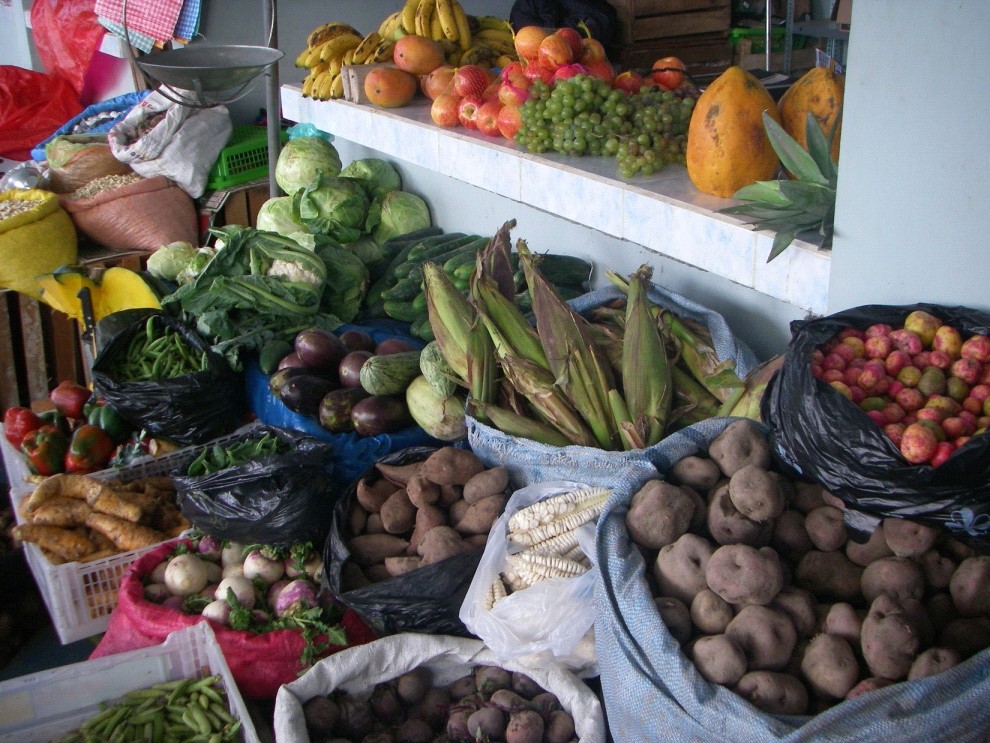
Abundant fruits and veggies in Coroico's weekly market. Papas lisas are the small red and yellow potatoes at right center. I also ate papas negras, the purple ones at bottom right and center, cooked whole in oil -- ¡muy rico!

Not all traditional medicine in the region is herbal or food-based. Good luck rituals and tokens abound, like the brightly-colored fetishes below, in La Paz' Mercado de Hechicería (Witches' Market). Arriving during Carnavál, we also saw cars, taxis, and buses decorated and prayed over as a blessing; and good luck icons by the score, such as miniatures of items the buyer hopes to obtain: money, cars, televisions, etc.[3] All of the shops in the Hechicería had coca. Some Andean shamans use hojas to divine the future.

In the Mercado de Hechicería, dried llama fetuses (hanging) of various sizes are sold. These are buried for good luck in new enterprises, especially those involving construction. Well-to-do traditional people are expected to sacrifice a live animal.

While our inquiries had been fruitful, we had questions our local informants couldn't readily answer. For example, other than for rapid drainage, and where the terrain consists of steep slopes, is it necessary to plant at such challenging angles? Also, can cocal be grown at lower altitudes than Coroico's 5000 feet above sea level, and if so, would this affect its strength or efficacy?

Lest you think we must have stood out for our unusual interest in coca, rest assured, we did not. Regular tours of the area include coca "plantations." Almost all of the other travelers we met in Coroico and Copacabana -- people of all ages from Switzerland, Belgium, New Zealand, Chile, Brazil, Germany, France, Australia, and Japan -- were interested in trying and discussing coca. Bolivians from other parts of the country were interested in comparing the local product with coca from their area.

Our "where's Waldo?" moment: a day after our field trip, strolling across Coroico's plaza for perhaps the 50th time that week, we finally recognized the healthy if somewhat untended stand of cocal growing there among the palms and hibiscus (Hibiscus sabdariffa). Since this is about the only flat spot in Nor Yungas, it seemed to settle whether cocal must be grown on a slope! (The question of altitude remains open.)

The public cocal patch in Coroico's main plaza.. Photo by Richard Lee / The Rag Blog.
Andean music on the plaza draws a crowd. Traditional women from the Afro-Bolivian community (seated, right front) are said to be prolific coca users.
The Sanjuanitos wowed us with John Lennon's "Imagine." Richard later wrote, "Lennon could have imagined this..."

It is in the plaza that matters of interest are discussed before and after cocalero meetings at the roofed "polyfunctional" sports court down the hill. Bolivia's future is being shaped by astute agriculturalists who value tradition but want the benefits of modernity. Change, like the new cell phone technology that has reportedly made rural life safer, is weighed and measured before adoption.

In this small plaza and others all over Bolivia and Peru, citizens talk and relax at the end of the day or the week, after school or at lunch time. Taxis come and go; buses disgorge weary travelers. Children and dogs run free and everyone sees that the soccer ball doesn't bowl over any old folks. Young couples promenade hand in hand in the evening, while the ice cream man, and the chicken sandwich lady, and the elders sitting on stone or wooden benches smile in approval. Here, coca is at home.

[Rag Blog Contributing Editor Mariann G. Wizard, a Sixties radical activist and contributor to The Rag, Austin's underground newspaper from the 60s and 70s, is a poet, a professional science writer specializing in natural health therapies, and a regular contributor to The Rag Blog. Read more poetry and articles by Mariann G. Wizard on The Rag Blog.]


Footnotes:
[1]I'm not naming any Bolivian acquaintances, in order to protect their privacy. None of them live electronically.
[2]http://en.wikipedia.org/wiki/Coca
[3]The fake lucky dinero, by the way, is from "El Banco de Buena Fortuna," and Richard got taken for 50 Bolivianos (about $7.50 US) by making change in the dark. It's a wonder what a photocopier can do, isn't it?

The Rag Blog

[+/-] Read More...

15 May 2013

REPORT / Mariann G. Wizard : 'La Vida Coca' in Bolivia and Peru / 2

Coca leaves, a standard small bag sold for personal use in Bolivia. From 10-40 hojas are used at once while working, walking, or otherwise exerting oneself at high altitudes. Habitual users enjoy coca three or four times a day. All photos by Mariann G. Wizard / The Rag Blog, unless otherwise credited.

La Vida Coca /2: 
Currents in traditional coca 
use in Bolivia and Peru
The overall effect of chewing leaves, drinking coca tea, or eating coca-containing foods can be described as both energizing and calming. Stress and anxiety are decreased, gastric disturbances eased, and the next hill isn't quite so daunting.
By Mariann G. Wizard / The Rag Blog / May 15, 2013

Part two of three.

[Rag Blog Contributing Editor Mariann Wizard recently visited Peru and Bolivia with former fellow Ragstaffer Richard Lee. Wizard says the whole thing was Lee's idea, although she did the heavy lifting of writing this report of their experiences, while lifting copiously from conversations they shared and short reports Richard wrote on the spot.]

It is estimated that 50% of Bolivia's gross national product is related directly or indirectly to coca. The illegality of much of this crop, and its ineligibility for international trade, has significantly handicapped Bolivia's economy and given it, along with Colombia, something of an "outlaw" reputation.

Rather than succumb as Colombia has at least temporarily done to U.S. demands for crop eradication, Bolivia now charts an independent path to international legitimacy and respect. Commodities production has given Bolivia a positive trade balance since 2004. Natural gas, silver, zinc, and soybeans account for 72% of total exports.

Main imports are machinery and transport equipment, chemicals and related products, and mineral fuels and lubricants. Main trading partners are Brazil (33% of total exports, 18% of imports), Argentina (12% of exports, 13% of imports), and United States (10% of exports and 11% of imports).[1]

A new Bolivian Vice Ministry of Coca and Internal Development was established in February 2009, in a reorganization of the executive branch. It is charged with developing employment opportunities, diversifying the economy, respecting traditional cultural values, and in general furthering Bolivian President Evo Morales' overarching vision of "Living Well."

It is expected to rationalize the processing of coca, maintain a climate of social peace, and mitigate and prevent conflicts under the new national policy of peacefully combating drug trafficking.[2]

One of the possible side effects of this policy is a striking lack of domestic militarization in Bolivia compared with most other Latin American nations we've visited in recent years. It's like the dog that didn't bark in the night, not obvious at first but increasingly pleasant over time.

It's worth noting that women spearhead Morales' administration. Strides in women's liberation are seen everywhere. Ending domestic violence and the rule of "machismo" are serious concerns in Bolivia's social revolution. Billboards and televised public service announcements proclaim, "Don't Kill The One You Love." Civilian gun ownership is banned.

While we were still in Bolivia, the campaign to have traditional coca use removed from the list of narcotics finally succeeded,[3] following a powerful appeal by Morales to UN delegates in Vienna.[4] Among the folks we talked with or saw responding in newscasts, this was met with firm approval. If Evo is leading a revolution, his constituents, at least in the altiplano, are keeping pace every step of the way.

Today, there is an emphasis on developing new products to "soak up" the excess coca that feeds illicit drug production, rumored to be concentrated in Brazil. Across the Amazon River, in one of the most difficult environments on the planet, one can envision secret jungle drug labs. But in the highlands, coca is part of a healthy, active lifestyle: "Living Well."

Coca candies, cookies, "teas" (actually infusions; true tea is Camellia sinensis), energy bars, and more are available or in the works. Coca Colla™, an energy drink made with coca extract, was reportedly launched in April 2010, but we didn't see it anywhere; we would surely have tried it. At least 35 coca product brands are operating.[5] A new publication, Il Jornada Nacional del Acullico, launched in 2012 to "reclaim" traditional coca mastication.[6]

Stevia (Stevia rebaudiana), an herb that produces the sweetest natural substances known to date, calorie-free steviosides, grows in Bolivia and is included in many products, in line with the government's overall health-promotion and economic development programs. It's commonly available in restaurants as an herb.

While coca "tea" is often made with whole leaves, there are also many chopped, bagged products from large and small manufacturers. When made of pure hojas, such teas may still be chewed as well as brewed for a stronger effect.
Coca teas, Larco Museum gift shop, Lima. Note the different flavors, including a coca-green tea combination. Some sources state that the term "maté" was adopted for coca teas to capitalize on the popularity of yerba maté (Ilex paraguariensis), but it is used in northwestern Bolivia for any mixed infusion. Matés commonly include tea, anise (Pimpinella anisum), cloves (Syzygium aromaticum), cinnamon (Cinnamonum verum), or other herbs or spices.
Energizing coca- and maca (Lepidum meyenii)-based candies, left, from airport gift shop, Lima. Coca-and-quinoa (Chenopodium quinoa) cookies, right, from Arcoiris Pasteleria on the plaza in Coroico, Nor Yungas, Bolivia.

Many medicinal and personal care products are made with coca, like these at Coroico's Blue Pine Tienda, as entrepreneurs combine traditional lore and modern marketing to legitimize coca in world markets.

Ingacoca's™ banner lists coca syrups for coughs, asthma, prostate support, rheumatism, acidic urine, liver support, stomach ulcers, gastritis, anemia, weight loss, mental acuity, poor appetite, diabetes, nerves, insomnia, kidneys, intestinal parasites, and high blood pressure; salves for rheumatism, varicose veins, bone support (coca is high in calcium), arthritis, gout, fungi, and hemorrhoids; and shampoo and skin creams.

What scientific support is there for the claimed benefits of coca leaf? Herbal medicine expert Andrew Weil says,
Coca appears to be a useful treatment for various gastrointestinal ailments, motion sickness, and laryngeal fatigue. It can be an adjunct in programs of weight reduction and physical fitness and may be a fast-acting antidepressant. It is of value in treating dependence on stronger stimulants.

Coca regulates carbohydrate metabolism in a unique way and may provide a new therapeutic approach to hypoglycemia and diabetes mellitus. With low-dose, chronic administration it appears to normalize body functions. In leaf form coca does not produce toxicity or dependence. Coca can be administered as a chewing gum or lozenge containing a whole extract of the leaf, including alkaloids, natural flavors, and nutrients.[7]
However, as with cannabis, coca's illegality makes it difficult for research on these benefits, all with at least some evidence, to proceed. A search of the PubMed database for Erythroxylon brought up just 109 reports, many on plant pharmacology. Interestingly, several studies used little-known species, not those most cultivated, but having local traditional uses. Most found a chemical basis for the tradition. Some reports are historical; others are policy, cultural, or environmental studies.

There are epidemiological and clinical studies of coca's effects in altitude sickness. (Results: it works and people use it without ill effects.) A study of effects of hojas on biochemical and physiological parameters found metabolic benefits with prolonged physical activity; that is, more fat is burned by users during exercise.[8]

We started seeing coca tea and/or hojas at the hotel breakfast (desayuno) buffet in Nazca, Peru, and at most hotels and hostels after that. Coca tea was on almost every restaurant menu. We learned later that coca is also readily available in Lima, where we had spent a week in ignorance. After all, at sea level, why would anyone have altitude sickness?

But the energizing qualities of coca can benefit tourists at any altitude: see more, do more, enjoy your trip more. While I was sick in Arequipa (everyone there blamed Nazca's water!), hotel staff, doctor, and "Ricardo" all recommended coca. Poco a poco, it helped.

Desayuno buffet at Hotel Berlina, La Paz, with hojas de coca and coca tea. This hotel also had leaves and tea, and hot water, in the lobby at all times.

So, everybody asks, "What is it like to chew coca?" What many really want to know is, "What is it like compared to cocaine?"

It's different. It's not nearly as strong as blow, no matter how much lejia (see below) you use or how many leaves you cram into your cheeks. Yes, there is an astringent flavor; yes, you can get a numbing effect in mouth and throat; yes, there are alkaloids in the leaves and you can test positive for cocaine if that's a concern.

The overall effect of chewing leaves, drinking coca tea, or eating coca-containing foods can be described as both energizing and calming. Stress and anxiety are decreased, gastric disturbances eased, and the next hill (everything in Bolivia is uphill or downhill from where you are!) isn't quite so daunting.

But, unlike the single alkaloid cocaine, use of whole leaf products doesn't end in a sudden emotional or energy crash or turn nice people into a--holes. After a time, the effect gently fades away. Neither of us ever experienced sleeplessness, anxiety, or remorse while using hojas.

And of course there is no issue of addiction or compulsion. You can take it or leave it (unless, of course, you're one of those people who can't take or leave anything; in that case, well, hojas are a lot cheaper than refined "salt").

The mild, balanced effects parallel those of other whole herbs versus single compounds. A classic example is cannabis flowers versus tetrahydrocannabinol (THC), their main psychoactive ingredient. Pharmaceutical medicines of THC alone can cause anxiety. Using whole cannabis for pain control, appetite stimulation, and other medical purposes causes fewer problems and gives patients more control.

And as it turns out, many "minor" ingredients of cannabis -- cannabinoids and other compounds -- also have benefits. The latest pharmaceutical versions of what Mother Nature provides are standardized cannabinoid blends.

A small piece of lejia ("lye") made from stevia (above) or quinoa ash, burned limestone, or baking soda ("bico"), is often chewed with coca to free more alkaloids. This produces a stronger effect, including numbing the inside of the mouth, than hojas alone.
Our serious quest for knowledge began in La Paz, the capital of Bolivia, 13,323 feet above sea level. We visited the coca market, ADEPCOCA, just four blocks from the Villa Fatima terminal, where minibuses from coca-growing Nor Yungas province leave and arrive hourly.

Four stories (each about 100 x 80 m) of coca fill La Paz' bustling ADEPCOCA market. This photo, made early on a Sunday, shows little of the traffic that normally congests this intersection, so that more of the building can be seen. The structure covers a full block. The sign on the front says "COCA ES VIDA"; coca is life.
Bags of prime hojas with the ADEPCOCA logo ready for delivery to hotels, markets, and other outlets. Taxis often carry several bags at a time along with passengers, piling bags in cargo compartments and atop vehicles.
While most traditional women and older men in the market didn't wish to be photographed, this young man with iPod had no qualms and happily posed. Many hundreds of bags like his are bought and sold daily at ADEPCOCA.

Between La Paz and Coroico, along what was once "the most dangerous road in the world," cocal, as coca is called in the field, begins to be seen. The closer we came to one of Bolivia's prime coca centers[9] (like our driver and some fellow passengers, chewing hojas all the way!), the more we saw the well-tended crop on steep hills framed by snowy peaks, rushing waterfalls, and infinite shades of green.

A cocal field near the road. Maintaining agricultural terraces or gradas under frequently torrential rains is an ongoing task of Andean coca growers. Photo by Richard Lee / The Rag Blog.

NEXT: Cocal up close and personal; everything else; our "Where's Waldo?" moment.

[Rag Blog Contributing Editor Mariann G. Wizard, a Sixties radical activist and contributor to The Rag, Austin's underground newspaper from the 60s and 70s, is a poet, a professional science writer specializing in natural health therapies, and a regular contributor to The Rag Blog. Read more poetry and articles by Mariann G. Wizard on The Rag Blog.]


Footnotes:
[1]Trading Economics.com. ]http://www.tradingeconomics.com/bolivia/balance-of-trade
[2]http://www.vcdi.gob.bo/index.php/institucion/institucional 
[3]Neuman W. Bolivia: Morales wins victory as U.N. agrees to define some coca use as legal. New York Times. Jan. 11, 2013. http://www.nytimes.com/2013/01/12/world/americas/bolivia-morales-wins-victory-as-un-agrees-to-define-some-coca-use-as-legal.html?_r=1& 
[4]Cusicanqui JJ. Morales buscar a retirar la coca de la lista de estupefacientes. La Razón. Mar. 12, 2013, p. A4. 
[5]Medrano E. Temen desvío de la industria de la hoja. La Razón. Mar. 12, 2013, p. A4. 
[6]Cusicanqui JJ. Morales buscar a retirar la coca de la lista de estupefacientes. Sidebar: Il Jornada del Acullico. La Razón. Mar. 12, 2013, p. A4. 
[7]Weil AT. The therapeutic value of coca in contemporary medicine. J Ethnopharmacol. 1981 Mar-May;3(2-3):367-76. http://www.ncbi.nlm.nih.gov/pubmed/6113306 
[8]Casikar V, Mujica E, Mongelli M, et. al. Does chewing coca leaves influence physiology at high altitude? Indian J Clin Biochem. July, 2010;25(3):311-4. doi: 10.1007/s12291-010-0059-1. http://www.ncbi.nlm.nih.gov/pubmed/21731204 
[9]The other is Chaparé.

The Rag Blog

[+/-] Read More...

09 May 2013

REPORT / Mariann G. Wizard : 'La Vida Coca' in Bolivia and Peru

Pre-Incan metal vessels in the Larco Museum, Lima, for storing coca leaves. Human-faced pots from some early Andean cultures (not shown) have distended cheek pouches, where coca leaves are held during use. The central figure above is using coca in the Amazonian/Caribbean way. There the Kogi, Arhuaco, and Wiwa people use a hollow gourd (poporo) associated with virility to consume coca. Women of these tribes are prohibited from coca use. All photos by Mariann G. Wizard / The Rag Blog, unless otherwise credited.
La Vida Coca /1: 
Currents in traditional coca 
use in Bolivia and Peru
Although its use continued, coca production had been 'stripped of its original cultural and social meaning' by the subjugation of indigenous practice to the whims of European and North American commodity culture.
By Mariann G. Wizard / The Rag Blog / May 9, 2013

Part one of three.

I recently visited Peru and Bolivia for the first time, in the company of intrepid adventurer and fellow former Ragstaffer Richard Lee. It was all his idea, a journey we talked about for a couple of years. Both South American nations are huge, with enormous wild and rugged areas; are rich in geographical, botanical, and cultural wonders; and are repositories of a wealth of ancient and modern histories unfamiliar to many outsiders.

We both like straying off the beaten path. A guide book or "canned" tour is merely a point of reference. While ruins and relics may be spectacular, inspiring, and mysterious, we prefer checking out current life and culture, moving slow, meeting people, and making new friends. Although my trip lasted two months, and Richard's even longer, it would take years to see all of the "must see" places the tour books extol.

Gradually, with experience, a sharper focus and questions may emerge. While Bolivia and Peru are each unique in hundreds of ways, they have something in common that is quite exotic to North Americans: traditional cultivation and use of coca (Erythroxylon spp). Coca, native to South America, has been used for thousands of years medicinally, ritually, and socially, and grown on several continents. Today Colombia, Peru, and Bolivia produce more than 98% of the world's coca.

Inca and pre-Incan cultures such as the Moche thought coca was a divine plant and sometimes reserved it for royalty. When the Inca fell to the Conquistadores, the Spanish at first tried to stamp out coca as a pagan practice. But they quickly learned to exploit its energizing qualities. Workers with a ready supply of coca didn't have to stop for lunch. So coca, monopolized by the conquerors, was "tolerated" for increased productivity, although Catholic missionaries continued to try to stop or limit its spiritual use.

Coca plants were grown by pre-Incan cultures 5000 years ago. These are at Huaca Pucllana, an active archaeological site in the heart of modern Miraflores, Lima, Peru.

According to Wikipedia, coca was traditionally used
as a stimulant to overcome fatigue, hunger, and thirst... particularly effective against altitude sickness. It also is used as an anesthetic and analgesic [for] pain of headache, rheumatism, wounds and sores, etc. Before stronger anesthetics were available, it also was used for broken bones, childbirth, and during trephining [sic] operations on the skull.

The high calcium content in coca explains why people used it for bone fractures. Because coca constricts blood vessels, it also serves to oppose bleeding, and coca seeds were used for nosebleeds. Indigenous use of coca has also been reported... for malaria, ulcers, asthma, to improve digestion, to guard against bowel laxity, as an aphrodisiac, and [was] credited with improving longevity.[1]
In some coca-using cultures, the herb was specifically linked to sexuality, procreation, and virility.

Richard, an avid horticulturalist, wanted to learn about coca growing. I write professionally about herbal medicines and welcome opportunities to encounter them "in the field." As we traveled south, and up, to the dizzying Andean altiplano, we started to feed our interests with knowledge.

Coca leaves (hojas) and seeds contain alkaloids and other compounds that exert physical and mental effects when consumed. Coca is intensively cultivated and harvested by hand, usually on well-drained, sunny mountainsides. It prefers somewhat alkaline soil. There are said to be over 250 Erythroxylon species; four are widely grown. Many, if not all, contain cocaine, an alkaloid that is coca's best-known ingredient.[2] The reported usual cocaine alkaloid content of coca leaf is between 0.1 and 0.8%.

Wikipedia says,
[P]lants thrive best in hot, damp and humid locations, such as the clearings of forests; but the leaves most preferred are obtained in drier areas, on the hillsides. The leaves are gathered from plants varying in age from one and a half to upwards of forty years, but only the new fresh growth is harvested. [Leaves] are... ready for plucking when they break on being bent. The first and most abundant harvest is in March after the rainy season, the second is at the end of June, and the third in October or November."[3]
Coca is a low-growing deciduous shrub. These plants are thriving in a traditional steeply terraced field.

Despite its South American origin, coca and its alkaloids have profoundly affected North American and European culture. Again from Wikipedia:
Coca was first introduced to Europe in the 16th century, but did not become popular until the mid-19th century, with the publication of an influential paper... praising its stimulating effects on cognition. This led to [the] invention of coca wine and the first production of pure cocaine."[4]
In the U.S., cocaine was associated with the Jazz Age and known as a "rich man's drug."

But another item originally derived from coca became the one symbol of North America, and specifically the U.S., known around the world: the Coca-Cola® soft drink, brand, and logos. Coke® and other kola (aka cola; Cola vera) drinks originally used coca as a flavoring and energizing ingredient; today's Coke still uses denatured coca leaves. The Stepan Company (Maywood, NJ), the top legal buyer of Bolivian coca, imports and denatures it. Coke owns Inka Cola®, formerly its main competitor in Peru, and Coke products are ubiquitous in both countries.

Coca Colla energy drink. Photo from Prensa Libre.com.

"Denaturing" means removing the cocaine. That is sold to Mallinckrodt (St. Louis, MO), the only pharmaceutical manufacturer in the U.S. licensed to purify "coke" for medical use. The only naturally occurring local anesthetic in use today, it was first isolated and purified in 1859. Approved uses include as anesthesia in eye surgery and as a precursor to synthetic prescription and over-the-counter painkillers: novocaine, lidocaine; essentially anything ending with "caine."

In addition to its medical value, cocaine is an attractive drug of abuse, providing an all-too-fleeting feeling of focused energy and power. Cheap South American coke and its derivative, even cheaper smokeable free-base or "crack" cocaine, flooded U.S. and European markets in the late 1960s, a ruinous flood that, with disco music, peaked in the 80s.

Coke and crack are still used, but methamphetamine is so much cheaper now (as well as heroin, other opiates, and prescription painkillers) that "Bolivian marching powder" has lost market share. The epidemic and resulting intensification of the so-called "war on drugs" left deep scars in many urban communities, put an end to the idyllic dreams of 60s social reformers and much of the U.S. Bill of Rights, bent law enforcement priorities, fed corruption both public and private, and helped fund repressive warfare in more than one foreign nation.

Efforts to control and eradicate coca had begun much earlier. The Convention for Limiting the Manufacture and Regulating the Distribution of Narcotic Drugs, an international drug control treaty, took effect in July 1933. It established two groups of forbidden drugs.

Group I included morphine and its salts, including morphine diacetate (heroin) and preparations made directly from raw or medicinal opium poppy (Papaver somniferum) containing more than 20% morphine; cocaine and its salts, including preparations made from coca leaf containing more than 0.1% cocaine[5], all esters of ecgonine and their salts; dihydrohydrooxycodeinone, dihydrocodeinone, dihydromorphinone, acetyldihydrocodeinone or acetyldemethylodihydrothebaine, dihydromorphine, their esters, and the salts of any of these substances and their esters; morphine-N-oxide, also morphine-N-oxide derivatives and other pentavalent nitrogen morphine derivatives; ecgonine[6] and thebaine and their salts; benzylmorphine and other ethers and salts of morphine, except methylmorphine (codeine); and ethylmorphine and its salts [Italics added].

Group II, more loosely regulated, included methylmorphine (codeine) and ethylmorphine, and their salts.[7]

These rudimentary groups foreshadowed the drug scheduling system still used today. The 1931 Convention was broadened considerably by later treaties and eventually superseded by the 1961 Single Convention on Narcotic Drugs, adding cannabis (Cannabis sativa) to the prohibited "narcotics." International law has been further expanded and amended since. Of course the U.S. has enacted its own drug legislation and has pushed prohibition hard in other nations, especially those it "aids."

Coca and coca products, used in the Andes for thousands of years and today by farmers, market women, hard-driving taxistas, tourists suffering from altitude sickness, and those with gastric distress, anxiety, high blood pressure, and other medical conditions, was thus prohibited by international law. Although its use continued, coca production had been "stripped of its original cultural and social meaning"[8] by the subjugation of indigenous practice to the whims of European and North American commodity culture.

The history of the U.S. drug war, specifically against coca cultivation in Colombia and Bolivia, is far beyond the reach of this report. It is well summed-up, however, in this assessment:
Attempts to reduce the supply of coca/cocaine oscillate between efforts to eradicate crops on the one hand, and crop substitution on the other... Experts have been unanimous in their condemnation of crop eradication as a viable strategy in isolation for the simple fact that the aggregated coca acreage has not been decreasing because crops have been displaced rather than eradicated.

And not only have such policies failed, but they have been accompanied by substantial ecological damage; virgin areas have been deforested and the environment has been polluted with long-lasting herbicides. But, above all, attempts at eradication have deprived poor peasants and their families of their main source of income.[9]
Crop substitution has had some limited successes. In mountainous Bolivia, coffee (Coffea robusta) was chosen for improvement and propagation. Long scorned as an inferior product, new cultivars, techniques, and training have made Bolivian coffee a star among aficionados.[10] However, unstable prices prevent it from persuading most coca growers to make the switch. Neither eradication nor substitution have ever had the full support of indigenous farmers where they have been tried.

Nor Yungas is home to wild, shade-grown, hand-harvested coffee, among the best in the world. These beans have another month or two to go before they're ready -- harvest generally coincides with la Semana Santa, Holy Week.

Peru and Bolivia did not accept coca's narcotic designation, repeatedly protesting in international forums. In 1994, the International Narcotics Control Board (INCB), the independent, quasi-judicial organ that implements UN drug conventions, said in its Annual Report, "mate de coca... considered harmless and legal in several countries in South America, is an illegal activity under the provisions of both the 1961 Convention and the 1988 Convention, though that was not the intention of the plenipotentiary conferences that adopted those conventions (Italics added)."[11]

But nothing changed legally.

Bolivian coca growers, or cocaleros, began in the mid-1980s to be a political and cultural force. Not coincidentally, in 1985 an energetic young man named Evo Morales was elected general secretary of a local cocalero union; by 1988 he was executive secretary of the Six Federations of the Tropics of Cochabamba.

Around then the Bolivian government, aided by the U.S., began an aerial spraying program to wipe out coca. Morales quickly became a leader among opponents of the program. As a result, he was frequently jailed and, in 1989, beaten nearly to death, dumped unconscious in some bushes and luckily found by colleagues. By 1996, he was president of the Tropics Federation (he retains this office today).[12]

Morales later led a 600 km march from Cochabamba to La Paz. Supporters gave the marchers drink, food, clothes, and shoes. They were greeted with cheers in the capital and the government agreed to negotiate with them. After they went home, the government sent forces to harass them.

According to Morales, in 1997 a U.S. Drug Enforcement Administration (DEA) helicopter strafed farmers with automatic rifle fire, killing five of his supporters. He also recounted being grazed by assassins' bullets in 2000. But Morales found a growing international audience for his positions, traveling abroad to gain support and to educate people on the differences between coca leaves and cocaine.

He says, "I am not a drug trafficker. I am a coca grower. I cultivate coca leaf, a natural product. I do not refine cocaine, and neither cocaine nor drugs have ever been part of Andean culture."[13]

After going through several political formations and fighting official suppression, Morales and his compatriots made a deal with a defunct yet still registered party, the Movement for Socialism (MAS). They could take over the party if they would keep its acronym, name, and colors. The former right wing MAS became the left coca activist party, the Movement for Socialism -- Political Instrument for the Sovereignty of the Peoples. The new MAS is "an indigenous-based political party that calls for nationalization of industry, legalization of the coca leaf... and fairer distribution of... resources."[14]

At a gathering of farmers in 2005 celebrating MAS' 10th anniversary, Morales declared the party ready to take power.[15] He was proven correct, winning over 53% of the vote in that year's Presidential election. Fending off attempts to remove him from office, he was re-elected in a 2009 landslide. Everywhere we went in northwestern Bolivia, graffiti on walls proclaimed, "¡VIVA MAS! ¡VIVA EVO!"[16]

Bolivian President Juan Evo Morales Ayma discussing coca use. Photo from www.parahoreca.com.

In his first term, in 2008, Morales evicted the DEA from Bolivia. When the U.S. ambassador protested, Evo accused him of conspiring against democracy and encouraging civil unrest, and ordered him out, too. The Bolivian ambassador to the U.S. was expelled in retaliation. Diplomatic relations between the two nations were restored in November, 2011, but have not warmed.

Morales still refuses to allow agents of the DEA into the country.[17] On May 1, 2013, he announced the long-threatened expulsion of the U.S. Agency for International Development (USAID), accusing it of funding his opposition. He also took exception to newly-confirmed U.S. Secretary of State John Kerry's recent characterization of the Western Hemisphere as the "backyard" of the U.S., a characterization most Central and South Americans and Canadians, and many U.S. citizens, must find paternalistic, arrogant, ignorant, and typical of the "Ugly Yanqui" we have come to know and despise.[18]

NEXT: Coca's changing future; the facts as we found them; our quest begins.

[Rag Blog Contributing Editor Mariann G. Wizard, a Sixties radical activist and contributor to The Rag, Austin's underground newspaper from the 60s and 70s, is a poet, a professional science writer specializing in natural health therapies, and a regular contributor to The Rag Blog. Read more poetry and articles by Mariann G. Wizard on The Rag Blog.]


Footnotes:
[1] http://en.wikipedia.org/wiki/Coca
[2] Bieri S, Brachet A, Veuthey JL, Christen P. Cocaine distribution in wild Erythroxylum species. J Ethnopharmacol. Feb. 20, 2006;103(3):439-47.
[3] Wikipedia/Coca, op. cit. Harvest times refer to commercial crops. Fresh hojas are picked and used as needed. Leaves are carefully sun dried for storage and shipment. Coca drops its leaves, like other deciduous plants, but every two-three years; new leaves soon emerge.
[4] Ibid.
[5] Remember, coca leaf material generally has a cocaine level of 0.1-0.8%; so, all products made from coca leaves were covered.
[6] Coca's alkaloids are all derivatives of ecgonine.
[7] http://en.wikipedia.org/wikiConvention_for_Limiting_the_Manufacture_and_Regulating_the_Distribution_of_Narcotic_Drugs
[8] Bastos FI, Caiaffa W, Rossi D, Vila M, Malta M. The children of Mama Coca: coca, cocaine and the fate of harm reduction in South America. Int J Drug Policy. Mar. 2007;18(2):99-106. doi:10.1016/j/drugpo.2006.11.017 – local_links.php
[9] Ibid.
[10] Friedman-Rudovsky J. Bolivian buzz: coca farmers switch to coffee beans. Time. Feb. 29, 2012. http://www.time.com/time/world/article/0,8599,2107750,00.html
[11] Wikipedia/Coca, op. cit.
[12] http://en.wikipedia.org/wiki/Evo_Morales#Early_cocalero_activism:_1978.E2.80.931983
[13] Ibid.
[14] Ibid.
[15] Ibid.
[16] It must be noted that this area is Morales' political stronghold. Opposition is centered in the eastern lowland province, Santa Cruz, and its capital of the same name, Bolivia's most populous city. 
[17] Wikipedia/Evo_Morales, op. cit.
[18] Valdez C, Bajak F. Bolivia's Morales expels USAID for allegedly seeking to undermine government. Associated Press. May 1, 2013. Accessed at http://www.huffingtonpost.com/2013/05/01/bolivia-morales-expels-usaid_n_3193115.html.

The Rag Blog

[+/-] Read More...

05 January 2012

Chellis Glendinning : In Bolivia, 'The Repression Strengthened Us!'

Native demonstrators march on La Paz to protest highway construction. Photo from AFP.

Letter from Bolivia:
'The repression strengthened us!'

The ragtag band walked day and night in flip-flops, and the hearts of Bolivians went out to them...
By Chellis Glendinning / The Rag Blog / January 5, 2012

LA PAZ, Bolivia -- One wrong move, forgetting to take your hat off, the interruption of a phone ringing notwithstanding, after a spell a trip to the bank to pay the light bill -- alongside men carrying machine guns -- does get to feel normal.

Such a transit of mind is a testimony to the human ability to adapt, yes? -- and I am reminded of a tale that dear friend anthropologist Francis Huxley tells.

It was the 1950s, and he was called to transport a Native of the Brazilian Xingu tribe to Sao Paulo for emergency medical treatment. After success with that, they strolled through the streets of the city -- for the Native man, the first time ever in such a scene. Upon passing a bank heavily guarded by men in military uniform, bearing epaulets, badges, and heavy black boots and carting machine guns -- the man turned and asked what this strange display was all about.

Grappling for words, Francis reported that this was where the jefe kept his riches. The Native man immediately quipped, “Well! He must not be a very good jefe!”

And so it is here, just over the border from Brazil and 60 years later.

Jefe Evo Morales has -- to quote one of Nicole Hollander’s “Sylvia” cartoons -- “made (him)self unpopular.” To tell the truth, he already had accomplished that feat, but the Moxeño-Chimare-Yurakerés march to the capital hammered the final nail in.

On 15 August, some 700 indígenas set out to protest a Brazil-funded intra-continental superhighway the Bolivian state was erecting through their constitutionally-protected, sovereign eco-reserve, the Territorio Indígena and Parque Nacional Isibro Sécure (TIPNIS) -- where the last of the planet’s gatherer-hunter cultures thrive, while flora and fauna in danger of extinction make their fragile way. The purpose of the highway: to carry petroleum from Brazil across Bolivia to Chile’s ports to be shipped to your cars in the U.S.

The ragtag band walked day and night in flip-flops, and the hearts of Bolivians went out to them in the form of a nationwide drive to send shoes, clothes, food, and medicines.

First the government blocked the road from passage, including the arrival of food and water. Then, on Sunday 25 September, the police attacked the encampment! Bursting in with tear gas, they chased down fleeing indígenas, sometimes five officers in full riot gear against a single boy in cotton shorts; with their night sticks they beat them on their backs and chests and heads; they bound their arms, legs, and mouths with silver duct tape making it almost impossible to breathe; they dragged some 300 dirigente-leaders, women, children, and ancianos to waiting trucks and hauled them away to unknown locations. It was claimed that one child died in the violence.

Riot police in La Paz. Photo from The Guardian (U.K).

By Monday morning a pall of shock had settled over Bolivia; everyone was glued to a television somewhere -- and then the popular response burst forth. All over, including at the Bolivian embassy in New York where Morales was presenting at the United Nations, people took to the streets. And the venting allowed for long pent-up emotions to flow into the public vocabulary.

Ya no tiene máscara indígena”/”Morales can no longer wear his mask of so-called indigenous support,” proclaimed Native social analyst Fernando Untoja. Long-time activist Rafael Quispe trotted out the as-yet unspoken words: “dictadura”/”dictatorship.” And ex-government official Alex Contreras termed the actions “métodos del fascismo”/”methods of fascism.”

Astoundingly, one marcher was quoted in a 20 October newspaper report, “La represión nos fortaleció”/”The repression strengthened us.”

On 19 October what had started, two months before, as a march of 700 had now swelled to 3,000. After two months of treking/camping, treking/camping; after the sweltering heat of the tropics and the driving sleet of the mountains; after bearing inadequate shoes, too thin jackets, foot sores, injuries, dehydration, diarrhea, and exhaustion; after enduring disregard, insults, and arguments for disqualification spouting from the mouths of government officials: after the official withholding of water and food; and then having endured violent repression -- the TIPNIS marchers rounded the last crag before the descent into the capital city.

What lay below, they say, was unexpected.

The streets of La Paz were teeming with supporters from every hamlet and municipality in Bolivia and beyond! Red flags were blowing in the wind. Green flags. Yellow flags. Wiphala flags. Workers. Taxi drivers. Housekeepers. University students. Mothers with babies. Union leaders. Theater groups. Supporting indigenous groups boasting traditional dress, flutes, and drums Former government officials who had left the MAS party. The press. International support teams.

Trumpets blared. Flutes sang. Mariachi bands blasted accordion music. Placards proclaimed: “TIPNIS=VIDA, EVO=MUERTE,” “EL TIPNIS: NO SE TOCA, CARAJO!” and “¡TIPNIS SOMOS TODOS!” People rushed to meet the marchers, hugged them, kissed them on the lips. Men and women were sobbing in the streets! Whole schools had been liberated to play a role in history, and uniformed children were waving flags, holding up their drawings of tropical flowers, and cheering.

Along the boulevards the welcomers flanked the marchers like a thick envelope of protection from potential police action; in some parts the shield extended five times thicker than the march itself.

It was the largest gathering of humanity in the history of Bolivia.

After all his grandstanding about how the state would never, ever, give in -- not! the president ventured into the plaza with his phony smile -- this after months of badmouthing the marchers as dupes of the imperialist state to the north, denying them a meeting, sending para-protestors out to harm them, cutting off food and water, and finally unleashing the military.

Against the very real possibility of his government going under, he gave in. No highway through TIPNIS. As we say in baseball, though, “It’s not over ‘till it’s over.” Now the government is finding ways to backpedal. But this was a major triumphant event that went unreported in the EE.UU -- and I wanted you, for this moment, to bask in the heroism that our human spirit is capable of mustering.

[Chellis Glendinning is the author of five books, including When Technology Wounds, Off the Map: An Expedition Deep into Empire and the Global Economy and Chiva: A Village Takes on the Global Heroin Trade. She lives in Bolivia and may be contacted via www.chellisglendinning.org. A version of this article was published at CounterPunch. Read more of Chellis Glendinning's writing on The Rag Blog.]

The Rag Blog

[+/-] Read More...

16 June 2011

Chellis Glendinning : 'Decepción' in Bolivia

This page has moved. You will be redirected in 5 seconds.

Militant ambivalence? A demonstrator holds portraits of President Evo Morales during a protest in La Paz, Bolivia. Photo from Reuters.

Evo on the rocks:
Decepción in Bolivia


By Chellis Glendinning / The Rag Blog / June 16, 2011

COCHABAMBA, Bolivia -- A poster of “Guernica” was bursting from the wall, and the umpteenth Latin American rendition of “My Way” was booming from the record player. I was sharing a hand-carved table in a Cochabamba cantina with a cowboy from the Chapare, an anti-capitalist immigration officer, an anarchist surgeon, and a barbacoa-restaurateur. All had been supporters of President Evo Morales’ Movimiento al Socialismo (MAS).

The conversation was fiery and, as is normal here in the Andes, its topic was politics.

Despite this particular crowd’s claim to the middle class, the agreement among them echoed a truth of Bolivian culture: a tendency to view things from the perspective of the collective, rather than solely from one’s perceived interests.

And indeed, this conversation echoed other charlas I’d had with campesinos, taxi-trufi drivers, and union members -- and I need to be straight with you: things are not going well for the government of Bolivia’s first indigenous leader in 500 years. It was only a matter of filling in the details -- and, in between gulps of Auténtico beer and Cuban mixed drinks, said details were pouring forth at the cantina.

Then the question was put to me. What did citizens of the United States think? I had to admit two answers: 1) if my daily dip into The New York Times provides any indication, people in the U.S. are basically uninformed about goings-on in Bolivia; and 2) for U.S. leftists, environmentalists, and climate-change activists, the aura of hope unleashed by the 2005 election of Evo Morales lingers like perfume from a Cochabamba jasmine bush.

I offer, then, a sweep of an overview of what’s happening and what some cowboys and campesinos, taxi drivers, and rank-and-file, are thinking.

Bolivian President Evo Morales reacts during a nationwide message at the presidential palace in La Paz while vice president Alvaro Garcia Linera looks on. Photo by Reuters.

Forked Tongue I: Madre Tierra

Out of one tine of what has become the Morales administration’s two-sided tongue come blood-stirring proclamations like the president’s empassioned grito¡Planeta o Muerte!” at the 2010 Cancun climate change talks. Brilliant. Then there is the stark refusal, that not even Cuba or Venezuela would match, to sign on to the watered-down agreement at said talks.

And now comes the nation’s new law proclaiming the rights of Madre Tierra -- to some minds, a legal-philosophic leap forward that, a few decades ago, only bioregionalists, primitive-anarchists, and traditional Native peoples could imagine.

But, sorry to say, the other spine of the eco-fork must be noted:
  • the launch of genetically-modified agriculture into a countryside presently free of GMOs;
  • two under-construction hydro-electric dams 300% bigger than the U.S.’s Hoover Dam at a cost of $13 billion, slated to channel water to Brazil in exchange for monies to boost Bolivia’s petro and plastic industries -- this, in a country where many communities have no potable water and water-borne illnesses are rampant;
  • in a nation uncontaminated by nuclear radiation: uranium mining, with future plans for nuclear power plants -- aided by Iran;
  • blankets of electromagnetic radiation in the form of WiMAX over urban landscapes – with the state telecommunications corporation bragging of 1350 radiobases in an area the size of Texas and California combined, with many more to come;
  • commodity-transporting highways bulldozing through protected nature reserves whose treasures, in the case of the Villa Tunari-San Ignacio de Moxos road, include 11 endangered species and three Native groups in 60 communities living their traditional hunter-gatherer-fishing lifeways;
  • new oil excavations;
  • new gas excavations;
  • in partnership with Mitubishi, Sumitomo, South Korea, and Iran: massive lithium development -- threatening leeching, leaks, emissions, and spills in the world-treasure salt flats;
  • Bolivia’s own Made-in-China satellite;
  • with the help of India, the construction of humankind’s largest iron mine;
  • 900 miles of pipeline slated to transport natural gas to Argentina; and
  • an explosion of airport and high-rise construction.
In other words: full-tilt, high-tech, colossal-scale, high-capital modernization -- on a Madre Tierra in which such expansion has already been shown to be The Problem.

A Dec. 30, 2010 protest against gas prices turns violent. Top image from FM Center es Noticia. Below, from Reuters.

Forked Tongue II: Democracy

Regarding governance, from one side of Bolivia’s forked tongue is spoken the legal language of plurinationalismo. After centuries of dictatorships, neoliberal governments, and military juntas, the 2009 Morales-initiated Constitution legitimizes a form of decentralized federalism: a reinstatement of decision-making to local communities, whether defined by place, indigenous heritage, or worker identity.

But, from the other tine of the fork, we encounter unabashed state centralism -- and the stringency of an If-You’re-Not-With-Us-You’re-Against-Us mentality to reinforce its dominion. A blazing example of such top-down musculature is the 2010 Christmas Time Gasolinazo: Decreto Supremo #748 in which Vice President Alvaro Garcia Linera abruptly announced that gasoline and diesel prices had been jacked up -- by as much as 83%. (“Joy to the World” notwithstanding, the violent uprisings that followed rerouted the government’s hurry to a slower pace of inflation.)

But the truth remains: ever since the immediate threat from the right wing subsided following Morales’ 2009 re-election by 62%, a chronic refusal to listen to the very social movements the president promised to follow has posed a disturbing blow to adherents of participatory democracy.

Indigenous woman in La Paz protests against high prices and low wages on Feb. 25, 2011. Photo by Juan Karita / AP / La Prensa.

When indigenous groups protest the bulldozing of their lands for the construction of freeways; when state workers call for increases in salaries against the reality of galloping food prices; when media workers fight for freedom of the press against regulations threatening fines and license suspensions, state control of 20% of the media, and state ownership of all of it -- the administration’s reaction is knee-jerk.

Whether by the vice president or the president himself, citizens questioning the government’s dictates are received with neither concern for their suffering nor gratitude for their participation; they are bold-facedly dismissed as instruments of U.S. imperialism, middle-class whiners, out of touch, and/or dupes of the right wing.

The Who’s famed rock ‘n roll declaration, “Meet the New Boss, Same as the Old Boss,” comes to mind, and the long-standing trade union congress Centro Obrera Boliviana (COB) is now seeking to unseat the vice president for just such a pronouncement aimed at workers.

A demonstrator sprays graffiti protesting fuel price hikes in Bolivia. Photo from Reuters.

Meet the new problems, same as the old problems

At the same time, Bolivia is rife with chronic problems that, according to some street-level opinion, the government has failed to address.

Corruption within government is an age-old theme. During the Morales administration, the most spectacular example occurred in February 2011: the U.S.-Chile-aided arrest of the national jefe of police, former head of the Fuerza Especial de Lucha Contra el Narcotráfico, and founder of the Centro de Inteligencia y Generación de Información, General René Sarabria Oropeza -- caught in the act of opening up cocaine routes to Miami. His accomplices included a mayor, a military colonel, and a captain.

Another revelation of corruption, more so perhaps for spiritual interest, was the June 2010 arrest of Valentín Mejillones, the amauta-priest who had led the purification ritual of Evo Morales’ inauguration at Tiawanaku in 2006 -- for hosting a cocaine purification factory in his El Alto home.

According to Diego Rada Cuadros, a lawyer whose family was forced to flee the country during the 1980s dictatorships, in the nation-state boasting the severest poverty in South America and -- save Haiti -- all of Latin America, a position in government that may last but six years (or, most probably, less) is a one-shot chance to amass some longer-lasting plata.

Too, while Bolivian coca has been sold for cocaine manufacture since Vietnam War days, the country is fast becoming a global fount of cocaine -- and this development also feeds popular discontent. In the tropical Chapare, where the leaf used for cocaine is grown, every family has a tale of relinquishing food crops to grow the more valuable produce, giving up agriculture all together to work in a lab, or loaning out a youth to play lookout at a staggeringly high salary of $200 a month.

According to satellite surveillance reported by the United Nations Office on Drugs and Crime and U.S. Drug Enforcement Administration (DEA), since Morales launched his presidency, the number of hectares commandeered has expanded by fútbol fields: by 2008 as many as 28,000 hectares were ponying up some 130 tons of cocaine, and in 2010 the vice president divulged that el narcotráfico now contributes $700 million a year to the national economy. To boot, one out of every 20 workers in the country is engaged in the biz.

In truth, the location of drug production is most often determined by international events like droughts, floods, inroads made by drug-war efforts, and inter-cartel politics -- yet many Bolivians contend that Morales is to blame. In 2008 he threw out the DEA; all the while, they contend, he was ignoring the expansion of cocaine production as he blithely touted the sacredness of the coca leaf and pushed for the right of cocaleros to plant it.

La Central Obrera Boliviana (COB) represents approximately 2 million workers and indigenous activists. Photo from AP /La Prensa.

Decepción and protest

Curiously, in Spanish, the word for “disappointment” is decepción -- a term that, to the English-speaking ear, does not merely name a feeling; it proposes a dynamic between inner and outer by citing the presence of an impacting source.

In Bolivia popular decepción was measured in a Radio Fides poll in February 2011. The sample was conducted in the barrios of La Paz that are normally a MAS stronghold, and yet a whopping 84% of respondents reported loss of confidence in the government of Evo Morales, with 80% saying they’d go for a change.

In other words, the red-blue-white chompa-sweaters emulating the one Morales wore on his 2005 foreign-policy tour -- that every Tomás, Ricardo, and Hari was sporting in 2006 -- are now totally and completely... out.

Also reflecting growing disappointment is the fact that today’s Bolivia exists in a near-constant state of disruption due to non-stop huelga-strikes, paro-stoppages, bloqueo-road blocks, and manifestacion-demonstrations. Such extreme tactics were honed during the military dictatorships of the 1960-‘90s to force demands by taking the economy hostage -- but they fell off during the early, hope-for-the-best years of the Morales administration.

As I pen this essay, the post office is closed down and a road block has halted overland travel between Cochabamba and Santa Cruz. Before that, in April, COB threw nationwide marches and paros seeking increases in state medical worker, teacher, and retired incomes to keep up with inflation.

During a (read: peaceful) demonstration by doctors, nurses, and educators in La Paz, a university professor nearly lost his eye when a tear-gas canister shattered his glasses. After multiple surgeries -- performed by the on-strike eye doctor in an act of solidarity -- he is now waiting to find out if his sight will return. His comment about the event: “This is my personal tragedy, yes. But it’s not isolated. It shows how really bad things are in Bolivia -- for all of us.”

From December 2010 through March of 2010, during the worst global-warming-induced storms -- when for months rain gushed as if being thrown from a bucket and floods washed over communities like raging rivers -- the taxi, trufi, and bus choferes and transportistas shut down what was left of the water-logged economy with paros, bloqueos, and manifestaciones in all the major cities of the country.

Earlier, in October 2010, when the government began to whittle away at guarantees for freedom of the press via La Ley Anti-Racismo y Toda Forma de Discriminación -- ostensibly geared to fight racism and sexism, but also containing two articles initiating government control over content -- the nation’s periodistas hit the streets with coffins bearing microphones and reporter tablets, wrote protest placards with their own blood, hung like Christ figures from the balconies of buildings, collected thousands of signatures, and appealed to international press associations.

And in July and August of 2010, the city of Potosí – normally a MAS bastion -- presented Morales with demands to be included in the promised proceso de cambio-process of change, mounting hunger strikes, bloqueos, and mobilizations of up to 100,000 protestors.

A Bolivian mine worker with a stick of dynamite on his helmet joins thousands of Bolivian miners in a protest rally in La Paz on April 6, 2011. Photo from Reuters.

The clutches of 'Guernica'

I understand that the information I am laying out may be difficult to take in -- and please know that activists in Bolivia have asked me to tell their compañeros in the U.S. what is happening here.

In a world laden with fires, tornadoes, hurricanes, tsunamis, volcanoes, earthquakes, and technological disasters; unending wars over land, oil, and water; the unfolding of Peak Oil and, frankly, of what scholar Richard Heinberg calls Peak Everything; a refurbishing of nuclear technologies and fears of nuclear war; swathes of electromagnetic radiation from consumer and military installations; increasing corporate power; decreasing social liberties; out-of-hand control by drug cartels; cancer epidemics; mass addictions; and growing social chaos -- in this world, hope is a precious thing.

When my essay “The Techno-Fantasies of Evo Morales” came out in CounterPunch (December 24-26, 2010), the messenger was held guilty by a few -- to me, revealing the distress at losing, or at least calling into question, the pure promise that Evo Morales’ Bolivia had once offered.

Such distress is not unknown to me. I left an established life in the U.S. to be part of history in Bolivia, and when I arrived in April 2010, my heart clawed at my throat upon encountering the cynicism and despair that had replaced 2006’s enthusiasm.

But now, if I may muster an iota of the courageous perspective my friend, the injured professor, has managed: the predicament isn’t isolated. It shows how bad things are -- for all of us.

Indeed, the politics of the socio-techno-psycho-economic aggregate known as empire have had their way. As American scholar Arab Edward Said has noted, no one in this world has escaped the impacts of imperialist conquest. And yet, if we acknowledge that a better -- and perhaps evolutionally built-in way of being human -- is possible, we might also grasp that the conflicts, contradictions, and conundrum created through centuries of ripping people from roots in land and community, whether by force or seduction, have us by toe, throat, and tail.

Yes, ours is a world writhing in the clutches of “Guernica,” in which too many are dancing to the individualism of “My Way.” In such a world, how does the beautiful, spirited human being blossom out of the militaristic politics, oversize scale, sterile alienation, and brash egoism that have, in one way or another, infected every one of us and every institution in our midst -- including in a mountain land called Bolivia?

I don’t ask my question seeking The Answer -- for, after a lifetime of participation in the political, cultural, and psychological movements of our times, I am aware of the multitude of intelligent projects afoot. I ask my question rather that -- if only for a moment -- we may bring awareness and compassion to the sad reality of our world.

[Chellis Glendinning is the author of five books, including the award-winning
Off the Map: An Expedition Deep into Empire and the Global Economy and Chiva: A Village Takes on the Global Heroin Trade. She is Writer-in-Residence at Asociación Jakaña in Cochabamba and may be contacted via www.chellisglendinning.org. This article was also published in the June 1-12, 2011 issue of CounterPunch. Read more of Chellis Glendinning's writing on The Rag Blog.]

The Rag Blog

[+/-] Read More...

Only a few posts now show on a page, due to Blogger pagination changes beyond our control.

Please click on 'Older Posts' to continue reading The Rag Blog.