22 December 2013

Steve Horn : Keystone XL's Houston 'Fork in the Road'

Houston's refinery row. Image from Gulf Restoration Network / DaSmogBlog.
Keystone XL fork in the road:
TransCanada's Houston Lateral Pipeline
Houston's LyondellBasell refinery is retooling itself for the looming feast of tar sands crude and fracked oil bounty that awaits the Houston Lateral's completion.
By Steve Horn / DeSmogBlog / December 23, 2013

Only Barack Obama knows the fate of the northern half of TransCanada's Keystone XL tar sands pipeline. But in the meantime, TransCanada is preparing the southern half of the line to open for commercial operations on January 22.

And there's a fork in that half of the pipeline that's largely flown under the radar: TransCanada's Houston Lateral Pipeline, which serves as a literal fork in the road of the southern half of Keystone XL's route to Gulf Coast refineries.

Rebranded the "Gulf Coast Pipeline" by TransCanada, the 485-mile southern half of Keystone XL brings a blend of Alberta's tar sands crude, along with oil obtained via hydraulic fracturing ("fracking") from North Dakota's Bakken Shale basin, to refineries in Port Arthur, Texas. This area has been coined a "sacrifice zone" by investigative journalist Ted Genoways, describing the impacts on local communities as the tar sands crude is refined mainly for export markets.

But not all tar sands and fracked oil roads lead to Port Arthur. That's where the Houston Lateral comes into play. A pipeline oriented westward from Liberty County, Texas, rather than eastward to Port Arthur, Houston Lateral ushers crude oil to Houston's refinery row.

"The 48-mile (77-kilometre) Houston Lateral Project is an additional project under development to transport oil to refineries in the Houston, TX marketplace," TransCanada's website explains. "Upon completion, the Gulf Coast Project and the Houston Lateral Project will become an integrated component of the Keystone Pipeline System."


Boon for Houston's refinery row

Houston's LyondellBasell refinery is retooling itself for the looming feast of tar sands crude and fracked oil bounty that awaits the Houston Lateral's completion.

"The company is spending $50 million to nearly triple its capacity to run heavy Canadian crude at the Houston refinery, to 175,000 bpd from 60,000 bpd," explained a March article in Reuters.

LyondellBasell admits TransCanada's Houston Lateral project is a lifeline ensuring its Houston refinery remains a profitable asset.

"Over time, heavy Canadian oil is going to be extremely important to this refinery," the company's spokesman David Harpole said in a February interview with Bloomberg. "It’s not all getting down there today but as time goes on, that will become more and more powerful to an asset like we have."

But LyondellBasell's not the only company with skin in the game. Valero -- whose refining capacity is currently overflowing with fracked Eagle Ford shale oil -- is also considering expanding its capacity to refine more tar sands crude.


Not 'what if,' but 'right now'

A financially lucrative asset to refining companies like LyondellBasell and Valero, Houston's refineries are an issue of life or death for those living within the vicinity.

"In a December 2010 report, the Sierra Club linked tar sands refinery emissions to prenatal brain damage, asthma and emphysema," a March Huffington Post article explained. "A recent Houston-area study found a 56 percent increased risk of acute lymphocytic leukemia among children living within two miles of the Houston Ship Channel, compared with children living more than 10 miles from the channel."

Like Port Arthur, Houston -- the headquarters for some of the biggest oil and gas companies in the world -- is a major "sacrifice zone" , for front-line communitieswith many people suffering health impacts from the city's four petrochemical refineries.

"Much of the debate around the Keystone XL pipeline has focused on the dangers of extracting and transporting the tar sands," DeSmogBlog contributor Caroline Selle wrote in a May 2013 article. "Left out, however, are those in the United States who are guaranteed to feel the impacts of increased tar sands usage. Spill or no spill, anyone living near a tar sands refinery will bear the burden of the refining process."

With Keystone XL's southern half currently being injected with oil and with TransCanada counting down the weeks until it opens for commercial operations, those living in front-line refinery neighborhoods face a daunting "survival of the fittest" task ahead.

"With toxic chemical exposure nearly certain, it is unclear what the next step will be for residents [living in refinery neighborhoods]," Selle wrote in her May article. "[T]his is a life or death struggle more immediate than the 'what-if' of a pipeline spill. And it’s not a 'what-if, [but rather] the fight is 'right now.'"

This article was originally published at DeSmogBlog and was cross-posted to The Rag Blog by the author.

[Steve Horn is a Research Fellow for DeSmogBlog. He previously was reporter and researcher at the Center for Media and Democracy, and interned in Washington, DC with former U.S. Sen. Russ Feingold (D-WI).]

The Rag Blog

[+/-] Read More...

19 December 2013

RAG RADIO / Thorne Dreyer : November Guests Include Spiritual Counselor, Citizens' Advocate, Singer-Songwriter

Rev. Bob Breihan, Methodist minister and longtime social activist, on Rag Radio, November 29, 2013. Photo by Roger Baker / The Rag Blog.
Rag Radio podcasts:
Thorne Dreyer interviews Rev. Bob Breihan,
Sam Daley-Harris, Doyle Niemann & Mariann
Wizard, Susan D. Carle, and Slaid Cleaves
Our November guests were a Methodist minister and longtime social activist, a noted citizens' advocate, two staffers from the original Rag, the author of a book about the 'movement that started the civil rights movement,' and an acclaimed singer-songwriter.
By Rag Radio / The Rag Blog / December 20, 2013

Thorne Dreyer's guests on Rag Radio in November 2013 included Methodist minister and longtime social activist, Rev. Bob Briehan; citizens' activist and author Sam Daley Harris; progressive Maryland legislator Doyle Neiman with poet-activist Mariann G. Wizard, both staffers of the original Rag in the '60s; Susan D. Carle, author of a groundbreaking study of nineteenth century social and legal activism; and noted Austin-based singer-songwriter Slaid Cleaves.

Rag Radio is a weekly syndicated radio program produced and hosted by long-time alternative journalist Dreyer and recorded at the studios of KOOP 91.7-FM, a cooperatively-run all-volunteer community radio station in Austin, Texas.


Rev. Bob Breihan

Listen to or download the podcast of our November 29 Rag Radio interview with longtime social activist and spiritual counselor Bob Breihan here:


Rev. Bob Breihan, a United Methodist minister, was state director of the Texas Methodist Student Movement in the 1950s and directed the Methodist Student Center at the University of Texas at Austin from 1960 to 1980. In 1986 he founded the New Life Institute, a non-profit training organization that provides emotional and spiritual counseling to those in need, regardless of ability to pay. Rev. Breihan is now retired and living in Austin.

Bob Breihan was an active participant in the civil rights and desegregation movement in Austin from the early 1950s, and was a vocal opponent of the Vietnam War. The Methodist Student Center under his tenure was a haven for student radicals and other wayward souls. It was home to the Ichthus Coffee House, where Pete Seeger and Janis Joplin performed, and to Sattva, Austin’s pioneering vegetarian restaurant and commune. Rev. Breihan assisted the Vets for Peace and counseled conscientious objectors during the Vietnam War and, later, young women seeking abortions.


Sam Daley-Harris

Listen to or download the podcast of our November 22 Rag Radio interview with citizens' advocate Sam Daley-Harris, author of Reclaiming Our Democracy here:


Activist and citizens' advocate Sam Daley-Harris, a former music teacher and classical percussionist, "has helped thousands of ordinary citizens transform from hopeless bystanders to powerful advocates." He is the author of Reclaiming our Democracy: Healing the Break Between People and Government, which recently was published in its updated 20th anniversary edition.

In 1980, Sam Daley-Harris founded RESULTS, a grassroots lobbying group that, according to The New York Times, "has had major success building support in Congress for initiatives aimed at basic needs for the poor." In 1995 Daley-Harris and Nobel Peace Prize Laureate Muhammed Yanus founded the Microcredit Summit Campaign that provided microloans to more than 100 million of the world's poorest families.

He also mentored the founder of Citizens Climate Lobby prior to its launch in 2007, and in 2012 started the Center for Citizen Empowerment and Transformation, a group that works with the leadership of organizations to empower their members and train them to work for social causes like "ending poverty, cleaning up the environment, building local economies, and bringing peace to the world."

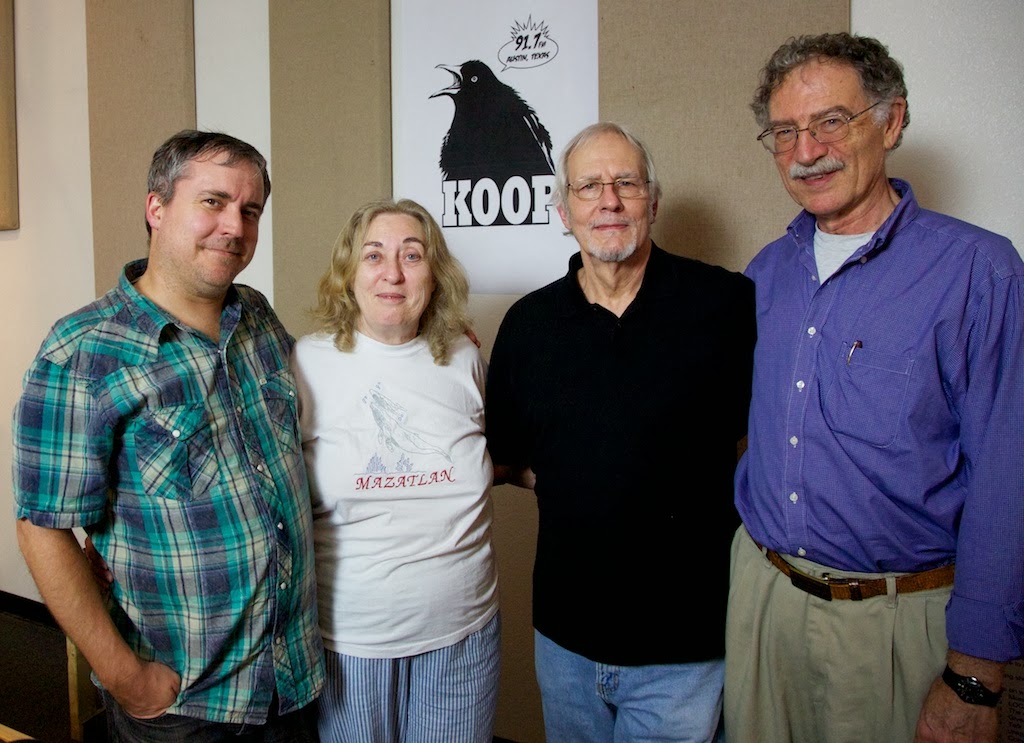
From left, Rag Radio's Tracey Schulz, guest Mariann Wizard, host Thorne Dreyer, and guest Doyle Niemann, at the studios of Austin's KOOP-FM, November 15, 2013. Photo by Alan Pogue / The Rag Blog.
Doyle Niemann and Mariann Wizard

Listen to or download the podcast of our November 15 Rag Radio interview with former Ragstaffers Doyle Niemann and Mariann Wizard here:


Doyle Niemann is now a progressive leader in the Maryland House of Delegates, and Mariann Garner-Wizard is an Austin-based poet and social activist. Niemann and Wizard (then Mariann Vizard) both worked with The Rag, Austin’s now legendary underground newspaper, published from 1966-1977.

Doyle Niemann was an anti-war activist at the University of Nebraska and the University of Texas where he worked with the Young Democrats and the Students for a Democratic Society (SDS). He later was on the staff of underground newspapers Space City! in Houston and The Great Speckled Bird in Atlanta, and was founding managing editor of the national progressive newspaper, In These Times. In 2002 Niemann was first elected to the Maryland House of Delegates where he is a legislative leader on environmental and housing issues.

Mariann Wizard has been a progressive activist since the ‘60s and an advocate for drug law reform. She is a widely-published poet, a professional science writer specializing in natural health therapies, and a regular contributor to The Rag Blog. Her recent books include Did You Hear Me the First Time? and End Games, a book of poetry and drawings, and Hempseed Food: The REAL Secret Ingredient for Health & Happiness.


Susan D. Carle

Listen to or download the podcast of our November 8 Rag Radio interview with author Susan D. Carle here:


Susan D. Carle is the author of Defining the Struggle: National Organizing for Racial Justice, 1880-1915, a groundbreaking study of nineteenth century social and legal activism published by Oxford University Press. According to NAACP president Benjamin Todd Jealous, “Susan Carle writes a clear and convincing history of the first generation of civil rights organizers and advocates -- the movement that started the Movement.”

Carle is a professor at American University Washington College of Law where she teaches legal ethics, anti-discrimination law, labor and employment law, and torts. She writes primarily about the history of social change lawyering, legal ethics, and the history and sociology of U.S. lawyers. Carle has been a community organizer, a civil rights lawyer, and a union-side labor lawyer. She graduated from Yale Law School in 1988 and received the 2001 American Association of Law Schools Best Junior Scholar Award and the 2006 Jean and Edgar Kahn National equal Justice Library Award for her writing on the early history of the NAACP.


Slaid Cleaves

Listen to or download the podcast of our November 1 Rag Radio interview with singer-songwriter Slaid Cleaves here:


Go to our earlier post about the show at The Rag Blog -- for information and photos from our interview with Slaid Cleave, who joined us in interview and lively performance.


Rag Radio is hosted and produced by Rag Blog editor Thorne Dreyer, a pioneer of the Sixties underground press movement. Dreyer was a founding editor of the original Rag, published in Austin from 1966-1977. Tracey Schulz is the show's engineer and co-producer.

Rag Radio has aired since September 2009 on KOOP 91.7-FM, an all-volunteer cooperatively-run community radio station in Austin, Texas. Rag Radio is broadcast live every Friday from 2-3 p.m. (CST) on KOOP and is rebroadcast on Sundays at 10 a.m. (EST) on WFTE, 90.3-FM in Mt. Cobb, PA, and 105.7-FM in Scranton, PA. Rag Radio is also aired on KPFT-HD3 90.1 -- Pacifica radio in Houston -- on Wednesdays at 1 p.m. (CST).

The show is streamed live on the web and, after broadcast, all Rag Radio shows are posted as podcasts at the Internet Archive.

Rag Radio is produced in association with The Rag Blog, a progressive Internet newsmagazine, and the New Journalism Project, a Texas 501(c)(3) nonprofit corporation.

Rag Radio can be contacted at ragradio@koop.org.

Coming up on Rag Radio:
THIS FRIDAY, December 20, 2013: Historian, author, and publisher of nonfiction comics, Paul Buhle, editor of Radical Jesus: A Graphic History of Faith.

The Rag Blog

[+/-] Read More...

18 December 2013

BOOKS / Alan Wieder : Paul Buhle's 'Radical Jesus: A Graphic History of Faith'

Paul Buhle's 'Radical Jesus':
Comic artists explore the history
and social message of Jesus Christ

By Alan Wieder / The Rag Blog / December 19, 2013
Paul Buhle, the noted historian, author, graphic novel publisher, and editor of Radical Jesus, is Thorne Dreyer's guest on the 200th edition of Rag Radio, Friday, December 20, from 2-3 p.m. (CST). Rag Radio airs and streams live on cooperatively-run KOOP 91.7-FM in Austin, Texas, and is rebroadcast and streamed on WFTE-FM in Mt. Cobb and Scranton, PA, Sunday at 10 a.m. (EST) and on KPFT's HD-3 Channel in Houston, Wednesday at 3 p.m. (CST). The podcast of this show can be found at the Internet Archive.
[Radical Jesus: A Graphic History of Faith. Paul Buhle, Editor; Sabrina Jones, Gary Dumm, Nick Thorkelson, Artists (2013: Herald Press); Paperback; 128 pp; $24.99.]

Paul Buhle is one of the most prolific and insightful critics from the American left. While his topics at first glance appear incredibly eclectic, closer reading uncovers a sharp focus that thoughtfully challenges class disparity, racism, and imperialism in the United States and throughout the world.

The breadth of his work, even if you consider only his collaborative graphic titles, is mind-boggling as the topics include Che, Yiddishkeit, SDS, the Wobblies, Emma Goldman, FDR, the Beats, and Isadora Duncan. And now, in collaboration with artists Sabrina Jones, Gary Dumm, and Nick Thorkelson, comes Radical Jesus: A Graphic History of Faith.

Like Buhle’s prior books, Radical Jesus investigates the inequalities that exist in the world, historically and presently, but this time through a theological lens. After an introduction, the sections of the book are “Radical Gospel,” “Radical History,” and “Radical Resistance.”

As a focus for reading the book we can assume that liberation theology began with Jesus and carries on at the present time. Each section is illustrated by a different artist but is pulled together by both content and style. As Buhle explains in the Introduction: “The book has been designed with a purposeful color progression from black and white in the first section, to a color choice reminiscent of the illuminated texts of the Middle Ages, to the full color of modern times.”

Combining substance and style, the drawings and text constantly switch between social issues of the past and the present. Interviewed by a reporter for the Brown University newspaper, Buhle said that he wrote the book for the young people involved in the Occupy Movement.
Oh, let’s say I was speaking to those young people. I’m not a person who goes to church. But I was speaking to those young people and to others who were looking for some alternative, there’s one page in the comic that says no to either passivity or violence. For some other way to respond to the crises, and you know, Americans by and large, still, have this religious thing, this mystique. It’s good to think of a way to speak to them in this fashion.
There are numerous poignant frames in Radical Jesus; below are some samples. With stark black and white graphics page 23 in the “Radical Gospel” section, by Sabrina Jones, begins with a priest looking at a dead man lying in the street, “unclean -- better keep away!” Another priest does the same but then comes the Good Samaritan who helps the man who isn’t dead -- who is the Christian.

Stories of Jesus and class disparity continue in this section with a distressing sequence on preaching and religious leaders on page 35, “They preach – But they don’t practice.” Reminiscent of of Bishop Tutu’s story of Europeans coming to Africa: “We had the land and they had the bible. Then they said, ‘Let us pray.’ And we dutifully shut our eyes, and when we said amen at the end and opened our eyes, why, they had the land and we had the bible.”

But of course Bishop Tutu said much more. Corresponding to Radical Jesus:
This God did not just talk... He showed himself to be a doing God. Perhaps we might add another point about God -- he takes sides. He is not a neutral God. He took the side of the slaves, the oppressed, the victims. He is still the same even today; he sides with the poor, the hungry, the oppressed, and the victims of injustice.
Gary Dumm did the “Radical History” section of the book with Laura Dumm and others. This section tells the story of dissent beginning in the 14th Century and concluding with the abolitionists. John Wycliffe, the Anabaptists, Quakers, and the Grimke sisters are introduced with many other people who challenged church hierarchy in the name of social justice. On page 63, Buhle collaborates with Dumm on a story called “Escape from Galley Slavery.”
Some martyrs were burned at the stake, others were drowned, decapitated, had their tongues ripped out, or their mouths filled with gunpowder. To go to a violent death with cold determination or even good cheer was to prove to all present that the believer placed ultimate trust in God’s judgment.
However, these executions were ultimately cynical and class disparately vicious.
French and Belgian royal courts sometimes offered ‘banquets’ for the intended victim the day before the execution. In the city hall, the accused would be compelled to take the seat of honor between the mayor and a local religious leader while being mocked and offered expensive food and wine.
Many a martyr refused to eat or drink!

Drawing by Sabrina Jones
from
Radical Jesus.
The last pages of “Radical History” speak to the Quakers in Pennsylvania losing the fight for Indian rights. Two frames appear on page 85 with the first showing Quaker representatives in the Pennsylvania Assembly resigning and walking out of the chambers in protest of oppressive actions to attack Indians.

The second frame, titled “What was Lost,” depicts people in a living room watching a baseball game between the Philadelphia Quakers and New York Iroquois -- shades of Howard Zinn history.

The 39 pages of the book’s last section, “Radical Resistance,” is thick as the art of Nick Thorkelson and the text speak to the many more modern quests for social justice through questions/statements of a grand diversity of people on-the-ground testifying at a faith-based meeting.

The courage of abolitionist Sojourner Truth is portrayed in a story called “Steal Away: Abolitionism and Black Freedom.” We meet those who fought for civil rights in the United States like Rosa Parks, Ella Baker, Martin Luther King, Ralph Abernathy, Fred Shuttleworth, Bob Moses, and many people whose names we don’t know.

The New Jim Crow is portrayed on page 104 with Reverend Jeremiah Wright connecting the incarceration of blacks in the United States with the plight of Jesus. On Reverend Wright: “A prophetic voice much maligned in the mainstream media but cherished by the thousands of black churches allied against mass incarceration.”

“Radical Resistance” also tell us of Dorothy Day and Peter Maurin’s Catholic Worker movement as a lead into the anti-war actions of the Berrigan brothers -- liberation theology and the work and political assassination in El Salvador of Archbishop Oscsar Romero. All of these accounts of activism conclude with stories of people that we have never heard of who fight for social justice in both their communities and throughout the world -- and there lies the "mission" of Paul Buhle and his collaborators in Radical Jesus.

Buhle writes:
The radicalism of Jesus has nothing to do with men hoarding guns against the imagined threat of black helicopters, or bearded fanatics burning down schools for women. Instead, Jesus goes to the roots of assorted hatreds -- not only our destructive exploitation of humanity but also our plundering of creation. All of life is endangered and we cannot afford these hatreds running rampant much longer.
Radical Jesus provides the stories of models, teachers, for the young people for whom Buhle says the book was written. The book’s portraits, graphics, and text are thoughtful and powerful, and are important not only for young activists, but also for all of us who thoughtfully work for social justice.

[Alan Wieder is an oral historian who lives in Portland, Oregon. His latest book, Ruth First and Joe Slovo in the War Against Apartheid was published in the United States by Monthly Review Press and in South Africa by Jacana Media. Read more articles by Alan Wieder on The Rag Blog.]

The Rag Blog

[+/-] Read More...

Rabbi Arthur Waskow : Israel, Hillel, and Idolatry

Harvard Hillel banned a speech by former Israeli Knesset Speaker Avraham Burg.
The spiritual issue:
Israel, Hillel, and idolatry
The Hillel International prohibitions make the State of Israel, and indeed only one version of it, into an idol.
By Rabbi Arthur Waskow / The Rag Blog / December 19, 2013

Recent controversies within Hillel International, the “home” for many Jewish college students of diverse backgrounds and beliefs, have made public in a sharper way a profound spiritual issue confronting American Jews and their “official” organizations.

The spiritual issue: When does strong support from many American Jews for the State of Israel and its Jewish citizens as an emergency refuge, as a creative culture, as a defender of Jewish interests, as a member of the Jewish family, become idolatry of the State?

First, the background of the Hillel controversy; then, an examination of what idolatry is:

The controversy surfaced most publicly when Swarthmore College Hillel announced they would refuse to abide by rules handed down by “Hillel International” that would limit what Jewish organizations and speakers were allowed to speak there. Hillel International then threatened to expel Swarthmore Hillel.

The debate within Hillel began in 2011 when its official managers adopted a policy that prohibited having speakers or partnering with organizations that “deny Israel’s right to exist as a Jewish and democratic state; delegitimize, demonize, or apply double standards to Israel; support boycott, divestment, and sanctions [BDS] efforts against Israel; or foster an atmosphere of incivility.”

Applying these rules, Harvard Hillel refused to allow a former Speaker of the Israeli Knesset, Avraham Burg, to speak at Hillel because co-sponsors of his speech included a group of pro-BDS students in the Palestinian Solidarity Committee along with J Street U, Students for Israel, and Progressive Jewish Alliance.

Responding to this exclusion of Burg, first Harvard students and then a growing band of Jewish students across the country created “Open Hillel,” arguing for a policy of welcoming broad debate and inclusion of Jews of varied views and action about Israel and about prayer, gender, sexuality, economic policy, political party, theology, and every other issue.

More recently, Hillel International announced it had become formal partners with AIPAC, an American lobbying group that almost always strongly supports Israeli government policies when it meets with and encourages campaign contributions to Members of Congress.

Open Hillel raised strong concerns about the effect of Hillel’s privileging AIPAC in this way, as against other Jewish organizations that strongly differ with Israeli government policy. Open Hillel urged that instead, AIPAC continue to be treated as one voice among many in the voices Hillel encourages to speak in its venues..

Then Swarthmore Hillel proclaimed itself an “Open Hillel.”


For me, all this raises some basic questions of the Spirit.

What is idolatry? Worshipping any being -- person, object, institution, community -- as if it were Divine. “Carving it out” and “bowing down to it” as the Ten Commandments describe and forbid. (Exod. 20: 4). Not only “carving out” a physical object, a statue, but carving out from the One Great Flow of Life a piece that must not be criticized, not be questioned. A piece not only to be loved and honored for its usefulness and beauty, not only to be seen as a temporary aspect in service to that Unity -- but treated as an Ultimate, Unchangeable good.

The Hillel International prohibitions make the State of Israel, and indeed only one version of it, into an idol.

I understand the urge to do this. The Rabbis told a tale in which they searched and searched for the yetzer hara (the evil impulse) toward idolatry, hoping to destroy it. They finally found it -- in the Holy of Holies! We most easily make an idol of something that has a lot of sacredness in it.

What is the alternative to idolatry of Israel? Idolatry of any thing?

The alternative is celebration of the God Whose Name is "Ehyeh Asher Ehyeh, I Will Be Who I Will Be." I am Becoming. Never stuck.

That was/is/will be the God of the Burning Bush, Who called Moses to resist Pharaoh and calls us to resist all pharaohs. (Exod. 4)

There is an intrinsic connection between Ehyeh Asher Ehyeh and freedom of work, restfulness, association, speech, conscience, politics, culture, sexuality.

Free speech is not only valuable because it treats individual conscience seriously; it is also valuable because from much debate emerges greater wisdom.

Does excluding Avraham Burg make sense? Does it work for or against a vibrant Jewish people, for or against wise policies toward Israel? Does refusing to allow Jewish groups and a pro-BDS pro-Palestinian group to co-sponsor a Hillel program make sense? Does that exclusion help Palestinians and Jews get to hear each other and begin to shape a relationship that could seek peace and pursue it? ?

A personal example: I have debated publicly against supporters of all-out BDS against Israel. As a result of those debates, people have written me that they have grown in their understanding of the flaws and dangers in such BDS. And I have grown in my own understanding as well, coming to see that a more limited and targeted boycott of products dependent on Israeli Occupation of the West Bank might be a reasonable instrument of nonviolent opposition. The debates have led to greater wisdom.

The danger is that because of its idolatry toward Israel, the Jewish establishment doesn’t want creative, independent-minded Jews around for the next generation to create a vibrant Judaism in tune with the God Whose Name is "Ehyeh Asher Ehyeh" -- a Judaism that would be threatening to those same established structures.

I prefer the intense debates that make the Torah and the Talmud, the Hassidim and their opponents the Misnagdim, full of life.

So I applaud the response of Open Hillel, which instead of walking away from Jewish life in disgust, seeks to shape not only new content but a new form of college Jewish life, and is using Internet connections to do it. You can access their website and sign their petitions at www.openhillel.org.

[Rabbi Arthur Waskow, Ph.D., directs The Shalom Center; the newest of his 22 books, Freedom Journeys: The Tale of Exodus and Wilderness Across Millennia, was co-authored with Rabbi Phyllis Berman (Jewish Lights Publishing, 2011). Read more articles by Rabbi Arthur Waskow on The Rag Blog].

The Rag Blog

[+/-] Read More...

Paul Krassner : Is There a Doctor in the House?

Doctors provide free medical care at the Riverside County Fair Grounds in California's Coachella Valley earlier this year. Image from KESQ.com.
California tops in most uninsured:
Is there a doctor in the house?
The insurance industry has a preexisting condition known in technical terminology as greed.
By Paul Krassner / The Rag Blog / December 19, 2013

Although Coachella Valley in Southern California has become synonymous with music festivals, Goldenvoice, the company that produces those events, also helped sponsor the first massive four-day health clinic this year. Free medical, dental, and vision care was provided to nearly 2,500 uninsured patients at the Riverside County Fairgrounds.

According to the California Healthcare Foundation, this state now has the largest number of people without health insurance -- 6.9 million –- more than any state in the country. More than 20% of Californians remain uninsured. Employees in businesses of all sizes are more likely to be uninsured in California than any other state. About 60% of the uninsured population are Latino.

Pamela Congdon, president of the Remote Area Medical’s California affiliate (RAM CA) and Volunteer Coordinator, told me that
The California Association of Oral and Maxillofacial Surgeons (CALAOMS) helps sponsor RAM CA. They allow us to use their office, use our staff, including myself and our Associate Director, without any charges.

I work for CALAOMS, and when I asked if they would help us bring RAM in Northern California, they agreed. Stan Brock asked me to start the affiliate -- RAM CA –- which ran the clinic in Coachella. Please say that the clinic is run by the greatest group of volunteers.
Indeed, over 1,200 general and healthcare professionals volunteered to provide more than 10,000 individual services with more than $1,000,000 in value. Over those four days, 12 hours a day, an estimated 600 custom pairs of eyeglasses were cut, 750 medical exams administered, and 1,300 dental patients treated.

There were 615 general volunteers, 395 dental professionals, 60 vision professionals, and 190 medical professionals of all kinds. There were 1,766 dental patients, 1,435 medical, and 798 vision. One patient hadn’t seen a doctor for 17 years. Of the 2,419 patients, 1,796 were Latino. Oh, yes, and 234 stuffed animals were handed out to children.

One patient sent this message:
My name is Jennifer and I wanted to say thank you from the deepest of my heart! I found out about RAM in Indio at 11 p.m. on Thursday. By 2:30 a.m., I had made my way across the valley, and joined in line with the rest of the people you helped. Not a SINGLE person I interacted with was anything but kind, courteous, and understanding. No one judged us for being there, no one thought we were a burden.

I had all of my wisdom teeth pulled, something I avoided due to an overbearing phobia of dentists in general. Both my dentist and the dental assistant were comforting, and made the procedure almost painless, and fast. I am almost in tears as I write this email, due to the overwhelming gratitude I have for everyone involved in this amazing project that has changed and saved so many lives, including my own.

I’m writing this in the middle of the Open Enrollment time frame, during which my wife Nancy and I finally signed up for a Medicare Advantage plan. Stemming from an old police beating, I use a cane to walk from room to room, and a walker outside the house. The new healthcare plan includes free access to a gym, and I picture myself using my walker on a treadmill.

That image reminds me of a New Yorker cartoon depicting a group of people on stationery bicycles in a park. In the process of enrolling in the Medicare Advantage plan, we were told that we would have to pay a penalty because we hadn't joined a Medicare (or any other “creditable”) prescription drug coverage. We were never informed about that requirement, which began in 2006.

Since we’ve always avoided taking prescription drugs, we never felt the need for it. I called the Health Insurance Counseling Advocacy Program and learned that the penalty would be $32 for each of us. That means $64 every month for the rest of our lives. It seems somewhat absurd and unfair that we could be penalized for not taking any prescription drugs.

Ironically, “This penalty is required by law and is designed to encourage people to enroll in a Medicare Drug Plan when they are first eligible,” yet we had no way of knowing there was such an option to consider. Another irony is that Medicare doesn’t cover any dental procedures, even though rotten teeth and gums can cause internal illness that Medicare does cover.

I asked RAM CA volunteer Dr. Peter Scheer, a world-renowned oral surgeon, about that. His response:
In regard to Medicare and covering dental needs, it has always been an issue. Medicare stands strong in only providing benefits for services that are deemed medically necessary and has always excluded anything related to dentistry, surgical or restorative.

Yes, there are situations where a patient may have an atrocious dental infection that can become life-threatening if not treated. The times where this situation really hits a grey area is when the patient also has other medical issues that may be affected by the infection or contributing to it. Unfortunately, most instances we come across are a decrease in the quality of life due to a poor oral condition rather than a life-threatening event.
However, a research team from Columbia University’s School of Public Health has just released the results of a three-year study of 420 men and women, concluding that the improvement of gum health can help slow the development of atherosclerosis, the build-up of cholesterol-rich plaque along artery walls, which can lead to heart attacks and strokes.

Meanwhile, Goldenvoice has invited RAM CA to return next year. I asked Pamela Congdon, “Will the Affordable Care Act affect that event, or is it too early to tell?” She replied, “The ACA won’t affect the event in terms of people needing service. We are going to have the Borrego Community Health Foundation there to help people sign up for the ACA.”

As inspiring as this year’s four-day free clinic has been, in a truly compassionate culture, there would be no need for its existence.

But the insurance industry has a preexisting condition known in technical terminology as greed. Not to mention the pharmaceutical industry; the annual turnover of revenue for prescription drugs by the top 10 companies is estimated to be worth $700 billion dollars.

In my new Medicare Advantage Enrollment Kit, there are listed a few thousand prescription drugs, from Abacavir to Zyvox. Okay, now cue that soothing voiceover to recite all their side effects, from anal leakage to zits.

As for me, I owe my longevity to never taking any legal drugs.

The above piece was first published on AlterNet and was cross-posted to The Rag Blog by the author.

[Paul Krassner’s latest book, an expanded, updated edition of his autobiography, Confessions of a Raving, Unconfined Nut: Misadventures in the Counterculture, available at Source paulkrassner.com. Read more articles by Paul Krassner on The Rag Blog.]

The Rag Blog

[+/-] Read More...

17 December 2013

Kate Braun : Winter Solstice Falls on Saturn's Day

Saturnalia by Ernesto Biondi, 1909.
Io Saturnalia!
Winter Solstice 2013
This seasonal celebration takes from many traditions, including the Roman Saturnalia, Druid customs, the German 'Yule,' and the birth of Jesus; and Queen Victoria popularized the lighted Christmas tree.
By Kate Braun / The Rag Blog / December 17, 2013

Saturday, December 21, 2013, marks Yule, the Winter Solstice, also the date observed as Saturnalia by the ancient Romans. Fittingly, this year’s Yule falls on a Saturday, Saturn’s Day.

For the Romans, Saturnalia was a time to remember and celebrate Rome’s “Golden Age," when Saturn ruled and life was perfect: the earth had no winter, food was abundant, there was no war, all living things on the planet coexisted peacefully.

In remembrance of this time, Romans gave each other gifts, opened their doors and shared hospitality, and partied like there would be no tomorrow! Many of the elements of Saturnalia have been absorbed into our Yule celebrations. Giving gifts and hosting parties are the most obvious ones.

There were other Sun-Gods in the Long Ago, most notably Mithras. His birth was celebrated on December 25 and involved much feasting and partying. In the 5th century, Church leaders moved the date of Jesus’ birth to December 25 in order to take advantage of the already existing celebrating and to shift the focus away from what they considered paganism.

Druid customs bring us the hanging of mistletoe over doorways. Give a kiss of peace on entering a home and it conveys the promise to not perpetrate mayhem or other negative mischief while inside.

Germanic influence brings us the Yule log and the decorating of trees. We can thank Queen Victoria for making a lighted Christmas tree popular; it was a custom introduced into England by Prince Albert. Queen Victoria found the custom delightful, and if it was good enough for the queen it was good enough for all her subjects!

The word “Yule” comes from a Germanic word meaning “wheel” and signifies the shifting of Planet Earth from the dark time to the lighter time when Lord Sun once again begins his ascendency. It is interesting to note that this year Lady Moon is in Leo, a Fire sign, on the day that marks the beginning of Lord Sun’s new life.

Use the colors red (for fire and Lord Sun’s new energy), green (for the new life soon to be seen in the emerging green shoots of plants), and white (for the snow that will melt away) in your decorating. Use evergreen boughs to symbolize the rebirth of life.

Serve your guests roast meat (it need not be a whole boar’s head), nuts, spiced cakes, and sweets as well as wassail (egg nog may easily replace a steaming wassail bowl) or other celebratory libations.

Sing carols to welcome the new life of Lord Sun: "Yonder Come Day," "Lo, How a Rose E’er Blooming," "I Heard the Bells on Christmas Day," "Pat-a-Pan," "White Christmas," "Angels We Have Heard on High"; any song that lifts your spirits. Don’t fret overmuch about how well you sing.

Sing in new life, brighter days, shorter nights, new beginnings, love, peace, goodwill towards all.

[Kate Braun was a contributor to the original Rag. Her website is www.tarotbykatebraun.com. She can be reached at kate_braun2000@yahoo.com. Read more of Kate Braun's writing on The Rag Blog.]

The Rag Blog

[+/-] Read More...

16 December 2013

Allen Young : Ralph Dungan, the 'Good Liberal'

Ralph Dungan in Chile, 1966. Photo from The Washington Post.
Discretion, valor, 
and the 'good liberal'
In the most patronizing tone, Mr. Dungan said if we opposed U.S. policy, we should 'return to the U.S. and run for Congress.'
By Allen Young / The Rag Blog / December 16, 2013

The October obituary of Ralph Dungan, one of President John F. Kennedy’s top aides who later served as ambassador to Chile, reminded me of my one-time experience with this man referred to by a historian as a “good liberal.”

In the mid-1960s, when I was living in Santiago, Chile, on a scholarship from the Inter-American Press Association, I was called in to Ambassador Dungan's office along with another American graduate student and given a tongue-lashing that I have never forgotten.

My friend and I both had strong objections to the growing military involvement of the United States in Vietnam and awareness of the growing anti-war movement back home, and we had been expressing our views to our Chilean friends. Fluent in Spanish, I spoke to a gathering of students at the University of Chile.

In the most patronizing tone, Mr. Dungan said if we opposed U.S. policy, we should “return to the U.S. and run for Congress.” He made veiled threats that if we continued this behavior, our lives could become complicated.

I became quite angry about this lecture and considered informing Chile's very popular left-wing press. This could have led to headlines, but the truth is that I was quite intimidated by the whole thing. I was only 25 years old, and I was afraid I could lose my scholarship and my related draft deferment. I didn't stop expressing my views, but I became more cautious.

Thus a classic liberal showed his true colors on the issue of the Vietnam War and freedom of expression. And I was not as courageous as I might have been. Looking back on my entire life, this moment in Chile is the best example I have of truly understanding the famous line from Shakespeare's Henry IV: "Discretion is the better part of valor."

[Allen Young left The Washington Post to work with Liberation News Service in the late Sixties and later became an important voice in the gay liberation movement. Allen now lives in rural Massachusetts where he is involved with environmental issues and writes a column for the Athol Daily News.]

The Rag Blog

[+/-] Read More...

11 December 2013

Ed Felien : A Good [Angry White] Man With a Gun

Image from The L Magazine.
Pissed-off patriot:
‘A good man with a gun’
These angry white men are doing their best to bring back an idealized past that never really existed
By Ed Felien / The Rag Blog / December 12, 2013
“The only thing that stops a bad man with a gun is a good man with a gun.” -- Wayne LaPierre, National Rifle Association
Paul Anthony Ciancia believed he was that good man. He believed he was a warrior against the traitors who were taking over our government, bankrupting our currency, and trying to establish a New World Order.

On Friday, November 1, Ciancia walked into the Los Angeles airport and began firing an assault rifle, killing Transportation Service Administration (TSA) officer Gerardo Hernandez and wounding several others, until police officers were able to bring him down with several rounds to his midsection.

Ciancia’s duffel bag contained a handwritten, signed letter stating that he had “made the conscious decision to try to kill” multiple TSA employees and that he wanted to “instill fear in their traitorous minds.” The note said he would be happy if he managed to kill just one TSA agent. “Black, white, yellow, brown, I don’t discriminate.” It also mentioned fiat currency and NWO (the New World Order).

One official, who was not authorized to discuss the investigation publicly and spoke on condition of anonymity, said the note referred to how the gunman believed his constitutional rights were being violated by TSA searches and that he was a “pissed-off patriot” upset at former Homeland Security Secretary Janet Napolitano.

Austin's Alex Jones, a popular right-wing conspiracy theorist, host of Infowars.com (“because there is a war on for your mind”), had ranted weeks before about how the government had always meant to arm TSA agents as part of the plan for the New World Order’s authoritarian and socialist domination of America.

The Southern Poverty Law Center explains:
The New World Order refers to a longstanding conspiracy theory that today, in its most popular iteration, claims that global elites are plotting to form a socialistic “one-world government” that would crush American freedoms. Often, the root of the alleged conspiracy is traced to the 1913 creation of the Federal Reserve and the adoption of fiat currency -- paper money that is not backed by gold, as it once was in the U.S.

So-called Patriots also increasingly see the Department of Homeland Security (DHS), which produces intelligence assessments of extremists that are distributed to other law enforcement agencies, as an enemy and even a collaborator in the New World Order conspiracy. Many believe DHS has targeted their movement and is somehow connected to the alleged construction of concentration camps by the Federal Emergency Management Agency (FEMA). The purported camps are thought to be meant for those Americans who resist a coming national seizure of all weapons from U.S. citizens.

The TSA, short for the Transportation Security Administration, is an agency of the DHS charged with ensuring the security of transportation, most notably air transportation. Although it has not been widely singled out by Patriots, it has been subjected to criticism by far-right homophobes, among others, who have alleged that TSA agents engaging in hand searches are really sexually groping travelers.
In his note, Ciancia called former director of DHS Janet Napolitano a “bull dyke.”

In many ways, Ciancia is no different from the other crazed lone gunmen who went berserk: Jared Loughner and the Gabrielle Giffords shooting; Wade Michael Page randomly killing six people in a Sikh temple in Oak Creek, Wisconsin; Adam Lanza and the Sandy Hook Elementary School shootings -- all young white males who couldn’t find their place in the world, couldn’t find work, couldn’t find meaning.

Michael Kimmel, an authority on male violence against women and the author of No Safe Place, says, in an interview with PBS:
The traditional model of masculinity has been around for an awfully long time, basically it posits that men have to be... well the basic rules of manhood, if I were to put them this way are, no sussy stuff, that’s the first rule. You can never do anything that even remotely hints of femininity. The second rule is to be a big wheel. You know, we measure masculinity by the size of your paycheck, wealth, power, status, things like that.

The third rule is to be a sturdy oak. You show that you’re a man by never showing your emotions. And the fourth rule is Give ‘em Hell. Always go forward, exude an aura of daring and aggression in everything that you do. And this model of masculinity has been around for an awfully long time.
I think Kimmel is right in his psychological assessment, and the actions of these men can be seen on the one hand as a grand and deluded burst of masculine assertion. As if by this one act they will redeem their lives.

But it would be wrong to ignore the political content of their actions. Jared Loughner was attempting to assassinate a Democratic Congresswoman. In January 2011, I wrote:
Kelly [Gabrielle Giffords’ opponent in the last election] was supported in his campaign by ALIPAC (Americans for Legal Immigration PAC). John McCain spokesman Brian Rogers said of the group, “It is backed by white supremacists, neo-Nazis and anti-Semites.” He was also supported by Sarah Palin. She appeared with him on Fox News and said, “ I don’t feel worthy to lace his combat boots.” Giffords’ congressional district was one of 20 Democratic districts that McCain carried in 2008 where the incumbent voted for health care reform.

On her website, Palin said, “We’ll aim for these races and many others. This is just the first salvo in a fight to elect people across the nation who will bring common sense to Washington.” Their districts were on a U.S. map located by crosshairs. After the shooting, Palin’s campaign denied the crosshairs were meant to appear as targets, even though she had also said on March 23, “Don’t Retreat, Instead, RELOAD!”

The imagery and the rhetoric is clear, and it’s consistent with Republican rhetoric throughout the 2010 campaign:
  • Robert Lowry, Republican candidate in Florida, fired at a target with his opponent’s initials written on it.
  • Rep. Allen West’s first choice for chief of staff, Joyce Kaufman, said, “If ballots don’t work, bullets will.”
  • Sharron Angle talked about Second Amendment remedies in her race against Harry Reid in Nevada.
  • Michele Bachman said she wanted her supporters “armed and dangerous.”
Jesse Kelly held a fundraiser in June where he advertised: “Get on Target for Victory in November. Help remove Gabrielle Giffords from office. Shoot a fully automatic M16 with Jesse Kelly.”

Minimum donation: $50.
Wade Michael Page could justify randomly killing six people in a Sikh temple because he believed they were a threat to racial purity in America.

Law enforcement officials told CBS that Adam Lanza may have been motivated by a desire to outdo Anders Behring Breivik, the Norwegian Neo-Nazi who killed 77 people, mostly children, in July 2011.

These acts, then, can be seen as part of a tradition begun by Timothy McVeigh, who detonated a truck bomb in front of the Alfred P. Murrah Federal Building in Oklahoma City on April 19, 1995, that killed 168 people. A militia sympathizer, he hoped to inspire a revolt against what he considered to be a tyrannical federal government.

These angry white men are doing their best to bring back an idealized past that never really existed -- where white male authority was unquestioned, where there was order in society and everyone knew their place, where God and the flag were respected.

In many ways the right is imitating the left-wing armed revolutionaries of the ’60s, Che Gueverra and the Weather Underground. What is needed now is not to react to this violence with more violence. What is needed is to help these people chill out.

Liberals and left-wing progressives don’t spend much time listening to right-wing talk radio. Any spare time for the mass media is reserved for The Daily Show or Stephen Colbert or Saturday Night Live. And the reward is a self-satisfied smirk and a feeling of superiority. It must be how the artists and intellectuals in Weimar Germany felt when they laughed at that funny man with the little mustache.

We should not try to fight fire with fire. We need to fight fire with water. We need to listen to right-wing talk radio. We need to call up Rush Limbaugh, Sean Hannity, and Alex Jones and gently pour water on their incendiary ideas. The alternative is continued violence, continued killings, continued chaos. It is up to us to make sense of it and help our right-wing brothers and sisters to simmer down.

[Ed Felien is publisher and editor of Southside Pride, a South Minneapolis monthly where this article was also published. Read more articles by Ed Felien on The Rag Blog.]

The Rag Blog

[+/-] Read More...

BOOKS / Ron Jacobs : Matt Hern Writes With Bravado That Sports Do Matter

Wait a minute people:
Sports do have meaning
Engagingly written, One Game at a Time is motivated by the belief that sports do matter as much as sports fans think they do.
By Ron Jacobs / The Rag Blog / December 12, 2013

[One Game at a Time: Why Sports Matter by Matt Hern (2013: AK Press); Paperback; 176 pp; $10.63.]

Earlier this fall the Boston Red Sox baseball team blew most preseason projections of their season all to hell when they bested the St. Louis Cardinals four games to two and won Major League Baseball's World Series.

Even though the team has already won two such championships this century after an 86-year drought, Boston fans (including myself) were quite ecstatic. As I write, the sports media are announcing the draws for football (that’s soccer to you folks in the U.S.) for the 32 national teams competing in the World Cup. Soon, even the non-sports media will be covering this event. Elsewhere in the sports world, basketball seasons are heating up and U.S. football seasons are cooling down, while ice hockey skates along.

I'm guessing about now some readers are already moving to the next article. After all, goes their thinking, sports are just another distraction. Why does anyone care?

I don't know the exact answer to that question. Nor, can I explain why I spend so many hours every summer watching, listening to, and umpiring baseball. However, there are a few writers currently around who continue to investigate that question. Writing in the tradition of The Daily Worker’s Lester Rodney and the Trinidadian CLR James, these writers attempt to place sports at all levels -- youth to college to professional level -- within the context of capitalist economics and the culture that grows from such economies.

I have reviewed a couple of leftist sportswriter Dave Zirin’s works, as well as Gabriel Kuhn’s top notch look at soccer titled Soccer vs. the State. These two writers take a serious and engaging look at the role sports play in making money for the neoliberal robber barons.

Zirin also champions individual athletes who use their notoriety to encourage gender and racial tolerance and even challenge imperial war. Kuhn has done similar work regarding various football players and teams. Between the two of them, the role played by professional sports in maintaining neoliberal economics and nationalist tropes is breached and examined.

Matt Hern is a sportswriter living in Vancouver, BC. His recently published title One Game at a Time walks into the terrain where sports and politics mesh, taking a look at some of the same issues his compatriots examine and exploring new ones. Hern’s view contains a bit more bravado than either Zirin’s or Kuhn’s, as if sports radio grew a brain while retaining its brashness.

Engagingly written, One Game at a Time is motivated by the belief that sports do matter as much as sports fans think they do. It’s just that they matter in ways not explored by the mainstream media and the advertising machine behind them.

Hern compares sports to other pursuits like music and theater. By doing this, he validates the multiple experiences associated with sports -- from participation at any level to viewing them and fandom -- while simultaneously critiquing capitalism’s manipulation of all the aforementioned pursuits in the name of maximum profit.

In other words, Hern extols the virtues of sports, yet takes capitalism to task for twisting their cultural value in a manner similar to capitalism’s manipulation of music, theater, and film. Instead of quality hip hop and rock, the masses get fed sexist nonsense and pop pablum promoting greed. When it comes to sports, we get corporatism, nationalism, overpriced cable television coverage, and tickets only the wealthy can truly afford; not to mention athletes afraid to speak out against wrongs for fear of losing their jobs and corporate sponsors.

Zirin has championed boxer Muhammad Ali as an example of a sports hero who rose above his game. Indeed, it can be reasonably argued that Ali is more famous for his presence and actions outside the boxing ring than for his feats within the ropes.

Hern adds to Zirin’s portrayal of Ali, detailing how his image has been watered-down and depoliticized, then writing “We have to be willing to read Ali as he was: defiant, radical, complex, devout, confusing, dangerous, and all the rest....” If we do this, then perhaps modern athletes will find the strength to replicate Ali’s militancy and courage. Then, sports can matter even more and for greater reasons than the reasons most fans currently care about them.

Matt Hern is a welcome addition to the growing team of sportswriters willing to move sports out of their current position that masquerades as being apolitical while actually being outrageously political in support of the status quo.

The excessive importance of sports in modern society is not going to go away. Therefore, it is crucial that those sportswriters whose writing challenges the conventional narrative accompanying the sports spectacle be read by as many people as possible. The crack they have created in the nationalist, pro-capitalist, homophobic, and even racist sports coverage too many fans have grown used to is finally shedding a little light on the cloistered world that is modern athletics.

[Rag Blog contributor Ron Jacobs is the author of The Way The Wind Blew: A History of the Weather Underground. He recently released a collection of essays and musings titled Tripping Through the American Night. His novel, The Co-Conspirator's Tale, was published in 2013, along with the third novel in the series All the Sinners Saints. Ron Jacobs can be reached at ronj1955@gmail.com. Find more articles by Ron Jacobs on The Rag Blog.]

The Rag Blog

[+/-] Read More...

10 December 2013

Lamar W. Hankins : Right-Wing Rants and the Abominable Straw Man

The abominable Straw Man argument. Image from Linda's Bees.
Frosty the Straw Man:
How right-wing rants 
poison political discussion
If we could have civil discourse about our disagreements and try to understand why we have differences of opinion, perhaps we would have fewer rants from all sides of the political divide.
By Lamar W. Hankins / The Rag Blog / December 10, 2013

The Internet is a marvelous tool when used honestly and correctly, and with recognition of its limitations. Not a week goes by that I don’t find in my email inbox ridiculous and false political narratives about some atrocity or other going on in Washington or directed by Washington. Our politicians are purveying plenty of nonsense without anyone making up stories about what they do.

The most recent nonsense I received is an email angrily claiming that under the authority of Obamacare, the administration is setting up gasoline stations to provide free gas to low-income people:
According to a report in The Detroit News this morning, the [Obama] administration is using its authority under the Affordable Care Act to “improve transportation routes to hospitals” to dispense gasoline free of cost in disadvantaged neighborhoods.

The $2 billion-a-year program aims to distribute 40 million gallons of free gasoline each year through 70 new gas stations constructed in major metropolitan areas. The Department of Health and Human Services (DHS) will be responsible for operating the network, whose first station opened yesterday in Detroit...

“Supposedly access to the station is determined by income,” says Ebony Jackson, manager of the first Obamastation. “But it’s pretty unrealistic to do an income check on each and every driver. So what we do is basically let all the black people pump for free, and charge all the white people the market rate.”
A simple Internet search reveals that factcheck.org explained weeks ago that this information started its life as a piece on a satirical site, The Daily Currant. There are many satirical sites on the Internet, including the better-known publication The Onion, where patently ridiculous material gives some of us something to laugh, or -- at least chortle, about.

But the free gasoline story was sent to me as fact, and it had morphed from being about gasoline for poor people into “Government Opening Free Gas Stations in Poor Black Neighborhoods.”

There may be a bit of racial animus in that evolution, but I’ll let you judge that. I mention this point only because my source for the gasoline story regularly sends me racist material about Obama and continues to question where Obama was born. Readers of my column know that I am no Obama apologist and have been as critical of his presidency as I was of George W. Bush’s.

Some of the latest right-wing drivel comes from sites I read regularly or magazines to which I subscribe. The latest offender in the “just making stuff up” category is the respected Biblical scholar Robert M. Price. Price is an avowed atheist and political conservative.

In two pieces recently, he has taken on what he calls liberalism. The problem is that he posits liberal positions that exist mostly in his imagination and then proceeds to knock them down, acting like he has refuted a liberal position. This practice is referred to as the “straw-man” argument, because it is easy to tear down. But it is the kind of deceit that undermines honest, rational discourse.

In a blog entry, Price says that the supporters of the Affordable Care Act (ACA) promised that it would “leave no one uninsured.” Unfortunately, the best the ACA was intended to do is reduce the 45 million or so uninsured by about half, leaving 23 million Americans uninsured in 2023 when the ACA would be fully functional.

While reducing the uninsured by about half is better than nothing, it is a far cry from assuring that all Americans have health insurance from birth to death, as every other western industrial country has accomplished. But the ACA never promised health care for all. It was always an incremental step toward providing all Americans with a product as vital as water to a full life.

Further, in Price’s world, the “mainstream media” (because of political correctness) refuses to identify the race of perpetrators of a “new” type of criminal assault -- the “Knock Out Game.” Price claims that this kind of assault is one carried out by African-American youth against Jews, mainly for the amusement of the attackers, who don’t commit any other crime, such as robbery.

A review of on-line reports makes clear that such an assault was perpetrated against a Norwegian exchange student as long ago as 1992, followed by more recent attacks in 2005 in Britain and France; attacks in Illinois and Missouri in 2009; in Missouri again in 2011; in Chicago in 2012; and in Connecticut, Britain, New Jersey, Syracuse, and Brooklyn in 2013.

These attacks have been perpetrated against minorities, members of ethnic groups, and whites by African-American youth and others who were not African-American. At least one such attack was carried out by a 35-year old man with drug or mental problems, according to the Columbia Journalism Review. Eight victims in Brooklyn were Jewish and the attacks were linked to Jewish-Black tensions by several news reports as a result of a statement by a newly elected council member.

The Anti-Defamation League issued a public statement charging that the attacks there targeted Jews and lamented the comments of the council member-elect for spreading a false justification for such attacks -- that Jews owned the rental housing that Blacks lived in and were threatening them with eviction. At least one attacker was charged with a hate crime under New York law.

Many politicians and organizations have spoken out about the attacks, which have been reported in the mainstream media, including the New York Daily News, CBS, CNN, ABC, and the New York Post. Otherwise, I would not be able to read extensively about them. Some media sources, mainstream and others, have found these attacks to be limited in scope, while some disagree. However, I could not find evidence that the mainstream media is not reporting the attacks accurately and fully, as Price alleges.

Another claim by Price is that he can’t make certain statements blaming “Islamofascism on Muslims” without being seen as insensitive. Perhaps it is hair-splitting to suggest that the very name “Islamofascism” carries with it the implicit criterion that to be an Islamofascist means that one is Muslim. That is not the same as suggesting that all Muslims are Islamofascists, but Islamofascism has to be blamed on those Muslims who fit that description.

I do think it is important to be careful not to blame all Muslims for the transgressions of some Muslims. We might argue about how many Muslims are to blame for the fascism in their midst, but that’s a different discussion.

No one that I have heard has blamed all Methodists for homophobia in their midst, though the official policy of the United Methodist Church (UMC) is to remove any UMC minister who performs a wedding ceremony for a same-sex couple. I know many Methodists who disagree with this official policy, so I know that the homophobia involved cannot be blamed on all Methodists.

The problem with Islamophobia may be that Price and most Americans know so few Muslims that they are willing to engage in group blame for the actions of relatively few terrorists out of the 1.6 billion Muslims in the world.

Price also takes on Americans who favor reasonable gun control. He claims that “Our culture...thinks it best to take guns away from law-abiding citizens so they can’t commit the 'crime’ of self-defense...” Of course, he offers no evidence for this claim, but it gives him an opportunity to blame this state of affairs on liberals.

That should come as news to all nine members of the Supreme Court who seem to agree that reasonable regulation of guns is permitted under the Second Amendment, even while it struck down too much regulation in Washington, D. C. v. Heller five years ago, abandoning an understanding of the Second Amendment that had stood since 1939. But straw men are so easy to knock down, Price can’t stop.

I was amused to read Price’s claim that liberals embrace “the unscrupulous, amoral power tactics of Saul Alinsky.” As I remember, it was the right-wing Tea Party types in 2010 who used Alinsky’s philosophy and practices (especially his book, Rules for Radicals) to develop new tactics to oppose the ACA and fight other issues and candidates who displeased them.

Whatever Alinsky was, he was a patriot who believed completely in democracy. He was often criticized for being too focused on ends to worry about the propriety of the means used to achieve them. In 1966, at Union Theological Seminary, he addressed this charge:
Life and how you live it is the story of means and ends. The end is what you want, and the means is how you get it. Whenever we think about social change, the question of what and how, or means and ends, always arises. The man of action views the issue of means and ends in pragmatic and strategic terms... He asks of ends only whether they are achievable and worth the cost; of means, only whether they will work... He knows intuitively that the real and only question regarding the ethics of means and ends is, and always has been, “Does this particular end justify this particular means?”
Alinsky further explained in Rules for Radicals: “Life is a corrupting process from the time a child learns to play his mother off against his father in the politics of when to go to bed. He who fears corruption fears life.”

The same argument Price makes against Alinsky was made also against Martin Luther King, Jr. in the fight for civil rights in Birmingham. King addressed such criticisms in his Letter From Birmingham Jail, written 50 years ago. The letter was addressed to clergymen who criticized King for using the wrong means to end segregation: creating immense tension in Birmingham with the demonstrations he led, taking these actions at the wrong time, being an extremist, and violating the law.

King responded that creative tension was needed for growth in the hearts and minds of whites in the community. Without such tension, change would never occur. Those who support the status quo always want to wait for change to come, but King quoted Chief Justice Earl Warren, who wrote in an opinion in 1958 that “justice too long delayed is justice denied.”

King supported violating unjust laws as a moral responsibility and argued that civil disobedience is justified in the face of such laws. As to the charge of extremism, King wrote that Jesus and others revered through the ages were called extremists, "So the question is not whether we will be extremists, but what kind of extremists we will be. Will we be extremists for hate or for love?"

Whatever one thinks about Saul Alinsky and Martin Luther King, Jr., neither belongs just to liberals or right-wingers. Alinsky was a man for all seasons and political viewpoints. But he was not an ethics teacher or philosopher; he was a man of action in the quest for social justice.

Likewise, King fought for social justice his entire adult life, never willing to sit on the sidelines when social injustice needed to be corrected. His example inspired many across the spectrum of political opinion. While Alinsky’s tactics were often dramatically creative, both he and King supported nonviolent means to achieve their ends.

Finally, I’ll deal with one other claim of Price, though he makes enough false claims to write a small book. Price complains that he can’t use the word “Christmas” because non-Christians may be offended. I don’t know what universe Price lives in, but Christmas is ubiquitous in this culture. None of my Jewish or Muslim or Buddhist or atheist friends and acquaintances can possibly escape it unless they wrap themselves in a cocoon between Halloween and New Year’s Day. Only on Fox News is Price’s complaint about Christmas part of the real world.

The only Christmas complaints I hear usually concern the government’s promotion of Christmas as a religious holiday. Manger scenes at city hall sponsored by a city council have usually been prohibited by the courts. But Christmas itself is predominantly secular, focused largely on giving and receiving gifts and selling lots of merchandise. This secular Christmas is woven into the culture as much as Thanksgiving or July 4th.

While the materialistic aspect of Christmas has been criticized by ministers and other religious people, it has also been fodder for thoughtful comments by poets. My favorite is a poem written in the 1950s by Lawrence Ferlinghetti:
CHRIST CLIMBED DOWN

Christ climbed down
from His bare Tree
this year
and ran away to where
there were no rootless Christmas trees
hung with candycanes and breakable stars

Christ climbed down
from His bare Tree
this year
and ran away to where
there were no gilded Christmas trees
and no tinsel Christmas trees
and no tinfoil Christmas trees
and no pink plastic Christmas trees
and no gold Christmas trees
and no black Christmas trees
and no powderblue Christmas trees
hung with electric candles
and encircled by tin electric trains
and clever cornball relatives

Christ climbed down
from His bare Tree
this year
and ran away to where
no intrepid Bible salesmen
covered the territory
in two-tone cadillacs
and where no Sears Roebuck crèches
complete with plastic babe in manger
arrived by parcel post
the babe by special delivery
and where no televised Wise Men
praised the Lord Calvert Whiskey

Christ climbed down
from His bare Tree
this year
and ran away to where
no fat handshaking stranger
in a red flannel suit
and a fake white beard
went around passing himself off
as some sort of North Pole saint
crossing the desert to Bethlehem
Pennsylvania
in a Volkswagen sled
drawn by rollicking Adirondack reindeer
with German names
and bearing sacks of Humble Gifts
from Saks Fifth Avenue
for everybody’s imagined Christ child

Christ climbed down
from His bare Tree
this year
and ran away to where
no Bing Crosby carolers
groaned of a tight Christmas
and where no Radio City angels
iceskated wingless
thru a winter wonderland
into a jinglebell heaven
daily at 8:30
with Midnight Mass matinees

Christ climbed down
from His bare Tree
this year
and softly stole away into
some anonymous Mary’s womb again
where in the darkest night
of everybody’s anonymous soul
He awaits again
an unimaginable
and impossibly
Immaculate Reconception
the very craziest
of Second Comings
If we could have civil discourse about our disagreements and try to understand why we have differences of opinion, perhaps we would have fewer rants from all sides of the political divide. I have dedicated this column to arguing my positions based on evidence and reason. I’m sure I have not always succeeded in that goal, but I will keep trying. And with a little luck, I may be able to avoid reading any more rants from any political perspective.

[Lamar W. Hankins, a former San Marcos, Texas, city attorney, is also a columnist for the San Marcos Mercury. This article © Freethought San Marcos, Lamar W. Hankins. Read more articles by Lamar W. Hankins on The Rag Blog.]

The Rag Blog

[+/-] Read More...

HISTORY / Bob Feldman : A People's History of Egypt, Part 12, Section 1, 1947-1948

Police crack down on strikers in Mahalla, 1947, killing three workers. Image from Hossam el-Hamalawy / Flickr.
A people's history:
The movement to democratize Egypt
Part 12: 1947-1948 period/Section 1 -- Anti-imperialist left grows; Muslim Brotherhood collaborates with Egyptian regime.
By Bob Feldman / The Rag Blog / December 10, 2013

[With all the dramatic activity in Egypt, Bob Feldman's Rag Blog "people's history" series, "The Movement to Democratize Egypt," could not be more timely. Also see Feldman's "Hidden History of Texas" series on The Rag Blog.]

Despite the post-July 1946 political repression of Egyptian dissidents by the UK imperialist-backed monarchical regime, by the end of May 1947, a new Egyptian left anti-imperialist organization, the Democratic Movement for National Liberation [DMNL], also known as Hadeto, was formed after EMNL and Iskra leaders united and merged their approximately 1,200 Egyptian communist supporters into one group.

Solely funded in 1947 “from subscriptions and contributions imposed upon party members,” the DMNL “had some success” recruiting more Egyptian supporters in "the textile workers’ union, the transportation union, among...communication workers, hotel workers, tobacco workers, and military men” who often met fellow Egyptian left activists downtown at the Café Issayi-vitch in Cairo, according to Selma Botman’s The Rise of Egyptian Communism, 1939-1970.

After the owners of the Misr Spinning and Weaving Company factory in Mahalla-al-Kubra -- Egypt’s largest and most modern textile factory -- announced plans to replace over 12,000 Egyptian textile factory workers with new machinery, the textile workers went on strike in early September 1947. And after four of the striking workers were killed and 70 strikers were arrested by the Egyptian forces of “law and order,” 17,000 more Egyptian textile “workers in Shubra went on strike for one day in sympathy,” according to the same book.

The early September 1947 strike in Mahalla-al-Kubra was lost by the textile workers following its repression by the Egyptian monarchical regime. But during the last three months of 1947, additional strikes by textile factory workers in Alexandria, by oil workers in Suez, and by Egyptian teachers and telegraph workers broke out; and between 1948 and 1950 Egyptian nurses, police officers, gas workers, and textile workers in some other Egyptian cities also held strikes.

The DMNL was still an underground group that had to organize clandestinely during the late 1940s because of the repressive nature of the Egyptian regime. Besides recruiting Egyptian workers who apparently acted as catalysts for the late 1940s wave of labor strikes in Egypt, the DMNL also was able to recruit into its ranks during the 1940s some non-commissioned officers in the Egyptian military and some Egyptian peasants or fallahin.

And by the early 1950s, “the DMNL had contacts in tens of villages” in Egypt, according to The Rise of Egyptian Communism, 1939-1970. In addition, by the early 1950s, there were almost 500 unions in Egypt, according to an article by Atef Said, titled “Egypt’s Long Labor History.” that appeared in Against The Current in 2009.

During the late 1940s, around 13 million Egyptians lived in Egypt’s countryside in the Nile River valley and 6 million Egyptians lived in Egyptian cities. So although the number of Egyptian factory workers had increased from 247,000 to 756,000 between 1937 and 1947, around 66 percent of Egypt’s labor force was still engaged in agricultural work in the late 1940s. And despite Egypt’s formal political independence, foreign business investors still owned 61 percent of all Egyptian companies in 1947.

Yet the various anti-imperialist left secular Egyptian political groups together still had much less mass support by the 1940s than did the religiously fundamentalist Muslim Brotherhood group. As Selma Botman’s Egypt from Independence to Revolution, 1919-1952 observed:
[Hasan] al-Banna...established the Muslim Brotherhood in 1928... Al-Banna promoted a simple and absolute message to his followers: struggle to rid Egypt of foreign occupation; defend and obey Islam... By the outbreak of World War II, the Brotherhood...movement’s strength was...estimated at somewhere from many hundreds of thousands to beyond a million activists…
But according to Robert Dreyfuss’ Devil’s Game: How The United States Helped Unleash Fundamentalist Islam,
Banna’s Muslim Brotherhood was established with a grant from England’s Suez Canal Company, and over the next quarter century British diplomats, the intelligence service, MI6, and Cairo’s Anglophilic King Farouk would use the Muslim Brotherhood as a cudgel against Egypt’s communists and nationalists...
After World War II, Al-Banna’s Muslim Brotherhood temporarily began to collaborate with the Egyptian  regime to block an increase of mass support for Egypt’s secular left. As the same book recalled, “between 1945 and 1948...the organization...acted on the instructions of various ruling governments, as a counterweight to the Communists” in Egypt; and the “[Muslim] Brotherhood would sabotage meetings, precipitate clashes at public gatherings and even damage property” of the left opposition groups with which the Muslim Brotherhood competed politically for recruits and which the Egyptian government had forced underground.

Egyptian prime minister al-Nuqrashi began to see the Muslim Brotherhood as a political threat to the regime and “used his martial law authority to dissolve” the organization “in November 1948.” Al-Nuqrashi was assassinated a month later by a student attached to the Brotherhood;” and, utilizing King Farouk’s bodyguards, the Egyptian government “responded by murdering Hasan al-Banna,” the Muslim Brotherhood’s founder and leader, in 1949, according to Jason Thompson’s A History of Egypt.

 [Bob Feldman is an East Coast-based writer-activist and a former member of the Columbia SDS Steering Committee of the late 1960s. Read more articles by Bob Feldman on The Rag Blog.]

The Rag Blog

[+/-] Read More...

Only a few posts now show on a page, due to Blogger pagination changes beyond our control.

Please click on 'Older Posts' to continue reading The Rag Blog.