Showing posts with label Louisiana. Show all posts

13 June 2011

Jordan Flaherty : Louisiana Civil Rights Activist Gets 15 Years on Drug Charge

Catrina Wallace (right), pictured with Caseptla Baily, has been sentenced to 15 years in prison for distribution of a controlled substance. Wallace and Baily were both active in the campaign to support the Jena 6. Their door was broken down by police in a drug raid while they slept. Photo by Jordan Flaherty / The Rag Blog.

'Jena Six' aftermath:
Louisiana civil rights activist
sentenced to 15 years in prison


By Jordan Flaherty / The Rag Blog / June 13, 2011

NEW ORLEANS -- On June 1, a week past her 31st birthday, civil rights activist Catrina Wallace was sentenced to 15 years in prison. This was the first arrest for Wallace, a single mother who became politically active when her brother was arrested in the case that later became known as the "Jena Six."

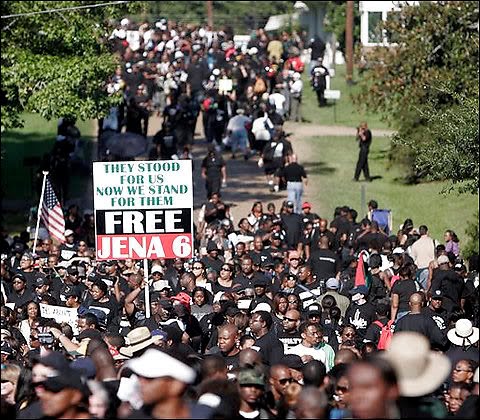
Wallace was part of a small group of family members and friends who built a movement that eventually brought 50,000 people to a September 2007 march in the small northern Louisiana town of Jena. The mass movement eventually led to freedom for the six young men, who have since gone on to college.

On March 31, a 12-person jury with one Black member convicted Wallace of three counts of distribution of a controlled substance. At her June 1 sentencing, Wallace received 5 years for each count, to be served consecutively. Even in Louisiana, the incarceration capital of the U.S., 15 years for a first offense is somewhat exceptional, as is the stacking of consecutive sentences.

"I've never seen a judge run anything consecutive, certainly not for drugs or a first offender," says Miles Swanson, an attorney in private practice who used to work for the public defenders office in Orleans Parish. "In New Orleans, a case like this probably wouldn't even go to trial -- they'd likely get offered probation."

However, vast discrepancies exist across parishes. For example, an Orleans Parish man recently received probation for selling pot. Then, when arrested for the same offense a few miles away in St. Tammany Parish, he was sentenced to life in prison.

"Unfortunately, I'm not shocked by the sentence," commented Jasmine Tyler, deputy director of national affairs for the Drug Policy Alliance. "We used to use prisons for the people who really caused problems, and made us concerned about public safety. Now we use them for the people we're mad at."

[Jordan Flaherty is a journalist and staffer with the Louisiana Justice Institute. His award-winning reporting from the Gulf Coast has been featured in a range of outlets including The New York Times, Al Jazeera, and Argentina's Clarin newspaper. His new book is FLOODLINES: Community and Resistance from Katrina to the Jena Six. He can be reached at neworleans@leftturn.org, and more information about Floodlines can be found at floodlines.org. Find more articles by Jordan Flaherty, including coverage of the Jena 6 and issues of criminal justice in Louisiana, on The Rag Blog.]

The Rag Blog

[+/-] Read More...

23 May 2011

Jordan Flaherty : Rising Anxiety on the Gulf Coast

Many residents have been forced from their homes as a spillway is opened to protect major cities from the flood. Photo by Gallo / Getty / Al Jazeera.

One disaster after another:
Mississippi flood renews Gulf Coast anxieties

By Jordan Flaherty / The Rag Blog / May 23, 2011

NEW ORLEANS -- Byron Encalade grew up in the swamps of southeast Louisiana, a place where day-to-day life hasn’t changed much in generations. “I grew up tying my Pirogue to the front porch when the tide would come up,” he says. “For a lot of us born and raised fishing and trapping and hunting, it’s a way of life.”

That way of life is now in danger.

First there was Hurricane Katrina and Hurricane Rita, two storms in 2005 that famously devastated the Gulf Coast, and literally changed the map of southern Louisiana, quickening already-rapid coastal erosion while destroying homes and communities. Just as coastal residents had begun to recover from those storms, last year's BP Deepwater Horizon drilling disaster had a catastrophic effect on the economy and health of the region and its people.

Now, the waters of the Mississippi River have reached historic heights, and Encalade is worried. “For the small fishers, it’s a very thin line between losing money and making a profit,” he explains.

The Mississippi is central to economic life here on the Gulf, and it’s rising waters have wide-ranging effects, from disrupting shipping and causing rising prices for gas, food, and other necessities, to a loss of tourism dollars and the destruction of an estimated 100,000 acres of crops, as well as oyster fisheries, in the now-flooded Atchafalaya Basin.

A third generation oyster fisherman, Encalade serves as president of the Louisiana Oystermen Association, which represents minority fishers, including African-American, Vietnamese and Cambodian and Native Americans. “This flooding is going to have a enormous economic effect in the fisheries,” he explains.

The U.S. Army Corps of Engineers, the federal agency charged with maintaining the levees and overseeing the flood controls, has acted to preserve the safety of Baton Rouge and New Orleans; two cities perched along the Mississippi. To reduce the stress on the levees around the urban areas, the Corps has let water flow through the Morganza Spillway, flooding farmland and rural communities upriver from Baton Rouge, including thousands of houses, farms and oyster fisheries.

The Morganza, a flood control structure designed and built in the aftermath of a devastating 1927 flood of the Mississippi, has only been opened once before, in 1973.

While no one can say for sure the lasting effects of this flooding, optimism is rare. “The oyster people, they’re screwed again,” says George Barisich, president of the United Commercial Fisherman’s Association. “The oysters that survived the BP spill, they’re going to die now.”

Barisich, a fisherman who lives and works in southern Louisiana, says that across the Gulf Coast fishing industry, people have been hit hard, both economically and personally. “A lot of people, this is wearing down on them,” he says. “For the people with the small boats, it’s going to wipe them out. People have heart attacks over this.”

The high waters in the Mississippi have brought into focus problems that have existed for a generation. Land loss caused by oil company drilling has already displaced many who lived by the coast, and the pollution from treatment plants has poisoned communities across the state -- especially in “cancer alley,” the corridor of industrial facilities along the Mississippi River south of Baton Rouge.

Matt Rota, science and water policy director for the Gulf Restoration Network, says that pollution carried by the Mississippi will create a massive “dead zone,” a lifeless stretch of water that he says will further harm the Gulf ecosystem and impact fishers.

According to Rota, the combination of oil company exploration with the construction of levees that have cut off the natural delta-building processes of the river has resulted in a massive loss of coastal land. The state loses a football field-sized area of its coast every 45 minutes, he says. Since 1930, Louisiana has lost over a million acres of land, an area the size of a small state.

While plans have been drafted to stop the erosion and replace the coast, the federal government has never found the money to actually follow through. “I’m seeing this as a squandered opportunity,” he says. “We need to build our wetlands and build our coast instead of losing it.”


Residents don’t trust the levees

Even with the Morganza open, high water levels continue to alarm residents of New Orleans, who are suspicious of the Army Corps of Engineers. “We can’t trust the levees, and we cant trust the Corps,” says Monique Harden, the co-director Advocates for Environmental Human Rights.

Harden, as with many Gulf residents, lost trust in the Corps after faulty construction and maintenance allowed the levees to fail in the wake of Hurricane Katrina. Her organization has worked to bring accountability to the U.S. government, even bringing charges of environmental injustice on the part of the U.S. to the United Nations. “This whole thing is going to be weeks, not days,” she says. “And no one’s giving any guarantees.”

Matt Rota of Gulf Restoration Network thinks the whole system of flood control needs to be rethought. “We’re still stuck in this opinion that we can control the Mississippi River,” he says. “We need to shift our thinking and let the river have more room. We’ve walled off the Mississippi from the vast majority of its floodplain.”

While freeing the river in these areas would carry great costs, it would also help restore the coast, and ease pressure on other levees, such as those protecting New Orleans, explains Rota.

“Right now, we’re very confident in the system we have,” responds Mike Petersen, public affairs officer for the Corps, when asked about the concerns expressed by Harden and Rota. However, says Petersen, there are still risks. “There’s no such thing as a flood-proof levee,” he acknowledges. “Although the system works beautifully now, it’s taking a beating like it never has before.”

First Sergeant Jimmy Hankins, with the New Orleans office of the Army Corps of Engineers, says he understands people’s fears. “People in New Orleans are always concerned about their levees. Were under sea level.” But he says New Orleans is safe. “Of course, we always recommend to be safe and concerned,” he added. “But the best levees there are, are the ones on the Mississippi because they’re tested every day.”

Byron Encalade doesn’t want to talk too much about the Army Corps or other federal agencies. “It gets to the point when you’re tired of saying who’s at fault,” he says. “Lets move forward with a solution.”

For Encalade, this means a comprehensive approach that repairs the Gulf, restores the coast, and maintains the freshwater, brackish water, and saltwater marshes so important to fisher communities and local ecosystems. “To do a plan that leaves out a part of it is to ruin it,” he says. For Encalade, whose family has been fishing here for generations, there is no other choice. “I just don’t know where else to go. I can’t live anywhere else. Louisiana is me.”

[Jordan Flaherty is a journalist and staffer with the Louisiana Justice Institute. His award-winning reporting from the Gulf Coast has been featured in a range of outlets including The New York Times, Al Jazeera, and Argentina's Clarin newspaper. His new book is FLOODLINES: Community and Resistance from Katrina to the Jena Six. He can be reached at neworleans@leftturn.org, and more information about Floodlines can be found at floodlines.org. This article was also published at Al Jazeera. Find more articles by Jordan Flaherty on The Rag Blog.]

The Rag Blog

[+/-] Read More...

29 March 2011

Jordan Flaherty : Race and Politics in Rural Louisiana

Image from The Louisiana Justice Center.

Race and politics in rural Louisiana town
The Black mayor of Waterproof, Louisiana has spent nearly a year behind bars without bail.
By Jordan Flaherty / The Rag Blog / March 29, 2011

NEW ORLEANS -- A legal dispute in the rural Louisiana town of Waterproof has attracted the attention of national civil rights organizations and activists. Color Of Change, an online activist group that helped garner national attention for the Jena Six Case, recently rallied their members in support of Waterproof mayor Bobby Higginbotham, who has been held without bail since May of 2010.

Advocates say the town’s mayor and police chief, both African American, were targeted by an entrenched white power structure, including a parish sheriff and district attorney, who were threatened by newly empowered Black political power in the town and are seeking to use the court system to undo an election.

While the mayor and police chief were both found guilty last year, their defenders say the trials have not resolved the conflict. Rachel Conner, a lawyer representing Higginbotham in his appeal, says she has never seen a case with so many flaws. “Essentially, every single thing that you can do to violate someone’s constitutional rights from beginning to end happened in his case,” she says.

The charges and counter charges are difficult to untangle. At the center of the case is a state audit of Waterproof that found irregularities in the town's record keeping. The Parish District Attorney says the audit shows mayoral corruption. The mayor says the problems pre-date his term, and he had taken steps to correct the issues. The mayor’s opponents claim he stole from the town by illegally increasing his salary. His supporters say he received a raise that was voted on by the town aldermen.

The mayor initially faced 44 charges; all but two were dropped before the trial began. Those charges -- malfeasance in office and felony theft -- were related to the disputed raise and use of the town’s credit card. Miles Jenkins, the police chief, faced charges related to his enforcement of traffic tickets.

The mayor was quickly convicted of both charges but lawyers have raised challenges to the convictions, bringing a number of legal complaints. For example: in a town that is 60% African-American, Mayor Higginbotham had only one Black juror.

Higginbotham’s counsel was disqualified by the DA, and the public defender had a conflict of interest, leaving the mayor with no lawyer. Two days before trial began, the DA gave Higginbotham 10 boxes of files related to his case. Higginbotham’s request for an extension to get an attorney and to examine the files was denied.

There’s more: during jury selection, when Higginbotham -- forced to act as his own lawyer -- tried to strike one juror who had relationships with several of the witnesses, he was told he could not, even though he had challenges remaining. There was also a problem with a sound recorder that the court reporter was using, and as a result there is no transcript at all for at least two witness’ testimony. Finally, during deliberation, the judge gave the jury polling slips that had "guilty" pre-selected, and then later hid the slips.

When Higginbotham was convicted, the judge refused to set bail in any amount. Although a possible sentence for the crime was probation, and despite the former mayor's obvious ties to the community, Higginbotham has spent the last 10 months in jail while his lawyers have worked on his appeal. “He’s not a flight risk,” says Conner. “He’s tied to Waterproof and he’s got a vested interest in clearing his name.”


Civil rights and Black political power

Waterproof, Louisiana is a rural town near the Mississippi border best known for holding an immigration detention center. The town -- population approximately 800 -- sits in Tensas Parish, a mostly agrarian region of the state. Community members say the civil rights movement came late to Tensas -- it was the last parish in the state where Black residents were able to register to vote, and the Klan was active until late in the 20th century.

The current troubles began in September 2006 when Higginbotham was elected mayor of Waterproof. Soon after, he appointed his associate Miles Jenkins as chief of police. Jenkins, who served in the U.S. military for 30 years and earned a master's degree in public administration from Troy University in Alabama, immediately began the work of professionalizing a small town police department that had previously been mostly inactive.

While both Jenkins and Higginbotham are from Waterproof, both had also spent much of their adult lives working in other places, and brought a professional background to their new positions. Allies of Higginbotham and Jenkins say this threatened Parish Sheriff Ricky Jones and DA James Paxton. Annie Watson, a school board member and former volunteer for the mayor, says officers working for Jones told her, “As soon as you people learn that the sheriff controls Tensas Parish, the better off you'll be.”

The charges against Higginbotham come in a context where many African Americans in Louisiana feel that Black political power in the state -- and in the country -- is under attack. Tens of thousands of African-American, mostly Democratic, voters remain displaced from the state post-Katrina.

For the first time since the post-civil war era, both houses of the legislature have Republican majorities, and every statewide elected official is Republican. The newly-dominant Republican majority will oversee the state’s legislative redistricting, as well as passage of Governor Bobby Jindal’s agenda, which includes large cuts to public education and other services, including the elimination of Southern University of New Orleans, a historically Black state university.

The allegations also come at a time of corruption investigations around the state that many civil rights activists say have disproportionately targeted Black elected officials. Tommy Nelson, the Black mayor of the Louisiana town of New Roads, recently filed a motion in U.S. district court that accuses government investigators of exclusive targeting Black elected officials, beginning with a National Conference of Black Mayors gathering in New Orleans in June 2008.

The investigation Nelson refers to resulted in racketeering charges against him, as well as Black elected officials in the Louisiana towns of White Castle and Port Allen. While the Waterproof case is not connected to these other corruption investigations, the cases add context to the charges from allies of Higginbotham that Black political power is the real target of the investigations.

For Conner, the fact that the former mayor remains locked in jail awaiting appeal is the most shocking part of this case. “The vindictiveness, and whatever else is going on under the surface, I think that’s where it shows itself,” she says. Pointing to much more high-profile cases, with much more money involved, Conner asks why Higginbotham is still locked up.

“William Jefferson is out on bail, Tom Delay is out,” she says. “And then you’ve got a guy with errors in his trial from A to Z. They didn’t even set three million dollars as his bond. They set no bond.”

The mayor and his allies have filed legal appeals, and are hoping for the U.S. Department of Justice to investigate, or for national media to come in. Tens of thousands of people have signed a petition, initiated by Color Of Change, asking Louisiana Governor Bobby Jindal to intervene. Chief Jenkins, who still has pending charges, believes that once word gets out, justice will come to Waterproof. “People need to see exactly what is going on in these little southern towns around here,” he says.

[Jordan Flaherty is a journalist and staffer with the Louisiana Justice Institute. His award-winning reporting from the Gulf Coast has been featured in a range of outlets including The New York Times, Mother Jones, and Argentina's Clarin newspaper. His new book is FLOODLINES: Community and Resistance from Katrina to the Jena Six. He can be reached at neworleans@leftturn.org, and more information about Floodlines can be found at floodlines.org.]

Also go to: The Rag Blog

[+/-] Read More...

21 March 2011

Jordan Flaherty : Challenging Louisiana's 'Crime Against Nature' Law

Harassment of New Orleans sex workers. Photo from ColorLines.

Justice Dept. calls law discriminatory:
Victims fight Louisiana's repressive
'Crime Against Nature' statute
Legal action comes with increased scrutiny from the federal government over the conduct of the New Orleans Police Department.
By Jordan Flaherty / The Rag Blog / March 21, 2011

NEW ORLEANS -- Eve is a transgender woman living in rural southern Louisiana. She was molested as a child and left home as a teenager. Homeless and alone, she was forced to trade sex for survival. While still a teenager, she was arrested and charged with a Crime Against Nature, an archaic Louisiana law originally designed to penalize sex acts associated with gays and lesbians.

Now Eve is one of nine plaintiffs fighting the law in a federal civil rights complaint that advocates hope will finally put this official discrimination to an end.

This legal action comes in the context of increased scrutiny from the federal government over the conduct of the New Orleans Police Department. A U.S. Justice Department investigation of the NOPD, released last week, found "reasonable cause to believe that patterns and practices of unconstitutional conduct and/or violations of federal law occurred in several areas," including "racial and ethnic profiling and lesbian, gay, bi-sexual, and transgender (LGBT) discrimination."

The report specifically mentioned Louisiana's Crime Against Nature law, calling it "a statute whose history reflects anti-LGBT sentiment." The report also concluded that investigators "found reasonable cause to believe that NOPD practices lead to discriminatory treatment of LGBT individuals."


Punishing women

Eve, who asked that her real name and age remain confidential, spent two years in prison. During her time behind bars she was raped and contracted HIV. Upon release, she was forced to register in the state’s sex offender database. The words “sex offender” now appear on her driver’s license.

“I have tried desperately to change my life,” she says, but her status on the database stands in the way of housing and other programs. “When I present my ID for anything,” she says, “the assumption is that you’re a child molester or a rapist. The discrimination is just ongoing and ongoing.”

Eve was penalized under Louisiana’s 205-year-old Crime Against Nature statute, a blatantly discriminatory law that legislators have maneuvered to keep on the state’s books for the purpose of turning sex workers into felons.

As enforced, the law specifically singles out oral and anal sex for greater punishment for those arrested for prostitution, including requiring those convicted to register as sex offenders in a public database. Advocates say the law has further isolated and targeted poor women of color, transgender women, and especially those who are forced to trade sex for food or a place to sleep at night.

In 2003, the Supreme Court outlawed sodomy laws with its decision in Lawrence v. Texas. That ruling should have invalidated Louisiana’s law entirely. Instead, the state has chosen to only enforce the portion of the law that concerns “solicitation” of a crime against nature. The decision on whether to charge accused sex workers with a felony instead of Louisiana’s misdemeanor prostitution law is left entirely in the hands of police and prosecutors.

“This leaves the door wide open to discriminatory enforcement targeting poor black women, transgender women, and gay men for a charge that carries much harsher penalties,” says police misconduct attorney and organizer Andrea J. Ritchie, a co-counsel in a new federal lawsuit challenging the statute.

A media-fueled national panic about child molesters has brought sex offender registries to every state. But advocates warn that, across the U.S., these registries have been used disproportionately against African Americans and other communities of color, and are often used for purposes outside of their original intent.

Louisiana, however, is the only state in the U.S. that requires people who have been convicted of crimes that do not involve minors or sexual violence to register as sex offenders.

In 1994, Congress passed Megan’s Law, also known as the Wetterling Act, which mandated that states create systems for registering sex offenders. The act was amended in 1996 to require public disclosure of the names on the registries and again in 2006 to require that sex offenders stay in the public registry for at least 15 years.

Megan’s Law was clearly not targeted at prostitution. However, Louisiana lawmakers opted to apply the registry to the crimes against nature statute as well, and at that moment started down the path to a new level of punishment for sex work. “This archaic law is being used to mark people with a modern day scarlet letter,” says attorney Alexis Agathocleus of the Center for Constitutional Rights, another party to the lawsuit.

People convicted under the Louisiana law must carry a state ID with the words “sex offender” printed below their name. If they have to evacuate because of a hurricane, they must stay in a special shelter for sex offenders that has no separate facilities for men and women.

They have to pay a $60 annual registration fee, in addition to $250 to $750 to print and mail postcards to their neighbors every time they move. The postcards must show their names and addresses, and often they are required to include a photo. Failing to register and pay the fees, a separate crime, can carry penalties of up to 10 years in prison.

Women and men on the registry will also find their names, addresses, and convictions printed in the newspaper and published in an online sex offender database. The same information is also displayed at public sites like schools and community centers. Women -- including one mother of three -- have complained that because of their appearance on the registry, they have had men come to their homes demanding sex. A plaintiff in the suit had rocks thrown at her by neighbors. “This has forced me to live in poverty, be on food stamps and welfare,” explains a man who was on the list. “I’ve never done that before.”

In Orleans Parish, 292 people are on the registry for selling sex, versus 85 people convicted of forcible rape and 78 convicted of “indecent behavior with juveniles.” Almost 40 percent of those registered in Orleans Parish are there solely because they were accused of offering anal or oral sex for money.

Seventy-five percent of those on the database for Crime Against Nature are women, and 80 percent are African American. Evidence gathered by advocates suggests a majority are poor or indigent.

Legal advocates credit on-the-ground organizing and the advocacy of the group Women With A Vision (WWAV) for making them aware of this discriminatory law. WWAV, a 20-year-old New Orleans-based organization, provides health care and other services to women involved in survival sex work.

“Many of these women are survivors of rape and domestic violence themselves,” says WWAV executive director Deon Haywood. “Yet they are being treated as predators.”

Advocates and attorneys announce lawsuit against New Orleans' "Crime Against Nature" ordinance. Photo from Louisian Justice Institute.


Plaintiffs tell their stories

Ian, another plaintiff in the legal challenge to the Crime Against Nature statute, was homeless from the age of 13, and began trading sex for survival. When an undercover officer approached him and asked him for sex, Ian asked for money. “All I said was $50,” he says, “And they put me away for four years.”

In prison, Ian was raped by a correction officer and by other prisoners, and like Eve, he contracted HIV. Now, he says, potential employers see the words “sex offender” written on his ID and no one will hire him. “Do I deserve to be punished any more than I’ve already been punished?” he asks. “I was 13 years old. That’s the only way I knew how to survive.”

Hiroke, a New Orleans resident and another plaintiff in the suit, spoke on a call set up by advocates. “I had just graduated from high school and was just coming out as transgender,” she says. Hiroke was arrested and convicted while still a teenager.

As she began to describe her experience, Hiroke’s voice began to shake. “I was being held with men in jail at the time...” she began. Then there was silence on the line. Holding back tears, she then apologized for being unable to continue.

The Louisiana legislature recently passed a reform of the Crime Against Nature statute, but for the vast majority of those affected, the change makes little to no difference. Although the new law takes away the registration component for a first conviction, a second conviction requires 15 years on the registry, and up to five years imprisonment. A third conviction mandates a lifetime on the registry.

More than 538 men and women remain on the registry because they were convicted of offering anal or oral sex, with more added almost every day.

The legal challenge to the Crime Against Nature law, called Doe v. Jindal, has been filed in Louisiana’s U.S. District Court Eastern District on behalf of nine anonymous plaintiffs. It was filed by the Center for Constitutional Rights, attorney Andrea J. Ritchie, and the Law Clinic at Loyola University New Orleans College of Law.

The anonymous plaintiffs include a grandmother, a mother of four, three transgender women, and a man, all of whom have been required to register as sex offenders from 15 years to life as a result of their convictions for the solicitation of oral sex for money.

[Jordan Flaherty is a journalist and staffer with the Louisiana Justice Institute. His award-winning reporting from the Gulf Coast has been featured in a range of outlets including The New York Times, Mother Jones, and Argentina's Clarin newspaper. His new book is FLOODLINES: Community and Resistance from Katrina to the Jena Six. He can be reached at neworleans@leftturn.org, and more information about Floodlines can be found at floodlines.org. This article was also posted at The Louisiana Justice Institute version of this article originally appeared at ColorLines.com.]The Rag Blog

[+/-] Read More...

15 June 2010

Jordan Flaherty : Cultural Extinction and the Deepwater Spill

Photo of Bayou Pointe-au-Chien from a backyard in the Louisiana Indian community. Photo by Jordan Flaherty / The Rag Blog.

Cultural extinction and the Deepwater spill
Louisiana’s coastal communities fear they may never recover from BP’s drilling disaster.
By Jordan Flaherty / The Rag Blog / June 15, 2010

As BP’s deepwater well continues to discharge oil into the Gulf, the economic and public health effects are already being felt across coastal communities. But it’s likely this is only the beginning. From the bayous of southern Louisiana to the city of New Orleans, many fear this disaster represents not only environmental devastation, but also cultural extinction for peoples who have made their lives here for generations.

This is not the first time that Louisianans have lost their communities or their lives from the actions of corporations. The land loss caused by oil companies has already displaced many who lived by the coast, and the pollution from treatment plants has poisoned communities across the state -- especially in “cancer alley,” the corridor of industrial facilities along the Mississippi River south of Baton Rouge.

“The cultural losses as a consequence of the BP disaster are going to be astronomical,” says Advocates for Environmental Human Rights (AEHR) co-director Nathalie Walker. “There is no other culture like Louisiana’s coastal culture and we can only hope they won't be entirely erased.”

Walker and co-director Monique Harden have made it their mission to fight the environmental consequences of Louisiana’s corporate polluters. They say this disaster represents an unparalleled catastrophe for the lives of people across the region, but they also see in it a continuation of an old pattern of oil and chemical corporations displacing people of color from their homes.

Harden and Walker point out that at least five Louisiana towns -- all majority African American -- have been eradicated due to corporate pollution in recent decades. The most recent is the Southwest Louisiana town of Mossville, founded by African Americans in the 1790s.

Located near Lake Charles, Mossville is only five square miles and holds 375 households. Beginning in the 1930s, the state of Louisiana began authorizing industrial facilities to manufacture, process, store, and discharge toxic and hazardous substances within Mossville. Fourteen facilities are now located in the small town, and 91 percent of residents have reported at least one health problem related to exposure to chemicals produced by the local industry.

The southern Louisiana towns of Diamond, Morrisonville, Sunrise, and Revilletown -- all founded by former slaves -- met similar fates. After years of chemical-related poisoning, the remaining residents have been relocated, and the corporations that drove them out now own their land. In most cases, only a cemetery remains, and former residents must pass through plant security to visit their relatives’ graves.

The town of Diamond, founded by the descendents of the participants of the 1811 Rebellion to End Slavery, the largest slave uprising in U.S. history, was relocated by Shell in 2002, after residents had faced decades of toxic exposure.

Morrisonville, established by free Africans in 1790, was bought out by Dow in 1989.

Residents of Sunrise, inaugurated near Baton Rouge by former slaves in 1874, were paid to move as the result of a lawsuit against the Placid Refining Company.

In the mid-1990s, Chemical producer Georgia Gulf Corporation poisoned and then acquired Revilletown, a town free Africans had started in the years after the civil war.

“We make the mistake of thinking this is something new,” says Harden. She adds that the historic treatment of these communities, as well as the lack of recovery that New Orleanians have seen since Katrina, makes her doubt the federal government will do what is necessary for Gulf recovery. “Since Obama got into office,” she says, “I have yet to see any action that reverses what Bush did after Katrina.”

Harden says Louisiana and the US must fundamentally transform our government’s relationships with corporations. “We’ve got to change the way we allow businesses to be in charge of our health and safety in this country,” she adds. As an example, Harden points to more stringent regulations in other countries, such as Norway, which requires companies to drill relief wells at the same time as any deepwater well.

Pointe-au-Chien community leader Theresa Dardar. Photo by Jordan Flaherty / The Rag Blog.


Pointe-au-Chien


Pointe-au-Chien Indian Tribe is a small band of French speaking Native Americans along Bayou Pointe-au-Chien, south of Houma, on Louisiana’s Gulf Coast. Their ancestors settled here three hundred years ago, and for them, the ongoing oil geyser is just the latest step in a long history of displacement and disenfranchisement. “The oil companies never respected our elders,” explains community leader Theresa Dardar. “And they never did respect our land.”

In the early part of this century, the oil companies took advantage of the fact that people living on the coast were isolated by language and distance, and laid claim to their land. Over the past several decades, these companies have devastated these idyllic communities, creating about 10,000 miles of canals through forests, marshes, and homes. “They come in, they cut a little, and it keeps getting wider and wider,” says Donald Dardar, Theresa’s husband and part of the tribe’s leadership. “They didn’t care where they cut.”

The canals have brought salt water, killing trees and plants and speeding erosion. According to Gulf Restoration Network, Louisiana loses about a football field of land every 45 minutes, and almost half of that land loss is as a result of these canals. Meanwhile, Pointe-au-Chien and other tribes have found they have little legal recourse. At least partly as a result of lobbying by oil companies, the state and federal government have refused to officially recognize them as a tribe, which would offer some protection of their land rights.

So late last month, when oil started washing up on the shores of nearby Lake Chien and fishing season was cancelled before it had even begun, members of Pointe-au-Chien took the news as another nail in the coffin of the lifestyle they had been living for generations. On a recent Sunday, a few residents gathered at the Live Oak Baptist Church, on the main road that runs through their community. They described feeling abandoned and abused by the government and corporations. They spoke of losing their language and traditions in addition to their homes.

Sitting on a church pew, Theresa said they had met with indigenous natives from Alaska who discussed their experience in the aftermath of the 1989 Exxon Valdez spill. “We don’t know how long we’ll be without fishing,” said Theresa. “It was 17 years before they could get shrimp.” And, she noted bitterly, this disaster is already much larger than the Valdez, with no end in sight.

BP has promised payouts to those who lose work from the oil, but few trust the company to make good on their promise, and even if they did, they doubt any settlement could make up for what will be lost. “It doesn’t matter how much money they give you,” says Theresa. “If we don’t have our shrimp, fish, crabs and oysters.”

“It’s not just a way of life, its our food,” she added. “It’s the loss of our livelihood and culture.”

The anxiety that Theresa expresses is also increasingly common in New Orleans, a city whose culture is inextricably linked to the Gulf. “How do you deal with this hemorrhaging in the bottom of the Gulf that seems endless?” asks Monique Harden of AEHR. “That is just scary as hell. I’ve been having nightmares about it.”

As the oil continues to flow, people feel both helpless and apocalyptic; depressed and angered. Residents who have just rebuilt from the 2005 hurricanes watch the oil wash up on shore with a building dread. “I never thought I’d be in a situation where I wanted another Katrina,” says Harden. “But I’d rather Katrina than this.”


Drilling economy

Across the street from the church in Pointe-au-Chien is a bayou, where frustrated fishers wait on their boats hoping against all odds that they will be able to use them this season. Behind the church is more water, and a couple miles further down the road ends in swamp. Dead oak trees, rotted by salt water, rise out of the canals. Telephone poles stick out of the water, along a path where once the road continued but now the encroaching waters have taken over.

The miles of swamp and barrier islands that stood between these homes and the Gulf used to slow hurricanes, and now the entire region has become much more vulnerable. Brenda Billiot, another local resident, gestured at her backyard, about a few dozen yards of grass that fades into marshes and water. “This used to be land,” she says, “as far as you could see.” Billiot is still repairing her home from the 2005 flooding, including raising it up a full 19 feet above the ground. She wonders if that will be enough, if there is anything they can do to make themselves safe and hold onto their culture.

A brown rabbit hops across her backyard, and Billiot describes the dolphins and porpoises she has seen swimming nearby. Walking along the bayou here, where generations of people have lived off the land and fought to protect their territory from corporate theft, you begin to sense the gravity of what will be lost.

Theresa believes that the government and oil companies are looking for an excuse to permanently displace the tribe. She believes this latest disaster, and the upcoming hurricane season, may spell the end for their language and culture. “I tell people; if we get another hurricane, take everything you want, because I don’t think they’ll let you back in,” says Dardar. “It’s scary because I don’t know where we’re going to go.”

[Jordan Flaherty is a journalist, an editor of Left Turn Magazine, and a staffer with the Louisiana Justice Institute. He was the first writer to bring the story of the Jena Six to a national audience, and his award-winning reporting from the Gulf Coast has been featured in a range of outlets including the New York Times, Mother Jones, and Argentina's Clarin newspaper. He has produced news segments for Al-Jazeera, TeleSur, and Democracy Now!. Haymarket Books has just released his new book, FLOODLINES: Community and Resistance from Katrina to the Jena Six. He can be reached at neworleans@leftturn.org.] Other Resources:The Rag Blog

[+/-] Read More...

30 May 2010

VERSE / Larry Piltz : New Atlantis and Banglateche

"Earth could not answer; nor the Seas that mourn..."
Illustration by Adelaide Hanscom and Blanche Cumming (1905) for “The Rubaiyat of Omar Khayyam,” tr. Edward Fitzgerald / Wikimedia Commons.


New Atlantis and Banglateche

By Houma Cayenne

Here beside my breathing Bayou Teche
true lifeblood of our Acadian creche
my second sight so easily stretches
oer the realm of the fishermen's catch
and the damage caused by greed and its wretches
I mourn for the view that's meant us
for the floating early grave that's sent us
the oncoming waters of New Atlantis

I see your sea birds' desperate flailing
overwhelmed, hopes frail and lean
and our skimmers' regretful sailing
while retching toxins oer the railing
dreading more each year's new gale e'en
as I ponder night and daily
the meaning of the mighty pirates failing
as mon amis must keep on bailing

To the inland coast of Banglateche
come the lapping waves of New Atlantis
through the heaving booms of helpless mesh
by the isles of decaying detritus
carrying bodies of beings you'd have to guess
a tide of mayhem, murder, and mindless mess
witnessed by your humble Cajun Cervantes
tilting seaward like a mantis
raging with a sacred wailing
for a time of great white whaling
a catch of mighty pirates failing
their lies and sad excuses trailing
all the way to their righteous jailing
as mon amis must keep on bailing

New Atlantis and Banglateche
our refuge now becomes the depths
our solid ground eternally wet
yet wonder where to throw our nets
and how we'll throw each jour de fete
Oh Evangeline you sweet coquette
we thought we'd somehow save you yet
your marshes and heron, chenier and egret
the sheltering cypress, the saltgrass carpet
the oyster and crab and shrimp we've met
Oh all of life, we are in your debt
as heart to heart and tete to tete
we grieve for the diet of poison you'll get
for your suffering we've more than our share of regret
as the years roll by a la morte de roulette
le bon temps au revoir et allons Banglateche
we pray that somehow we can all start afresh
as out in New Atlantis the pirates keep failing
and mon amis still keep on bailing

Houma Cayenne
As told to Larry Piltz / The Rag Blog
May 30, 2010

The Rag Blog

[+/-] Read More...

29 May 2010

Worse or Worser? : Barrier Grief in Louisiana

An oil soaked brown pelican attempts to takes flight on Louisiana coast. Photo by Gerald Herbert / AP.

Worse or worser?
Gulf grief, contractors, and media mania


By Greg Moses / The Rag Blog / May 29, 2010

Shock and awe, misdirection, the whole truth turned upside down? Could it be that the obscenity-driven confrontation between Plaquemines Parish President Billy Nungesser and Louisiana Governor Bobby Jindal was a more exact replica of oil war shock tactics than I thought?

Kirk James Murphy, MD, argues in the firedoglake blog that the sand-barrier plan to block the oil slick on the Louisiana coast is being pushed to completion by interests who would rather be rid of the marshlands than save them.

Is our grief over the deathwatch at the Gulf Coast being crassly manipulated for the purposes of real estate development? Dr. Murphy’s blog-post quotes at length a May 8 report by Josh Wingrove of the News and Mail, pointing out that the barrier-island plan has been three years in the making.

What wrenched our hearts out this week was the CNN presentation of Anderson Cooper’s visit to a dead marshland, recently killed off by a gooey assault of crude oil. Not even the bugs had survived, we were shown. Nungesser pleaded for immediate action. James Carville bore witness to the fact that nothing was being done anywhere in sight.

Jindal and Nungesser have been arguing that barrier berms would stop oil from reaching more marshland. And their arguments make obvious sense under the circumstances.

The danger in the dredging plan, argues Dr. Murphy, is that the dredged material would be drawn from polluted shipping channels and washed ashore during the volatile hurricane season coming soon. The oil will not be stopped, yet the toxic damage will be multiplied.

There is money involved, of course. And already by Thursday evening Nungesser was on CNN demanding more.

The CNN media campaign this week has the shocking effects that we remember from oil wars past. And the effects are especially felt among those of us who like Louisiana Congressman Charlie Melancon find it difficult not to cry at the sight of our dying Gulf. And there is no doubt that our shock is being played like a football on its way to one goal line or the other.

But why does Dr. Murphy opine that the berms probably won’t survive the hurricane season, while he argues that they would dry out the marshes? And what good are wetlands anyway once they have been covered by bubbling crude?

Dr. Murphy’s argument would place our shocked grief in alliance with the Corps of Engineers, who apparently resisted the berm idea until CNN tossed Nungesser a lateral pass this week. Given the velocities of these shock tactics, there is never very much time to decide things. And maybe the velocity alone is enough to raise suspicion. Except.

Except in this case there actually is an enemy attacking the marshlands, and Nungesser appeared to be making his arguments in the company of lots of people. The image of Nungesser in a crowded room makes it more difficult to believe that his plan runs counter to the interests of people who live along the marshlands and who are working up a campaign of self-defense. But this is the way shock psychology would work with the power of images.

It’s also curious that the Corps of Engineers is not more forthcoming for the cameras. Nungesser does make a point when he asks: where’s the plan? And compared with the images of oily death in the marshes, it would seem that the risk of drying wetlands is less inhumane to the doomed creatures of the Gulf. Once upon a time I walked to work through those coastal marshlands on my way to an offshore drilling job. On the Gulf Coast, from Corpus Christi to New Orleans, there is no such thing as a non-toxic option.

Marshland protection is one of at least three scientific issues that are being fought on the fly during this oil spill. Thursday evening brings news of an “oil plume” that is about 1,000 yards deep and six miles wide drifting in the direction of Mobile Bay, Alabama. Reports say the plume is a toxic cocktail of dispersants and oil. Is it better or worse than an oil slick? Oil slicks either repel life or kill it. Plumes, apparently, allow life but at the cost of a living toxicity that will work its way up the food chain. Cancer clinics for everyone.

When CNN flashes pictures of the oil operation, there is a ship spraying cascades of fluids onto the water. Is this the dispersant? Here and there we see comments from scientists saying that nobody knows if the dispersant is such a good idea. Is it better or worse than a slick of thick crude? LIke Nungesser’s berms, dispersants also raise questions of money trails.

The third scientific issue of course is how to plug the hole. Speaking on Larry King Live, the legendary oilman T. Boone Pickens says either you get lucky or you drill a relief well. August is the frequently cited expectation for when the relief well will be completed.

“We’ve been here 38 days,” said Pickens, “and we’ll probably be here 38 days more.” If Pickens is right, will it be possible to stop the oil from washing ashore?

They say the first stage of grief is denial, and I don’t want to believe that any of this is happening. What Congressman Melancon did in public yesterday, we have been doing in our homes this week all along the Gulf Coast. You cannot love the Gulf Coast, witness this shocking trauma, and control your tears at the same time.

But now on top of it all we have to watch out for the ways that our tears are being maneuvered into contracting strategies that may have no other uses beyond profiteering. I’m not convinced that there are worse things than a raw oil slick, not even if they are barrier berms or 6-mile plumes of noxious crap. But if it is the best thing for all God’s creatures on the Gulf Coast to just stand aside and accept the sacrifice that oil slicks bring once they are imminent, then it’s time we started moving from Denial to Acceptance at some improbable speed.

[Greg Moses is editor of the Texas Civil Rights Review and author of Revolution of Conscience: Martin Luther King, Jr. and the Philosophy of Nonviolence. He can be reached at gmosesx@gmail.com]

The Rag Blog

[+/-] Read More...

14 May 2010

Jena, Louisiana : Drug Bust or Racist Revenge?

Sheriff Scott Franklin, shown reveling in loot obtained during a controversial drug raid last summer in Jena, Louisiana. Photo special to The Rag Blog.

Revenge for civil rights protests?
'Operation Third Option' in Jena


By Jordan Flaherty / The Rag Blog / May 14, 2010
Award-winning journalist and author Jordan Flaherty will be Thorne Dreyer's guest on Rag Radio, Tuesday, May 18, 2-3 p.m. (CST) on KOOP 91.7 FM in Austin. For those outside the listening area, go here to stream the show.

They will discuss Flaherty's post-Katrina writings, his reporting about the Jena Six incidents and their aftermath, and about harassment of minorities, transgenders, sex workers, and others in New Orleans and in Louisiana -- and about the positive community organizing that has occurred in response to this harassment.
At 4 a.m. on July 9 of last year, more than 150 officers from 10 different agencies gathered in a large barn just outside Jena, Louisiana. The day was the culmination of an investigation that Sheriff Scott Franklin said had been going on for nearly two years. Local media was invited, and a video of the Sheriff speaking to the rowdy gathering would later appear online.

The Sheriff called the mobilization “Operation Third Option,” and he said it was about fighting drugs. However, community members say that Sheriff Franklin’s actions are part of an orchestrated revenge for the local civil rights protests that won freedom for six Black high school students -- known internationally as the Jena Six -- who had been charged with attempted murder for a school fight.

One thing is clear: the Sheriff spent massive resources; yet officers seized no contraband. Together with District Attorney Reed Walters, Sheriff Franklin has said he is seeking maximum penalties for people charged with small-time offenses. Further, in a parish that is 85 percent white, his actions have almost exclusively targeted African Americans.
Sheriff Scott Franklin of Jena says he is trying to rid his community of drugs. Critics say he is pursuing revenge against the town’s Black community.
Downtown Baghdad

According to a report from Alexandria’s Town Talk newspaper, LaSalle Parish Sheriff Scott Franklin prepared the assembled crowd for a violent day. "This is serious business what we're fixing to do," said Sheriff Franklin. "If you think this is a training exercise or if you think these are good old boys from redneck country and we're just going to good-old-boy them into handcuffs, you're wrong. These people have nothing to lose. And they know the stakes are high."

“It's going to be like Baghdad out in this community at 5 a.m.,” he continued dramatically, explaining that their target was 37-year-old Darren DeWayne Brown, who owns a barbershop -- one of the only Black-owned businesses in town -- and his “lieutenants,” who Franklin said supplied 80 percent of the narcotics for three parishes. "Let me put it to you this way," declared the Sheriff, "When the man says, 'We don't sell dope today,' dope won't get sold."

Sheriff Franklin said that option one is for drug dealers and users to quit, option two is to move, and option three is to spend the rest of their lives in prison. And this day was all about option three. "They will get put in handcuffs, put behind bars today and never see the light of day again unless they are going out on the playground in prison,” he boasted.

At the end of the day, a dozen people were arrested on charges that ranged from contempt of court to distribution of marijuana, hydrocodone, or cocaine. Despite catching the accused residents by surprise with early morning raids, in which doors were battered down by SWAT teams while a helicopter hovered overhead and then search teams were brought in to take houses and businesses apart, no drugs or other physical evidence was retrieved.

All evidence in the cases comes from the testimony of 23-year-old Evan Brown of Jena, who also wore a hidden camera during the investigation that parish officials have said provides powerful visual evidence. “We’re completely satisfied with the results,” said LaSalle Sheriff’s Department Narcotic Chief Robert Terral, who refused further comment on the operation.

Lasalle Parish is a politically conservative enclave located in northwest Louisiana. Former Klansman David Duke received a solid majority of local votes when he ran for governor in 1991 -- in fact, he received a higher percentage of votes in LaSalle Parish than in any other part of the state.

The Parish became famous in 2007 for the case of the Jena Six. In demonstrations that were called the birth of a 21st Century civil rights movement, an estimated 50,000 people marched in Jena. They were protesting a pattern of systemic racism and discriminatory prosecutions. All six youths, who once faced life in prison, are now either enrolled in college or are on their way.

The Sheriff told the Jena Times that he began preparing for Operation Third Option in November of 2007, less than two months after the historic protests.

Caseptla Bailey (left) and Catrina Wallace were active in the campaign to support the Jena 6. Their door was broken down by police while they slept. Photo by Jordan Flaherty / The Rag Blog.

A terrifying morning

Catrina Wallace, 29, was sleeping in her bed with her youngest child when her door was broken down and she awoke to the feeling of a gun to her head. When she opened her eyes, her small home was filled with police. “I never seen that many police at one time,” she recalled. “Everywhere I looked all I saw was police. There were six or seven just in my bedroom.” She says police pointed guns at her small children and wouldn’t let her comfort them.

Catrina Wallace is the sister of Robert Bailey, one of the Jena Six. Along with her mother, Caseptla Bailey, she was one of the leaders of the campaign to free the accused youths, and she organized meetings and protests for months. Wallace says her political activism made her a target. “I’m a freedom fighter,” she says. “I fight for peoples’ rights. I’ve never been in trouble.”

As with every other house raided that day, the police found no drugs in Wallace’s home. According to Wallace, police initially claimed they found marijuana on her kitchen table, but later discovered that they had collected broccoli stems, left over from dinner the previous night.

Despite the lack of evidence, and the fact that she has lived her whole life in Jena and is raising three small children, she was held for a $150,000 cash-only bond. Her car, a 1999 Mitsubishi Gallant, was also seized by police, who continue to hold it in an impound lot. If she wants it back, Catrina will have to pay $12 a day to the lot for every day since it was seized, in July of last year -- an amount already larger than the value of the car.

Tasered and traumatized

Samuel Howard was sleeping in his bed, naked, when police broke down his door at 5 a.m. Howard says police tasered him three times, twice in the back and once in his arm, and pointed guns at his three kids. They took him out of his house still naked, and brought him to a baseball field, along with the other arrestees from that day. There he says he spent another hour without any clothes, standing with the other arrestees, until police brought him an orange jailhouse jumper.

“They treated us like we was hard core killers,” says Howard, who says that in a small town like Jena where everyone knows each other, such violent tactics are uncalled for. “The sheriff knows me,” he says. “We went to school together. He knows I’m not a violent person.”

Howard is being charged with three counts of distribution of cocaine. His trial is scheduled for May 24 (Catrina Wallace’s is scheduled for the same week). As with the other defendants, the only evidence against him is the testimony and video from the police informant. Howard, who has seen the evidence, says he is not implicated in the video.

His home was badly burned up that day, apparently from flares that police fired inside, and his windows were all destroyed. Howard, who does some auto repair work, says his four vehicles -- including two older cars that don’t run -- were also seized by police.

Racially motivated

Many of Jena’s Black residents say that the town’s white power structure -- including the DA, Sheriff, and the editor of the local paper -- wants revenge against Black people in town who stood up and fought against unjust charges. They complain that in a town that is mostly white, all but two of the people arrested were Black, and the only arrestees pictured in the town’s paper were Black. The sheriff “Just wants to humiliate people,” says Caseptla Bailey, Wallace’s mother, “Especially the African Americans.” The editor and publisher of the Jena Times, the town’s only paper, is Sammy Franklin, who has owned the paper since 1968. His son is Sheriff Scott Franklin.

A white-owned store around the corner from the courthouse in downtown Jena sells t-shirts commemorating Operation Third Option, with a design of a person behind bars. Black residents of Jena say that an earlier version of the shirt featured a monkey behind bars. They say that white residents of Jena have gloated about the arrests.

Four of those arrested on that day have pled guilty. Chelsea Brown, who was arrested for contempt of court, received a sentence of 25 days. Devin Lofton, who pled guilty to conspiracy to distribute, received 10 years. Adrian Richardson, 34, who pled guilty on April 23 to two counts of distribution, received 25 years. Termaine Lee, a 22-year-old who had no previous record but faced six counts of distribution, received 20 years.

Some of the accused have hired attorneys, while others have had public defenders appointed. However, all involved say they doubt they can receive a fair trial in LaSalle. They say that white defendants with similar or worse charges received lower bonds, and face lesser sentences. “It’s crooked,” says Howard. “They ain’t playing fair down here, that’s all.”

Marcus Jones, father of Mychal Bell, one of the Jena Six youths, doesn’t mince words. “This is racially motivated,” he says. “It’s revenge.” He says that the problem is that while the Jena Six youths were freed, there were no consequences for the Sheriff or DA. “Wouldn’t none of this be going on if justice had been done the way it was supposed to have been,” he says.

Jones was not among those arrested, but in a small town like Jena, he knows everyone involved. He says he was shocked at the resources the police brought in. “Why did you need helicopters and military weapons?” he asks. “I could see it if you were going to arrest Noriega or the Mafia, but these are people with kids in their homes. The Sheriff’s department never had any violent run-ins with any of these people.”

Jones believes the entire campaign by Sheriff Franklin has been a gesture of asserting control over the Black community, and he calls for a federal investigation of the Sheriff’s department and DA.

Samuel Howard says that now he mostly stays home with his three kids, ages 12, 14, and 15. He’s afraid of the Sheriff’s office arresting him if he leaves the house, and he wants to stay close to his kids, who were traumatized by his arrest. “It scared them to death,” he says. “They still talk about it to this day.”

“They know they’re wrong,” said Howard, referring to the Sheriff and DA, “You can’t tell me they don’t know.”

[Jordan Flaherty is a journalist, an editor of Left Turn Magazine, and a staffer with the Louisiana Justice Institute. He was the first writer to bring the story of the Jena Six to a national audience and audiences around the world have seen the television reports he’s produced for Al-Jazeera, TeleSur, GritTV, and Democracy Now. Haymarket Press will release his new book, FLOODLINES: Stories of Community and Resistance from Katrina to the Jena Six, this summer. He can be reached at neworleans@leftturn.org.]

Marcus Jones, Catrina Wallace, and others in Jena are available for interviews.


Representatives of the Jena, Louisiana, Sheriff's Department arrest an unidentified suspect during drug raids July 9, 2009. Photo from the Jena Times.

A member of a white supremacist group marches in Jena, Louisiana, January 22, 2008. Photo by Jessica Rinaldi /Reuters.

Demonstrators march in support of the Jena Six, September 20, 2007. Photo from The Cheddar Box.

The Rag Blog

[+/-] Read More...

27 March 2010

Jordan Flaherty : Racist Coup in Waterproof, Louisiana?

Waterproof, LA. Photo from Fox 44 / Baton Rouge.

Did racist coup in northern Louisiana town
Overthrow Black mayor and police chief?


By Jordan Flaherty / The Rag Blog / March 27, 2010

NEW ORLEANS -- In Waterproof, a small northern Louisiana town near Natchez, Mississippi, the African-American mayor and police chief assert that they have been forced from office and arrested as part of an illegal coup carried out by an alliance of white politicians and their followers.

In a lawsuit filed last week, Police Chief Miles Jenkins asserts a wide-ranging conspiracy involving the area’s district attorney and parish sheriff, along with several other members of the region’s entrenched political power structure. These events come at a time when the validity of federal power is being questioned because of the race of the U.S. president, and in a state where white political corruption and violence have been and continue to be used as tools to fight Black political power.

About 800 people live in Waterproof, a rural community in the south of Tensas Parish. Tensas has just over 6,000 residents, making it both the smallest parish in the state, and the parish with the state’s fastest declining population. The parish’s schools remain mostly segregated, with nearly all the Black students attending public schools, and nearly all the white students attending private schools.

Waterproof Police Chief Miles Jenkins.

With a median household income of $10,250, Waterproof is also one of the poorest communities in the U.S. The only jobs for Black people in town are in work for white farmers, according to Chief Jenkins. “Unless you go out of town to work,” he says, “You’re going to ride the white man’s tractor. That's it.”

Bobby Higginbotham was elected mayor of Waterproof in September of 2006. The next year, he appointed Miles Jenkins as chief of police. Jenkins, who served in the U.S. military for 30 years and earned a master’s degree in public administration from Troy University in Alabama, immediately began the work of professionalizing a small town police department that had previously been mostly inactive.

“You called the Waterproof police for help before,” says Chief Jenkins, “He would say, wait ‘til tomorrow, it’s too hot to come out today.” He also sought to reform the town’s financial practices, which Chief Jenkins says were in disorder and consumed by debt.

Chief Jenkins asserts that a white political infrastructure, led by the Parish Sheriff Ricky Jones and District Attorney James Paxton, were threatened by their actions. This group immediately sought to orchestrate a coup against the two Black men, including clandestine meetings, false arrests, harassment, and even physical violence.

Court documents describe how Paxton, Jones, and their allies formed an alliance “designed to harass intimidate, arrest, imprison, prosecute, illegally remove plaintiff from his position of police chief, prevent plaintiff from performing his law duties as police chief and/or force plaintiff to leave the town of Waterproof.”

Ms. Annie Watson, a Black school board member in her 60s who was born and raised in Waterproof, worked as a volunteer for the mayor. She says that the mayor and chief, who had both lived in New Orleans, brought a new attitude that Parish officials didn’t like.

“The Mayor and the Chief said you can’t treat people this way, and the Sheriff and DA said you got to know your place. If you're educated and intelligent and know your rights and in this parish, you are in trouble,” she says. “They are determined to let you know you have a place and if you don't jump when they say jump you are in trouble.”

Ms. Watson explains that Paxton and Jones were threatened by Chief Jenkins’ efforts to professionalize the town’s police force. Aside from representing a challenge to Sheriff Jones’ political power, this also took away a source of his funding. “Before Mayor Higginbotham, all traffic tickets went to St. Joseph,” she says, referring to the Parish seat, where Sheriff Jones is based. “So he cut their income by having a police department.”

Jack McMillan, an African American deputy sheriff in Tensas Parish, says he tried to warn Chief Jenkins to back down. “You’ve got to adapt to your environment,” he says. “You can't come to a small town and do things the same way you might in a big city. Like the song says, you got to know when to hold ‘em, and know when to fold ‘em.”

Waterproof District Attorney James Paxton.

Tensas Parish

Tensas and the nearby parishes of Madison and East Carroll all share the sixth judicial district -- currently represented by District Attorney James Paxton. Buddy Caldwell, DA for the sixth judicial district from 1979 to 2008, is now Attorney General for the state of Louisiana.

The sixth district parishes all have majority Black populations and mostly white elected officials, which Chief Jenkins and Watson attribute to political corruption and disenfranchisement of Black voters. Prior to the registration of 15 voters in 1964, there was not a single Black voter registered in Tensas, despite having more than 7,000 African American residents (and about 4,000 white residents), making it the last Parish in Louisiana to allow African Americans to register.

Waterproof is “Reminiscent of the bygone days of southern politics,” with a white power structure maintaining political power over a Black majority, according to veteran civil rights attorney Ron Wilson, who is representing Jenkins in his civil rights lawsuit. “At any and all costs, even jeopardizing the life and freedom of my client, they will ruin him to maintain power. This case is ultimately about whether an African-American can be guaranteed the rights that are assured to him in the constitution.”

According to court papers, this Jim Crow alliance dominates elected power in the area, and "even on the local level, where the office holders tend to be African American, they are powerless to control their own destiny.” According to Chief Jenkins, the District Attorney once boasted that he controlled the votes of Waterproof’s Black Aldermen.

Chief Jenkins says he faced an immediate campaign of harassment from Sheriff Jones. “They just wanted this town to be white-controlled,” explained Chief Jenkins. The police chief described being arrested multiple times under the order of District Attorney Paxton and Sheriff Jones.

The charges, says Jenkins, range from charges of theft for a pay raise he received from the town’s board of Aldermen to criminal trespass for going to the home of a citizen who had been stopped for speeding without a valid driver’s license, to disturbing the peace for an incident where individuals threatened the police chief with violence for issuing traffic citations.

Ms. Watson says the charges were invented out of thin air. “It was a sad case of lies,” she says, adding that, “The majority of the town of Waterproof supports the chief and supports the mayor.”

Chief Jenkins says he was arrested and declared a flight risk by District Attorney Paxton, despite living and owning property in the Parish. “In all my years,” says attorney Ron Wilson, “I've never seen a police officer, and certainly not a police chief, charged for something like this.”

Chief Jenkins alleges he was attacked and choked by a deputy sheriff, who he says shouted, "Shut up... We are in charge…We are the sheriff and the sheriff controls Tensas Parish. The sooner you all learn this the better off you will be," an action that Ms. Watson says she also witnessed.

Chief Jenkins says his police car was shoved in a ditch, and when he arrested the people who had committed the act, the DA refused to press charges. In fact, he says the DA refused almost all charges he presented and released anyone he arrested. The chief was even charged with kidnapping for one incident in which he arrested the former town clerk for illegal entry.

“That’s the most ludicrous notion I've ever come across,” says Wilson. “That a police chief can be arrested for kidnapping, because he placed someone under arrest who was breaking the law.”

A grand jury has returned indictments of Chief Jenkins and Mayor Higginbotham, and Higginbotham’s trial is scheduled to begin this Monday. The mayor faces 44 charges, including multiple counts of malfeasance in office and felony theft. The charges appear to be based on the results of a state audit of Waterproof that found irregularities in the town’s record keeping going back to before the election of Higginbotham -- irregularities that the mayor and police chief say they had repaired.

Waterproof Sheriff Ricky Jones.


Patterns of violence

Mayor Higginbotham was elected at the same time as two other Black mayors of small Louisiana towns, both of whom also received threats based on race. In December of 2006, shortly after Higginbotham was elected mayor of Waterproof, Gerald Washington was shot and killed three days before he was to become the first Black mayor of the small southwest Louisiana town of Westlake.

An official investigation called his death a suicide, but family members call it an assassination. Less than two weeks after that, shots were fired into the house of Earnest Lampkins, the first Black mayor of the northwest Louisiana town of Greenwood. Lampkins reported that he continued to receive threats throughout his term, including a “for sale” sign that someone planted outside his house.

Waterproof was Klan country from the reconstruction era until well into the 20th century, and violence frequently broke out in the area. Seven Black men in Madison Parish were lynched over a period of three days in 1894 for the charge of “insurrection,” apparently because one man refused to follow an order from a sheriff.

“The Klan was very active here,” says Ms. Watson, recalling her childhood in the 50s and 60s. “We had crosses burned on people’s lawns. The school principal had a cross burned on his lawn. A man named Sun Turner was shot and killed on the streets by the Klan.”

Waterproof is an hour south of Tallulah, the site of a notoriously abusive youth prison, and a little more than hour east of Jena, where accusations of systemic racism brought 40,000 people from around the country, including many civil rights leaders, to a 2007 march. Like Jena, Waterproof is also home to a prison that contracts to hold federal immigration prisoners.

When asked for comment on Chief Jenkins’ lawsuit, Tensas Parish Sheriff Ricky Jones denied that race was a factor, claiming that Jenkins had abused his office and that many of the local citizens who filed complaints against him were Black. “I'm not going to support any type of corruption,” said Jones. “Certainly not from him.”

District Attorney Paxton, also named as a defendant in the lawsuit, disputed all accusations from Jenkins, suggesting that he had tried to help Jenkins when he was first elected. “A lot of this will become clear when the case against Mayor Higginbotham goes to trial on Monday,” he added.

Flood Caldwell, one of the town’s aldermen, is currently serving as the town’s mayor. Jenkins points to Caldwell’s appointment as further evidence of a coup, saying that the town aldermen, under the direction of DA Paxton, illegally voted to remove Mayor Higginbotham. “No one recognizes Caldwell as mayor except the DA and his friends,” says Chief Jenkins. The office of the Louisiana Secretary of State confirms that they still have Higginbotham listed as mayor, adding that they cannot comment further because of pending litigation.

Wilson says this case is ultimately about the repression of Black political and civil rights. “I think this has been going on in Tensas for a while,” he says. “I think they’ve gone too far in this case, and someone finally has come along and says they won’t go along.” Wilson hopes this lawsuit will bring federal attention. “We hope the justice department will look into this and bring some much-needed reform to this part of the world,” he says.

Chief Jenkins says he took the Sheriff’s job to serve the community, “You’ve given this country the best years of your life and you get treated like an unwanted stepchild,” he says. “I didn't realize there was so much politics to just doing your job.”

Ms. Watson believes that this is a struggle for self-determination and basic civil rights. “I was born in 1948,” she says. “Ever since I was born, Blacks never had a say in this parish, until Chief Jenkins and Mayor Higginbotham. They spoke up, and tried to change things. That’s why the parish is going after them.”

Jacques Morial of the Louisiana Justice Institute contributed to this story.

[Jordan Flaherty is a journalist, an editor of
Left Turn Magazine, and a staffer with the Louisiana Justice Institute. He was the first writer to bring the story of the Jena Six to a national audience and audiences around the world have seen the television reports he’s produced for Al-Jazeera, TeleSur, Press-TV, GritTV, and Democracy Now, as well as his appearances on Anderson Cooper 360, CNN Headline News, and several other programs. His post-Katrina reporting for ColorLines shared an award from New America Media for best Katrina-related reporting in ethnic press. Haymarket Press will release his new book, FLOODLINES: Community and Resistance from Katrina to the Jena Six, in 2010. He can be reached at neworleans@leftturn.org.]

Links to Resources Mentioned in Story:Other Resources:Also by Jordan Flaherty on The Rag Blog:The Rag Blog

[+/-] Read More...

Only a few posts now show on a page, due to Blogger pagination changes beyond our control.

Please click on 'Older Posts' to continue reading The Rag Blog.