Showing posts with label KKK. Show all posts

15 August 2013

Thorne Dreyer : Houston Was an Unlikely '60s Hotbed

The staff of Space City!, Houston's late '60s-early '70s underground newspaper. Cover photo -- from the paper's June 8, 1971, issue -- by Jerry Sebesta. Image from Wikimedia Commons.
Boys From Houston:
Bayou city was unlikely '60s hotbed
Houston may not have had a center, but it certainly had a heart. Montrose, still one of the great neighborhoods of the world, and long a haven for artists, homosexuals, and iconoclasts, became a bohemian mecca in the Sixties.
By Thorne Dreyer / The Rag Blog / August 15, 2013

[The following is reprinted from Vicki Welch Ayo's new book, Boys From Houston, about the city's thriving '60s music scene. Houston native Dreyer, now editor of The Rag Blog and host of Rag Radio, was active in alternative media and community organizing in late '60s-early '70s Houston. Also see Ivan Koop Kuper's Rag Blog review of The Boys From Houston.]

Houston was a fairly unlikely Sixties hotbed. A sprawling adolescent boomtown, the city had no real center and little sense of actual community (unless you were River Oaks old money and/or in the oil bidness). Austin, on the other hand, had long been a focus for literate and iconoclastic traditions and populist/left activism, geographically and culturally tied to the campus of the University of Texas.

Austin was a major point of origin for the massive student rebellion against the War in Vietnam, for the psychedelic music phenomenon, and for the underground press and comix movements. Austin, too, was très cool; it was beautiful and progressive and everyone in Texas who was born with the weird gene wanted to head for the hills of Central Texas.

Houston, not so much.

But by the late 1960’s/early ‘70s, Houston was really where it was happening in the Texas counterculture. There were several factors that played into this transformation (including an “us-versus-them” attitude that made for a strong and cohesive community).

First, lots of important music talent grew out of or was nurtured in Houston and East Texas, and Houston had a vital, organic club scene that provided outlets for that talent. Mike Condray, George Banks, and the Jubilee Hall-Family Hand-Liberty Hall continuum of clubs played an especially critical role in showcasing cutting edge roots-music talent from the region and around the country, and Anderson Fair -- which from its inception served as an organizing site for progressive politics -- would become one of the nation’s most important acoustic venues.

Billy Gibbons with Vicki
Ayo's
Boys From Houston.
Although I first saw Janis Joplin in Austin -- at the UT student union’s weekly folksinging circle -- it was Houston’s Jubilee Hall that initiated me into the transformative experience that was the Thirteenth Floor Elevators; Liberty Hall where I first saw Lightnin’ Hopkins and Bruce Springsteen; and Anderson Fair where I discovered Townes Van Zandt, Guy Clark, and a raft of progressive folkies.

The Old Quarter was a pioneering acoustic venue, and David Adickes’ Love Street Light Circus held court to the psychedelic crowd and the likes of Bubble Puppy, Fever Tree, and Billy Gibbons’ Moving Sidewalks. Of Our Own brought in Phil Ochs and the MC5.

These weren’t just places to go hear music. They were an integral part of the scene; there was little separation between them and the community they served.

Second, Houston may not have had a center, but it certainly had a heart. Montrose, still one of the great neighborhoods of the world, and long a haven for artists, homosexuals, and iconoclasts, became a bohemian mecca in the Sixties, with a sense of community and a tolerance for diversity that were unique in the city.

It was an eclectic mix of elegant old houses and ramshackle apartment complexes, head shops and boutiques, strip clubs and burger joints, lively music venues and gay bars. There were galleries, museums, and folk art sites, hippie communes and esoteric enterprises like the Pagan Church, plus a Greenwich Village-type strip of bars and bistros with European fare. There were always block parties and outdoor concerts and guerrilla theater actions and anti-war demonstrations -- and longhairs, dude, abode!

And, if you really looked, you could find a place to live for well under $100 a month. With indoor plumbing!

Logo from Houston Scene.
Finally, and perhaps most important, was the role of underground newspaper Space City! -- with a significant assist from Pacifica radio station KPFT -- in spreading the word and creating an environment where the counterculture could thrive. Space City! (originally Space City News) helped to pull together “pockets of resistance” throughout the massive metropolitan area, provided otherwise-isolated hipsters with a sense of belonging, and was a primary source of information about community activities.

In the community-at-large, Space City! became the face of Houston’s thriving counterculture, as hundreds of young kids peddled the newspaper throughout the city -- at the corner of Montrose and Westheimer, on the University of Houston campus, at Hippie Hill in Hermann Park, and downtown at Market Square and Allen’s Landing.

Not only did the offices of Space City! serve as a de facto community center, but the paper also spun off a number of auxiliary counterculture institutions, including a drug crisis center, a food coop, several high school underground newspapers, and a community-run nonprofit rock ‘n roll hall, Of Our Own.

Also playing a key role in making Houston a happening place were noted painter Margaret Webb Dreyer, a peace activist and a prime mover in the Houston art scene, and her journalist husband, Martin. (Full disclosure: they also doubled as my parents.) Their Dreyer Galleries had, since the 50’s, been a gathering spot for Houston’s arts, literary, and academic types -- and liberal politicos like Houston’s young progressive mayor, Fred Hofheinz -- and now it became a center for the burgeoning peace movement.

Thorne Dreyer in the mid-Sixties. Photo by Robert Simmons. Image from Vicki Welch Ayo's Boys From Houston.
(Avant garde rockers the Red Krayola played [blasted!] at one Dreyer Galleries art opening, and legendary Houston folkie Don Sanders sang at the 1976 memorial homage to Maggie Dreyer, held at Houston’s Rothko Chapel.)

Houston was also home to an active -- and actively violent -- chapter of the Knights of the Ku Klux Klan. (It would later be revealed that the KKK had built a strong and abiding presence inside the Houston police department.) The Klan targeted the Houston counterculture, with most of the city’s peace organizations feeling its wrath. Klansmen shot bullets through the front door of Dreyer Galleries after throwing yellow paint on the front wall of the converted old house on San Jacinto. The offices of Space City! were bombed and some of the paper’s advertisers were threatened and their shops riddled with bullets. Pacifica radio was twice bombed off the air by right wing nightriders.

Ironically, the work of the KKK scared nobody off, and if anything, the violent acts just seemed to strengthen the commitment of the peace activists and counterculture denizens -- and made the radical community even more cohesive and purposed.

To say nothing of providing a lot of free publicity!

[Thorne Dreyer is the editor of The Rag Blog and host of Rag Radio on KOOP 91.7-FM in Austin. A Houston native, Dreyer was a founding editor of underground newspapers The Rag in Austin and Space City! in Houston and was general manager of KPFT-FM, Houston's Pacifica radio station.] The Rag Blog

[+/-] Read More...

12 December 2012

Bob Feldman : The Rise of the Klan in Texas, 1920-1930

Flyer for "Ku Klux Klan Day," October 24, 1923. Image from The Portal to Texas History.

The hidden history of Texas
Part 10: 1920-1930/1 -- The rise of the Klan in Texas
By Bob Feldman / The Rag Blog / December 12, 2012

[This is the first section of Part 10 of Bob Feldman's Rag Blog series on the hidden history of Texas.]

Between 1920 and 1930, the number of people living in Texas increased from over 4.6 million to over 5.8 million, and the percentage of Texas residents who now lived in urban towns and cities with populations above 2,500 people increased from 34 to 41 percent.

By 1930, over 292,000 people lived in Houston, over 260,000 people lived in Dallas, over 231,000 people lived in San Antonio and over 163,000 people lived in Fort Worth -- although the number of people living in Austin in 1930 was still less than 54,000.

Between 1920 and 1930 the percentage of farmers in Texas who were now just tenant farmers also increased to 61 percent. And in Texas during the "Roaring Twenties,” as Randolph Campbell recalled in his book, Gone To Texas:
Thousands upon thousands of farmers continued to live in destructive poverty as tenants and sharecroppers. Giant corporations still wielded monopoly power because anti-trust and regulatory laws had always aimed more at "foreign" businesses... Laws protecting children in industry... went unenforced... The doctrine of white supremacy ruled race relations, and in South Texas Anglo bosses exploited Texans of Mexican descent politically and economically...
Alwyn Barr’s Black Texans, observed:
Mob violence increased in the early 1920s with the rise of the new Ku Klux Klan... Klansmen branded a black bellhop in Dallas with acid and castrated a light-skinned Negro accused of relations with a white woman. They raided the office of the Houston Informer and threatened the Dallas Express, both black papers. Hooded groups beat a black youth in Texarkana, removed two Negroes from the Denton jail to flog them, and forced black cotton pickers near Corsicana to end their strike for higher wages...
In addition, during the 1920s, “the new Klan, which claimed over 100,000 members in the state, proved powerful enough... to help elect Earle B. Mayfield, a Klansman, to the United States Senate from Texas,” the same book noted.

According to Gone To Texas :
The KKK arrived in Texas in September 1920 when a kleagle came to Houston and recruited 100 men into the state’s first local chapter. "The initial roster represented literally a glossary of Houston ’s Who’s Who," wrote one observer. The charter members were silk-stocking men from the banks, business houses, and professions...

From its Houston beginning, the Klan spread rapidly across the state. In January 1922, when membership reached more than 75,000, Texas was organized as a realm of the "Invisible Empire" under its own grand dragon, A.D. Ellis, an Episcopal priest from Beaumont. That same year women... obtained a Texas charter as the Women of the Invisible Empire of America. In June 1923, 1,500 masked and robed klanswomen held a parade through Fort Worth. Eventually male membership alone stood at approximately 150,000.
Some opposition to the KKK’s growing influence in Texas electoral politics began to develop within Texas white power structure and political establishment circles (who then backed state-wide candidates that were able to defeat some KKK members who ran against them) by 1924. But as Merline Pitre’s In Struggle Against Jim Crow noted:
The Ku Klux Klan in the 1920s was a viable force in Houston and throughout the state. In Texas, this vigilante group occupied a position of power and influence unequaled in any other state, giving Texas the designation of Star Klan State. Houston was dubbed as the Star Klan City...

In 1921, Houston Klansmen, led by Deputy Sheriff George E. Kimbro, attacked and castrated a black dentist and beat a white lawyer who represented him. Several years later, the Klan tarred and feathered a black physician. In 1928, a Houston mob dragged a black man, accused of killing a white police officer, from his bed in a local hospital and hanged him from a bridge -- a murder for which no one was ever convicted. Additionally, a Klan newspaper, Colonel Mayfield’s Weekly, circulated throughout the city.

[In Houston ] in 1920, backed by a city ordinance, the American Legion excluded blacks from the annual Armistice Day parade. Blacks also were prohibited from voting in the municipal elections of February 1921. In 1923 and 1924, respectively, blacks were banned from standing in the same lines as whites to purchase stamps at the post office and to pay property taxes at the Harris County Courthouse. In 1925, the Electric Company excluded blacks from riding its buses, while in 1926, the Majestic Theater refused to admit blacks on weekends.
In 1921, Houston ’s Democratic Party also passed a resolution "allowing only whites to vote in the upcoming Democratic primary;” and in 1923 the Texas state legislature passed a law stating that “only white Democrats and none other” could vote in primary elections, according to the same book.

Between 1920 and 1930, the KKK was also visibly active on the streets of Austin, Texas . In 1921, for example, “500 white-robed and hooded Ku Klux Klansmen from Austin and San Antonio marched single file in silence up and down Congress Avenue, while thousands of spectators looked on,” according to David Humphrey’s Austin: An Illustrated History. The same book also observed:
Capital City Klan No. 81 was organized in 1921 and a year later had 1,500 members including the sheriff of Travis County and apparently other highly placed city and county police officials. The Klan thrived in Austin in the early and mid-1920s... In the mid-1920s the Klan even purchased a sizable piece of property off South Congress Avenue and erected a hall or "Klan haven"…
So, not surprisingly, Austin’s “1928 city plan recommended that East Austin be designated a `Negro district’ and that municipal services for blacks, such as schools and parks, be confined to this district” and so “thirteen-acre Rosewood Park in East Austin provided recreational facilities for blacks, but other city parks were closed to them,” according to Austin: An Illustrated History.

[Bob Feldman is an East Coast-based writer-activist and a former member of the Columbia SDS Steering Committee of the late 1960s. Read more articles by Bob Feldman on The Rag Blog.]

The Rag Blog

[+/-] Read More...

23 June 2010

Dick J. Reavis : How Davy Crockett Really Died

Costumed Klansmen plying their trade. Image from University of North Carolina.

The true story:
David Crockett and the KKK
in San Antonio

By Dick J. Reavis / The Rag Blog / June 23, 2010

During a bout of recent microfilm reading in the pages of an old and obscure newspaper, I discovered who killed Davy Crockett and how he died. The story reporting it is below. Perhaps history buffs in San Antonio will be able to help me flesh out this startling Texana find:
SAN ANTONIO, Tex.—David Crockett, 24 year-old jobless white worker, is believed to have been “done away with” by Klansmen, following his disappearance and the finding of his bullet-shattered automobile.

“Warning. We are certain you raised the Ku Klux Klan issue in this campaign,” said a note he received the day before his disappearance. “If you want to remain in good health, tend to your own private business and leave us alone.” The note was signed “K.K.K.”

The issue of the right of Negroes to vote in the Democratic primary has again been raised in this present campaign, with many demanding this right following a U.S. supreme court decision supporting upholding it. Negroes are, nevertheless, still barred from the primaries and the Texas supreme court has upheld this rule.
The trick of this story is revealed in its headline: “K.K.K. ‘Gets’ White Texan.” It is from the Sept. 1934 of the Southern Worker, a newspaper published by the Communist Party in Birmingham, Ala.

It leaves much untold. Who was this David Crockett? A city directory would tell us, and so, too, might copies of the July or August issues of the “boss” dailies in San Antonio. (I am not in Texas. If anyone wants to volunteer to do the library work, I’d be much obliged.)

Maybe David Crockett, the one mentioned here, ought to be a hero for the Left in Texas!

[Dick J. Reavis, a contributor to the original Rag, is a professor in the English department at North Carolina State University. He can be reached at dickjreavis@yahoo.com .]

The Rag Blog

[+/-] Read More...

14 May 2010

Jena, Louisiana : Drug Bust or Racist Revenge?

Sheriff Scott Franklin, shown reveling in loot obtained during a controversial drug raid last summer in Jena, Louisiana. Photo special to The Rag Blog.

Revenge for civil rights protests?
'Operation Third Option' in Jena


By Jordan Flaherty / The Rag Blog / May 14, 2010
Award-winning journalist and author Jordan Flaherty will be Thorne Dreyer's guest on Rag Radio, Tuesday, May 18, 2-3 p.m. (CST) on KOOP 91.7 FM in Austin. For those outside the listening area, go here to stream the show.

They will discuss Flaherty's post-Katrina writings, his reporting about the Jena Six incidents and their aftermath, and about harassment of minorities, transgenders, sex workers, and others in New Orleans and in Louisiana -- and about the positive community organizing that has occurred in response to this harassment.
At 4 a.m. on July 9 of last year, more than 150 officers from 10 different agencies gathered in a large barn just outside Jena, Louisiana. The day was the culmination of an investigation that Sheriff Scott Franklin said had been going on for nearly two years. Local media was invited, and a video of the Sheriff speaking to the rowdy gathering would later appear online.

The Sheriff called the mobilization “Operation Third Option,” and he said it was about fighting drugs. However, community members say that Sheriff Franklin’s actions are part of an orchestrated revenge for the local civil rights protests that won freedom for six Black high school students -- known internationally as the Jena Six -- who had been charged with attempted murder for a school fight.

One thing is clear: the Sheriff spent massive resources; yet officers seized no contraband. Together with District Attorney Reed Walters, Sheriff Franklin has said he is seeking maximum penalties for people charged with small-time offenses. Further, in a parish that is 85 percent white, his actions have almost exclusively targeted African Americans.
Sheriff Scott Franklin of Jena says he is trying to rid his community of drugs. Critics say he is pursuing revenge against the town’s Black community.
Downtown Baghdad

According to a report from Alexandria’s Town Talk newspaper, LaSalle Parish Sheriff Scott Franklin prepared the assembled crowd for a violent day. "This is serious business what we're fixing to do," said Sheriff Franklin. "If you think this is a training exercise or if you think these are good old boys from redneck country and we're just going to good-old-boy them into handcuffs, you're wrong. These people have nothing to lose. And they know the stakes are high."

“It's going to be like Baghdad out in this community at 5 a.m.,” he continued dramatically, explaining that their target was 37-year-old Darren DeWayne Brown, who owns a barbershop -- one of the only Black-owned businesses in town -- and his “lieutenants,” who Franklin said supplied 80 percent of the narcotics for three parishes. "Let me put it to you this way," declared the Sheriff, "When the man says, 'We don't sell dope today,' dope won't get sold."

Sheriff Franklin said that option one is for drug dealers and users to quit, option two is to move, and option three is to spend the rest of their lives in prison. And this day was all about option three. "They will get put in handcuffs, put behind bars today and never see the light of day again unless they are going out on the playground in prison,” he boasted.

At the end of the day, a dozen people were arrested on charges that ranged from contempt of court to distribution of marijuana, hydrocodone, or cocaine. Despite catching the accused residents by surprise with early morning raids, in which doors were battered down by SWAT teams while a helicopter hovered overhead and then search teams were brought in to take houses and businesses apart, no drugs or other physical evidence was retrieved.

All evidence in the cases comes from the testimony of 23-year-old Evan Brown of Jena, who also wore a hidden camera during the investigation that parish officials have said provides powerful visual evidence. “We’re completely satisfied with the results,” said LaSalle Sheriff’s Department Narcotic Chief Robert Terral, who refused further comment on the operation.

Lasalle Parish is a politically conservative enclave located in northwest Louisiana. Former Klansman David Duke received a solid majority of local votes when he ran for governor in 1991 -- in fact, he received a higher percentage of votes in LaSalle Parish than in any other part of the state.

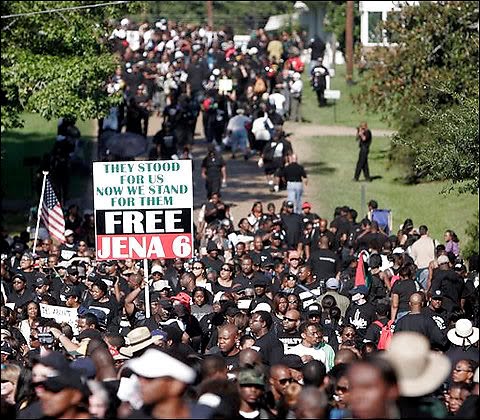
The Parish became famous in 2007 for the case of the Jena Six. In demonstrations that were called the birth of a 21st Century civil rights movement, an estimated 50,000 people marched in Jena. They were protesting a pattern of systemic racism and discriminatory prosecutions. All six youths, who once faced life in prison, are now either enrolled in college or are on their way.

The Sheriff told the Jena Times that he began preparing for Operation Third Option in November of 2007, less than two months after the historic protests.

Caseptla Bailey (left) and Catrina Wallace were active in the campaign to support the Jena 6. Their door was broken down by police while they slept. Photo by Jordan Flaherty / The Rag Blog.

A terrifying morning

Catrina Wallace, 29, was sleeping in her bed with her youngest child when her door was broken down and she awoke to the feeling of a gun to her head. When she opened her eyes, her small home was filled with police. “I never seen that many police at one time,” she recalled. “Everywhere I looked all I saw was police. There were six or seven just in my bedroom.” She says police pointed guns at her small children and wouldn’t let her comfort them.

Catrina Wallace is the sister of Robert Bailey, one of the Jena Six. Along with her mother, Caseptla Bailey, she was one of the leaders of the campaign to free the accused youths, and she organized meetings and protests for months. Wallace says her political activism made her a target. “I’m a freedom fighter,” she says. “I fight for peoples’ rights. I’ve never been in trouble.”

As with every other house raided that day, the police found no drugs in Wallace’s home. According to Wallace, police initially claimed they found marijuana on her kitchen table, but later discovered that they had collected broccoli stems, left over from dinner the previous night.

Despite the lack of evidence, and the fact that she has lived her whole life in Jena and is raising three small children, she was held for a $150,000 cash-only bond. Her car, a 1999 Mitsubishi Gallant, was also seized by police, who continue to hold it in an impound lot. If she wants it back, Catrina will have to pay $12 a day to the lot for every day since it was seized, in July of last year -- an amount already larger than the value of the car.

Tasered and traumatized

Samuel Howard was sleeping in his bed, naked, when police broke down his door at 5 a.m. Howard says police tasered him three times, twice in the back and once in his arm, and pointed guns at his three kids. They took him out of his house still naked, and brought him to a baseball field, along with the other arrestees from that day. There he says he spent another hour without any clothes, standing with the other arrestees, until police brought him an orange jailhouse jumper.

“They treated us like we was hard core killers,” says Howard, who says that in a small town like Jena where everyone knows each other, such violent tactics are uncalled for. “The sheriff knows me,” he says. “We went to school together. He knows I’m not a violent person.”

Howard is being charged with three counts of distribution of cocaine. His trial is scheduled for May 24 (Catrina Wallace’s is scheduled for the same week). As with the other defendants, the only evidence against him is the testimony and video from the police informant. Howard, who has seen the evidence, says he is not implicated in the video.

His home was badly burned up that day, apparently from flares that police fired inside, and his windows were all destroyed. Howard, who does some auto repair work, says his four vehicles -- including two older cars that don’t run -- were also seized by police.

Racially motivated

Many of Jena’s Black residents say that the town’s white power structure -- including the DA, Sheriff, and the editor of the local paper -- wants revenge against Black people in town who stood up and fought against unjust charges. They complain that in a town that is mostly white, all but two of the people arrested were Black, and the only arrestees pictured in the town’s paper were Black. The sheriff “Just wants to humiliate people,” says Caseptla Bailey, Wallace’s mother, “Especially the African Americans.” The editor and publisher of the Jena Times, the town’s only paper, is Sammy Franklin, who has owned the paper since 1968. His son is Sheriff Scott Franklin.

A white-owned store around the corner from the courthouse in downtown Jena sells t-shirts commemorating Operation Third Option, with a design of a person behind bars. Black residents of Jena say that an earlier version of the shirt featured a monkey behind bars. They say that white residents of Jena have gloated about the arrests.

Four of those arrested on that day have pled guilty. Chelsea Brown, who was arrested for contempt of court, received a sentence of 25 days. Devin Lofton, who pled guilty to conspiracy to distribute, received 10 years. Adrian Richardson, 34, who pled guilty on April 23 to two counts of distribution, received 25 years. Termaine Lee, a 22-year-old who had no previous record but faced six counts of distribution, received 20 years.

Some of the accused have hired attorneys, while others have had public defenders appointed. However, all involved say they doubt they can receive a fair trial in LaSalle. They say that white defendants with similar or worse charges received lower bonds, and face lesser sentences. “It’s crooked,” says Howard. “They ain’t playing fair down here, that’s all.”

Marcus Jones, father of Mychal Bell, one of the Jena Six youths, doesn’t mince words. “This is racially motivated,” he says. “It’s revenge.” He says that the problem is that while the Jena Six youths were freed, there were no consequences for the Sheriff or DA. “Wouldn’t none of this be going on if justice had been done the way it was supposed to have been,” he says.

Jones was not among those arrested, but in a small town like Jena, he knows everyone involved. He says he was shocked at the resources the police brought in. “Why did you need helicopters and military weapons?” he asks. “I could see it if you were going to arrest Noriega or the Mafia, but these are people with kids in their homes. The Sheriff’s department never had any violent run-ins with any of these people.”

Jones believes the entire campaign by Sheriff Franklin has been a gesture of asserting control over the Black community, and he calls for a federal investigation of the Sheriff’s department and DA.

Samuel Howard says that now he mostly stays home with his three kids, ages 12, 14, and 15. He’s afraid of the Sheriff’s office arresting him if he leaves the house, and he wants to stay close to his kids, who were traumatized by his arrest. “It scared them to death,” he says. “They still talk about it to this day.”

“They know they’re wrong,” said Howard, referring to the Sheriff and DA, “You can’t tell me they don’t know.”

[Jordan Flaherty is a journalist, an editor of Left Turn Magazine, and a staffer with the Louisiana Justice Institute. He was the first writer to bring the story of the Jena Six to a national audience and audiences around the world have seen the television reports he’s produced for Al-Jazeera, TeleSur, GritTV, and Democracy Now. Haymarket Press will release his new book, FLOODLINES: Stories of Community and Resistance from Katrina to the Jena Six, this summer. He can be reached at neworleans@leftturn.org.]

Marcus Jones, Catrina Wallace, and others in Jena are available for interviews.


Representatives of the Jena, Louisiana, Sheriff's Department arrest an unidentified suspect during drug raids July 9, 2009. Photo from the Jena Times.

A member of a white supremacist group marches in Jena, Louisiana, January 22, 2008. Photo by Jessica Rinaldi /Reuters.

Demonstrators march in support of the Jena Six, September 20, 2007. Photo from The Cheddar Box.

The Rag Blog

[+/-] Read More...

27 March 2010

Jordan Flaherty : Racist Coup in Waterproof, Louisiana?

Waterproof, LA. Photo from Fox 44 / Baton Rouge.

Did racist coup in northern Louisiana town
Overthrow Black mayor and police chief?


By Jordan Flaherty / The Rag Blog / March 27, 2010

NEW ORLEANS -- In Waterproof, a small northern Louisiana town near Natchez, Mississippi, the African-American mayor and police chief assert that they have been forced from office and arrested as part of an illegal coup carried out by an alliance of white politicians and their followers.

In a lawsuit filed last week, Police Chief Miles Jenkins asserts a wide-ranging conspiracy involving the area’s district attorney and parish sheriff, along with several other members of the region’s entrenched political power structure. These events come at a time when the validity of federal power is being questioned because of the race of the U.S. president, and in a state where white political corruption and violence have been and continue to be used as tools to fight Black political power.

About 800 people live in Waterproof, a rural community in the south of Tensas Parish. Tensas has just over 6,000 residents, making it both the smallest parish in the state, and the parish with the state’s fastest declining population. The parish’s schools remain mostly segregated, with nearly all the Black students attending public schools, and nearly all the white students attending private schools.

Waterproof Police Chief Miles Jenkins.

With a median household income of $10,250, Waterproof is also one of the poorest communities in the U.S. The only jobs for Black people in town are in work for white farmers, according to Chief Jenkins. “Unless you go out of town to work,” he says, “You’re going to ride the white man’s tractor. That's it.”

Bobby Higginbotham was elected mayor of Waterproof in September of 2006. The next year, he appointed Miles Jenkins as chief of police. Jenkins, who served in the U.S. military for 30 years and earned a master’s degree in public administration from Troy University in Alabama, immediately began the work of professionalizing a small town police department that had previously been mostly inactive.

“You called the Waterproof police for help before,” says Chief Jenkins, “He would say, wait ‘til tomorrow, it’s too hot to come out today.” He also sought to reform the town’s financial practices, which Chief Jenkins says were in disorder and consumed by debt.

Chief Jenkins asserts that a white political infrastructure, led by the Parish Sheriff Ricky Jones and District Attorney James Paxton, were threatened by their actions. This group immediately sought to orchestrate a coup against the two Black men, including clandestine meetings, false arrests, harassment, and even physical violence.

Court documents describe how Paxton, Jones, and their allies formed an alliance “designed to harass intimidate, arrest, imprison, prosecute, illegally remove plaintiff from his position of police chief, prevent plaintiff from performing his law duties as police chief and/or force plaintiff to leave the town of Waterproof.”

Ms. Annie Watson, a Black school board member in her 60s who was born and raised in Waterproof, worked as a volunteer for the mayor. She says that the mayor and chief, who had both lived in New Orleans, brought a new attitude that Parish officials didn’t like.

“The Mayor and the Chief said you can’t treat people this way, and the Sheriff and DA said you got to know your place. If you're educated and intelligent and know your rights and in this parish, you are in trouble,” she says. “They are determined to let you know you have a place and if you don't jump when they say jump you are in trouble.”

Ms. Watson explains that Paxton and Jones were threatened by Chief Jenkins’ efforts to professionalize the town’s police force. Aside from representing a challenge to Sheriff Jones’ political power, this also took away a source of his funding. “Before Mayor Higginbotham, all traffic tickets went to St. Joseph,” she says, referring to the Parish seat, where Sheriff Jones is based. “So he cut their income by having a police department.”

Jack McMillan, an African American deputy sheriff in Tensas Parish, says he tried to warn Chief Jenkins to back down. “You’ve got to adapt to your environment,” he says. “You can't come to a small town and do things the same way you might in a big city. Like the song says, you got to know when to hold ‘em, and know when to fold ‘em.”

Waterproof District Attorney James Paxton.

Tensas Parish

Tensas and the nearby parishes of Madison and East Carroll all share the sixth judicial district -- currently represented by District Attorney James Paxton. Buddy Caldwell, DA for the sixth judicial district from 1979 to 2008, is now Attorney General for the state of Louisiana.

The sixth district parishes all have majority Black populations and mostly white elected officials, which Chief Jenkins and Watson attribute to political corruption and disenfranchisement of Black voters. Prior to the registration of 15 voters in 1964, there was not a single Black voter registered in Tensas, despite having more than 7,000 African American residents (and about 4,000 white residents), making it the last Parish in Louisiana to allow African Americans to register.

Waterproof is “Reminiscent of the bygone days of southern politics,” with a white power structure maintaining political power over a Black majority, according to veteran civil rights attorney Ron Wilson, who is representing Jenkins in his civil rights lawsuit. “At any and all costs, even jeopardizing the life and freedom of my client, they will ruin him to maintain power. This case is ultimately about whether an African-American can be guaranteed the rights that are assured to him in the constitution.”

According to court papers, this Jim Crow alliance dominates elected power in the area, and "even on the local level, where the office holders tend to be African American, they are powerless to control their own destiny.” According to Chief Jenkins, the District Attorney once boasted that he controlled the votes of Waterproof’s Black Aldermen.

Chief Jenkins says he faced an immediate campaign of harassment from Sheriff Jones. “They just wanted this town to be white-controlled,” explained Chief Jenkins. The police chief described being arrested multiple times under the order of District Attorney Paxton and Sheriff Jones.

The charges, says Jenkins, range from charges of theft for a pay raise he received from the town’s board of Aldermen to criminal trespass for going to the home of a citizen who had been stopped for speeding without a valid driver’s license, to disturbing the peace for an incident where individuals threatened the police chief with violence for issuing traffic citations.

Ms. Watson says the charges were invented out of thin air. “It was a sad case of lies,” she says, adding that, “The majority of the town of Waterproof supports the chief and supports the mayor.”

Chief Jenkins says he was arrested and declared a flight risk by District Attorney Paxton, despite living and owning property in the Parish. “In all my years,” says attorney Ron Wilson, “I've never seen a police officer, and certainly not a police chief, charged for something like this.”

Chief Jenkins alleges he was attacked and choked by a deputy sheriff, who he says shouted, "Shut up... We are in charge…We are the sheriff and the sheriff controls Tensas Parish. The sooner you all learn this the better off you will be," an action that Ms. Watson says she also witnessed.

Chief Jenkins says his police car was shoved in a ditch, and when he arrested the people who had committed the act, the DA refused to press charges. In fact, he says the DA refused almost all charges he presented and released anyone he arrested. The chief was even charged with kidnapping for one incident in which he arrested the former town clerk for illegal entry.

“That’s the most ludicrous notion I've ever come across,” says Wilson. “That a police chief can be arrested for kidnapping, because he placed someone under arrest who was breaking the law.”

A grand jury has returned indictments of Chief Jenkins and Mayor Higginbotham, and Higginbotham’s trial is scheduled to begin this Monday. The mayor faces 44 charges, including multiple counts of malfeasance in office and felony theft. The charges appear to be based on the results of a state audit of Waterproof that found irregularities in the town’s record keeping going back to before the election of Higginbotham -- irregularities that the mayor and police chief say they had repaired.

Waterproof Sheriff Ricky Jones.


Patterns of violence

Mayor Higginbotham was elected at the same time as two other Black mayors of small Louisiana towns, both of whom also received threats based on race. In December of 2006, shortly after Higginbotham was elected mayor of Waterproof, Gerald Washington was shot and killed three days before he was to become the first Black mayor of the small southwest Louisiana town of Westlake.

An official investigation called his death a suicide, but family members call it an assassination. Less than two weeks after that, shots were fired into the house of Earnest Lampkins, the first Black mayor of the northwest Louisiana town of Greenwood. Lampkins reported that he continued to receive threats throughout his term, including a “for sale” sign that someone planted outside his house.

Waterproof was Klan country from the reconstruction era until well into the 20th century, and violence frequently broke out in the area. Seven Black men in Madison Parish were lynched over a period of three days in 1894 for the charge of “insurrection,” apparently because one man refused to follow an order from a sheriff.

“The Klan was very active here,” says Ms. Watson, recalling her childhood in the 50s and 60s. “We had crosses burned on people’s lawns. The school principal had a cross burned on his lawn. A man named Sun Turner was shot and killed on the streets by the Klan.”

Waterproof is an hour south of Tallulah, the site of a notoriously abusive youth prison, and a little more than hour east of Jena, where accusations of systemic racism brought 40,000 people from around the country, including many civil rights leaders, to a 2007 march. Like Jena, Waterproof is also home to a prison that contracts to hold federal immigration prisoners.

When asked for comment on Chief Jenkins’ lawsuit, Tensas Parish Sheriff Ricky Jones denied that race was a factor, claiming that Jenkins had abused his office and that many of the local citizens who filed complaints against him were Black. “I'm not going to support any type of corruption,” said Jones. “Certainly not from him.”

District Attorney Paxton, also named as a defendant in the lawsuit, disputed all accusations from Jenkins, suggesting that he had tried to help Jenkins when he was first elected. “A lot of this will become clear when the case against Mayor Higginbotham goes to trial on Monday,” he added.

Flood Caldwell, one of the town’s aldermen, is currently serving as the town’s mayor. Jenkins points to Caldwell’s appointment as further evidence of a coup, saying that the town aldermen, under the direction of DA Paxton, illegally voted to remove Mayor Higginbotham. “No one recognizes Caldwell as mayor except the DA and his friends,” says Chief Jenkins. The office of the Louisiana Secretary of State confirms that they still have Higginbotham listed as mayor, adding that they cannot comment further because of pending litigation.

Wilson says this case is ultimately about the repression of Black political and civil rights. “I think this has been going on in Tensas for a while,” he says. “I think they’ve gone too far in this case, and someone finally has come along and says they won’t go along.” Wilson hopes this lawsuit will bring federal attention. “We hope the justice department will look into this and bring some much-needed reform to this part of the world,” he says.

Chief Jenkins says he took the Sheriff’s job to serve the community, “You’ve given this country the best years of your life and you get treated like an unwanted stepchild,” he says. “I didn't realize there was so much politics to just doing your job.”

Ms. Watson believes that this is a struggle for self-determination and basic civil rights. “I was born in 1948,” she says. “Ever since I was born, Blacks never had a say in this parish, until Chief Jenkins and Mayor Higginbotham. They spoke up, and tried to change things. That’s why the parish is going after them.”

Jacques Morial of the Louisiana Justice Institute contributed to this story.

[Jordan Flaherty is a journalist, an editor of
Left Turn Magazine, and a staffer with the Louisiana Justice Institute. He was the first writer to bring the story of the Jena Six to a national audience and audiences around the world have seen the television reports he’s produced for Al-Jazeera, TeleSur, Press-TV, GritTV, and Democracy Now, as well as his appearances on Anderson Cooper 360, CNN Headline News, and several other programs. His post-Katrina reporting for ColorLines shared an award from New America Media for best Katrina-related reporting in ethnic press. Haymarket Press will release his new book, FLOODLINES: Community and Resistance from Katrina to the Jena Six, in 2010. He can be reached at neworleans@leftturn.org.]

Links to Resources Mentioned in Story:Other Resources:Also by Jordan Flaherty on The Rag Blog:The Rag Blog

[+/-] Read More...

21 January 2010

All White Hoops : The New Public Racism

Image from The Portland Mercury.

Racists coming out of the closet:
Whites only basketball league
'Would you want to go to the game and worry about a player flipping you off or attacking you in the stands or grabbing their crotch?' -- Don "Moose" Lewis, All-American Basketball Alliance
By Ted McLaughlin / The Rag Blog / January 21, 2010

When Barack Obama was elected president of the United States, there were many people (including myself) who thought it might herald a new era of better race relations in this country. Maybe it will, but it has also had another effect. It has caused many racists to crawl out from under their rocks and once again make their slimy presence known.

In the last few years it had become socially unacceptable to be openly racist. The racists were still there (although fewer in number) but they kept it to themselves and the few like-minded friends they had. Even racist organizations like the KKK were having trouble attracting new members.

But President Obama's election changed that. Perhaps fearing their racist beliefs were not just out of vogue but disappearing altogether, the racists have once again become public and very vocal. And they have found a comfortable home in the Republican Party and other anti-Democratic and anti-government groups (such as the teabaggers). These groups allow them to thinly disguise their racism as a form of rabid patriotism (which it is not).

Almost every week we see more examples of this newly public brand of obvious racism. Of course they all deny that they are being racist. To hear them tell it, they are just trying to protect some vital aspect of American society and culture, and race has nothing to do with it. But their racism is so clearly the driving force behind their actions that their denial of it just seems stupid and inane.

Consider this perfect example of the new public racism. There is a group now that wants to create a new professional basketball league. And one of the major rules of the new league is that all of the players must be "natural born citizens with both parents of the caucasian race" (white). Of course, the people trying to create this new league say it has nothing to do with race and they are not racists.

The league will be called the All-American Basketball Alliance (AABA) and they say they will start play next June with teams in 12 cities. The league commissioner, Don "Moose" Lewis, says he is not racist, but just wants to get away from "street ball" and get back to "fundamental basketball". He went on to say:
There's nothing hatred about what we're doing. I don't hate anyone of color. But people of white, American-born citizens are in the minority now. Here's a league for white players to play fundamental basketball, which they like... Would you want to go to the game and worry about a player flipping you off or attacking you in the stands or grabbing their crotch? That's the culture today, and in a free country we should have the right to move ourselves in a better direction.
I am amazed at this man's stupidity. He as much as says that all the bad behavior in the NBA is by African-Americans and white boys would not act like that, and doesn't even realize that his statement itself is racist? Any rational thinker knows that neither bad nor good behavior is linked to race (which is in itself a spurious concept invented to advance colonialism and greed).

The league is based in Atlanta and is targeting cities in the Southeast to fill the 12 slots for franchises. However, they are already having trouble in one of the targeted cities -- Augusta, Georgia. The city is making it clear they want no part of the new league.

Augusta Mayor Deke Copenhaver says, "As a sports enthusiast, I have always supported bringing more sporting activities to Augusta. However, in this instance I could not support in good conscience bringing in a team that did not fit with the spirit of inclusiveness that I, along with many others, have worked so hard to foster in our city."

Augusta State University athletic director Clint Bryant was even more blunt, saying, "It's so absurd it's funny, but it gives you an idea of the sickness of our society. It shows you what lengths people will go to just to be mean-spirited." Mr. Bryant is absolutely right. This sort of thing is sick and mean-spirited.

Now I don't think this new league has a chance of succeeding. Even if it does get established, it will quickly fold because most people will not support this kind of overt racism -- even in the South. The South still has its problems, but it has come a long way since the bad old days of Jim Crow.

But personally, I'm damn sick and tired of the new public racism that is rearing its ugly head in this country. Because of our country's free speech rights, these racist creeps have the right to speak their evil minds. But we also have the same right, and we have a responsibility to come down hard on this racist sickness. Racism doesn't just hurt individuals, it hurts our country as a whole.

It is time for decent people of all ethnicities and colors to rise up and let the racists know we just won't stand for it. It's both the decent and patriotic thing to do.

[Rag Blog contributor Ted McLaughlin also posts at jobsanger.]

The Rag Blog

[+/-] Read More...

15 September 2009

The Righteous Mob : Like Talking to Children

Photo from registeredmedia.com.

KKK to Tea Parties:
Communicating with the ignorant and angry


By Larry Ray / The Rag Blog / September 15, 2009

If angry outbursts and placard waving protesters against health care reform seem heated today, the idea of planned parenthood and birth control in the early 1900's caused a raging bonfire.

Margaret Sanger, an activist way ahead of her time, is credited with starting the idea of planned parenthood. Over the years she was arrested more than eight times for expressing her ideas back when speaking out in public in favor of birth control was illegal. She did time in jail in 1916 nine days after opening America's first birth control and family planning clinic in Brooklyn.

But Margaret Sanger's message also supported "negative eugenics" saying, "It is a vicious cycle; ignorance breeds poverty and poverty breeds ignorance. There is only one cure for both, and that is to stop breeding these things."

So, like a modern day Sibyl, her pronouncements could be interpreted by opposing sides, each opting either to hear the positive germ of her message, or to embrace the radical edges of some of her statements as pillars of support for their views... including white supremacy.

In the mid 1920's she received more than a million letters requesting information on birth control. And she spoke from coast to coast to diverse groups including "cotton workers, churchmen, liberals, socialists, scientists, civic clubs, and fashionable, philanthropically minded women."

In 1926, she was invited to speak to the ladies axillary of the Ku Klux Klan in Silver Lake, New Jersey. After being driven in a curtain shuttered car for almost an hour, way out into a country field, she gave a lecture to the robed and hooded ladies, as well as a smattering of male Klansmen. In her memoirs she described it as "one of the weirdest experiences I had in lecturing," noting that she was forced to use only "the most elementary terms, as though I were trying to make children understand." The KKK ladies and their male attendees were reportedly delighted with the idea of promoting birth control for 'the colored folks.'

Though she remains to this day a controversial figure it is interesting to note that as the nation became more enlightened, birth control and family planning became accepted, championed by the Rockefeller, Jr.'s Bureau of Social Hygiene. In spite of allegations of racism, she earned the respect and support of of civil rights leaders such as Martin Luther King, Jr. and the American Humanist Association named her Humanist of the Year in 1957.

Today President Barack Obama has undertaken the tough task of renewing a demand for universal health insurance legislation for all Americans. For seventy years political manipulation, crass profit incentives of big business and a whipped up mistrust of "big government" as a convenient devil has blocked health care reform legislation.

Medicare health insurance for our senior citizens finally passed in 1965 after years of being protested and assailed as "socialist" and a "government takeover" by conservative Republicans adverse to any change. A high percentage of today's protesters have Medicare cards in their pockets.

The busloads of well fed white folks who angrily waved placards in the nation's capitol last week probably didn't pay for their bus tickets and their mental carry on baggage was not packed with reasoned ideology based upon clear fact. Rather, it was stuffed with anger, startling ignorance of the facts and, worse, their willingness to believe such political purée.

It is daily becoming more and more clear that much, but not all, of what we are seeing is driven by simmering racism, the idea that the most powerful man in the world, the President of the USA is not a white man. That a black skinned (his white half doesn't seem to count), calm, educated and persuasive man is deciding what will happen to THEM!

The busloads arriving in Washington D.C. and in the town hall meetings, were all for the most part provided a free ride and a sense of indignant importance, banding together to hate, vent frustration and spout utter nonsense. With Rush Limbaugh, Fox News and the endless babble of knee-jerk talking heads on cable TV, the ignorant are rewarded for their ignorance. They are delighted to hear what they want to hear fed to them daily.

Also, today's so-called "Tea Parties" which have no relationship whatsoever to the reasons for the Boston Tea Party are a sad testament in themselves to the ignorance of most of the shouting sign carriers of what the historic "Tea Party" actually was. Similarly, a large number of those screaming "Socialist" would, I will wager, be unable to define what a socialist is. But by God, they are mad!

Today's disgruntled race baiting demonstrators aren't wearing robes or hoods. Most also are not armed with facts or reasoned opposition. They are armed with anger, wild rumors and a sense of empowerment that harks back some 40 some odd years ago when this same mentality produced sneers and shouts of "Boy!" to make a black move off the sidewalk, or to those who carried "no nigger" placards outside public schools as police dogs strained at their leashes as small black children walked past. Fine law-abiding, church going folks then ... and now.

This minority of our citizenry has long been hijacked for cynical purposes. They present a golden opportunity for the struggling, discredited conservative Republican base to recruit and inflame the bigoted and ignorant with poisoned misinformation.

Though this righteous mob is making the most noise and is getting the media coverage that would be bestowed on a fully grown two-headed mule, our elected representatives must hear the louder voice of reason from the overwhelmingly reasonable majority. Maybe it would help if we speak to them "in the most elementary terms, as though we were trying to make children understand."

[Retired journalist Larry Ray is a Texas native and former Austin television news anchor. He also posts at The iHandbill.]

The Rag Blog

[+/-] Read More...

25 August 2009

James Retherford : Who Watches the Watchman? Paranoia and Persecution


Part VI
Who Watches the Watchman?


COINTELPRO and the Federal Government’s
Clandestine Attack on the U.S. Constitution

Paranoia strikes deep / into your life it will creep
it starts when you’re always afraid
step out of line and they’ll come
and take you away... -- Buffalo Springfield
By James Retherford / The Rag Blog / August 25, 2009
Quis custodiet ipsos custodes?
-- Juvenal, Satires, VI, 347
During the 1960s, movement activists discovered a new definition of the clinical term, paranoia. If classic paranoia is an irrational response to irrational fears, then the new paranoia could be defined as an irrational response to rational fears. One of the FBI COINTELPRO’s most effective initiatives was to create and exploit paranoia in order to disrupt the organizing work of the American Left.

The following is a list, both paranoid and rational, of known and suspected COINTELPRO operations that I experienced as an underground newspaper editor in Bloomington, Indiana, and later as a writer and anti-war organizer in New York City. Please note that because of continued secrecy surrounding many federal covert operations I am forced to include events that are unproven but fit the COINTELPRO profile. This illustrates precisely why paranoia proved to be such an effective weapon against dissidents:

1. Sometime in late 1967, small calibre gunshots fired through my front door in Bloomington, Indiana. Later this was revealed to be a “fear” tactic used by the FBI against activists, usually carried out by off-duty local police officers or members of right-wing support groups (such as the Bloomington Ku Klux Klan who months later firebombed an African-American bookstore near the Indiana University campus). (The offices of Space City! in Houston were shot up in similar fashion, with the local police and KKK later implicated.)

2. Publication in a local right-wing newspaper of a rude, crude caricature intended to ridicule my appearance and politics. (Note: one wonders whether FBI field agents perhaps had too much time on their hands -- the cartoon made great refrigerator art.) In Los Angeles, a COINTELPRO-produced Black Panther “coloring book” exploited tensions between the Panthers and white cops, on one hand, and Ron Karenga’s black nationalist US, on the other.

When the smoke had cleared, Black Panthers Bunchy Carter and John Huggins had been shot to death on the UCLA campus, and Geronimo Pratt, targeted by a COINTELPRO operation to “neutralize Pratt as an effective BPP functionary,” spent 27 years in prison falsely imprisoned on a murder charge based solely on the testimony of FBI and Los Angeles Police Department informant Julius Butler. Pratt’s conviction was vacated in 1997 when his defense team discovered Butler’s secret “business relationship” with the police.

3. A probable “snitch jacket”operation in Bloomington, revealed in 1967 when friends told me that someone was spreading rumors that I was an undercover agent. During this period, snitch rumors also were rampant about other local activists, narc rumors about some notable potheads, persistent rumors about impending busts. (One local crazy figured out where the rumors were coming from and started his own counter-counter intelligence rumor campaign: a plot to spike the Bloomington drinking water supply with LSD. The reverse rumor operation peaked when the governor publicly announced plans to call out the National Guard to circle and protect the waters of Lake Lemon, and we -- temporarily -- had to find a new place to go skinny dipping.)

4. A fairly recent discovery, thanks to Texan Geoffrey Rips, that Director Hoover himself approved an attempt by the Indianapolis field office to publish a fake “underground newspaper” -- called Armageddon News -- in another crude attempt to discredit The Spectator and divide the local New Left leadership. Hoover himself critiqued the first issue, chiding his field officers for failing to use words and phrases that would sound “authentic” to students.

A note to Ragsters: the FBI created a similar faux underground newspaper in Austin during this time. It was called Longhorn Tales (though a more apt name would have been The Bull Sheet.) I have not spoken with anyone in Bloomington or in Austin who remembers seeing either of the FBI’s “journalistic” enterprises. However, I briefly examined Armageddon Times at the Indiana University Archives several years ago and have to say that it was NOT one of COINTELPRO’s most effective endeavors.

5. Use of the sympathetic courts to “railroad” activists into prison: While this tactic was successful in imprisoning African American, Native American, and hispanic leaders for decades, it was also used against white activists such as myself. In December 1967 I learned that I was the subject of two federal grand indictments alleging Selective Service law violations. (In January a third indictment was announced.) The indictments were so specious that one must wonder whether the government’s intention was actually to gain a conviction or merely to overextend the Bloomington movement’s limited resources and put The Spectator out of business. The government’s “case” was pathetic, as evidenced by the fact that Attorney General Ramsey Clark ordered the federal prosecutor to stop the investigation and later to drop all charges. The judge refused, and in June 1968 I went on trial.

I did not go on trial, however, for technical violations of the Selective Service act, though that is what was written on the indictments. Rather I was put on trial for the editorial content of The Spectator. Lengthy excerpts of articles and editorials were recited into the court record to build a case of sedition. I was portrayed as a revolutionary advocating the violent overthrow of the government, a communist subversive, a seditious traitor. Every time my attorney attempted to object on grounds of relevance to the actual charges, he was overruled by the trial judge, who, time and again, ruled that the prosecution’s relentless political attack was relevant to the case. I was found guilty on all counts and sentenced to six years in federal prison.

Next the judge ruled that my appeal had been improperly filed, and I was incarcerated for almost three months while my new attorney, Leonard Boudin (representing the Emergency Civil Liberties Committee), successfully appealed for my right to appeal. A year later, noting that my order to appear for “additional processing” was not only unsigned but also hand written on blank note paper, rather than official Selective Service stationary as required by law, and that I “was never officially declared delinquent by the Selective Service System,” a stipulated prerequisite for draft law prosecution, Federal Circuit Court of Appeals for the Seventh Circuit on October 2, 1969, overturned all convictions with a strongly worded rebuke to the prosecution and the presiding district trial judge.

6. Discovery of a new “snitch jacket” operation in New York City, where I had moved in late 1968 to assist Boudin’s preparation of my appeal. As before, friends told me about a rumor that I was an FBI informer. At the time, such rumors were rampant in the close-knit Lower East Side activist community, and, indeed, the Movement had been hard hit by police infiltrators and agents provocateurs, notably Crazy George Demerle in the Sam Melville bombing case.

7. Proverbial cracks, hisses, and buzzes during telephone conversations.

8. Numerous observations of New York Police Red Squad and the ubiquitous Detective Finnegan taking photographs as activists entered and exited public meetings at Washington Square Church and other popular Movement meeting places.

9. Discovery of an electronic surveillance operation set up in an adjoining apartment on West Sixteenth Street near Eighth Avenue. The FBI and local authorities moved my next-door neighbor to another location and then used his apartment to eavesdrop on my activities. During this time frame, the same thing happened to my friends Stew Albert and Judy Gumbo (see below).

After I met my neighbor in the hallway with suitcases in hand, leaving for what he said was a theatre gig in upstate New York, I became suspicious when I ran into a crew cut white male -- 30ish, wearing suit, tie and London Fog trenchcoat, and looking very out-of-his-element in this dilapidated tenement building -- leaving the neighbor’s apartment. When he had gone down the stairs, I tapped on the apartment door. When no one answered, I edged my way out on the fire escape landing through my living room window and peeked into the neighbor’s window. Inside the dark room in front of the common wall separating the two apartments, I spotted banks of green-glowing VU meters illuminating slowly moving tape reels.

10. A couple weeks later, I was awakened by a loud banging on my door. I opened it to discover a half-dozen trenchcoat-clad clones, some very large, nasty-looking guys wearing jeans and jackboots, and about a dozen uniformed SWAT police carrying shotguns lining the hallway. Stepping forth, one of the men identified himself as a federal marshal and handed me a subpoena to appear to a federal grand jury hearing.


11. The Guy Goodwin Grand Jury. Following the bombing of a washroom in the Capitol Building in Washington, the FBI faced increased pressure from the White House to catch some radicals. First they seized my friend Leslie Bacon, age 19, from her bed in the Student Mobilization collective house in Washington, D.C., and transported her incommunicado by automobile to Seattle where they put her, represented by counsel arranged by the government, in front of a specially convened grand jury. For two days, Leslie answered seemingly innocuous questions about her personal life and friends. This was the beginning of the infamous Guy Goodwin grand juries; Goodwin used the names revealed by Leslie to issue subpoenas for grand jury proceedings all over the U.S.

I was one of seven activists commanded to testify in New York. Our response was quite appropriate. Stew Albert, a large man with a big blonde afro, wore a custom-made rainbow-sequined dress with appliqué spelling out the name “Bernardine” (for Bernardine Dohrn, the Weather Underground spokeswoman who had announced the group’s responsibility for the Capitol bombing and a number of other equally provocative “armed” actions). Judy “Gumbo” Clavet and Santa Barbara-Isla Vista activist Sandra Wardwell dressed as witches and carried broomsticks… to assist Goodwin in his witch hunt.

I rented a gorilla costume and showed up at the grand jury chambers as King Cong -- remember, Goodwin was looking for, ah, gorilla fighters… Only Walter Teague (who headed a National Liberation Front support group with perhaps the longest set of initials in U.S. movement history) actually got invited into the chamber -- he was wearing his “Walter Teague” working class disguise, i.e., plaid flannel work shirt, jeans, and work boots, and thus probably looked less frightening to the geriatrics who typically serve on grand jury panels. Walter was quickly dismissed after he recited the litany of constitutional amendments which our legal team was using to launch a legal challenge to the government’s “witch hunt.”

Goodwin eventually was forced to call off all grand jury probes when it became obvious that the government could not make any cases without producing volumes of evidence obtained from illegal wiretaps, electronic surveillance, and other illicit operations.

12. “Dumpster diving” and trashcan espionage: several weeks after the subpoena was served, my apartment house superintendent stopped me on my way in. With a big grin splashed across his face, he asked me if I knew that the FBI had been pulling up in a big garbage truck and hauling off trash for the entire building.


13. In the summer of 1974, Fred Newman’s small New York City Upper West Side psychotherapy cult, newly merged into Lyndon LaRouche’s National Caucus of Labor Committees (NCLC), went to the FBI and Justice Department with the story that I had harbored fugitives such as Jane Alpert, at that time on the FBI most-wanted list as one of Sam Melville’s accomplices. The Newmanites also told the FBI that I was working with the Weather Underground.

At that time, I was “underground” myself, having moved my infant son to safety far away from the Newman cult in whose hands Jesse had been criminally neglected, abused, and almost killed. The group was under investigation for child endangerment. This was the period when NCLC was staging violent attacks on public meetings held by the Communist Party USA and the Socialist Workers Party, when Chairman LaRouche appeared to be mentally unstable and a number of suspected agents (including Zeke Boyd, who had been thrown out of the Baltimore Black Panther chapter as an agent provocateur) had moved into secondary leadership positions and were orchestrating the group’s orgy of thuggery and intimidation. Many New York activists already had concluded that NCLC had, by this time, become a front for the government’s attack on the anti-racism/anti-imperialism movement.

14. As late as 1990 or 1991, in the midst of a very mellow buzz, my telephone range, and the disturbing voice of a man who said something like, “Hey, Jim. This is [name unintelligible]. I’ve been wondering what you’ve been up to. I haven’t seen you since I ran into you at the Indianapolis jail in 1968.” The diction was neither African American nor Southern White, which meant he had not been in lock-up with me. My heightened sense of awareness told me that he sounded like an FBI bureaucrat assigned to work an old case file, trying to scare up some action.

[James Retherford knows firsthand what it was like to be targeted by COINTELPRO. A founder and editor of The Spectator in Bloomington, Indiana, in 1966, Retherford is a director of the New Journalism Project, the nonprofit organization that publishes The Rag Blog.]

Please see
Also see James Retherford : Brandon Darby, The Texas 2, and the FBI's Runaway Informants by James Retherford / The Rag Blog / May 26, 2009

And for more background on the history of informants in Texas, read The Spies of Texas by Thorne Dreyer / The Texas Observer / Nov. 17, 2006.

The Rag Blog

[+/-] Read More...

06 August 2009

Fascist America : Are We There Yet?


Fascism in five easy steps

...mature democracies turn fascist by a recognizable process, a set of five stages that may be the most important family resemblance that links all the whole motley collection of 20th Century fascisms together.
By Sara Robinson / August 6, 2009

All through the dark years of the Bush Administration, progressives watched in horror as Constitutional protections vanished, nativist rhetoric ratcheted up, hate speech turned into intimidation and violence, and the president of the United States seized for himself powers only demanded by history's worst dictators.

With each new outrage, the small handful of us who'd made ourselves experts on right-wing culture and politics would hear once again from worried readers: Is this it? Have we finally become a fascist state? Are we there yet?

And every time this question got asked, people like Chip Berlet and Dave Neiwert and Fred Clarkson and yours truly would look up from our maps like a parent on a long drive, and smile a wan smile of reassurance. "Wellll...we're on a bad road, and if we don't change course, we could end up there soon enough. But there's also still plenty of time and opportunity to turn back. Watch, but don't worry. As bad as this looks: no -- we are not there yet."

In tracking the mileage on this trip to perdition, many of us relied on the work of historian Robert Paxton, who is probably the world's pre-eminent scholar on the subject of how countries turn fascist. In a 1998 paper published in The Journal of Modern History, Paxton argued that the best way to recognize emerging fascist movements isn't by their rhetoric, their politics, or their aesthetics. Rather, he said, mature democracies turn fascist by a recognizable process, a set of five stages that may be the most important family resemblance that links all the whole motley collection of 20th Century fascisms together.

According to our reading of Paxton's stages, we weren't there yet. There were certain signs -- one in particular -- we were keeping an eye out for, and we just weren't seeing it.

And now we are. In fact, if you know what you're looking for, it's suddenly everywhere. It's odd that I haven't been asked for quite a while; but if you asked me today, I'd tell you that if we're not there right now, we've certainly taken that last turn into the parking lot and are now looking for a space. Either way, our fascist American future now looms very large in the front windshield -- and those of us who value American democracy need to understand how we got here, what's changing now, and what's at stake in the very near future if these people are allowed to win -- or even hold their ground.

What is fascism?

The word has been bandied about by so many people so wrongly for so long that, as Paxton points out, "Everybody is somebody else's fascist." Given that, I always like to start these conversations by revisiting Paxton's essential definition of the term:
Fascism is a system of political authority and social order intended to reinforce the unity, energy, and purity of communities in which liberal democracy stands accused of producing division and decline.
Elsewhere he refines this as
a form of political behavior marked by obsessive preoccupation with community decline, humiliation or victimhood and by compensatory cults of unity, energy and purity, in which a mass-based party of committed nationalist militants, working in uneasy but effective collaboration with traditional elites, abandons democratic liberties and pursues with redemptive violence and without ethical or legal restraints goals of internal cleansing and external expansion.
Jonah Goldberg aside, that's a basic definition most legitimate scholars in the field can agree on, and the one I'll be referring to here.

From proto-fascism to the tipping point
...it's easy to trace how American proto-fascism offered redemption from the upheavals of the 1960s by promising to restore the innocence of a traditional, white, Christian, male-dominated America.
According to Paxton, fascism unfolds in five stages. The first two are pretty solidly behind us -- and the third should be of particular interest to progressives right now.

In the first stage, a rural movement emerges to effect some kind of nationalist renewal (what Roger Griffin calls "palingenesis" -- a phoenix-like rebirth from the ashes). They come together to restore a broken social order, always drawing on themes of unity, order, and purity. Reason is rejected in favor of passionate emotion.

The way the organizing story is told varies from country to country; but it's always rooted in the promise of restoring lost national pride by resurrecting the culture's traditional myths and values, and purging society of the toxic influence of the outsiders and intellectuals who are blamed for their current misery.

Fascism only grows in the disturbed soil of a mature democracy in crisis. Paxton suggests that the Ku Klux Klan, which formed in reaction to post-Civil War Reconstruction, may in fact be the first authentically fascist movement in modern times. Almost every major country in Europe sprouted a proto-fascist movement in the wretched years following WWI (when the Klan enjoyed a major resurgence here as well) -- but most of them stalled either at this first stage, or the next one.

As Rick Perlstein documented in his two books on Barry Goldwater and Richard Nixon, modern American conservatism was built on these same themes. From "Morning in America" to the Rapture-ready religious right to the white nationalism promoted by the GOP through various gradients of racist groups, it's easy to trace how American proto-fascism offered redemption from the upheavals of the 1960s by promising to restore the innocence of a traditional, white, Christian, male-dominated America.

This vision has been so thoroughly embraced that the entire Republican party now openly defines itself along these lines. At this late stage, it's blatantly racist, sexist, repressed, exclusionary, and permanently addicted to the politics of fear and rage. Worse: it doesn't have a moment's shame about any of it. No apologies, to anyone. These same narrative threads have woven their way through every fascist movement in history.

In the second stage, fascist movements take root, turn into real political parties, and seize their seat at the table of power. Interestingly, in every case Paxton cites, the political base came from the rural, less-educated parts of the country; and almost all of them came to power very specifically by offering themselves as informal goon squads organized to intimidate farmworkers on behalf of the large landowners.

The KKK disenfranchised black sharecroppers and set itself up as the enforcement wing of Jim Crow. The Italian Squadristi and the German Brownshirts made their bones breaking up farmers' strikes. And these days, GOP-sanctioned anti-immigrant groups make life hell for Hispanic agricultural workers in the U.S. As violence against random Hispanics (citizens and otherwise) increases, the right-wing goon squads are getting basic training that, if the pattern holds, they may eventually use to intimidate the rest of us.

Paxton wrote that succeeding at the second stage "depends on certain relatively precise conditions: the weakness of a liberal state, whose inadequacies condemn the nation to disorder, decline, or humiliation; and political deadlock because the Right, the heir to power but unable to continue to wield it alone, refuses to accept a growing Left as a legitimate governing partner."

He further noted that Hitler and Mussolini both took power under these same circumstances: "deadlock of constitutional government (produced in part by the polarization that the fascists abetted); conservative leaders who felt threatened by the loss of their capacity to keep the population under control at a moment of massive popular mobilization; an advancing Left; and conservative leaders who refused to work with that Left and who felt unable to continue to govern against the Left without further reinforcement."

And more ominously: "The most important variables... are the conservative elites' willingness to work with the fascists (along with a reciprocal flexibility on the part of the fascist leaders) and the depth of the crisis that induces them to cooperate."

That description sounds eerily like the dire straits our Congressional Republicans find themselves in right now. Though the GOP has been humiliated, rejected, and reduced to rump status by a series of epic national catastrophes mostly of its own making, its leadership can't even imagine governing cooperatively with the newly mobilized and ascendant Democrats.

Lacking legitimate routes back to power, their last hope is to invest the hardcore remainder of their base with an undeserved legitimacy, recruit them as shock troops, and overthrow American democracy by force. If they can't win elections or policy fights, they're more than willing to take it to the streets, and seize power by bullying Americans into silence and complicity.

When that unholy alliance is made, the third stage -- the transition to full-fledged government fascism -- begins.

The third stage: being there
Now, the guessing game is over. We know beyond doubt that theTeabag movement was created out of whole cloth by astroturf groups like Dick Armey's FreedomWorks and Tim Phillips' Americans for Prosperity, with massive media help from FOX News.
All through the Bush years, progressive right-wing watchers refused to call it "fascism" because, though we kept looking, we never saw clear signs of a deliberate, committed institutional partnership forming between America's conservative elites and its emerging homegrown brownshirt horde. We caught tantalizing signs of brief flirtations -- passing political alliances, money passing hands, far-right moonbat talking points flying out of the mouths of "mainstream" conservative leaders. But it was all circumstantial, and fairly transitory. The two sides kept a discreet distance from each other, at least in public. What went on behind closed doors, we could only guess. They certainly didn't act like a married couple.

Now, the guessing game is over. We know beyond doubt that theTeabag movement was created out of whole cloth by astroturf groups like Dick Armey's FreedomWorks and Tim Phillips' Americans for Prosperity, with massive media help from FOX News. We see the Birther fracas -- the kind of urban myth-making that should have never made it out of the pages of the National Enquirer -- being openly ratified by Congressional Republicans.

We've seen Armey's own professionally-produced field manual that carefully instructs conservative goon squads in the fine art of disrupting the democratic governing process -- and the film of public officials being terrorized and threatened to the point where some of them required armed escorts to leave the building. We've seen Republican House Minority Leader John Boehner applauding and promoting a video of the disruptions and looking forward to "a long, hot August for Democrats in Congress."

This is the sign we were waiting for -- the one that tells us that yes, kids: we are there now. America's conservative elites have openly thrown in with the country's legions of discontented far right thugs. They have explicitly deputized them and empowered them to act as their enforcement arm on America's streets, sanctioning the physical harassment and intimidation of workers, liberals, and public officials who won't do their political or economic bidding.

This is the catalyzing moment at which honest-to-Hitler fascism begins. It's also our very last chance to stop it.

The fail-safe point

According to Paxton, the forging of this third-stage alliance is the make-or-break moment -- and the worst part of it is that by the time you've arrived at that point, it's probably too late to stop it. From here, it escalates, as minor thuggery turns into beatings, killings, and systematic tagging of certain groups for elimination, all directed by people at the very top of the power structure.

After Labor Day, when Democratic senators and representatives go back to Washington, the mobs now being created to harass them will remain to run the same tactics -- escalated and perfected with each new use -- against anyone in town whose color, religion, or politics they don't like. In some places, they're already making notes and taking names.

Where's the danger line? Paxton offers three quick questions that point us straight at it:
  1. Are [neo- or protofascisms] becoming rooted as parties that represent major interests and feelings and wield major influence on the political scene?

  2. Is the economic or constitutional system in a state of blockage apparently insoluble by existing authorities?

  3. Is a rapid political mobilization threatening to escape the control of traditional elites, to the point where they would be tempted to look for tough helpers in order to stay in charge?
By my reckoning, we're three for three. That's too close. Way too close.

The Road Ahead
Unfortunately, all the noise and bluster actually obscures the danger. These people are as serious as a lynch mob, and have already taken the first steps toward becoming one.
History tells us that once this alliance catalyzes and makes a successful bid for power, there's no way off this ride. As Dave Neiwert wrote in his recent book, The Eliminationists, "if we can only identify fascism in its mature form -- the goose-stepping brownshirts, the full-fledged use of violence and intimidation tactics, the mass rallies -- then it will be far too late to stop it."

Paxton (who presciently warned that "An authentic popular fascism in the United States would be pious and anti-Black") agrees that if a corporate/brownshirt alliance gets a toehold -- as ours is now scrambling to do -- it can very quickly rise to power and destroy the last vestiges of democratic government. Once they start racking up wins, the country will be doomed to take the whole ugly trip through the last two stages, with no turnoffs or pit stops between now and the end.

What awaits us? In stage four, as the duo assumes full control of the country, power struggles emerge between the brownshirt-bred party faithful and the institutions of the conservative elites -- church, military, professions, and business.

The character of the regime is determined by who gets the upper hand. If the party members (who gained power through street thuggery) win, an authoritarian police state may well follow. If the conservatives can get them back under control, a more traditional theocracy, corporatocracy, or military regime can re-emerge over time. But in neither case will the results resemble the democracy that this alliance overthrew.

Paxton characterizes stage five as "radicalization or entropy." Radicalization is likely if the new regime scores a big military victory, which consolidates its power and whets its appetite for expansion and large-scale social engineering. (See: Germany) In the absence of a radicalizing event, entropy may set in, as the state gets lost in its own purposes and degenerates into incoherence. (See: Italy)

It's so easy right now to look at the melee on the right and discount it as pure political theater of the most absurdly ridiculous kind. It's a freaking puppet show. These people can't be serious. Sure, they're angry -- but they're also a minority, out of power and reduced to throwing tantrums. Grown-ups need to worry about them about as much as you'd worry about a furious five-year-old threatening to hold her breath until she turned blue.

Unfortunately, all the noise and bluster actually obscures the danger. These people are as serious as a lynch mob, and have already taken the first steps toward becoming one. And they're going to walk taller and louder and prouder now that their bumbling efforts at civil disobedience are being committed with the full sanction and support of the country's most powerful people, who are cynically using them in a last-ditch effort to save their own places of profit and prestige.

We've arrived. We are now parked on the exact spot where our best experts tell us full-blown fascism is born. Every day that the conservatives in Congress, the right-wing talking heads, and their noisy minions are allowed to hold up our ability to govern the country is another day we're slowly creeping across the final line beyond which, history tells us, no country has ever been able to return.

How do we pull back? That's my next post.

[Tip o' the hat to Chip Berlet and Steven Martin for their research help and encouragement.]

Source / The Seminal / Firedoglake

Thanks to Bob Simmons / The Rag Blog

[+/-] Read More...

Only a few posts now show on a page, due to Blogger pagination changes beyond our control.

Please click on 'Older Posts' to continue reading The Rag Blog.