Showing posts with label Computers. Show all posts

11 January 2011

Robert Jensen : Machines Change, Our Work Remains the Same

Early computer. Image from Corbis-Bettmann.

The limits of internet activism:
Machines change, the work remains the same


By Robert Jensen / The Rag Blog / January 11, 2011

When I first got involved in left/radical political organizing in the 1990s, I don’t recall any of us referring to our efforts as “phone activism” or calling ourselves “fax activists.” A friend who started organizing in the early 1960s assured me that he never heard the term “mimeograph activism” in those days. We used telephones, fax machines, and mimeographs in our organizing work, but the machines didn’t define our work and we didn’t spend a lot of time arguing about the implications of using them.

Today the terms “online activism” and “internet activist” are common, as are discussions about the positive and negative effects of computer-mediated communication (CMC) on left/progressive political organizing. (See interview with Joss Hands on "Activism in a digital culture.”)

Is CMC so dramatically different, or is the left simply caught up in the larger culture’s obsession with life online? I will start with observations that likely are not controversial, and then step back to frame the question in ways that may not be widely accepted.

Two basic points:

First, CMC makes possible the distribution of information to a larger number of people at lower financial cost than previous technologies (though the ecological cost of a communication technology that creates highly toxic e-waste and consumes enormous amounts of energy may make this technology prohibitively expensive in the long run) and allows for easier and faster feedback from the recipients of that information.

Second, while the technology is too new for definitive assertions, there is a seductive quality to CMC that leads some groups and individuals to spend too much of their time and resources online, even when there’s ample reason to suspect that expense of energy isn’t productive.

Two corollary cautions:

First, political information is not political action. Being able to distribute more information more widely more quickly does not automatically lead to people acting on that information. The information must be presented in ways that lead people to believe they should act, and there must be vehicles for that action.

Second, what appears to be wasting time online is not always a waste of time. Just as we solidify bonds with people face-to-face by chatting about the mundane aspects of our lives, we sometimes do that online. Political organizing -- like all of life -- includes such interaction.

So, it’s true that the things we do with a computer online are often like the things we do, or did, with telephone calls, faxes, and mimeographs; the question is how to most effectively apportion our time, energy, and resources on these machines as part of a larger organizing strategy. In that sense, deciding whether to focus on an email or a door-knocking campaign is a straightforward calculation about resources and the likely outcomes of using those resources in different ways.

It’s also true that we should be more critically self-reflective about our use of computers for political organizing, lest we be seduced by how productive we imagine we are being online simply because of the speed and reach of CMC. Because an email campaign can reach more people quickly, we are tempted to believe it will lead to the more effective outcomes, though the patient work of door-knocking may yield better long-term results if it builds deeper support that endures.

As our organizing tools change rapidly, these calculations of the likely success of different tactics are not always easy to make, but they are relatively simple questions to formulate. Much more vexing are questions about the complex changes in the world in which we are organizing.

We like to say the internet has changed everything, perhaps in as dramatic a fashion as the printing press changed the act of reading. But the world of the 15th century was not changing at anything like the speed that the world is changing today. We need to think about the “everything” in which our email messages are bouncing around. We need to be clearer about the scale of the problems we face, the scope of the changes necessary to address the problems, and the time available to us for creating meaningful change. To illustrate these issues, I’ll talk about the state of the ecosphere.


Scale of the problems

For many years activists focused on “environmental problems,” offering ways that humans could adjust the way we live to cope with problems of dirty air, dirty water, and dirty land. The assumption behind those projects was that an environment consistent with long-term human flourishing was possible within existing economic, social, and political systems.

That assumption was wrong, and evidence continues to pile up that the ecosphere cannot sustain billions of people when even a fraction of them live at First-World levels. Look at any crucial measure of the health of our ecosphere -- groundwater depletion, topsoil loss, chemical contamination, increased toxicity in our own bodies, the number and size of “dead zones” in the oceans, accelerating extinction of species and reduction of bio-diversity -- and the news is bad and getting worse.

And we live in an oil-based world that is fast running out of oil with no viable replacement fuels. And we can’t forget global warming and climate instability. Add all that up and it’s not a pretty picture, especially when we abandon the technological fundamentalism of the culture and stop believing in fantasy quick fixes for deeply rooted problems.

Our troubles are not the result of the bad behavior within the systems in which we live but of the systems themselves. We have to go to the root and acknowledge that human attempts to control and dominate the non-human world have failed. We are destroying the planet and in the process destroying ourselves.


Scope of the changes

So, we either abandon the industrial model of development based on the concentrated energy in fossil fuels or we face a significant human die-off in a grim future that is within view. Abandoning that industrial model means a sudden shift in human living arrangements that would be unprecedented in history. We have to redefine what it means to live a good life, dramatically lowering our energy use and reducing our expectations about the material goods we consume.

That means that we not only won’t be getting a new flat-screen television, but that we won’t be amusing ourselves with new Hollywood movies and TV. It means not only that we won’t be able to buy an SUV, but that we won’t be using cars for routine personal transportation. It means a whole lot less of everything, and such changes in living arrangements are impossible within capitalism.

While capitalism is not the only unsustainable economic system in history, it is the system that structures the global economy today, and it has to be scrapped. If a transition to a sustainable economy is possible, it also means we will have to abandon the nation-state as the primary unit of political organization and find functional political systems at a much lower level.

These changes in economic, social, and political systems mean significant changes in how we understand the nature of the self, the relationship to other humans, and the human place in the larger living world. When we redefine what it means to live a good life, we will be defining what it means to be human.


Time available

No one can predict the trajectory of a full-scale ecological collapse, in part because it is complex beyond human understanding and in part because how we act in the present can affect that trajectory. But even without the capacity to predict with precision, we have to make our best guesses to guide our choices in organizing.

The best-case scenario is that we have a few decades to accomplish these changes. The worst-case scenario is that we are past the point of no return and that the systems in place will exhaust the ecosphere’s capacity to sustain human life as we know it before we can adjust.

If ecological collapse is either coming soon or already in motion, then traditional organizing strategies may be obsolete. The problem is not just that existing economic, social, and political systems are incapable of producing a more just and sustainable world, but that there isn’t time available for working out new ways of understanding our self, others, and the world. There is no reason to assume that the non-human world will wait while we slowly come to terms with all this; the ecosphere isn’t going to conform to our timetable.


Where this leaves us

Though I made no claims to special predictive powers, two things seem likely to me: (1) All human activity will become dramatically more local in the coming decades, and (2) Without coordinated global action to change course, there is little hope for the survival of human society as we know it.

When I offer such an assessment, I am routinely accused of being hysterical and apocalyptic. But I don’t feel caught up in an emotional frenzy, and I am not preaching a dramatic ending of the human presence on Earth. Instead, I’m taking seriously the available evidence and doing my best to make sense of that evidence to guide my political choices. I believe we all have a moral obligation to do that.

As a result, I have recommitted to local organizing that aims mainly to strengthen institutions and networks on the ground where I live, rooted in a belief that those local connections will be more important than ever in coming decades. At the same time, I try to maintain and extend connections to like-minded people around the world, hoping that those connections can contribute to the possibility of coordinated global action.

In short, I am trying to become more tribal and more universal at the same time, recognizing there is no guarantee that of a smooth transition or success in the long run.

In these efforts, I engage in a considerable amount of computer-mediated communication. Whenever it’s feasible, I favor direct human communication in face-to-face settings, on the assumption that local networks will be strengthened by such communication in ways that CMC cannot foster.

I also use CMC to reach out beyond the local, both to learn about global initiatives and to contribute to such initiatives. I try to take advantage of the opportunities offered by CMC without being seduced by illusions of easy organizing through the send button.

So, a summary that likely isn’t controversial: These days almost all left/radical organizers will communicate online, but the social justice and ecological sustainability at the heart of left/radical politics isn’t going to be achieved online.

It’s tempting to leave the discussion at that level, but the questions about scale/scope/time aren’t addressed by that easy summary. With a larger focus, the trouble with CMC -- with all the time and effort it takes to learn new programs, keep up with the constant changes on the internet, think about the role of the virtual world in real-world politics -- is that it keeps us stuck in the past.

That may seem paradoxical; we’re used to talking about the people who don’t embrace computers as being the ones stuck in the past. After all, isn’t the internet the key to the future? Not if the future is going to be defined by less energy and less advanced technology.

If the changes outlined above are an unavoidable part of our future, then we would be well advised to start weaning ourselves from the high-energy/high-technology world, not only in our personal lives but in our organizing as well. That doesn’t mean immediately abandoning all the gadgets we use, but rather always realizing that our efforts to make the most effective use of the gadgets in the short term shouldn’t crowd out the long-term planning for a dramatically different world.

That different world may well impose changes on us before we have been able to face them ourselves. Novelist/poet/critic Wendell Berry captures this when he writes, “We are going to have to learn to give up things that we have learned (in only a few years, after all) to ‘need.’ I am not an optimist; I am afraid that I won’t live long enough to escape my bondage to the machines.”

The task is daunting, but it is our task nonetheless. Berry is not optimistic about the future, but he concludes with our charge:

“Nevertheless, on every day left to me I will search my mind and circumstances for the means of escape. And I am not without hope. I knew a man who, in the age of chainsaws, went right on cutting his wood with a handsaw and an axe. He was a healthier and a saner man than I am. I shall let his memory trouble my thoughts.”[1]

When we lack answers to difficult questions -- or even a way to imagine finding answers -- it’s easy to put the questions aside. Better, I think, to let the questions continually disturb us.

Every time I touch the keyboard of my laptop to write an essay that will be posted on a web site, which I will send to editors via email, my thoughts are troubled.

[Robert Jensen is a journalism professor at the University of Texas at Austin and board member of the Third Coast Activist Resource Center in Austin, and one of the partners in the community center “5604 Manor.” He is the author of All My Bones Shake: Seeking a Progressive Path to the Prophetic Voice, (Soft Skull Press, 2009) and Getting Off: Pornography and the End of Masculinity (South End Press, 2007); Jensen is also co-producer of the documentary film Abe Osheroff: One Foot in the Grave, the Other Still Dancing, which chronicles the life and philosophy of the longtime radical activist. Robert Jensen can be reached at rjensen@uts.cc.utexas.edu. This article also appears at the New Left Project.]

[1] Wendell Berry, What Are People For? (San Francisco: North Point Press, 1990), p. 196.

The Rag Blog

[+/-] Read More...

15 October 2010

William Michael Hanks : Net Neutrality / Stop Thief!

Stop thief!
How the internet happened
and why it's in danger now

By William Michael Hanks / The Rag Blog / October 15, 2010

  • Also see Mike Hanks' companion article: Net Neutrality / Open Internet Under Fire
  • And see 'Save the Internet' video and Net Neutrality resources, Below
  • Somebody is trying to steal your shiny new bicycle and I know who it is. What you can do about it depends on being able to dissuade their accomplices from participating in the crime.

    Your bicycle is the Internet. It takes you to far away places, on adventures, to see friends and family, and it informs your opinions. Right now you can hop on it and go anywhere you want. But if five monopolistic corporations have their way you'll have to ask their permission first.

    A few short years ago there were thousands of local Internet Service Providers (ISP's). They sold, for a monthly fee, telephone modem access to the Internet. Beep beep, whistle, buzz, long wait. Then cable service providers began to offer the service over much faster cable lines. Cable companies merged and consolidated so that now four or five corporations operate in protected monopolies across the entire country.

    The biggest are Comcast, AT&T, Verizon, Time Warner, and Cox. It's not enough that they have a monopoly in your community, or that you pay them for the use of your Internet highway. They want to control where and how fast you can go and who you can do business with as well.

    Why is this a theft? After all it's their cables. Because, if you have ever paid taxes, the Internet belongs to you. It was conceived with tax dollars spent on your behalf by the Defense Advanced Research Projects Agency (DARPA). Like most bureaucratic projects, it began with a memo:
    Dated April 23, 1963, the memo was dictated as its author, Joseph Carl Robnett Licklider, was rushing to catch an airplane. Licklider’s task might have been easier if he had been pursuing a more conventional line of computing research -- improvements in database management, say, or fast-turnaround batch-processing systems. He could have just commissioned work from mainstream companies like IBM, who would have been more than happy to participate. But in fact, with his bosses’ approval, Licklider was pushing a radically different vision of computing.

    His inspiration had come from Project Lincoln, which had begun back in 1951 when the Air Force commissioned MIT to design a state-of-the art, early-warning network to guard against a Soviet nuclear bomber attack. The idea -- radical at the time -- was to create a system in which all the radar surveillance, target tracking, and other operations would be coordinated by computers, which in turn would be based on a highly experimental MIT machine known as Whirlwind: the first "real-time" computer capable of responding to events as fast as they occurred.

    Licklider, who was then a professor of experimental psychology at MIT, had led a team of young psychologists working on the human factors aspects of the SAGE radar operator’s console. And something about it had obviously stirred his imagination.

    By 1957, he was giving talks about a "Truly SAGE System" that would be focused not on national security, but enhancing the power of the mind.... he imagined a nationwide network of "thinking centers," with responsive, real-time computers that contained vast libraries covering every subject imaginable. And in place of the radar consoles, he imagined a multitude of interactive terminals, each capable of displaying text, equations, pictures, diagrams, or any other form of information.

    By 1958, Licklider had begun to talk about this vision as a "symbiosis" of men and machines, each preeminent in its own sphere -- rote algorithms for computers, creative heuristics for humans -- but together far more powerful than either could be separately.

    By 1960, in his classic article "Man-Computer Symbiosis," he had written down these ideas in detail -- in effect, laying out a research agenda for how to make his vision a reality. And now, at ARPA, he was using the Pentagon’s money to implement that agenda.

    Licklider’s research program was so successful, in fact, that it’s now hard for us to remember just how visionary it was. IBM and the other major computer manufacturers were going in a completely different direction at the time, emphasizing punch cards and batch-processing machines suited to the needs of the business world. Mainstream computer engineers tended to see the ARPA approach as totally wrong-headed. Use precious computer cycles just to help people think? What a waste of resources!

    Thus his memo on April 23, 1963, which he addressed to "the members and affiliates of the Intergalactic Computer Network" -- they would have to take all their time-sharing computers, once the machines became operational, and link them into a national system. "If such a network as I envisage nebulously could be brought into operation," Licklider wrote, "we would have at least four large computers, perhaps six or eight small computers, and a great assortment of disc files and magnetic tape units -- not to mention the remote consoles and Teletype stations -- all churning away."

    Leave aside the primitive technology and the laughably small number of machines: The vision that lay behind that sentence is still a pretty good description of the Internet we have today. Indeed, Licklider’s Intergalactic Network memo would soon become the inspiration for the Internet’s direct precursor, the ARPANET."

    -- "DARPA and the Internet Revolution," by Mitch Waldrop

    Project Sage's Whirlwind computer, developed at MIT, was the first computer to operate in real time. Image from History of Computers.

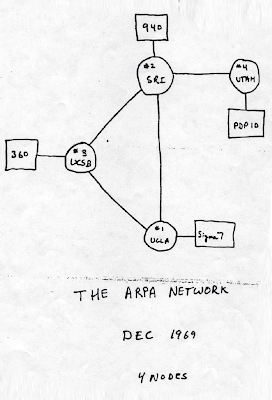
    One big problem remained and that was how to get all these computers physically linked to one another. The job of laying wires to each computer even in the U.S., much more so to computers all over the world, was monumental. However, a simple solution was found in using existing AT&T telephone wires.

    Essentially the network leased long distance lines and kept them perpetually open as in a never ending long distance call. But static in the system posed another problem. When data was being transmitted, if the stream broke, the data was useless -- mere bips and beeps without meaning.

    To solve that, a method of correcting errors was developed along the lines of the U.S. Postal Service. The data stream was broken up into packets, each with the address of the sender and recipient. That way if a packet were unreadable it would be resent and added to the coherent data stream. After some hardware and software design accommodations, the inter-network system -- the Internet -- was a reality. It was a pretty small reality then but it had profound implications. With simple scalability it could be extended anywhere in the world, or, as in Linklider's original, perhaps tongue in cheek memo, to the Galaxy.


    The content was primitive by today's standards -- ones and zeros -- computer code. But that soon changed. Standards were developed to translate the bits and bytes into letters and numbers. The first email programs were written. And the whole system met it's design criteria -- no single node was necessary to exchange information. It could just be rerouted. So if those darn commies blew up a computer somewhere in the system -- no problems mate. The world went merrily on as if nothing happened.

    But the thing that really made the Internet what it is today -- the thing we all love and the main reason we use it -- was the Graphic User Interface (GUI). That's why we can send Aunt Martha pictures of the kids, why we can see animation of the space station construction, and why we can read and write blogs like this. The ability to see pictures and hear sounds, to tell a story, to research a term paper, to do all the things and go to all the places our shiny new bicycle will take us -- it all depends on the GUI.

    The GUI was a gift. We didn't pay for it like we did the design, architecture, hardware and software that put the Internet in place. It was a gift of a few good geniuses who wanted to do a few good things. Tim Berners-Lee, while at CERN, the European Particle Physics Laboratory, invented a way to transmit images over the Internet -- and the World Wide Web was born. He could have patented his invention, protected it with copyrights, and made a bizzillion dollars. But he didn't. He gave it to us, free of charge -- a gift to the people.

    So not only is the foundation of the World Wide Web -- the Internet -- yours because you paid to develop it, but the World Wide Web itself -- the Graphic Interface -- is yours because it was a gift.

    So what's the problem? The problem is a bunch of fat cats who can barely tie their shoes and could never in a million years create it themselves want to steal it and sell it back to you. Who would have the presumption, the hubris, the unmitigated gall to try such a thing? I'll give you a clue. It's who you make your check out to each month for your Internet connection.

    It's the huge corporate vultures who are not content to simply have a monopoly on your Internet business -- they want more. They want to leverage their monopoly to sell you services that you would otherwise freely choose on the open market where their limited abilities and lack of innovation make them uncompetitive.

    Here's how it works. Lets say you use Vonage or Skype for phone service. You pay the modest fees, they give you good service, you save money. But the company that you use -- that you pay to use -- to connect to Vonage -- your Internet Service Provider (ISP) -- sees that's a good business and wants to offer it too. So mysteriously your calls with Vonage buzz with static, get dropped, aren't as clear as they used to be.

    Then, here comes your Internet Service Provider to the rescue. They have a service. It costs a little more but it's more reliable so you switch. But because they have their foot on the hose -- your Internet connection -- they have just turned down or turned off your connection to Vonage without your knowledge. They think people are stupid enough not to notice.

    Well, people do notice. So now they have a problem. They have just hijacked your freedom to choose but how do they get away with it? Enter the accomplices -- your representatives. You see, if the law doesn't forbid this practice -- or worse, if it encodes it into law -- then there's nothing you or anybody else can do about it.

    They have just stolen your shiny new bicycle and are offering to sell it back to you and it's all perfectly legal. Well, after all, Representatives and Senators have to fly in jet planes and live high on the hog too. What's a little graft in the free market. So what if they are selling you out to line their pockets. What are you going to do about it -- complain? Take a number.

    There's only one currency that is slightly more valuable to elected officials than dollars and that is votes. And that's what you have. You may spend every dime every month just to live or send your kids to school but you still have what your representatives want just a little more than money -- a vote. Or more exactly lots of votes. So if you exercise your oversight over your representatives and you convince enough other people to do the same, you win. If not, you lose. It's just that simple.

    The theft of Net Neutrality is only one crime that moneyed corporations have tried to legitimize by recruiting your representatives as accomplices. But it's one of the most important because if they can control your access to services that you choose to purchase on the Web they can also control your access to any kind of information about the world that you live in. They can tell you where you can and cannot ride your shiny new bicycle because now they own it.

    Net Neutrality is non-negotiable if you want to go where you want to go, see what you want to see, and continue to create and have access to ideas of your own choosing. Act now. Sign the petitions. Call your Senators and Representatives. Write them, email them. Get your friends together, make signs and march in the streets. Because once your freedom to ride your bike wherever you want to go is gone you may never get it back. Don't let 'em steal the Internet -- it belongs to you and to the generations to come.

    [William Michael Hanks lived at the infamous Austin Ghetto and worked with the original Rag gang in the Sixties. He has written, produced, and directed film and television productions for the National Aeronautics and Space Administration, The U. S. Information Agency, and for Public Broadcasting. His documentary film The Apollo File won a Gold Medal at the Festival of the Americas. Mike lives in Nacagdoches, Texas.]

    Also see:


    Net Neutrality Resources:
    • Electronic Frontier Foundation (EFF): Anyone who watched John Hodgman's famous Daily Show rant knows what Net Neutrality means as an abstract idea. But what will it mean when it makes the transformation from idealistic principle into real-world regulations? 2010 will be the year we start to find out, as the Federal Communications Commission begins a Net Neutrality rulemaking process.

      But how far can the FCC be trusted? Historically, the FCC has sometimes shown more concern for the demands of corporate lobbyists and "public decency" advocates than it has for individual civil liberties. Consider the FCC's efforts to protect Americans from "dirty words" in FCC v. Pacifica Foundation, or its much-criticized deregulation of the media industry, or its narrowly-thwarted attempt to cripple video innovation with the Broadcast Flag.

      With the FCC already promising exceptions from net neutrality for copyright-enforcement, we fear that the FCC's idea of an "Open Internet" could prove quite different from what many have been hoping for.

    • Democracy Now: The internet and telecom giants Verizon and Google have reportedly reached an agreement to impose a tiered system for accessing the internet. The deal would enable Verizon to charge for quicker access to online content over wireless devices, a violation of the concept of net neutrality that calls for equal access to all services. The deal comes amidst closed-door meetings between the Federal Communications Commission and major telecom giants on crafting new regulations.
    Net Neutrality Petitions:Some You Tube Videos:The Rag Blog

    [+/-] Read More...

    01 August 2008

    Travelers' Laptops May Be Detained At Border

    No suspicion required under Homeland Security policies
    By Ellen Nakashima / August 1, 2008

    Federal agents may take a traveler's laptop computer or other electronic device to an off-site location for an unspecified period of time without any suspicion of wrongdoing, as part of border search policies the Department of Homeland Security recently disclosed.

    Also, officials may share copies of the laptop's contents with other agencies and private entities for language translation, data decryption or other reasons, according to the policies, dated July 16 and issued by two DHS agencies, U.S. Customs and Border Protection and U.S. Immigration and Customs Enforcement.

    "The policies . . . are truly alarming," said Sen. Russell Feingold (D-Wis.), who is probing the government's border search practices. He said he intends to introduce legislation soon that would require reasonable suspicion for border searches, as well as prohibit profiling on race, religion or national origin.

    DHS officials said the newly disclosed policies -- which apply to anyone entering the country, including U.S. citizens -- are reasonable and necessary to prevent terrorism. Officials said such procedures have long been in place but were disclosed last month because of public interest in the matter.

    Civil liberties and business travel groups have pressed the government to disclose its procedures as an increasing number of international travelers have reported that their laptops, cellphones and other digital devices had been taken -- for months, in at least one case -- and their contents examined.

    The policies state that officers may "detain" laptops "for a reasonable period of time" to "review and analyze information." This may take place "absent individualized suspicion."

    The policies cover "any device capable of storing information in digital or analog form," including hard drives, flash drives, cellphones, iPods, pagers, beepers, and video and audio tapes. They also cover "all papers and other written documentation," including books, pamphlets and "written materials commonly referred to as 'pocket trash' or 'pocket litter.' "

    Reasonable measures must be taken to protect business information and attorney-client privileged material, the policies say, but there is no specific mention of the handling of personal data such as medical and financial records.

    When a review is completed and no probable cause exists to keep the information, any copies of the data must be destroyed. Copies sent to non-federal entities must be returned to DHS. But the documents specify that there is no limitation on authorities keeping written notes or reports about the materials.

    "They're saying they can rifle through all the information in a traveler's laptop without having a smidgen of evidence that the traveler is breaking the law," said Greg Nojeim, senior counsel at the Center for Democracy and Technology. Notably, he said, the policies "don't establish any criteria for whose computer can be searched."

    Customs Deputy Commissioner Jayson P. Ahern said the efforts "do not infringe on Americans' privacy." In a statement submitted to Feingold for a June hearing on the issue, he noted that the executive branch has long had "plenary authority to conduct routine searches and seizures at the border without probable cause or a warrant" to prevent drugs and other contraband from entering the country.

    Homeland Security Secretary Michael Chertoff wrote in an opinion piece published last month in USA Today that "the most dangerous contraband is often contained in laptop computers or other electronic devices." Searches have uncovered "violent jihadist materials" as well as images of child pornography, he wrote.

    With about 400 million travelers entering the country each year, "as a practical matter, travelers only go to secondary [for a more thorough examination] when there is some level of suspicion," Chertoff wrote. "Yet legislation locking in a particular standard for searches would have a dangerous, chilling effect as officers' often split-second assessments are second-guessed."

    In April, the U.S. Court of Appeals for the 9th Circuit in San Francisco upheld the government's power to conduct searches of an international traveler's laptop without suspicion of wrongdoing. The Customs policy can be viewed here..

    Source / Washington Post

    Thanks to Shelia Cheaney / The Rag Blog

    [+/-] Read More...

    23 July 2008

    John McCain, Please Log On


    The crusty ol' Repub says he has no clue how to use a computer. Isn't that cute?
    By Mark Morford / July 23, 2008

    Dear McCain presidential campaign:

    You know what's funny and cute and just a little bit sad? Wacky old pre-industrial war-hungry guys admitting they don't know a computer from a microwave oven, a hyperlink from a heart med, can't turn on one of those newfangled PC things if his life depended on it and/or he wanted to see what his weird tattooed bi-curious grandson is posting on his MySpace home docking station whateveryoucallit. Adorable!

    Cuter still is when said wisecrackin' curmudgeon admits he depends on the wife to show him how it all works, to log on and open a browser and check e-mail and describe what it all might mean out there in Interweb Cybertown, as you get the distinct feeling the old guy has no idea what makes it go and believes all this crazy gizmongery is for troublemakin' whippersnappers anyway, as he pines for the days of teletype machines and prop aeroplanes. Charming!

    Or, you know, maybe not. Because you know what's depressing and just a bit beyond sad? A serious presidential candidate — that is to say, yours — who thinks it's harmless that he's actually one of those guys, who admits he's a complete Luddite when it comes to computers and, by extension, most every aspect of modern multimedia and technology, except perhaps the exact specs of the nuke required to annihilate Iran and/or take out a big pile of "gooks."

    See, word has gotten out. Your boy John McCain says has no clue how to work a computer. He's an admitted tech illiterate, couldn't Google his way out of a DailyKos to save his Yahoo.

    But here's the disturbing part: This confession of ignorance apparently bothers him and his campaign not at all, as they apparently believe any sort of tech know-how isn't really required to run our deeply busted-up ship of state, that you need no real firsthand experience with the most definitive technology of the past 100 years to make decisions that affect the entire planet. Go figure.

    So then, the valid question: Is it a big deal? Should you care? Because McCain's I'm-just-a-clueless-old-guy comment has caused a bit a stir, with anyone with a functioning DSL line calling it a bit of an embarrassment, a bit like running for captain of the swim team while admitting all you know how to do is splash around in the bathtub. Gosh, Senator, don't you think you need just a passing understanding of the culture in which you live to qualify you to oversee the damnable place? Doesn't it help?

    Maybe not. Maybe McCain's apologists are right, the POTUS really doesn't need to have a working knowledge of what hundreds of millions of people use every day to live, work, communicate, shop and blog and breed and porn and tube and book. Hell, just look at President Bush — still giggles every time Laura plugs in the air popcorn popper, has an Irish drinking song as a ringtone, enjoys a working grasp of the English language that borders on infantile. Really, who says a president has to be even modestly versed in the culture of his or her day? Or even passably competent?

    But then, that's not really the point, is it? The point, of course, is about social interconnection. It's about understanding the basic workings of one of the most powerful, fundamental engines of modern society, its staggering impact and consequence and reach. To not use or comprehend computers and the Net in 2008 is to basically confess to your own cultural irrelevance.

    Maybe a short lesson, then? Shall we offer a bit of help to McCain and his hapless crew? Couldn't hurt.

    Look here, Senator, this is a link. You click it to take you somewhere else on the Web. Here's an example: When we click this link we see this page of — oh I'm sorry, this appears to be a big list of your most significant and appalling flip-flops, major issues you've reversed yourself on over weeks, months, years. Goodness, there sure are a lot of them.

    Well, let's scroll around a bit — scrolling is how you move up and down a large page to take it all in. As we move down here ... oh look, here's information about your famed McCain-Feingold bill on campaign finance reform. Except, oh dear, it appears you're no longer connected to the most high-profile legislation of your career. Heck, now that you're running for prez and need all the cash you can muster, who wants finance reform? I understand. What a maverick you are. Well, let's move on.

    Here are nice video clips of you decrying the ugly forces of the religious right, and then later kissing Falwell's fat, nauseating ring. And here's you trashing Bush's useless tax cuts for the wealthy, then completely flopping over and supporting them. And whoops, gay marriage might be OK, then it's definitely not. Torture is absolutely wrong, then it's not. You say you're rather clueless about the economy and will need some lessons in basic finance, then here's you denying outright that you ever said that. Isn't technology amazing, Senator?

    Wow, there sure is a lot of information about your bizarre inconsistency on just about every issue of note. Immigration, energy, health care reform, offshore drilling, Social Security, Roe v. Wade, and, oh my goodness, the Iraq war? You really are all over the place. One thing's for certain, though: your position on war and violence and America as ruthless pre-emptive aggressor, well, let's just say you can sometimes make Dick Cheney look like a peacenik. Scary.

    Ah, but it's not all bad. To be fair, there is good amount of evidence of your past battles against Big Money, proof that you truly earned your maverick status in numerous contentious fights against special interests, lobbyists, Big Tobacco, ethanol subsidies (even Barack Obama won't touch that one), Big Sugar, et al. Your record is — or rather, was — impressive.

    Not anymore. It's amazing what a taste of serious power will do to a man's values, no? Don't worry, it's happening to your rival Obama, too — albeit to a far lesser degree. Hell, it happens to them all. This is another mandatory lesson about the Web, Senator. While it can certainly be a bit unfair and extreme, it's also startlingly effective in how it tracks of the ugly erosion of your soul.

    Maybe we should stop the lesson now. I think I'm beginning to see just why you don't want to know how to use these hateful little gizmos. Damn things have a painful ability to tell the truth, to keep a dynamic, revealing record of your general inability to understand not just what's really going on in the world, but what's going on in your own muddled, fuzzy, increasingly dangerous mind. Ah, modern technology. Ain't it a bitch?

    Source / S.F. Gate

    Thanks to Fontaine Maverick / The Rag Blog

    [+/-] Read More...

    Only a few posts now show on a page, due to Blogger pagination changes beyond our control.

    Please click on 'Older Posts' to continue reading The Rag Blog.