Showing posts with label Criminal Justice Reform. Show all posts

14 October 2010

Diana Claitor : Why We Need To Protect Texas Inmates
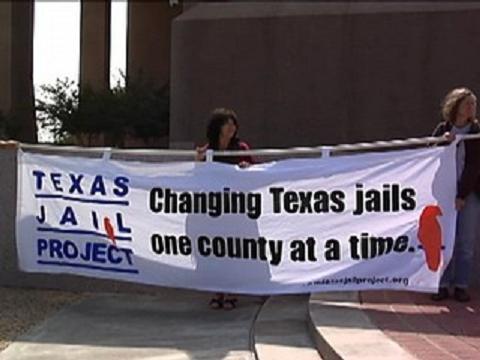
Texas Jail Project protests at Taylor County Jail in 2008. Image from Abilene Reporter-News.
Texas Jail Project director Diana Claitor will be Thorne Dreyer's guest on Rag Radio on KOOP 91.7 FM in Austin, Tuesday, October 19, 2-3 p.m. (CST). To stream Rag Radio live, go here. To listen to this show after the broadcast, or to listen to earlier shows on Rag Radio, go here.
Protecting Texas inmates:
Why do we need another law?


By Diana Claitor / The Rag Blog / October 14, 2010

I often hear about how stupid it is that Texas and other states have to pass bills and create laws to ensure care for pregnant inmates or to stop the shackling of nonviolent women during childbirth. Folks say, "Why don't people in charge just do the right thing?"

Of course, you can say that about everything. Why do we have to pass laws against pollution or bribery? Why do we have to enact standards or requirements for elected officials to follow?

Probably because those in charge are human beings and make mistakes -- and because they don't always do the right thing. Like when sheriffs and jail administrators release inmates in dangerous locations after dark.

Texas Jail Project recently found out about a man with a mental disorder who was shoved out of the Val Verde County facility, onto the county road outside Del Rio. Traumatized and lacking any information about where the town was, he walked up and down the road for hours in the dark until a deputy felt sorry for him and drove him into town.

A typical response to stories like that: "Well, that's an isolated case. You're going to have that happen with some 245 jails all over this huge state."

But it's turning out not
to be so isolated. We have received detailed accounts of similar releases at night in Houston, and in Seguin over in Guadalupe County. Even worse cases are coming to light, including two releases outside Brownsville that resulted in women being hit by cars. Both woman died, one of them this past summer. Priscilla Falduto was 27.

Patricia Falduta, who was arrested for swimming nude in a Brownsville park fountain, was killed when struck by a car after being released from custody on a highway close to the jail.

Brownsville citizens wrote to their newspapers in outrage and contacted their elected representatives. Texas Jail Project brought these examples up to the Texas Commission on Jail Standards in the past month, but director Adan Muñoz says it is outside their purview -- that when and where people are released is under local control.

“The sheriff can’t be told when and where inmates are to be released,” says Muñoz.

Why not, Mr. Muñoz?

It seems to me that the legislature could pass a state law requiring that county jail inmates be released during daylight hours (like at Texas state prisons) at safe locations where transportation and a phone are available -- thus ensuring that inmates are not treated like so much garbage, to be put out at night.

The general idea of incarceration is that jails should hold people safely until it is determined whether they have broken the law or not. In the latter case, or after bail is made, they are released -- and we want that to be a safe release.

So it looks like we actually do need a new law, to require sheriffs and counties to be as careful in how they restore freedom as they are (or should be) when holding a person in custody.

If, however, any of you readers should discover that human nature has changed and that people in charge have started making sure that each inmate gets released safely, let me know -- it will be a huge relief.

Please help us at the Texas Jail Project to research and publicize this problem.

[Diana Claitor is director of the Texas Jail Project, an organization dedicated to improving conditions for the approximately 70,000 people incarcerated in Texas jails on any given day. Visit www.texasjailproject.org to learn more or to help support their efforts.]
Activist-author Diane Wilson.

Diane Wilson headlines Texas Jail Project bash.

The Texas Jail Project is having a fundraising event Saturday, November 6, from 7-10 p.m., at 3209 Hemlock Ave. in Austin. Special guest will be TJP co-founder and award-winning author and activist Diane Wilson. Wilson will speak about the history of the Texas Jail Project and her experiences in the Harris and Victoria County Jails, and she will also tell about being arrested in Washington D.C. after disrupting two Senate hearings on the Gulf oil disaster.

Wilson will also preview her new book, Diary of an Eco-Outlaw: An Unreasonable Woman Breaks the Law for Mother Earth, to be published in the spring of 2011. For more information on this event, please contact Diana Claitor at diana@texasjailproject.org or call (512) 597-8746.
The Rag Blog

[+/-] Read More...

20 November 2009

Lily Keber : Putting Families in Jail in America


Putting children in jail:
T. Don Hutto and family detention in America

As hope for change in Obama immigration policy dwindles, activists speculate on the fate of family detention.
By Lily Keber / The Rag Blog / November 20, 2009
See 'Hutto: America's Family Prison,' A film by Lily Keber and Matt Gossage, Below.
When she first arrived in the U.S. with her two small children, Denia didn’t realize she was pregnant. Fleeing an abusive relationship in Honduras, she had traveled north to the U.S. to reunite with her mother, a naturalized citizen living in Houston. But instead of reuniting with their grandmother, Denia and her daughters found themselves in a medium-security prison, dressed in prison garb and forced to line up to be counted several times daily.

Though pregnant, she was losing weight from lack of food. Guards shouted at her children and threatened to take them away if they misbehaved. Security lights were left on all night, and alarms went off if a child wandered from its cell during the night.

Denia remembers:
“I was really scared. I would say: 'Dear God -- what am I going to do with a newborn here? He’ll die in this freezing cold' It was so cold, and the worst thing was that they wouldn’t give us enough blankets... And how could I get enough rest if resting is prohibited here? I wouldn’t be able to take care of myself properly the way one should after giving birth. I was really worried.”
The rise of family detention

Unfortunately, Denia’s experiences are not unique. The U.S. has been detaining families since March 2001. In an effort to end what was labeled the “catch-and-release” policy -- wherein migrants with immigration violations were given a mandate to appear in court and then released back into the community -- the Department of Homeland Security under Michael Chertoff began detaining all immigrants without documents -- even those with small children.

The first facility for families was an 84-bed converted nursing home in Berks County, PA. At Berks, families were separated by age and gender and slept in dorm-style rooms, 2–8 per room. (Children under five slept with their parent.) But even with Berks open, there was not enough room for all the families ICE was detaining. Some were still being released. Others were separated -- adults sent to adult facilities while children as young as six months old were sent to children’s facilities or foster care. After 9/11, DHS announced it needed more room to expand, and turned to long-time partner Corrections Corporation of America (CCA) for solutions.

The largest for-profit corrections company in the country, CCA is best known for its infamous failed bid to take over the corrections operations of the entire state of Tennessee. However, by 2000 CCA had hit hard times and its stocks were at an all-time low. In July 2005, it had been forced to shutter the T. Don Hutto Detention Facility -- a medium-security prison in Texas -- due to lack of demand. CCA jumped at the government’s offer to pay $2.8 million a month to house immigrant families. In May 2006, it reopened the prison as the T. Don Hutto Residential Facility. Little had changed except the name and the population. Razor wire still laced the fencing, though now with wooden playgrounds in the yard and painted murals in the halls.

Familes in the hall of the T. Don Hutto Residential Center in Taylor, Texas. Photo by Charles Reed / Dept. of Homeland Security / via AP.

“I was shocked. It was like nothing I had ever seen,” said Barbara Hines, director of the University of Texas Immigration Clinic and one of the first to visit Hutto. Frances Valdez, a former UT Immigration Clinic student, adds:
“It was surreal. It was everything I had already experienced in other jails, but here was this baby. I would go out [to Hutto] asking [the inmates] about their immigration issues and… they started telling me about the conditions… They were like, ‘Hey, I can't be here, get me out of here. My kids are getting sick, and they can't eat the food and I can't eat the food, and they separate us at night and they yell at us and they only give us 15 minutes to eat and my children are really scared and crying and it's horrible.’”
Other reports from initial visits describe children in prison garb, poor sanitation, limited education for the children, only one hour of access to fresh air and recreation, and armed guards threatening the families.

Denia’s 5-year-old daughter remembers:
“For me it was terrible because I would always dream at night that they were yelling at my mother and they were going take her to another jail. And they had told us that mothers who misbehave and take extra cookies in their pockets [for their kids to eat] would be sent somewhere else and…that they would take the children away from their mothers."
Word spread about the facility and outrage grew. An early report of the rape of an inmate by a guard mobilized neighbors. Local activists from Williamson County and nearby Austin began staging candlelight vigils and protests. Representatives from the Women’s Commission for Refugee Women and Children testified to Congress about its findings at Hutto, recommending the facility be closed immediately.

Jorge Bustamante, United Nations Special Rapporteur on the Human Rights of Migrants, attempted an investigation on conditions in Hutto and was denied access. Two documentaries were made, and screenings staged across the country. Articles appeared in the New York Times, New Yorker, The Economist, salon.com, and local papers.

Barbara Hines, clinical law professor at the University of Texas, Austin, with ACLU lawyers Vanita Gupta and Lisa Graybill at T. Don Hutto in 2007. Photo from statesman.com.

In March 2007, the ACLU and UT Law Clinic waged a lawsuit against ICE maintaining that children were being held in inhumane conditions. Several months later, ICE settled and pledged improvements to the facility. Education and recreation times increased, pregnant women were allowed more food, and families permitted to close the door to their rooms as they slept. CCA officials maintain that reforms at Hutto had been underway already and were not due to the lawsuit.

Immigrant detention continued to expand throughout the Bush years. Plans were announced for three similar facilities to be built in other parts of the country, and rumors spread of families held in other unauthorized facilities.

With Obama’s election, hopes soared that the new administration would usher in comprehensive change in immigration policy. In August of this year, ICE Secretary John Morton announced a reworking of the nation’s immigration jail network into a “truly civil detention center.” In August 2009, ICE announced Hutto was to stop taking families, and that plans for three additional family detention facilities were to be scrapped. Obama’s call for progressive reform was, it seemed, coming to fruition. By September 17th, all families had left the facility.

Demonstrators at T. Don Hutto. Photo from Of América.


Family detention under Obama

Today, Hutto looks pretty much the same as it always has: a drab building tucked just out of town, sandwiched between a train car storage yard and fields of Texas beef cattle. The razor wire is gone, and freshly painted murals inside the facility depict smiling cartoon animals, a reminder to visitors of its former occupants. Hutto is back at maximum occupancy, though this time with women. Even before the last of the families were out, CCA had worked a new contract with ICE to house women from its other immigrant detention facilities at Hutto.

“By more fully utilizing the facility’s capacity and consolidating the female populations from multiple facilities, this change will yield substantial savings each month, “ICE spokeswoman Nina Pruneda said. And indeed, current reforms seem driven as much by the bottom line as by humanitarian concerns. By ending family detention at Hutto, ICE will save nearly $900,000 per month in contract costs.

The question remains, though: Where are arrested families going today? According to ICE, detained families will now be housed at Berks Family Residential Center in PA. Yet not a single family from Hutto made it to Berks; all were either deported or released. And at an 84-bed capacity, it is hardly sufficient for current needs, let alone for future expansion. Compounding this is an August announcement in the Reading Eagle that Berks County commissioners “are considering getting out of the alien-housing business.” New federal regulations prohibit governmental agencies from turning a profit on these types of services, and the county is just breaking even.

According to ICE spokesperson Carl Rusnok, today “each family is evaluated on a case-by-case basis. The Berks Residential Family Facility is the only facility ICE now uses to house families. Families that are encountered may be placed at Berks, placed on an ‘alternative to detention’ or issued a notice to appear before a federal immigration judge and released on their own recognizance.”

But Bob Libal of Grassroots Leadership worries:
“I think it is still unclear what is happening to people apprehended at the border. ICE says it is sending people to Berks, but I think there is some concern ICE may facilitate a new family detention center. I think it is important to look critically at Berks… and see if conditions are adequate or if people are being held for long periods of time. Is Berks another 84 beds that ICE doesn’t have to use?”
Libal adds: “The advocacy community is ready to fight for increased use of alternatives rather than increased family detention.”

Others worry that ICE has no intentions of limiting detention, only of avoiding the flashpoints that caused public outcry in the past. This spring, it released a request for comments on standards for a family residential facility, leading some to suggest that it will be building its own facilities. “ICE says they are in the process of developing a new assessment tool that will help them determine whether a family can be released, or placed into an alternatives program pending resolution of their status instead of being detained,” says Michelle Brane of the Women’s Refuge Commission. [The Women’s Commission for Refugee Women and Children has since changed its name to Women’s Refugee Commission.] “They have told us in the meantime that they are releasing families and using alternatives to detention.”

Alternatives to detention -- such as supervised release and ankle-bracelet monitoring -- allow a family to remain in the community while greatly improving the chances they’ll make their court hearing. It also saves the government a substantial sum of money: the most expensive alternatives to detention cost $14 per day, compared with detention rates that can exceed $100 per day.

“In general, ICE seems to be moving away from subcontracting its detention needs out to private companies and local jails,” said Lauren Martin, doctoral student at the University of Kentucky. This continued reliance on detention “indicates a lot of continuity between Bush and Obama. They’re going to build facilities for low-risk populations like asylum seekers, families, etc, and actually expand capacity.”

A cell with a baby bed and children's toys at the T. Don Hutto Residential Center in Taylor, Texas. Photo by L.M. Otero / Pool via AP.

Though all sides agree that Hutto is better than it was when it initially opened, it’s hard to find such enthusiasm about the broader picture. “Even though Hutto no longer holds families, there’s still 512 women being held there. That’s not something that anyone would have advocated for. Beyond that, here they haven’t made any moves to shut down or improve the most egregious conditions in Texas detention centers… There’s a lot of skepticism,” contended Martin.

A recent report by Dr. Dora Schriro, former director of the ICE Office of Detention Policy, focuses federal priorities on detainee care and uniformity at detention centers. The report recommends that ICE establish standards and assessment tools for its detention facilities, improve medical care, and provide federal oversight of its detention operations- all goals lawyers and activists have been calling for.

But with nearly 380,000 immigrants detained in ICE custody a year -- 30,000 on any given day in 300 facilities nationwide -- it is clear that Obama has not brought a shift away from detention, only a repeal of some of the worse malpractices of the Bush administration.

Where family detention will go from here, no one knows for sure. “ICE has made clear that they plan to issue [a Request for Proposals] and open a new facility, one that they say will be better suited to families with young children. It is still unclear what that means,” says Michelle Brane. “For the present, we are all still waiting for answers from ICE.”

[Lily Keber is a documentary filmmaker and teacher living in New Orleans. Her film Hutto: America's Family Prison brought family detention to national attention and continues to be used as an activism tool throughout the country. She currently is a media trainer for New Orleans Video Voices, a media collective devoted to fostering critical, independent thinking through the direct and meaningful use of new media.]

Hutto: America's Family Prison:
A film by Lily Keber and Matt Gossage

Hutto: America's Family Prison from Lily Keber on Vimeo.

  • For previous Rag Blog articles on T. Don Hutto and immigrant family detention, go here.
The Rag Blog

[+/-] Read More...

22 October 2009

David Richards : The Judge Who Brought Justice to Texas

Justice William Wayne Justice. Photo by Michael O'Brien / School of Law / UT Austin
William Wayne Justice, Judge Who Remade Texas, Dies at 89

William Wayne Justice, a federal district judge who ruled on ground-breaking class-action suits that compelled Texas to integrate schools, reform prisons, educate illegal immigrants and revamp many other policies, died [October 13, 2009] in Austin. He was 89.
[….]
Judge Justice was a small-town lawyer active in Democratic Party politics when President Lyndon B. Johnson appointed him to the federal bench of the Eastern District of Texas in 1968. Sitting in Tyler, Tex., he came to be called the most powerful man in Texas by those who agreed with his largely liberal decisions and the most hated by those who differed.

In a 1998 column in The Fort Worth Star-Telegram, Molly Ivins made what she called the “painfully obvious point” that Judge Justice had lived up to his name, saying he “brought the United States Constitution to Texas.”

The same year, Lino Graglia, a constitutional law professor at the University of Texas at Austin, said in an interview with The Dallas Morning News, “He has wreaked more havoc and misery and injury to the people of Texas than any man in the last 25 years.”

-- Douglas Martin / New York Times
Judge William Wayne Justice:
A great and courageous man

By David Richards / The Rag Blog / October 22, 2009

Judge Justice’s death has produced an outpouring of admiration, all of it justified and understandable. He was a remarkable figure in the state’s history. The only thing I might add is a bit of historical perspective. I spent many hours in his court and come from the same Texas political generation. Indeed at one point we were friendly rivals for a vacancy on the Fifth Circuit that didn’t come our way, I have always assumed that for differing reasons, we were each too off the wall for the Carter administration.

The Judge grew up in East Texas-Henderson County. These roots are fundamental to understanding his career. He was one of that rare breed of East Texas liberals who opposed the racism that dominated Texas, especially East Texas, in that era. He practiced law in Athens with that great democrat and social renegade, Bill Kugle. The two of them were major activists in the Frankie Randolph-Ralph Yarborough wing of the democratic party, a wing that was decidedly anti-Lyndon Johnson in the 1950’s.

Johnson’s 1968 appointment of Justice to the federal bench has always struck me as a bit of a surprise given Johnson’s reputation for long memory. In all events the Judge hit the ground running, as the sitting federal judge in Tyler, Texas. His predecessor had been a defender of the conservative establishment and civil rights issues had not been welcome in his court.

In that time long hair seemed to threaten all school officials. Tyler Junior College prohibited beards and long hair on male students. In one of his early decisions Justice declared the rules unconstitutional. Shortly thereafter, in another case, he ordered the closing of the Black high school and integration of the students into the all-white schools of Tyler. Although this decision ultimately brought Earl Campbell, and a state football championship, that did nothing to assuage the anger of the white community.

These decisions insured that the Judge became from the get-go a total pariah in his home community, an animosity that endured throughout his life in Tyler. Paul Burka has written movingly on the subject of the ostracism and threats the Judge and his family faced in Tyler. This was not like a judge sitting in some urban metropolis where a degree of anonymity might be available, Judge Justice was exposed on a daily basis to the vitriol and somehow managed to maintain his equilibrium. Indeed his outside family was largely his staff and the young liberal law clerks who clamored for the opportunity to work for him.

In the not so secret world of lawyers, venue is frequently the linchpin of success in litigation. Where a case is tried may be the most important factor in outcome. In short order the handful of Texas civil rights lawyers began to beat a path to Tyler, where the Judge heard every case filed in federal court.

He issued landmark decisions on reform of the Texas juvenile justice system, the Texas prison system and the education of alien school children, to name just a few. Predictably, the Tyler docket became overcrowded and a new judge was assigned to hear a portion of the cases. We were forced to scramble a bit in our venue search; for a while one was assured of getting Judge Justice if you filed in Sherman, Texas, then that forum became uncertain. In my last filing before him I had to pursue the Judge to Paris, Texas, where for a short time he had the entire docket.

Most of my cases before the court involved voting rights, principally concerning the Black community. Judge Justice played a key role in the establishment of single member district representation in the Texas Legislature and in city councils and school boards across the state. In the early 1970’s I filed a series of cases in East Texas challenging city and county election systems. It was my first real exposure to the isolation and victimization of the rural black community of the State.

As a result of Judge Justice’s rulings we had some successes. A Black County Commissioner was elected in Nacogdoches; he was believed to be the first Black elected official since reconstruction in that part of the world. Some other victories followed in Palestine and Lufkin. The striking thing to me was the realization that throughout the East Texas Black community Judge Justice was viewed almost like a Messiah. While he was an anathema to the white establishment, he gave to the beleaguered Black world hope that they had never enjoyed before. Things were never the same again in East Texas.

Wayne Justice was a great and courageous man who chose a lonely and difficult path, and pursued it with good humor and intelligence.

[David Richards is a renowned Texas civil rights lawyer and sometimes writer. He is the author of Once Upon a Time in Texas: A Liberal in the Lone Star State . He lives in Austin.]

See William Wayne Justice / Wikipedia

Read more about the death of Judge William Wayne Justice:The Rag Blog

[+/-] Read More...

10 September 2009

Beyond Hutto : Reforming Immigrant Detention

Demonstrator at T. Don Hutto detention facility on World Refugee Day, June 20, 2009. Photo by Melissa Del Bosque / The Texas Observer.

Beyond Hutto:
Activists reflect on the continuing struggle against immigrant detention centers.


By DC Tedrow / The Rag Blog / September 10, 2009

In response to mounting criticism of harsh policies, the Obama administration announced in August that the United States would begin reforming the government's immigrant detention system. Although details are sketchy and changes will be introduced slowly, one immediate and appreciable shift in policy was the announcement that Immigrant and Customs Enforcement (ICE) will no longer send immigrant families to the T. Don Hutto Residential Center in Taylor, Texas, just northwest of Austin.

That the administration mentioned Hutto specifically is not surprising; news media, religious groups, and progressive activists have criticized the facility for locking up children since Hutto began detaining families in May 2006. In 2007, the American Civil Liberties Union filed a lawsuit against ICE on behalf of families detained at Hutto, which led to improved conditions at the facility. After investigating the prison in June 2009, the Inter-American Commission on Human Rights (IACHR) announced in a press release that, even though conditions had improved since the ACLU lawsuit, the continued detention of asylum seekers and their children at Hutto violated principles of international law.

In addition to the ACLU and the IACHR, the organizations Grassroots Leadership and Texans United for Families have helped lead the charge against the Hutto facility. Below, Bob Libal of Grassroots Leadership and Lauren Martin of Texans United for Families discuss Hutto, the Obama administration’s announcement, and prospects for future organizing.

Bob Libal is the Texas coordinator for Grassroots Leadership, a southern based social justice organization taking on private prisons, and an activist in the movement to end immigrant detention at Hutto. Lauren Martin is a member of Texans United for Families, an Austin-based coalition working to end family detention, and is a PhD student in geography at the University of Kentucky.


Talk about the history of the T. Don Hutto facility.

Bob Libal: Basically, Hutto was a medium-security prison that Corrections Corporation of America took over in the late '90s. It was a failing private prison that couldn't retain much of a population base. CCA had contracted with U.S. Marshals, with ICE to house adult detainees, and both of those contracts had fallen through. Then, in the spring of 2006 they reopened it with the announcement that they were going to be detaining immigrant families, including small children for ICE. This was a pretty big expansion of the family detention system in this country.

In August, the Obama administration announced that the U.S. government would no longer be holding immigrant families at facilities such as Hutto. Why did they make this move?

Bob Libal: I think they made this decision because of political pressure, because organizers had made Hutto a lightning rod of controversy. The decision basically takes family detention policy back to pre-9/11 levels. Before the announcement last month, there were two family detention centers in the country: Hutto and the Berks County Detention Center in Pennsylvania, which has 80 beds. Last year, ICE proposed three new family detention centers around the country. What we were looking at, up until this announcement, was an expansion of the family detention system.

The announcement is that they would be either transferring families to Berks or releasing them on alternatives-to-detention programs. Berks is full right now: it's at capacity at 82 beds, so in reality what that's translated to is they're releasing families into alternatives-to-detention programs or releasing them with notices to appear at their immigration hearings. They also are taking the new family detention centers off the table. I think it's a pretty substantial victory. The New York Times described it as the first major departure on immigration policy from the Bush administration.

Is this going back to the idea of "catch and release?"

Bob Libal: I've heard John Morten, who is the Assistant Secretary for Homeland Security, say “No, we're not returning to that.” But I think the people who are getting out of Hutto are getting out on notices to appear. I think that it's still unclear how this sort of processing is going to take place. Say that you're apprehended or apply for asylum on the border. What happens to you? Are you then just released into an alternatives-to-detention program, or are you sent to Berks and then released? I think we don't know that yet. What it does mean is that, at any one time, there are a lot fewer families in detention.

Lauren Martin: I think it's important to differentiate, too, between "catch and release," which is really vague and could mean anything, and the bond and parole procedures that have been in place and are available to many immigrant detainees. That's often what families are released on. There is some degree of supervision, and they also pay quite a bit of money either in bond or for parole to participate in those programs. So "release" is misleading. Just because they're not in Hutto, there are still other forms of institutional supervision. Alternatives-to-detention programs have a wide range of forms of supervision.

"Catch and release" is this phrase that critics of this policy bandy about.

Lauren Martin: Right. And the justification for opening Hutto was that they need to move from "catch and release" to "catch and return." There's a presumption of illegality -- that all these families would be released into the population and abscond. Michael Chertoff said that. A vast majority of the families that have been detained at Hutto are asylum seeking families, so it's a lot more complicated than this simplistic illegal-versus-legal dichotomy.

Hutto has not been shut down, though. It's been converted into a detention center for women, correct?

Lauren Martin: Yes. After the legal settlement mandated that they do periodic reviews -- every 30 days they have to review whether a specific family qualifies to be released on bond or parole -- once they started doing that, they did start releasing families a lot faster, which made the population drop. So they filled Hutto halfway with immigrant women. As families are released, it will be filled completely with immigrant women without children. That's what they've announced. It's not closed.

What now? Will Grassroots Leadership continue to focus on Hutto?

Lauren Martin: I work with Texans United for Families, a coalition of people that have been fighting family detention at Hutto. I can sort of speak for the coalition, but not Grassroots Leadership. We're trying to figure out what the announcement really means, so we've been staying in close contact with Washington, D.C.-based advocates who have closer relationships with ICE, and the attorneys in the lawsuit who are actually representing folks at Hutto, to see what's going on there and to make sure that everything continues to go well. The next project is to figure out how to use the energy from the victory -- because it is still a victory, even it's a partial one -- how to roll that in to serve the next campaign. What are the lessons we've learned? How do we build on it and expand it?

We also have to think about, what do we do when there are not families detained? That was clearly something that mattered to a lot of people. And widening the question to detention requires very careful strategies about messaging, although there's plenty to organize around.

Do you think there's a climate for expanding this message to include more than just families? To target detention itself?

Lauren Martin: I think so. There have been a lot of really successful campaigns in the United States around other family-related issues, not necessarily family detention. In New York, Families for Freedom is a close ally of ours, and they've been organizing around the Child Citizen Protection Act, which is basically an act that says if someone has a citizen child, then the immigration judge will get some discretion to not deport the parents. Right now, in many situations, judges get no discretion. They don't get to say, "This person clearly has family ties, they have a few kids who need them, so it would be better not to deport this person." Immigration judges' hands are tied by the way our legislation is written right now.

Family unity is supposed to the backbone of our immigration system. However heternormative a form a family it may be, it is still what both conservatives and liberals think of as the touchstone of the immigration system. So I think that's actually a really powerful discourse that we can use to expand to other injustices in the immigration system, because it's something that everybody understands, whereas immigration law is totally obscure and difficult to understand.

Bob Libal: We will certainly continue to draw attention to the broader issues of immigrant detention and private prisons. And I believe that we will continue to draw attention to Hutto, since it's right outside of Austin and still a private prison that holds immigrant detainees. But I think that it is important to think strategically about how we can best push back on that system. I don't think we've figured out exactly what the next big campaign is going to be, because there are so many immigrant detention centers. It's important to both target geographic locations -- like a facility -- but also work towards policy change.

I think that is one of the lessons of the Hutto campaign: You can target a facility to make it very infamous, which the movement did to Hutto. But at the same time, it was drawing attention to a broader policy, which is family detention. I think we've pushed back family detention policy by drawing attention to Hutto. Hopefully we'll be able to do that again in the future: by targeting a facility and pushing back on a policy like mandatory detention, secure communities, or any of these other really horrendous programs that lead to the incarceration of immigrants on a mass scale.

[DC Tedrow edits The New Texas Radical where this article also appears.]

The Rag Blog

[+/-] Read More...

03 November 2008

Austin : 20 Men Exonerated by DNA call for Death Penalty Moratorium

Former Florida death row inmate Juan Melendez, left, greets former Texas death row inmate Clarence Brandley at a news conference Friday, Oct. 31, in Austin. Photo by Rudolfo gonzalez / Austin American-Statesman.

'The exonerated men, members of Witness to Innocence, want Texas to create a commission to search for wrongful convictions.'
By Grits for Breakfast / November 3, 2008

Twenty men exonerated by DNA evidence all gathered in Austin on Friday to call for a moratorium on Texas' death penalty in light of the state's recent slew of long-time inmates proven innocent by applying modern forensics to old evidence, including most recently the exoneration by DNA of Michael Blair who'd been sitting on Texas' death row. Reported the Austin American-Statesman:
The exonerated men, members of Witness to Innocence, a Philadelphia-based organization that is holding its annual meeting in Austin, want Texas to create a commission to search for wrongful convictions. And while the commission works, they want a moratorium on executions in the busiest death penalty state — with 419 executions since 1982 and six more scheduled this month. ...

Sam Millsap, former Bexar County district attorney, said he slowly came to believe that the death penalty must be abolished because of the growing number of exonerated death row inmates — 130 since 1973, including nine in Texas, according to the Death Penalty Information Center. "I am no longer convinced that our courts will in fact guarantee the protection of the innocent," Millsap said.

Millsap said he has taken responsibility for the 1993 execution of Ruben Cantu , a San Antonio man who Millsap said might have been innocent of a 1984 murder. The conviction was based on one eyewitness who later recanted, and no physical evidence tied Cantu to the crime, he said. "My decision to seek the death penalty was a mistake."

The most recent Texas exoneration was in September , when a Collin County court dismissed the capital murder case against Michael Blair , sentenced to die for the 1993 murder of 7-year-old Ashley Estell.
However, the reporter (perhaps rightly) warned the exonerees:
any bill to halt executions stands no chance of passing the Texas Legislature, [Austin state Representative Elliott] Naishtat said. Capital punishment has substantial support in Texas. The 2007 Texas Crime Poll by Sam Houston State University found 74 percent of Texans support the death penalty. And 66 percent said they were confident that innocent people are protected from execution.
Research underlying DNA forensics began in Houston

The Houston Chronicle published a story commemorating the 20th anniversary of a Harris County case that launched the international boom in the use of DNA in forensic science and interviewing Dr. Tom Caskey, whose patents on the early technology still fund research positions at the Baylor College of Medicine:
"Don't ever say crime doesn't pay. Crime does pay," quipped Caskey, who now directs the Brown Foundation Institute of Molecular Medicine for the Prevention of Human Diseases, a part of the University of Texas Health Science Center at Houston.
Caskey's early work on a Houston homicide case became the foundation for today's national network of criminal DNA sampling, reported the Chronicle's Eric Berger:
Caskey's primary scientific interest at the time involved the identification of genes linked to human disease. But, during the course of his research, he identified short segments of DNA — called short tandem repeats, or STRs — that vary widely from person to person.

His lab developed an STR identification technique that soon became the gold standard for criminal cases.

The method underlies the U.S. Combined DNA Index System, or CODIS, which contains DNA information on more than 6 million offenders. The system also forms the basis of Interpol's criminal database and that of most governments.
A constitutional right to DNA testing?

The US Supreme Court will soon decide whether a federal right exists to have DNA evidence tested that could prove a long-ago convicted defendant's innocence, even if he confessed to the crime:
William Osborne was accused of raping a prostitute at gunpoint, beating her with an ax handle and leaving her for dead in the snow. His lawyer declined a DNA test of the evidence, thinking that it would confirm his guilt.

Osborne was convicted, spent more than a decade in prison and gave a detailed confession to a parole board. But after recanting that confession, the Alaska man won a federal lawsuit seeking new DNA tests that he now says can clear him, a judgment that was affirmed by the U.S. Court of Appeals for the 9th Circuit. It is the first time an appellate court has ruled that an inmate has a federal constitutional right to such testing.

Now, the Supreme Court is being asked to evaluate that ruling in a case that pits the administration of Alaska Gov. Sarah Palin, the Republican vice presidential nominee, against a Republican-appointed judge who accuses her state attorney general of being "obstinate" in blocking Osborne from getting to test the evidence used to convict him. The high court debated Alaska's request to take the case in a private conference on Friday and could announce its decision as early as today.
Touch DNA evidence could overwhelm crime labs

Finally, if you're not yet familiar with the concept of "touch DNA," be sure to check out this piece from the back pages of Scientific American which answers the question:
So what’s touch DNA?

The touch DNA method—named for the fact that it analyzes skin cells left behind when assailants touch victims, weapons or something else at a crime scene—has been around for the last five years. In fact, the prosecutor in the Ramsey case, Boulder County District Attorney Mary Lacy, learned about touch DNA when she attended a course here at the West Virginia University Forensic Science Initiative in the summer of 2007.

The technique has dramatically increased the number of items of evidence that can be used for DNA detection. In the 1980s, in order to perform DNA analysis on a crime scene or victim, forensic investigators needed a blood or semen stain about the size of a quarter. The sample size fell in the 1990s to the size of a dime and then became: “If you can see it, you can analyze it.”

Touch DNA doesn’t require you to see anything, or any blood or semen at all. It only requires seven or eight cells from the outermost layer of our skin.

Here’s how it works: Investigators recover cells from the scene, then use a process called polymerase chain reaction (PCR) to make lots of copies of the genes. Next, scientists mix in fluorescent compounds that attach themselves to 13 specific locations on the DNA and give a highly specific genetic portrait of that person. The whole process takes a few days, and forensic labs are often backed up analyzing data from other cases.
These cautionary asides about touch DNA, backed up labs and evidence retention problems echo concerns voiced recently to the Court of Criminal Appeals "Criminal Justice Integrity Unit that:
The advent of "touch DNA" ... threatened to overwhelm agencies' storage capacity. Potentially lots of new items could be stored for touch-DNA testing, even though labs already have tremendous backlogs. That means long lag times during which the evidence must be securely stored despite limited space.
Texas' DNA labs right now are backed up and understaffed, but the trend will be for their caseloads to dramatically expand in the near term as these techniques become more widely used (especially considering the range of possible uses to which it could be subjected). For these reasons, ironically, demand for DNA lab services will inevitably increase regardless of whether crime rates go up or down.

Forensic science errors and the introduction of junk science as evidence are responsible for up to a quarter of false convictions among Texas DNA exonerees. The focus on DNA forensics in Texas has been to bring existing labs up to snuff quality-wise, but nobody's planning pro-actively, to my knowledge, how the state will make the labs independent, much less eliminate current backlogs, or meet the inevitable, expanded future demand for forensic capacity.

The advent of touch DNA is an amazing and wonderful thing evidence-wise, but it exacerbates an already problematic situation with regard to lab backlogs and DNA-related forensic errors.

Source / Grits for Breakfast

The Rag Blog

[+/-] Read More...

08 August 2008

Texas Appeals Court Takes New Look at Use of Post-Conviction DNA Evidence

Texas State Sen. Rodney Ellis gave opening remarks at first meeting of "Criminal Justice Intergrity Unit." Photo by Harry Cabluck / AP.

'We know the criminal justice system needs reform,'
By Grits for Breakfast / August 7, 2008

There was a time not so long ago when the Texas Court of Criminal Appeals didn't think too highly of post-conviction DNA evidence, but not anymore. Yesterday, on the heels of Texas' 34th DNA exoneration since 2001, the Texas Court of Criminal Appeals held the first meeting of a new "Criminal Justice Integrity Unit" created to identify and promote reforms aimed at preventing false convictions identified through DNA exonerations. (Conflict alert: I attended the event in my capacity working for the Innocence Project of Texas.)

The actual meeting was held in the same chambers where the CCA hears oral arguments. It was an odd little event - more focused on presentations (two by Barry Scheck from the national Innocence Project) than process - but presumably yesterday was just an introductory affair. The CJIU will meet again on Sept. 25 and between then and now Judge Barbara Hervey, who chaired the group, said she'd be calling members privately to hand out assignments.

Declaring "we know the criminal justice system needs reform," Judge Hervey said that "first and foremost the goal of this unit is to educate," citing so-called Fund 540 grant money the CCA controls that pays for training judges. She suggested several times, however, that the group would make specific legislative suggestions, and intimated that some of her colleagues - four of whom attended - were already further along toward supporting some of the most important proposals than court observers might expect.

Hervey rattled off several issues - including eyewitness ID, recording interrogations, funding innocence clinics, making it easier to file innocence writs in non-DNA cases and a couple others - while acknowledging the major task would be narrowing down the agenda to something do-able. Judge Hervey also promoted a "pet" idea to create a mobile oversight lab to travel around doing surprise spot checks at Texas forensic labs, suggesting the Forensic Science Commission would be an appropriate entity to operate such a mobile unit and be the official custodian of results.

In his opening remarks, Sen. Rodney Ellis cited these data regarding the first 33 Texas DNA exonerations:
Erroneous eyewitness ID: 82%
False or fraudulent forensics: 18%
Junk science (testifying to untrue science): 24%
Unreliable informant testimony: 15%
False confessions: 9%
Prosecutors withheld exculpatory material: 12%
San Antonio District Judge Sid Harle raised an important issue regarding evidence preservation, particularly biological evidence of the type that has spawned so many DNA exonerations. He surveyed judges from every jurisdiction in Texas and found that all but one jurisdiction was following current law - the court reporter is custodian of most evidence until appeals are over, then the district clerk stores it after that and sets their own retention policies. However, said Harle, most jurisdictions had the district clerk instead of the court reporter hold biological evidence even pending appeal.

From this discussion, it seems likely that many district clerks are ill equipped for preserving biological evidence and most aren't doing so for any length of time. The reason so many DNA exonerations have happened in Dallas is simply that the evidence was kept. Harle also said District Clerks may not retain or have policies for handling biological evidence that's not admitted in court. In most jurisdictions they toss it, regardless of the fact that ten years or even ten weeks from now some new technology may be invented, like DNA testing, that allows a more probative review of the evidence.

Barry Scheck, co-director of the NY Innocence Project, gave two notable presentations that I may discuss later in more detail - one on how innocence commissions operate in other states (and related entities in the UK and Canada) and one on the ins and outs of current research on eyewitness ID reform.

Finally, I thought Rep. Jim McReynolds hit the nail on the head when he declared that what we're seeing in most innocence cases are "system errors," or places where existing process safeguards failed to adequately protect the innocent. Eyewitnesses who wrongfully accused someone did not intentionally do so, for example, nor did scientists who testified to forensics later proven to be "junk" act in bad faith. However 20/20 hindsight tells us that there simply weren't enough checks and balances to prevent wrongful convictions. More are needed.

The event had a positive vibe, if an indeterminate agenda. Some of the topics and solutions discussed ran counter to the direction the Court of Criminal Appeals has been headed this last decade, and one took away the feeling that an emerging consensus could be forming even within those august chambers around the need to fix some of this stuff. This time next year, perhaps we'll look back and think of yesterday's meeting as a tipping point for establishment opinion and a precursor to successfully addressing some of these topics in the 81st Texas Legislature. Time will tell.
I suppose this event is a step in the right direction. It is also indicative of how political the Court of Criminal Appeals has become that the judges feel a necessity to put on a public show, perhaps to generate some political support for that emerging consensus you mentioned.

If these judges were not such political creatures, they would do what judges do on the civil side, and what CCA judges in the past have done: They would, upon being presented with an appeal that has the appropriate law and facts at work, issue an opinion addressing and maybe correcting the problems which they have identified.

This Court cannot do that, in large part because the individual judges have, in their political campaigns, public (out of Court) comments, and some case opinions, so stoked the right-wing fires of guilt and retribution that the judges are concerned about getting burned at the next election.

But, there is more than one way to skin a cat. So this way may be the only way to get some reforms started.

Doran Williams / August 7, 2008
Source / Grits for Breakfast

The Rag Blog

[+/-] Read More...

04 August 2008

Texas Jail Crisis : Pretrial Detention up nearly 50%

Henderson County (Texas) Courthouse. Photo by Bob Weston.

Dumping Debra and Donna: Counties should reduce pretrial incarceration if they can't afford health costs
August 4, 2008

Over the last decade or so, even as crime has declined, most Texas jails have gotten fuller mostly because of a dramatic expansion in pretrial detention - in particular requiring bail instead of releasing offenders on personal recognizance bonds.

Indeed, for reasons I cannot explain, this pattern constitutes a statewide trend even though the decisions behind it are all made by local judges. According to Dr. Tony Fabelo, overall jail populations in Texas increased 18.6% between 2000-2007, while the number of pretrial detainees increased 49.2% over the same period.

With this decision, though, comes all the costs resulting from jail overcrowding - particularly health care for inmates.

In two ugly cases this year in Henderson County, a judge refused to offer a female defendant a personal bond, then while incarcerated they became sick unto death. Reports the Athens Review ("Second inmate dies after jail release," Aug. 1 ):
Like Debra Lee Newton, Donna Carroll, 49, of Mabank was released from jail on a personal recognizance bond a few days before she died earlier this month.

The cases of the two women are similar in some respects.

Both were handled by area police on drug charges. Both became ill while in the Henderson County Jail. And both were released on $5,000 personal recognizance bonds once it was determined they needed major medical attention.

Both also died within several days of being released from Henderson County Sheriff’s Department custody.

While Newton’s body was disposed of without an autopsy being performed, Carroll’s body was autopsied.

The difference?

Carrol’s death was “unattended” at her home in Mabank. State law requires that all such deaths undergo autopsy.

Newton died at ETMC as a patient of the hospital.
The article goes on to speculate that health problems related to meth abuse may have caused these women's deaths, but there are policy concerns that won't be satisfied with that explanation.

In the case of Debra Newton, she'd been in the jail two months before a judge released her on a personal bond and deputies took her to the local hospital where she later died. So even if drug abuse caused her problem, she'd presumably been off drugs and under the jail's care for two full months. If either a) she was able to get drugs in the jail or b) the Sheriff did not provide adequate health care, the county may still be at fault.

Finding another, similar case makes me think the county simply has too many people in its jail to provide adequate health care. These women had not been sentenced, they were being held pretrial on drug charges because they could not make bail and a judge denied them personal bonds. Then, when healthcare costs became too dear, probably the same judge decided they were safe to release on their own recognizance, conveniently eliminating the county's obligation to pick up the tab for their health care.

When judges require bail for low-level offenses, they're undertaking costs to the taxpayers that can easily rise if the person gets sick or must stay in jail many months awaiting trial. Counties unwilling to meet their obligation to provide health care to inmates shouldn't incarcerate so many of them prior to sentencing. But once they do, they're the county's responsibility when they get sick; jailers and judges can't just dump sick inmates at home or in the local E.R. and wash their hands of the matter.

Source / Grits for Breakfast

The Rag Blog

[+/-] Read More...

03 August 2008

Death Row and 'The Rat Trap'

Levon Jones was freed from North Carolina's death row in May after a paid informant recanted her testimony.

Death row exonerations expose failings of the ‘snitch system’
By Christopher Moraff
Since 1973, 129 innocent people were released from death row -- more than 50 of whom were sentenced to death based partly or wholly on false informant testimony.
Levon Jones is supposed to be dead.

If the state of North Carolina had its way, Jones, 49, would have been strapped to a gurney years ago, hooked to an IV and pumped full of a lethal, three-drug cocktail until he asphyxiated.

Instead, on May 2, he walked out of prison a free man after spending 13 years on death row, and another 24 months locked up awaiting retrial — all for a murder he almost certainly did not commit.

Jones — known to friends and family as “Bo” — was released with the help of the American Civil Liberties Union’s (ACLU) Capital Punishment Project after the prosecution’s star witness recanted her testimony against him. (Lovely Lorden, a former girlfriend, admitted she’d collected $4,000 in reward money in exchange for testifying against Jones.)

He was an easy target: an African-American ex-con with a history of mental illness and violent behavior. When Lorden came forward with her story — a full three years after the 1987 shooting of a local bootlegger named Leamon Grady — Jones was doing time on an unrelated assault charge.

The prosecution felt little obligation to question the veracity of Lorden’s claim. And if the witness is to be believed today, investigators actually helped her keep her story straight.

As a result of Lorden’s testimony — and despite the lack of physical evidence tying him to the crime — a jury convicted Jones in 1993 and he was sentenced to die for Grady’s killing.

What Jones’ attorneys didn’t know at the time — and, as it turns out, didn’t really bother trying to uncover — is that Lovely Lorden had made something of a career out of testifying against people close to her. By her own admission, she has aided law enforcement in dozens of investigations and says she helped police make cases against several other boyfriends, as well as her own brother and sons.

What’s more, her work as a confidential informant didn’t stop after Jones was sent to death row. Jones’ attorneys sent In These Times copies of receipts that show Lorden was paid money at least seven times for her work as a confidential informant from December 2003 to April 2004, while Jones sat in jail.

Today, Lorden contends she testified against Jones under pressure from the police, in particular Dalton Jones (no relation), the lead officer in the case.

That doesn’t surprise Jones’ ACLU attorney, Brian Stull, who says it’s not uncommon for police to find a suspect first and worry about making a case later.

“I think often times they look at the usual suspects,” Stull says. “I think Dalton Jones was thinking, ‘This is a dangerous person, and whether he did it or whether he didn’t, I’m going to get him off the street.’ “

Jones owes his freedom in part to an astute federal judge who sensed something amiss with Lorden’s testimony during a 2006 penalty appeal.

In granting Jones a new trial, U.S. District Judge Terrence Boyle, of the Eastern District of North Carolina, noted Lorden’s statements to police were “riddled with inconsistencies” and “reflect that Lorden is unable to fairly and reliably describe the circumstances of the offense.”

Unfortunately, the case of Levon Jones is not an anomaly. He is the fifth death row prisoner to be exonerated in the past year. Since December, North Carolina alone has released three inmates from death row after it was determined that they did not commit the crimes for which they were convicted. Of these three men, two, including Jones, were convicted on the false testimony of snitches.

The other, Jonathon Hoffman, was released in December 2007 after spending seven years on death row. His freedom came when the prosecution’s key witness — Hoffman’s cousin — admitted that he had lied to get back at Hoffman for stealing money and had been both paid for his testimony and given a reduced sentence for bank robbery. At the time of Hoffman’s trial, prosecutors withheld the deal from defense attorneys, the jury and even the judge.

A recipe for disaster

In a country where more than one out of every 100 citizens is now incarcerated, criminal justice advocates are scrutinizing the way in which police and prosecutors go about getting the information to pursue and prosecute suspects. This inquiry has increasingly focused on the extent to which incentivized informants and jailhouse snitches are contributing to the convictions of innocent people.

A cursory review of the Jones case would be enough to suggest something is wrong. But a thousand Levon Jones stories don’t elicit the same amount of outcry as one Kathryn Johnston case does.

In November 2006, Atlanta police gunned down Johnston — an elderly Atlanta grandmother — inside her home. The officers, who were from the city’s narcotics task force, claimed to be acting on information they received from a confidential informant that drugs were being sold from the house. That allegation turned out to be false.

The Johnston tragedy shined a spotlight on the cavalier use of informant information to obtain arrest and search warrants. The Justice Department launched a federal probe and, nine months after the shooting, in July 2007, the House Committee on the Judiciary held a hearing on law enforcement’s use of confidential informants.

“We’ve got a serious problem here that goes beyond coughing up cases where snitches were helpful,” said committee chair Rep. John Conyers (D-Mich.) at the hearing. “The whole criminal justice system is being intimidated by the way this thing is being run, and, in many cases, especially at the local level, mishandled. … A lot of people have died because of misinformation.”

It isn’t known if any of those people have died at the hands of the state; but judging by some of the relevant corollary statistics, it’s plausible that some have.

Falsified informant testimony accounts for nearly half of all wrongful convictions in capital cases nationwide, according to data from Northwestern University Law School’s Center on Wrongful Convictions. Since 1973, 129 innocent people were released from death row — more than 50 of whom were sentenced to death based partly or wholly on false informant testimony, according to the Center.

Alexandra Natapoff, an associate professor of law at Loyola University and one of the country’s foremost authorities on the problems with paid informants, thinks that’s just the tip of the iceberg.

“We have the most data on capital and homicide convictions because they are the most high profile,” she says, “so we have no idea how many wrongful convictions there are in larceny cases or assault cases or any other because nobody is paying any attention to those.”

Natapoff has written extensively on the role of snitch testimony in wrongful convictions and says that informants have become law enforcement’s investigative tool of choice.

“The government’s use of criminal informants is largely secretive, unregulated and unaccountable,” she says. “This lack of oversight and quality control leads to wrongful convictions, more crime, disrespect for the law and sometimes even official corruption.”

She continues: “If the criminal system can’t get homicide cases right, then it’s very unlikely that we’re getting other things right.”

A broken system

With the expansion of the “war on drugs” during the crack epidemic of the late 1980s, police began to abandon traditional investigative work in favor of insider cooperation. Cops say it’s almost impossible to make a drug case any other way. But critics say the practice has led to a “dumbing down” of police work across the board.

“The drug war has eroded law enforcement practices,” says investigative reporter Ethan Brown, whose recently published book, Snitch: Informants, Cooperators and the Corruption of Justice, traces the genesis of the informant culture and its effect on communities.

Those who study the snitch culture trace the problem to a criminal justice policy that has created the perfect atmosphere for what Brown calls the “cooperator institution” to thrive.

Most notably, Brown says, federal sentencing guidelines, adopted in 1987, have exacerbated the growth of the cooperator institution over the past two decades. Until a 2005 Supreme Court ruling gave judges more flexibility in sentencing, the guidelines made cooperating with authorities the only real option for defendants seeking leniency.

“Those guidelines really forced drug defendants into cooperating,” says Brown. “Very few people will look at that kind of prison time and not cooperate.”

But over the years, a practice once confined mainly to drug investigations has become standard operating procedure for the prosecution of all kinds of crime.

The reasons are myriad, but the simple matter of resources looms large. In a system severely taxed by an unwinnable drug war, relying on informants is a cheap and easy investigative option. It can cost thousands of dollars to house, feed and protect an actual witness until trial, and, depending upon the offense and the defendant, such protection can carry on for years after conviction. By contrast, criminal informants are often compensated with leniency or are paid small sums, and often simply released into the same streets from which they came.

“It’s all about this staggering misallocation of resources,” says Brown. “We have this incredible institution for cooperators and informants, yet, for the kind of cooperating we need the most, there are really no resources.”

This mutually beneficial relationship between police officers and their informants is what Natapoff calls “a disturbing marriage of convenience.”

Prosecutors and police know the pitfalls, but in many cases write them off as the cost of doing business and making cases.

In a 1999 study published in the Fordham Law Review, Ellen Yaroshefsky, a law professor from the Benjamin N. Cardozo School of Law, interviewed a number of assistant U.S. attorneys from the Southern District of New York and found that while most said they made every effort to be diligent in assessing the veracity of informants, they admitted it’s easy to get in too deep and lose objectivity.

In her study, Yaroshefsky described this as “fall[ing] in love with their rat.”

“You’re not supposed to, of course. You are trained to maintain your objectivity,” an anonymous participant in Yaroshefsky’s study said. “But you spend time with this guy, you get to know him and his family, you like him. You believe that he has come clean. Hopefully the assistant has a skeptical mindset, but the reality is that the cooperator’s information often becomes your mindset.”

Still, other times investigators are already working under an assumption of guilt and are simply seeking confirmation.

“[Sometimes] prosecutors are convinced they have the guilty guy, then they go about seeking to convict and do not carefully look at things that are funny about their case,” one of Yaroshefsky’s sources said.

Former prosecutor and now Howard University law professor Andrew Taslitz says that when he started out in the Philadelphia district attorney’s office, his youth and ambition often clouded his judgment when it came to reliance on informants who had received incentives. He says he thinks his experience is the norm.

“Most prosecutors are very, very young, especially at the state level,” Taslitz says. “They’re new graduates of law school or they’ve done some other job for a few years but they’re mostly in their late 20s, early 30s tops, with very little experience. It’s one of the reasons that office policies that just tell them what to do are so important.”

Another problem is that many of the assumptions that courts make about how witness testimony is received simply don’t pan out.

The Supreme Court established the constitutional basis for using paid informants in 1966 with U.S. v. Hoffa, which decided that rewarding a witness for testimony does not violate due process. In its opinion, the court wrote: “The established safeguards of the Anglo-American legal system leave the veracity of a witness to be tested by cross examination, and the credibility of his testimony to be determined by a properly instructed jury.”

But Natapoff says, in practice, those mechanisms are deeply ineffective at protecting defendants from lying informants.

“Let’s say the government does disclose [compensation] and the jury knows about it,” she says. “You would think, and the Supreme Court certainly thinks, that that will make a difference. Well, psychological research has found that it makes almost no difference, that jurors ignore the fact that the witness is compensated.”

And that’s only for the cases that go to trial. Because 95 percent of criminal cases are resolved through plea agreements, defendants rarely get the chance to challenge an informant’s story or credibility.

“The Supreme Court has held that while defendants who go to trial are entitled to impeachment material about their informants, defendants who plead guilty are not,” Natapoff says. “So that means that most defendants will never see the deal that the informant got.”

In spite of all the potential pitfalls, police and prosecutors say the benefits of informants outweigh the potential for abuse.

Ronald E. Brooks, president of the National Narcotic Officers’ Associations’ Coalition, calls informants “indispensable investigative assets” and cautions against issuing a blanket judgment on the use of confidential informants by police officers for “a few instances of mismanagement or wrongdoing.”

“When we appropriately manage informants, great cases, ones that make our community safe are the result,” he says. “When informants are improperly used, the results can be devastating. But without the ability to freely use informants, law enforcement would have very few significant investigative successes.”

A call for reform

Since the 2007 House Judiciary Committee hearing in the wake of the death of Kathryn Johnston, little headway has been made in reforming the practice of using incentivized informants to send people to jail — and, possibly, execution.

According to the American Bar Association (ABA), 18 states now require corroboration of an accomplice’s statements. Those that require corroboration for other forms of incentivized witnesses, however, are few and far between.

Illinois currently mandates corroboration in capital cases, and courts in Nebraska and Oklahoma have required corroboration for jailhouse snitches. Texas, meanwhile, has a different requirement, not for jailhouse snitches, but for undercover drug operatives working for the police.

Criminal justice reformers say they want to make sure police and prosecutors are following protocol in how and when they use paid or incentivized informants.

Taslitz, who serves in the ABA’s Criminal Justice Section, says more transparency is needed during the discovery phase. For example, he’d like to see defendants who are negotiating a plea agreement have access to the information and witnesses being used against them.

In a 2005 ABA resolution that Taslitz helped write, the association urged federal, state and local authorities to require that informants meet certain standards of credibility and that courts mandate corroboration in all cases that involve jailhouse snitches.

But so far there has been little in the way of reform.

“It’s a slow process,” Taslitz says, “and it doesn’t have to necessarily be a matter of legislation, but it could be a matter of individual prosecutors’ offices adopting specific policies; it can be a matter of local ordinances; it can be case law where judges start to intervene. It’s a slow process and, as of yet, there is no uniform informants act.”

For cases that do go to trial, Natapoff has been pushing for “pre-trial reliability hearings” as a potential remedy. Under such a system, the burden would be on the government to prove witness reliability by a preponderance of evidence. Courts would be required to consider such factors as the criminal history of the informant, any compensation for their testimony, and other cases in which the informant has testified, among other things.

“Given the prevalence of informant falsehoods in wrongful capital convictions, such hearings should be mandatory in capital cases, even where the defense intends to concede guilt and move directly to the sentencing phase,” Natapoff says.

Considering that for every innocent person convicted of murder, a real murderer escapes justice, requiring such checks and balances is as much a victim’s rights issue as a matter of criminal justice.

For his part, in spite of losing a decade and a half of his life, Levon Jones says he holds no grudge against the snitch that put him on death row.

Rather, he attributes his ordeal to a miscarriage of justice.

Says Jones: “It was the system itself.” 

Source / In These Times / Posted July 30, 2008

The Rag Blog

[+/-] Read More...

30 July 2008

Decriminalising Pot: Can They Do It This Time?


Ease Pot Restrictions, Lawmakers Urge
July 30, 2008

The U.S. should stop arresting responsible marijuana users, Rep. Barney Frank said Wednesday, announcing a proposal to end federal penalties for Americans carrying fewer than 100 grams, almost a quarter-pound, of the substance.

Current laws targeting marijuana users place undue burdens on law enforcement resources, punish ill Americans whose doctors have prescribed the substance and unfairly affect African-Americans, said Frank, flanked by legislators and representatives from advocacy groups.

"The vast amount of human activity ought to be none of the government's business," Frank said on Capitol Hill. "I don't think it is the government's business to tell you how to spend your leisure time."

The Massachusetts Democrat and his supporters emphasized that only the use -- and not the abuse -- of marijuana would be decriminalized if the resolution resulted in legislation.


The Drug Enforcement Administration says people charged with simple possession are rarely incarcerated. The agency and the White House Office of National Drug Control Policy have long opposed marijuana legalization, for medical purposes or otherwise.
Marijuana is a Schedule I controlled substance, meaning it has a high potential for abuse and no accepted medical use, according to the drug control office.

"Smoked marijuana has not withstood the rigors of science -- it is not medicine and it is not safe," the DEA states on its Web site. "Legalization of marijuana, no matter how it begins, will come at the expense of our children and public safety. It will create dependency and treatment issues, and open the door to use of other drugs, impaired health, delinquent behavior, and drugged drivers."

Allen St. Pierre, spokesman for the National Organization for the Reform of Marijuana Laws, likened Frank's proposal -- co-sponsored by Rep. Ron Paul, R-Texas -- to current laws dealing with alcohol consumption. Alcohol use is permitted, and the government focuses its law enforcement efforts on those who abuse alcohol or drive under its influence, he said.

"We do not arrest and jail responsible alcohol drinkers," he said.

St. Pierre said there are tens of millions of marijuana smokers in the United States, including himself, and hundreds of thousands are arrested each year for medical or personal use.

There have been 20 million marijuana-related arrests since 1965, he said, and 11 million since 1990, and "every 38 seconds, a marijuana smoker is arrested."

Rob Kampia, director of the Marijuana Policy Project, said marijuana arrests outnumber arrests for "all violent crimes combined," meaning police are spending inordinate amounts of time chasing nonviolent criminals.

"Ending arrests is the key to marijuana policy reform," he said.

Reps. William Lacy Clay, D-Missouri, and Barbara Lee, D-California, said that in addition to targeting nonviolent offenders, U.S. marijuana laws unfairly target African-Americans.

Clay said he did not condone drug use but opposes using tax dollars to pursue what he feels is an arcane holdover from "a phony war on drugs that is filling up our prisons, especially with people of color."

Too many drug enforcement resources are being dedicated to incarcerating nonviolent drugs users, and not enough is being done to stop the trafficking of narcotics into the United States, he said.

Being arrested is not the American marijuana smoker's only concern, said Bill Piper of the Drug Policy Alliance Network. Those found guilty of marijuana use can lose their jobs, financial aid for college, their food stamp and welfare benefits, or their low-cost housing.

The U.S. stance on marijuana, Piper said, "is one of the most destructive criminal justice policies in America today."

Calling the U.S. policy "inhumane" and "immoral," Lee said she has many constituents who are harassed or arrested for using or cultivating marijuana for medical purposes. California allows medical marijuana use, but the federal government does not, she explained.

House Resolution 5843, titled the Personal Use of Marijuana by Responsible Adults Act of 2008, would express support for "a very small number of individuals" suffering from chronic pain or illness to smoke marijuana with impunity.

According to NORML, marijuana can be used to treat a range of illnesses, including glaucoma, asthma, multiple sclerosis, HIV/AIDS and seizures.

Frank, who is chairman of the Financial Services Committee, said that about a dozen states have approved some degree of medical marijuana use and that the federal government should stop devoting resources to arresting people who are complying with their states' laws.

In a shot at Republicans, Frank said it was strange that those who support limited government want to criminalize marijuana.

Asked whether the resolution's passage would change his personal behavior, Frank quipped, "I do obey every law I vote for" but quickly said he did not use marijuana, nor does he encourage it.

"I smoke cigars. I don't think other people should do that. If young people ask me, I would advise them not to do it," he said.

If HR 5843 were passed, the House would support marijuana smokers possessing up to 100 grams -- about 3½ ounces -- of cannabis without being arrested. It would also give its blessing to the "nonprofit transfer" of up to an ounce of marijuana.

The resolution would not address laws forbidding growing, importing or exporting marijuana, or selling it for profit. The resolution also would not speak to state laws regarding marijuana use.

© 2008 Cable News Network.

Source / America On Line

The Rag Blog

[+/-] Read More...

25 July 2008

Slammed: Welcome to the Age of Incarceration

The US holds 1 in 4
of the world's prisoners.


What happens when you lock up 1 in every 100 American adults?
By Jennifer Gonnerman

The number first appeared in headlines earlier this year: Nearly one in four of all prisoners worldwide is incarcerated in America. It was just the latest such statistic. Today, one in nine African American men between the ages of 20 and 34 is locked up. In 1970, our prisons held fewer than 200,000 people; now that number exceeds 1.5 million, and when you add in local jails, it's 2.3 million—1 in 100 American adults. Since the 1980s, we've sat by as the numbers inched higher and our prison system ballooned, swallowing up an ever-larger portion of the citizenry. But do statistics like these, no matter how disturbing, really mean anything anymore? What does it take to get us to sit up and notice?

Apparently, it takes a looming financial crisis. For there is another round of bad news, the logical extension of the first: The more money a state spends on building and running prisons, the less there is for everything else, from roads and bridges to health care and public schools. At the pace our inmate population has been expanding, America's prison system is becoming, quite simply, too expensive to sustain. That is why Kansas, Texas, and at least 11 other states have been trying out new strategies to curb the cost—reevaluating their parole policies, for instance, so that not every parolee who runs afoul of an administrative rule is shipped straight back to prison. And yet our infatuation with incarceration continues.

There have been numerous academic studies and policy reports and journalistic accounts analyzing our prison boom, but this phenomenon cannot be fully measured in numbers. That much became apparent to me when, beginning in 2000, I spent nearly four years shadowing a woman who'd just been released from prison. She'd been locked up for 16 years for a first-time drug crime, and her absence had all but destroyed her family. Her mother had taken in her four young children after her arrest, only to die prematurely of kidney failure. One daughter was deeply depressed, the other was seething with rage, and her youngest son had followed her lead, diving into the neighborhood drug culture and then winding up in prison himself.

The criminal justice system had punished not only her but her entire family. How do you measure the years of wasted hours—riding on a bus to a faraway prison, lining up to be scanned and searched and questioned, sitting in a bleak visiting room waiting for a loved one to walk in? How do you account for all the dollars spent on collect calls from prison—calls that can cost at least three times as much as on the outside because the prison system is taking a cut? How do you begin to calculate the lessons absorbed by children about deprivation and punishment and vengeance? How do you end the legacy of incarceration?

This is not to say that nobody deserves to go to prison or that we should release everyone who is now locked up. There are many people behind bars who you would not want as your neighbor, but in our hunger for justice we have lost perspective. We treat 10-year sentences like they're nothing, like that's a soft penalty, when in much of the rest of the world a decade behind bars would be considered extraordinarily severe. This is what separates us from other industrialized countries: It's not just that we send so many people to prison, but that we keep them there for so long and send them back so often. Eight years ago, we surpassed Russia to claim the dubious distinction of having the world's highest rate of incarceration; today we're still No. 1.

If awards were granted to the country with the most surreal punishments, we would certainly win more than our share. Thirty-six straight years in solitary confinement (the fate of two men convicted in connection with the murder of a guard in Louisiana's Angola prison). A 55-year sentence for a small-time pot dealer who carried a gun during his sales (handed down by a federal court in Utah in 2004). Life sentences for 13-year-olds. (In 2005, Human Rights Watch counted more than 2,000 American inmates serving life without parole for crimes committed as juveniles. The entire rest of the world has only locked up 12 kids without hope of release.) Female prisoners forced to wear shackles while giving birth. (Amnesty International found 48 states that permitted this practice as of 2006.) A ban on former prisoners working as barbers (on the books in New York state).

America is expert at turning citizens into convicts, but we've forgotten how to transform convicts back into citizens. In 1994, Congress eliminated Pell grants for prisoners, a move that effectively abolished virtually all of the 350 prison college programs across the country. That might not seem like a catastrophe, until you consider that education has been proven to help reduce recidivism. (This was the conclusion of a recent paper by the Urban Institute, which reviewed 49 separate studies.) As the New York Times' Adam Liptak has pointed out, our prisons used to be models of redemption; de Tocqueville praised them in Democracy in America. Many prisons still call themselves "correctional facilities," but the term has become a misnomer. Most abandoned any pretense of rehabilitation long ago. Former California governor Jerry Brown even went so far as to rewrite the state's penal code to stress that the primary mission of that state's prisons is punishment.

Our cell blocks are packed with men and women who cannot read or write, who never graduated from high school—75 percent of state inmates—who will be hard-pressed to find a job once they are released. Once freed, they become second-class citizens. Depending on the state, they may be denied public housing, student loans, a driver's license, welfare benefits, and a wide range of jobs. Perhaps there is no more damning statistic than the fact that within three years, half will be convicted of a new crime.

Recently, there have been some hopeful signs. In April, the Second Chance Act was finally signed into law; it will provide federal grants to programs that help prisoners reenter society. But our punishment industry—which each year spends millions lobbying federal and state lawmakers—has grown so massive and so entrenched that it will take far more than one piece of legislation to begin to undo its far-reaching effects.

Just look at our felony disenfranchisement laws, which prohibit 5.3 million people from voting—including 13 percent of African American men. These numbers actually underestimate the scope of the problem, as many ex-prisoners believe they cannot vote even if they can. And so the legacy of our prison boom continues: We've become a two-tier society in which millions of ostensibly free people are prohibited from enjoying the rights and privileges accorded to everyone else—and we continue to be defined by our desire for punishment and revenge, rather than by our belief in the power of redemption.

[Contributing writer Jennifer Gonnerman's book, Life on the Outside, was a 2004 National Book Award finalist. This article appears in the July/August issue of Mother Jones.]

Source / Mother Jones

The Rag Blog

[+/-] Read More...

Only a few posts now show on a page, due to Blogger pagination changes beyond our control.

Please click on 'Older Posts' to continue reading The Rag Blog.