Showing posts with label Willie Nelson. Show all posts

16 February 2012

Jane Ayers : Willie Nelson and 300,000 Others Sue Monsanto

Willie Nelson. Image from OTRC.

Occupy the Food System:
Willie Nelson and 300,000
other activists sue Monsanto


By Jane Ayers / Reader Supported News / February 16, 2012

Little did Willie Nelson know when he recorded "Crazy" years ago just how crazy it would become for our cherished family farmers in America.

Nelson, president of Farm Aid, recently called for the national Occupy movement to declare an "Occupy the Food System" action. Nelson said that, "Corporate control of our food system has led to the loss of millions of family farmers, destruction of our soil," and much more.

Hundreds of citizens, including New York City chefs in their white chef hats, joined Occupy the Food System groups and Food Democracy Now, and gathered outside the Federal Courts in Manhattan on January 31, to support organic family farmers in their landmark lawsuit against Big Agribusiness giant Monsanto (Organic Seed Growers & Trade Association v. Monsanto).

Oral arguments were heard that day by 83 plaintiffs representing over 300,000 organic farmers, organic seed growers, and organic seed businesses.

The lawsuit addresses the bizarre and shocking issue of Monsanto's harassing and threatening organic farmers with lawsuits for "patent infringement" if any organic farmer ends up with any trace amount of GM seeds on their organic farmland.

Judge Naomi Buckwald heard the oral arguments on Monsanto’s "motion to dismiss," and the legal team from Public Patent Foundation represented the rights of American organic farmers against Monsanto, maker of GM seeds (as well as Agent Orange, dioxin, etc.).

After hearing the arguments, Judge Buckwald stated that on March 31 she will hand down her decision on whether the lawsuit will move forward to trial.

Not only does this lawsuit raise the issue of Monsanto's potentially ruining the organic farmers’ pure seeds and crops with the introduction of Monsanto’s genetically modified (GM) seeds anywhere near the organic farms, but additionally any nearby GM fields that can withstand Monsanto’s Roundup herbicides, thus possibly further contaminating the organic farms nearby if Roundup is used.

Of course, the organic farmers don’t want anything to do with that ol' contaminated GM seed in the first place. In fact, that is why they are certified organic farmers. Hello? But now they have to worry about getting sued by the very monster they abhor, and even have to spend extra money and land (for buffers which only sometimes deter the contaminated seed from being swept by the wind into their crop land).

At this point, they are even having to resort to not growing at all the following organic plants: soybeans, corn, cotton, sugar beets, and canola... just to protect themselves from having any (unwanted) plant that Monsanto could possibly sue them over.

"Crazy, crazy for feeling so….."

The farmers are suffering the threat of possible loss of "right livelihood." They are creating good jobs for Americans, and supplying our purest foods. These organic farmers are bringing Americans healthy food so we can be a healthy nation, instead of the undernourished and obese kids and adults that President Obama worries so much about us becoming.

So what was President Obama doing when he appointed Michael Taylor, a former VP of Monsanto, as senior advisor to the commissioner at the FDA? The FDA is responsible for "label requirements" and recently ruled during Michael Taylor’s time as FDA Food Czar that GMO products did not need to be labeled as such, even though national consumer groups loudly professed the public’s right to know what is genetically modified in the food system.

Sad to remember: President Obama promised in campaign speeches that he would "let folks know what foods are genetically modified." These are the conflicts of interest that lead to the 99% movement standing up for the family farmers.

Just look at the confusing headlines lately that have revealed that Midwestern farms of GM corn will be sprayed with 2,4-D toxins found in the deadly Agent Orange. Just refer to the previous lawsuits taken all the way to the U.S. Supreme Court by U.S. Veterans who tried to argue the dangers of Monsanto’s Agent Orange, and high rates of cancers in our soldiers who had to suffer the side effects from their wartime exposure in Vietnam.

In 1980 alone, when all this mess started with corporations wiping out the livelihoods of family farmers, the National Farm Medicine Center reported that 900 male farmers in the Upper Midwest committed suicide. That was nearly double the national average for white men. Even sadder is the fact that some of the farmers’ children also committed suicide. Studies show that when one generation of family farmers lose their farms, then the next generation usually can’t revive the family business and traditions later.

Jim Gerritsen, president of the Organic Seed Growers and Trade Association, has pointed out that there are fifth- and sixth-generation family farmers being pushed off their farms today, and because of a "climate of fear" (from possible lawsuits from Monsanto), they can’t grow some of the food they want to grow.

These farmers are the ones who have been able to survive the changes over the past 20 years by choosing to go into the budding niche of organic farming. Now look at what they have to deal with while trying to grow successful businesses: Monsanto’s threats.

Even organic dairy farmers have had to suffer lawsuits (from Monsanto) when they labeled their organic milk "non-BGH" referring to Monsanto’s bovine growth hormone used by conventional dairies.

Consumers want organic food, and they want America’s pure food source to stay protected in America. Made in America, organically, is the way of the future, and family farmers and seed businesses should be free to maintain their high standards for organic foods. They deserve protection from Big Agribusiness’ dangerous seeds trespassing on their croplands, not to mention the use of pesticides and herbicides on GM crops.

The organic industry has an "organic seal" which is also important to the success of family businesses, and even that stamp of quality is threatened by the spread of Monsanto’s GM seed contaminating their pure seed banks.

The banking industry is also partly to blame. Years before the mortgage crisis and homes fiasco we have now, the farmers were the first to feel the squeeze. I interviewed Willie Nelson in the 1980’s, and he mentioned even then the high rates of farmer suicides, and that Farm Aid was receiving letters from family farmers saying the banks had "called in their loans," even though "we had never missed a payment."

Was this just a veiled land grab for fertile lands, or an attempt to intentionally bankrupt independent family farmers?

It was so inspiring years ago when Michelle Obama planted an organic garden at the White House. It was a great precedent for the future, but what happened? It was ruined when they discovered sewer sludge from previous administrations had contaminated their beautiful soil where the organic vegetables were planted. Just one small upset but it was remedied for future plantings.

What about our whole country’s organic food supply being contaminated by previous adminstrations’ bad choices? Why did they ever allow Monsanto to introduce genetically engineered seeds into our pure, organic, and heirloom stockpiles across America in the first place?

Recently, the Obama Administration, in an effort to boost food exports, signed joint agreements with agricultural biotechnology industry giants, including Monsanto, to remove the last barriers for the spread of more genetically modified crops.

But in this recent lawsuit filed by the Organic Seed Growers & Trade Association, it was argued that a previous contamination of a "genetically engineered variety of rice," named Liberty Link 601, in 2006, before it was approved for human consumption, "extensively contaminated the commercial rice supply, resulting in multiple countries banning the import of U.S. rice." The worldwide economic loss was "upward to $1.285 billion dollars" due to the presence of GMOs.

What are everyday Americans going to do to turn it around, to get rid of Monsanto’s genetically modified seeds and the threat they pose to America’s heirloom and organic seed caches?

There is a high rate of cancer in America, and eating healthier, especially organic foods, has been shown to have great benefits in beating cancer and other diseases. When we have agribusiness threatening independent family farmers, which leads to the farmers feeling so scared that they don’t even plant their organic crops that Americans need, then perhaps we can all see what the 99% Occupy movement is trying to say about their conflict of interest and seemingly abuse of powers.

Willie Nelson just released a new poem on You Tube: "We stand with Humanity, against the Insanity, We’re the ones we’ve been waiting for… We’re the Seeds and we’re the Core, We’re the ones we’ve been waiting for; We’re the ones with the 99%."

Monsanto’s practices are a clear example of the direction that the 99% don't want our country to go in. How about shining some light on Monsanto, and before it is too late, realizing the dangers of genetically modified seeds which are contaminating the world’s food supply.

"Crazy, crazy for feeling so…… 99% ."

[Jane Ayers is an independent journalist (USA Today, Los Angeles Times, The Nation, SF Chronicle, Truthout) and is director of Jane Ayers Media. She can be reached at ladywriterjane@gmail.com. This article was published by Nation of Change and distributed by Reader Supported News.]

The Rag Blog

[+/-] Read More...

18 December 2011

Willie Nelson : Occupy the Food System

Willie Nelson at Farm Aid 2011.

Occupy the food system
From seed to plate, our food system is now even more concentrated than our banking system.
By Willie Nelson / Reader Supported News / December 18, 2011

Thanks to the Occupy Wall Street movement, there's a deeper understanding about the power that corporations wield over the great majority of us. It's not just in the financial sector, but in all facets of our lives. The disparity between the top 1 percent and everyone else has been laid bare -- there's no more denying that those at the top get their share at the expense of the 99 percent. Lobbyists, loopholes, tax breaks... how can ordinary folks expect a fair shake?

No one knows this better than family farmers, whose struggle to make a living on the land has gotten far more difficult since corporations came to dominate our farm and food system. We saw signs of it when Farm Aid started in 1985, but corporate control of our food system has since exploded.

From seed to plate, our food system is now even more concentrated than our banking system. Most economic sectors have concentration ratios hovering around 40 percent, meaning that the top four firms in the industry control 40 percent of the market. Anything beyond this level is considered "highly concentrated," where experts believe competition is severely threatened and market abuses are likely to occur.

Many key agricultural markets like soybeans and beef exceed the 40 percent threshold, meaning the seeds and inputs that farmers need to grow our crops come from just a handful of companies. Ninety-three percent of soybeans and 80 percent of corn grown in the United States are under the control of just one company. Four companies control up to 90 percent of the global trade in grain. Today, three companies process more than 70 percent of beef in the U.S.; four companies dominate close to 60 percent of the pork and chicken markets.

Our banks were deemed too big to fail, yet our food system's corporations are even bigger. Their power puts our entire food system at stake. Last year the U.S. Departments of Agriculture (USDA) and Justice (DOJ) acknowledged this, hosting a series of workshops that examined corporate concentration in our farm and food system.

Despite the hundreds of thousands of comments from farmers and eaters all over the country, a year later the USDA and DOJ have taken no action to address the issue. Recent decisions in Washington make clear that corporate lobbyists have tremendous power to maintain the status quo.

In November, the Obama administration delivered a crushing blow to a crucial rule proposed by the USDA (known as the GIPSA rule), which was meant to level the playing field for independent cattle ranchers. The large meat packers, who would have lost some of their power, lobbied hard and won to leave the beef market as it is -- ruled by corporate giants.

In the same month, new school lunch rules proposed by the USDA that would have brought more fresh food to school cafeterias were weakened by Congress. Food processors -- the corporations that turn potatoes into French fries and chicken into nuggets-- spent $5.6 million to lobby against the new rules and won, with Congress going so far as agreeing to call pizza a vegetable. Both decisions demonstrate that corporate power wins and the health of our markets and our children loses.

Despite all they're up against, family farmers persevere. Each and every day they work to sustain a better alternative -- an agricultural system that guarantees farmers a fair living, strengthens our communities, protects our natural resources, and delivers good food for all.

Nothing is more important than the food we eat and the family farmers who grow it. Corporate control of our food system has led to the loss of millions of family farmers, destruction of our soil, pollution of our water, and health epidemics of obesity and diabetes.

We simply can't afford it. Our food system belongs in the hands of many family farmers, not under the control of a handful of corporations.

[Country musician, poet, and activist Willie Nelson, an American legend, is the president of Farm Aid. This article was distributed by Reader Supported News.]

The Rag Blog

[+/-] Read More...

30 November 2009

Turk Pipkin : A Simple Truth... or Two

Turk Pipkin with students at Mahiga Primary School in Kenya.

One Peace at a Time:
A simple truth… or two


By Turk Pipkin / The Rag Blog / November 30, 2009

With the problems of the world appearing more challenging with each passing year, there has never been a greater need for simple truths that can guide us to a better way. Shooting my new film One Peace at a Time in 20 countries gave me the opportunity to interview brilliant people who share a common trait -- the ability to cut to the heart of the matter.

“We are not the last generation on this planet,” Nobel Peace laureate Muhammad Yunus told me from his Grameen Bank office in Dhaka, Bangladesh. “We have to think about Generation Number Two after us, and about Generation One Hundred after us.”

Having dedicated his life to bringing millions of people out of extreme poverty, Yunus has benefitted both from his long-term view, and by making his work easy to understand. Imagine that you’re a village woman who wants a microloan to start a small business to support your children. In addition to repaying the loan, you have to agree to grow fresh vegetables year-round, to feed your children fresh vegetables every day, and to keep them in school. In the past 30 years, that simple deal has brought millions of Bangladeshi families out of extreme poverty (while dramatically reducing malnutrition and Night Blindness caused by Vitamin A deficiency).

Here’s a simple truth that’s considerably less inspiring. There are a billion people on earth who don’t have access to clean water.

One Peace at a Time opens at Austin’s Arbor Cinema this Friday, December 4, continuing through the 10th, and will be bouncing around the country between now and its DVD release in April. You can watch the trailer, which is loaded with simple truths from Yunus, Willie Nelson and many others, at www.nobelity.org.
My film looks at the possibility of providing basic rights to every child. I spent three years shooting this film in a lot of places where children have very limited access to clean water, adequate nutrition, healthcare, education or opportunity. That may sound like a wall-to-wall bummer, but I’m willing to wager that One Peace at a Time is one of the most inspiring films you’ll ever see. Like the Ben Harper song that carries the trailer, there is A Better Way.

From halfway around the world, it’s not easy to imagine any way to provide basic rights for every child. But if you look closely at communities where simple solutions are already working, the possibilities are astounding. Consider the Austin-based nonprofit, A Glimmer of Hope, which works to bring Ethiopians out of poverty by partnering on integrated development -- water, education, healthcare and opportunity.

Water is the foundation on which the others are built. For eight dollars a person, Glimmer has provided a clean and reliable source of water for well over a million Ethiopians, reducing infant mortality rates and water-borne illnesses, and enabling women to trade a life of lugging water for a life of education and productivity. Nearly 3000 of these water projects have been hand-dug wells.

“We buy the pump; they dig the wells,” Glimmer’s founder Philip Berber told me at a new well celebration in Northern Ethiopia. My daughter’s photo of a group of Ethiopian boys welcoming us shows one of the boys holding a hand-painted sign that says, “Water is life.”

Photo by Katie Rose Pipkin / The Rag Blog.

“It’s about people,” Philip Berber told me as he examined the school report card of a boy who hadn’t missed a single day of school. “You think it’s about projects, but it’s not, it’s about people.”

Having watched wells go dry in much of Texas, I was skeptical of the long-term success of Glimmer’s large-scale well digging. But Ethiopians, as it turns out, are smarter with their water resources than Texans. The same people who benefit from those wells also participate in the Food for Work programs that pay one meal a day for workers who build mountainside terraces and other simple structures that catch the rain water, prevent soil erosion and increase the amount of water going into the aquifers. More wells doesn’t have to mean depleted aquifers.

Water is life. That’s why Ethiopia has educated vast numbers of hydrologists to coordinate this work. With America facing dire water shortages in the coming decades -- particularly in the American West where climate change is greatly reducing the snowpack and threatens to destroy the world’s most productive agriculture economy -- perhaps we should take a Generation 2-to-100 view of our education priorities and our response to climate change. Do we need more investment bankers or do we need more scientists?

Everywhere I show the new film, young people tell me that instead of working on Wall Street, they’d like to engage with the world through a non-profit or NGO. Can our nation harness their talent and energy in a partnership that restores America’s reputation as the world’s greatest beacon of hope while bringing meaningful change to people in need?

I have another photo of a simple truth -- this one from the Shia Festival of Muharram in Calcutta. I was told that hanging with 200,000 Muslims in the wake of America’s fiascos in Afghanistan and Iraq was too dangerous for an American. But here I am with a group of smiling teens, one of them wearing a t-shirt that reads, “If you are looking for a big opportunity, seek out a big problem!”

Photo by Vance Holmes / The Rag Blog.

Replicating A Glimmer of Hope’s work with communities in need across the planet is a tremendous opportunity. At the Glimmer rate, we’d need $8 billion dollars to tackle the water challenge alone. That’s a big sum, but only half of what America spends on bottled water each year. The enormous negative impacts of bottled water include massive amounts of energy, and millions of tons of carbon emissions for transporting the water. All this when almost all Americans already have a clean source of water. (Don’t like the chlorine in municipal water? Build a rainwater system and you’ll be drinking the purest water possible.)

With a plastic recycling rate of 23%, Americans toss 38 billion polyethylene terephthalate (PET) plastic bottles into landfills each year. Those bottles are made from oil, and making them creates even more carbon emissions. Glass bottles are much heavier and require even more energy to make and transport them. And where do we obtain the raw materials for the glass?

I was visiting The Nobelity Project’s tree-planting partnership in Southern Kenya, and had my first look at Tata India’s soda ash factory operating on the shore of Lake Magadi. Magadi is one of the prime breeding grounds of East Africa’s 4 million pink flamingos, and I was expecting to see perhaps a million flamingos. Instead I found a train track laid across the dry lake bottom and heavy industrial equipment mining the soda ash that comes up with the hot mineral waters that used to sustain the flamingos. Lake Magadi is already imperiled by reduced rainfall resulting from climate change and from deforestation due to illegal logging for producing charcoal. Add long man-made dikes that split the lake in half to enable a massive level of mineral extraction and the result is a potential for disaster. Instead of a million flamingos at Magadi, after two days of searching, we finally found a hundred.

By now you’ve probably concluded that the soda ash being mined from the lake is used to make glass bottles. A ton of new glass requires 400 pounds of soda ash. And the world blasts through a lot of glass, primarily because the great majority of us are too lazy to recycle. So how’s this simple truth for an advertising slogan? Tap water – the source that doesn’t kill pink flamingos when you drink it.

The world is not likely to ban bottled water. We’ve seen over and over that jobs for Generation 1 trump sustainability for Generation 2-100. But maybe it’s time for some Lasik surgery on our short-term vision. For the sustainability of the world, the price of all products -- including bottled water, glass and plastic -- must include their real costs to every generation, from Gen 1 to Gen 100.

To make that a reality, America needs a nationwide deposit law on glass and plastic bottles. You want to throw it away anyway? Fine, but you’ll have to pay for the privilege. In an ideal world, a small portion of that deposit money would go to provide clean drinking water for children in the developing world.

The new wells in their communities could each have a sign with a small American flag on it. That would create more friends and greater security in the world than the trillions we spend on weapons and war.

I’ve lately been hearing that our response to climate change should be adaptation to the new conditions. That may sound innovative but what about the Masai people whose way of life is being destroyed by diminishing rainfall? Or the tens of millions of Bangladeshis who will be displaced from their low-lying homes by rising sea levels. How do they adapt?

“For us it is a life and death issue,” Muhammad Yunus told me as the Muezzin sang the call to prayer outside his office window in Dhaka.

“It’s not only my life,” he concluded. “I have to think about my children’s life, and my grandchildren’s life and their grandchildren’s life. From that I have to decide what I have to do.”

[Turk Pipkin is an Austin-based writer, actor, and filmmaker, and the director of the new feature documentary, One Peace at a Time, which looks at the possibility of providing basic rights to every child. He is the author of 10 books including the New York Times bestseller, The Tao of Willie, which Turk coauthored with American music legend, Willie Nelson. Turk's acting work includes the feature films Friday Night Lights and A Scanner Darkly, and a recurring role in HBO's The Sopranos. Turk also directed the feature documentary, Nobelity, and is the co-founder of the education and action nonprofit, The Nobelity Project, online at www.nobelity.org.]
  • Turk Pipkin will be Thorne Dreyer's guest on Rag Radio Tuesday, December 1, from 2-3 p.m. on KOOP 91.7 FM in Austin. To stream the show online, go here.

  • From December 4-9, Turk Pipkin will have an audience Q&A following the evening screenings of One Peace at a Time at Austin’s Arbor Cinema. Learn more about the film and about The Nobelity Project’s work to build Mahiga Hope High School in Kenya, at www.nobelity.org
Also see:The Rag Blog

[+/-] Read More...

18 August 2009

Closing Time : Gilley's Sherwood Cryer, a Honky Tonk Legend

Gilley's owner Sherwood Cryer, right, with singer Mickey Gilley, at the Pasadena club in 1980. Photo by Joel Draut / Houston Chronicle.
Former owner of iconic honky-tonk Gilley's dies

Sherwood Cryer, whose honky-tonk Gilley's created a lasting image of the Houston area as a blue-collar, redneck boomtown after it was immortalized in the movie Urban Cowboy, has died. He was 81.
[....]
Cryer's genius was most evident in the mechanical bull he invented, the bucking, spinning mechanical ride that brought lines of people into the Pasadena bar and made for Urban Cowboy's most memorable scenes -- John Travolta, Debra Winger and Scott Glenn taking turns atop it.
[....]
The bar was founded in 1971 after Cryer discovered Gilley singing at a Pasadena club where he was making so little money he could barely pay his three-member band. Cryer told Gilley, “How would you like to have a club of your own?” the singer was quoted as saying five years ago.

-- Todd Ackerman / Houston Chronicle

As Sherwood made more money, he eventually put up walls on this structure and installed air-conditioning. He later met Mickey Gilley, and the rest was history.
By Carlos Calbillo / The Rag Blog / August 18, 2009

I grew up in Pasadena, Texas. in fact, I graduated (barely) from Sam Rayburn High School. High school for me was an ordeal. The school was brand new when I arrived there in 1965, and I did not know who this school was named for and never learned anything about Sam Rayburn until much later. I read Robert Caro's incredible books on Lyndon Johnson and finally learned the real deal about Sam Rayburn, one of the greatest sons of Texas, a populist and fighter in his time, for the farmers and the common man.

Sherwood Cryer, as the story goes, opened a club out on Spencer Highway named "Sherwood's" (or possibly, "Shelly's") in the late 1950's or early 60's. It was an acre of concrete slab with no walls, just a roof.

There was a great picture in Sherwood's office at Gilley's of a young unknown singer who played there in those days, with short, short hair, clean-shaven, wearing a coat and tie, by the name of Willie Nelson. This Nelson kid was living in Nashville, having moved there to try to make it in C/W Showbiz after being a DJ in Texas for so many years. When he played Sherwood's place, he was not known very well as a performer but was beginning to show promise as a songwriter.

As Sherwood made more money, he eventually put up walls on this structure and installed air-conditioning. He later met Mickey Gilley, and the rest was history.

Gilley's patron rides the mechanical bull on Dec. 17, 1980. AP photo / ABC13.com

The word "legend" in Texas is thrown around a lot (we Texans have a lot of pride, are known throughout the planet for it, and unfortunately much of it as it turns out, is false pride and/or misplaced; some of it IS right on). Sherwood had genuinely achieved this status of "legend" way before the Urban Cowboy scene hit and took off around the world. There are many many stories about Sherwood, and many of them are fantastic.

Even before the Urban Cowboy era began, I would visit Gilley's, sometimes in the company of Roberto of Liberty Hall fame. My friend Bob Claypool, music writer at the Houston Post, would also be there a lot and we would talk about the scene, checking out the gorgeous cowgirl honeys in their tight Wranglers, swigging longnecks as we posed in our boots and ten-gallon hats, quintessential "drugstore cowboys.”

Todd Ackerman’s reference in the Houston Chronicle to Sherwood's appearance is true; you would walk into the club and see this shabby guy emptying the garbage cans, clanking around with all of those empty longneck bottles of Gilley’s Beer, and if you weren't acquainted with him, you would think, curiously, that he was the only non-Mexican janitor that worked in the place. This guy who appeared homeless, was to become one the richest men in Texas, owning clubs, mansions, boats, cars and a fleet of airplanes to fly people in to perform in his place.

One of the memorable shows (there were many) that I remember was the night I sat in the front to watch the great Ernest Tubb, who by then was an old man, touring because he had to make money somehow and only occasionally showing some of the magic that he would dredge up from within that had made HIM a Texas legend. There was of course the magic in the place that floated about whenever Willie took to the stage.

I was also there one night when the International Harvester Tour, fronted by a hillbilly-looking dude with a railroad gimme cap, showed up and he and his band tried their best to show the Gilley's crowd that they were the real item and not just novices playing at being C/W. The band's leader of course was a guy named Neil Young; now -- that was weird.

John Travolta and Debra Winger on the Gilley's dance floor. Photo is a still from Urban Cowboy.

Usually when Mickey Gilley was in town and fronting for or opening a show, he would close the night's entertainment by going up on stage and performing "Goodnight Irene,” sometimes just on his piano, without his band, with EVERYONE singing along. Mickey Gilley of course was the cousin of both rock legend Jerry Lee Lewis and evangelist Jimmy Lee Swaggert; I always wondered if Mickey knew the provenance of this incredible song written so many years ago by the great Huddie Ledbetter, yet ANOTHER Texas music legend.

I remember when Sherwood opened a club, also on Spencer Highway, for his good friend Jose Maria DeLeon Hernandez of Temple, Texas, and named the club "Little Joe's.” It only lasted a year or two but some great Tejano and Norteño music was presented there. Sherwood seemed always to have an instinct/gift for making money.

Sherwood was a first-class raconteur. If you were lucky, and I was on several occasions, you could sit in Sherwood's small office at the club during one of his breaks, or perhaps after the night's show, and he could be persuaded to tell you some stories, sometimes also offering you a beverage. I remember asking him one time about the famous Gilley's bouncers. Sherwood employed about 20 of the roughest, biggest, mean-looking Pasadena good ol' boys you would never want to run into in a dark alley. These bouncers, many off of the local oil rigs, were proficient with their fists, boots and blackjacks, and they kept order, especially in the early days before the tourists descended, and beer-fueled fights among the patrons were frequent.

I asked Sherwood to tell me about the BIGGEST fight or free-for-all he had ever witnessed in his place and he told me about the time that a teacher's (!) convention had come to Houston and on a Saturday night a busload of teachers, men and women from all parts of the country, had shown up to take in the Gilley's experience, as the club's fame was beginning to soar. They all went to sit in one of the corners of the cavernous club and they soon began to have too much fun; these teachers got liquored up and began to fight, first with each other, and then they took on the regulars.

Sherwood sent over two, then four, then eventually every bouncer and large patron he could find in an attempt to restore order, but these drunken teachers ended up beating the crap out of every bouncer and wannabee bouncer in that melee and finally Sherwood had to call in the Pasadena Police and the EMTs and shut down and evacuate the club for the night. When the Pasadena Police arrived in force with their riot helmets on and brandishing serious-looking batons and when the schoolteachers found themselves being surrounded by these officers, they reacted by attacking the cops (!) and eventually many of these rowdy educators were hauled off to jail.

He had a great story-telling style and as you visualized this scene he was describing you also took in his glee as he recalled it.

Next time you are in Austin, go by the Texas State History Museum to see the actual, real entryway and door to Gilley's club, preserved there for future generations.

We are losing more and more of the great characters of Texas that I, for one, was lucky enough to grow up with and be around, and we are all becoming the poorer for it.

[Carlos Calbillo is an independent filmmaker, writer, producer and director. He works with the Southwest Alternate Media Project in Houston, conducting filmmaking classes and seminars with youth from the inner city. He is currently in pre-production on a documentary film about emerging Latino political power in Houston.]

The Rag Blog

[+/-] Read More...

16 August 2009

Greg Moses : The Dylan Show Plays Corpus Christi


The Geometries of the Bob Dylan Show in South Texas

Instantly the night is dark. Orchestra music plays from hanging speakers. Time to cheer and squint into the black box that has become the stage. There is a man in white hat moving into center position.
By Greg Moses / The Rag Blog / August 17, 2009

CORPUS CHRISTI -- The Bob Dylan Show this summer reaches its south-most destination at 27 degrees 48 minutes north latitude, half past four degrees into the Tropic of Cancer where fat velocities of rotation spin hysterical contradictions between centrifugal ups and centripetal downs.

Or if it’s not about cosmic number tonight why does this latitude trace eastward to Qalandul where southbound priests of Egypt would disembark from lotus-flower boats for a three mile walk to the moon temple of Khmounoun named for the number eight? If mathematics is beside the point why does the latitude of Corpus Christi -- named after the body of Christ -- line up with that place in Egypt identified by the Catholic Encyclopedia as the residence of the boy Jesus when his family carried him into exile?

Nor is any of this geometry too heavy for tonight’s three stars: Dylan, Willie Nelson, or John Cougar Mellencamp, whose converging chords have capacities to re-curve time and space for our drought and debt saturated landscapes. If ticket-holders hadn’t already calculated the likelihood of some momentary resurrection in cosmic geometries why would any of us have put up dollars to broil under this August sun?

Of course, for the most part, the dollars in question will be advanced courtesy of MasterCard – Visa and reallocated as a leveraged put toward one last long play on the possibilities of a harmonic salvation against the dissonance and entropy of all things coming undone. De-leverage and stay home? That would be like losing faith in daily bread.

Why these three stars chose the first week of August to play five Texas concerts outdoors says something about their heroic confidence, their leather skins, and their complete indifference to the pain of making a living. July Fourth is hard enough down here -- that day in mid-summer when Willie Nelson and his good man Poodie (God rest his soul) gathered head-popping tribes of rednecks and hippies at open-sky picnics across Texas, year after year -- where you might have exhaled on David Carradine floating by in a long white cloak or kicked over a cow patty passing David Allen Coe in an oasis of grinning mesquite, a blonde on one arm and a brunette on the other.

But August Fifth! Jesus, what a date to pick for playing Corpus Christi outdoors. To the west of Whataburger Field there will be nothing very tall to stand up against the sun as it takes its ever loving time going down. These are the Dog Days for Christ's sake, named since the beginning of time by those very priests who studied the high heavens at 8-Town until they figured out that when Sirius, the Dog star, came out from behind the sun, it was a visible promise that the river was fixin' to rise again, thank God.

And so the boys have chosen a dog day to put down for the evening in Corpus Christi harbor, up against the south bank of Tule Lake Channel, a mainline canal for barges of the planetary chemical coast, toting eastward past Whataburger Field and then northward past Dagger Island and Ransom Island as they cut eastward again thru Aransas Pass into the Gulf of Mexico all kinds of fluids drawn up from the arteries of Mother Earth and alchemized into kerosene or feed stocks for Naugahyde, depending. Along this third coast, clear up to Texas City, is where better living thru chemistry begins.

Sales by the chemical giants are down twenty to thirty percent or more and, like other industries these days, chemical profits are being sustained through layoffs. Investors were kind in July to chemco stock prices, but the cost of that form of prosperity means that the labor market around here is a bear, with unemployment on the rise.

Likewise with the other four stops on this tour, whether you’re looking at the energy companies who built the Woodlands, the tech sector that built Dell Diamond, the bankers who anchored Dallas as a regional center for the Federal Reserve just 13 miles from Quick Trip Park in Grand Prairie, or the cotton and cattle enterprises that undergird the stadium facilities at Texas Tech’s Jones AT&T stadium.

Interestingly enough, if you look at some of the breakout hits for tonight’s three stars, such as Dylan’s “Like a Rolling Stone,” Mellencamp’s “Hurts so Good,” or Nelson’s “Shotgun Willie” album -- they all soared into our hearts at well-defined market lows. Riding a three-wave bounce thru Texas, therefore, is a trio of bear-market bards. When the chips are down, these are the fellas we want to hear most.


5pm August 5 at the crossroads of federal highway 37 and state highway 59 -- there is no way to be at Whataburger Field on time to catch the warm-up act by the Wiyo’s who say they are from Brooklyn but look like they should be from Kentucky or some Hollywood movie show. Up there on stage with their washboard and dusty clothes you wouldn’t be surprised if they started pitching you some all-purpose elixir to fix everything from charley horse to heartache. They have the perfect attitude for a band that’s prepping for today’s top billers, pitching nothing too heavy to weigh down a grin.

Maybe some day the Wiyo’s will return triumphant as top bills and contribute a poster to the wall of fame that’s collected here at the crossroads Burger King – signed posters from Linda Escobar, D.J. Kane, Kevin Fowler, Ruben Ramos, and other troubadours who have crossed here going in one of four directions, maybe even Southbound on federal 37 toward Whataburger Field.

But since this is mostly an arithmetic excursion so far, the fifth at five thing reminds me that the classic Mayans named the daystar God-5 in honor perhaps of the fifth direction you could always hope to go at any crossroads. In first people rituals on this very continent 5-God is dressed in pants with yellow stripes, the emblematic color of the sun and the third age back when grandmothers -- not their grandsons -- were in charge.

Yes we are driving toward the beach as they say, but on this coastline your playtime scenery has an industrial backdrop. Signs say Seafood and Scrap Metal. Redbird Lane turns into Railroad Ave. And right over the tracks, Five Points Road turns into Leopard, a Mayan math trick for sure. By the time I get to Whataburger Field the clock over the entrance is a perfect straight-up six, but I’m too busy to do the math right now. There is no music coming out of the place, which means Willie’s roadies are setting up. I do not want to miss those first chords of Whiskey River.

Bottled water first. The layout of this stadium is very similar to last night’s venue at the Dell Diamond, probably because the same designer landed both jobs. So it’s not difficult to find a well-staffed concession stand upon the mezzanine before turning toward the stage. From about first base over to the left field bleachers there is shade thrown down by the stadium. And just like yesterday afternoon, all the shaded seats have been filled up first. The sunny seats over along right field are nearly completely empty.

The infield has been blocked off with some temporary barriers made of plastics that didn’t fall too far from the chemical towers that rise up all around these parts. Just outside second base is a white pyramid-topped canopy for equipment and cameras. Between the canopy and the stage they have laid down some heavy white rubber mats that protect the outfield Astroturf and hide some hefty electrical wires underfoot.

Upon the white mats in center field is the temple of the sun, where worshippers are dedicated and few. It would be easy to get very close to the stage, but like most folks this afternoon I hang back in the shade. What does 98 degrees in the full sun feel like when you’re standing on a rubber mat? At yesterday’s concert I ran into an old, old friend who had a twenty-something son, and we followed the kid right down there onto a quilt in the midst of the sun worshipping crowd, which was larger last night. It turned out not to be as fatal as it sounds although the official temperature was 101.


This evening at short-stop position I take my stand just about the time the sun worshippers start cheering to let everyone know that Willie has stepped into view. Then those chords. Of course the last thing you think about is how Willie’s spotlight right now is the third coast sun. Just like last night he takes the sun shift full in the face and it seems to bother him not a bit.

Something is different tonight about Willie. Usually he plays with a guitar backup. Last night the honor was done by the legendary Ray Benson. Tonight Willie has other familiar members of the family on stage, and a bass player, but there is only one guitar. You’ve probably seen it. It sounds great. My ears are telling me the ticket price has already been returned with interest.

As Willie switches tunes to “Still is Still Moving” we can see the high backs of trucks flying over his head as they move up and down the steel trussed harbor bridge along the east side of Whataburger Field. “La la la,” sings the singer. When Mickey Raphael steps up to blow the harmonica, Willie lifts his right hand to point toward the sky. Cheers fly up from a commotion of ballcaps and shorts.

At a peace concert a few years back, Willie introduced “Beer for my Horses” as the homeland security song, so that’s the way I’ve thought about it ever since. He stops his own singing to let the audience fill in the title lyric, as they did last night. Mothers in cowboy hats walk to and fro. A snuff dipper wearing a bud cap raises a plastic bottle to his lips. An extra large man walks out of the sun crowd wearing an extra large red t-shirt that reads “Big Frank.”

“Well Hello There,” is the way Willie opens the fourth song to immediate cheers. With Paul English hitting the backbeat and Willie pointing to folks here and there, everyone is enjoying the chance to get reacquainted. We’re thinking about last time and next time. T-shirts walk by texting Dynamo or smiling in the image of Jackson Browne.

“Crazy!” is a song that Willie always seems to begin abruptly, and it always produces an abrupt reply. As Willie hits the four notes down, here comes a mother in pale pink boots. Holding mom’s hand is her waist-tall daughter whose boots are pale green. Here are your green shoots people. Before you have time to figure out what to say about the teen boy in the BIMBO shirt, an image of Hendrix reminds your mind to take a deep breath.

Literally, it’s a little too early for that “Night Life” song, because the sun is still pretty much all up in his face, but Willie is in the mood to give Trigger a good workout. “Listen what the blues are playing.” A Motown insider once assured me that when Willie comes to town, the Motown session musicians get front row seats. That’s the first thing he told me after asking me where I was from.

Coming off the field now is a young tall buck in a big black hat, hefty silver buckle, brand new jeans draping down over calf-brown boots holding hands with a wide-eyed doe in boots, cutoff jeans, and purple top. Are my sunglasses dark enough for this? “Thank y’all very much. I love y’all. How y’all doing out there?” is what Willie says next.

As Little Sister Bobbie hits her “Down Yonder” piano solo, Willie tosses his black hat into the crowd, puts the red bandana over his forehead, and tops it with a wide and flat straw hat that someone has tossed up. After asking Sister Bobbie to give the crowd a wave over top of the grand piano, Willie introduces drummer Paul and plays the song about “Me and Paul.” The lyric about almost getting busted in Laredo draws a response from this South Texas crowd, probably because Laredo is a name they hear all the time.

Buck and doe are easing back toward the sun worshippers now. A silver fuel truck flies down the Harbor Bridge followed by a gleaming red pickup riding high on the back of a tow. Willie introduces Paul’s little brother Bobby and Mickey Raphael. I don’t recall seeing Mickey this tan before. He’s been playing the sun shift beside Willie for a few weeks. Coming out of the crowd now is a serious looking fellow in sunglasses and camo pants. He is followed by a couple with a vast age difference. I take the older man to be a grandfather and the younger woman in the Hooks shirt to be his daughter, but I wonder. The main thing is their smiles.

Willie hits stride with “Money Honey” then slows it down for “Blue Eyes Crying in the Rain.” A young mom has stepped out of the sun into the shaded area where she waltzes with the boy she carries. The boy climbs down to the turf and starts running a diamond of bases, preparing his imagination for the big leagues. A daddy steps into the shade carrying his daughter dressed in a yellow shirt. The sea breeze kicks up the smell of salt. And I’ll be darned if it’s not buck and doe coming this way again.

Tom T. Hall wrote “Shoeshine Man” declares Willie introducing the novelty tune which seems to have replaced “Kiss Big Booty Goodbye” in this year’s lineup. Willie does the video for the shoeshine song by playing with his web cam and, according to the definitive stillisstillmoving blog, Jackass Johnny Knoxville sez it’s the best video of all time (lower case letters inserted). Little Sister Bobbie kicks up a storm on the pinanny as Mickey and Willie hop onto her musical dust devil. Cheers and whistles swirl all around.

As Willie kicks it up one more notch with “Mammas Don’t Let Your Babies Grow Up to Be Cowboys,” the little base runner is swept up by mom for more dancing. But there is only so much will a momma can have over the boy who pushes himself back down to run some more diamonds. Walking through this little drama is a high-contrast image of young Dylan’s face carried forward on a purple t-shirt by a proud teen grrrl walking beside her proud gramps. "Thank you very much,” says Willie, because the applause is getting pretty loud.

Tenderness returns to the fading day with “Angel Flying too Close to the Ground.” A big brother and little sister come off the field side-by-side with some serious responsibilities showing in their faces. Probably they have been given a time limit, maybe even some cash. High above the stage, gulls dive after each other, energized by an updraft. A young momma steps confidently under black hat, platoon leader to passing images of Kid Rock, pink sunglasses, and Bob Marley.

At “On the Road Again” a beverage salesman comes striding out of the crowd, slinging an empty blue bucket. As he turns North along the left field foul line his back draws my eyes toward Willie’s bus parked behind the stage with its painted horse always ready to ride. Time to reload that bucket. On a blanket thrown down near second base, a young family claps in unison. Mommy and baby girl dress in matching outfits.

With Sister Bobbie’s piano striking a melancholy mood, Willie eases into an apology song. “Maybe I didn’t love you quite as.” A young Dad with trimmed beard, gator boots, and beaded belt dances. A youngster’s t-shirt advises us to save water. Arms go up in applause.

“I had a carpal tunnel operation and my doctor told me to go home and shut up,” explains Willie as he sets the stage for the next ditty about being Superman Not. “Too many pain pills, too much pot.” Willie has lost his big straw hat. The bandana he wears now looks more like a head wrap for a wounded man. And Sister Bobbie helps to strike the appropriate musical pose. In the lengthening shadows, a personage in chrome boots and white hat is busy talking up something they’ll probably get from someone they probably know.

“How about a little Hank Williams?” asks Willie, which is not really a question so much as a cue to start hoo-ing and whistling and shouting things like hell yeah as he hops right onto the bayou song. Self, sez I to me, I told you this was going to be a mathematical event. There will be three (count ‘em three) Hank songs. “Hey Good Lookin” might be dedicated to more than half the crowd tonight and Willie is still pointing them out. A woman prettier than gold passes by, talking on her cell phone. The kid runs a diamond around her knees. Time for a little riff from Trigger and before you know it the cosmos has been segued into Hank’s “Big Dog” song.

Okay, dear reader, you are thinking how long is this going to go on? Are you going to report on each and every one of these songs and fashions and dramas as if you were responsible for something like memory itself? Yes ma’am, and without commercial interruption.

So while we were finishing up the triangulation of Hank there was this ACDC t-shirt that I forgot to mention just before all hands went up in applause, which is good a time as any to start “City of New Orleans” while an independent woman in plaid top, shorts, and boots keeps her attention split between the ground, the stairs ahead, and the text message she is sending: IYKWIMAITYD. “I Just Want My Noodles” is what it says on the next t-shirt immediately followed by a grrrl in dayglo sunglass frames and a hint of leopard-skin fabric worked in to the waist line.

The beverage salesman who we lost in the direction of Willie’s bus has returned now walking with a bit of a strain against the weight of the filled bucket that he has strapped across a broad shoulder. He’s handling his job with sweat and good cheer as Willie kicks up the melody for “Pipeliner” and sings about a man who’d walk from Corpus to Wichita Falls.

A double-dating foursome probably with fresh memories of the prom is enjoying a stroll around left field as Willie begins to ease his way off stage. “Thank y’all very much. We love y’all. I hope you’ll stay for John and Bob.” But no Willie show is over until the Gospel tune sings, so he and Sister Bobbie and the family treat us all to “I Saw the Light.” Talk about your understatement. More thanks, more love. The man in the black hat blows kisses. The bleacher folks stand up to clap and cheer. Mickey gives a hearty wave. And cut.


Up on the mezzanine a Skol can hits the concrete floor and a big man reaches down to retrieve it. Big red plastic carts on big plastic wheels are rolled into place as drink stations for the surge between acts. Over by the Whataburger counter the plastic coated picnic tables are keeping themselves occupied as diners wait for their numbers, grab their bags, sit and eat, and make room for the next shift. A woman with a long braid holds out her walkie-talkie with one hand as she pushes down trash with the other. It’s beginning to look like evening. The breeze is strong enough that I set my full water bottle on the floor instead of the railing.

By now the empty seats in right field have some shade moving onto them. I sit down behind folks who have traveled some distance to see Mellencamp mostly. A walkway at ground level is guarded gently by a young woman dressed in the lightly printed pattern of the Whataburger Field staff. She either nods to let you pass or shakes her head to stop you. Near the entrance to the walkway a few women stand on the field wearing USO t-shirts. Here comes a couple holding hands. Dad wears a Grand Funk Railroad t-shirt.


A guy big enough and about the right age to be the real thing wears a t-shirt that says Notre Dame Football. On the field a littler kid kneels, tucks his head down and rolls completely over into a sitting position, rolls again, and again, and again. He comes up smiling each time. When he’s finished, he gets up to pull a cell phone from mom’s back pocket. Mom is having a live conversation with friends. Cheers. Spring-loaded fans jump up and walk quickly onto the field. It’s Mellencamp time and here he comes.

“You guys ready?” asks Mellencamp. “Then someone’s going to have to count to four. One. Two.” His band hits the opening chords for “Little Pink Houses.” Right field is dancing. Hands are high up and clapping. We’re feeling that electric violin. Down on the field grandpa in his yellow shirt tosses grandson two feet to the kid’s father. Catch! The three of them are laughing loud. Dad puts the boy down next to little sister. Dad picks up little sister. And the whole family rocks. All hips are in motion. A surfer cowboy grabs his date for a closer dance. A blonde grrrl and brunette grrrl come strolling hand in hand. “Home of the Free!” Binoculars turn to John.

The violin is smoking hot tonight as it plays the riff for “Paper and Fire.” A young man with light brown dreds strolls out to meet the music. As the violin saws into “Check It Out” hands go up to clap the beat. Mellencamp pitches back pictures of our lives. On the highway of this song we’re all making very similar trips. Check out that Harley Davidson t-shirt passing by. There’s a long message on it that we can’t quite make out at walking speed in fading daylight. Bet it sums something up about living.

Mellencamp’s band leaves him solo with an acoustic guitar explaining how he’s “sicker than a mf*r up here” and how he’d seriously considered canceling tonight’s performance. “But I can’t do it to these people!” Applause and good cheers for that. “Glad you all showed up!” Then he polls the audience for their mood in terms of “old song” or “new.” For the “old song” landslide majority he presents a chorus of “Club Cherry Bomb” a capella - to which they all sing along in remembrance of when “groovin’ was groovin’.”

Having done his best to prepare his fans for something completely new, Mellencamp introduces a dream song that he very recently recorded in a Savannah Georgia Baptist Church. Here come the dredlocks back out. A tall daddy carries his baby girl high up on his shoulders. A pair of toddlers walk unsteadily together, still finding their legs.

Mellencamp begins “Small Town” as an acoustic solo, but the song ends with the band in full electric swing. A man with freshly trimmed gray hair nods and smiles as the Cougar sings about being born and raised in a small town. But when the singer sings about probably dying in a small town, the man emphatically shakes his head not me.

Now it’s the band’s turn to give Mellencamp a little break as they play a violin powered song that haunts the spirit of something Irish, Dixified, and Gospel. A double date of teens walks in formation, smiling and chatting about all kinds of possibilities for this life. A mom strolls hand in hand with her daughter. A big guy with big hands stuffs three empty bottle necks between the fingers of one hand and walks confidently upstairs.

“Scarecrow” pulses through the crowd in the form of chest-thumping full-frontal rock. A woman in pink dress and high heels bounces out along the right foul line, veers into fair play, returns toward first base with a friend. Mellencamp turns around to the drummer and raises his arms. Five cases of beer go rolling toward an ice-cold oasis. From every face a glow of something like I’m proud to be who I am. Nobody who’s not somebody far as you can see.

Power chords for “Troubled Land” introduce Mellencamp’s prayer for peace. Palm trees pose in silhouette against the last horizontal light of the day. Police lead a woman upstairs with a couple of thick deposit bags. In this mood right now, they could probably just ask the audience to pass the cash. A tall thin man with arms outstretched comes floating across the foul line toward the right field steps, lifted up and carried by event staff who sit down with him in the bleachers. Grins and grumbles ripple out.

“If I Die Suddenly” is a resurrection song about leaving it all behind. Even the preacher would be too late to do anything useful. All the necessary arrangements have been taken care of through family and prayer. Stage lights glow purple as twilight darkens the sky into various shades of charcoal blue. Backlit advertisements for K Triple Eye TV and the Gulf Coast Federal Credit Union contribute softening glows. Corpus Christi cops stroll relaxed as five cases of empties get pushed westward for disposal. A fat supply plane passes southbound overhead.

It’s 1-2-3 and all hips are swinging for the crumblin’ wall song. The bass player takes center stage, and he’s just spanking that thing. Then the drummer rolls in with a solo. Lights strobe. There’s hollering all around. Blackberries get lifted up to capture the ecstasy. Whistles. Applause. “This is good!” shouts a Mellencamp fan from the right field bleachers. This is exactly what he came for.

“When I put this band together in the early 70’s it was a garage band,” says Mellencamp after introducing the players. “We went from the garage to the bar and back to the garage. After years of doing that I was surprised to see that you could play on stages where your feet didn’t stick to the floor.” Mellencamp explains how his breakout hit “Hurts So Good” was written as a way to catch the spirit of bars at 5 a.m. But with a voice busted by the August weather in Texas, Mellencamp says that he’d like to throw the vocal part to a fan who has been up front singing along with every note.

“So come on up here. What’s your name?” As Tom Cruise is to Bob Seeger, Mike is to Mellencamp. He grabs the microphone and hits the song like a punching bag, scoring every word. Of course the audience sings the chorus, too, as Mellencamp swoops in for the closing lines. Before Mike leaves the stage, he grabs Mellencamp and lifts him high off his feet! No sticking to the floor tonight.

“Thanks a lot you guys,” says Mellencamp, “good bye,” leaving us Mellen-heads with wide grins. Up on the mezzanine food and drinks are still selling fast. In a kitchen on the south side of Whataburger Field a woman scrubs a pile of steel pans. Nearby a couple of guys open an exhaling cooler and roll out a frosted keg. I grab a fresh bottle of water and get back down to the outfield.


As I take up position in center-left field, the party is in full swing. Under bright ballpark lights, friends gather into a hundred small circles chattering and laughing. Oops, down goes a full cup of beer. Oops, down goes a bottle. Behind the stage three candy red semi trucks rest side by side as their long steel trailers are emptied and refilled by more than a dozen roadies in sportive uniforms who roll cases of equipment one way or the other over a steel plank. After a while the stage empties of workers. A senior operator comes out to check a few final details at the keyboard station.

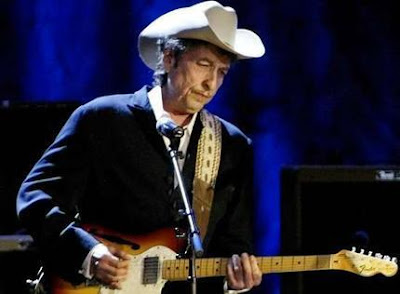
Instantly the night is dark. Orchestra music plays from hanging speakers. Time to cheer and squint into the black box that has become the stage. There is a man in white hat moving into center position. Time to cheer again. No way to keep up with the rapid intro, a biograph of Dylan that takes us from rock legend, through drug haze, then into Jesus and beyond. But as it (not absolutely) always was, he remains the Columbia recording artist. Cue lights and trilling notes of “Watching the River Flow.”

Dylan holds the fat neck of his guitar up like in the promo pics. Makes me think of the way you hold a shotgun and what Woodie Guthrie wrote on his own guitar. And if you read the reports after every ballpark show you can tell it begins to work pretty quickly. Also, in the context of today’s show, Dylan’s opening guitar work feels like a kind of tribute to Willie Nelson’s guitar style with alternating riffs and hard-scrubbed chords.

“Don’t Think Twice” was the song that pulled me into Dylan way back when I was skinny and lovesick. It’s a nice surprise to hear it as song number two. Magically the electric bass has been replaced with a full-sized acoustic. Down here among the ticketholders a woman with a sweet smile and twinkling eyes holds up two cups of foaming beer, pauses, looks around. Maybe she’s really lost? So many two’s all at once. Time for this party to double down.

With a shot from the drums that startles you into thinking explosion, the band hits the wailing chords of “Till I Fell in Love with You.” Dylan begins at the keyboards downstage right, facing three axemen stage left in black suits and hats. The fifth black-suited player sits upstage right behind a pedal slide. Dylan seems to be getting the feel of the stage, making eye contact with players. Then he turns to grab a well-placed harmonica and walks to center stage for a solo. On his pants, the outseam is covered by a broad yellow stripe that matches his yellow shirt. Could be a ritual Mayan dressing for a ceremony at high noon.

When the song feels done Dylan nods to the bass player and leader of the band -- a familiar face to old fans of Saturday Night Live. The bass player cues the drummer, and the boys bring the thing to a stop. In the song the singer was “Dixie Bound.” Now the song is over, and look who’s here.

It’s a soft-pitch melody up next, with the yellow-breasted poet’s jacket unbuttoned for “a whoppin’ good time.” Last night The Vocalist stressed the lyrics a little more at that “over the hill” allegation. Tonight the emphasis shifts to the keyboard and the tall, acoustic bass. Cellphones are up and streaming rows of tiny screens over ballcaps and beer. Jupiter is chasing the moon up over the harbor bridge leaving plenty of clearance for more chemical trucks to go barreling down westward toward Laguna Madre.

Whistles come flying into the stage from various points. Someone tosses off a light scream. Dylan and the boys reply with a rollickin Muddy Waters takeoff, “and I tumbled, I cried the whole night long.” The gulf breeze offers a gusty supercharge. A southbound airplane blinks high overhead. Drum and bass beat CPR into each and every heart.

For me, Dylan’s “Workingman’s Blues #2” is a reminder of Jody Payne who for years sang the Merle Haggard original during Willie Nelson concerts. The Dylan reply has a sing-song rhythm that the crowd enjoys, hands up, clapping. For his part, The Vocalist is tossing the notes back and forth from guttural to nasal, playing with the range of possibilities. A few popcorn clouds wave at the Sturgeon Moon. A couple giggles together as they hold up a Willie Doll that can’t help but sway to the happy feel of things. I hear Payne is in retirement today enjoying time with his son, Waylon. Still, we missed him this evening at 6:15 or thereabouts.

Before Dylan pitches “Tweedle Dee and Tweedle Dum” he steps back in the dark, gives his arms a good stretch, and grabs a drink. Another tanker truck comes wheeling down the harbor bridge, shining its stainless steel body back at the moon. At the keyboard, Dylan turns and kicks to one side and then to the other. But don’t let that song and dance act fool you too much, because the serious side of Dylan’s art is just now kickin’ in.

“Ballad of a Thin Man” is a song you can lay back and enjoy a little more if it doesn’t catch you live taking notes. People can’t help but grin at you. They even start walking a little closer to you in the moonlight just so you can be sure to see they’re on the side that’s grinning. “With great lawyers and scholars,” sings the man with the thin mustache, pouring a little pepper onto your paranoia. Indeed you miss plenty and most of the time. But you’re no quitter, are you -- dum, dum, dum, dum -- Mr. Jones? When the song is finally over, I give it a four-finger whistle. Sportsmanship.

At last night’s show in Round Rock, “Highway 61” was the apex of the arc as it is tonight, even without the amazing center-stage guitar work of Charlie Sexton or the amusing lyrical antics of the vocalist. There’s just a way the song comes together. Dylan enjoys jamming the song on the keyboard, and the guitars enjoy answering him. Then the guitars start answering each other. Before you know it there is a full blown conversation going on between the drummer and the bass player, too. Everybody has something to say. The lighting crew starts mixing in a few tricks and pretty soon the Bob Dylan Show is taking us all down for a ride.

In the darkness before “Nettie Moore,” Dylan steps back to take a sip. The song is such a sweet and sad thing. The violin sounds perfect for it, and Dylan seems to place special emphasis on the lines, “I loved you then, and ever shall.” Meanwhile, the audience has divided itself in half between those who have inched ever forward and those who have stepped back. In the gap between them a 12-foot ring of rubber mat.

“Thunder on the Mountain” is a wide-ranging plaint. You’ve got the man, the woman, and the world all on the verge of some critical swerve. The beat is ferocious as a freight train. The crew up on stage is stoking the engine hotter than an August night with all the seriousness and concentration they can sustain. It’s like one little cotter pin could spring out of joint and the whole 46-box-car operation would come crushing down upon us all. The front rail audience is completely transfixed. It’s like they are just holding on for dear life. Then the grand conductor gives a quick nod to the leader of the band and the whole damn weight of things is braked to a smooth but quick stop.

When the band goes off-stage I wonder if they’ll come back for an encore. There is a hearty group of folks who are into the show, and they are trying to put up a ruckus, but they’ve been beered and beaten by the heat for about five hours, so it’s not clear they have much left inside to wring out. By rock concert standards, their cries for more would be deniable. But after a polite interlude the band does come back. Dylan’s return gait is loose and lanky. He seems to gesture something merciful with his body before returning to work.

The encore begins with Dylan’s signature song, the one that branded a glorious generation of rolling stones. At the keyboard, Dylan reminds us of Al Kooper’s licks. On the line -- “How does it feel?” -- the stage lights cast a flashing fishnet pattern over the near crowd. On the black backdrop is a lighted image of the new Dylan logo, an eye of Horus crowned as feathered serpent. Mayan math connected to Egyptian is what I say. And the all seeing stagemaster himself seems to signal something significant as his hand flies up from the keyboard to touch cheek, back of neck, and then quickly back down.

The seven-note riff for “Jolene” sashays through the sky. “Baby I’m the King,” declares the triumphant showman, “and you’re the Queen.” Dylan twists sideways for one more flash of that yellow stripe. A final, faint, and seedy whiff of freedom passes through the crowd. “Okay, git,” says a short man to a short woman as they turn toward the parking lot. Wednesday night is coming to a close.

“Thank you, friends,” says Dylan before introducing the four boys in the band. “There must be some kind of way out of here,” is not exactly what we hear next, but we can tell that’s what the song is supposed to be. A moth catches the spotlight, zigs toward Dylan’s white hat, then zooms up offstage. As the band hammers out the notes of this last song, Dylan pulls a hand up, wipes some of that (officially) 82 percent humidity from the back of his neck, pulls the other hand up, wipes the other side. Toward the Green Corn Moon a wispy cloud approaches in sickle form, making a perfect harvest. Cut.

“None of them along the line know what any,” Dylan stops, catches the word “any,” repeats it, punctuates the delivery of the next three words - “of . . . it . . . is” -- and then grinds out a deep growl for all it is “wo-oo-rr-rr-th!” Music slams shut, lights go down. In the dark, Dylan assembles the band into two rows, then takes the front and center position. Lights up, Dylan raises his hands out above his elbows in a gesture that looks like a kind of blessing.

A dedicated pack of stage huggers want to go for one more encore, but it is no use. As the true few cheer and whistle (what good would it do to stomp?) the mostly many turn toward home. Before you know it, the band has disappeared, the crowd is up and out of Whataburger Field, and two dozen yellow-shirted event staffers swarm the brightly-lit outfield, picking up trash, breaking down settings, getting the ballpark ready for Friday night’s game against the Midland RockHounds.

“Bye Bye Bob,” says a mom sadly to no one in particular as she hauls an over-stuffed bag of supplies for her gaggle of grrrls that she leads to the steps.

“I love him!” rejoins one of the grrrls, barely teenaged, as security discreetly herds us out.

Past the blinking ATM machine and a pile of empty beer cartons we step off the field and up to the mezzanine where it’s nothing now but stragglers and cleanup crew.

“Last call for Willie Nelson t-shirts,” hollers a weary hawker. Next door over at the Dylan-Mellencamp booth the last sales of the evening are being resized. A pony-tailed blonde grandmother points to the next size in the Dylan ’63 t-shirt as a mom next to her negotiates with two daughters over which size purple Dylan T the girls are going to get.

Down the front steps, ticket takers stand their posts, retooled now into exit greeters. Three cops joke around in the street until the long black bus is ready to roll outbound with a smooth left turn.

The Rag Blog

[+/-] Read More...

03 August 2009

Bob Dylan : Texas Troubadour


More than iconic
Bob Dylan: Texas Troubadour


By Guy Schwartz / The Rag Blog / August 4, 2009

Bob Dylan was more than iconic Sunday night in The Woodlands outside Houston. He rocked and grooved!

It was a concert that I wasn't too interested in, so I stayed home and kept overdubbing my way thru Willie Nelson and John Mellencamp's set times. (Yeah -- I missed Willie. So, sue me!)

But -- Bob Dylan is an icon, one I hadn't seen since 2004 in Amsterdam (and the best thing about that show was watching one of our party, Carolyn Wonderland, go backstage to meet with Bob at intermission), so I saddled up the Blue Scion, and drifted out to the Woodlands after dark.

I'd heard that Bob had taken to saying he was from Texas (in some European interviews). It seemed like more amusing Bobness with the press, but last night I found out that his reasons for making that statement were deeper than they initially appeared!

The band's groove was deep! Musically, the history and home towns didn't matter. On this tour, The Bob Dylan Show featured a great Texas roadhouse band.

Bob's suit was black and his hat was white. The rest of the band wore all black with white sport coats.

And...

Every musician onstage played rhythm! The band's groove was deep, I tell ya!

No solos except for a few from Bob!

Rearranging old classics into mostly Texas shuffles on this tour, the band played those as if they had all grown up on the Texas Gulf Coast. It felt good! Watching those fellas in their matching jackets and hats, I felt like I was 14 in 1966 again, sneaking out of the house and taking the old Dodge Dart to some faraway East Texas dance hall to see some space-aged Ernest Tubb and Texas Troubadours.

Bob's still in Texas for a spell. He's at Round Rock tonight.

Take advantage of it if you can.

The Rag Blog

[+/-] Read More...

23 November 2008

Austin Works to Maintain its Status as Live Music Mecca

Paul Oveisi, who chairs the 15-member Live Music Task Force created by the Austin City Council, at Momo's, his live music venue on Austin's famed Sixth Street. Photo by Harry Cabluck / AP.

'Today, Austin is defined as much by its high-tech industry as its live music scene, and some say the once laid-back college town is in danger of losing its stage presence.'
By Jay Root / November 23, 2008

AUSTIN — Thriving nightclubs, popular festivals and favorite sons like Willie Nelson and Stevie Ray Vaughan have given Austin a well-deserved, if boastful, moniker: "Live Music Capital of the World."

But the world has gotten a lot bigger since the days of the Armadillo World Headquarters, when hippies and rednecks joined together in musical harmony and everybody got to park for free. Back then, to hear the old timers tell it, nobody worried much about health insurance or affordable housing, and noise complaints were considered welcome attention.

Today, Austin is defined as much by its high-tech industry as its live music scene, and some say the once laid-back college town is in danger of losing its stage presence. That's why city leaders are welcoming a plan to promote Austin's rhythmic heritage, ease the struggles of performing artists and make the town a true music incubator.

"We're kind of at this pinnacle moment, where we can either continue the status quo and watch a dilution of the music scene, or we can value it and recognize that it's part of the fabric of who we are as a city," says Paul Oveisi, an Austin club owner who helped compile a recent series of recommendations about promoting the live music scene.

The Austin music task force Oveisi heads up is now pushing the creation of a city music department, the development of more music venues, an aggressive marketing campaign and incentives designed to lure music industry components such as publishing houses, managers, record labels and digital distributors.

Music enthusiasts also want to crack down on what they say are a handful of fly-by-night outdoor venues that blast high-decibel noise into the night and produce most of the music-related, sound ordinance violations.

City leaders, who received the report from the panel last week, say there's good reason to protect Austin's status as a live music hub. Live music and related industries have an estimated $1 billion economic impact on Austin, whose cultural sector generates some $2.3 billion in yearly economic activity. There are an estimated 8,000 working musicians in Austin.

The pulsating music scene has helped give the state capital its enduring reputation as a youthfully hip, fun town. It was here, at the old Armadillo World Headquarters in the early 1970s, that Willie Nelson's brand of outlaw country was born. Years later, at the famed Antone's nightclub, blues guitarist Stevie Ray Vaughan roared into the city's musical conscience.

Since then, internationally acclaimed musical festivals like South By Southwest (SXSW) and Austin City Limits have lured thousands, and thriving venues from 6th Street to South Lamar — places like Antone's, The Broken Spoke, Momo's, the Continental Club, Stubbs, La Zona Rosa, The Hole in the Wall — continue to draw big acts and large crowds.

"Live music is a defining characteristic of Austin," said Austin Mayor Will Wynn. "Many people consider it to be the heart and soul of what makes Austin such a desirable city in which to live, work and play."

But members of the task force say the city's rapid expansion, rising health care costs, expensive real estate — even the difficulty of finding a parking spot in the car-choked city center — have made Austin an increasingly tough place to make a living as a performer.

"It's tough when your take home pay is a hundred bucks and 20 of it is going to pay for the valet guy who parked your car, or 15 of it is going to pay the parking ticket," said Brandon Aghamalian, one of the 15 task force panelists. Their report recommends that the city give parking vouchers to "certified musicians" in entertainment districts and create loading and unloading areas specifically reserved for them.

It also urges the city to pool public and private funds to help provide affordable housing and bolster health care services for performers, including the possible creation of a musician-only health clinic similar to the one in New Orleans.

Promoting the entertainment business at a time of national economic decline might be a tough sell, but task force members and city leaders alike say Austin's music scene is a vital job-creating engine that will pay long-term dividends. Plus, legendary guitarist Carlos Santana, who just opened a new restaurant and live music venue in Austin called Maria Maria, says the economic distress will soon seem like "a bad dream that you won't even remember."

Appearing at the grand opening of the restaurant earlier this month, Santana fondly recalled playing here with Vaughan and the Fabulous Thunderbirds and said he envisioned performing at his club next year. Santana said Austin's musical heritage won't fade because it flows naturally from the musical legends and fans who found their vibe amid the city's limestone cliffs.

"The thing about music is that if you think about it you missed it. You just have to just, like, trust your heart to feel it. And my favorite story about Austin is that," Santana said. "There is something really special about Austin."

Source / AP / Houston Chronicle

Also see New music fest ends in discord by Michael Corcoran / Austin American-Statesman / Nov. 18, 2008

Thanks to Harry Edwards / The Rag Blog

[+/-] Read More...

07 July 2008

Willie Nelson and Wynton Marsalis - Two Men With The Blues


Thanks to Harry Edwards / The Rag Blog / Posted July 7, 2008

[+/-] Read More...

Only a few posts now show on a page, due to Blogger pagination changes beyond our control.

Please click on 'Older Posts' to continue reading The Rag Blog.