Showing posts with label Ecuador. Show all posts

25 June 2013

James McEnteer : Escape to Ecuador

Edward Snowden and the flag of Ecuador. Image from Salon.com.
Rehanging the crepe paper:
Escape to Ecuador
Edward Snowden is the latest insider who pulled back the curtain to reveal the wizardry of American Freedom as the diabolical machinations of a surveillance state.
By James McEnteer / The Rag Blog / June 25, 2013

QUITO, Ecuador -- The colored crepe paper we hung up has tattered and fallen. The balloons we tied to the walls and ceiling have deflated or popped. Confetti remains in bags, unthrown. The welcome party we planned for the arrival of Julian Assange has had to be postponed indefinitely. Graffiti on the city walls prophesying his advent have begun to chip and fade away.

We know Assange is safe and still active in his Ecuadorian Embassy sanctuary in London. But we can’t help feeling disappointed that he never actually landed here among us. It’s not simply that we wanted the spotlight of his celebrity to shine a bit on the rest of us. There is so much here that we wanted to show him.

The bracing air of the Andes would revive his spirits. The sight of snow-covered volcanic peaks bespeaks a primordial reality which dwarfs the foolish vanity and paranoia of the people and the governments who want him silenced and punished. Julian Assange and Wikileaks have spotlighted the new political reality.

Our primary struggle now is not a conflict of countries or religions or ideologies against one another, but the wars of governments against their own peoples. The governments of China, Russia, and the United States have more in common with one another than they do with their own populations. Ours is a battle between state control and personal freedom.

The Turkish people know this. So do the Syrians and the Brazilians and the Egyptians. They have fewer illusions than Americans do because they can’t afford them. They have learned to trust their own eyes and ears rather than rely on the televised, predigested propaganda churned out by corporate U.S. media in service to the state.

Julian Assange and Ecuador's Foreign
Affairs Minister Ricardo Patiño Aroca
at Embassy in London.
Americans cling to their comforting delusions, that we are the greatest, freest country on earth, that the political landscape is painted blue and red, that liberals and conservatives are battling for dominance, and the extremes of tea-party libertarianism and radical leftist socialism should be reviled and feared.

All this is irrelevant and distracting, like the clash of Christianity versus Islam. Or the flood of professional sporting events and pornography that drowns our awareness with vivid images. Americans are bad at organizing, still suffering from the cult of rugged individualism. But when we do form trade unions or progressive political groups or student protests against wars or the depredations of Wall Street, the tentacles of government are quick to infiltrate, defame, and destroy.

Edward Snowden is the latest insider who pulled back the curtain to reveal the wizardry of American Freedom as the diabolical machinations of a surveillance state. Is he a hero or a traitor? Where you stand depends on where you sit. For all those growing fat off the surveillance state, the toady media, the corporate Congress, the social networks and other minions of the ruling oligarchy, Snowden is a trouble-maker, messing with the dominance of their masters.

For the rest of us, trying to survive and live our lives as well as we can, Snowden is a freedom fighter, exposing the intrusion of the state apparatus into our private affairs. That is why we have begun to rehang the crepe paper here, inflate new balloons and prepare once again for a welcome party fit for a man of principle and courage.

Snowden would add luster and gravitas to our community. We can only hope he really comes. Then we have to find a way to spring Bradley Manning. Manning’s only crime was believing he could appeal to the conscience of the American people over and above the violent authoritarian regime masquerading as a democracy.

It would be great to have Assange, Manning, and Snowden all here in Ecuador. They could all have faculty positions at the IIF (International Institute of Freedom). I think they’d have a lot of valuable lessons to teach. You know we’ll have a good time then.

[James McEnteer is the author of Shooting the Truth: the Rise of American Political Documentaries (Praeger). He lives in Quito, Ecuador. Read more of James McEnteer's articles on The Rag Blog.]

The Rag Blog

[+/-] Read More...

20 June 2012

James McEnteer : Julian Assange, Come on Over

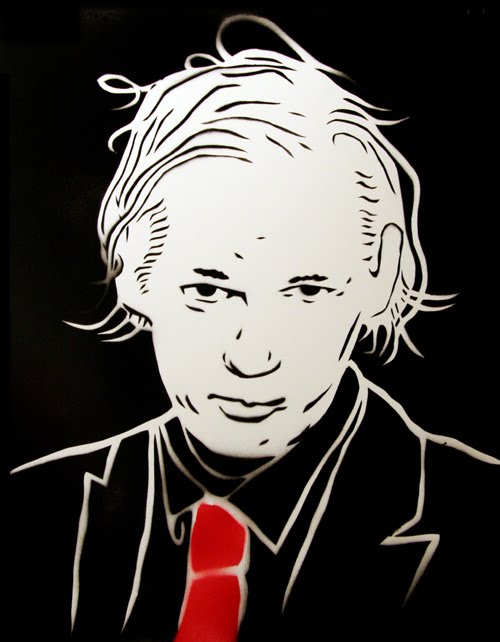
Stencil of Julian Assange from Bold Legume.

Insane Asylum?
From Center Stage to Middle Earth
Is Julian Assange crazy to want to go to Ecuador, of all the obscure places on this globe?
By James McEnteer / The Rag Blog / June 20, 2012

QUITO, Ecuador -- After the UK waived the right of Julian Assange to resist extradition to Sweden, Assange took refuge in the Ecuadorean Embassy in London. He is seeking political asylum in Ecuador to avoid prosecution in Sweden and possible deportation to the United States for exposing state secrets via Wikileaks.

Western media are second-guessing Assange’s choice. Is he crazy to want to go to Ecuador, of all the obscure places on this globe? UK and U.S. officials are already putting pressure on the government of Ecuador to hand Assange over for prosecution for violating the terms of his bail. That pressure will no doubt intensify.

Assange interviewed Ecuadorean President Rafael Correa last month on his syndicated talk program with world leaders. The two men appeared cordial. After Wikileaks exposed U.S. accusations of Ecuadorean police corruption and presidential malfeasance, Ecuador expelled U.S. Ambassador Heather Hodges from the country in 2011.

The United States and Ecuador have been on touchy terms since Correa’s presidency began in 2007. Correa refused to renew the U.S. air base in Manta, on Ecuador’s Pacific coast, choosing instead to open an oil refinery there in partnership with Venezuela’s Hugo Chavez. Correa said at the time that he would be glad to let the U.S. maintain its base in Ecuador if Ecuador were allowed to open a military base in Florida. Rafael Correa is not likely to be easily intimidated.

Critics of Assange’s decision to seek asylum in Ecuador cite Rafael Correa’s crackdown on oppositional media. From the start of Correa’s term in office, media have attacked him politically and personally. He has responded with law suits, prosecutions of individuals and confiscations of media outlets, accusing his critics of colluding with the largest banks against the interests of the majority.

Correa’s censure of local media has brought him international criticism from organizations such as the Committee to Protect Journalists and the Inter American Press Association. Under intense international pressure he pardoned several high-profile journalists who had been fined and sentenced to prison. To oppose a free press would seem a vile act. But opposing a Murdoch-like press, itself a vile species, is much less so. Quoth A.J. Liebling: “Freedom of the press belongs to those who own one,” aka the 1 percent.

Critics who believe Correa’s press crackdown should give Assange pause fail to realize that both men abhor media corruption, especially the complicity of mass media with governmental and financial interests and pressures.

Changes in the new Ecuadorean constitution, written since Correa took office, have empowered the environmental movement on several fronts, on land and at sea. Assange will find Ecuador one of the greenest governments on earth. And with his popularity at a continued unprecedented high, Correa is highly likely to maintain the country’s presidency in the upcoming 2013 elections. So there would be no likely radical change of policy in the foreseeable future.

Though it’s a small country, Ecuador is ethnically and environmentally diverse, with lovely tropical coast, high volcanic Andes, and Amazon rainforest. Indigenous peoples and Afro-Ecuadorians enrich the culture. Increasing numbers of U.S. retirees are choosing to move here. So while Ecuador may seem like a “last resort” for Julian Assange, he will actually have a number of resorts -- and climates -- from which to choose.

Mr. Assange will also find more than adequate high-speed Internet connections available, at least in the urban areas. It’s not exactly a hardship post. And at least some of us who have chosen to live in Ecuador would be proud to have Julian Assange as a neighbor. There’s a perfectly comfortable two-bedroom apartment downstairs from us that’s currently available.

Julian, come on over!

[James McEnteer is the author of Shooting the Truth: the Rise of American Political Documentaries (Praeger 2006). He lives in Quito, Ecuador. Read more of James McEnteer's articles on The Rag Blog.]

The Rag Blog

[+/-] Read More...

14 June 2012

James McEnteer : On the Lean Streets of Quito

Lean streets of Quito. Image from Lonely Planet.

Sell on wheels:
Pitching and rolling on 
the lean streets of Quito
A man dressed as a circus clown boards a bus selling packs of magic candy, two for a dollar.
By James McEnteer / The Rag Blog / June 13, 2012

QUITO, Ecuador -- In Quito you’re either on the bus or off the bus and many are on it. Ecuador’s long, narrow capital city lies between rows of volcanic Andean peaks. Though the urban area stretches nearly 50 kilometers from north to south, it’s possible to traverse most of that distance for 25 cents (12 cents for children and seniors), transferring from one city bus to another. Of course this cheap, reliable public transportation is very popular.

Quito bus riders are also captive audiences for all sorts of sales pitches. Hawkers may come on peddling medicines, for instance. They will make a brief introduction, apologizing for the intrusion, as they move swiftly down the aisle handing out samples of their wares to anyone who will accept them. They launch directly into the long list of benefits their miracle pill or powder can bestow, the many ailments it can cure or prevent.

Or someone might chant the praises of a cookbook full of many fabulous recipes. The salesperson may run through some or all of those recipes, a litany that sounds something like an auction, to entice customers to buy. This prodigious feat of memory may provoke hunger as the bus passengers listen to the long list of meat and fish dishes, or the many desserts one can learn to cook from the proffered volume.

More entertainingly, sales folk pitching CDs pass out their samples and then play excerpts on a small computer or a portable CD player they wear around their necks to keep their hands free to pass out their products or collect their payments.

Whether the products on offer are medicines, cookbooks or music, most passengers accept the chance to hold them in their hands while they listen to the pitch. Inevitably, no matter how much the salesperson claims their product is worth, they end up asking one dollar for it, just to keep things simple. The U.S. dollar is the largest common coin in circulation here.

A man dressed as a circus clown boards a bus selling packs of magic candy, two for a dollar. He says if you eat one, you’ll be able to speak English. Eat two, and you can speak French. Three, and you’ll be fluent in Quichua (a local indigenous language). But if you eat four you’ll turn mute.

As in any profession, some bus vendors excel at what they do, while others are hopeless, rattling on in a rote, unconvincing singsong. Or mumbling their inaudible spiel beneath the drone of the bus engine and the cacophony of city traffic. Some vendors are too shy for their chosen profession. They should probably stand passively with their wares on a street corner, as many do in this lemonade stand economy.

In some cases, a bus sales pitch has little to do with the product. One man who hawks packets of plastic garbage bags spends most of his time describing the community of orphans that stands to benefit from his sales. Of course, what can you say about a garbage bag? That it can hold all the stuff you could buy on a bus?

Blind and crippled vendors board the busses too, sometimes with children or other helpers, to throw themselves on the mercy of the passengers, urging them to buy candy or simply to give them donations. Handicapped vendors wear official government name tags which certify their afflictions as genuine. Considering the meager gleanings of the disabled bus vendors, it is a wonder that their helpers make enough to get by.

Two or three strapping young men may start rapping along with their recorded music and breaking out dance moves down the center aisle. I tend to donate to these guys, whether or not they’re any good, to encourage their show business aspirations, so they don’t have to fall back on crime, mugging pedestrians on the street if their bus performance gigs don’t pan out.

Performers especially, but all vendors, must time their bus sales to avoid the crush of standing riders during peak commuting hours. That makes for a short, intense work day, hopping on and off one bus after another, every 15 minutes or so after the early morning crowds ease off and before the late afternoon commute begins. Is there a training school for bus vendors? Maybe there should be.

Annoying, amusing, always on the go, Quito bus vendors offer random interactive diversion for passengers shuttling from here to there at bargain rates, whether or not you buy what they’re selling. They make online pop-up ads look slick and remote by comparison, and way two-dimensional.

[James McEnteer is the author of Shooting the Truth: the Rise of American Political Documentaries (Praeger). He lives in Quito, Ecuador. Read more of James McEnteer's articles on The Rag Blog.]

The Rag Blog

[+/-] Read More...

24 October 2008

Ecuador : Nature has Inherent Rights


'Breaking with tradition and establishing a bold legal precedent, Ecuador recently decided that nature should have rights of its own.'
By Anna Cederstav / October 23, 2008

Most environmentalists believe that nature has a right to exist for its own sake, but that's not how the law works in our country.

In the United States, nature is defensible only if a human will miss the forest, species, or clean water when it is gone. To use the law, a human must first prove harm to their person.

If that proverbial tree falls in the woods and no human cares, no laws were broken. But if a tree falls and the hiker who depended on its shade is harmed, the U.S. legal system may provide some relief.

Breaking with tradition and establishing a bold legal precedent, Ecuador recently decided that nature should have rights of its own. Just for the sake of protecting nature and the intricate web of life that depends on it.

Although constitutions in other countries have long provided stronger protections than those available in the United States, guaranteeing for example the right of all citizens to enjoy an environment that is healthy and in equilibrium, as in Costa Rica, the right of nature to simply exist and continue to evolve for its own sake has not yet been guaranteed.

However, the Rights of Nature section in the Ecuadorian constitution that recently became law does just that. In Ecuador today, an ecosystem:

* Has the "right to exist" and—perhaps more importantly—to "persist."

* Has the right to "maintain and regenerate its vital cycles, structure, and functions."

* Has the right to "its processes in evolution."
And most important, any person, people, or community can take legal action to defend those rights without showing personal harm.

Rights of Nature provisions may finally provide balance in legal systems around the world that tend to view nature as only an economic resource for humans.

We congratulate our colleagues in AIDA and ECOLEX who contributed to the efforts that led to this great precedent.

There are some worries that this new take on the inherent importance of defending nature may be too associated with President Rafael Correa, and that these new provisions are only as strong as the party currently holding power in Ecuador.

But if the country remains stable, the Ecuadorian Rights of Nature could be a model for what may someday become standard practice in constitutions around the world.

Each year, the Earthjustice International Program tracks changes in national environmental laws from around the world. See recent reports from EarthJustice.

Source / Earthjustice

Thanks to Richard Kendrick / The Rag Blog

[+/-] Read More...

Only a few posts now show on a page, due to Blogger pagination changes beyond our control.

Please click on 'Older Posts' to continue reading The Rag Blog.