
Jack A. Smith : Reversing the Vietnam War Verdict

Reversing the Vietnam War verdict
Most of the allegations about insults directed at soldiers or vets from war opponents have been fabrications to discredit the antiwar forces.By Jack A. Smith / The Rag Blog / June 7, 2012
The Pentagon has just launched a multi-year national public relations campaign to justify, glorify, and honor Washington's catastrophic, aggressive, and losing war against Vietnam -- America's most controversial and unpopular military conflict.
President Barack Obama opened the militarist event, which was overwhelmingly approved by Congress four years ago, during a speech at the Vietnam Wall on Memorial Day, May 28. The entire campaign, which will consist of tens of thousands of events over the next 13 years, is ostensibly intended to "finally honor" the U.S. troops who fought in Vietnam. The last troops were evacuated nearly 40 years ago.
In reality, the unprecedented project -- titled the Vietnam War Commemoration -- will utilize the "pro-veteran" extravaganza to accomplish two additional and more long lasting goals:
- The first is to legitimize and intensify a renewed warrior spirit within America as the Pentagon emerges from two counterproductive, ruinously expensive, and stalemated unjust wars in Iraq and Afghanistan, and prepares for further military adventures in Asia, the Middle East, and Africa. Within days of Obama's speech, for instance, Defense Secretary Leon E. Panetta announced a big increase of U.S. Navy forces in the Pacific, a move obviously targeting China. At the same time the Obama Administration's drone wars are accelerating as the Oval Office's kill list expands, and the president engages in cyber sabotage against Iran.
- The second is to dilute the memory of historic public opposition to the Vietnam war by putting forward the Pentagon's censored account of the conflict in public meetings, parades, and educational sessions set to take place across the nation through 2025. These flag-waving, hyper-patriotic occasions will feature veterans, active duty military members, government officials, local politicians, teachers, and business leaders who will combine forces to praise those who fought in Vietnam and those on the home front who supported the war. There won't be much -- if any -- attention focused on the majority of Americans who opposed this imperialist adventure, except as a footnote describing how tolerant U.S. democracy is toward dissent.

President Obama told the large, cheering crowd of veterans and their families at the Vietnam Wall exactly what they — and all those who still resented the era's large antiwar movement — wanted to hear:
One of the most painful chapters in our history was Vietnam -- most particularly, how we treated our troops who served there....There was virtually no criticism in the corporate mass media about the president's gross exaggerations concerning the "mistreatment" of Vietnam era veterans. True, there were no victory parades, but that was because the U.S. Armed Forces were defeated by a much smaller and enormously outgunned adversary -- the guerrilla forces of the South Vietnamese National Liberation Front (NLF) and regular forces from North Vietnam.
You were often blamed for a war you didn't start, when you should have been commended for serving your country with valor. (Applause.) You were sometimes blamed for misdeeds of a few, when the honorable service of the many should have been praised. You came home and sometimes were denigrated, when you should have been celebrated. It was a national shame, a disgrace that should have never happened. And that's why here today we resolve that it will not happen again. (Applause.)....
[Y]ou wrote one of the most extraordinary stories of bravery and integrity in the annals of military history. (Applause.).... [E]ven though some Americans turned their back on you -- you never turned your back on America... And let's remember all those Vietnam veterans who came back and served again -- in the wars in Iraq and Afghanistan. You did not stop serving. (Applause.)
So here today, it must be said -- you have earned your place among the greatest generations. At this time, I would ask all our Vietnam veterans, those of you who can stand, to please stand, all those already standing, raise your hands -- as we say those simple words which always greet our troops when they come home from here on out: Welcome home. (Applause.) Welcome home. Welcome home. Welcome home. Thank you. We appreciate you. Welcome home. (Applause.)....
May God bless you. May God bless your families. May God bless our men and women in uniform. And may God bless these United States of America.

By the time many vets returned home the American people had turned against the war and wanted it over, as did a significant portion of active duty troops, including the many who identified with the peace movement or who mutinied or deserted. Undoubtedly some veterans were disrespected -- but to a far lesser extent than Obama and pro-war forces have suggested over the years.
Whenever the U.S. conducts unpopular invasions, as in Vietnam, Afghanistan, and Iraq, Washington and the mass media invariably insist that it is the duty of patriotic citizens to "support the troops" even if they oppose the war. But to manifest the kind of support the government seeks inevitably implies support for the war. This is why the peace groups came up with the slogan "Support the Troops -- Bring 'em home NOW!"
According to the Pentagon, which is in charge of staging the Vietnam War Commemoration, the main purpose is
To thank and honor veterans of the Vietnam War... for their service and sacrifice on behalf of the United States and to thank and honor the families of these veterans. To highlight the service of the Armed Forces during the Vietnam War and the contributions of Federal agencies and governmental and non-governmental organizations that served with, or in support of, the Armed Forces. To pay tribute to the contributions made on the home front by the people of the United States during the Vietnam War..."Thousands of community, veteran, and various nongovernmental organizations throughout the U.S. are expected to join the Commemorative Partner Program
to assist federal, state and local authorities to assist a grateful nation in thanking and honoring our Vietnam Veterans and their families. Commemorative Partners are encouraged to participate... by planning and conducting events and activities that will recognize the Vietnam Veterans and their families’ service, valor, and sacrifice.In addition the government and its "partners" will be distributing educational materials about the war, according to the Pentagon, but it is unlikely that the Vietnamese side of the story or that of the multitude of war resisters in the U.S., civilian and military, will receive favorable attention. Many facts, including the origins of the war will undoubtedly be changed to conform to the commemoration's main goal of minimizing Washington's defeat and maximizing the heroism and loyalty of the troops.
Officially, the Vietnam war lasted 11 years (1962-1973), but U.S. involvement actually continued for 21 years (1954-1975). The U.S. financially supported the restoration of French colonial control of Vietnam and all of Indochina after the defeat of Japanese imperialism in 1945 (Japan earlier displaced French rule). By 1954, Washington not only supplied money and advisers but sent 352 Americans to Vietnam in a "Military Assistance Advisory group" supporting the French against liberation forces led by the Vietnamese Communist Party. The liberators defeated the French army at the historic battle of Dien Bien Phu that same year.
The Geneva Conference of 1954, facilitating impending French withdrawal, established that Vietnam would be divided temporarily into two halves until free elections were held in 1956 to determine whether the liberation forces, led by Ho Chi Minh, or Emperor Bao Dai, who had collaborated with both French and Japanese occupation forces and was a puppet of the U.S., would rule the unified state.

It is doubtful that the commemoration is going to emphasize the fact that the U.S., led by President Dwight D. Eisenhower, used its power to prevent nationwide elections from taking place when it became clear that Ho Chi Minh would win 80% of the vote. Eisenhower acknowledged this in his memoirs. Instead, Washington allied itself to right wing forces in the southern sector to declare "South Vietnam" to be a separate state for the first time in history and set about financing, training and controlling a large southern military force to prevent reunification. The U.S. dominated the Saigon government throughout the following war.
When Paris withdrew remaining French troops in April 1956, according to John Prados in Vietnam: The History of an Unwinnable War, 1945-1975 (2009), "their departure made America South Vietnam's big brother," i.e., overlord and military protector against popular liberation forces in the southern half of the country.
By June 1962, 9,700 U.S. "military advisers" plus a large number of CIA agents were training and fighting to support the corrupt U.S.-backed regime in Saigon (now Ho Chi Minh City), at which time President Kennedy's Defense Secretary, Robert McNamara, announced that "every quantitative measure shows that we're wining the war."
By 1968, when the number of U.S. troops attained their apogee of 535,040, Washington was obviously losing to its tenacious opponent. This is when Democratic President Lyndon B. Johnson decided not to seek reelection rather than face the humiliation of defeat. Republican President Richard M. Nixon succeeded to the presidency and vastly increased the bombings while also calling for negotiations to end the war.
Facing an impending defeat and political catastrophe, American troops pulled out in 1973. The CIA and some U.S. military personnel and political advisers remained in diminished South Vietnam assisting the right wing government in Saigon until April 1975 when the entire country was liberated.
The U.S. lost 58,151 troops in the war. Between four and five million Vietnamese civilians and soldiers were killed on both sides in a catastrophe that could have been entirely avoided had Washington allowed the free elections to take place. Over a million civilians in neighboring Laos and Cambodia also were killed or wounded by U.S. firepower.
Vietnam, north and south, was pulverized by U.S. bombs and shells. The Pentagon detonated 15,500,000 tons of ground and air munitions on the three countries of Indochina, 12,000,000 tons on South Vietnam alone in a failed effort to smash the National Liberation Front backed by the North Vietnamese army. By comparison, the U.S. detonated only 6,000,000 tons of ground and air munitions throughout World War II in Europe and the Far East. All told, by the end of the war, 26,000,000 bomb craters pockmarked Indochina, overwhelmingly from U.S. weapons and bombers.
The Pentagon also dumped 18,000,000 gallons of herbicides to defoliate several million acres of farmland and forests. Millions of Vietnamese suffered illness, birth defects, and deaths from these poisonous chemicals. The AP recently reported from Hanoi, Vietnam's capital, that "More than 100,000 Vietnamese have been killed or injured by land mines or other abandoned explosives since the Vietnam War ended nearly 40 years ago, and clearing all of the country will take decades more."
It should also be mentioned -- since it will be suppressed during the commemoration -- that U.S. forces, including the CIA and the Pentagon-controlled South Vietnamese military, tortured many thousands of "suspected" supporters of the liberation struggle, frequently with portable electrical current. An estimated 40,000 "Vietcong" (suspected members or supporters of the NLF) were murdered during the long-running "Operation Phoenix" assassination campaign conducted by the CIA, Special Forces, and killer units of the Saigon forces.

There were three main fronts in the Vietnam war, in this order: First, the battlefields of Indochina. Second, the massive antiwar movement within the United States and international support for Vietnam. Third, the Paris Peace Talks. Well over 60% of the American people opposed the war by the late 1960s-early '70s. The first peace protest took place in 1962; the first very large protest took place in Washington in 1965. Subsequently there were thousands of antiwar demonstrations large and small in cities, towns, and campuses all over America.
[Disclosure; This writer was a war opponent and a conscientious objector during this period. His information about the war derives from when he functioned as the news editor, managing editor and then chief editor of the largest independent leftist paper in the U.S. at the time, the weekly Guardian. This publication thoroughly covered the war, peace movement, antiwar veterans (Vietnam Veterans Against the War [VVAW] was founded in 1967 and is still active today), the extraordinary resistance of active duty troops in Vietnam and at U.S. bases and COs in prison or in Canada and Europe throughout the period of conflict.]
Most of the allegations about insults directed at soldiers or vets from war opponents have been fabrications to discredit the antiwar forces -- falsehoods Obama chose to repeat as part of the Pentagon's campaign to reverse history's negative verdict on the war in Vietnam. The peace movement's targets were the warmakers in Washington and their allies abroad, not members of a largely conscript army. Perhaps the most notorious of the false accusations were frequent reports about antiwar individuals "spitting" at GIs and vets. The rumors were so wild that sociologist Jerry Lembcke wrote a book exposing the lies -- The Spitting Image: Myth, Memory, and the Legacy of Vietnam, New York University Press, 1998.
It's extremely doubtful that the war commemoration will dare touch honestly upon the movement of active duty troops against the war and the hundreds of cases killing their own officers.
Historian Howard Zinn included this paragraph on the opposition to the Vietnam War by American soldiers in his People's History of the United States:
The capacity for independent judgment among ordinary Americans is probably best shown by the swift development of antiwar feeling among American GIs -- volunteers and draftees who came mostly from lower-income groups. There had been, earlier in American history, instances of soldiers' disaffection from the war: isolated mutinies in the Revolutionary War, refusal of reenlistment in the midst of hostilities in the Mexican war, desertion and conscientious objection in World War I and World War II. But Vietnam produced opposition by soldiers and veterans on a scale, and with a fervor, never seen before.According to the Washington Peace Center:
During the Vietnam War, the military ranks carried out mass resistance on bases and ships in Southeast Asia, the Pacific, U.S., and Europe. Military resistance was instrumental in ending the war by making the ranks politically unreliable. This history is well documented in Soldiers in Revolt by David Cortright and the recent film Sir! No Sir!One of the key reports on GI resistance was written by Col. Robert D. Heinl Jr. and published in the Armed Forces Journal of June 7, 1971. He began:
The morale, discipline and battle worthiness of the U.S. Armed Forces are, with a few salient exceptions, lower and worse than at anytime in this century and possibly in the history of the United States.According to the 2003 book by Christian Appy, Patriots: The Vietnam War Remembered from All Sides, Gen. Creighton Abrams -- the U.S. military commander in Vietnam -- made this comment in 1971 after an investigation: "Is this a god-damned army or a mental hospital? Officers are afraid to lead their men into battle, and the men won’t follow. Jesus Christ! What happened?"
By every conceivable indicator, our army that now remains in Vietnam is in a state approaching collapse, with individual units avoiding or having refused combat, murdering their officers and non-commissioned officers, drug-ridden, and dispirited where not near mutinous. Elsewhere than Vietnam, the situation is nearly as serious.
Intolerably clobbered and buffeted from without and within by social turbulence, pandemic drug addiction, race war, sedition, civilian scapegoatise, draftee recalcitrance and malevolence, barracks theft and common crime, unsupported in their travail by the general government, in Congress as well as the executive branch, distrusted, disliked, and often reviled by the public, the uniformed services today are places of agony for the loyal, silent professions who doggedly hang on and try to keep the ship afloat.
Another former Army colonel in Vietnam, Andrew J. Bacevich Sr. (now a professor of international relations at Boston University and a strong opponent of U.S. foreign/military policy) wrote a book about how the U.S. military labored for a dozen years after the defeat to revamp its war strategy and tactics. (The New American Militarism: How Americans Are Seduced by War, Oxford University Press, 2005.)
One major conclusion was that a conscript army may become unreliable if the war is considered unjust in nature and unpopular at home. This is why conscription was ended for good and the Pentagon now relies on better paid professional standing military supplemented by a large number of contractors and mercenaries, who perform many duties that were once handled by regular soldiers.
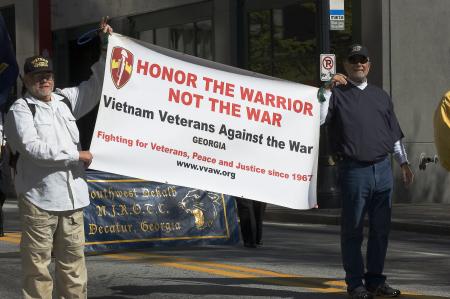
Veterans' movements from the professional military of contemporary wars, such as Iraq Veterans Against the War and March Forward, as well as from the Vietnam era, are still out in the streets opposing imperialist wars, and public opinion polls reveal that over 60% of the American people oppose the Afghan adventure.
Despite the colossal damage the U.S. inflicted on Vietnam and its people during the war years, the country has emerged from the ashes and is taking steps toward becoming a relatively prosperous society led by the Communist Party. The Hanoi government has received no help from Washington. During the Paris Peace Talks of 1973, Nixon promised Prime Minister Pham Van Dong in writing that the U.S. would pay Vietnam $3.5 billion in reparations. This promise turned out to be worthless.
What strikes visitors to Vietnam in recent years, including this writer, is that the country appears to have come to terms with what it calls the American War far better than America has come to terms with the Vietnam War. Despite the hardships inflicted upon Vietnam, the government and people appear to hold no grudges against the United States.
Hanoi has several times extended the welcome mat to former antagonists, urging Americans and residents of southern Vietnam who now live abroad to "close the past and look to the future." Wherever touring U.S. citizens -- including former GIs -- travel in Vietnam, they are met with the same respect as visitors from other countries.
In the U.S., the Vietnam war still evokes fighting words in some quarters. Some Americans still argue that the U.S. "could have won if it didn’t have one hand tied behind its back" (i.e., used nuclear weapons), and some continue to hate the antiwar protesters of yesteryear, just as they do demonstrators against today’s wars. And some others -- in Congress, the White House and the Pentagon -- still seem to continue fighting the war by organizing a massive propaganda effort to distort the history of Washington's aggression and unspeakable brutality in Vietnam.
[Jack A. Smith was editor of the Guardian -- for decades the nation's preeminent leftist newsweekly -- that closed shop in 1992. Smith now edits the Hudson Valley Activist Newsletter. Read more articles by Jack A. Smith on The Rag Blog.
The Rag Blog


