Showing posts with label Nicaragua. Show all posts

01 May 2013

RAG RADIO / Thorne Dreyer : Pedro Gatos and Val Liveoak on Nicaragua, Cuba, and the Global South

From left, Pedro Gatos, Rag Radio's Thorne Dreyer, and Val Liveoak, in the studios of KOOP-FM in Austin, Texas, Friday, April 26, 2013. Photo by Roger Baker / The Rag Blog.
Rag Radio podcast:
Pedro Gatos and Val Liveoak on changes
in Cuba, Nicaragua, and the Global South
We discuss the legacy of Hugo Chavez, the state of the Cuban revolution, the landmark genocide trials in Guatemala, and the growing challenge to U.S. hegemony in the hemisphere.
By Rag Radio / The Rag Blog / May 1, 2013

Peace activists Pedro Gatos and Val Liveoak joined Rag Radio host Thorne Dreyer in a discussion of recent developments in Cuba, Nicaragua, Guatemala, and the Global South on Friday, April 26, 2013. Rag Radio is a syndicated radio program produced at the studios of KOOP 91.7-FM in Austin, Texas.

Listen to or download our interview with Pedro Gatos and Val Liveoak here:


Among the topics Gatos and Liveoak discussed on the show were the legacy of Hugo Chavez in Nicaragua and the recent narrow victory of Nicolas Maduro; Cuba in transition and the state of the continuing revolution; the landmark genocide trials in Guatemala of former head of state Efraín Ríos Montt and former military intelligence chief José Mauricio Rodríguez Sanchez; and the region's growing challenge to U.S. hegemony.

Pedro Gatos (aka Pete Katz) is an activist, a specialist in Latin American politics and history, a radio show host, and a licensed chemical dependency counselor. He was employed in the Travis County Justice System in Austin, Texas, for 24 years.

He founded the Pedro Gatos Institute on Addiction, Health and Social Theory. He has facilitated workshops on subjects ranging from addiction and the War on Drugs to U.S. foreign policy and "The Bay of Pigs 50 Years Later."

Gatos has visited Cuba five times since 2000 and has had exclusive interviews with then National Assembly President Ricardo Alarcón and many others. Pedro hosts Bringing Light into Darkness Mondays at 6 p.m. on KOOP-FM in Austin.

Val Liveoak is the volunteer Coordinator of Friends Peace Teams’ Peacebuilding en las Américas program. An activist since 1971, she founded the Friends Peace Teams in 1993, and has been involved with many community organizations and nonviolent struggles.

For 21 years, she has been a facilitator with the Alternatives to Violence Project (AVP), working in Mexico, Canada, Burundi, Rwanda, Kenya, Guatemala, Nicaragua, Cuba, St. Croix, St. Kitts, Bolivia, Colombia, Honduras, and El Salvador.

Val lives in San Antonio, but spends most of the year in Suchitoto, El Salvador, and travels throughout the region. She has been named a “Woman of Peace” by Womens’ Peacepower Foundation (2009) and Peacemaker of the Year by the Austin Peace and Justice Center (1986).

Listen to our December 9, 2011, Rag Radio interview with Val Liveoak here.

Rag Radio has aired since September 2009 on KOOP 91.7-FM, an all-volunteer cooperatively-run community radio station in Austin, Texas. Hosted and produced by Rag Blog editor and long-time alternative journalist Thorne Dreyer, a pioneer of the Sixties underground press movement, Rag Radio is broadcast every Friday from 2-3 p.m. (CDT) on KOOP, and is rebroadcast on Sundays at 10 a.m. (EDT) on WFTE, 90.3-FM in Mt. Cobb, PA, and 105.7-FM in Scranton, PA.

The show is streamed live on the web by both stations and, after broadcast, all Rag Radio shows are posted as podcasts at the Internet Archive.

Rag Radio is produced in association with The Rag Blog, a progressive Internet newsmagazine, and the New Journalism Project, a Texas 501(c)(3) nonprofit corporation. Tracey Schulz is the show's engineer and co-producer.

Rag Radio can be contacted at ragradio@koop.org.

Coming up on Rag Radio:
THIS FRIDAY, May 3, 2013:
Free-form radio pioneer Bob Fass of Pacifica Radio's WBAI-FM in New York, with filmmaker Paul Lovelace (Radio Unnameable).
Friday, May 10, 2013: Journalism professor & activist Robert Jensen, author of Arguing for Our Lives: A User's Guide to Constructive Dialog.
Friday, May 17, 2013: Political economist Gar Alperovitz, author of What Then Must We Do?
May 24, 2013 (RESCHEDULED): Amsterdam-based poet John Sinclair, legendary founder of the White Panther Party and former manager of the MC5.

The Rag Blog

[+/-] Read More...

11 October 2012

Tom Hayden : Dark-Skinned Democracy Wins in Venezuela

Venezuelan President Hugo Chavez celebrates with a crowd of supporters after winning reelection. Photo by Juan Barreto / Getty Images.

Chavez' Bolivarian Revolution:
Dark-skinned democracy
wins in Venezuela
Modern liberals see something ominous in the Chavez mandate. They frequently opine that the dark-skinned poor are an uneducated, worshipful, populist mass of people subject to the Leader’s hypnotic speeches.
By Tom Hayden / The Rag Blog / October 11, 2012

Hugo Chavez was reelected president of Venezuela by a 56-44 percent margin on October 7, extending his 14-year revolutionary tenure for another six-year term. The margin was significantly closer than in previous campaigns, and set the stage for legislative elections this December.

Chavez was carried to victory by the dark-skinned voters who form the core of his revolutionary experiment, and against the continuing skepticism of mainstream liberal media like The New York Times and leaders of both U.S. political parties. At the beginning of his term, President Obama offered a friendly handshake to Chavez at a summit of the Americas, but hard-line administration officials, whom Obama both inherited and kept on their jobs, smothered that initial thaw.

In the established consensus view, Latin America was divided by a “good” left -- for example, Brazil and Chile -- and a “bad” left led by Chavez along with Cuba, Bolivia, Ecuador, Argentina, Nicaragua, occasionally Peru, and Honduras before the coup. The dividing line seemed not to be whether the countries in question held democratic elections, but whether they adjusted to the agenda of international financial institutions (IFIs). The division was awkwardly constructed on the model of the Cold War.

The official Obama Venezuela policy, articulated by his former security adviser, Daniel Restrepo, has been to de-escalate the tension and threats of open destabilization, while at the same time doing little to nothing publicly to improve the bilateral relationship.

Mitt Romney condemned Obama on Monday as being too soft on Venezuela.

Chavez’ opponent, Henrique Capriles Radonski, a 40-year-old former legislator and scion of a wealthy developer, managed to unite a fragmented Venezuelan opposition. The United States was invisibly neutral in the process.

Chavez is being treated for cancer in Cuba, not only because of the medical skills of Cuban doctors, but because the Cuban government has held tightly to any news of his condition, which would have been the subject of daily tabloid gossip if Chavez was being treated in Caracas.

Nevertheless, Chavez has been away for prolonged periods, indicating to many Venezuelans that his time in power might be short-lived and the future uncertain. Continuing problems of crime, violence, and institutional dysfunction formed the basis of Capriles’ challenge. But Chavez’s indisputable claims to have sharply reduced poverty and improved health care for the poor sustained his march to victory.

The core, though not all, of Chavez’ support came from the long-disenfranchised, dark-skinned sector of Venezuelans. According to most accounts, one-fifth of the population is white, while the rest are mestizo (mixed), African and indigenous, historically the most oppressed sectors of Venezuelan society.

Electoral turnout was 80 percent for the election, consistent with a pattern of high mobilization during Chavez’ tenure in office. Venezuela under Chavez has been the site of more presidential, legislative, and local elections and referenda than any country on earth. Reputable observers like former President Jimmy Carter have recognized its electoral process to be fair.

But The New York Times, the U.S. State Department, and some on the liberal-left spectrum remain hostile to the Venezuelan government no matter how many elections it wins. Their skepticism ranges from legitimate issues such as Chavez’ caudillo style of governing to a belief that Chavez is building a dictatorship through democratic elections.

For example, Obama’s adviser to the 2009 Summit of the Americas, Jeffrey Davidow, a former ambassador to Venezuela during the era preceding Chavez, warned in 2007 of a “creeping coup” through democratic elections. Chairing a regional meeting of the Trilateral Commission in Cancun, Davidow asked, “What do other countries do when a country votes itself out of democracy? It’s an interesting question. At least it’s interesting to me.” (Hayden, Tom. "Obama and His Dinosaur in Trinidad," April 21, 2009)

Corporate-oriented diplomats like Davidow may fear that Venezuelan democratic socialism is a creeping democratic threat to private American economic interests -- including oil -- in the future. Or they harbor an unconscious imperial bias going back to the Monroe Doctrine.

But modern liberals like the Times editors and reporters also see something ominous in the Chavez mandate. They frequently opine that the dark-skinned poor are an uneducated, worshipful, populist mass of people subject to the Leader’s hypnotic speeches. They complain that the Chavez base is subsidized by grants for eye care, preventive health care, housing, schooling, and, above all, government jobs. Thus, their argument suggests, Chavez has an unfair structural advantage, a lock on the electorate, due to his misiones (government programs).

For good measure, a front-page Times article asserted last week that the majority would vote for Chavez out of fear that he would somehow read their ballots and have them fired. (Neuman, William. New York Times, “Fears Persist Among Venezuelan Voters Ahead of Election,” October 5, 2012.)

On the surface, the argument would seem specious when 45 percent of the electorate votes, rallies, and protests loudly against Chavez year after year. They even voted against Chavez in 2007 when he sought to run for reelection indefinitely. Venezuela is a wildly argumentative society.

But there is an establishment fear that resembles that of Mitt Romney in his off-the-record condemnation of the “shiftless” 47 percent who will vote for Obama because they are blindly dependent on federal spending. In this view, such people are an unqualified populist mass of voters, whether they live in Harlem or Caracas.

Chavez runs “a well-oiled patronage system, a Tammany Hall-like operation,” according to the Times. What is ignored in this criticism is the historic discrimination and exclusion that made possible the rise of Tammany politics, and the fact that most people will excuse corruption if the corrupt machine delivers, which Chavez is so far able to do.

These are the same assumptions that underlie the modern neoliberal opposition to public (that is, government) spending, public works projects, public education, and public radio and television programming. The implicit “solution” is not to make these programs more transparent and accountable, but to privatize every sector of life possible. And that the voters of Venezuela will not do.

It is true that some Chavistas are so reflexively protective of the Bolivarian Revolution that they have difficulty criticizing the regime on any count. But any radical or revolutionary movement in power is bound to encounter intractable policy problems and harbor a tendency toward insulation and aggrandizement.

It appears that the Chavez era is beginning to wane, if only because of time and mortality. How to manage a gradual transition is a major challenge the Bolivarian civil society, party activists and intellectuals all face. The regional power balance will be at stake. Tragically, the United States and its mainstream policy intellectuals are unlikely to be constructive good neighbors.

[Tom Hayden is a former California state senator and leader of Sixties peace, justice, and environmental movements. He currently teaches at Pitzer College in Los Angeles. His latest book is The Long Sixties. Hayden is director of the Peace and Justice Resource center and editor of The Peace Exchange Bulletin. Read more of Tom Hayden's writing on The Rag Blog.]

The Rag Blog

[+/-] Read More...

11 December 2008

Politics in El Salvador : Echos of Nicaragua

Special to The Rag Blog

'The Salvadoran Right has capitalized on the chaos in Nicaragua to further their negative campaign to defame the left-wing Farabundo Martí National Liberation Front (FMLN) party.'
By Leah Wilson / The Rag Blog / December 11, 2008
See 'Open Letter to Nicaragua Solidarity Activists' by Chuck Kaufman, Below.
SAN SALVADOR, El Salvador -- The results of Nicaragua’s municipal elections on November 9, 2008, and the post-election violence and calls of fraud have saturated El Salvador’s newspapers throughout November.

The Salvadoran Right has capitalized on the chaos in Nicaragua to further their negative campaign to defame the left-wing Farabundo Martí National Liberation Front (FMLN) party and its presidential candidate Mauricio Funes and vice-presidential candidate Salvador Sánchez Cerén who have a 13 point lead over the governing right-wing Nationalist Republican Alliance (ARENA) party. As ARENA -- which has had an openly close relationship with the Bush administration and implemented neoliberal and repressive policies under the Bush camp’s guidance -- realizes the likelihood of El Salvador taking a left turn in the presidential elections in March 2009, they have stepped up the efforts of their campaign.

Fuerza Solidaria is doing much of the dirty work. It's an organization that was founded by right wing Venezuelan Alejandro Peña Esclusa with the sole purpose of stopping the leftward turn that many Latin American countries have decided to take. The primary message of their print, TV, and pamphlet campaign is the same US-interventionist rhetoric seen in every Salvadoran election: if the FMLN wins, your relatives living in the US will be deported and remittances sent home from the US (which amount to over $3 billion dollars a year and sustain the Salvadoran economy) will come to an end. So far, the US government has made no attempts to clarify the lies being propagated using their name, despite declarations of neutrality for the 2009 elections.

The violence, chaos and accusations of fraud that followed Nicaragua’s November elections, along with the United States’ freezing of Millennium Fund social project money for Nicaragua after the elections, has added a new dimension to the campaign against the FMLN. While Fuerza Solidaria has played a part in this new effort, it is primarily the right-wing owned media that have taken the lead. I am including an open letter from the US-based solidarity organization Nicaragua Network that contains more information on the Nicaraguan government and the actual events of November 9 and the aftermath — something you will not find in the mainstream media.

La Prensa Gráfica and the Diario de Hoy (unaffectionately known as the Diablo de Hoy by many Salvadorans) are two of the most widely circulated dailies in El Salvador. They are also owned by right-wing businessmen who consistently do the work of the ARENA party in their coverage of national and international events. Throughout the month of November, articles highlighting the violence in Nicaragua were combined with references to the FMLN’s historic ties to Nicaragua’s governing Sandinista Front for National Liberation (FSLN) party. Accusations of FMLN participation in the post-election violence were rampant, often substantiated by photos of one person wearing an FMLN T-shirt in a group of masked Sandinistas and testimonies of journalists who supposedly saw cars with Salvadoran license plates. The story of the freezing of Millennium Fund money, of which El Salvador is currently a recipient, was also front-page news.

So, currently in El Salvador I found myself thinking a lot about Nicaragua. I knew that the Salvadoran Right’s use of the chaos there was just part of their campaign tactics (which judging by the polls have proved mostly ineffective in swaying the opinions of the people of El Salvador); however, I wanted a better analysis of Nicaragua outside of the El Salvador lens. In my efforts to make sense of the Nicaragua elections and better understand the very complex political situation there, I read lots of materials; but the open letter pasted below from the Nicaragua Network not only gave me that clarity that cannot be found in the mainstream media, but it helped me better understand the nature of international solidarity in general and Central American solidarity specifically.
Open Letter to Nicaragua Solidarity Activists
By Chuck Kaufman / December 9, 2008

[Chuck Kaufman is national co-coordinator of the Nicaragua Network.]

The Nicaragua Network has received many notes and emails about our coverage of Nicaragua in recent months. Some think we’re too supportive of the government of President Daniel Ortega, while others think we are too critical. Still others have written to thank us for what they consider to be balanced information in a highly polarized situation. We welcome the dialogue and constructive criticism and are encouraged that so many people are still paying attention to Nicaragua and the US role in that small, poor country.

In my more than 21 years on the national staff of the Nicaragua Network, it has never been more difficult to determine the best way to present the information and analysis we provide to solidarity activists in the United States. In the 1980s we saw our mission to be to explain to the US solidarity community the actions of the Sandinista government in the context of the brutal US-manufactured contra war and economic sabotage. That resulted in the appearance of uncritical support of the Sandinistas on our part.

In the era of the neoliberal governments, news and analysis was easy. We opposed neoliberalism, US domination, and the efforts to wipe out the gains of the Sandinista revolution. Today our work is more difficult because there are both positive and negative aspects of the current government’s political project, and there are divisions within Sandinismo about how to move forward. Our staff and board have had many long phone and email conversations in an effort to sharpen and balance our analysis.

Many people came to their love of Nicaragua after the 1990 electoral defeat of the Sandinistas, and thus have no experience with the Sandinista revolutionary period. This is especially true in the Sister City movement which began in the 1980’s but it is the only sector of Nicaragua solidarity to add significant new members after the 1990 electoral defeat. I have the greatest respect for the sister city groups; they are the ones who have stuck with their partners in Nicaragua through thick and thin while many of those whose solidarity was motivated primarily by ideology have long since moved on to other progressive causes. I am not for a moment implying that people in sister city groups are apolitical; a conversation with our board, most of whom represent sister city groups, would dispel that error quickly.

Still, it is hard for anyone who joined the solidarity movement after 1990 to understand the historical importance of the FSLN to those of us who traveled to – and supported – Nicaragua in the 1970s and 1980s. After 1990, the neoliberal Nicaraguan governments worked hard to eradicate the memory of the Sandinista revolution and the Sandinista struggles to protect the Nicaraguan people from attacks by the US-sponsored contras. Our government and corporate media worked equally hard to eradicate those memories in the United States. However, many of us in the Nicaragua Network haven’t forgotten.

I think it would be useful, both for new and older solidarity activists, if we review the roots of the Nicaragua Network to better understand the context in which we develop our current information and analysis.

The Nicaragua Network was born 30 years ago this coming February 24 at a conference in Washington, DC. A number of major cities already had solidarity committees working to support the Sandinista armed liberation movement. They decided they needed national coordination to make their work more effective. So, the Nicaragua Network was formed first and foremost to provide solidarity support to the Sandinista Front for National Liberation (FSLN) and its struggle to overthrow, by force of arms, the brutal US-backed Somoza dictatorship.

The Sandinista triumph on July 19,1979 was met with joy not only in Nicaragua but here in the United States as well. The wedding of the Sandinista socialist program with liberation theology's "preferential option for the poor" created what Oxfam-Great Britain later called "the threat of a good example." The Empire was quick to strike back. I don't need to go into the whole history of the illegal and immoral contra war and the relentless efforts by the US government and the corporate media to vilify and delegitimize the Sandinista government, both before and after it became a duly elected representative democracy in 1984.

The campaign of misinformation, disinformation, and outright lies was enthusiastically waged by the US corporate media, led by the Washington Post and New York Times. I was surprised when someone referred us to an article in the New York Times to demonstrate the Nicaragua Network's bias. When have we ever been able to believe a word about Nicaragua that was printed in the New York Times? When reporters like Raymond Bonner tried to report factually and impartially from Central America, they were demoted or fired. Bonner eventually received an apology, but the New York Times bias never changed.

So yes, there is no question that the Nicaragua Network has its own bias. Our bias is in favor of democratic socialism (not to be confused with social democracy) and a preferential option for the poor. We don't hide it, and we make no apologies. While the government of President Daniel Ortega may fall short in the area of democratic socialism, it is our judgment that it is demonstrating a proven preferential option for the poor. We view the mission of the Nicaragua Network to be to stop the US government from once again denying Nicaraguans the opportunity to achieve greater economic and social justice. The most fundamental mission of the Nicaragua Network is to stop our government from intervening in Nicaragua’s internal affairs.

As evidence of the Ortega government’s preferential option for the poor, I would cite as an example that it will have eliminated illiteracy by July 2009 and the majority of municipalities have already been declared free of illiteracy. That is due, in part, to the fact that the first action of the new government was to eliminate school fees. This bold action enabled more than 100,000 additional children to attend school. During the neoliberal years, many parents weren’t able to send their kids to school because of school fee policies dictated by the IMF and World Bank. For adult literacy the Sandinista government has implemented the Cuban literacy program “Yes, I Can!” and even extended it to the Miskito and Mayagna (Sumo) indigenous languages.

That is just one example. The free health clinics are once again staffed and stocked with medicine so that patients receive medicine, rather than prescriptions they couldn’t afford to fill under the right-wing governments of 1990-2007. Cooperation with Cuba and Venezuela has given several thousand people back their sight after cataract surgery, and free operations in the hospitals have saved uncounted lives. The Sandinista government has also resurrected the small and medium farming sector, the historic backbone of Nicaragua’s economy, which wasn’t even in the National Development Plan Ortega inherited from his predecessor Enrique Bolaños.

The Zero Hunger program has provided 32,709 poor families with animals, seeds, fertilizer, etc. so they could become food self-sufficient and sell their surplus. Zero Usury has provided low interest loans to small farmers and merchants so they can earn a livelihood and feed their families. Houses for the People is putting roofs over the heads of families that previously lived in shacks built of anything they could find. Project Love is working to eliminate the tragedy of child labor. The subsidized food distribution centers are all that stand between some families and malnutrition. The Sandinista government is taking steps to feed, clothe and house its people despite skyrocketing food costs and the greatest crisis in capitalism in 80 years. I think these programs mean something; and what they mean for the lives of real people is more important than the howls and outrage among the political class in Nicaragua and abroad.

Do we think the Ortega government is perfect? No, and even a casual reading of the information and analysis we have produced over the nearly two years of his presidency will demonstrate that fact. We continue to criticize Sandinista support for criminalizing therapeutic abortion. We have criticized violent excesses of Sandinista supporters during the recent electoral process. And we have cautioned that the effort to monitor foreign funding of nongovernmental organizations not be used as an excuse to persecute women’s rights groups.

But, do we think the Ortega government is better than another right-wing, neoliberal government beholden to US masters? Absolutely. Just imagine how much worse the people of Nicaragua would be suffering in the current economic crisis if US-favored Eduardo Montealegre had become president in January 2007 instead of Daniel Ortega. How much worse off in the current economic crisis would poor Nicaraguans be in the absence of the anti-poverty programs of the current Sandinista government? The answer should be self evident.

I personally find it hard to get excited about the claims by the right-wing of fraud in the recent municipal elections. I think the claims are much greater than the reality. Of course, the US advisers and funders of the right-wing parties know all about stealing elections. Maybe they assume that all elections are as crooked as the ones in Florida and Ohio. My analysis is that the FSLN received more votes than the opposition. The biggest stink was made about the mayoral election in Managua, but an independent poll right before the election showed FSLN candidate Alexis Arguello with a 5 point lead, and that’s what he won by. Frankly, I think the supporters of Ivy League trained oligarch Eduardo Montealegre just can’t believe that a barrio born former boxer beat him. I’m delighted, and I can’t imagine why any U.S. solidarity activist would want to see Montealegre, the corrupt banking buddy of the Bush regime, as mayor of Nicaragua’s capital city.

The FSLN played by the European-US "liberal democracy" rules in 1984, 1990, 1996, 2001, and 2006. In 1984 the US forced the major opposition candidate out of the race, when it was obvious he would lose, so they could claim the election was not legitimate. In 1990, the US spent more per voter on the Nicaraguan election than Democrats and Republicans combined spent per voter on the 1988 US presidential election.

In 1996 the election was blatantly stolen by the Constitutional Liberal Party with US technological assistance as well as funding. Jimmy Carter and Oscar Arias told Ortega he had to accept the fraudulent results to prevent a civil war. He did, just as he accepted the 1990 returns resulting in the first peaceful turnover of power from one political party to another in Nicaragua’s history. The result of the 1990 election doomed Nicaraguans to 17 years of hunger, poverty, and the loss of nearly everything they had gained from ousting the Somoza dictatorship.

Is it any wonder if some in the FSLN might have been determined not to suffer losses in this year's municipal election, or that certain international election observers, who had certified previous fraudulent elections as “free and fair,” were not invited to observe this one? (There were other certified international observers, however, and the political parties had poll watchers just like in US elections.) I find it hard to fault the logic even if I don't approve of all the methods. And if the fraud was as blatant as the charges claim, why won’t the Constitutional Liberal Party present its “evidence” to the Supreme Electoral Commission where they hold an equal number of seats as the Sandinistas? Sure, some of the media events were impressive and disturbing, but that’s not the same as following the constitutionally mandated mechanisms for proving fraud.

The FSLN won the majority of municipalities in the previous election and, by all account; most of the Sandinista mayors did a good job. With the additional boost of the Ortega government's anti-poverty programs over the last two years, I don't find it surprising at all that they made further gains this year. The surprise would be if they hadn't.

One of the tried and true tactics of the so-called democracy building programs of the National Endowment for Democracy (NED) and US Agency for International Development (USAID) is to manipulate polls, quick counts, and the corporate media to cast doubts on the legitimacy of elections. Look at the Ukraine election of 2003, where they succeeded, and the Venezuelan recount vote of 2004, where they failed, to see similarities to the reactions to the Nicaraguan municipal elections of 2008.

What does surprise me is that some people in the US continue to fail to recognize the treachery of our government and credulously read and listen to the US corporate media. How many times must it be proven that the US government and corporate media lack any commitment to democracy when the outcome doesn't conform with their perceived "interests” before some people learn to read the propaganda?

So the Nicaragua Network will continue to expose and oppose US intervention in Nicaragua and elsewhere. We will continue to support governments that show a preferential option for the poor. And we'll continue to oppose right-wing neoliberalism wherever it rears its ugly head. We'll continue to fight disinformation by putting out true information about the Sandinista government's anti-poverty programs, and we'll continue to criticize its excesses of authoritarianism.

We won't get the balance right in each and every case, but I firmly believe that if you examine the body of our work from the perspective of our historical mission, on the whole we are right where we should be. We welcome constructive criticism when solidarity activists believe we are off the mark and we always welcome dialogue.
The Rag Blog

[+/-] Read More...

14 October 2008

Report from Nicaragua : Repression in the Revolution

Nicaraguan president Daniel Ortega when he was a leader of the Sandinistas

‘I met Martin Vega just after the Nicaraguan revolution when we all saw such promise there.’
By Mercedes Lynn de Uriarte / The Rag Blog / October 14, 2008
Below is a dispatch from Martin Vega about conditions in revolutionary Nicaragua followed by remarks by Rag Blog contributor Ron Ridenour.
I am lucky that Martin Vega has been a close friend for almost 30 years. He is a University of Texas alum with a MA in Business. I usually stay with him and his family when I visit New York. I have always admired his personal and political ethical life.

I met him just after the Nicaraguan revolution when we all saw such promise there. When I met him he was working to help Nicaragua realize that promise. He was in the Foreign Ministry, having gone there from his home in San Francisco to help in the Revolution. He was eventually a key staff member with the Nicaraguan Ambassador to the United States.

He recently spent several months there with a funder trying to bring some assistance to the nation. His news below is so disheartening that I pass this along with a hope you can help with his request to let others, especially press people and human rights advocates, know about these abuses.
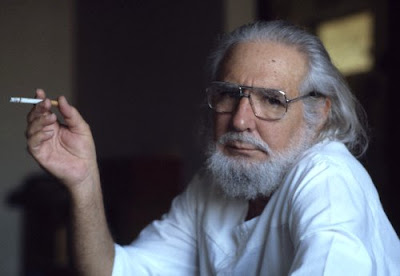
Nicaraguan poet Ernesto Cardenal: Government has frozen his bank account and threatened to jail him.

Repressive tactics in revolutionary Nicaragua
By Martin Vega / The Rag Blog / October 14, 2008

I never thought I would see the day when the forces of the current Nicaraguan government would be used in such a coercive and repressive style as I have observed today. [As has been reported in El Nuevo Diaro and El Prensa], the judicial, fiscal bodies as well as the police forces of the state have been unleashed and are being instrumentalized for political ends to attack and denigrate members of civil society, the opposition press and political parties, the intelligentsia and cultural artists, etc. In the past few months the government has ostensibly closed most avenues of free expression while resorting to increased levels of intimidation and violence against those it deems its "enemies".

Until today I had refrained from making any type of comment on the worsening situation in the country hoping that officials within the Nicaraguan government would reflect and seek some form of accommodation and dialogue with its growing opposition. But quite the contrary, the government has seen fit to falsely accuse persons of Carlos Fernando's stature of "laundering" money; it has denigrated Nicaragua's revered poet Ernesto Cardenal threatening to jail him and frozen his bank accounts; it has falsely accused one of Nicaragua's most competent journalists, Sofia Montenegro of being a "CIA dupe" given her critical position towards the government's corruption; it has declared Nicaragua's main feminist organization, MAM to be "illegal" merely because it has advocated for women's reproductive rights and taken a critical stand against the government's prohibition on abortion rights; it has eliminated Nicaragua's two main opposition parties via legal fiat and through the control of the Electoral Council; and just two weeks ago, it unleashed virulent attacks against a civic and political rally of the opposition, resorting to the use of mortars, machetes, clubs and the burning down cars.

Because of these and other untoward developments, I feel that I have a moral duty not to remain quiet but let all of you know of my serious concerns about the Nicaraguan situation and ask that you move your consciences in any way possible towards the alleviation of this aggression against the Nicaraguan people. I ask that if any of you have any contacts in human rights organization, press associations, etc. that you please make known your outrage at this type of behavior and request that the Nicaraguan government cease committing arbitrary acts such as those outlined above. I would also be important for you to express your solidarity towards Carlos Fernando Chamorro B. who is being threatened with jail for merely expressing his views as as a renown and widely-respected journalist and intellectual.
Daniel Ortega and his wife Rosario Murillo (in Gucci?) wave to the press Nov. 6, 2006, in Managua. Photo by AFP / Getty Images.

'The problem is: Nicaragua is so divided into so many factions and not one of them is trustworthy.'
By Rod Ridenour / The Rag Blog / October 14, 2008

[Prominent writer Ron Ridenour, who wrote a series of articles on Venezuela for The Rag Blog, has expertise in Latin American politics. He provides these remarks as historical perspective.]

I was unaware of these events but they don't surprise me too much. I know [Nicaraguan President] Daniel Ortega and his aristocratic wife, for whom I worked as PR director when she was head of the ASTC, cultural workers association, in 1984. I wrote the book, "Yankee Sandinistas" (Curbstone, 1986), about which Ernesto Cardenal, then cultural minister, wrote a lovely blurb. I knew Tomas Borge and thought he should have been president. The Ortegas have always been suspects in that they lie, love the wine and dining life, the fancy houses, etc.

Ortega lost the 1990 election, in part, because he offered a hand out to the rich one day and then another hand to the workers another day. He hired a New York political spin doctor firm to run his campaign and bought Gucci clothes and expensive sunglasses in NY while the Yankees were murdering his people. To re-win at all costs the high post of president, Ortega has stooped lower than any politician, at least on the left, that I know of. He hired a vice-president who had been a torturing-murdering contra; he kissed the ass of the worst cardinal in current times; he rejected the right of women to decide over their bodies.

The problem is: Nicaragua is so divided into so many factions and not one of them is trustworthy, as I see it from far far away now. The original FSLN, which had three main factions somewhat united for a good many years, broke into opposing groups and none of them -- including the best of guerrilla leaders – ended up being revolutionary, rather they went towards the right. Ortega's FSLN, what is left, was the "best" of evils. But I knew from the day he won that something rotten would occur in his regime.

The next problem is that Ortega is supported by Fidel and Chavez. He uses the rhetoric they use when he is with them and in context of ALBA etc.

And, all the three dailies are (were) run by the Chamorro family, which split into three factions. And when one of them, El Nuevo Diario (for which I did some writing), calls what is happening now "worse than Somocismo" so are we really down in the pits of bullshit and exaggeration. As I read the situation today no one has been tortured, jailed or murdered, and that was daily occurrence in Somoza's time.

Of all the many original leaders very few remain by Ortega's sleazy side, but Tomas Borge is his ambassador to Peru, I think. At least he was. He was one of the few I trusted. Martin Vega I do not know. He lives in New York. We need some voice(s) we can trust who is (are) in the struggle within Nicaragua to give validity to what is going on.

That will take some time. If I were you, I'd wait a bit and find some backup, find some balance. This is quite delicate but I am not recommending throttling the matter. This is the kind of situation where [activist, writer and Latin American expert] James Petras would have a strong argument.
The Rag Blog decided to publish Martin Vega’s dispatch, along with Rag Blog contributor Ron Ridenour’s comments, but we will also seek other input on the situation in Nicaragua. We do not believe in uncritical support, even for a revolutionary movement. We encourage the readers to add their comments to this post.
The Rag Blog

[+/-] Read More...

Only a few posts now show on a page, due to Blogger pagination changes beyond our control.

Please click on 'Older Posts' to continue reading The Rag Blog.