Showing posts with label Drought. Show all posts

09 February 2012

Richard Raznikov : As Benign as Lucifer

Locked water tap in Kipsaraman, Kenya. Image from oxfam.org.uk.

As benign as Lucifer:
The privatization of water
By Richard Raznikov / The Rag Blog / February 9, 2012
Beginning about 20 years ago, it dawned on the bankers and some major corporations that if oil was a lucrative commodity water would be even more so... The trick was how to take it away from the people and sell it back to them.
SAN RAFAEL, California -- There hasn’t been much rain this season where I live. Personally, I don’t mind much. I like sunny days, summer weather, dry fairways at San Geronimo. The deer are not very happy, having to spend more time on my street than they’d prefer but they’ve had to come down from the hills a bit looking for food.

Where I live the reservoirs are still mostly full from the last winter’s rain and we will not experience any delays or service interruptions. I pay for water every month, the local water district sends a bill, costs maybe 30 bucks if everybody showers a lot and there are loads of clothes.

Drinking water, all I have to do is open the tap.

I take water for granted, did even during drought years when we recycled water for the garden and to flush toilets. Shower with a friend, the saying went, and we did, although that didn’t really seem to save much water.

Every year about 2 million people, most of them children, die from lack of water, either directly or indirectly through lack of sanitation; that’s twice as many people as the United States killed in Iraq. Estimates of international agencies put the number at 1.1 billion who do not have access to enough water to drink, cook with, or properly bathe.

Water in Marin County is a public utility. There’s a water board elected by the voters and various projects from time to time. For most of my life I was not even aware that water might be a problem for some people, blissfully wrapped in the Bay Area cocoon. What I’d heard seemed to be passing news bulletins. Droughts somewhere, I wasn’t sure. Relief efforts.

I’ve also been ignorant about nearly everything else in the world. I don’t think I really got how deeply evil some corporations were. I didn’t understand how money worked, nor what the World Bank was about, nor the International Monetary Fund. They sounded benign. They are about as benign as Lucifer.

I certainly didn’t understand how the World Bank and some huge corporations were, in concert, working to kill millions of people by depriving them of access to water. I do now.

Of course, their public relations departments would go berzerko at such a charge. For my opinion on public relations departments, see Bill Hicks on YouTube.

We’re helping all of those people, the World Bank would say. We’re sponsoring important developments and laying pipe all over the place. Without us, hell, that water would just lay there underground not doing anybody any good. That’s not only what they would say, it’s what they do say.

If you were naive, like I was, you might think that water, being the one single necessity of life without which you’re flat-out dead, and being a substance which comprises 70% of the surface of the planet, and which falls from the sky and runs in rivers above and below ground, you might think that water is a common property, owned by the human race. That’s pretty much been true for a couple of thousand years.

It has long been accepted throughout the world that, according to Indian author Vandana Shiva, “water must be free for sustenance needs. Since nature gives water to us free of cost, buying and selling it for profit violates our inherent right to nature’s gift and denies the poor of their human rights,” and “water is a commons... it cannot be owned as private property and sold as a commodity.” Water is the basis of all life. It is preposterous that it might be owned and that some may be thereby deprived of it.

Thanks, however, to the World Bank, which is actually just the operative arm of the largest U.S. banks and whose policies can bring down governments -- c.f. Italy and Greece in the past few months alone -- the commons argument is quickly dying. Most Americans, being inhabitants of a nation which does not generally have these worries, are unaware of this.

Beginning about 20 years ago, it dawned on the bankers and some major corporations that if oil was a lucrative commodity water would be even more so. Everyone had to have water, even if they rode bicycles to work or took public transit. The trick was how to take it away from the people and sell it back to them.

But with the help of the World Bank and friendly governments such as the U.S. under Bill Clinton, stipulations could be included in trade agreements and in loan conditions to developing countries.

Programs grew quickly in India, Bolivia, Chile, Argentina, Nigeria, Mexico, Malaysia, Australia, and the Philippines. They’ve now spread to Canada, England, Turkey, Colombia, Guatemala, Morocco, New Zealand, South Africa, El Salvador, and even China.

The impact has been to dramatically, and fatally, increase the cost of water, especially to the poor and for small agriculture, while simultaneously degrading its quality. Corporations such as Coca-Cola, Bechtel, Nestle, Pepsi-Cola, and the French company, Suez Lyonnaise des Eaux, have bought off local governments, imposed horrendous conditions, and in some cases murdered people who have tried to stop them.

Maybe you’re thinking, Coca-Cola? How can that be? Things go better with Coke! But no, they actually don’t. And Bechtel? Why, that’s a Bay Area company, voted near the top of employers people like working for. I mean, it’s not as though we’re talking about Halliburton here.

Everywhere water privatization has gone there are stories of widespread misery. Quite literally, every country listed above is a horror story, with the exception of Argentina because the government there, and the people, kicked Suez’ sorry ass out (along with the World Bank). But we’ll focus on just two or three. Whatever I don’t get to in this column -- I’ve got more than 50 pages of notes and printouts -- you can find by typing in the name of a country, water, and the World Bank. That ought to do it.

The first water privatization story I ever heard was out of Bolivia. It seemed that Bechtel, somehow, had gotten hold of the country’s water supply. I didn’t understand how that was possible, plus I’d never associated Bechtel, which is mostly a construction outfit once run by Reagan’s pal (and Secretary of State) George Schultz, with water. What could that possibly be about? As it happens, Bechtel is involved in over 200 water and wastewater projects in more than 100 countries around the world.

If you were naive, like I was, you might think that water, being the one single necessity of life without which you’re flat-out dead, and being a substance which comprises 70% of the surface of the planet... is a common property, owned by the human race.

Cochabamba, Bolivia, is a semi-desert region.
Water is a scarce precious resource. In 1999, the World Bank told Bolivia that in order to obtain a much-needed $600 million in international debt relief, it would have to privatize Cochabamba’s public water system, giving the concession to a Bechtel subsidiary, International Water.

The Bolivian Congress caved in, passing the ‘Drinking Water and Sanitation Law’ in October of 1999, ending government subsidies to municipal utilities and authorizing privatization. International Water took over in Cochabamba. The minimum wage is less than $100 a month, but IW raised the price of water to an average of $20 per household. The impact was immediate: many poor families had to choose between food and water.

The people rebelled. In January 2000, peasants formed the Coalition in Defense of Water and Life and through mass mobilization shut down the city for four days. Within a month a million Bolivians marched to Cochabamba and stopped all transportation in the city.

The Bolivian government pretended to give in, promising to roll back water prices; it never did. In February, the Coalition organized a peaceful march demanding that the October 1999, law be repealed, the water contract terminated, the inclusion of ordinary people in drafting a resources law, and the cancellation of ordinances permitting privatization. The government responded by imposing martial law.

The media was censored, activists were arrested, and several protesters, including a 17-year-old boy shot in the head by soldiers, were killed.

But the people would not bend. Finally, after demonstrations which rocked the country, the government was forced to revoke the privatization legislation. The water company (and its debts) was surrendered to the people, and the Coalition held public hearings to start democratic management and planning.

Bechtel, and its allies inside the government, refused to quit. They harassed and threatened activists and leaders of the Coalition. In November 2001, Bechtel filed a lawsuit before the International Center for the Settlement of Investment Disputes, which happens to be located on the grounds of the World Bank in Washington, D.C. The ICSID holds its sessions in private. The public and the media are barred from the proceedings.


I’ve written before about how the world’s largest banks control nations by forcing them into positions of debt from which they can’t escape. It’s a simple but elegant mechanism. Simply loan money to a government which desires to -- choose one or more of the following –– steal it, give it to their friends, buy weapons, build infrastructure, and then enjoy the leverage you’ve got when they can’t quite service the debt.

It’s how France was able to crush Haiti forever on the imposition of a debt for Haitian independence. It’s how nearly all Latin American countries have been controlled for decades, making deals to stave off bankruptcy by borrowing ever greater sums and, for the dubious privilege, sacrificing the public welfare and in many cases democracy.

It’s how the World Bank and the IMF were able to impose on Italy and Greece so-called "austerity measures" which screw the poor, privatize public resources, and install as President in each country a recent big shot from Goldman Sachs by way of the IMF.

That’s why the Kirchners sent such shock waves through the world’s banking giants when they got themselves elected in Argentina and promptly told the World Bank to go fuck itself.

But for the most part, in most places on earth, regardless of the people living there, the unholy alliance between multinational corporations, the World Bank, and governments with flexible ethics has produced vast profits for the principals and increasing misery for the people.


Cartoon by Ludus / toonpool.


India is another classic example, although there it is Coca-Cola, which has essentially appropriated the water needed for agriculture, which is despoiling large portions of the country.

Although its public relations whores have recently described the corporation as “a leader when it comes to environmental issues,” the facts are quite different. One classic example would be in the Plachimada community in the state of Kerala. Coke opened a bottling plant there in 2000; the community immediately suffered from chronic drought and polluted water. The reasons are hardly in dispute. As Indian journalist Arjun Sen wrote in 2003,
Three years ago, the little patch of land in the green, picturesque rolling hills of Palakkad yielded 50 sacks of rice and 1,500 coconuts a year. It provided work for dozens of labourers. Then Coke arrived and built a 4-acre bottling plant nearby. In his last harvest, Shahul Hameed, owner of the small holding, could manage only five sacks of rice and just 200 coconuts. His irrigation wells have run dry because Coke draws up to 1.5 million litres of water daily through its deep wells...

To make matters worse, the bottling plant was producing thousands of gallons of toxic sludge and, as the BBC reported, disposed of it by selling the carcinogenic material to local farmers as "fertilizer."
That’s a “leader when it comes to environmental issues”? Christ, who finished second?

Needless to say, many people in India have fought against the Coca-Cola operations but they’ve been unable to overcome money and vast political resources of the corporation. The company is able to extract groundwater free of charge, except for a small fee for discharging wastewater. It makes exploiting India too valuable to give up. About a dozen years ago, the cost of industrial water in the United States was roughly $5 per 10,000 litres. In India, the price was three cents.

By several reliable estimates, there have been in excess of 25,000 suicides by farmers over the last decade, a majority of these in the western and southern states, no longer able to feed their families because Coca-Cola has destroyed their farms.

Popular protest finally forced the closing of the Kerala plant, at least temporarily, but the corporation simply shifted its operations to other areas of Southern India. Other companies besides Coca-Cola have begun to grab a piece of the action, all of this facilitated by the World Bank, which is promoting the privatization of water in India and all over the world.

The northern territories are also at risk. Another bottling plant, which opened in 2000, is located in Mehdiganj, where company extraction has caused water levels to fall more than 6 meters. Crops have failed and livelihoods have been destroyed. Local activists throughout the country, trying to rally opposition, have discovered that Coca-Cola, in league with the wealthier segments of the polity, have simply rerouted pipelines to bypass villages entirely.

“What we see happening with Coca-Cola has been happening all over the country,” says Tom Palakudiyil of Water Aid. “The rich (are) able to acquire powerful pumps and extract more and more water with no limits.”

It is not only Coca-Cola sucking up the Indian water. In partnership with Enron -- yes, that Enron -- it operated the Dabhol plant and is involved in water privatization in Coimbatore/Tirrupur as part of a consortium with others.

As internet journalist Tom Levitt reported two years ago,
Sitting at the bottom of the pile are the small-scale farmers. Without adequate water supplies, the 70 percent of Indians who make their living from agriculture have nothing. The Bundelkhand region in northern India is a typical example of what happens when the water runs dry. Although never a lush region, the area has now completely lost the ability to sustain small-scale agriculture.
Many thousands of villages have been unable to get water even from tankers and have been abandoned completely. The entire society is being violently altered by what amounts to wholesale theft of the nation’s water. And, of course, larger forces are prepared to “help” those most in need.


One of the powerful forces driving the growing problem worldwide has been the World Bank which, in late 2009, had the astonishing temerity to say that “under current practices” one-third of the world’s population would have access to only half the water they need by the year 2030. The report then recommended that $50 billion be invested annually by governments and business in water management projects.

Coca-Cola, which uses enough water each day to meet the entire world’s water requirements for 10 days, enthusiastically endorsed the World Bank report.

To fully appreciate how powerful the World Bank is and how significant its "recommendations," consider that it is able to wave large sums of money in front of political leaders in any country, offering not only cash which may or may not be diverted into personal bank accounts but financing for massive projects which both enrich major contractors and, for a while, please a lot of people.

The debt incurred, as you know from periodic references on the generally useless mainstream U.S. media, cannot be paid back. Many governments don’t much care at the time of the original loan, of course, because by the time the interest becomes onerous those politicos will be retired on their estates.

Any country faced with a large debt, and there are many, is forced by the IMF and the World Bank to privatize water. It is a common demand of these entities as one of the conditions of a loan. They also insist on creation of policies which guarantee “full cost recovery” and the elimination of internal government subsidies. In Ghana, for example, thanks to the World Bank, the forced sale of water at "market rates" required the poor to spend up to half of their earnings on water.

This is worldwide, it is growing, and it is killing people.

Add to this equation what happens when nations do not wish to borrow themselves into a hole. They mysteriously find themselves in wars. Ask Libya. And in the aftermath of wars, there is enormous wealth to be made.

Consider again our friends at Bechtel. Being run out of Bolivia has not daunted them, no indeed. Within a month of the 2003 U.S. invasion of Iraq, Bechtel acquired a $680 million contract for "rebuilding" the country we were about to destroy.

As described by Vandana Shiva in her article, "Bechtel And Blood For Water: War As An Excuse For Enlarging Corporate Rule," "The U.S. led war first bombed out Iraq’s hospitals, bridges, water works, and now U.S. corporations are harvesting profits from ‘reconstructing’ a society after its deliberate destruction. Blood was not just shed for oil, but for control over water and other vital services."

Our old friend George Schultz, board member and senior counsel to the company where he once served as president, wrote a September, 2002, newspaper OpEd in which he was a positively thrilled cheerleader for the destruction yet to come: “A strong foundation exists for immediate military action against Hussein and for a multilateral effort to rebuild Iraq after he’s gone.” How’s that for putting a price tag on human misery?


Now, let’s talk about Mexico.

The situation in Mexico is especially dire, and its impact is of course felt directly by the United States since it impacts the desire of people to cross the northern border illegally, and contributes, with NAFTA, at least indirectly, to the drug wars near the border.

Coca-Cola is big in Mexico, very big. It is the number one Coke consuming nation in the world. Its impact on the water supply has been catastrophic. The company spends more than $500 million annually on advertising. It also imposes quotas on small shop owners in exchange for promotional items such as tables, chairs, and refrigerators with the Coke logo.

“Water’s been a public resource under public domain for more than 2,000 years,” says attorney James Olson, who specializes in water rights. “Ceding it to private entities feels both morally wrong and dangerous."

At the same time, and not coincidentally, 12 million people have no access to piped water and 32 million have no access to proper sewage. Coca-Cola’s resource monopoly simultaneously creates a scarce water supply and an abundant supply of Coke. The country is also the second largest consumer of bottled water, much of it sold by guess who.

The process of making Coke requires at least two liters of water for each liter of the finished product; some estimates are as high as five-to-one. The business end is covered by dozens of water concessions from the Mexican government which handed the company the legal right to take water from, as of 2008, 19 aquifers and 15 rivers, many of these in indigenous territories. They have also picked up the right to dump toxic waste in at least eight different public water sources.

The process of privatization has nearly swallowed the entirety of the country’s water. Yet the country hasn’t received much in return from Coca-Cola. In 2003, the company paid $29,000 for water concessions in the entire nation; in 2004, their profits from the bottling plant in San Cristobal de las Casas, the largest in the country and second largest in the world, alone reached $40 million.

An internet article by journalist Monica Wooters in 2008 described the situation in Chiapas, which gets nearly half of Mexico’s total annual rainfall and contains a large percentage of its surface water.

The bottling plant is located at the foot of Huitepec, a mountain overlooking the city, protected in part by a Zapatista ecological preserve. Huitepec is on top of an enormous underground aquifer, which is the key source for Coca-Cola’s water for the plant. In 2004, the company used 107 million liters from this aquifer, enough to supply water to 200,000 homes -- more homes than currently exist in San Cristobal.

There’s no actual record of the size of the aquifer, and the company, if it has estimates, is not saying, however the company’s operative subsidiary, FEMSA, has begun looking for new water sources in Chiapas. In addition, the waste created by the plant is often toxic, containing lead, cadmium, and chromium. The city has not imposed controls on dumping, nor does the central government, and there is now a risk of contaminating the water table.

The central Mexican government does not recognize indigenous communities as having any rights to participate in the legal proceedings concerning water concessions. Coca-Cola, via FEMSA, has achieved what is essentially a monopoly over water rights. In 1996, the Zapatista rebellion, which roiled the country for a considerable time, succeeded in gaining a measure of local voice in water decisions, however in 2001 the legislature overturned the agreements which the central government had made.


The impact around the world of the privatization of water is calamitous.

In each of the countries cited earlier, there are similar stories about privatization: the destruction of agriculture, the escalating cost to the poor, the concomitant rise in associated diseases and infant mortality. In many places, the private corporations, in league with corrupt, venal governments, simply rob inhabitants of one of the necessities of life. In many places, corporations are assisted by extortionate lending practices of the World Bank and International Monetary Fund. In many of these, the United States and its State Department play significant roles.

Privatization of water is making inroads in the United States. In Sitka, Alaska, which is home to one of the world’s most spectacular lakes, the Blue Lake Reservoir holds trillions of gallons of water so pure it does not need any treatment.

Now, under the auspices of True Alaska Bottling and S2C Global, hundreds of millions of gallons are being siphoned into tankers and shipped to Mumbai, and from there to several cities in the MiddleEast. Water is being turned into a global commodity.

“Water’s been a public resource under public domain for more than 2,000 years,” says attorney James Olson, who specializes in water rights. “Ceding it to private entities feels both morally wrong and dangerous.” He may be right on both counts. Commodities are sold to the highest bidder for the biggest profit. They have nothing to do with human needs or even human survival.

A former vice president of the World Bank said, “The next world war will be fought over water.” If he’s right, he’d better be well-armed because most of the rest of the world will be looking for sons of bitches like him.

[Richard Raznikov is an attorney practicing in San Rafael, California. He blogs at News from a Parallel World. Find more articles by Richard Raznikov on The Rag Blog.]

The Rag Blog
<

[+/-] Read More...

29 December 2011

Bruce Melton : Welcome to Climate Change in Texas

Tree Kill in Central Texas, drought of 2011. Photo by Bruce Melton / The Rag Blog.

Drought and wildfires:
Welcome to climate change in Texas


By Bruce Melton / The Rag Blog / December 29, 2011
Environmental researcher and climate change activist Bruce Melton will be Thorne Dreyer's guest on Rag Radio, Friday, Dec. 30, from 2-3 p.m. (CST), on KOOP 91.7-FM in Austin and streamed live on the web. (The show is rebroadcast on Sundays at 10 a.m. [Eastern] on WFTE, 90.3-FM in Mt. Cobb, PA, and 105.7-FM in Scranton, PA.) Also, listen to our Dec. 12, 2010, interview with Bruce Melton at the Internet Archive, and read more articles by Bruce Melton about global warming on The Rag Blog.
[This is the first in a three-part series.]

AUSTIN -- If this is not climate change, then this is exactly what climate change will be in as little as a decade. What has been happening in Texas, with these unprecedented (in time frames that matter) droughts and wildfires, is exactly what the climate scientists have been warning us about for over 20 years. We have been building up to this point since about the turn of the century, and now ecosystems have tipped over the edge. Climate feedbacks have kicked in hard.

The Texas Forest Services tells us that a half billion trees have died. Many more will die in the next five to 10 years from disease and insect infestation allowed by the damage that has already been done. These are the trees that have died in the drought, not the fires.

The first of this series of drought in 2005/6 was just classified as extreme. The last two have been one category worse than extreme -- the exceptional category. The last 12 months were drier than the worst 12 months of the great drought of the 1950s. This has been a $10 billion drought, with another $1 billion in damages from the fires.

Worse, it’s hotter now. This summer was 4.9 degrees warmer than average. This may not seem like a lot, but think how sick you have been in the past if you have ever had a 102.9 degree temperature. The reason that increased heat makes such a big difference is that extra heat greatly increases evaporation intensifying the effects of drought. In other words, the same drought is much worse if it is only a little hotter.

Trees started dying from the drought in 2005/6. The die-off became really bad in 2009 when broad swaths of the countryside west and east of Austin turned brown and failed to turn green again in the spring. Trees damaged from just one of these droughts can remain weak and susceptible to disease or dieback for a decade or more after the drought. The little root hairs on tree roots that soak up water take a long time to grow back.

West of Fredricksburg for 100 miles to the edge of the forest the desert has arrived. Fully half of the trees in that region are defoliated from drought (only a small amount is from oak wilt). The fate of many of these trees is sealed, but there is hope that rain will return fast enough to make a difference for some.

The total number of fires in Texas since November 2010 (through September 20, 2011) is 22,790, totaling 3,759,331 acres. This exceeds the previous record of 2.1 million acres, set in just 2005/6, by 80 percent. We almost doubled the last record, set just five years ago.

Thirty-three percent of U.S. wildland fires this year have been in Texas. The number of Texas fires this year is 61 percent greater (so far) than the 10-year national average for the entire United States. Six of the 10 largest wildfires in Texas history have occurred in 2011.

Sure, there have been bigger droughts and bigger fires in the early 1900s or the 1800s or the 1,300 hundreds or 3,000 year BC, but our complicated society did not evolve back then. We do not have the water to support our region today. This is why we have water use restriction in effect now, and last summer and every summer since the turn of the 21st century.

Do those bigger droughts in the past matter? Not one bit unless one uses that knowledge to understand the droughts and other really serious impacts allowed by drought that will happen right here, starting now. This is exactly what our climate scientists have been doing for these last 20 or 30 years that they have been warning us that these things would become the normal on a warmer planet.

In June 2009, the U.S. Global Change Research Program (USGCRP), founded by Ronald Reagan, published a report that tells us that by 2080, Austin will see an average of 90 to 120 days of 100 degree weather every year -- 10 times more than today’s average of 12 days per year. And this evaluation was done based on one of the middle of the road scenarios.

We are currently smack-dab in the middle of the worst-case scenario of the climate models. FYI: the Sonoran Desert Research Station in Arizona, the one with the giant Saguaro cactus, has an average of 87 days every year where the temperature tops 100 degrees.

A paper in Geophysical Research Letters in July 2010 (Diffenbaugh and Ashfaq) tells us that climate conditions will continue to rapidly worsen in the interior of North America and especially the West. The worsening will be so rapid that the decade 2020 to 2029 will include three to five droughts as bad as or worse than the worst drought that we have seen since 1951 (like what we just had).

A report out of the National Climatic Data Center in February 2011 (Dia) tells us that beginning in just 19 years (2030) Dust Bowl conditions will be the average climate condition across much of the interior of the U.S. By 2060, much of the interior of the nation will be two to three times as bad as the Dust Bowl with some areas four to five times more extreme than the Dust Bowl.

If you think I am trying to scare you, you are wrong. Projecting the second year of this current drought similar to or worse than what we have just experienced, with a growing La Nina and Lake Travis at 38 percent of capacity right now -- that’s scary.

Lake Travis was 100 percent full just 16 months ago. Travis is at its third lowest level or as low as it has been in 47 years. The only reason that it is not the lowest level ever though, is that prior to 47 years ago Lake Travis was used extensively for hydropower generation. This has not been done since that time.

What are we gonna do? Getting through the drought and fires is very important. This situation is extremely dangerous. Trim your trees, police your underbrush, move that firewood pile away from the house, get your valuables together in a “go-bag.”

The threat of suburban and even urban firestorms, as demonstrated recently in Bastrop and accidentally predicted, to the weekend -- by our State Climatologist -- is real and it is not likely to get better for another year. The future is here now. We must change the evolution of our society fast, before we run completely out of water. Prehistory tells us that these abrupt climate changes can be exceedingly violent.

This is no longer business as usual. Water use restrictions will not meet this challenge alone. We must act now to convince our leaders that this is not just another in a long string of extraordinary weather events that we cannot yet blame on climate change. If we do not immediately change our habits and lifestyles, we will run out of water. Our forests are already dying because they have run out of water.

Now: if you have read this far, you deserve a break. The bigger picture is a little more comforting than what is happening in our region today. I just finished another book by Dr. Richard Alley, one of the pivotal climate scientists of our time. Professor Alley tells us in Earth, the Operators Manual, that fixing our climate will be no more difficult or costly than creating our society’s wastewater collection and treatment infrastructure.

Cleaning up human waste took about 100 years and so will fixing our climate. It took about one percent of global GDP to install our wastewater infrastructure and this is close enough to the latest economic analyses of dealing with climate change to make the comparison valid. One percent of global GDP is almost exactly the same amount of money as the U.S. spends on its military every year, not counting wars.

But please understand that our climate scientists have been warning us for more than 20 years that if we do not act now, the costs and impacts will only become greater.

[Bruce Melton is a professional engineer, environmental researcher, filmmaker, writer, and front man for the band Climate Change. Information on Melton’s new book, Climate Discovery Chronicles, can be found, along with more climate change writing and outreach, critical environmental issue films, and the band’s original blues, rock, and folk music tuned to climate change lyrics at his website. Read more articles by Bruce Melton on The Rag Blog.]


References:

A half billion trees:
Preliminary estimates show hundreds of millions of trees killed by 2011 drought, Texas Forest Service, December 19, 2011.
http://txforestservice.tamu.edu/main/default.aspx?dept=news

The Texas drought and future of drought in Texas:
Snapshot of the Texas Drought: Near-term and long-term, projections include more dry conditions in Texas, Texas Climate News, Houston Advanced Research Center, November 2011.
http://texasclimatenews.org/wp/?p=3548

Drought in Texas: Status, Future, Reinsurance, Willis Re, 2011.
http://www.willisre.com/documents/publications/Risk_Financing_Structuring/Resource/Property/TexasDrought_2011.pdf

August 2011 Weather Summary: National Climatic Data Center, National Oceanic and Atmospheric Administration:
http://www.ncdc.noaa.gov/sotc/national/2011/8

Billion dollar U.S. weather disasters 2011, National Climatic Data Center:
http://www.ncdc.noaa.gov/oa/reports/billionz.html

USGCRP, U.S. Climate Change Science Program Coastal Sensitivity to Sea Level Rise: A Focus on the Mid-Atlantic Region, U.S. Geological Survey, Environmental Protection Agency, National Oceanic and Atmospheric Administration and Department of Transportation, 320 pages, November 2009.
Complete report available online: http://www.globalchange.gov/publications/reports/scientific-assessments/saps/302

Diffenbaugh and Ashfaq, Intensification of hot extremes in the United States, Geophysical Research Letters, August 2010. http://www.stanford.edu/~omramom/Diffenbaugh_GRL_10.pdf

Dai, Drought under global warming - a review, Wiley Interdisciplinary Reviews - Climate Change, p 45-65, January-February 2011.
http://onlinelibrary.wiley.com/doi/10.1002/wcc.81/pdf

Alley, Earth: The Operators Manual, WW Norton, 2011


The Rag Blog

[+/-] Read More...

09 November 2011

Robert Jensen : Angus Wright and the 'Fire Next Time'

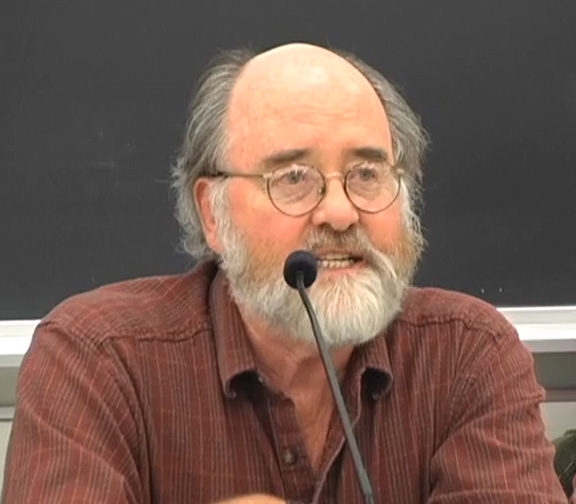
Angus Wright. Screen grab from Vimeo.

The fire next time is now:
Environmental historian Angus Wright’s
call for a planetary patriotism


By Robert Jensen / The Rag Blog / November 9, 2011

Angus Wright has a way of saying things we may not want to hear in a way that’s hard to ignore.

An example: During a meeting of environmentalists about shaping the public conversation on our most pressing ecological crises, folks were wrestling with how to present an honest analysis in accessible language -- how to talk about the bad news and the need for radical responses, without turning people off. During the discussion about the effects of climate change, Wright offered a simple suggestion for a slogan: “No more water, the fire next time.”

Those words from a black spiritual, made famous by James Baldwin’s borrowing for his 1963 book The Fire Next Time, are usually invoked metaphorically. Wright was suggesting that we might want to consider the phrase literally. After a summer of drought and forest fires in Texas where I live, Wright’s comment reminded me that climate disruption isn’t part of some science-fiction future, but is unfolding around us in ways that are both complex and hard to predict, but devastatingly simple: We’re in deep trouble, ecologically and culturally, as we try to face up to unprecedented planetary problems in a society in denial.

Wright is one of our most astute observers of these troubles. His willingness to face these issues, and his ability to grasp the interplay of complex systems, is no surprise to readers of his book The Death of Ramon Gonzalez: The Modern Agricultural Dilemma, first published in 1990 and revised for a 2005 edition. Looking at one region in Mexico, Wright explains how political and economic power, combined with the arrogance of experts who believe they have all the answers, have radically changed people, communities, and land -- mostly for the worse.

Though Wright speaks bluntly about these grim realities, he hasn’t given up trying to change the trajectory of a society that so often denies or minimizes the threat. A retired professor of environmental studies at California State University, Sacramento, Wright is the chair of the board of The Land Institute, which is committed to the research and organizing necessary for a truly sustainable agriculture. His writing also focuses on those issues -- he is co-author of To Inherit the Earth: The Landless Movement in the Struggle for a New Brazil (with Wendy Wolford) and Nature’s Matrix: Linking Agriculture, Conservation, and Food Sovereignty (with Ivette Perfecto and John Vandermeer).

Because Wright has a knack for presenting complex ideas in plain language, I asked him to respond to some crucial questions about how to understand our predicament and options. Can we face reality honestly without feeling overwhelmed? Wright suggests we can.

The 2011 Texas drought. Image from tamu.edu.

Robert Jensen: Your invocation of “the fire next time,” with its Biblical roots, suggests a moral warning and the potential catastrophe if we are not up to the moral task. Before we get to questions of politics and science, what do you think is the right moral framework for understanding the ecological crises?

Angus Wright: There certainly is a moral question, but I think we in the environmental movement have wasted a lot of time dealing with it at the wrong level. I get frustrated with the deep tendency of so many Americans to be more worried about the task of saving their souls rather than solving the problem. I am not as interested in the purity of intention or personal practice as I am concerned about correctly identifying the nature of problems and getting to work in an organized way to solve them.

The emphasis, for example, on whether individuals are hypocritical when their personal consumption is out of sync with their political/ecological views has been a diversion. It undermines effective organization and helps to maintain the myth that it is personal rather than collective action that really matters.

When we think we are saving ourselves, we tend to become self-righteous in ways that separate us from the other people we need to work with in order to effect societal change. The important moral question is social, not individual. How do we collectively figure out ways to live that don’t require that we destroy the planet’s capacity to sustain life?


What are the two or three most important things we need to understand about humans, psychologically and politically, if we are to avoid that destruction?

Humans are capable of immense creativity and sacrifice, which has been demonstrated in crisis situations such as wars, famines, migrations, and in the building and defense of homes and communities. In my work, I have been frequently reminded of the incredible sacrifices Mexican immigrants make to earn a little money to send back to their families over years, sacrifices that have both an individual and a community aspect.

Many of us know how hard and how creatively our parents and ancestors worked to provide us with the lives we now take for granted. Of course, such effort can have negative as well as positive aspects -- for example, the creation of the majority European culture of the Americas at the expense of Native Americans and Africans. People are also capable of stunning complacency, greed, and divisiveness.

The secret we seek is what inspires humans to act positively and creatively in the face of huge challenges. As humanity faces the environmental crisis, this is its greatest challenge: How do we elicit the kind of collective and individual action and creativity that will be needed? I think previous experience implies that it cannot be fear alone, nor opportunity alone, nor persuasion alone, nor organization alone, but a blend of these elements, with much else.

We have been able to lump these things together successfully in the past in something called patriotism -- a powerful force for good and ill -- and now we need something like a planetary patriotism. But no planetary patriotism can be built without acknowledging and dealing with the major things that divide us as well as the challenge that must unite us. Putting on a happy face won’t cut it.


If we have a considerable body of knowledge concerning the seriousness of the ecological crises and we have the capacity to respond to threats, what are the key impediments to change? Is the problem in the political leadership of recent decades? The economic system? Something we can’t yet identify?

One problem is an economic system that impels each company within it to pursue growth -- each company must seek new investment funds by demonstrating greater growth potential than its competitors. Another problem is a political system that is so heavily corrupted by corporate cash, exacerbated by the absurd legal fiction that a corporation is a person with constitutional rights to free speech. Without those problems, we could have the kind of largely publicly funded campaigns adopted by other countries.

I also think that for all its virtues, the constitutional checks and balances built into our system have brought us to gridlock -- we really might want to consider the advantages of a parliamentary system in which the executive branch is headed by the leader of the majority party, as in England and many other parliamentary democracies.

We have to be enlightened enough to take aggressive and expensive actions primarily for the benefit of our children and grandchildren. While individuals and families have been able to do this throughout history, it has proven very difficult for whole societies to do so. All these barriers are so daunting that we become overwhelmed by the sheer magnitude of it all. Here we face fundamental philosophical and psychological problems at both the individual and collective levels.

Wind farm. Photo from oz_britta's photostream / Flickr.

You said the solutions aren’t going to be individual. But how do you evaluate the efforts of people who focus on their everyday lives? That can range from being diligent about recycling, to buying “green,” to biking to work, to planting a vegetable garden. If we don’t naively believe those things can solve all our problems, are they worth doing?

Our most important problems can only be solved by collective action -- new policies and laws taken by government. That requires that we act, above all, as citizens. I have watched over the past 40 years as nearly every important institution in our society has gradually shifted to encouraging us to see ourselves as individuals and consumers as opposed to group participants and citizens. We are all aware of this in advertising, but it has also become a powerful trend in education and in government itself.

We are encouraged to believe that we can bring the changes we need by exercising our “consumer vote” in the marketplace more effectively than by exercising our citizenship -- not just in voting, but also in public debate, in participating in political parties, in the exercise of our professional judgment, in educating our children, in participation in labor unions and professional associations, in speaking out in our communities.

Our “vote” through marketplace purchases can only bring about very limited change, and by thinking of ourselves more as consumers than as citizens we diminish our very dignity as human beings. We become a mouth that eats rather than a voice that speaks.

That said, I am all for making the changes at the individual level that can help to create a culture of frugality, help us realize that we don’t really need the great quantity of junk our civilization produces, help us understand that we can make major social changes while actually improving our lives. Most of us want sociability and conviviality more than we want consumer goods. We can set a good example for others by showing that we can live more happily by consuming less. All of this can also help us live within a discipline of conscious choice rather than of allowing advertising to manipulate us.


In my experience, academics tend to focus on narrow questions they think they can answer. You seem to gravitate toward big questions that defy definitive conclusions. I wonder if that’s because of your training and teaching -- you’re a historian who taught environmental studies. We might say that the object of your inquiry has been everything that happened before today, and the interconnectedness of everything happening today. What lessons have you learned about intellectual life from your career?

When Wes Jackson (president of The Land Institute) recruited me to help him create an environmental studies program at Cal State-Sacramento, I was the all-purpose humanities and social science person in a small core faculty. I learned all I could from Wes about biology and genetics, and from other colleagues about oil and mineral depletion, nuclear power, city and regional planning, environmental law. It was a wonderful kind of second graduate school experience that lasted through an entire career.

I had always been attracted academically to what might be called the “pan-disciplines” such as geography, anthropology, and history, disciplines that can reasonably take on almost any topic in human affairs. Salina, our small Kansas city, was known nationally for having one of the best public libraries of its size, and I spent a lot of time camped out in its stacks.

My parents -- intensely intellectual people who were too poor to go to college -- assumed that any reasonable and moral person would be interested in nearly everything, and they hadn’t been beaten into submission by professors to think differently. They were good models who were eager for knowledge of all kinds. They were looking for clear words and straightforward thinking, and they assumed that good thinking led to social responsibility and political action, to which they were dedicated.


Thinking about that need for clarity, one last question. As an environmentalist, you can’t ignore the stark reality of the data about our ecological crises. As a historian, you can’t ignore the record of human successes and failures. When you weigh all that up, what advice do you have for how we should face the future? Many people find it hard to face the changes that are likely coming, which I once heard you describe as “dramatic and potentially highly unpleasant.” Are we facing “the fire next time”? Is there a way out of the trap we’ve set for ourselves?

I don’t know if there is a way out, but we have to try. My own expectations are pessimistic because I don’t see enough people having sufficient awareness, understanding, and determination to bring about the major changes we need.

And of course, contradicting what I just said, we don’t really have to try. We only really have to try if we want to maintain our self-respect. If we want to stumble forward drunk while whistling in the dark, we could choose that. I maintain a certain faith that many people are going to make the right choices, and we can hope that is enough. I think Gramsci had it right when he said that he lived with “pessimism of the intellect, optimism of the will.” And you have to take that seriously from a guy who wrote while in prison for his political beliefs.

[Robert Jensen is a journalism professor at the University of Texas at Austin, where he teaches courses in media law, ethics, and politics -- and a board member of the Third Coast Activist Resource Center in Austin. His books include All My Bones Shake: Seeking a Progressive Path to the Prophetic Voice, and Getting Off: Pornography and the End of Masculinity. His writing is published extensively in mainstream and alternative media. Robert Jensen can be reached at rjensen@uts.cc.utexas.edu. Read more articles by Robert Jensen on The Rag Blog.]

The Rag Blog

[+/-] Read More...

23 December 2010

Bruce Melton : I Want a Sequestration Machine for Christmas!

Photo by Bruce Melton / The Rag Blog.

Climate intrigue and a change in prosperity:
I want a sequestration machine for Christmas


By Bruce Melton / The Rag Blog / December 23, 2010

Climate change is not just another dangerous dead-end road for humanity. There is really no doom and gloom just around the corner. The situation is not as dire as the catastrophists would have you believe. Yet, the news from climate science land has gone from bad to worse.

The impacts are happening faster with greater strength. The feedbacks appear stronger. The thresholds are proving to be nearer and threaten greater consequences. Ecosystems are rapidly deteriorating right now, or in some cases like caribou and coral reefs, they are simply collapsing.

So how can I be convinced that the solutions to the climate change challenge are things that can easily be accomplished? That the cost will at first seem burdensome, but will quickly be realized to be the intelligent investment that it is?

In the thousands of scientific papers on climate change that I have reviewed, most of the results talk about how lab tests sequestered far more carbon than imagined; about how the new techniques have been “scaled up” to mass production capacity and shown to be valid. The cost analyses show what at first would seem like ghastly expensive expenditures, but upon deeper thought, are revealed to be no different than other challenges we as society have already conquered.

Lord Nicholas Stern was former Prime Minister Tony Blair’s head of economic services in the United Kingdom. In 2006, Stern authored a definitive review of the economic impacts of climate change. His work was 700 pages of evaluation that included most of the current knowledge on climate science.

What Lord Stern found was that it would take approximately 1 percent of world gross domestic product to address climate change every year. But in 2008 Stern came forward with a revision to his report. He said that in the two years since his book was completed, new discoveries about climate change and about how we as a society were reacting would raise the cost of mitigating climate change to about 2 percent of gross domestic product.

So, one or two percent of world gross domestic product (GDP) is what it will take to avert a climate catastrophe; is that a lot of money? How much money is this exactly, compared to something that we can relate to? The Moon shot maybe


To see the value of anything, first we must understand how that value is important to our society. Preventing “dangerous climate change," or as the scientists call it “dangerous anthropogenic interference," is what the scholarly climate change literature tells us is our goal. The climate scientists say that just 2 degrees C of change (about 3.6 degrees Fahrenheit) will result in dangerous climate change.

Or at least this is what they said five or six years ago. Today the answer is more like 1.5 degrees C (2.7 degrees F) and this is additional warming above pre-industrial levels. We have already warmed 0.7 degrees C (1.3 degrees C). So just 1.3 to 2.3 degrees F of warming is what remains between dangerous anthropogenic interference and us.

Considering that most of the warming that has already occurred has happened since 1970, It appears as if we cannot help but pass this dangerous threshold. But, you may ask, what is so dangerous about a couple of degrees of warming?

Most folks think climate change is no big deal. The polls these days show that nearly one-half to two-thirds of Americans think that climate change is either not real, not going to impact them in their lifetimes or is exaggerated.

All of this while the latest mega review of climate science literature shows that 97 to 98 percent of climate scientists agree on the tenents of the Intergovernmental Panel on Climate Change.

In the climate scientists’ world, the one where I interpret the peer reviewed literature so you don’t have to, the beginnings of dangerous climate change are here now.

Right now, primary productivity in our oceans has declined 40 percent from levels in the 1950s because of warming. Billions of trees are dead in the North American Rockies in a sixty-one million acre attack. A native pine bark beetle is responsible and this event is 10 to 20 times bigger than anything ever recorded. It is still growing and is expected to impact virtually every pine forest in North America. Only extreme cold can kill the pine beetle, cold like we have not seen in nearly two decades.

Eighty percent of complex reefs in the Caribbean Sea have collapsed because of warming between 1969 and 2008 and the worst coral bleaching year ever recorded is likely to have just occurred in 2010. Greenland’s ice melt and discharge have quadrupled in 20 years. Antarctica is discharging now as much ice as Greenland, but Antarctica, in the 2001 IPCC report, was not supposed to start losing any ice for another 100 years or more.

These things are happening now, but as of yet they do not really rate as extreme enough to be called dangerous climate change. To get the idea across, I like to use an analogy comparing the weather to climate. We have all heard time and again that we cannot compare the weather to climate. We know that the weather is what happens tomorrow, or last spring, or even for the last decade and that climate is measured in decades, generations, and even centuries of average weather.

Climate happens on such a large scale though that it is difficult to grasp, even for me. So I have developed analogies to aid my own comprehension. My current favorite analogy compares the Dust Bowl to something that climate scientists call a mega drought.

We have these mega droughts in North America once every millennia or so, or at least we have had two or three of them in the last 1,500 to 2,000 years. These things are completely natural, they last for 100 to 300 years (the Dust Bowl lasted nine to 11 years) and they have only half of the rainfall annually when compared to the Dust Bowl.


As big as the Dust Bowl was, it was a simple weather aberration. Mega droughts however, at 10 to 30 times longer and twice as dry, are classified as something that would rate as a dangerous climate change. This is the scale of things that we have to contend with if we warm the planet just another 1.3 to 2.3 degrees F.

A mega drought would obliterate a continental agricultural region. There is only so much water underground that could be used for irrigation. Once groundwater is gone, all that would remain is shifting sand; for generations or centuries.

Another dangerous climate change would be 10 feet of sea level rise in a hundred years or maybe even as little as 500 years. It has already happened on a planet as warm as Earth is today, or within about one degree C of as warm as we are today.

The event occurred 121,000 years ago, in the interglacial warm period between the last 100,000 year-long ice age and the previous 100,000 year-long ice age (there have been about 10 100,000 year-long ice ages in the last million years.)

This globally catastrophic sea level jump happened naturally because of a collapse of the West Antarctic Ice Sheet due to natural warming between ice ages. It is just this kind of collapse that the ice scientists have seen signs of starting in the last several years.

Ten feet of sea level rise would displace 700 to 800 million people. Once the West Antarctic Ice Sheet collapsed, it would likely unleash a rush of dammed up ice from the Antarctic Continent into the ocean. This ice would continue to raise sea level at rates up to 10 feet per century or more for centuries on end.

Today we are changing the CO2 concentration of our atmosphere 14,000 times faster than normal for any time in the last 55 to 65 million years. If we as a society continue ignoring climate science as we have been for the last couple of decades, we will see 3 to 5 degrees C of warming (5.4 to 9 degrees F). This means by mid-century, maybe even just another 20 years, we will cross the 1.3 to 2.3 degree F threshold to dangerous climate change.

Our future lives may never be the same, but they may never be better either. We can prevent globally crippling mega drought that would starve hundreds of millions. We can keep the West Antarctic ice sheet from collapsing, or any number of other calamities that could basically end life as we know it.

All we have to do is bring CO2 levels in the atmosphere down to 350 ppm or less. Considering that the Kyoto Protocol would have had our society reducing our emissions to somewhere slightly below 1990 levels by 2012, and that emissions levels have only continued to climb since 1990, it is no wonder that doom and gloom is closely associated with climate change.


But the technologies are out there. The research has been done, the technologies proven in the lab, and some scale models have been built that prove successful. We could even use current CO2 extraction technology, commonly used in industry, to do the job. All it takes is a will to do so, money, and manpower.

For example, Klaus Lackner, at Columbia University, has shown how a polyester-like plastic sheet can absorb CO2 and the CO2 can be rinsed out with water. They built a full scale model and the technology worked well. The cost of the model was also in the feasible range.

Lackner’s full-scale test model was about the size of a train car. Thousands of these rail car-sized sequestration machines could easily be built. We could build enough to remove half of mankind’s CO2 emissions every year. The completed machine would be about the size of the Great Wall of China.

Lackner added up how much his machine cost and made some generalizations about full-scale implementation. When the numbers are looked at in more detail, a full scale model of their sequestration machine costed out so that it would take as much money as the U.S. spent on World War II, about $5 trillion adjusted for inflation, to pay for the machine.

That’s a lot of money of course. But Lackner was careful to explain that his cost was calculated on their own “actual costs” to build the one railcar-sized machine. Reduction in costs due to scale would likely be trillions of dollars.

This would still make the ultimate cost of the machine be trillions of dollars, but we just spent 3 trillion dollars on the economic conundrum bailout stimulus mess. And remember, this is just spending by the United States. Around the world, spending on World War II as well as spending this latest economic brain donation, was significantly more than just that spent by the U.S. alone.

Now comes the good part. These technologies are literally littered across the scientific landscape. We have all heard about how impossible clean coal is. But clean coal is only impossible on Earth as we know it. If our society finds the courage to address the true risks of climate change, clean coal suddenly becomes entirely feasible.


We are at the same point in our new clean energy economy today as we were just before the Interstate Highway system was built, or just before the Manhattan project ended World War II, or before John Kennedy said that we would go to the moon in 10 years because “it was hard.”

Wind energy is taking off like a bird. From 1996, wind energy installations doubled in capacity every three years. Installed solar capacity has increased 40 percent per year since 1990. Some parts of the U.S., Europe, and Japan have already reached parity -- where solar costs the same as coal-fired power. Worldwide, solar should reach parity with coal in two to five years. In a decade or less, we will see “naked parity” where solar costs the same as coal without subsidies.

All of this clean energy will change our lives for the better. A new economic engine will take over our planet. We will no longer be slaves to fossil carbon. Our skies will clear, our health will improve, our lives will be better, and economies will prosper. It happened when we changed our base energy unit from wood to coal and again when we changed from coal to oil. It will do the same when we change from oil to wind and solar.

Our society has an innate capacity to accomplish vast challenges. The Great Wall of China and the pyramids are two low-tech accomplishments, built by hand, that can be seen from space. The Apollo project put a man on the moon. The winning of World War II saved our society from global dictatorship (or worse.)

Like the pyramids, the Great Wall, the Moon Shot, and World War II, fixing our climate will not be easy. And like those other things, it will not be cheap. It will take one to two percent of global Gross Domestic Product (GDP), which is $70 trillion today.

Remember Lackner’s sequestration machine the size of the Great Wall of China that you can see from the moon? One to two percent of GDP is a couple of trillion dollars.

So how much money is a trillion dollars? Let’s compare it to World War II and GDP. The $5 trillion that the U.S. spent on World War II was 25 times the U.S. GDP at the time, which was about $200 billion. Today’s U.S. GDP is $14 trillion. So 25 times today’s GDP would be about the same as what we spent on WW II, scaled for GDP. That’s $125 trillion dollars.


Scaled up to the actual size of the U.S. economy then (this is what GDP is), we spent $125 trillion dollars on World War II! So why is the measly $3 trillion that we spent on the economic conundrum perceived to be so much money? It’s all relative to perceived risk.

When the bailouts happened, Wall Street was being attacked by bad economic policy, not bad imperialists or Nazi’s bent on world domination. The perceived risk that the public has about climate change is just not comparable to world domination. It does not matter that the real risks of climate change are frightening beyond imagining; it is the perceived risk that counts.

Without public opinion, without the votes, without a global catastrophe threatening our very way of life, our leaders will not act. If the climate change threat were recognized for what it is, something worse than world domination, we would easily spend 25 times current GDP on prevention.

And the money is really there. Our capacity to create deficit spending 40 times greater than what we just spent on this little recession is real. It has happened before. We spent all that money during WW II because we saw the need. We understood the risks. We had the courage.

Please, in this time of thought about things bigger than ourselves, about the past and the future, and about our children, have courage. Go to meetings. Write your Senator. Tell your councilperson. Write a letter to the editor. Start a group. Attend a rally.

World War II was won by a revolution. The climate crisis is no less profound. It will need a revolution too. This new economic alternative energy revolution, this great societal challenge that we face, is not really without parallels. Repairing our deteriorating climate is a task that is within our grasp. There is no need for despair. We did not despair when we were attacked at Pearl Harbor. We rose to the challenge.

[Bruce Melton is a registered professional engineer, environmental researcher, trained outreach specialist, and environmental filmmaker. He has been translating and interpreting scholarly science publications for two decades. His main mission is filming and reporting on the impacts of climate changes happening now, unknown to the greater portion of society. Austin, Texas is his home. His writing and films are on his website.] The Rag Blog

[+/-] Read More...

Only a few posts now show on a page, due to Blogger pagination changes beyond our control.

Please click on 'Older Posts' to continue reading The Rag Blog.