Showing posts with label Cuisine. Show all posts

22 May 2013

REPORT / Mariann G. Wizard : 'La Vida Coca' in Bolivia and Peru / 3

Coroico is the administrative capital of Bolivia's Nor Yungas province. The town hall façade features the coca leaf and coffee bean of local agriculture in addition to the exotic bird of tourism, the area's main economic activities. All photos by Mariann G. Wizard / The Rag Blog, unless otherwise credited.
La Vida Coca /3: 
Currents in traditional coca 
use in Bolivia and Peru
Regular tours of the area include coca 'plantations.' Almost all of the other travelers we met in Coroico and Copacabana were interested in trying and discussing coca.
By Mariann G. Wizard / The Rag Blog / May 22, 2013

Part three of three.

(Rag Blog Contributing Editor Wizard recently visited Peru and Bolivia with former fellow Ragstaffer Richard Lee. Wizard says the whole thing was Lee's idea, although she did the heavy lifting of writing this report of their experiences, while lifting copiously from conversations they shared and short reports Richard wrote on the spot.)

After being in Coroico about a week, we asked a woman we'd met on our first day there if she knew any cocaleros who might be willing to talk with us about the crop. A hard-working, intelligent person who was extremely patient with our often halting Spanish, she laughed, ducked her head, and said, "Soy una cocalera." ("I am a coca grower.")[1]

She isn't a commercial grower. She and her family tend a few plants, along with abundant fruit trees and vegetables. Over coffee and cake, she described carefully sprouting the small red seeds, transplanting them into pots, then into the field. She showed us the growth pattern of the plants and told us that the growth tips are never touched. We heard about cutting plants off near the base, then regrowing them; regeneration can occur several times, giving plants a life span of 20 years or more.

Most of what we learned I've since confirmed online, but there's nothing like hearing it from a passionate gardener! Her cupped hands as she demonstrated transplanting seedlings, her expertise in how to tell by touch when the hojas are dry enough for storage, reminded me of every other master gardener I know: pride, respect, and love make things grow. Richard, green thumb tingling, was also in his element!

Still, we wanted to see large coca fields. A couple we'd met recommended a local taxista who knew the area well, and we took an agricultural tour of greater Coroico. Tramping up and down steep, muddy jungle slopes before breakfast, swarmed by aroused mosquitoes, we weren't so much in our element as over cake and coffee! But we kept on chewing hojas and drinking water, and keeping on, until we saw what we came to see: well-tended, mature cocal, up close and personal.

Like many Bolivian towns, Coroico is surrounded by a network of rural villages (villas). I liked this "bewitching" signpost.
Here, several distinct cocal fields are seen on the hillside. We were told that each plot is owned by an individual or family; adjoining plots may be owned by close relatives or grown children. Photo by Richard Lee / The Rag Blog.
This small, well-tended cocal field near the road was easy for us to access.
Here you can see that the plant in front center has been cut off just above the ground and regenerated to its present height.
Small red seeds (see inset for enlargement) from tiny white flowers. Seeds are planted soon after falling off the parent plant. PVC pipes bring water for irrigation and for workers to drink. At high altitudes under a strong sun, hydration is vital.

Coca isn't the only traditional herbal medicine in common use in Peru and Bolivia. Chamomile (manzanillo; Matricaria recutita syn. Chamomilla recutita) or anise teas, mint (yerba buena; Mentha viridis), lemon verbena (yerba luisa, cedrón; Aloysia citriodora), and West Indian lemongrass (Cymbopogon citratus) were recommended and served to us by gardeners, restaurateurs, and/or friends.

Specific comments regarding manzanillo as a sleep aid, yerba buena to "balance" heavy foods, and yerba luisa as an overall tonic were noted. As in other indigenous cultures, many foods' and condiments' health effects are common knowledge, especially in traditional Quechua- and Áymara-speaking households.

After I had an allergic reaction to Coroico's notorious mosquitoes, bringing up lovely big red welts on my arms, everyone we met told me about one or another traditional repellent. Rubbing whole limes (Citrus limonum) on the skin in the evening was the one most mentioned. To be fair, DEET also worked quite well; if only I'd thought to use it that first rainy day!

Dried spices, hojas de coca, peppers (Capsicum spp.), and other condiments at Coroico's weekly market. Peppers, garlic (Allium sativum), and other spices are used in unique sauces, ajillos, by restaurants and at home; everyone seems to have a recipe for ají.
Both countries boast a wealth of fruits and vegetables -- Bolivia has over 30 varieties of potatoes (papas; Solanum spp.)! -- many not seen in the U.S., or seen infrequently, or in a processed state. While restaurants do not avail themselves much of this produce bounty (many serve French fries and rice at every meal!), a trip to the mercado brings delicious rewards. We recruited friends to cook papas lisas for us and enjoyed a fabulous traditional stew of the tiny potatoes, onion (Allium cepa), and alpaca rib meat – ¡que sabrosa!

Besides cattle, pigs, poultry, and sheep, two domestic camelid species, llamas and alpacas, are raised for meat, fiber, and as beasts of burden. (Wild vicuñas are protected.) Alpaca meat isn't much different from grass-fed beef in flavor. Guinea pigs (cuy) are also a traditional Andean food. Richard ate cuy years ago in Ecuador; I'll pass! However, some dishes I did have were equally odd, like this "chicken foot soup":


Peru, with its extensive coastline -- Bolivia is landlocked -- offers a wide array of fresh seafood. Lake Titicaca, between the two nations, is home to delicious lake trout.

By the way, again from Wikipedia, "Raw coca leaves, chewed or consumed as tea or mate de coca, are rich in nutrition... Specifically, the coca plant contains essential minerals (calcium, potassium, phosphorus), vitamins (B1, B2, C, and E) [, and]... protein and fiber."[2]
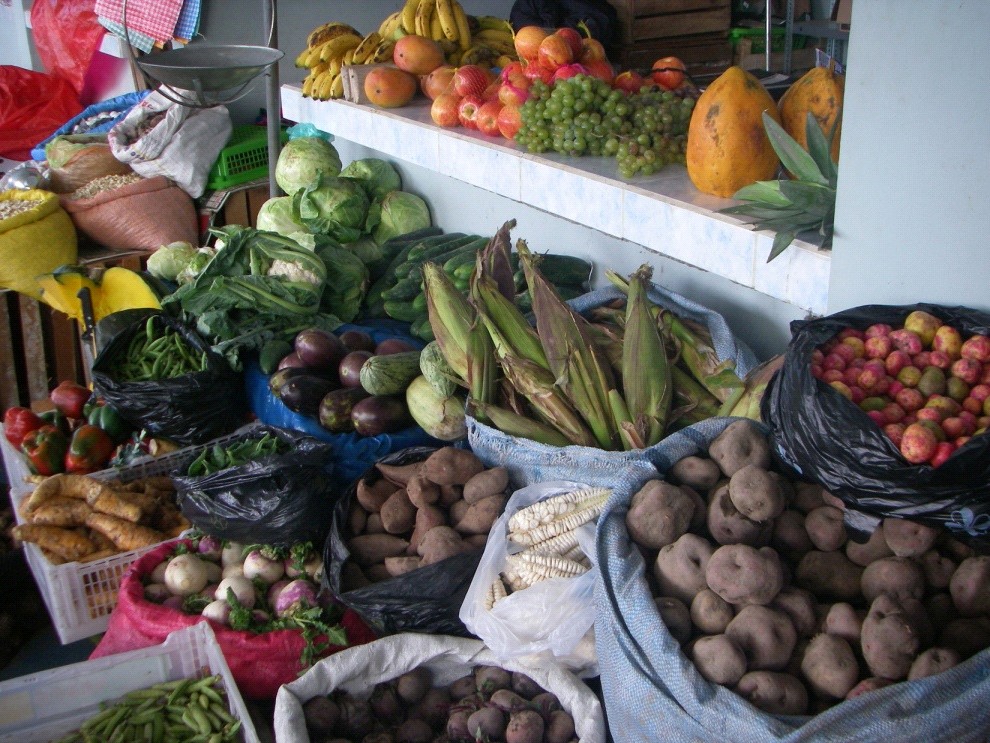
Abundant fruits and veggies in Coroico's weekly market. Papas lisas are the small red and yellow potatoes at right center. I also ate papas negras, the purple ones at bottom right and center, cooked whole in oil -- ¡muy rico!

Not all traditional medicine in the region is herbal or food-based. Good luck rituals and tokens abound, like the brightly-colored fetishes below, in La Paz' Mercado de Hechicería (Witches' Market). Arriving during Carnavál, we also saw cars, taxis, and buses decorated and prayed over as a blessing; and good luck icons by the score, such as miniatures of items the buyer hopes to obtain: money, cars, televisions, etc.[3] All of the shops in the Hechicería had coca. Some Andean shamans use hojas to divine the future.

In the Mercado de Hechicería, dried llama fetuses (hanging) of various sizes are sold. These are buried for good luck in new enterprises, especially those involving construction. Well-to-do traditional people are expected to sacrifice a live animal.

While our inquiries had been fruitful, we had questions our local informants couldn't readily answer. For example, other than for rapid drainage, and where the terrain consists of steep slopes, is it necessary to plant at such challenging angles? Also, can cocal be grown at lower altitudes than Coroico's 5000 feet above sea level, and if so, would this affect its strength or efficacy?

Lest you think we must have stood out for our unusual interest in coca, rest assured, we did not. Regular tours of the area include coca "plantations." Almost all of the other travelers we met in Coroico and Copacabana -- people of all ages from Switzerland, Belgium, New Zealand, Chile, Brazil, Germany, France, Australia, and Japan -- were interested in trying and discussing coca. Bolivians from other parts of the country were interested in comparing the local product with coca from their area.

Our "where's Waldo?" moment: a day after our field trip, strolling across Coroico's plaza for perhaps the 50th time that week, we finally recognized the healthy if somewhat untended stand of cocal growing there among the palms and hibiscus (Hibiscus sabdariffa). Since this is about the only flat spot in Nor Yungas, it seemed to settle whether cocal must be grown on a slope! (The question of altitude remains open.)

The public cocal patch in Coroico's main plaza.. Photo by Richard Lee / The Rag Blog.
Andean music on the plaza draws a crowd. Traditional women from the Afro-Bolivian community (seated, right front) are said to be prolific coca users.
The Sanjuanitos wowed us with John Lennon's "Imagine." Richard later wrote, "Lennon could have imagined this..."

It is in the plaza that matters of interest are discussed before and after cocalero meetings at the roofed "polyfunctional" sports court down the hill. Bolivia's future is being shaped by astute agriculturalists who value tradition but want the benefits of modernity. Change, like the new cell phone technology that has reportedly made rural life safer, is weighed and measured before adoption.

In this small plaza and others all over Bolivia and Peru, citizens talk and relax at the end of the day or the week, after school or at lunch time. Taxis come and go; buses disgorge weary travelers. Children and dogs run free and everyone sees that the soccer ball doesn't bowl over any old folks. Young couples promenade hand in hand in the evening, while the ice cream man, and the chicken sandwich lady, and the elders sitting on stone or wooden benches smile in approval. Here, coca is at home.

[Rag Blog Contributing Editor Mariann G. Wizard, a Sixties radical activist and contributor to The Rag, Austin's underground newspaper from the 60s and 70s, is a poet, a professional science writer specializing in natural health therapies, and a regular contributor to The Rag Blog. Read more poetry and articles by Mariann G. Wizard on The Rag Blog.]


Footnotes:
[1]I'm not naming any Bolivian acquaintances, in order to protect their privacy. None of them live electronically.
[2]http://en.wikipedia.org/wiki/Coca
[3]The fake lucky dinero, by the way, is from "El Banco de Buena Fortuna," and Richard got taken for 50 Bolivianos (about $7.50 US) by making change in the dark. It's a wonder what a photocopier can do, isn't it?

The Rag Blog

[+/-] Read More...

08 January 2010

BOOKS/ Jonah Raskin : Michael Pollan's 'Food Rules'


We can decide what we want to eat!
Michael Pollan: America’s new Food Czar

By Jonah Raskin / The Rag Blog / January 8, 2010

[Food Rules: An Eater's Manual, by Michael Pollan. (Penguin, Trade Paperback, December 29, 2009, 112 pp, $11.00.]

A few years ago, Berkeley, California, super chef Alice Waters of Chez Panisse fame suggested that Michael Pollan and Eric Schlosser run for president and vice president, respectively. That didn’t happen, of course, and who knows what might have occurred if they had campaigned for public office. Perhaps the American public would know more about industrial farming and about the fast food industry than it does now.

Schlosser, the author of Fast Food Nation, has largely disappeared from view for the moment. But Pollan, who has written half-a-dozen books, is more visible than ever before. In fact, he seems to have taken it upon himself to become America’s new food czar. On The Daily Show the first week of January he was certainly acting like the food czar and repeated his familiar mantra to Jon Stewart. “Eat food. Not too much. Mostly plants,” he said.

In his latest book, Food Rules, which has just been published in a mass market, paperback edition, he sets out 64 rules about eating and diet. Pollan probably has as much of a right as anyone else in America to tell eaters what to put into their bodies and what to avoid.

In Botany of Desire (2001), he described the fascinating history and evolution of four plants -- apples, marijuana, tulips, and potatoes -- and their integral connections to human wants and needs. In Omnivore’s Dilemma (2006), he exposed the pernicious place of corn in agribusiness, and the noxious dependency on corn syrup. He also poked holes in the halo that Whole Foods, the nation-wide food chain, was trying to wear, as though it was a spiritual institution, not a business for profit.

Then, in In Defense of Food (2008), subtitled “An Eater’s Manifesto,” Pollan took on “nutritionism,” and what he calls “the Western Diet.” At the end of that book, he offered 23 suggestions about eating properly, such as “Avoid Food Products that Make Health Claims,” “Shop the Periphery of the Supermarket and Stay Out of the Middle,” and “Eat Mostly Plants, Especially Leaves.”

For his latest book, Food Rules (2010), he has taken his original two dozen suggestions, and boiled them down to their essence. He has also added 41 additional suggestions, such as “Serve a proper portion and don’t go back for seconds,” and stirred them all together to produce a small stew of a book. Food Rules is largely nifty packaging, or rather repackaging. It doesn’t add much that’s new. Pollan’s publisher, Penguin, has also distilled his 64 rules to 10, and has printed them on bookmarks available in stores.

It’s true that Pollan has a certain healthy sense of humor about his rules. “Food Rules” is after all a playful title, and on the last page the author urges readers and eaters to “Break the Rules Once In a While.” Still, Pollan seems to take himself much too seriously. Do Americans really need 64 rules? Probably not! Who is going to remember all 64 and abide by them? Not many people.

Moreover, Pollan doesn’t see that for nearly every one of his rules there are valid exceptions. Sometimes seconds are very much in order. Sometimes it even feels good to pig out at least once in a while. Granted, leaves -- lettuce leaves and spinach leaves -- are good for us. But so are root vegetables. Yams, carrots, turnips, and parsnips are wonderful, nutritious and tasty.

Rules, even food rules, have always been broken; perhaps they’re made to be broken. Pollan’s 64 rules surely will be broken time and again, and while some eaters no doubt appreciate guidelines, the American diet probably won’t really improve until Americans take charge of their own eating habits and don’t turn to so-called experts for advice. The country doesn’t need drug czars or food czars, whether they're self-appointed or appointed to office by a president.

Pollan can be very astute about the food industry, but at times he can also be blind, as when he suggests that Americans “buy a freezer,” and also “pay more, eat less.” The trouble with those two suggestions is that increasingly Americans can’t afford to buy a freezer or to pay more for food.

More Americans are hungry today than they have been in the last decade. Hunger is afoot in the land. More Americans are also relying on food stamps. In the light of those hard realities, Pollan’s suggestions seem like they're aimed at the middle and upper classes -- and are meant for people who can afford freezers.

He’s certainly not as oblivious to hunger as the 18th-century person who said, “Let them eat cake.” (Historians say it probably wasn’t Marie Antoinette.) But sometimes Pollan’s food rules can seem silly, and oblivious to the needs and wants of hungry Americans dependent on food stamps for their very survival.

[Jonah Raskin is the author of Field Days: A Year of Farming, Eating, and Drinking Wine in California (University of California Press).]

Find Food Rules: An Eater's Manual, by Michael Pollan on Amazon.com.

The Rag Blog

[+/-] Read More...

25 August 2008

Slow Food Nation : You Are What You Eat


The Slow Food Nation gathering promises to be a Woodstock for food lovers and enviros concerned with our food system.
By Kerry Trueman / August 25

SAN FRANCISCO -- A swarm of 40,000 to 50,000 locavores will descend on San Francisco this Labor Day weekend to attend Slow Food Nation, a four-day extravaganza of teach-ins and tastings that's being billed as a kind of "Woodstock for gastronomes."

I'd rather go to a Woodstock for garden gnomes, myself -- at least those Lilliputian lawn ornaments share my fondness for front yard farming. Gastro gnomes, on the other hand, sound like elitist elves who are overly fond of artisanal cheeses and grass-fed beef. Do we really need a celebration of such highfalutin culinary novelties at a time when high fuel and food costs are making it harder for people to keep their pantries stocked with even the most basic staples?

Well, yes, we do, because we need to remember that the fresh, unadulterated, minimally processed, locally produced foods that Slow Food Nation is showcasing were our pantry staples, before the military-industrial complex annexed our food chain a half a century or so ago in the name of progress.

Our great-grandparents would be flabbergasted to learn that grass-fed milk in glass bottles bearing the local dairy farm's logo is now a rare luxury item available to only the affluent few who are willing to pay $4 for a half-gallon of milk.

Back in the day, our breads were fresh-baked and free of high fructose corn syrup, and our eggs and bacon came from chickens and hogs that rolled around in the dirt and saw the light of day. The word "farm" still evokes nostalgic pastoral images for most Americans, but there's nothing even remotely benign or bucolic about the fetid, brutal factory farms that supply us with most of our meat, poultry, eggs and dairy products today. And unmasking this unsavory reality is as much a part of Slow Food Nation's agrarian agenda as dishing out local delicacies.

So don't be distracted by the aroma of wood-fired focaccia wafting from the Fort Mason Center "Taste Pavilions"; Slow Food Nation has the potential to spark a crucial dialogue about where our food comes from, how it's grown, and why all that matters. With forums featuring the good food movement's marquee names, including Wendell Berry, Vandana Shiva, Michael Pollan, Marion Nestle and Eric Schlosser, this Alice Waters-sponsored shindig could be the watershed event that puts America's foodsheds on the map.

Don't know what a "foodshed" is? Don't worry, nobody else does, either -- the word is still so obscure it hasn't earned an entry on Wikipedia. It means, essentially, the area through which food travels to get from the farm to your plate. That would have been a pretty short trip a few generations ago, but in this era of globalization, our foodshed now encompasses the whole world, more or less.

This far-flung food chain has enslaved us with a false sense of abundance, turning the produce aisles of our supermarkets into a seasonless place where you can find berries and bell peppers all year round. But this apparent bounty diverts us from the fact that industrial agriculture has actually drastically reduced the diversity of the foods that our farmers grow.

As small and mid-size farms got swallowed up by the massive monoculture operations we now call "conventional," the varieties of fruits and vegetables grown on those farms got whittled down to just those few that shipped the best and had the longest shelf life. Breeders chose to focus on species of livestock and poultry that fatten up the fastest, such as big-breasted but bland Butterball turkeys so top-heavy they can't reproduce naturally and have to be artificially inseminated. For this we give thanks each November?

This focus on economies of scale, and the illusory "efficiency" of a food system dependent on cheap fossil fuels and perpetual subsidies, gave us, the richest nation in the world, the cheapest food. And we are all the poorer for it.

Along the way, we lost hundreds of different kinds of plants and animals; currently, "at least 1,060 food varieties unique to North America are threatened, endangered or functionally extinct in the marketplaces of the United States, Canada, and northern Mexico," Gary Paul Nabhan writes in Renewing America's Food Traditions, a new book that celebrates the distinctive culinary regions of our country that Agribiz almost obliterated in recent decades.

But Renewing America's Food Traditions is not just a book; it's an alliance: Called RAFT for short, it's a collaborative effort from Slow Food USA and six other sustainably minded organizations. RAFT's mission is to inspire what the folks at Slow Foods USA call "eater-based conservation" by preserving and promoting the culinary heritage and extraordinary biodiversity that blessed this country for centuries before we shifted gears and became a fast food nation.

Nabhan is participating in a Slow Food Nation forum, "Re-Localizing Food," along with Pollan, Dan Barber and Winona LaDuke, but this powerhouse panel is, alas, already sold out, along with most of the other forums featuring the rock stars of the real food movement.

Thankfully, the Slow Food Nation folks are offering some free events and exhibits, too, including the Marketplace, which promises "to transform San Francisco's Civic Center Plaza into an urban garden, farmers market, outdoor food bazaar and soapbox," and the Slow Food Nation Victory Garden in front of City Hall, whose impressive array of organic heirloom vegetables is being donated to local food banks.

In keeping with its goal to promote all things sustainable, Slow Food Nation aspires to be a "zero waste event:" In addition to recycling and composting food waste, plates, flatware and packaging, Slow Food Nation is joining forces with Food and Water Watch to banish bottled water from the four-day festival. Echoing Food and Water Watch's Take Back the Tap campaign, the event will instead offer five tap water stations where folks can refill their water bottles -- or, if you didn't bring your own, you can buy a reusable, eco-friendly stainless steel canteen.

Not content to just spare us the spectacle of 50,000 good food fanatics washing down all those sustainable snacks with bottled water, Food and Water Watch has posted a much-needed guide on its Web site for the rest of us on how to "Free Your Event From Bottled Water." Pair this with Slow Food Nation's Declaration for Healthy Food and Agriculture, to be unveiled on Aug. 28 at San Francisco's City Hall, and you've got a virtual road map to a real revolution, even if you're not going to San Francisco.

Source / AlterNet

Thanks to David Hamilton / The Rag Blog

[+/-] Read More...

08 July 2008

Summit That's Hard to Swallow

Hungry? CLICK on menu to enlarge.

World leaders enjoy 18-course banquet as they discuss how to solve global food crisis
By James Chapman / July 8, 2008

Just two days ago, Gordon Brown was urging us all to stop wasting food and combat rising prices and a global shortage of provisions.

But yesterday the Prime Minister and other world leaders sat down to an 18-course gastronomic extravaganza at a G8 summit in Japan, which is focusing on the food crisis.

The dinner, and a six-course lunch, at the summit of leading industrialised nations on the island of Hokkaido, included delicacies such as caviar, milkfed lamb, sea urchin and tuna, with champagne and wines flown in from Europe and the U.S.

But the extravagance of the menus drew disapproval from critics who thought it hypocritical to produce such a lavish meal when world food supplies are under threat.

G8 leaders discussing the world food crisis in Japan raise their glasses ahead of an 18-course dinner.

On Sunday, Mr Brown called for prudence and thrift in our kitchens, after a Government report concluded that 4.1million tonnes of food was being wasted by householders.

He suggested we could save up to £8 a week by making our shopping go further. It was vital to reduce 'unnecessary demand' for food, he said.

Last night's dinner menu was created by Katsuhiro Nakamura, the first Japanese chef to win a Michelin star. It was themed: Hokkaido, blessings of the earth and the sea.

But Dominic Nutt, of the charity Save the Children, did not approve.

'It is deeply hypocritical that they should be lavishing course after course on world leaders when there is a food crisis and millions cannot afford a decent meal,' he said.

'If the G8 wants to betray the hopes of a generation of children, it is going the right way about it. The food crisis is an emergency and the G8 must treat it as that.'

In 2005, at the G8 summit in Gleneagles, Scotland, world leaders promised to increase global aid by £25billion a year by 2010 and raise aid to Africa, the world's poorest continent, by £12.5billion. But the bloc of rich nations is only 14 per cent of the way towards hitting its target.

Britain is meeting its commitments in full, but other countries are understood to be dragging their feet - and there are fears the figures on global aid could be watered down.

French President Nicolas Sarkozy and Italian leader Silvio Berlusconi, who face pressure to cut spending at home, are understood to be leading the charge to weaken the Gleneagles proposal.

Tory international development spokesman Andrew Mitchell said: 'The G8 have made a bad start to their summit, with excessive cost and lavish consumption.

'Surely it is not unreasonable for each leader to give a guarantee that they will stand by their solemn pledges of three years ago at Gleneagles to help the world's poor.

'All of us are watching, waiting and listening.'

The G8 Summit is addressing world food shortages

A World Bank study released last week estimated that up to 105million more people, including 30million in Africa, could drop below the poverty line because of rising food prices.

Yesterday the European Union agreed to channel £800million in unused European farm subsidies to African farmers, as part of its response to the global food crisis.

'The EU really can give a boost to agriculture in developing countries,' Jose Manuel Barroso, president of the European Commission, told the meeting.

The money will be used to buy seed and fertiliser and fund agriculture projects in Africa.

The meal was served at the Windsor Hotel, on the shores of Lake Toya, where the presidential suite costs £7,000 a night.

Japan has spent a record sum of money and deployed about 20,000 police to seal off the remote lakeside town of Toyako for the three-day talks.

Source. / The Huffington Post

The Rag Blog

[+/-] Read More...

16 June 2008

Cindy's Cookie Caper

Cindy McCain's filched oatmeal butterscotch cookie. Yum.

...how will America heal?

Cindy McCain Continues To Steal
Easily Googlable Recipes


A few months ago, John McCain’s second and current wife, “Trollop” Cindy, was caught stealing recipes from the Food Network and publishing them as her own material, a simple lapse of ethics that you’re supposed to learn, and master, at age four. To atone for this, Cindy fired a hapless intern. But the problem was systemic! Cindy has contributed another recipe, to Parents magazine. This recipe for Oatmeal Butterscotch Cookies was, of course, directly cribbed from Hershey’s website. Th-that’s not ch-change we-ee can b-believe in. In fact, it’s copyright infringement!

Source. / Wonkette / June 16, 2008

Cindy McCain’s Oatmeal-Butterscotch Cookies / Parents

Cindy McCain Stole Her Cookie Recipe Straight from the Hershey's Website! / Democratic Underground

Thanks to Jim Baldauf / The Rag Blog

[+/-] Read More...

Only a few posts now show on a page, due to Blogger pagination changes beyond our control.

Please click on 'Older Posts' to continue reading The Rag Blog.