Showing posts with label Anti-War Vets. Show all posts

15 November 2012

Alice Embree / Terry DuBose : Defend the Soldiers' Right to Heal

Under the Hood contingent at Veterans Day Parade, Killeen, Texas, Saturday, November 10, 2012. Photo by Susan Van Haitsma / The Rag Blog.

Defend the right to heal:
Veterans’ Day parade in Killeen
As the deployments wind down from this decade of combat, service members are finding that their access to medical care is restricted, denied, delayed, and stigmatized.
By Alice Embree / The Rag Blog / November 15, 2012
See story by Terry J. DuBose and photos by Alice Embree and Susan Van Haitsma, Below.
Malachi Muncy’s vision was obscured, but he could hear a boy’s voice saying: “It’s a soldier in a pill bottle. Break out! Break out!”
The boy, a spectator along the Veterans Day parade route in Killeen, Texas, got it. So did most of those who saw Under the Hood’s message on Saturday, November 10.

Under the Hood (UtH) is a GI coffeehouse that opened in 2009 in Killeen, a mile from Fort Hood, the largest U.S. military post in the world. The UtH contingent marched for the second time in Killeen’s Veterans’ Day event. Three veterans led the march with this banner: “Honor All Who Served: Defend Service Members’ and Veterans’ Right to Heal.”

Behind the banner, on the bed of a pickup truck, was Malachi Muncy, a veteran of two Iraq deployments, a writer and an artist. Malachi had produced the pill bottle image as a print on paper made of combat uniforms. For the parade he took his art large, constructing a six-foot tall orange pill bottle with a white cap. Malachi, in uniform, stood inside the bottle, occasionally reaching his hands above him into the air. The prescription read: “RX: We Deserve Better.”

Although Malachi’s vision was somewhat limited by the orange acetate he was behind, he could hear the crowd’s response. Those seated along the parade route would begin asking each other what was on the truck, then talk amongst themselves as they realized it was a soldier in a pill bottle. There was occasional laughter, even applause. Some spectators made comments about the medicines they were on.

Along the route, UtH supporters handed out leaflets supporting soldiers’ right to heal -- for real treatment beyond pills for the hidden injuries that are now so prevalent -- Post Traumatic Stress Disorder, Military Sexual Trauma, and Traumatic Brain Injury.

Supporters also carried signs with the grim markers of this decade of war. “A veteran commits suicide every 80 minutes. Stop the cycle!” “There were 154 service member suicides in the first 155 days of this year. 154 suicides vs. 134 combat deaths.”

In an October 23 article, the Austin American-Statesman dug deep into the Texas face of these statistics: “Special Report: Uncounted Casualties,” reporting on the recent Texas veterans who have died of overdoses, suicide, and vehicle crashes.

As the deployments wind down from this decade of combat, service members are finding that their access to medical care is restricted, denied, delayed, and stigmatized. An appeal to Congress for redress for service members’ and Veterans’ right to heal can be found at www.RighttoHeal.org. You are urged to sign this petition and to continue to support Under the Hood -- a space for free speech, peer support, and decompression.

[Alice Embree is a long-time Austin activist, organizer, and member of the Texas State Employees Union. A former staff member of underground papers The Rag in Austin and RAT in New York, and a veteran of SDS and the women's liberation movement, she is now active with CodePink Austin and Under the Hood Café. Embree is a contributing editor to The Rag Blog and is treasurer of the New Journalism Project. Read more articles by Alice Embree on The Rag Blog.]


"Trapped." Print by Malachi Muncy on paper made from old combat uniform.
Malachi Muncy: A veteran artist

Malachi Muncy, a veteran of two deployments to Iraq, uses art and theater to express his frustration, situation, and anger. Two of his prints, “Trapped” and “Escape,” carry strong messages in this era of record suicide rates among troops and veterans.

Malachi prints on paper made from his combat uniforms. As guerrilla theater for the Veterans’ Day Parade in Killeen, Malachi designed and built a giant pill bottle. Standing in uniform in the bottle on the back of a pickup truck his art reached hundreds along the parade route.

Malachi served in the Texas Army National Guard as a motor vehicle operator from 2003 to 2009, with service in Iraq from 2004-2005 and 2006-2007. He has a BA in journalism form Texas State University (TSU) and is currently pursuing a BA in English.

Malachi’s writing has appeared in the Copperas Cove Leader Press, SKUNK Magazine, and at RawStory.com. His poetry and prose have been included in the Warrior Writers anthologies. Malachi’s print and papermaking artwork has been exhibited at The National Veterans Art Museum in Chicago.

Malachi has volunteered as arts coordinator at Under the Hood Café, a GI Outreach Center in Killeen. He has conducted workshops there on making “combat paper” from uniforms -- transforming war experiences into art. In December he will become the new manager of Under the Hood.

-- Terry J. DuBose / The Rag Blog

[Terry J. DuBose, who was an organizer for Vietnam Veterans Against the War (VVAW) in Texas, is an Associate Professor Emeritus of Diagnostic Medical Sonography at the University of Arkansas for Medical Sciences.]
"Escape." Print by Malachi Muncy.


Photo Gallery:
Under the Hood at Veterans Day Parade

Photo by Alice Embree / The Rag Blog.

Photo by Alice Embree / The Rag Blog.

Photo by Alice Embree / The Rag Blog.

Photo by Susan Van Haitsma / The Rag Blog.

Photo by Alice Embree / The Rag Blog.

Photo by Susan Van Haitsma / The Rag Blog.

Photo by Susan Van Haitsma / The Rag Blog.

Photo by Susan Van Haitsma / The Rag Blog.

Photo by Susan Van Haitsma / The Rag Blog.

Photo by Susan Van Haitsma / The Rag Blog.

Photo by Susan Van Haitsma / The Rag Blog.

Photo by Susan Van Haitsma / The Rag Blog.

Photo by Susan Van Haitsma / The Rag Blog.

Find more photos of Under the Hood and the Veterans Day parade by Alice Embree and Susan Van Haitsma.

The Rag Blog

[+/-] Read More...

07 June 2012

Jack A. Smith : Reversing the Vietnam War Verdict

Demonstrators at the October 21, 1967 march on the Pentagon carry a banner that says, "Support our GIs, Bring Them Home Now."

Reversing the Vietnam War verdict
Most of the allegations about insults directed at soldiers or vets from war opponents have been fabrications to discredit the antiwar forces.
By Jack A. Smith / The Rag Blog / June 7, 2012

The Pentagon has just launched a multi-year national public relations campaign to justify, glorify, and honor Washington's catastrophic, aggressive, and losing war against Vietnam -- America's most controversial and unpopular military conflict.

President Barack Obama opened the militarist event, which was overwhelmingly approved by Congress four years ago, during a speech at the Vietnam Wall on Memorial Day, May 28. The entire campaign, which will consist of tens of thousands of events over the next 13 years, is ostensibly intended to "finally honor" the U.S. troops who fought in Vietnam. The last troops were evacuated nearly 40 years ago.

In reality, the unprecedented project -- titled the Vietnam War Commemoration -- will utilize the "pro-veteran" extravaganza to accomplish two additional and more long lasting goals:
  • The first is to legitimize and intensify a renewed warrior spirit within America as the Pentagon emerges from two counterproductive, ruinously expensive, and stalemated unjust wars in Iraq and Afghanistan, and prepares for further military adventures in Asia, the Middle East, and Africa. Within days of Obama's speech, for instance, Defense Secretary Leon E. Panetta announced a big increase of U.S. Navy forces in the Pacific, a move obviously targeting China. At the same time the Obama Administration's drone wars are accelerating as the Oval Office's kill list expands, and the president engages in cyber sabotage against Iran.

  • The second is to dilute the memory of historic public opposition to the Vietnam war by putting forward the Pentagon's censored account of the conflict in public meetings, parades, and educational sessions set to take place across the nation through 2025. These flag-waving, hyper-patriotic occasions will feature veterans, active duty military members, government officials, local politicians, teachers, and business leaders who will combine forces to praise those who fought in Vietnam and those on the home front who supported the war. There won't be much -- if any -- attention focused on the majority of Americans who opposed this imperialist adventure, except as a footnote describing how tolerant U.S. democracy is toward dissent.
The principal theme of the president's address was that American troops have not received sufficient laurels for their efforts to violently prevent the reunification of North and South Vietnam. He did not point out that there would have been no war had the United States permitted nationwide free elections to take place in Vietnam in 1956 as specified by the 1954 Geneva Agreement ending the French colonialism in Indochina. Washington recently decided that the war "officially" began in 1962 (although U.S. involvement dates back to the 1950s), allowing the commemoration to begin during the "50th anniversary" year.

President Obama lays a commemorative wreath during Memorial Day ceremony at the Tomb of the Unknowns at Arlington National Cemetery, May 28, 2012 in Arlington, Virginia. Photo by Mark Wilson / Getty Images.

President Obama told the large, cheering crowd of veterans and their families at the Vietnam Wall exactly what they — and all those who still resented the era's large antiwar movement — wanted to hear:

One of the most painful chapters in our history was Vietnam -- most particularly, how we treated our troops who served there....

You were often blamed for a war you didn't start, when you should have been commended for serving your country with valor. (Applause.) You were sometimes blamed for misdeeds of a few, when the honorable service of the many should have been praised. You came home and sometimes were denigrated, when you should have been celebrated. It was a national shame, a disgrace that should have never happened. And that's why here today we resolve that it will not happen again. (Applause.)....

[Y]ou wrote one of the most extraordinary stories of bravery and integrity in the annals of military history. (Applause.).... [E]ven though some Americans turned their back on you -- you never turned your back on America... And let's remember all those Vietnam veterans who came back and served again -- in the wars in Iraq and Afghanistan. You did not stop serving. (Applause.)

So here today, it must be said -- you have earned your place among the greatest generations. At this time, I would ask all our Vietnam veterans, those of you who can stand, to please stand, all those already standing, raise your hands -- as we say those simple words which always greet our troops when they come home from here on out: Welcome home. (Applause.) Welcome home. Welcome home. Welcome home. Thank you. We appreciate you. Welcome home. (Applause.)....

May God bless you. May God bless your families. May God bless our men and women in uniform. And may God bless these United States of America.
There was virtually no criticism in the corporate mass media about the president's gross exaggerations concerning the "mistreatment" of Vietnam era veterans. True, there were no victory parades, but that was because the U.S. Armed Forces were defeated by a much smaller and enormously outgunned adversary -- the guerrilla forces of the South Vietnamese National Liberation Front (NLF) and regular forces from North Vietnam.

Members of the Vietnam Veterans Against the War (VVAW) hold a peaceful demonstration outside the 1972 Democratic National Convention in Miami. Photo by JP Laffont / Sygma / Corbis.

By the time many vets returned home the American people had turned against the war and wanted it over, as did a significant portion of active duty troops, including the many who identified with the peace movement or who mutinied or deserted. Undoubtedly some veterans were disrespected -- but to a far lesser extent than Obama and pro-war forces have suggested over the years.

Whenever the U.S. conducts unpopular invasions, as in Vietnam, Afghanistan, and Iraq, Washington and the mass media invariably insist that it is the duty of patriotic citizens to "support the troops" even if they oppose the war. But to manifest the kind of support the government seeks inevitably implies support for the war. This is why the peace groups came up with the slogan "Support the Troops -- Bring 'em home NOW!"

According to the Pentagon, which is in charge of staging the Vietnam War Commemoration, the main purpose is
To thank and honor veterans of the Vietnam War... for their service and sacrifice on behalf of the United States and to thank and honor the families of these veterans. To highlight the service of the Armed Forces during the Vietnam War and the contributions of Federal agencies and governmental and non-governmental organizations that served with, or in support of, the Armed Forces. To pay tribute to the contributions made on the home front by the people of the United States during the Vietnam War..."
Thousands of community, veteran, and various nongovernmental organizations throughout the U.S. are expected to join the Commemorative Partner Program
to assist federal, state and local authorities to assist a grateful nation in thanking and honoring our Vietnam Veterans and their families. Commemorative Partners are encouraged to participate... by planning and conducting events and activities that will recognize the Vietnam Veterans and their families’ service, valor, and sacrifice.
In addition the government and its "partners" will be distributing educational materials about the war, according to the Pentagon, but it is unlikely that the Vietnamese side of the story or that of the multitude of war resisters in the U.S., civilian and military, will receive favorable attention. Many facts, including the origins of the war will undoubtedly be changed to conform to the commemoration's main goal of minimizing Washington's defeat and maximizing the heroism and loyalty of the troops.

Officially, the Vietnam war lasted 11 years (1962-1973), but U.S. involvement actually continued for 21 years (1954-1975). The U.S. financially supported the restoration of French colonial control of Vietnam and all of Indochina after the defeat of Japanese imperialism in 1945 (Japan earlier displaced French rule). By 1954, Washington not only supplied money and advisers but sent 352 Americans to Vietnam in a "Military Assistance Advisory group" supporting the French against liberation forces led by the Vietnamese Communist Party. The liberators defeated the French army at the historic battle of Dien Bien Phu that same year.

The Geneva Conference of 1954, facilitating impending French withdrawal, established that Vietnam would be divided temporarily into two halves until free elections were held in 1956 to determine whether the liberation forces, led by Ho Chi Minh, or Emperor Bao Dai, who had collaborated with both French and Japanese occupation forces and was a puppet of the U.S., would rule the unified state.

American soldiers carry a wounded comrade through a Vietnam Swamp. Photo by Paul Halverson, 1969. Image from The Veterans Hour.

It is doubtful that the commemoration is going to emphasize the fact that the U.S., led by President Dwight D. Eisenhower, used its power to prevent nationwide elections from taking place when it became clear that Ho Chi Minh would win 80% of the vote. Eisenhower acknowledged this in his memoirs. Instead, Washington allied itself to right wing forces in the southern sector to declare "South Vietnam" to be a separate state for the first time in history and set about financing, training and controlling a large southern military force to prevent reunification. The U.S. dominated the Saigon government throughout the following war.

When Paris withdrew remaining French troops in April 1956, according to John Prados in Vietnam: The History of an Unwinnable War, 1945-1975 (2009), "their departure made America South Vietnam's big brother," i.e., overlord and military protector against popular liberation forces in the southern half of the country.

By June 1962, 9,700 U.S. "military advisers" plus a large number of CIA agents were training and fighting to support the corrupt U.S.-backed regime in Saigon (now Ho Chi Minh City), at which time President Kennedy's Defense Secretary, Robert McNamara, announced that "every quantitative measure shows that we're wining the war."

By 1968, when the number of U.S. troops attained their apogee of 535,040, Washington was obviously losing to its tenacious opponent. This is when Democratic President Lyndon B. Johnson decided not to seek reelection rather than face the humiliation of defeat. Republican President Richard M. Nixon succeeded to the presidency and vastly increased the bombings while also calling for negotiations to end the war.

Facing an impending defeat and political catastrophe, American troops pulled out in 1973. The CIA and some U.S. military personnel and political advisers remained in diminished South Vietnam assisting the right wing government in Saigon until April 1975 when the entire country was liberated.

The U.S. lost 58,151 troops in the war. Between four and five million Vietnamese civilians and soldiers were killed on both sides in a catastrophe that could have been entirely avoided had Washington allowed the free elections to take place. Over a million civilians in neighboring Laos and Cambodia also were killed or wounded by U.S. firepower.

Vietnam, north and south, was pulverized by U.S. bombs and shells. The Pentagon detonated 15,500,000 tons of ground and air munitions on the three countries of Indochina, 12,000,000 tons on South Vietnam alone in a failed effort to smash the National Liberation Front backed by the North Vietnamese army. By comparison, the U.S. detonated only 6,000,000 tons of ground and air munitions throughout World War II in Europe and the Far East. All told, by the end of the war, 26,000,000 bomb craters pockmarked Indochina, overwhelmingly from U.S. weapons and bombers.

The Pentagon also dumped 18,000,000 gallons of herbicides to defoliate several million acres of farmland and forests. Millions of Vietnamese suffered illness, birth defects, and deaths from these poisonous chemicals. The AP recently reported from Hanoi, Vietnam's capital, that "More than 100,000 Vietnamese have been killed or injured by land mines or other abandoned explosives since the Vietnam War ended nearly 40 years ago, and clearing all of the country will take decades more."

It should also be mentioned -- since it will be suppressed during the commemoration -- that U.S. forces, including the CIA and the Pentagon-controlled South Vietnamese military, tortured many thousands of "suspected" supporters of the liberation struggle, frequently with portable electrical current. An estimated 40,000 "Vietcong" (suspected members or supporters of the NLF) were murdered during the long-running "Operation Phoenix" assassination campaign conducted by the CIA, Special Forces, and killer units of the Saigon forces.

Iconic photo of crying Vietnamese children after an aerial napalm attack near near Trang Bang, Vietnam, June 8, 1972, Photo by Nick Ut / AP.

There were three main fronts in the Vietnam war, in this order: First, the battlefields of Indochina. Second, the massive antiwar movement within the United States and international support for Vietnam. Third, the Paris Peace Talks. Well over 60% of the American people opposed the war by the late 1960s-early '70s. The first peace protest took place in 1962; the first very large protest took place in Washington in 1965. Subsequently there were thousands of antiwar demonstrations large and small in cities, towns, and campuses all over America.

[Disclosure; This writer was a war opponent and a conscientious objector during this period. His information about the war derives from when he functioned as the news editor, managing editor and then chief editor of the largest independent leftist paper in the U.S. at the time, the weekly Guardian. This publication thoroughly covered the war, peace movement, antiwar veterans (Vietnam Veterans Against the War [VVAW] was founded in 1967 and is still active today), the extraordinary resistance of active duty troops in Vietnam and at U.S. bases and COs in prison or in Canada and Europe throughout the period of conflict.]

Most of the allegations about insults directed at soldiers or vets from war opponents have been fabrications to discredit the antiwar forces -- falsehoods Obama chose to repeat as part of the Pentagon's campaign to reverse history's negative verdict on the war in Vietnam. The peace movement's targets were the warmakers in Washington and their allies abroad, not members of a largely conscript army. Perhaps the most notorious of the false accusations were frequent reports about antiwar individuals "spitting" at GIs and vets. The rumors were so wild that sociologist Jerry Lembcke wrote a book exposing the lies -- The Spitting Image: Myth, Memory, and the Legacy of Vietnam, New York University Press, 1998.

It's extremely doubtful that the war commemoration will dare touch honestly upon the movement of active duty troops against the war and the hundreds of cases killing their own officers.

Historian Howard Zinn included this paragraph on the opposition to the Vietnam War by American soldiers in his People's History of the United States:
The capacity for independent judgment among ordinary Americans is probably best shown by the swift development of antiwar feeling among American GIs -- volunteers and draftees who came mostly from lower-income groups. There had been, earlier in American history, instances of soldiers' disaffection from the war: isolated mutinies in the Revolutionary War, refusal of reenlistment in the midst of hostilities in the Mexican war, desertion and conscientious objection in World War I and World War II. But Vietnam produced opposition by soldiers and veterans on a scale, and with a fervor, never seen before.
According to the Washington Peace Center:
During the Vietnam War, the military ranks carried out mass resistance on bases and ships in Southeast Asia, the Pacific, U.S., and Europe. Military resistance was instrumental in ending the war by making the ranks politically unreliable. This history is well documented in Soldiers in Revolt by David Cortright and the recent film Sir! No Sir!
One of the key reports on GI resistance was written by Col. Robert D. Heinl Jr. and published in the Armed Forces Journal of June 7, 1971. He began:
The morale, discipline and battle worthiness of the U.S. Armed Forces are, with a few salient exceptions, lower and worse than at anytime in this century and possibly in the history of the United States.

By every conceivable indicator, our army that now remains in Vietnam is in a state approaching collapse, with individual units avoiding or having refused combat, murdering their officers and non-commissioned officers, drug-ridden, and dispirited where not near mutinous. Elsewhere than Vietnam, the situation is nearly as serious.

Intolerably clobbered and buffeted from without and within by social turbulence, pandemic drug addiction, race war, sedition, civilian scapegoatise, draftee recalcitrance and malevolence, barracks theft and common crime, unsupported in their travail by the general government, in Congress as well as the executive branch, distrusted, disliked, and often reviled by the public, the uniformed services today are places of agony for the loyal, silent professions who doggedly hang on and try to keep the ship afloat.
According to the 2003 book by Christian Appy, Patriots: The Vietnam War Remembered from All Sides, Gen. Creighton Abrams -- the U.S. military commander in Vietnam -- made this comment in 1971 after an investigation: "Is this a god-damned army or a mental hospital? Officers are afraid to lead their men into battle, and the men won’t follow. Jesus Christ! What happened?"

Another former Army colonel in Vietnam, Andrew J. Bacevich Sr. (now a professor of international relations at Boston University and a strong opponent of U.S. foreign/military policy) wrote a book about how the U.S. military labored for a dozen years after the defeat to revamp its war strategy and tactics. (The New American Militarism: How Americans Are Seduced by War, Oxford University Press, 2005.)

One major conclusion was that a conscript army may become unreliable if the war is considered unjust in nature and unpopular at home. This is why conscription was ended for good and the Pentagon now relies on better paid professional standing military supplemented by a large number of contractors and mercenaries, who perform many duties that were once handled by regular soldiers.

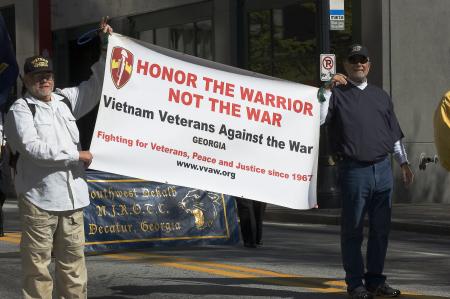
Vietnam Veterans Against the War at 2009 Atlanta Veterans Dav Parade. Photo by David Howell.

Veterans' movements from the professional military of contemporary wars, such as Iraq Veterans Against the War and March Forward, as well as from the Vietnam era, are still out in the streets opposing imperialist wars, and public opinion polls reveal that over 60% of the American people oppose the Afghan adventure.

Despite the colossal damage the U.S. inflicted on Vietnam and its people during the war years, the country has emerged from the ashes and is taking steps toward becoming a relatively prosperous society led by the Communist Party. The Hanoi government has received no help from Washington. During the Paris Peace Talks of 1973, Nixon promised Prime Minister Pham Van Dong in writing that the U.S. would pay Vietnam $3.5 billion in reparations. This promise turned out to be worthless.

What strikes visitors to Vietnam in recent years, including this writer, is that the country appears to have come to terms with what it calls the American War far better than America has come to terms with the Vietnam War. Despite the hardships inflicted upon Vietnam, the government and people appear to hold no grudges against the United States.

Hanoi has several times extended the welcome mat to former antagonists, urging Americans and residents of southern Vietnam who now live abroad to "close the past and look to the future." Wherever touring U.S. citizens -- including former GIs -- travel in Vietnam, they are met with the same respect as visitors from other countries.

In the U.S., the Vietnam war still evokes fighting words in some quarters. Some Americans still argue that the U.S. "could have won if it didn’t have one hand tied behind its back" (i.e., used nuclear weapons), and some continue to hate the antiwar protesters of yesteryear, just as they do demonstrators against today’s wars. And some others -- in Congress, the White House and the Pentagon -- still seem to continue fighting the war by organizing a massive propaganda effort to distort the history of Washington's aggression and unspeakable brutality in Vietnam.

[Jack A. Smith was editor of the Guardian -- for decades the nation's preeminent leftist newsweekly -- that closed shop in 1992. Smith now edits the Hudson Valley Activist Newsletter. Read more articles by Jack A. Smith on The Rag Blog.

The Rag Blog

[+/-] Read More...

06 December 2011

Harry Targ : Vince Emanuele, Anti-War Vets, and the 99%

Anti-war vet Vince Emanuele. Photo by Jessica A. Woolf / nwtimes.

Veterans unplugged:
Hoosier anti-war activist connects
returning veterans to the 99%


By Harry Targ / The Rag Blog / November 6, 2011

“I grew up in Chicago and Northwest Indiana. Working-class family, father was a Union Ironworker... mother was a stay at home Mom.” Vince Emanuele joined the Marines after graduating from high school. “I came out of boot camp a hard chargin’ Devil Dog.”

He served in the Marines from 2003 until 2005 stationed in California, Kuwait, and Iraq. His eight month deployment in Iraq involved him in street patrols, looking for snipers and land mines, “along with shooting at innocent civilians, destroying their property and beating up prisoners.”

While in Iraq the fascination with war that he had acquired as a kid playing video games dissipated. His father sent him reading material -- Noam Chomsky, Gore Vidal, Hunter Thompson, The Nation -- and he and friends began to reflect on what they were doing in Iraq. He came to the view that the war was “illegal, immoral, unjustified, and unneeded.” He was not spreading “democracy” or “peace” and the U.S. war effort was not winning the “hearts and minds” of the Iraqi people.

After returning to the U.S., Emanuele joined Iraq Veterans Against the War, has been organizing vets in Indiana and Illinois, created a weekly radio show called “Veterans Unplugged” which is available online, and has become a prominent activist for social, economic, and political justice in the heartland of America while finishing an undergraduate political science degree.

Emanuele recently spoke on a panel organized by the Lafayette Area Peace Coalition. He elaborated on the current plight of veterans, particularly veterans who served in the two longest wars in U.S. history, Afghanistan and Iraq.

While acknowledging that the current military force has chosen to enlist in regular army or reserve units, the 21st century enticement to serve is really an “economic draft.” With declining incomes, wages, job opportunities, and rising educational costs, more and more men and women, he said, have seen military service as the only escape from lives of economic marginalization.

He spoke of the culture of militarization to which every new recruit is exposed: a process of dehumanization; the spread of racism, particularly targeting stereotypes of Muslims; sexism; and homophobia. In reality the military experience of young people, Emanuele said, involves placing raw, uneducated, teenagers in a war zone, with weapons and a license to kill. The victims of the actions of these raw recruits, schooled in video games and super-patriotism, were the millions of Iraqi and Afghan citizens who most fervently wanted the young foreigners off their land.

Emanuele presented some figures on the impacts of military service on returning veterans. (According to the Bureau of Labor Statistics in 2010 there were 20.2 million men and 1.8 million women who had served in the military). In 2011, Emanuele reported:
  • Rates of unemployment of returning veterans from Afghanistan and Iraq are higher than in the non-veteran population, both men and women;
  • African-American vets experience double the unemployment rate of white vets;
  • 80,000 returning veterans are currently homeless (56 % of homeless vets are African American or Latinos);
  • 20% to 50% of 21st century returning veterans suffer some form of Post Traumatic Stress Syndrome (an estimated 350,000 to 1 million vets);
  • 1,000 returning vets attempt suicide each month.
Emanuele, connected the plight of returning veterans to the military-industrial complex and imperial wars. As a member of Iraq Veterans Against the War, he highlighted the long tradition of soldiers resisting participation in unjust wars. He referred to patterns of resistance to war running throughout U.S. history:
  • In 1781 the Pennsylvania militia mutinied against war profiteers and for food;
  • Between the 1870s and the 1890s, National Guard soldiers often refused to fire on striking workers;
  • In 1919 unknown numbers of U.S. soldiers refused orders to go fight against the Bolsheviks who had come to power in Russia;
  • Thousands of World War I veterans, known as the Bonus Army, assembled in Washington D.C. in 1932 to demand back pay due them from their active duty experience;
  • From 1964-75 a massive GI anti-Vietnam war resistance movement emerged with over 300 GI anti-war newspapers produced, 10 % of all Vietnam era soldiers going AWOL or deserting, and a broad array of other forms of anti-war resistance and opposition to military recruiting.
Emanuele stressed the commonality of experience and vision that is shared by most veterans with the Occupy Movement. He suggested that peace and justice activists must understand that returning veterans are a vital part of the 99% movement committed to radically restructure American society.

He argued that the 99%, including vets, must see the vital connections between the global capitalist system, the military-industrial complex, and the pain and suffering that have generated war and economic insecurity in the 21st century.

Emanuele ended his talk with reference to the frank admission of General Smedley Butler who oversaw the effort to crush the army of Augusto Sandino in Nicaragua in the early 1930s. Butler admitted that he, as a Marine General, had served as an instrumentality of Wall Street, putting down popular rebellions in the service of profit.
  • To learn more about Vince Emanuele and his weekly radio show check out Veterans Unplugged.
  • To learn more about Iraq Veterans Against the War, go to the IVAW website.
[Harry Targ is a professor of political science at Purdue University who lives in West Lafayette, Indiana. He blogs at Diary of a Heartland Radical -- and that's also the name of his new book which can be found at Lulu.com. Read more of Harry Targ's articles on The Rag Blog.]

The Rag Blog

[+/-] Read More...

15 November 2011

Susan Van Haitsma : Anti-War GI's March in Killeen Vets Day Parade

Representatives of IVAW and Under the Hood Cafe marched in the Killeen Veterans Day Parade. Photo by Susan Van Haitsma / The Rag Blog.

The burdens of war:
Anti-war GI's on Veterans Day


By Susan Van Haitsma / The Rag Blog / November 15, 2011
See more photos by Susan Van Haitsma, Below.
KILLEEN, Texas -- Usually Veterans Day bums me out big time. War is the worst human invention I know. Sacrificing the lives of young adults to "protect my way of life" is false and backward. I don’t know how to thank veterans for their sincere motivation to help the world when consequences of their roles as soldiers have been so harmful to the world and to themselves.

This Veterans Day, I had an opportunity to reconcile these sentiments in the heart of Texas, in the small town that contains the largest military base in the world.

Staff and volunteers with Under The Hood, the GI Rights Center and Café in Killeen, Texas, teamed with members of the Ft. Hood chapter of Iraq Veterans Against the War (IVAW) to march in the Killeen Veterans Day Parade, and they invited supporters to join them. Several of us drove up from Austin to take part.

The parade entry was designed to promote IVAW's Operation Recovery project, a campaign for service members’ right to heal. The campaign is calling for increased health services for traumatized troops instead of continued deployments. Surely this is a reasonable demand.

To dramatize the message in the parade, four soldiers marched single file, carrying full army duffel bags on their backs. The bags were labeled “Trauma,” “PTSD,” “MST" (Military Sexual Trauma, and “TBI” (Traumatic Brain Injury). Each bag was also ringed with the word, “Stigma” in bold lettering.

The symbolism of the burdens of war borne by soldiers provided a strong visual message. The soldiers also carried signs calling on Ft. Hood’s base commander, General Donald Campbell, to stop deploying traumatized troops from Ft. Hood.

We civilian supporters walked with the soldiers, carrying an Operation Recovery banner and distributing fliers to the parade audience about Operation Recovery and Under The Hood. We weren’t sure how we would be received by the crowd lining the parade route, but even with red, white and blue everywhere, people were overwhelmingly receptive.

As the parade wound its way through Killeen’s modest downtown streets, we passed deserted storefronts and saw many signs of economic struggle. War does not profit the warrior.

A press release about our parade entry was issued just before we walked the few blocks from Under The Hood, across the railroad tracks to the parade lineup. A local ABC-TV affiliate responded, and a reporter came to the café after the parade. Iraq war vets, Kyle and Curtis, gave excellent interviews for a good report that ran on the evening news and the KXXV-TV home page.

After the interviews, we hung around the café and talked, readying things for the evening’s special Veterans Day poetry event hosted by the phenomenal Killeen poetry slam group. My feelings about the day’s events seemed to find expression in the poems I heard that night. Truths were spoken about military life, death and injury, separation and reconciliation, love and pain. We were drawn together: soldier and civilian, gay and straight, youngadults and older ones.

Under The Hood is a busy place, with lots of good things happening. Current events include weekly “Ribs ‘n Rights” nights, twice monthly poetry slams and an upcoming Warrior Writers workshop. They recently held a community art show and Combat Paper workshop.

Check out www.underthehoodcafe.org to find out more about Under The Hood, and go to www.operationrecoverycampaign.org to register your support for service members’ right to heal.

[Susan Van Haitsma is active in Austin with Sustainable Options for Youth and CodePink. She also blogs at makingpeace. Find more articles by Susan Van Haitsma on The Rag Blog.]
Photos by Susan Van Haitsma / The Rag Blog.

The Rag Blog

[+/-] Read More...

22 November 2010

Clare Bayard : Veterans and the Healing Process

AWOL soldier Jeff Hanks speaks about the effects of PTSD on his family, Nov. 11, near Ft. Campbell in Oak Grove, Ky. Photo by Robert Smith / AP.

Healing from empire:
Anti-war veterans redefine Veterans Day


By Clare Bayard / The Rag Blog / November 22, 2010
“Today we are asking for more than a moment of silence. We are demanding justice.”
This statement, published in a Veterans' Day open letter from the Central Illinois chapter of Iraq Veterans Against the War (IVAW), reflects the spark lit in cities across the country for Veterans Day this year.

Last Thursday, anti-war veterans and their supporters marked Veterans Day with a range of coordinated events around the country. Until the 1950s, November 11th was known as Armistice Day to commemorate the end of World War I. This year, members of IVAW and their civilian allies evoked the original meaning of this holiday through building up Operation Recovery, a campaign to transition this country out of our declared “endless war” and heal some of its wounds.

Operation Recovery: End the Deployment of Traumatized Troops was launched this past October 7th, on the tenth anniversary of the Afghanistan War. It seeks to end the military's abusive practices of deploying soldiers suffering from trauma, including Post-Traumatic Stress Disorder (PTSD), Traumatic Brain Injury (TBI), and Military Sexual Trauma (MST).

IVAW's research estimates that approximately 20% of active duty troops are suffering from untreated trauma; many servicemembers have shared stories of being denied treatment as well as being punished and mocked for seeking it, even as military suicides continue to rise.

This campaign is one step towards IVAW's broader goals to not only ensure the right of servicemembers to heal, but also to end the wars and occupations, deliver reparations to Iraq, and hold accountable the people who are responsible.

Operation Recovery events included an art opening and Warrior Writers workshop in Chicago; street outreach in New York, Philadelphia, Champaign-Urbana, Illinois, and Manhattan, Kansas; outreach on bases to active duty soldiers at Fort Riley, Kansas, and Fort Lewis, Washington; teach-ins and organizing meetings in Savannah, Georgia and San Francisco; and the public surrender of an injured AWOL soldier at Ft. Campbell, Kentucky.


Picture this when you think of Veterans Day

Among this year's Veterans Day events for Operation Recovery, Army Specialist Jeff Hanks publicly surrendered during a press conference across from Ft. Campbell, Kentucky. Spc. Hanks went AWOL to resist redeployment to Afghanistan this fall after the military refused to treat him for severe PTSD. Supported by military and civilian allies alike, Hanks and other veterans testified about the military's negligent and often abusive treatment of even severely traumatized soldiers seeking care.

Spc. Hanks decided he wanted to turn himself in publicly to draw attention to these widespread practices. Hanks, his wife Christina, and their two young daughters are still awaiting the Army's verdict, trying to keep up hope despite their anxiety. If he is court-martialed, he could face up to two years in prison, and a lifetime felony conviction on his record. At worst, the Army could attempt to forcibly deploy him again.

At the gates of Ft. Campbell, 25 supporters from across the Southeast stood with Jeff Hanks as he told his story to 15 news cameras. Another AWOL soldier from his unit traveled to join the rally, disclosing similar experiences. One supporter explained that her husband, who is currently deployed, was sent against medical advice. Over the last week, a number of other soldiers gone AWOL from the 101st due to mental health struggles have reached out to Operation Recovery for support.

Visibility and support are important factors that can influence the morale of traumatized troops and their families, and can also impact the military's treatment of people who go public. Aaron Hughes of IVAW shared with supporters the fact that “Jeff's command was extremely hostile when he turned himself in on Veterans Day, but after [Jeff was interviewed by Katie Couric in a] CBS story aired on Friday, they changed their tune.”

At the same time, Operation Rescue unfolded in other forms around the country. On the University of Illinois campus in Champaign-Urbana, IVAW members and civilian antiwar organizers publicly mounted a large display board that counted Army suicides during the past year, with 334 bold tally marks. The striking art drew veterans, students (including Iraqi-Americans), professors, and workers into conversations with the organizers.

“It felt like an important presence to have because there were so many pro-military groups, including the military themselves, who were there using the day to drum up support for the wars. We effectively inserted a different understanding of what it means to support the troops, which is to bring them home,” said Sarah Lazare from the Civilian-Soldier Alliance that helped organize the event.

In San Francisco, 50 people -- from a range of veterans' and civilian organizations -- gathered to launch Operation Recovery on the West Coast. IVAW members traveled from four states across the West. Leaders visited from Coffee Strong, the G.I. Coffeehouse at Ft. Lewis, Washington, that provides critical support and community to questioning soldiers.

IVAW members explained the campaign and discussed local strategy with people from over 15 organizations and at least five cities. Thursday's event built on the momentum of the previous Sunday's annual Veterans Day march in San Francisco. This year kicked off a multi-year set of healing ceremonies and events led by veteran and non-veteran members of the Ohlone Nation, working alongside Veterans for Peace.


Veterans breaking the silence

The November elections revealed a striking wall of silence around war as a campaign issue. Politicians across the spectrum seem to be finding it expedient to keep people from thinking about or discussing the wars. At the same time mainstream coverage of PTSD and other health issues for veterans has increased.

The various forms of violence that people experience in the military -- and how bringing the war home effects them -- have long been taboo subjects in this country. But veterans and their loved ones are refusing to stay quiet about these important issues. And the increasing visibility of this campaign is not only raising public awareness, but it is also helping to break through the isolation that so often effects traumatized servicemembers and their families.

“We're excited to help Jeff get the help he needs, but this is not over. We intend to hold the people responsible for this accountable,” says Chantelle Bateman, a field organizer with Iraq Veterans Against the War who accompanied Spc. Hanks into Ft. Campbell as he surrendered himself.


Nobody is a bystander

This moment calls for the mass participation of veterans, their families and friends, and everyone who is looking for ways to actively reclaim this country from war. Operation Recovery offers concrete and powerful ways to involve a real grassroots movement in turning the tide. IVAW encourages veterans and their communities to contact them directly. The rest of us have a number of ways to support war resisters who are pushing back from inside the military.

Here are some ways to get involved:
  • Sign the Pledge and learn more about IVAW's work and the campaign.
  • Support Operation Recovery and Spc. Jeff Hanks financially.
  • Raise funds through raising awareness in your own circles, and bringing your community into the loop: Hold a house party for Operation Recovery (contact IVAW field organizer Joe Callan at zkjcallan@ivaw.org).
  • Write a supportive letter to Spc. Jeff Hanks and his family, as his wife Christina has requested. Even a quick note makes a difference. Email to: CMH1more30@yahoo.com.
  • Help us build networks of skilled people who can provide health services and other basic needs to support veterans transitioning to civilian life. The campaign team is plugging in lawyers, therapists, doctors, acupuncturists, and others who are donating their talents to this cause.
It's time to turn away from war and towards healing and rebuilding.

[Clare Bayard organizes with the Catalyst Project and War Resisters League, building a G.I. resistance movement that challenges U.S. empire, and connecting domestic racial and economic justice organizing with international movements against militarism.]
  • Those in the Austin area can also support Under the Hood, the GI Coffeehouse at Ft. Hood in Killeen.
The Rag Blog

[+/-] Read More...

25 August 2010

BOOKS / Mariann G. Wizard : The Odyssey of Our Winter Soldiers


Nancy Miller Saunders' Combat by Trial:
Documenting 20th century 'winter soldiers'


By Mariann G. Wizard / The Rag Blog / August 25, 2010

Combat by Trial: An Odyssey with 20th Century Winter Soldiers by Nancy Miller Saunders. (iUniverse, Inc., 2008.) 591 pp, $34.95. Available at www.iuniverse.com.

Turning the Guns Around: Notes on the GI Movement by Larry G. Waterhouse and Mariann G. Wizard (Praeger, 1971). 221 pp., published at $6.95.


In 1971, my second husband and good friend Larry Waterhouse and I, through a fortuitous series of chances and choices, wrote a book on antiwar activity in the U.S. armed forces for a respected New York publisher. Turning the Guns Around: Notes on the GI Movement (Praeger) was researched and written entirely in four months to conform to a deadline occasioned by the failure of a previously contracted writer to deliver a manuscript.

Following Robert Sherrill's successful Military Justice is to Justice as Military Music is to Music (HarperCollins,1970), Praeger was eager to jump on the military dissent bandwagon, and to fill the hole in their spring line-up.

Turning the Guns Around gave 'em more than they bargained for. With chapter titles like, "Gen. Baconfat vs. the Red Menace" and "Today's Pig is Tomorrow's Bacon," and copiously drawing from the irreverent and often profane underground GI press of the day, we proclaimed the entry of activist grunts, swabbies, jarheads and/or flyboys, along with some servicewomen, into the ranks of revolution.

Drafted out of graduate school at UT Austin on November 25, 1969, Larry made no secret of his sympathy for Vietnam's National Liberation Front during induction and basic training. As a result, he spent his entire 14-month military career at Ft. Ord, California, near Monterey.

By the time I joined him the next summer, he'd made the transition from leadership in UT's Students for a Democratic Society (SDS) to leadership in the Ord chapter of Movement for a Democratic Military (MDM). The group rented a house off-post where off-duty soldiers could meet, hang out, and talk; published an erratic newspaper; and engaged in anti-war actions as well as solidarity actions with, groups like the lettuce-boycotting Farmworkers Union, protesting the enormous amounts of lettuce being served in Army mess halls.

We had each worked with individual anti-war vets in Austin, and with anti-war GIs somewhat through the Oleo Strut, an anti-war coffeehouse in Killeen, Texas, near Ft. Hood, and knew from history the potential importance of rising dissent within America's armed forces.

Despite rising rapidly to a responsible and even rather sensitive position in Ft. Ord's payroll office, Larry never earned a stripe, remaining a proud buck private throughout his military servitude. His only bling was a Sharpshooter medal.

We signed our book contract at Christmas in 1970, in a Houston hospital, at the bedside of his Mom, who we thought might not live to see the book (she did). We'd flown to Texas on emergency leave when Gretchen had a heart attack, but tried to save money on the way back by delivering a "drive-away" car to Los Angeles. This became a marathon trip-from-Hell that landed us back in Monterey on Jan. 2, 1971, at about 4 a.m. I fell into bed. Larry put on his uniform and went to work.

An hour or so later he woke me with amazing news: he was being summarily, and honorably, discharged. Apparently the brass didn't want an active duty private authoring a book about dissent in the armed forces!

Back in Austin, we finished the book, found a place to live, figured out what was next in terms of employment and school, and along the way met and started working with a good-natured Army vet, Terry DuBose, to organize an Austin chapter of Vietnam Veterans Against the War (VVAW).

It wasn't long, however, until we found ourselves in the best place organizers can be: not needed. By the fall of 1971, VVAW was an organization of, by, and for combat vets and their spouses, and Larry and I were politely asked to step out. We continued opposing the seemingly endless Vietnam conflict in other ways.

VVAW continued to emerge as a leading anti-war organization, especially as the beleaguered student movement imploded, until the war finally ended and the last U.S. troops came home.

Nancy Miller Saunders' memoir, Combat by Trial, tells VVAW's story not only from her point of view, that of a non-veteran "insider," but also, by skillfully interweaving the stories of veterans, government documents and vintage press reports, paints a collective memoir of a very crazy time. She was not, and does not present herself, as a VVAW leader, but was a trusted collaborator and confidante of many of VVAW's key players, especially in the Southern region, over several years.

The liberal film school graduate encountered VVAW as a member of Winterfilm, a collective documenting testimony at VVAW's first nationally-noted action, the Winter Soldier Investigation.

Held in late January and February 1971, WSI grouped combat vets by service and division to give public testimony about atrocities and war crimes in which they had participated, and/or had witnessed. The first panel was made up of veterans of the Marine Corps' highly decorated First Division that had been in Vietnam since 1965.

From painfully detailed testimony in this and subsequent panels a pattern of officially-sanctioned brutality over overlapping tours of duty emerged, demonstrating unequivocally that the recently-revealed massacre at My Lai had been no accident, and no particular exception.

Saunders describes the haggard, haunted, but still child-like men who made these bloody confessions, and her own growing awareness that these gallant, all-American boys had been maimed not only, all too often, in their bodies, but in their souls. VVAW's quest for an end to the war was at once a quest for their own healing, and for the healing of a nation.

Describing her journey, that of her then-partner, Arkansas VVAW coordinator Don Donner, and of VVAW as a whole from concerned patriots to targets of government intrigue, Saunders dips willingly into her own interpretations, but takes care to label them as such, urging readers to draw their own conclusions.

Her point of view differs from mine, for example, on the role of more radical anti-war groups, who she generally regarded then and now as "crazies" who drew attention from VVAW's powerful statements and needlessly endangered peaceful protesters. However, her own militancy was raised by threatening events and the intense persecution of VVAW. This internal shift, from being a total pacifist to someone who, on occasion, could not sleep without knowing that a loaded pistol was within reach, is powerfully evoked.

The book made me remember walking into the MDM house in Monterey for the first time and seeing the sandbags lining the walls to protect against occasional drive-by shootings. The story of her and Donner's reception by the New Orleans "Red Squad" gave me a chill; the Monterey police department knew of my arrival almost before I did.

If you are among those who can't imagine what led some anti-war protesters of the 1960s and 1970s, as well as Black liberationists, to consider violence, this book is "must reading"! The short version: the U.S. government, through its willful lies, delusional fantasies, and brutally destructive acts, brought much enmity upon itself.

Turning the Guns Around. Dell paperback edition.

Those who read with interest in The Rag Blog about Federal Bureau of Investigation informer Brandon Darby and the impact of his unmasking will be fascinated with the story of VVAW's snitches. Even now, with the perspective of years and Saunders' deep research into FBI files, the motivations of such individuals remain obscure, but the VVAW experience demonstrates that this must be a secondary consideration.

Deliberately false "intelligence" was the result of a political program that aimed to destroy VVAW's credibility through accusations of planned violence and expensive trials, draining group resources. That this was accomplished, in part, through the testimony of paid informers and provocateurs worked eventually to bring in "not guilty" verdicts for most VVAW members charged with crimes, but the damage had been done. The question of how to defend against such betrayals remains open, and urgent.

In the biggest legal case, veterans were charged with conspiring to riot at the 1972 Republican National Convention in Miami. The trial of the Gainesville 6, that then became the Gainesville 8, and of the "Forgotten 4," involved Austin's own "movement lawyers," most notably Cameron Cunningham for the defense.

Saunders recalls the bickering between and among defendants and defenders; between VVAW's southern regional leaders -- most of those accused in the case -- and its compromised national office; as well as the convoluted legal wrangling that led to complete acquittal in Gainesville -- but only after the RNC was over and Nixon anointed once more as the nominee.

Although Saunders and Donner were not active here, Austin VVAW's actions are amply chronicled, largely through Saunders' conversations with and letters from local leader John Kniffen, one of the Gainesville 8, as well as through her direct observations of VVAW actions in the Dallas-Ft. Worth area and in Killeen.

Kniffin, a taciturn, wiry, former tank commander who did 32 months in-country, joined Austin VVAW in 1971, and became a force regionally, and then in national VVAW, where he demanded -- and got -- more democratic decision-making.

His recollections, and those of his widow, Cathy, who continues, after John's death from Agent Orange exposure, to work for veterans' rights, brought back vivid memories of actions here in which Larry and I participated, the most awesome of which was a gigantic outpouring of peace and justice forces at the official dedication of the Lyndon Baines Johnson Presidential Library, attended by a Who's Who of U.S. imperialism, including then-President Richard "Tricky Dick" Nixon.

While there are a few errors that old Austinites will readily spot (e.g., the University's West Mall is referred to repeatedly as the East Mall), it's also fun figuring out who certain unnamed activists must be, simply from their descriptions.

In what I believe to be an original contribution, using FBI and press reports, Saunders alluringly links dirty tricks played against VVAW with Nixon's Watergate burglary team. Offices and homes of VVAW members and attorneys were burgled, especially in Florida, where Nixon's plumbers were based; as in the better-known Washington, D.C. break-ins that ultimately brought down the President, only certain papers were stolen.

In the weeks before the 1972 national political conventions, both of which were in Miami, Florida leaders of VVAW were in discussion with Democratic Party headquarters -- one of the targets of Nixon's buggers -- about security for demonstrators ("nondelegates") who would attend. Democrats feared, and hoped to avoid, a repeat of the 1968 Chicago convention debacle, where anti-war youth had been clubbed through the streets on national television.

Was this discussion the reason Nixon bugged Democratic Party HQ? Did the same crew that burgled Pentagon papers whistle-blower Daniel Ellsburg's psychiatrist's office burgle VVAW files in Gainesville? Did Nixon hope to tie national Democratic leaders to VVAW's alleged conspiracy to riot? While no conclusive proof is presented, "coincidences" of timing and personnel movement are compelling. Has anyone offered a more reasoned explanation of what Watergate was all about?

Saunders also presents evidence that on at least two occasions, VVAW's release of information gleaned from active-duty contacts (the anti-war movement within the military having continued to grow despite its own problems and persecutions) about U.S. troop and materiel build-ups prevented the war from being intensified on Nixon's watch, rather than eventually being abandoned. This seems a plausible enough reason for the vengeful, plotting Nixon to want the organization destroyed!

The collective nature of Saunders' memoir is its true strength. By giving free voice to the many vets who entrusted her with their papers, their unpublished memoirs, their own FBI files, etc., she avoids the self-centered quality common in such memoirs, while still allowing herself free voice.

She knows that no one person has the full story, and in fact not even a group of people such as she draws from see everything that happened around them and to them. Part of the immense satisfaction I found in the book came from seeing other views of events I had seen peripherally, in a time that seems both very long ago and strangely like this morning.

In a funny circle-of-life coincidence, a bus Terry DuBose drove with other veterans to Washington, D.C. -- a bus belonging to John Kniffin -- and wrote about in an epilogue for Turning the Guns Around, pops up in Nancy's book, stranded by the side of the road, from a completely different source.

DuBose electronically introduced me to Saunders and her husband, Budd -- a sometimes contributor to The Rag Blog from rural "Arkansaw" -- a year or so ago, which is how I heard about her book, and requested a swap. As a sometimes self-published author myself, I'm happy to recommend this Internet publication in overall quality and value.

You'll find as many typos in any book these days, and none of Saunders' are very off-putting. Spelling errors, etc., in sources quoted, add, in several cases, to the authenticity of her documentary. Saunders still sees life through a film editor's eye, and has a good gift both for description, especially of people and the places where action takes place, and for dialogue, as well as voluminous resources.

Turning the Guns Around was a snapshot of an emerging movement, a Rorschach blot of a moment. Combat by Trial is a deeper, longer, and more nuanced look at that same movement -- military opposition to U.S. military adventurism -- as it grew, rose, and fell in the 1970s.

Now it is rising again, in our younger brothers and sisters, sons and daughters, who have been to war in the cauldrons of Iraq and Afghanistan. Saunders doesn't shy away from drawing parallels between Vietnam and the "Afraq" conflicts, and I will not shy away from pointing out that Turning the Guns Around predicted these wars in some detail 39 years ago. Unlike some Vietnam-era memoirs, Combat by Trial has plenty to offer today's peace warriors.

[Mariann Wizard, a Sixties radical activist and contributor to The Rag, Austin's underground newspaper from the 60s and 70s, is a poet, a professional science writer specializing in natural health therapies, and a regular contributor to The Rag Blog.]

The Rag Blog

[+/-] Read More...

23 August 2010

Alice Embree : Protesters Block Fort Hood Troop Deployment

Participants in the blockade action at Fort Hood, Texas, on August 23, 2010. Left to right: Iraq Veterans Bobby Whittenberg-James and Crystal Colon, Jeff Grant, Military Spouse Cynthia Thomas and Afghanistan Veteran Matthis Chiroux. Photo from Fort Hood Disobeys.

Protesters at Fort Hood in Killeen
Block buses deploying troops to Iraq


By Alice Embree / The Rag Blog / August 23, 2010

KILLEEN, Texas -- Under darkness at about 4 a.m. this morning, buses carrying the 3rd Armored Cavalry Regiment (3rd ACR) to planes were stopped by a group of five protesters that included two Iraq veterans, one Afghanistan veteran, and one military spouse whose husband had been deployed to Iraq three times.

The Fort Hood Disobeys group clambered down from a highway overpass where supporters held banners and signs. Holding banners that said, “Occupation is a Crime” and “Please Don’t Make the Same Mistake We Did. RESIST NOW,” the protesters spread across Clarke Road. Police with automatic weapons and dogs beat them out of the roadway. They were not arrested.

Deployments are usually scheduled for the afternoon with family members present as soldiers board the buses. Whether this deployment left in the dead of night because of planned protests is unknown, but averting media attention was undoubtedly part of the Army calculus.

As the corporate media heralds the “end of combat missions,” the truth about the troops deploying to Iraq has not made mainstream news. Two more deployments of the 3rd ACR, a combat regiment, are scheduled this week. The total 3rd ACR troop deployment to Iraq from Fort Hood will be about 3,000. These will be added to the 50,000 troops remaining.

“Operation New Dawn” is the new brand for the U.S. occupation in Iraq. As combat deployments continue, it rings as hollow as George Bush’s proclamation of “Mission Accomplished.”

Two more upcoming events are aimed at peeling back the mass deception surrounding the “end of combat operations.”

Dahlia Wasfi, an Iraqi-American doctor, will speak next Sunday in Austin about the U.S. Policy in Iraq: A Humanitarian Disaster. The event is co-sponsored by Texas Labor Against the War and CodePink Austin and will take place at the Texas State Employees Union meeting hall, 5 p.m., Sunday, August 29, 1700 South First, Austin.

The following morning, there will be a press conference at Under the Hood GI Cafe in Killeen that will highlight many facets of the Iraq debacle, including the impact on soldiers, military families, Iraqis, and funding to meet domestic needs. Dahlia Wasfi will speak at this press conference and will be joined by Rep. Lon Burnam from Fort Worth, Texas. Representatives from several groups including Iraq Veterans Against the War, Veterans for Peace, CodePink, and Texas Labor Against the War will be present. The press conference will take place at 10 a.m., Monday, August 30, Under the Hood, 17 South College, Killeen, Texas.

[Alice Embree is a long-time Austin activist and organizer, a former staff member of The Rag in Austin and RAT in New York, and a veteran of SDS and the women's liberation movement. She is a regular contributor to The Rag Blog and is treasurer of the New Journalism Project.]

Following are personal statements from four of the participants in the action:

Bobby Whittenberg-James:
I am a Marine veteran of the war against the people of Iraq, a Purple Heart recipient, and a third generation military service member. I joined the Marines in June of 2003, believing the lies about weapons of mass destruction and an imminent threat to our safety. I have since come to learn that these wars and occupations do not keep the people of the United States or the Middle East safe, but instead serve the interests of politicians, capitalists, and corporations: the ruling elite.

These unjust wars and occupations rob the people of Iraq, Afghanistan, Pakistan, and Yemen of their dignity and their right to self-determination and serve to make the people of both the Middle East and the United States less safe. They also serve to further destabilize a region that has suffered under the boot-heel of western colonialism for over a century. The U.S. Empire also supports both financially and militarily the brutal apartheid regime that occupies Palestine. All of this is done in our name with our money, and I am here to say "Not in my name!"

The recent information leaks about the U.S. Empire's wars lay bare their war crimes and crimes against humanity. We must face the truth, even if it makes us uncomfortable or shows us something about ourselves that we don't want to see. When we find the truth, we must respond accordingly. I will not be complicit in the killing of people. Since I do not believe that the government or the capitalists will end these wars, I will vote with my body.

Bobby Whittenberg-James
Disobedient
Crystal Colon:
I was a sergeant in the Army for five years, stationed at Fort Hood the entire time, save two deployments to Iraq totaling 26 months. I was a Signal Support Systems Noncommissioned Officer, coordinating communications for various commands. I was honorably discharged in Jan., 2010, and have been organizing in the veterans peace movement ever since.

I first began to question the war in Iraq during my first deployment in '05-'06. After my friend Robbie was killed, I was very deeply affected. I started questioning why we were in Iraq. It felt like he had died for nothing. After returning from Iraq, I planned to leave the military. I was stop-lossed and forced to return to Iraq for 15 months, in total held beyond the length of my enlistment more than 450 days. Since leaving the military, I have been active with the veterans peace movement, speaking out about my experiences and supporting troops who refuse to fight.

I am doing this today because I can't allow this war in which I have fought to continue. I can't allow other soldiers to make the same mistake I did, deploying in support of a war crime. As a veteran of Iraq, how could I not do this today? For the people I helped occupy, for the friends I lost and stilI have over there, for the soldiers on those buses. How could I not do this today? I should have disobeyed. I should have never boarded those buses to Iraq. I wish someone had tried to stop me.

Crystal Colon
Disobedient
Matthis Chiroux:
I am a former Army sergeant and war resister. I was press-ganged into the Army by the Alabama Juvenile "Justice" System in 2002. While in the military, I occupied the nations of Japan and Germany for more than four years, with shorter tours in the Philippines and Afghanistan. I was a Public Affairs noncommissioned officer specializing in strategic communications. In reality, I was a propaganda artist. I was discharged honorably to the Individual Ready Reserve in 2007.

While I have always been against the war in Iraq, I began resisting it actively in 2008, after I received mobilization orders for a year-long deployment to Iraq. I refused those orders in Congress in May of 2008, calling my orders illegal and unconstitutional. I believed appealing to Congress would end the war. When 13 Members signed a letter of support for my decision and sent it to Bush, I thought we had won a victory for peace. This was more than two years ago. The president has changed, and the wars and destruction drag on.

Today, I am blocking the deployment of the 3rd Armored Cavalry Regiment with my fellow vets and military family members because the wars will continue to victimize our communities until we halt this bloody machine from within. I am putting my body on the line in solidarity with the people of the Middle East, whose bodies have been shot, burned, tortured, raped, and violated by our men and women in and out of uniform. I cannot willfully allow Americans in uniform to put their lives and the lives of Iraqis in jeopardy for a crime. We are here because we have a responsibility to ourselves as veterans and as humans of the world. I will not rest until my people, ALL PEOPLE, are free.

In Struggle and Solidarity,

Matthis Chiroux
Disobedient
Cynthia Thomas:
I have been an Army wife for 18 years. My husband has been deployed three times since the wars began. During his second deployment, he was severely wounded and medevaced to Walter Reed Army Hospital on life support. Even though he had posttraumatic stress disorder and traumatic brain injury,and suffered three fractures in his back, three fractures on his pelvis, and countless other injuries, the Army deployed him a third time. This was devastating to our two daughters, our step-son and to me.

Three months after my husband deployed for the third time, our stepson called to inform me he was joining the Marines. That was the exact moment I realized that our children would be fighting these endless wars. I decided that I needed to start resisting.

The reason I am doing this today is because for the past three years that I have been speaking out and advocating for Soldiers, things have only gotten worse. I have heard countless stories from vets and activevduty soldiers that give people nightmares. I have heard stories from family members that would shock people awake if they would just listen! Our military community is being destroyed!

If these wars are destroying our soldiers and military families with 12 to 15-month, often repeat deployments, how do you think the Iraqi and Afghan people doing? They have been living these wars 24/7, 365 days a year for nearly a decade! My youngest daughter is an Operation Iraqi Freedom baby. She was less than one-year-old when her father left to invade Iraq. I look at her, and I see an Iraqi or Afghan child having to live in constant fear with no end in sight! I am doing this for our community, for my girls, for my husband and our Marine. I am doing this for the Iraqi and Afghan People. Enough is enough. If soldiers really want to go fight, they'll have to go through me.

Cynthia Thomas
Disobedient
The Rag Blog

[+/-] Read More...

Only a few posts now show on a page, due to Blogger pagination changes beyond our control.

Please click on 'Older Posts' to continue reading The Rag Blog.