Showing posts with label Nature. Show all posts

13 October 2011

Ellen LaConte : Finding Democracy in Unexpected Places

Single-celled amoeba called dictyostelium gather together and turn themselves collectively into a new creature: slime mold. Image from National Center for Biotechnology Information (NCBI).

Finding democracy in unexpected
-- and radically green -- places
What if nature -- life as we know it -- rather than our own history, provides 'the inspiration for genuine democratic thinking'?
By Ellen LaConte / The Rag Blog / October 13, 2011

[This post is adapted from Ellen LaConte’s article in the Fall/Winter 2011 issue of the international journal, Green Horizon.]
"Our capacity for democracy grows from our connection with nature. As we lose that connection, isolation, fear, and the need to control grow -- and democracy inevitably deteriorates. It’s easy to forget that a deep connection with nature provides the inspiration for genuine democratic thinking.” -- Peter Senge in Presence: Exploring Profound Change in People, Organizations and Society i
In my book Life Rules (the implication being that we don't), I make the case that the prognosis for global or even national-level solutions for the syndrome of economic, environmental, and political/social crises we presently face is poor.

I take the recent debt-ceiling fiasco as further proof of the pudding. Variously inept, corrupt, craven, bought and paid for, ideologically intransigent, and ignorant of or unwilling to face and make the electorate face hard realities, our leaders are evidently incapable of comprehending or coping with the complexity of the issues before them.

They fail to see, or at least fail to say that they see, the connections between and among these crises. They exhibit an almost pathological inability or refusal to recognize the seriousness of consequences of the convergence of these crises: economic and ecological breakdown and worldwide chaos.

Tackling these crises -- or at least seeming to -- only one at a time is equivalent to treating AIDS-related cancers without treating the recurrent pneumonia and wasting disease that are also symptomatic of AIDS.

Leaders of both major parties have chosen posturing and pandering as alternatives to governing and Greens haven’t yet the numbers, leverage, or heft to challenge them. For the major media, posturing and pandering are meat, potatoes, trifle, and a raison d’etre. For the American people they’re disastrous. Waiting for politicians and politics as we’ve known them to cure themselves of this life-threatening condition could prove fatal.

Taking to the streets as larger and larger numbers of Americans are, for a variety of causes ranging from climate change to oligarchy removal, is a start. It signals that a critical mass of Americans are dissatisfied.

But nonviolent protests may meet with dismissal at worst and minor concessions at best. Because, whatever else may be said of the present political “process” and the behaviors of the Powers in Washington, it’s not democracy. Genuinely democratic praxis is nowhere to be found inside the beltway. Representative Eric Cantor’s description of the Wall Street justice-and-democracy-starved occupiers as a “mob” is indicative of the present batch of powers’ perspective on the people they are supposed to represent.

As a set of behaviors and relationships that can help people talk through and across their differences, integrate their interests and skills, work for the common good, and organize otherwise fractious and factional humans in common cause, democracy is missing in action in America. It has been co-opted by globalized capitalism much as the human body is co-opted by HIV.

I think, however, that it’s not that democracy has failed us but our way of thinking about it that has. We might say of democracy what Gandhi said when asked what he thought of civilization: “It would be a very good idea.”


What democracy's not

So far we’ve gotten the idea wrong. We are accustomed to thinking of democracy as a noun. “A democracy” is a physical place, a nation with borders defined on a map such that if we are born within those borders we are somehow born into democracy too.

Democracy is a kind of protective covering “under” which we live, such that it will take care of us and keep us from harm. We treat it as if it were a possession. “Having it,” we are superior to those who don’t. We think of it as a right. Aside from being born within a particular nation’s borders and under the protection of that nation’s government, police, and military, we don’t have to do anything to get democracy.

In fact, we have very little to do with it. It’s just ours, by right. Nonetheless, we go to great lengths to “keep it,” including going to war for it or over it. And we’ve gotten into our minds and political discourse the notion that we ought to try to “give it” to others, as if it were a thing we could give like food or money or weapons.

But what if “democracy” is not a noun? What if, as Frances Moore LappĂ© and I have proposed in our books Democracy’s Edge and Life Rules, it’s more like a verb. What if it’s not something we have but something we do, together; how we organize ourselves and relate to and behave with each other?

And what if, as MIT management innovator Peter Senge suggests, we’ve been looking for democracy in the wrong places. What if nature -- life as we know it -- rather than our own history, provides “the inspiration for genuine democratic thinking”? And what if, as Hopi elders proposed some hundreds of years ago, what life tells us is that we really are the ones we’re waiting for.

African buffalo herds stand up and point themselves in the same direction. Image from redbubble.


Democracy all the way up...

It has long been assumed that most animal societies are organized as we are with powers and cowerers, doers and done to, top dogs and underdogs, alpha males and dominance everywhere you look. That view is changing.

Larissa Conradt, an evolutionary biologist at the University of Sussex, UK, writes that,
In social species many decisions need to be made jointly with other group members because the group will split apart unless a consensus is reached. Consider, for example, a group of primates deciding which direction to travel after a rest period, a flock of birds deciding when to leave a foraging patch, or a swarm of bees choosing a new nest site. Unless all members decide on the same action, some will be left behind and will forfeit the advantages of group living. ii
And if too many are left behind the group will fall apart leaving the members in a state of chaos and confusion and at a survival disadvantage. Accordingly, “group decision-making is a commonplace occurrence in the lives of social animals.” iii

In studies of red deer conducted with her colleague Tim Roper, Conradt found that when it comes to making decisions about moving on from a resting place, feeding ground or watering hole, it’s not the sexually dominant alpha male or even a group of sexually-dominant males that make the decision when to go or even necessarily where.

Life has taught red deer the hard way that even the most experienced, strong, clever alpha might decide to move the herd based on nothing more than a sudden urge or misinterpreted sign of danger, even though many members of the herd are still thirsty, tired or hungry.

Barring clear and present danger, members of red deer herds, gorilla bands, African buffalo herds and other close-knit animal societies vote their readiness to move by standing up and pointing themselves in the direction they want to go. When a significant majority have stood and/or pointed themselves in the chosen direction, the group moves on together in the direction they’ve chosen together. In a statement that until recently the scientific community would have considered unorthodox or heretical, Roper and Conradt concluded that “democratic behavior is not unique to humans.” iv

Anna Dornhaus of the University of Arizona and Nigel R. Franks at the University of Bristol in the UK have found that some varieties of bees and ants engage in information pooling and consensus decision making. “Democracy is not something that humanity invented,” Dornhaus concludes.

Radio personality and author Thom Hartmann has written of this new understanding of animal behavior:
Without exception the natural state of group-living animals is to cooperate, not dominate. Democracy, it turns out, is hardwired into the DNA of species from ants to zebras. And it includes all of the hominids from the great apes to Homo sapiens. v

...and all the way down

Examples of democratic activity can be found at levels as far down Life’s food chain as microbes. “In recent years,” Werner Krieglstein wrote in Green Horizon Magazine,
scientists have documented a remarkable sequence of behavior that might well be suited to serve as a metaphor if not as a lived example for how we human beings can and should behave in times of need... Scientists observed this single cell organism cooperating in a quite extraordinary fashion when the food supply was running short.
Facing a life threatening famine, hordes of single-celled amoeba called dictyostelium gather from every direction and every part of famine territory and turn themselves collectively into a new creature: slime mold. “They group together, forming a community, to achieve goals they could not achieve by themselves.”vi

Microbiologist Mahlon Hoagland explains how this works: Recognizing pending catastrophe,
a single amoeba, apparently self-appointed, begins to emit a chemical signal. Near-by neighbors, irresistibly drawn to the signal "ooze" over and attach themselves to the signaler. Each new member of the cluster amplifies the signal by releasing its own signal. More amoeba arrive.
It’s sort of like a grassroots flash mob at this point.
Then a startling transformation occurs: The aggregate shapes itself into a slug and begins to migrate to a new location, leaving a trail of slime behind it. As the slug moves the cells differentiate into three distinct types,
each type taking up a task vital to the group’s survival.vii

They form a creature that looks like a tiny futuristic floor lamp with a base, a post, and a round, covered bulb. The base roots the slime mold in its new food-rich environment. The post raises the bulb high so that its equivalent of light will cover as large an area as possible.

And what’s the equivalent of light in this amoebic democracy analogy? Spores, like tiny eggs. Dispersed like photons in their new space when the bulb “turns on” and emits them, they become new single-celled amoebae. “And then the cycle begins anew.” Individuals do their own thing until collective -- democratic -- action is required again to deal with another shared crisis.


Dog, meet dog

Dog-eat-dog is, after all, an anomaly. It is not the state of nature. Something closer to democracy is. Red in tooth and claw is a human projection based on incomplete and inaccurate science and biased observation.

Carnivores for the most part turn on each other -- the weakened, wasting, wounded, or recently deceased -- only when there’s not enough else to eat. And that happens for the most part only when we or natural forces dramatically reduce their territory and/or sources of food. In other words when our activities and presence or natural cycles or cataclysms have caused Critical Mass.

Think urban feral dogs and cats, gorillas when the mist has gone away with the forests, wolves when wildfire or volcanic eruption clears the landscape of herds and small prey. But even in desperate times, most other-than-human species continue to cooperate more like those amoeba than like rabid packs of dogs. Why? Democracy is key to species survival.

We are about to learn that. If the protests in the American Street bear down hard on the Wall Street occupiers intent that Americans work together to “create a process to address the problems we face, and generate solutions accessible to everyone” rather than assuming any elected official or group of them will do these things for us, then we might gather to ourselves the courage and conviction necessary for a Second American revolution, this time not just to topple oligarchs but to declare independence from the Global Economic Order that they support so that it will continue to support them.

References

i Peter Senge, C. Otto Scharmer, Joseph Jaworski, Betty Sue Flowers,
Presence: Exploring Profound Change in People, Organizations and Society (Nicholas Brealey Publishing, 2005), p. 173.
ii From the website of the Center for the Study of Evolution at the University of Sussex, www.biols.susx.ac.uk/members/lconradt

iii Ibid.
iv Tim Roper and L. Conradt, “Group Decision-Making in Animals,”
Nature, 421 (January 2003): 155.
v Thom Hartmann,
What Would Jefferson Do? (Harmony Books, 2004), 141.
vi Werner Krieglstein, “How to Feel and Act Like an Amoeba,”
Green Horizon Magazine, Spring 2008.
vii Mahlon Hoagland and Bert Dodson,
The Way Life Works, (Three Rivers Press, 1995), 152-153

[Ellen LaConte’s book Life Rules: Why so much is going wrong everywhere at once and how Life teaches us to fix it (Green Horizon, 2010, orderable from all book sellers) from which parts of this post have been drawn has a diverse and deep list of supporters ranging from Richard Heinberg, Robert Jensen, and William Catton to John Cobb, Joanna Macy, and Derrick Jensen. She will be guiding workshops at the “Brave New Planet: Imagining Ecological Societies ” conference in Claremont CA, Oct. 27-29. Bill McKibben keynotes. McKibben, Cobb, and plenary speaker David Orr will participate in open discussions throughout the conference. You can link to podcasts of LaConte’s radio interviews at www.ellenlaconte.com. Read more articles by Ellen LaConte on The Rag Blog.]

The Rag Blog

[+/-] Read More...

14 August 2011

Robert Jensen : Nature Bats Last

"Celebrating Global Warming." Art quilt by Laura Wasilowski / PAQA.

Nature bats last:
Notes on revolution and resistance,
revelation and redemption


By Robert Jensen / The Rag Blog / August 14, 2011

[An edited version of this essay was presented as a talk to the Veterans for Peace conference in Portland, Oregon, on August 4, 2011.]

My title is ambitious and ambiguous: revolution and resistance (which tend to be associated with left politics), revelation and redemption (typically associated with right-wing religion), all framed by a warning about ecological collapse. My goal is to connect these concepts to support an argument for a radical political theology -- let me add to the ambiguity here -- that can help us claim our power at the moment when we are more powerless than ever, and identify the sources of hope when there is no hope.

First, I realize that the term “radical political theology” may be annoying. Some people will dislike “radical” and prefer a more pragmatic approach. Others will argue that theology shouldn’t be political. Still others will want nothing to do with theology of any kind. At various times in my life, I would have offered all of those objections. Today, I think a politics without a theology is dangerous, a theology without a politics is irrelevant, and radical is realistic.

By politics, I don’t mean we need to pretend to have worked out a traditional political program that will lead us to the land of milk and honey; instead, I’m merely suggesting that we always foreground the basic struggle for power in whatever work we do at whatever level. By theology, I don’t mean that we need to believe in supernatural forces that will lead us to a land of milk and honey; instead, I’m merely pointing out that we all construct a worldview that is not reducible to evidence and logic.

In politics and theology, it’s important to be clear about what we know, and even more important to recognize what we don’t know, what we can’t know, what is instinct and emotion.

And all this needs to be radical -- not in the self-indulgent “more radical than thou” style that crops up now and then on the left -- but rather in the sense of an unflinching honesty about that unjust and unsustainable nature of the systems in which we live. Whatever pragmatic steps we may decide to take in the world, they should be based on radical analysis if they are to be realistic.


Revolution

I’m not interested in speculating about future revolutions, I don’t take seriously anyone who predicts a coming revolution in the United States, and I doubt that the traditional concept of a revolution is even relevant today -- the dramatic changes that lie ahead likely won’t arrive that way. Rather than dream of revolutions to come, it’s more productive to think about the revolutions that brought us to this moment.

Ask an audience to name the three most important revolutions in human history, and the most common answers are the American, French, and Russian. But to understand our current situation, the better answer is the agricultural, industrial, and delusional revolutions. While those national revolutions had dramatic effects, not only on those nations but on the course of the history of the past two centuries, these other revolutions not only reshaped the lives of every human but remade the world in ways that may spell the end of human history as we know it. The agricultural, industrial, and delusional revolutions were -- to use a current political cliché -- real game-changers.

The agricultural revolution started about 10,000 years ago when a gathering-hunting species discovered how to cultivate plants for food and domesticate animals. Two crucial things resulted, one political and one ecological. Politically, the ability to stockpile food made possible concentrations of power and resulting hierarchies that were foreign to band-level gathering-hunting societies, which were highly egalitarian and based on cooperation.

This is not to say that humans were not capable of doing bad things to each other prior to agriculture, but only that large-scale institutionalized oppression has its roots in agriculture. We need not romanticize pre-agricultural life but simply recognize that it was organized in far more egalitarian fashion than what we call “civilization.”

Ecologically, the invention of agriculture kicked off an intensive human assault on natural systems. While gathering-hunting humans were capable of damaging a local ecosystem in limited ways, the large-scale destruction we cope with today has its origins in agriculture, in the way humans started exhausting the energy-rich carbon of the planet, first in soil.

Human agricultural practices have varied over time and place but have never been sustainable over the long term. There are better and worse farming practices, but soil erosion has been a consistent feature of agriculture, which makes it the first step in the entrenchment of an unsustainable human economy based on extraction.

We are trained to think that advances in technology constitute progress, but the post-World War II “advances” in oil-based industrial agriculture have accelerated the ecological destruction. Soil from large monoculture fields drenched in petrochemicals not only continues to erode but also threatens groundwater supplies and contributes to dead zones in oceans.

While it’s true that this industrial agriculture has produced tremendous yield increases during the last century, no one has come up with a sustainable system for perpetuating that kind of agricultural productivity. Those high yields mask what Wes Jackson has called “the failure of success”: Production remains high while the health of the soil continues to decline dramatically.[1]

That kind of “success” guarantees the inevitable collapse of the system. We have less soil that is more degraded, with no technological substitute for healthy soil; we are exhausting and contaminating groundwater; and we are dependent on an agriculture tied to a fuel source that is running out.

That industrialization of agriculture was made possible, of course, by the larger industrial revolution that began in the last half of the 18th century in Great Britain, which intensified the magnitude of the human assault on ecosystems and humans assaults on each other.

This revolution unleashed the concentrated energy of coal, oil, and natural gas to run the new steam engine and machines in textile manufacturing that dramatically increased productivity. That energy -- harnessed by the predatory capitalist economic system that was beginning to dominate the planet -- not only eventually transformed all manufacturing, transportation, and communication, but disrupted social relations.

People were pushed off the land, out of communities, and into cities that grew rapidly, often without planning. Traditional ways of knowing and living were destroyed, by force or by the allure of affluence. World population soared from about 1 billion in 1800 to the current 7 billion, far beyond the long-term carrying capacity of the planet.

This move from a sun-powered and muscle-based world to a fossil fuel-powered and machine-based world has produced unparalleled material comfort for some. Whatever one thinks of the effect of such levels of comfort on human well-being -- in my view, the effect has been mixed at best[2] -- the processes that produce the comfort are destroying the capacity of the ecosystem to sustain human life as we know it into the future, and in the present those comforts are not distributed in a fashion that is consistent with any meaningful conception of justice.

In short, our world is unsustainable and unjust -- the way we live is in direct conflict with common sense and the ethical principles on which we claim to base our lives. How is that possible? Enter the third revolution.

The delusional revolution is my term for the development of sophisticated propaganda techniques in the 20th century (especially a highly emotive, image-based advertising/marketing system) that have produced in the bulk of the population (especially in First World societies) a distinctly delusional state of being.

Although any person or group can employ these techniques, wealthy individuals and corporations -- and their representatives in government -- take advantage of their disproportionate share of resources to flood the culture with their stories that reinforce their dominance. Journalism and education, idealized as spaces for rationally based truth-telling, sometimes provide a counter to those propaganda systems, but just as often are co-opted by the powerful forces behind them.

Perhaps the most stunning example of this is that during the 2000s, as the evidence for human-caused climate disruption became more compelling, the percentage of the population that rejects that science increased.

Why would people who, in most every other aspect of life accept without question the results of peer-reviewed science, reject the overwhelming consensus of climate scientists in this case? Some have theological reasons, and for others perhaps it is simply easier to disbelieve than to face the implications. But it’s clear that the well-funded media campaigns using these propaganda techniques to create doubt have been effective.[3]

Even those of us who try to resist it often can’t help but be drawn into parts of the delusion; it’s difficult to keep track of, let alone understand, all of the fronts on which we are facing serious challenges to a just and sustainable future.

As a culture, these delusions leave us acting as if unsustainable systems can be sustained simply because we want them to be. Much of the culture’s story-telling -- particularly that which comes through almost all of the mass media -- remains committed to maintaining this delusional state. In such a culture, it becomes hard to extract oneself from that story.

Singer/songwriter Greg Brown captures the trajectory of this delusional revolution when he speculates that one day, “There’ll be one corporation selling one little box/it’ll do what you want and tell you what you want and cost whatever you got.”[4]

In summary: The agricultural revolution set us on a road to destruction. The industrial revolution ramped up our speed. The delusional revolution has prevented us from coming to terms with the reality of where we are and where we are heading.

Art and resistance: Mural on the Palestine Wall. Image from Tidings.


Resistance

Even if a revolutionary program is not viable at the moment, strategies and tactics for resistance are crucial. To acknowledge that the social, economic, and political systems that have produced this death spiral can’t be overthrown from the revolutionary playbooks of the past does not mean there are no ways to affirm life.

We face planetary problems that seem to defy solutions, but the U.S. empire and predatory corporate capitalism remain immediate threats and should be resisted. An honest, radical assessment of our situation doesn’t mean giving up, but it requires us to be tough-minded. We need to understand which resistance strategies and tactics are likely to be most productive at this moment in history.

To advance that discussion, let’s think back to February 15, 2003. Many of us on that Saturday participated in actions in opposition to the planned U.S. invasion of Iraq. It was an exhilarating day, the largest coordinated political protest in the history of the world.

At least 10 million people participated across the globe, with a clear message for U.S. policymakers: The invasion being planned is illegal and immoral, and we reject not only this war but your right to use violence to achieve your political and economic goals. I was the emcee of the event in Austin, and I remember being amazed at the thousands who gathered at the Texas Capitol, stretching back so far that our loudspeakers couldn’t reach the entire crowd.

We had a compelling message, rooted in international law, political principles, and moral values. We had huge numbers of people. We had an international presence. And none of it mattered; the war came.

Why could U.S. policymakers ignore us without consequence? First, those elites knew that a large segment of the public either actively supported the war or would passively support almost any war that was out of sight/out of mind. Second, they knew that when that day of protest was over, most of the people in the streets would go home, satisfied with their public statement and unlikely to go beyond that polite expression of dissent.

Political movements are most potent when people are willing to take risks; without a large number of such people, the powerful know they can wait out protests.

For most people, attending an anti-war rally posed no risk. Immigrants and people in targeted groups (Arabs, South Asians, Muslims) had reason to feel threatened, but people who look like me -- with only rare exceptions -- don’t face serious repression in the United States today for engaging in peaceful political activity, though that can change quickly.

What were most of us willing to do beyond attending a rally in opposition to a war being planned? A month later, when the war came, we got a partial answer. The crowd for the standing call to come to the Capitol when the bombs fell was at best one-fourth of the pre-war rally. Most of the people who came on February 15 weren’t willing to come out in public once the nation was at war; even that trivial a risk was too much.

I could be cocky and say that in 2003 I was willing to risk my job, my physical safety, even my life to stop the war. It might be true; I certainly felt the urgency of the moment. But the question is moot, because at that time there was no strategy for taking such risks. These decisions about risk are made by individuals but in the context of options developed collectively, and the movement I was part of had not discussed such options.

So, when certain resistance tactics don’t work as part of a strategy that’s not clearly articulated, it’s time to rethink. I have no grand strategy to offer, and I am skeptical about anyone who claims they have worked out such a strategy. But I am reasonably confident that this is not a mass-movement moment, not a time in which large numbers of Americans are likely to engage in political activity that challenges basic systems of power and wealth.

I believe we are in a period in which the most important work is creating the organizations and networks that will be important in the future, when the political conditions change, for better or worse. Whatever is coming, we need sharper analysis, stronger vehicles for action, and more resilient connections among people. In short, this is a cadre-building moment.

Although for some people the phrase “cadre-building” may invoke the worst of the left’s revolutionary dogmatism, I have something different in mind. For me, “cadre” doesn’t mean “vanguard” or “self-appointed bearers of truth.” It signals commitment, but with an openness to rethinking theory and practice.

I see this kind of organizing in some groups in Austin, TX, where I live. Not surprisingly, they are groups led by younger people who are drawing on longstanding radical ideas, updating as needed to fit a changing world. These organizers don’t have all the answers, and I don’t agree with some of the answers they do have, but I am drawn to them because they recognize the need to dig in.


Revelation

Most discussions of revelation and apocalypse in contemporary America focus on the Book of Revelation, also known as The Apocalypse of John, the final book of the Christian New Testament. The two terms are synonymous in their original meaning -- “revelation” from Latin and “apocalypse” from Greek both mean a lifting of the veil, a disclosure of something hidden from most people, a coming to clarity. What is the nature of this unveiling today? What is being revealed to us?

A reactionary end-times theology turns that particular book of the Bible into the handbook for a death cult, fantasizing about an easy way out. That isn’t the direction I will be heading. Rather than thinking of revelation as divine delivery of a clear message about some fantastic future above, we can think of it as a process that requires tremendous effort on our part about our very real struggles on this planet.

That notion of revelation doesn’t offer a one-way ticket to a better place, but reminds us that there are no tickets available to any other place; we humans live and die on this planet, and we have a lot of work to do if, as a species, we want to keep living.

That process begins with an honest analysis of where we stand. There is a growing realization that we have disrupted natural forces in ways we cannot control and do not fully understand. We need not adopt an end-times theology to recognize that on our current trajectory, there will come a point when the ecosphere cannot sustain human life as we know it.

As Bill McKibben puts it, “The world hasn’t ended, but the world as we know it has -- even if we don’t quite know it yet.”[5]

McKibben, the first popular writer to alert the world to the threat of climate change, argues that humans have so dramatically changed the planet’s ecosystems that we should rename the Earth, call it Eaarth:
The planet on which our civilization evolved no longer exists. The stability that produced that civilization has vanished; epic changes have begun. We may, with commitment and luck, yet be able to maintain a planet that will sustain some kind of civilization, but it won’t be the same planet, and hence it won’t be the same civilization. The earth that we knew -- the only earth that we ever knew -- is gone.[6]
If McKibben is accurate -- and I think the evidence clearly supports his assessment -- then we can’t pretend all that’s needed is tinkering with existing systems to fix a few environmental problems; massive changes in how we live are required, what McKibben characterizes as a new kind of civilization.

No matter where any one of us sits in the social and economic hierarchies, there is no escape from the dislocations of such changes. Money and power might insulate some from the most wrenching consequences of these shifts, but there is no escape. We do not live in stable societies and no longer live on a stable planet. We may feel safe and secure in specific places at specific times, but it’s hard to believe in any safety and security in a collective sense.

This is a revelation not of a coming rapture but of a deepening rupture. The end times are not coming, they are unfolding now.

Bill McKibben. Image from The Boston Globe.


Redemption

Just as revelation can be about more than explosions during the end times, redemption can be understood as about more than a savior’s blood washing away our sin. In a world in which so many decent people have been psychologically and theologically abused by being called “sinner” by jealous and judgmental scolds, sin and redemption are tricky terms.

But we shouldn’t give up on the concept of sin, for we are in fact all sinners -- we all do things that fall short of the principles on which we claim to base our lives. Everyone I know has at some point lied to avoid accountability, failed to offer help to someone in need, taken more than their fair share.

Given that we all sin, we all should seek redemption, understood as the struggle to come back into right relation with those we have injured. If we are to live up to our own moral standards, we must deepen our understanding of sin and its causes so that we can understand the path to redemption.

For Christians, sin traditionally has been marked as original and individual -- we are born with it, and we can deal with it through an individual profession of faith. In some sense, of course, sin is obviously original. At some point in our lives we all do things that violate our own principles, which suggests the capacity to do nasty things is a part of normal human psychology.

Equally obvious is that even though we live interdependently and our actions are conditioned by how we are socialized, we are distinct moral agents and we make choices. Responsibility for those choices must in part be ours as individuals.

But an individual focus isn’t going to solve our most pressing problems, which is why it is crucial to focus on the sins we commit that are created, not original, and solutions that are collective, not individual.

These sins, which do much greater damage, are the result of -- we might say, created by -- political, economic, and social systems. Those systems create war and poverty, discrimination and oppression, not simply through the freely chosen actions of individuals but because of the nature of these systems of empire and capitalism, rooted in white supremacy and patriarchy. Humans’ ordinary capacity to sin is intensified, reaching a different order of magnitude, and responsibility for the resulting sins is shared.

There is a politics to sin, and therefore there has to be a politics to redemption. That desire to return to right relation with others in our personal lives is not enough; collectively we have to struggle for the same thing, which requires us to always be working to dismantle those hierarchical systems that define our lives.

Within hierarchy, right relation is impossible; assertions of dominance and concentrations of power create domination and abuses of power. That includes the most abusive of all hierarchies: The human claim to a right to dominate everything else. Our most important struggle for redemption concerns our most profound sin: Our willingness to destroy the larger living world of which we are a part.

The first step in redemption is to not turn away from that lifting of the veil, to face honestly what we have done, to contest the culture’s delusions wherever possible. Then we can face what we must do to enhance justice and build sustainable living arrangements.

What does this kind of redemption look like in practice? I think we should proceed along two basic tracks. First, we should commit some of our energy to the familiar movements that focus on the question of justice in this world, such as anti-war struggles. We redeem ourselves -- especially those of us with privilege that is rooted in that injustice -- through that commitment to fighting empire, capitalism, white supremacy, and patriarchy.

But I also think there is important work to be done in experiments to prepare for what will come in this new future we can’t yet describe in detail. Whatever the limits of our predictive capacity, we can be pretty sure we will need ways of organizing ourselves to help us live in a world with less energy and fewer material goods.

We have to all develop the skills needed for that world (such as gardening with fewer inputs, food preparation and storage, and basic tinkering), and we will need to recover a deep sense of community that has disappeared from many of our lives. McKibben puts this in terms of a new scale for our work:
The project we’re now undertaking -- maintenance, graceful decline, hunkering down, holding on against the storm -- requires a different scale. Instead of continents and vast nations, we need to think about states, about town, about neighborhoods, about blocks... We need to scale back, to go to ground. We need to take what wealth we have left and figure out how we’re going to use it, not to spin the wheel one more time but to slow the wheel down... We need, as it were, to trade in the big house for something that suits our circumstances on this new Eaarth. We need to feel our vulnerability.”[7]

Nature bats last

The phrase “nature bats last” circulates these days among people who have their eye on the multiple, cascading ecological crises. The metaphor reminds us that nature is the home team and has the final word. We humans may be particularly impressed with our own achievements -- all of the spectacular home runs we have hit with science and technology -- but when those achievements are at odds with how nature operates, then nature is going to bring in the ultimate designated hitter and knock the human race out of the ballpark.

OK, let’s not try to stretch this too far -- no single metaphor can work at every level needed. The point is simple: We are not as powerful as the forces that govern that larger living world.

The metaphor offers one other crucial lesson, in this case because of its limitations. When we say “nature bats last,” it implies we are one team and nature is on another, as if it were possible for us to compete with nature. But we are, of course, simply part of nature, one species in an indescribably diverse living world. To imagine ourselves as competing with nature would be like our lungs competing with our heart -- either those organs work together, or an individual human dies.

Unfortunately, the architects of modern science didn’t see the world that way. One of the most often-quoted, Francis Bacon, believed that modern science and technology “have the power to conquer and subdue [nature], to shake her to her foundations.” Rene Descartes, another of these founding fathers, believed humans could achieve the knowledge and develop the means to know:
the force and action of fire, water, air, the stars, the heavens, and all the other bodies that surround us, as distinctly as we know the various crafts of our artisans, we might also apply them in the same way to all the uses to which they are adapted, and thus render ourselves the lords and possessors of nature.
These thinkers also contributed to our understanding of the workings and power of the natural world. But this language of domination -- to conquer and subdue, becoming lords and possessors -- is the language not of a baseball game but of war, which brings us to the relevance of this to Veterans for Peace. VFP members have seen through and gone beyond the egotistical rhetoric of our national fundamentalism -- with all its fraudulent claims about “fighting for freedom” -- to reject the U.S. wars of empire and stake out an audacious goal: “To abolish war as an instrument of national policy.”

We also need to see beyond the egotistical rhetoric of our technological fundamentalism -- the claims that infinitely clever humans will solve all problems with gadgets -- and stake out an even more audacious goal: To end the human war on the rest of living world.

3-D concept art by Alex Broeckel, Germany / CoolVibe.


Life is hard

If all this seems too much to ask of ourselves, that’s because it is. We live in a time when we must face honestly the whole truth, but to do that is too much to bear. We struggle to claim our power at the moment when we are more powerless than ever, and find hope where there is no hope.

On power: Those of us in dissident movements understand we face difficult odds, fighting entrenched forces of the state and corporation. We know the keys to prevailing: Fight organized money with organized people; compromise to build a power base but never abandon core principles; find ways to delegitimize authority; raise the social costs for elites to pursue unjust policies; hang in for the long haul. Those organizing basics don’t change, though the application of them must constantly adapt to changes in the structure of power. But the ecological crises change things in the big picture.

First, we should not assume the long haul is as long as we’ve always imagined. No one can predict the rate of collapse if we stay on this trajectory, and we don’t know if we can change the trajectory.

There is much we don’t know, but everything I see suggests that the world in which we will pursue political goals will change dramatically in the next decade or two, almost certainly for the worse. Organizing has to adapt not only to changes in societies but to these fundamental changes in the ecosphere. We are organizing in a period of contraction, not expansion.

Second, we can’t be satisfied with contesting imperialism in the nation-state and the concentration of wealth in corporate capitalism, but also must change the human relationship to the living world.

Dissident movements have an advantage, given that a larger percentage of people involved in left/radical politics have less of a commitment to maintaining the dominant culture’s delusions. Radicals don’t have the wealth and power that can appear to insulate us from collapse, which means we have more room to think about what living arrangements are consistent with reality. Elites, who typically mistake temporary domination for real power, have a harder time recognizing that humans are powerless in the face of the forces we have been trying to conquer and subdue.

In the end, we can never be the lords and possessors of something larger and more enduring in time. Many traditions recognize this basic reality: We don’t own the earth, the earth owns us. Our power comes in recognizing our powerlessness and adapting to the world as it is, not the world as we imagine it to be.

How does this approach give people hope? It doesn’t, and it shouldn’t, because hope is not something you give to people. The political organizers on the liberal/left who are always touting a new way to restore the American Dream are peddlers of false hope, offering allegedly exciting opportunities to allegedly new movements that are stuck in the same old failed ideology of the dominant culture, steadfastly ignoring the depth and scope of the ecological crises.

Real hope comes with abandoning the false prophets and moving on to accomplish something. Authentic hope comes when we honestly confront our condition and dig in to create new, or revive old, forms of community. Hope comes from proving to ourselves that we are competent to manage our own lives. Hope doesn’t fall from the sky but rather is built from the ground up.

That hope doesn’t ask for guarantees that our movements will prevail. That hope doesn’t require us to pretend we know whether the human experiment will go on forever. That hope comes from the understanding that while we did not choose to live in a desecrated world, such is the world into which we were born.

All we can do is act out of respect for ourselves, for each other, and for nature, in the hope that we can restore the sacredness of the individual, the human community in which individuals find meaning, and the living world of which human communities are a part.

Organizers have long said that the key to successful organizing is making it easy for people to do the right thing. Today, our task is to be honest about how difficult it is to do the right thing. Anyone who thinks it can be easy to do the right thing is part of the delusional culture. Rather than delude ourselves, let’s face the truth and recognize the difficulty of the path that lies ahead.

Other social movements have prevailed in the face of great difficulty, but no social movement has had to face this simple but profound reality: We have to become the first species on the planet to practice restraint in the scramble for energy-rich carbon. All life on this planet is based on that scramble, but if we continue on the path unchecked the planet will be incapable of sustaining human life as we know it.

That is a brand new organizing challenge. In facing it, we need to leave the platitudes at home.

The radical political theology I believe we need for this moment in history would acknowledge, rather than try to mask, our confusion and uncertainty. We know we are in deep trouble; beyond that, it’s guesswork. Facing that takes a new kind of courage.

We usually think of courage as rooted in clarity and certainty -- we act with courage when we are sure of what we know. Today, the courage we need must be rooted in the limits of what we can know and trust in something beyond human knowledge. In many times and places, that something has gone by the name “God.”

Religious fundamentalism offers a God who will protect us if we follow orders. Technological fundamentalism gives us the illusion that we are God and can arrange the world as we like it. A radical political theology leaves behind fear-based protection rackets and arrogance-driven control fantasies.

The God for our journey is neither above us nor inside us but around us, a reminder of the sacredness of the living world of which we are a part. That God shares the anxiety and anguish of life in a desecrated world. With such a God we can be at peace with our powerlessness and alive in hope. With such a God, we can live in peace.

References:

[1] Wes Jackson, New Roots for Agriculture (Lincoln: University of Nebraska Press, 1980), chapter 2. Many of my points in this talk were greatly influence by the work of Jackson and The Land Institute, http://www.landinstitute.org.

[2] Tim Kasser, The High Price of Materialism (Cambridge, MA: MIT Press, 2002).

[3] Naomi Oreskes and Erik M. Conway, Merchants of Doubt: How a Handful of Scientists Obscured the Truth on Issues from Tobacco Smoke to Global Warming (New York: Bloomsbury Press, 2010).

[4] Greg Brown, “Where Is Maria?” from the CD “Further In,” Red House Records, 1996.

[5] Bill McKibben, Eaarth: Making Life on a Tough New Planet (New York: Times Books/Henry Holt, 2010), p. 2.


[6] McKibben, Eaarth, p. 25.

[7] McKibben, Eaarth, p. 123.

[Robert Jensen is a journalism professor at the University of Texas at Austin, where he teaches courses in media law, ethics, and politics -- and a board member of the Third Coast Activist Resource Center in Austin. His books include All My Bones Shake: Seeking a Progressive Path to the Prophetic Voice, and Getting Off: Pornography and the End of Masculinity. His writing is published extensively in mainstream and alternative media. Robert Jensen can be reached at rjensen@uts.cc.utexas.edu. Read more articles by Robert Jensen on The Rag Blog.]

The Rag Blog

[+/-] Read More...

19 July 2011

Leonardo Boff : Man as 'Lord and Master' of Nature

Art by Gorgok / Picable.

Man as 'lord and master':
Modernity's 'God complex'


By Leonardo Boff / The Rag Blog / July 19, 2011

The present crisis is not just a crisis of the growing scarcity of natural resources and services. It fundamentally is the crisis of a type of civilization that has put the human being as the "lord and master" of Nature (Descartes). In this civilization, nature has neither spirit nor purpose, and therefore, humans can do what they want with her.

According to the founder of the modern paradigm of techno-science, Francis Bacon, the human being must torture Nature until she yields all her secrets. This attitude has devolved into a relationship of aggression, and a true war against a supposedly savage Nature that had to be dominated and "civilized." Thus also emerged the arrogant projection of the human being as the God who dominates and organizes everything.

We must recognize that Christianity helped to legitimate and reinforce this understanding. Genesis clearly says: "replenish the Earth and subdue it, and have dominion over... every living thing that moveth upon the Earth." (1,28). It also affirmed that the human being was made in God's "image and likeness." (Genesis 1,26).

The biblical sense of this expression is that the human being is God's deputy, and as God is lord of the universe, humans are the masters of the Earth. Humans enjoy a dignity that is theirs alone: that of being above all other beings. This generated anthropocentrism, one of the causes of the ecological crisis. Finally, strict monotheism suppressed the sacred character of all things and centered it only in God. The world, lacking anything sacred, need not be respected. We can mold it at our pleasure.

The modern civilization of technology has filled everything with its devices, and has been able to penetrate to the heart of the matter, of life and of the universe. Everything comes wrapped in the aura of "progress," a sort of recuperation of the paradise that was lost some time before, but is now rebuilt and offered to all.

This glorious vision began to crumble in twentieth century with the two world wars and other colonial wars that produced 200 million victims. The greatest terrorist act of history was perpetrated when the U.S. army launched the atomic bombs against Japan, killing thousands of people and destroying Nature. This gave humanity a shock from which it has not yet recovered. With the atomic, biological, and chemical weapons built afterwards, we have come to realize that we do not need to be God to make the Apocalypse a reality.

We are not God and our desire to be such takes us to madness. The idea of man wanting to be "God" has become a nightmare. But man still hides behind the neoliberal tina: "there is no alternative, this world is definitive." Ridiculous. Let us understand that "knowledge as power" (Bacon) which lacks conscience and limits can destroy us.

What power do we have over Nature? Who can control a tsunami? Who controls the Chilean volcano Puyehe? Who restrains the fury of the flooding in the highland cities of Rio de Janeiro? Who blocks the deadly effect of the atomic particles of uranium, cesium, and of other elements, spewn by the catastrophes of Chernobyl and Fukushima? As Heidegger said in his last Der Spiegel interview: "only a God could save us."

We have to accept ourselves as simple creatures together with all others in the community of life. We have a common origin: the dust of the Earth. We are not the crown of creation, but a link in the current of life, with a difference, that of being conscious and having the mission to "guard and to care for the garden of Eden" (Genesis 2,15), that is, the mission of maintaining the conditions of sustainability of all the ecosystems that make up the Earth.

If we use the Bible to legitimize domination over the Earth, we must return to the Bible to learn to respect and care for her. The Earth generated all. God ordained: "let the Earth bring forth the living creature after his kind" (Genesis 1,24). She, consequently, is not inert; she is the generator; the Earth is mother. The alliance of God is not only with human beings. After the tsunami of the flood, God redid the alliance "with you and with your seed after you; and with every living creature" (Genesis 9,10). Without them, we are a diminished family.

History shows that the arrogance of "being God," without ever being able to do so, only brings us tragedy. It should be enough for us to be simple creatures with the mission of caring for and respecting Mother Earth.

Translated into English by Melina Alfaro, Refugio del Rio Grande, Texas.

[A Brazilian theologian, philosopher, educator, and author of more than 60 books, Leonardo Boff lives in Jardim Araras, an ecological wilderness area in the municipality of PetrĂłpolis, Rio de Janeiro. Boff is Professor Emeritus of Ethics, Philosophy of Religion, and Ecology at the State University of Rio de Janeiro. A former Franciscan priest with a doctorate from the University of Munich, Boff was an early advocate of liberation theology. In 1991, after a series of clashes with the Vatican, Boff renounced his activities as a priest and "promoted himself to the state of laity." See more articles by Leonardo Boff on
The Rag Blog.]

The Rag Blog

[+/-] Read More...

23 March 2011

Jonah Raskin : The Last Great California Hunter

Wild boar photographed on Cottontail Creek Road in the hills behind Cayucos, California. Photo from goingslo's photostream / Flickr.

Tooch Colombo:
The last great California hunter


By Jonah Raskin / The Rag Blog / March 23, 2011

Tooch Colombo isn’t like you, me, most of our friends and family members. When he wants to eat meat he doesn’t go to Central Market, Whole Foods, or Safeway. He goes for his guns and heads for the wilds of California where his ancestors hunted for thousands of years.

He’s been hunting his whole life -- including a stint as a professional hunter -- and when he stops hunting, a way of life will die with him. He’s the last of the great hunters in California; most of the men with whom he hunted are dead, and the plentiful game they once hunted has long since been annihilated.

Colombo is one of a kind, a survivor of a way of life that as recently as the 1970s in California was also a way of making a decent living. Hunting in the wilds just doesn’t pay anymore, though Colombo still thrills to the excitement of the hunt.

Most men half his age have given up hunting, though they still remember week-long jaunts in the mountains where they shot deer, pigs, antelope, and bear, slept under the stars, told stories, and cooked and ate over an open fire what they had killed.

Colombo is unusual in more than just one way. He does almost everything himself, or nearly so. He’s not only a hunter, he’s also a butcher, a cook, and, of course, an eater with a ravenous appetite. “I eat everything that I kill,” he told me when I first met him at the offices of the Federated Indians of Graton Rancheria, a tribe in which he’s a leading member. He adds, “I’m the complete cycle.”

Colombo’s hair is white and his face is ruddy. He wears battered cowboy boots and well-worn jeans. He is intense and funny and very serious about hunting for wild game and about the centuries-long hunting of Indians by white men that nearly exterminated all of the Indians.

Before he goes hunting, Colombo says a prayer to the “Grandfather in the Sky,” as he calls the Great Spirit. “Let me find game,” he says. “Let me be merciful and let the animal die with one shot.” After he kills a deer or a pig he gives thanks and he means it, too.

Tooch Colombo’s ancestors lived on the coast of California for thousands of years, though he didn’t know anything about them until he was an adult. No one, not even his mother who was born a Miwok, told him that he was an Indian when he was a boy growing up not far from the Pacific Ocean, where his forefathers also fished.

“In those days it was a disgrace to be a Indian,” he told me. “You didn’t advertise the fact.”

On his father’s side, his ancestors were Italians, as the family name Colombo attests. The mixture of Indian and Italian has made for a lifetime of exciting cooking and eating and for an appreciation of the sacredness of food and of life itself.

For Colombo, the authentic life starts with hunting in the rugged terrain of California, where he’s roamed ever since the 1940s. When he was a younger man he worked 9-to-5 as a butcher for Safeway, Lucky, and other supermarkets, but he always took a month off for hunting, which meant that he always had to find another job at the end of hunting season. No one was willing to rehire a butcher who took off for a whole month to stalk, track, and hunt.

At the age of 75, he still goes out for deer in August and for pig all year long, as hunting rules allow. He loves racing up and down steep inclines, his heart pumping. He’s no lonely hunter, either. He goes into the wilds with his buddy, Euell Baker, who is 78, and with three or four dogs that are indispensable for the hunt.

“The dogs are able to track and then to stop a pig long enough for me to get close and to shoot it behind the ears,” he tells me on an afternoon when he remembers a lifetime of hunting stories that would make Ernest Hemingway or William Faulkner proud.

In the field, he skins and guts the animal he kills, and at home he cuts it up into chops and roasts. Sometimes he ages the meat; since he can’t cook and eat everything he kills all at once he freezes a lot of it and thaws it out when he needs it.

If he has both venison and pork on hand in his kitchen he mixes the two together and makes his own version of Italian sausage. He won’t tell me the whole recipe, and he insists that, “Italians will go to their grave rather than give away the secret ingredients,” but he does say that he uses “lots of wine and lots of garlic.” After all, he’s half Italian and he lives up to his roots on both sides of his family.

Occasionally, he also forages for plants that Indians, including his mother, used for cooking and for medicinal purposes.

Colombo has always been a meat eater and he always will be. Years ago, he turned his wife, who was a vegetarian, into a meat eater, too. He started with abalone that she loved and then he made a dish he calls “Pork a la Toochi” that persuaded her to eat the wild pig he hunted and killed.

Still, he doesn’t insist that meat is for everyone. “If you want to eat snow peas for the rest of your life go ahead,” he says. He’s well aware of the impact of hunting on the environment and on wild animals, and he tells me, “there are too many people looking for too few resources.”

There will always be wild pig in the West, he believes, but he has noticed that deer are becoming scarcer, even in rural areas. “My Indian grandmother remembered elk and grisly bears,” he explains. “She also said that the grass was so high after the rains that a man on horse could hardly see over it.”

For a time, he served as the chairman of the California Fish and Wild Life Advisory Board, and tried to implement rules about the protection of fish and game. “I was a voice crying in the wilderness,” he says. “I was hunting in the hills and I could see that the limits had been reached, but I couldn’t persuade others to see them, too.”

Hunting is in Colombo’s blood, and he’s as proud of his skills as a hunter as he is about his identity as an Indian. He’s also not the same hunter at 75 that he was at 13 when he killed his first deer with a rifle his father bought for him.

“Hunting has been a way of life for me,” he says. “It has put food on the table, and it still keeps me in shape. These days, I don’t kill as much as I used to. I’ve learned how precious life is, and how much we need to protect it.”

[Jonah Raskin is the author of Field Days: A Year of Farming, Eating and Drinking Wine in California.]

The Rag Blog

[+/-] Read More...

31 January 2011

Kate Braun : The Feast of Candlemas

Celebrating the feast of Candlemas. Image from The Cottage Wytch.

Strengthening of Lord Sun:
The feast of Candlemas


By Kate Braun / The Rag Blog / January 31, 2010
“You light up my life...”
Wednesday, February 2, 2011 is the feast of Candlemas. Also called Imbolc and Briget’s Day, it is a fire festival that encourages Lord Sun’s continuing strengthening. Wednesday is Odin’s Day: Odin, the highest-ranking Nordic deity who also personifies many sun qualities.

Choose from the colors white, yellow, red, pink, light green, light blue, and brown to adorn yourself and your festal area; incorporate candle wheels, sun wheels, corn dollies, and especially candles into your decorations.

Serve your guests seeds, dairy foods, spicy foods, breads, and meat. A menu including lamb curry; brown rice; and sauteed vegetables seasoned with onions, garlic, and chili peppers and topped with toasted pumpkin seeds would nicely invoke the fiery qualities of Lord Sun as well as tickle the taste buds.

A dessert of yogurt cheesecake in your favorite flavor would be an appropriate conclusion to the dinner. Including dairy foods in your menu reinforces the new life emerging on Mother Earth, as Imbolc means “in the belly” and February is when ewes bring forth their lambs and suckle them.

There is much activity associated with Candlemas that incorporates aspects of “Spring Cleaning," not the least of which is to clean all windows, mirrors, and other shiny surfaces. This cleaning and polishing helps to reflect the light of not only Lord Sun but also of the many candles you should light during the course of your celebration. The more candles lit, the greater the energy transmitted to Lord Sun and the stronger his energy will be in the first half of the year. Or so it is stated in Candlemas Lore.

Putting out and reigniting your hearth fire is symbolic of Lord Sun’s returning strength, as is shining a flashlight into every closet, cabinet, corner, and drawer. The more light brought into these areas, frequently forgotten in ritual work, the greater the positive Sun-influence will be able to interact with the home. This is the point of the celebrating done this day: to generate energy that promotes clarity, growth, strengthening, forward motion.

But do not cut or pick plants on this day; to do so would be to cut short the energy going into their growth.

[Kate Braun's website is www.tarotbykatebraun.com. She can be reached at kate_braun2000@yahoo.com.]

The Rag Blog

[+/-] Read More...

26 July 2010

Kate Braun : Lammas Celebrates the First Harvest

Celebrating Lammas. Image © flaming crones.

Thanksgiving, sacrifice, and celebration...
Lammas is a fire festival of the First Harvest


By Kate Braun / The Rag Blog / July 26, 2010
“If a body meet a body comin’ through the rye...”
Saturday, July 31, 2010, is a good day to celebrate Lammas, a fire festival also known as First Harvest, Harvest Home, and Lughnasadh. This celebration centers energies on the themes of thanksgiving, sacrifice, and celebration. We give thanks for the good things in our lives and the food Mother Earth has provided for us; we sacrifice the first harvest of grain with the goal of strengthening the land, which promotes fertility and a bountiful harvest in the future; we celebrate the harvest with gusto, recognizing that it feeds our souls as well as our bodies.

Choose among your preferred shades of red, gold, orange, yellow, bronze, citrine, gray, and green, and incorporate your choice of sickles, scythes, corn dollies, sun-wheels, breads, and fresh fruits and veggies in your decorations. If possible, celebrate outdoors and build a fire. Remember that fire-pits, cauldrons, and outdoor barbecue grills will generate positive fire-energy just as well as a bonfire.

Bread and all dishes whose primary ingredient is grain should be the focus of your menu. Granola, pasta and rice salads, tabooli, and cornbread are but a few examples. Berry pies, locally grown seasonal produce, roast lamb, fruit wine, and ale all provide a tasty compliment for your enjoyment.

You and your guests may enjoy playing outdoor games of strength, or you may prefer to tell and retell the stories of various grain goddesses (Ceres is but one suggestion); but whatever activities you choose to pursue, be sure to include time for each guest to give thanks at the beginning and end of your celebration for whatever each considers deserves thanks.

Another useful activity is to write down on a piece of paper things you regret doing or thinking or saying during the past 12 months (you may draw a symbol that represents them if you prefer) and burn that paper in the ceremonial fire. This activity represents not only acknowledging where you got off track and could do better, but it also releases that energy, opening you to positive improvements during the next 12 months. Remember that the first step toward improvement is recognizing that there is room for improvement.

Share the leftover food with your guests. If you have made this a pot-luck gathering, be sure that each guest takes home some of someone else’s donation, not just their own. By sharing in this way, you are creating more energy for positive growth in the future.

[Kate Braun's website is www.tarotbykatebraun.com. She can be reached at kate_braun2000@yahoo.com. Kate will be participating in a Metaphysical Fair on Saturday and Sunday, August 14-15, 2010, at the Holiday Inn (formerly the Radisson) at 6000 Middle Fiskville Rd. in Austin (between Highland Mall and Lincoln Village).]

The Rag Blog

[+/-] Read More...

07 July 2010

Gulf Oil Spill : Toxic Popsicle or Extinction Event?

This page has moved. You will be redirected in 5 seconds.

A speckled crab -- and an American flag -- are encased in a thick layer of oil just offshore from the Bon Secour National Wildlife Refuge. Photo from BP Slick.

Methane in the Gulf:
Is the oil spill a toxic popsicle
Or an extinction event?

By Bruce Melton / The Rag Blog / July 6, 2010

Tar balls have hit Galveston now, observations from Monday show patches of oil south of Vermillion Bay, Lousiana, half way between New Orleans and Texas, but poor observation conditions due to rough seas may be hampering the identification of oil.

The oil spread models for the Gulf south of Western Louisiana and Eastern Texas show that strong southeast winds have set up a strong westward current that could result in impacts to Texas.

NOAA says there is a 60% chance that Miami Beach will be hit, and although the models show the oil ejecting far out into the North Atlantic on the Gulf Stream, NOAA is saying that it is increasingly unlikely that anything north of North Carolina will be affected.

It is also interesting to understand how these models work. The current NOAA model says that the "coastlines with the highest probability for impact (81 to 100 percent) extend from the Mississippi River Delta to the western panhandle of Florida...”

Science is science. There are industry standards in the world of science that dictate how scientists behave. To say that there is only an 81% probability of oil hitting the coast from Louisiana to Florida, may be perfectly valid to a computer modeler. But tell that to the wildlife, the fishermen, the business owners and the generation (generations?) of people who will have to live with the results of this modeling.

The model uses 90 days of spill at 33,000 barrels per day, or just about 3 million barrels (120 million gallons). The official Deepwater Horizon Spill Response numbers for what is actually coming out of the blowout are between 35,000 and 60,000 barrels per day or up to 2.5 million gallons per day.

As of July 6, the 77 days of spill could have released 4.6 million barrels or 193 million gallons of oil. This would be equal to 17 Exxon Valdez spills. This volume of oil is now approaching the level of the largest spill ever -- the Gulf War spill in Kuwait.

British Petroleum (BP) says they have captured about 10 million gallons of oil and 28 million gallons of oily water.

Eighty one thousand square miles of the Gulf are closed to fishing, an area larger than the six New England States and New Jersey combined. Enough boom has been placed to almost stretch from Pheonix, Arizona to Pensacola, Florida. More than 45,000 personnel are working the spill with the on and offshore response. More than 1.7 million gallons of dispersant have been deployed.

Five hundred miles of shoreline are oiled, but the area of marsh impacted is not readily available. I was able to dig up this quote from Plaquemines Parish (on the Mississippi delta in Louisiana) president Billy Nungesser: “Well, they can go to Pensacola and find tar balls. If they want to find 4,000 acres of thick oil, destroying wildlife, eating up the marsh, where everything is dead, come to Plaquemines Parish.”

What Nungesser is saying is something that is feared in the environmental community. When oil soaks a marsh, it not only kills the vegetation, but it can form a seal on the marsh muck where the marsh plants have their roots. Once this happens, oxygen is cut off and the roots of the plants die, along with all of the life that lives in the muck (a lot more than just crabs and crawdads).

Without this life, the countless number of air channels and decomposition gas pockets (think of rotten eggs) and root paths that gave the marsh muck that good old mucky feel -- well, all of that collapses. Once it collapses, it can take years, or even decades to regenerate.

So now we have a situation similar to that in the Rockies, where the forests are dying because their changed climate is just too warm. The foresters say that the trees will grow back in 100 years but in 100 years the temperature will be 13 degrees warmer than it is now. (The Rockies will warm like the polar regions -- at a much greater rate than the rest of the planet.)

If the forests are dying now because of a few degrees of temperature change, how will they grow back with five times that much change?

In Lousiana, the marshes are already struggling with sea level rise, subsidence, and lack of sediment nourishment. But that will not complete the death sentence of the marshes. Sea level rise is rapidly accelerating.

For most of the 20th century sea level rise was about 1.5 mm per year. Since the turn of the Century it has jumped to 3.4 mm per year and is rapidly accelerating.

I know 3.4 mm per year doesn’t sound like much, but it is cumulative. And the Army Corp of Engineers has recently published a report stating that, in healthy ecosystems, when sea level rise reaches 7 mm per year, the dynamical processes will begin to disintegrate -- meaning that even healthy marshes will disappear. How will these marshes devastated by oil be able to cope?

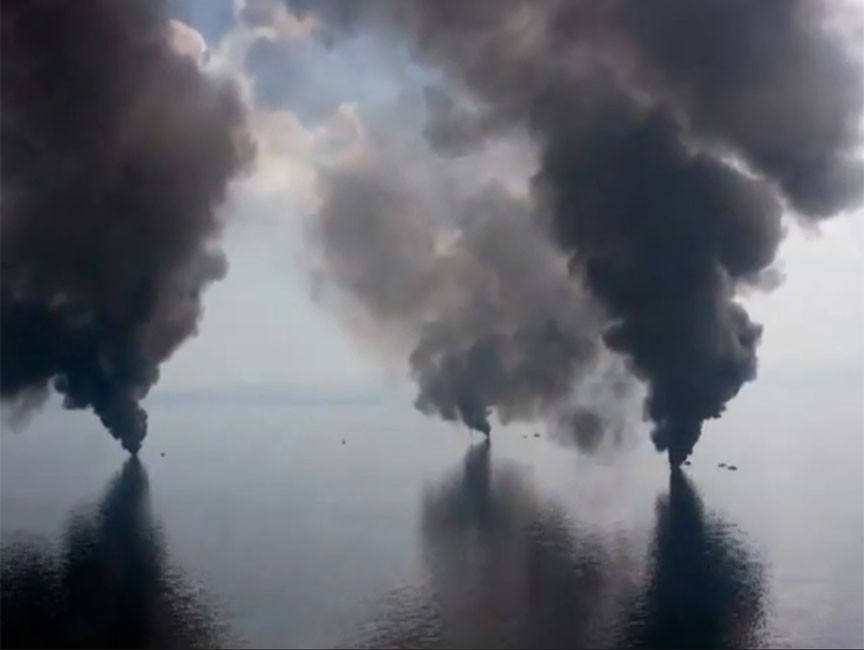
To keep some of the spill from hitting shore, 275 fires have been set in the Gulf to burn oil corralled by containment booms. These fires are the fires that have reportedly burned sea turtles alive, confirmed by testimony from NOAA scientists in a Huffington Post article on July 2.

The wildlife report below is of course the official statistics for the subject. None of the turtles burned in the 275 offshore fires were included in this report. These are just the numbers of reported impacts by the official collectors and rehabilitates. The actual number of impacted individual animals is also unknown, but it's likely to be far in excess of the official statistics.

CLICK ON CHART TO ENLARGE.
The Ixtoc blowout in the Bay of Campeche in the far southwestern Gulf of Mexico in 1979, the second largest oil spill ever, dumped 140 million gallons in nine months. The Deepwater Horizon spill surpassed this milestone in late June, after about three months. The difference in scale too is dramatic. The Ixtoc was in 160 feet of water and the well was 10,000 feet deep. The Deepwater Horizon is in 4,100 feet of water and the well is 18,000 or maybe even 25,000 feet below the ocean bed (there seems to still be some uncertainty involving the permitted and actual numbers).

There is a big difference between the Deepwater Horizon oil and that from most other oil wells because of the amount of natural gas in this particular oil field. As a result, this spill contains enormous amounts of natural gas, or methane.

This methane has caused a lot of trouble beginning with the actual blowout itself. Natural gas in an oil well is common, but not in large amounts and it is usually not a good thing. A lot of natural gas makes things even worse.

This well pushes the limits in many ways -- with the combination of the deep water, the deep well, and the high natural gas concentration -- and then we add in the technical mistakes, which we won't be able to fully determine until sometime in the future.

Gulf on fire. Image by John L. Walthen / BP Slick.

The methane continued to cause problems, as the oil recovery devices started to became clogged with methane ice, or what is really called methane clathrates -- a combination of methane and water ice that can freeze when the temperature is above 32 degrees and the pressure is high enough (like at the bottom of the ocean).

But this is not the worst that methane can do. Texas A&M Oceanographer John Kessler says that deep-ocean methane levels from the Deepwater Horizon blowout are hundreds of thousands of times higher than background levels and even approached one million times higher than normal in some of the samples that his team made while researching the “oil plumes” around the blowout.

One million times greater than background is indeed astonishing, but when put into context it becomes all the more sobering.

Methane is the same as the natural gas that we burn in our stoves. It is a greenhouse gas with one carbon and four hydrogen atoms. It has a global warming potential many times that of carbon dioxide, but when burned as a fuel only emits 71% as much CO2 as oil and 56% as much as coal. (Some say it could be a good transition fuel to get us off of coal.)

This well has a tremendous amount of natural gas, estimated to be 40% by weight of the total spill by Kessler and 50% by Samantha Joye at the University of Georgia. This is compared to about 5% from normal oil deposits.

By day 160 of the blowout we will hopefully have the pipe plugged. It should be well into August when the relief wells are finished. But we should note that it took the Mexican oil firm Pemex nine months to get their relief well to work on the Ixtoc blowout -- a well that was only 10,000 feet deep in 160 feet of water. And by the time 160 days have elapsed, the Deep Horizon will have spilled 236 million barrels of natural gas.

To put this much methane into perspective, we have to understand its global warming potential. Normally, we know that methane, as a greenhouse gas, is capable of capturing about 25 times more heat than carbon dioxide. But recent studies have shown this to be low. Because our planet is warming and the natural CO2 sinks are slowing, methane really has about 34 times the heat trapping capacity of CO2.

But wait, that’s not all.

The figure of 34 times the heat trapping capacity is for time spans of 100 years. In the not too distant past, this was an appropriate time span to consider for climate change. But that was 20th century climate change. A decade -- a half generation -- has passed since those times. The climate change times scale of relevance today is 20 or 30 years, not a century.

So when we realize that the heat trapping capacity of methane should now be based on a short 20 or 30 year times scale, the number increases to something more like 62 times more potent, not 34, or even 25.

So methane has a warming capacity that is 62 times more than carbon dioxide. And when we calculate the global warming potential of those 236 million barrels of methane, it is equal to about 5 percent of the total U.S. transportation fleet emissions of carbon dioxide. This is one incredibly huge well.

But are the emissions really important? Doctors Kessler and Joye are finding that little of the methane is making it to the surface. It is becoming dissolved in the great ocean depths and suspended with the oil in those massive plumes.

Microbiologoic activity then begins to consume the methane (and the oil). It is this bioactivity that consumes the oxygen in the water and creates hard times for the organisms that live there. Kessler and Joye said that oxygen depletion had not reached a critical level yet, only falling about 30 to 40 percent below normal. But this was about three weeks ago and at the time they said that, levels were falling 1 to 2 percent per day.

This oxygen depletion would put the waters in question down in the 4 ppm (parts per million) range. Levels of 2 ppm stress most fish. Levels below 1.4 ppm are deadly. The plumes are still 30 to 40 miles long, miles wide and thousands of feet thick. The closer to the well you get, the lower the oxygen content is, and the higher the methane concentrations.

From all over the oil-impacted coastal areas, we are hearing anecdotal reports of strange fish behavior, of sharks and turtles congregating near shore, dolphins disappearing, and that sort of thing. There are also reports about other oxygen deprived waters in the Gulf that are not associated with the great Mississippi Delta dead zone for which there are no ready explanations.

Dead zones are increasing significantly in our world’s oceans because the oceans are getting warmer (warmer water holds less oxygen) and because of increased nutrient runoff from agricultural industrialization. But further study is needed concerning these new Gulf of Mexico dead zones.

Methane occurs naturally in sea water; it is released as a byproduct of the decomposition of organic material. The organic material gets there because of the constant cycling of life; fish live and die and organic debris is washed into the oceans from rivers, but mostly it comes form what is called primary productivity. This is the planetary sized mass of life that creates half of the oxygen on Earth -- the algae and plankton of the oceans.

These single and few celled organisms are like grass and trees on land. They are the fundamental building blocks of life in the oceans. There are approximately 50 gigatons of primary productivity in our oceans (one gigaton is a billion tons). To put this to scale, there are about 2 gigatons of crops on earth.

Over tens and hundreds of thousands of years, this natural production of methane collects in sediments. Below a couple of thousand feet in depth, pressures are so high and water temperature is generally cool enough that the methane decomposition products can freeze, just like the natural gas coming out of the busted blowout preventer froze and clogged up the top hat spill collector that BP had deployed.

The frozen methane, or methane clathrates, collect in the ocean sediments and over tens and hundreds of millions of years form oil deposits deep below the ocean floor.

This is where the methane that clogged the top hat oil collector that BP deployed came from -- four to five miles beneath the bottom of the Gulf of Mexico.

But the formation of the shallow methane clathrates continue to this day. The Gulf of Mexico contains some of the greatest shallow methane clathrates deposits in the world and the oil giants are itching to get their hands on them.

There is only one problem. Methane clathrates are very unstable. They form on the edge of the envelope of pressure and temperature. Just a little warming and they become unstable. The recent Congressional inquiry into the Deep Horizon incident brought up this point:

Offshore drilling operations that disturb methane hydrate-bearing sediments could fracture or disrupt the bottom sediments and compromise the wellbore, pipelines, rig supports, and other equipment involved in oil and gas production from the seafloor.

Destabilization of methane clathrates has also been identified as a likely culprit in some of Earth’s more punctuating moments. These moments usually took tens to hundreds of thousands of years, as the earth’s climate naturally changed from warm to cold because of solar influences and natural feedbacks.

But at some point, an additional forcing, like an asteroid striking the Yucatan Peninsula, caused a perturbation in the natural cycle. The additional warming triggered the instability of the methane clathrates, great amounts of methane were released causing great warming, and abrupt climate changes occurred that caused great extinction events.

This is a very critical path that our planet occasionally follows . Right now mankind is increasing the CO2 concentration on this planet faster than at any time in the last 20 million years and likely as fast as when the giant asteroid hit the Yucatan Peninsula and the dinosaurs went extinct 65 million years ago.

Methane concentrations on earth have started to rise again after a decade of stability. It is thought that contemporary agricultural techniques and their expansion across the world had halted the increase in our planet’s methane emission, and this is probably what happened.

Baby Kemp's Ridley Sea Turtle, covered in oil. Image courtesy the National Oceanic and Atmospheric Administration (NOAA).

The new increase is likely coming from methane clahtrates in the Laptev Sea on the edge of Siberia and the Arctic Ocean. This area of the planet has warmed 7 to 9 degrees Fahrenheit in the last 20 years and the methane clahtrates on the bottom of the Laptev sea have started to vent.

The venting is so great that it rivals all the rest of the methane emissions from all of the rest of the world’s oceans combined.

The methane gas also melts beneath the clahtrates. The heat of the earth can cause free methane gas to collect beneath the solid sheet of methane ice in the sediments at the bottom of the sea. This sheet of ice has become perforated in the Laptev Sea. But what happens when the clathrates are on a slope like in the Gulf of Mexico and Mississippi Canyon where the Deepwater Horizon is?

In the past, phonemena called methane outburst occurred when their overlying methane ice laden sediment became destabilized. Scars from dozens of massive tsunami causing landslides along the continental shelf of the east coast are evident from prehistoric times.

These things happen when our climate is rapidly changing. Eight thousand years ago when Earth had just warmed out of the depths of the last ice age, a great undersea landslide took place off of the shores of Norway.

It is called the Storrega slide. It was 200 miles across and the slide traveled for 800 miles under the Atlantic Ocean, most of the way to Greenland. The tsunami it produced was 65 to 82 feet tall. The 2004 Indian Ocean Tsunami, that killed 200,000, was 50 feet tall.

I am not saying that anything of the sort is imminent. I am saying that there are important things to understand about our Earth and the way it operates. So the important things to understand now are that clathrates are unstable on slopes, the Deepwater Horizon is on a big slope, and the product coming out of the blowout is 180 degrees Fahrenheit.

[When Bruce Melton, P.E., isn't practicing civil engineering, he's studying climate change and writing about it. Melton was one of eight Austinites named in the "Heroes of Climate Change" article published in The Good Life magazine in July 2007. To read more of his work on climate change, visit his website, Melton Engineering Services Austin.]

References:

EIA Transportation Sector Emissions in 2008 –
Total CO2 emissions from transportation sector in the U.S. = 1.93 billion tons
http://www.eia.doe.gov/oiaf/1605/ggrpt/carbon.html

Primary Produtivity 50 Gtons in the oceans, 2 gtons in world crops
http://en.academic.ru/dic.nsf/enwiki/30382

Methane GWP 20 year timeframe – 62 times more potent than CO2
Nisbet, Have sudden large releases of methane from geologic reservoirs occurred since the last Glacial Maximum, Philosophical Transactions of the Royal Society, 2002.

Dr, John Kessler, Texas A&M University, Department of Oceanography
http://tamunews.tamu.edu/2010/05/26/prof-heads-out-to-study-gulf-oil-spill-with-first-nsf-grant/

Samantha Joye, University of Georgia
http://solveclimate.com/blog/20100701/methane-dead-zones-gulf-waters-confirmed-gas-levels-100-000-times-normal

Methane clathrates:
Laherrere, Oceanic Hydrates - more questions than answers, Energy Exploration and Exploitation, May 2000.

The national Methane Hydrates R&D lab
http://www.netl.doe.gov/technologies/oil-gas/FutureSupply/MethaneHydrates/projects/DOEProjects/MH_5668EMCharGOM.html

NOAA Modeling Threat
http://www.noaanews.noaa.gov/stories2010/20100702_longterm.html

Wildlife Report – July 5, 2010
http://www.deepwaterhorizonresponse.com/posted/2931/WildLifeConsolidated5july.739707.pdf

Gulf Oil Spill – The Plight of the Sea Turtles, Huffington Post, July 2, 2010
http://www.huffingtonpost.com/2010/07/02/gulf-oil-spill-the-plight_n_634083.html

Stats July 5, 2010, Government Monitor
http://www.thegovmonitor.com/world_news/united_states/florida-releases-july-6-2010-gulf-oil-spill-situation-update-34982.html

Tsunamis India 2004: Australian Bureau of Meteorology

The North Atlantic tsunami caused by a methane clathrate slide:
Record Breaking Height for Tsunami in the North Atlantic 8000 yrs BP, EOS, 2003

Stability of methane clathrates on slopes:
Deepwater Horizon Oil Spill: Selected Issues for Congress
http://www.fas.org/sgp/crs/misc/R41262.pdf

The oil coming out of the seafloor in Mississippi canyon is about 180 degrees F.
A July 1 interview on the American Geophysical Union blog of marine goechemist John Farrington, one of a group of scientists of the Consortium of Ocean Leadership at Louisiana State University.
http://blog.agu.org/geohazards/2010/07/01/oil-spill-science/

The Rag Blog

[+/-] Read More...

Only a few posts now show on a page, due to Blogger pagination changes beyond our control.

Please click on 'Older Posts' to continue reading The Rag Blog.