Showing posts with label Agriculture. Show all posts

13 June 2013

RAG RADIO / Thorne Dreyer : Mother Jones' Tom Philpott on Big Ag and the Politics of Food


Sustainable food writer Tom Philpott at the studios of KOOP-FM in Austin, Texas, June 7, 2013. Photo by William Michael Hanks / The Rag Blog.
Rag Radio podcast:
Mother Jones' Tom Philpott on
sustainable ag and the politics of food
"As a writer for Grist and now Mother Jones, Tom Philpott draws links between your kitchen, your food sources, your government, and the earth. An organic farmer, he knows how to pull weeds as well as yank the chain of Big Ag. " -- Utne Reader
By Rag Radio / The Rag Blog / June 13, 2013

Tom Philpott, sustainable food and agriculture correspondent for Mother Jones magazine, was Thorne Dreyer's guest on Rag Radio, Friday, June 7, 2013.

Rag Radio is a syndicated radio program produced at the studios of KOOP 91.7-FM, a cooperatively-run all-volunteer community radio station in Austin, Texas.

Listen to or download our interview with Tom Philpott here:


Tom Philpott writes about sustainable agriculture and the politics of food for Mother Jones and is the cofounder of Maverick Farms, a center for sustainable food education in Valle Crucis, North Carolina. As Utne Reader said, Philpott "knows how to pull weeds as well as yank the chain of Big Ag."

Among the issues Philpott addresses on Rag Radio are the extensive abuses of big agribusiness, especially in the meat industry and in the GMO seed business -- and the failure of government oversight in both. On the positive side, he points to the growing role played by community farming and cooperatives.

For five years, Tom Philpott served as a columnist, food editor, and senior food writer for the online environmental site Grist. His work on food politics has appeared in The New York Times, Newsweek, Orion, OnEarth, Gastronomica, and the Guardian, and he has been interviewed by Terry Gross on Fresh Air. Philpott also worked as a financial journalist in Mexico City and New York, most recently for Reuters.com.

Tom Philpott.
Maverick Farms has been featured in Gourmet and The New York Times, and in September 2008, Food & Wine named Philpott one of "ten innovators" who "will continue to shape the culinary consciousness of our country for the next 30 years." In 2011, Utne Reader named him one of "25 Visionaries Who Are Changing Your World."

A graduate of the University of Texas, where he co-founded and ran the radical investigative magazine Polemicist in the late '80s/early '90s, Philpott currently divides his time between Austin and the farm in North Carolina.

Leslie Hatfield wrote at EcoCentric: "A path that led from a restaurant kitchen in Austin eventually took Tom Philpott -- by way of Mexico City and Brooklyn, New York -- to North Carolina’s Blue Ridge Mountains, where he now serves as co-founder/core group member at Maverick Farms, while also dishing out what may be the most consistently awesome food policy reporting in the blogosphere."

Tom Philpott and the Real Food Media Project’s Anna Lappé spoke on “Busting Food Myths” at the 5604 Manor Community Center in Austin, Friday, June 7, 2013.


Rag Radio is hosted and produced by Rag Blog editor and long-time alternative journalist Thorne Dreyer, a pioneer of the Sixties underground press movement.

The show has aired since September 2009 on KOOP 91.7-FM, an all-volunteer cooperatively-run community radio station in Austin, Texas. Rag Radio is broadcast live every Friday from 2-3 p.m. (CDT) on KOOP and is rebroadcast on Sundays at 10 a.m. (EDT) on WFTE, 90.3-FM in Mt. Cobb, PA, and 105.7-FM in Scranton, PA.

The show is streamed live on the web by both stations and, after broadcast, all Rag Radio shows are posted as podcasts at the Internet Archive.

Rag Radio is produced in association with The Rag Blog, a progressive Internet newsmagazine, and the New Journalism Project, a Texas 501(c)(3) nonprofit corporation. Tracey Schulz is the show's engineer and co-producer.

Rag Radio can be contacted at ragradio@koop.org.

Coming up on Rag Radio:
THIS FRIDAY,
June 14, 2013: Peruvian social psychologist Cristina Herencia, official observer at the United Nations Permanent Forum on Indigenous Issues.
Friday, June 21, 2013: Bill Fletcher Jr., African-American scholar, writer, and union organizer.

The Rag Blog

[+/-] Read More...

22 May 2013

REPORT / Mariann G. Wizard : 'La Vida Coca' in Bolivia and Peru / 3

Coroico is the administrative capital of Bolivia's Nor Yungas province. The town hall façade features the coca leaf and coffee bean of local agriculture in addition to the exotic bird of tourism, the area's main economic activities. All photos by Mariann G. Wizard / The Rag Blog, unless otherwise credited.
La Vida Coca /3: 
Currents in traditional coca 
use in Bolivia and Peru
Regular tours of the area include coca 'plantations.' Almost all of the other travelers we met in Coroico and Copacabana were interested in trying and discussing coca.
By Mariann G. Wizard / The Rag Blog / May 22, 2013

Part three of three.

(Rag Blog Contributing Editor Wizard recently visited Peru and Bolivia with former fellow Ragstaffer Richard Lee. Wizard says the whole thing was Lee's idea, although she did the heavy lifting of writing this report of their experiences, while lifting copiously from conversations they shared and short reports Richard wrote on the spot.)

After being in Coroico about a week, we asked a woman we'd met on our first day there if she knew any cocaleros who might be willing to talk with us about the crop. A hard-working, intelligent person who was extremely patient with our often halting Spanish, she laughed, ducked her head, and said, "Soy una cocalera." ("I am a coca grower.")[1]

She isn't a commercial grower. She and her family tend a few plants, along with abundant fruit trees and vegetables. Over coffee and cake, she described carefully sprouting the small red seeds, transplanting them into pots, then into the field. She showed us the growth pattern of the plants and told us that the growth tips are never touched. We heard about cutting plants off near the base, then regrowing them; regeneration can occur several times, giving plants a life span of 20 years or more.

Most of what we learned I've since confirmed online, but there's nothing like hearing it from a passionate gardener! Her cupped hands as she demonstrated transplanting seedlings, her expertise in how to tell by touch when the hojas are dry enough for storage, reminded me of every other master gardener I know: pride, respect, and love make things grow. Richard, green thumb tingling, was also in his element!

Still, we wanted to see large coca fields. A couple we'd met recommended a local taxista who knew the area well, and we took an agricultural tour of greater Coroico. Tramping up and down steep, muddy jungle slopes before breakfast, swarmed by aroused mosquitoes, we weren't so much in our element as over cake and coffee! But we kept on chewing hojas and drinking water, and keeping on, until we saw what we came to see: well-tended, mature cocal, up close and personal.

Like many Bolivian towns, Coroico is surrounded by a network of rural villages (villas). I liked this "bewitching" signpost.
Here, several distinct cocal fields are seen on the hillside. We were told that each plot is owned by an individual or family; adjoining plots may be owned by close relatives or grown children. Photo by Richard Lee / The Rag Blog.
This small, well-tended cocal field near the road was easy for us to access.
Here you can see that the plant in front center has been cut off just above the ground and regenerated to its present height.
Small red seeds (see inset for enlargement) from tiny white flowers. Seeds are planted soon after falling off the parent plant. PVC pipes bring water for irrigation and for workers to drink. At high altitudes under a strong sun, hydration is vital.

Coca isn't the only traditional herbal medicine in common use in Peru and Bolivia. Chamomile (manzanillo; Matricaria recutita syn. Chamomilla recutita) or anise teas, mint (yerba buena; Mentha viridis), lemon verbena (yerba luisa, cedrón; Aloysia citriodora), and West Indian lemongrass (Cymbopogon citratus) were recommended and served to us by gardeners, restaurateurs, and/or friends.

Specific comments regarding manzanillo as a sleep aid, yerba buena to "balance" heavy foods, and yerba luisa as an overall tonic were noted. As in other indigenous cultures, many foods' and condiments' health effects are common knowledge, especially in traditional Quechua- and Áymara-speaking households.

After I had an allergic reaction to Coroico's notorious mosquitoes, bringing up lovely big red welts on my arms, everyone we met told me about one or another traditional repellent. Rubbing whole limes (Citrus limonum) on the skin in the evening was the one most mentioned. To be fair, DEET also worked quite well; if only I'd thought to use it that first rainy day!

Dried spices, hojas de coca, peppers (Capsicum spp.), and other condiments at Coroico's weekly market. Peppers, garlic (Allium sativum), and other spices are used in unique sauces, ajillos, by restaurants and at home; everyone seems to have a recipe for ají.
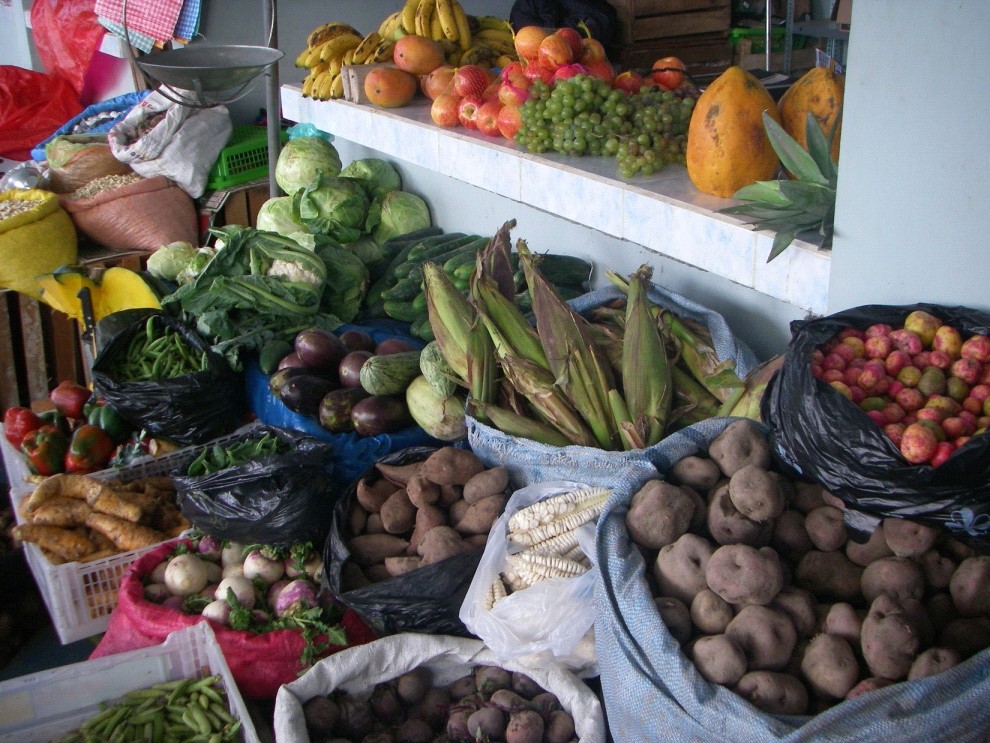
Both countries boast a wealth of fruits and vegetables -- Bolivia has over 30 varieties of potatoes (papas; Solanum spp.)! -- many not seen in the U.S., or seen infrequently, or in a processed state. While restaurants do not avail themselves much of this produce bounty (many serve French fries and rice at every meal!), a trip to the mercado brings delicious rewards. We recruited friends to cook papas lisas for us and enjoyed a fabulous traditional stew of the tiny potatoes, onion (Allium cepa), and alpaca rib meat – ¡que sabrosa!

Besides cattle, pigs, poultry, and sheep, two domestic camelid species, llamas and alpacas, are raised for meat, fiber, and as beasts of burden. (Wild vicuñas are protected.) Alpaca meat isn't much different from grass-fed beef in flavor. Guinea pigs (cuy) are also a traditional Andean food. Richard ate cuy years ago in Ecuador; I'll pass! However, some dishes I did have were equally odd, like this "chicken foot soup":


Peru, with its extensive coastline -- Bolivia is landlocked -- offers a wide array of fresh seafood. Lake Titicaca, between the two nations, is home to delicious lake trout.

By the way, again from Wikipedia, "Raw coca leaves, chewed or consumed as tea or mate de coca, are rich in nutrition... Specifically, the coca plant contains essential minerals (calcium, potassium, phosphorus), vitamins (B1, B2, C, and E) [, and]... protein and fiber."[2]

Abundant fruits and veggies in Coroico's weekly market. Papas lisas are the small red and yellow potatoes at right center. I also ate papas negras, the purple ones at bottom right and center, cooked whole in oil -- ¡muy rico!

Not all traditional medicine in the region is herbal or food-based. Good luck rituals and tokens abound, like the brightly-colored fetishes below, in La Paz' Mercado de Hechicería (Witches' Market). Arriving during Carnavál, we also saw cars, taxis, and buses decorated and prayed over as a blessing; and good luck icons by the score, such as miniatures of items the buyer hopes to obtain: money, cars, televisions, etc.[3] All of the shops in the Hechicería had coca. Some Andean shamans use hojas to divine the future.

In the Mercado de Hechicería, dried llama fetuses (hanging) of various sizes are sold. These are buried for good luck in new enterprises, especially those involving construction. Well-to-do traditional people are expected to sacrifice a live animal.

While our inquiries had been fruitful, we had questions our local informants couldn't readily answer. For example, other than for rapid drainage, and where the terrain consists of steep slopes, is it necessary to plant at such challenging angles? Also, can cocal be grown at lower altitudes than Coroico's 5000 feet above sea level, and if so, would this affect its strength or efficacy?

Lest you think we must have stood out for our unusual interest in coca, rest assured, we did not. Regular tours of the area include coca "plantations." Almost all of the other travelers we met in Coroico and Copacabana -- people of all ages from Switzerland, Belgium, New Zealand, Chile, Brazil, Germany, France, Australia, and Japan -- were interested in trying and discussing coca. Bolivians from other parts of the country were interested in comparing the local product with coca from their area.

Our "where's Waldo?" moment: a day after our field trip, strolling across Coroico's plaza for perhaps the 50th time that week, we finally recognized the healthy if somewhat untended stand of cocal growing there among the palms and hibiscus (Hibiscus sabdariffa). Since this is about the only flat spot in Nor Yungas, it seemed to settle whether cocal must be grown on a slope! (The question of altitude remains open.)

The public cocal patch in Coroico's main plaza.. Photo by Richard Lee / The Rag Blog.
Andean music on the plaza draws a crowd. Traditional women from the Afro-Bolivian community (seated, right front) are said to be prolific coca users.
The Sanjuanitos wowed us with John Lennon's "Imagine." Richard later wrote, "Lennon could have imagined this..."

It is in the plaza that matters of interest are discussed before and after cocalero meetings at the roofed "polyfunctional" sports court down the hill. Bolivia's future is being shaped by astute agriculturalists who value tradition but want the benefits of modernity. Change, like the new cell phone technology that has reportedly made rural life safer, is weighed and measured before adoption.

In this small plaza and others all over Bolivia and Peru, citizens talk and relax at the end of the day or the week, after school or at lunch time. Taxis come and go; buses disgorge weary travelers. Children and dogs run free and everyone sees that the soccer ball doesn't bowl over any old folks. Young couples promenade hand in hand in the evening, while the ice cream man, and the chicken sandwich lady, and the elders sitting on stone or wooden benches smile in approval. Here, coca is at home.

[Rag Blog Contributing Editor Mariann G. Wizard, a Sixties radical activist and contributor to The Rag, Austin's underground newspaper from the 60s and 70s, is a poet, a professional science writer specializing in natural health therapies, and a regular contributor to The Rag Blog. Read more poetry and articles by Mariann G. Wizard on The Rag Blog.]


Footnotes:
[1]I'm not naming any Bolivian acquaintances, in order to protect their privacy. None of them live electronically.
[2]http://en.wikipedia.org/wiki/Coca
[3]The fake lucky dinero, by the way, is from "El Banco de Buena Fortuna," and Richard got taken for 50 Bolivianos (about $7.50 US) by making change in the dark. It's a wonder what a photocopier can do, isn't it?

The Rag Blog

[+/-] Read More...

16 May 2013

Norman Pagett and Josephine Smit : Grain of Truth

Image from UCL.
Grain of truth:
Our precarious food supply
Global food production has been allowed to fall into the hands of fewer and fewer megacorporations, and their aims are simple: to deliver short-term profits and ultimately to control the entire system of world supply.
By Norman Pagett and Josephine Smit / End of More / May 16, 2013
“A hungry world is a dangerous world. Without food, people have only three options: they riot, they emigrate or they die.” -- Josette Sheeran, World Food Programme
We owe our lives to technology that uses 10 calories of energy in the process of growing food to produce a single calorie of energy in the food we eat.

On average, we need to consume about 2,500 calories a day, so each of us has to find 10 times that amount of energy in order to stay alive. Our existence rests on that fundamental equation. Looked at it in cold print, this might seem irrelevant to our day-to-day lives but it means that global agricultural production and food supply systems are consuming 10 times more energy than they deliver as food.

Few of us ever stop to consider the embodied energy in what we eat. Why would we? Calories have become purely the currency of dietary fads, something to be limited in our constant battle with obesity. We have been well fed for so long that we imagine that supermarket shelves will always be amply stocked to support our affluent comfort. Until now, in the developed world at least, the food production, distribution and supply infrastructure has been able to obtain all the energy it needs, and in ever increasing amounts.

We are far more prosperous than the third world countries that are constantly being brought to the brink of food deprivation or outright starvation. Yet we are only marginally safer. We have a blind faith in our supply systems and expect our food stores to have everything we might want to buy available fresh every day. Remove the certainty of our seven-day-a-week food supplies and supermarkets would be stripped bare within hours.

Our food supply is extremely precarious; it takes very little disturbance to disrupt it severely. During an oil delivery tanker drivers’ strike in the UK in 2001, the government was given the stark warning by a consortium of major retailers that the food chain delivery system carried only three days’ supply. This information was not released to the public at the time.

The fuel supply emergency lasted only a week, but if it had gone on for longer rapidly emptying supermarket shelves would have provided the impetus for food hoarding and panic. This is what happens when there is a temporary break in just one link in the energy chain that supports our highly complex food supply system.

Reduced to its raw essentials, the embodied energy in food represents all the mechanical input of our farming system: the tractors, the fishing boats, and the trucks. It includes the water transported from Portugal disguised as melons, and that air-freighted from Kenya disguised as green beans -- 4 litres of water are needed to grow a single bean stem.

It covers the diesel in the trucks that deliver loads to your supermarket several times a day, fresh and just in time, and it includes the gasoline in your car when you go to collect your weekly groceries. The cumulative energy intrinsic to so many food processes -- growing, packaging, distribution and delivery -- is so cheap in historic terms that most of us could buy sufficient basic food for a week for what we earn in an hour or two, and in many cases far less than that.

Over 50 years, our average food expenditure has dropped from half of our income to around 10% but that is a purchasing total, not the cost of what might be described as essentials. Our food is so cheap that we can afford to buy far in excess of what our bodies need for survival and throw large quantities of it away -- at least a third of the food we buy is wasted.

Cheap food is an illusion; it is put there by energy sources that we have come to regard as inexhaustible. Our collective genius at devising new ways of producing food, faster and in the name of greater efficiency and productivity, has worked so well that we see it as normal. Greater abundance of food has allowed more people to survive, and dramatically increased global population.

It has been estimated that the number of people now alive is more than the entire number of human beings who have ever lived. Some 90% of those people are only here because of our ingenuity at delivering food with that 10:1 calorie factor built into it, together with all the other benefits of cheap fossil fuel energy.

As fossil fuel energy declines, renewable sources will not be able to maintain our complex, energy-intensive food systems in their present form. As a result, we will not be able to feed our present numbers. Our food production level will return to roughly what it was 500 years ago, when one calorie had to be put in as manual labour or animal manure to produce one calorie to eat. By that reckoning, our food supply system will only support one-tenth of us. To put it bluntly, at least 6 billion people won’t have a future.

The energy that goes into making our food is taken from the ground in some form of fossil fuel, and there is no substitute for it. It is not possible to make nitrate fertilizer or a tractor tire from the energy output of a wind turbine or a photovoltaic panel because these agricultural essentials depend on a high volume input of hydrocarbons.

We are pressing ahead with the large-scale manufacture of biofuel because we have convinced ourselves it is a viable alternative, predominantly to liquid hydrocarbon fuel. But a growing consensus of scientific opinion, backed by extensive research, has demonstrated that biofuel is not a practical solution.

It requires vast quantities of land, which we also need for foods, and consumes more energy in production than is obtained by its use. It is at best only marginally better than 1:1. Putting biofuel into a tractor to cultivate crops to make yet more biofuel would only be done by the kind of farmer who was a regular guest at the Mad Hatter’s tea party, unless of course he was being subsidized at the taxpayer’s expense.

This is the logic of what has come to be known as agribusiness. Agribusiness now dominates farming, although its originators have little in common with the land; they in fact began as giant chemical companies. These chemical companies had the resources to initiate development and analysis of fundamental crop science, so that plants could be engineered to suit exact conditions and resist specific pests while at the same time remaining under the patented control of their producers.

The science of agriculture and food production changed forever around the turn of the millennium when the United States Supreme Court judged that a patent could be granted on bioengineered seed. While dairy products, fruit and vegetables may still be wrapped in packaging bearing images of the rosy-cheeked farmer, food production is now an industrial process and inherited farming skills are rapidly being lost.
“Today so few people farm that vital knowledge of how to farm is disappearing." -- Richard Heinberg, "Fifty Million Farmers," 26th annual EF Schumacher lecture, 2006
Big business, in the form of supermarkets and agribusiness, is squeezing out the small farmers on the grounds that their methods are "inefficient" and is pushing down the price of produce to such an extent that local operators are struggling to make a living or are being displaced altogether. Agribusiness supplies supermarkets with consistent product on a massive scale and at a rock-bottom price. The small farmer struggles just to stay in business.

The principles of large-scale industrialized farming, now epitomized by the U.S. mega-farm, are being exported to Europe and elsewhere across the globe. The spread of agribusiness is stripping the world of its family farmers, those who possess skills handed down through generations in tending small parcels of land sustainably.

Today the typical farmer in both the UK and U.S. is likely to be over the age of 55, and UK farmers are leaving the industry at a rate of around a dozen a week. These trends are being repeated across the developed world. In developing countries small farmers are abandoning rural life to take their chances in the city because they can no longer make their living from the land.

This shift is of critical importance because the very infrastructure of farming is being destroyed. The inherited link between mankind and the land that supports him is being broken. Once gone, that link cannot be easily reestablished. Farming knowledge is an instinct passed down through generations; it is not something that can be learned from books.

The Caribbean’s lush islands were once key food producers with Jamaica providing up to 500,000 pounds of rice a year, until agriculture decreased in favour of a more lucrative income from tourism through the latter half of the twentieth century. The prosperity brought by tourism in turn supported increased population numbers, with visitors’ dollars buying rice from Guyana and the U.S. When the prices of basic foodstuffs soared around the world in 2008, the islands found their annual rice bill had risen to $3 billion.

Now they are seeking to revive lost farming skills but have had to turn to other countries for help, with Jamaica asking Guyana to help reestablish rice production. It is not redeveloping the techniques of its own small farmers, and has instead turned to foreign mega-farming operations, welcoming them with open arms and, according to local news reports, preferential treatment.

In microcosm, Jamaica serves as a warning to all of us. We have freely chosen to abandon our understanding of how food is produced, preferring more comfortable jobs that offer transient wealth but no long-term sustenance.

Global food production has been allowed to fall into the hands of fewer and fewer megacorporations, and their aims are simple: to deliver short-term profits and ultimately to control the entire system of world supply.
“The twenty first century is going to have to produce a new diet for people, more sustainably, and in a way that feeds more people more equitably using less land.” -- Tim Lang, Professor of Food Policy, City University, London, 2008
Biofuel production, now inextricably linked with that of food, has given the megacorporations even greater power over our lives. These megacorporations are feeding on government subsidies paid by the taxpayer and given by politicians on the vague promise that in the long term biofuel will become economic to produce, and will replace the conventional oil we need to provide our food by current farming methods.

Food security is of little concern to those involved in agribusiness. U.S. giant Cargill delivered a 68% increase in earnings over just three months in 2010, on the back of "crop market volatility," ie, rising prices on the global market. Cargill is a very successful company and its financial performance was good news for the company’s stockholders. But over the same period of time in Mozambique, people at the bottom of the food chain were rioting at the 30% increase in the price of a loaf of bread.

Agribusiness exists to convert the fertility of the land into profit with maximum efficiency. The industry functions on the widely accepted, successful, and profitable laws of business. That may mean forcing food producers into a state of dependence on crops that must be treated with specific weedkiller and grown by increasing applications of fertilizer. Seeds, weedkillers, and fertilizers may have to be obtained from specific sources that further contribute to the profit margins of agribusiness.

In the third world basic farming economies have been devastated by agribusinesses dumping subsidised grain crops on the market at prices below that which indigenous farmers could compete. Their actions effectively forced farmers off the land, leaving the way clear for them to buy vast acreages from governments in order to make still more money from the twin essentials of food and oil.

Highly industrialized farming is stripping the soil of its underlying fertility and water reserves. Food products are ultimately shipped to those countries with the ability to pay the going rate for them.

If we think about these practices we may feel uncomfortable about the methods, but in our immediate short term, agribusiness is delivering what we need: cheap, varied foods of consistent quality.

Food has become currency, not only through the activities of agribusiness but more literally with the rise in prominence and influence of the food speculator. In 2000 the U.S. government changed the business of commodities trading with the introduction of the Commodity Futures Modernization Act. This paved the way for financial institutions that were in no way connected with the business of agriculture to trade in food-based commodities.

Effectively it gave investors the power to manipulate markets, by buying up foodstuffs, exacerbating shortages and as a result inflating prices. As returns from traditional investments have dwindled because of the global economic downturn, putting money into staples like food has appeared a safe and attractive investment. Investors are essentially profiteering at the expense of human hunger, an unacceptable trade that is provoking world-wide food riots as well as global demands for constraints on this kind of speculation.

In the hands of unscrupulous people, food is becoming a means of control. Profits and financial results are now the goals; starvation does not appear on balance sheets.

The rapid transfer of food and energy into the combined asset of money is resulting in supply pressures that are already climbing the ladder of prosperity and will inevitably exacerbate over time. Today it is the world’s poor who are affected, but each successive stratum of society will find itself subject to food stress as the one below falls under the hammer blows of outright starvation.

We can measure poverty or prosperity by the proportion of income that has to be used to obtain what we need for subsistence. Our perceived income, derived from raw energy itself, will buy less and less as even the developed societies of the west have to use a greater proportion of income to obtain the means to eat. We will be subject to the same shortages that drove the underclasses of Mexico City, Lagos, Cairo, or Jakarta to riot in 2008.

Those shortages will take a little longer to reach the food markets of the developed West, but already the poorest are depending on financial support to eat. In the U.S., one in eight citizens relies on the government’s supplemental nutrition assistance program, the politically correct term for food aid, and that number is rising every month. In the UK and most other countries in the EU there is a growing network of food banks to provide people with an essential supplement to state support.
“Part of the reason for the fall in stock levels was simply that global use of grains and oilseeds had overtaken production – a factor that has continued to hold for seven of the eight years since 2000” -- Chatham House, "Feeding the Nine Billion," 2009
There have always been hungry people in the world, although there has in fact been sufficient food to "feed" everyone. But increases in global population, pressures from developing nations for more varied diets, and the destruction of crops through environmental disasters are producing new tensions, and desperate steps to try to ensure security of supply.

The food production shortfall and resulting price spike in 2008 caused 29 countries to ban or restrict exports of staple foods. They had no option but to hoard what they had; there was no concern whatsoever for the condition of those who had not.

Saudi Arabia is now growing a high proportion of its food in Ethiopia using Nile water, while Ethiopia itself has to seek food aid from other regions of the world to feed its own starving people. In Indonesia, palm oil plantations suck water out of what was rainforest so that developed societies can cling on to vain hopes of maintaining a lifestyle of infinite plenty at the expense of others less fortunate. In Brazil, indigenous people are displaced en masse as the rainforest is cleared to make way for cash and energy producing crops.
“Although we believe agriculture has enabled us to lead lives of wealth, health and great longevity, it has in fact been detrimental to the human species.” -- Jared Diamond, Guns, Germs and Steel
As with all species, our strength is drawn from the nourishment we absorb, and our survival depends on continued access to food. Although present levels of production cannot be maintained, let alone increased, we will continue to believe that this is somehow possible and that continual progress and growth form part of our ultimate destiny.

When we finally recognize that commerce and our own communal greed have destroyed our means of survival, we will have no option but to fight for what’s left, using every weapon at our disposal in order to gain advantage for our country, our tribe and ultimately for ourselves.

[Norman Pagett is a UK-based professional technical writer and communicator, working in the engineering, building, transport, environmental, health, and food industries. Josephine Smit is a UK-based journalist specializing in architecture and environmental issues and policy who has freelanced for British newspapers including the Sunday Times.Together they edit and write The End of More.]

The Rag Blog

[+/-] Read More...

15 May 2013

REPORT / Mariann G. Wizard : 'La Vida Coca' in Bolivia and Peru / 2

Coca leaves, a standard small bag sold for personal use in Bolivia. From 10-40 hojas are used at once while working, walking, or otherwise exerting oneself at high altitudes. Habitual users enjoy coca three or four times a day. All photos by Mariann G. Wizard / The Rag Blog, unless otherwise credited.

La Vida Coca /2: 
Currents in traditional coca 
use in Bolivia and Peru
The overall effect of chewing leaves, drinking coca tea, or eating coca-containing foods can be described as both energizing and calming. Stress and anxiety are decreased, gastric disturbances eased, and the next hill isn't quite so daunting.
By Mariann G. Wizard / The Rag Blog / May 15, 2013

Part two of three.

[Rag Blog Contributing Editor Mariann Wizard recently visited Peru and Bolivia with former fellow Ragstaffer Richard Lee. Wizard says the whole thing was Lee's idea, although she did the heavy lifting of writing this report of their experiences, while lifting copiously from conversations they shared and short reports Richard wrote on the spot.]

It is estimated that 50% of Bolivia's gross national product is related directly or indirectly to coca. The illegality of much of this crop, and its ineligibility for international trade, has significantly handicapped Bolivia's economy and given it, along with Colombia, something of an "outlaw" reputation.

Rather than succumb as Colombia has at least temporarily done to U.S. demands for crop eradication, Bolivia now charts an independent path to international legitimacy and respect. Commodities production has given Bolivia a positive trade balance since 2004. Natural gas, silver, zinc, and soybeans account for 72% of total exports.

Main imports are machinery and transport equipment, chemicals and related products, and mineral fuels and lubricants. Main trading partners are Brazil (33% of total exports, 18% of imports), Argentina (12% of exports, 13% of imports), and United States (10% of exports and 11% of imports).[1]

A new Bolivian Vice Ministry of Coca and Internal Development was established in February 2009, in a reorganization of the executive branch. It is charged with developing employment opportunities, diversifying the economy, respecting traditional cultural values, and in general furthering Bolivian President Evo Morales' overarching vision of "Living Well."

It is expected to rationalize the processing of coca, maintain a climate of social peace, and mitigate and prevent conflicts under the new national policy of peacefully combating drug trafficking.[2]

One of the possible side effects of this policy is a striking lack of domestic militarization in Bolivia compared with most other Latin American nations we've visited in recent years. It's like the dog that didn't bark in the night, not obvious at first but increasingly pleasant over time.

It's worth noting that women spearhead Morales' administration. Strides in women's liberation are seen everywhere. Ending domestic violence and the rule of "machismo" are serious concerns in Bolivia's social revolution. Billboards and televised public service announcements proclaim, "Don't Kill The One You Love." Civilian gun ownership is banned.

While we were still in Bolivia, the campaign to have traditional coca use removed from the list of narcotics finally succeeded,[3] following a powerful appeal by Morales to UN delegates in Vienna.[4] Among the folks we talked with or saw responding in newscasts, this was met with firm approval. If Evo is leading a revolution, his constituents, at least in the altiplano, are keeping pace every step of the way.

Today, there is an emphasis on developing new products to "soak up" the excess coca that feeds illicit drug production, rumored to be concentrated in Brazil. Across the Amazon River, in one of the most difficult environments on the planet, one can envision secret jungle drug labs. But in the highlands, coca is part of a healthy, active lifestyle: "Living Well."

Coca candies, cookies, "teas" (actually infusions; true tea is Camellia sinensis), energy bars, and more are available or in the works. Coca Colla™, an energy drink made with coca extract, was reportedly launched in April 2010, but we didn't see it anywhere; we would surely have tried it. At least 35 coca product brands are operating.[5] A new publication, Il Jornada Nacional del Acullico, launched in 2012 to "reclaim" traditional coca mastication.[6]

Stevia (Stevia rebaudiana), an herb that produces the sweetest natural substances known to date, calorie-free steviosides, grows in Bolivia and is included in many products, in line with the government's overall health-promotion and economic development programs. It's commonly available in restaurants as an herb.

While coca "tea" is often made with whole leaves, there are also many chopped, bagged products from large and small manufacturers. When made of pure hojas, such teas may still be chewed as well as brewed for a stronger effect.
Coca teas, Larco Museum gift shop, Lima. Note the different flavors, including a coca-green tea combination. Some sources state that the term "maté" was adopted for coca teas to capitalize on the popularity of yerba maté (Ilex paraguariensis), but it is used in northwestern Bolivia for any mixed infusion. Matés commonly include tea, anise (Pimpinella anisum), cloves (Syzygium aromaticum), cinnamon (Cinnamonum verum), or other herbs or spices.
Energizing coca- and maca (Lepidum meyenii)-based candies, left, from airport gift shop, Lima. Coca-and-quinoa (Chenopodium quinoa) cookies, right, from Arcoiris Pasteleria on the plaza in Coroico, Nor Yungas, Bolivia.

Many medicinal and personal care products are made with coca, like these at Coroico's Blue Pine Tienda, as entrepreneurs combine traditional lore and modern marketing to legitimize coca in world markets.

Ingacoca's™ banner lists coca syrups for coughs, asthma, prostate support, rheumatism, acidic urine, liver support, stomach ulcers, gastritis, anemia, weight loss, mental acuity, poor appetite, diabetes, nerves, insomnia, kidneys, intestinal parasites, and high blood pressure; salves for rheumatism, varicose veins, bone support (coca is high in calcium), arthritis, gout, fungi, and hemorrhoids; and shampoo and skin creams.

What scientific support is there for the claimed benefits of coca leaf? Herbal medicine expert Andrew Weil says,
Coca appears to be a useful treatment for various gastrointestinal ailments, motion sickness, and laryngeal fatigue. It can be an adjunct in programs of weight reduction and physical fitness and may be a fast-acting antidepressant. It is of value in treating dependence on stronger stimulants.

Coca regulates carbohydrate metabolism in a unique way and may provide a new therapeutic approach to hypoglycemia and diabetes mellitus. With low-dose, chronic administration it appears to normalize body functions. In leaf form coca does not produce toxicity or dependence. Coca can be administered as a chewing gum or lozenge containing a whole extract of the leaf, including alkaloids, natural flavors, and nutrients.[7]
However, as with cannabis, coca's illegality makes it difficult for research on these benefits, all with at least some evidence, to proceed. A search of the PubMed database for Erythroxylon brought up just 109 reports, many on plant pharmacology. Interestingly, several studies used little-known species, not those most cultivated, but having local traditional uses. Most found a chemical basis for the tradition. Some reports are historical; others are policy, cultural, or environmental studies.

There are epidemiological and clinical studies of coca's effects in altitude sickness. (Results: it works and people use it without ill effects.) A study of effects of hojas on biochemical and physiological parameters found metabolic benefits with prolonged physical activity; that is, more fat is burned by users during exercise.[8]

We started seeing coca tea and/or hojas at the hotel breakfast (desayuno) buffet in Nazca, Peru, and at most hotels and hostels after that. Coca tea was on almost every restaurant menu. We learned later that coca is also readily available in Lima, where we had spent a week in ignorance. After all, at sea level, why would anyone have altitude sickness?

But the energizing qualities of coca can benefit tourists at any altitude: see more, do more, enjoy your trip more. While I was sick in Arequipa (everyone there blamed Nazca's water!), hotel staff, doctor, and "Ricardo" all recommended coca. Poco a poco, it helped.

Desayuno buffet at Hotel Berlina, La Paz, with hojas de coca and coca tea. This hotel also had leaves and tea, and hot water, in the lobby at all times.

So, everybody asks, "What is it like to chew coca?" What many really want to know is, "What is it like compared to cocaine?"

It's different. It's not nearly as strong as blow, no matter how much lejia (see below) you use or how many leaves you cram into your cheeks. Yes, there is an astringent flavor; yes, you can get a numbing effect in mouth and throat; yes, there are alkaloids in the leaves and you can test positive for cocaine if that's a concern.

The overall effect of chewing leaves, drinking coca tea, or eating coca-containing foods can be described as both energizing and calming. Stress and anxiety are decreased, gastric disturbances eased, and the next hill (everything in Bolivia is uphill or downhill from where you are!) isn't quite so daunting.

But, unlike the single alkaloid cocaine, use of whole leaf products doesn't end in a sudden emotional or energy crash or turn nice people into a--holes. After a time, the effect gently fades away. Neither of us ever experienced sleeplessness, anxiety, or remorse while using hojas.

And of course there is no issue of addiction or compulsion. You can take it or leave it (unless, of course, you're one of those people who can't take or leave anything; in that case, well, hojas are a lot cheaper than refined "salt").

The mild, balanced effects parallel those of other whole herbs versus single compounds. A classic example is cannabis flowers versus tetrahydrocannabinol (THC), their main psychoactive ingredient. Pharmaceutical medicines of THC alone can cause anxiety. Using whole cannabis for pain control, appetite stimulation, and other medical purposes causes fewer problems and gives patients more control.

And as it turns out, many "minor" ingredients of cannabis -- cannabinoids and other compounds -- also have benefits. The latest pharmaceutical versions of what Mother Nature provides are standardized cannabinoid blends.

A small piece of lejia ("lye") made from stevia (above) or quinoa ash, burned limestone, or baking soda ("bico"), is often chewed with coca to free more alkaloids. This produces a stronger effect, including numbing the inside of the mouth, than hojas alone.
Our serious quest for knowledge began in La Paz, the capital of Bolivia, 13,323 feet above sea level. We visited the coca market, ADEPCOCA, just four blocks from the Villa Fatima terminal, where minibuses from coca-growing Nor Yungas province leave and arrive hourly.

Four stories (each about 100 x 80 m) of coca fill La Paz' bustling ADEPCOCA market. This photo, made early on a Sunday, shows little of the traffic that normally congests this intersection, so that more of the building can be seen. The structure covers a full block. The sign on the front says "COCA ES VIDA"; coca is life.
Bags of prime hojas with the ADEPCOCA logo ready for delivery to hotels, markets, and other outlets. Taxis often carry several bags at a time along with passengers, piling bags in cargo compartments and atop vehicles.
While most traditional women and older men in the market didn't wish to be photographed, this young man with iPod had no qualms and happily posed. Many hundreds of bags like his are bought and sold daily at ADEPCOCA.

Between La Paz and Coroico, along what was once "the most dangerous road in the world," cocal, as coca is called in the field, begins to be seen. The closer we came to one of Bolivia's prime coca centers[9] (like our driver and some fellow passengers, chewing hojas all the way!), the more we saw the well-tended crop on steep hills framed by snowy peaks, rushing waterfalls, and infinite shades of green.

A cocal field near the road. Maintaining agricultural terraces or gradas under frequently torrential rains is an ongoing task of Andean coca growers. Photo by Richard Lee / The Rag Blog.

NEXT: Cocal up close and personal; everything else; our "Where's Waldo?" moment.

[Rag Blog Contributing Editor Mariann G. Wizard, a Sixties radical activist and contributor to The Rag, Austin's underground newspaper from the 60s and 70s, is a poet, a professional science writer specializing in natural health therapies, and a regular contributor to The Rag Blog. Read more poetry and articles by Mariann G. Wizard on The Rag Blog.]


Footnotes:
[1]Trading Economics.com. ]http://www.tradingeconomics.com/bolivia/balance-of-trade
[2]http://www.vcdi.gob.bo/index.php/institucion/institucional 
[3]Neuman W. Bolivia: Morales wins victory as U.N. agrees to define some coca use as legal. New York Times. Jan. 11, 2013. http://www.nytimes.com/2013/01/12/world/americas/bolivia-morales-wins-victory-as-un-agrees-to-define-some-coca-use-as-legal.html?_r=1& 
[4]Cusicanqui JJ. Morales buscar a retirar la coca de la lista de estupefacientes. La Razón. Mar. 12, 2013, p. A4. 
[5]Medrano E. Temen desvío de la industria de la hoja. La Razón. Mar. 12, 2013, p. A4. 
[6]Cusicanqui JJ. Morales buscar a retirar la coca de la lista de estupefacientes. Sidebar: Il Jornada del Acullico. La Razón. Mar. 12, 2013, p. A4. 
[7]Weil AT. The therapeutic value of coca in contemporary medicine. J Ethnopharmacol. 1981 Mar-May;3(2-3):367-76. http://www.ncbi.nlm.nih.gov/pubmed/6113306 
[8]Casikar V, Mujica E, Mongelli M, et. al. Does chewing coca leaves influence physiology at high altitude? Indian J Clin Biochem. July, 2010;25(3):311-4. doi: 10.1007/s12291-010-0059-1. http://www.ncbi.nlm.nih.gov/pubmed/21731204 
[9]The other is Chaparé.

The Rag Blog

[+/-] Read More...

16 February 2012

Jane Ayers : Willie Nelson and 300,000 Others Sue Monsanto

Willie Nelson. Image from OTRC.

Occupy the Food System:
Willie Nelson and 300,000
other activists sue Monsanto


By Jane Ayers / Reader Supported News / February 16, 2012

Little did Willie Nelson know when he recorded "Crazy" years ago just how crazy it would become for our cherished family farmers in America.

Nelson, president of Farm Aid, recently called for the national Occupy movement to declare an "Occupy the Food System" action. Nelson said that, "Corporate control of our food system has led to the loss of millions of family farmers, destruction of our soil," and much more.

Hundreds of citizens, including New York City chefs in their white chef hats, joined Occupy the Food System groups and Food Democracy Now, and gathered outside the Federal Courts in Manhattan on January 31, to support organic family farmers in their landmark lawsuit against Big Agribusiness giant Monsanto (Organic Seed Growers & Trade Association v. Monsanto).

Oral arguments were heard that day by 83 plaintiffs representing over 300,000 organic farmers, organic seed growers, and organic seed businesses.

The lawsuit addresses the bizarre and shocking issue of Monsanto's harassing and threatening organic farmers with lawsuits for "patent infringement" if any organic farmer ends up with any trace amount of GM seeds on their organic farmland.

Judge Naomi Buckwald heard the oral arguments on Monsanto’s "motion to dismiss," and the legal team from Public Patent Foundation represented the rights of American organic farmers against Monsanto, maker of GM seeds (as well as Agent Orange, dioxin, etc.).

After hearing the arguments, Judge Buckwald stated that on March 31 she will hand down her decision on whether the lawsuit will move forward to trial.

Not only does this lawsuit raise the issue of Monsanto's potentially ruining the organic farmers’ pure seeds and crops with the introduction of Monsanto’s genetically modified (GM) seeds anywhere near the organic farms, but additionally any nearby GM fields that can withstand Monsanto’s Roundup herbicides, thus possibly further contaminating the organic farms nearby if Roundup is used.

Of course, the organic farmers don’t want anything to do with that ol' contaminated GM seed in the first place. In fact, that is why they are certified organic farmers. Hello? But now they have to worry about getting sued by the very monster they abhor, and even have to spend extra money and land (for buffers which only sometimes deter the contaminated seed from being swept by the wind into their crop land).

At this point, they are even having to resort to not growing at all the following organic plants: soybeans, corn, cotton, sugar beets, and canola... just to protect themselves from having any (unwanted) plant that Monsanto could possibly sue them over.

"Crazy, crazy for feeling so….."

The farmers are suffering the threat of possible loss of "right livelihood." They are creating good jobs for Americans, and supplying our purest foods. These organic farmers are bringing Americans healthy food so we can be a healthy nation, instead of the undernourished and obese kids and adults that President Obama worries so much about us becoming.

So what was President Obama doing when he appointed Michael Taylor, a former VP of Monsanto, as senior advisor to the commissioner at the FDA? The FDA is responsible for "label requirements" and recently ruled during Michael Taylor’s time as FDA Food Czar that GMO products did not need to be labeled as such, even though national consumer groups loudly professed the public’s right to know what is genetically modified in the food system.

Sad to remember: President Obama promised in campaign speeches that he would "let folks know what foods are genetically modified." These are the conflicts of interest that lead to the 99% movement standing up for the family farmers.

Just look at the confusing headlines lately that have revealed that Midwestern farms of GM corn will be sprayed with 2,4-D toxins found in the deadly Agent Orange. Just refer to the previous lawsuits taken all the way to the U.S. Supreme Court by U.S. Veterans who tried to argue the dangers of Monsanto’s Agent Orange, and high rates of cancers in our soldiers who had to suffer the side effects from their wartime exposure in Vietnam.

In 1980 alone, when all this mess started with corporations wiping out the livelihoods of family farmers, the National Farm Medicine Center reported that 900 male farmers in the Upper Midwest committed suicide. That was nearly double the national average for white men. Even sadder is the fact that some of the farmers’ children also committed suicide. Studies show that when one generation of family farmers lose their farms, then the next generation usually can’t revive the family business and traditions later.

Jim Gerritsen, president of the Organic Seed Growers and Trade Association, has pointed out that there are fifth- and sixth-generation family farmers being pushed off their farms today, and because of a "climate of fear" (from possible lawsuits from Monsanto), they can’t grow some of the food they want to grow.

These farmers are the ones who have been able to survive the changes over the past 20 years by choosing to go into the budding niche of organic farming. Now look at what they have to deal with while trying to grow successful businesses: Monsanto’s threats.

Even organic dairy farmers have had to suffer lawsuits (from Monsanto) when they labeled their organic milk "non-BGH" referring to Monsanto’s bovine growth hormone used by conventional dairies.

Consumers want organic food, and they want America’s pure food source to stay protected in America. Made in America, organically, is the way of the future, and family farmers and seed businesses should be free to maintain their high standards for organic foods. They deserve protection from Big Agribusiness’ dangerous seeds trespassing on their croplands, not to mention the use of pesticides and herbicides on GM crops.

The organic industry has an "organic seal" which is also important to the success of family businesses, and even that stamp of quality is threatened by the spread of Monsanto’s GM seed contaminating their pure seed banks.

The banking industry is also partly to blame. Years before the mortgage crisis and homes fiasco we have now, the farmers were the first to feel the squeeze. I interviewed Willie Nelson in the 1980’s, and he mentioned even then the high rates of farmer suicides, and that Farm Aid was receiving letters from family farmers saying the banks had "called in their loans," even though "we had never missed a payment."

Was this just a veiled land grab for fertile lands, or an attempt to intentionally bankrupt independent family farmers?

It was so inspiring years ago when Michelle Obama planted an organic garden at the White House. It was a great precedent for the future, but what happened? It was ruined when they discovered sewer sludge from previous administrations had contaminated their beautiful soil where the organic vegetables were planted. Just one small upset but it was remedied for future plantings.

What about our whole country’s organic food supply being contaminated by previous adminstrations’ bad choices? Why did they ever allow Monsanto to introduce genetically engineered seeds into our pure, organic, and heirloom stockpiles across America in the first place?

Recently, the Obama Administration, in an effort to boost food exports, signed joint agreements with agricultural biotechnology industry giants, including Monsanto, to remove the last barriers for the spread of more genetically modified crops.

But in this recent lawsuit filed by the Organic Seed Growers & Trade Association, it was argued that a previous contamination of a "genetically engineered variety of rice," named Liberty Link 601, in 2006, before it was approved for human consumption, "extensively contaminated the commercial rice supply, resulting in multiple countries banning the import of U.S. rice." The worldwide economic loss was "upward to $1.285 billion dollars" due to the presence of GMOs.

What are everyday Americans going to do to turn it around, to get rid of Monsanto’s genetically modified seeds and the threat they pose to America’s heirloom and organic seed caches?

There is a high rate of cancer in America, and eating healthier, especially organic foods, has been shown to have great benefits in beating cancer and other diseases. When we have agribusiness threatening independent family farmers, which leads to the farmers feeling so scared that they don’t even plant their organic crops that Americans need, then perhaps we can all see what the 99% Occupy movement is trying to say about their conflict of interest and seemingly abuse of powers.

Willie Nelson just released a new poem on You Tube: "We stand with Humanity, against the Insanity, We’re the ones we’ve been waiting for… We’re the Seeds and we’re the Core, We’re the ones we’ve been waiting for; We’re the ones with the 99%."

Monsanto’s practices are a clear example of the direction that the 99% don't want our country to go in. How about shining some light on Monsanto, and before it is too late, realizing the dangers of genetically modified seeds which are contaminating the world’s food supply.

"Crazy, crazy for feeling so…… 99% ."

[Jane Ayers is an independent journalist (USA Today, Los Angeles Times, The Nation, SF Chronicle, Truthout) and is director of Jane Ayers Media. She can be reached at ladywriterjane@gmail.com. This article was published by Nation of Change and distributed by Reader Supported News.]

The Rag Blog

[+/-] Read More...

10 January 2012

Richard D. Jehn : Moving Through the End of Growth

Transformation time. Image from Fluxed Up World.

Moving through the end of growth
and the collapse of the U.S. as we know it
Welcome to the New World.
By Richard D. Jehn / The Rag Blog / January 10, 2012

Although my headline implies catastrophe, and I firmly believe that there are now factors beyond our control that strongly suggest we are in for an unprecedented hard time, this article is actually one of hope and a call to action for those who are inclined.

First I will discuss briefly those things I think are conspiring to bring on the collapse of U.S. society. I will conclude the article with things that I believe every one of us should become involved in to make the end of growth easier and the transition to a steady-state economy less painful.

It is now five years since Richard Heinberg published The Party's Over (2nd edition), a chronicle of peak oil and why there are few strategies that will help us come up with the shortage in energy as oil production truly begins to fall. He just published a more encompassing undertaking titled The End of Growth that provides some concrete evidence for things I have begun saying in the past two years.

I believe there are four prime factors which may bring us to economic and social collapse: (1) peak oil (which has just begun to have its effects; gasoline prices will never fall again); (2) climate change (which I now suspect cannot be reversed even if every nation world-wide adopted the equivalent of the Kyoto Protocol to the United Nations Framework Convention on Climate Change tomorrow); (3) the financial crisis (which is far from over; signs are that the U.S. is even closer to bankruptcy than previously believed); and (4) the crisis of industrial agriculture (which is slowly killing us off, despite its best intentions).

There are related factors which are of equal importance that I won't discuss, such as "peak water" and "peak food" (see The End of Growth).

I am not an expert on petroleum extraction or any of its related activities. Nonetheless, it is apparent from even casual reading that we have passed the point known as peak oil (where world oil production begins to decline), probably about five years ago. Alternative meaningful sources of energy have not seen the level of development that will be necessary to make a smooth transition from oil to something else (although China is pouring significant resources into the development of renewable energy).

No matter what we do in the next 20 years, peak oil will have a profound impact on everything about our present-day lives. Remember that a typical grocery store will empty within three days with no truck deliveries, 80% of our electricity is supplied by generation plants that use some form of hydrocarbons, the source of all plastic goods is oil, and a myriad of other things too numerous to list.

Global warming is now a fait accompli in the eyes of most climate scientists world-wide. The polar ice caps are melting, California, Texas, Arizona, and New Mexico are burning, storms are becoming more intense with each passing season, and we have really just begun to see the first impacts of this new climate regime.

I believe that each passing season we will witness more intense storms and greater climate chaos across the globe. I also believe that there is exactly one solution available to us: adaptation. We are no longer capable of reversing the effects of what has begun in earnest, and the impact, particularly on agriculture, will be devastating.

The financial crisis of 2008 was precipitated by a corrupt capitalist system in the U.S. driven by greed, but it was dramatically accelerated by a largely unsupervised financial sector's activities that emulated gambling. The Financial Crisis Inquiry Commission report provides a large number of reasons for what happened, but what they fail to do adequately is summarize the structural issues that remain and will likely lead to the financial collapse that I believe is imminent.

There are now numerous publications (see Reinventing Collapse, The Myth of Endless Growth: Exposing Capitalism's Insustainability, Collapse: How Societies Choose to Fail or Succeed) suggesting that capitalism is really at fault.

Do you remember the advertising from the 1950s where some fellow with a deep, resonant voice reminds us that we will achieve "Better Living Through Chemistry"? Industrial agriculture is one of the results of that perspective, as are our toxic bodies and surroundings, numerous poisons used in war, and an endless reliance on unhealthy, unnatural solutions to our problems.

Industrial agriculture is frequently touted as the solution to the imminent food shortages world-wide, but in Diet for a Hot Planet, Anna Lappé argues that industrial agriculture may not be necessary to feed a hungry world. Regardless, the use of poisonous substances on our food supply to control pests, weeds, and diseases is counterintuitive at best, sheer stupidity at worst.

In more recent years, growth hormones and antibiotics used in raising our meat have yielded horrible results -- antibiotic-resistant bacteria, MRSA in hospitals, and the proliferation of truly dangerous diseases that require ever-stronger drugs to combat.

All these negatives do not have to give us a catastrophic outcome; however, we really cannot waste time and we must personally start with concrete positive actions. What I believe has happened is that we have completely disconnected from a large number of the things that actually matter, such as ensuring we have a healthy food supply, expressing compassion for each other, cooperating to achieve common goals.

The first obvious step we all should be taking is to grow our own gardens including preserving the food produced to last the winter. We should all make every effort to reject industrial agriculture completely, refusing to purchase processed foods, rejecting fruits and vegetables that are treated with chemical herbicides and pesticides (that are mostly based on chemicals left over from previous military research efforts into nasty things like nerve gas) and fertilizers that are based on petroleum products, and also rejecting meats that contain antibiotics and other drug or chemical treatments.

Failing to do so could have quite negative impacts personally -- cancer or other diseases such as asthma related to poisons in our immediate environment, or less obvious illnesses such as chronic allergies.

The second clear step is to reduce energy usage to the greatest extent possible. This is really not a trivial proposition, since it entails eliminating car travel from your life if you mean it. There is no realistic way that North America is going to keep up its oil/car habit at present levels for very long.

The likelihood is that pricing will drive some to stop driving, but for others, it will take more to change their priorities. If you want to be realistic about what is coming, the time to do it is now -- get cars out of your life to the extent possible.

Other energy conservation steps would be to install solar panels, or a wind or water power generator for your home, eliminating the purchase of plastics, and taking daily concrete steps to eliminate your reliance on hydrocarbons.

Another necessary step is to recycle everything. In today's world, there is not much excuse for failing to recycle as much as humanly possible, and laziness does not qualify as a good reason. Especially non-renewable natural resources such as mined metals and minerals, and hydrocarbons should be maximally recycled.

Finally, get involved in the Transition movement. Taken from the Transition Whatcom website, "The goal of [...] all Transition Initiatives is to create a long term Energy Descent Action Pathway, a blueprint -- by the community, for the community -- of how to significantly reduce energy use and yet provide for our basic needs in times of energy scarcity."

There are other similar organizations that are moving toward a different world, for example Business Alliance for Local Living Economies and all its myriad local organization members such as Bellingham, Washington's Sustainable Connections. Get involved as it is very likely that you have a local organization that is doing remarkably good works to turn this planet around.

There are myriad examples of remarkable things happening around the country and around the world. For example, a New England town recently enacted "food sovereignty" legislation that rejects federal and state overview of the production and distribution of local food. In Diet for a Hot Planet, Anna Lappé relates cases of replacing industrial agriculture with sustainable organic farming with comparable yields and much higher quality produce.

We must reject the status quo capitalist approach and build a new society. Welcome to the New World.

[Richard Jehn, who lives in Bellingham, Washington, was the founder and first editor of The Rag Blog in May 2006. His work and education have been in horticulture, linguistics, and computer technologies.]

References:

Diamond, Jared. 2005, 2011.
Collapse: How Societies Choose to Fail or Succeed. Penguin.
Flannery, Tim. 2010.
Here on Earth: A Natural History of the Planet. Atlantic Monthly Press.
Heinberg, Richard. 2005.
The Party's Over: Oil, War and the Fate of Industrial Societies, 2nd edition. New Society Publishers.
Heinberg, Richard. 2011.
The End of Growth: Adapting to Our New Economic Reality. New Society Publishers.
Lappé, Anna. 2010.
Diet for a Hot Planet: The climate crisis at the end of your fork and what you can do about it. Bloomsbury.
Orlov, Dmitry. 2008.
Reinventing Collapse: The Soviet Example and American Prospects. New Society Publishers.
Strauss, William. 2010. The Myth of Endless Growth: Exposing Capitalism's Insustainability. Lulu Press.


The Rag Blog

[+/-] Read More...

Only a few posts now show on a page, due to Blogger pagination changes beyond our control.

Please click on 'Older Posts' to continue reading The Rag Blog.