Showing posts with label Horticulture. Show all posts

27 August 2013

INTERVIEW / Jonah Raskin : The Quest of Cannabis King Jorge Cervantes

Jorge Cervantes with some of his queenly Cannabis plants. Photos special to The Rag Blog.
An Interview with Jorge Cervantes:
The king of marijuana cultivators and
his quest for the 'Queens of Cannabis'
Marijuana will keep its underground character for a while, but it will eventually become legal. The wind is blowing in that direction. Politicians like to be on the winning side and cannabis is slowly winning.
By Jonah Raskin / The Rag Blog / August 27, 2013

Call him the counterculture godfather of cannabis cultivation. He’s the go-to guy who can tell you -- in nearly every media, new and old -- when to plant a crop, when to harvest it and what to do in-between. His YouTube channel -- has had nearly 5 million hits since it started in 2010.

Or, better yet, just call him Mr. God. He’s the author of the best-selling bible on both indoor and outdoor marijuana cultivation first published in 1983, and with hundreds of thousands of copies in print. Unlike God, who rested on the seventh day, Jorge Cervantes hardly takes a day off. Over the last five years he’s worked -- with time out for a joint or two -- on a new book that offers nearly all the cannabis information you could want. Out January 2014, it’s entitled Marijuana Horticulture: The Indoor/Outdoor Medical Grower's Bible and it’s a labor of love.

An editor, publisher, photographer, researcher, and the writer of all his books, Jorge Cervantes, 59 years old, was born George Van Patten in Ontario, Oregon, near the Idaho border. (His alias is hardy a secret. Jorge is George in Spanish. Miguel Cervantes, the author of Don Quixote, is his favorite writer.)

George smoked his first joint -- rolled from “dirt weed,” he says -- in 1968, when Mexican pounds sold for $100. Not long afterwards, George morphed into Jorge. Ever since then, his journey has taken him to California and to Spain, where he lives much of the year, writing, making videos, and appearing at cannabis fairs where he’s become an iconic figure, nearly as recognizable as Don Quixote himself.

Jorge Cervantes wasn’t the first cannabis aficionado to write how-to-books for cultivators. Mel Frank and Ed Rosenthal preceded him. Their Marijuana Grower’s Guide, first published in 1980, became perhaps the most popular how-to-grow-sinsemilla book during the Reagan era War on Drugs.

Cervantes quickly caught up -- and along the way never got arrested. No one in the global cannabis world is more visible than he, and yet no icon in the cannabis world is more invisible. Like Frank and Rosenthal, he’s been a long-time High Times columnist and as devoted a HT reader as anyone around.

“He’s tenacious,” HT editor Chris Simunek says. “He’s a real horticulturist who loves all kinds of plants.” Cervantes began the interview by speaking in Spanish, then changed to English. He’s fluent in both languages.


Jonah Raskin: What’s it like there now in Barcelona?

Jorge Cervantes: It’s raining buckets of water and as they say, rain makes the flowers grow.

In Spain is there a shift from hash to cannabis?

It took a long time before cannabis became popular in Spain. We‘re across the Straits of Gibraltar and Moroccan hash is relatively inexpensive and abundant here. Domestically grown cannabis has come down in price; it’s nearly the same as hash. Now, in Spain, people are cultivating cannabis for less money than it takes to buy hash. There’s also so much cannabis here that people are making hash and concentrated oils.

In my part of California, growers are "sitting on” their medicine. What’s the supply/demand story in your world?

Unemployment in Spain is 27%. The number is double for those under 30. Growing cannabis is a way to survive. Few Spanish growers have the luxury of holding out for a higher price. Moreover, the 27 countries in the European Union provide a large market. The price of cannabis will remain less volatile than in the U.S where growers produce much more than can be consumed and where oversupply drives down the price. In Europe, the cost of production and transportation have remained surprisingly stable.

In what ways have the Spanish learned from U.S. farmers?

Spanish growers have taken information from the best cannabis cultivators in the world. They’re adapting it to their conditions. Then, too, over the last 20 years, growers from all over Europe, especially the Netherlands, have moved to Spain. American and Canadian cannabis companies have a major presence through huge trade fairs (www.cannabis.com, www.growmed.es, www.expocannabis.com, and www.expogrow.net). They’re the biggest in the world.

Some guerrilla growers in the States go into forests and damage the environment. What’s the Spanish awareness about the environment?

Until Spain entered the EU, their track record on environmental responsibility was low. Today attitude has improved. Guerilla growers tend to be messy, but most of them remove trash because it attracts unwanted attention.

Are growers growing organically? Do companies make soil mixes and "teas"?

Organic gardening is around but it is not as developed as it is in the U.S or Germany. There’s a basic knowledge about composting and growers use compost teas. But, I have not seen activated aerated compost teas (AACT) in use. The U.S. is more innovative in this respect, but the technology is moving to Spain. I recently gave two lectures at GrowMed in Valencia where I talked about AACT. Growers want to try it.

Has greed crept into the cannabis culture in Spain? Have Spaniards becoming wealthy, as has happened in California?

When money is involved there’s bound to be greed. But greed and getting rich don’t drive the bulk of Spanish growers. Most start off wanting to grow their own cannabis so that they don’t have to buy it. Some overproduce. When they do, they give to friends or make hash for personal consumption.

What about cannabis clubs?

They started to surface a few years ago. Their location is not advertised and they’re behind secure doors. Members are charged a modest annual fee. When they belong they can purchase small amounts of cannabis. But the legality of the clubs is up in the air and so the situation is unstable.

Spain has come a long way since the days of the dictator, Franco, hasn’t it?

The funny thing about Spain under Franco is that hashish was a common commodity. Many soldiers and fishermen, too, smoked it. Smuggling hash into the country was commonplace. I smoked it in Spain when Franco was still alive. In fact, the military controlled many of the hash smuggling operations.

In the 1980s, I remember people smoking joints in Spanish resort towns. During the 1990s, when there were squats around Barcelona, everybody smoked Moroccan hash. Today, the biggest cannabis fairs in the world are in Spain. Spannabis in Barcelona is by far the biggest of all. Spain is a natural for cannabis: sunny, relatively inexpensive and tolerated when cultivation is on a small scale.

So, the police are not a heavy presence?

In Spain there is a big respect for personal space and individual sovereignty. The police don’t have the same kinds of power in Spain they do in the States. They’re not real heavy or overbearing. They would not, for example, stop someone and search a backpack.

Why do you think the DEA is so against cannabis?

I think they want to keep their jobs and get paid. They also really believe it’s bad for you.

Are doctors recommending or prescribing cannabis?

Spain legalized medical cannabis in 2006. The province of Cataluña -- where I live -- also legalized distribution through pharmacies, but the current financial crisis has prevented the creation of a distribution network.

At the recent GrowMed Fair in Valencia, several doctors talked about the medical benefits. They prescribe it for many ailments. Several medical studies have been completed in Spain, including Dr. Guzman’s 2000 “Pot Shrinks Tumors,” and there’s an organization, Fundación CANNA, that studies the medical properties of cannabis.

Are there regions where there’s more of it grown? Are there urban gardens?

More cannabis is grown in the Basque country, Cataluña, and on the Mediterranean Coast than in the interior. But other regions are growing their fair share of cannabis, so much so that cannabis theft is a problem. Outdoor cultivation is bigger than indoor cultivation. Greenhouse cultivation is also popular. In Galicia, where it rains more in than in Seattle, growing outdoors is difficult. Growing in a greenhouse works well there and hydroponic stores have opened.

The magazine, Soft Secrets, published in seven languages, is the biggest in Europe and is widely read by indoor and outdoor growers. All editions, except for the Spanish one, show a country flag on top of the front page. Spain is a group of distinct zones. We speak five different languages: Gallego, Basco, Catalan, Asturiano, and Castellano (Spanish) and every region differs geographically, climatically, and culturally.

If you walk around Barcelona in the summertime, cannabis growing on balconies is a relatively common sight. Indoor urban gardens are also commonplace. They’re generally small because of the limited space and electrical service.

In California, there are neighborhoods where you smell cannabis at harvest because there’s so much of it. Is it similar in Spain?

Yes! It’s a problem! But a bigger one is rogue male pollen in the air. Many people grow from seed here and male plants are common. I have attended neighborhood meetings where residents bring photos of male plants and ask neighbors to pull them. Fragrance is a problem only with large stands of cannabis outdoors, which is not common.

What is the legal status of cannabis in Spain?

It’s legal to grow for personal consumption and it isn’t a crime to consume cannabis. But the legal situation is still unclear because the law is interpreted differently and enforced inconsistently. Of course, it’s illegal to sell cannabis, but the clubs are all doing it. In the Basque and Cataluña, laws appear to be more lax.

Are there “stoners" In Spain?

In Spain there never was a “stoner hippie” stereotype. But in Spanish there’s lots of cannabis slang. A stoner might be a “fumeta” in Spain or a “voludo” in Latin America, but those words are more common in South America. Spanish is a very rich language that lends itself to innovation. However, unlike English, cannabis terms evolve around describing an object or the effect of a substance.

Spain has a long history of hashish smoking so there’s a rich vocabulary to describe hash. “China’ is the word for a small piece of hash, “pedazo” the word for a larger piece of hash, and “taco” for a still larger piece of hash.

I like the notion that we ought not to separate and distinguish between the "recreational" user and the "medicinal" user. What thought do you have about that?

I believe that recreational users can be classified as medicinal users. Consuming cannabis lowers pressure in the body. It’s relaxing and therapeutic.


How is the Spanish cannabis world different than Holland?

For one thing, we have five big cannabis fairs and the Dutch have just one, the Cannabis Cup. We have sunshine and they have rain. The Dutch coffee shop industry has ground to a halt. We have more than 200 cannabis clubs and the number is growing rapidly.

In Holland, as in Spain, a right-wing government is in power. Here, unemployment is high and the government is scrambling to solve social problems. Here, people are thrown out of their homes if they can’t pay the mortgage, and that’s a bigger issue than cannabis.

Where I live in California there are at least three generations of cannabis smokers -- people from 15 to 75. What is the generational picture in Spain?

I have a couple of friends that grew up growing cannabis. They have baby photos in which they’re watering cannabis. Industrial hemp. Then in the late 1970s after Franco, the country had many rural areas that were abandoned. Some of these areas were planted with cannabis.

It depends upon age, one’s profession and geographic location here. Many young people consume cannabis, but it also depends on geography, profession, and actual age. It is common in the society as is reflected in the program Malviviendo. The YouTube series is hilarious! It reflects life today in Seville, Andalucía.

Is smoking the preferred method, or edibles, or tinctures?

Virtually everybody mixes tobacco with cannabis. The habit comes from mixing hashish with tobacco. Edibles and tinctures are few and far between, but concentrates are becoming popular

I think of California’s Proposition 215, the Compassionate Care Act of 1996 as a real game-changer. Do you?

Prop. 215 was huge, a breakthrough, and the momentum it unleashed is still building. It hasn’t come to a head yet. Before 215, people were afraid. They’re less afraid now, though they’re still anxious about paying fines, going to jail, losing their rights, having their name in the paper and being shamed. Those are all big penalties for someone who hasn’t stolen anything or hurt anyone. For the most part, it’s victimless crime. Throughout history, fear is the biggest controller. It works.

What do you hope will happen vis-a-vis cannabis in the next year or two?

I hope that the UN repeals the Single Convention Treaty of 1961 when they meet in Vienna, Austria, in March of 2014. The treaty, signed by member nations, classifies cannabis as having absolutely no medicinal use. The treaty lumps cannabis into the same group as heroin. Next, I think we’ll see more and more states in the U.S. adopt both medical and recreational cannabis laws.

A tipping point will be reached with about 30-35 states -- a situation similar to the repeal of prohibition. Scientific research on cannabis will also become popular. Wall Street will invest in the medicinal cannabis industry. Seed sales and information dissemination will continue on the Internet worldwide. Cannabis gardeners around the world will continue to plant more cannabis. It is virtually impossible to stop the life cycle of this ancient plant.

Marijuana will keep its underground character for a while, but it will eventually become legal. The wind is blowing in that direction. Politicians like to be on the winning side and cannabis is slowly winning.

You’ve had a long, close connection to HT haven’t you?

High Times is the first and longest-lived cannabis/drug magazine in the world. It’s had an amazing run; it has lived through drug czars, crackdowns, wild times and very serious times. High Times goes on and on! The High Times website is packed with the latest, vital information. The future is with the Internet. Of course, everyone at High Times knows this.

What’s in your future?

I´m finishing a new cultivation book. It’s been five years in the making and it’s twice as big as Marijuana Horticulture – with both text and images. It’ll be released January 1, 2014. My sites -- www.youtube.com/user/jorgecervantesmj and www.marijuanagrowing.com -- are growing very quickly and I continue to write for more than 20 magazines in 10 languages.

Hadn't you said everything that you wanted to say already?

No, not even close. There was so much left out of the “Bible” and so much has changed over the last seven years. For example, we now have much more information about ultraviolet light and its effect on plants. LED (Light Emitting Diode) lamps, HEP (High-Efficiency Plasma) lamps and Induction lamps were not covered in the bible.

What's new and different to say? 

The problem with the new book is there’s not enough paper to include all the new information. I had to cut many subjects down and refer readers to our website forum for more information. Cannabis is a never-ending subject and always changing. It’s universal and certainly one of the most fascinating plants on the face of the earth. Go to Google earth and you can see marijuana everywhere. It’s here to stay.

[Jonah Raskin, a frequent contributor to The Rag Blog, is a professor emeritus at Sonoma State University and the author of Marijuanaland: Dispatches from an American War. Read more articles by Jonah Raskin on The Rag Blog.]

The Rag Blog

[+/-] Read More...

22 May 2013

REPORT / Mariann G. Wizard : 'La Vida Coca' in Bolivia and Peru / 3

Coroico is the administrative capital of Bolivia's Nor Yungas province. The town hall façade features the coca leaf and coffee bean of local agriculture in addition to the exotic bird of tourism, the area's main economic activities. All photos by Mariann G. Wizard / The Rag Blog, unless otherwise credited.
La Vida Coca /3: 
Currents in traditional coca 
use in Bolivia and Peru
Regular tours of the area include coca 'plantations.' Almost all of the other travelers we met in Coroico and Copacabana were interested in trying and discussing coca.
By Mariann G. Wizard / The Rag Blog / May 22, 2013

Part three of three.

(Rag Blog Contributing Editor Wizard recently visited Peru and Bolivia with former fellow Ragstaffer Richard Lee. Wizard says the whole thing was Lee's idea, although she did the heavy lifting of writing this report of their experiences, while lifting copiously from conversations they shared and short reports Richard wrote on the spot.)

After being in Coroico about a week, we asked a woman we'd met on our first day there if she knew any cocaleros who might be willing to talk with us about the crop. A hard-working, intelligent person who was extremely patient with our often halting Spanish, she laughed, ducked her head, and said, "Soy una cocalera." ("I am a coca grower.")[1]

She isn't a commercial grower. She and her family tend a few plants, along with abundant fruit trees and vegetables. Over coffee and cake, she described carefully sprouting the small red seeds, transplanting them into pots, then into the field. She showed us the growth pattern of the plants and told us that the growth tips are never touched. We heard about cutting plants off near the base, then regrowing them; regeneration can occur several times, giving plants a life span of 20 years or more.

Most of what we learned I've since confirmed online, but there's nothing like hearing it from a passionate gardener! Her cupped hands as she demonstrated transplanting seedlings, her expertise in how to tell by touch when the hojas are dry enough for storage, reminded me of every other master gardener I know: pride, respect, and love make things grow. Richard, green thumb tingling, was also in his element!

Still, we wanted to see large coca fields. A couple we'd met recommended a local taxista who knew the area well, and we took an agricultural tour of greater Coroico. Tramping up and down steep, muddy jungle slopes before breakfast, swarmed by aroused mosquitoes, we weren't so much in our element as over cake and coffee! But we kept on chewing hojas and drinking water, and keeping on, until we saw what we came to see: well-tended, mature cocal, up close and personal.

Like many Bolivian towns, Coroico is surrounded by a network of rural villages (villas). I liked this "bewitching" signpost.
Here, several distinct cocal fields are seen on the hillside. We were told that each plot is owned by an individual or family; adjoining plots may be owned by close relatives or grown children. Photo by Richard Lee / The Rag Blog.
This small, well-tended cocal field near the road was easy for us to access.
Here you can see that the plant in front center has been cut off just above the ground and regenerated to its present height.
Small red seeds (see inset for enlargement) from tiny white flowers. Seeds are planted soon after falling off the parent plant. PVC pipes bring water for irrigation and for workers to drink. At high altitudes under a strong sun, hydration is vital.

Coca isn't the only traditional herbal medicine in common use in Peru and Bolivia. Chamomile (manzanillo; Matricaria recutita syn. Chamomilla recutita) or anise teas, mint (yerba buena; Mentha viridis), lemon verbena (yerba luisa, cedrón; Aloysia citriodora), and West Indian lemongrass (Cymbopogon citratus) were recommended and served to us by gardeners, restaurateurs, and/or friends.

Specific comments regarding manzanillo as a sleep aid, yerba buena to "balance" heavy foods, and yerba luisa as an overall tonic were noted. As in other indigenous cultures, many foods' and condiments' health effects are common knowledge, especially in traditional Quechua- and Áymara-speaking households.

After I had an allergic reaction to Coroico's notorious mosquitoes, bringing up lovely big red welts on my arms, everyone we met told me about one or another traditional repellent. Rubbing whole limes (Citrus limonum) on the skin in the evening was the one most mentioned. To be fair, DEET also worked quite well; if only I'd thought to use it that first rainy day!

Dried spices, hojas de coca, peppers (Capsicum spp.), and other condiments at Coroico's weekly market. Peppers, garlic (Allium sativum), and other spices are used in unique sauces, ajillos, by restaurants and at home; everyone seems to have a recipe for ají.
Both countries boast a wealth of fruits and vegetables -- Bolivia has over 30 varieties of potatoes (papas; Solanum spp.)! -- many not seen in the U.S., or seen infrequently, or in a processed state. While restaurants do not avail themselves much of this produce bounty (many serve French fries and rice at every meal!), a trip to the mercado brings delicious rewards. We recruited friends to cook papas lisas for us and enjoyed a fabulous traditional stew of the tiny potatoes, onion (Allium cepa), and alpaca rib meat – ¡que sabrosa!

Besides cattle, pigs, poultry, and sheep, two domestic camelid species, llamas and alpacas, are raised for meat, fiber, and as beasts of burden. (Wild vicuñas are protected.) Alpaca meat isn't much different from grass-fed beef in flavor. Guinea pigs (cuy) are also a traditional Andean food. Richard ate cuy years ago in Ecuador; I'll pass! However, some dishes I did have were equally odd, like this "chicken foot soup":


Peru, with its extensive coastline -- Bolivia is landlocked -- offers a wide array of fresh seafood. Lake Titicaca, between the two nations, is home to delicious lake trout.

By the way, again from Wikipedia, "Raw coca leaves, chewed or consumed as tea or mate de coca, are rich in nutrition... Specifically, the coca plant contains essential minerals (calcium, potassium, phosphorus), vitamins (B1, B2, C, and E) [, and]... protein and fiber."[2]

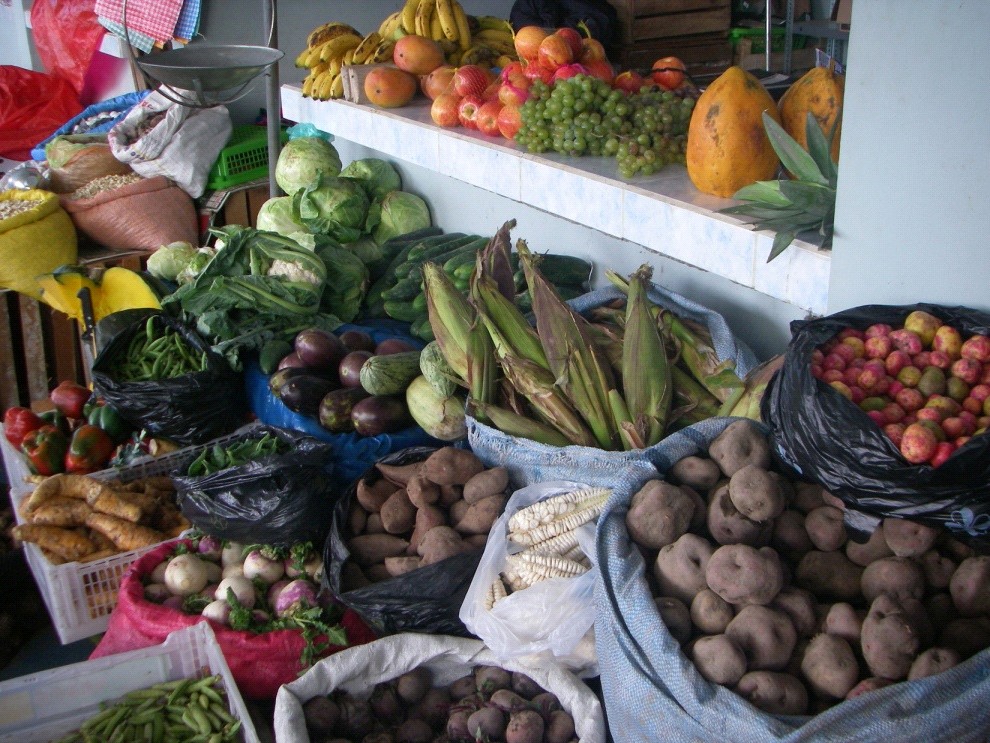
Abundant fruits and veggies in Coroico's weekly market. Papas lisas are the small red and yellow potatoes at right center. I also ate papas negras, the purple ones at bottom right and center, cooked whole in oil -- ¡muy rico!

Not all traditional medicine in the region is herbal or food-based. Good luck rituals and tokens abound, like the brightly-colored fetishes below, in La Paz' Mercado de Hechicería (Witches' Market). Arriving during Carnavál, we also saw cars, taxis, and buses decorated and prayed over as a blessing; and good luck icons by the score, such as miniatures of items the buyer hopes to obtain: money, cars, televisions, etc.[3] All of the shops in the Hechicería had coca. Some Andean shamans use hojas to divine the future.

In the Mercado de Hechicería, dried llama fetuses (hanging) of various sizes are sold. These are buried for good luck in new enterprises, especially those involving construction. Well-to-do traditional people are expected to sacrifice a live animal.

While our inquiries had been fruitful, we had questions our local informants couldn't readily answer. For example, other than for rapid drainage, and where the terrain consists of steep slopes, is it necessary to plant at such challenging angles? Also, can cocal be grown at lower altitudes than Coroico's 5000 feet above sea level, and if so, would this affect its strength or efficacy?

Lest you think we must have stood out for our unusual interest in coca, rest assured, we did not. Regular tours of the area include coca "plantations." Almost all of the other travelers we met in Coroico and Copacabana -- people of all ages from Switzerland, Belgium, New Zealand, Chile, Brazil, Germany, France, Australia, and Japan -- were interested in trying and discussing coca. Bolivians from other parts of the country were interested in comparing the local product with coca from their area.

Our "where's Waldo?" moment: a day after our field trip, strolling across Coroico's plaza for perhaps the 50th time that week, we finally recognized the healthy if somewhat untended stand of cocal growing there among the palms and hibiscus (Hibiscus sabdariffa). Since this is about the only flat spot in Nor Yungas, it seemed to settle whether cocal must be grown on a slope! (The question of altitude remains open.)

The public cocal patch in Coroico's main plaza.. Photo by Richard Lee / The Rag Blog.
Andean music on the plaza draws a crowd. Traditional women from the Afro-Bolivian community (seated, right front) are said to be prolific coca users.
The Sanjuanitos wowed us with John Lennon's "Imagine." Richard later wrote, "Lennon could have imagined this..."

It is in the plaza that matters of interest are discussed before and after cocalero meetings at the roofed "polyfunctional" sports court down the hill. Bolivia's future is being shaped by astute agriculturalists who value tradition but want the benefits of modernity. Change, like the new cell phone technology that has reportedly made rural life safer, is weighed and measured before adoption.

In this small plaza and others all over Bolivia and Peru, citizens talk and relax at the end of the day or the week, after school or at lunch time. Taxis come and go; buses disgorge weary travelers. Children and dogs run free and everyone sees that the soccer ball doesn't bowl over any old folks. Young couples promenade hand in hand in the evening, while the ice cream man, and the chicken sandwich lady, and the elders sitting on stone or wooden benches smile in approval. Here, coca is at home.

[Rag Blog Contributing Editor Mariann G. Wizard, a Sixties radical activist and contributor to The Rag, Austin's underground newspaper from the 60s and 70s, is a poet, a professional science writer specializing in natural health therapies, and a regular contributor to The Rag Blog. Read more poetry and articles by Mariann G. Wizard on The Rag Blog.]


Footnotes:
[1]I'm not naming any Bolivian acquaintances, in order to protect their privacy. None of them live electronically.
[2]http://en.wikipedia.org/wiki/Coca
[3]The fake lucky dinero, by the way, is from "El Banco de Buena Fortuna," and Richard got taken for 50 Bolivianos (about $7.50 US) by making change in the dark. It's a wonder what a photocopier can do, isn't it?

The Rag Blog

[+/-] Read More...

15 May 2013

REPORT / Mariann G. Wizard : 'La Vida Coca' in Bolivia and Peru / 2

Coca leaves, a standard small bag sold for personal use in Bolivia. From 10-40 hojas are used at once while working, walking, or otherwise exerting oneself at high altitudes. Habitual users enjoy coca three or four times a day. All photos by Mariann G. Wizard / The Rag Blog, unless otherwise credited.

La Vida Coca /2: 
Currents in traditional coca 
use in Bolivia and Peru
The overall effect of chewing leaves, drinking coca tea, or eating coca-containing foods can be described as both energizing and calming. Stress and anxiety are decreased, gastric disturbances eased, and the next hill isn't quite so daunting.
By Mariann G. Wizard / The Rag Blog / May 15, 2013

Part two of three.

[Rag Blog Contributing Editor Mariann Wizard recently visited Peru and Bolivia with former fellow Ragstaffer Richard Lee. Wizard says the whole thing was Lee's idea, although she did the heavy lifting of writing this report of their experiences, while lifting copiously from conversations they shared and short reports Richard wrote on the spot.]

It is estimated that 50% of Bolivia's gross national product is related directly or indirectly to coca. The illegality of much of this crop, and its ineligibility for international trade, has significantly handicapped Bolivia's economy and given it, along with Colombia, something of an "outlaw" reputation.

Rather than succumb as Colombia has at least temporarily done to U.S. demands for crop eradication, Bolivia now charts an independent path to international legitimacy and respect. Commodities production has given Bolivia a positive trade balance since 2004. Natural gas, silver, zinc, and soybeans account for 72% of total exports.

Main imports are machinery and transport equipment, chemicals and related products, and mineral fuels and lubricants. Main trading partners are Brazil (33% of total exports, 18% of imports), Argentina (12% of exports, 13% of imports), and United States (10% of exports and 11% of imports).[1]

A new Bolivian Vice Ministry of Coca and Internal Development was established in February 2009, in a reorganization of the executive branch. It is charged with developing employment opportunities, diversifying the economy, respecting traditional cultural values, and in general furthering Bolivian President Evo Morales' overarching vision of "Living Well."

It is expected to rationalize the processing of coca, maintain a climate of social peace, and mitigate and prevent conflicts under the new national policy of peacefully combating drug trafficking.[2]

One of the possible side effects of this policy is a striking lack of domestic militarization in Bolivia compared with most other Latin American nations we've visited in recent years. It's like the dog that didn't bark in the night, not obvious at first but increasingly pleasant over time.

It's worth noting that women spearhead Morales' administration. Strides in women's liberation are seen everywhere. Ending domestic violence and the rule of "machismo" are serious concerns in Bolivia's social revolution. Billboards and televised public service announcements proclaim, "Don't Kill The One You Love." Civilian gun ownership is banned.

While we were still in Bolivia, the campaign to have traditional coca use removed from the list of narcotics finally succeeded,[3] following a powerful appeal by Morales to UN delegates in Vienna.[4] Among the folks we talked with or saw responding in newscasts, this was met with firm approval. If Evo is leading a revolution, his constituents, at least in the altiplano, are keeping pace every step of the way.

Today, there is an emphasis on developing new products to "soak up" the excess coca that feeds illicit drug production, rumored to be concentrated in Brazil. Across the Amazon River, in one of the most difficult environments on the planet, one can envision secret jungle drug labs. But in the highlands, coca is part of a healthy, active lifestyle: "Living Well."

Coca candies, cookies, "teas" (actually infusions; true tea is Camellia sinensis), energy bars, and more are available or in the works. Coca Colla™, an energy drink made with coca extract, was reportedly launched in April 2010, but we didn't see it anywhere; we would surely have tried it. At least 35 coca product brands are operating.[5] A new publication, Il Jornada Nacional del Acullico, launched in 2012 to "reclaim" traditional coca mastication.[6]

Stevia (Stevia rebaudiana), an herb that produces the sweetest natural substances known to date, calorie-free steviosides, grows in Bolivia and is included in many products, in line with the government's overall health-promotion and economic development programs. It's commonly available in restaurants as an herb.

While coca "tea" is often made with whole leaves, there are also many chopped, bagged products from large and small manufacturers. When made of pure hojas, such teas may still be chewed as well as brewed for a stronger effect.
Coca teas, Larco Museum gift shop, Lima. Note the different flavors, including a coca-green tea combination. Some sources state that the term "maté" was adopted for coca teas to capitalize on the popularity of yerba maté (Ilex paraguariensis), but it is used in northwestern Bolivia for any mixed infusion. Matés commonly include tea, anise (Pimpinella anisum), cloves (Syzygium aromaticum), cinnamon (Cinnamonum verum), or other herbs or spices.
Energizing coca- and maca (Lepidum meyenii)-based candies, left, from airport gift shop, Lima. Coca-and-quinoa (Chenopodium quinoa) cookies, right, from Arcoiris Pasteleria on the plaza in Coroico, Nor Yungas, Bolivia.

Many medicinal and personal care products are made with coca, like these at Coroico's Blue Pine Tienda, as entrepreneurs combine traditional lore and modern marketing to legitimize coca in world markets.

Ingacoca's™ banner lists coca syrups for coughs, asthma, prostate support, rheumatism, acidic urine, liver support, stomach ulcers, gastritis, anemia, weight loss, mental acuity, poor appetite, diabetes, nerves, insomnia, kidneys, intestinal parasites, and high blood pressure; salves for rheumatism, varicose veins, bone support (coca is high in calcium), arthritis, gout, fungi, and hemorrhoids; and shampoo and skin creams.

What scientific support is there for the claimed benefits of coca leaf? Herbal medicine expert Andrew Weil says,
Coca appears to be a useful treatment for various gastrointestinal ailments, motion sickness, and laryngeal fatigue. It can be an adjunct in programs of weight reduction and physical fitness and may be a fast-acting antidepressant. It is of value in treating dependence on stronger stimulants.

Coca regulates carbohydrate metabolism in a unique way and may provide a new therapeutic approach to hypoglycemia and diabetes mellitus. With low-dose, chronic administration it appears to normalize body functions. In leaf form coca does not produce toxicity or dependence. Coca can be administered as a chewing gum or lozenge containing a whole extract of the leaf, including alkaloids, natural flavors, and nutrients.[7]
However, as with cannabis, coca's illegality makes it difficult for research on these benefits, all with at least some evidence, to proceed. A search of the PubMed database for Erythroxylon brought up just 109 reports, many on plant pharmacology. Interestingly, several studies used little-known species, not those most cultivated, but having local traditional uses. Most found a chemical basis for the tradition. Some reports are historical; others are policy, cultural, or environmental studies.

There are epidemiological and clinical studies of coca's effects in altitude sickness. (Results: it works and people use it without ill effects.) A study of effects of hojas on biochemical and physiological parameters found metabolic benefits with prolonged physical activity; that is, more fat is burned by users during exercise.[8]

We started seeing coca tea and/or hojas at the hotel breakfast (desayuno) buffet in Nazca, Peru, and at most hotels and hostels after that. Coca tea was on almost every restaurant menu. We learned later that coca is also readily available in Lima, where we had spent a week in ignorance. After all, at sea level, why would anyone have altitude sickness?

But the energizing qualities of coca can benefit tourists at any altitude: see more, do more, enjoy your trip more. While I was sick in Arequipa (everyone there blamed Nazca's water!), hotel staff, doctor, and "Ricardo" all recommended coca. Poco a poco, it helped.

Desayuno buffet at Hotel Berlina, La Paz, with hojas de coca and coca tea. This hotel also had leaves and tea, and hot water, in the lobby at all times.

So, everybody asks, "What is it like to chew coca?" What many really want to know is, "What is it like compared to cocaine?"

It's different. It's not nearly as strong as blow, no matter how much lejia (see below) you use or how many leaves you cram into your cheeks. Yes, there is an astringent flavor; yes, you can get a numbing effect in mouth and throat; yes, there are alkaloids in the leaves and you can test positive for cocaine if that's a concern.

The overall effect of chewing leaves, drinking coca tea, or eating coca-containing foods can be described as both energizing and calming. Stress and anxiety are decreased, gastric disturbances eased, and the next hill (everything in Bolivia is uphill or downhill from where you are!) isn't quite so daunting.

But, unlike the single alkaloid cocaine, use of whole leaf products doesn't end in a sudden emotional or energy crash or turn nice people into a--holes. After a time, the effect gently fades away. Neither of us ever experienced sleeplessness, anxiety, or remorse while using hojas.

And of course there is no issue of addiction or compulsion. You can take it or leave it (unless, of course, you're one of those people who can't take or leave anything; in that case, well, hojas are a lot cheaper than refined "salt").

The mild, balanced effects parallel those of other whole herbs versus single compounds. A classic example is cannabis flowers versus tetrahydrocannabinol (THC), their main psychoactive ingredient. Pharmaceutical medicines of THC alone can cause anxiety. Using whole cannabis for pain control, appetite stimulation, and other medical purposes causes fewer problems and gives patients more control.

And as it turns out, many "minor" ingredients of cannabis -- cannabinoids and other compounds -- also have benefits. The latest pharmaceutical versions of what Mother Nature provides are standardized cannabinoid blends.

A small piece of lejia ("lye") made from stevia (above) or quinoa ash, burned limestone, or baking soda ("bico"), is often chewed with coca to free more alkaloids. This produces a stronger effect, including numbing the inside of the mouth, than hojas alone.
Our serious quest for knowledge began in La Paz, the capital of Bolivia, 13,323 feet above sea level. We visited the coca market, ADEPCOCA, just four blocks from the Villa Fatima terminal, where minibuses from coca-growing Nor Yungas province leave and arrive hourly.

Four stories (each about 100 x 80 m) of coca fill La Paz' bustling ADEPCOCA market. This photo, made early on a Sunday, shows little of the traffic that normally congests this intersection, so that more of the building can be seen. The structure covers a full block. The sign on the front says "COCA ES VIDA"; coca is life.
Bags of prime hojas with the ADEPCOCA logo ready for delivery to hotels, markets, and other outlets. Taxis often carry several bags at a time along with passengers, piling bags in cargo compartments and atop vehicles.
While most traditional women and older men in the market didn't wish to be photographed, this young man with iPod had no qualms and happily posed. Many hundreds of bags like his are bought and sold daily at ADEPCOCA.

Between La Paz and Coroico, along what was once "the most dangerous road in the world," cocal, as coca is called in the field, begins to be seen. The closer we came to one of Bolivia's prime coca centers[9] (like our driver and some fellow passengers, chewing hojas all the way!), the more we saw the well-tended crop on steep hills framed by snowy peaks, rushing waterfalls, and infinite shades of green.

A cocal field near the road. Maintaining agricultural terraces or gradas under frequently torrential rains is an ongoing task of Andean coca growers. Photo by Richard Lee / The Rag Blog.

NEXT: Cocal up close and personal; everything else; our "Where's Waldo?" moment.

[Rag Blog Contributing Editor Mariann G. Wizard, a Sixties radical activist and contributor to The Rag, Austin's underground newspaper from the 60s and 70s, is a poet, a professional science writer specializing in natural health therapies, and a regular contributor to The Rag Blog. Read more poetry and articles by Mariann G. Wizard on The Rag Blog.]


Footnotes:
[1]Trading Economics.com. ]http://www.tradingeconomics.com/bolivia/balance-of-trade
[2]http://www.vcdi.gob.bo/index.php/institucion/institucional 
[3]Neuman W. Bolivia: Morales wins victory as U.N. agrees to define some coca use as legal. New York Times. Jan. 11, 2013. http://www.nytimes.com/2013/01/12/world/americas/bolivia-morales-wins-victory-as-un-agrees-to-define-some-coca-use-as-legal.html?_r=1& 
[4]Cusicanqui JJ. Morales buscar a retirar la coca de la lista de estupefacientes. La Razón. Mar. 12, 2013, p. A4. 
[5]Medrano E. Temen desvío de la industria de la hoja. La Razón. Mar. 12, 2013, p. A4. 
[6]Cusicanqui JJ. Morales buscar a retirar la coca de la lista de estupefacientes. Sidebar: Il Jornada del Acullico. La Razón. Mar. 12, 2013, p. A4. 
[7]Weil AT. The therapeutic value of coca in contemporary medicine. J Ethnopharmacol. 1981 Mar-May;3(2-3):367-76. http://www.ncbi.nlm.nih.gov/pubmed/6113306 
[8]Casikar V, Mujica E, Mongelli M, et. al. Does chewing coca leaves influence physiology at high altitude? Indian J Clin Biochem. July, 2010;25(3):311-4. doi: 10.1007/s12291-010-0059-1. http://www.ncbi.nlm.nih.gov/pubmed/21731204 
[9]The other is Chaparé.

The Rag Blog

[+/-] Read More...

Only a few posts now show on a page, due to Blogger pagination changes beyond our control.

Please click on 'Older Posts' to continue reading The Rag Blog.