Showing posts with label VVAW. Show all posts

07 February 2013

Nancy Miller Saunders : They Tried to Tell Us

Vietnam veterans testify at the Winter Soldier Investigation in 1972. Image is a screen grab from the film, Winter Soldier, produced by the Winterfilm Collective.

Winter Soldiers:
They tried to tell us
We as a nation did not want to know the horrible truth of what we asked our children to do in Vietnam. To acknowledge it was to admit complicity, to take responsibility for it.
By Nancy Miller Saunders / The Rag Blog / February 8, 2013

Forty-two years ago, the Vietnam Veterans Against the War tried to do what Nick Turse seems to have accomplished, judging by Jonathan Schell’s review of Turse’s book, Kill Anything that Moves, in The Nation and online at TomDispatch.com.

The veterans did not have access to the classified information or Pentagon reports Turse used to document the brutal horror the war really was as a result of government pressures. All the vets had were their personal experiences and DD214s (discharge papers that listed their assignments), which about 100 of them took to Detroit in the winter of 1971 for what they called the Winter Soldier Investigation (WSI).

Every veteran who testified had to provide proof of service and whenever possible their testimony was corroborated by other veterans. VVAW was trying to tell the nation for which they had fought, killed, and sacrificed that My Lai was not an aberration, that it was U.S. policy they were ordered to carry out.

I was a member of the film collective, Winterfilm, that had come together to document the WSI, VVAW’s second major demonstration. Most of us had gotten to know the vets while filming their first action over Labor Day weekend 1970.

Video cameras had not yet come into their own for documentaries, so we were using 16mm film. Since the audio was taped separately, my job at the WSI was to take notes of the testimony so that our editors could synchronize picture and sound for our film, Winter Soldier. Thus, except for one panel, I listened closely to all three days of mind-wrenching testimony from men I had learned to respect.

In the process I saw the kind of documentation I needed to believe them. I looked at their firm, youthful cheeks, none completely hidden under beards. And then I looked into their eyes, which were those of old men who had seen too much grief in long lives.

I saw hardened combat veterans weeping on each others’ shoulders. I watched one veteran lean against a wall and slide down in moaning, “It’s no use. It’s no use.” And I watched other veterans kneel beside him, hold him, comfort him, and let him talk.

None of this was acting. Also none of it was the kind of documentation required to prove a point to those who were not there.

Winterfilm’s editors did their best to communicate this documentation while also including clips of the care VVAW took to confirm veterans’ stories before it would let them testify. In one debriefing a former Marine sergeant, Scott Camil, is being questioned while another Marine from his unit corroborates and adds to Camil’s stories.

But these debriefings were not credible documentation for those who did not want to believe that our troops -- our brothers and sons, friends and neighbors -- could possibly have done what these men were saying they had done and seen others do.

Therefore, the consensus had to be -- as veterans in cities around the country held their own WSIs -- that the men testifying were a handful of dangerous men, homegrown terrorists, a threat to national security. Either that or they were peaceniks smearing the reputation and dedication of our troops. Either way, the Vietnam Veterans Against the War were not to be believed.

The Nixon administration saw them as a threat to its credibility. Twice VVAW’s exposure of military movements forced changes of plans. I can almost hear Nixon paraphrasing King Henry II: “Will no one rid me of these turbulent vets?”

Local and federal spies and provocateurs were infiltrated into VVAW. I knew two of them -- Bill Lemmer of Arkansas and Karl Becker of New Orleans. I personally saw both try to provoke the veterans into fights. I also saw FBI reports picturing VVAW as dangerously violent.

Six of VVAW’s Southern leaders, including Scott Camil, were indicted for conspiracy to provoke riots at the 1972 Republican convention, when VVAW had actually undertaken responsibility for keeping the peace among demonstrators at both conventions to avoid a repeat of the riots at the Democrats’ 1968 convention in Chicago just four years earlier. After two more defendants were added in a superseding indictment, they became known collectively as the Gainesville 8.

Lemmer and Becker were two of the FBI informers called by the prosecution to testify against the 8. Because I knew both of them, the defense attorneys hired me to help them with their cross-examinations of the two. Because the judge refused to admit the 8’s defense arguments -- that their plans were purely defensive, the result of information supplied by local and federal provocateurs -- cross-examinations to reveal the truth were crucial to their defense. The jury quickly returned a blanket acquittal.

The campaign against VVAW was revived during John Kerry’s 2004 presidential campaign by the Swiftboat nay-sayers. The corroboration of Camil’s testimony they said was “proof” that Camil had been “coached.” Kerry’s interview with Pitkin, who had now turned against VVAW, was “proof” Kerry helped to slander our gallant troops

Despite condemnation of the Vietnam Veterans against the War, there seemed to be a national schizophrenia about the Vietnam War and its veterans. On the one hand they were our troops whom we should all honor for their dedication and sacrifice. On the other, they were “baby burners,” the villains in TV shows night after night. Scriptwriters no longer needed to provide motives for crimes the bad guys committed. All that was needed was a mention that a certain character was a Vietnam veteran and the audience knew he was the villain.

We as a nation did not want to know the horrible truth of what we asked our children to do in Vietnam. To acknowledge it was to admit complicity, to take responsibility for it. Peter Michelson, who attended the WSI, wrote in the February 27, 1971, New Republic,
As the testimony flooded over me for three days I kept saying, "I don’t want to hear this." I knew that what I was hearing was true; I knew it from other veterans, from published accounts, and from my own brother who had been there. What I was resisting were the ethical obligations that knowledge imposes. Like most people, I didn’t want to have to work out what I ought to do... I am afraid of what I ought to do.
[Nancy Miller Saunders is the author of Combat by Trial: An Odyssey with 20th Century Winter Soldiers in which she tells of her years of working with Vietnam Veterans Against the War (VVAW) and includes stories entrusted to her by veterans to tell, which she lets them do whenever possible in their own words. Read more articles by Nancy Miller Saunders on The Rag Blog.]

The Rag Blog

[+/-] Read More...

07 June 2012

Jack A. Smith : Reversing the Vietnam War Verdict

Demonstrators at the October 21, 1967 march on the Pentagon carry a banner that says, "Support our GIs, Bring Them Home Now."

Reversing the Vietnam War verdict
Most of the allegations about insults directed at soldiers or vets from war opponents have been fabrications to discredit the antiwar forces.
By Jack A. Smith / The Rag Blog / June 7, 2012

The Pentagon has just launched a multi-year national public relations campaign to justify, glorify, and honor Washington's catastrophic, aggressive, and losing war against Vietnam -- America's most controversial and unpopular military conflict.

President Barack Obama opened the militarist event, which was overwhelmingly approved by Congress four years ago, during a speech at the Vietnam Wall on Memorial Day, May 28. The entire campaign, which will consist of tens of thousands of events over the next 13 years, is ostensibly intended to "finally honor" the U.S. troops who fought in Vietnam. The last troops were evacuated nearly 40 years ago.

In reality, the unprecedented project -- titled the Vietnam War Commemoration -- will utilize the "pro-veteran" extravaganza to accomplish two additional and more long lasting goals:
  • The first is to legitimize and intensify a renewed warrior spirit within America as the Pentagon emerges from two counterproductive, ruinously expensive, and stalemated unjust wars in Iraq and Afghanistan, and prepares for further military adventures in Asia, the Middle East, and Africa. Within days of Obama's speech, for instance, Defense Secretary Leon E. Panetta announced a big increase of U.S. Navy forces in the Pacific, a move obviously targeting China. At the same time the Obama Administration's drone wars are accelerating as the Oval Office's kill list expands, and the president engages in cyber sabotage against Iran.

  • The second is to dilute the memory of historic public opposition to the Vietnam war by putting forward the Pentagon's censored account of the conflict in public meetings, parades, and educational sessions set to take place across the nation through 2025. These flag-waving, hyper-patriotic occasions will feature veterans, active duty military members, government officials, local politicians, teachers, and business leaders who will combine forces to praise those who fought in Vietnam and those on the home front who supported the war. There won't be much -- if any -- attention focused on the majority of Americans who opposed this imperialist adventure, except as a footnote describing how tolerant U.S. democracy is toward dissent.
The principal theme of the president's address was that American troops have not received sufficient laurels for their efforts to violently prevent the reunification of North and South Vietnam. He did not point out that there would have been no war had the United States permitted nationwide free elections to take place in Vietnam in 1956 as specified by the 1954 Geneva Agreement ending the French colonialism in Indochina. Washington recently decided that the war "officially" began in 1962 (although U.S. involvement dates back to the 1950s), allowing the commemoration to begin during the "50th anniversary" year.

President Obama lays a commemorative wreath during Memorial Day ceremony at the Tomb of the Unknowns at Arlington National Cemetery, May 28, 2012 in Arlington, Virginia. Photo by Mark Wilson / Getty Images.

President Obama told the large, cheering crowd of veterans and their families at the Vietnam Wall exactly what they — and all those who still resented the era's large antiwar movement — wanted to hear:

One of the most painful chapters in our history was Vietnam -- most particularly, how we treated our troops who served there....

You were often blamed for a war you didn't start, when you should have been commended for serving your country with valor. (Applause.) You were sometimes blamed for misdeeds of a few, when the honorable service of the many should have been praised. You came home and sometimes were denigrated, when you should have been celebrated. It was a national shame, a disgrace that should have never happened. And that's why here today we resolve that it will not happen again. (Applause.)....

[Y]ou wrote one of the most extraordinary stories of bravery and integrity in the annals of military history. (Applause.).... [E]ven though some Americans turned their back on you -- you never turned your back on America... And let's remember all those Vietnam veterans who came back and served again -- in the wars in Iraq and Afghanistan. You did not stop serving. (Applause.)

So here today, it must be said -- you have earned your place among the greatest generations. At this time, I would ask all our Vietnam veterans, those of you who can stand, to please stand, all those already standing, raise your hands -- as we say those simple words which always greet our troops when they come home from here on out: Welcome home. (Applause.) Welcome home. Welcome home. Welcome home. Thank you. We appreciate you. Welcome home. (Applause.)....

May God bless you. May God bless your families. May God bless our men and women in uniform. And may God bless these United States of America.
There was virtually no criticism in the corporate mass media about the president's gross exaggerations concerning the "mistreatment" of Vietnam era veterans. True, there were no victory parades, but that was because the U.S. Armed Forces were defeated by a much smaller and enormously outgunned adversary -- the guerrilla forces of the South Vietnamese National Liberation Front (NLF) and regular forces from North Vietnam.

Members of the Vietnam Veterans Against the War (VVAW) hold a peaceful demonstration outside the 1972 Democratic National Convention in Miami. Photo by JP Laffont / Sygma / Corbis.

By the time many vets returned home the American people had turned against the war and wanted it over, as did a significant portion of active duty troops, including the many who identified with the peace movement or who mutinied or deserted. Undoubtedly some veterans were disrespected -- but to a far lesser extent than Obama and pro-war forces have suggested over the years.

Whenever the U.S. conducts unpopular invasions, as in Vietnam, Afghanistan, and Iraq, Washington and the mass media invariably insist that it is the duty of patriotic citizens to "support the troops" even if they oppose the war. But to manifest the kind of support the government seeks inevitably implies support for the war. This is why the peace groups came up with the slogan "Support the Troops -- Bring 'em home NOW!"

According to the Pentagon, which is in charge of staging the Vietnam War Commemoration, the main purpose is
To thank and honor veterans of the Vietnam War... for their service and sacrifice on behalf of the United States and to thank and honor the families of these veterans. To highlight the service of the Armed Forces during the Vietnam War and the contributions of Federal agencies and governmental and non-governmental organizations that served with, or in support of, the Armed Forces. To pay tribute to the contributions made on the home front by the people of the United States during the Vietnam War..."
Thousands of community, veteran, and various nongovernmental organizations throughout the U.S. are expected to join the Commemorative Partner Program
to assist federal, state and local authorities to assist a grateful nation in thanking and honoring our Vietnam Veterans and their families. Commemorative Partners are encouraged to participate... by planning and conducting events and activities that will recognize the Vietnam Veterans and their families’ service, valor, and sacrifice.
In addition the government and its "partners" will be distributing educational materials about the war, according to the Pentagon, but it is unlikely that the Vietnamese side of the story or that of the multitude of war resisters in the U.S., civilian and military, will receive favorable attention. Many facts, including the origins of the war will undoubtedly be changed to conform to the commemoration's main goal of minimizing Washington's defeat and maximizing the heroism and loyalty of the troops.

Officially, the Vietnam war lasted 11 years (1962-1973), but U.S. involvement actually continued for 21 years (1954-1975). The U.S. financially supported the restoration of French colonial control of Vietnam and all of Indochina after the defeat of Japanese imperialism in 1945 (Japan earlier displaced French rule). By 1954, Washington not only supplied money and advisers but sent 352 Americans to Vietnam in a "Military Assistance Advisory group" supporting the French against liberation forces led by the Vietnamese Communist Party. The liberators defeated the French army at the historic battle of Dien Bien Phu that same year.

The Geneva Conference of 1954, facilitating impending French withdrawal, established that Vietnam would be divided temporarily into two halves until free elections were held in 1956 to determine whether the liberation forces, led by Ho Chi Minh, or Emperor Bao Dai, who had collaborated with both French and Japanese occupation forces and was a puppet of the U.S., would rule the unified state.

American soldiers carry a wounded comrade through a Vietnam Swamp. Photo by Paul Halverson, 1969. Image from The Veterans Hour.

It is doubtful that the commemoration is going to emphasize the fact that the U.S., led by President Dwight D. Eisenhower, used its power to prevent nationwide elections from taking place when it became clear that Ho Chi Minh would win 80% of the vote. Eisenhower acknowledged this in his memoirs. Instead, Washington allied itself to right wing forces in the southern sector to declare "South Vietnam" to be a separate state for the first time in history and set about financing, training and controlling a large southern military force to prevent reunification. The U.S. dominated the Saigon government throughout the following war.

When Paris withdrew remaining French troops in April 1956, according to John Prados in Vietnam: The History of an Unwinnable War, 1945-1975 (2009), "their departure made America South Vietnam's big brother," i.e., overlord and military protector against popular liberation forces in the southern half of the country.

By June 1962, 9,700 U.S. "military advisers" plus a large number of CIA agents were training and fighting to support the corrupt U.S.-backed regime in Saigon (now Ho Chi Minh City), at which time President Kennedy's Defense Secretary, Robert McNamara, announced that "every quantitative measure shows that we're wining the war."

By 1968, when the number of U.S. troops attained their apogee of 535,040, Washington was obviously losing to its tenacious opponent. This is when Democratic President Lyndon B. Johnson decided not to seek reelection rather than face the humiliation of defeat. Republican President Richard M. Nixon succeeded to the presidency and vastly increased the bombings while also calling for negotiations to end the war.

Facing an impending defeat and political catastrophe, American troops pulled out in 1973. The CIA and some U.S. military personnel and political advisers remained in diminished South Vietnam assisting the right wing government in Saigon until April 1975 when the entire country was liberated.

The U.S. lost 58,151 troops in the war. Between four and five million Vietnamese civilians and soldiers were killed on both sides in a catastrophe that could have been entirely avoided had Washington allowed the free elections to take place. Over a million civilians in neighboring Laos and Cambodia also were killed or wounded by U.S. firepower.

Vietnam, north and south, was pulverized by U.S. bombs and shells. The Pentagon detonated 15,500,000 tons of ground and air munitions on the three countries of Indochina, 12,000,000 tons on South Vietnam alone in a failed effort to smash the National Liberation Front backed by the North Vietnamese army. By comparison, the U.S. detonated only 6,000,000 tons of ground and air munitions throughout World War II in Europe and the Far East. All told, by the end of the war, 26,000,000 bomb craters pockmarked Indochina, overwhelmingly from U.S. weapons and bombers.

The Pentagon also dumped 18,000,000 gallons of herbicides to defoliate several million acres of farmland and forests. Millions of Vietnamese suffered illness, birth defects, and deaths from these poisonous chemicals. The AP recently reported from Hanoi, Vietnam's capital, that "More than 100,000 Vietnamese have been killed or injured by land mines or other abandoned explosives since the Vietnam War ended nearly 40 years ago, and clearing all of the country will take decades more."

It should also be mentioned -- since it will be suppressed during the commemoration -- that U.S. forces, including the CIA and the Pentagon-controlled South Vietnamese military, tortured many thousands of "suspected" supporters of the liberation struggle, frequently with portable electrical current. An estimated 40,000 "Vietcong" (suspected members or supporters of the NLF) were murdered during the long-running "Operation Phoenix" assassination campaign conducted by the CIA, Special Forces, and killer units of the Saigon forces.

Iconic photo of crying Vietnamese children after an aerial napalm attack near near Trang Bang, Vietnam, June 8, 1972, Photo by Nick Ut / AP.

There were three main fronts in the Vietnam war, in this order: First, the battlefields of Indochina. Second, the massive antiwar movement within the United States and international support for Vietnam. Third, the Paris Peace Talks. Well over 60% of the American people opposed the war by the late 1960s-early '70s. The first peace protest took place in 1962; the first very large protest took place in Washington in 1965. Subsequently there were thousands of antiwar demonstrations large and small in cities, towns, and campuses all over America.

[Disclosure; This writer was a war opponent and a conscientious objector during this period. His information about the war derives from when he functioned as the news editor, managing editor and then chief editor of the largest independent leftist paper in the U.S. at the time, the weekly Guardian. This publication thoroughly covered the war, peace movement, antiwar veterans (Vietnam Veterans Against the War [VVAW] was founded in 1967 and is still active today), the extraordinary resistance of active duty troops in Vietnam and at U.S. bases and COs in prison or in Canada and Europe throughout the period of conflict.]

Most of the allegations about insults directed at soldiers or vets from war opponents have been fabrications to discredit the antiwar forces -- falsehoods Obama chose to repeat as part of the Pentagon's campaign to reverse history's negative verdict on the war in Vietnam. The peace movement's targets were the warmakers in Washington and their allies abroad, not members of a largely conscript army. Perhaps the most notorious of the false accusations were frequent reports about antiwar individuals "spitting" at GIs and vets. The rumors were so wild that sociologist Jerry Lembcke wrote a book exposing the lies -- The Spitting Image: Myth, Memory, and the Legacy of Vietnam, New York University Press, 1998.

It's extremely doubtful that the war commemoration will dare touch honestly upon the movement of active duty troops against the war and the hundreds of cases killing their own officers.

Historian Howard Zinn included this paragraph on the opposition to the Vietnam War by American soldiers in his People's History of the United States:
The capacity for independent judgment among ordinary Americans is probably best shown by the swift development of antiwar feeling among American GIs -- volunteers and draftees who came mostly from lower-income groups. There had been, earlier in American history, instances of soldiers' disaffection from the war: isolated mutinies in the Revolutionary War, refusal of reenlistment in the midst of hostilities in the Mexican war, desertion and conscientious objection in World War I and World War II. But Vietnam produced opposition by soldiers and veterans on a scale, and with a fervor, never seen before.
According to the Washington Peace Center:
During the Vietnam War, the military ranks carried out mass resistance on bases and ships in Southeast Asia, the Pacific, U.S., and Europe. Military resistance was instrumental in ending the war by making the ranks politically unreliable. This history is well documented in Soldiers in Revolt by David Cortright and the recent film Sir! No Sir!
One of the key reports on GI resistance was written by Col. Robert D. Heinl Jr. and published in the Armed Forces Journal of June 7, 1971. He began:
The morale, discipline and battle worthiness of the U.S. Armed Forces are, with a few salient exceptions, lower and worse than at anytime in this century and possibly in the history of the United States.

By every conceivable indicator, our army that now remains in Vietnam is in a state approaching collapse, with individual units avoiding or having refused combat, murdering their officers and non-commissioned officers, drug-ridden, and dispirited where not near mutinous. Elsewhere than Vietnam, the situation is nearly as serious.

Intolerably clobbered and buffeted from without and within by social turbulence, pandemic drug addiction, race war, sedition, civilian scapegoatise, draftee recalcitrance and malevolence, barracks theft and common crime, unsupported in their travail by the general government, in Congress as well as the executive branch, distrusted, disliked, and often reviled by the public, the uniformed services today are places of agony for the loyal, silent professions who doggedly hang on and try to keep the ship afloat.
According to the 2003 book by Christian Appy, Patriots: The Vietnam War Remembered from All Sides, Gen. Creighton Abrams -- the U.S. military commander in Vietnam -- made this comment in 1971 after an investigation: "Is this a god-damned army or a mental hospital? Officers are afraid to lead their men into battle, and the men won’t follow. Jesus Christ! What happened?"

Another former Army colonel in Vietnam, Andrew J. Bacevich Sr. (now a professor of international relations at Boston University and a strong opponent of U.S. foreign/military policy) wrote a book about how the U.S. military labored for a dozen years after the defeat to revamp its war strategy and tactics. (The New American Militarism: How Americans Are Seduced by War, Oxford University Press, 2005.)

One major conclusion was that a conscript army may become unreliable if the war is considered unjust in nature and unpopular at home. This is why conscription was ended for good and the Pentagon now relies on better paid professional standing military supplemented by a large number of contractors and mercenaries, who perform many duties that were once handled by regular soldiers.

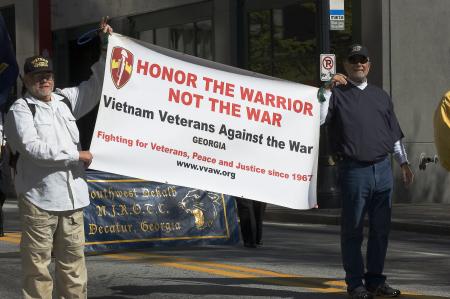
Vietnam Veterans Against the War at 2009 Atlanta Veterans Dav Parade. Photo by David Howell.

Veterans' movements from the professional military of contemporary wars, such as Iraq Veterans Against the War and March Forward, as well as from the Vietnam era, are still out in the streets opposing imperialist wars, and public opinion polls reveal that over 60% of the American people oppose the Afghan adventure.

Despite the colossal damage the U.S. inflicted on Vietnam and its people during the war years, the country has emerged from the ashes and is taking steps toward becoming a relatively prosperous society led by the Communist Party. The Hanoi government has received no help from Washington. During the Paris Peace Talks of 1973, Nixon promised Prime Minister Pham Van Dong in writing that the U.S. would pay Vietnam $3.5 billion in reparations. This promise turned out to be worthless.

What strikes visitors to Vietnam in recent years, including this writer, is that the country appears to have come to terms with what it calls the American War far better than America has come to terms with the Vietnam War. Despite the hardships inflicted upon Vietnam, the government and people appear to hold no grudges against the United States.

Hanoi has several times extended the welcome mat to former antagonists, urging Americans and residents of southern Vietnam who now live abroad to "close the past and look to the future." Wherever touring U.S. citizens -- including former GIs -- travel in Vietnam, they are met with the same respect as visitors from other countries.

In the U.S., the Vietnam war still evokes fighting words in some quarters. Some Americans still argue that the U.S. "could have won if it didn’t have one hand tied behind its back" (i.e., used nuclear weapons), and some continue to hate the antiwar protesters of yesteryear, just as they do demonstrators against today’s wars. And some others -- in Congress, the White House and the Pentagon -- still seem to continue fighting the war by organizing a massive propaganda effort to distort the history of Washington's aggression and unspeakable brutality in Vietnam.

[Jack A. Smith was editor of the Guardian -- for decades the nation's preeminent leftist newsweekly -- that closed shop in 1992. Smith now edits the Hudson Valley Activist Newsletter. Read more articles by Jack A. Smith on The Rag Blog.

The Rag Blog

[+/-] Read More...

06 September 2011

Nancy Miller Saunders : Idiots and Blinders

Vietnam Veterans protest the war at the Republican National Convention in 1972. Photo by Langelle.

Idiots and blinders:
Military 'intelligence' then and now
There is nothing new about such blindness to alternative possibilities. Forty years ago those of us who wanted to end the Vietnam War were the 'terrorists.'
By Nancy Miller Saunders / The Rag Blog / September 6, 2011

Are the developers of our intelligence operations idiot savants, brilliant in some areas and totally oblivious in others? (Think Dustin Hoffman in The Rain Man.) Or do they wear blinders to keep themselves from seeing anything other than what they expect to see?

Recently I learned that our military is “forging the onscreen cyber-trademarks used by Al Qaeda” to post “confusing and contradictory orders, some so virulent that young Muslims dabbling in jihadist philosophy, but on the fence about it, might be driven away.”[1]

Did anyone at the Pentagon think about all those jihadists who are not on the fence who might follow those “virulent” (i.e., venomous, contagious; deadly, noxious; poisonous, hateful)
[2] orders? Tom Engelhardt did. In a recent Tomgram he asks in his title, “Could the Pentagon Be Responsible for Your Death?”[3] Scary thought.

Engelhardt compared this plan to the Bureau of Alcohol, Tobacco, Firearms and Explosive’s (ATF) Operation Fast and Furious, which is either “an ambitious new strategy allowing Fast and Furious agents to follow the paths of guns from illegal buyers known as ‘straw purchasers’ through middlemen and into the hierarchy of the powerful Sinaloa drug cartel.”[4] Or, as the National Rifle Association (NRA) contends, it is a scheme to use ”the violence in Mexico as an excuse to promote gun restrictions.”[5]

Whatever the reason, according to the Washington Post, in the nearly two years of operation, more than 2,000 weapons (including AK47s) have been allowed to “walk” into Mexico. A U.S. Border Patrol agent was killed with one and fewer than 600 have been recovered.

There is nothing new about such blindness to alternative possibilities. Forty years ago those of us who wanted (among other things) to end the Vietnam War were the “terrorists.” The handful of Weather Underground bombers and a few other crazies got all of us branded as dangerous criminals. People worried that there would be even more serious riots at the 1972 national conventions than there had been at the Democrats’ 1968 convention in Chicago.

The RAND corporation did a contingency study of different ways the government could handle riots. These included declaring martial law, round-ups of activists, and even possibly canceling the election. News of these contingency plans made it into the news briefly.

Groups planning to demonstrate were making their own contingency plans to avoid rioting. Many provided training in passive resistance and asked the Vietnam Veterans Against the War (VVAW), to provide internal security. They were combat veterans who understood violence, wanted no more of it, knew how to defuse it, and how to exert the necessary authority. And VVAW had a consistent record of nonviolent protests.

Capitalizing on fears of rioting, certain myopic officials within the federal government thought up a way to put riots to good use -- not unlike current ideas of aping al Qaeda to discourage jihadists and facilitating gunrunning to trace guns.

The Nixon administration put G. Gordon Liddy in charge of its convention plans. He obligingly developed his Gemstones, several “operations” named for gems and minerals, which he presented to Attorney General John Mitchell in the presence of White House counsel John W. Dean, III, and interim director of the Committee to Re-elect the President (CREEP) Jeb Stuart Magruder.[6]

G. Gordon Liddy was in charge of Nixon's convention plans. Image from PhilroPost.

Liddy later wrote that, Operation “DIAMOND was our counterdemonstration plan.” Calling demonstrations attacks, he wrote that he and his operatives would identify demonstration “leaders through intelligence before the attack got under way [his emphasis], kidnap them, drug them, and hold them in Mexico until after the convention was over... Leaderless, the attack would be further disrupted by fake assembly orders and messages, and if it ever did get off the ground it would be much easier to repel.”[7]

Magruder later described what he called an “awkward exchange” with his wife when he told her,
"[W]e may have to grab some of the radical leaders and take them to Mexico."

“How would they get back?" Gail asked incredulously.

“They might not get back," I said.[8]
Los Angeles police and FBI informer, Lewis Tackwood, added twists to the plot.
The plans entailed planting a number of agents-provocateur inside and outside the 1972 Republican Convention in San Diego... to provoke street battles with the police surrounding the convention hall, meanwhile agents inside the convention hall were to have planted explosives.
The intent...
...was to create a nation-wide hysteria that would then provide President Richard M. Nixon with the popular support necessary to declare a state of emergency; the government could then arrest all "radicals," "militants," and "left-wing revolutionaries.”[9]
Of all the perceived “terrorists,” Vietnam veterans were generally thought to be the most dangerous. They had the capability to launch attacks. They were popularly considered to be “baby burners.” The worst of all were veterans who denounced the war. They were traitors. They had to go. So VVAW was targeted. And I had a ringside seat.[10]

When 1972 began I was living with VVAW’s South-Central coordinator, Don Donner, at the University of Arkansas in Fayetteville. One of the local veterans, Bill Lemmer, insisted to me that the RAND study was not a contingency plan, it was a blueprint to round us all up and cancel the elections so that Nixon could remain president.

The next month he told another woman,
Just before the [Democratic] convention the VVAW leaders would be rounded up and held somewhere, possibly out of the country, and a lot of shooting and rioting would occur at the convention.
Then, "he and other people who were working with him would go to the convention disguised as VVAW and shoot leaders of the convention."[11]

Such was the plan. Fortunately the plotters were not dealing with either suicidal jihadists or drug cartels. They had blinded themselves to the fact that VVAW had consistently conducted nonviolent demonstrations. As numerous vets told me, they had seen enough of violence and its devastation. They were not going to contribute to it here at home. In the years I worked with VVAW I was frequently surrounded by enraged vets, and every time they found ways to face down the threat of violence and restore calm.[12]

Now here is what happened. The prophesized round-up did occur, but not in any way that we had imagined.

On May 5 the Republicans moved their August convention out of San Diego to Miami Beach, where the Democrats were holding theirs in July. Now all convention security planning could be consolidated in one place. And all of VVAW’s security planning became the responsibility of Florida coordinator Scott Camil.

At the urging of Louisiana state coordinator, Karl Becker, Scott agreed to host a security planning meeting in Gainesville, Florida, and to notify the local Florida coordinators. Karl was to notify the other state and regional coordinators. Scott, and later Texas coordinator, John Kniffin, reminded Karl to notify Don, not Bill whom they distrusted. Karl assured them that he would do so.

Later that month events took an ominous turn. On May 15 presidential contender George Wallace was shot in Laurel, Maryland. Four days later, May 19, a bomb exploded in the Pentagon.

Scott took his responsibility seriously, focusing on the Democratic convention. He would learn from it ways to handle the Republicans’ convention. He and his Miami coordinator worked with police and city officials to establish cooperation and to learn all they could of their security plans.

Among the things they learned was that the police were being issued automatic weapons, that Cuban exile groups were planning to provoke trouble with demonstrators, that the bridges between Miami and Miami Beach (which is an island) would be raised to contain any trouble, and that boats and aircraft would be patrolling the waters to keep demonstrators from escaping.

Meanwhile Don never heard from Karl. He knew nothing about the Gainesville meeting until the day before it started. It was too late for him to get there, but Bill Lemmer was on his way. The next day, after the meeting was underway, they learned that Lemmer was an FBI informer. From personal encounters with him, we knew he was also a provocateur. We tried all weekend to call and warn Scott. He never answered. All calls between our phone and his were blocked until the meeting was over.

As one attendee described Lemmer’s arrival, he “burst upon the scene, not wearing a red cape or carrying a bullwhip, but he had the presence of a red cape.” Texas coordinator John Kniffin explained that “Lemmer had just come from a demonstration in Washington, DC, and he was all hyped up about these troopers in black jumpsuits beating up women and bashing people and ‘this is going to happen in Florida [at the conventions] and what are we going to do about it?’”

Thus Lemmer set the tone for planning.

Members of the Vietnam Veterans Against the War (VVAW) hold a peaceful demonstration outside the 1972 Democratic National Convention in Miami. Photo by JP Laffont / Sygma / Corbis.

After the meeting Scott went to Miami to hold peace talks with Cuban activists. They refused to talk to him until a pair of police officers arranged for him to meet with Pablo Manuel Fernandez, who was more interested in trying (unsuccessfully) to sell Scott weapons than in talking peace.

The Democratic convention opened Monday, July 10. The Friday before that, July 6, FBI agents swept through the South from Texas and Arkansas to Miami and the national office in New York handing out subpoenas to more than 20 of VVAW’s southern leaders. All of them were ordered to appear in Tallahassee Monday morning. No exceptions.

That was the roundup. No grand jury can question so many witnesses in one day, yet those responsible for security at the Democratic convention had been corralled in Tallahassee, which is about as far from Miami as one can get and still be in Florida.

And the subpoenas were delivered so quickly that Scott and the others had no time to make alternative security plans for the convention. The round-up left the convention vulnerable to the provocateurs that Tackwood, Liddy, and Lemmer had talked about.

But the myopic planners had overlooked a critical fact about combat veterans. They cover for each other. Picking up the slack when buddies fell had kept them alive in war. It had become instinctive for them to fill in and move on. Thus the vets who did get to Miami kept things peaceful.

The day the convention ended, the subpoenas were dropped and six of the vets -- including Scott and John Kniffin -- were indicted for conspiracy to riot at the upcoming Republican convention. Two more men were added in a superseding indictment. The group became known as the Gainesville 8.

We would later learn that Karl Becker -- who had orchestrated time, location, and attendees at the meeting -- was an FBI informer; that the Miami police officers who set up the meeting between Scott and Fernandez were working undercover; and that Fernandez was a police informer who had been wearing a wire. We also learned that most of the information Scott had collected had been supplied by undercover police and FBI sources. VVAW had been set up, but avoided the trap.

I have to agree with the NRA that “American law enforcement agencies must never be allowed to make the situation worse “ -- which, but for VVAW, would have happened in 1972; which may happen with the cyber program to dissuade jihadists; and that has happened with ATF’s Operation Fast and Furious.

We deserve better.

Notes:

[1]Eric Schmitt and Thom Shanker, “After 9/11, an Era of Tinker, Tailor, Jihadist, Spy,” The New York Times, August 6, 2011 http://www.nytimes.com/2011/08/07/sunday-review/after-911-an-era-of-tinker-tailor-jihadist-spy.html?pagewanted=all.
[2]Definitions come, in order, from WordNet, an online lexical database for English http://wordnetweb.princeton.edu/perl/webwn; my Webster’s Unabridged Dictionary; The American Heritage Dictionary of the English Language.
[3]http://original.antiwar.com/engelhardt/2011/08/11/could-the-pentagon-be-responsible-for-your-death/
[4]Sari Horowitz, “A gunrunning sting gone fatally wrong,” The Washington Post, July 25, 2011 http://www.washingtonpost.com/investigations/us-anti-gunrunning-effort-turns-fatally-wrong/2011/07/14/gIQAH5d6YI_story.html
[5]Chris W. Cox, “The Big Question Of ‘Fast and Furious’: Who Knew?” America’s 1st Freedom, Vol. 12, No. 9, September 2011, p. 35.
[6]Liddy, Dean and Magruder all wrote of these meetings in their books, Liddy in, Will: the Autobiography of G. Gordon Liddy (St. Martin’s Press, NY, 1980), pp. 182 & 196-200; Dean in Blind Ambition (Pocket Books, NY, 1977), pp. 73-78; and Magruder in An American Life: One Man’s Road to Watergate (Atheneum, NY, 1974), pp. 192-195.
[7]Liddy, p. 197.
[8]Magruder, p. 248.
[9]Citizens Research and Investigation Committee and Louis E. Tackwood, The Glass House Tapes: The Story of an Agent-Provocateur and the New Police-Intelligence Complex (Avon, NY, 1973), pp. 41-2.
[10]]As I relate in Combat by Trial: An Odyssey with 20th Century Winter Soldiers (iUniverse, Bloomington, IN, 2008) for which veterans gave me their personal memoirs, let me go through their files, and interview them.
[11]The woman was Barbara Stocking who entrusted to me her personal memoir and let me interview her for Combat by Trial.
[12]I tell of these instances in Combat by Trial along with explanations from veterans, often in their own words, and with descriptions of what it felt like to be in the middle of such rage and watching the vets handle it.
[13]Ibid., p. 288, I quote Bill Patterson from an interview I conducted with him, John Kniffin, and another veteran who attended the Gainesville meeting.
[14]Cox, op. sit.


[Nancy Miller Saunders was a member of Winterfilm Collective which documented activities of the Vietnam Veterans Against the War. She is the author of Combat by Trial and is a freelance writer living in the Arkansas Ozarks with her husband Budd Saunders.]

The Rag Blog

[+/-] Read More...

11 August 2011

Nancy Miller Saunders : Jane Fonda and the 'Home of the Brave'

Jane Fonda at the Oleo Strut GI Coffee House, Killeen, Texas, circa May 1970. Photo by Thorne Dreyer / Space City!

Jane Fonda and the 'home of the brave'

By Nancy Miller Saunders / The Rag Blog / August 11, 2011
"I was infuriated as I learned just how much our soldiers were being lied to about why we were fighting in Vietnam and I was anguished each time I would be with a young man who was traumatized by his experiences." -- Jane Fonda
The same day Obama and the Democrats caved in to Republican Tea Party extremists on the deficit, I learned that the cable channel QVC canceled an appearance by Jane Fonda because of angry calls from extremists objecting to her anti-Vietnam War activities. It has been nearly 40 years since that war ended yet these Swiftboater-types still cling to hatred of her, much of which is based on lies and distortions.

Yes, the picture of her sitting and laughing on a Vietnamese anti-aircraft gun damned her in many people's eyes. But appearances can be misleading, which they are in this case as she explains in a recent piece, “The Truth About My Trip To Hanoi," posted on her blog.

Although one picture may be worth a thousand words, those words can be misleading as easily as they can be revealing. But rather than risk letting go of their hatred by listening to her explanations of what happened and why she went to North Vietnam, these Swiftboaters have clamped their minds shut around their hatred. One mistake in an otherwise exemplary campaign to stop an increasingly unpopular war and Fonda is condemned forever and always.

We claim in our national anthem that ours is “the home of the brave.” Is it, when our president and Congress knuckle under to extremists' threats to bankrupt the country? Is it, when cable channels let bullies frighten them out of letting a movie star peddle her latest book on an entirely different topic?

Where is the bravery in these cave-ins? Where is the bravery in our docile acceptance of such hateful extremism? We recently saw true bravery in Tahrir Square in Cairo, Egypt, where people fed up with corruption nonviolently withstood fierce attacks and toppled Hosnei Mubarak's regime. We are seeing it again in the streets of Syria where people are being gunned down for their nonviolent protests.

Jane Fonda is a brave woman who looked beyond her instinctive feelings that would not let her imagine the United States could ever fight an unjust war. But then she met and listened to active duty GIs and Vietnam veterans. She began to study that war and discovered what it was doing to the men being sent to fight it. She worked to find them help they needed.

When they asked, she spoke for them, using her celebrity to amplify their voices in an effort to get the American people to listen to what they had to say about what was being done in our name and to our sons, brothers, and neighbors. Only with knowledge -- not emotional assumptions, no matter how treasured -- can we correct our mistakes and maybe, just maybe, avoid making them again in the future. But, sadly, we have repeated them in Iraq.

Fonda also campaigned for an organization that was unprecedented in our history: Vietnam Veterans Against the War (VVAW). Never before had U.S. combat veterans massed together to protest the continuation of the war in which they fought, but Vietnam veterans did just that, beginning in 1968.[1]

Two years later Fonda was working with VVAW and I found myself listening to the war's veterans after VVAW asked a group of us filmmakers to film their first two major demonstrations. They pointed out that they had the message and we had the means to broadcast it.

We put together four film crews to accompany VVAW and document the first demonstration, a RAW March over Labor Day weekend, 1970, from Morristown, New Jersey, to Valley Forge, Pennsylvania.[2]
(RAW stood for Rapid American Withdrawal from Vietnam.) Those of you old enough to remember that day may know that we risked being busted for crossing a state line to foment a riot, even though starting a riot was definitely not our intention.

Whenever possible VVAW used paradigms from the American Revolution to emphasize their patriotism and dedication to our founding principles. The route they chose was one some of George Washington's troops took to Valley Forge that memorable winter. In towns along the way, the veterans performed guerrilla theater in which they used volunteers acting as Vietnamese civilians to demonstrate their sanctioned brutality during the many search and destroy missions they had been sent on.

Image from the 1972 documentary film, Winter Soldier. Photo from Winterfilm Collective.

We filmmakers were with VVAW the entire weekend, even camping on the ground next to the veterans' encampment all three nights. We interviewed them, waded into the middle of their guerrilla theater to film it, and watched with growing admiration as they resisted provocation after provocation. They knew what violence is like and the damage it can do. They did not want to yield to it here at home.

At Valley Forge on Labor Day, VVAW staged a rally that began with more than 200 veterans making a moving entrance. Fonda was one of the speakers, again using her celebrity to amplify what the veterans had to tell their fellow citizens. She then left on a nationwide tour of campuses, introducing veterans to VVAW and recruiting volunteers for the next major action.

That second action was the Winter Soldier Investigation (WSI) in Detroit, Michigan, Jan. 31-Feb. 2, 1971, when more than 100 Vietnam veterans gave “straightforward testimony -- direct testimony -- about acts which are war crimes under international law. Acts which these men have seen and participated in. Acts which are the inexorable result of national policy.”[3]

Contrary to extremists' accusations, VVAW carefully vetted the men it let testify. All had to have their discharge papers and IDs with them. Their testimony was checked against what other veterans knew, against documented evidence and whatever else the organizers could lay their hands on. We filmed the entire three days of testimony as well as related events and interviews with men who testified. Fonda financed us and attended the investigation, though she did not speak at it.[4]

The memories I brought away from the WSI are of haunted eyes of old men who had seen too much grief in already long lives -- as they looked at me from youthful faces. The contrast was proof of their stories. I remember seeing tough, war-hardened men break down and weep. I remember them hugging each other for mutual support. I remember listening to gut-wrenching testimony hour after hour for the full three days.

And I remember a love that spread from the veterans to include all of us who took the time to listen, to really listen, to what they had to say. This was a love far more powerful than any romantic love. It was the love of shared commitment.

Working on those two films with VVAW changed my life, much as I imagine listening to GIs and veterans changed Fonda's. Neither of us had to do what we did, but our hearts and souls had been touched. We knew, as few civilians did, why the war had to be ended. Its destruction had come home in the bodies and minds of those sent to fight it. Sadly there are people still trapped with the hatred necessary for war, necessary to make rational human beings kill other human beings.

I was so moved that I vowed to write the truths I learned about the war, about our national policy, and about the terrible toll it had taken on its veterans, and about the Nixon administration's efforts to silence and discredit VVAW. A number of veterans entrusted their stories to me to tell, much as others had trusted Fonda to speak for them.

In far subtler ways than the blatant lies and hatred used to vilify Fonda, I was hounded, intimidated, pressured, and threatened -- in attempts to make me shut up. The pressure was subtle, and friends to whom I turned for help told me to “stop being so paranoid” -- but some of the veterans stood by me. The first two people not directly involved with VVAW to believe me both had connections in the CIA, which suggests that I was not being paranoid. At times I was so terrified that I did stop... for a while.

The cumulative result of this harassment is that it took me nearly 40 years to finally keep my vow. Unable to find a publisher brave enough to work with me, I had to self-publish Combat by Trial: An Odyssey with 20th Century Winter Soldiers.[5] All that interference would make another good book.

In a second book I would include the lessons I learned from the veterans about overcoming one's fears, about reaching down inside oneself to find the courage needed to continue, about the value of humor and laughter. And I would write about a man I met, Budd Saunders, a combat veteran who believed me -- although he was not a VVAW member or even a veteran of the Vietnam War.

Budd protected me, loved me, married me, and encouraged me to finish Combat by Trial. On our living room wall is a photograph of two of the veterans who most influenced me during those difficult years. One of them, Scott Camil, was hounded far worse than I was. He was framed several times, once for a capital offense (kidnapping), and he was shot in the back (the bullet barely missing his heart) by DEA agents when he refused to let them set him up on a drug deal.

Underneath their photograph I have pasted a quote from Scott: “If you let them demoralize you, then they're effective. If you don't, they aren't. That's up to you, not them.”

If enough of us keep such thoughts in mind, instead of clinging to our fears and wishful beliefs, we can rebuild our “home of the brave.” But it will take all of us finding the strength and courage that dwells within each of us to speak out against lies, distortions, and intimidation; to stand up to the corporate bosses who would squeeze us dry for their profit. And, above all, to stop letting hatred destroy us personally and as a nation.

References:

[1] Iraq and Afghanistan veterans have joined together in Iraq Veterans Against the War (IVAW).
[2] Different Sons , Bowling Green Films, New York, NY.
[3] Excerpt from the transcript of the opening statement to the Winter Soldier Investigation, January 31, 1971.
[4] Winter Soldier, Winterfilm, New York, NY; reissued by Millarium Zero, Harrington Park, NJ.
[5] Nancy Miller Saunders, Combat by Trial: An Odyssey with 20th Century Winter Soldiers, iUniverse, Bloomington, IN, 2008.


[Nancy Miller Saunders was a member of Winterfilm Collective which documented activities of the Vietnam Veterans Against the War. She is the author of Combat by Trial and is a freelance writer living in the Arkansas Ozarks with her husband Budd Saunders.]

Also see:The Rag Blog

[+/-] Read More...

25 August 2010

BOOKS / Mariann G. Wizard : The Odyssey of Our Winter Soldiers


Nancy Miller Saunders' Combat by Trial:
Documenting 20th century 'winter soldiers'


By Mariann G. Wizard / The Rag Blog / August 25, 2010

Combat by Trial: An Odyssey with 20th Century Winter Soldiers by Nancy Miller Saunders. (iUniverse, Inc., 2008.) 591 pp, $34.95. Available at www.iuniverse.com.

Turning the Guns Around: Notes on the GI Movement by Larry G. Waterhouse and Mariann G. Wizard (Praeger, 1971). 221 pp., published at $6.95.


In 1971, my second husband and good friend Larry Waterhouse and I, through a fortuitous series of chances and choices, wrote a book on antiwar activity in the U.S. armed forces for a respected New York publisher. Turning the Guns Around: Notes on the GI Movement (Praeger) was researched and written entirely in four months to conform to a deadline occasioned by the failure of a previously contracted writer to deliver a manuscript.

Following Robert Sherrill's successful Military Justice is to Justice as Military Music is to Music (HarperCollins,1970), Praeger was eager to jump on the military dissent bandwagon, and to fill the hole in their spring line-up.

Turning the Guns Around gave 'em more than they bargained for. With chapter titles like, "Gen. Baconfat vs. the Red Menace" and "Today's Pig is Tomorrow's Bacon," and copiously drawing from the irreverent and often profane underground GI press of the day, we proclaimed the entry of activist grunts, swabbies, jarheads and/or flyboys, along with some servicewomen, into the ranks of revolution.

Drafted out of graduate school at UT Austin on November 25, 1969, Larry made no secret of his sympathy for Vietnam's National Liberation Front during induction and basic training. As a result, he spent his entire 14-month military career at Ft. Ord, California, near Monterey.

By the time I joined him the next summer, he'd made the transition from leadership in UT's Students for a Democratic Society (SDS) to leadership in the Ord chapter of Movement for a Democratic Military (MDM). The group rented a house off-post where off-duty soldiers could meet, hang out, and talk; published an erratic newspaper; and engaged in anti-war actions as well as solidarity actions with, groups like the lettuce-boycotting Farmworkers Union, protesting the enormous amounts of lettuce being served in Army mess halls.

We had each worked with individual anti-war vets in Austin, and with anti-war GIs somewhat through the Oleo Strut, an anti-war coffeehouse in Killeen, Texas, near Ft. Hood, and knew from history the potential importance of rising dissent within America's armed forces.

Despite rising rapidly to a responsible and even rather sensitive position in Ft. Ord's payroll office, Larry never earned a stripe, remaining a proud buck private throughout his military servitude. His only bling was a Sharpshooter medal.

We signed our book contract at Christmas in 1970, in a Houston hospital, at the bedside of his Mom, who we thought might not live to see the book (she did). We'd flown to Texas on emergency leave when Gretchen had a heart attack, but tried to save money on the way back by delivering a "drive-away" car to Los Angeles. This became a marathon trip-from-Hell that landed us back in Monterey on Jan. 2, 1971, at about 4 a.m. I fell into bed. Larry put on his uniform and went to work.

An hour or so later he woke me with amazing news: he was being summarily, and honorably, discharged. Apparently the brass didn't want an active duty private authoring a book about dissent in the armed forces!

Back in Austin, we finished the book, found a place to live, figured out what was next in terms of employment and school, and along the way met and started working with a good-natured Army vet, Terry DuBose, to organize an Austin chapter of Vietnam Veterans Against the War (VVAW).

It wasn't long, however, until we found ourselves in the best place organizers can be: not needed. By the fall of 1971, VVAW was an organization of, by, and for combat vets and their spouses, and Larry and I were politely asked to step out. We continued opposing the seemingly endless Vietnam conflict in other ways.

VVAW continued to emerge as a leading anti-war organization, especially as the beleaguered student movement imploded, until the war finally ended and the last U.S. troops came home.

Nancy Miller Saunders' memoir, Combat by Trial, tells VVAW's story not only from her point of view, that of a non-veteran "insider," but also, by skillfully interweaving the stories of veterans, government documents and vintage press reports, paints a collective memoir of a very crazy time. She was not, and does not present herself, as a VVAW leader, but was a trusted collaborator and confidante of many of VVAW's key players, especially in the Southern region, over several years.

The liberal film school graduate encountered VVAW as a member of Winterfilm, a collective documenting testimony at VVAW's first nationally-noted action, the Winter Soldier Investigation.

Held in late January and February 1971, WSI grouped combat vets by service and division to give public testimony about atrocities and war crimes in which they had participated, and/or had witnessed. The first panel was made up of veterans of the Marine Corps' highly decorated First Division that had been in Vietnam since 1965.

From painfully detailed testimony in this and subsequent panels a pattern of officially-sanctioned brutality over overlapping tours of duty emerged, demonstrating unequivocally that the recently-revealed massacre at My Lai had been no accident, and no particular exception.

Saunders describes the haggard, haunted, but still child-like men who made these bloody confessions, and her own growing awareness that these gallant, all-American boys had been maimed not only, all too often, in their bodies, but in their souls. VVAW's quest for an end to the war was at once a quest for their own healing, and for the healing of a nation.

Describing her journey, that of her then-partner, Arkansas VVAW coordinator Don Donner, and of VVAW as a whole from concerned patriots to targets of government intrigue, Saunders dips willingly into her own interpretations, but takes care to label them as such, urging readers to draw their own conclusions.

Her point of view differs from mine, for example, on the role of more radical anti-war groups, who she generally regarded then and now as "crazies" who drew attention from VVAW's powerful statements and needlessly endangered peaceful protesters. However, her own militancy was raised by threatening events and the intense persecution of VVAW. This internal shift, from being a total pacifist to someone who, on occasion, could not sleep without knowing that a loaded pistol was within reach, is powerfully evoked.

The book made me remember walking into the MDM house in Monterey for the first time and seeing the sandbags lining the walls to protect against occasional drive-by shootings. The story of her and Donner's reception by the New Orleans "Red Squad" gave me a chill; the Monterey police department knew of my arrival almost before I did.

If you are among those who can't imagine what led some anti-war protesters of the 1960s and 1970s, as well as Black liberationists, to consider violence, this book is "must reading"! The short version: the U.S. government, through its willful lies, delusional fantasies, and brutally destructive acts, brought much enmity upon itself.

Turning the Guns Around. Dell paperback edition.

Those who read with interest in The Rag Blog about Federal Bureau of Investigation informer Brandon Darby and the impact of his unmasking will be fascinated with the story of VVAW's snitches. Even now, with the perspective of years and Saunders' deep research into FBI files, the motivations of such individuals remain obscure, but the VVAW experience demonstrates that this must be a secondary consideration.

Deliberately false "intelligence" was the result of a political program that aimed to destroy VVAW's credibility through accusations of planned violence and expensive trials, draining group resources. That this was accomplished, in part, through the testimony of paid informers and provocateurs worked eventually to bring in "not guilty" verdicts for most VVAW members charged with crimes, but the damage had been done. The question of how to defend against such betrayals remains open, and urgent.

In the biggest legal case, veterans were charged with conspiring to riot at the 1972 Republican National Convention in Miami. The trial of the Gainesville 6, that then became the Gainesville 8, and of the "Forgotten 4," involved Austin's own "movement lawyers," most notably Cameron Cunningham for the defense.

Saunders recalls the bickering between and among defendants and defenders; between VVAW's southern regional leaders -- most of those accused in the case -- and its compromised national office; as well as the convoluted legal wrangling that led to complete acquittal in Gainesville -- but only after the RNC was over and Nixon anointed once more as the nominee.

Although Saunders and Donner were not active here, Austin VVAW's actions are amply chronicled, largely through Saunders' conversations with and letters from local leader John Kniffen, one of the Gainesville 8, as well as through her direct observations of VVAW actions in the Dallas-Ft. Worth area and in Killeen.

Kniffin, a taciturn, wiry, former tank commander who did 32 months in-country, joined Austin VVAW in 1971, and became a force regionally, and then in national VVAW, where he demanded -- and got -- more democratic decision-making.

His recollections, and those of his widow, Cathy, who continues, after John's death from Agent Orange exposure, to work for veterans' rights, brought back vivid memories of actions here in which Larry and I participated, the most awesome of which was a gigantic outpouring of peace and justice forces at the official dedication of the Lyndon Baines Johnson Presidential Library, attended by a Who's Who of U.S. imperialism, including then-President Richard "Tricky Dick" Nixon.

While there are a few errors that old Austinites will readily spot (e.g., the University's West Mall is referred to repeatedly as the East Mall), it's also fun figuring out who certain unnamed activists must be, simply from their descriptions.

In what I believe to be an original contribution, using FBI and press reports, Saunders alluringly links dirty tricks played against VVAW with Nixon's Watergate burglary team. Offices and homes of VVAW members and attorneys were burgled, especially in Florida, where Nixon's plumbers were based; as in the better-known Washington, D.C. break-ins that ultimately brought down the President, only certain papers were stolen.

In the weeks before the 1972 national political conventions, both of which were in Miami, Florida leaders of VVAW were in discussion with Democratic Party headquarters -- one of the targets of Nixon's buggers -- about security for demonstrators ("nondelegates") who would attend. Democrats feared, and hoped to avoid, a repeat of the 1968 Chicago convention debacle, where anti-war youth had been clubbed through the streets on national television.

Was this discussion the reason Nixon bugged Democratic Party HQ? Did the same crew that burgled Pentagon papers whistle-blower Daniel Ellsburg's psychiatrist's office burgle VVAW files in Gainesville? Did Nixon hope to tie national Democratic leaders to VVAW's alleged conspiracy to riot? While no conclusive proof is presented, "coincidences" of timing and personnel movement are compelling. Has anyone offered a more reasoned explanation of what Watergate was all about?

Saunders also presents evidence that on at least two occasions, VVAW's release of information gleaned from active-duty contacts (the anti-war movement within the military having continued to grow despite its own problems and persecutions) about U.S. troop and materiel build-ups prevented the war from being intensified on Nixon's watch, rather than eventually being abandoned. This seems a plausible enough reason for the vengeful, plotting Nixon to want the organization destroyed!

The collective nature of Saunders' memoir is its true strength. By giving free voice to the many vets who entrusted her with their papers, their unpublished memoirs, their own FBI files, etc., she avoids the self-centered quality common in such memoirs, while still allowing herself free voice.

She knows that no one person has the full story, and in fact not even a group of people such as she draws from see everything that happened around them and to them. Part of the immense satisfaction I found in the book came from seeing other views of events I had seen peripherally, in a time that seems both very long ago and strangely like this morning.

In a funny circle-of-life coincidence, a bus Terry DuBose drove with other veterans to Washington, D.C. -- a bus belonging to John Kniffin -- and wrote about in an epilogue for Turning the Guns Around, pops up in Nancy's book, stranded by the side of the road, from a completely different source.

DuBose electronically introduced me to Saunders and her husband, Budd -- a sometimes contributor to The Rag Blog from rural "Arkansaw" -- a year or so ago, which is how I heard about her book, and requested a swap. As a sometimes self-published author myself, I'm happy to recommend this Internet publication in overall quality and value.

You'll find as many typos in any book these days, and none of Saunders' are very off-putting. Spelling errors, etc., in sources quoted, add, in several cases, to the authenticity of her documentary. Saunders still sees life through a film editor's eye, and has a good gift both for description, especially of people and the places where action takes place, and for dialogue, as well as voluminous resources.

Turning the Guns Around was a snapshot of an emerging movement, a Rorschach blot of a moment. Combat by Trial is a deeper, longer, and more nuanced look at that same movement -- military opposition to U.S. military adventurism -- as it grew, rose, and fell in the 1970s.

Now it is rising again, in our younger brothers and sisters, sons and daughters, who have been to war in the cauldrons of Iraq and Afghanistan. Saunders doesn't shy away from drawing parallels between Vietnam and the "Afraq" conflicts, and I will not shy away from pointing out that Turning the Guns Around predicted these wars in some detail 39 years ago. Unlike some Vietnam-era memoirs, Combat by Trial has plenty to offer today's peace warriors.

[Mariann Wizard, a Sixties radical activist and contributor to The Rag, Austin's underground newspaper from the 60s and 70s, is a poet, a professional science writer specializing in natural health therapies, and a regular contributor to The Rag Blog.]

The Rag Blog

[+/-] Read More...

17 August 2009

David Zeiger: These Wars Aren't Over Yet

Why We Fight from Displaced Films on Vimeo.


An Open Letter to Iraq Veterans Against the War Members and Supporters
From David Zeiger, Director of This is Where We Take Our Stand and Sir! No Sir!


Dear Friends,

As I write this, we are getting ready to post the fourth episode of This is Where We Take Our Stand, our six-part web series about last year’s Winter Soldier: Iraq and Afghanistan event. You can find the series at www.thisiswherewetakeourstand.com, and of course on Facebook, Twitter, and Youtube.

It’s been a huge struggle, but this series is finally here–and I hope we created something that will bring the truth you revealed at Winter Soldier to thousands, even millions. We strove to make each episode a revelation and a punch in the gut, featuring some of the most important and powerful testimony from Winter Soldier along with the battles so many of you fought to make it happen. Boots Riley of The Coup wrote a killer theme song, Sound Off, that can also be downloaded from the site.

Winter Soldier happened in the last year of the Bush administration, and it was the most powerful condemnation of the occupations of Iraq and Afghanistan that I have seen. Your testimony laid bare the insane, relentless brutality of those wars and the hypocrisy of Bush’s claims that you were there to bring “freedom and democracy” to the people of Iraq and Afghanistan. You made it clear that it was the policy of the government and military that was criminal. And you brought into the open the courageous, profound opposition to the wars that exists within the military and veterans’ community.

But what about now? Millions of people expected the Obama administration to change those policies and end the occupations. Well, where is that change? In Iraq, where we have been promised there might be a withdrawal by 2011 leaving 50,000 troops there to insure an “America friendly” government? Or how about Afghanistan, where a
thoroughly corrupt, Bush-installed government is now being propped up with the
additional 20,000 troops that were withdrawn from Iraq? What has changed?

What’s most horrifying for me is seeing the slaughter continue today with hardly a peep from those who would have loudly objected when Bush was in charge. So, perhaps
ironically, Winter Soldier is today more relevant and urgent than ever. This is not about the past, as Obama has often said, but about what is happening right now.

It is your voices that must be heard in this darkness. And it’s in that spirit that we have made this series. It belongs to you, and we hope you will not only watch and show it to others, but use it to spread the impact of Winter Soldier and build your movement. We welcome your thoughts and comments, and urge you to add your own testimonials to the web site. Along with posting the final three episodes through September, we will make the whole series available on a DVD for you to use.

With love and solidarity,
David Zeiger

The Rag Blog

[+/-] Read More...

18 July 2009

David Zeiger : This is Where We Take Our Stand

Episode One : For Those Who Would Judge Me


This is Where We Take Our Stand
A web series about Winter Soldier


By David Zeiger / The Rag Blog / July 18, 2009

I am more than pleased to announce to Rag Blog readers that the web series produced by Bestor Cram and me about last year's Winter Soldier Iraq and Afghanistan Investigation is finally starting. Throughout the summer we will be posting six episodes of This is Where We Take Our Stand, one every two weeks, at www.thisiswherewetakeourstand.com. Episode one is available now, along with the trailer for the series, and I want to urge all of you to not only watch but post, promote, and help spread the series throughout the internet.

Why this series, and why now? you may ask. Good question. Last year we spent three months following and filming the complicated, intense and emotional process of bringing two hundred and fifty veterans and active duty soldiers to Washington, DC, to expose the realities of America's occupations of Iraq and Afghanistan from their own experience. With strong support from the antiwar and progressive funding community, we hoped and expected to have a film available in six months. But surprise! Along came Barack Obama and suddenly that support was dust in the wind. I won't go into details -- I think you know the reasons.

In my view, there is no better time than now to present this series. In the name of "not looking backward," the very policies and strategic goals put in place by the Bush administration in the Gulf region stand fundamentally unchallenged and unchanged by the Obama administration. Am I overstating the case here? Yes, the rhetoric is different, and Obama has even called the invasion of Iraq a mistake. A mistake?! If it's a "mistake," that means the goals are valid and righteous, they're just being pursued with the wrong tactics-as Obama has repeatedly said in the name of "supporting the troops."

Well, I beg to differ. At the risk of stating the obvious, if these wars were illegal and immoral under Bush, by what logic are they not illegal and immoral under Obama?

Below is the statement about the series written by Bestor and me. I hope that our series will do a little to rattle the sleep out of many people's eyes, as these occupations continue and, in the case of Afghanistan, expand. Please help us make that happen.

[David Zeiger is an award-winning film producer and director whose highly–acclaimed film Sir! No Sir! documented the little-known GI resistance to the Vietnam War. His production company is Displaced Films.]

This is Where We Take Our Stand:

The series that tells the riveting and timely story of the hundreds of Iraq and Afghanistan veterans who testified at last year's Winter Soldier investigation, has now begun. We hope to reach thousands, even millions worldwide as the six episodes are released throughout the summer:
  • Episode One: For Those Who Would Judge Me available now. See above or click here.
  • Episode Two: Rules of Engagement will launch July 27, 2009.
  • Episode Three: Why We Fight will launch August 10, 2009.
  • Episode Four: Broken Soldier will launch August 24, 2009.
  • Episode Five: This is Not Human Nature will launch September 7, 2009.
  • Episode Six: No Longer a Monster will launch September 20, 2009.
Where's the debate?

Are we watching passively while Barack Obama carries out the same policies as George W. Bush?

When an American bombing raid this May killed over two hundred civilians in a village in Afghanistan, it was met with a deafening silence. When Obama's promised "withdrawal" from Iraq leaves 130,000 troops there for at least two more years and 50,000 permanently, it's hailed as an end to the occupation. And who is demanding to know just what the mission really is when 30,000 more troops are sent to Afghanistan?

Where's the debate?

In March of 2008, two hundred and fifty veterans and active duty soldiers marked the fifth anniversary of the invasion of Iraq by gathering in Washington, DC, to testify from their own experience about the nature of the occupations of Afghanistan and Iraq. It was chilling, horrifying, and challenging for all who witnessed it. Against tremendous odds, they brought the voices of the veterans themselves into the debate. That was then.

This is now. Today, we present to you This is Where We Take Our Stand, the inside story of those three days and the courageous men and women who testified. And we present this story today, told in six episodes, because we believe it is as relevant now as it was one year ago. Maybe more.

Here is our challenge to you: Watch the series; spread it far and wide; and ask yourself, Is this about the past, or the present and future? Then add your voice.

If you are a veteran or active duty, present your own testimony. If you are not, but you are still a living, breathing member of the human race, then do whatever you can to join and fan the flames of debate.

- Displaced Films and Northern Light Productions


The Rag Blog

[+/-] Read More...

15 March 2009

Austin : Eyewitness Accounts from Winter Soldiers for Peace

Winter Soldier: Iraq and Afghanistan. Austin, Texas, Feb. 28, 2009. Photo by Carlos Lowry / The Rag Blog.

Winter Soldiers for Peace
After three more decades of aggressions upon foreign soils, brigades of Veterans for Peace (VFP) and Vietnam Veterans against the War (VVAW) have been joined by Iraq Veterans against the War (IVAW). Testimonies today from this new generation of “boots on the ground veterans” will carry echoes blown in from Vietnam and Detroit ‘71.
By Greg Moses / The Rag Blog / March 14, 2009

AUSTIN — In the stone-walled sanctuary of Central Presbyterian Church, on Saturday, Feb. 28, three hundred faithful settle into pews as the dean of Austin peace activism, Fran Hanlon, previews how the rest of the weekend schedule has been planned for this Winter Soldier event.

Fran’s partner at the podium, Doug Zachary, is looking pleased already. The house is full. The program is printed. The act is together. A banner hanging large to stage left says “Winter Soldier” and Zachary with his whitening beard, angle-bent hat, and Palestinian scarf, is looking like a perfected instance of the eternal type.

Zachary has been a Winter Soldier for 37 years. In 1970 he won an honorable discharge after convincing the Marine Corps that he took the words of Jesus seriously. In 1971, as Zachary was seeking alternative paths through Texas, the Winter Soldier Movement was born in Detroit where 109 veterans of the War on Viet Nam turned out the truth of what they’d done as war criminals in a criminal war. Not many years later, of course, that war was ended.

After three more decades of aggressions upon foreign soils, brigades of Veterans for Peace (VFP) and Vietnam Veterans against the War (VVAW) have been joined by Iraq Veterans against the War (IVAW). Testimonies today from this new generation of “boots on the ground veterans” will carry echoes blown in from Vietnam and Detroit ‘71.

A Winter Soldier, says Zachary, is “loyal, steadfast, faithful, resolute, conscientious, scrupulous, and unafraid of painstaking work.” On this last day of February, 2009, with north winds howling out back along San Jacinto Boulevard, Zachary is here to declare that the movement– in these “times that try men’s souls”–shall not quit resisting the ongoing “imperialist, racist, and anti-democratic” wars on Afghanistan and Iraq.

Zachary yields the podium to the chaplain of the Austin IVAW, Hart Viges, who will be moderating the first panel of speakers. Viges looks like a lanky pastor with his trimmed hair, spectacles, dark blazer, white shirt, and blue jeans, not to mention the mighty large cross hanging on the wall behind him.

“I’d like to give a quote from Rabbi Yeshua (Jesus)” says Viges. “He said, ‘Blessed are the ones who have undergone ordeals, for they have entered into life’.” After this refreshing translation of a beatitude the IVAW chaplain reminds us that even the things we will hear today can be transcended.

They Built Hanging Gardens without Strange Fruit

First to speak today is Dr. Dahlia S. Wasfi, M.D. whose grandparents include a Sunni Muslim, a Shia Muslim, and two Holocaust Jews. She therefore begins her story with a memory of the Abraham who once upon a time walked with Allah in Iraq. Dr. Wasfi’s cousins will sometimes boast that they walk the same ground as Abraham, but it has been hard ground lately. There was an 8-year war with Iran, a 42-day bombing of the First Gulf War, and of course the Shock and Awe campaign of 2003. In such a land it would be miraculous not to be living out some disorder of post-traumatic stress.

A film clip pulls us into the streets of Fallujah where two children carry small bags to a cemetery. A tiny grave marks the burial of a child’s arm. A grown man weeps. Another declares that “our enemy” is anyone who had any part in these killings. Clicking between slides, Dr. Wasfi shows us two more children from Iraq and Philadelphia joined together through an extended family that spans half the world and several religions. Shouldn’t we be working to build a world where these children can enjoy a common future of peace and prosperity?

Consider the example of Babylon. Dr. Wasfi presents a slide of what the Hanging Gardens must have looked like when they counted among the Seven Wonders. Do we seriously think that such a people from such a land actually need our outside assistance to figure out how to be great or to do great things? Well there is one thing the Iraqi people could use that we could give them, says Dr. Wasfi, and that is immediate and unconditional withdrawal.

HUMINT Unit

Winter Soldier testimony begins with Ronn Cantu, who steps to the podium with trim dark hair, a bare shadow of beard and mustache, dressed in jeans and a black t-shirt that identifies him as an Iraq Veteran Against the War. In 2003, he believed so strongly in “the war on terrorism” that he re-joined the Army after two years out. The Army sent him to Iraq once, then twice. So 2007 found him back in Iraq.

“During my second tour I served as a human intelligence collector,” says Cantu, looking over his notes. “A lot of people know that as an interrogator, but interrogation is only half of what a HUMINT DIR does. The other half is source operations where we look for Iraqi citizens to give us information willingly and thereby become sources.”

Cantu explains the method of “dual source reporting” which requires two written statements before a suspect can be detained. The database assigns each report a number, but the number does not reveal whether a second report comes from a second source. Two reports from a single source could therefore qualify as “dual source reporting.” Database numbers could also be entered without any real sources behind them.

One of his first assignments was to help round up four members of an IED cell. It seemed like a “success” but Cantu wondered: “Does a flock disperse when you detain the shepherd?” As a HUMINT operator, Cantu was working for the “new body count,” and under these circumstances his unit could do what’s ethical or please the masters. “We did the latter.”

From questionable database practices that could barely count to two, the operation soon degraded into detain first, dual source later. From one suspected “al Qaeda” mosque Cantu’s unit detained every male and then looked for reasons to keep them. Thirteen qualified.

“Then the worst thing happened,” said Cantu. “We accidentally caught somebody big.” Congratulations came sliding down the command chain. What was there to do but to repeat the whole method next week. By this time the people in the neighborhood were convinced that the Army had declared war against Islam. To show how that wasn’t true, the Army got the Iraqi police to handle the next mosque roundup. Since the neighborhood was Sunni and the police were Shia, the operation worked perfectly to divide and conquer.

When detainees were sent to confinement with boot-shaped bruises, missing teeth, or broken arms, military handlers got nervous and started rejecting them. Once again, Iraqi police could help with backup detention facilities. But when Cantu attempted to report questionable detention practices on the basis of seeing a man with an eye swollen shut he was asked: “Did you see him being tortured?” What he heard was: “If you didn’t see it, it didn’t happen.” When a Warrant Officer assured Cantu that he did not have to carry out duties he considered to be illegal and discomforting, he began to pull away.

Gitmo Grand Opening

Brandon Neely was born into a military family in Georgia and he turned to the military when he reached working age in Texas. He still keeps a military haircut that he wears today with his IVAW t-shirt. Like Cantu’s before him, Neely’s confessions have been made in previous venues. He opens by explaining how military guards sent to the Guantanamo Bay prison were never trained in the Geneva Conventions because they were taught that Gitmo was an exceptional place where the Geneva Conventions didn’t apply.

We’ve seen pictures of Gitmo prisoners arriving at Camp X-Ray, dressed in bright orange jumpsuits, knit orange caps, surgical masks, goggles, earmuffs, and gloves; hands strapped together. What we didn’t see was the first guy who hopped off the bus on one leg as he was screamed at to move it. Nor did we see how after he had hopped so many yards someone bothered to toss from the bus his prosthetic leg.

We’ve seen the cruel pictures from Iraq of naked prisoners piled on top of each other, but we haven’t seen the pileup that Neely describes when a bunch of Gitmo guards jumped on top of a prisoner who called one of them a bitch.

And we’ve heard the hype about the Gitmo prisoners being certified homicidal maniacs, but we haven’t heard how the first prisoner that Neely took charge of was trembling with all his might under a fear of everything he expected to experience when ordered to kneel. He was slow to get into that position because he believed it would be his last. What Neely reflexively took to be killer resistance was only one mortal’s attempt to steal an extra breath from this life, sucking it down from behind a surgical mask that he was convinced he would never be able to remove. From their separate places across the globe, two distraught men were ordered to collide at Gitmo, each brainwashed into thinking that he was meeting a killer of instant resort.

Wake Up Call

“He knew how to sleep as only the innocent and the dead could dig,” says Rooster Romriell, opening his testimony with a poem made from fragments of razor-edged memories. Long hair covering his right ear is mismatched by a buzz cut on the left side, as if to say once you get that military cut, it can never be outgrown. His black t-shirt declares an imperative: “Support GI Resistance.”

Rooster transports the sanctuary to a home in Sadr City where an American squad has just discovered an AK-47, which is a legal weapon to keep at home. We watch horrified as “an old woman with an infant in her arms” falls to the ground “weeping inconsolably” as two shots ring out. The bullets crash through an innocent man’s face. With a quivering chin, Rooster tells us that the woman still screams in his head at night when he’s trying to sleep.

Then comes the dump truck. American troops fire upon it and watch it burn. A man comes “waving a white cloth and yelling ‘baby, baby,’ trying to tell us that we were destroying nothing more than children and garbage.” Rooster’s flesh quivers again with the pain of a conscience that dares him not to cry on the spot. He exhales into the sanctuary and we barely breathe. He has more stories to tell.

“Obama claims that he wants to withdraw the troops from Iraq—at least he did prior to gaining the presidency—all the while saying that Iran is a constant threat, allowing troops to be increased in Afghanistan, turning his sights on Russia, claiming they were delivering nukes to the terrorists, and now he’s confronting China for currency manipulation and monetary policy. He’s calling for a civilian security force and mandatory service. We cannot allow a blind eye to be turned on these things. Obama is no friend to the veteran.” As Rooster withdraws from the podium, Cantu offers a handshake.

“Bring the Troops Home Now”

“I’m a little overwhelmed by some of the testimony that’s been shared with us today, as I imagine many of you are,” says the next speaker. Greg Foster is president of the Austin IVAW. He is a panelist during this part of the program. Later he will serve as moderator. His black t-shirt bears a familiar script: “We the People.” Picking up the general theme of the day, Foster declares that Winter Soldiers are responsible citizens.

“We know the reality of the occupations of Iraq and Afghanistan,” says Foster. The testimonies may be difficult to speak and difficult to hear, but the truth is important and it should be shared. The US owes compensation and reparations for damage done on foreign soil, but the country also needs to provide full benefits and adequate health care to “soldiers and Marines.”

Foster, like Rooster, spent time in Sadr City. He recalls fighting street by street to secure a zone of operation, then watching burned-out awnings replaced with fresh cloth. “I saw Sadr City slowly start to rebuild itself.” After his unit was transferred out, the new unit had to start all over again with another street-by-street battle to reassert the “hegemony” of American power. Says Foster: “When I say bring the troops home now, it’s not a slogan.”

The FOBulous Life

After a crowded and chattering intermission in the basement Fellowship Hall, the afternoon program resumes with two videos by Casey J. Porter. As far as Porter was concerned, one tour of duty in Iraq would have been enough. After returning from his first year in Iraq he joined the IVAW in 2007. Yet that same year he was “stop-lossed”– instead of getting out on schedule he was ordered back to Iraq. This time around, Porter posts short anti-war videos to his YouTube channel.

The first Porter film today is “The Deployment Game: Livin’ FOBulous,” a satirical presentation of Camp Taji, a forward operating base (FOB) north of Baghdad that boasts 29,000 square feet (count ‘em) of retail space, complete with comfort foods from back home (listed in order of appearance): Subway, Burger King, Pizza Hut, Seattle’s Best Coffee, Cinnabon, and Taco Bell.

Cut to a car salesman seated behind a laptop, discussing the price of a Mustang GT fully loaded with leathers, then to a segment about KBR–the corporation that announced 2007 revenues of $8.7 billion, down a hundred million dollars from 2006 because of “lower Iraq-related activities in the Government and Infrastructure business unit.” From a faucet in Iraq we watch a dingy yellow liquid fall into a sink and down a drain. If it’s not a picture of the clean water KBR is supposed to be providing, then it’s a perfect image of something.

“It’s going to take a lot of stuff to kind of fix this bruise that we put on the whole earth,” says a fully jacketed combat soldier in the Porter film Deconstructed. A hand-held camera follows soldiers through a home raid, lingers over a twig that a soldier uses to poke through human remains, records passing scenes of Iraqi life as viewed from a moving patrol vehicle, and occasionally shows a tender moment between an American GI and an Iraqi child. “Going out into these neighborhoods and really helping to reconstruct, we’re not you know,” says the GI. “I don’t see that happening. I don’t see a true reason for us being here.” The video has racked up 46,000 confirmed views.

A Woman in the War System

After “Deconstructed” comes an awkward pause, as if the fog of war leaked into the sanctuary upon images of IED dust. Greg Foster gets things back on track by introducing the first speaker of the second panel, Navy veteran Marie Combs. Although Combs has been featured at Winter Soldier events before, this is her first appearance since leaving the Navy two weeks ago. As a military translator, her experience begins at the Defense Language Institute in Monterey, California, where she learns how women in the military are treated to health care. At every visit to the doctor every woman is asked to take a pregnancy test. Apparently when it comes to women, pregnancy is the only “medical condition” that the system is prepared to see.

At a deployment base near Iraq, there is one woman physician, but she is frequently sent away on the medevac transport with women in labor. And wherever they are taken, stories come back that women are made to walk on days when they should qualify for transport, such as when they’ve just had a c-section or when they are visiting the hospital to nurse their infants. If war is something only real men do, then women soldiers also have war done to them, even though they wear the war’s uniform. Combs herself suffered from depression after the birth of her daughter, nor was it easy to find help for that.

“The more wars we start, the more countries we invade, it’s breaking all of us down,” warns Combs. She recalls a newscast where the war in Iraq was dubbed a “detour” that would soon be finished on our way back to a fresh start in Afghanistan. But how can we start this kind of thing again? “It’s hard to speak,” says Combs, “when nobody is listening. No one’s paying attention to war.” Now that Combs puts it that way, a kind of coherence emerges. Wherever terms of power are deployed by real men, the voice of peace counts precisely as the voice of a woman.

The Art of Peace

“I’d really like to speak about the strategies that I feel would really bring an end to this war quicker,” says Austin IVAW Chaplain Hart Viges, who has changed roles from moderator to panelist. “So I look to peace and try to find my definition of peace, and the best thing I can come up with (and I think there is influence from other sources) is that peace is conflict without violence. In this life that we live we cannot escape from conflict or the rubbing of parts or ideas. This is our life and it is the struggle. Buddha says that life is suffering, then so be it. So I go to war,” says Chaplain Viges, holding up a book. “Sun Tzu, The Art of War–this is a very important book that every peace activist should read and soak in. It may sound confusing, but really the same strategies that we apply to war can be applied to peace.”

Viges takes special interest in Sun Tzu’s advice that victory in war depends upon seizing something that the enemy holds dear. And so what do the makers of war need? They need people and money. But “if there’s no one to pull a trigger and if they don’t have any money to spend on a trigger they cannot make war.”

Strategy number one for the art of peace: deprive the warmakers of people. To do his part, Viges hangs out where young soldiers can be talked to. He also helps to staff a local GI Rights Hotline. Viges declares that there is no better satisfaction than taking calls from people with stress in their voices. They have been told they cannot say no to military service. When they are advised how to remove themselves from that matrix, Viges can hear their voices change from stress to relief. In hearing that change in voice, Viges gets the best feeling.

Viges also works with the local counter-recruitment group, Nonmilitary Options for Youth, where he takes credit for deterring ten young people from signing up for military service. “That’s a body count I can live with,” he smiles. Already, the local group has won a public complaint in the form of a newspaper quote from military recruiters. If local recruiters can feel the impact of a half-dozen organizers working on a shoestring, what would happen with a steady budget and expanded staff?

Strategy number two: take away the warmakers’ money. According to the current pie chart at WarResisters.Org more than half of our federal tax payments in 2008 will help to fund wars past and present. “And since I’ve been downrange,” says Viges, “I know what those dollars turn into. They turn into real bullets and real bombs that kill real people.” The Religious Freedom Peace Tax Fund Act would allow citizens to opt out of war spending as a matter of conscience. During the last session of Congress, legendary peacemaker John Lewis (D-GA) was able to gather more than 40 co-sponsors for the bill. Watch for the bill to come up again this session, then “saturate them with communication.”

Keep Yourself Right

It takes Oklahoma farmer John Scripsick about seven seconds to draw cheering applause: “After listening to you talk about recruiting, I think it should be a law that a recruiter cannot go into a high school.” Dressed in plain clothing and ball cap, Scripsick tells the story of his son Bryan who joined the Marines right out of high school and served for three years and three weeks before being killed in Iraq.

“I often wonder if my son had lived if he would have joined your cause,” says Scripsick. “I was told that in a training exercise in California a higher up gave Bryan an order and Bryan just stood there. The higher up gets in Bryan’s face and asks him if he is going to obey his orders and Bryan just stood there and said, ‘No sir!’ The guy got louder and asked Bryan, you know, ‘Why aren’t you going to do that?’ And Bryan said, ‘Because. That’s. Stupid. Sir!’”

The week before Bryan left for Iraq, Scripsick told his son that although he was going to some dangerous places, if he kept himself right with the man upstairs, he would have nothing to be afraid of. “You who see wrong and speak out,” says Scripsick nodding to the Winter Soldiers, “you’re speaking the truth, and you don’t have anything to be afraid of.” As the audience rises for a standing ovation, Scripsick collects his notes from the podium.

We are not Dollar Signs

As Scripsick walks slowly away from the podium, past the first chair at the panel table, Bobby Whittenberg rises to give the Gold Star Father a big hug and a hearty slap on the back. Whittenberg is introduced as a new member of the IVAW with an impressive passion for the cause of peace. “Hey thanks a lot for being here everybody,” says Whittenberg leaning forward into the mic. Over his black t-shirt, Whittenberg wears a camouflage shirt filled with counter-insignia, sleeves rolled up past elbows. His cap, too, is decked with pins, and he looks out with intensity from behind a trim brown beard as he checks his watch for the starting time.

It was the way his John Wayne commander wanted his men to come swaggering into that Iraqi town that is to blame for Whittenberg getting shot with an AK-47 in some foreign war. “But what happened after that blew my mind even more,” he says. “I became a pariah.” Whittenberg found himself fighting for medical attention then fighting to get out. By the time he won his freedom, he was virtually bed sick and the Veteran’s Administration was explaining to him why he couldn’t get the latest drug to address his medical condition. As soon as he switched to a civilian doctor, his health improved within weeks.

“And the reason is this:” explains Whittenberg, “when you live in a hierarchical capitalist system, the little guy on the bottom, everyone, every one of you, is assessed not by your value as a human being, but by your market value. My market value was not very much at the Department of Defense and was not very much at the V.A. But we’re not dollar signs,” says Whittenberg pointing upward with his left hand. “We’re not weapons. We are not a means of spreading capitalism and greed around the world. We are human beings,” he declares. As Whittenberg says “human” he raises his right forearm to flash the tattoo that says “HUMAN” in bold, all-cap font, written from elbow to wrist.

Soon enough the sound system is quavering and popping as Whittenberg raises one arm and another in passionate declarations that, “Each one of us is born into this world in the same way. We live the same way. Breathe the same air. They can try to commodify food, they can try to commodify water, they can try to commodify health care, but they will never commodify our lives!” Whittenberg shouts into a commotion that drowns his voice, so he pauses. “Your power is not at the ballot box. Your power is in your voice. We need no representation. We can speak for ourselves. We are all equal.” As Whittenberg brings the hall to a crescendo, a man stands fist-up to echo his final refrain: “All power to the people!”

Gazing Upon the Future

“That’s Bobby,” deadpans Greg Foster, raising a swell of laughter as he prepares to introduce the last speaker on the program, Mike Corwin. “When I was talking to some local IVAW members about the program and they saw Mike’s name on the program they said, ‘Is that that one guy who’s smiling and always friendly?’ I said, yeah, that’s Mike, so here he is.”

Corwin has been a socialist a little too long to get qualified as a Winter Soldier, but if we think about the qualities that Doug Zachary says a Winter Soldier should have, then Corwin clearly counts as a steadfast activist against imperialist aggressions. A civilian for peace was the first panelist of the day; another civilian for peace will be the last.

“Why is it that we are spending trillions of dollars already on the wars in Iraq and Afghanistan and being told at the same time that the money is not there to bring badly needed relief to people here at home,” asks Corwin. He wants to frame an answer in the context of Obama America. On the one hand, Obama’s election seemed to signal a “total rejection of ideas popular for a generation.” On the other hand, as far as the interests of the “American corporate class” are concerned, the new administration offers “a great deal of continuity.”

In fact, says Corwin, “Obama’s goal is to salvage and rehabilitate U.S. military power for the ruling class.” Tactical decisions on Iraq and Afghanistan are still being governed by an overall strategic priority to prop up a permanent global reach for US empire, which means the withdrawal from Iraq is getting slower, the buildup in Afghanistan bigger, and the legacy of the endless war on terrorism clings to its spending priorities.

But there are “chimes of freedom flashing,” says Corwin with Dylan on his mind. Chicago workers occupied their workplace to win severance pay. Students at New School University occupied their cafeteria to gain influence in university leadership. And on college campuses across the country, students protested Israel’s attack on Gaza. At the University of Rochester, a student occupation drew concessions regarding institutional spending in the Middle East.

Corwin wins a passionate burst of applause as he takes his seat. After a round of Q&A, folks head outdoors into the wind for a spirited march through downtown Austin, chanting, “They’re our brothers, they’re our sisters! We support war resisters!” As marchers round the corner in front of the homeless shelter at 7th and Neches, they chant, “Money for Jobs, Not for War!” At Sixth Street the “Not for War” chant draws a heckler: “Ain’t gonna stop the war, get used to it!” But nobody misses a step.

At the sundown rally on West Cesar Chavez St., three generations of war resisters hold up an American flag, an IVAW banner, and the day’s Winter Soldier banner that Heidi Turpin made. Casey Porter’s mother greets the group with smiling support and appreciation from Casey’s extended family. And Arizona Winter Soldier Adam Kokesh punctuates the day with his ex-Marine conclusion that there is no such thing as a good war.

Tonight there will be fellowship in famous Austin fashion, and tomorrow up the road there will be a grand opening of the “Under the Hood” coffee shop for soldiers near Ft. Hood. But right now as the sun glows into the evening wind, pretty much what you hear are the birds gathering in the Live Oak trees, chattering insistently about their Saturday. Yes of course it is–no it must be–a conference of the birds preparing themselves to see in the Colorado water below everything they’re looking for when nothing but the ultimate answer will suffice. Perhaps there are no more than thirty left at the rally after all, but why should any more be needed to set the universe right side up?

[Greg Moses is editor of the Texas Civil Rights Review and author of Revolution of Conscience: Martin Luther King, Jr. and the Philosophy of Nonviolence. He is a regular contibutor to The Rag Blog. This article was also posted at Dissident Voice.]

The Rag Blog

[+/-] Read More...

Only a few posts now show on a page, due to Blogger pagination changes beyond our control.

Please click on 'Older Posts' to continue reading The Rag Blog.