Showing posts with label Port Huron Statement. Show all posts

24 July 2013

RAG RADIO / Thorne Dreyer : Sociologist, Author, and New Left Pioneer and Critic, Todd Gitlin

Todd Gitlin. Photo by David Shankbone / Wikimedia Commons.
Rag Radio podcast:
Sociologist, media critic, author, 
and SDS pioneer Todd Gitlin
Our discussion with the renowned scholar and author ranges from the legacy of the Port Huron Statement and Gitlin's critical take on the later days of the movement, to the role of mass media in shaping social events.
By Rag Radio / The Rag Blog / July 24, 2013

Todd Gitlin, an American writer, sociologist, and media scholar -- and a pioneer of the '60s New Left and underground press movements -- was Thorne Dreyer's guest on Rag Radio, Friday, July 19, 2013, in the first of two interviews.

Our second on-air visit with Gitlin will take place on Friday, August 9. It will be broadcast live from 2-3 p.m. (CDT) on KOOP 91.7-FM in Austin, Texas, and streamed live on the Internet.

Rag Radio is a syndicated radio program produced at the studios of KOOP, a cooperatively-run all-volunteer community radio station in Austin, Texas.

Listen to or download this episode of Rag Radio here:


Todd Gitlin, an American writer, sociologist, communications scholar, novelist, poet, and public intellectual -- and an early president of the Students for a Democratic Society (SDS) -- is the author of 15 books, including Occupy Nation: The Roots, the Spirit, and the Promise of Occupy Wall Street.

He is a professor of journalism and sociology and chair of the Ph. D. program in Communications at Columbia University. He holds degrees from Harvard University (mathematics), the University of Michigan (political science), and the University of California, Berkeley (sociology). He lectures frequently on culture and politics in the United States and abroad

Gitlin is on the editorial board of Dissent and is a contributing writer to Mother Jones. His writing has appeared in The New York Times, Los Angeles Times, Washington Post, San Francisco Chronicle, and many more.

His other books, several of which have won major awards, include The Sixties: Years of Hope, Days of Rage, The Whole World Is Watching, Media Unlimited: How the Torrent of Images and Sounds Overwhelms Our Lives, and The Twilight of Common Dreams: Why America Is Wracked by Culture Wars.

Todd Gitlin was the third president of SDS, in 1963-64, and was coordinator of the SDS Peace Research and Education Project in 1964-65, during which time he helped organize the first national demonstration against the Vietnam War and the first American demonstrations against corporate aid to the apartheid regime in South Africa.

During 1968-69, he was an editor and writer for the San Francisco Express Times, and through 1970 wrote widely for the underground press. In 2003-06, he was a member of the Board of Directors of Greenpeace USA.

On the show we discuss the lasting legacy of SDS and the Port Huron Statement; Gitlin's critiques of the '60s movement and the Left involving issues like violence -- especially in the case of the Weather Underground and later Black Panther Party -- and "identity politics"; the role of the mass media in shaping our understanding of events, including social movements; and some reflections on the Occupy Wall Street movement.


Rag Radio is hosted and produced by Rag Blog editor and long-time alternative journalist Thorne Dreyer, a pioneer of the Sixties underground press movement.

The show has aired since September 2009 on KOOP 91.7-FM, an all-volunteer cooperatively-run community radio station in Austin, Texas. Rag Radio is broadcast live every Friday from 2-3 p.m. (CDT) on KOOP and is rebroadcast on Sundays at 10 a.m. (EDT) on WFTE, 90.3-FM in Mt. Cobb, PA, and 105.7-FM in Scranton, PA.

The show is streamed live on the web by both stations and, after broadcast, all Rag Radio shows are posted as podcasts at the Internet Archive.

Rag Radio is produced in association with The Rag Blog, a progressive Internet newsmagazine, and the New Journalism Project, a Texas 501(c)(3) nonprofit corporation. Tracey Schulz is the show's engineer and co-producer.

Rag Radio can be contacted at ragradio@koop.org.

Coming up on Rag Radio:
THIS FRIDAY,
July 26, 2013: Sanford, FL-based political science prof Jay D. Jurie and Austin lawyer Gary Bledsoe, President of the Texas NAACP, on the consequences of the Trayvon Martin verdict.
Friday, August 2, 2013: Linda Litowsky and Stefan Wray of ChannelAustin on the historic significance of public access television.
Friday, August 9, 2013: We continue our discussion with sociologist, author, and New Left pioneer Todd Gitlin.

The Rag Blog

[+/-] Read More...

06 September 2012

Thorne Dreyer : Tom Hayden on Drug War and Legacy of Port Huron

Tom Hayden speaks on "The Drug War, the Peace Movement, and the Legacy of Port Huron" at the 5604 Manor Community Center in Austin, Saturday, August 25, sponsored by The Rag Blog and Rag Radio. Video produced by Jeff Zavala of ZGraphix.

Tom Hayden in Austin:
The peace movement, the drug war,
and the Legacy of Port Huron

By Thorne Dreyer / The Rag Blog / September 6, 2012

AUSTIN, Texas -- Progressive activist, New Left pioneer, and former California state senator Tom Hayden spoke on “The Drug War, the Peace Movement, and the Legacy of Port Huron” on Saturday, August 25, 2012, before an enthusiastic packed house at the 5604 Manor Community Center in Austin. He also appeared before a group of Austin activists at a South Austin Mexican restaurant the night before.

Both events were sponsored by the New Journalism Project, the nonprofit that publishes The Rag Blog, and by Rag Radio.

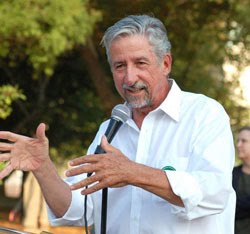
Tom Hayden addresses August 25 crowd at Austin's 5604 Manor Community Center. Inset below: Hayden raps with Austin activists at gathering the previous night. Photos by Carlos Lowry / The Rag Blog.

Hayden was also in Austin as a correspondent for The Nation, covering Mexican poet Javier Sicilia’s Caravan for Peace, which aims at ending the U.S.-sponsored Drug War and which held a rally at the Texas State Capitol at noon that Saturday.

Tom Hayden was a moving force behind the Students for a Democratic Society (SDS)and was the primary author of the Port Huron Statement, the defining document of the Sixties New Left which is celebrating its 50th Anniversary this year. Historian James Miller called the Port Huron Statement “one of the pivotal documents in post-war American history” and Hayden said on Rag Radio that, "It’s a little uncanny how the words of the Port Huron Statement echo today...”

Hayden, who spent 16 years in the California state legislature, where the Sacramento Bee called him the “conscience of the Senate," and is the author or editor of 19 books and a regular contributor to The Rag Blog, has been putting much of his energy into his outspoken criticism of America’s “long war" in Iraq, Afghanistan, and elsewhere, because of the way it “robs our domestic potential.” He now directs the Peace and Justice Resource Center in Culver City, California, and edits the Peace Exchange Bulletin.

Tom, who was a prime mover behind much of the social activism of the Sixties –- from civil rights to community organizing to opposition to the Vietnam War -- said that he has been involved in “one kind of social movement or another,” for 50 years. He told the Austin gathering that “change comes from the margins, is almost never noticed by the mainstream media until it’s upon us like a wave, and is never mentioned or noticed by politicians until it comes to their district.”

“It comes like a miracle -- un milagro as they describe this caravan against the drug war –- without notice, as if by God’s grace, and disappears before we know it, without our control.” But most of our social gains “come from this ‘mysterious force’” which “baffles journalists and even organizers.”

After his visit to Austin, Hayden wrote at The Nation about Sicilia's Caravan for Peace: "This is a far different peace movement than the ones American officials and media are used to seeing. For the first time in memory, a caravan of Mexicans have crossed the border north to demand that the U.S. government take responsibility for its major part in the mayhem" caused by the drug war.

Members of Javier Sicilia's Caravan for Peace -- who have lost loved ones to the War on Drugs -- demonstrate at the Texas Capitol, Saturday, August 25, 2012. Photo by Mariann Wizard / The Rag Blog.

"The core of the movement," he wrote, after interviewing Sicilia in Austin, "is composed of Mexican victims of violence who are calling for the end of the militarized approach to drugs policy," adding that Mexicans and others in Latin America "have had enough of tougher law-and-order (mano dura) crackdowns, police buildups, impunity for the powerful, corrupt judiciaries, dictatorships and torture chambers..."

Sicilia, who was moved to action after his son was killed in drug war-related crossfire, told Hayden in Austin: "The only ones who benefit [from the Drug War] are the criminals, the corrupt bureaucracy, the bankers who launder money protected by the state, and those who invest in prisons, the army, the police, industries of violence and horror."

Sicilia told Hayden that the Drug War "has taken more lives, caused more misery, more destruction of democracy, far more than the consumption of drugs has done. It is the opening of the doors to hell."

Tom Hayden's August 25 talk at 5604 Manor will be broadcast on Allan Campbell's People United on KOOP 91-7-FM in Austin, Friday, September 14, 1-2 p.m. The show will be streamed live here.

[Thorne Dreyer, a pioneering Sixties underground journalist and a veteran of SDS and the New Left, edits The Rag Blog, hosts Rag Radio, and is a director of the New Journalism Project. He can be contacted at editor@theragblog.com. Read more articles by and about Thorne Dreyer on The Rag Blog.]

The Rag Blog

[+/-] Read More...

21 August 2012

The Rag Blog : Peace and Justice Activist Tom Hayden in Austin


Progressive activist and New Left pioneer:
Tom Hayden in Austin Saturday

The Rag Blog and Rag Radio are presenting progressive activist and New Left icon Tom Hayden at the 5604 Manor Community Center, 5604 Manor Rd. in Austin, on Saturday, August 25, at 5 p.m. Hayden will speak on "The Drug War, the Peace Movement, and the Legacy of Port Huron." There is a suggested donation of $5 which will benefit the New Journalism Project, publisher of The Rag Blog.

Hayden will be in Austin in conjunction with Mexican poet Javier Sicilia’s Caravan for Peace which is aimed at ending the U.S.-sponsored Drug War and which will rally on the steps of the Texas State Capitol from noon-3 p.m., Saturday, Aug. 25, 2012.

Tom Hayden was a founder of SDS and the primary author of the Port Huron Statement, the defining document of the New Left, which is celebrating its 50th Anniversary this year with major observances around the country.

He was a Freedom Rider in the Deep South, a community organizer in Newark, N.J., and one of the most visible and articulate opponents of the War in Vietnam. He was one of the Chicago Seven, arrested during demonstrations at the 1968 Chicago Democratic Convention.

He later organized the grassroots Campaign for Economic Democracy in California and then spent 16 years in the California legislature -- where the Sacramento Bee called him the “conscience of the Senate” -- and is now an author, a teacher, and one of the country’s most eloquent advocates for peace and justice.

Tom has recently taught at Scripps College and Pitzer College, Occidental College, and Harvard University’s Institute of Politics; and is currently teaching a class at UCLA on protest movements from Port Huron to the present.

Hayden, who is the author or editor of 19 books and serves on the editorial board of The Nation, is a leading progressive activist and an outspoken critic of the Pentagon's “Long War.” He was an initiator of Progressives for Obama, a group that offered critical support for Barack Obama during his initial campaign for the presidency.

Hayden is director of the Peace and Justice Resource Center in Culver City, California, edits the Peace Exchange Bulletin, and organizes anti-war activities for the Progressive Democrats of America (PDA).

Nicholas Lemann wrote in The Atlantic that “Tom Hayden changed America.” Historian James Miller called the Port Huron Statement “one of the pivotal documents in post-war American history.” Historian Michael Kazin called Port Huron “the most eloquent manifesto in the history of the American Left.” Richard Goodwin, advisor to Kennedy and Johnson, said that Hayden “created the blueprint for the Great Society programs.”

Tom Hayden told Thorne Dreyer on Rag Radio: "It’s a little uncanny how the words of the Port Huron Statement echo today...”

Read "As Port Huron turns 50: An Interview with Peace and Justice Activist Tom Hayden," by Thorne Dreyer at The Rag Blog, and listen to Dreyer's two hour-long Rag Radio interviews with Hayden.

Read articles by Tom Hayden on The Rag Blog.

The Rag Blog

[+/-] Read More...

17 April 2012

Danny Schechter : Adbusters' 'Battle for the Soul of Occupy'

Graphic from AdBusters.

Here we go again:
Battle for the 'soul' of Occupy
AdBusters' latest communiqué is offered up almost like a new commandment from the mountaintop of political purity.
By Danny Schechter / The Rag Blog / April 17, 2012

Perhaps my problem is that I live in too many worlds at the same time, while many political eras live in me.

That may be why I responded so negatively to a recent polemic wrapped up in a poetic communique from AdBusters, the culture jammers in Canada, who do so much good work (and often so creatively) battling the consumption virus promoted by big corporations many of us have grown to despise.

I respect their magazine and marvel at the impact they have had in helping to stir Occupy Wall Street into existence. They clearly feel a sense of ownership in the movement and act not just as the midwife that promoted the occupy idea, but as the guardians of their version of the movement’s essence, as if they own the copyright and have to defend it aggressively in the court of public opinion.

Their latest communiqué, directed to “jammers, occupiers and Springtime dreamers,” is offered up almost like a new commandment from the mountaintop of political purity, warning one and all “that a new enemy is in their midst that is... threatening to neutralize our insurgency with an insidious campaign of donor money and co-optation.”

Batten down the hatches! Defend the ramparts! Fly the flag!

They then call for a “fight to the finish” to defend the “soul of Occupy” that they claim is menaced by a “THEY” that is out to get us like some boogie man that acts like a virus and can’t be resisted. Will “Black Block” militants become their enforcers?

Who is the THEY? Nefarious bankers on Wall Street? The CIA and Blackwater-type mercenaries? Karl Rove and the Koch Brothers?

No, their new enemy is pictured not as an external threat representing the status but an internal one they have no use for.

Read on: “First they silenced our uprising with a media blackout… then they smashed our encampments with midnight paramilitary raids... “ And now? They are planning to destroy all that that we built.

Suddenly the brutal police raids on Occupy and the initial media indifference are conflated with alleged operatives of the Obama campaign on a stealth mission of cooptation.

There’s no real evidence cited, but that’s not the point of this appeal to fear and unity. Political paranoia is always driven by what COULD happen, not, necessarily, what is happening,

The political theory behind all this is that Occupy is not just the vanguard of the revolution but the revolution itself, and is in danger of being stifled by reformers who fear its imminent success in toppling capitalism. How realistic is that?

This worst case scenario is projected as a coordinated and calculated strategy by groups they put down in terms reminiscent of the way the Chinese cultural revolution demonized and stigmatized millions of people as counterrevolutionaries that tore the Chinese Revolution apart using strident ideology to silence a “class enemy.”

Were there class enemies? Sure, there always are, but thousands of innocent people were accused and abused by ultra leftists on a mission from Mao.

Today’s self-appointed and unelected commissars of new consciousness say they see a new set of counter-revolutionaries out to snuff Occupy/

They ask:
Will you allow Occupy to become a project of the old left, the same cabal of old world thinkers who have blunted the possibility of revolution for decades? Will you allow MoveOn, The Nation and Ben & Jerry to put the brakes on our Spring Offensive and turn our struggle into a “99% Spring” reelection campaign for President Obama?
Is this really what is happening or is it more like a conspiratorial fabrication? Is this type of insulting language really appropriate for a movement that claims to be democratic and inclusive?

MoveOn and Van Jones have denied they are trying to control the movement, refuse to speak in its name, and couldn't steal its thunder if they wanted to. The Nation is just one magazine of many that has been sympathetic to Occupy, but also supports the more structured but very democratic resistance in Wisconsin that Ad Busters ignores.

Ben & Jerry are individuals, former business partners, who want to help by raising money for Occupy after consulting with many activists on how they could be helpful. They seem sincere to me.

Why is all this so threatening? Why the fearful and purist denunciation? Can't they respect people who -- unlike Occupy’s core activists -- don’t make decisions at General Assemblies.?

Occupy has in the past sought coalitions with labor unions and black community groups that often have more traditional leadership structures. They haven’t tried to dictate politically correct processes that allies and supporters must accept. Why this intolerance now?

By the way, I have been pouring my heart out in books, blogs, films, and opinion pieces about the failures of the Obama Administration in combating the financial crimes that enabled the depression we are coping with. My latest exposes the campaign’s pandering on terrorism and threatening Iran.

MoveOn would not help me promote my work, and neither has The Nation, really, or, for that matter, Ben & Jerry, whose work I admired more before they sold their company to a mainstream corporation (although they have been engaged in admirable campaigns challenging military spending for years).

That doesn’t make them all sellouts. Even if in the eyes of some they are the “enemy” because they aren’t “horizontal” enough, or anti-capitalist enough, or anarchistic enough, and may act more like reformers than Ad Buster-approved revolutionaries.

On Friday, NYU hosted a tribute to the 50th anniversary of the Port Huron Statement, the founding document of SDS that sparked activism in the 1960’s. Former SDS leader Tom Hayden was on hand to tell some stories about that era.

He noted that the central idea of Port Huron, “participatory democracy,” also appears in Occupy’s first declaration, suggesting continuity with the so-called “old thinkers” that AdBusters gratuitously derides.

He also recounted how liberals with whom SDS were aligned at first demanded that their movement become more outspokenly anti-communist, even as the movement rejected the cold war.

When SDS wouldn’t go along with this arrogant old left thinking, (funded in part by the CIA), there was an internal “trial” and interrogation that led to SDS’ defunding and ouster from its offices.

According to Hayden, it was a scene right out of Kafka, not unlike the tone of this recent communiqué.

SDS stood true to its principles and politics and refused to work with the people who tried to control them.

The result: they grew more influential. They successfully resisted cooptation and fought for racial justice and against the war in Vietnam. They supported organizing on campuses and in communities. They challenged the Democratic Party, which later also fragmented over the war with Richard Nixon the ultimate beneficiary of all the discord.

SDS couldn’t find a way of bridging its own ideological divides and the movement broke into warring factions that led to an organizational implosion. There also was plenty of paranoia and repression with the government covertly pitting one group against the other, using the FBI, racism, and phony patriotism.

There is plenty of blame to go around. And there may be parallels here with this call to “save the soul” of Occupy.

Can we learn from this destructive history of acrimony and sectarianism or are we doomed to repeat it?

[News Dissector Danny Schechter wrote Occupy: Dissecting Occupy Wall Street (Cosimo Books) based on his coverage for his Newsdissector.net, Al Jazeera.com, and other outlets including The Rag Blog, and also directed a TV film on the organization of Zuccotti Park. Earlier, he was an activist in the civil rights, anti-war and anti-apartheid movements. Email Danny at dissector@mediachannel.org. Read more articles by Danny Schechter on The Rag Blog.]

The Rag Blog

[+/-] Read More...

26 January 2012

Thorne Webb Dreyer : Peace and Justice Activist Tom Hayden on Rag Radio


As Port Huron turns 50:
Peace and justice activist
Tom Hayden on Rag Radio


By Thorne Webb Dreyer / The Rag Blog / January 26, 2012

Peace and justice activist Tom Hayden, a driving force in SDS and the Sixties New Left, was our guest on Rag Radio on January 6 and January 20, 2012. On the two hour-long programs we discussed the legacy of SDS and Sixties activism, as well as contemporary American society, foreign policy, and progressive politics.

The shows can be heard here and here.

Progressive Activist and SDS Pioneer Tom Hayden
on Rag Radio with Thorne Dreyer, Jan. 6, 2012:


Progressive Activist Tom Hayden on Current Issues
on Rag Radio with Thorne Dreyer, Jan. 20, 2012:


Rag Radio, which has been aired since September 2009 on KOOP 91.7-FM, a cooperatively-run all-volunteer community radio station in Austin, Texas, features hour-long in-depth interviews and discussion about issues of progressive politics, culture, and history. It is hosted by Rag Blog editor and SDS veteran Thorne Dreyer.

Tom Hayden was the primary author of the Port Huron Statement, SDS’ 1962 “Agenda for a Generation,” the legendary SDS manifesto that is celebrating its 50th anniversary this year with events at UCLA, UC-Santa Barbara, NYU, MIT, and the University of Michigan, and at the Los Angeles Times Book Festival. Historian James Miller called the Port Huron Statement “one of the pivotal documents in post-war American history.”

Ken Handel, writing in The Rag Blog on July 19, 2011, said that, “The 59 SDS members who assembled in the small Michigan town of Port Huron in June 1962 could not accept a status quo that tolerated the possibility of nuclear annihilation, state-sanctioned racism, and a nation suffering from extensive poverty amidst affluence.”

The Port Huron Statement -- which brought the term “participatory democracy” into the common parlance -- begins in words familiar to most anyone who was active in the era. “We are people of this generation, bred in at least modest comfort, housed now in universities, looking uncomfortably to the world we inherit.” It concludes: “If we appear to seek the unattainable, as it has been said, then let it be known that we do so to avoid the unimaginable.”

In the Rag Radio interviews, Hayden compared the era in which the Port Huron Statement was written with the world today: “The Cold War is gone, but not the threat of nuclear weapons, and I think the Cold War has been replaced as a template by the global war on terrorism, which requires secrecy, excessive military spending, and the shrinking of civil liberties.”

“So many of the issues that plagued us as young people then, plague students today,” Hayden said, “but I think the big difference is the economic recession and the gloom.” We are moving, he said, into a “whole new period of conflict and threats involving the possible use of force with China, and that’s going to be the next generation’s issue.”

Reflecting on Port Huron, Hayden said that "these crazy, inspired, visionary documents often come from the young and liberated and innocent. Most of us who wrote it were 21 years old and it remains to be seen whether such a document materializes again..." But, he added, "It’s a little uncanny how the words of the Port Huron Statement echo today, as it’s used in classes and a lot of the students can’t tell when it was written."

According to Nicholas Lemann of The Atlantic, “Tom Hayden changed America.” Hayden was a Freedom Rider in the deep South, a community organizer in Newark, N.J., and one of the most visible and articulate opponents of the War in Vietnam. He was one of the Chicago Seven, arrested during demonstrations at the 1968 Chicago Democratic Convention. Richard Goodwin, an advisor to presidents Kennedy and Johnson, said Hayden "created the blueprint for the Great Society programs."

Hayden later organized the grassroots Campaign for Economic Democracy in California, and served for 18 years in the California State Assembly and Senate. At that time, The Sacramento Bee called Hayden “the conscience of the Senate.”

Tom has recently taught at Scripps College and Pitzer College, Occidental College, and Harvard University’s Institute of Politics; and is currently teaching a class at UCLA on protest movements from Port Huron to the present.

Hayden, who is the author or editor of 19 books and serves on the editorial board of The Nation, is a leading progressive activist and an outspoken critic of the Pentagon's “Long War.” He was an initiator of Progressives for Obama, a group that offered critical support for Barack Obama during his initial campaign for the presidency. Hayden is director of the Peace and Justice Resource Center in Culver City, California, edits the Peace Exchange Bulletin, and organizes anti-war activities for the Progressive Democrats of America (PDA).

On Rag Radio, Tom Hayden discussed his work with the Peace and Justice Resource Center, explaining that its mission is to provide “original research and reporting and networking principally around the ending of the wars in Iraq and Afghanistan and Pakistan, and the ‘Long War’ doctrine behind them, and the war on the border that we share with California, Texas, and Mexico where 47,000 people have died since 2006.”

He said it’s important that we realize that Obama’s ending the war in Iraq was a victory for the anti-war movement, and he expresses serious concern over the possibility of war with Iran, even though he doesn’t believe such a war would be in the United States’ “imperial interests.” Hayden recently wrote that “rational self interest is not always enough to prevent what Barbara Tuchman has called the ‘march to folly.’”

He fears things could be getting out of control “because it’s an election year in America.” Obama “doesn’t exactly need a war in the election year because it will drive up oil prices,” he said. “He’s looking at the Democratic Party and they’re pretty limp… the doves in the Democratic Party are not exactly flapping.”

“You see the right wing Israeli government of Netanyahu very intertwined with Romney and Gingrich. And they’re pounding on Obama to do something,” he says.

“It’s sort of stunning. I didn’t know until last year that Romney was in business with Netanyahu. They were business partners in a consulting firm… And Gingrich. The guy that bailed him out, Adelson, the casino billionaire, is very, very close to Netanyahu. Adelson owns newspapers in Israel that support Netanyahu. And both of them [Romney and Gingrich] are for a war with Iran, if need be, or forcing Iran to essentially submit to regime change.”

Hayden said that Obama was responding to pressure from environmentalists in postponing the Keystone Pipeline. “Bill McKibben, whose credentials as an environmental fighter go unchallenged, actually said on Pacifica… that he thought that the president’s decision was bold and brave.”

Looking to the 2012 elections, Hayden said, “My philosophy is that there’s no one prescription for the vast diversity of protesters, progressives, and radicals, and movement activists in this country..."

He believes we should take a "pluralistic approach where we should look to the federal government to protect certain basic standards but also allow cities and states to take more progressive steps where they can, so that we’re not bound by the lowest possible standard."

"You could start with state initiatives, the way California has done for decades, on energy efficiency, on solar power, anti-Nuke, and fuel efficiency standards for automobiles. And linking up with other states, they begin to create a powerful political and economic force for an alternative," he said. "I think we win by building progressive power in certain areas of the country and then eventually the federal government is forced to go along."

Hayden suggests "we should study more how our victories are won and how our defeats are suffered, and learn more about the interaction between social movements and electoral politics and this president... We’ve had a couple of years to see what works and what doesn’t and we need to move forward…"

He also says we should "focus more on Citizens United and taking down the infernal power of finance capital and the corporations over the campaign contributions.”

Hayden believes we need to reelect Obama, “hopefully elect Elizabeth Warren as a symbolic crusader against Wall Street in Massachusetts… [and] at all costs, do not lose the presidency and the Senate and the House to the Republicans, unless you’re ready for a juggernaut backed by a crazy right-wing U.S. Supreme Court.”

As far as Obama’s performance: “Do I think that he has performed less well than I would have hoped? Yes, absolutely. But it’s an experiment, it’s a learning enterprise… he’s always going to be a disappointment as a centrist because he needs to have a left against him in order to counterbalance the right.”

Hayden believes that Wisconsin has been the site of “the single most important political and economic struggle in the country… [Wisconsin] was the spearpoint of the Tea Party governors who wanted to destroy labor -- public sector unions -- and the spear got broken by the Wisconsin opposition.”

“If we ever mark a time when the Tea Party started to be repelled and pushed back, I think it started in Wisconsin.”

Hayden notes that Wisconsin Gov. Scott Walker offered the police and the firefighters a deal “to exempt them from his attack on public sector workers, because he wanted to go after the teachers’ unions and so forth -- and they said no.”

“If you go out there to Wisconsin to this day you’ll find the fife and drum corps of the firefighters, dressed in kilts, playing their instruments and leading the crowds into the state capitol, where they take the place over for an hour a day and sing all these very lively, energized radical labor songs.”

Hayden's not sure how powerful the Occupy movement is. “They had a surprising beginning, amazing acceleration and spread, they had tremendous media impact on the income equality issues, but they don’t have the Tea Party’s resource base or political base.”

But, “as long as we have our economic misery and Wall Street is out there as a big fat plutocratic target, I think Occupy will keep coming back in different forms.”

“These movements always come like the wind, they come out of nowhere, they come by surprise. It’s very hopeful, and it’s become a universal consensus that they’ve changed the dialogue to income inequality and poverty.”

And, “If you read the manifesto of Occupy Wall Street, the very first principle in their statement of principles is a transparent 'participatory democracy.'" The Occupy movement is clearly “carrying on the participatory democracy tradition.”

Port Huron lives. Fifty years and counting.


Rag Radio -- hosted and produced by Rag Blog editor Thorne Dreyer -- is broadcast every Friday from 2-3 p.m. (CST) on KOOP 91.7-FM in Austin, and streamed live on the web. After broadcast, all episodes are posted as podcasts and can be downloaded at the Internet Archive. Tracey Schulz is the show's engineer and co-producer.

Rag Radio is also rebroadcast on Sundays at 10 a.m. (EST) on WFTE, 90.3-FM in Mt. Cobb, PA, and 105.7-FM in Scranton, PA. Rag Radio is produced in the KOOP studios, in association with The Rag Blog, a progressive internet newsmagazine, and the New Journalism Project, a Texas 501(c)(3) nonprofit corporation.

[Thorne Dreyer was a prominent Sixties activist and underground journalist. Active with SDS in Austin and nationally, Dreyer was a founding editor of The Rag in Austin and Space City! in Houston, was on the editorial collective of Liberation News Service (LNS) in New York, and was manager of Pacifica Radio's KPFT-FM in Houston. He now edits The Rag Blog, hosts Rag Radio on KOOP 91-7-FM in Austin, and is a director of the New Journalism Project. Read more articles by and about Thorne Dreyer on The Rag Blog.]

Coming up on Rag Radio:

Jan. 27, 2012: Authors Kim Simpson and Jan Reid discuss the American radio revolution of the '60s and '70s.
Feb. 3, 2012: Historian and political economist Gar Alperovitz, author of
America Beyond Capitalism.

The Rag Blog

[+/-] Read More...

08 November 2011

Harry Targ : Building a New Society

Paul Goodman. Image from Zeitgeist Films / Sam Falk for The New York Times.

Moving the vision forward:
Building a new society
Although the times are so different from the 1960s, perhaps the vision of community that animated our thinking then may still be relevant for today.
By Harry Targ / The Rag Blog / November 8, 2011

A powerful concept animated the vision of young people in the 1960s, the idea of community. Many of us came to that decade with little interest in politics. We were not “red diaper” babies but we became outraged by Jim Crow, McCarthyism, and war. Our education had communicated an early version of Margaret Thatcher’s admonition, “ there is no alternative,” and our impulses told us then that “another world was possible.”

New and old ideas about a better world began to circulate from college campuses, the streets, some churches, and popular culture. A whole body of engaging literature caught the fancy of young people. For me Paul Goodman’s description of youth growing up in the sterile 1950s, Growing Up Absurd, resonated. He wrote about alternative possibilities in such books as Utopian Essays and Practical Proposals.

Perhaps most startling to a young reader was the earlier analysis Goodman published with his brother Percival, Communitas. In that book the Goodman brothers argued that societies, big and small, were products of values. Architecture and the organization of space, social, and political forms, and the ease with which people could communicate and interact with each other varied. And the variations created in space and social forms affected whether communities valued life and sociability or consumption and profit maximization.

The Goodmans opened up new intellectual doors for me. I looked at earlier anarchists, such as Peter Kropotkin, who argued that humans -- if not separated by time, space, and power structures -- often lived in solidarity with their neighbors. A “mutual aid” principle was natural to human existence. And, as a result “the state" sought to stamp it out and replace it with top down authority.

Martin Buber, in Paths in Utopia, identified a “centralistic political principle” that emerged when groups and states sought control of markets and natural resources and “the most valuable of all goods,” the lives of people who lived with each other changed as “...the autonomous relationships become meaningless, personal relationships wither; and the very spirit of...” being human “...hires itself out as a functionary.”

The alternative for Buber was what he called a decentralized social principle, or community which is “...never a mere attitude of mind” but of “...tribulation and only because of that community of spirit; community of toil and only because of that community of salvation...”

In 1974, I wrote in summation about these theorists and many others that
the architectural forms and social structures of the Goodmans can profitably be blended with the spiritualism and socialism of Buber to construct a synthesis of all that the utopians and anarchists set out to achieve. The Goodmans show how community can be created in the industrial age and Buber illustrates how the best features of the entire community tradition fit together.
The ideas of community, empowerment, and social justice spread from these and other sources. They were articulated for the Sixties in the Port Huron Statement, written by founders of the Students for a Democratic Society. While written by and for a relatively privileged sector of disenchanted youth in a period of booming economic growth and military expansion, the document spoke to the passion for justice, participation, and community, and an “…unrealized potential for self-cultivation, self-direction, self-understanding, and creativity.”

It called for the creation of “human interdependence,” replacing “...power rooted in possession, privilege, or circumstance...” by “power and uniqueness rooted in love, reflectiveness, reason and creativity.”

By the late Sixties many of us were identifying a new society that must be built on core principles. These included:
  • local control and participatory democracy;
  • racial justice;
  • gender equality;
  • equitable distribution of resources and the collective product of human labor;
  • commitments to the satisfaction of minimal basic needs for all of humankind;
  • the development of an ethic that connects survival to human existence, not to specific jobs;
  • human control over technology; and
  • a new “land ethic” that conceives of humankind as part of nature, not in conflict with it.
Many of us began to explore the impediments to the construction of a society based on human scale that would celebrate both individual creativity and community. Growing familiarization with the critique of capitalism suggested that the capitalist mode of production, dominant over two-thirds of the world, was based upon the exploitation, oppression, dehumanization, and repression of the vast majority of humankind.

Incorporating an understanding of the workings of capitalism did not contradict the vision that Buber called the decentralized social principle and the many eloquent calls by others for “community.” It did suggest that building a new society entailed class struggle which would manifest itself in factories and fields, in rich and poor countries, and in political venues from the ballot box to the streets.

Bringing about positive change was a much more complicated affair than activists originally thought, but the sustained and sometimes brutal opposition to our visions validated the general correctness of them.

Today, new generations of activists, along with older ones, are reflecting and participating in diverse social movements in our cities and towns. They observe with enthusiasm the mobilizations, the militancy, and the passion for justice still unfolding in the Middle East.

The efforts of Venezuelans, Bolivians, Ecuadorians, and the Cubans who inspired us so much over the years are applauded. Important debates about social market economies, workers’ management of large enterprises, this or that candidate or political party, are occurring on the Internet and in the streets.

Although the times are so different from the 1960s, perhaps the vision of community that animated our thinking then (which we in turn learned from those who preceded us) may still be relevant for today.

Without creating new documents or dogmas perhaps it can be proclaimed that we remain committed to the sanctity of human life, to equality, to popular control of all our institutions, to a reverence for the environment, and to the idea that the best of society comes from our communal efforts to make living better for all.

[Harry Targ is a professor of political science at Purdue University who lives in West Lafayette, Indiana. He blogs at Diary of a Heartland Radical -- and that's also the name of his new book which can be found at Lulu.com. Read more of Harry Targ's articles on The Rag Blog.]

The Rag Blog

[+/-] Read More...

19 July 2011

Ken Handel : The Port Huron Statement Spoke Truth to Power

The Port Huron Statement. Image from Bibliopolis.

Speaking truth to power
The 1962 Port Huron Statement describes the goals, values, and strategies of Students for a Democratic Society -- and continues to inform and inspire.
By Ken Handel / The Rag Blog / July 19, 2011

“My Generation,” released by The Who in 1965, is one of that group’s most popular songs -- and a rallying cry for disaffected youth. Three years earlier, in 1962, Students for a Democratic Society (SDS) created “An agenda for a generation,” an action plan for young people seeking broad societal change.

(SDS was the leading organization of the Sixties New Left. At its peak it had more than 100,000 members in 400 chapters around the country.)

The 59 SDS members who assembled in the small Michigan town of Port Huron in June 1962 could not accept a status quo that tolerated the possibility of nuclear annihilation, state-sanctioned racism, and a nation suffering from extensive poverty amidst affluence. Scholar James Miller, in Democracy Is in the Streets, described the Port Huron Statement (PHS) as being “one of the pivotal documents in post-war American history.”


In their own words

In Rebels With A Cause, a film on SDS created in 2000 by Helen Garvy, Port Huron participants reflected upon their experiences. Tom Hayden, the document’s primary author, described “sitting around in small groups talking about your values and how they applied to politics and to economics.” He also spoke of the American tradition of “decentralized democracy, or direct democracy, or town-meeting democracy.”

Sharon Jeffrey identified two key themes the document addressed: “…participatory democracy: this was something that somehow it had a resonance to it… This was really significant because it touched very deeply… sort of like the soul of who we were”; and the importance of values.

On this point, Steve Max commented, “The idea that you make your own values as a group was a new thing. That values weren’t just inherited and weren’t just transmitted from the older generation but that people could actually sit down and work out an ethical framework, as an organization…”


Political and cultural influences

In the first paragraph of the Port Huron Statement, SDS members acknowledged their privileged status: they were “bred in at least modest comfort, housed now in universities…” But in what Hayden has termed “a manifesto of hope,” the 41-page document envisioned an end to racism, a transformation of democracy, a reconception of the economy, and a conclusion to the cold war.

In his book, The Long Sixties: From 1960 to Barack Obama, Hayden noted the influences that contributed to the document’s explicit idealism.

Port Huron participants had witnessed the independence of many African nations, and Cuba’s successful revolution. They abhorred South Africa’s policy of apartheid and its violent repression of the African National Congress. They allied themselves with other students fighting racism in the U.S. -- and in particular, the Student Nonviolent Coordinating Committee (SNCC). They had read inspiring books, seen influential films, and rocked around the clock. Port Huron, Hayden says, “was a spontaneous beginning, but one informed by legacy.”


Does Port Huron still resonate?

June 2012 represents the Port Huron Statement’s golden anniversary. And the alienation and apathy SDS sought to counter nearly 50 years ago is even more prevalent today: only six percent of a Harris Poll expressed confidence in Congress. In the 2010 mid-term election, 59.1 percent of registered voters chose to withhold their ballots.

To counteract hopelessness, the document offered a new definition of individual rights and of the role a person plays in the political system:

Participatory Democracy: “…we seek the establishment of a democracy of individual participation, governed by two central aims: that the individual share in those social decisions determining the quality and direction of his life; that society be organized to encourage independence in men and provide the media for their common participation.”

Values: “Men have unrealized potential for self-cultivation, self-direction, self-understanding, and creativity. It is this potential that we regard as crucial and to which we appeal, not to the human potentiality for violence, unreason, and submission to authority. The goal of man and society should be human independence: a concern not with image of popularity but with finding a meaning in life that is personally authentic...”

SDS succumbed to factionalism and dissolved in 1969. But the Port Huron Statement is the group’s living legacy. Just as “My Generation” continues to win new fans, so too can the Port Huron Statement assist today’s citizens in fulfilling their aspirations and in making government more responsive.

Monte Wasch offers a unique perspective on the PHS. As a 20 year-old City College student he attended the Port Huron gathering. When he returned to New York, Tom and Casey Hayden temporarily moved into his apartment. There, Hayden worked on final PHS edits, which Wasch typed up.

“I remember,” he comments, “a summer of optimism and challenge. Optimism because we all felt we were on the cusp of something exceptional and unique in the history of American progressivism. The challenge was -- as a new generation with a progressive, reform set of values -- to leave behind the narrow sectarian battles that had long characterized the Left. The PHS prescribed a new model for social change and non-sectarian progressive action by developing a new model for social change: participatory democracy.

[Ken Handel is a freelance writer and editor. This article was also posted to Suite101.]

Sources

Students for a Democratic Society
Port Huron Statement, SDS Documents
Democracy Is In the Streets: From Port Huron to the Siege of Chicago by James Miller (Simon and Schuster, 1987.) “Pivotal Document”: Page 13; “manifesto of hope”: Page 77
Rebels With A Cause, a documentary film written, produced, and directed by Helen Garvy, 2000.
The Long Sixties: From 1960 to Barack Obama by Tom Hayden. (Paradigm Publishers. 2009). SDS influences: Page 21-23

Poll Citations:
The Rag Blog

[+/-] Read More...

Only a few posts now show on a page, due to Blogger pagination changes beyond our control.

Please click on 'Older Posts' to continue reading The Rag Blog.