Showing posts with label Free Speech Movement. Show all posts

10 November 2013

Michael James : Going Off Campus, 1965
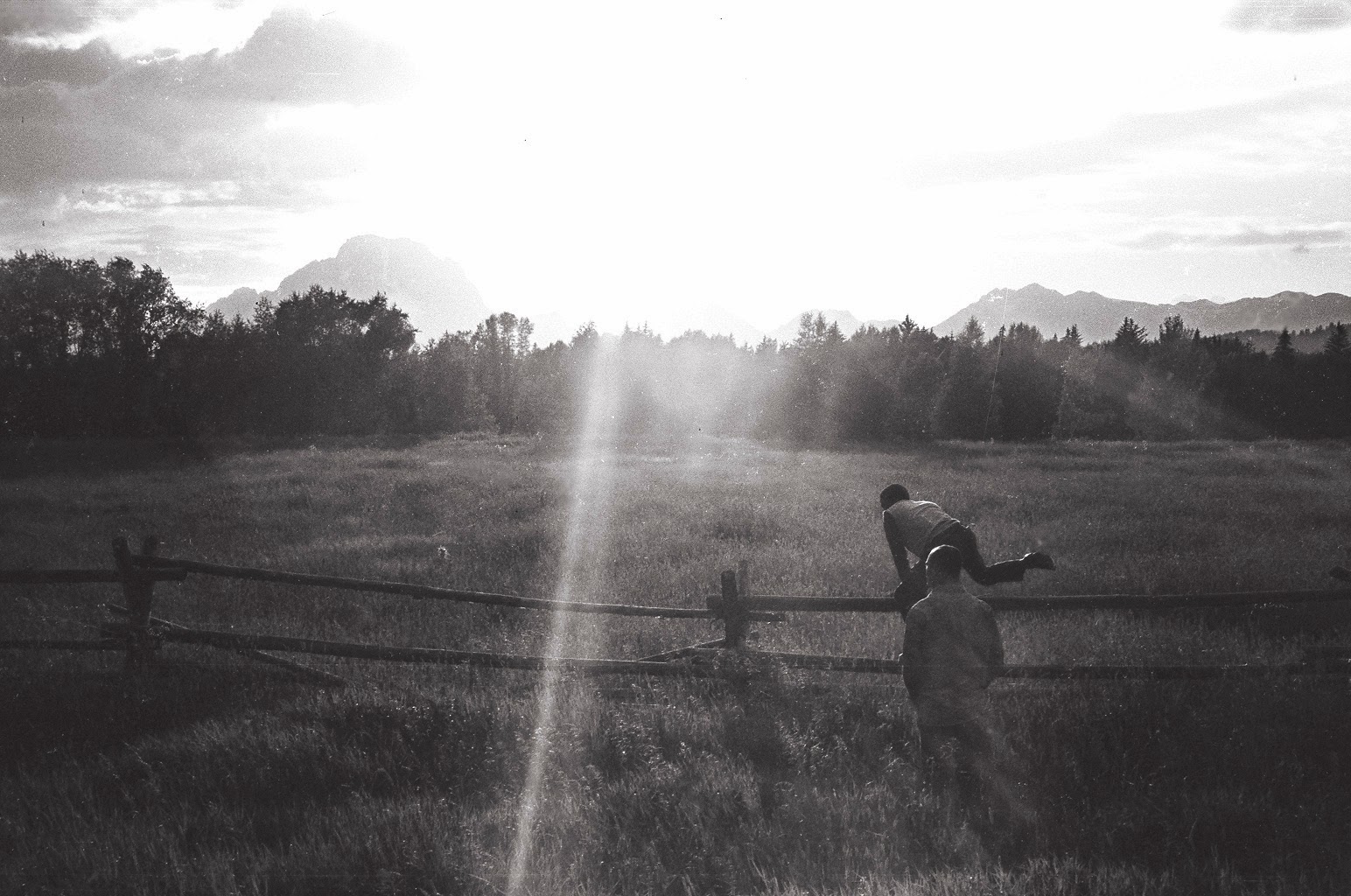
Sam and Theophilius at sunset in Jackson Hole, Wyoming. Photos by Michael James from his forthcoming book, Michael Gaylord James' Pictures from the Long Haul.
Pictures from the Long Haul:
Going off campus:
Idaho, Wyoming, and Connecticut, 1965
I proceeded to quote Tom Paine: “Let them call me rebel and welcome, I feel no concern from it; but I should suffer the misery of devils were I to make a whore of my soul.”
By Michael James / The Rag Blog / November 11, 2013

[In this series, Michael James is sharing images from his rich past, accompanied by reflections about -- and inspired by -- those images. This photo will be included in his forthcoming book, Michael Gaylord James' Pictures from the Long Haul.]

At UC Berkeley in the winter and spring of 1965 the Free Speech Movement battles continued. The court proceedings for the Sproul Hall arrests continued, as did rallies and negotiations. My sentence gave me a choice: 25 days in jail, a year’s probation, or a $250 fine. Believing that a year’s probation would limit my political activities, I took the fine, and said to the judge; “A lot of people across the land are coming to feel as I do,” and proceeded to quote Tom Paine: “Let them call me rebel and welcome, I feel no concern from it; but I should suffer the misery of devils were I to make a whore of my soul.”

Eventually the University agreed to permit tables and discussion in Sproul Hall Plaza, and reversed their edict on no political activity. And political activity there was. The U.S. war on the people of Vietnam was in the forefront. I got involved with the Vietnam Day Committee initiated by Jerry Rubin, Stew Alpert, and others. In May we held a two-day teach-in, which thousands attended. Senator Ernest Gruening of Alaska was a featured speaker. He and Oregon’s Wayne Morse were the first Senators to stand in opposition to U.S. involvement in the war in Vietnam.

Ken Kesey and his Merry Pranksters showed up in a wildly painted school bus; Allan Ginsberg, Wavy Gravy, and others were on the scene. Protest singer Phil Ochs came to perform. Before he took to the stage I was fortunate to hang out with him at the home of Neil Blumenthal, a Berkeley psychologist and the Free Speech Movement’s resident shrink.
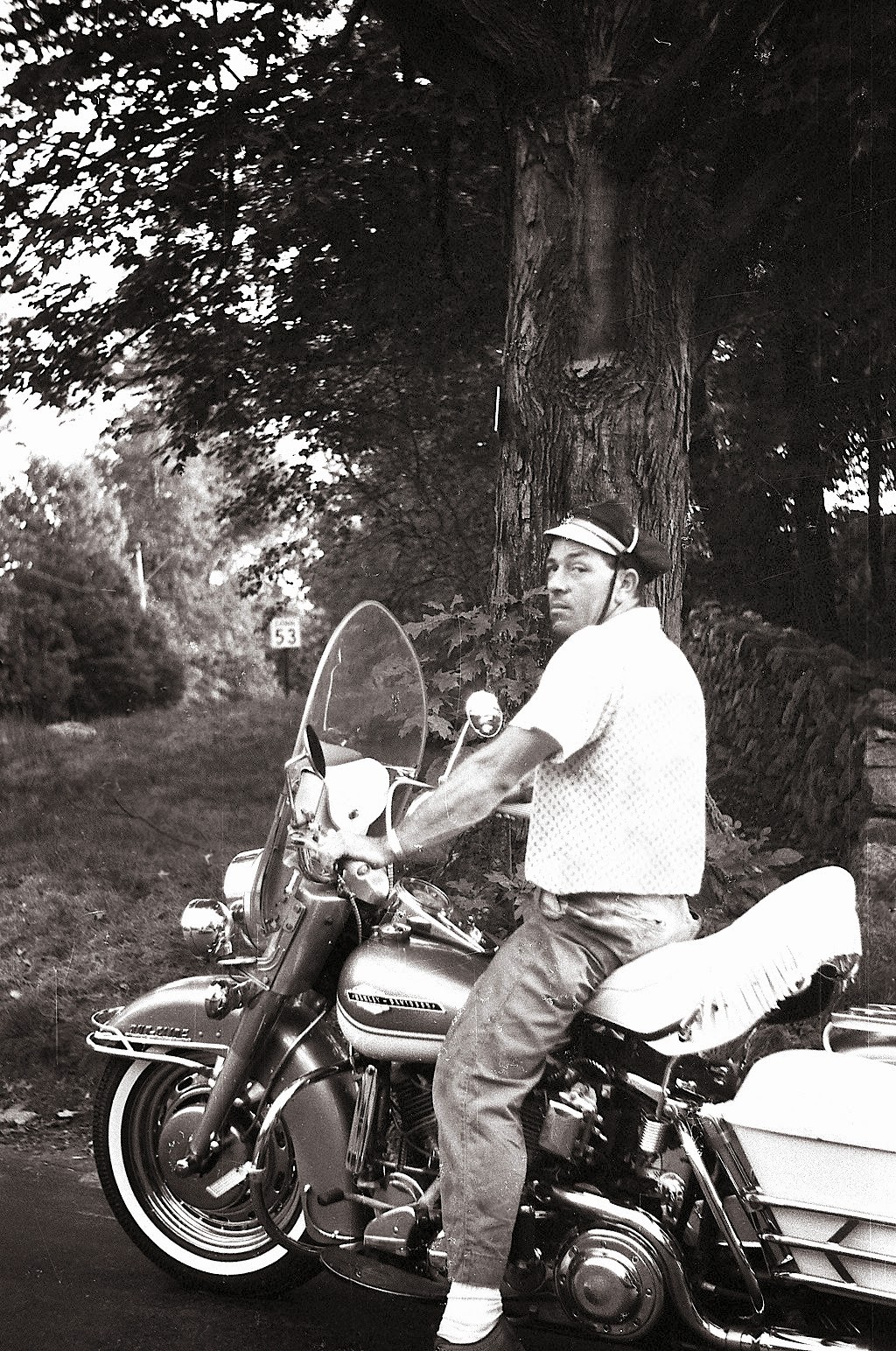
Man on Harley, Route 53, Connecticut.
For the teach-in I helped compile a pamphlet with articles on Vietnam and the war. While laying it out at the Berkeley Free Press, I leaned on the light table and fell through the glass (no injuries, luckily, and the shop owner took it in stride). When the pamphlet made it to press, I remember the brass bell on the Multilith offset that gave a constant ding-ding at the tempo of the press’s speed. The pressman was David Goines, who became a well-known poster artist.

Students for a Democratic Society was the organization that caught my attention, and then my love and devotion. Back when we surrounded the police car with Jack Weinberg in it -- the event that really set the Free Speech Movement in motion -- I had found a leaflet put out by SDS calling to “build the interracial movement of the poor.” SDS “traveler” (field organizer) Mike Davis, now a noted author, came through town and signed me up into the ranks of SDS. At an SDS party I talked and drank wine with Michael Harrington, who I had heard speak in 1962 at the University of Chicago, along with the old socialist Norman Thomas. Harrington’s ’62 book The Other America exposed the dramatic extent of poverty in the U.S.

The summer of ’65, while the anti-war movement was building at Berkeley and across the land, some of us were making plans to move into West Oakland. We would be among SDS members involved in the Economic Research and Action Project (ERAP), which had begun organizing in 13 cities, trying to build an interracial movement of the poor. Paul Booth, an SDS leader, came to California to help with what would be called the West Oakland Community Project (WOCP). We were idealistic. We said, “Let the people decide.” An SDS button proclaimed Sam Cook’s lyric “A change is gonna come.”

Twelve of us --11 white, one black -- were involved in the WOCP that summer. We had a house at 320 Henry Street near the Southern Pacific Railroad yards. People in the community wondered who we were and what was going on. A ragtag group of men who lived at the Catholic Worker’s Peter Maurin House came by to check us out. [Peter Maurin was a Catholic activist who along with Dorothy Day founded the Catholic Worker Movement]. They’d been drinking wine and their spokesman was challenging, but mellowed out when we shared our hopes and intentions.

Lots of people were working for change in Oakland. There were freedom schools, summer work projects, and labor projects. The issue that got traction in our efforts was beautification. It may not seem radical, but responding to the way the city was tearing down fences and ruining people’s gardens at Peralta Villa Public Housing without notice or community input, was about letting the people decide, a major SDS principle. The Peralta Villa folks were pissed off, and they let the city know about it. The fence removal was halted, a small but significant victory.

A mostly white group of Berkeley students organizing in a poor black community did not bring us far on the road to a revolution. Perhaps the biggest deterrent to sustained work by WOCP was the exploding growth of opposition to the Vietnam War. There was considerable anti-war activity on campus and energies were pulled in that direction.

To top it off, there were the troop trains, and the efforts by hundreds to stop them. During August there was a demonstration at the railroad tracks in Berkeley. My clearest memory of that day is a soldier’s face, probably a conscript, who was on the Union Pacific train from Fort Riley in Kansas, heading to the Oakland Army Terminal to be shipped off to Nam. He was at the window with a shaved head. His face was laughing yet somehow also fearful as he watched me take the picket sign I held and slap it against the window. “U.S. Out of Viet Nam!” I hope he made it back.

Sam and Theophilus in Wyoming or Nebraska.


At the end of the summer I headed back east. My Staples High School pal, football lineman Sam Whiteside, was on the West Coast. He and I, along with two women from the Oakland Project and a young black SNCC activist named Theopholis Smith, headed east in Sam’s Chevy wagon. Theo had been on a break from his work in the South and was heading back to the voter registration battlefield in Alabama.

I was back on the road, heading east from Berkeley by car for the first time. Sam, like me, was up for a circuitous route, and I had a camera with me. We drove through Nevada, then Idaho, and on to Jackson Hole, Wyoming, where at sunset I caught a picture of Sam and Theo climbing a over a fence. Later that night we spotted Indians swaying and staggering along the road. We were riding through a Crow reservation as we neared Dubois, Wyoming. In Dubois we ate at a bar while a piano player tickled the keys. We joined him in song before driving off into the night.

By morning we were in my ancestral homeland of Nebraska. Near Valentine we decided to stop and take a jump into the Niabrara River. Sam cut his foot, and got stitches from a doctor in Valentine. I talked to the doc about the war, which he supported. As my family will attest, this was the beginning of a lifetime of bringing up politics with folks anywhere I am -- in an elevator, at a gas station, attending a wedding, on the phone with an operator at a credit card company in wherever. “And what state are you taking this call in? Hope you guys are going to vote out so-and-so!”

In Chicago we went to the Uptown neighborhood, where the JOIN (Jobs or Income Now) Community Union office was located on Argyle. There I met Sandra Cason, aka Casey Hayden, who had just left her work with SNCC in Mississippi after Stokley Carmichael (Kwame Ture) had booted the white members out. Sam and the others left me there.

Cross, cowboy, Conoco, and Wonder Bread truck in Idaho.
Casey and I visited Old Town, a pioneer hip neighborhood and happening place. The night heat was close to unbearable, and the sidewalks were packed with people. A guy on a motorcycle, his squeeze on the back, was jumpy and jittery as he revved his bike, moving through the crowds crossing the street. I suggested to Casey, “Let’s get out of here!” We took the Chicago Northwestern RR to Lake Forest, 30 miles north. It was cooler there, where we stayed at the home of my anthropology Prof Gerry Gerasimo.

The next morning we said goodbye to Gerry and his wife Dottie, who had been a classmate of mine. Casey and I grabbed our stuff and hitchhiked east, stopping for a night at an SDS ERAP project in Cleveland, located in a mostly poor white neighborhood near the Great Lake Erie. The next day, thumbs out, we hitched rides and made it to Connecticut.

We linked up with fellow Berkeley sociology student Nigel Young and his wife Antonia, serious peace activists from England. Nigel told me about writing “U.S. out of Guatemala” on a wall in London in 1956, when he got arrested while trying to figure out how to spell Guatemala. They were quite a couple, he in mod all black: turtleneck, black pants, short black jacket, and pointy-toe black shoes. Antonia wore a big long fur coat. (This was before there was much talk of animal rights.)

All four of us headed west in a gray 1957 Plymouth station wagon “drive-away” that needed to be delivered to California. We stopped at the Custer Battlefield and Museum in Montana, where the park ranger-guide kept referring to “the hostiles” coming over this hill, and doing this or that. With Crazy Horse and Sitting Bull already heroes in my consciousness, I found his rap to be offensive. In Billings we stopped to eat at a place with an adjacent bar that had a dirt floor and a sign “Check guns at door.” That made sense.

We cruised through Yellowstone National Park, took in the geysers, and had our progress momentarily halted while a bull buffalo decided to mosey along the middle of the road. In Idaho we crossed over a mountain and stopped to eat early in the morning. On the jukebox I noticed Johnny Cash covers of Dylan tunes, and thought: “Wow, something is happening here, the times indeed are a-changing.”

A ranch in Idaho.
On a back road we stopped at an abandoned ranch where I found a branding iron. Down the road we had to stop for a herd of sheep. The shepherd was Basque, didn’t speak English, and wore a jean jacket and pants and engineer boots. Later Nigel enlightened us about the struggles of the Basque people in Spain.

Back at school in Berkeley, I was a graduate teaching assistant. Casey was bereft, missing her comrades in Mississippi, and returned to her family’s home in Victoria, Texas. I tried to restart the Oakland Project along with Vivian Rothstein. From 12 of us, we were down to two. We moved into a different house where neighborhood kids ripped us off. Honest talk led to the goods being returned.

Barry and Betty, both of whom had worked in the Newark Community Union Project (NCUP), soon joined Vivien and me in our efforts. We took a trip to a commune near Big Sur. As we approached we heard beating drums, apparently a sunset ritual to help the sun to go down over the Pacific. A number of longhairs came running at us with clubs, but backed off when Barry yelled he was there to see his sister.

It quickly became clear that the Oakland Project had run out of steam. Though my heart was still with the interracial movement of the poor, I needed to figure out the best place for me to help work toward that vision. Knowing now that I wanted to leave Berkeley, to go off campus and organize, I began contemplating my next moves.

[Michael James is a former SDS national officer, the founder of Rising Up Angry, co-founder of Chicago's Heartland Café (1976 and still going), and co-host of the Saturday morning (9-10 a.m. CDT) Live from the Heartland radio show, here and on YouTube. He is reachable by one and all at michael@heartlandcafe.com. Find more articles by Michael James on The Rag Blog.]

The Rag Blog

[+/-] Read More...

01 October 2013

Michael James : Free Speech at Sproul Plaza, Berkeley, Fall of 1964

Gathering during Free Speech Movement at UC Berkeley, December 1964. At left, with mustache, is Jack Weinberg; center, in tie, is Michael Lerner; second from right, in glasses, is Marvin Garson. Photos by Michael James from his forthcoming book, Michael Gaylord James' Pictures from the Long Haul.
Pictures from the Long Haul:
Free speech, Sproul Plaza with Jesus,
and the Roseville Auction, Fall of '64
I am one of 773 arrested at Sproul Hall and hauled off to Santa Rita County Jail. One of many who goes limp, I am arrested with the added charge of resisting arrest, and dragged down the stairs. It will not be the only time I’ll get that charge.
By Michael James / The Rag Blog / October 1, 2013

[In this series, Michael James is sharing images from his rich past, accompanied by reflections about -- and inspired by -- those images. This photo will be included in his forthcoming book, Michael Gaylord James' Pictures from the Long Haul.]

I’m heading west to grad school at Berkeley in my “ragtop” (convertible) 1957 Ford. Mine has a ripped as well as ragged top. I’m on US Route 40 -- Victory Highway, the first federally funded highway. In1964 it was the main cross-continental route and I take it from St. Louis west.

It takes me through Salina, Kansas, smack dab in the middle of the country -- a fact I know from having read Hot Rod Magazine’s 1955 report, “Showdown in the Middle of the Nation.”

Temperatures on the prairie and the plains are hot -- real hot. Around twilight I stop for gas and a good meal at a gas station diner in western Kansas and shoot the shit with the young attendant. He has long blond hair and is wearing blue jeans, a white t-shirt, and engineer boots, a la James Dean in Rebel Without A Cause.

Moving through the Great Plains I sense a moving on up, a gradual incline taking me higher and higher. The terrain changes, sagebrush rolls and tumbles, and I see dozens of black and white birds with long tail feathers on and along the road -- learned later they were Magpies.

I make it to California. It’s afternoon and I stop in Delano to visit the headquarters of the National Farm Workers Association (later the United Farm Workers), founded in 1962 by Dolores Huerta and César Chávez. Heat, dust. I find myself in a single story building, where I enter a room and meet and speak with Mr. Chavez. I donate my Lake Forest College football letter jacket to their clothing drive.

In the mid-70’s, progressive organizations -- including Rising Up Angry -- will welcome a large contingent of UFW workers to Chicago during the grape boycott and ongoing picketing of Jewel supermarkets. And in the fall of 1986 Caesar will be eating at the Heartland Café, sharing his jazz love. In my studio office I will show him my record collection and he will ask me to make tapes from my vinyl, selecting a stack nearly two feet tall. Sadly, he passed away before I could honor his request.

After leaving Delano, I roll into Canyon, a hip little town on the eastern slope of the Berkeley Hills. Skip Richheimer and his wife Susan are living in a cool crib at the bottom of a canyon, surrounded by tall redwoods and oaks. It is dusk. The home scene is warm and comforting.

I met Skip through a mutual friend, Gloria Peterson, a Lake Forest College classmate of mine. He was a fellow Triumph motorcycle guy, part of the Blessed Virgin Mother Mary Motorcycle Club at the University of Chicago. Once I was following him near the Museum of Science and Industry when he crashed, injuring both himself and his bike. We loaded it into my trunk, and then dropped him at the University of Chicago Hospital. An hour later I ditched the bike at his dad’s coffee roasting plant -- Richheimer Coffee, on Halsted near the Chicago River.

Calls to action: 'With Jesus' at Sproul Plaza, UC Berkeley..
In ’64 Skip is a Berkeley grad student in history and the only person I’m aware that I know at my new school. Soon I’ll run into some fellow Staples High students from Connecticut: Joy Kimball, Robert Roll, and Ginger Akin. I go on a date with Joy; Robert and Ginger are already conservatives and will soon work for the Rand Corporation think tank.

I enter the campus for the first time from Telegraph and Bancroft. Berkeley feels good -- exciting from the very get-go. I walk into events from which will grow the Free Speech Movement, soon to capture worldwide attention. There are people at many tables representing a smorgasbord of beliefs, organizations, movements, and causes. There is plenty of information and calls to action: left, right, Jesus, atheist, Zen, civil rights, socialist, peace -- you name it.

At Berkeley there is no shortage of people to talk with, to learn from. One is Al Plumber, a likeable old guy who had been involved with the Industrial Workers of the World (IWW). He talks about earlier struggles -- government harassment and repression of organizations and activists. In the 50’s Al hid from the FBI, living up in Idaho with other Wobblies.

People are riled up about the University’s new rules that curtail advocating action and forbid fundraising for off-campus political activities. That strikes many of us -- including supporters of SNCC’s Mississippi Freedom Sumer voter registration drive and California farm workers -- as terrible.

The UC Berkeley policy is clearly out of sync with the student body -- and apparently with the times. The Bay Area -- with its long history of labor and civil rights activism -- had been the site of considerable protest and militant action. This included effective demonstrations against HUAC, the notorious House Un-American Activities Committee (HUAC). This Federal committee blackened the nation’s eyes with its witch hunts, interrogations, and imprisonment of Communists and non-Communists alike, accusing them all of being “un-American.”

At a nighttime rally in front of Sproul Hall a large group of fraternity guys show up chanting in support of the University’s edict, but are rebuffed by the rest of the crowd. Two sociology professors I thought to be “radicals” in the field -- Seymour Martin Lipset and Nathan Glazer -- try to defend the new policy. People boo them. I am taken aback, thinking these are supposed to be the good guys, part of the reason I selected Berkeley for grad school. I will learn to look beyond reputation and begin to understand revisionism.

At a meeting of graduate sociology students I meet Dave Wellman, who is the president of the Graduate Sociology Club. We become roommates and move into 5006 Telegraph Avenue in Oakland across from Vern’s Supermarket. There is a bar next-door where I meet singer Bill Withers ("Ain’t no Sunshine" and "Lean on Me") who is hanging out at the bar. And some blocks behind Vern’s I discover a blues club and spend two nights listening to one of my favorites, Little Junior Parker.

Davy is a red diaper baby. His dad and mom, Saul and Peggy Wellman, were members of the Michigan Communist Party. She was a labor organizer who had once been deported to Canada, when the U.S. government falsely claimed she had been born there. Saul was a commissar in the Lincoln Brigade, the American volunteer force that fought fascism in Spain in the 1930’s. President Roosevelt and Congress had turned a blind eye to the slaughter being carried out by dictator Franco, who was backed in the Spanish Civil War by Hitler and the Nazis.

Davy tells me about being a kid growing up in Detroit and being followed, questioned, and bullied by the FBI. I will learn a lot from him and be introduced to many interesting people and ideas. Our saddest day together is Sunday, February 21, 1965, when we are both home studying and learn of the assassination of Malcolm X.

On a weekend I take a ride north to Loomis, an agricultural town where Jack and Donna Traylor live. I know them from my 1962 motorcycle-trip-summer-of-study to Mexico City. They are schoolteachers and Jack makes music -- playing and performing. They have a daughter, Xochimilco (“garden of flowers”), who has just learned to walk and they live in a cabin in an Oak grove. I meet his mom -- an attractive blonde Oklahoma woman with her hair up in curlers. Walking back to Jack’s on a dusty road I meet his dad, who works for the state’s Department of Agriculture.

A visit to the Roseville Auction and Market in Roseville, California .
A highlight of my visit -- in addition to hearing Jack sing Woody Guthrie’s "Deportees" -- is a trip to the Roseville Auction. It’s a bit like Chicago’s Maxwell Street market -- all sorts of people, anything and everything for sale. I buy a second-hand cast iron frying pan I continue to use to this day.

At the Roseville Auction and Market livestock are for sale. I observe goats in a truck, where rams gang up on the ewe, forcing her into a corner. This catches my attention; anthropomorphizing, I find it somewhat disturbing and unfair.

On a weekend evening I end up at the San Francisco Mime Troup space. Later my sister Melody will be a member of that groundbreaking theater. On this particular night I meet SFMT founder R.G. Davis, and also Joe McDonald, the future Country Joe, mainstay of Country Joe and the Fish. And I meet the late filmmaker, writer, and Cuban documentarian Saul Landau, whom I knew by reading his articles in Studies on the Left.

On campus the protests over freedom of speech are heating up and on October 1, Jack Weinberg, working a Congress of Racial Equality (CORE) table, refuses to give campus police his name. He is arrested and the local constabulary attempts to take him away. The police car is quickly surrounded and the FSM (Free Speech Movement) is born.

While sitting around the police car I find a leaflet on the ground. It has a picture of a black man selling apples and the slogan “Build the Interracial Movement of the Poor.” Put out by SDS’s ERAP (Economic Research and Action Project), it reverberates in my heart and mind.

I write SDS headquarters in Chicago: “I would like to be a part of building the interracial movement of the poor.” A return letter will tell me it is up to me to help build it. Soon that is exactly what I will try to do.

That fall the FSM is the main event. The rebellion grows and there are near-daily rallies and plenty of speakers and performers. State Senator (later San Francisco Mayor) Willie Brown fires up a crowd; so does Congressman Bill Burton. On November 20, Joan Baez performs for thousands while the California Board of Regents meets and takes a position to the right of the UC Berkeley Administration.

On December 2, the graduate students go on strike. The noon rally is huge. Our leader and FSM spokesman Mario Savio, who spent the summer doing voter registration in Mississippi, gives his great speech, a speech for the ages. He talks about universities' compliance with corporations and the educational and corporate machine’s dehumanizing process, which turns people into a compliant profit-serving workforce.

Rally at Lower Sproul Plaza, Berkeley.
Mario says:
There's a time when the operations of the machine becomes so odious, makes you so sick at heart, that you can't take part; you can't even passively take part. And you've got to put your bodies upon the gears and upon the wheels, upon the levers, upon all the apparatus, and you've got to indicate to the people who own it that unless you're free, the machines will be prevented from working at all.
And with that, over 1,500 of us march into Sproul Hall.

In the wee hours of the morning on December 4, 1964, the Sproul Hall bust is on. (Five years later -- to the day -- Chicago Police will assassinate Black Panther Party leader Fred Hampton in his bed.)

Some protesters leave before the arrests begin. I stay and am one of 773 arrested and hauled off to Santa Rita County Jail. One of many who goes limp, I am arrested with the added charge of resisting arrest, and dragged down the stairs. It will not be the only time I’ll get that charge.

We’re out of the slammer before sunrise December 5. Some of us reassemble on campus and attempt to block trucks from making their campus deliveries. We encourage Teamster drivers to honor our movement. They express their support, but we do not shut down the campus.

No, we don’t shut down the campus, but people around the world take note of these events. Nothing will ever be the same -- not for UC Berkeley and the university community, not for the members of the FSM, and not for me.

[Michael James is a former SDS national officer, the founder of Rising Up Angry, co-founder of Chicago's Heartland Café (1976 and still going), and co-host of the Saturday morning (9-10 a.m. CDT) Live from the Heartland radio show, here and on YouTube. He is reachable by one and all at michael@heartlandcafe.com. Find more articles by Michael James on The Rag Blog.]


Type rest of the post here

The Rag Blog

[+/-] Read More...

12 January 2012

Tony Platt : Remembering Alex Haley and Mario Savio

Alex Haley. Image from Gather.

A Better Day:
Remembering Alex Haley and Mario Savio


By Tony Platt / The Rag Blog / January 12, 2012
Let me drink from the waters
where the mountain streams flood
Let the smell of wildflowers
flow free through my blood
Let me sleep in your meadows
with the green grassy leaves
Let me walk down the highway
with my brother in peace
Let me die in my footsteps

Before I go down under the ground

-- Bob Dylan, “Let Me Die in My Footsteps,” 1963
In 1963 I moved from England to California, in part to get as far away as possible from my father’s overbearing influence. The political divide between us had deepened as I embraced Marxism and the New Left, while he shunned anything smacking of isms, except capitalism.

As he soured on politics, I was ready to be inspired by Mario Savio standing on a police car in Berkeley's Sproul Plaza, urging us to put our bodies on the gears and wheels of the machine in order to make it stop; and by Malcolm X, as channeled by Alex Haley, saying it was possible for black and white to unite and fight. “In our mutual sincerity we might be able to show a road to the salvation of America’s very soul.”

My father and I, as it turns out, shared a very similar political trajectory: unrealistic optimism followed by pessimistic realism. For Monty, the 30s promised global socialism. For me, the 60s was a vibrant and hopeful era, with socialism spreading throughout the world, social democracy coming to the West, and colonialism on the run in the Third World.

The collapse of utopian dreams is always rupturing, and always unexpected. The rise and fall of Alex Haley, and the spirit and untimely death of Mario Savio epitomize for me the hope and demise of the New Left.

Alex Haley was an unlikely hero. Without any formal training in history, not even a college degree, he wrote two bestsellers that more than any other books written about the United States in the twentieth century changed the public conversation about race.

In The Autobiography of Malcolm X (1965), he made a black revolutionary into a popular, cultural icon and a model of redemption. And his book Roots: The Saga of an American Family (1976) – and, more important, the television mini-series on which it was based -- are credited with generating an unprecedented black-white dialogue, as well as a compelling origins story.

Six million copies of Malcolm X were sold by 1977 and 130 million viewers watched Roots.

Haley wasn’t a particularly good historian. He lifted whole sections from another author’s book for Roots; his ties to his supposed African ancestor, Kunta Kinte, are likely fictional; and recent research on Malcolm X has blown huge holes in Haley’s hagiography. But he was a hell of a good storyteller and the stories he told resonated with millions of people.

I got a sense of his rock-star popularity in 1989 when he visited Sacramento State University, where I was teaching at the time. Nobody seemed to care about his oddly Republican politics, or the plagiarism charges, or sloppy scholarship. “You are the answer to the prayer of our ancestors who hoped during uncertain, terrible times that there would be a better day,” was his upbeat message spoken to a large, mostly youthful crowd on a crisp, fall day.

He seemed to look each of us directly in the eye, urging us to find common ground, telling us what we had come to hear. He was on the road, giving his stump speech, the talk that he had delivered so many times since Roots that the only notes he needed were the ones reminding him where he was and to whom he was speaking.

Some of my friends were disappointed because they expected something new or different. But most people there wanted to hear the familiar speech, delivered in his unpretentious style, a message of reassurance and comfort. He told us the story about how he came to write Roots. Like all good folk tales, we wanted to hear the ending that we already knew.

Although Haley’s speech seemed to ramble from anecdote to anecdote, it was in fact finely honed and crafted, a mosaic of disparate threads. Constructed around a narrative that traced his life from childhood to the present, his story was crammed full of moral lessons, biographies, autobiography, motherwit, and parables.

Haley’s message was relentless: a people whose voice has been long silenced and whose vision has been long hidden from history in fact possess a wondrous past that can’t be denied. The crowd listened closely, imagining the untold stories of our individual pasts and the unexplored potentiality of our collective futures. And in case we missed the point, the motif on his stationary proclaims: “Find The Good – And Praise It.”

Haley’s stories moved easily between experience and imagination, a talent that upset critics who prefer writers to come packaged in appropriate boxes -- fictional or non-fictional. By this time, Haley probably wasn’t sure which was which. In Roots, he invented dialogue. Malcolm X wanted Haley to serve as his recorder and clean up his grammar, but Haley engaged his subject in a passionate dialogue that resulted in a memorable book of many voices.

Haley left the Coast Guard in 1959 after a 21-year enlistment. He was 38 years old, searching for a new career. He was an outsider to academia -- he had quit college after two unsuccessful years, despite the advice of his professorial father -- and regarded as an interloper by the Negro literati who, with one notable exception, had no time for a writer who had learned his craft writing love letters for illiterate sailors and public relations pieces for Uncle Sam.

When C. Eric Lincoln, a fellow writer and authority on black Muslims, proposed Haley’s membership in an African American academic group in the early 1960s, years before he became a celebrity, he was voted down because he lacked proper credentials. In response to his inquiry to leading black writers, asking for their advice about how to make it as a freelance journalist, James Baldwin, fresh from his success with Go Tell It On The Mountain and Notes of a Native Son, was the only who took time to see Haley and give him tips about how to survive in New York’s cutthroat literary circles.

Years later, the tables were turned: Haley’s books were selling in the millions and Baldwin was struggling to survive, economically and physically. When Baldwin called, asking for advice and a “loan,” Haley quickly wrote him the first of many checks, “never more than just a few thousand.” Haley told me that he would never forget the “thin-as-a-willow-reed” writer whose generosity defied the snobbish intellectuals who had turned their backs on a struggling writer without status. Later, when Roots made Haley a rich man, he turned over the royalties of The Autobiography to Malcolm X’s widow, Betty Shabazz.

Though he got paid well to visit Sacramento State for half a day, there was no show-biz glamour or phalanx of security guards. He walked slowly through the campus, portly and easy-going, stopping to greet the constant stream of admirers who let out squeals usually reserved for movie stars. They came up asking for autographs or to shake his hand, but quickly found themselves answering his questions about their roots.

Still, he was never really comfortable in the public spotlight or around intellectuals. He preferred writing about legends than being one. And so every year, once in the summer and once in the winter for two months at a time, he would retreat to the “fruitful writing isolation of a cargo ship,” crisscrossing the Atlantic and Pacific just as he had done in the Coast Guard.

“It is my impression,” Haley wrote to me during a slow trip to Australia, “that academia contains some of the more grudging folk in this world. With no respect whatever to the institution of academia, I counted one of my luckier things that I did not become a scholar, as my professor father very strongly intended. In fact, there were three sons of us for whom he had this intention, and we turned out to be writer, lawyer, and architect. Dad, bless his heart, was still nonetheless proud of us.”

When Haley finished his talk in Sacramento and the audience rose to give him a standing ovation, I realized that this was the first time I had ever been part of a truly multicultural audience on campus. For a brief moment, the university actually reflected the diversity of our community.

Hundreds of black high school kids, most of whom will never make it to any university under our current system, had come to witness the rare spectacle of an African American as an American hero. They were loud and boisterous during Haley’s speech and, after it was over, they had a purposeful gleam in their eyes, a renewed determination to envision a better day.

Mario Savio on the steps of Sproul Hall, Berkeley, December 2, 1964. Image from WSU Libraries.


Alex Haley’s ability to reach and move a crowd reminded me of the time that 22-year-old Mario Savio reached and moved me. I was in my second year as a graduate student in Berkeley in 1964 when Savio, in protest of the university’s ban on political speech, told a campus crowd on December 2nd that “there’s a time when the operation of the machine becomes so odious -- makes you so sick at heart -- that you can’t take part.” Drawing upon imagery from Thoreau, he called upon to us practice civil disobedience and to jam the gears of the machine.

That day, Savio and 800 others were arrested in Sproul Plaza. I supported the Free Speech Movement, but avoided arrest then since I was nervous about my immigration status. (About a decade later, I’d make amends by getting arrested twice during People’s Park protests at the same site.)

The FSM was a defining moment for activism in the 1960s and for my own political development. Poised between the civil rights struggles of the previous decade and the promise of the antiwar and feminist movements ahead, it offered our generation of students the opportunity to participate in history, to be activists in our own right rather than vicarious participants in other people's struggles.

It was a joy to feel that we might be part of an emergent majority, with the moral authority of justice on our side for once. Savio was not the only leader of the student movement, but his example of self-sacrifice moved many people like myself to deeply consider our political commitments and to put our beliefs into practice. Also, it helped that we were on the winning side: the university revoked its ban on political speech.

Thirty years later, in 1994, I was back in Sproul Plaza for the Free Speech Movement's reunion. In the intervening years, my political activism cost me my job at Berkeley, but I was lucky to get a tenure-track job at Sacramento State. Mario had not been as lucky. It took him until 1984 to get a science degree and until 1989 to get his master’s degree.

He was nearly 50 years old when he started teaching math and philosophy as a lecturer at Sonoma State University. By then the boom years in academia were over and part-time jobs were the norm.

There was a large crowd on hand at the reunion, including a new generation of activists who were eager to witness a slice of history and hear old-timers justify our pasts. Mario Savio -- now graying, balding, and pony-tailed, like many of us in the crowd -- spoke with vigor and eloquence about our legacy, likening us in the words of T.S. Eliot to "the hidden laughter of children in the foliage." There we had been, in the margins and shadows of political power, but still alive and kicking, "sudden in a shaft of sunlight even while the dust moves."

Mario was not there that December day in 1994 to sentimentalize or bury our movement. If it had been hard on him to live with fame and notoriety in the aftermath of the 1960s, it was even harder to be treated in the 1990s as an icon of a long-gone past. He insistently spoke to the present, of the growing boldness of an increasingly reactionary political system, attacks on immigrant and women's rights, and the rollback of civil rights gains. Be vigilant, don't mourn, and get organized, he told us.

A few months later, Mario and I worked together in the Campus Coalitions for Human Rights and Social Justice, a loose-knit organization of campus activists in northern California. Our challenge, no less, was to go against the tide of immigrant bashing, prison building, and welfare cutting. In particular, we focused our efforts on opposing the so-called California Civil Rights Initiative, which as Proposition 209 on the 1996 ballot asked voters to go beyond even the most conservative Supreme Court decisions to end all forms of state-supported affirmative action.

It was an uphill battle. Mario had been more hopeful than most of us that the attack on affirmative action would generate a political revival by combining youthful idealism with wise experience, creating the basis for a new, vibrant, cross-generational movement. Pity he didn’t live to see the rise of the Occupy movement; he would have been out there on the front lines.

It was difficult for him to accept the degree to which universities had by the 1990s become sites of demobilization and cynicism. When his health, already a problem for many years, got worse, his friends urged him to slow down and take it easy, which, for a short while, he did. "Obviously I needed to pull back," he wrote me in May of 1996. "In the past I have not had the good sense to read my own signals right. Guess I'm growing up -- at last, and just in time!"

But, quickly, he was back in the fray, compelled by the news that the anti-affirmative action forces were in disarray and that, with enough effort and work, we had a chance to defeat Proposition 209. Mario worked with his son Nadav day and night to produce a pamphlet, "In Defense of Affirmative Action," which was used widely on campuses in the last few weeks of the campaign. It helped to close the gap in the polls, but with insufficient money, the damning of faint support by the National Democratic Party, and a low voter turnout, our anti-209 campaign failed by eight points.

Mario suffered a heart attack and went into a coma a few days before the elections, and died the day after without regaining consciousness. He left life as he lived it, intensely committed and passionate in his public politics, gracious in private to his friends. I miss his shaft of sunlight.
  • Alex Haley (1921-1992)
  • Mario Savio (1942-1996)
[Tony Platt is the author of 10 books and 150 essays and articles dealing with issues of race, inequality, and social justice in American history. He has written for the Los Angeles Times, San Francisco Chronicle, Truthdig, History News Network, Z Magazine, Monthly Review, and the Guardian. Platt, now an emeritus professor living in Berkeley, California, taught at the University of Chicago, University of California (Berkeley), and California State University (Sacramento). This article was also posted to his blog, GoodToGo. Read more articles by Tony Platt on The Rag Blog.]

The Rag Blog

[+/-] Read More...

Only a few posts now show on a page, due to Blogger pagination changes beyond our control.

Please click on 'Older Posts' to continue reading The Rag Blog.