Showing posts with label Archeology. Show all posts

22 May 2012

Tony Platt : Justice for the Living Dead
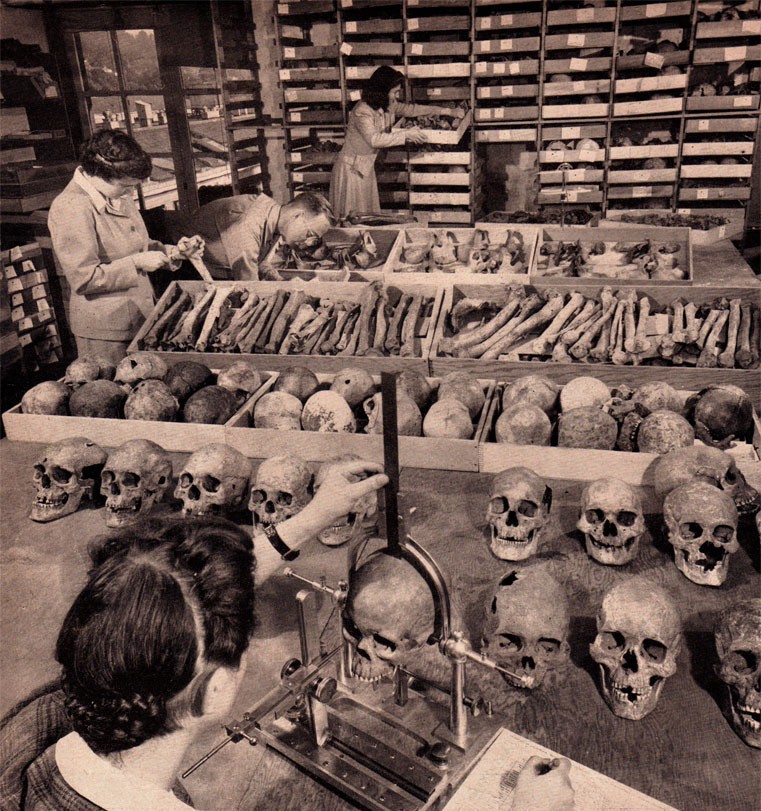
A graduate student at an anthropology museum at Berkeley uses a craniometer to measure an ancient Indian skull. This collection alone contained more than 10,000 Indian skeletons. Photo from Life magazine, October 25, 1948. Image from The Buffalo Post.

Death's double standard:
Justice for the living dead
It’s not only the unauthorized digging up of ancestors that haunts the memory of native peoples, it’s also the blatant double standard that adds indignity to insult.
By Tony Platt / The Rag Blog / May 22, 2012

It’s good news that the United Nations has authorized University of Arizona professor James Anaya, Special Rapporteur on the Rights of Indigenous Peoples, to carry out its first investigation into the status of Native Americans in the United States, with a particular focus on American compliance with standards embodied in the UN Declaration on the Rights of Indigenous Peoples, to which the U.S. became a signatory in 2010.

The focus of Anaya’s scrutiny no doubt will be on today’s inequalities and injustices that deeply impact 2.7 million Native Americans throughout the country. But let’s not forget the inequities of death.

Despite popular images of tribal members getting rich from gaming pay-offs, the overwhelming majority of Native Americans remain mired in poverty, the victims of structural unemployment and racial exclusion, compounded by devastating rates of diabetes, suicide, infant mortality, and cardiovascular and alcohol-related diseases.

There is a long way to go before, in the words of the Declaration, “indigenous peoples are equal to all other peoples” entitled to the right to “self-determination” and to “be free from discrimination of any kind.”

Inequality is a problem for the dead as well as the living. According to Article 12 of the UN Declaration, native peoples have a right to “the use and control of their ceremonial objects, and the repatriation of their human remains.” Repatriation as a central demand of Native American movements in the United States speaks to the long history of plunder of native artifacts and bodies.

Over a period of some two hundred years, from Thomas Jefferson’s exploration of a Native American barrow near his home in Virginia, to passage of the federal Native American Graves Protection and Repatriation Act (NAGPRA) in 1990, several hundred thousand native grave sites -- maybe as many as one million -- were dug up in the name of science, recreation, and commerce.

There was a brisk trade in native body parts and funerary artifacts, propelled by the popularity of commercial and recreational “collecting,” scientific curiosity, and the heritage industry. The artifacts removed from graves ended up in private collections and public display cases around the world, including the Smithsonian, Royal Museum of Ethnology in Berlin, the British Museum in London, and museums in Prague, Zurich, Vienna, and Moscow.

During the 19th and early 20th centuries, scientists in universities and museums engaged in a frenzy of acquisition in the hope that native bodies would shed light on the origins of the species or on racial typologies of human difference. They were particularly interested in the bodies of Indians, who, it was believed, had been frozen in time since the Stone Age, and whose remains therefore were thought to hold the key to “secrets of human origins,” as well as provide physical evidence for claims about European superiority and native degeneracy.

This science made it easier to frame the near extermination of native peoples in the imagery of natural rather than social history, subject to inevitable processes of erosion and decline, rather than as the result of human intervention and -- in the case of California -- genocide.

In widely read treatises -- such as Samuel Morton’s Crania America (1839), Ales Hrdlicka’s Directions for Collecting Information and Specimens for Physical Anthropology (1904), and Edward Gifford’s Californian Anthropometry (1926) -- the measurement of brain cavities, nostrils, and degree of slope in foreheads generated all kinds of scientific quackery to justify the civilizational superiority of white Europeans and innate inferiority of native peoples.

Aside from the racist assumptions that guided research on native bodies, the science was also flawed because documentation of provenience of bones and artifacts found in graves was often nonexistent. Moreover, scientists harvested far more corpses than they could ever study. Tens of thousands of native dead were stashed in boxes, cellars, and personal collections, only to be resurrected for display in cabinets of curiosities, museums, schools, and international expositions.

A skull collected on Santa Rosa Island was included in the U.S. exhibition at the Columbian Historical Exposition in Madrid in 1892. In the 1920s and 1930s, a self-styled amateur archaeologist dug up hundreds of dead Tongva Indians and used their bones to decorate his Catalina Museum of Island Indians. To this day, the Favell Museum in Klamath Falls, Oregon, proudly displays native artifacts looted from graves.

With passage of the Native American Graves Protection and Repatriation Act in 1990, the practice of widespread grave looting was officially stopped. Moreover, NAGPRA requires federally funded institutions to publish their holdings of native body parts, as well as artifacts taken from graves, and to facilitate their return to tribes that are able to make a case for genealogical or cultural connection.

NAGPRA was as significant a piece of legislation for Native Americans as the Civil Rights Act was for African Americans. And, similarly, it represents an unfinished revolution. The pace of repatriating human remains is glacially slow: by 2009, less than five percent nationwide had been returned to tribes. By 2010, the University of California at Berkeley had repatriated only 179 of its 10,000 native body parts.


There is nothing inherently wrong with using the dead to reconstruct the past. With the help of new developments in chemistry, DNA analysis and dating methods, we can learn a great deal from human remains about how our ancestors lived, worked, and died. Respectful collaboration between community groups, advocacy organizations, politicians, and scientists in New York in the 1990s, for example, made it possible to excavate what had been the Negros Buriel Ground, resulting in a detailed portrait of the daily lives of Africans in colonial New Amsterdam in the seventeenth and eighteenth centuries.

A similar collaboration between the Muwekma Ohlone Tribe, archaeologists, and Pacific Gas and Electric Company -- following the inadvertent exposure of native burials in Santa Clara, California, in 2008 -- produced a great deal of information about the lives and deaths of Ohlone neophytes buried in the mission at the end of the 18th and beginning of the 19th centuries.

For most twentieth century archaeology, however, the decision to excavate and exhume native remains was typically made unilaterally and imposed by fiat. The problem is not with the search for knowledge, but rather the unequal relations of power between investigator and subject, collector and collected; the lack of consultation and permission, the arrogance run wild; and how the products of knowledge are misused.

It’s not only the unauthorized digging up of ancestors that haunts the memory of native peoples, it’s also the blatant double standard that adds indignity to insult. Remembrance and treatment of the dead is a highly selective political project. Some of our collective dead are respected, others humiliated. Consider some examples:
  • The priests who worked at Mission Carmel in California from 1771 to 1833 are buried in solid tombs and named in headstones. Junipero Serra, architect of the mission system, is interred in an ornate crypt. The thousands of Ohlones, whose slave labor built and ran the mission, are buried anonymously in mass pits. When I visited Mission Carmel in February with Louise J. Miranda Ramirez, tribal chairwoman of the Ohlone/Costanoan-Esselen Nation, she picked up several items from the ground. “Look,” she showed me, “these are human bones dug up by gophers. I’ve asked the authorities to bring in soil and cover the graves with some protection, but they don’t do anything.”

  • In the second half of the 19th century, while scientists and collectors raided native cemeteries for booty and bodies, the nation made amends for the Civil War by creating a system of national cemeteries and making a conscientious effort to preserve the names and identities of those killed. Today, a Defense Department unit with an annual budget of $55 million searches the world for unaccounted soldiers killed in the line of duty. No comparable effort is put into retrieving thousands of native remains unceremoniously stored in university, military, and museum basements.

  • An expensive effort, led by the FBI, is currently under way to find the remains of a six-year old boy killed in New York more than 30 years ago. Recently, a national scandal erupted when it was revealed that the mortuary at Dover Air Force Base in Delaware dumped in a landfill the body parts of some victims of the September 11, 2001, tragedy. Similarly, the Pentagon expressed strong condemnation of the Los Angeles Times for publishing photographs of American soldiers posing with the body parts of dead Afghan insurgents. No such objections were made when museums and newspapers throughout most of the 20th century displayed native skeletons as objects of curiosity and entertainment.

  • A debate is under way today about the propriety of excavating the wreck of the Titanic when it may contain corpses that, say Federal officials, should be accorded the respect of a graveyard and shielded from “looters and artifact hunters.” In contrast, the University of California, Berkeley, is closing the Hearst Museum for two years in order to “renovate and transform its public spaces.” There are no plans, apparently, to give 10,000 native remains stacked in a dank basement a respectful burial or commemorate their theft from native graveyards.
Federal policies of repatriation are a step in the right direction. But most native remains are unclaimed or unknown. What should be a national ritual of remembrance and mourning has become a technical, bureaucratic process. In addition to tribal claims for the return of their dead, there is also a need for public commemoration that speaks to a national tragedy.

Throughout much of the 20th century, while the government built memorials to the victims of world wars and now, as it continues to make efforts to account for every person missing from the Vietnam War, hundreds of thousands of native bones and skulls have been stored anonymously in basements and boxes, and their burial goods displayed as mementos of a “vanishing race” or as freak show curiosities.

However much we have tried to assiduously forget this sorrowful history, the past continues to reverberate in the here and now. It is time to do justice to our living dead.

[Tony Platt is the author of 10 books and 150 essays and articles dealing with issues of race, inequality, and social justice in American history. Platt taught at the University of Chicago, University of California (Berkeley), and California State University (Sacramento). He is a Visiting Professor in Department of Justice Studies, San José State University. His publications have been translated into German, Spanish, Italian, and Japanese. His latest book -- Grave Matters: Excavating California’s Buried Past -- was recently published by Heyday. He lives in Berkeley and Big Lagoon, California, and serves as secretary of the Coalition to Protect Yurok Cultural Legacies at O-pyuweg (Big Lagoon). He blogs on history and memory at GoodToGo. Find more articles by Tony Platt on The Rag Blog]

The Rag Blog

[+/-] Read More...

27 June 2010

John Ross : An Uprising of Bones in Mexico

Tlatecuhtli, Aztec goddess of the earth, a fierce frog-like creature. The monumental 12-ton slab was discovered during an excavation beneath a popular Mexico City cantina. Photo from Noticias Azatlan Virtual.

An uprising of bones:
Macabre marks past and present in Mexico


By John Ross / The Rag Blog / June 27, 2010

MEXICO CITY -- Under the martial cadence of muffled drums, the bones rolled solemnly up the elegant Paseo de Reforma atop a dozen military vehicles. Four skulls could be spotted in one large glass urn. "Look Papi, there goes Hidalgo!" a small boy pointed excitedly -- one of the skulls is purported to be that of Miguel Hidalgo, the country priest who rose in rebellion in 1810 to initiate Mexico's struggle for independence from Spain, an event whose bicentennial is being celebrated this year.

For his efforts, Hidalgo was fusilladed by a Royal firing squad then decapitated and his head hung from a public building to impress upon would-be disciples the folly of rebellion.

Other urns were full of arm bones and femurs, said to be the remains of Jose Maria Morelos, Vicente Guerrero, Guadalupe Victoria, Leona Vicaria and her lover Andres Quintana Roo, and other heroes of the struggle for independence.

The macabre military parade was captained by President Felipe Calderon this May 30th to usher in Bicentennial festivities that will climax in September. The bones of the heroes are being shifted from their crypts in the slender column that supports the gilded Angel of Independence installed by dictator Porfirio Diaz (1876-1910) just weeks before the Mexican revolution exploded a hundred years ago.

Under Calderon's direction, they were being transported up to Chapultepec Castle, the colonial palace that overlooks the city, where experts will sort out whose bones are whose, and polish them up in anticipation of the big fiesta.

2010, of course, also marks the 100th anniversary of the Mexican revolution but the bones of the heroes of that landmark uprising of the poor are buried in their own monument, currently undergoing renovation. Of the duel centennials, the marking of the Mexican revolution has been downgraded by the right-wing president Calderon who reportedly is uncomfortable with the images of such revolutionaries as Emiliano Zapata, Francisco Villa, and others who once overthrew a conservative government.

But the bones of the heroes are not the only bones stirring in Mexico these days. In Taxco, the historic Guerrero state silver mining town, now a tourist Mecca, at least 77 cadavers were removed this June from the shuttered San Francisco Cuadra mineshaft, all of them casualties of Calderon's never-ending drug war. Although most had been reduced to piles of bones, more recent victims were identified by striking tattoos of Santa Muerte, the death goddess of the narcos.

The bones retrieved from the Taxco mine are thought to have been deposited there by pistoleros in the employ of La Familia, a drug gang based in next-door Michoacan state, notorious for beheading its rivals. Some drug war observers link the death cult to the Evangelical prosperity gospel.

On June 16th, La Familia gunmen and federal police troops mixed it up outside Taxco. According to Mexican drug war officials, a total of 15 dead pistoleros were added to the mounting bone pile. Taxco's stock as a tourist destination has declined precipitously since the killing spree began.

All over Mexico, the narco bones are piling up. 23,000 citizens have perished since Calderon declared war on the drug cartels 43 months ago to curry favor with Washington and garb himself in the mantle of military authority after a fraud-marred presidential election that left him with little credibility. To underscore the campaign, Calderon donned a military field jacket two sizes too big for his small, pudgy stature to the delight of the nation's acid-penned political cartoonists.

In addition to the 23,000 dead, hundreds are missing in action, many buried in clandestine common graves like the Taxco silver mine. Families set out on federal and state highways and never arrive home. Some vanish at impromptu checkpoints set up by the military and police and the drug gangs.

A record number of bones were collected this May when 1060 died in the drug war, a 43% increase over May 2009. June has been even more horrific. This June 11th while Mexico's national team inaugurated the World Cup football championship in South Africa, 85 new candidates for the bone pile were counted, a new one-day record.

Two 70-plus days followed. Ninteen addicts were slain in a Chihuahua City drug clinic, the fourth mass killing at such facilities in the state in the past year. In Ciudad Madero where 20 were slain, a clique known as "The Artists of Assassination" took credit for distributing the dead in a score of colonies in this Tamaulipas oil town.

A skull -- perhaps that of revolutionary legend Miguel Hidalgo -- seen in a glass crypt containing the bones of a dozen national heroes in Mexico , Sunday, May 30, 2010. The remains were carried through the city in a solemn Bicentennial procession. Photo by Marco Ugarte / AP.

On June 15th, 29 members of the Zeta Cartel were massacred inside a Mazatlan Sinaloa state penitentiary by rivals from El Chapo Guzman's Pacific Cartel armed with automatic weapons. El Chapo ("Shorty") is reputed by U.S. National Public Radio to be Calderon's favorite narco lord. Thirty-five prisoners had previously been slaughtered in the prison since the first of the year.

On the same day as the massacre in Mazatlan, a dozen federal troops were ambushed by La Familia near Zitacuaro Michoacan in the heart of the Monarch butterfly sanctuary zone. The ambush occurred almost a year to the date of a La Familia attack that cost 10 federal police officers their lives.

With the daily body count zooming, President Calderon has been obligated to launch a media campaign in an effort to convince a dubious public that he is winning his drug war. In mid-June, the President's public relations team bought up double truck space in every daily newspaper and weekly magazine in the country for the publication of Calderon's 5,000-word defense of his failing policies, shifting blame for the violence to the insatiable demand for drugs of his nearest neighbor to the north which he also lamented is arming the drug cartels via thousands of gun shops strung along the 1964 mile border.

The president also put the onus on the purportedly increasing affluence of Mexicans (presumably due to his administration's economic initiatives) that has provided them with enough disposable income to buy drugs.

Sic.

Felipe Calderon's mobilization of the armed forces to take on the cartels has been, at best, a big bust. Sending in the troops has predictably led to massive corruption. The Mexican Army, which took over the drug war from very corruptible state and federal police, is now so untrustworthy that the Navy is being deployed in high profile operations.

Civilian security agencies are riddled with cartel infiltrators. Officials on drug gang payrolls have been uncovered in the Special Prosecutor for Organized Crime office, the Federal Police command, and even Interpol and the U.S. Homeland Security Customs & Border Enforcement. Human rights abuses have climbed to over a thousand incidents a month reported to the National Commission on Human Rights (CNDH.)

The border around Reynosa, Tamaulipas and McAllen, Texas is particularly treacherous. On June 3rd, three boys -- the youngest was 13 -- were gunned down by Mexican Army troops near Reynosa. The military claims they were Gulf cartel gunmen ("sicarios"). Their parents testify they were wearing their middle school uniforms when the soldiers opened fire.

Calderon's preference for marketing the Bicentennial of Independence reflects the skittishness of his rightist PAN party to deal with class-based social upheaval. On the other side of the political ledger, the Left is focused on the possibility of renewed uprising as the nation approaches the centennial of the 1910 revolution.

Tattoo depicting Santa Muerte, the death goddess of the narcos. Image from Marzia Tattoo / Flickr.

Class tensions, exacerbated by the spiraling economic downturn; the increasing concentration of wealth in the coffers of the oligarchy; and rampant injustice are seen as signposts towards a new Mexican revolution. But the Left may have missed the boat. Indeed, if revolution can be defined as the violent overthrow of a sitting government, the new Mexican revolution has already begun:
  • Item -- Narco commandos are in the field inflicting double-digit casualties on federal security forces such as in the June 15th ambush in the Monarch butterfly sanctuary. Police and military outposts and prisons have been repeatedly overrun by such commandos.

  • Item -- Revolutionaries seek to demonstrate to the masses that the government can no longer protect them. The recent spate of bloody massacres seems to be directed to this end.

  • Item -- On June 9th, Monterrey youth gangs affiliated with the Zetas shut down that northern industrial city, blocking central thoroughfares and freeways with stolen trailer trucks, tourist buses, and earth-moving equipment at rush hour, a stunt that would make many left revolutionaries salivate. A similar shutdown in April was rumored to have provided the Zetas with free access to move troops and weapons through this strategically located metropolis.

  • Item -- "Plata o plomo" ("silver or lead"), the slogan of the drug gangs when dealing with the political parties and elected officials, is operative. Candidates for all three major parties have been threatened, bribed, and sometimes assassinated in the run-up to state elections this July. The kidnapping of a powerful politico and possible PAN presidential candidate is another indicator that an armed struggle for state power is in process.
Amidst dibilitating narco wars and bicentennial ballyhoo, older bones are rising to the surface these days.

Deep beneath the Templo Mayor or Great Temple in Mexico City's old quarter where the Aztec emperors butchered tens of thousands of warriors to win the blessings of Tlaloc, the god of the rain, and Huitzilopochtli, the sun at mid-day, the bones of the ancients are rattling around as never before.

In 2006, at the foot of the altar to Tlaloc on the corner of Guatemala and Argentina Streets, the National Institute of History and Anthropology (INAH) began to excavate a site beneath a popular cantina, El Seminario. Ten meters down, the diggers hit pay dirt: a monumental 12-ton slab depicting the Tlatecuhtli, the Aztec goddess of the earth, a fierce frog-like creature that had been buried for five centuries following the fall of the Mexica empire to the European invaders.

Archeologist Eduardo Matos Mocuhtezuma, on whose watch the earth goddess was uncovered, speculates that the Tlatecuhtli was installed by the Emperor Mocuhtezuma II (no relation) to cover the tomb of Ahuizotl, one of the most powerful of Mexica rulers.
Although the bones of Ahuizotl have not yet been located, the discovery of many offerings ("ofrendas") -- textiles, gold jewelry, tiny figures of Aztec deities -- indicate a new find is imminent.

This May 17th, the Tlatecuhtli, which has broken into four large sections and is missing a four foot section where its viscera should be, was painstakingly carried into the Templo Mayor museum to be the centerpiece of an exhibition documenting the "Time and Destiny" of Mocuhtezuma's governance -- his fall in 1521 amidst multiple signs of doom and gloom marked the end of the Aztec empire.

As they were 500 years ago, these are apocalyptical times. The deluge of bones here is accompanied by premonitions of cataclysm: global warming, a deadly Gulf of Mexico oil spill, terrifying acts of violence and vengeance.

Laid out on an immense bier, the Tlatecuhtli is visible from three stories above the museum floor. Viewed from on high, she seems immersed in beatific repose, her heavy lids turned demurely downwards and her serrated tongue dangling comically from her open mouth. Capped by a crown of caracoles (snails) she is perched on thick claws that communicate maximum animal power.

Jesus, a breakfast companion at the Café La Blanca, studies the photo in the morning daily, La Jornada. "Wow! What do you think will happen to us if she ever wakes up?" he wonders.

[John Ross lives in Mexico City a few blocks from the Tlatecuhtli and the subject of his latest cult classic El Monstruo: Dread & Redemption In Mexico City ("gritty & pulsating" -- New York Post.) He is can be fingered at johnross@igc.org.]

The Rag Blog

[+/-] Read More...

Only a few posts now show on a page, due to Blogger pagination changes beyond our control.

Please click on 'Older Posts' to continue reading The Rag Blog.