Showing posts sorted by relevance for query roger baker and peak oil. Sort by date Show all posts

07 April 2009

Roger Baker : The Reality of 'Peak Oil,' Part 1

ASPO Ireland.
Peak Oil is the point at which the total world oil production reaches its high point and finally starts to decline... We at last have some pretty convincing data to indicate that world oil production probably peaked forever in the summer of 2008...
By Roger Baker / The Rag Blog / April 7, 2009

Has peak oil arrived yet, and how do we know when that happens?

Everyone has probably at least heard the term "peak oil" by now, but perhaps without understanding much about what that phrase means or implies. It is the point at which the total world oil production reaches its high point and finally starts to decline. This is something that almost all geologists have known was going to happen sooner or later. During the energy crisis of the 1970's, Scientific American predicted that oil production was already going to have peaked by now. There are many good "peak oil" sites these days, but this primer from Energy Bulletin is as good as any place to learn the basics:

For those of us who have been warning of the economic implications of peak oil, we do have at last some pretty convincing data to indicate that world oil production probably peaked forever in the summer of 2008. For one thing, we know from the official OPEC and International Energy Agency data that there was a supply peak and decline about the same time as the price peaked in the summer of 2008. Go here and scroll down to the chart titled "Now it is beginning to look like world oil production is beginning to decline.” (Lots more good economic discussion at the same link.)

As a follow-up example, look at Tony Ericksen's chart and the discussion on the Oil Drum, which is a leading and essential energy policy discussion website. Erickson's conclusions were based on a combination of current production data together with knowledge of the new oil production projects scheduled to come on line. His conclusion of a peak in 2008 was supported by most of the Oil Drum's staff of (pro bono) writers and researchers.

In addition, the highly respected ASPO International newsletter, edited by the Association for the Study of Peak Oil International director and geologist Dr. Colin Campbell, agrees with a 2008 world oil production peak. This fact is represented in the information on the second page of recent ASPO newsletters. Conventional oil produced from drilling on land probably peaked in 2005. The other more difficult and expensive sources like polar and deep-water and tar sand oil are now themselves falling short of being able to fill the widening oil demand shortfall left by the slow decline of the huge but aging fields that supply most of the world's oil.

The argument for making the case that we have already hit world peak oil production is simple. First, oil production is known from the official data (see the second link above) to have reached a peak in July 2008 of about 86 million barrels per day. Since that time production declined, but not fast enough to match an even steeper drop in demand caused by the global economic crisis.

Up until July 2008, the bidding for the amount of oil globally available, including some element of speculation associated with a super-tight world market, raised the oil price to a historic high of $147 a barrel before the oil supply, oil price and the global economy collapsed, approximately together in their timing.

The July 2008 maximum production level was hugely expensive to reach. As one might imagine, vast amounts of capital were attracted in the past few years to the lucrative profits to be made in places like the Canadian tar sand fields from producing $100 plus oil.

Now that the price has collapsed to less than $50 a barrel, very many oil (and gas) drilling rigs previously devoted to trying to maintain maximum oil production have been shut down, or are falling into disrepair. Major oil projects around the world, including those in Saudi Arabia, have been canceled.

This collapse in current oil infrastructure investment due to a current lower price, together with the slow depletion of the biggest global super-giant fields, makes it very likely that oil production will now continue to contract. This no matter how much we might try to invest when the price shoots back towards $150 a barrel. Crash investments are unlikely to make much difference, assuming the capital is still available.

Since we don't know the depth of what already amounts to a world depression, oil prices could remain at $50 a barrel for several years until a partial global economic recovery recreates a world market bumping up against the slowly declining ceiling in production once again. Nobody can accurately predict what will happen because the unpredictability of the current economic crisis makes the recovery of energy demand unpredictable. (See Heinberg in the upcoming Part 2 of this article.)

Oil is like nothing else in its role in the economy. Oil is the essential lifeblood of our modern fossil-fueled global economy, powering virtually all transportation, whether on land, or air, or sea. For this reason, the global economy is ultimately limited in its potential expansion by oil, and will for the foreseeable future. Just try to imagine the cost and difficulty of retrofitting the world's jet aircraft to burn some other fuel than the kerosene-like jet fuel that they need now. We use a similar oil distillate fuel to launch rockets into space because nothing else can safely deliver more energy per pound when burned together with liquid oxygen. Less and more expensive oil means we will necessarily fly less and move fewer things around.

There are many important economic implications of our inconvenient industrial addiction, with most of them likely to be seen as unwelcome to conducting business as we have in the past. This is especially true when viewed in the context of a global capitalist economy.

By definition capitalism must always increase its production of goods, in order to earn interest on investment and remain economically healthy. Capitalism exists solely by virtue of its tendency to expand more strongly than competing modes of economic organization. When there is still lots of planet left to profitably exploit, capitalism tends to win out, at least in a Darwinian sense.

High oil prices act like a universal tax on all commerce. The price of oil is still poised to surge again whenever the desire to pay customers to move things around exceeds the amount of oil needed to accomplish that goal.

Not only is peak oil bad news to its users in a direct sense, but the evidence indicates this economic headwind, operating together with an unregulated and unwieldy mountain of poorly-secured global debt, probably initiated the economic collapse of 2008, as the Wall Street Journal indicates.

This is not the only source to implicate peak oil as a primary cause of the financial crisis. The crisis started to unwind in August 2007, beginning with the sub-prime mortgage problem, but it became acute in mid 2008. The following is from “Oil price and economic crash,” ASPO International, Feb. 1, 2009.
The German Financial Times features an article that links the record high oil prices of last July to the onset of the financial

No financial analyst managed to predict that 2008 would end in a recession. Generally the financial crisis has been described as the cause. However, it turns out that the initial suspicion was wrong. The chronology speaks against the fact that the September bankruptcy of Lehman Brothers crash caused the real economy. Key economic indicators were on descent weeks before Lehman Brothers collapsed.

In the United States, the number of new applications for unemployment benefits soared in the last week in July suddenly to recession levels - not mid-September. In August broke the upward trend in orders for U.S. companies, the orders fell within one month increased by four percent. Industrial production also fell abruptly in the month before the Lehman-crash - not afterwards. The same is true for America's exports, which previously had boomed for months.

In the euro zone started in the mood indicators in June to time, with worsening in July. Even in China there was already weeks before Lehman signs of a serious economic setback. The crash of the summer of 2008 coincided with another global phenomenon: In June and July 2008, at the rise in oil prices, the first courses were almost twice as high as a year earlier. This also caused another shock as a result of the global: an inflation scare that led to just the interest rate in June shot up high expectations.

In agreement with the oil price theory, the sales of cars in the U.S. crashed at exactly the mid-July . With the oil price could also explain why no industry as a crisis like the car industry. In the euro zone fell to new registrations from June to July by 8.3 percent. The German car industry was almost 15 percent fewer orders than last year.
Oil production limits clearly initiated the bidding war that raised the world price to $147 a barrel before the oil price and the global economy collapsed approximately together. The ASPO newsletter has an oil price graph that strikingly shows the slow acceleration of oil price from 2000 to a soaring peak in summer of 2008. This chart can be seen as a visual representation of an irresistible economic force in direct collision with an immovable natural barrier.

Since liquid fuel production (most of which is oil) was running flat out at nearly 86 million barrels per day, any further bidding by an expanding economy, including some short term speculative forces, could only bid the price up still further, perhaps to $200 a barrel as some were anticipating in 2008.

At some point these very high fuel costs were bound to wreck the ability of the over-leveraged economy to expand and repay its debt. Cost-push inflation associated with the embedded cost of transportation was poised to diffuse throughout the economy within months of fuel price increases. Things just happened to hit the wall of financial reality when oil reached $147 per barrel.

This world fuel production level of 86 million barrels per day was a very expensive and difficult level of oil production to achieve and maintain. Now that the world oil price has collapsed to less than $50 a barrel, partly due to about a 4% reduction in yearly US oil demand, many oil and gas rigs have been forced to shut down.

This collapse in current investment together with slow depletion of the biggest global giant fields virtually assures that world oil production will now continue to contract. Since oil is the lifeblood of the modern world economy, powering virtually all transportation, the global economy will have to contract too, and probably for a long time to come.

There are many implications of peak oil. There are delayed effects, like the current economic crisis, but most of the results are likely to be seen as unwelcome. If things were bad when gasoline hit $4 a gallon last summer, what happens when it costs $10 a gallon?

[What to do about the current situation will be the focus of Part 2 of Roger Baker's series, "The Reality of 'Peak Oil.'"]

The Rag Blog

[+/-] Read More...

17 June 2008

There's Peak Oil and then there's (FREAK!!) Oil...


I think this might Imply that we can either try to devise techno-fixes aimed as business as usual or we can move to a more survivalist post-corporate mode of social organization dealing with an abrupt reduction in the average living standard, as implied by peak oil. There is going to have to be a right and left wing of the peak oil believers, probably represented by a political movement of sorts,

Roger Baker / The Rag Blog

A leading 'peak oil' theorist
ponders movement's direction

By Nathanial Gronewold / June 16, 2008

NEW YORK -- Record oil prices, which have more than doubled in a year and have already jumped nearly 40 percent in the last six months, have some "peak oil" theorists gloating a bit.

But Nathan Hagens, a prominent peak oil scholar, isn't in the mood to celebrate. He is worrying that the community of economists and analysts who say global oil consumption will outstrip daily production is headed for a schism.

"We're going to start to decouple in the peak oil community," said Hagens, a student of energy and ecology and co-editor of "The Oil Drum" blog.

Once dismissed as alarmists and doomsayers, proponents of peak oil are now enjoying the spotlight at center stage of a global energy debate. More mainstream energy analysts, including Platts' senior oil economist and even some heads of major oil companies, are increasingly giving credence to their arguments. The International Energy Agency is also concerned that the world might soon reach maximum output, spurring a major reassessment of the agency's supply forecasts.

But there is growing disagreement about what peak oil means. Some factor tar sands, oil shale and other unconventional sources into the equation, suggesting production can continue to increase for quite some time. Others count only free-flowing crude and say the world has already reached peak output, pointing to the popularity of unconventional extraction as a sign of a desperate society exerting more and more energy for less and less oil.

Nevertheless, there is broad consensus within the peak-oil community over the fundamental thesis. But Hagens says the increased attention they are getting and the heightened public anxiety over high fuel prices is splitting the community "between people focusing on supply-side answers, technology ... and others that say the problem is much, much bigger than that and we need to change the whole economic system that underpins society."

Hagens places himself in the more pessimistic camp, arguing that a 1,300 percent increase in oil prices over the past decade will accelerate in coming years, with devastating consequences for the poor and middle class.

And if his central argument is correct -- that market economics are inherently irrational and that mankind was driven to this point by forces of human nature that most are incapable of resisting -- then it may be too late to reverse the world's long-standing complacency over energy security and effectively address the problem.

"I think we've peaked in net energy production already," he said.

"There's an energy-to-profit ratio on coal, and nuclear, on hydro, on oil, on natural gas, and they're all declining."

'Depletion is beating technology'

Hagens was not born a skeptic of market forces. In an interview, he described the path he took from managing investment portfolios of wealthy clients at Salomon Brothers and Lehman Brothers to running his own hedge fund, then to quitting Wall Street altogether in 2003 to sound the alarm over peak oil.

"I decided to go back and get my Ph.D. and study the environment," Hagens said. "The impetus for that was I saw that the market was not including negative externalities, and that we were kind of running out of resources, of the high-quality, low-cost resources."

Hagens currently pursues the problem at the University of Vermont. His unique approach to the topic -- which mixes economics, psychology and evolutionary biology -- has won praise from and notoriety among his peers and has helped solidify peak-oil theory.

Hagens now divides his time between his research, giving lectures at energy conferences, and explaining his findings and concerns to lawmakers and industry insiders who seek him out.

"Global warming and everything else had me upset that people were just focused on making money," he said, "but subsequently I learned about peak oil and the evolutionary side of our behavior, and I thought those two issues trumped global warming and the other environmental things."

Studying the peak-oil conundrum from the perspective of human evolution, the world Hagens describes is one where human society is driven to compete and grow. This growth, in the form of economic and population expansion, can only continue as long as we are able to extract much more energy than we exert trying to get it, an equation more popularly known as net energy return on energy invested.

The signs that we are reaching "peak oil" are not coming from the depletion of reserves -- most proponents of the theory accept that there is plenty of oil left in the world and will be for a long time. Rather, the run-up in oil prices, and indeed in the price of all energy, is a sign that we are fast approaching, or have already hit, a net energy peak. Whereas in the past it took perhaps the equivalent of one drum of oil's worth of energy to gain 100 drums of oil, Hagens argues that the world is fast approaching a 1-to-1 ratio.

"Depletion is beating technology, and in the end it always will," he said. "We've gone from 100-to-1, to 30-to-1, to 10-to-1, and at some point you could spend as much energy as you get out, and that would only make sense if you had an unlimited amount of lower-quality energy."

Hagens and others do not believe the world has an unlimited supply of oil shale, deep water reserves, coal to liquid and other schemes companies and governments everywhere are busily pursuing.

And Hagens said his research shows that the market forces most economists are relying on to save the day do a terrible job of pricing resources trapped underground, resulting in an over-reliance on gasoline, which, even at $4 a gallon, is still cheaper than Gatorade.

The marketplace is adjusting to higher prices. Consumers are driving less and turning to more fuel-efficient vehicles. Energy consumption as a whole is growing less or becoming more efficient in the face of higher prices. People are beginning to move their residences closer to their places of work, or working from home. Business travel is also way down.

But proponents of peak oil theory say that none of that will be enough to offset the loss in terms of energy gain that declining production will bring. Experts believe that it takes at least 17 years for the United States to roughly overturn its entire vehicle fleet -- and changing jobs and houses to shorten commutes is not something that is accomplished quickly, either.

"As our energy-to-profit ratio declines, we can't grow, we can't grow the economy unless that is offset by efficiency and conservation, but the magnitude of gain that we have right now can't possibly be offset by efficiency and conservation," Hagens said.

'Lifeblood of civilization'

In the end, those on the more pessimistic side of the peak-oil argument -- those who see a global economic crash coming -- say we risk becoming victims of our own nature.

Hagens, for one, says numerous studies of evolutionary behavior and the workings of the mind show that humans value the present far more than the future, and that we are driven by a powerful assumption that what is true today will continue to be true tomorrow.

This fundamental aspect of how the mind operates, he said, explains why the peak oil argument has been dismissed by mainstream society for so long. It also explains why even the brightest minds in the industry, notably expert analysts at the consulting firm Cambridge Energy Research Associates routinely fail to accurately predict future oil prices. Today, the cost of a barrel of crude oil is hovering at around $135, not the $85 level that many experts assumed it would beat.

"The root causes are at the psychological side of human behavior," said Hagens. "Individuals being rational is the exception, not the rule."

The point is to not only become more energy efficient, diversify energy supplies or develop ever greater technological fixes, he said, but to change human behavior so success will be measured in consuming less instead of more. That, he added, is a tall order.

And the peak-oil crowd itself, now increasingly divided between those who fear the worst and those who believe in market forces and are even exploring ways to profit from the fallout, needs to find a consensus on how serious the problem is and on ways to influence economic and political changes, Hagens said.

"What people don't understand," he said, "is that this is the lifeblood of civilization, and once people realize that it's scarce, you're going to see individual behaviors revert to 'I'm looking out for number one,' and things can flip pretty quickly."

Source. / Greenwire (limited access)

The Rag Blog

[+/-] Read More...

23 June 2011

Roger Baker : Have We Turned the Corner on Peak Driving?

A window on peak driving. Image from The Auto Channel.

Coming soon:
Peak oil, peak driving, peak cars
Part II: Have we turned the corner on peak driving?
By Roger Baker / The Rag Blog / June 23, 2011

[This is the second part of a series by Roger Baker on transportation, centering on the issue of peak oil and its ramifications.]

Tell the average U.S. car owner that total driving in the USA might have already peaked forever, and they are likely to think you're crazy. That possibility goes against a lifetime of personal experience, living as we do in a country dependent on personal vehicles for work trips and various other vital functions.

It doesn't seem possible that total driving could peak and decline in our lifetimes, especially given an ever increasing population. Cars and their social and economic implications might be said to be the primary basis for the prevailing U.S. lifestyle and culture.

We see evidence for a shift in driving behavior in many places. Indeed, evidence for a driving slowdown clearly predates the big 2008 run-up in fuel prices. There are a number of factors at work. High unemployment cuts down on work trips. Intractable traffic congestion associated with suburban commuting in most U.S. metropolitan areas plays a role. As the U.S. population ages, it is driving less.

According to the best data, collected by hundreds of stations around the USA by the Federal Highway Administration, the total amount of U.S. driving, called VMT or vehicle miles traveled, hit a peak of about 3.04 trillion miles of travel in 2007. Since 2007, travel volume has been making a sluggish recovery, but U.S. driving is still over 1 percent below the level of four years ago.

The chart below offers my expanded version, including the latest month available, the VMT for April 2011, and extending back for each month since 2004. We can see there were several years of a weaker increase, beginning about mid-2005. As gas prices rose during 2008, total driving took a nosedive and then made a slow bumpy recovery during 2009-2010. In early 2011, driving has dropped again, likely in response to sharply higher fuel prices.

Rag Blog chart by Roger Baker.
CLICK ON IMAGE TO ENLARGE.
The reason for this slow recovery in U.S. driving is not hard to understand. The most recent data show that the cost of transportation (mostly driving) in the U.S. has been rising with increasing fuel prices. It has now recovered and exceeds the previous 2008 peak, even as household income continues to fall behind due to inflation.

If we are optimists, we can look at this chart and argue the VMT numbers might keep rising at the current sluggish rate. Purely by eyeballing the chart, it looks like U.S. travel volume might possibly recover to reach its old 2007 peak in two years or so. But the likelihood of higher oil prices and the slow replacement of the existing vehicle fleet suggest that this is unlikely to happen.

The U.S. vehicle fleet of cars, light trucks, etc may already be past its peak. The total number of private vehicles reached a high of about 250 million in 2008.

An excellent analysis of the changing economics of U.S. transportation has been provided by Worldwatch Institute founder Lester Brown. He points out that In 2009 alone, car ownership declined by about 4 million vehicles, or about 2%.
Future U.S. fleet size will be determined by the relationship between two trends: new car sales and cars scrapped. Cars scrapped exceeded new car sales in 2009 for the first time since World War II, shrinking the U.S. vehicle fleet from the all-time high of 250 million to 246 million. It now appears that this new trend of scrappage exceeding sales could continue through at least 2020.
The basic case for peak driving and peak cars is that driving is becoming increasingly unaffordable for the steadily growing ranks of low income drivers, in a nation where vehicle ownership is highly correlated with income. Annual car ownership cost is now estimated at $9,000.

Meanwhile, many experts now believe that we are very near or past peak global oil production. Given a steadily growing demand for a shrinking global oil supply, the lack of practical alternatives is bound to make driving in the U.S. steadily less affordable. This is doubly the case when rising fuel prices act like a tax that competes with, and depresses, consumer spending in other sectors of the economy.

Until the U.S. economy recovers, it is hard to see how driving and car sales can recover. Assuming the U.S. and global economy do recover, it is just as hard to imagine a scenario in which basic supply and demand will not raise the cost of fuel high enough to kill the economic recovery, much as we saw in 2008 when the price of oil reached $147 a barrel.

If we knew the state of the U.S. economy a year from now, and an average driver's fuel costs, we would be in a good position to predict the level of driving. Since the economy is unlikely to recover much the next year, in terms of the part of family income that can be devoted to driving, the wild card, the biggest source of economic uncertainty, is the cost of motor fuel next year and beyond.


The Road Lobby:
Why public planners hate the concept of peak driving

The reality of peak driving and peak cars on the road is guaranteed to be seen as unwelcome, and to be unpopular among planners. Planning for peak driving deeply disturbs the basis for business as usual, an unpopularity it shares with measures to limit global warming. Peak driving is subversive of existing interests since so much existing investment and infrastructure is based on the status quo.

There are a constellation of powerful financial interests tied in one way or another to the automobile, all sharing in common an interest in the continuation and expansion of a car-centric and oil-addictive U.S. suburban lifestyle. These interests include the car building industry, the road construction industry, the home products industry, and also include the various suburban sprawl and home-building beneficiaries.

Most transportation planners and their allies -- ranging from Exxon, to Walmart, to General Motors -- are inclined by the nature of their existing investments to favor roads and driving as the way to serve a profitable continuation of the prevailing pattern of suburban development.

It should come as no surprise that there is an active road lobby with many branches, including here in Austin, dedicated to perpetuating the privately profitable aspects of driving. The road lobby has its own stable of active driving promoters like Wendell Cox and Randal O'Toole, both stridently pro-road and anti-transit. If there is a toll road lobby it is probably centered around Peter Samuel and Toll Roads News.

The Texas Transportation Institute is essentially the academic think tank of the Texas road lobby. It offers an academic fig leaf of respectability to the active promotion of roads and cars and driving as unchallenged core values and infrastructure funding assumptions.

One of their current projects is to study, and prove the necessity for, a new tax on miles driven to replace or supplement the current fuel tax. The fact that the road lobby would be suggesting what is guaranteed to be such a highly unpopular kind of tax only underlines the deteriorating economics of driving.

The road lobby, in its more overtly and stridently political manifestation, often maintains that the ability to drive anywhere is a basic civil right under attack by transit advocates and urban planners inside government. At any rate, this outlook applies when the planners are not primarily trying to build more roads. Especially the roads that subsidize the suburban growth surrounding major U.S. metropolitan areas, where most state and federal planners are still focusing their attention.

The ultimate futility of subsidizing suburban sprawl development with more roads comes as no surprise. The case was already solidly made in 2004 in the classic peak oil documentary, The End of Suburbia.

The degree to which supposedly near-universal car ownership is threatened by a relatively declining U.S. household income is a factor that U.S. transportation planners are especially reluctant to admit. The reality is that rising fuel prices and a stagnant economy are fundamentally changing the economics of transportation and forcing the growing ranks of the poor to give up their cars.

Next time: A deeper look at what is by now an overwhelming body of evidence that U.S. driving behavior is fundamentally changing in response to our changing economy. The closer you look, the more apparent that a basic shift is really taking place. But what will the public transportation alternative look like by the time the public widely appreciates how much they really need it?

[Roger Baker is a long time transportation-oriented environmental activist, an amateur energy-oriented economist, an amateur scientist and science writer, and a founding member of and an advisor to the Association for the Study of Peak Oil-USA. He is active in the Green Party and the ACLU, and is a director of the Save Our Springs Association and the Save Barton Creek Association in Austin. Mostly he enjoys being an irreverent policy wonk and writing irreverent wonkish articles for The Rag Blog. Read more articles by Roger Baker on The Rag Blog.]

The Rag Blog

[+/-] Read More...

08 June 2011

Roger Baker : Playing 'Peak-a-Boo' With the Earth

Cartoon by Andrew Weldon / The Age / National Museum of Australia-Canberra.

Coming soon:
Peak oil, peak driving, peak cars
Part I: Fuel prices and the global oil supply
By Roger Baker / The Rag Blog / June 8, 2011

In recent years, we are used to hearing something about oil in the news nearly every day. With rising fuel prices at the gas pump acting as a constant reminder, it is getting harder for the public to deny that the United States is in big energy trouble.

I have written three essays to explain our current situation, with a focus on transportation. This first one explains the global oil supply situation that has been causing fuel prices to go back up.


This will be followed by an essay documenting and explaining the basic shifts in driving and transportation behavior that are already well under way. It is indeed quite possible that the total vehicle miles driven in the United States has already peaked in 2007. Barring something unanticipated, we should plan to drive less, pay more, and begin to envy those with good transit service.

A third essay will focus on the efforts of the "Texas road lobby" to block transportation reform that might move Texas away from the sunbelt syndrome, a mode of growth highly dependent on cars, trucks, and roads to serve suburban sprawl development. When such groups fight progress or change, the skillful use of misleading data always helps. As does a new state leadership unwilling to acknowledge global warming.

Since there is a lot of money involved, and since this is Texas, we now see a new statewide network of Texas road promoters. In Texas, the road builders and their allies are thriving -- actually manage to increase their funding at the expense of competing priorities like health care and education.

The road goes on forever, and the party never ends. At least not while the Texas road lobby has its way. -- RB


The big picture: The global supply of cheap oil is mostly gone

The USA has, in effect, squandered the decades since the energy crisis of the 1970s in denial of its growing dependence on cheap imported oil. The USA gambled its economic future on the expectation of an eternally abundant supply of liquid fuels needed to power its unusually oil-dependent, low-density suburban lifestyle.

The U.S. energy crisis of the 1970's was temporarily abated by new Alaskan oil production, and by agreements with the Saudis and other OPEC producers. Market access to cheap OPEC oil was then promised forever, in return for unlimited access to Middle East oil reserves, and for U.S. military protection of the status quo.

Now that the cheap conventional petroleum of our past is in global decline, as reflected in its erratic but stubbornly rising price, keeping the U.S. transportation system functioning as usual is a continuing struggle. Over 95% of the world's transportation runs on oil-based fuel or its liquid equivalent; essentially all the world's ships and planes and trucks, and most trains, run on conventional hydrocarbon fuels.

Producing the remaining supply of more expensive nonconventional oil requires that the biggest private companies like BP have to work a lot harder, by going far offshore, by using lower quality sour or heavy oil, or by mining tar sands, etc.

Since most of the richest geological oil deposits have already been located and largely produced, we're finally getting down to the dregs. Global demand must increasingly be met by these "non-conventional" oil sources, where the energy return on our energy investment from drilling, etc., is much lower than before; perhaps only three-to-one rather than the previous twenty-to-one.

Given the new global oil supply situation, and with especially serious economic and transportation implications for the car-dependent U.S., it is past time to do something. The real issue is how hard we hit the wall as fuel prices keep on rising.

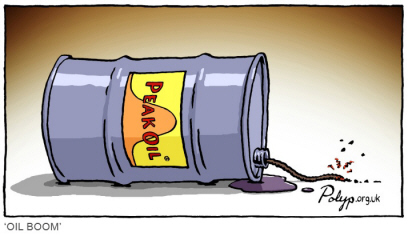
Cartoon by Polyp / UK.


Oil sets a limit on economic recovery

Oil reached its all-time high of $147 per barrel in mid-2008. Since then, the global supply hasn't gone up much, but demand has shrunk with the recession, and the price has decreased. With a global recovery, a recurrence of another oil price spike is now well underway, to be followed shortly by a second stage of global recession, a continuation or second phase of the Great Recession of 2008.

This time around, after a lot of previous destruction of soft global demand, and due to rapid oil demand growth in China, we should anticipate that oil demand and oil prices will not fall to such a degree as they did in the recession of 2009.

During the entire period from 2005 to the present, the global production of conventional oil has been relatively constant, with oil prices rising and falling with the strength of the dollar and global demand. Global oil demand has been steadily rising during the last year, running up against global production a second time, as reflected in its rising price.

Since about June 2010, we have seen a slow acceleration in price, to the point that Brent crude (the best global price to watch) now sells at about $117 per barrel. Assuming the global economy falls back into recession, oil may get a little cheaper in dollar price, but it will probably keep getting less affordable.

Energy analyst Tom Whipple explains the same situation this way:
There are only a limited number of ways that the current economic recession and the looming prospects of a final decline in oil production can play out. None of these will permit much of an economic revival. The global financial crisis as presently understood is clearly too firmly rooted to be fixed by government bailouts and stimulus packages. The recession will only deepen for the foreseeable future, and the massive deficit financing by the United States and many other countries cannot go on much longer. Although China, with its large reserves of foreign currency, may be able to continue underwriting stimulus packages longer than other countries, it too will succumb to the lack of exports, the need to import energy, and other looming problems

Oil-related thinking and politics at the national level

For anyone living in the U.S., it's easy to see that we are a car dependent nation. Oil addiction implies a corresponding car addiction. President George W. Bush first used the distressing "A" word toward the end of his term. Obama has now been warning us of the same thing for almost two years, and again last year during the BP spill.

Recently, Obama has proposed a national U.S. goal of reducing oil imports by a third, by 2025. In his words,
The Federal Government operates the largest fleet of light duty vehicles in America. We owe a responsibility to American citizens to lead by example and contribute to meeting our national goals of reducing oil imports by one-third by 2025 and putting one million advanced vehicles on the road by 2015.
This slow pace of of breaking our oil habit, offered here as a top national goal, is one way of admitting that our imported oil dependency will be extremely hard to break.

Along with the difficulty of reducing our import habit through painful economic restructuring over time, a domestic culture of denial persists, giving way to frustration and anger. We like to blame big oil companies like Exxon for holding back on production, or for causing high gasoline prices in some other way that they could easily reverse. It would be better to focus on the long term structural oil dependence of our society that these major producers have encouraged for decades, and which is arguably their major corporate sin.

Of course Republicans like to blame Obama for not encouraging more domestic drilling to hold down our driving costs. The reality is that no possible domestic energy policy can make much difference any more. Adding any plausible amount of new American production can scarcely sway the price on the huge global oil market. The guys still drilling in Texas or the Gulf are not likely to give us much of a price break since they can sell it to Europe for even more.

Oil has become more expensive globally, due to supply and demand in the world oil market -- of which the USA is now only about 20%. We might like to blame oil speculators for the oil price bubbles, but they are not a major factor on their own; they can't move the markets for very long without support from real market supply and demand forces.

The true adequacy of supply is revealed when and if tankers full of Arab oil arrive from the Middle East to undercut the speculative portion of demand. Even speculators have to sell the oil they buy, and they didn't get to be important players by making stupid bets.

Cartoon by Bromi / Mindfully.org.


European thinking about the oil supply problem


The International Energy Agency -- the top energy adviser to Europe -- now concedes that global conventional oil production, the ordinary oil you drill for on land, peaked about 2005 and is now in decline. The end of the cheap oil is automatically shifting the market toward more expensive and lower quality oil.

In fact, the IEA is now pleading with the OPEC cartel to raise its oil production enough to prevent a renewed economic crisis. The IEA can see what is happening. Faced with stagnating global oil production and the inability of low grade Saudi oil to make up for Libyan sweet crude losses, the IEA is asking OPEC to increase its oil exports -- enough to keep the global economy from slipping back into recession:
In an unusual development, last week the IEA’s governing board called on oil producers to increase their output to "help avoid the negative global economic consequences which a further sharp market tightening could cause." The Agency’s position is in stark contrast to that of OPEC, and in particular the Saudis, who maintain that the oil markets are adequately supplied and that there is no need for a production increase at this time.

The statement released by the IEA cited a “clear, urgent need for additional supplies." This time around the IEA seems to be taking the lead in warning that ever since the Saudis pulled back from replacing the lost Libyan exports last month, global demand for oil has been exceeding supply with the difference coming out of stocks.
With respect to world oil supply problems, many experts are now conceding that the days of cheap oil, and cheap driving, are over. The British are starting to face up to their own serious and rapidly worsening energy import problem, which parallels U.S. oil dependency in many respects, though it is not as severe.

By the time the general public understands the problem well enough to trouble the politicians, the situation it will be terribly difficult to deal with because of the long advance time needed to make an economic transition. We saw this during the long energy crisis of the 1970s.
The Hirsch report, published in 2005, concluded that to avoid major disruptions, we need to plan 20 years before the arrival of the oil peak, and that we just don’t have.

The key role of Saudi oil

The Saudis by themselves, by means of their unmatched reserve production capacity, and with their almost 9 million barrels a day in oil exports, or about 10% of the world supply, are the key oil export source. The world has relied on them since the 1970s -- to keep the world oil price as low and stable as it is now. Any big loss in Saudi exports, perhaps through spreading "Arab Spring" political instability, would rapidly plunge the world into a global depression.

Since they have already produced their best and cheapest oil, the Saudis are having to produce heavier and more sour crude oil, which is harder to refine. The Saudis are now struggling to maintain even their current level of oil exports to hold down the world price.
"The easy oil is coming to an end," says Alex Munton, a Middle East analyst for the Scottish energy consulting firm Wood Mackenzie. The major oil fields in the Gulf region, he says, have pumped more than half their oil -- the point at which production traditionally begins to decline.

The U.S. Energy Information Administration said earlier this month that world-wide oil consumption would hit a record 88 million barrels a day this year. Turmoil in Libya, combined with slowing production growth in Western countries, will keep supplies tight, boosting prices, the federal agency said. It projects oil prices will average $103 a barrel this year, up 30% from last year, and will be even higher next year.
Meanwhile, there is a growing suspicion that OPEC is holding back on oil production to keep prices high:
There appeared to be signs of growing panic behind the latest declaration from the International Energy Agency. The statement calls on oil producing countries to increase production and reduce costs in order to avert economic crisis. To date Opec members have been insisting that the market is well supplied and that prices are being driven by speculation. Saudi Arabia actually reduced production substantially in April on claimed lack of demand.

However, it is becoming clear that high oil prices are currently attractive to Opec leaders confronted with social unrest as it allows them to increase subsidies and other financial transfers to their populations.
It is mainly the unverified claim of Saudi oil reserve production capacity that the world has been depending on to keep global transportation costs affordable. Thus any move to raise oil prices by withholding production would be bad news. From an economic point of view, $90 oil acts like a new universal tax that puts a floor under the costs of all globally traded goods and commodities.

As the Saudi oil gets harder to produce, the scale of new capital investments needed to keep up production from the aging Saudi fields apparently establishes a new price floor of about $91 per barrel on their oil.
Saudi seen needing $91 oil to fund gov't spending plans
Bloomberg, arabianbusiness.com, 13 May 2011:

Saudi Arabia, the world's largest crude exporter, needs oil to trade at about $91 a barrel this year to cover the cost of government programmes, according to the Centre for Global Energy Studies. The country has "ratcheted up" spending and requires high prices to maintain the commitments, CGES chief economist Leo Drollas said on Friday at the Platts Crude Oil Markets conference in London
Cartoon by Ed Stein / ASPO-USA.


The latest oil production numbers

The latest world oil production figures show that global oil production has fallen back from a recent high of about 88 to about 87.5 million barrels per day. Nobody can say for sure yet if this is the peak, but these latest global oil production figures are only slightly above the previous global production peak of 2008, when global production reached about 87 million barrels per day, and the price hit $147 a barrel.

Is there any relief from high fuel prices on the horizon? Frankly no. The world economy has now recovered to the previous peak of global trade in 2008, just before the "Great Recession." With trade recovery comes a parallel recovery in demand for oil. Lacking any fuel alternative, an expansion of global trade implies a proportional expansion of the supply of fuel needed to move the traded goods.

If global oil (or other liquid fuel) production doesn't increase, then global trade cannot expand (barring perhaps a global readoption of sailing ships, etc). Since trade has recovered, oil has to expand in step, or market demand will raise global oil prices high enough to kill the recovery, as it did in 2008.

There is speculation that global trade has managed to recover (to the degree that it already has) only by tapping into the stockpiles of oil reserves already on hand. Unless world oil production increases to its previous peak of about 88 million barrels per day, something has got to give before too long, likely by the end of this year.


How soon till we hit the peak oil price wall?

How soon before things suddenly get a whole lot worse, as opposed to gradually worse? Probably by sometime in 2012, oil prices will spike high enough to shut down the U.S. economy and send it into recession again. This may be happening already. If you think times are hard now, expect worse next year. Here are some specifics offered by Martenson in this snip from his longer essay, well worth reading to fully appreciate the gravity of the current global oil supply situation.
How the major economies can continue proceeding with a business-as-usual mindset given the oil data is really quite a mystery to me, but that’s just how things happen to be at the moment. At any rate, with Brent crude oil having lofted over $100/bbl at the beginning of February and remained above that big, round number for four months now, we are already in the middle of a price shock. It may not be a perfect repeat of the circumstances of the 2008 oil shock, but it's close enough that the risk of an economic contraction, at least for the weaker economies, is not unthinkable here. Japan, now in recession and 100% dependent on oil imports, comes to mind.

Looking at the new data and reading even minimally between the lines of recent International Energy Agency (IEA) statements, I am now ready to move my "Peak Oil is a statistically unavoidable fact" event to sometime in 2012, which tightens my prediction from the prior range of 2012-2013.

Upon this recognition, the next shock will drive oil to new heights that are currently unimaginable for most. First, $200/bbl will be breached, then $300, and then more. And these are in current dollar terms; any additional dollar weakness will simply be additive to the actual quoted price. By this I mean that if oil were to trade at $200 but the dollar lost one half of its value along the way, then oil would be priced at $400.
As we now see here, the U.S. economy does appear to be headed down into a double dip recession, with private job creation in serious decline. What bank wants to lend into a faltering recovery, involving a consumer population greatly burdened by existing mortgage debt, high unemployment, and rising food and fuel prices? The biggest banks can do better investing in profitable deals backed up by U.S. government guarantees:
There’s no money going to the private sector. There are no loans, no leases, no venture capital, no anything. It’s another day in the United Socialist States of America, where bankers are paid well for borrowing at 0.25% from the government and lending at 0.5% to the government.

Risk-taking? Never heard of it! Why should anyone take risk, when you can get a tax-advantaged 7.4% yield on the preferred securities of banks who are too big to fail? And why should the banks take risk when they can make a decent living doing nothing?.
If there is no economic recovery and no relief from high oil prices either, it means working longer hours and cutting discretionary spending elsewhere to just support our car habit -- no matter what our dollars are finally worth next year.

Next time: Peak Driving and Peak Cars.

[Roger Baker is a long time transportation-oriented environmental activist, an amateur energy-oriented economist, an amateur scientist and science writer, and a founding member of and an advisor to the Association for the Study of Peak Oil-USA. He is active in the Green Party and the ACLU, and is a director of the Save Our Springs Association and the Save Barton Creek Association. Mostly he enjoys being an irreverent policy wonk and writing irreverent wonkish articles for The Rag Blog. Read more articles by Roger Baker on The Rag Blog.]

The Rag Blog

[+/-] Read More...

30 September 2007

Peak Oil - Roger Baker

These three references following represent the state of the art in thinking on peak oil so far as I am concerned.

We now know that oil will peak within about five years (2012), partly because of a convergence of opinion among experts like Chris Skrebowski skilled at estimating the time needed to bring new finds to market. When the previously more optimistic international advisory body like the IEA agrees, the matter is pretty well proven to me. See Exhibit A. The problems are that the price peak is likely to hit sooner and the solutions prove slower and more difficult than most environmentalists anticipate.

Exhibit A

ASPO conference confirms a peak in global oil production by 2012
by Douglas Low

A conference held in Cork, Ireland by the Association for the Study of Peak oil and Gas (ASPO) last week [1] heard representatives from industry forecast that the best data available data pointed to reserves of 250 billion barrels of yet-to-find global conventional oil, and as a result oil production would plateau at less than 100 million barrels per day before 2020.

This was followed up by a range of speakers who stated that current trends in bringing new projects onstream indicate that global oil production would peak on or before 2012, a forecast that coincides with the latest announcement from International Energy Agency that an oil crunch will occur by 2012 [2]...


Read all of it here.

This being the case, we could possibly imagine that we could have as much as five years to 2012 to ignore the fact that we are fossil fuel addicts in denial, and before the price goes up higher than average folks can easily afford. But if we believe this, we ignore the fact that newly prosperous producing nations like Saudi Arabia are using more of their oil themselves and exporting less, so that the actual real downturn for the rest of the world will happen sooner. Timing of the oil supply problem, reflecting the best thinking by retired federal energy analyst Tom Whipple, reflecting recent analysis on "The Oil Drum", etc. Exhibit B.

Exhibit B

The peak oil crisis: Has the media become the message?
by Tom Whipple

With every passing month, evidence peak world oil production has either passed or is getting very close becomes stronger. Last week, the world peak oil conference in Ireland, heard that the best available data now suggests there may only be about 250 billion barrels of oil left to find rather than the generally accepted figure of 700 billion barrels put forth by the USCGS in 2000. Keep in mind that 250 billion barrels is only about eight years worth at our current 31 billion barrel per year rate of consumptions and that, should these billions of barrels actually be found, they will be extremely difficult to find and exploit.

Optimists at the peak oil conference believe world oil production can keep growing for perhaps another 15 years, but those who are calculating the likely balance between depletion from existing oil fields, and production from new fields believe that declines will set in within three.

Add to this the phenomenon of falling exports from the major oil producer countries, and we have a situation where problems may be only months away. Last week the CEO of the U.S. Shell Oil Company told an audience in New Orleans the U.S. may be only one hurricane away from an energy crisis.

Unfortunately, public and congressional recognition of this situation remains virtually zero. Progress on energy legislation currently is stalled as the House and Senate attempt to reconcile un-reconcilable bills. From the perspective of appreciating the danger we face, there are probably not more than dozen members of the current Congress who understand the urgency of the situation...


Read all of it here.

This finally brings us to the timing and economic constraints of responding to this oil supply crunch, and in terms of the problem of transfer of the economy to energy alternatives. Since the US imports and burns so much oil for transportation, the following reflects the best thinking focusing on transportation by federal consultant Robert Hirsch. Whereas the oil supply crisis is within a few years, transitions to alternatives on a wide scale have typically taken much longer than that, more like 1-2 decades. See Exhibit C.

Exhibit C

PEAKING OF WORLD OIL PRODUCTION: IMPACTS, MITIGATION, & RISK MANAGEMENT
Robert L. Hirsch, SAIC, Project Leader
Roger Bezdek, MISI
Robert Wendling, MISI
February 2005

EXECUTIVE SUMMARY

The peaking of world oil production presents the U.S. and the world with an unprecedented risk management problem. As peaking is approached, liquid fuel prices and price volatility will increase dramatically, and, without timely mitigation, the economic, social, and political costs will be unprecedented.

Viable mitigation options exist on both the supply and demand sides, but to have substantial impact, they must be initiated more than a decade in advance of peaking.

In 2003, the world consumed just under 80 million barrels per day (MM bpd) of oil. U.S. consumption was almost 20 MM bpd, two-thirds of which was in the transportation sector. The U.S. has a fleet of about 210 million automobiles and light trucks (vans, pick-ups, and SUVs). The average age of U.S. automobiles is nine years. Under normal conditions, replacement of only half the automobile fleet will require 10-15 years. The average age of light trucks is seven years. Under normal conditions, replacement of one-half of the stock of light trucks will require 9-14 years. While significant improvements in fuel efficiency are possible in automobiles and light trucks, any affordable approach to upgrading will be inherently time-consuming, requiring more than a decade to achieve significant overall fuel efficiency improvement...


Read all of it here. Full report available here (PDF format).

Roger Baker

[+/-] Read More...

13 April 2009

Roger Baker : The Reality of 'Peak Oil,' Part 2

ASPO USA.
Peak Oil is the point at which the total world oil production reaches its high point and finally starts to decline... We at last have some pretty convincing data to indicate that world oil production probably peaked forever in the summer of 2008... -- From Part 1.
By Roger Baker / The Rag Blog / April 13, 2009

[This is the second installment of a two-part series on Peak Oil by Rag Blog contributor Roger Baker. “The Reality of ‘Peak Oil,’ Part 1,” can be found here.]

Assuming that world oil production has indeed already peaked, how should we best respond to that situation?

Most typical US citizens, who are also aware of the global warming problem, when asked to consider this issue would probably prescribe a crash program of building alternative energy infrastructure like wind and solar energy supplies, and plug-in electric vehicles. Maybe they would suggest various home energy conservation techniques and more local food production. Perhaps they would advocate policies meant to encourage compact development and end urban sprawl surrounding major US metro areas, or a return to energy-efficient rail transportation.

Who, knowing our situation, would not applaud such policies as progress? We need to do all that as fast as we can do it. The problem is that once we start crunching the numbers we will start to see that if these policies are to be very effective, they need to be implemented more than a decade in advance of peak oil. Which peak is probably here already.

The problem is that we now lack the time to restructure very much of our unusually oil-addictive US national economy toward better energy efficiency. The energy crunch is thus likely to hit us much harder, and to force widespread involuntary conservation. That won't make anyone very happy.

The Hirsch Report by Robert L. Hirsch (“Peaking of World Oil Production: Impacts, Mitigation, and Risk Management”) laid out the interactive problems of trying to institute a crash program of rebuilding a greener economy, while lacking sufficient time to do so properly. The Hirsch report was itself not an isolated revelation. It built on earlier works describing the economic limits to rapid industrial and economic transitions tied to energy, such as "Beyond Oil" by Gever, et al. Here is an introduction to Hirsch's report:
The peaking of world oil production presents the U.S. and the world with an unprecedented risk management problem. As peaking is approached, liquid fuel prices and price volatility will increase dramatically, and, without timely mitigation, the economic, social, and political costs will be unprecedented. Viable mitigation options exist on both the supply and demand sides, but to have substantial impact, they must be initiated more than a decade in advance of peaking.
Perhaps one proper perspective from which to view the current situation is the understanding that we have, since WWII, become an advertising-driven consumerist culture in denial of any natural limits whatsoever. This leaves us in a situation that causes us to try to use politics to turn back history and restore the old status quo of greater material affluence. All the while trying to operate under the increasingly inappropriate social, economic, legal, and political institutions of a society in denial of its natural limits.

Jim Kunstler often writes about that kind of social dysfunction in arguing for change. He says we should make an abrupt shift toward restructuring the economy for survival in the harder times to come. The following, entitled “Full Commanding Denial,” is from March 23, 2009.
If central casting called for a poised, straight-talking, and capable-seeming president, it would be hard to come up with someone better than the Barack Obama who walked and talked around the White House grounds with Steve Croft on "60-Minutes" Sunday night. He may perfectly represent the majority who elected him, though, because he also appears to be in full commanding denial of the realities overtaking our American experience.

Those realities include the fact that we can't possibly return to the easy credit and no money down "consumer" economy no matter how many nominal dollars get shoveled into the fiery furnaces of banks too-big-to-fail. As Treasury Secretary Geithner's underling, Stephanie Cutter, said last week, "Our singular focus is on increasing lending to support economic recovery. Everything we do to stabilize the financial system is done with that goal in mind."

Lending on the scale that became normal over the last decade is for sure the one thing that we will not recover. We turn around in 2009 to find ourselves a much poorer nation than we thought we were a year ago, especially among that broad range of formerly middle-class wage-earners who lived so luxuriously until yesterday. The public can't process this reality and the president, for all his relaxed charm, is either not ready to articulate it, or can't process it himself.

Everything that we're doing right now is engineered to avoid reality, to sustain the unsustainable, to recover the unrecoverable,when the mandate of reality compels us to face our losses in order to move on to the next chapter of a collective American life. The next chapter would be a society that runs on a much more local and modest scale, centered on essential activities like growing food, requiring harder physical work, and focused attention -- in other words, the opposite of a society lost in abstractions, long-range daisy chains of off-loaded responsibility, and incessant pleasure-seeking. . .
There are now a number of admirable efforts and individuals urging fast reform, especially in light of global warming. Al Gore is generally trying to lead us in the right direction. Another good effort is Lester Brown's Earth Policy Institute. There are probably thousands of broadly similar simultaneous reform and environmental efforts going on, all over the blogosphere and on all levels of internet communication.

That said, not many such efforts have a strong focus on peak oil economics. Many liberal economists like Paul Krugman do not seem willing to acknowledge serious limits to growth.

ASPO-USA is an ASPO International affiliate working hard to raise general public consciousness, and to educate Congress. They sponsor Peak Oil News; a valuable daily oil analysis commentary by a distinguished retired CIA analyst, Tom Whipple.

Also deserving of special praise, there is an excellent new non-profit think tank, the Post Carbon Institute, that is actively studying the energy-constrained economic transition problem we all face. There are lots of top quality links on its site.

Environmental resource scholar, and now Post Carbon Institute Fellow, Richard Heinberg puts out an excellent, long-running monthly analysis and commentary titled "Museletter.” Heinberg's latest Museletter deals with the most likely economic scenarios resulting from the oil peak, with a special focus on the timing of the situation.

The discussion is tied to the economics of the energy crisis. It is impossible to predict where the current economic crisis will lead, due to the fact that nobody knows how much longer the current global deflationary spiral will continue. At some point, the trillions of dollars being injected by the feds, now printing up money without apology, will probably act to turn around the depressed psychology of consumer saving, partly revive an easy spending psychology, leading to a faster velocity of circulation of money. There are big unknowns at work since there is not a strong link between the amount of money in general circulation and consumer confidence. However much economics strives to be a science, it actually turns out to based on a foundation of psychology and politics.

Printing money to stimulate the economy is a tool of last resort, being employed only after interest rate cuts and bank bailouts have failed. Since the average consumers who make up the bulk of the economy are already deep in debt, injecting lots of money is a bit extreme, perhaps akin to using gasoline to revive a smoldering fire. Money stimulation by the US treasury and Federal Reserve is likely to work at some point, but it is also likely to get out of hand and lead to an uncontrolled turnaround in consumer behavior from saving to spending.

This could easily result in hyperinflation at worst, and nothing a whole lot better at best. It seems likely that a lot of the new federal stimulus dollars might start buying oil, which would increase the price. Which would attract even more investors to the new honeypot. In the absence of rationing, this is likely after a time to initiate another debilitating oil price spike.

Here are a few Museletter snips related to some plausible economic scenarios:
The general picture is clear enough. A combination of peak oil, climate change, and the bursting of the mother of all economic bubbles will result in a collapse of the global economy, perhaps of civilization itself. If we are still to avert the worst of a crisis that could eventuate in untold death, destruction, and tragedy, we need to restructure the world's energy systems and money systems immediately...

But the enormity of the current economic meltdown raises the question: Is this really just a hiccup, or is it the beginning of the end (not of the world, perhaps, but certainly of life as we have known it for the past decades)?

It's still a judgment call, at this point.

Maybe Geithner and Bernanke can pull off a miracle and stabilize the economy. In that case, with energy demand having fallen so far below its level of just a year ago, it might take as long as five years from no—who knows, maybe even seven—for depletion and decline to cause oil prices to spike again, giving the economy the coup de grace. At that point, there can indeed be no recovery, only adaptation. That's the best-case scenario I can imagine (in terms of preserving the status quo).

But I have a hard time picturing that. A much more likely scenario, in my view: We will see a few months of fairly gradual economic deterioration (slowed by the mighty efforts of the Bailout Brigade), followed by a truly ugly global economic meltdown. The result will be a general level of economic activity much lower than the world is accustomed to. Efforts to right the ship will include protectionist legislation (that will provoke international confrontations), the convening of world leaders to create a new global currency and financial system (which probably won't succeed, at least not the first time around), and various populist uprisings that will lead to political instability around the globe. Energy demand will remain low, but energy production will fall dramatically due to lack of investment. Carbon emissions will therefore fall too, so the world's attention will be diverted from tackling the greenhouse gas issue, even though climate impacts from previous carbon emissions will continue to worsen.

But here's the crux of the matter: unlike the situation the world faced in the 1970s, there is no prospect for another cheap-energy bounce this time. It's too late to muddle. We have run out the clock on proactive adaptation. From now on, collective survival will hinge on the strategies we adopt for emergency response. Some strategies will make matters worse, while others will lay the groundwork for better times to come. This is what it has come to. One doesn't wish to sound shrill, but there it is. . . .
Assuming that Heinberg is correct, what should intelligent environmental visionaries do about the current situation? The Post Carbon Institute has recently issued a manifesto declaring their intent to help prepare us for what to do, offering guidance on how to best and most gracefully reduce peak world industrial production.

This economic sea change that we face does not imply that everything will stagnate and fall into ruin. But we do need to actively restructure things ASAP, with sustainability and long-range human survival kept very much in mind. This even as global warming and water constraints get worse and disrupt our agriculture. Here are some snips from the Post Carbon Institute that set the tone for their efforts. They may not have all the answers, but the Post Carbon group seems to me to be thinking as clearly as any of the visionaries who are pondering our global resource constraints:
. . .It is no coincidence that so many resource peaks are occurring together. All are causally related by way of the historic reality that, for the past 200 years, cheap and abundant energy from fossil fuels has driven technological invention, increases in total and per-capita resource extraction and consumption (including food production), and population growth. We are enmeshed in a classic self-reinforcing feedback loop.

Our starting point for future planning, then, must be the realization that we are living today at the end of the period of greatest material abundance in human history -- an abundance based on temporary sources of cheap energy that made all else possible. Now that the most important of those sources are entering their inevitable sunset phase, we are at the beginning of a period of overall economic contraction. . ..

The Role of Post Carbon Institute

Post Carbon Institute is dedicated to answering the central question of our times: How do we manage the transition to a post-growth, post-fossil fuel, climate-changed world?

It will be Post Carbon Institute's role to publicly discuss these issues in accessible ways, and as aspects of a systemic, interdependent web of crises. We will gather and analyze response strategies (whether proven or under experimentation), and disseminate them to the individuals, communities, businesses, and governments who need them. We will develop the framing and messaging of these issues so as to significantly raise the visibility and impact of emerging solutions.

We will constantly monitor both challenges and exciting new developments in a range of fields: energy, climate, food systems, land use, green building construction and retrofits, biodiversity and ecological restoration, water, transportation, and new economic systems. We will highlight green-leader cities and businesses, Transition Town 8

Through our close relationships with forward-thinking communities and organizations, Post Carbon Institute is uniquely positioned to both draw from their best practices and provide them with the resources they need to quickly scale up and replicate their work. To our knowledge, there is no other organization taking this important leadership role. . .
Also see Roger Baker : The Reality of 'Peak Oil,' Part 1 by Roger Baker / The Rag Blog / April 7, 2009

The Rag Blog

[+/-] Read More...

17 February 2010

ExxonMobil and the Oil Supply : The Bigger Picture

ExxonMobil CEO Rex W. Tillerson: What, me worry? Photo from Getty Images.

The good news and the, well...
Exxon says: No need to worry


By Roger Baker / The Rag Blog / February 17, 2010

Here is the good news as seen through the eyes of Texas-based global energy giant Exxon:
ExxonMobil is an industry leader in reserves replacement,” said Rex W. Tillerson, chairman and chief executive officer.“We have replaced more than 100 percent of production for 16 consecutive years, reflecting our strategic focus on resource capture, a disciplined approach to investment and excellence in project execution. Adding new reserves ensures that ExxonMobil will continue to develop new supplies of energy to meet future demand and support economic growth and improved standards of living.
This sounds like we don't need to worry very much, at least about Exxon's oil. But let us read between the lines.

We need to know that the world's cheap conventional oil on dry land probably peaked in 2005, whereas most of the new oil being added is very expensive. The average price of adding new oil is thought now
to be about $70 a barrel, which doesn't leave much profit (today's Nymex price is $77). The new oil reserves being discovered and produced are mostly deep underwater, or arctic, or heavy crude, or tar sand oil etc.; this is the kind of oil you go after only when you run out of the easy reserves to produce.

Exxon now produces only about 3% of world oil production. It used to be called "big oil" but a better term nowadays would be "baby oil." Exxon already produced its main reserves in Texas etc., long ago.

The Mideast, OPEC politics, and, increasingly, Saudi production are now what really count in determining global oil price. They can keep the global price from sinking so much in a slack market, but they can't hold price down very well when the world is demanding and producing at maximum, as the world saw in mid-2008.

There are several ways that Exxon's news release paints too rosy a picture. First of all, what they carefully don't say is the degree to which they are replacing their old cheap reserves on dry land with much more costly oil and gas offshore, etc. Anyone can drill for and find some oil in certain known areas, but to what degree is it profitable?
These additions are based on the corporation’s definition of proved reserves, which utilizes the long-term pricing basis that the corporation uses to make its investment decisions. This is a different price basis than the SEC basis, which uses 12-month average prices for the 2009 year-end reserves calculation.
Exxon says that their analysis does not comply with SEC practice. Perhaps one reason is that they seem to be considering gas as an equal replacement for oil. Gas as a fossil fuel is very expensive (~10X) to move around when compared to oil; this is why they used to flare it in West Texas. Oil is inherently more valuable than gas as a liquid fuel. It is irreplaceable in powering the world's transportation, and it will be for a long time to come.
At year-end 2009, ExxonMobil's proved reserves base, utilizing the corporation’s definition of year-end reserves, increased to 23.3 billion oil-equivalent barrels, split approximately evenly between liquids and gas (51 percent liquids, 49 percent gas).
The third way Exxon can try to look good is by exploring the edges of their big old fields, which are some of the only rich areas left. There are certain tax advantages to the majors in underestimating their true reserves. When prices get high they can keep drilling and producing the dregs in their fields that are left over from their golden era:
The corporation’s reserves additions in 2009, the highest in the decade, reflect new developments with significant funding commitments as well as revisions and extensions of existing fields resulting from drilling, studies and analysis of reservoir performance.
This is not to say that Exxon reserves are not worth its stock price, whenever the global market tightens up and the global oil price soars again. However, Exxon's best days as an energy producer are numbered, and it doesn't like to admit that, or to discuss the implications of peak oil.

For those who want to understand the big picture, the sites Energy Bulletin and The Oil Drum are excellent places to go for the smart analysis needed to penetrate the cloud of corporate BS, as well as the popular oil addiction denial.

[Roger Baker is a long time transportation-oriented environmental activist, an amateur energy-oriented economist, an amateur scientist and science writer, and a founding member of and an advisor to the Association for the Study of Peak Oil-USA. He is active in the Green Party and the ACLU, and is a director of the Save Our Springs Association and the Save Barton Creek Association. Mostly he enjoys being an irreverent policy wonk and writing irreverent wonkish articles for The Rag Blog.]The Rag Blog

[+/-] Read More...

23 February 2012

BOOKS / Roger Baker : Richard Heinberg's 'The End of Growth'


Another 'inconvenient truth':
Richard Heinberg's The End of Growth

"The central assertion of this book is both simple and startling: economic growth as we have known it is over and done with." -- Richard Heinberg, introduction to The End of Growth
By Roger Baker / The Rag Blog / February 23, 2012

[The End of Growth: Adapting to Our New Economic Reality, by Richard Heinberg (New Society publishers, 2011); Paperback, 336 pp., $17.95.]

The End of Growth comes as a useful successor and updated sequel to Heinberg's 2004 book, The Party's Over, an important book that led the way by comprehensively describing the economic impact of peaking oil and how that peak would necessarily constrain growth, and then going on to explain how closely peak oil is related to other global resource limits.

Other Heinberg books along the same lines include Powerdown, and Peak Everything.

The new book is clearly written and deserves a much wider audience than it is likely to get, because the news is not that which most people want to hear. Public policy leaders need to read the book because it documents the transition to a stagnating global economy without any easy policy remedy.

Bad news is a hard sell. We can see this by what happened to Al Gore. His warnings about climate change in An Inconvenient Truth were greeted in the U.S. with inaction and denial. This suggests that widespread acceptance of the current situation is also likely to have to wait. Things may have to deteriorate enough that the public consciousness finally reaches a tipping point, leading to a demand for radical action in response to a widely perceived crisis.

There is a huge amount of good reporting and analysis currently available to collect and put together in this sort of book which reviews the global situation from the standpoint of a rapidly growing literature on global resource limits. We can now see a lot more details and tradeoffs and plausible outcomes than we could when The Party's Over was written.

There are many acknowledgements at the front of the book; this book was carefully written and reviewed for accuracy by a number of experts in the rapidly growing peak oil community, and the book is documented with hundreds of references. Not all of Heinberg's recommendations, in particular the Personal Rapid Transit proposal, seem plausible, but most of the advice offered seems sound. Political will is the primary barrier to smart transition.

The book is not shy about describing the daunting problems of a global transition to using less energy, but it clearly tries to be as hopeful as the facts permit. The last chapter, "Life After Growth," recommends a number of appropriate responses and community level solutions.

With less energy to squander, we are necessarily going to be driving less, but we can still do a lot more social networking, as well as developing new local, practical, and pragmatic solutions to our problems. Even though a future without growth seems bleak, the book points out the benefits of understanding the situation and responding appropriately so that we can make the best of a crisis that appears to to be introducing the most challenging period in all of human history.

The economic theory that maximizing the gross domestic product, or GDP, is a meaningful index of social progress, is thoroughly debunked. This old economic expansionist credo was that the more the economy expands its reach, and the more material goods the system produces, the happier we will all be as a result.

According to this way of thinking, wars and planned obsolescence are socially productive. It is probably no accident that those who benefit most from this outlook are those who own the means of production. By contrast, a focus on leisure time and better social relationships, which may equally be sources of happiness, don't show up in the economic data, and thus don't count as progress.

Most of the economic transition recommendations appropriate to a non-growth economy seem like good advice. The last chapter, "Life After Growth," recommends a number of appropriate responses and community level solutions. With less cheap energy to squander on discretionary driving, we are probably going to have to do a lot more social networking and developing local, practical, and lawyer-free pragmatic solutions to our problems. For example Heinberg describes "Common Security Clubs," and the importance of replacing the current consumerist sources of happiness with other neglected social sources.

Heinberg's talents extend considerably beyond writing teaching and lecturing. Heinberg began as a teacher and writer who arrived at an ideal time to help popularize progressive environmental thinking about the implications of global resource limits and tie it all together.

He has been a key force in helping to organize the Post Carbon Institute into a think tank with a large pool of respected associate fellows. Post Carbon Institute has now become a highly regarded source of peak oil preparedness information. Writing books is one way to spread the word, lecturing is another, and sponsoring multi-media videos centered on energy issues is another.

Post Carbon also sponsors the Energy Bulletin, with an excellent editor, Bart Anderson, who provides a daily digest of news centered on energy, and also offers useful coverage of topics like the Occupy Movement. [The coming of the Internet has created a new golden age for editors and analysts; it is like a new meritocracy benefiting those who are skilled at the collecting, editing, and attractive repackaging of content to facilitate easy public access.]

This book is not for everyone. Traditional liberals who believe in the application of Keynesian economic stimulus policy as the best route to economic recovery will be disappointed by this book. So will many sincere environmentalists and socialists. They tend to promise an end to hard times by reform involving a change in better leaders within the current inherently expansionist economic structure of capitalism, or else a resumption of past growth via socialist reorganization.


Has the time arrived for the Peak Oil
message to be widely accepted?


Just as polls show even less public support for belief in global warming than a decade ago, those who warn of peaking oil, water, or food are inclined to generate natural disbelief. We live in an expansionist society with a culture deeply in denial of natural limits. We tend to deny limits that cannot somehow be circumvented by continuing scientific progress, or by the help of market-driven substitutes for scarce resources.

These are concepts that most Americans who grew up after WWII will find naturally hard to believe. One of the hardest ideas to abandon is that the steady scientific and technical benefits of the last century -- and the easier and longer life that seemed to be the result -- cannot be extended indefinitely, even with the help of sufficiently good social management of some kind.

The proof of this prevailing cultural outlook is the regular improvement in living standards seen by most Americans throughout their lifetimes. From the depths of the great depression, say about 1932 until about 2007, a period of 75 years, it seemed that in the USA, for those willing to work, a formula for permanent prosperity had been discovered.

There were already academic warnings that there were natural limits to growth such as the Club of Rome book The Limits To Growth. The energy crisis of the 1970's, with a lot of agreement in the popular and scientific press, supported King Hubbert's prediction of a global oil peak.

The nation was rather prepared to sacrifice under the Carter administration. From that time of missed opportunity for a transition until now, we have had a prevailing resource limit denial culture. The current election year strategy revolves around campaign promises that propose that there are neglected polices that, if only implemented, would lead to jobs and economic recovery. No politician is willing to risk defeat by failing to promise a recovery and a brighter future. The public seems to understand that we are in a crisis, but not much about its causes.

The facts argue that we are in now deep into the crisis that James Kunstler outlined in his book, The Long Emergency. In such times we really need leaders who help us break through our denial, who can lead us to make the difficult sacrifices appropriate for times of war, as soon as possible before our ability to respond is paralyzed by a shrinking capacity to respond.

Widespread blindness toward resource limits like auto-addictive suburbia, plus ignoring unsustainable trends, have led us toward what Heinberg terms "a perfect storm of converging crises," a situation so encompassing that it demands a fresh and radical solution.

With peaking oil now widely accepted as fact by many experts, it appears the tide may be turning. The global production of cheap conventional oil, the stuff we used to help win WWII, is known to have already peaked in 2005, according to widely accepted IEA data. Given this fact, the evidence is compelling that only the addition of costlier and harder to access oil, plus equally costly alternative fuels like ethanol, have filled the gap and prevented a global decline in global fuel production since that time.

About the best we can now expect is to keep global fuel production from all sources level at about 90 million barrels per day, despite an ever-rising global population that depends on this fuel for survival.

In reality, a widespread public consciousness of implications of the end of cheap oil will probably have to be come about in large part as the result of the frustration caused by higher gas prices. This is likely to happen as soon as this summer. Higher gasoline prices can be seen and understood by everyone. Unfortunately, the way things play out, the economic relationships are not always easy to see, because high fuel prices depress the economy enough to lower oil demand. This temporarily lowers the oil price until the economy recovers enough to tighten up the market again.


Where things stand now

It has been about six months since The End of Growth was written. How are its main conclusions holding up? Rather well it, appears.

On January 26, 2012, Nature magazine, a top scientific journal, ran an article, "Oil's Tipping Point Has Passed," which documented the arrival of an alarming new phase of oil price economics extending from about 2005 (when the global production of cheap conventional oil peaked) to 2011. During this latest period, global oil production has no longer been responding as previously to rising oil prices with an increase in output. This has profound economic implications which limit growth, as the article describes here:
What does this mean for the global economy, which is so closely tied to physical resources? Of the 11 recessions in the United States since the Second World War, 10, including the most recent, were preceded by a spike in oil prices. It seems clear that it wasn’t just the "credit crunch" that triggered the 2008 recession, but the rarely-talked-about "oil-price crunch" as well. High energy prices erode family budgets and act as a head wind against economic recovery.
The last year has been one of global social rebellion, and this may not be a coincidence. When the price of the oil that powers the world economy rises by a factor of five in only about a decade, it reduces profit throughout the global economy. That causes the system to become meaner and more exploitative of labor to compensate and restore profit. World leaders at their yearly meeting at Davos recently expressed their belief that the prevailing system of global finance capital may be in serious trouble.

The Occupy Movement hasn't yet questioned the concept of economic growth. However it has challenged the concept of corporate-led consumerism with its trend to concentrated wealth, and to favor a tiny elite, while failing to distribute the benefits widely enough to prevent widespread discontent.

The Saudis alone produce enough of the total world oil production, about 10 million barrels a day, that their oil production is vital to hold the global price down, even to its currently elevated level of $120 per barrel for Brent crude oil, now the global price benchmark standard.

As part of a sobering new economic reality, the Saudis have lost much incentive to expand their oil production to hold down its price. On the contrary, the Saudis are effectively raising the oil price by actually cutting oil production in a tight market. The Saudis now maintain that $100 a barrel is a fair price for their oil, which they now argue that they need to conserve for the benefit of their own future.

Peak Oil Consulting economist Chris Skrebowski has recently suggested that the global economy is now caught up in a sort of economic feedback oscillation tied to oil prices. Whenever the economy recovers a bit, especially in the U.S. where fuel costs are relatively unshielded by taxes, and after a delay, it causes a rise in the price of oil until its rising price kills the recovery.

Higher oil prices subtract from and depress consumer spending in other areas. Another factor is that whenever reserve production capacity that still exists is added in response to a rising oil price, this added capacity tends to deplete faster than the big old fields, meaning that such newly added spare capacity is increasingly ineffective at holding oil prices down.

The thinking about peak oil used to be focused more on geology than economics. Recently it has become more clearly understood that there is no natural limit to global petroleum production. There is a natural economic limit that says that you must always produce substantially more fuel than you have invested in its production; a factor commonly referred to as "energy return on energy investment."

In the petroleum industry this ratio of recovery to investment has been getting worse for decades; the remaining oil production sweet spots have become very hard to find, and they are often in politically unstable areas. Skrebowski suggests that the global oil production limit is really economic in character. What is worse, the numbers provide good indications that drilling will soon become unprofitable due to this declining return on investment.

The fact that Brent oil is currently selling for $120 a barrel is partly psychological, due to fear and speculation surrounding political turmoil in the Mideast. Although a lack of political stability can drive the oil price up, it does not follow that a return to stability could lower the price and improve the overall situation very much.

China and India are increasingly able to outbid the industrialized world, with its higher embedded labor costs, for the globally limited amount of economically recoverable oil. This means that, in the new global economy, only a weakening of global oil demand due to its rising oil price can restrain increasing demand.

Oil has become like the new gold -- a new limiting factor tied to the physical world that is uniquely capable of disciplining the world of finance capital by setting an ultimate limit to its economic growth.

[Roger Baker is a long time transportation-oriented environmental activist, an amateur energy-oriented economist, an amateur scientist and science writer, and a founding member of and an advisor to the Association for the Study of Peak Oil-USA. He is active in the Green Party and the ACLU, and is a director of the Save Our Springs Association and the Save Barton Creek Association in Austin. Mostly he enjoys being an irreverent policy wonk and writing irreverent wonkish articles for The Rag Blog. Read more articles by Roger Baker on The Rag Blog.]

The Rag Blog

[+/-] Read More...

Only a few posts now show on a page, due to Blogger pagination changes beyond our control.

Please click on 'Older Posts' to continue reading The Rag Blog.