Showing posts sorted by date for query "under the hood" OR "IVAW". Sort by relevance Show all posts

06 January 2014

Michael James : Like a Bruegel Painting, 1966

The JOIN Community Union was our effort in Uptown, Chicago, to build solidarity and create an organized force for change, especially among poor people of Southern origin.
james JOIN 5
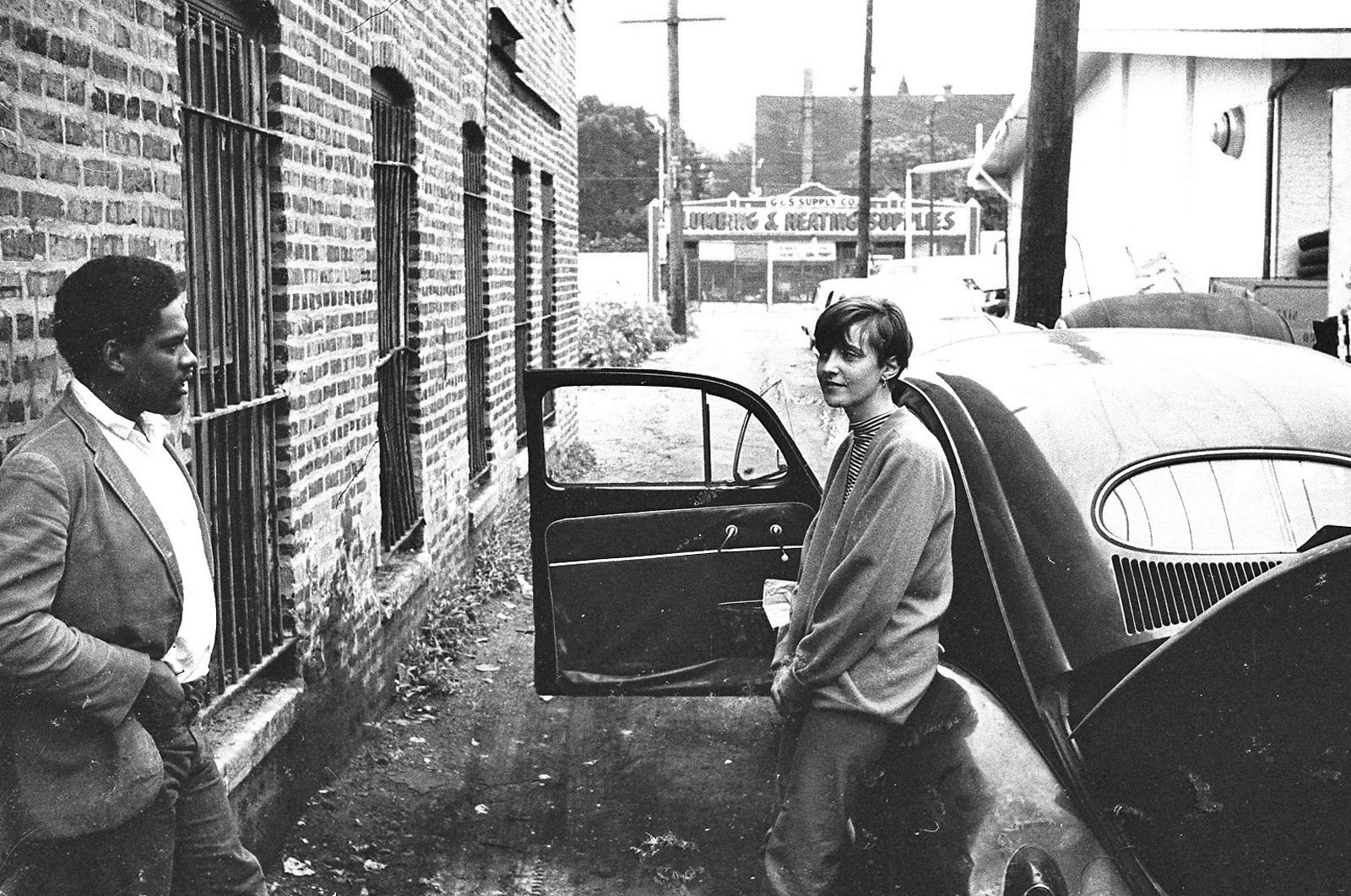
SNCC’s Curtis Hayes (Muhammad) and SDS’s Susan Lum in Uptown, Chicago, 1966. Photos by Michael James from his forthcoming book, Michael Gaylord James' Pictures from the Long Haul.

By Michael James | The Rag Blog | January 6, 2014

[In this series, Michael James is sharing images from his rich past, accompanied by reflections about -- and inspired by -- those images. This photo will be included in his forthcoming book, Michael Gaylord James' Pictures from the Long Haul.]

UPTOWN, Chicago in 1966. I called it “Hillbilly Harlem.” Uptown was the regional capital of poor Southern white migrants moving to the North. The migration of Southern whites began when they came north in the 1940’s for war industry work, and accelerated after WWII when factories flourished in and around Chicago.People arrived from rural and urban areas throughout the South, with the majority coming from Appalachia.

I had lived in Uptown in the summer of 1964 when I worked as a participant observer for a Notre Dame study of Southern white migrants. Daytime had found me hanging out with older guys, often drinking, rolling cigarettes, and playing the guitar under the El tracks next to Graceland Cemetery. Now I was working with others in JOIN Community Union, a community organizing project initiated by SDS (Students for a Democratic Society) and its Economic Research and Action Project (ERAP).

When it first started, as a project to organize the unemployed, JOIN stood for Jobs or Income Now. But when organizing the unemployed didn’t pan out, JOIN evolved into a “community union,” uniting folks to fight around issues that affected their lives, like housing, welfare, and police brutality.

Young radicals like myself went into cities around the country trying to organize “to build an interracial movement of the poor.” JOIN was our effort to build solidarity and create an organized force for change among poor people of Southern origin and others who lived in this community on Chicago’s North Side. We intended to help our nation live up to its stated vision of equal opportunity for all.
james JOIN 2
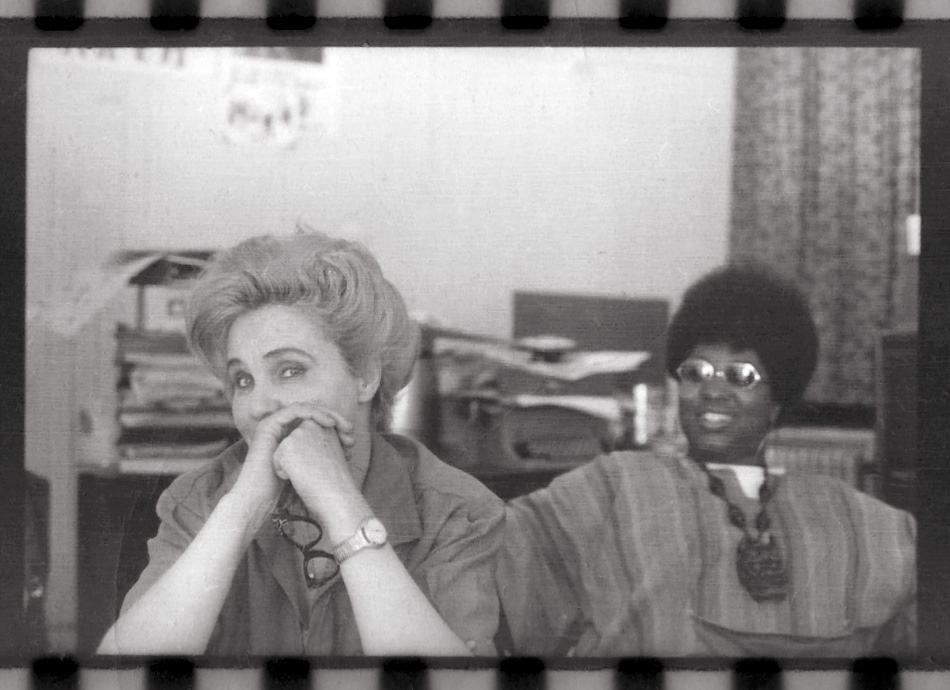
Virginia Bowers and Little Dovie.
In Uptown, we met a lot of folks while leafleting in front of the Unemployment Compensation Office on Lawrence Avenue. The backbone of JOIN was welfare women. The leadership included Dovie Coleman and Dovie Thurman, aka Big Dovie and Little Dovie -- confident and forceful black women.

Southern white women on welfare were aware of the goings-on in the civil rights movement and looked to these black women for leadership. One was Virginia Bowers from Arkansas, who became the JOIN office manager. Key organizers included Harriet Stulman, Alice Keller, and Vivien and Richie Rothstein.

Vivien and I had worked together what had been the West Oakland Community Union Project. In future years she became an organizer in Los Angeles of Vietnamese immigrants. Richie forged links to unions and set up a JOIN School to help community people learn about the power structure, welfare, police, and housing matters.

Post-JOIN he wrote about education for The New York Times and worked on education policy at the Economic Policy Institute at the University of California, Berkeley. In his Uptown work he was serious, smart, dedicated and, as I now realize, inspirational. He didn’t always appreciate my rebellious youthful behavior.

The government’s new War on Poverty was active in Uptown, headquartered on Montrose (now a gym in the increasingly gentrified neighborhood). We believed the War on Poverty didn’t encourage community people to take action or make decisions on the big issues of jobs, housing, education, and welfare. It too often focused on superficial, harmless programs like where to plant trees.

JOIN held weekly meetings that featured speakers, theatrical skits, and singing. The group-sing was enthusiastic, if sometimes off key, and included mountain tunes, spirituals, and traditional union songs. Sometimes we altered the lyrics to reflect current conditions.

We showed films we got from UE’s (United Electrical Workers') treasure-trove of labor documentary and training films. We rented films from a distribution house, including the previously banned Salt of the Earth about striking mine workers in Silver City, New Mexico — though The Hank Williams Story turned out a larger crowd.
Regular attendees were a unique, interesting, somewhat motley crew of Uptown residents.
Regular attendees were a unique, interesting, somewhat motley crew of Uptown residents. We had our share of wino attendees, including a Greek fellow named John. Once I carried a drunk John into Cook County Hospital, when his frostbitten feet prevented him from walking.

Each week there was an increasing number of young guys from the neighborhood, hanging in the back of the room. One Southern kid named James Osborne had a job with the War on Poverty and also hung around JOIN. At a meeting in Washington, D.C., he spoke up and asked Sargent Shriver, the War on Poverty’s head man, a question that was apparently too challenging. James lost his job -- and distanced himself from JOIN.

A short time later he married a nun who worked in the neighborhood and they opened the Book Box on Lawrence (now Shake Rattle and Read) by the Green Mill. Later, in 1968, we held training sessions in its basement for a short-lived outfit called the National Organizing Committee (NOC), which recruited college students to be community organizers.
james JOIN 4
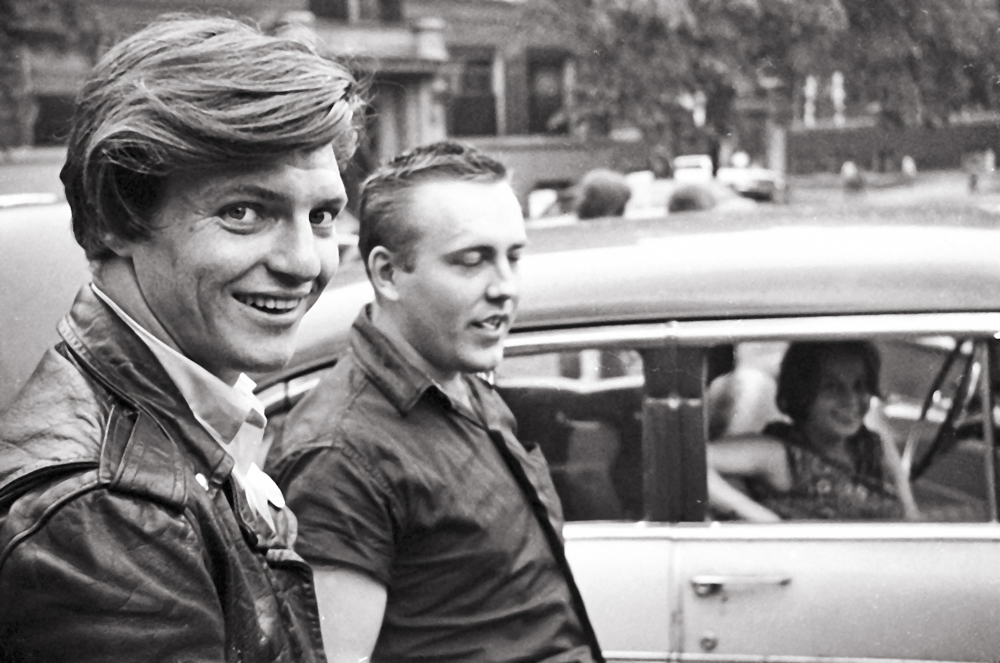
Goodfellows and girl in a car.
While I liked to joke that the meetings reminded me of a Bruegel painting, a mass of tortured and rough-edged peasants, there were of course plenty of sharp and effective people among the ranks, including Sarah, a Russian who had participated in the Russian Revolution and by 1966 was selling papers on Argyle.

Carl, a physically challenged welfare activist, came, as did Eugene Feldman, a retired teacher and former Communist. Feldman had organized sharecroppers in the South during the 1930s and shared pamphlets from those times. We knew we were part of an ongoing, long tradition of organizing and fighting for peoples’ rights.

A highlight of many meetings was a JOIN Theater agitprop skit that focused on the likes of Mayor Daley, urban renewal (poor people removal), landlords, and welfare and police brutality. My younger sister Melody James founded this project. Melody studied drama at Carnegie Institute and San Francisco State, so I asked her to come to Uptown to organize a peoples’ theater. After her JOIN work she returned to San Francisco and became a member of the legendary San Francisco Mime Troupe.

For JOIN Melody put together a lively mix of community people and student organizer types. JOIN Theater performed on various stages around town and in an empty lot on Clifton Street. Following the City’s massive urban removal of people in that part of the neighborhood, they performed before a large crowd, calling on the city to build a Hank Williams Memorial Playground in the space where Truman College stands today.

Over the spring and summer of ‘66 young guys began coming around JOIN. Near the old Wilson Avenue pool hall where Al Capone was said to have played, Reverend Maury ran a program for young guys. As we were less concerned with life after death than a better life in this lifetime, the Reverend’s hall became fertile ground for recruiting and we quickly made inroads.

We got to know these young guys, many of whom readily shared their accounts of police harassment and brutality. By the fall of 1966 Rev. Maury closed his operation. In its stead Bob Lawson, a JOIN organizer who had played football at Berkeley, gathered a group of young Southern guys that included Ralph Thurman, Hi Thurman, Bobby Joe McGinnis, and Jack (Junebug) Boykin.

They started a new group, which was friendly to but officially independent of JOIN. They called themselves The Uptown Goodfellows and opened a hangout-clubhouse space on Wilson at Kenmore.
When the police killed a young man named Ronnie Williams, who had moved to Uptown from Kentucky, it set off activity protesting police harassment and brutality.
When the police killed a young man named Ronnie Williams, who had moved to Uptown from Kentucky, it set off activity protesting police harassment and brutality. The Goodfellows and JOIN together organized a march on the infamous Summerdale 20th District Police Station. Over 300 people marched, mostly but not only, white Southerners.

Summerdale had been implicated earlier in a stolen-goods ring. The “Summerdale Scandal” led to the hiring (and brief tenure) of a forward-thinking criminology professor from Berkeley named O. W. Wilson as Police Superintendent. Our march called for an end to all police brutality but singled out a particularly hard-ass cop named Sam Joseph.

My own interaction with Joseph was limited to a short exchange of wise-ass remarks after he shined a flashlight into my car. I was parked down at Montrose Beach with Susan Ring, who was from a progressive home in the Swedish neighborhood of Andersonville. Her mom worked for the AFSC (American Friends Service Committee) and her dad was a butcher I jokingly referred to as the “Marxist butcher.”

Susan and I were making out when Joseph and his sidekick shined the light into the car and knocked on the window. Later Susan ended up marrying Junebug Boykin, who was my main street mentor.

The Summerdale march gave people a sense of unity, direction, and power. What followed from JOIN and the community was the founding of a program called Citizens’ Alert. This was an earlier version of the Oakland Black Panther Party’s practice of following the police and observing their activities. Citizens’ Alert is still active in Chicago, calling attention to police misbehavior. Activist Mary Powers has long been its leader.

The police response to the march was more hard-hitting on young guys in the neighborhood and an attack on JOIN. My college roommate Patrix Sturgis and my sister Melody were at the JOIN office when the 20th District Chicago Police burst in, ransacked the office and arrested them, claiming to have found a small amount of pot. Though it received less media coverage, they were later acquitted, after the police were found to have lied and planted the marijuana.

Housing was another major concern of folks in the hood. Buildings had mice, rats, and roaches, repairs weren’t made, and people were locked out when rent was late. We held rent strikes and demonstrations around housing issues. A group of lawyers who helped JOIN included Irv Birnbaum and Ted Stein. They worked with organizers and tenants, often going to housing court with them.

We tried to stop evictions. I made my way into a number of basements, turning on gas or electricity after landlords or their managers had turned the utilities off, and was once arrested when I informed an officer of the tenant’s rights and the law. Tenants at a large building on Broadway near Irving Park went up against a slumlord named Gutman. On a Sunday morning Rennie Davis and I went to his apartment building on the northwest side and hung a leaflet inside his vestibule: “Your Neighbor is a Slumlord!” We also put one on every car on the street.

In short order Gutman settled with the tenants, and that particular building became part of an improved housing initative by the Kate Maremont Foundation. A prolonged rent strike with marches at the “Sampson Building” on the 4100 N. Kenmore block led to an agreement and the formation of a tenant’s council.
JOIN did welfare advocacy, demonstrated at the welfare office, and called for fair treatment by the Illinois Department of Welfare.
JOIN did welfare advocacy, demonstrated at the welfare office, and called for fair treatment by the Illinois Department of Welfare. We worked closely with the Kenwood Oakland Community Organization (KOCO) and the Latin American Defense Organization. These demonstrations and marches exemplified the potential for building an interracial movement of the poor. Actions involving primarily black, brown, and white organizations helped lay the early groundwork for rainbow coalitions to come.
james JOIN 3
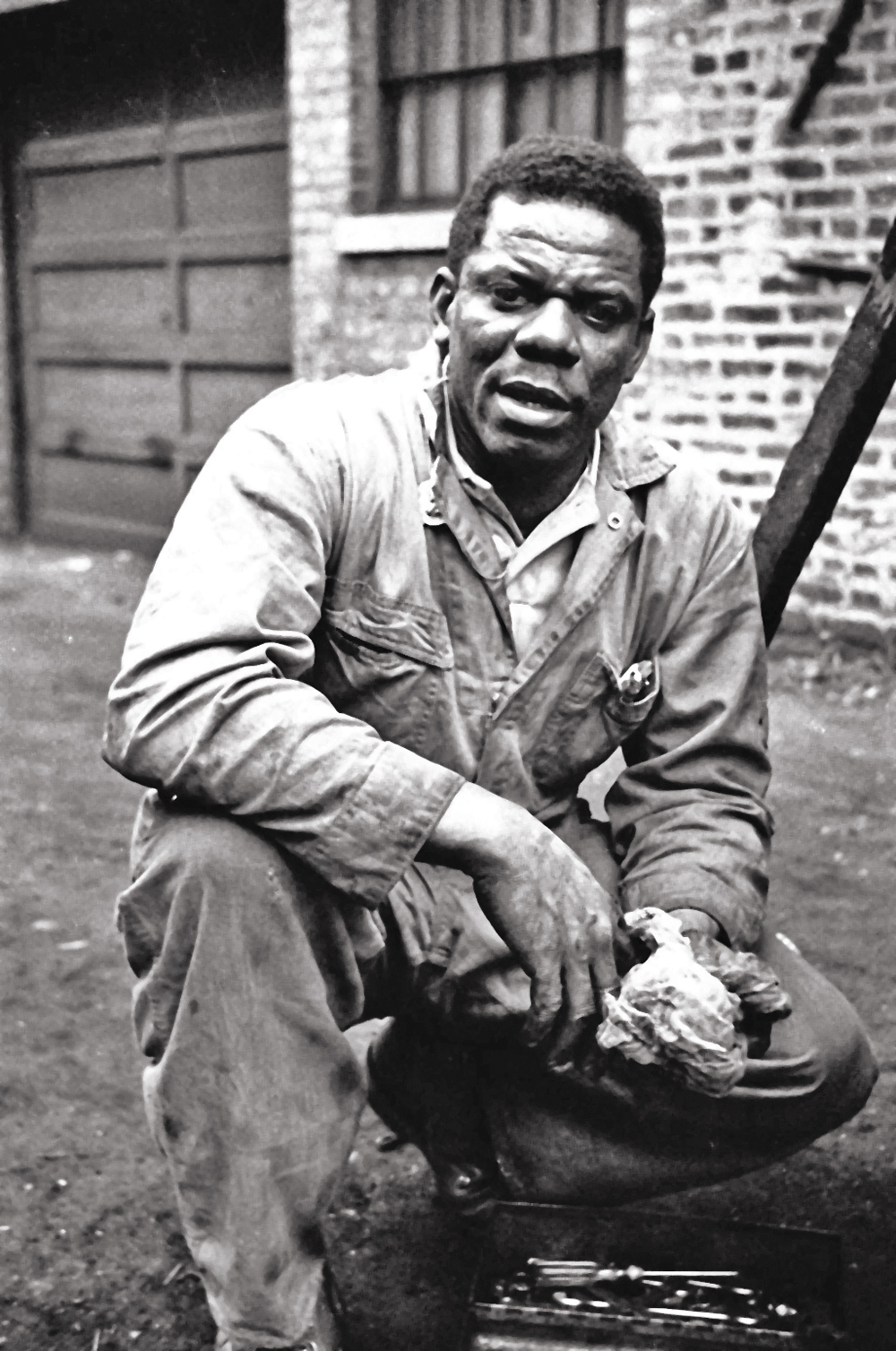
Mechanic and Steelworker Eric Gil.
 One spring afternoon the photographer Danny Lyon gave me a ride on his Triumph motorcycle to Molly Hagen’s apartment on Hyde Park Blvd. on the South Side. Molly’s crib became a regular destination. I would head there to hang out, smoke weed, and eat. I met Curtis Hayes (now Muhammad), who had worked with Molly in the Student Nonviolent Coordinating Committee (SNCC), and Eric Gill, from Belize, who worked on cars and had a job in the steel mill, and an assortment other characters, including a salesman for Duncan Yo Yo.

That summer I bought a 1963 Triumph 650 TR6 motorcycle from Clay Highland, who I knew from Lake Forest College. On the bike, sometimes with Molly on board, I explored Chicago and its far-flung neighborhoods, communities, and off-the-beaten-path treasures. I loved late night cruising up and down Lake Shore Drive, the green tunnel of Lower Wacker Drive, the smell of chocolate production on Kinzie, and the blast furnace at Finkl & Sons Steel on Armitage.

In addition to country music joints in Uptown, I went to hear Paul Butterfield, first in Old Town at Big John’s (where I had first seen Steve Miller), and then at the Blue Flame on Drexel Blvd at 39th Street, where he played with Howlin’ Wolf’s old band. At a meeting of activists from various projects around town I met a law student named Bernardine Dohrn.

Days later Bob Lawson and I took an exhilarating ride on my Triumph to the SDS Convention held in Clear Lake, Iowa, the place where Buddy Holly, Richie Valens, and the Big Bopper had gone down in an airplane. While there we got word that both the JOIN office and the new Movement for A Democratic Society office in Rogers Park had been busted. People were out of sorts.

Wearing a cowboy hat, I stood up and quoted Joe Hill: “Don’t mourn, organize.” This moment was my introduction to the assembled SDSers, and I left Clear Lake as part of SDS’s leadership, a member of the National Interim Committee. Before heading back to Chicago I reintroduced myself to Bernardine by sending her a post card: “Nice meeting you; how about we take a ride together on my motorcycle?”

[Michael James is a former SDS national officer, the founder of Rising Up Angry, co-founder of Chicago's Heartland Café (1976 and still going), and co-host of the Saturday morning (9-10 a.m. CDT) Live from the Heartland radio show, here and on YouTube. He is reachable by one and all at michael@heartlandcafe.com. Find more articles by Michael James on The Rag Blog.]

The Rag Blog

[+/-] Read More...

29 May 2013

Michael James : Late Summer Sundown on the Karma Farm

Late summer sundown on the Karma Farm, New Lisbon, Wisconsin 1981. Photo by Michael James from his forthcoming book, Michael Gaylord James' Pictures from the Long Haul.
Pictures from the Long Haul:
Late summer sundown on the Karma Farm
To other people who talked of 'moving to the country' I would say 'stay in the city but spend some time in the country: think, nourish yourself, and come back to the city to fight the imperialist ogre from within the belly of the beast.'
By Michael James / The Rag Blog / May 29, 2013

[In this series, Michael James is sharing images from his rich past, accompanied by reflections about -- and inspired by -- those images. This photo will be included in his forthcoming book, Michael Gaylord James' Pictures from the Long Haul.]

Old man Burtchie had been a Seabee during World War II, a member of the U.S. Navy's construction battalion. When I knew him he was a plumber and small farmer.

His son Vic went off to Korea and when he returned in 1951 I was a nine-your-old living up the Red Coat Road in my Connecticut hometown. The name of the road is derived from the British Red Coats who marched nearby on their way to burning the hat factories in Danbury during the Revolutionary War. We played "fight the British"! Victor had a Harley and I had the pleasure of getting to ride with him around hilly and curvy Berkshire foothills, on Connecticut back roads. I was the kid on the back, the third rider on occasion.

Victor give me a winged-wheel Harley hat and also instructed me not to let on to the current woman on the machine between him and me that there had been another woman in that very position cruising with the group of riders earlier in the day.

Besides motorcycles, my close proximity to the farm gave me an early hit of agricultural life. I hung around the barn and did what I was told. I remember a lot of commotion when a Ford pickup truck showed up with a bull with a ring in his nose that was released into a pasture of about six cows. And I helped out when the old man butchered chickens, pigs, and heifers.

Back up the road I helped my dad plant our first garden. The corn grew high as an elephant's eye, or at least twice as high as I stood back in 1949. My younger brother Beau and I both had the farm vibe and became members of the Green Farmers, a 4H club in the Greensfarms part of Westport.

I loved the 4H club and still spout its "head, heart, hand and health." We went to the Grange fair in Easton and took in the livestock exhibits at the Danbury State Fair and the Eastern States Exposition. We took it all in -- the food, the rides, the carnie strip and all its sideshows. Mostly we loved the animals,

In 1952 we moved a half-­mile away to a pre-­revolutionary war onion farm on the Wilton Road. Over the years our stock included Harvey the rabbit, King pigeons, Muscovy ducks, African Tumbler pigeons, and Bantam chickens. In 1962 Beau upped the ante and brought in a couple of sheep. Years later my step dad Shookie planted a sizable garden. When visiting I picked the oh-­so-­fresh tomatoes and ate them with a dose of salt.

Beau was a tractor freak with a collection of John Deer toy tractors. He got our mom to drive him to a tractor dealer and lot where he could look over and learn about these groundbreaking machines. He married and moved to Vermont for a time, starting a sod farm and raising kids and some animals. I visited once and went to the Bondville Fair where I recall watching drunk rural dudes climbing out of an old Plymouth -- deer antlers mounted on the hood, with beer cans in hand.

After moving to and taking various stands in Chicago, I cherish my short-­term escapes to the Karma Farm up in New Lisbon, Wisconsin. To other people who talked of "moving to the country" I would say "stay in the city but spend some time in the country: think, nourish yourself, and come back to the city to fight the imperialist ogre from within the belly of the beast." I am glad I knew the hippie families that tried to make a go of rural life there.

I would haul myself up north, visit and make plans with my friend Lester Doré. Lester, the agriculturally knowledgeable son of an oil field worker family, came out of New Iberia, Louisiana (think Tabasco) and grew up in Tulsa. He ended up in Chicago where he did artwork for The Seed, designed Rising Up Angry's logo, did the original artwork for the Heartland Café, and was the art director of the Heartland Journal.

He also did an artwork stint on the old San Francisco Oracle, designed rolling paper logos, and did a famed piece of design work picturing a marijuana leaf and a peace symbol. He did a series of great jazz t-shirts under the label Bird Lives that were printed at the Farm's little t-shirt factory.

My sojourns to the Karma Farm in beater trucks and cars were peaceful, enlightening, comforting, educational, and fun. These small adventures to the Karma Farm and beyond often found me returning to Chicago with "the goods" for the Heartland Cafe -- t-shirts, firewood, an old wood burning stove, food and maple syrup. I am grateful for those times.

Thank you oh great Mother Earth for the good things you give and the good times you bring.

[Michael James is a former SDS national officer, the founder of Rising Up Angry, co-founder of Chicago's Heartland Café (1976 and still going), and co-host of the Saturday morning (9-10 a.m. CDT) Live from the Heartland radio show, here and on YouTube. He is reachable by one and all at michael@heartlandcafe.com. Find more articles by Michael James on The Rag Blog.]

The Rag Blog

[+/-] Read More...

06 March 2013

Jim Turpin : Is the Imperial Presidency the 'New Normal'? / 2

Photo by Jim Watson / AFP / Getty Images./ Foreign Policy.
The 'new normal'?
The Imperial Presidency / 2
“You may ask yourself, well, how did I get here?”
-- Talking Heads ("Once in a Lifetime")
By Jim Turpin / The Rag Blog / March 7, 2013

Second in a two-part series.

In my previous installment of this article, I discussed how the codification of the Executive’s imperial power and America's one party political system have contributed to a deeply emboldened presidential authority.

But recent executive branch overreach is also propped up with a troubling combination of additional factors including:
  • Assassination by star chamber
  • Subjugated and 'craven' media

Assassination by star chamber

Star Chamber (n):
  1. A 15th-century to 17th-century English court consisting of judges who were appointed by the Crown and sat in closed session on cases involving state security.
  2. star chamber: A court or group that engages in secret, harsh, or arbitrary procedures.
The Department of Justice (DOJ), in an effort to codify extrajudicial killings in the “War on Terror” by the Executive branch had a “white paper” leaked earlier this week.

The contents and justification for killing U.S. citizens or foreign nationals are chilling and this was laid out by Glenn Greenwald in The Guardian:
The most extremist power any political leader can assert is the power to target his own citizens for execution without any charges or due process, far from any battlefield. The Obama administration has not only asserted exactly that power in theory, but has exercised it in practice. In September 2011, it killed U.S. citizen Anwar Awlaki in a drone strike in Yemen, along with U.S. citizen Samir Khan, and then, in circumstances that are still unexplained, two weeks later killed Awlaki's 16-year-old American son Abdulrahman with a separate drone strike in Yemen.

Since then, senior Obama officials including Attorney General Eric Holder and John Brennan, Obama's top terrorism adviser and his current nominee to lead the CIA, have explicitly argued that the president is and should be vested with this power. Meanwhile, a Washington Post article from October reported that the administration is formally institutionalizing this president's power to decide who dies under the Orwellian title "disposition matrix."
This “disposition matrix” -- more commonly referred to as a “kill list” -- is done in complete secrecy by this administration with the aid of the CIA, the National Counterterrorism Center (NTC), and others in a “star chamber." This unaccountable and unmonitored group metes out justice that is death from above, without a shred of “due process” which has been the center of western legal principles and law since the Magna Carta.

More from Greenwald in The Guardian:
The president's underlings compile their proposed lists of who should be executed, and the President -- at a charming weekly event dubbed by White House aides as "Terror Tuesday" -- then chooses from "baseball cards" and decrees in total secrecy who should die. The power of accuser, prosecutor, judge, jury, and executioner are all consolidated in this one man, and those powers are exercised in the dark. In fact, The Most Transparent Administration Ever™ has been so fixated on secrecy that they have refused even to disclose the legal memoranda prepared by Obama lawyers setting forth their legal rationale for why the president has this power.
With unmanned aerial vehicles (UAV), also known as “drones” and having names like “Predator” and “Reaper," the destruction for those on the ground is both horrific and widespread.

Code Pink, a women-initiated grassroots peace and social justice movement working to end U.S.-funded wars and occupations and to challenge militarism globally, recently traveled to the tribal area in Pakistan to both discuss the impact with civilians and protest the use of drones.

Medea Benjamin, one of the founders of Code Pink, recently released her book Drone Warfare: Killing by Remote Control, an “extensive analysis of who is producing the drones, where they are being used, who are ‘piloting’ these unmanned planes, who are the victims and what are the legal and moral implications.”

Code Pink also, as one of the few activist groups still holding the Obama administration accountable for the use of drones, disrupted the confirmation hearing of new CIA director James Brennan. Professed liberal Democratic Senator Dianne Feinstein quickly removed Code Pink at the beginning of the proceedings.

Just as important, Stanford and NYU released a report last year, titled “Living Under Drones: Death, Injury and Trauma to Civilians from U.S. Drone Practices in Pakistan." This report lays out evidence of terrorized populations living in fear 24 hours a day:
  • “Drones hover twenty-four hours a day over communities in northwest Pakistan, striking homes, vehicles, and public spaces without warning. Their presence terrorizes men, women, and children, giving rise to anxiety and psychological trauma among civilian communities.
  • “The U.S. practice of striking one area multiple times, and evidence that it has killed rescuers, makes both community members and humanitarian workers afraid or unwilling to assist injured victims.”
  • “Some community members shy away from gathering in groups, including important tribal dispute-resolution bodies, out of fear that they may attract the attention of drone operators. Some parents choose to keep their children home, and children injured or traumatized by strikes have dropped out of school.”
The efficacy of the entire drone program is highly suspect. The following is from the same report:
The number of "high-level" targets killed as a percentage of total casualties is extremely low -- estimated at just 2%.Furthermore, evidence suggests that U.S. strikes have facilitated recruitment to violent non-state armed groups, and motivated further violent attacks.

Subjugated and 'craven' media

The subject of waterboarding, remarkably, has been a topic in U.S. newspapers since the Phillipine Insurrection at the beginning of the 20th century, when U.S. soldiers were accused of torturing Filipino prisoners with the “water cure”:
A letter by A. F. Miller, of the 32nd Volunteer Infantry Regiment, published in the Omaha World-Herald in May, 1900, told of how Miller’s unit uncovered hidden weapons by subjecting a prisoner to what he and others called the “water cure.” “Now, this is the way we give them the water cure,” he explained. “Lay them on their backs, a man standing on each hand and each foot, then put a round stick in the mouth and pour a pail of water in the mouth and nose, and if they don’t give up pour in another pail. They swell up like toads. I’ll tell you it is a terrible torture.
The Kennedy School of Government published a study by a group of Harvard students in 2010, titled, “Torture at the Times: Waterboarding in the Media." The remarkable results of this study show evidence of no longer using the term “torture” in U.S. newspapers post 9/11, when these horrific acts are committed by U.S. armed forces.

Ironically, when these acts are committed by other countries, the term “torture” is used much more frequently.

One of the worst offenders was The New York Times:
The New York Times called waterboarding torture or implied it was torture in just 2 of 143 articles (1.4%). The Los Angeles Times did so in 4.8% of articles (3 of 63). The Wall Street Journal characterized the practice as torture in 1 of 63 articles (1.6%). USA Today never called waterboarding torture or implied it was torture.

In addition, the newspapers are much more likely to call waterboarding torture if a country other than the United States is the perpetrator. In The New York Times, 85.8% of articles (28 of 33) that dealt with a country other than the United States using waterboarding called it torture or implied it was torture, while only 7.69% (16 of 208) did so when the United States was responsible. The Los Angeles Times characterized the practice as torture in 91.3% of articles (21 of 23) when another country was the violator, but in only 11.4% of articles (9 of 79) when the United States was the perpetrator.”
Furthermore, it was revealed this week that The New York Times and other newspapers bowed to this administration’s request to keep drone bases in Saudia Arabia secret and then later decided to publish the story on the eve of the Brennan-CIA confirmation hearings:
According to a reporter on the national security beat, The New York Times participated in an “informal arrangement” to keep secret a Saudi Arabian base for U.S. interests -- and then suddenly withdrew from that arrangement. A story posted on the paper’s Web site last night -- titled “Drone Strikes’ Dangers to Get Rare Moment in Public Eye“ -- summarizes the leak of a white paper on the Obama administration’s targeted killing program and tees up the Senate confirmation hearing of White House counterterrorism adviser John O. Brennan to be the director of the Central Intelligence Agency.
Maybe The New York Times' slogan, “All the News That’s Fit to Print,” should now be “All the News That’s Fit to Print…When It Makes Us More Money”

The nexus of all these contributing factors to empowering the executive branch is deeply troubling and seems insurmountable. It is rare that when power is given to those in authority, that it is later put aside.
“You may say to yourself, my God, what have I done?" -- Talking Heads ("Once in a Lifetime")
[Rag Blog contributor Jim Turpin is an Austin activist and writer who works with CodePink Austin. He also volunteers for the GI coffeehouse Under the Hood Café at Ft. Hood in Killeen, Texas. Read more articles by Tim Turpin on The Rag Blog.]

The Rag Blog

[+/-] Read More...

27 February 2013

Jim Turpin : Is the Imperial Presidency the 'New Normal'?

The Imperial Obama? Image from The Express Tribune.
The 'new normal'?
The Imperial Presidency
"Same as it ever was..."
--
Talking Heads ("Once in a Lifetime")
By Jim Turpin / The Rag Blog / February 27, 2013

First of a two-part series.

Many presidents throughout our history, from revered to despised, have ignored the Constitution and taken on the mantle of imperial power. From Lincoln to FDR to Nixon, the examples are easily found.

In the ancient Roman world, the term imperium refers to the amount of power given to individuals of authority such as dictators or consuls and was frequently applied to generals with military power. The term “imperial” usually is linked to an empire or the concept of imperialism.

But how have we gotten to where we are today, where the president of the United States can detain or assassinate an American citizen without due process? Where American citizens are constantly monitored and personal information is subject to review? Where whistleblowers are now detained and prosecuted for exposing war crimes and corruption?

The development of the executive branch’s imperial power has its gnarled roots deep in American history. Frequently presidents have used it as an excuse during times of war, but this has not always been the case.

Abraham Lincoln famously suspended habeas corpus during the Civil War on April 27, 1861, in response to riots, local militia actions, and the threat that the border slave state of Maryland would secede from the Union. Habeas corpus (literally in Latin “you shall have the body [in court]”) is specifically detailed in the U.S. Constitution in Article I, Section 9: “The Privilege of the Writ of Habeas Corpus shall not be suspended, unless when in Cases of Rebellion or Invasion the public Safety may require it.”

A writ of habeas corpus is used to bring a prisoner or other detainee before the court to determine if the person's imprisonment or detention is lawful.

Franklin D. Roosevelt issued Executive Order 9066 over 70 years ago on February 19, 1942, which led to the forced internment of more than 120,000 Japanese-Americans that lived on the west coast.
The U.S., citing national security interests, demanded that Japanese-Americans be interned without due process or, it would eventually turn out, any factual basis. Whole communities were rounded up and sent to camps, sometimes just clapboard shelters or converted horse stables, in arid deserts and barren fields in Utah, Idaho, Wyoming, Arkansas.
Nixon's paranoid presidency..
Richard M. Nixon’s deep paranoia over the civil rights and peace movement led to the continued use of the secret FBI program Counterintelligence Program (COINTELPRO), as a means to monitor, sabotage, and neutralize legitimate dissent across the country. COINTELPRO infiltrated the Southern Christian Leadership Conference (SCLC), the NAACP, the Students for a Democratic Society (SDS), the National Lawyer Guild, and many other groups and organizations.

But what drives today’s constitutional overreach by the Executive Office? Recent history points to a number of factors, including:
  • Codification of the Executive’s Imperial Power
  • America’s One Party System

Codification of the Executive Imperial Power

Within days of the 9/11 attacks, the U.S. Congress responded by ramroding a number of open-ended laws that gave the Executive branch a blank check to wage war world-wide and indefinitely detain civilians at home and abroad.

Joanne Mariner of Justia.com neatly fits together the convoluted pieces of the Patriot Act, the Authorization of the Use of Military Force (AUMF), and the National Defense Authorization Act (NDAA) which, though initiated by George W. Bush, is now fully promulgated by Barack Obama:
During the Bush years, despite massive public and press attention to the administration’s detention policies, Congress remained largely out of the picture. While the USA PATRIOT Act contained some provisions on detention, they were never put to use; the Bush administration preferred to create a detention system that was, it assumed, largely free of legal constraints and judicial oversight.

The military prison at Guantanamo and the CIA’s secret prison system were therefore created by executive fiat, without congressional input or restriction. When cases challenging Guantanamo and the military detention of U.S. citizens on U.S. soil got to court, however, the administration claimed that the Authorization for Use of Military Force (AUMF), a joint resolution passed by Congress in September 2001, gave congressional approval for those detentions.

The AUMF, which authorizes the president to use “necessary and appropriate force” against those whom he determined “planned, authorized, committed or aided” the September 11 attacks, or who harbored such persons or groups, is silent on the issue of detention. A plurality of the U.S. Supreme Court agreed with the administration, nonetheless, that the power to detain is necessarily implied by the power to use military force.
The NDAA, which is renewed every year, also contains sections, according to Mariner, that are deeply troubling to human rights activists:
What is now known as Subtitle D of the NDAA -- the section on detention -- made its first appearance in March of this year (2011). Called the Detainee Security Act in the House, and the Military Detainee Procedures Improvement Act in the Senate, the bills, introduced by Representative Buck McKeon and Senator John McCain, respectively, were meant to shift counterterrorism responsibilities from law enforcement to the military.

The clear goal of the two bills was to require that suspected terrorists either be tried before military commissions or be held in indefinite detention without charge... every provision in subtitle D is objectionable from the standpoint of human rights and civil liberties. Among the controversial provisions are sections 1026, 1027 and 1028 of the bill, which restrict detainee transfers and releases from Guantanamo. But while human rights organizations are worried about these limitations, their gravest concerns pertain to sections 1021 and 1022.
Glenn Greenwald, while still at Salon, addresses Sections 1021 and 1022:
There are two separate indefinite military detention provisions in this bill. The first, Section 1021, authorizes indefinite detention for the broad definition of “covered persons” discussed above in the prior point. And that section does provide that “Nothing in this section shall be construed to affect existing law or authorities relating to the detention of United States citizens, lawful resident aliens of the United States, or any other persons who are captured or arrested in the United States.” So that section contains a disclaimer regarding an intention to expand detention powers for U.S. citizens, but does so only for the powers vested by that specific section.

More important, the exclusion appears to extend only to U.S. citizens “captured or arrested in the United States” -- meaning that the powers of indefinite detention vested by that section apply to U.S. citizens captured anywhere abroad (there is some grammatical vagueness on this point, but at the very least, there is a viable argument that the detention power in this section applies to U.S. citizens captured abroad).

But the next section, Section 1022, is a different story. That section specifically deals with a smaller category of people than the broad group covered by 1021: namely, anyone whom the President determines is “a member of, or part of, al-Qaeda or an associated force” and “participated in the course of planning or carrying out an attack or attempted attack against the United States or its coalition partners.”

For those persons, section (a) not only authorizes, but requires (absent a Presidential waiver), that they be held “in military custody pending disposition under the law of war.” The section title is “Military Custody for Foreign Al Qaeda Terrorists,” but the definition of who it covers does not exclude U.S. citizens or include any requirement of foreignness.

That section -- 1022 -- does not contain the broad disclaimer regarding U.S. citizens that 1021 contains. Instead, it simply says that the requirement of military detention does not apply to U.S. citizens, but it does not exclude U.S. citizens from the authority, the option, to hold them in military custody.
The annual renewal of the NDAA by the Congress of the United States is a sad and deeply troubling testimony to how we empower an Executive branch that is ironically supposed to have their overreach limited by the very branch voting for this law.


America’s One Party System

John Kerry, Winter Soldier.
During the presidential election last fall, if I closed my eyes and listened to speeches on national security, there was basically no policy difference. Both parties called us the “Greatest nation on Earth” and tried to outdo the other with patriotic and nationalistic proclamations and slogans.

As pointed out by Mother Jones during coverage of the election for both party’s conventions, John Kerry (who coincidentally became our new Secretary of State in 2013) spouted, “Ask Osama bin Laden if he is better off now than he was four years ago."

The story went on:
...Democrats have adopted the kind of language that might have been derided as "cowboy rhetoric" four years ago. And Kerry wasn't the first or last speaker to invoke Bin Laden in Charlotte last week [in 2012]. Asking for four more years of Obama, Vice President Joe Biden intoned that "Osama bin Laden is dead and General Motors is alive!" Eight years ago, Democrats trying to act tough on national security sounded like kids playing pretend; at times, this year's convention sounded like a Roman triumph.
Let’s remember, this is the same Lieutenant John Kerry who as a member of Vietnam Veteran’s Against the War (VVAW) spoke at Winter Soldier in 1971 in Washington, D.C., decrying militarism and war:
We are here in Washington also to say that the problem of this war is not just a question of war and diplomacy. It is part and parcel of everything that we are trying as human beings to communicate to people in this country, the question of racism, which is rampant in the military, and so many other questions also, the use of weapons, the hypocrisy in our taking umbrage in the Geneva Conventions and using that as justification for a continuation of this war, when we are more guilty than any other body of violations of those Geneva Conventions, in the use of free fire zones, harassment interdiction fire, search and destroy missions, the bombings, the torture of prisoners, the killing of prisoners, accepted policy by many units in South Vietnam. That is what we are trying to say. It is part and parcel of everything.
I would be curious to know if Kerry as the new Secretary of State remembers the importance of his testimony in 1971 and what his brothers at VVAW think of him now.

The same Mother Jones article deftly points out that:
Barack Obama has a plan to withdraw troops from Afghanistan, but neither candidate [Democratic or Republican] actually has a plan to end the war that started on September 11, 2001. Both parties accept that conflict as a permanent feature of American life. An American citizen in the U.S. is as likely to be killed by their own furniture as a Muslim terrorist, but fear of violent Islamic extremism has changed this country almost irrevocably.
But let’s compare... are the Democratic and Republican Party really just the same party on issues like national security?

ProPublica recently did a side-by-side comparison of Bush and Obama policies on the use of torture, surveillance, and detention and the results are not very surprising.

To Obama’s credit, CIA “black sites” (outsourced torture sites to foreign countries) and “enhanced interrogation techniques” (also known in the vernacular as “torture”) have been, as far as the American public is aware, discontinued and stopped by this administration.

But... Obama has continued the following policies started by Bush and ramped them up dramatically under his administration:
  • Continued renewal of the Patriot Act;
  • Wiretaps and data collection of U.S. citizens and foreign nationals;
  • Continuation of Guantanamo prison as an indefinite detention center;
  • Targeted killings (also known as “assassinations”) of U.S. citizens and foreign nationals without legal oversight;
  • Significant increase of drone strikes in Afghanistan, Pakistan, Yemen, Somalia, and possibly now in Mali, that have killed thousands of civilians;
  • The use of military commissions to nullify the rights of U.S. citizens and foreign nationals in civilian court.
On issues of national security, America really remains a one-party system that use the “War on Terror” as an excuse to abrogate civil liberties of its’ citizenry.
“You may ask yourself, where does that highway lead to?” -- Talking Heads ("Once in a Lifetime")
In the second installment of this article, I will investigate the use of assassination by "Star Chamber” and how a subjugated and cravenly media has led us down the highway of a fearful nation with fewer and fewer civil liberties.

[Rag Blog contributor Jim Turpin is an Austin activist and writer who works with CodePink Austin. He also volunteers for the GI coffeehouse Under the Hood Café at Ft. Hood in Killeen, Texas. Read more articles by Tim Turpin on The Rag Blog.]

The Rag Blog

[+/-] Read More...

18 December 2012

Alice Embree : Campaigning against Cuts at Corn Dog's Office

From left, at Austin "fiscal Cliff" demonstration: Aron Duhoon, Harrison Hiner, Grover Norquist (Thorne Dreyer), Alice Embree, Les Cunningham, Paula Littles, and, in front, Sen. John (Corn Dog) Cornyn. Photo by Carlos Lowry / The Rag Blog.

Austin protest against cuts for rich:
'Racketeer' Norquist meets 'Corn Dog' Cornyn
Union members, MoveOn, and citizens who want to protect Social Security, Medicare, and Medicaid, made their message to Senator Cornyn clear with a 'Candlelight Campaign against Cuts.'
By Alice Embree / The Rag Blog / December 18, 2012

AUSTIN -- Grover Norquist, Racketeer for the Rich, made an unannounced visit to Senator John Cornyn's district office in Austin, Texas, on Monday, December 10, 2012. His message, "Don't Tax the Wealthy," is still wildly in vogue with Republicans. A group of citizens was there with another message for Senator Cornyn.

Cornyn (who was affectionately known as "Corn Dog" by George W. Bush), was present in canine form in front of the real Cornyn's district office. Rag Blogger Thorne Dreyer (as Grover) tussled with Corn Dog handler, Alice Embree, over the direction he should take. Grover kept urging hard right turns.

As part of nationwide protests that coincided with International Human Rights Day, union members, MoveOn, and citizens who want to protect Social Security, Medicare, and Medicaid, made their message to Senator Cornyn clear with a "Candlelight Campaign against Cuts." There were also demonstrations in Dallas, Austin, Corpus Christi, Laredo, San Antonio, and Houston suburb Sugar Land.

Participants in the Austin action included members of the Communications Workers of America, Texas State Employees Union (TSEU), National Nurses United, American Federation of State, County and Municipal Workers (AFSCME), United Steelworkers (USW), International Brotherhood of Electrical Workers (IBEW), and MoveOn.

Hats off to the spirited nurses who brought "Robin Hood" hats and a banner that read: "Don't Push Seniors Off the Fiscal Cliff, Tax Wall Street." (See RobinhoodTax.org and like it on Facebook.)

[Alice Embree is a long-time Austin activist, organizer, and member of the Texas State Employees Union. A former staff member of underground papers The Rag in Austin and RAT in New York, and a veteran of SDS and the women's liberation movement, she is now active with CodePink Austin and Under the Hood Café. Embree is a contributing editor to The Rag Blog and is treasurer of the New Journalism Project. Read more articles by Alice Embree on The Rag Blog.]

Here are links to demonstrations around Texas:
The Rag Blog

[+/-] Read More...

28 November 2012

Fran Clark : Keeping Watch on the 'School of Assassins'

One at a time, marchers place their crosses in the chain link fence outside Fort Benning in Columbus, Georgia. Photos by Heidi Turpin / The Rag Blog.

By any other name:
Protesters keep watch at
the 'School of Assassins'

Each cross has the name of one of the thousands murdered or disappeared throughout Latin America during decades of violence and oppression.
By Fran Clark / The Rag Blog / November 29, 2012

FORT BENNING -- In the chilly morning air of Columbus, Georgia, on Sunday, November 18, outside the gates of Fort Benning, people gather early. Most hold crosses, either made before arriving or picked up from the pile made for years past.

Each cross has the name (or other identification, such as "infant girl") of one of the thousands murdered or disappeared throughout Latin America during decades of violence and oppression, sometimes referred to as “the dirty wars.”

From Bolivia to Panama to Guatemala and El Salvador, religious workers, labor organizers, student groups, or anyone working in sympathy with the poor, were targets of assassination, mass killings, and torture.

Many of those responsible for these acts received training at the School of the Americas, located behind the gates outside which we are gathered. Originally established in Panama in 1946, the SOA moved to Fort Benning in 1984. It has trained over 60,000 members of Latin American militaries, and has been widely criticized for the human rights abuses of its graduates.

Documented atrocities include the murders of Archbishop Oscar Romero and the rape and murders of four U.S. church women in El Salvador. Priests, nuns, labor leaders, women, children, and entire communities have been massacred at the hands of SOA-trained military forces.

Among the most notorious graduates are Manuel Noriega of Panama, Rios Montt of Guatemala, and Hugo Banzer Suarez of Bolivia. SOA trained soldiers in Mexico have been implicated in the murders and disappearances of over 50,000 people since 2006. In Honduras, SOA graduates carried out the 2009 coup and continue a campaign of violence and murder against the resistance.

In 1996 the Pentagon admitted that the school’s training manuals advocated torture, execution, and blackmail. But, despite these admissions, not a single U.S. official has been held accountable. In 2000, after another close vote in the U.S. House on whether to close the school failed, the school’s name was changed to the Western Hemisphere Institute for Security Cooperation (WHINSEC). But, the atrocities continue, as does the work of the SOA Watch to close the "School of  Assassins.”

SOA Watch has held vigils at Fort Benning each year since its founding in 1990 by Father Roy Bourgeois. The weekend-long series of events include outstanding music, workshops, auctions, and profound testimonies from those directly affected by the violence carried out in their home countries.

The crowds have varied in size, but, there is always an eclectic mix of young and old, nuns and college students. (One college group sleeps on the stage each night to watch over it!)

The spirit is always the same. Mourners with white painted faces and red tears carry coffins. The names of the dead are read in liturgical style; marchers in the procession raise their crosses and sing “presente” as each name is read. Each marcher approaches the fence which denies access to the fort, stabs her cross through the chain links, and leaves it as a memorial, along with hundreds of others.

Some leave flowers, photos, and banners. Some sit down to cry, some meditate, and each year at least one is called to commit an act of civil disobedience by "crossing the line." In years past, this meant simply stepping onto military property. Now, it means scaling a tall fence topped with barbed wire and dropping down on the other side to face an almost certain six-month sentence in federal prison.

As the procession ends and all marchers have placed their crosses, the mourners are called to “return to life” as the uplifting music begins, and the Puppetistas perform their pageant. Many dance joyously as they prepare to return to their communities and rededicate themselves to the work for justice in the Americas and beyond.

[Fran Clark is a community health nurse who is active with CodePink Austin and the Texas Jail Project. She has also been involved with the GI Rights Hotline, Under the Hood Cafe, and the Hutto Visitation Program.]

The Rag Blog

[+/-] Read More...

15 November 2012

Alice Embree / Terry DuBose : Defend the Soldiers' Right to Heal

Under the Hood contingent at Veterans Day Parade, Killeen, Texas, Saturday, November 10, 2012. Photo by Susan Van Haitsma / The Rag Blog.

Defend the right to heal:
Veterans’ Day parade in Killeen
As the deployments wind down from this decade of combat, service members are finding that their access to medical care is restricted, denied, delayed, and stigmatized.
By Alice Embree / The Rag Blog / November 15, 2012
See story by Terry J. DuBose and photos by Alice Embree and Susan Van Haitsma, Below.
Malachi Muncy’s vision was obscured, but he could hear a boy’s voice saying: “It’s a soldier in a pill bottle. Break out! Break out!”
The boy, a spectator along the Veterans Day parade route in Killeen, Texas, got it. So did most of those who saw Under the Hood’s message on Saturday, November 10.

Under the Hood (UtH) is a GI coffeehouse that opened in 2009 in Killeen, a mile from Fort Hood, the largest U.S. military post in the world. The UtH contingent marched for the second time in Killeen’s Veterans’ Day event. Three veterans led the march with this banner: “Honor All Who Served: Defend Service Members’ and Veterans’ Right to Heal.”

Behind the banner, on the bed of a pickup truck, was Malachi Muncy, a veteran of two Iraq deployments, a writer and an artist. Malachi had produced the pill bottle image as a print on paper made of combat uniforms. For the parade he took his art large, constructing a six-foot tall orange pill bottle with a white cap. Malachi, in uniform, stood inside the bottle, occasionally reaching his hands above him into the air. The prescription read: “RX: We Deserve Better.”

Although Malachi’s vision was somewhat limited by the orange acetate he was behind, he could hear the crowd’s response. Those seated along the parade route would begin asking each other what was on the truck, then talk amongst themselves as they realized it was a soldier in a pill bottle. There was occasional laughter, even applause. Some spectators made comments about the medicines they were on.

Along the route, UtH supporters handed out leaflets supporting soldiers’ right to heal -- for real treatment beyond pills for the hidden injuries that are now so prevalent -- Post Traumatic Stress Disorder, Military Sexual Trauma, and Traumatic Brain Injury.

Supporters also carried signs with the grim markers of this decade of war. “A veteran commits suicide every 80 minutes. Stop the cycle!” “There were 154 service member suicides in the first 155 days of this year. 154 suicides vs. 134 combat deaths.”

In an October 23 article, the Austin American-Statesman dug deep into the Texas face of these statistics: “Special Report: Uncounted Casualties,” reporting on the recent Texas veterans who have died of overdoses, suicide, and vehicle crashes.

As the deployments wind down from this decade of combat, service members are finding that their access to medical care is restricted, denied, delayed, and stigmatized. An appeal to Congress for redress for service members’ and Veterans’ right to heal can be found at www.RighttoHeal.org. You are urged to sign this petition and to continue to support Under the Hood -- a space for free speech, peer support, and decompression.

[Alice Embree is a long-time Austin activist, organizer, and member of the Texas State Employees Union. A former staff member of underground papers The Rag in Austin and RAT in New York, and a veteran of SDS and the women's liberation movement, she is now active with CodePink Austin and Under the Hood Café. Embree is a contributing editor to The Rag Blog and is treasurer of the New Journalism Project. Read more articles by Alice Embree on The Rag Blog.]


"Trapped." Print by Malachi Muncy on paper made from old combat uniform.
Malachi Muncy: A veteran artist

Malachi Muncy, a veteran of two deployments to Iraq, uses art and theater to express his frustration, situation, and anger. Two of his prints, “Trapped” and “Escape,” carry strong messages in this era of record suicide rates among troops and veterans.

Malachi prints on paper made from his combat uniforms. As guerrilla theater for the Veterans’ Day Parade in Killeen, Malachi designed and built a giant pill bottle. Standing in uniform in the bottle on the back of a pickup truck his art reached hundreds along the parade route.

Malachi served in the Texas Army National Guard as a motor vehicle operator from 2003 to 2009, with service in Iraq from 2004-2005 and 2006-2007. He has a BA in journalism form Texas State University (TSU) and is currently pursuing a BA in English.

Malachi’s writing has appeared in the Copperas Cove Leader Press, SKUNK Magazine, and at RawStory.com. His poetry and prose have been included in the Warrior Writers anthologies. Malachi’s print and papermaking artwork has been exhibited at The National Veterans Art Museum in Chicago.

Malachi has volunteered as arts coordinator at Under the Hood Café, a GI Outreach Center in Killeen. He has conducted workshops there on making “combat paper” from uniforms -- transforming war experiences into art. In December he will become the new manager of Under the Hood.

-- Terry J. DuBose / The Rag Blog

[Terry J. DuBose, who was an organizer for Vietnam Veterans Against the War (VVAW) in Texas, is an Associate Professor Emeritus of Diagnostic Medical Sonography at the University of Arkansas for Medical Sciences.]
"Escape." Print by Malachi Muncy.


Photo Gallery:
Under the Hood at Veterans Day Parade

Photo by Alice Embree / The Rag Blog.

Photo by Alice Embree / The Rag Blog.

Photo by Alice Embree / The Rag Blog.

Photo by Susan Van Haitsma / The Rag Blog.

Photo by Alice Embree / The Rag Blog.

Photo by Susan Van Haitsma / The Rag Blog.

Photo by Susan Van Haitsma / The Rag Blog.

Photo by Susan Van Haitsma / The Rag Blog.

Photo by Susan Van Haitsma / The Rag Blog.

Photo by Susan Van Haitsma / The Rag Blog.

Photo by Susan Van Haitsma / The Rag Blog.

Photo by Susan Van Haitsma / The Rag Blog.

Photo by Susan Van Haitsma / The Rag Blog.

Find more photos of Under the Hood and the Veterans Day parade by Alice Embree and Susan Van Haitsma.

The Rag Blog

[+/-] Read More...

25 July 2012

RAG RADIO / Thorne Dreyer : Jim Turpin on the Myth of 'American Exceptionalism'

Jim Turpin, center, with Rag Radio's Tracey Schulz, left, and Thorne Dreyer in the KOOP studios, Austin, Texas, July 13, 2012.

Rag Radio interview:
Peace activist Jim Turpin
on the myth of 'American exceptionalism'

By Rag Radio / The Rag Blog / July 25, 2012

Peace Activist and writer Jim Turpin was Thorne Dreyer's guest on Rag Radio, Friday, July 13, 2012, on KOOP 91.7-FM in Austin, Texas. Turpin discussed issues raised in his article, "The Myth of American Exceptionalism," published at The Rag Blog on July 6, 2012.

Listen to Thorne Dreyer's Rag Radio interview with Jim Turpin, here:


Rag Radio features hour-long in-depth interviews and discussion about issues of progressive politics, culture, and history. The syndicated show is produced in the studios of KOOP-FM, Austin's cooperatively-run all-volunteer community radio station. It is broadcast live on KOOP and streamed live on the Internet, and is rebroadcast on WFTE-FM in Mt. Cobb and Scranton, PA.

Jim Turpin, a native of Austin, Texas, who works in the field of public health, has a Bachelor of Science in Speech Communications from the University of Texas at Austin. He is a member of Code Pink/Austin and an associate member of Veterans for Peace. He also volunteers at Under the Hood Café & Outreach Center, the GI coffeehouse at Ft. Hood, Texas, and is a contributor to The Rag Blog.

In his Rag Blog article, Jim Turpin pointed out that the United States is number one in the world in military spending with troop presence in over 150 countries; has record levels of hunger, poverty and unemployment; has seen the rise of an Orwellian national security state; and has experienced "obscene accumulation of wealth by a corporate plutocracy" -- with record corporate profits while middle-class American families have "lost a staggering 39% of their net worth."

Turpin wrote that "America is indeed exceptional on many levels. We remain a country envied around the globe for our ability to create, think, and believe we can be a better place for all people. Maybe we only now are beginning to see that war, nationalism, wealth, and power are not the tools to make this happen."

Watch Jeff Zavala's video of Thorne Dreyer's Rag Radio interview with Jim Turpin:

Jim Turpin discussed the myth of "American exceptionalism" on Rag Radio, Friday, July 13, 2012. Video by Jeff Zavala of ZGraphics, who filmed the show live in the KOOP studios in Austin.

Rag Radio has aired since September 2009 on KOOP 91.7-FM in Austin. Hosted and produced by Rag Blog editor and long-time alternative journalist Thorne Dreyer, a pioneer of the Sixties underground press movement, Rag Radio is broadcast every Friday from 2-3 p.m. (CDT) on KOOP, 91.7-fM in Austin, and is rebroadcast on Sundays at 10 a.m. (EDT) on WFTE, 90.3-FM in Mt. Cobb, PA, and 105.7-FM in Scranton, PA.

The show is streamed live on the web by both stations and, after broadcast, all Rag Radio shows are posted as podcasts at the Internet Archive.

Rag Radio is produced in association with The Rag Blog, a progressive internet newsmagazine, and the New Journalism Project, a Texas 501(c)(3) nonprofit corporation. Tracey Schulz is the show's engineer and co-producer.

Rag Radio can be contacted at ragradio@koop.org.

Coming up on Rag Radio: THIS FRIDAY, July 27, 2012, Actor, Musician & former Movement Lawyer Brady Coleman, with live performance by The Melancholy Ramblers. Brady will also be joined by Jim Simons in remembering the late Cam Cunningham of Austin's movement law commune.

The Rag Blog

[+/-] Read More...

15 July 2012

JIm Simons : Remembering Cam Cunningham

Former Movement lawyer Cam Cunningham passed away this month. Photo by Alan Pogue / The Rag Blog.

Defending the Movement:
Remembering Cam Cunningham
In 1971 we cleaned out our firm bank account and took off by car to the May Day action in Washington, D.C., where we started out as participants... to 'shut down D.C.' in protest against the Vietnam war and wound up lawyering to get our comrades out of jail.
By Jim Simons / The Rag Blog / July 15, 2012
Jim Simons will join his former Movement law partner Brady Coleman (now an actor and musician) and Brady's band, The Melancholy Ramblers (who will perform live) as Thorne Dreyer's guests on Rag Radio, Friday, July 27, 2-3 p.m., on KOOP 91.7-FM in Austin, and streamed live on the Internet.
AUSTIN -- Cameron McPherson Cunningham was a lawyer nonpareil. Although he succumbed to cancer in July 2012, he will be long remembered in Texas and California, even on the national stage, because he chose to be a lawyer for the people, not for the corporations.

It is not so uncommon now for young lawyers to go into public interest law, or legal services, or even to become radical lawyers, as Bill Kunstler described himself in his memoir. When I was Cam's law partner for the early years in Austin -- 1969 to 1978 -- we both thought of ourselves and self-identified as radical lawyers. As did other partners who came aboard the rollicking ship of our law firm, unlike most all the legal vessels of the time. We meant it to be that way. And I can tell you it was damn good fun in addition to being deadly serious politics.

It all started in Montreat, North Carlolina, in late August or early September 1969. Cam had graduated from the University of Texas Law School in 1967. He received a Reginald Heber Smith fellowship which paid all or part of his salary at a designated legal services program. For him it was the DNA Navajo legal services program, federally funded as part of the War on Poverty, located in the four corners in Arizona. DNA is an acronym for the Navajo phrase Dinébe’iiná Náhiitna be Agha’diit’ahii -- which means “attorneys who work for the economic revitalization of The People."

I had met Cam when he was still in law school and I was with the OEO Regional Office in Austin. (OEO being the federal agency that ran the War on Poverty). Over the next couple of years we became friends. The Movement had galvanized a large segment of young people in the U.S. I opened my solo practice in 1968 and was immediately swamped with cases arising from anti-war demonstrations, the military draft, and civil rights.

Austin's Movement lawyers: From left, Cam Cunningham, Jim Simons, and Brady Coleman, at Austin's Saxon Pub for the first public performance by The Melancholy Ramblers in 1991. Photo by Tom Moriarty.

In December of 1968 Austin activists, including Martin Wiginton and Greg Calvert, with input from Cam in Arizona, organized a conference of lawyers and Movement people at a dude ranch in Wimberley, Texas, just outside of Austin. The purpose was to nudge fee-charging lawyers into pro bono representation of the multitude of arrestees and military resisters.

As a result of the conference, Cam was “hired” as a roving organizer or liaison with the progressively-inclined lawyers in Texas identified at Wimberley. I doubt that much money for living expenses was ever paid but at some point Cam left the legal services program to take on his new task.

He and his wife, Cris, moved into the rented house where my wife and I lived on the east side of Austin. We became closer friends, so to speak. But we did enjoy the companionship and it was the Sixties. I recall that Cam got a part-time position at the law school with the penal code revision project, in part thanks to law professor and friend, Fred Cohen, known facetiously by other faculty folk as “Fred the Red."

By 1969 Cam was committed to devoting his considerable energies and abilities to Movement law. At summer’s end we got wind of the lawyers’ confab known as the Southern Legal Action Movement (SLAM) to be held at Black Mountain near Montreat, North Carolina. Cam convinced me to go although I had been in informal rehab from the law that summer.

Like Wimberley, the Montreat conference was wild and wooly. All the Movement lawyers we ever heard of were there. From the New York Law Commune we found a model for what Cam wanted to do in Austin: a law commune. And so it was born in the wee hours one night in a long whiskey conversation between the two of us. He had the vision and I at least had some experience in such cases, which did not make me enthusiastic at first. We followed the New York lawyers up to New York after the conference and learned a lot.

Those idealistic principles seem a tad naive now. Like income limitation, legal workers and lawyers all with the same say and voice in the operation, fee cases to pay the way for Movement work, and so on. By the time we got back to Austin I did share Cam’s zeal to proceed with it; he had won me over. We rented a small suite near the University of Texas campus. We had one legal worker, Julie Howell (she is a lawyer now). But it really did not go too well.

Cam was trying to keep the penal code revision job and still practice law. We did defend Richard Chasein at a general court-martial at Fort Hood, after he declined training for riot control in American cities. This was a Movement case we did without fees. Other cases that should have generated fees didn’t. Money was a big problem that fall. I took a job at Dallas Legal Services Project in the spring of 1970. Cam soldiered on. In a few months I returned.

That summer the Radical Lawyers Caucus was formed for a run at the State Bar of Texas convention. With Bill Kunstler as our main speaker and other speeches by Maury Maverick, Jr. and Warren Burnett -- both great progressive Texas lawyers -- we made a splash at the convention. Before the convention the bar’s official journal declined to accept our paid ad about the Radical Lawyers Caucus. The suit we wanted to file was sent to Cam in Austin. I came back in time to brief the law and try the case which we won in federal court.

Our early struggles, stops and starts, changed for the better when a trial lawyer from East Texas contacted us -- or we contacted him after we saw his ad in the Texas Observer. In the fall of 1970 Brady Coleman became the third musketeer and our course was set. For the next couple of years we three were very close. We joked that we were closer to each other than to our wives, which was probably no joke. All three marriages ended in divorce in the early ‘70s.

In court: Com Cunningham, center, in beard, with Brady Coleman, right, successfully defended John Kniffen, left, a former Vietnam Marine who was beaten by Austin cops at an anti-Vietnam war demonstration. Photo by Alan Pogue / The Rag Blog.

Brady had a lot of trial experience and he and Cam became a lethal trial team. Cases all around the state sent us into battle: Dallas, Houston, South Texas, and West Texas. Fort Hood kept us hopping. Busts on a large scale happened around the university. Cam was loving the practice of Movement law. He especially took to the criminal law. He and I defended a black activist charged with setting the UT ROTC building on fire.

Cam and Brady tried some murder cases (not political) and we all represented those charged with drugs. Brady and I tried civil cases against the city, police, even one against Ma Bell, the proceeds of which funded a great party that we dubbed the Last Annual Ma Bell Counter-Ripoff Wild Boar Feast.

In 1971 we cleaned out our firm bank account and took off by car to the May Day action in Washington, D.C., where we started out as participants in the action to “shut down D.C.” in protest against the Vietnam war and wound up lawyering to get our comrades out of jail. Later that summer we went to the riotous National Lawyers Guild convention in Boulder, Colorado, where it was decided amid great controversy that legal workers, jail house lawyers, and law students could be members of the previously all-lawyer Guild, the progressive bar association through the decades representing the Movement.

One thing we always did on these trips: have a big old good time. Cam was the leader of this fun, with all of us singing at the top of our lungs, quaffing any available spirits, toking and talking the talk, later recalling the great stories repeatedly even when they made us look bad -- especially when they made us look bad! We were doing exactly what we wanted to do in a time when it counted for more than any other time.

If Cam was the leader of merriment, Brady was the provider of mellow entertainment with his guitar and voice. I tried to crack jokes, often so droll Cam did not recognize the joke and took it literally, as a Midwesterner is wont to do. (He often spoke of growing up in Detroit.) This was the beginning I guess of small rifts between us.

One night sitting at the old Villa Capri Motel dining room in Austin, Cam excoriated both Brady and me for the conventional, sell-out law we had been guilty of prior to coming under his tutelage. It got so bad we all three slammed out of there in different directions. At a time when there was definitely a bit of tension, we were saved again by adding legal ballast to the firm. We were lucky enough to gain two great new partners, Bobby Nelson and John Howard in fall 1972 at the old 15th Street law office. And soon we were back to doing what we set out to do, representing the Movement.

Anti-war GI's and other activists gathered at the Oleo Strut GI Coffee House in Killeen, Texas, 1971. Cam Cunningham, in inset at right, with long dark hair. Brady Coleman is to his right. Photo by Alan Pogue / The Rag Blog.

In 1972 Cam and Brady were part of the legal team that represented the Vietnam Veterans Against the War (VVAW) in a trial in Gainesville, Florida. The Gainseville 8 were charged with conspiring to blow up the Republican convention. In 1974 John Howard and I represented a defendant in the Wounded Knee occupation (as we might call it now). There had been a siege of 71 days to a standoff with blazing guns. The Indians and their allies who held the store against the FBI were charged with multiple felonies in federal court.

I am unsure of the year, but in that same period, Bobby Nelson was part of a delegation to Cuba. We all had our Movement cases in and around Austin involving defense of GI’s, SDS members, civil rights activists, lawsuits concerning women’s rights, gay rights, and the counterculture in myriad legal battles. The law firm was an institution in the community of Movement groups and people from that Montreat beginning -- Cam’s vision and determination -- to the end of the firm in 1977, the year Cam moved to the Bay Area of California.

[Jim Simons practiced law in Austin for 40 years, representing many movement activists, including anti-war GIs. Jim served as a counsel for members of the American Indian Movement who were arrested at Wounded Knee in 1974. After he retired he published his memoir Molly Chronicles in 2007. Read more articles by Jim Simons on The Rag Blog.]

The Rag Blog

[+/-] Read More...

Only a few posts now show on a page, due to Blogger pagination changes beyond our control.

Please click on 'Older Posts' to continue reading The Rag Blog.